






Abstract
This study investigates regressive cross-linguistic influence (rCLI) from developing third language (L3) Norwegian, Swedish, or Danish to advanced second language (L2) English among first language (L1) Polish speakers. We focus on three phenomena related to second position finite verb placement (V2), differing in frequency and input ambiguity: V2 with adverbial fronting, V2 with object fronting, and adverb placement in main clauses. Using three tasks targeting comprehension and production – an acceptability judgement task, a self-paced reading task, and an oral production task – we compare two groups: L3 (n = 163) and L2 learners (n = 71) matched in L2 English proficiency. We found modest but consistent evidence for rCLI: compared to the L2 group, L3 learners were more likely to accept V2 items, were less sensitive to V3 violations, and produced occasional instances of V2. Structure-specific rCLI emerged only in the judgment task, with the strongest effects in V2 with adverbial fronting, weaker effects in adverb placement, and no effects in V2 with object fronting. Extending the Linguistic Proximity Model to rCLI, we argue that the underlying mechanism is the same as in progressive CLI: co-activation. However, because L2 grammars are more stable and less underspecified than a developing Ln, co-activation does not lead to L2 grammar restructuring.
Keywords
1. Introduction
The source and extent of cross-linguistic influence (CLI) is a central focus in research on third and additional language acquisition, as third language (L3) learners draw on two potential source languages rather than one. Current models make different predictions about the factors shaping CLI, giving precedence to typological similarity, structural similarity, or first language (L1) / second language (L2) status (e.g. Rothman et al., 2019). While some accounts are limited in scope to the initial stages of L3 acquisition, others seek to theorize its development beyond the point of Ln (nth language) onset.
The latter perspective is exemplified by the Linguistic Proximity Model (LPM; Mykhaylyk et al., 2015; Westergaard et al., 2017), which holds that all languages in the learner’s repertoire remain co-activated and hence interact at the level of individual linguistic properties. Under this view, CLI can be observed at any stage of Ln development. While it is primarily driven by abstract structural similarity, it can be modulated by additional factors such as frequency or ambiguity in the input – a point also emphasized by the Scalpel Model (Slabakova, 2017). These accounts provide a framework for investigating not only the progressive direction of CLI, but also its multidirectional nature – specifically, the effects that acquiring a novel language may have on already existing grammars.
This study contributes to this emerging line of research on regressive cross-linguistic influence (rCLI) 1 by investigating the effect of developing L3 Norwegian, Swedish, or Danish on advanced L2 English among L1 Polish speakers. We examine three structures related to second position finite verb placement (V2) – V2 with adverbial fronting, V2 with object fronting, and adverb placement in main clauses – each differing in L3 frequency and input ambiguity in the L2. To test how these property-specific variables modulate rCLI, we employ an acceptability judgement task (AJT), a self-paced reading task (SPRT), and an oral production task (OPT) to provide comprehensive insights into the fine-grained mechanisms driving L3-induced change in previously acquired grammars.
1.1. Regressive cross-linguistic influence in a multilingual context
When treated as a distinct phenomenon, rCLI has been addressed within four theoretical frameworks to date. The Differential Stability Hypothesis (DSH; Cabrelli Amaro, 2017), originally formulated for phonology (Cabrelli Amaro, 2013; Cabrelli Amaro and Rothman, 2010) and later extended to morphosyntax, links susceptibility to rCLI to age of acquisition. L2, as a later-acquired language, is assumed to be less stable and therefore more prone to L3 influence than L1. This was supported by a mirror-image study involving English–Spanish learners of L3 Brazilian Portuguese, in which both experimental groups showed effects on acceptability judgements regarding raising across a dative experiencer, but the influence was stronger on L2 Spanish rather than on L1 Spanish.
In the first empirical test of the DSH, Puig-Mayenco (2023) employed a self-paced reading paradigm with Catalan–Spanish–English trilinguals, who had an early-acquired L2 and were recently immersed in the L3 environment. Using a similar mirror-image design (inverting L1s and L2s while keeping L3 constant), the study found an effect only on L2, yielding partial support for the DSH. The absence of effects on L1 was deemed unsurprising, given the participants’ recent L3 immersion – a condition often considered essential in L1 attrition research. Initially, optionality was considered as a possible explanatory factor, as the L2 structures that were affected by rCLI allowed for both the presence and absence of sentential negation, while the unaffected ones did not. However, based on comparison with earlier findings, the author ultimately proposed the Sandwich effect (SE), suggesting that L2 is particularly vulnerable to influence when a property follows the same pattern in L1 and L3.
Subsequently, Brown-Bousfield and Chang (2023) proposed the Similarity Convergence Hypothesis (SCH), according to which rCLI is driven by typological similarity between the interacting languages, though the account has so far been limited to phonology. This proposal was motivated by a parallel, mirror-image study involving English–German learners of L3 Spanish, in which L3 influence on speech rhythm was observed only in L1 English, the typologically more similar language.
Recently, Olszewska and Długosz (2026) investigated Polish–English learners of L3 Norwegian, Swedish, or Danish. The study focused on particle placement – which is variable in English and Norwegian but restricted to a single position in Danish and Swedish – and reported shifts in word order patterns in both judgement and self-paced reading data in the latter two L3 groups. The findings were framed within the Linguistic Proximity Model, which attributes CLI to the co-activation of structurally similar grammars – in this case, the L3 grammar during L2 processing. Extending the model, the authors proposed that optionality in the language undergoing change is the key factor in rCLI, which they link to different degrees of underspecification in learners’ L1/L2 versus L3 grammars. CLI in general is driven by underspecification – in the progressive direction, the more unstable the incrementally built L3 grammar, the more cases of CLI are expected. When the regressive direction of influence is considered, it should be noted that learners are typically dominant in their L1 and more proficient in their L2 than in their L3. Consequently, these two previously acquired languages typically exhibit fewer cases of underspecification than the developing L3 system and are therefore less prone to error, allowing learners to suppress the co-activation of incongruent L3 structures or features when parsing L1 or L2 input. However, the presence of structural similarities and optionality in L1/L2 complicates the picture, as the parser may accept L3-like structures as suitable for parsing L1/L2 input, resulting in rCLI. Structural optionality is therefore argued to promote rCLI.
Although theoretical accounts are still emerging, some exploratory studies building on the comparison of a trilingual and a bilingual group have yielded mixed findings. For example, Cheung et al. (2011) reported L3-induced non-facilitation in tense–aspect among Chinese–English learners of L3 German, whereas Fung and Murphy (2016) found no such effect for L3 French. Aysan (2012) observed effects in pronoun omission among Turkish learners with non-pro-drop L2 English and pro-drop L3 Italian, while Kim (2023) showed that L3 Spanish influenced Korean–English learners’ generic interpretation of bare plurals. Importantly for our study, Tsang (2016a, 2016b) tested several structures within the same population and reported facilitative effects of L3 French on L2 English number agreement and past tense marking, but no rCLI for adverb placement. Overall, however, most studies point to facilitative rCLI, particularly from L3 Romance or Germanic to L2 English (e.g. Llinàs-Grau and Puig-Mayenco, 2016; Park and García-Mayo, 2024; Velnić et al., 2025; Xiao, 2018).
Together, these findings highlight the complex nature of rCLI and underscore the need for further research that systematically varies:
Linguistic properties: In the syntactic domain, only two have been investigated so far, with adverb placement yielding null results (Tsang, 2016b), and particle placement proving susceptible to influence (Olszewska and Długosz, 2026);
Experimental tasks: Current research relies heavily on acceptability judgements (e.g. Cabrelli Amaro, 2017) and written production (e.g. Hui, 2010), with fewer studies employing real-time processing measures (e.g. Puig-Mayenco, 2023) and none using oral production;
L3 proficiency levels: Most work focuses solely on advanced learners (e.g. Park and García-Mayo, 2024), although the few available cross-sectional studies suggest that effects may already be observed at intermediate levels (Olszewska and Długosz, 2026; Xiao, 2018) and/or develop later (Tsang, 2016a; 2016b); and
Learner backgrounds: There is a dominance of studies on Chinese–English speakers (e.g. Cheung et al., 2011), which leaves other language constellations underrepresented.
1.2. Verb and adverb placement in the examined languages
Norwegian, Swedish, and Danish exhibit second-position finite verb placement (V2) in main declarative clauses (e.g. Holmberg, 2015). 2 Consequently, subject–verb inversion is obligatory if the first position is occupied by any constituent other than the subject (1a, in Norwegian), while adverbs are placed post-verbally (2a).
(1) a. I går yesterday travelled they to Sweden b. ‘Yesterday, they (2) a. Han he reads often books b. ‘He often
In contrast, English lacks obligatory V2, 3 and constituent fronting results in V3 rather than subject–verb inversion (1b). Adverb placement depends on the verb type; when lexical verbs are involved, adverbs are typically placed in the pre-verbal position (2b).
The languages also differ in terms of information structure. In the Scandinavian branch, subject-initial SVX clauses are the most common, accounting for approximately 60–70% of declarative sentences in written and spoken corpora (e.g. Bohnacker and Rosén, 2007, for Swedish; Eide and Sollid, 2011, for Norwegian; Kristensen, 2012, for Danish). XVS clauses, however, are also frequent – in particular, adverbials are routinely fronted (ca. 22%–23% of corpora occurrences), while object fronting is rare (ca. 3%–9%). In English, by contrast, SVX is also the predominant word order, and XSV occurs in only 6.8% of declaratives (Jensen et al., 2019: 7), making element fronting far less commonly attested than in Scandinavian. Although exact proportions of fronted constituents in English are not documented, non-obligatory adverbials are known to appear clause-initially, while objects in this position are strikingly rare (e.g. Chamonikolasová, 2009).
Polish word order is more flexible compared to the rigid Germanic patterns, and constituent ordering is largely guided by pragmatic factors. Based on two corpora, Castle et al. (2025) report that SVO is most prevalent (58.9%–65.4% of all instances), followed by SOV (8.9%–12.4%), OVS (9.1%–9.7%), and OSV (4.5%–5.9%). To our knowledge, no corpus data are currently available on adverb placement or the relative frequency of fronted elements. We therefore collected acceptability judgements from 27 Polish–English bilinguals (see the OSF repository). This provides a reference point, confirming that these different constituent orderings are available in L1 Polish, allowing the study to primarily focus on L3 → L2 influence.
1.3. Transferability of V2 into Ln English
While V2 has been examined in multiple contexts and learning situations (Bohnacker and Westergaard, 2024, for an overview), one particularly relevant perspective to this study concerns instances in which it spills over into non-V2 systems in a non-target-like manner.
Among simultaneous bilinguals, Dutch–English children were found to be more likely to accept XVS word order in English than their monolingual peers, but showed no CLI in oral production (Bosch and Unsworth, 2021).
In sequential L2 acquisition, non-target-like verb placement resembling V2 typically emerges at early stages and gradually declines over L2 development (e.g. Stadt et al., 2020; Westergaard, 2003), though traces can remain even at higher levels of attainment (e.g. Rankin, 2012; Robertson and Sorace, 1999). In this domain, Westergaard (2003) showed that Norwegian beginner learners of L2 English acquired target-like finite verb placement (i.e. V3) earlier with fronted adverbials than with fronted objects. Subject-initial clauses with adverbs – which in English can occupy different positions depending on verb type – were acquired last. The study highlighted the crucial role of frequency and ambiguity in learner input: because objects in the clause-initial position are infrequent, learners take longer to inhibit non-facilitative V2 from the L1. Likewise, since adverbs can appear in multiple positions in subject-initial clauses, their salience in the input is reduced, and the development is slower. 4 Concerning the type of fronted constituent, Rankin (2023) examined a written production corpus of German–English learners and found a contrasting trend. While XVS in the material was overall rare, making the conclusions tentative, non-target-like verb placement resembling V2 in English occurred more often with fronted adverbials than with topic NPs.
In an L3 context, simultaneous Russian–Norwegian learners of subsequent English were found to experience CLI from both previously acquired languages. In studies on adverb placement, these trilinguals were more target-like than Norwegian–English learners, yet scored lower than Russian–English learners, suggesting persistent non-facilitation from Norwegian V2 (Mykhaylyk et al., 2015; Westergaard et al., 2017). A follow-up study by Jensen et al. (2023) examined a broader set of properties and identified property-specific developmental trajectories. For V2 with adverbial fronting, no group differences were found, indicating that this structure was acquired early on due to its high salience in the input. In contrast, for subject-initial clauses with adverbs, the trilingual group patterned with Russian–English learners. Given the availability of both Russian and Norwegian in the learners’ repertoires, the authors interpreted this finding as indicative of later stages of L3 development, characterized by successful suppression of non-facilitative influence from Norwegian and continued facilitation from Russian.
Considering instructed V2 acquisition, Angelovska (2017) examined Russian learners with advanced L2 German and L3 English, whose L3 proficiency ranged from beginner to intermediate. Across written and oral elicitation tasks, CLI in the L3 was limited overall (4% instances of *XVS, compared with 12% XSV and 84% SVX), but dependent on task modality and L3 proficiency – learners exhibited more CLI in speaking than in writing, and at beginner rather than intermediate stages. Sánchez (2020) investigated written production of simultaneous Catalan-Spanish learners of L3 German and L4 English, focusing on the relationship between L3 accuracy and CLI robustness in L4. The results revealed a counter-intuitive pattern – CLI into L4 English was stronger among learners with lower, rather than higher, L3 accuracy. The author argued that at lower levels of L3, learners have more difficulties with inhibiting co-activation from the underdeveloped source language, leading to a higher incidence of CLI in L4.
2. The study
2.1. Research questions
Building on findings from previous studies on V2 transferability and rCLI in multilingual learners, this study addresses the following research questions:
Research question 1: To what extent does rCLI from L3 to L2 manifest in different V2-related structures – namely, V2 with adverbial fronting, V2 with object fronting, and adverb placement in main clauses – and do structure-specific factors such as L3 frequency and ambiguity in the L2 input condition the observed patterns?
Research question 2: Is the effect in L2 modulated by learners’ developing knowledge of the relevant structure in L3?
Research question 3: Do task modality differences – online comprehension (SPRT), offline acceptability judgement (AJT), and oral production (OPT) – modulate rCLI effects?
Regarding research question 1, L1 sensitivity to micro-variation in verb placement has been shown to result in different CLI patterns in L2, reflected in earlier versus later acquisition of specific properties (e.g. Westergaard, 2003). This developmental variability maps directly onto the frequency of these properties in learners’ input, with more frequent properties giving rise to stronger CLI and to earlier acquisition. Although the learning situation is vastly different – inhibiting V2 from L1 to L2, versus from L3 to L2 – we assume that these factors will also matter in the regressive direction of CLI. In line with findings on progressive CLI, we expect rCLI to manifest for V2 with adverbial fronting, which is frequent in the L3, but not for V2 with object fronting, which is comparatively rare. We further assume that ambiguity in the L2 will modulate these effects: because English adverbs can occur in clause-initial, clause-medial, or clause-final position, with placement additionally conditioned by verb type, this variability is likely to constrain rCLI more than in cases involving unambiguous verb placement, which in English typically occurs in the V3 position.
With respect to research question 2, we predict that rCLI in L2 will strengthen with increasing accuracy in L3. This expectation aligns with earlier findings, where rCLI first appeared at intermediate stages and subsequently became more robust (Olszewska and Długosz, 2026) or was found only at advanced levels (Tsang, 2016a, 2016b). It is worth noting, however, that Xiao (2018) detected rCLI shortly after the onset of L3 acquisition with no further facilitation, and other studies only considered advanced L3 learners.
Turning to research question 3, we examine whether potential rCLI effects differ as a function of task modality. The three tasks tap into distinct levels of linguistic processing: SPRT targets online comprehension and is sensitive to short-term co-activation of grammatical representations; AJT reflects offline comprehension and may capture more stable representational properties; and OPT requires the retrieval and deployment of grammatical knowledge in production. Given these differences, rCLI effects may vary in their robustness across tasks rather than manifest uniformly. We therefore do not advance strong directional predictions for production in the regressive domain. While increased cognitive demands may facilitate cross-linguistic influence in production, extended planning time may equally allow speakers to suppress non-target representations. By comparing patterns across the SPRT, AJT, and OPT, research question 3 aims to determine whether task-related processing demands modulate the visibility of rCLI effects.
All materials, data, and analysis code supporting the findings of this study are available in the OSF repository at https://osf.io/7vdn4.
2.2. Participants
Two groups of learners participated in the study: 171 Polish–English–Scandinavian trilinguals (L3 group) and 74 Polish–English bilinguals (L2 group). All had acquired L2 English in instructed settings and reported advanced proficiency prior to testing. Eleven participants were excluded, as they reported native knowledge of an additional language or having resided abroad for over a year.
The trilingual experimental group included 163 students or graduates of bachelor and master programmes in Scandinavian Studies. All began learning Norwegian, Swedish or Danish at university. Recruiting students from different years enabled a cross-sectional view of developing L3 proficiency. In total, the group included 65 Polish–English learners of Norwegian, 52 learners of Swedish, and 46 learners of Danish. Given the close structural similarity and the shared requirement for finite verb placement in second position among the Scandinavian languages, the learners were considered together for a more robust statistical analysis.
The bilingual control group comprised 71 first-year university students majoring in either Scandinavian Studies or German and English Studies. Both programmes were designed for absolute beginners in German and the Scandinavian languages, and testing for the study took place at the very start of the academic year. Therefore, none had yet received any university-level language instruction. This ensured that the background profiles of both groups were comparable to the highest possible degree, with the presence or absence of L3 Scandinavian knowledge being the sole distinguishing factor.
Proficiency in L2 English and L3 Scandinavian was assessed using a modified Dialang placement test (Alderson, 2005), in which 75 real and nonce words were randomized and presented on-screen one at a time. Participants responded by pressing Y or N on the keyboard (for yes/no; J/N in the Scandinavian versions), and scored one point for each correct judgement, with a maximum score of 75 (e.g. Lloyd-Smith et al., 2018). In addition, participants provided self-reported ratings of listening, speaking, reading and writing skills on a 7-point scale, from which an average score was computed.
Participants also completed the Language History Questionnaire (LHQ3; Li et al., 2020), and their background information is summarized in Table 1.
Participants’ characteristics.
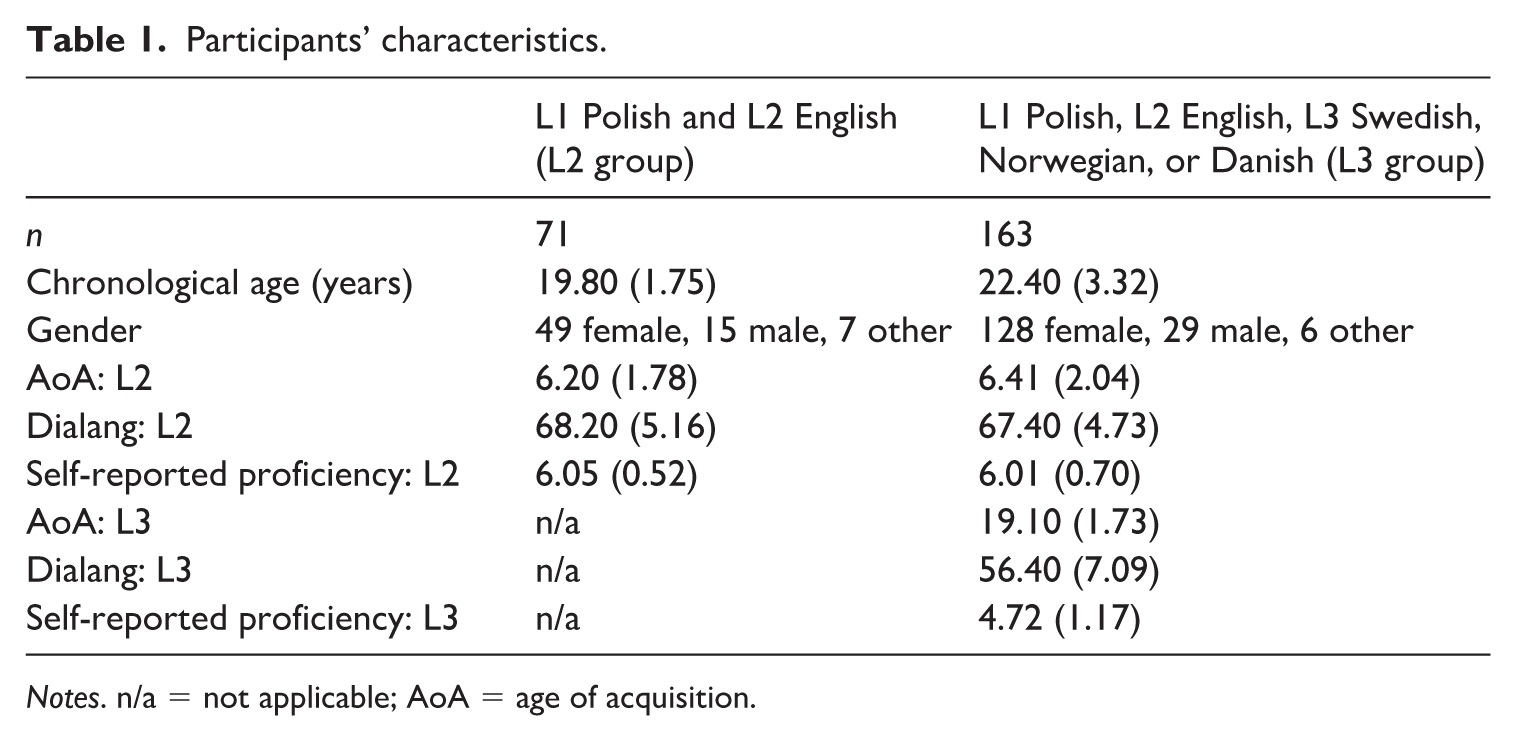
Notes. n/a = not applicable; AoA = age of acquisition.
Mann–Whitney U tests showed no significant group differences in L2 English regarding the Dialang score, AoA, or self-reported proficiency (all ps ⩾ .142). However, a significant difference in chronological age emerged (p < .001), reflecting the fact that the control group consisted of newly enrolled students, while the experimental group included both students and recent graduates. Given the groups’ otherwise comparable backgrounds, this age difference is not expected to affect the study’s outcomes.
Both groups included participants with additional knowledge of German. In the L3 group, 76 participants reported no such knowledge, 57 had beginner-level proficiency (A1–A2 according to CEFR; Mself-report = 2.48, SD = 0.90), and 30 indicated intermediate or higher proficiency (B1–C1; Mself-report = 5.13, SD = 0.60). In the L2 group, 29 participants reported no knowledge, 36 were at the A1–A2 level (Mself-report = 2.48, SD = 0.78), and 6 were at the B1–C1 level (Mself-report = 5.17, SD = 0.83). A Mann–Whitney U test showed no significant difference in self-reported German proficiency between the groups (p = .989). Importantly, participants did not report any current use or active exposure to German; rather, their knowledge typically reflected earlier school-based instruction. This contrasts with the L3 Scandinavian languages in the L3 group, which participants were studying on a daily basis at the time of testing. Nevertheless, as German main clause word order resembles that of the Scandinavian languages, German proficiency was included as a covariate in the analyses.
2.3. Materials
2.3.1. Acceptability judgement task and self-paced reading task
The same stimuli were used in both AJT and SPRT. For each of the three tested structures, we had eight items per word order pattern: SVA, ASV, AVS (3a–c) for V2 with adverbial fronting, SVO, OSV, OVS for V2 with object fronting (4a–c), and Adverb–Verb, Verb–Adverb for adverb placement in main clauses (5a–b). All target items were constructed according to the same structure. In addition to these 64 target items, each task included four practice items, 16 unrelated fillers, 16 items testing subordinate clauses, and 32 items testing particle placement (not reported here).
(3) V2 with adverbial fronting a. SVA – baseline, grammatical in L2 and L3 Han tvättar smutsiga kläder på lördag. (Swedish) He washes dirty clothes on Saturday. (English) b. ASV – grammatical in L2 *På lördag han tvättar smutsiga kläder. On Saturday he washes dirty clothes. c. AVS – grammatical in L3 På lördag tvättar han smutsiga kläder. *On Saturday washes he dirty clothes. (4) V2 with object fronting a. SVO – baseline, grammatical in L2 and L3 Nina legger nøklene på bordet. (Norwegian) Nina lays the keys on the table. (English) b. OSV – grammatical in L2 *Nøklene Nina legger på bordet. The keys Nina lays on the table. c. OVS – grammatical in L3 Nøklene legger Nina på bordet. *The keys lays Nina on the table. (5) Adverb placement in main clauses a. Adverb–Verb – grammatical in L2 *Han altid køber billige produkter. (Danish) He always buys cheap products. (English) b. Verb–Adverb – grammatical in L3 Han køber altid billige produkter. *He buys always cheap products.
To ensure attentive reading during the SPRT, half of the items were followed by equally balanced yes/no comprehension questions, targeting either the object or the prepositional phrase.
All items were written in the present simple tense. We avoided identical cognates and words belonging to more than one category (e.g. ‘tests’ is ambiguous, as it functions as both a noun and a verb). To ensure comprehensibility, lexical material was selected from textbooks for beginner learners of Scandinavian (A1–A2). Items were written in Norwegian and translated into Danish, Swedish and English to ensure close lexical equivalence. As outlined in Section 2.4, English and Scandinavian stimuli were presented during two separate sessions to minimize cross-language activation. All stimuli were proofread by respective native speakers and revised accordingly.
A Latin square design was used to create four counterbalanced presentation lists, ensuring that each participant encountered the same lexical material in only one condition. All materials are available in the OSF repository.
2.3.2. Oral production task
The oral production task used the same lexical material and structural patterns as the AJT and SPRT but employed a different method, detailed in Section 2.4. Instead of full stimuli, participants received background sentences and were prompted to produce syntactic transformations. The task included eight items per structure, resulting in 24 target items, along with four practice items, eight items testing subordinate clauses, and 16 testing particle placement (not reported here). No additional fillers were included, as this task was cognitively more demanding than the receptive tasks.
For object and adverbial fronting, participants were given a background sentence with canonical word order (SVA or SVO; 6a). An object or an adverbial was then extracted and given as a cue (6b, in bold), prompting production with either target-like or non-target-like word order.
(6) a. Kari lager svart kaffe om morgenen. (Norwegian) Kate brews black coffee every morning. (English) b.
To elicit adverb placement in main clauses, a relative clause with a clause-final adverb was presented (7a). The subject followed as a production cue (7b, in bold).
(7) a. Komplicerade diskussioner är något som hon ofta inleder. (Swedish) Complex discussions is something that she begins often. (English) b.
The overarching criterion across all transformations was that the target word order was never given in the background sentence, ensuring it had to be produced by the participant.
2.4. Procedure
The first testing session was always conducted in L2 English. It included (1) the first block of the self-paced reading task, (2) the Dialang placement test, (3) the second block of the SPRT, (4) the acceptability judgement task, (5) the oral production task, and (6) the Language History Questionnaire, in this order. After a minimum of 7 days, trilingual participants returned for a second session, during which they completed the same battery of tasks in their L3 Scandinavian language of choice.
In the SPRT, participants read sentences word-by-word in a linear, non-cumulative manner, with full control over the pace. A fixation point first appeared on the left side of the screen to draw their attention, and each word was displayed upon pressing the spacebar.
In the AJT, a fixation point appeared in the centre of the screen for 500 ms before each item. Participants rated items on a 5-point scale by pressing a corresponding key on the keyboard. There was no time constraint, and no feedback was provided.
In the OPT, participants first saw a background sentence on-screen. They read it silently and pressed the spacebar to continue. They then completed a colour-word Stroop task (Stroop, 1935) within a 4,000 ms time window, in which they had to indicate the colour of the word they saw by pressing the corresponding key on a keyboard (R, B, Y, and O were used for red, blue, yellow and orange). Afterwards they received a cue (a subject, an object or an adverbial) accompanied by a beep sound, prompting them to reproduce the sentence by speaking out loud. While not strictly timed, the auditory cue encouraged an immediate response. A fixation point was displayed in the centre for 500 ms between segments, and participants advanced to the next item at their own pace (see Figure 1).
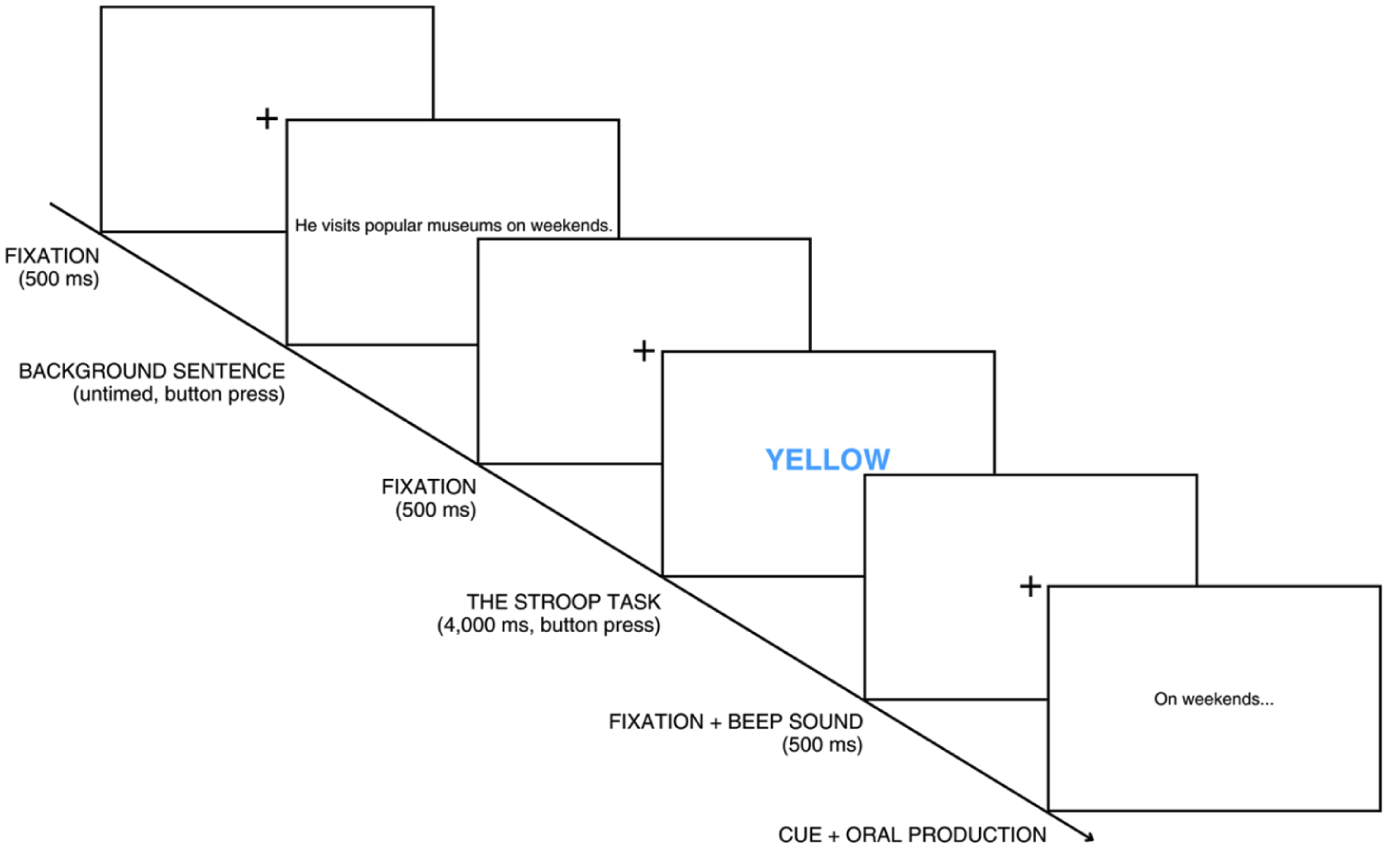
Oral production task procedure.
The OPT was adapted from the NWD project (Lundquist et al., 2019), retaining the core mechanism behind syntactic transformations, but introducing changes to emphasize the reconstructive side of the task.
The SPRT and AJT were run on PsyToolkit (Stoet, 2010, 2017), a web-based platform for online experiments, with the items randomized for each participant. The OPT was conducted via PowerPoint Online using two presentation lists. All items appeared as single-line white text on a black background. Oral instructions in Polish preceded each testing session, and written instructions in the target language were provided at the start of each task.
3. Data analysis
The dependent variable was rating on a 1–5 scale in the AJT, reading times on critical and spill-over regions in the SPRT, and accuracy (binary outcome) in the OPT. The AJT and SPRT data were analysed using linear mixed-effects models (LMEMs) in R, version 4.4.0 (R Core Team, 2024), with the lme4 package (Bates et al., 2015) and the lmerTest package (Kuznetsova et al., 2017). The OPT data were analysed using Bayesian logistic mixed-effects models with weakly informative priors in the brms package (Bürkner, 2017).
In the AJT and SPRT, the SVA and SVO items were excluded to enable direct comparisons across conditions (V2 with adverbial fronting, V2 with object fronting, adverb placement) and groups within a single model. Accordingly, AVS, OVS, and Verb–Adverb were classified as V2, whereas ASV, OSV, and Adverb–Verb were classified as V3.
For the AJT and SPRT analyses, the fixed-effects structure included Group, Condition, Verb placement, L2 proficiency, and the three-way interaction between Group, Condition, and Verb placement, along with the corresponding lower-order interactions. For the OPT analysis, the predictors were Group, Condition, L2 proficiency, and the Group × Condition interaction.
In all models, we included German proficiency as a covariate to control for between-participant differences in German knowledge. As a further control, we also included interactions between Verb placement, on the one hand, and L2 proficiency and German proficiency, on the other, to account for potential differential effects of these two proficiency measures across verb placement patterns.
Additional analyses explored the role of L3 accuracy, based on AJT ratings for each structure in the L3. Mean scores were derived from original ratings in the grammatical condition and recoded ratings in the ungrammatical condition, where a correct rejection (rated ‘1’) was converted into a high accuracy score (‘5’). 5
We began with a maximal random effects structure justified by the experimental design (Linck and Cunnings, 2015). Random slopes that were not supported by the data, as indicated by non-convergence or singular fits, were removed stepwise until a parsimonious model that converged without warnings was obtained.
Categorical predictors were coded using sum contrasts so that the model intercept represented the grand mean. Binary predictors were effect coded (–0.5, 0.5), and predictors with three levels were coded using standard sum contrasts. Continuous predictors were standardized (z-scored) prior to analysis. Multicollinearity was assessed using variance inflation factors (VIFs).
P-values were obtained from Type III F-tests with Satterthwaite-approximated degrees of freedom for linear mixed-effects models (lmerTest; Kuznetsova et al., 2017), and from Type III likelihood-ratio χ2 tests for generalized mixed-effects models (car; Fox and Weisberg, 2019). Post hoc analyses were conducted using estimated marginal means (EMMs) via the emmeans package (Lenth, 2024). Pairwise comparisons were adjusted using the Tukey method for factors with more than two levels and Bonferroni correction for two-level contrasts.
4. Results
4.1. Acceptability judgment task
4.1.1. Group comparisons: L2 versus L3
The mean rating for the grammatical filler items was 4.85 (SD = 0.24), while for the ungrammatical filler items, it was 2.14 (SD = 0.85). One participant who rated the grammatical filler items very low (M = 3.38) was excluded from the analysis. Table 2 presents the results of Type III F-tests, and the results of the post hoc tests are reported below.
The results of Type III F-tests for the acceptability judgement task (AJT) models (with a two-level group factor).
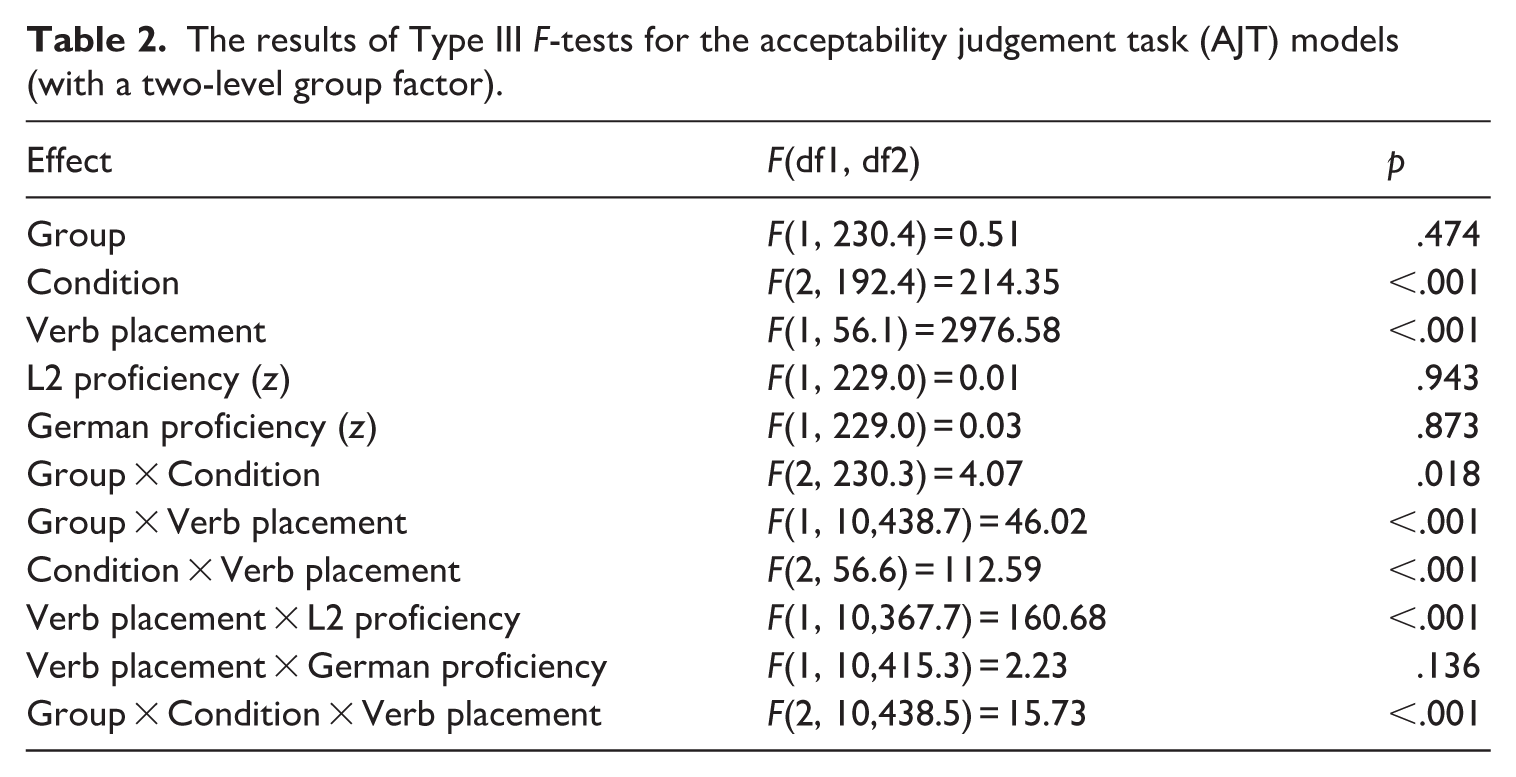
First of all, all conditions differed significantly, with ratings following the pattern adverb placement > adverbial fronting > object fronting (all ps < .001). Overall, V3 items received higher ratings than V2 items, an effect that was further qualified by the Condition × Verb placement interaction.
The Group × Condition interaction was also significant. The L3 group gave higher ratings than the L2 group for adverb placement (p = .037), but the groups did not differ significantly for adverbial fronting (p = .080) or object fronting (p = .312).
Regarding the Group × Verb placement interaction, the L2 and L3 groups did not differ in their ratings of V3 items (p = .412), but the L3 group rated V2 items significantly higher than the L2 group (p = .026). In addition, although both groups rated V3 higher than V2 (ps < .001), this effect was significantly larger in the L2 group than in the L3 group (interaction contrast estimate = 0.25, z = 6.78, p < .001).
The Group × Condition × Verb placement interaction further showed that the L3 group rated V2 with adverbial fronting higher than the L2 group (p = .001), but the groups did not differ for V2 with object fronting (p = .495) or V2 with adverb placement (p = .084). For V3, the groups did not differ in adverbial fronting (p = .913). However, V3 with object fronting was rated lower by the L3 group than by the L2 group (p = .008), whereas V3 with adverb placement was rated higher by the L3 group (p = .034).
Finally, the Verb placement × L2 proficiency interaction reflected opposite proficiency slopes across verb-placement contexts. Higher L2 proficiency was associated with lower ratings for V2 (β = −0.108, SE = 0.033, 95% CI [−0.173, −0.042]) but higher ratings for V3 (β = 0.112, SE = 0.033, 95% CI [0.047, 0.178]).
Figure 2 shows model-predicted ratings in L2 English by Group, Condition, and Verb placement. Overall, the L3 group rated V2 items significantly higher than the L2 group, suggesting greater acceptance of non-target V2 word order in English among participants with knowledge of L3 Scandinavian. Although both groups rated V3 items higher than V2 items, this difference was significantly larger in the L2 group, again indicating greater acceptance of V2 in the L3 group. The three-way interaction further showed that the higher acceptance of V2 in the L3 group was primarily driven by adverbial fronting, marginally by adverb placement, and not observed for object fronting, suggesting structure-specific acceptance patterns. In addition, the L3 group rated V3 sentences with object fronting lower and V3 sentences with adverb placement higher than the L2 group.
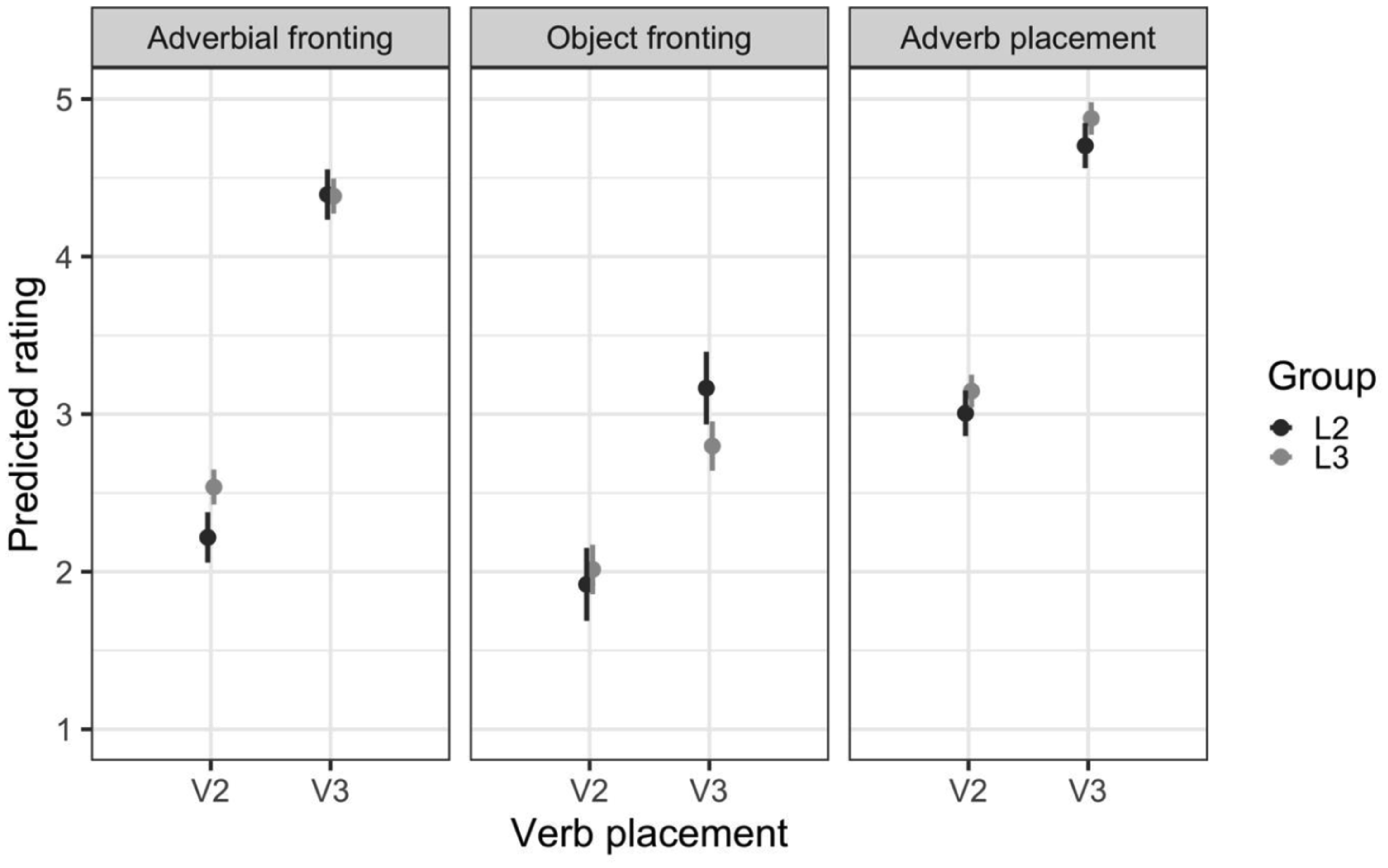
Predicted ratings in L2 English as a function of group (two-level), condition, and verb placement.
4.1.2. Group comparisons: L2 versus L3 intermediate versus L3 advanced
To examine how L3 accuracy affected participants’ L2 ratings, we conducted additional analyses including this factor. Visual inspection suggested a non-linear relationship between L3 accuracy and L2 ratings for V2 (AVS, OVS, and Verb–Adverb; see Figure 3), but closer examination showed that the lower L2 ratings in these conditions at low L3 accuracy were driven by very few participants (in one case, a single individual). After accounting for this, the relationship appeared more linear: predicted cross-linguistic influence was reflected in higher L2 ratings for participants with L3 accuracy 3–4 and lower L2 ratings for those above 4; this was consistent across all three syntactic structures. We therefore divided the L3 group into two subgroups for further analysis – intermediate (L3 accuracy: 3–4) and advanced (L3 accuracy: > 4) – and compared them to the L2 control group. Thus, the factor Group comprised three levels: L2, L3 intermediate, and L3 advanced. Importantly, the three groups did not differ in German proficiency (L2: 2.9/7, L3 intermediate: 3.5/7, L3 advanced: 3.3/7), as indicated by a Kruskal–Wallis test (χ2(2) = 3.44, p = .179). Table 3 shows the Type III F-test results.
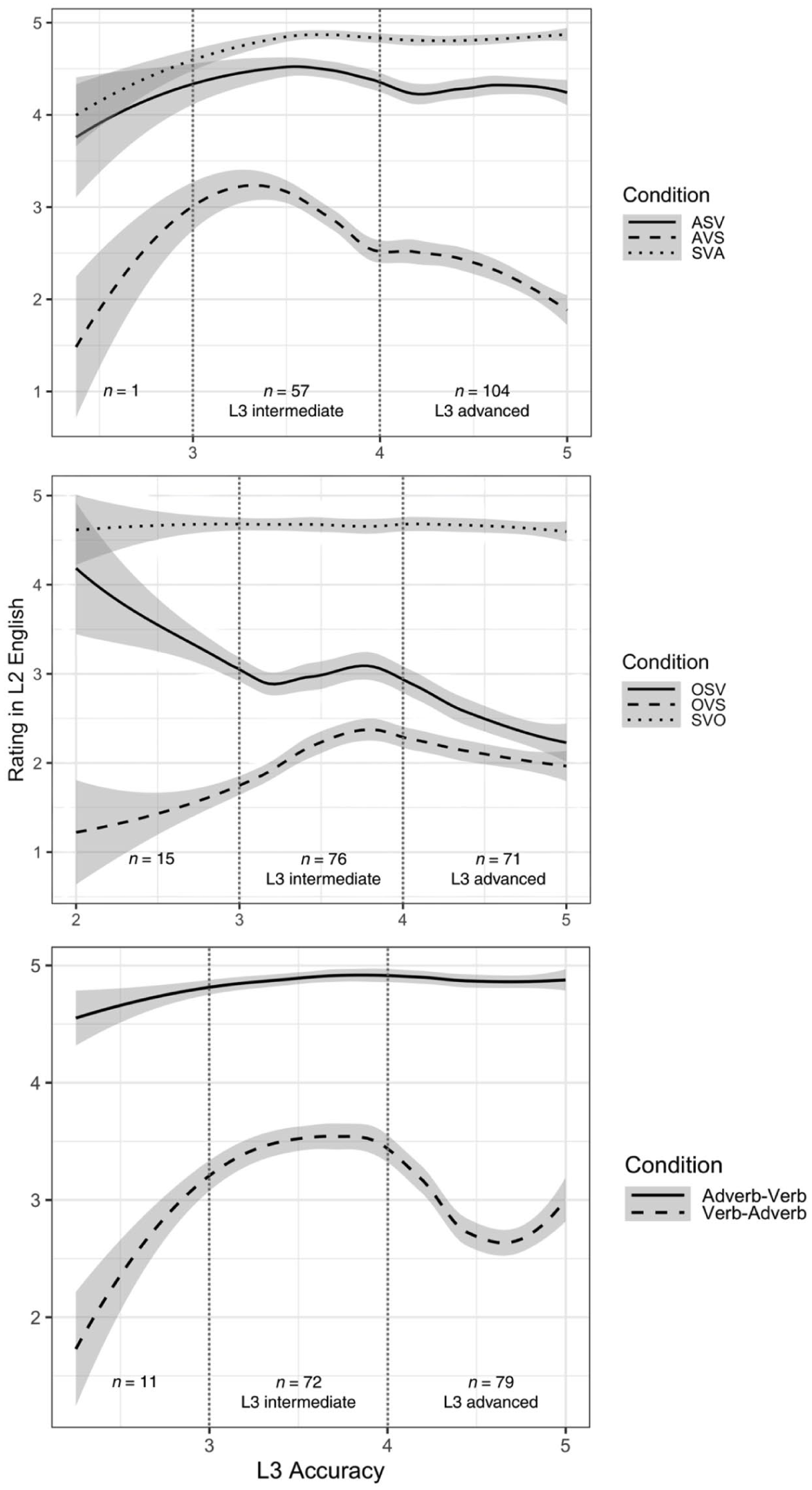
Raw ratings in L2 English for the three structures as a function of L3 accuracy.
The results of Type III F-tests for the acceptability judgement task (AJT) models (with a three-level group factor).
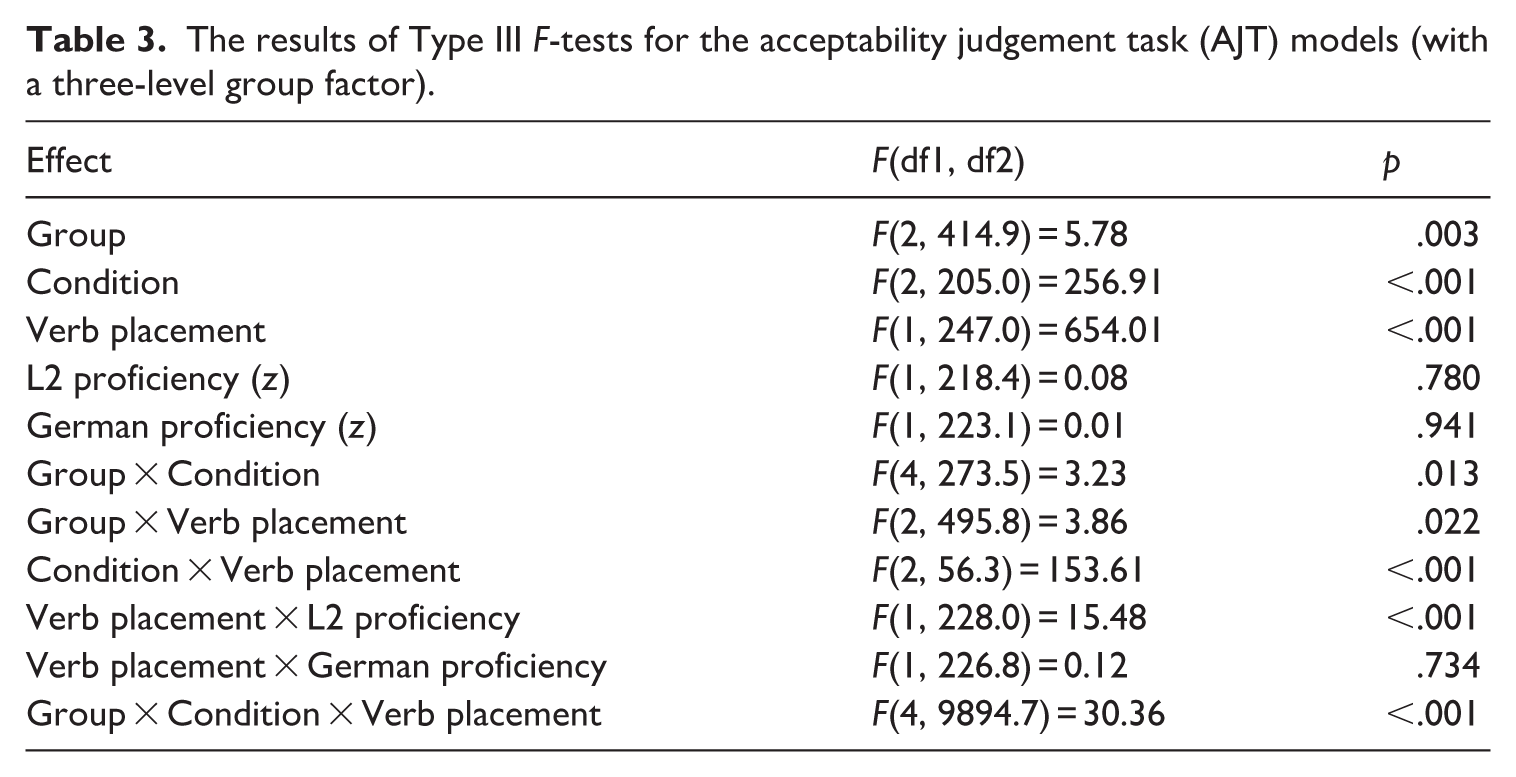
As the main effects and the interactions Condition × Verb placement and Verb placement × L2 proficiency replicate those reported in the previous analysis, we focus here on effects involving Group (three levels). Figure 4 visualizes participants’ model-predicted ratings in L2 English as a function of Group, Condition, and Verb placement.
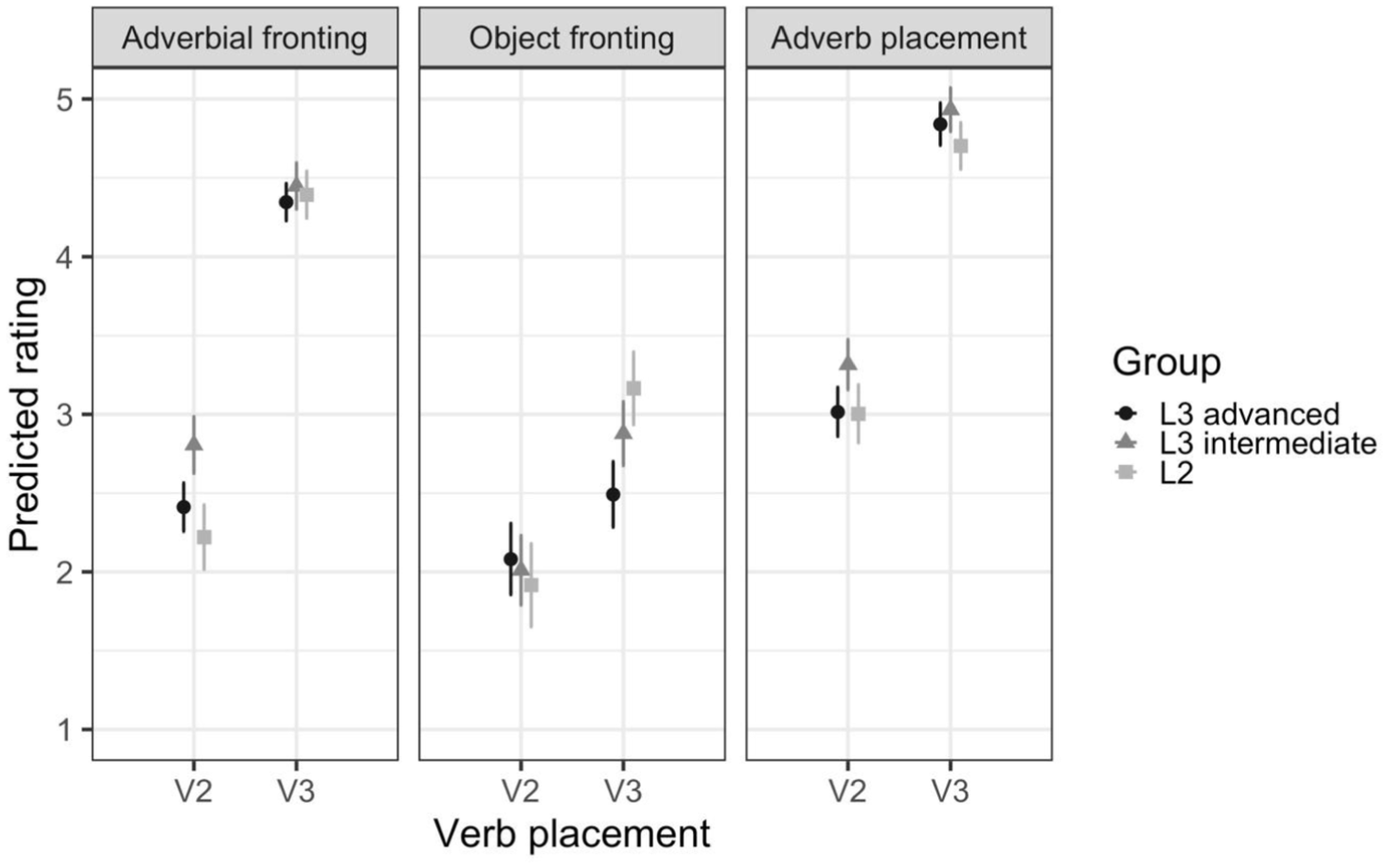
Predicted ratings in L2 English as a function of group (three-level), condition, and verb placement.
Starting with the Group × Condition interaction, the L3 intermediate group rated items with adverbial fronting and adverb placement higher than both the L3 advanced group (p = .002 and p = .024, respectively) and the L2 group (both ps = .003). The L3 advanced and L2 groups did not differ for these conditions (p = .697 and p = .627, respectively). For object fronting, no between-group differences were observed (all ps > .20).
Regarding the Group × Verb placement interaction, V2 items were rated higher by the L3 intermediate group than by both the L3 advanced (p = .008) and L2 groups (p = .014), while the L3 advanced and L2 groups did not differ (p = .545). For V3 items, the L3 intermediate group gave higher ratings than the L3 advanced group (p = .009), whereas the L2 group did not differ significantly from either group (both ps > .07).
The Group × Condition × Verb placement interaction further showed that the L3 intermediate group rated V2 with adverbial fronting and V2 with adverb placement higher than both the L3 advanced group (p < .001 and p = .002, respectively) and the L2 group (p < .001 and p = .019, respectively), whereas the L3 advanced and L2 groups did not differ (all ps > .28). For V2 with object fronting, no between-group differences were found (all ps > .60).
For V3 with object fronting, the L3 advanced group gave lower ratings than both the L3 intermediate (p = .008) and L2 groups (p < .001), whereas the L3 intermediate and L2 groups did not differ. For V3 with adverb placement, the L3 intermediate group showed higher ratings than the L2 group (p = .043) but did not differ from the L3 advanced group (p = .520). The L3 advanced and L2 groups also did not differ (p = .309). Finally, for V3 with adverbial fronting, no between-group differences were observed (p > .40).
To sum up, the additional analysis focusing on the role of L3 accuracy showed that the higher acceptance of V2 items emerged at intermediate but not advanced L3 accuracy levels and was restricted to adverbial fronting and adverb placement, again suggesting structure-specific acceptance patterns. In addition, the lower ratings for V3 with object fronting were specific to the L3 advanced group. Finally, V3 with adverb placement received higher ratings in the L3 intermediate group than in the L2 group, but the L3 intermediate and L3 advanced groups did not differ.
4.2. Self-paced reading task
Data from one participant with a comprehension accuracy below 50% were removed. For the rest, reading times under 100 ms or over 4,000 ms were excluded per region, eliminating <1% of data. Reading times were collected at the critical region and the spill-over region. The critical region was where a syntactic violation could first be detected (the verb for V2 with adverbial or object fronting, and the adverb for adverb placement). The spill-over region was defined as the first word consistently occurring after the ordering manipulation (the adjective for V2 with adverbial fronting and adverb placement, and the preposition for V2 with object fronting; see example 8).
(8) a. Every day takes [CR] he long [SO] showers. (V2 with adverbial fronting) b. The jackets hangs [CR] she in [SO] the closet. (V2 with object fronting) c. He gives rarely [CR] clear [SO] answers. (adverb placement)
For ease of presentation, we report the results of Type III F-tests with Satterthwaite-approximated degrees of freedom for the fixed effects in Table 4 in the main text. The complete model summaries – including parameter estimates, standard errors, and t-values – are available in the OSF repository. Figure 5 shows model-predicted reading times, back-transformed from log scale, at the critical and spill-over regions as a function of group, condition, and verb placement.
The results of Type III F-tests for the self-paced reading task (SPRT) models.
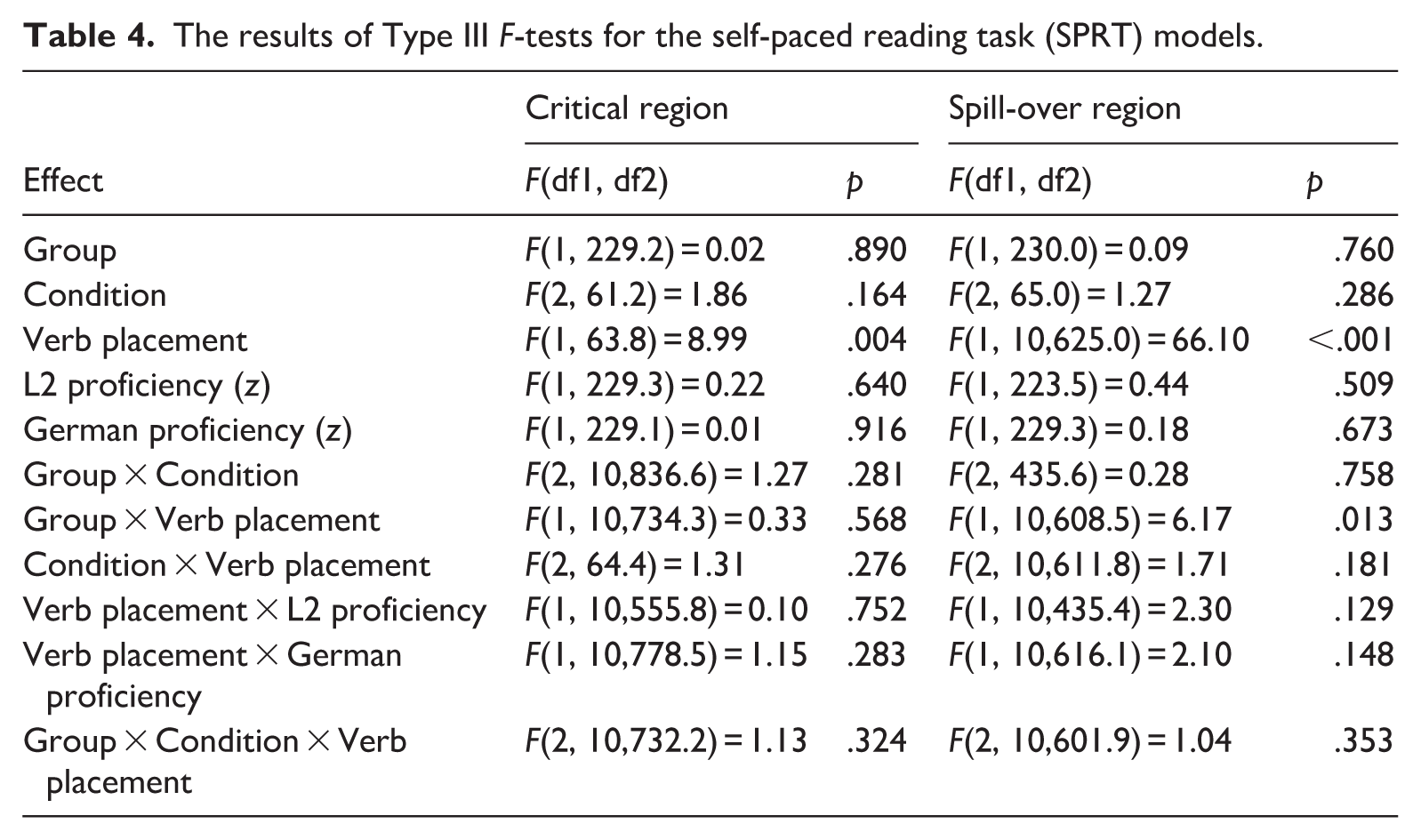
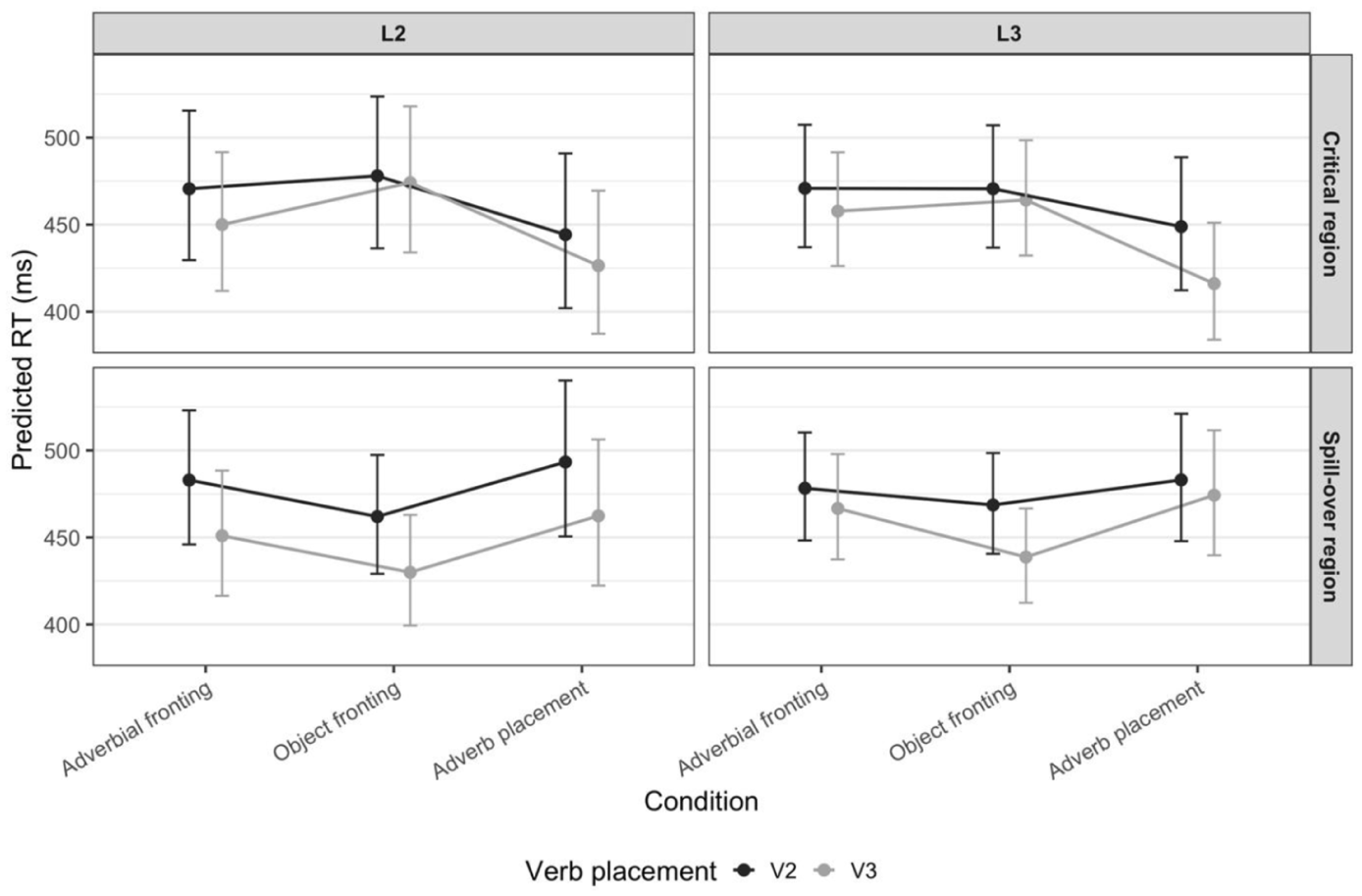
Predicted reading times (ms), back-transformed from log scale, at the critical and spill-over regions as a function of group, condition, and verb placement.
There was a significant main effect of Verb placement, with longer reading times for V2 than for V3 at both the critical and spill-over regions. At the spill-over region, the Group × Verb placement interaction was also significant. V2 was read more slowly than V3 in both groups. However, the size of this difference was significantly larger in the L2 group than in the L3 group (interaction contrast estimate = 0.032, z = 2.48, p = .013). In contrast, the two groups did not differ in overall reading times for either V2 (p = .876) or V3 (p = .449). Apart from these effects, no other main effects or interactions were statistically significant (all ps > .13).
Figure 6 shows model-predicted reading times for the spill-over region by Group and Verb placement. Additional models restricted to the L3 group tested the effects of L3 accuracy and its interactions with Condition and Verb placement, including the three-way interaction. The results indicated that L3 accuracy did not influence L3 participants’ performance in any condition, verb placement context, or region. Detailed results of these analyses are available in the OSF repository.
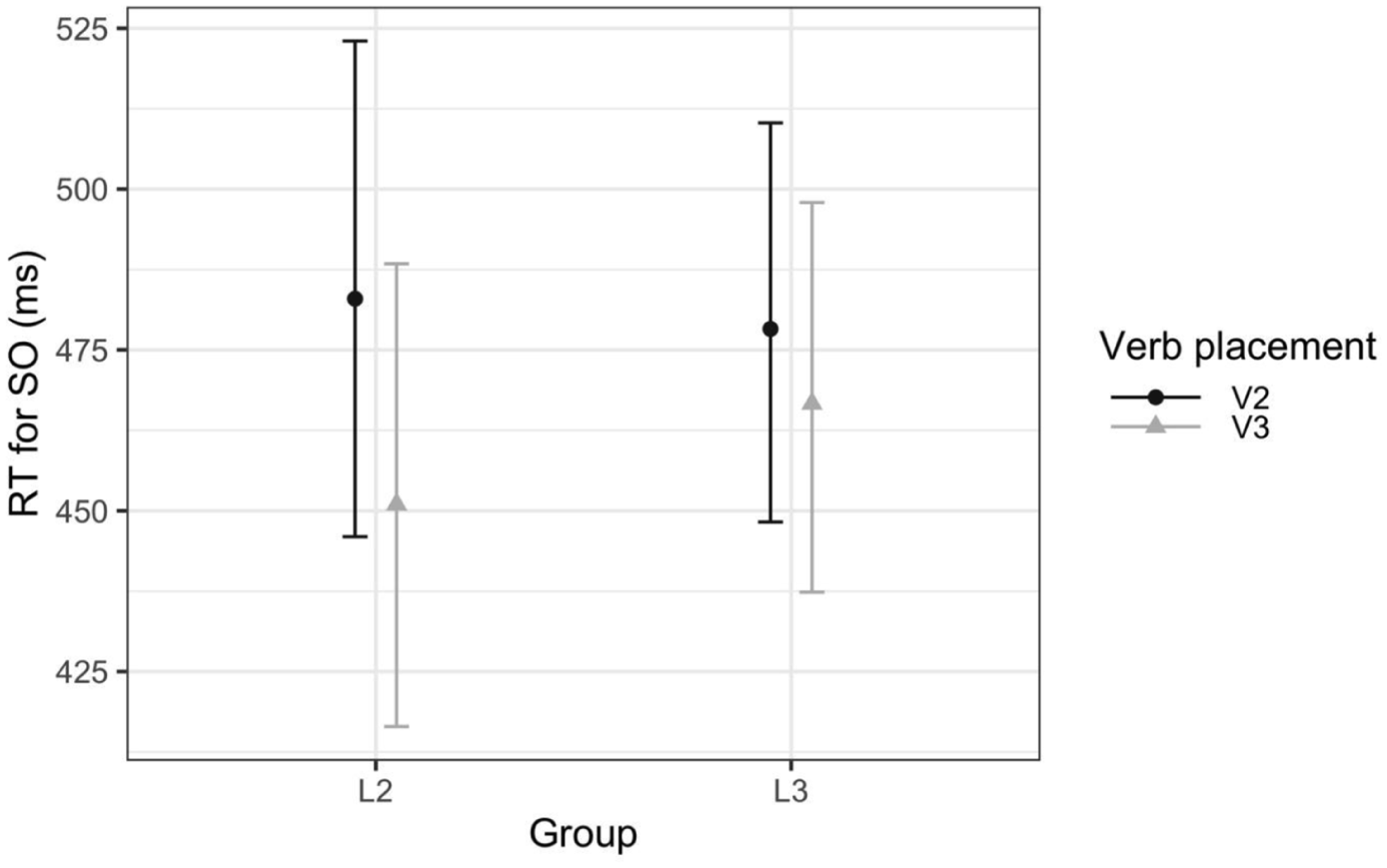
Predicted reading times (ms), back-transformed from log scale, at the spill-over region as a function of group and verb placement.
In sum, the self-paced reading results partly corroborated the judgment task. Although both groups were clearly sensitive to syntactic violations, as reflected in elevated reading times at the critical and spill-over regions, they differed in the degree of sensitivity. Specifically, at the spill-over region, the difference between V2 and V3 items was larger in the L2 group than in the L3 group, suggesting reduced sensitivity to non-target V2 word order among participants with knowledge of L3 Scandinavian. However, this effect was neither structure-specific nor modulated by L3 accuracy.
4.3. Oral production task
One participant in each group did not complete the OPT. Recordings from the remaining participants (162 and 70, respectively) were manually transcribed and coded for word order accuracy (0/1). Swapping lexical material was not penalized, provided the targeted structure was produced. Sentences that were incomplete or lacked the targeted structures were excluded, reducing the dataset by 6.71%. For V2 with object fronting, where the object served as a prompt, most background sentences were transformed into passive voice (e.g. The books are read in the library) and were therefore not coded for V2 accuracy. Results for this structure should thus be interpreted with caution. A summary of OPT is provided in Table 5.
Summary of responses produced in the oral production task (OPT).
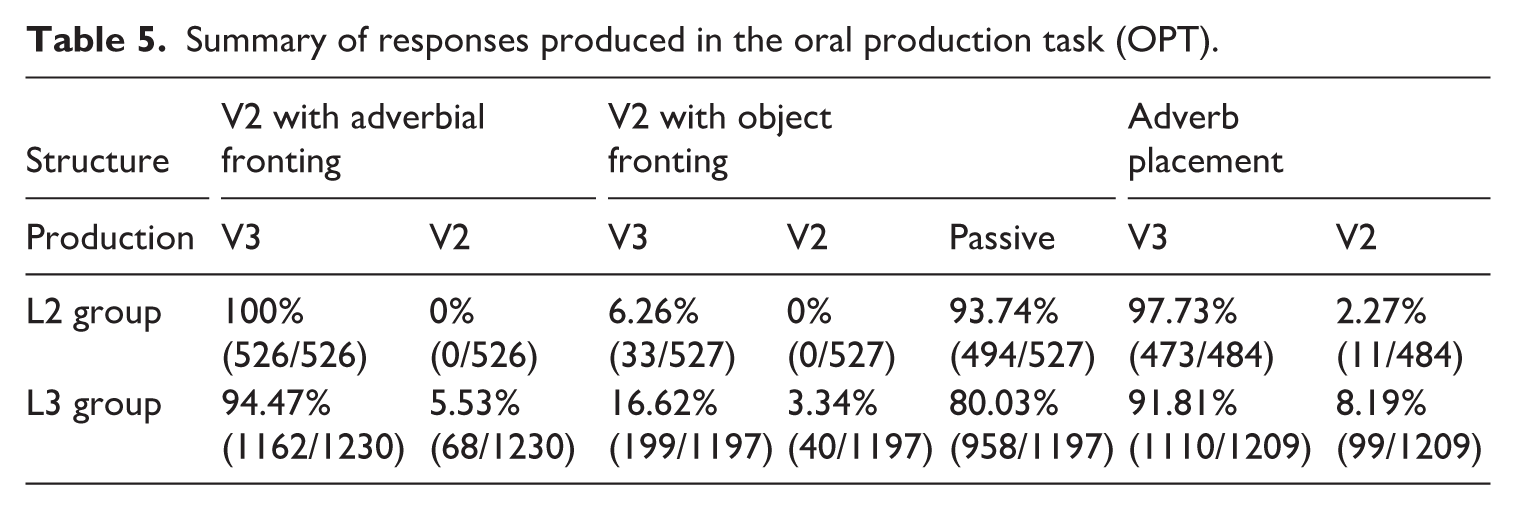
Figure 7 presents the summarized raw accuracy (0/1) to participant-level proportions per structure; points show each participant. Within each group and structure, the larger marker denotes the mean of participant proportions, and the error bars indicate 95% confidence intervals across participants.
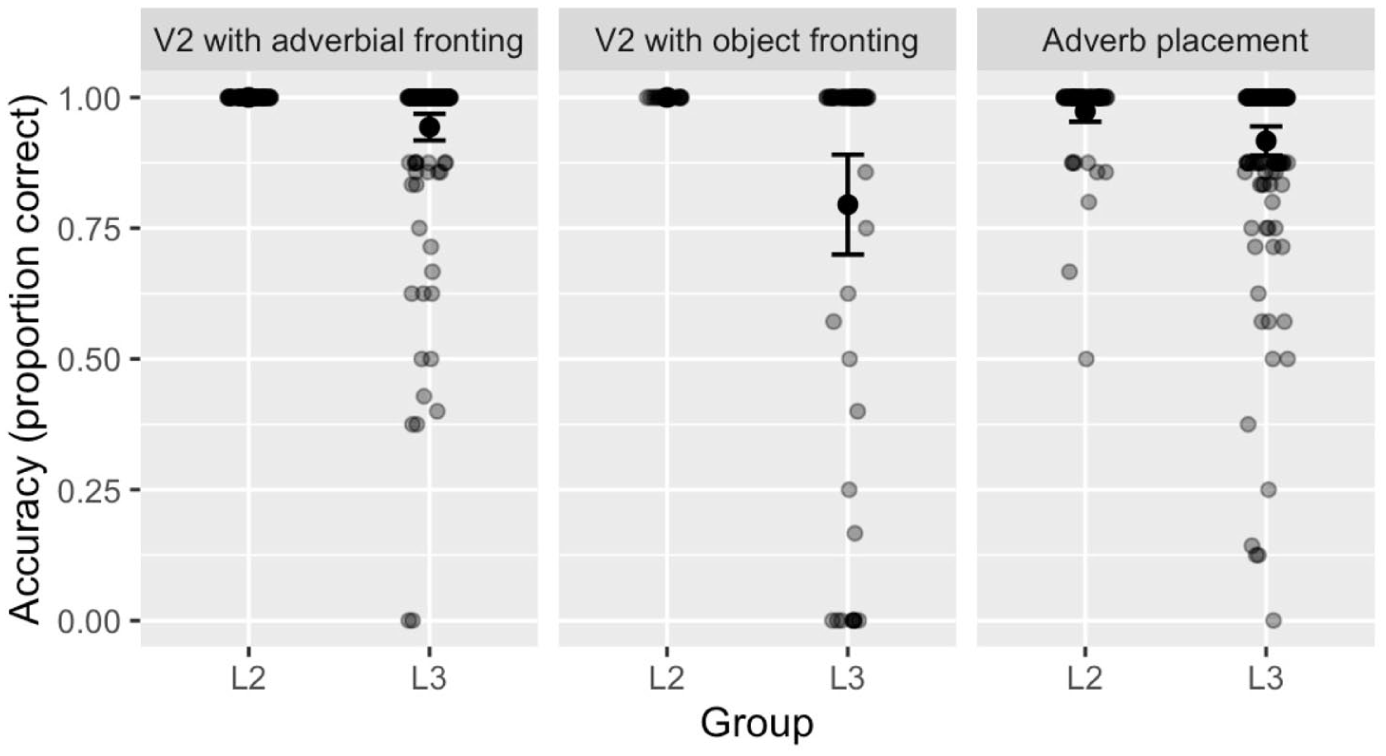
Raw production accuracy for the three structures as a function of group (two-level).
For V2 with both adverbial and object fronting, the L2 group performed at ceiling (100% accuracy), resulting in complete separation for the Group factor. We therefore used Bayesian logistic mixed-effects models with a Bernoulli likelihood, a logit link, and weakly informative priors to obtain regularized, finite estimates while retaining the full crossed random-effects structure.
Accuracy was near ceiling overall (baseline posterior probability ≈ .9998), but a strong Group effect was observed. The L3 group was substantially less accurate than the L2 group (posterior log-odds difference = −5.38, 95% credible interval [−9.30, −2.36]), corresponding to an odds ratio of 0.07 [0.01, 0.31]. Thus, the posterior probability that the L3 group was less accurate than the L2 group exceeded .99. There was no credible evidence that the size of the group difference differed across conditions (Condition × Group interactions: 95% CIs included zero), indicating that the L3 disadvantage was comparable for V2 with adverbial fronting, V2 with object fronting, and adverb placement. Neither L2 proficiency nor German proficiency showed a reliable association with production accuracy once Group and Condition were taken into account (all 95% CIs included zero).
A separate Bayesian logistic mixed-effects model was fit to the L3 group only to examine whether L3 accuracy predicted production accuracy. Accuracy was again near ceiling (baseline posterior probability ≈ .997). Nevertheless, L3 accuracy showed a reliable negative association with L2 production accuracy (log-odds = −0.81, 95% CI [−1.61, −0.10]), corresponding to an odds ratio of 0.44 [0.20, 0.90]. Thus, higher L3 accuracy was associated with lower accuracy in production. In contrast, L2 proficiency was positively associated with accuracy (log-odds = 0.80, 95% CI [0.05, 1.58]). German proficiency did not show a reliable effect once L2 proficiency and L3 accuracy were included (log-odds = −0.64, 95% CI [−1.42, 0.09]). There was no credible evidence that the effect of L3 accuracy differed across structures (L3 accuracy × Condition interactions: 95% CIs included zero).
5. Discussion
This study investigated the effect of acquiring three V2-related structures in L3 Norwegian, Swedish, and Danish on advanced L2 English. We considered (1) the influence of structure-specific factors such as L3 frequency and L2 input ambiguity, (2) the role of developing L3 accuracy, and (3) differences across task modalities.
Our results reveal modest but consistent evidence for the influence of L3 Scandinavian on verb placement across the three tasks, indicating that L3 Scandinavian can indeed trigger V2 in L2 English to some extent. Compared to the L2 group, the L3 group was more likely to accept V2 items, was less sensitive to V2 violations, and produced more instances of V2. While the judgment results reveal structure-specific acceptance patterns, the other two tasks point to a more general influence in the verb placement domain, regardless of structural context. The following discussion first focuses on the judgment data.
In our view, the property-specific influence observed in the judgment task aligns with the premises of the Linguistic Proximity Model (Mykhaylyk et al., 2015; Westergaard et al., 2017). According to the model, all languages in the learner’s repertoire remain co-activated throughout L3 development. In the learning process, learners consult both previously acquired grammars, use them to parse incoming input and construct a new grammar incrementally – the more corroborating input is parsed, the more stable the representations become. Crucially, the model is not tied to a fixed direction of CLI, as ‘the learning context itself is not the central part of the LPM; instead, the linguistic properties of the three languages take central stage, as these will be responsible for the co-activation of structures in the learner’s mind’ (Westergaard, 2021b: 507). As a consequence, L1 and L2 structures can be co-activated during L3 processing and, conversely, learners can parse L2 input through both L1 and L3 grammars. Extending the LPM to rCLI, Olszewska and Długosz (2026) argue that the mechanism behind rCLI is essentially the same as in progressive CLI: co-activation. They propose that an already advanced L2 exhibits fewer cases of underspecification or parsing failure than a newly developing grammar, resulting in fewer opportunities for influence from other languages – in this case, the L3 (and L1) on the L2 grammar. Therefore, more favourable conditions are required for rCLI to occur. These are provided by factors outlined in the LPM – such as structural similarity and structure frequency – to which Olszewska and Długosz (2026) add optionality in the target language as a key factor.
Moreover, the model assumes that learners are sensitive to fine-grained distinctions in the input, with the strength of co-activation modulated by frequency of specific structures (Slabakova, 2017; Westergaard, 2021a). This accounts for the differential patterns observed in our judgement data: V2 with a frequently fronted adverbial yields the most robust effects, converging across online and offline comprehension, while a fronted object, rarely occurring in this position, does not elicit an equivalent response. 6
A further modulatory factor is input ambiguity, which gives rise to less stable effects in adverb placement. This pattern is consistent with previous findings showing that input ambiguity renders adverb placement in L2 English challenging to acquire (e.g. Jensen et al., 2023; Westergaard, 2003). While preverbal placement is most typical (e.g. She often reads books), English also allows adverbs in clause-initial (e.g. Often, she reads books) and clause-final positions (e.g. She reads books often). Although Scandinavian-like word order is ungrammatical in English (e.g. *She reads often books), sentences with intransitive verbs may appear similar on the surface (e.g. She sleeps often), making the two orders indistinguishable in the absence of an object. This ambiguity helps explain why the effect fluctuates – while present among L3 intermediate participants, it becomes less robust and only marginally significant in L2–L3 group comparisons.
In the study by Olszewska and Długosz (2026), optionality – broadly understood as the ability to place an element in more than one position 7 – was proposed as a key condition enabling rCLI. By contrast, we examine V2, which is not characterized by optionality. For these structures, adopting L3-like processing in L2 would result in a grammar violation. While rCLI for V2 with object fronting is ruled out due to low frequency in the L3, the other two structures – V2 with adverbial fronting and adverb placement – do show evidence of rCLI. However, non-target English items receive higher scores only at the intermediate level of L3 accuracy. These learners with accuracy scores between 3 and 4 are in the process of acquiring V2 word order in their L3 Scandinavian. Ratings of 3 and 4 correspond to 60% and 80% accuracy, respectively, suggesting a decent mastery of the structure. Our findings indicate that these L3 representations in the incrementally built grammar may temporarily destabilize the previously acquired L2. Despite this temporary misanalysis, the effects fade, and advanced L3 learners’ judgements return to baseline by drawing on stable representations in both L2 and L3. Similar effects of robust CLI in L4 at lower levels of accuracy in L3 were also observed by Sánchez (2020), who argued that an underdeveloped source language is more difficult to inhibit. An anonymous reviewer suggested that the effects observed at the intermediate level of L3 accuracy may reflect differences in language learning aptitude, such that learners who perform poorly in the L3 also perform poorly in the L2. Although we acknowledge this possibility, we believe that our results are better explained in terms of rCLI for two reasons. First, the acceptance patterns among intermediate L3 participants are structure-specific and align with our predictions regarding the role of L3 frequency and L2 input ambiguity. Second, the L3 intermediate group rated V2 with adverbial fronting and adverb placement higher than the L2 group, suggesting that the effect is conditioned by knowledge of L3 Scandinavian rather than by general language learning aptitude.
This reasoning also accounts for the fact that in the study by Olszewska and Długosz (2026) on optional particle placement, the effects were observed at intermediate (for the Swedish group, which had an easier task of acquiring a pre-posed particle) or at higher levels of L3 accuracy (for the Danish group, which had to acquire a post-posed placement). In comparison, the effects observed here appear at intermediate stages of L3 accuracy and subsequently diminish. We suggest that these differences can be traced back to optionality – in particle placement, a more stable L3 representation reinforces one of the options already available in the L2, whereas in V2, greater stability in the L3 representation leads to the detection of a grammar violation in the L2 and is, in turn, more strongly inhibited.
Notably, the effects observed in online processing are independent of structural context and L3 accuracy levels. It is worth recalling, however, that this transient co-activation does not lead to major changes in the L2. On the contrary, the non-target V2 order elicits sensitivity to violations in both learner groups, but the crucial difference lies in the effect size, which is significantly smaller in the L3 group. This indicates that V2 is present in the L3 grammar and is transiently co-activated when encountered in L2 input. Yet this, in our view, is where rCLI stops. In the absence of optionality in L2 English, the L3 word order is (weakly) co-activated and employed to parse L2 input, but is successfully blocked by the strong L2 representations, preventing any representational changes – as observed in ratings at advanced L3 levels, which pattern with those of the L2 control group.
To explain the differential effects of L3 accuracy on participants’ performance across the three tasks, it is necessary to consider the characteristics of the tasks themselves. First, the acceptability judgment task is a metalinguistic task that provides abundant opportunities to consult explicit grammatical knowledge, particularly in its untimed version (Spinner and Gass, 2019: 49). Given that our participants were university students, it is conceivable that those at higher levels of L3 accuracy – that is, those who achieved a V2 accuracy of 80–100% in their L3 Scandinavian – are more aware of differences in verb placement between English and Scandinavian languages and are therefore more likely to reject the L3-like V2 order in their L2 English. This would explain why the structure-specific effects emerge at intermediate levels of L3 accuracy, which, as a reminder, correspond to a V2 accuracy of 60%–80% in the L3.
In turn, the self-paced reading task taps into largely unconscious processing or implicit knowledge that remains outside the learner’s control. Crucially, the reduced sensitivity to V3 violations emerged regardless of L3 accuracy, suggesting that greater mastery of V2 in the L3 does not lead to stronger syntactic co-activation in the L2 during online processing. Notably, both groups were sensitive to syntactic violations, but this sensitivity was weaker in the L3 group. Thus, while participants in the L3 group were ultimately able to suppress the L3-like V2 order when processing L2 English, the presence of the L3 still resulted in a reduced violation effect relative to the L2 group. One possible explanation is that cross-linguistic co-activation during online processing does not depend on the degree of mastery of a structure, but rather on whether the structure is represented in the learner’s grammar. Once V2 has been acquired in the L3, even at intermediate levels, it may become available for automatic activation during sentence processing. Additional increases in L3 accuracy may therefore strengthen explicit knowledge of the structure without necessarily increasing its influence on online L2 processing.
In oral production, the L3 group exhibited greater variability and committed more errors than the L2 group. As in the self-paced reading task, these effects were not structure-specific, indicating a more general disadvantage in the L2 stemming from L3 Scandinavian acquisition. Descriptively, in V2 contexts with a fronted element, the L3 group produced V2 with adverbial fronting in 5.53% of instances and V2 with object fronting in 3.34% of instances, while the L2 group remained fully target-like. These rates resemble the low proportions of XVS observed in L2→L3 CLI in written and oral production (ca. 4% in Angelovska, 2017). Adverb placement presents a different picture. Here, the L3 group produced 8.19% non-target V2 word order compared to 2.27% in the L2 group. We interpret this as further corroboration of the role of input ambiguity, as even learners without any knowledge of Scandinavian did not consistently produce adverbs in the target position.
Crucially, overall accuracy in the L3 group was very high. We therefore interpret these patterns as evidence for rCLI in the form of short-term V2 co-activation, likely amplified by the heavy cognitive demands of the task. As noted by an anonymous reviewer, the production results may also reflect considerable individual variation. Overall, 62 out of 162 L3 learners produced at least one V2 structure in English, compared to 9 out of 71 L2 learners. Excluding adverb placement, 32 L3 learners produced V2, whereas no L2 learners did. Because overt speech arises from competitive processes, and individual learners differ in their ability to suppress interference from non-target languages, this individual variation may reflect differences in inhibitory control, particularly under conditions of increased processing load (e.g. Green, 2017).
In addition, when the L3 group is considered separately, higher L2 English proficiency facilitates performance, whereas higher L3 Scandinavian accuracy appears to exert an opposing influence. While the latter pattern may seem to contradict the assumption that intermediate L3 learners’ grammars undergo temporary destabilization, after which advanced L3 learners successfully inhibit L3 interference, the AJT and OPT differ substantially in their processing demands (e.g. Kim and Nam, 2017). Given the high processing load involved in the OPT, it is conceivable that the inhibition of V2 interference depends more on individual control abilities, which may override the employment of metalinguistic knowledge evidenced in the AJT. Since the L3 accuracy proxy was derived from an untimed task, an additional measure of individual control aptitude would be necessary to disentangle the observed patterns.
Returning to the finding that the L3 group rated V2 with object fronting word order lower than the L2 group, particularly at advanced L3 accuracy levels, we attribute this effect to rCLI at the level of information structure (e.g. Bohnacker and Rosén, 2007). As OSV sentences are infrequent and thus dispreferred in L3 Scandinavian, the L3 group is arguably less permissive toward them in their L2 English.
Our study is not free from limitations. We suggest that transient changes occur in L2 English when trilinguals are at intermediate stages of L3 accuracy, based on comparisons with advanced L3 speakers and L2 speakers with no knowledge of L3. While the relatively large group sizes support this interpretation, we note that we did not track the same learners throughout L3 development. A longitudinal study could therefore corroborate or challenge our findings. Another limitation concerns language exposure in L2 and L3: our questionnaire captured only self-estimated daily use in hours, and some participants appeared to misinterpret the question. 8 Future studies on rCLI should incorporate a fine-grained assessment of exposure and use across specific contexts to better capture individual variation, as these factors may play a role. Furthermore, future studies could include less proficient L2 learners, which was not feasible in our context. The effects of L3 on L2 syntax could be more pronounced if the L3, rather than the L2, were the dominant language.
In conclusion, our findings demonstrate that acquiring a novel L3 can trigger rCLI even in advanced L2 grammars. In line with the Linguistic Proximity Model, these effects in judgement data are property-specific and dependent on frequency and ambiguity in the input, highlighting their role in modulating the strength of co-activation. In a prior study (Olszewska and Długosz, 2026) on particle placement, we found evidence for rCLI under favourable conditions – namely, when the target language permits optionality within the structure and adopting L3-like parsing reinforces an existing option. In the present study, by contrast, we show that in the absence of optionality, rCLI manifests as short-term co-activation of the L3 during L2 comprehension, without evidence of further L2 restructuring. Under these conditions, rCLI is largely restricted to online processing and to occasional deviations in oral production under high processing load. Together, these findings contribute to our understanding of the multidirectional nature of CLI and suggest that, in the absence of optionality, rCLI may operate primarily at the level of processing rather than grammatical representation.
Footnotes
Acknowledgements
We would like to thank Professor Dominika Skrzypek for contributing to the conceptualization of the larger project from which this study derives. We are also grateful to the anonymous reviewers for their thoughtful and constructive comments on an earlier version of this manuscript.

Ethical considerations
The study was approved by the Ethics Committee for Research Involving Human Participants at Adam Mickiewicz University (approval number 10/2023/2024) on 2 February 2024.
Consent to participate
All participants provided written informed consent prior to participation.
Author contributions
Anna Olszewska: funding acquisition; conceptualization; methodology; investigation; data curation; writing – original draft; writing – review and editing; Kamil Długosz: supervision; formal analysis; visualization; writing – original draft; writing – review and editing.
Funding
The authors disclosed receipt of the following financial support for the research, authorship, and/or publication of this article: This work was supported by the National Science Centre, Poland (Narodowe Centrum Nauki) (grant number 2023/49/N/HS2/00116).
Declaration of conflicting interests
The authors declared no potential conflicts of interest with respect to the research, authorship, and/or publication of this article.