






Abstract
This study investigates whether and to what extent native Russian-speaking and Dutch-speaking second-language learners of German can acquire lexical and distributional constraints on permissible structural variation in infinitival complementation. The results from an elicited written production task and a scalar acceptability judgement task showed that, in both experiments, the two non-native speaker groups behaved differently both from German native speakers and from each other. We attribute the observed group differences to the influence of first language (L1) word-order constraints on second language (L2) infinitival linearization preferences. Our findings support the hypothesis that structural surface-level overlap between the L1 and L2 facilitates cross-linguistic influence on L2 word-order choices and judgements. We also observed task effects indicating that L1 performance profiles can be approached more closely in L2 production than in metalinguistic judgements, which shows that L1 constraints do not necessarily affect all language modalities to the same extent.
1. Introduction
While human grammars may allow for the same message to be syntactically encoded in different ways, speakers often show a preference for one structural variant over others. One example of permissible structural variation is the availability of different linearization patterns for infinitival complements in German. These can either be extraposed to the right of the matrix verb (1a), intraposed to its left (1b), or form a discontinuous linearization pattern known as the ‘third construction’ (1c) (Haider, 2010).
(1) a. Extraposition: dass Fred versucht [den Kuchen zu schneiden] that Fred tries the cake to cut ‘. . . that Fred tries to cut the cake.’ b. Intraposition: dass Fred [den Kuchen zu schneiden] versucht that Fred the cake to cut tries ‘. . . that Fred tries to cut the cake.’ c. Third construction: dass Fred [den Kuchen] versucht [zu schneiden] that Fred the cake tries to cut ‘. . . that Fred tries to cut the cake.’
German speakers’ ordering preferences are primarily determined by verb type, with control verbs favouring extraposition (1a) and raising verbs intraposition (1b). Third construction patterns (1c), on the other hand, are relatively rare (e.g. Bosch et al., 2023).
As the frequency distributions of different word-order variants are unlikely to be taught in second-language (L2) classrooms, permissible word-order variation provides a suitable testing ground for examining whether gradient preference patterns can be acquired from the L2 input, and what factors influence L2 speakers’ word-order choices.
Word-order preferences as reflected in frequency distributions may be shaped by a variety of factors, including lexical-semantic, information-structural and processing-related constraints. For non-native speakers, influence from word-order properties of the native language (L1) might be another relevant factor. For probabilistic constraints that can only be learned through exposure, limited linguistic experience in the L2 might promote a stronger reliance on L1 properties in comparison to categorical grammatical phenomena that are explicitly taught. The Surface Overlap Hypothesis (SOH) (Hulk and Müller, 2000) claims that structural surface-level overlap between two languages may give rise to cross-linguistic influence, that is, to a tendency for learners to favour structural options that are also available in their L1 (see also Yip and Matthews, 2007). If, for example, language A allows for one word-order option and language B allows for two alternative word-order variants, one of which overlaps with the language A type at the surface level, language learners may tend to use the language A variant in language B.
In the context of post-childhood L2 acquisition, evidence consistent with the SOH has been found in studies on the English genitive alternation (e.g. the squirrel’s nest vs. the nest of the squirrel). In an elicited production study with Egyptian Arabic-speaking learners of English, Azaz (2020) found that intermediate-level learners preferably produced of-genitives in contexts favouring the s-genitive construction. The author concluded that the L2 group’s production patterns can be attributed to influence from their L1, whose genitive constructions resemble English of-genitives. Further evidence comes from a corpus study reported by Gries and Wulff (2013), whose results show that L2 learners’ genitive choices varied as a function of their L1 background. While L1 Chinese-speaking learners’ genitive choices closely patterned with those of L1 English speakers, L1 German-speaking learners chose s-genitives much more frequently than L1 English speakers did. The authors attributed these findings to properties of the two L2 groups’ native languages: While Mandarin Chinese and English both make use of a modification marker (i.e. of in English and de in Mandarin Chinese) to express genitive-type relations, German has a more complex set of options for expressing possessor–possessee relationships which do not easily map onto English. According to Gries and Wulff (2013), the lack of a direct L1–L2 correspondence might account for the fact that L1 German-speaking learners overgeneralize English s-genitives.
Previous research on the L2 acquisition of the dative alternation (e.g. Mary gave the book to her mother vs. Mary gave her mother the book) has not provided consistent findings with respect to the role of L1 influence, however. Investigating the acceptability of German prepositional and double-object datives in L1 Dutch-speaking learners of German, Baten and De Cuypere (2014) found that even though the L2 speakers seemed aware of native German speakers’ double-object preference, their ratings were still influenced by the availability of Dutch prepositional datives. A similar acceptability rating study by De Cuypere et al. (2014), in contrast, reported no statistical evidence for the transfer of L1 Russian speakers’ preference for theme-recipient order to L2 English.
Jäschke and Plag (2016) conducted a sentence-rating task on the English dative alternation with L1 German speakers. In contrast to previous claims that learners of English show a stronger preference for prepositional datives over double-object constructions, relative to native speakers, Jäschke and Plag’s (2016) results showed that their advanced learner group only had a slight tendency towards rating prepositional datives more favourably than L1 English speakers did, and that their ratings were generally influenced by the same syntactic and semantic factors as were L1 English speakers’ ratings. There was no indication of L1 German speakers transferring their L1 preference for the double-object variant to English.
The L2 acquisition of gradient grammatical phenomena is still an under-researched area, and it is conceivable that the above seemingly inconsistent findings regarding L1 influence do at least partly reflect task effects. Moreover, examining only a single L1/L2 combination makes it difficult to assess whether L1 influence or other factors (such as relative processing ease) determine L2 word-order preferences. The present study investigates the production choices and metalinguistic judgements of L2 speakers from different L1 backgrounds, Russian and Dutch, focusing on permissible structural variation in German infinitival complementation.
In the following, we first discuss the syntax of infinitival complementation in German (see Section 2) and in Russian and Dutch, the native languages of our L2 participants (see Section 3). Our experiments are presented in Section 4, followed by a discussion of our findings in Section 5.
2. Word-order variation in German infinitival complementation
The selection of the word-order variants shown in (1a-c) has been argued to be driven by lexical properties of infinitive-embedding verbs (e.g. Haider, 2010; Reis, 2001; Wurmbrand, 2001), including differences in their argument structure. Control verbs (such as versprechen ‘promise’) select non-finite clausal complements containing a null subject pronoun (PRO) which is referentially dependent on one of the control verb’s arguments, as indicated in (2).
(2) dass Fredi Anita versprach [PROi den Kuchen zu schneiden] that Fred Anita promised the cake to cut ‘. . . that Fred promised Anita to cut the cake.’
Raising verbs such as scheinen ‘seem’, on the other hand, are assumed to lack an external argument. Within the generative-transformational tradition, for languages that require the subject position of finite clauses to be filled, the subject of the infinitive selected by a raising verb is thought to undergo movement to matrix subject position, as indicated in (3). 1
(3) dass Fredi gestern [ that Fred yesterday the cake to cut seemed ‘. . . that Fred seemed to be cutting the cake yesterday.’Fredi den Kuchen zu schneiden] schien
Extraposed infinitival complements are normally available only for control verbs. Intraposition places the infinitival complement to the left of the subcategorizing verb instead, which is the canonical position for direct objects in German. If no other material intervenes between the infinitive and the matrix verb, intraposed infinitives are structurally ambiguous: They can either be analysed as forming a clausal unit, as is also the case for extraposed infinitives, or they can enter into a monoclausal construal with the matrix clause via the creation of a verbal complex comprising both the infinitive and the matrix predicate (Haider, 2010). Monoclausal construals are also referred to as ‘coherent’ and biclausal ones as ‘incoherent’ (Bech, 1983 [1955]). While some control verbs (such as versuchen ‘try’) allow for both types of construal and are compatible with both extraposed and intraposed infinitives, subject-raising verbs normally require monoclausal construals, which are only possible for intraposed infinitives; compare (4a) and (4b).
(4) a. Extraposition: *dass Fred scheint den Kuchen zu schneiden that Fred seems the cake to cut b. Intraposition: dass Fred den Kuchen zu schneiden scheint that Fred the cake to cut seems
In a third word-order variant called the ‘third construction’ (3C) pattern (1c), the infinitival complement is linearized discontinuously (Den Besten and Rutten, 2019; Wöllstein-Leisten, 2001). According to Wöllstein-Leisten (2001), the 3C infinitival pattern forms a monoclausal structure with the matrix predicate as a result of argument structure unification but does not involve verb-cluster formation. The parts of the infinitive that appear to the right of the matrix verb result from verb phrase rather than complementizer phrase extraposition. According to Wöllstein-Leisten (2001), neither monoclausal intraposition structures nor the third construction pattern involve a control relationship. The 3C pattern is not normally available for complements of raising verbs in German.
A number of corpus-based and experimental studies have investigated German speakers’ linearization preferences. Taken together, these studies demonstrate that speakers’ word-order choices depend on a variety of factors, including lexical properties of the infinitive-embedding verb and processing-related constraints (e.g. Bayer et al., 2005; Bosch et al., 2022, 2023; Schmid et al., 2005). For control verbs, extraposed infinitives are considerably more frequent than alternative word-order variants (e.g. Bayer et al., 2005). Raising verbs, in contrast, occurred exclusively with intraposed infinitivals across different types of corpora examined by Bosch et al. (2023). Distributional differences between raising and control verbs are also reflected in German speakers’ acceptability judgements (Bosch et al., 2023). For control verbs, extraposition was rated most favourably, followed by coherent intraposition and third constructions, which were both deemed more acceptable than incoherent intraposition. For raising verbs, in contrast, coherent intraposition was rated more favourably than all other word-order variants.
As the present study examines the potential role of L1 influence on L2 German word-order preferences, the following section will discuss the linearization patterns available for Russian and Dutch infinitives.
3. Cross-linguistic differences in infinitival complementation
3.1. Infinitival complementation in Russian
As Russian is an SVO language (e.g. Kallestinova, 2007), the canonical position of infinitival complements is postverbal as in (5), where the matrix verb (pytaetsja ‘try’) follows the subject (muzchina ‘man’) and precedes the infinitival complement (pogladit’ sobaku ‘to pet the dog’).
(5) Я думаю, что мужчина пытается [погладить собаку]. Ja dumaju, chto muzhchina pytaetsja [pogladit’ sobaku]. I think that the man tries to pet the dog ‘I think that the man tries to pet the dog.’
However, word order is comparatively free in Russian, such that for simple sentences like John sees Mary, six different word orders are possible. Besides the postverbal positioning of infinitives, Russian also allows for alternative word-order variants such as intraposition (6a) and third construction-like patterns (6b).
(6) a. Я думаю, что мужчина [собаку погладить] пытается. Ja dumaju, chto muzhchina [sobaku pogladit’] pytaetsja. I think that the man the dog to pet tries b. Я думаю, что мужчина [собаку] пытается [погладить]. Ja dumaju, chto muzhchina [sobaku] pytaetsja [pogladit’]. I think that the man the dog tries to pet
These alternative word-order patterns represent marked options in Russian that are licensed by information-structural needs, such as focusing; e.g. of the dog in (6b). Without appropriate contextual triggers, word orders other than extraposition would not normally be used (see, for example, Laleko, 2022; Luchkina et al., 2025). One crucial difference between Russian and German is that subject-to-subject raising in Russian is only possible from a small clause but not from infinitival complements (e.g. Bailyn, 2012; Schein, 1982). Hence, while sentences as in (7a) are grammatical, sentences like our example (7b) are ungrammatical (compare Schein, 1982: 221).
(7) a. Он кажется больным On kazhetsja bol’nym he seems ill b. *Он кажется погладить собаку On kazhetsja pogladit’ sobaku he seems to pet the dog
Verb cluster formation or monoclausal infinitival construals do not occur in Russian.
3.2. Infinitival complementation in Dutch
Dutch infinitival complements are traditionally divided into three groups: om+te-infinitivals, bare infinitivals, and te-infinitivals. While om+te-infinitivals must be extraposed, bare infinitives cannot undergo full extraposition. Te-infinitivals resemble German zu-infinitives, such that they exhibit more variability with respect to their word-order behaviour: Both full and partial extraposition seem to be possible, depending on the type of infinitive-embedding verb (Evers, 1975). For subject-raising verbs such as schijnen ‘seem’, extraposition is excluded as a potential word-order variant in standard Dutch. A linearization pattern resembling the German 3C pattern must be used instead, with the infinitival verb thought to have undergone verb raising to the right clausal periphery (compare 8a and 8b below, adapted from Broekhuis et al., 1995: 96).
(8) a. *?dat Jani schijnt [ that Jan seems the book to read b. dat Jani [ that Jan the book seems to read ‘. . . that Jan seems to read the book.’Jani het boek te lezen]Jani het boek te lezenk] schijnt [te lezen]k
For control verbs, both verb raising and extraposition are available options. In early work on Dutch infinitival complements, no distinction was made between clustering constructions as a result of verb raising and the third construction (Evers, 1975). Broekhuis et al. (1995) argue that the surface forms of sentences, as in (9a), in which the matrix verb probeert ‘tries’ is in the present tense, are structurally ambiguous between a clustering construction resulting from verb raising (as in (9b)) and the third construction (as in (9c)). For both structural variants, the embedded internal argument (de hond ‘the dog’) precedes the matrix verb, and the matrix verb and infinitive are adjacent.
(9) a. dat de man de hond probeert te aaien. that the man the dog tries to pet ‘. . . that the man tries to pet the dog.’ b. dat de man [PRO de hond ti] probeert te aaieni. that the man the dog tries to pet ‘. . . that the man tries to pet the dog.’ c. dat de man de hondi probeert [PRO te aaieni] that the man the dog tries to pet ‘. . . that the man tries to pet the dog.’
Hence, the surface forms of both clustering constructions and third constructions in Dutch can correspond to the third construction pattern in German. Word orders that are equivalent to German intraposed infinitives, with the full infinitival complement preceding the matrix verb, are ungrammatical in Dutch.
4. The present study
Here we investigate whether and to what extent L1 Russian and L1 Dutch-speaking late learners of German can acquire lexical and probabilistic constraints on permissible structural variation. We seek to address the following three research questions:
Research question 1: Are proficient L2 learners of German sensitive to lexical constraints on word-order variation in infinitival complementation (raising vs. control verbs)?
Research question 2: Are proficient L2 learners of German sensitive to distributional constraints on the linearization of infinitival complements?
Research question 3: To what extent are proficient L2 learners of German influenced by L1 word-order constraints in L2 production and/or judgement?
According to the SOH, L2 learners tend to favour structural patterns that are also available in their L1. Recall that, in Russian, postverbal infinitive placement is the dominant linearization pattern for all types of verb. Dutch patterns with German in that extraposition is virtually excluded for raising verbs but available for control verbs. Fully intraposed infinitives are generally unavailable in Dutch, however. If L1 word-order constraints influence L2 learners’ choices of infinitival linearization patterns in German, we would expect neither of our two L2 groups’ performance patterns to fully align with L1 German speakers’ performance profiles. We would also predict our two L2 groups to show distinct performance patterns: L1 Russian speakers’ word-order choices should be similar for both raising and control verbs in German, such that extraposed infinitives are produced most frequently and rated best. L1 Dutch speakers, in contrast, are expected to show distinct performance patterns for German raising and control verbs, avoiding or rejecting extraposition for raising verbs but showing more variability between word-order variants for control verbs. In addition, due to the lack of fully intraposed infinitives in Dutch, we predict our Dutch-speaking participants to produce third construction infinitives more frequently, and rate them more favourably, compared to L1 German and L1 Russian speakers.
We might moreover see differences between our non-native participants’ performance patterns across our two experiments. Ringbom (1992) put forward the claim that different language modalities may be affected differently by L1 transfer, with L1 properties more likely to influence L2 comprehension or judgements in comparison to production. If this is correct, we would expect to see stronger evidence of L1 influence in our judgement (Experiment 2) than in our production task (Experiment 1).
4.1. Experiment 1: Elicited written production
4.1.1. Participants
For the L1 German control group, we recruited 46 healthy adult speakers (16 male; mean age: 23.91 years; range: 18–34) via the University’s participant database. In addition, 66 late learners of German with either Russian (N = 46; one male; mean age: 31.39 years; range: 20–40; place of residence: 43 in Germany, one in Austria, one in Belarus, one in Ukraine) or Dutch (N = 20; seven male; mean age: 28.95 years; range: 19–38; place of residence: 10 in Germany, 10 in the Netherlands) as their native language participated in our written production study. While the L1 Russian speakers were recruited either via the University’s participant database or social media posts, L1 Dutch speakers were recruited from universities in the Netherlands and Germany via email contact. All participants were right-handed and had normal or corrected-to-normal vision. They had never been diagnosed with any learning or behavioural/neurological disorders, and none of them had ever experienced any language or literacy-related difficulties. They had first been exposed to German after the age of seven years (Russian: Age of Exposure: 11.0 years; range: 7–15) or 11 years (Dutch: Age of Exposure: 12.7 years; range: 11–14) respectively, and none of them considered themselves bilingual.
Although most of our participants spoke several languages and were likely to be proficient in English as well, all of them reported that they were using both German and their native language in their everyday lives. Participant screening involved the completion of the grammar subtest of the Goethe Institute Placement Test (http://www.goethe.de/cgi-bin/einstufungstest/einstufungstest.pl), a 30-item multiple-choice gap-filling task. Participants’ scores in this task indicated that their average German grammar skills corresponded to C1 level according to the Common European Framework of Reference for Languages (CEFR), with none of them scoring below B2 level (Russian: 26.7/30; range: 22–30 [C1–C2 level]; Dutch group: 24.9/30; range: 20–30 [B2–C2 level]). All participants volunteered to take part in the experiment, were naïve with respect to its purpose and received a small sum of money for their participation.
4.1.2. Materials
24 experimental sentences were constructed using six infinitive-embedding verbs (raising verbs: scheinen ‘seem’, pflegen ‘be in the habit of’; subject-control verbs: versuchen ‘try’, beschließen ‘decide’, ankündigen ‘announce’, bedauern ‘regret’), each of which appeared four times in different contexts. 2 To ensure that the sentences to be produced included subordinate clauses, which in non-extraposition structures require verb-final order, each trial was introduced by a main clause fragment such as Maria glaubt, . . . ‘Maria believes . . .’. Participants saw a medley of words to be included in the remainder of the sentence. They were instructed to form a complete and grammatically correct sentence, including all and only the words displayed on the computer screen, and to type their sentence completion into the questionnaire; see example (10). Depending on their personal preference, they could arrange the words so as to produce an extraposed, an intraposed, or a third construction infinitival complement.
(10)
Maria glaubt, . . .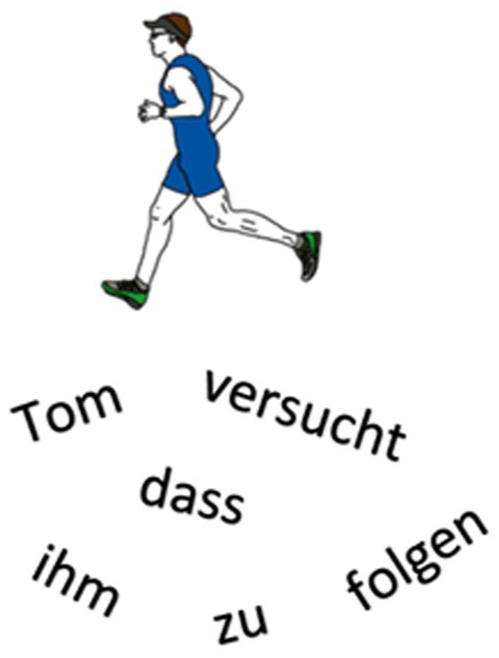
In response to (10), which contains the control verb versuchen ‘try’, L1 German speakers would be expected to preferentially produce an extraposition pattern (. . . dass Tom versucht ihm zu folgen ‘. . . that Tom tries to follow him’). Every trial additionally displayed a picture illustrating the entity referred to by the personal pronoun that was to form part of the infinitival complement, in the absence of any explicitly mentioned antecedents for these pronouns.
To mask the purpose of the current study, the critical materials were mixed with 36 filler sentences which did not include any infinitival complements and differed from our experimental items both in their lexical material and syntactic structure. The order in which the individual words were arranged on the computer screen was held constant across participants. Experimental sentences and fillers were presented in pseudo-randomized order, with no more than three critical items in a row.
4.1.3. Procedure
The written production experiment was administered via the internet using a Google Forms questionnaire. Participants were first asked to answer several questions related to their biographical background and language learning history, and to provide their voluntary consent to participating in our study. The main experiment then started with written instructions and three practice items which allowed participants to familiarize themselves with the experimental task. Participants did not receive any feedback while completing these practice trials. Afterwards the main experiment started with the presentation of the first trial.
All trials were presented individually in black colour against a white background. Participants could take as much time for their response as they needed. After entering their sentence completions into the questionnaire, they could click on a Weiter ‘Continue’ button to bring up the next trial. The experiment took about 30 minutes to complete on average.
4.1.4. Data cleaning and analysis
Sentence completions were coded for constituent order (extraposed, intraposed, or 3C ordering). Responses which did not include all available words, or which included different and/or more words than were presented on the computer screen, were excluded from further analyses. This was the case for 0.78% of the whole dataset. We analysed participants’ responses using Bayesian multinomial logistic regression as implemented in the brms package in R (Bürkner, 2017; R Core Team, 2017). The factorial structure of these models reflected our experimental design, such that the dependent variable represented participants’ production choices, which had three levels: Extraposition, Intraposition, and Third Construction. This variable was modelled using a categorical family, with the reference level set to Extraposition. To obtain all theoretically motivated pairwise contrasts between response categories, we relevelled the outcome variable and refit the model with Intraposition as reference category.
These models included the categorical fixed-effect variables Group (L1 German, L1 Russian, L1 Dutch) and Verb Type (raising vs. control) as well as their interaction. To control for potential task-related or habituation effects, the continuous predictor Trial Position (i.e. the order of items in the experiment) was centred around its mean and added to our analyses. The overall statistical model employed sum-coded contrasts for the factors Group and Verb Type, so that the intercept represented the grand mean and main effects represented average differences across levels. Follow-up analyses were conducted by splitting the data by the factor Verb Type and employing treatment contrasts to the factor Group to investigate the L1 vs. L2 group differences for raising and control verbs separately. To obtain all pairwise contrasts between speaker groups, we relevelled the factor Group and refit the model accordingly.
For determining the best-fit random slopes structure for each model, we started with the maximal model, including random slopes and intercepts for factors and iteratively removed random slopes by participant or by item which explained the least variance, when models failed to converge. Model comparison was performed using the LOOIC (Leave-One-Out Information Criterion), evaluating the model’s predictive accuracy while accounting for its complexity (Vehtari et al., 2017). Lower LOOIC values indicate better expected out-of-sample performance.
Bayesian inference was based on posterior distributions, with 95% credible intervals and the probability of direction (pd) used to assess the certainty and directionality of effects. We also report the percentage of the posterior falling within the Region of Practical Equivalence (ROPE) to assess practical significance. Four MCMC chains were run for 4,000 iterations each (2,000 warm-up), and model convergence was assessed using R-hat < 1.01 and by ensuring sufficient effective sample sizes for all parameters.
4.1.5. Results
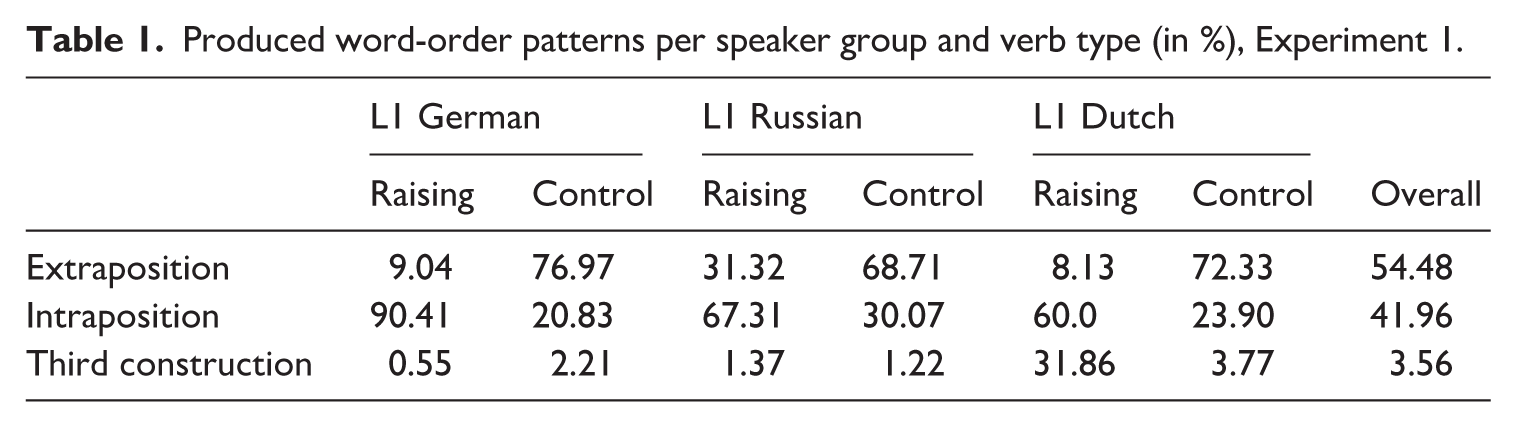
Table 1 displays the distribution of word-order productions per verb type for each participant group. Raising verbs elicited more intraposed than extraposed infinitives across all participant groups, while the opposite was the case for control verbs. Overall, third constructions were produced least often. However, our L1 Dutch speakers produced more third construction infinitives for raising verbs in comparison to both L1 German and L1 Russian speakers.
Produced word-order patterns per speaker group and verb type (in %), Experiment 1.
For all contrasts of the outcome variable in the overall model there was strong evidence for main effects of the factors Verb Type and Group. In particular, the factor Group modulated construction preferences most clearly in contrasts involving the Third Construction. In the Third Construction vs. Extraposition and the Third Construction vs. Intraposition contrasts, Dutch speakers were more likely than the grand mean to produce Third Constructions, while Russian speakers showed a reduced tendency to do so. In addition, for all contrasts between produced constructions, we obtained clear interactions between the factors Verb Type and Group, which indicates that the three speaker groups showed different response patterns across raising and control verbs. To resolve these interactions, we performed separate follow-up analyses for control and raising verbs.
For control verbs, the two L2 speaker groups did not show statistically different production patterns compared to the German L1 group. The word-order choices of the two L2 speaker groups merely differed in that Dutch speakers were slightly more likely to produce third constructions compared to Russian speakers in relation to extraposed (ß = 1.62, CrI [0.09, 3.38], pd = 98.24%, ROPE = 0.7%) and intraposed infinitives (ß = 4.06, CrI [1.23, 7.46], pd = 99.70%, ROPE = 0%).
For raising verbs, in contrast, both L2 groups’ word-order choices differed from the L1 speakers’ pattern (Table 2). Both L1 Russian and L1 Dutch speakers were less likely to produce intraposed infinitives compared to the L1 German group. In particular, there was strong evidence that Russian speakers produced fewer intraposed but more extraposed infinitives than L1 German speakers did (ß = −2.72, 95% CrI [−4.27, −1.26], pd = 99.99%, ROPE = 0%). In contrast, Dutch speakers showed an enhanced likelihood of producing third constructions relative to the L1 German-speaking controls, both compared to extraposed (Third Construction vs. Extraposition: ß = 4.68, CrI [3.08, 6.71], pd = 100%, ROPE = 0%) and intraposed infinitivals (Third Construction vs. Intraposition: ß = 6.63, CrI [4.15, 9.89), pd = 100%, ROPE = 0%). In addition, the two L2 speaker groups also differed reliably in their word-order choices, such that the Dutch group was more likely to produce third constructions than the Russian group, relative to both extraposition (ß = 4.98, CrI [3.76, 6.49], pd = 100%, ROPE = 0%) and intraposition (ß = 4.81, CrI [2.77, 7.31], pd = 100%, ROPE = 0%).
Summary of the posterior estimates from Bayesian multinomial models for raising verbs, Experiment 1.
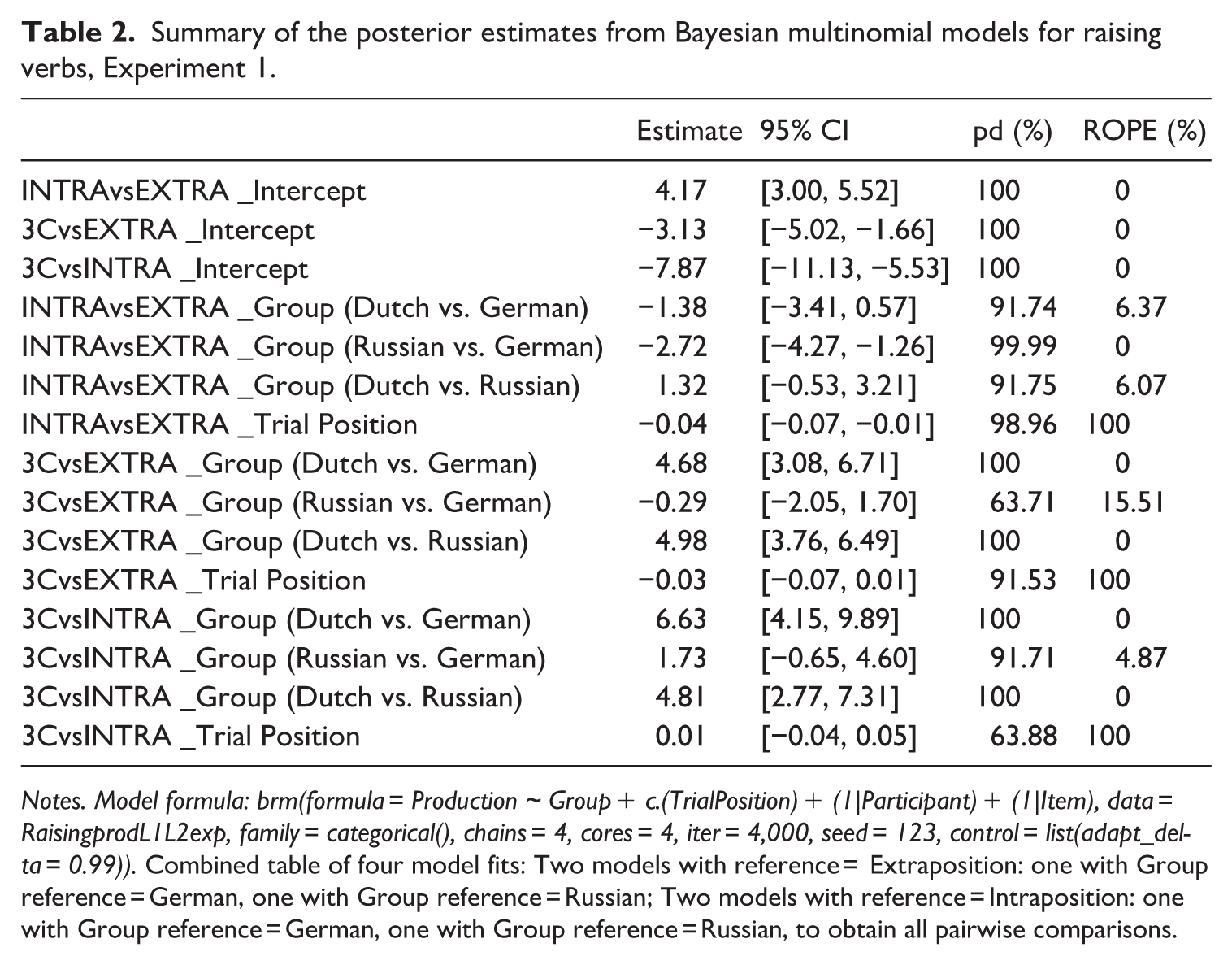
Notes. Model formula: brm(formula = Production ~ Group + c.(TrialPosition) + (1|Participant) + (1|Item), data = RaisingprodL1L2exp, family = categorical(), chains = 4, cores = 4, iter = 4,000, seed = 123, control = list(adapt_delta = 0.99)). Combined table of four model fits: Two models with reference = Extraposition: one with Group reference = German, one with Group reference = Russian; Two models with reference = Intraposition: one with Group reference = German, one with Group reference = Russian, to obtain all pairwise comparisons.
4.1.6. Summary and discussion
Our written production experiment yielded the following findings: Firstly, the L1 German speakers’ production patterns, with extraposed infinitives being favoured for control verbs and intraposed infinitives for raising verbs, and third constructions hardly produced at all, replicate previously reported preference patterns (Bayer et al., 2005; Bosch et al., 2022, 2023). Secondly, both L1 Russian and L1 Dutch-speaking learners patterned with native German speakers in differentiating between raising and control verbs, also predominantly choosing intraposition for raising verbs and extraposition for control verbs. Thirdly, however, the two L2 groups showed distinct production profiles for raising verbs, both in comparison to the German L1 group and from each other. Although L1 Russian speakers showed the same relative word-order preference pattern as the L1 German-speaking controls did (intraposition > extraposition > third construction, see Table 1), they were more likely to produce extraposition compared to the L1 German group. L1 Dutch speakers differed more substantially from L1 German speakers in that they showed a different relative preference pattern (intraposition > third construction > extraposition, see Table 1). That is, they showed an enhanced likelihood of producing third construction infinitives for raising verbs compared to L1 Russian and L1 German speakers.
These data show, on the one hand, that L2 word-order choices patterned globally with those of native German speakers, such that intraposition was the preferred word-order option for raising verbs and extraposition was produced most frequently for control verbs. On the other hand, the observed L2 production patterns indicate that even advanced learners of German cannot fully approach L1 performance profiles. For both L2 groups, L1 word-order constraints on infinitival complementation seem to have affected their performance. The high production rate of extraposed infinitives for German raising verbs in the L1 Russian speakers’ data (31.32%) can be accounted for by the fact that extraposition represents the canonical word-order pattern in Russian. Regarding the L1 Dutch-speaking group, their relatively high production rate of third construction linearization patterns (31.86%) indicates that the superficial ambiguity of verbal clustering and third constructions in Dutch might have led Dutch speakers to consider the third construction pattern a legitimate word-order option for German raising verbs.
As word-order production is a ‘winner-takes-all’ process, the results from Experiment 1 cannot tell us whether other word-order options were disfavoured because they were considered inappropriate or merely as less good than the winning option, however. To obtain a picture of gradient differences between word-order options, and to examine whether L1 influence also affects L2 learners’ performance in a different language modality, we carried out an acceptability judgement experiment on the same phenomenon.
4.2. Experiment 2: Acceptability ratings
4.2.1. Participants
We collected acceptability judgements from 34 learners of German with Russian as their L1 (three male; mean age: 27.85 years, range: 17–38; all resident in Germany) who were recruited either via the University’s participant database or social media posts, and 28 L1 Dutch-speaking learners of German (seven males; mean age: 33.75 years, range: 19–48; place of residence: 10 in the Netherlands, 18 in Germany) who were recruited from universities in the Netherlands and in Germany via email contact. We also included judgement data from 37 native German speakers (five male, 32 female; mean age: 23.24 years, range: 18–32) that was collected as part of an earlier monolingual study (Bosch et al., 2022) to serve as control data for our L2 data. All participants were right-handed, had normal or corrected-to-normal vision, were never diagnosed with any learning or other behavioural/neurological disorders, and none of them had ever experienced language or literacy-related difficulties. All our non-native participants had first been exposed to German after the age of five years, and none of them considered themselves bilingual (Russian: Age of Exposure: 10.70 years; range: 5–14; Dutch: Age of Exposure: 11.90 years; range: 5–15). All participants were using German as well as their native language in their everyday lives, and their average German grammar skills corresponded to the C1 level according to the grammar subtest of the Goethe Institute Placement Test (Russian group: 26.21/30, range: 22–30 [C1–C2 level]; Dutch group: 24.97/30, range: 20–30 [B2–C2 level]). All participants provided written consent to take part in the experiment, were naïve with respect to the its ultimate purpose and received a small monetary compensation for their participation.
4.2.2. Materials
We adopted the experimental materials from Bosch et al. (2022, 2023). Stimulus sentences were constructed using the same six infinitive-embedding verbs as in Experiment 1, which were combined with infinitival complements in different word-order patterns; see examples (11a–d). For intraposed infinitives, we differentiated between coherent and incoherent subtypes (11c,d), a distinction that we could not make in Experiment 1. 3
(11) a. Extraposition (EXTRA): Maria glaubt, dass Tom versucht [ihm zu folgen]. Maria believes that Tom tries him to follow ‘Maria believes that Tom tries to follow him.’ b. Third Construction (3C): Maria glaubt, dass Tom [ihm] versucht [zu folgen]. Maria believes that Tom him tries to follow ‘Maria believes that Tom tries to follow him.’ c. Intraposition coherent (INTRA C): Maria glaubt, dass [ihmi] Tom [ Maria believes that him Tom to follow tries ‘Maria believes that Tom tries to follow him.’ d. Intraposition incoherent (INTRA IC): Maria glaubt, dass Tom [ihm zu folgen] vergeblich versucht. Maria believes that Tom him to follow in vain tries ‘Maria believes that Tom tries to follow him in vain.’ihmi zu folgen] versucht.
While the entire infinitival complement is located at the right sentence periphery in the extraposition condition (11a), it is realized discontinuously in the third construction condition (11b). The intraposed infinitives in (11c,d) are disambiguated differently with respect to their structural integrity. Condition (11c) represents an unambiguously monoclausal structure in which the dative-marked object pronoun ihm has been scrambled out of the infinitival complement to the left of the subordinate clause subject Tom. In condition (11d), in contrast, the infinitival complement only allows for an incoherent (i.e. biclausal) construal, with the clause boundary between the infinitive and its subcategorizer, versucht ‘tries’, signalled by an intervening adverb (vergeblich ‘in vain’).
24 critical item sets were created by using each infinitive-embedding verb in four different sentential contexts, with each sentence introduced by a main clause such as Maria glaubt, dass . . . ‘Maria believes that . . .’. Every trial also displayed a picture illustrating the entity referred to by the personal pronoun in the infinitival complement, as illustrated in example (12). These pictures were shown above each printed stimulus sentence and helped ensure that the sentences could be easily understood despite the pronouns’ antecedents not being mentioned verbally.
We additionally constructed 40 filler sentences which did not include any infinitival complements and which differed from our experimental items both in their lexical material and syntactic structure. In order to encourage participants to make use of the full range of our rating scale, we included both fully acceptable and completely unacceptable filler sentences. Experimental test sentences and fillers were presented in pseudo-randomized fashion such that no more than three critical items appeared in a row, and were distributed across four different presentation lists using a Latin Square Design. Each list included 24 critical test items and the 40 filler sentences.
4.2.3. Procedure
The acceptability judgement task was administered via the internet using Google Forms questionnaires. Prior to the main experiment, participants were asked to answer several questions about their biographical background as well as their language learning history and to provide their voluntary consent to participating in our study. The experiment then started with written instructions and three practice items for which participants received feedback in order to allow them to familiarize themselves with the experimental task.
All experimental sentences were presented individually in Arial 20pt in black colour against a white background. Participants were asked to rate the acceptability of each presented sentence on a 5-point Likert scale, which appeared below each test sentence. In analogy to the German school grading system, this scale allowed ratings from 1 as vollkommen akzeptabel ‘totally acceptable’ to 5 as völlig inakzeptabel ‘totally unacceptable’. The intermediate ratings 2, 3, and 4 were not specifically labelled in each trial, but introduced at the beginning of the experiment as 2 meaning eher akzeptabel ‘rather acceptable’, as 3 meaning nicht sehr akzeptabel ‘not very acceptable’, and as 4 meaning eher inakzeptabel ‘rather unacceptable’. Each trial appeared on the computer screen as shown in example (12).
(12)
Maria glaubt, dass Tom versucht ihm zu folgen.


Participants could take as much time as they needed for their ratings. After they indicated their judgement of a given sentence, the next trial started automatically. The acceptability rating experiment took 30 minutes to complete on average.
4.2.4. Data cleaning and analysis
We employed cumulative link mixed models (CLMM) for ordinal regression (Christensen, 2018) from the ordinal package in R (R Core Team, 2017) on acceptability ratings. The factorial structure of our experiment was reflected in the structure of our models. As categorial fixed effect variables, the models included the factors Verb Type, comparing raising versus control verbs, Condition, comparing the four word-order variants under investigation, and Group, comparing L1 German, L1 Russian and L1 Dutch speakers, as well as interactions thereof. Finally, the continuous predictor Trial Position was centred around its mean and added to our analyses to control for task-related effects and remove auto-correlation of residuals (Baayen and Milin, 2010). We employed sum-coded contrasts to all three factors – Condition, Group, and Verb Type – for overall analyses. For hypotheses-driven follow-up analyses within speaker groups and conditions, treatment contrasts were employed, and for effects within factors, the theoretically motivated comparisons were obtained by relevelling factors and refitting the model.
For determining the best-fit random slopes structure, we started with the maximal model, including random slopes and intercepts for factors and iteratively removed random slopes by participant or by item, which explained the least variance, when models failed to converge (Barr et al., 2013). This procedure was repeated until the model did not improve any further according to its AIC value. The best model for each analysis is reported in Section 4.2.5.
4.2.5. Results
Figure 1 shows the mean acceptability ratings per verb type and condition for the three participant groups. As was expected, our L1 German-speaking controls (Figure 1a) provided the best ratings for intraposed coherent infinitives for raising verbs, and for extraposed infinitives for control verbs. Both L2 groups exhibit different performance patterns from the native speaker controls: While L1 Russian speakers (Figure 1b) rated extraposed infinitives most favourably across both raising and control verbs, L1 Dutch speakers (Figure 1c) rated extraposition best for control verbs only. For raising verbs, the L1 Dutch group rated both third constructions and intraposed coherent constructions considerably better than the other two word-order variants.
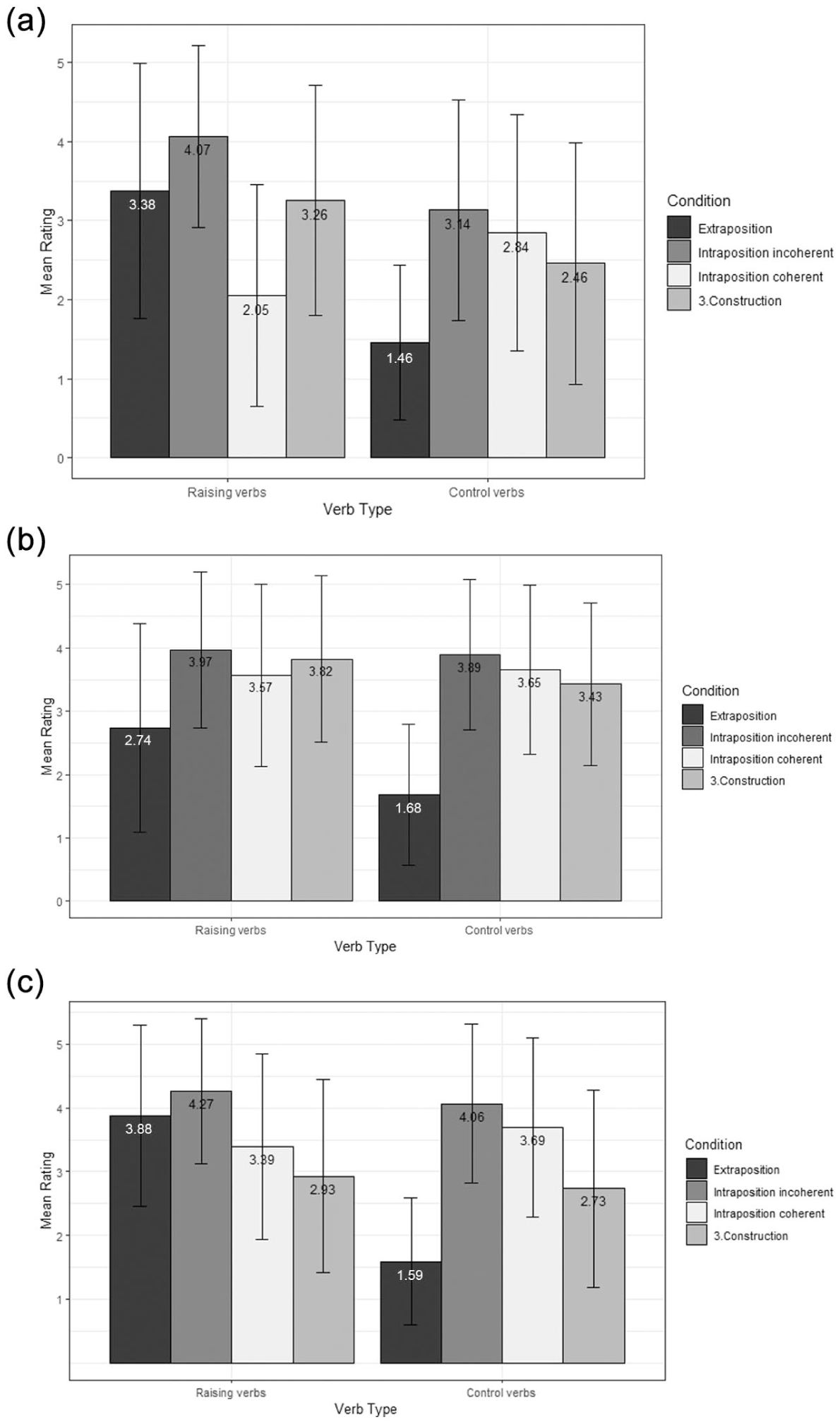
Mean ratings and standard errors per speaker group and verb type, Experiment 2. (a) L1 German. (b) L1 Russian. (c) L1 Dutch.
A CLMM including the factors Group, Verb Type and Condition revealed significant three-way interactions. To explore the source of these interactions in more detail, we performed planned comparisons between individual conditions and speaker groups.
For control verbs, statistical analyses revealed a significant main effect for Condition indicating that across speaker groups, extraposed infinitives received better ratings than all other word-order options across speaker groups. In addition, L1 Russian speakers rated third constructions significantly worse relative to the L1 Dutch group (Estimate = 1.713; SE = 0.415; z = 4.127; p = .008). However, overall rating patterns for the four word-order variants did not differ between the three participant groups.
In contrast, the three speaker groups differ significantly in their rating patterns for German raising verbs. The L1 German group rated intraposed coherent infinitives such as (11c) most favourably and significantly better than both learner groups did. The L1 Dutch group rated third constructions such as (11b) and intraposed coherent infinitives most favourably, and significantly better than L1 Russian speakers did (Estimate: 1.329; SE = 0.446; z = 2.981; p = .002). L1 Russian speakers differed from the other two participant groups in that they preferred extraposed infinitives over all other structural variants (Table 3).
Summary of the statistical analysis for raising verbs per speaker group, Experiment 2.
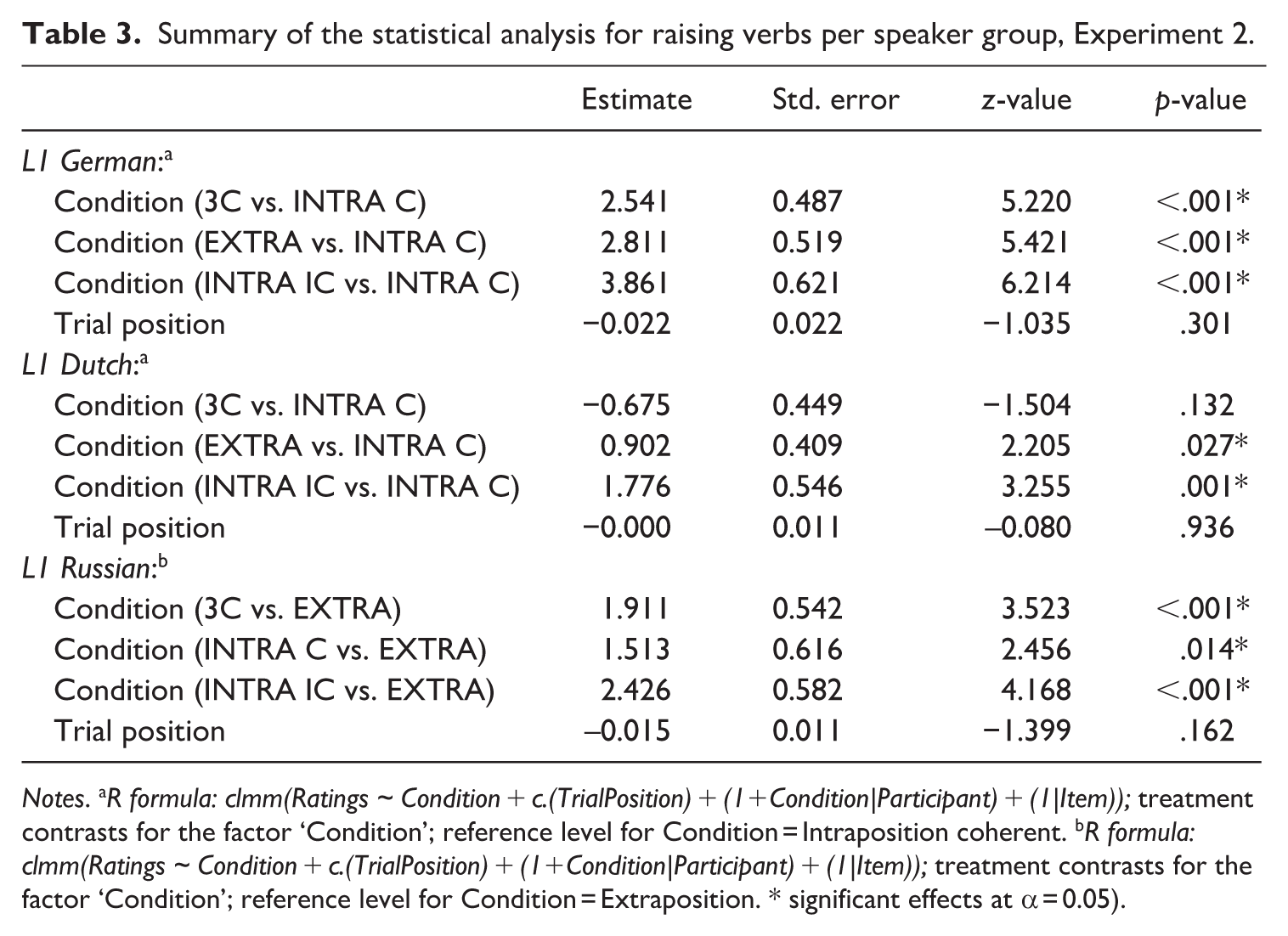
Notes. aR formula: clmm(Ratings ~ Condition + c.(TrialPosition) + (1+Condition|Participant) + (1|Item)); treatment contrasts for the factor ‘Condition’; reference level for Condition = Intraposition coherent. bR formula: clmm(Ratings ~ Condition + c.(TrialPosition) + (1+Condition|Participant) + (1|Item)); treatment contrasts for the factor ‘Condition’; reference level for Condition = Extraposition. * significant effects at α = 0.05).
4.2.6. Summary and discussion
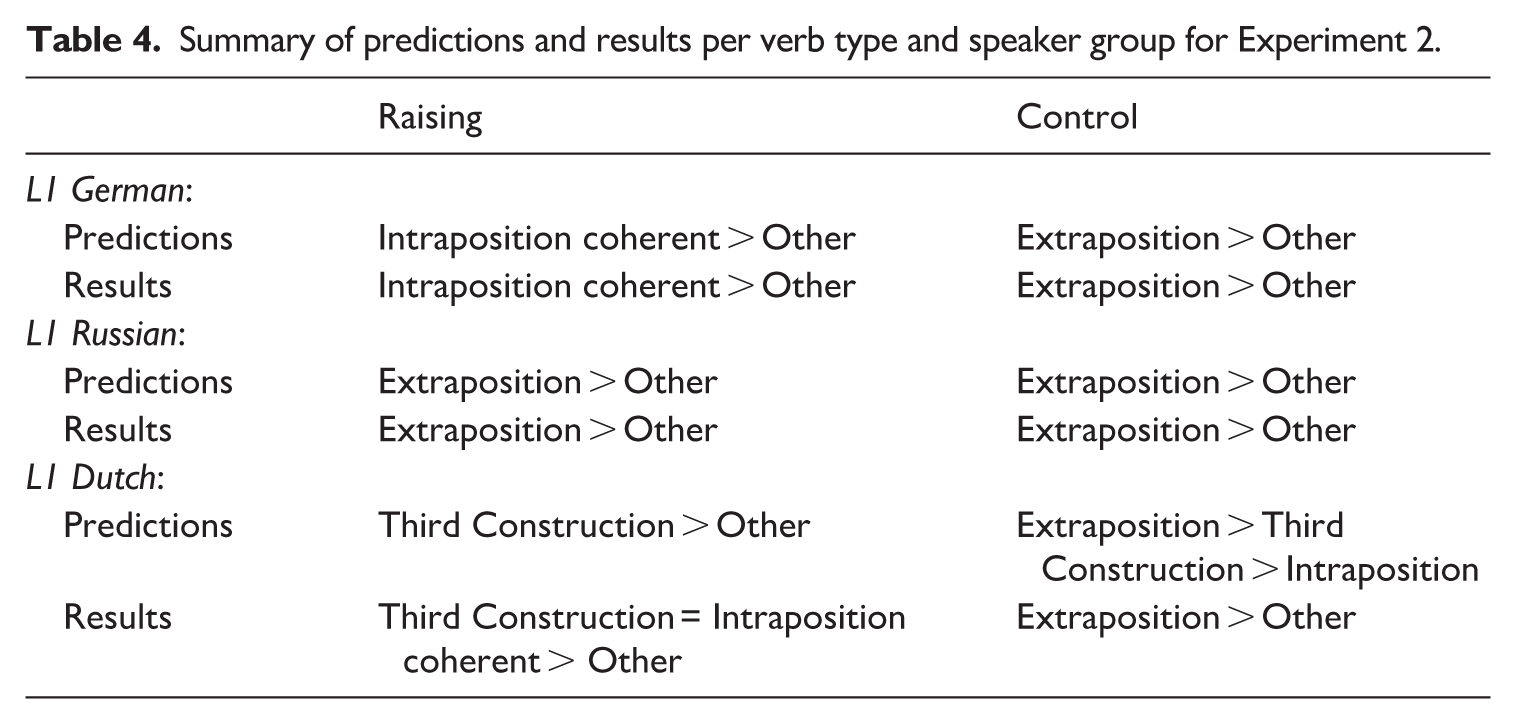
The overall acceptability rating profiles of L1 Russian and L1 Dutch speakers differed both from the L1 German rating profile and from each other, essentially confirming our predictions (see Table 4). L1 German speakers rated extraposed infinitives best for control verbs, while raising verbs elicited better ratings for intraposed infinitives than for any other word-order variant. The L1 Russian speakers rated extraposed infinitives best across the board (that is, even for raising verbs, which require monoclausal coherent construals). In contrast, the L1 Dutch group showed more variability in their acceptability ratings. They rated third constructions and intraposed coherent infinitives most favourably for raising verbs, whilst extraposition received the best ratings for control verbs.
Summary of predictions and results per verb type and speaker group for Experiment 2.
The results of our acceptability judgement task strengthen the findings of our production experiment: Both L1 Russian and L1 Dutch speakers’ performance differed from L1 German speakers’ performance profiles. The L2 learners’ rating patterns did not necessarily correspond to their production preferences, however. L1 Russian speakers, for example, rated extraposition best for German raising verbs in Experiment 2 but predominantly produced intraposed infinitives for the same verbs in Experiment 1. The findings from our two experiments will be discussed in more detail in Section 5.
5. General discussion
We asked whether and to what extent proficient L2 learners of German can approach L1 performance profiles with respect to permissible structural variation in German infinitival complementation. We investigated word-order preference patterns both from the perspective of language production (Experiment 1) and from the perspective of language comprehension and judgement (Experiment 2). We specifically examined whether our L2 participants were sensitive to lexical and distributional constraints on word-order variation, and to what extent they relied on L1 word-order constraints when producing or judging infinitival constructions in German. In both experiments we observed differences between L1 and L2 German speakers’ performance profiles on the one hand, and between the two L2 groups’ performance patterns on the other. While L1 Russian rated extraposed infinitives best for both raising and control verbs, the L1 Dutch-speaking group showed more variability in their performance patterns, with particularly high production and judgement rates for third construction infinitives. Below we will discuss our findings and their implications in more detail, while also noting our study’s limitations and making some suggestions for future research.
5.1. Sensitivity to L2 constraints on word-order variation
To answer research question 1 of whether L2 learners are sensitive to lexical constraints on word-order choices, we need to consider their responses to raising vs. control verbs. Recall that in German, raising verbs normally require infinitival complements to be intraposed and to be construed coherently. Infinitival complements of control verbs, in contrast, are preferably extraposed. In Experiment 1, the production choices of both learner groups conformed to this general pattern, demonstrating sensitivity to the divergent word-order preferences of the two different verb types. In Experiment 2, only the L1 Dutch group, but not the L1 Russian group, showed clear evidence of distinguishing between raising and control verbs in their judgement patterns, however.
Research question 2 asked about sensitivity to distributional constraints on permissible word-order variation. Our results indicate that these may be difficult for L2 learners to acquire, confirming and extending previous findings by Gries and Wulff (2013). While L1 German speakers have an almost categorical preference for intraposing complements of raising verbs, both of our L2 groups showed a weaker production preference for intraposition compared to L1 German speakers in Experiment 1. In Experiment 2, L1 Russian speakers differed markedly from both L1 German and L1 Dutch speakers in rating extraposition most favourably for raising verbs. L1 Dutch speakers, on the other hand, rated third constructions on a par with intraposition, unlike L1 German speakers, who clearly favoured intraposition over all other word-order variants.
German control verbs allow for more variability than raising verbs regarding the linearization of their complements. In Experiment 1, our L2 groups’ production choices resembled L1 German speakers’ word-order preference pattern for control verbs. In Experiment 2, we found the L1 Dutch group behaving differently from the L1 Russian group, however. L1 Dutch speakers rated third constructions more favourably than L1 Russian speakers did, and also significantly more favourably than intraposition.
In short, our L2 groups’ performance profiles only partly conformed to those of German native speakers, with some rather striking differences between learners’ response patterns in both our production and judgement tasks.
5.2. L1 influence on L2 word-order preferences
Regarding research question 3, we found strong evidence of our L2 participants’ performance profiles being influenced by word-order constraints from their native language in both of our experiments. Recall that previous research on the influence of L1 word-order properties on L2 speakers’ performance patterns in variation contexts did not yield entirely consistent findings. On the one hand, Gries and Wulff’s (2013) L2 corpus study and Azaz’s (2020) elicited production study on the English genitive alternation provided evidence for L2 word-order preferences being influenced by properties of the L1. On the other hand, De Cuypere et al. (2014) found no evidence of L1 Russian influence on L2 English structural variation, and Jäschke and Plag (2016) found that L2 speakers’ word-order choices for the English dative alternation were influenced by the same factors as were L1 speakers’ preferences – albeit to a lesser degree. The current findings fit with those reported by Gries and Wulff (2013) and Azaz (2020) in that we found our L2 speakers’ word-order preferences to vary as a function of their L1, such that in the case of surface word-order overlap between the L1 and L2, language learners tend to favour patterns that are also available in their L1.
L1 influence was most obvious in our L2 participants’ word-order preferences for complements of raising verbs. These verbs normally require intraposition in German, a linearization pattern that is either non-canonical (Russian) or absent (Dutch) in our L2 participants’ native languages. Recall that Russian favours postverbal placement of infinitival complements for all verb types, and that subject raising from infinitival complements is prohibited. Infinitival complements of Dutch raising verbs, on the other hand, usually occur in third construction-like patterns.
In Experiment 1, L1 Russian speakers produced a much larger proportion of extraposed infinitives for raising verbs compared to both L1 German and L1 Dutch speakers. In Experiment 2, the L1 Russian speakers rated extraposition above all other word-order options for these verbs. L1 Dutch speakers, in contrast, produced a larger proportion of third constructions for raising verbs in Experiment 1 than both our L1 German and L1 Russian speakers did. In Experiment 2, the L1 Dutch group rated third constructions best numerically (and statistically as good as intraposed coherent infinitives) for raising verbs.
German control verbs preferentially combine with extraposed infinitives, a linearization pattern that is also commonly used for control verbs in Russian and Dutch. Our finding that both L2 groups favoured extraposition for complements of control verbs is therefore hardly surprising. However, there was also evidence of participants’ L1 background influencing their rating of other word-order variants. L1 Dutch speakers differed from L1 Russian speakers in producing third constructions more frequently and rating them more favourably than intraposition for control verbs.
As fully intraposed infinitives are ungrammatical in Dutch, and Dutch verbal clustering and third constructions are superficially ambiguous, our L1 Dutch participants might have considered German third constructions as an appropriate alternative linearization pattern for German intraposition, possibly being unaware that the 3C word-order pattern does not signal a monoclausal clustering construction in German. Our Dutch speakers’ tendency to over-produce and over-accept German third constructions was stronger for raising than for control verbs. This indicates that they knew about the requirement that infinitival complements of German raising verbs – but not of control verbs – should normally enter into a monoclausal construal.
In summary, our results confirm the prediction made by the SOH that surface-structural overlap between two languages facilitates cross-linguistic influence on L2 word-order choices and judgements. Where several word-order options overlap, the relative frequency of these word-order variants in the L1 also seems to play a role.
5.3. L1 influence across different language modalities
Evidence of L1 influence on learners’ performance was more pronounced in our acceptability judgement task (Experiment 2) than in our production task (Experiment 1). While in the written production task, both L1 Russian and L1 Dutch speakers globally patterned with L1 German speakers, such that intraposition was the preferred option for raising verbs and extraposition for control verbs, L2 speakers’ acceptability judgements diverged more strongly from those of L1 German speakers. L1 Russian speakers’ performance differed most markedly between the two experiments, as they preferentially produced intraposed infinitives for raising verbs in Experiment 1 whilst rating extraposition best for the same verbs in Experiment 2.
Differences between the types of selection processes involved in production vs. judgement tasks may have contributed to the inconsistent L2 results across our two experiments. Sentence production essentially reflects a ‘winner-takes-all’ process, in which the speaker evaluates a set of alternative – but potentially equally suitable – word-order options and ultimately chooses a single optimal candidate. In contrast, scalar acceptability judgement tasks allow for each word-order variant to be evaluated individually without forced-choice selection and thus can also capture gradience. Our findings suggest that if proficient L2 speakers are forced to choose one of several permissible word-order candidates and suppress all less optimal variants, they pattern fairly closely with L1 speakers. If, however, all available word-order candidates need to be evaluated separately in a task which taps into metalinguistic knowledge, even highly proficient L2 speakers can be strongly influenced by L1 word-order properties.
The observed task effects support Ringbom’s (1992) claim that L2 production should be less affected by L1 influence than L2 comprehension. According to Ringbom, the function-to-form mapping involved in language production requires more specific L2 knowledge, and greater consideration of formal accuracy and appropriateness of L2 forms compared to comprehension-based tasks. He argues that L1 knowledge is less available, or less likely to be recruited, in L2 production than in comprehension, and that transfer in comprehension is ‘overt’ transfer, that is, transfer based on the perceived similarity between the L1 and the L2. Given that acceptability judgement tasks are primarily comprehension-based, Ringbom’s (1992) line of reasoning may help explain why we found stronger evidence of L1 influence in Experiment 2 than in Experiment 1. Clearly though, our data show that L1 influence on L2 written production is by no means precluded (compare also Barking et al., 2022; Gries and Wulff, 2013, among others).
5.4. Implications, limitations and outlook
Our results indicate that having similar structural variants in the L1 may promote L1 influence, and show that L1 word-order constraints can affect L2 performance even at advanced learner levels. It would be interesting in future research to include a comparison group of L2 learners whose L1 lacks comparable structural variation (such as English).
Like Gries and Wulff (2013), we found that L2 distributional constraints on word-order variation are difficult for L2 learners to acquire. From the perspective of frequency or usage-based models of L2 acquisition (e.g. Ellis, 1994, 2013; MacWhinney, 1997; for an overview, see Wulff and Ellis, 2018) this would be expected especially if similar word-order variants existed in learners’ native languages whose distributional patterns differ between the L1 and the L2. That said, both our L2 groups showed evidence of having acquired divergent L2 word-order preferences for different verb types (subject raising vs. subject control) in our production task. Gradient word-order preferences within sets of verbs of the same type seem to be harder to acquire, however.
One limitation of our study is our focusing on a small set of verbs only, which raises the possibility that lexical idiosyncrasies may have affected our results. Another problem concerns the lack of information on the relative frequency distributions of different infinitival linearization patterns in Russian and Dutch, which makes it difficult to determine more precisely the extent to which probabilistic constraints from the L1 contributed to our L2 participants’ performance profiles. Recall also that in Russian, the postverbal placement of infinitives is the default ordering, while other linearization options are pragmatically conditioned. It is therefore possible that, due to missing contextual triggers of the kind that would license non-canonical linearization patterns in Russian, the judgement preferences of our Russian speaker group reflect the default ordering in their L1.
Our study is also limited with respect to the systematic investigation of learner-specific factors such as L2 proficiency, immersion, or multilingual experience on L2 grammatical performance. Our Dutch and Russian-speaking groups were not matched regarding their place of residence at the time of testing, such that nearly all Russian participants were residing in Germany, whereas a substantial proportion of the L1 Dutch participants were living in the Netherlands. Our L2 groups also differed in their German placement test scores, with the Russian groups’ scores minimally exceeding those of the Dutch groups. Many of our participants might also be highly proficient users of English, and thus functionally L3 learners of German. Future studies on the acquisition of word-order variation might want to
systematically control for L2 speakers’ place of residence and multilingual experience; and
examine potential effects of L2 proficiency by testing participants across a wider proficiency range and carrying out comprehensive proficiency assessments.
One factor that may have contributed to the Dutch learners’ observed behaviour is the typological proximity between Dutch and German, particularly with respect to clause structure and verb placement. Typological similarity has been shown to modulate cross-linguistic influence in bilingual processing and acquisition (e.g. Lindgren and Muñoz, 2013). As the present study was not designed to isolate the source of transfer within participants’ multilingual repertoires, the possible role of typological proximity cannot be disentangled from other explanations of the observed patterns, however.
The discrepancies we observed between the results from Experiment 1 and Experiment 2 highlight the importance of using data from multiple sources for gauging learners’ sensitivity to L2 distributional constraints. Current models of L2 acquisition do not offer any straightforward explanations for the observed task effects (but cf. Ringbom, 1992). Theoretical hypotheses and predictions regarding the role of L1 transfer in L2 acquisition should also take into account language modality and the nature of the task. As speakers’ linearization preferences may also be affected by the relative ease of processing alternative word-order variants, future L2 studies of permissible variation might consider including online processing measures as well.
6. Conclusions
Our results show that distributional constraints on permissible word-order variation can be difficult for L2 learners to acquire, with L1 word-order properties affecting L2 production and judgements even in advanced learners. Both the availability of superficially similar word-order patterns and their distribution in the L1 can affect L2 speakers’ judgements and production choices, which is consistent with the surface overlap hypothesis and with usage-based approaches to L2 acquisition. We also observed task effects, such that our L2 participants approached L1 performance profiles more closely in their production than in their judgement patterns. This finding indicates that the degree of L1 influence on L2 performance may be inflated in tasks that encourage conscious deliberation and the use of metalinguistic information. On the methodological side, our study illustrates the usefulness of combining different types of data in order to gain more comprehensive insights into learners’ ability to acquire distributional constraints in an L2.
Footnotes

Consent to participate
The authors confirm that all participants provided written consent and voluntarily took part in the experiments of the present study.
Consent for publication
The authors confirm that all participants provided written informed consent to the anonymized publication of their data.
Funding
The authors disclosed receipt of the following financial support for the research, authorship, and/or publication of this article: This research was funded by the Deutsche Forschungsgemeinschaft (DFG, German Research Foundation) (project ID 317633480 – SFB 1287).
Declaration of conflicting interests
The authors declared no potential conflicts of interest with respect to the research, authorship, and/or publication of this article.