






Abstract
Real-time sentence comprehension can pose a challenge for second-language (L2) speakers due to limited exposure to certain syntactic structures. While English allows dative alternation between double object (DO) and prepositional object (PO) constructions, Spanish only allows PO, which can render DOs more difficult to process than POs for Spanish–English bilinguals. However, semantic cues can also play a role: POs often feature inanimate themes, whereas DOs typically involve animate recipients following the verb. In a self-paced reading study, we examined the interplay of structural preferences and animacy in L2 dative sentence comprehension and how proficiency modulates these factors. Both first language (L1) and L2 participants exhibited longer reading times for DOs than POs, with a larger effect in L2 comprehenders. Notably, DOs with recipients plausibly acting as themes (e.g. ‘dog’) were read faster than DOs with nouns that could only act as recipients (e.g. ‘chef’), suggesting a temporary PO interpretation. Moreover, reliance on PO parsing strategies was stronger in less proficient than in more proficient L2 comprehenders. Together, our results align with experience-based models of L2 sentence processing.
1. Introduction
A central question in psycholinguistics is how bilinguals represent and process second language (L2) syntax (Clahsen and Felser, 2006b; Cunnings, 2016; Hopp, 2022; McDonald, 2006). In the present research, we focus on whether Spanish–English bilinguals’ reduced accumulated experience with double object (DO) structures, relative to the more frequently encountered PO construction, leads them to favor prepositional object (PO) interpretations in real-time comprehension. Experience-based accounts hold that prior exposure to particular syntactic patterns guides parsing decisions (MacDonald et al., 1994; Mitchell et al., 1995; Wells et al., 2009). Because PO constructions are available in both Spanish and English, whereas DO constructions are grammatical in English but not licensed in Spanish (1a–2b), we assume that Spanish–English bilinguals receive less cumulative input with DOs than with POs across their two languages, such that their syntactic processing in L2 may be more closely aligned with PO structures. We therefore investigate how this asymmetry in experience, in combination with semantic cues such as animacy, shapes bilingual syntactic parsing and the extent to which proficiency influences these processes.
Factors like animacy can significantly contribute to sentence interpretation (Gennari and MacDonald, 2008; Mak et al., 2006; Trueswell et al., 1994), particularly for dative sentences. The order of the thematic roles is reversed between dative constructions with theme > recipient in POs and recipient > theme in DOs (1a–1b). Because themes are generally inanimate (Hovav and Levin, 2008), Spanish–English bilinguals may anticipate an inanimate noun following the verb in line with the more expected PO pattern. Thus, when an animate noun appears in that position, it may introduce a processing cost associated with the interplay between semantic properties and syntactic parsing.
(1) a. The postman is giving a ball to a chef. (English, PO) b. The postman is giving a chef a ball. (English, DO) (2) a. El cartero le está dando una pelota a un chef. (Spanish, PO) b. *El cartero le está dando un chef una pelota. (Spanish, DO)
In addition, a number of reading studies suggest that L2 proficiency influences sentence processing (Brothers et al., 2021; Dallas et al., 2013; Hopp, 2006; Lee et al., 2013). In general, more proficient L2 comprehenders exhibit native-like comprehension, whereas less proficient L2 comprehenders may be more affected by non-syntactic factors, given their limited experience with L2 syntax. Some accounts propose that L2 comprehenders often rely on semantic and pragmatic cues due to less detailed syntactic representations (Clahsen and Felser, 2006b). Consequently, lower-proficiency bilinguals may depend more strongly on animacy information. Here, we aim to determine how both syntactic experience and animacy factors are modulated by proficiency in real-time L2 sentence processing.
1.1. Sentence processing in first language (L1)
To study structural preferences and animacy factors, we used temporarily ambiguous sentences where the first postverbal noun can serve as either the theme or the recipient. In sentence parsing, people rely on frequency information to resolve ambiguity, tending to favor the most commonly encountered structures (Desmet et al., 2006; MacDonald et al., 1994; Mitchell et al., 1995). For instance, English speakers often attach ambiguous relative clauses to the second noun in a complex NP (e.g. ‘The journalist interviewed the daughter of the colonel who had the accident’), whereas Spanish speakers typically attach them to the first noun (Carreiras & Clifton, 1999; although see Cuetos & Mitchell, 1988; Traxler et al., 1998). These language-specific biases highlight how cumulative experience shapes sentence comprehension over time.
Comprehenders are also influenced by semantic plausibility – that is, how well a noun matches the thematic requirements of the preceding verb (Binder et al., 2001; Clifton, 2003; Pickering and Traxler, 1998; Trueswell et al., 1994). For example, readers experience increased difficulty when processing implausible objects in subordinate clauses – such as ‘As the woman sailed the magazine about fishing amused all the reporters’ – compared to clauses with more plausible objects, like ‘As the woman edited the magazine about fishing amused all the reporters’ (Pickering and Traxler, 1998). These findings indicate that comprehenders make efficient use of verb semantics to evaluate the suitability of postverbal nouns as sentences unfold. In addition, semantic plausibility effects have also been investigated by manipulating animacy (Gennari and MacDonald, 2008; Mak et al., 2006; Trueswell et al., 1994). For instance, reading times increase at the disambiguating by-phrase in sentences with reduced relative clauses containing an animate subject (e.g. ‘The defendant examined by the lawyer turned out to be unreliable’), compared to those featuring an inanimate subject (e.g. ‘The evidence examined by the lawyer turned out to be unreliable’; Trueswell et al., 1994). Because inanimate nouns are unlikely agents for transitive verbs such as ‘examine’, comprehenders experience less processing cost when these nouns are interpreted as themes. Together, these results underscore the importance of plausibility and animacy cues in guiding real-time syntactic analysis.
1.2. Sentence processing in L2
Broadly speaking, bilinguals process L2 ambiguous sentences in ways that resemble monolingual patterns (e.g. Felser et al., 2003; Frenck-Mestre and Pynte, 1997; Juffs and Harrington, 1996). For instance, L2 English comprehenders from a range of different L1s showed ambiguity resolution strategies similar to L1 English speakers (Juffs, 1998). When reading reduced relative clauses temporarily ambiguous as main verbs (e.g. ‘The bad boys criticized during the morning were playing in the park’), L2 readers effectively used verb argument structure to guide their parsing as well as postverbal cues to avoid misinterpretation.
However, existing evidence indicates that L2 comprehenders may differ from L1 speakers with respect to lexico-semantic cues. According to the Shallow Structure Hypothesis (Clahsen and Felser, 2006b), L2 speakers may depend more strongly on non-syntactic information, in part because their syntactic representations might be less robust. More specifically, L2 comprehenders use a shallow processing route that privileges semantic, pragmatic, and world knowledge information due to less detailed (i.e. shallow) L2 syntactic information (Clahsen and Felser, 2006a). This account is largely supported by evidence on structural ambiguity resolution. In a study on relative clause attachment, Greek learners from a variety of L1’s did not show attachment preferences as L1 Greek speakers did, despite all their L1’s shared attachment preferences with Greek (Papadopoulou and Clahsen, 2003). In another study, although both L1 and L2 groups showed similar relative clause attachment preferences when the preposition was ‘with’, their preferences diverged when the preposition was ‘of’ (e.g. ‘The dean liked the secretary with/of the professor who was reading a letter’) (Felser et al., 2003). These findings thus suggest that L2 comprehenders underuse L2 syntactic representations and heavily rely on lexical and semantic information.
A crucial element shaping L2 sentence processing is L2 proficiency (e.g. Brothers et al., 2021; Dallas et al., 2013; Jackson, 2008; Lee et al., 2013; Rah and Adone, 2010). When resolving subject–object ambiguities, for instance, highly proficient L2 German comprehenders displayed native-like subject preferences, indicating that they effectively used morphosyntactic cues such as case marking (Jackson, 2008). By contrast, intermediate L2 speakers showed similar but delayed effects, suggesting a less efficient integration of syntactic information. Relatedly, verb subcategorization studies suggest that more proficient L2 comprehenders respond to thematic mismatches similarly to L1 readers, whereas less proficient L2 comprehenders exhibit weaker effects (Brothers et al., 2021). Altogether, these findings point to the significance of proficiency in mediating how syntactic and semantic factors interact during online L2 parsing, thereby highlighting the influence of accumulated experience and the potential for non-syntactic cues to play a larger role when proficiency is lower.
Although prior research offers valuable insights into how L2 speakers parse sentences, it remains unclear whether L2 parsing decisions are primarily guided by accumulated syntactic experience or by animacy constraints, and how these influences shift with increasing proficiency. According to a prominent model of L2 acquisition (MacWhinney, 1997), L2 comprehenders weight multiple cues during sentence comprehension based on their reliability – that is, how frequently these cues occur in the language and whether they correctly signal sentence meaning. Therefore, to successfully interpret English dative sentences, comprehenders have to integrate a number of reliable cues such as word order, animacy, thematic role plausibility, and the way they interact. More specifically, comprehenders should compute the theme > recipient and recipient > theme order associated with PO and DO forms, respectively, recognize that recipients are usually animate, whereas themes are typically inanimate, and weigh each cue’s contribution to arrive at a correct interpretation of the sentence.
To investigate this issue, we manipulated theme plausibility in English dative sentences, building on earlier work that has documented plausibility effects in L2 processing (Hopp, 2013; Roberts and Felser, 2011; Williams et al., 2001). In some constructions, for instance, when Greek–English bilinguals read garden-path sentences with ambiguous nouns that could serve as plausible or implausible direct objects (e.g. ‘The inspector warned the boss/crimes would destroy very many lives’), L2 parsers showed reading-time increases for implausible compared to plausible nouns, mirroring English monolinguals (Roberts and Felser, 2011). However, in more complex constructions – such as sentences with preposed adjunct clauses – L2 comprehenders exhibited plausibility effects similar to those in simpler configurations, unlike native speakers. These findings suggest that, although L2 speakers can exhibit native-like responses to certain plausibility manipulations, their processing strategies may differ under more demanding structural conditions.
Crucially, animacy can act as a decisive cue in understanding English datives as a postverbal animate noun aligns naturally with a DO interpretation, whereas a postverbal inanimate noun suggests a PO construction. Existing studies indicate that L2 comprehenders can be as sensitive to animacy as monolinguals (Jackson and Roberts, 2010; Sun et al., 2023). For example, German-Dutch bilinguals and Dutch monolinguals showed minimal structural preference differences when both subject and object relative-clause subjects were animate (e.g. Voor de kinderen zijn de taarten, die de clown heeft gegooid, het hoogtepunt van de voorstelling ‘For the children the pies, that the clown threw, were the highlight of the performance’) (Jackson and Roberts, 2010). Similarly, in Chinese–English bilinguals, inanimate subjects posed greater processing challenges than animate ones (Sun et al., 2023). Taken together, these findings highlight the likely relevance of animacy to L2 dative comprehension, yet the extent to which proficiency modulates this factor, particularly when combined with restricted exposure to DO structures, remains unclear.
2. The study
To investigate how structural preferences and animacy interact in L2 online sentence reading, we used a self-paced reading task in which Spanish–English bilinguals and English monolinguals read English DO and PO sentences whose theme plausibility was systematically manipulated. Given that Spanish–English speakers generally have less exposure to DOs than to POs, we anticipated that they would exhibit increased difficulty with DOs. However, Spanish–English bilinguals may experience additional processing costs if they expect an inanimate postverbal noun and instead encounter an animate one. In other words, any observed differences between DOs and POs could stem both from reduced DO experience and from plausibility constraints tied to noun animacy.
To separate structural from animacy-based effects, we held animacy constant and varied the theme plausibility of the postverbal nouns, which act as actual recipients of both DO and PO constructions (3a–4b). For example, ‘dog’ and ‘chef’ are both the recipients of dative events, yet only ‘dog’ is a plausible theme (i.e. giving a dog to someone is plausible), whereas ‘chef’ (i.e. giving a chef to someone) is highly implausible. Because the theme > recipient sequence is normally associated with a PO structure, we examined whether L2 speakers would momentarily interpret DO sentences containing a plausible theme (like ‘dog’) as a PO more frequently than those containing an implausible theme (like ‘chef’). Such temporary PO interpretations would suggest that learners rely strongly on a PO-biased structural expectation, potentially overshadowing animacy considerations.
(3) a. The postman is giving aDet1 dogN1 aDet2 ballN2 atP2 the beach. (DO-plausible theme) b. The postman is giving aDet1 chefN1 aDet2 ballN2 atP2 the beach. (DO-implausible theme) (4) a. The postman is giving aDet1 ballN1 toP1 aDet2 dogN2 atP2 the beach. (PO-plausible theme) b. The postman is giving aDet1 ballN1 toP1 aDet2 chefN2 atP2 the beach. (PO-implausible theme)
A number of corpus studies suggest that PO is overall more frequent than DO in British English, although such frequencies can vary depending on the verb (e.g. Biber et al., 2021; Gries and Stefanowitsch, 2004). In addition, Brown et al. (2012) argue that PO is the more canonical construction in English as almost every dative verb allows PO, but only a restricted set of verbs permit DO. Although some studies report higher overall frequencies of DO structures (e.g. Jenset et al., 2018), this pattern is strongly influenced by pronominality (among other factors like length), with pronominal recipients favoring DO and pronominal themes favoring PO. Importantly, the materials used in the present study include nominal recipients and themes, which corpus studies rarely report separately. However, evidence from structural priming studies using comparable materials generally shows that British English speakers produce more PO than DO constructions in baseline conditions – that is, in the absence of prior DO/PO primes (Flett et al., 2013; Pickering et al., 2002), and an overall PO preference irrespective of prime type (Corley and Scheepers, 2002; Pickering and Branigan, 1998; Scheepers et al., 2017). Taken together, these findings suggest that a general PO preference is likely for the sentences used in the present study.
On this basis, we anticipate that DO sentences will be more difficult to read than POs in both L2 and L1 groups. Nevertheless, we expect L2 comprehenders – who have less accumulated exposure to DO syntax – to display more pronounced reading differences between DOs and POs than L1 comprehenders. In addition, we predict proficiency effects within the L2 group: lower-proficient bilinguals should exhibit heightened difficulty with DO sentences relative to those with higher proficiency. Critically, if processing costs for DOs are driven by syntactic experience rather than by animacy constraints, both L1 and L2 groups should show greater difficulty for DOs with implausible animate themes (e.g. ‘chef’) than for DOs with plausible animate themes (e.g. ‘dog’). Concretely, in DOs, comprehenders should be particularly sensitive to whether the first postverbal noun can function as either the theme or the recipient. Accordingly, we expect larger plausibility effects among L2 speakers, especially those with lower proficiency, given their relatively minimal DO exposure.
3. Method
3.1. Participants
We recruited 80 fluent L1 Spanish–L2 English bilinguals (mean age = 23 years; SD = 3.98) and 80 English natives (mean age = 24 years; SD = 4.62), all of whom received monetary compensation for their participation. Data from two additional bilingual participants were removed due to technical issues while recording their data. Bilinguals were recruited from the student communities at Universidad de Chile and Universidad Católica de Chile. They were all native speakers of Spanish and reported to live in Chile at the moment of the experiment. One bilingual participant reported English as their dominant language, whereas another bilingual participant reported having learned English before the age of 6 years. To obtain their proficiency scores, we conducted the LexTALE test (English version) (Lemhofer and Broersma, 2012). Their LexTALE mean was 70.42 (SD = 9.8). English native participants were recruited online through Prolific. According to Prolific’s prescreening options, they reported to reside in the UK and to be native speakers of English with no knowledge of any other language. Their mean LexTALE score was 85.98 (SD = 9.7). Data were collected using the web-based platform PCIbex (Zehr and Schwarz, 2018). Bilingual participants completed the experiment in a laboratory setting at the University of Chile, while English natives completed it online. All participants provided written informed consent prior to participating.
3.2. Design and materials
We conducted a 2 × 2 × 2 mixed-design study. The within-participant factors were Sentence Structure and Theme Plausibility, whereas the between-participant factor was Language Group. Crossing Sentence Structure with Theme Plausibility yielded four experimental conditions: DOPT (DO/plausible theme), DOIT (DO/implausible theme), POPT (PO/plausible theme), and POIT (PO/implausible theme), which were organized into four different stimuli lists.
We created 36 experimental items consisting of four sentences that crossed Sentence Structure and Theme Plausibility, resulting in a total of 144 target sentences (see Appendix A). All sentences adhered to the following structure: subject, verb, first object, second object, and prepositional phrase, with the same thematic roles across structures (Agent, Theme, Goal). We used six dative verbs – give, lend, return, throw, hand, and pass – which were presented in present progressive form to facilitate comprehension. We chose this form because it is acquired early by L2 English learners (Goldschneider and DeKeyser, 2001), and closely matches its Spanish counterpart, with direct equivalents for both the auxiliary and progressive marking. We therefore assumed it would be relatively easy for L2 English readers compared to other forms (e.g. simple past). In addition, we used six animate nouns as recipients that were plausible themes (rabbit, hamster, dog, puppy, cat, parrot) and six animate nouns as recipients that were implausible themes (dancer, teacher, chef, nurse, nun, waiter). 1 We also used six inanimate nouns as sentence themes (blanket, cookie, ball, scarf, box, banana). All postverbal nouns were matched in log-transformed frequency from the SUBTLEX-UK corpus (van Heuven et al., 2014) (plausible themes: M = 4.3, SD = 0.61; implausible themes: M = 4.2, SD = 0.53; themes: M = 4.3, SD = 0.72; F < 1) and word length (plausible themes: M = 5, SD = 1.67; implausible themes: M = 5.17, SD = 1.47; themes: M = 5.17; SD = 1.47; F < 1). Each noun appeared once within each verb, resulting in six repetitions each across the experiment. Additionally, we created 72 filler intransitive sentences that matched the target sentences in length; see Appendix A.
3.3. Procedure
Participants were randomly assigned to one list. They were instructed to read English sentences presented one word at a time on the screen. We used the moving window technique (Just et al., 1982) in which participants saw a series of lines marking the position of the sentence words. Each word was revealed after pressing the space bar, at which time the previous word would disappear. Experimental and filler items were presented in a fully randomized order. To ensure participants read the sentences attentively, they answered a yes/no comprehension question related to the agent, verb, or location of the sentence, indicated by an underscored question region (e.g. Did
3.4. Data analysis
We conducted all statistical analyses in R (R Core Team, 2023), employing the lme4 (Bates et al., 2015) and lmerTest (Kuznetsova et al., 2017) packages for mixed-effects regression modeling. First, we removed participants whose comprehension accuracy fell below 80% on all sentences, as they did not appear to engage reliably with the task (n = 2, L1 group only). Next, we identified and eliminated outlier trials by log-transforming reading times and removing data points that deviated more than 3 standard deviations from the mean for each region, an approach aimed at minimizing the influence of extreme values. After this step, we lost 1.9 % and 2.3 % of the data in the L1 and L2 groups, respectively.
In the regression analysis, we used a sum contrasts approach for the categorical predictors. Specifically, Sentence Structure (DO vs. PO), Theme Plausibility (plausible vs. implausible), and Language Group (L1 vs. L2) were each coded with −0.5 and 0.5. Additionally, to test differences between groups further, we used treatment coding for Language Group (coded with 1 and 0), while keeping the same regression model. In this treatment coding approach, any effects are attributed to the language level coded with 0 (either L1 or L2). Based on our descriptive analyses (see Figure 1), we ultimately restricted our inferential analysis to the determiner (Det2) immediately preceding the second postverbal noun (N2), as it was the only region to show recognizable effects of our manipulation in both language samples. While we initially hypothesized that the critical effects might have emerged at the first postverbal noun (N1) or N2, the data consistently localized them to the Det2 region. Observing this effect in both independent samples suggests that the pattern is robust, rather than a spurious finding. This unanticipated pattern likely reflects spill-over processing often observed in self-paced reading studies (see Mitchell, 1984; more recently, Guerra and Kronmüller, 2020; Jegerski and Keating, 2023). To test our hypotheses, we entered log-transformed reading times into linear mixed-effects models with random intercepts and by-participant and by-item random slopes for all predictors (by-item only for Language). We tested fixed effects for Sentence Structure, Theme Plausibility, and Language Group, as well as their interactions.
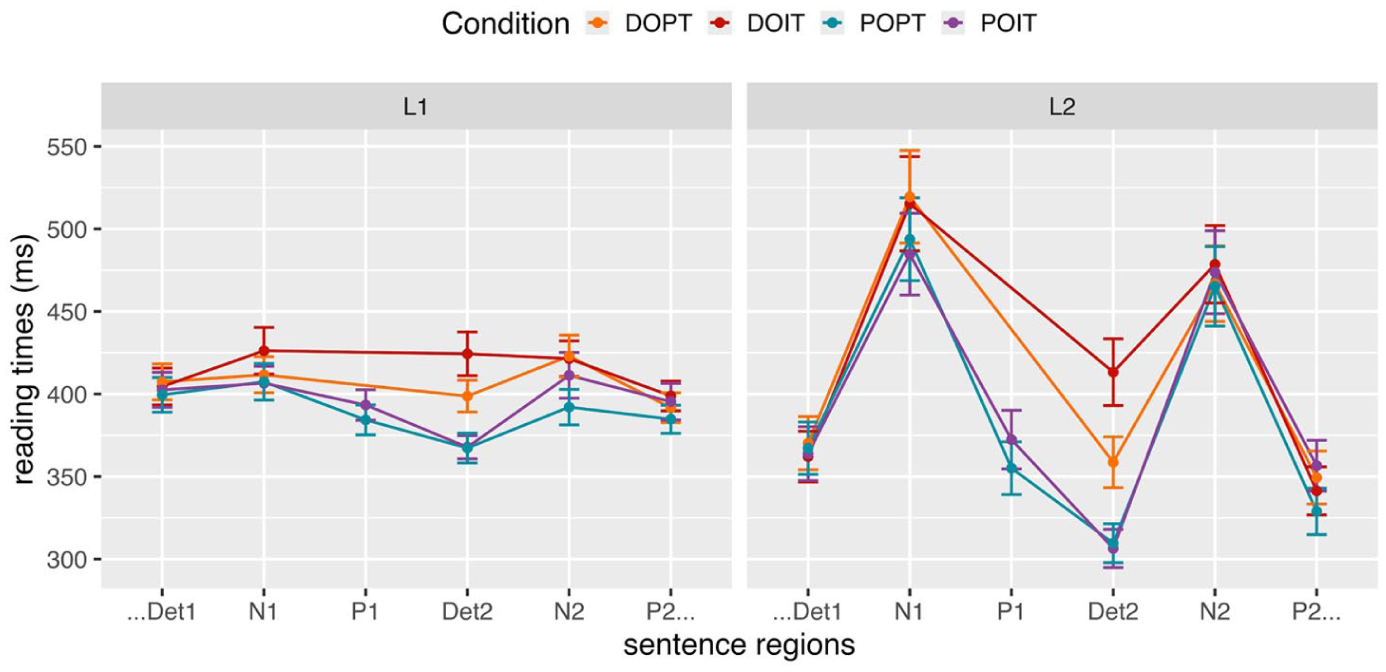
Averaged reading times by region and group.
To investigate the role of proficiency, we centered participants’ LexTALE scores and added these variables as continuous predictors in a separate model using a treatment coding approach for Language Group (L2 coded with 0). We included all critical two- and three-way interactions involving proficiency, random intercepts for participants and items, and by-participant and by-item slopes for fixed effects. Finally, we performed an exploratory analysis of L2 participants’ exposure indices (from a self-reported time percentage of English exposure) implemented also via an equivalent mixed-effect linear regression.
4. Results
Due to a programming error, one experimental item of one list was removed from the analysis in the L2 group. 2 Analysis of the log-transformed reading times at the Det2 region revealed a significant main effect of Sentence Structure, with DO sentences consistently taking longer to read than PO sentences across both groups (t = −10.070, p < .0001) (see Table 1). An exploratory analysis in the L1 group showed no reliable interactions between Sentence Structure and verb, 3 indicating that the overall reading advantage of PO over DO did not reliably differ across verbs. Furthermore, a significant interaction between Sentence Structure and Language Group indicated that L2 participants exhibited more pronounced reading time differences between DO and PO sentences compared to L1 participants (t = −2.034, p = .0436). The analysis also uncovered a significant main effect of Theme Plausibility, with implausible themes leading to longer reading times than plausible themes (t = −4.687, p < .0001). Critically, a significant interaction between Sentence Structure and Theme Plausibility (t = 3.722, p = .00071) indicated that plausibility effects were more pronounced in DO sentences than in PO sentences. No significant three-way interaction with Group emerged, suggesting that plausibility effects were similar across L1 and L2 participants.
Linear mixed-effects regression (LMER) model summary of the reading times analysis across groups.
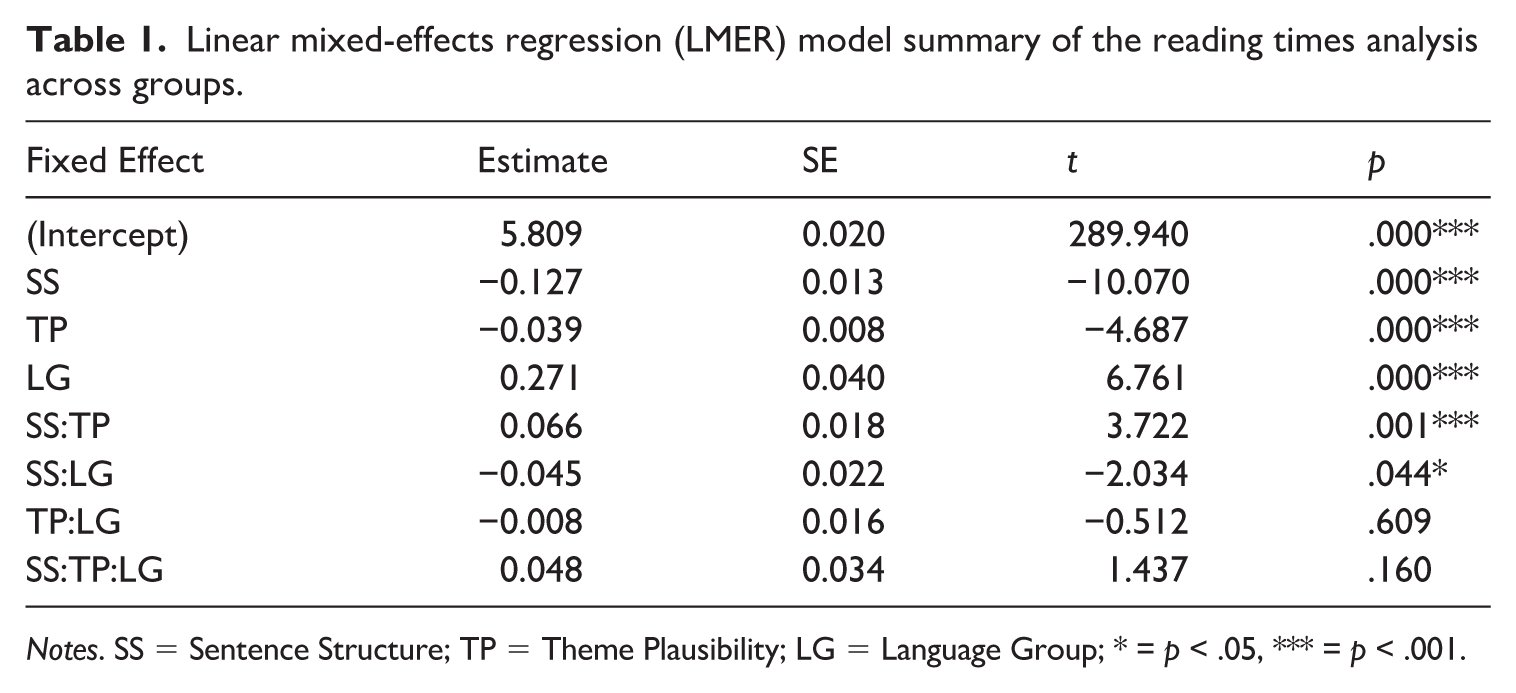
Notes. SS = Sentence Structure; TP = Theme Plausibility; LG = Language Group; * = p < .05, *** = p < .001.
Subsequently, separate analyses for L1 and L2 groups revealed more fine-grained differences (see Table 2). In the L1 group, significant effects of Sentence Structure (t = −6.174, p < .0001) and Theme Plausibility (t = −2.988, p = .00282) were observed. Additionally, an interaction between these factors approached significance (t = 1.819, p = .06901), suggesting a trend toward stronger plausibility effects in DO sentences. For the L2 group, both Sentence Structure (t = −8.901, p < .0001) and Theme Plausibility (t = −3.698, p = .000319) yielded significant effects. The interaction between these factors was also significant (t = 3.745, p = .000284), confirming that plausibility effects were amplified in DO sentences for L2 participants.
Linear mixed-effects regression (LMER) model summary of the reading times analysis by group.
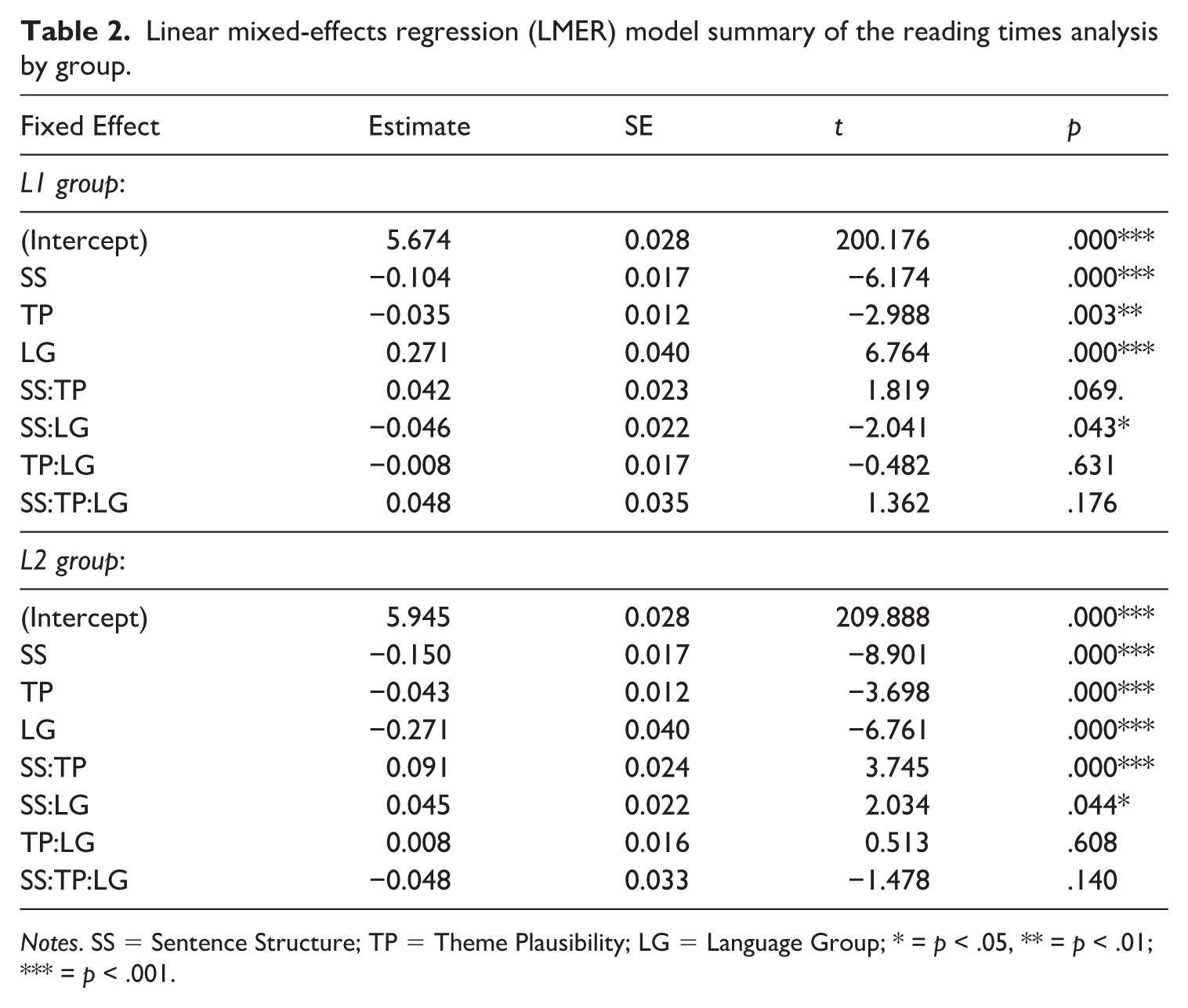
Notes. SS = Sentence Structure; TP = Theme Plausibility; LG = Language Group; * = p < .05, ** = p < .01; *** = p < .001.
Additionally, we implemented a model that included LexTALE proficiency scores (see Table 3). We observed significant interactions of Sentence Structure, Theme Plausibility, and Proficiency (t = −2.608, p = .00966), indicating that differences between plausible versus implausible recipients in DO constructions varied systematically with proficiency levels (see Figure 2). Additionally, a significant interaction of Sentence Structure, Language Group, and Proficiency (t = 2.300, p = .02278) revealed that the extent to which DO sentences proved more difficult than PO sentences depended on participants’ proficiency and whether they were L1 or L2 comprehenders. Other two-way or higher-order interactions with Proficiency were not significant. These findings suggest that less proficient L2 speakers were especially susceptible to increased reading times for DO sentences with implausible recipients, whereas more proficient L2 participants showed somewhat reduced effects.
Linear mixed-effects regression (LMER) model summary of the second language (L2) proficiency analysis on reading times.
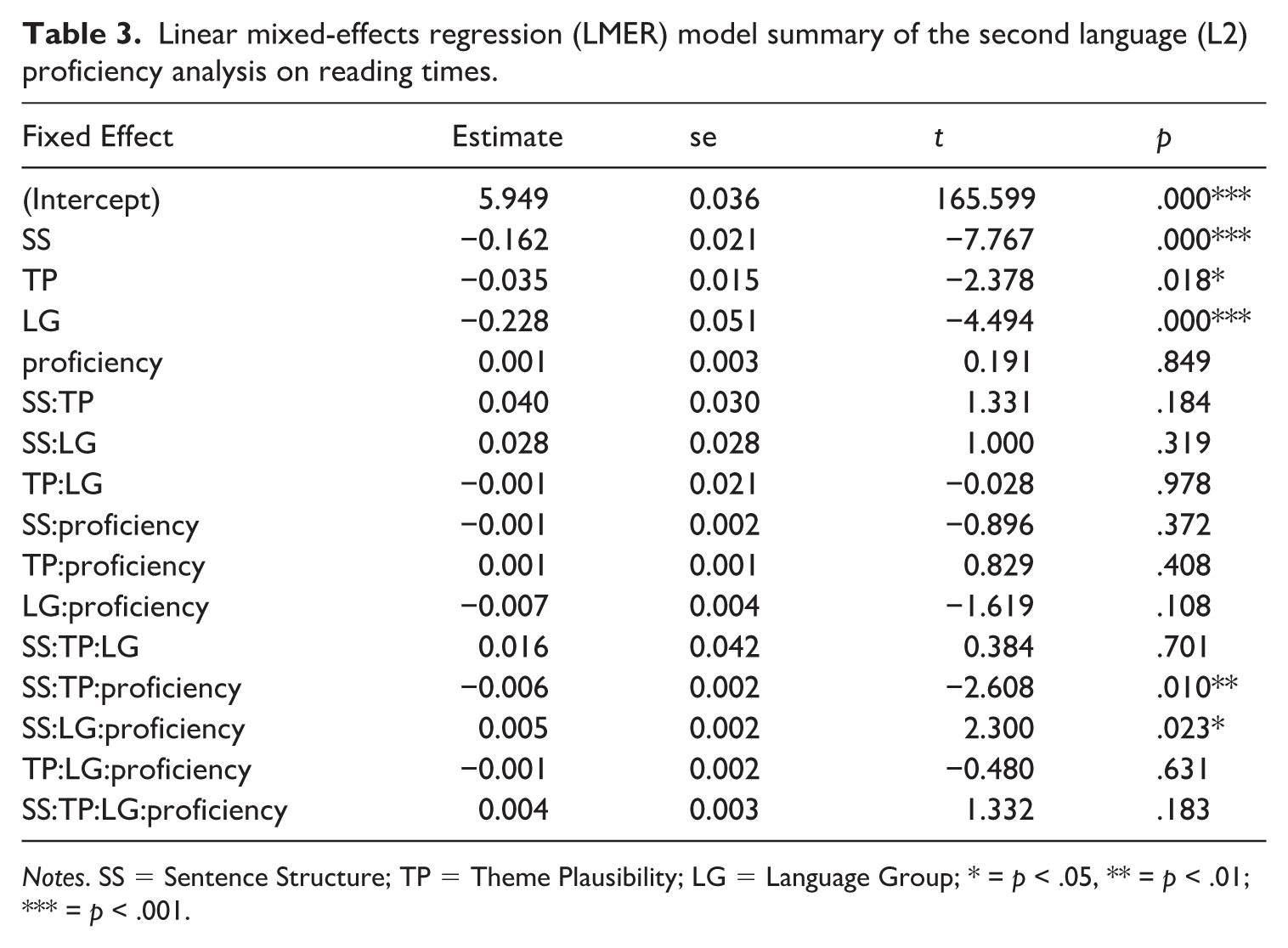
Notes. SS = Sentence Structure; TP = Theme Plausibility; LG = Language Group; * = p < .05, ** = p < .01; *** = p < .001.
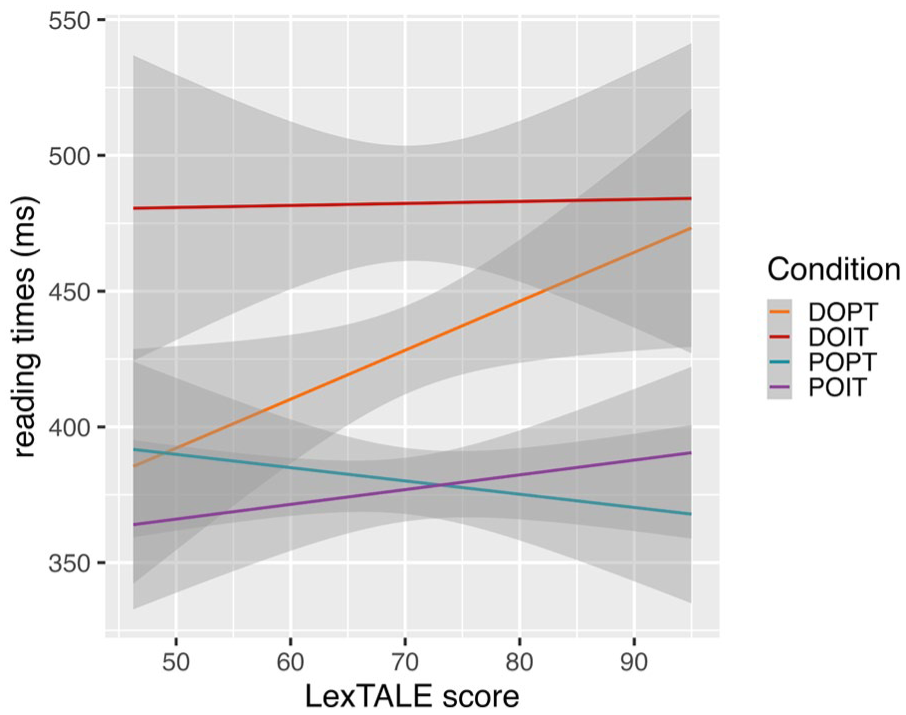
Averaged reading times by condition as a function of English proficiency (indicated by LexTALE scores) in the second language (L2) group.
Finally, we conducted an exploratory analysis examining the relationship between L2 exposure and reading times for the L2 group. While Sentence Structure (t = −8.953, p < .0001), Theme Plausibility (t = −3.390, p = .00179), and the interaction between them (t = 3.381, p = .00182) remained significant predictors, no interaction with exposure was observed, suggesting that exposure did not modulate the observed effects.
5. Discussion
The present study investigated how Spanish–English bilinguals and English monolinguals process double object (DO) and prepositional object (PO) dative constructions in real-time sentence comprehension. Our primary goal was to determine whether Spanish–English speakers – whose first language predominantly uses PO syntax – experience heightened difficulties with DO sentences in their L2, and whether such difficulties derive mainly from structural biases or from animacy constraints. We additionally examined how proficiency and exposure modulate these processes.
Our results show that DO constructions generally incurred greater reading difficulty than their PO counterparts across both bilingual and monolingual groups. In L1 comprehenders, such processing difficulty may reflect relatively lower experience with DO than with PO patterns in sentence contexts like those tested here. Although the frequency of these constructions can vary by verb, our exploratory analysis indicated that the greater difficulty associated with DOs was comparable across verbs in this group. Importantly, bilinguals showed even larger differences between DOs and POs than monolinguals, consistent with the idea that Spanish–English speakers have more limited accumulated experience with DO syntax relative to L1 comprehenders.
Critically, our data demonstrate that DO sentences containing animate recipients, which were plausible themes (e.g. ‘dog’), were read faster than those containing animate recipients, which were implausible themes (e.g. ‘chef’). These findings suggest that participants momentarily treated animate recipients in DOs as though they were themes, likely drawing on a PO preference. This pattern was especially pronounced among L2 comprehenders, indicating that less exposure to DO constructions amplifies the effect. As plausible and implausible themes were both animate, our data suggest that structural preferences – particularly those favoring PO over DO – are the primary driver of the observed processing differences.
Although these results may seem difficult to reconcile with the view that ambiguity leads to processing difficulty, much of the evidence for ambiguity costs comes from garden-path and relative-clause sentences (e.g. Felser et al., 2003; Juffs and Harrington, 1996), which arguably require stronger revision processes than our dative materials. More importantly, in our study ambiguity did not necessarily increase difficulty when one of the possible analyses was strongly supported by plausibility and syntactic frequency information. Thus, plausible themes were easier to read than implausible themes in DOs because their ambiguity aligned with an analysis that was both semantically supported and expected. This interpretation is consistent with previous findings showing reduced difficulty for plausible readings (Pickering and Traxler, 1998; Roberts and Felser, 2011) and experienced-based attachment preferences (Desmet et al., 2006).
Furthermore, proficiency analyses revealed that L2 participants with lower LexTALE scores (reflecting lower English proficiency) were more likely to interpret plausible themes in DOs as though they belonged to a PO construction. This finding suggests that lower proficient bilinguals, whose DO representations are less well-established, do not distinguish between the syntactic possibilities that emerge from the thematic information of L2 dative verbs and tend to favor the PO interpretation that is more strongly supported by their prior experience. Similar proficiency effects have been observed in previous research (Brothers et al., 2021; Lee et al., 2013) in which less proficient bilinguals did not use verb-specific thematic information as much as more proficient bilinguals. In a general language-specific PO bias context, our results provide additional evidence on proficiency-related differences in the sensitivity to L2 structural cues in their syntactic decisions. The finding that such ambiguous recipients were interpreted as POs as a function of L2 experience offers further support for the view that bilinguals, as a group, exhibited processing difficulties mostly due to less accumulated experience with DOs versus POs. Consistent with this, our exploratory analysis showed that current L2 exposure did not modulate these effects, indicating that individual differences in this domain are better captured by proficiency than by other measures of L2 experience. We notice, however, that DO processing in L2 speakers was not influenced by increasing proficiency as we predicted (i.e. longer DO reading times for less than for more proficient bilinguals). We believe that this is precisely due to the finding that lower-proficiency bilinguals interpreted DO ambiguous recipients as easy as PO themes, thus driving an overall decrease in DO reading times for these bilinguals.
Overall, these findings offer insight into how L2 syntactic processing is governed by a confluence of structural preferences and animacy cues – yet with a stronger tilt toward experience-driven parsing when exposure to a particular syntactic pattern is limited. These results align with experience-based frameworks (MacDonald et al., 1994) proposing that parsers routinely capitalize on probabilistic distributions of grammatical structures encountered in linguistic input. For Spanish–English bilinguals, DOs are relatively infrequently encountered compared to POs, both in English at large and in their daily language experiences. Consequently, an animate recipient in a DO position is (mis)analyzed as a theme, thereby momentarily conforming to a PO interpretation, even when animacy cues would suggest a DO interpretation. In contrast, our results are less consistent with the Shallow Structure Hypothesis (Clahsen and Felser, 2006b). Rather than relying primarily on semantic cues such as animacy, L2 comprehenders’ parsing decisions were mostly guided by structural information. This pattern suggests that, even when animacy is held constant, less frequently encountered structures face processing penalties, especially among lower-proficiency L2 speakers.
We note that our materials included dative verbs that vary in how frequently they occur in DO structures. The use of DOs can be viewed as graded rather than categorical, as some verbs readily occur in both structures (often called alternating verbs), whereas others rarely appear in the DO form (non-alternating verbs). 4 Importantly, however, our main findings do not hinge on this distinction, as our core prediction concerned whether animate recipients in DO sentences would pattern differently – that is, whether such recipients would be more likely to be temporarily interpreted as themes associated with a corresponding PO structure. It is also worth noting that our animacy manipulation introduced a human–animal contrast between ambiguous (e.g. dog) and unambiguous (e.g. chef) recipients. This difference arises naturally from our theme-plausibility manipulation, since pets are more plausible themes than humans. In line with previous work showing no reading differences between human and animal themes in DO/PO sentences (Brown et al., 2012), we interpret our effects as driven by theme plausibility rather than by whether the recipient was human or not.
One limitation of the present study is our reliance on self-paced reading, which may not fully capture real-time syntactic revision processes. Eye-tracking or neurophysiological measures (e.g. ERPs) could provide more granular data on how dative structures unfold in the parser. Additionally, future studies might recruit an even broader range of bilingual participants, encompassing diverse proficiency levels and varying degrees of immersion in English-speaking contexts, to ascertain how incremental exposure reshapes structural biases over time. Finally, exploring whether bilinguals exhibit similar preference patterns in other syntactic domains – such as passive constructions or relative clauses – will help clarify the extent to which experience-driven parsing strategies generalize across linguistic structures.
6. Conclusions
In sum, our study shows that Spanish–English bilinguals encounter greater difficulty when processing DO sentences in their L2, driven largely by structural preferences favoring PO interpretations. Although animacy can still influence parsing, the effect of animacy in our dataset appears secondary to structural considerations tied to bilinguals’ accumulated experience. Lower-proficiency bilinguals, in particular, display a pronounced tendency to treat ambiguous animate nouns in DO constructions as if they were themes, reflecting their preference for the PO structure. These findings underscore the intricate interplay between syntactic experience and animacy cues in shaping bilingual sentence comprehension.
Footnotes
Appendix A: Stimuli
Appendix B
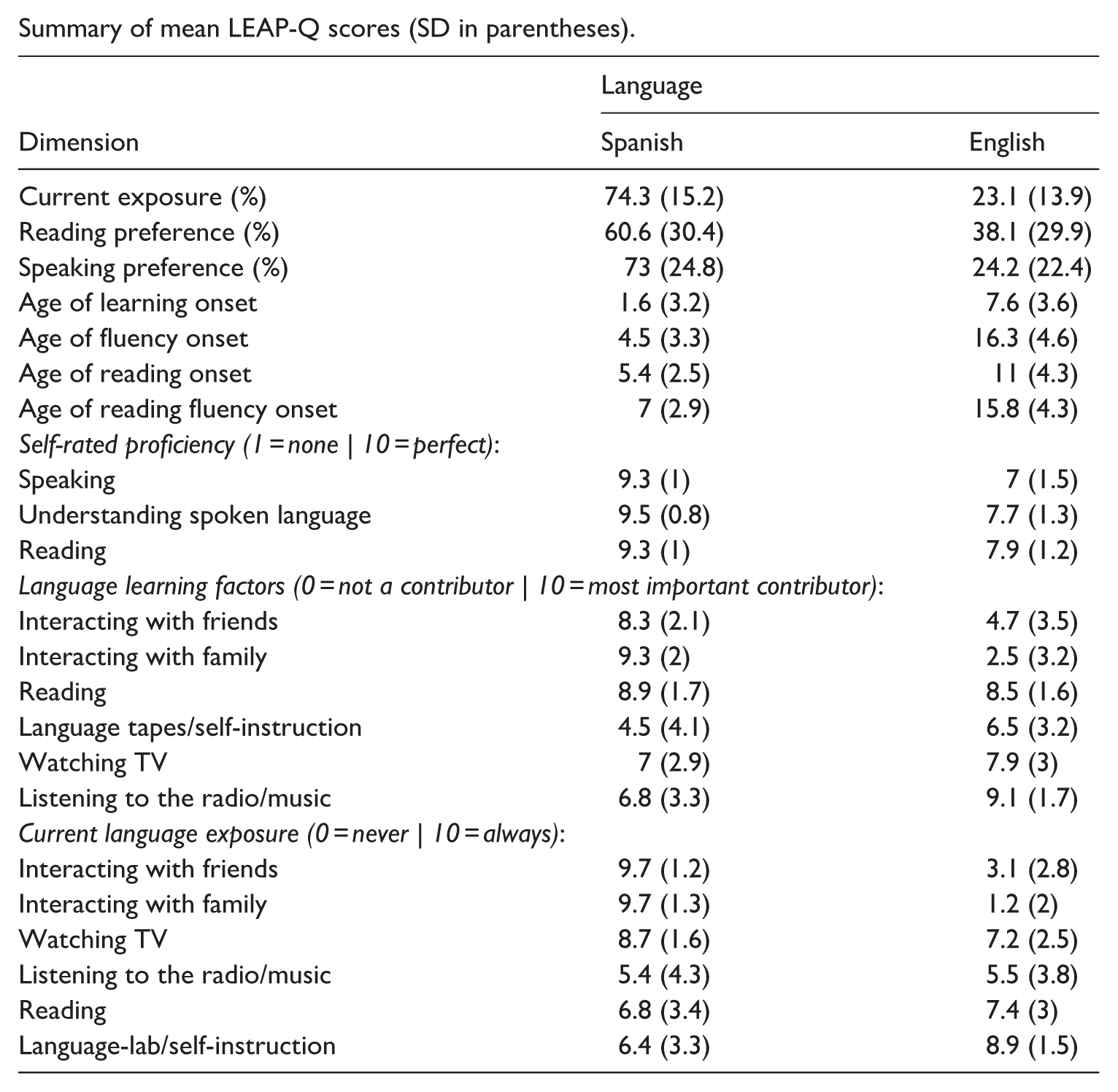
Summary of mean LEAP-Q scores (SD in parentheses).
| Dimension | Language | |
|---|---|---|
| Spanish | English | |
| Current exposure (%) | 74.3 (15.2) | 23.1 (13.9) |
| Reading preference (%) | 60.6 (30.4) | 38.1 (29.9) |
| Speaking preference (%) | 73 (24.8) | 24.2 (22.4) |
| Age of learning onset | 1.6 (3.2) | 7.6 (3.6) |
| Age of fluency onset | 4.5 (3.3) | 16.3 (4.6) |
| Age of reading onset | 5.4 (2.5) | 11 (4.3) |
| Age of reading fluency onset | 7 (2.9) | 15.8 (4.3) |
| Self-rated proficiency (1 = none | 10 = perfect): | ||
| Speaking | 9.3 (1) | 7 (1.5) |
| Understanding spoken language | 9.5 (0.8) | 7.7 (1.3) |
| Reading | 9.3 (1) | 7.9 (1.2) |
| Language learning factors (0 = not a contributor | 10 = most important contributor): | ||
| Interacting with friends | 8.3 (2.1) | 4.7 (3.5) |
| Interacting with family | 9.3 (2) | 2.5 (3.2) |
| Reading | 8.9 (1.7) | 8.5 (1.6) |
| Language tapes/self-instruction | 4.5 (4.1) | 6.5 (3.2) |
| Watching TV | 7 (2.9) | 7.9 (3) |
| Listening to the radio/music | 6.8 (3.3) | 9.1 (1.7) |
| Current language exposure (0 = never | 10 = always): | ||
| Interacting with friends | 9.7 (1.2) | 3.1 (2.8) |
| Interacting with family | 9.7 (1.3) | 1.2 (2) |
| Watching TV | 8.7 (1.6) | 7.2 (2.5) |
| Listening to the radio/music | 5.4 (4.3) | 5.5 (3.8) |
| Reading | 6.8 (3.4) | 7.4 (3) |
| Language-lab/self-instruction | 6.4 (3.3) | 8.9 (1.5) |
Ethics approval
This study was approved by the Social Sciences and Humanities Research Ethics Committee (approval number 1221792), Faculty of Philosophy and Humanities, Universidad de Chile, on 25 May 2022.
Consent to participate
All participants provided written informed consent prior to participating.
Funding
The authors disclosed receipt of the following financial support for the research, authorship, and/or publication of this article: Matías Morales is supported by the National Agency for Research and Development (ANID/FONDECYT postdoctoral grant 3240535). Funding from ANID CIAE CIA250005 is gratefully acknowledged.
Declaration of conflicting interests
The authors declared no potential conflicts of interest with respect to the research, authorship, and/or publication of this article.
Data availability statement
This study was pre-registered on OSF at https://osf.io/hcpv5. All data, materials, and analysis code are available at  .
.