






Abstract
Research on scalar implicatures has increasingly highlighted ‘scalar diversity’, showing that pragmatic inferences vary systematically across lexical scales rather than arising uniformly. Two factors pertaining to the semantic structure of adjectives are found to play a particularly influential role: ‘endpoint salience’, where scales with fixed boundaries more readily support implicatures, and ‘semantic distance’, where the further a stronger scalemate is from its weaker counterpart, the more likely an implicature is to be derived. While these effects are well documented among native speakers, little is known about how second language (L2) learners navigate such dimensions. Across three experiments, we examined how proficiency modulates L2 learners’ sensitivity to these semantic factors in gradable adjectives. Experiment 1 showed that learners were broadly sensitive to whether or not an adjective denotes an endpoint, but awareness strengthened as proficiency increased. Experiment 2 revealed that learners’ perceptions of semantic distance between scalemates were more pronounced on scales with endpoint denoting adjectives versus those without. Experiment 3, an inference evaluation task, demonstrated that while both groups generated more implicatures on bounded than unbounded scales, lower proficiency learners tended to endorse implicatures more broadly, whereas higher proficiency learners displayed a near native-like tendency to suspend inferences until sufficient context was available. Together, these findings suggest that increasing proficiency promotes greater sensitivity to scale structure and more flexible integration of semantic and pragmatic information during implicature generation.
Keywords
1. Introduction
Scalar implicatures (SIs) are pragmatic inferences that arise when a speaker selects a weaker term from an ordered set of lexical alternatives, leading listeners to infer that a stronger alternative does not hold. For example, the utterance ‘Some cookies were eaten’ is typically interpreted to mean that not all the cookies were eaten, even though the literal meaning of some is logically compatible with all. This inference arises not from semantics alone but from pragmatic reasoning, guided by principles of cooperative communication such as informativeness and relevance (Geurts, 2010; Grice, 1975; Noveck, 2018). Scalar implicatures thus provide a rich testbed for investigating how human cognition navigates between linguistic form, speaker intent, and context.
A long-standing debate in experimental pragmatics concerns which interpretation of the scalar phrase is computed first: the literal or the pragmatic. Do listeners first access literal meanings and then enrich them, or are pragmatic inferences generated by default? Neo-Gricean two-step models propose that SIs are computed automatically via general conversational heuristics, with the enriched (pragmatic) interpretation being derived prior to the literal one, making the implicature the default or primary interpretation (Gazdar, 1979; Levinson, 2000). In contrast, implicature derivation in Relevance Theory is seen as cognitively demanding and occurs only when the context requires it, in line with the principle of maximizing relevance via a tradeoff between effort and expected effects (Noveck, 2018; Sperber and Wilson, 1995).
Relatedly, constraint-based accounts suggest that literal and pragmatic interpretations are processed in parallel, with contextual factors ultimately modulating the hearer’s final interpretation through Bayesian means (Degen and Tanenhaus, 2015, 2019). In addition to pragmatic and constraint-based accounts, grammatical approaches argue that SIs arise through exhaustivity operators encoded directly in the grammar, and whose application is guided by the lexical structure of scales (Chierchia, 2006; Chierchia et al., 2012). On this view, endpoint-denoting terms such as impossible in a <difficult, impossible> scale arise as particularly strong candidates for exhaustification, predicting greater stability of implicatures on bounded scales.
Thus, a second, more recent line of inquiry complicates the processing debate by emphasizing scalar diversity – the idea that not all scalar terms behave equally when it comes to implicature derivation. While classic scales such as <some, all> reliably elicit SIs, others – like <like, love> or <pretty, beautiful> – do so far less consistently (Doran et al., 2012; Orr et al., 2024; van Tiel et al., 2016). Such findings suggest that the likelihood of SI derivation may depend not only on general cognitive mechanisms but also on the properties of individual lexical scales.
Recent work has identified two semantic factors that strongly predict implicature behavior in gradable adjective scales.
Endpoint salience: Scales whose stronger term denotes a fixed boundary (e.g. impossible in <difficult, impossible>) tend to elicit implicatures more often than those whose stronger terms are relative and context-dependent (e.g. brilliant in <intelligent, brilliant>) (Gotzner et al., 2018; Kennedy and McNally, 2005; Orr et al., 2024).
Semantic distance: When two scalemates are perceived as overlapping in meaning (e.g. pretty and beautiful, both being judged as equally applicable to the same entity), listeners are less likely to construe them as distinct alternatives and therefore less likely to derive implicatures (Orr et al., 2024; Sun et al., 2018).
By contrast, when scalemates are perceived as occupying clearly distinct regions on a scale (e.g. tall vs. gigantic on a height scale), listeners are more likely to interpret them as non-overlapping alternatives, thereby facilitating implicature derivation.
Second language (L2) acquisition provides an especially informative testing ground for investigating how semantic and pragmatic factors interact in this process. It is thought that a learner’s first language (L1) and L2 are co-activated to varying degrees when processing L2 input, and this co-activation comes with cognitive costs associated with inhibiting one language while using the other (Dijkstra, 2009; Green, 1998; Marian and Spivey, 2003). Beyond these processing challenges, L2 learners must also acquire the meanings of individual adjectives and understand how they relate to one another within a scale, and how such relationships can support pragmatic inferences. This process can be further complicated by lexical transfer from the L1 (Mazzaggio et al., 2025; Starr and Mazzaggio, 2026). Prior work on L2 implicatures has focused primarily on quantifier scales such as <some, all>, with findings ranging from nativelike performance (Miller et al., 2016; Snape and Hosoi, 2018) to evidence of processing constraints or reliance on pragmatic defaults (Lin, 2016; Slabakova, 2010). Far less is known, however, about how L2 learners handle adjectival scales, which are less categorical and for which implicature generation is more context-sensitive, thereby presenting a distinct set of challenges.
The present study builds on this line of inquiry by examining whether endpoint salience and semantic distance influence L2 learners of French and native French speakers’ implicature derivation behavior in gradable adjective scales. Across three experiments, we assess whether learners perceive properties of scale structure in adjectives, whether they distinguish between adjectives on bounded versus unbounded scales in terms of semantic distance, and whether proficiency modulates their use of semantic cues in pragmatic reasoning. In doing so, this work extends the study of scalar diversity into the L2 domain and sheds light on how learners integrate the structural properties of adjectives during inferential reasoning processes.
1.1. Scalar diversity
Traditional accounts of pragmatic inferences typically assume that the mechanism underlying SI generation with some should generalize across other lexical scales. For example, because intelligent denotes a lower scalar value than brilliant, it is presumed that Gricean reasoning applies similarly to adjective scales. If John says of Sally, ‘She is intelligent,’ listeners may infer that he deliberately avoided the stronger term brilliant. However, although the resulting implicature communicates that Sally is not brilliant, the literal meaning of intelligent remains semantically compatible with the stronger term. Therefore, the use of intelligent could still imply brilliant. Thus, deriving SIs on any scale involves evaluating both the literal meaning of the expression and the range of pragmatic inferences the speaker may be intending to convey.
That any two lexical items which share a scalar relationship will reliably produce implicatures when the weaker term is uttered is known as the uniformity assumption (van Tiel et al., 2016). To test this, van Tiel et al. (2016) had native English-speaking participants evaluate trials as in (3) in an inference evaluation task: (1) John says: This student is intelligent. Would you conclude from this that, according to John, she is not brilliant?
A ‘yes’ response signals derivation of the inference (i.e. intelligent but not brilliant) while ‘no’ indicates inference suspension and a lower bound interpretation of the scalar expression (i.e. intelligent and possibly brilliant). The authors surveyed 43 scales across a variety of lexical items, including adjectives, adverbs, quantifiers, and verbs, finding that gradable adjective scales yielded significantly fewer implicatures overall. These results echoed earlier findings, which had shown a similar trend (Baker et al., 2009; Doran et al., 2012). Researchers speculated that boundaries between adjectives are often vague, and so weaker values may be used to describe a scenario where the stronger term is also true. For example, a student who consistently earns top grades and demonstrates exceptional insight may rightly be described as brilliant, yet calling them intelligent would still be accurate.
Later investigations revealed that the properties of lexical scales themselves, such as polarity, semantic distance, and boundedness, helped explain some of the variance in SI rates (Gotzner et al., 2018; Orr et al., 2024; Sun et al., 2018; Pankratz and van Tiel, 2021). Boundedness, for example, accounted for between 10% (van Tiel et al., 2016) and 31% (Sun et al., 2018) of the variation and was a prominent predictor of scalar diversity, particularly for gradable adjective scales. Indeed, there is a distinction between bounded and unbounded adjective scales in terms of whether the stronger scalar term in each represents an endpoint (Kennedy, 2007; Kennedy and McNally, 2005; Paradis, 2001).
Kennedy and McNally (2005), for example, highlight how absolute adjectives like impossible, dead, and complete serve to describe a property that is either fully present or absent, with no intermediate degrees. Thus, their interpretation is typically context-independent, making them especially salient vis-à-vis their scalemates in scalar inference tasks (Gotzner et al., 2018; Orr et al., 2024; van Tiel et al., 2016). In contrast, relative adjectives representing the stronger term in unbounded scales like hilarious in <funny, hilarious> or hideous in <ugly, hideous> are interpreted contextually and do not represent fixed endpoints. Their meaning depends on comparison to a standard that may vary across contexts. Furthermore, since boundaries between relative adjectives are vague, the accessibility of the alternative is reduced, and SIs are less likely (Leffel et al., 2019).
Orr et al. (2024) further observed that perception of distance between lexical items is a crucial prerequisite for scalar construal, remarking that the lower bounds of any two scalar expressions must be far enough apart so that a weak/strong relationship can emerge in the user’s mind. If the meanings of the two terms overlap or share the same interval, it will be much more difficult to generate enough distance wherein an x but not y implicature can emerge. Orr and colleagues investigated these effects by probing participant awareness of the scalar properties of boundedness and semantic distance in two pre-tests. Results from a subsequent inference task revealed that bounded scales containing entrenched scalar structures, such as endpoint-denoting adjectives (which result in greater perceived distance between scalemates), produce higher SI rates compared to unbounded scales (where less distance is perceived between the weak and strong expressions).
In explanation of their findings, Orr et al. (2024) reference Barner et al.’s (2011) developmental account of SI derivation. The idea is that children only succeed in deriving SIs in quantifier scales once they acquire the ability to conceptualize a scalar relationship between some and all. Once the connection is established, all can be recognized as a stronger alternative to some, which facilitates implicature generation (see also Foppolo et al., 2012; Noveck, 2001; Papafragou and Musolino, 2003; Sullivan et al., 2019). A natural extension of this line of reasoning is to consider how second language (L2) learners perform in SI tasks, particularly considering the cognitive and representational demands associated with establishing scalar relationships.
1.2. Implicatures in L2 acquisition
Research on L2 acquisition of SIs has produced a range of intriguing but often unexpected findings in recent years (Feng, 2024; Longo and Mazzaggio, 2026). Slabakova’s (2010) seminal study tested L1 Korean-L2 English learners’ interpretation of underinformative phrases like Some books have pages in an offline truth-value judgement task. While these sentences are true in their literal sense, the upper-bound some but not all reading renders the statement false. 1 It was found that learners disagreed with such statements far more than native speakers, prompting Slabakova to reason that learners have difficulty overturning default pragmatic interpretations. The idea that learners experience a cognitive bottleneck that prevents consideration of the alternative lower-bound semantic meaning of some supports a Neo-Gricean view of implicature generation, yet subsequent studies employing similar offline methods have raised questions about this account.
For example, although Miller et al. (2016) found that L1-Spanish–L2-English learners derived implicatures with the Spanish equivalent of some at rates comparable to native speakers, their findings nevertheless failed to confirm Slabakova’s original claim of an emergent L2 ‘pragmatic default’. Additionally, Snape and Hosoi’s (2018) L1-Japanese–L2-English learners did not differ statistically from native English or native Japanese speakers in a truth-value judgement task. Nevertheless, both L2ers and native speakers were divided into comparable sets of logical versus pragmatic responders, replicating a key finding from Slabakova (2010) regarding individual differences.
Dupuy et al. (2019), in a study of L1 French learners of L2 English and Spanish, showed that pragmatic response rates increased when participants were tested in both their L1 and L2 using a within-subjects design (Experiment 1a). By contrast, a between-subjects design (Experiment 1b), where learners were tested only in their L2, resulted in lower implicature rates. The authors argued that Slabakova’s (2010) elevated implicature rates may have stemmed from her within-subjects methodology, potentially heightening learners’ sensitivity to pragmatic cues through cross-linguistic comparison.
Studies incorporating online measures have produced further conflicting findings. Lin (2016) investigated how L1 Mandarin learners of English interpret some in context-rich sentences (e.g. John has many dictionaries. Some dictionaries are used.) and found that learners readily accepted pragmatic readings and were slower to interpret logical ones, particularly under time pressure. This suggests greater cognitive effort is needed to suppress implicatures during L2 processing. In contrast, Mazzaggio et al. (2021) and Khorsheed and van Tiel (2025) observed that learners tend to accept pragmatically infelicitous statements (e.g. Some children are humans) under time constraints, aligning with predictions from Relevance Theory (Sperber and Wilson, 1995).
Khorsheed and van Tiel (2025) further demonstrated a notable methodological effect: in Experiment 1, L1-Malay–L2-English learners showed native-like rates of implicature derivation during an untimed, self-paced task; however, in Experiment 2, where participants read sentences word-by-word and were instructed to respond as quickly as possible, low-proficiency learners were significantly less likely to derive implicatures than their high-proficiency peers. These findings highlight the central roles of proficiency and processing capacity in L2 implicature generation. Related work in bilingual and developmental populations further shows that sensitivity to scalar alternatives can emerge early and that implicature rates increase when tasks make alternatives more explicit, underscoring the role of methodological factors in performance variability (Spychalska et al., 2016; Syrett et al., 2017; Vargas-Tokuda et al., 2009).
Notably, most L2 studies utilize the <some, all> scale, leaving open the question of how learners process implicatures from other scalar expressions. Recent exceptions include Feng and Cho (2019), Mazzaggio et al. (2025), Sun and Feng (2025), Starr and Destruel (2025), and Destruel and Starr (2025). In a sentence-picture verification task, Mazzaggio and colleagues examined SI derivation for six scalar terms – low, scarce, might, some, most, and try – and found that L1-Slovenian–L2-English learners patterned similarly to L1 Slovenian speakers, but showed slight differences from L1 English controls, suggesting possible L1 transfer effects. Notably, processing times were comparable across groups, contrasting with earlier findings from Mazzaggio et al. (2021).
Adopting the same design and scale set as van Tiel et al. (2016), Sun and Feng (2025) explored scalar diversity in L1-Chinese–L2-English learners by assessing SI rates and perception of semantic distance across two experiments. Interestingly, they found boundedness and semantic distance predictive of overall L2 implicature derivation behavior, though these structural factors were found to have weaker effects in comparison to native English speakers. Moreover, learners with greater proficiency were more sensitive to boundedness when generating implicatures, deriving them more often in bounded versus unbounded scales. However, perceived semantic distance did not prove to be a reliable predictor in this way.
Employing a bidirectional design while also using van Tiel et al.’s (2016) methodology, Starr and Destruel (2025) further examined scalar diversity effects in L1-French–L2-English and L1-English–L2-French learners. However, the study focused on adjectival scales exclusively and investigated sensitivity to boundedness alone. Native French and English control groups derived implicatures more frequently in bounded vs. unbounded scales, consistent with prior findings that endpoint-denoting adjectives strengthen scalar contrasts and increase SI rates. Native speakers were more likely to interpret difficult as not impossible in a bounded <difficult, impossible> scale but then suspend the inference in an unbounded <intelligent, brilliant> scale (i.e. interpreting intelligent as compatible with brilliant). In contrast, L2ers showed limited sensitivity to boundedness, defaulting to upper-bound readings regardless of scale type. Nevertheless, as in Sun and Feng (2025), an intriguing proficiency effect emerged: more advanced learners patterned more closely with native speakers, deriving implicatures selectively in accordance with scale type.
These results provide preliminary evidence that greater command of language facilitates awareness of underlying semantic cues in scales that, in turn, affect the rate at which SIs are generated. L2ers’ graded sensitivity to the semantic characteristic of boundedness further suggests a hierarchy of non-structural information types. That is, L2ers may adopt somewhat of a default pragmatic heuristic in SI scenarios, eschewing consideration of semantic entailment relations either due to processing constraints or because of a still-developing understanding of the scalar relationship between gradable adjectives.
2. The study
The current work builds on the investigation into how L2 learners derive implicatures in adjective scales but expands upon the literature in several ways. In Starr and Destruel (2025), the learners’ performance raised several questions that the study design could not address. First, it is unclear whether learners recognized that the provided adjectives were on the same scale. If learners conceptualized the adjectives in each pair as distinct items in the L2 lexicon, unaware that the two terms share a scalar relationship, then a ‘yes’ response in the inference evaluation task does not mean that a scalar inference was derived. Rather, learners may simply interpret intelligent as not brilliant via an exclusion (or mutual exclusivity) inference (Katsos and Wilson, 2014; Sullivan et al., 2019). 2 That is, they may not be aware that brilliant is a relevant alternative to intelligent or that one is informationally stronger than the other. Similarly, they may not be aware that the two words share entailment relations or the same semantic field. Formal SI derivation processes necessitate reasoning about these conditions when deciding whether to enrich the literal meaning of a scalar expression (Chierchia, 2006; Chierchia et al., 2012; Horn, 1972, 1989).
Following this, it is uncertain whether learners are knowledgeable about structural properties of gradable adjective scales such as boundedness and distance, traits which predict SI rates in experiments with native speakers (NSs) (Gotzner et al., 2018; Orr et al., 2024; Starr and Destruel, 2025; van Tiel et al., 2016). That is, L2ers may not recognize that impossible serves as an endpoint on the <difficult, impossible> scale or the extent to which the meanings of pretty and beautiful on the <pretty, beautiful> scale overlap, if at all. Thus, in our first two experiments, we test awareness of these structural properties in L2 learners.
After investigating the perception of these cues and relationships, we extend the investigation of this phenomenon further in Experiment 3. Following van Tiel et al. (2016), Orr et al. (2024), Sun and Feng (2025), and Starr and Destruel (2025), we employ an inference evaluation paradigm where participants read statements containing a weak scalar expression (e.g. Charles says that the professor is intelligent) and answer whether it is possible to conclude that, according to the speaker, the stronger statement does not hold (i.e. That the professor is intelligent, but not brilliant). Recall that a ‘yes’ response signals the derivation of the implicature, but ‘no’ indicates that the SI has been suspended and that the participant has interpreted the weaker term as compatible with the stronger one (i.e. The professor is intelligent and possibly brilliant).
Building from preliminary evidence in Starr and Destruel (2025), we predict that greater familiarity with the L2 enhances perception of semantic characteristics in gradable adjectives. With this knowledge, it is anticipated that highly proficient learners will more closely resemble native speakers in their inference derivation behavior. We expect more inferences to be derived in bounded scales where the distance between scalemates is perceived to be greater. At the same time, we anticipate a greater preponderance of inference suspension in unbounded scales wherein adjectives may overlap in degree, thus removing a key prerequisite of implicature generation.
Our participants comprised two populations: Monolingual native speakers of French (FNS) and L1-English–L2-French learners (L2ers). Overall, we tested a total of 184 participants. An a priori power analysis (f² = .15, α = .05, power = .80) indicated a minimum sample of 58 participants; each experiment met or exceeded this threshold. 60 participants (29 FNS and 31 L2ers) completed Experiment 1; another 64 participants completed Experiment 2 (33 FNS and 31 L2ers); and a group of 60 participants completed the inference evaluation task (35 FNS and 25 L2ers). All participants completed a short biographical questionnaire and a cloze test taken as a proficiency measure (Tremblay, 2011). The cloze test required participants to fill in missing words (45 blanks) from a text taken from a non-technical French newspaper article (314 words). Therefore, the maximum score possible was 45/45. Our scoring protocol followed Tremblay’s (2011) recommendations, and the scores were treated as a continuous variable in our analysis unless otherwise specified.
All FNS participants for the first two experiments were recruited from a university in Southern France, where they were either students or staff. L2ers who took part in these first two experiments were recruited from a Midwestern university in the U.S. Both groups completed a pen-and-paper task. 3 The FNS participants for Experiment 3 were recruited online using Prolific (Palan and Schitter, 2018). They completed the task on their personal computer and were paid $8. L2ers in the main task were recruited from two large Midwestern universities in the US and completed the task in a lab setting. They either received partial course credit or were compensated $15 for participating. Biographical details for all groups are summarized in Table 1 below.
Participants’ biographical details, language experience, and proficiency scores.
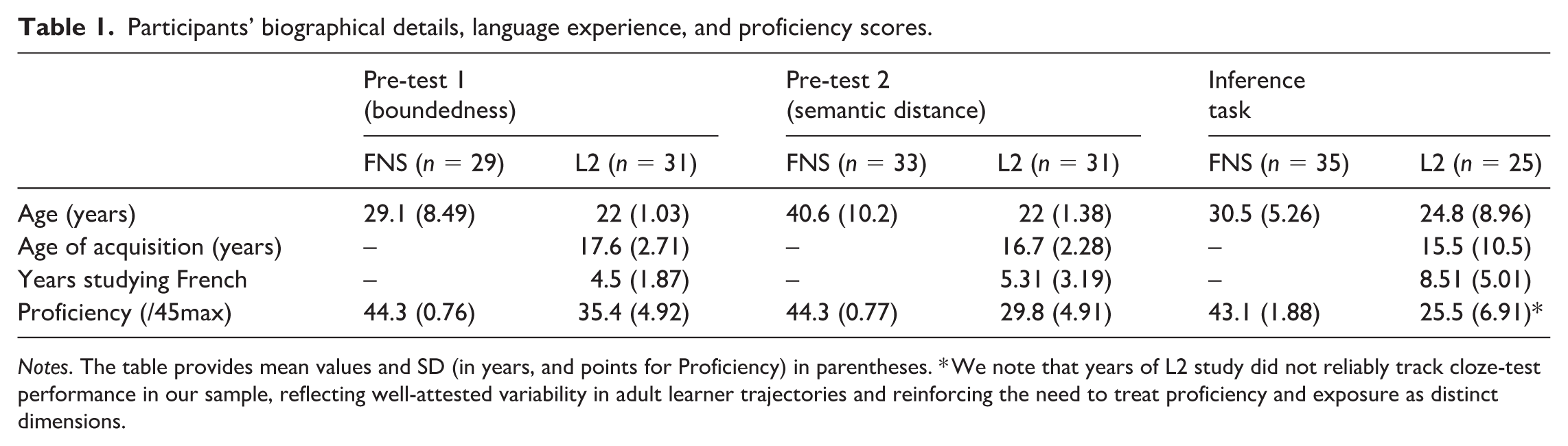
Notes. The table provides mean values and SD (in years, and points for Proficiency) in parentheses. * We note that years of L2 study did not reliably track cloze-test performance in our sample, reflecting well-attested variability in adult learner trajectories and reinforcing the need to treat proficiency and exposure as distinct dimensions.
3. Experiment 1: Perceived boundedness of scalar adjectives
3.1. Methods
The goal of Experiment 1 is to empirically examine and quantify sensitivity to the structural property of boundedness in adjectives. As a reminder, bounded scales are those where the stronger scalar expression denotes an endpoint (e.g. full in <empty, full>), whereas in unbounded scales, the stronger expression, similarly to the weak expression, does not have a specific limit or degree boundary, but rather denotes an interval (e.g. brilliant in <intelligent, brilliant>) (Kennedy, 2007; Kennedy and McNally, 2005; Paradis, 2001). Past literature has found boundedness to affect the frequency with which scalar implicatures arise, with bounded expressions being associated with higher rates of implicature derivation (Gotzner et al., 2018; Pankrats and van Tiel, 2021; Starr and Destruel, 2025; van Tiel et al., 2016).
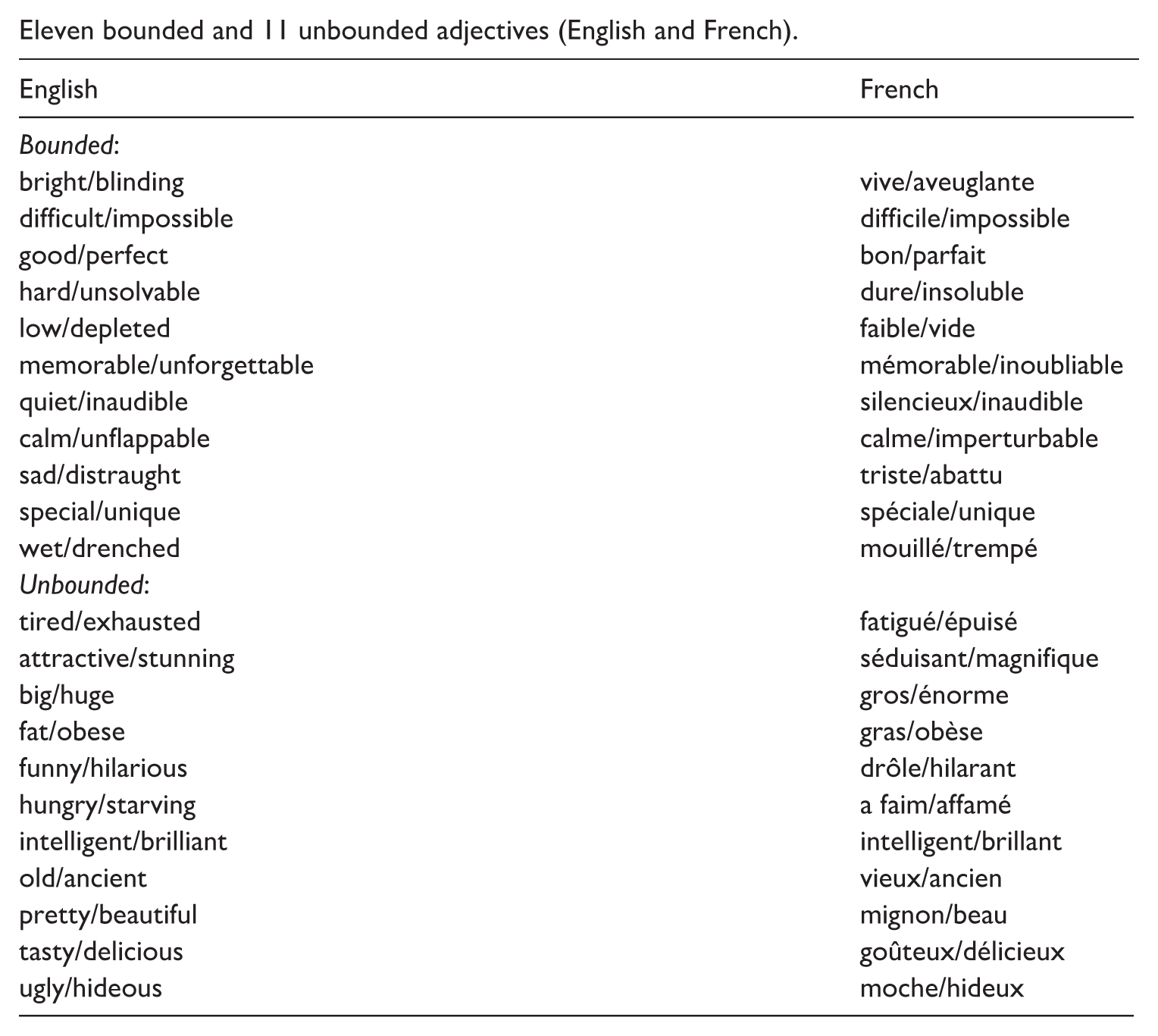
To explore this effect, we adapted the design of the second experiment in Orr et al. (2024). The materials included a total of 22 experimental items (strong adjectives from 11 bounded and 11 unbounded pairs) plus 10 fillers (see Appendix A), presented in French. 4 The filler items included verbs. 5 We selected extreme adjectives (EAs) when choosing strong terms for each scale type (Morzycki, 2012; Paradis, 2001). EAs are compatible with extreme degree modifiers such as simply, just, positively, absolutely, and flat-out, among others. 6 Following Kennedy and McNally’s (2005) classification scheme, the strong terms in bounded scales are both absolute adjectives and compatible with either proportional, maximality, or endpoint-oriented modifiers such as 100%, almost, completely, fully, mostly, and totally while the relative adjectives in unbounded scales are not.
We created four experimental lists that included all 32 items in randomized order. This experiment was delivered to participants as a pen-and-paper task in a quiet room. Each item consisted of a statement of the form ‘X says: The Noun is Adjectivestrong’ followed by a conclusion sentence asking participants to indicate if, in principle, it is possible for ‘Noun to be even more Adjectivestrong’, with Adjective being the stronger adjective of the pair tested. To illustrate, consider (2) for the pair ‘intelligent/brilliant’: Participants had to rate how likely it is that the professor described as ‘brilliant’ could be ‘even more brilliant’.
(2) Anna dit: Le professeur est brillant. ‘Anna says: “The professor is brilliant.” ’ En principe, est-il possible que le professeur soit encore plus brillant ? ‘In principle, is it possible for the professor to be even more brilliant?’

Participants indicated their response by circling the selected rating on a 7-point Likert scale placed adjacent to the conclusion statement. Three points were labeled: The left-end ‘1’ was labeled as ‘No, absolutely not / Non absolument pas’, the mid-point ‘4’ was labeled as ‘Maybe / Peut-être’, and the right-end ‘7’ was labeled as ‘Yes, of course / Oui, bien évidemment’. We expect that participants will rate adjectives closer to or at the right-end point, ‘Yes, of course’, if they conceptualize the meaning as unbounded. A rating closer to the left end of the scale indicates that participants do not think the noun can have more of the specified attribute.
3.2. Results 7
Investigating participant awareness of the structural property of boundedness, we first report mean ratings for each group according to adjective type. Figure 1 shows that both groups think it is less likely that strong, bounded adjectives can be ‘more Adjectivestrong’. These adjective types receive a mean rating of 2.03 (SD = 1.26) from L2ers and 1.85 (SD = 1.16) from French native speakers (FNSs). On the other hand, noticeably higher ratings are provided for strong terms on unbounded scales, indicating that both L2ers and FNSs treat these adjectives as being more fluid and without a fixed scalar position or interval. L2ers give strong adjectives on unbounded scales a mean rating of 5.9 (SD = 0.93) while FNSs give a mean rating of 6.06 (SD = 0.94). Thus, at first glance, both groups seem similarly sensitive to endpoint semantics.
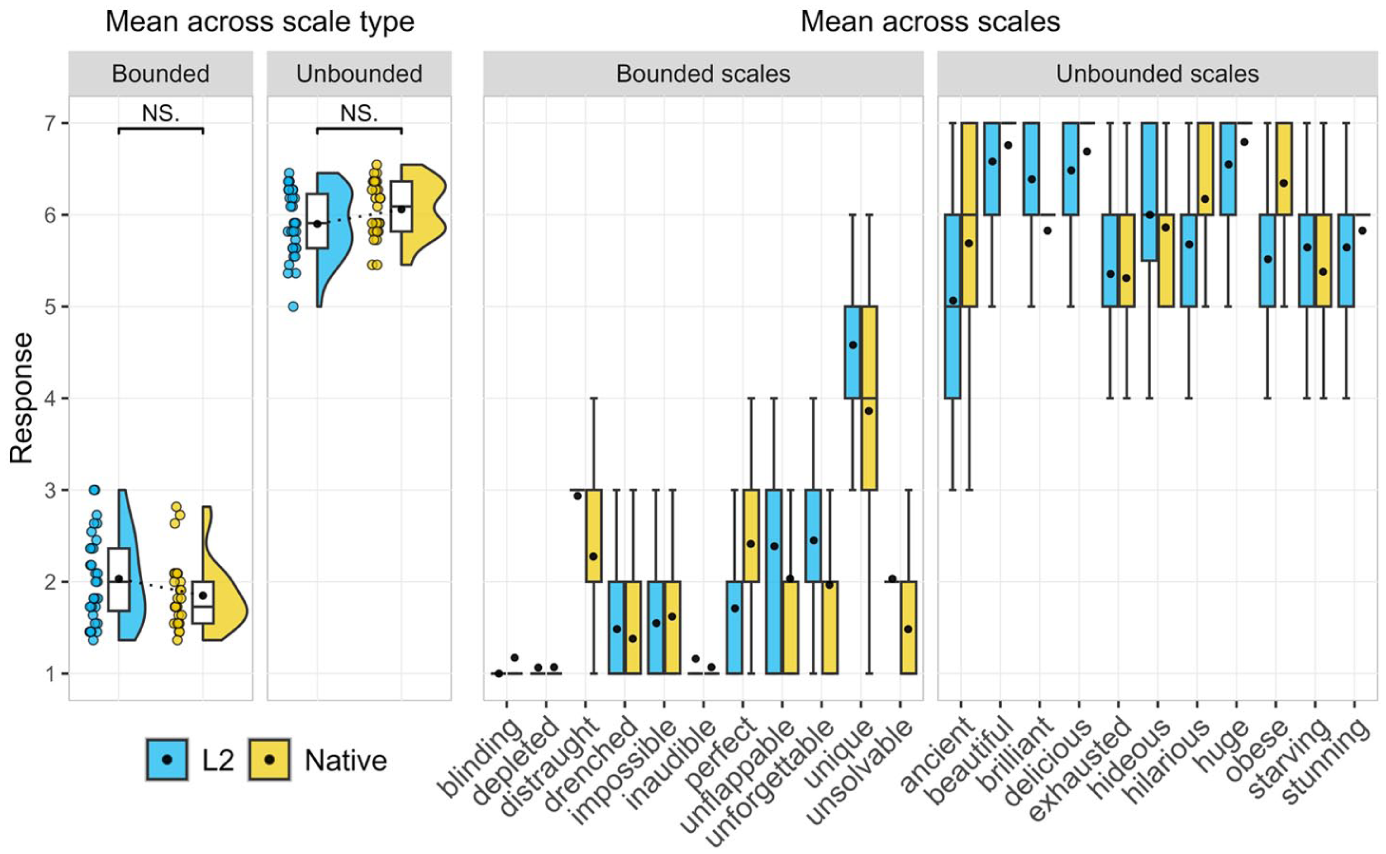
Assessments of perceived boundedness of scalar adjectives: Rating distributions for
Using the ordinal package (Christensen, 2023), we fit a series of cumulative link mixed models (CLMMs) to analyze the results of Experiment 1. CLMMs are mixed-effects regression models designed for ordinal outcome data, such as Likert-scale ratings, while accounting for random effects. Using a probit link function, these models estimate the cumulative probability that an observation falls at or below a given response threshold (e.g. a rating of ‘2’, ‘3’, etc.). To focus the analysis on participants’ sensitivity to the experimental manipulation, ratings from filler trials were excluded from the statistical models.
In the main model,
The main CLMM shows a significant simple main effect of
In the L2 model with
4. Experiment 2: Perceived semantic distance between scalemates
4.1. Methods
In Experiment 2, we adopted the methodology of Orr et al.’s (2024) third experiment to assess the perceived semantic distance between scalar expressions. Distance represents a second structural property of scales that has been shown to predict scalar implicature rates (Gotzner et al., 2018; van Tiel et al., 2016). The reasoning is as follows: when two expressions are difficult to distinguish (i.e. when they are perceived as near-synonymous), it becomes less likely that listeners will establish a scalar relationship between them, a prerequisite for implicature derivation.
Rather than asking participants to explicitly judge relative strength (e.g. whether brilliant is stronger than intelligent, as in van Tiel et al. (2016) and Sun and Feng (2025)), Orr et al. asked participants to rate the degree to which one statement could replace another. This manipulation is crucial as it avoids presupposing a scalar ordering and instead only measures perceived overlap in semantic space. We take this as an important methodological advance. Thus, our Experiment 2 follows this interchangeability-based distance methodology in task structure and response format, while adapting it to French adjective pairs and to the L2er-FNS comparison central to the present study.
We created 22 adjectival pairs by using all the strong adjectives from Experiment 1 while adding 20 relative and 2 minimum standard adjectives as their weaker scalemates. In addition, we included filler trials designed to verify participants’ understanding of the interchangeability task and appropriate use of the rating scale. Filler-false items paired sentences that were semantically unrelated and therefore clearly non-interchangeable (e.g. The pen is red / The pen is functional). Filler-true items paired sentences that were truth-conditionally equivalent and thus fully interchangeable (e.g. The tickets are cheap / The tickets are not expensive.)
The pre-test was administered to participants via a pen-and-paper task. In each trial, they were asked to read a pair of statements in French as in (3) and to decide whether it was possible to replace sentence 1 with sentence 2 by selecting a Likert-scale value of ‘1’ (Pas du tout / Not at all) or ‘7’ (Absolument / Absolutely). If participants perceived the two expressions as replaceable, they would indicate as such by selecting values closer to ‘7’ and, if not, by selecting values closer to ‘1’.
(3) (1) Le professeur est intelligent. ‘The professor is intelligent.’ (2) Le professeur est brillant. ‘The professor is brilliant.’ Peut-on remplacer la phrase 1 par la phrase 2 ? ‘Can sentence 1 be replaced with sentence 2?’

Since boundedness and distance are related, we expect participants who are aware of a scalar relationship between two adjectives to provide lower ratings for expression pairings containing the endpoint-denoting stronger term. Conversely, ratings at the higher end of the scale are expected for those pairing expressions that contain relative adjectives in the stronger position. This would indicate that participants view the two terms as less distinct, providing evidence that they do not view the two expressions as clear intervals on an underlying scale.
4.2. Results
Analyzing perceived distance between scalar expressions, we first report the mean rating between scale types and across scales in Figure 2. Recall that ratings closer to ‘1’ signal that a participant perceives the two expressions as not at all replaceable (i.e. as more distinct), whereas ratings closer to ‘7’ indicate the expressions are viewed as occupying the same interval on a scale. In bounded scales, we see that L2ers are less certain than FNSs regarding the replaceability of the paired expressions. L2ers provide a higher mean rating of 3.48 in comparison to FNSs’ 2.59. We also see a more concentrated distribution among FNSs. With unbounded scales, the two groups perform similarly. L2ers and FNSs’ mean ratings are nearly equivalent (5.87 and 5.76, respectively), demonstrating that both perceive paired expressions on unbounded scales as less distinguishable.
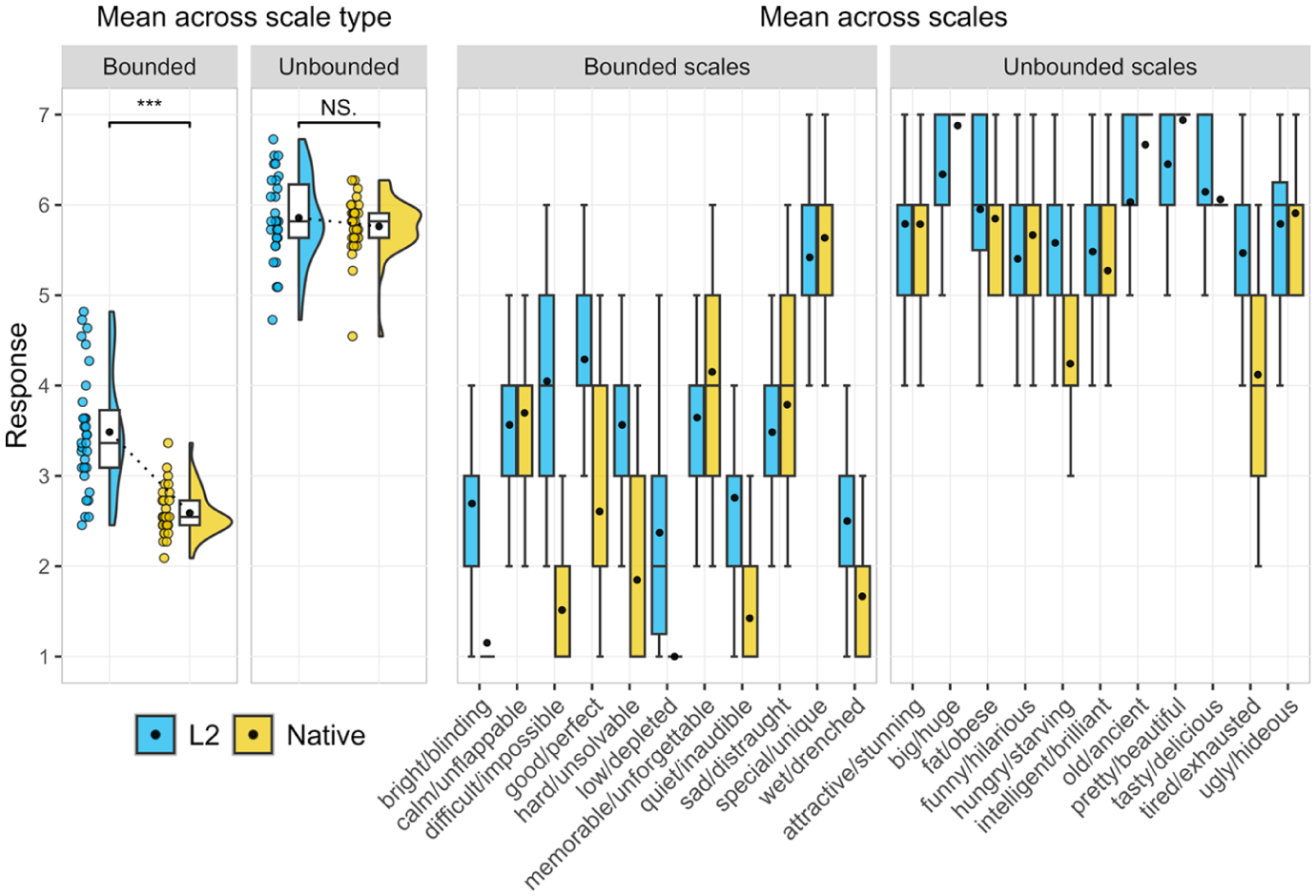
Assessment of perceived semantic distances between scalemates: Rating distributions for
To determine whether these patterns reflect statistically reliable differences, we fit CLMMs to the data. In the main model, there was a significant simple main effect of
In the L2-specific model where
5. Experiment 3: Inference evaluation task
5.1. Methods
The goal of Experiment 3 is to examine sensitivity to scalar boundedness in gradable adjective scales and to assess learners’ tendency to retrieve a scale’s boundedness designation to generate inferences in comparison to native French speakers. By investigating whether L2ers are sensitive to scalar structure and how they resolve pragmatic inferences, we aim to shed light on the extent to which SI derivation is shaped by bilingual language experience. This approach not only addresses key questions about pragmatic development in L2 acquisition but also contributes to broader debates about the interplay between lexical semantics, pragmatic reasoning, and bilingual decision-making.
Materials included the same 22 adjective pairs and 10 filler items as Experiment 2. The presentation of the stimuli was adapted from that of van Tiel et al. (2016): Target items appeared in a statement form ‘Speaker says: The Noun is Adjectiveweak’ with a conclusion sentence underneath, asking whether it could be concluded from the statement that, according to the Speaker, the noun is Adjectiveweak but not Adjectivestrong. For instance, for the pair <intelligent/brilliant>, participants had to decide whether it could be concluded from the statement ‘Anna says: The professor is intelligent’ that, according to Anna, the professor is intelligent but not brilliant, as in (4). To reiterate, a ‘Yes’ response signals endorsement of the implicature while ‘No’ suggests the inference was suspended.
(4) Anna dit : Le professeur est intelligent. ‘Anna says: The professor is intelligent.’ Est-ce que vous pouvez conclure que, selon Anna, le professeur est intelligent mais pas brillant ? ‘Would you conclude from this that, according to Anna, the professor is intelligent but not brilliant?’
A key difference from Starr and Destruel (2025) and others who have used this paradigm in the past (e.g. Gotzner et al., 2018; Orr et al., 2024; Sun and Feng, 2025; van Tiel et al., 2016) is that the question to participants in this iteration now explicitly displays the enriched meaning of the weaker scalar term. For example, rather than just asking participants to answer whether the professor is not brilliant, we instead ask whether it’s possible, according to the speaker, that the professor is intelligent, but not brilliant. This was done to highlight the entailment relations between the two terms so that learners, particularly those of lower proficiency, may avoid generating mutual exclusivity inferences and, instead, reason only about scalar implicatures. 9
We utilized the Gorilla Experiment Builder (www.gorilla.sc) to create the inference evaluation task. In each trial, participants watched a short video sequence in which a pair of French sentences appeared one word at a time on a white background, with each word displayed in synchrony with the spoken audio of a native French speaker. After the audio and video had finished, the text remained, and participants had to click ‘continue’ to proceed to a screen presenting a ‘yes’ or ‘no’ choice. The sentence and question were shown again in full text for review, and participants were given five seconds to respond. Upon clicking to select their response, a new trial began. This sequence was repeated for all 32 items.
As demonstrated in the previous literature, NSs’ familiarity with scale structure results in higher SI endorsement rates in bounded versus unbounded scales (Gotzner et al., 2018; Orr et al., 2024; Starr and Destruel, 2025; van Tiel et al., 2016). L2ers, however, particularly less proficient ones, may not realize that two adjective terms necessarily form a scale and may be similarly unaware of scalar characteristics such as boundedness and semantic distance between scalemates. Nevertheless, we hypothesize that structural awareness improves with proficiency.
Thus, we predict that higher proficiency L2ers will distinguish between bounded and unbounded scales when deriving inferences, while lower proficiency learners may respond consistently across conditions while underutilizing information about the underlying structural properties of adjectives. This will result in smaller rating differences across conditions for the less proficient, with minimal differences in the rates of implicature across bounded and unbounded scales. We anticipate that higher proficiency learners, on the other hand, will be more likely to derive inferences in bounded vs. unbounded trials, much like native French participants.
5.2. Results
Figure 3 reveals that L2ers diverged from FNSs in implicature endorsement rates under certain conditions but overlapped in others. For example, learners’ endorsement rates in bounded scales were 50% overall compared to 49.6% in native French speakers. However, in unbounded scales, learners derived SIs 32.2% of the time, but the native French did so at a rate of only 22.2%. At first glance, this suggests that L2ers are more likely to derive SIs than FNSs, with the latter group suspending implicatures more often when the adjective pair lacks an endpoint denoting cue.
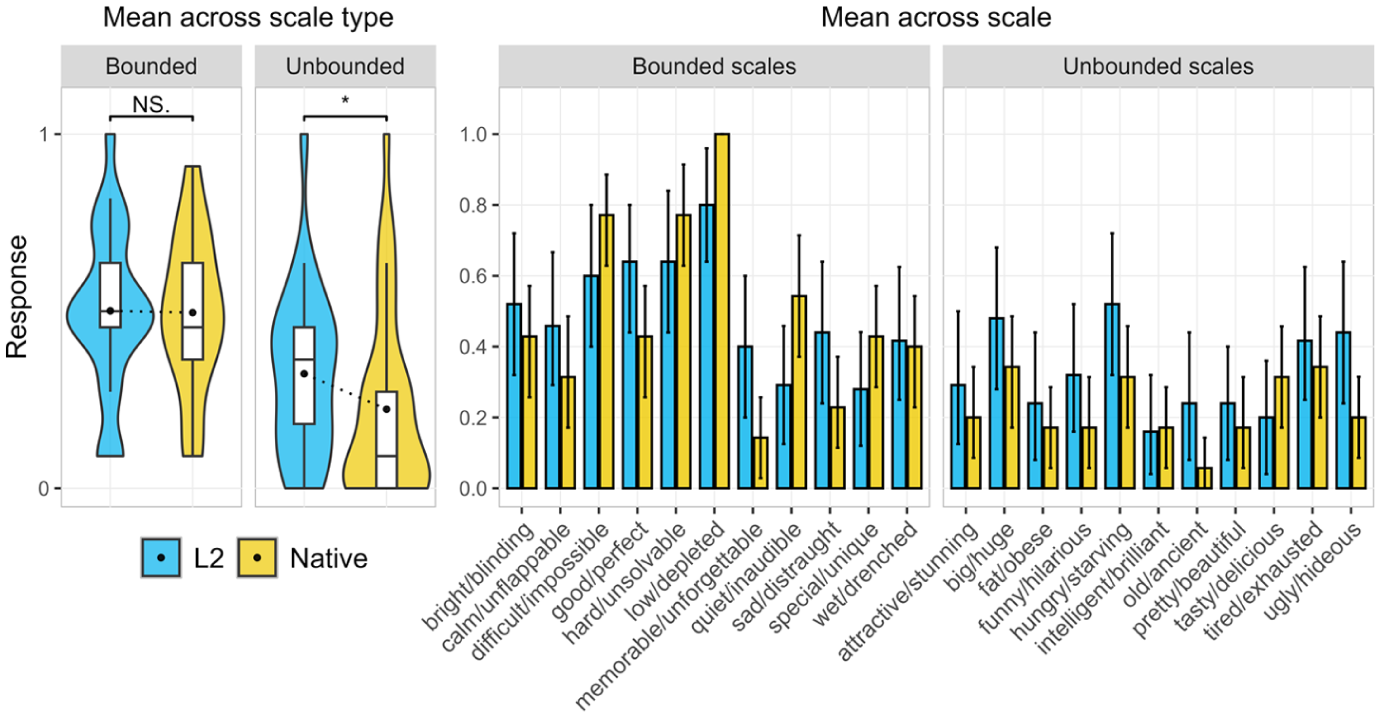
Scalar implicature endorsement rates (1 = yes, 0 = no) for
To analyze these results statistically, we fit a generalized linear mixed-effects model (GLMM) using the lme4 package in R (Bates et al., 2015). The dependent variable was participants’ binary
The analysis revealed a significant simple main effect of
Crucially, a significant
An examination of participant-level consistency (defined as ⩾70% uniform responses within a condition; consistent implicature derivation ⩾70% or suspension ⩽30%) showed that 77.1% of FNSs were consistent suspenders in the unbounded condition, whereas L2 learners were more heterogeneous (48% consistent suspenders, 48% mixed). In the bounded condition, both groups were more variable, with mixed responding predominating (FNSs: 60%; L2: 56%), though 24% of FNSs and 23% of L2ers consistently derived SIs here.
In addition, we fit a separate L2-specific model to examine whether response patterns varied as a function of
To investigate whether greater proficiency led to fewer implicatures overall, irrespective of
Since there was considerable variation in proficiency scores (from 14–39 out of 45), and no uniform cutoff points have been established and agreed upon in the literature (Tremblay, personal communication, 2015), we followed Destruel and Donaldson’s (2017) classification scheme and divided participants into beginner (< 27), intermediate (27–36), and advanced (> 36) proficiency levels to investigate categorical effects of proficiency on L2 response behavior. Since only three participants scored into the advanced level, we combined the intermediate and advanced groups into an ‘intermediate+’ cluster, numbering 13 individuals. The beginner group contained 12 learners.
We then fit a GLMM predicting response as a function of
Pairwise comparisons indicated that the contrast between bounded and unbounded trials at the intermediate+ level was significant (β = 1.15, SE = 0.39, z = 2.94, p = .02), while beginners showed no reliable differences. Nevertheless, we emphasize that the
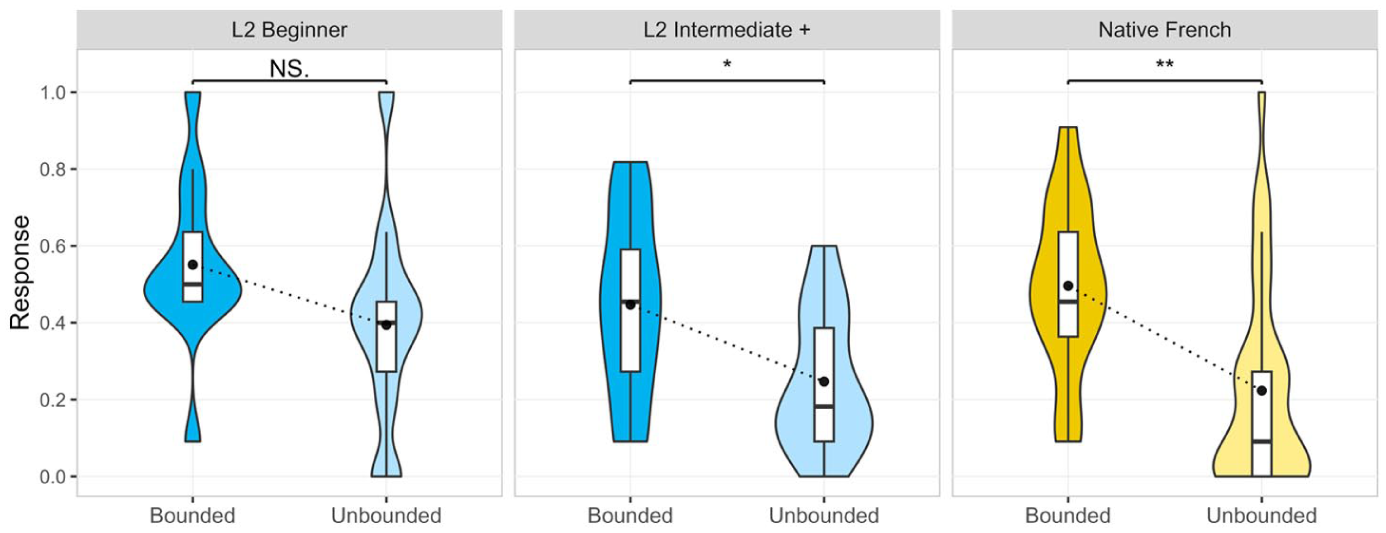
Mean probability of ‘yes’ responses in bounded and unbounded conditions across groups in the inference evaluation task.
6. Discussion
In our first two experiments, proficiency emerged as a key factor in sensitivity to the endpoint semantics of bounded adjectives and to the perceived distance between scalemates on gradable adjective scales. In Experiment 1, both L2 learners and native speakers showed awareness of the endpoint-denoting meanings of bounded terms such as impossible and unsolvable, and recognized the extendibility of strong terms like beautiful and brilliant on unbounded scales. This awareness, however, increased with proficiency: more advanced learners differentiated more clearly between bounded and unbounded conditions. These results provide our first piece of evidence that greater L2 expertise enhances responsiveness to the semantic properties of gradable adjectives.
In Experiment 2, a similar pattern emerged. Both native speakers and L2 learners distinguished between bounded and unbounded scales, but higher proficiency was again associated with more nativelike responses. In the bounded condition, advanced learners were more likely to perceive distance between strong and weak terms, whereas lower proficiency learners showed greater uncertainty. This divergence produced significant variation in the degree of scalar differentiation, with more advanced learners aligning more closely with native speakers. These findings further illustrate how increasing proficiency benefits learners with a greater understanding of the structural relationships between gradable adjectives, which, in turn, serve to build the foundation for scalar construal.
Given these results, it would be reasonable to assume that more advanced learners would exhibit greater rating differences between bounded and unbounded scales in the inference evaluation task, and that lower proficiency learners would show less sensitivity. Moreover, it might be expected that proficiency would be associated with higher SI rates in the bounded condition, specifically. In the third experiment, we found that proficiency again proved to be a determining factor, but in ways that we did not anticipate. Ultimately, greater L2 ability did not prove to be a reliable predictor of the expected differentiation between bounded and unbounded scales, even though native French speakers demonstrated the greatest sensitivity to the boundedness distinction compared to L2ers. However, an intriguing pattern emerged in that more proficient learners tended to suspend implicatures, while the less proficient derived them more readily.
At first glance, such a result may be interpreted in line with the Neo-Gricean view that pragmatic inferences are generated automatically (Gazdar, 1979; Levinson, 2000), though without reading or reaction time data from our learners, arriving at this conclusion would be premature. Nevertheless, consistent with Starr and Destruel (2025) and Lin (2016), our results support Slabakova’s (2010) claim of a ‘cognitive bottleneck’ which serves to mitigate suspension of implicatures in L2ers. This is to say, for less proficient learners, deriving implicatures in gradable adjective scales may be less computationally demanding than suspending them. The latter maneuver would require focused consideration of why the implicature should not proceed – such as the absence of contextual support or indeterminacy in scalar degree specification – both of which may impose additional processing costs.
To begin with, if the scenario in which the two scalar terms appear is contextually underdefined, it will be difficult to reason whether there is sufficient separation of degree to warrant the generation of an inference. As McNally’s (2017) critique of van Tiel et al.’s (2016) inference evaluation task highlights, we cannot know for certain what is in the speaker’s mind when we read something like ‘Paul says: The problem is difficult’. We may ask, for example, what kind of problem it is and what is difficult about it. Without this clarifying information, it may not be possible to truly know if the problem is impossible (or not). McNally’s chief critique, however, and one that we stress may account for some of our results, is that gradable adjectives cannot be clearly evaluated against one another in the absence of a context-dependent standard.
In inference evaluation tasks, the participant is asked to evaluate the relevance of the stronger term in a context devoid of a clear standard of comparison. Thus, without additional discourse cues to facilitate its derivation, the inference may be suspended, leaving open the logical ‘difficult and possibly impossible’ option, at least temporarily. Recall as well that only 23% of FNSs and 24% of L2ers consistently derived implicatures in the bounded condition, while 77% of FNSs and 48% of L2ers suspended them consistently in the unbounded condition. Thus, even though the endpoint denoting cue in bounded scales supplies a trigger point to inference generation, which in itself proves to be a significant predictor in our study (and in others), SI rates are nevertheless tempered. Hu et al. (2022) provide evidence to this end with native English speakers, demonstrating that an increase in the uncertainty about the applicability of the stronger alternative in the underlying adjective scale results in a reduced likelihood of endorsing a scalar implicature. That is, the less confident a listener is about the distribution of possible alternatives in the context, the more likely they are to prevent pragmatic inferences from going through (see also Gotzner and Lacina, 2024).
A complementary interpretation of our findings comes from recent grammatical accounts of scalar implicature, which attribute implicature derivation to covert exhaustivity operators interacting with the lexical semantics of scales (Chierchia, 2006, 2017; Chierchia et al., 2012). Under this perspective, when a weak term on a gradable adjective scale is uttered, all relevant alternatives are activated simultaneously. Thus, the activation of a stronger scalar alternative with an endpoint-denoting feature would help define the interval between the weak and strong. This would provide particularly robust input for the exhaustification process, predicting the relative stability and high implicature rates observed for bounded scales across populations. The boundedness effect observed here is consistent with this prediction and suggests that endpoint sensitivity is not purely pragmatic or contextual but also grounded in lexical scale structure.
Crucially, grammatical approaches may also allow for developmental and proficiency-related differences in how exhaustification is accessed and deployed. From this perspective, the somewhat weaker boundedness differentiation reported in less proficient L2 learners need not reflect a lack of scalar knowledge, but rather reduced semantic entrenchment or delayed access to scalar alternatives in online processing. As proficiency increases, learners may gain quicker and more reliable access to interval structure and scalar alternatives, enabling more selective application of exhaustivity. This, in turn, can yield greater inference suspension in underspecified contexts, even as sensitivity to boundedness and semantic distance continues to strengthen. This interpretation is further supported by our first two experiments, which show that awareness of boundedness and semantic distance is present early but becomes more robust and reliable with increasing proficiency, consistent with gradual semantic entrenchment of scalar structure in the L2 lexicon.
Taken together, SIs in gradable adjective scales depend on both contextual and semantic factors. Alexandropoulou et al. (2022) provide an interesting example of this with native speakers, showing that while some adjective scales yield implicatures more reliably when a clear contextual contrast is available, others – such as those containing minimum-standard adjectives (e.g. breezy) – can generate implicatures independently due to their ability to establish a clear semantic threshold (i.e. implicit semantic distance) which separates them from their stronger scalemates (e.g. windy), thus facilitating inferences even in the absence of context. Our findings corroborate this perspective from an L2 standpoint and further highlight how both the contextual and semantic routes to SI generation involve consideration of alternatives, both in meaning and in form, and likely in parallel.
An additional factor that may shape L2 implicature behavior is L1 transfer, insofar as English and French adjective scales may differ in lexicalization or degree semantics; however, because our materials were designed to target broadly comparable scalar relations and because proficiency effects patterned by scale type rather than by individual adjective pairs, L1 transfer alone is unlikely to account for the observed results. 14 Nevertheless, this feature represents a crucial avenue to explore in subsequent work and should not be ignored. For example, the addition of an English version of our tasks and results from a native English control group would provide direct evidence of transfer effects with respect to L1-English–L2-French response behavior. Likewise, a bidirectional study such as the one carried out in Starr and Destruel (2025) involving both native groups as well as L2 learners of French and English would provide further clarity along this dimension.
Moreover, we also note that because the categorically advanced group in Experiment 3 was small, our findings there should be interpreted cautiously. Future work with larger samples of highly proficient L2 learners will be essential for determining whether increased proficiency yields fully native-like sensitivity to scalar structure or whether differences persist at advanced levels. Additionally, future studies adopting processing measures such as reading or reaction times would help further shape our understanding of the time course of inference derivation in gradable adjective scales and whether implicature suspension (or access to logical interpretations of scalar adjectives) is truly costly for L2ers. 15
Also, owing to variability in responder type, we highlight the importance of investigating the causes behind individual differences as a future point of focus (Bott and Noveck, 2004; Slabakova, 2010). A further limitation in Experiment 3 is that FNSs completed the task using an online participant recruitment platform, whereas L2ers finished the experiment in a lab setting. This represents a difference in the method of task delivery, which may have affected participant response behavior. Future work should consider controlling these factors during the study design phase.
Nonetheless, this study builds on the results of Starr and Destruel (2025), providing further evidence of a developmental pattern in L2 implicature behavior, with less proficient learners demonstrating a preference for the adoption of pragmatic heuristics in inference evaluation tasks involving gradable adjective scales. Although they demonstrated awareness of boundedness and semantic distance, this sensitivity was attenuated relative to more proficient learners and native speakers. Furthermore, they do not consistently exploit these cues to modulate inference strength. In contrast, advanced learners patterned more closely with native speakers in that they were more selective in their implicature endorsement rates and more likely to suspend inferences, indicating a more integrated use of semantic and pragmatic information.
The present work thus reveals a developmental shift in how learners weight available cues. Early in acquisition, implicatures appear to be generated relatively indiscriminately, guided primarily by pragmatic reasoning. With increased proficiency, learners adopt a more context-sensitive strategy in which semantic structure and discourse considerations jointly constrain inference derivation. In this sense, L2 development involves not simply increased access to scalar information, but increasingly precise integration of that information into pragmatic decision-making. Thus, our results complement those of Starr and Destruel (2025) but also address some unanswered questions therein regarding L2 awareness of scalar dynamics in gradable adjectives.
7. Conclusions
This study set out to examine how L2 learners of French process scalar implicatures in gradable adjective scales, focusing on the role of endpoint salience and perceived semantic distance. Across three experiments, we found that both native speakers and L2 learners display sensitivity to these structural cues, but proficiency modulates how reliably such information is exploited. Early learners tended to endorse implicatures broadly, relying to a greater degree on pragmatic routes to interpretation in the inference task. More proficient learners, by contrast, not only demonstrated increased awareness of scalar structure but were also more prone to suspend implicatures overall. These findings contribute to ongoing debates about the mechanisms underlying implicature derivation in L2ers by showing that learners do not follow a single developmental path from ‘more implicatures’ to ‘fewer implicatures’, but instead recalibrate the weighting of semantic, pragmatic, and contextual cues as proficiency grows.
At the same time, the results underscore the need to consider how proficiency interacts with semantic cues to shape the balance between pragmatic enrichment and inference suspension. Future work should further explore the role of context and processing demands in strengthening or attenuating these effects, as well as investigate whether similar developmental trajectories emerge across other scale types and L2 populations. Taken together, these findings extend theories of scalar diversity into the L2 domain and underscore the value of examining gradable adjectives as a testing ground for pragmatic enrichment. They demonstrate that L2 acquisition involves not only learning to map words onto meanings but also learning how structural properties embedded within the lexical semantics of scalar terms guide inferential reasoning.
Footnotes
Appendix A
Eleven bounded and 11 unbounded adjectives (English and French).
| English | French |
|---|---|
| Bounded: | |
| bright/blinding | vive/aveuglante |
| difficult/impossible | difficile/impossible |
| good/perfect | bon/parfait |
| hard/unsolvable | dure/insoluble |
| low/depleted | faible/vide |
| memorable/unforgettable | mémorable/inoubliable |
| quiet/inaudible | silencieux/inaudible |
| calm/unflappable | calme/imperturbable |
| sad/distraught | triste/abattu |
| special/unique | spéciale/unique |
| wet/drenched | mouillé/trempé |
| Unbounded: | |
| tired/exhausted | fatigué/épuisé |
| attractive/stunning | séduisant/magnifique |
| big/huge | gros/énorme |
| fat/obese | gras/obèse |
| funny/hilarious | drôle/hilarant |
| hungry/starving | a faim/affamé |
| intelligent/brilliant | intelligent/brillant |
| old/ancient | vieux/ancien |
| pretty/beautiful | mignon/beau |
| tasty/delicious | goûteux/délicieux |
| ugly/hideous | moche/hideux |
Acknowledgements
We would like to extend a sincere thank you to the editor, Silvina Montrul, and the three anonymous reviewers for providing their useful and helpful suggestions throughout the revision process. We also owe a debt of gratitude to Drs Anne Pycha, Nicolas Russell, Anita Alkhas and Eric Anderson for help with participant recruitment. We further thank undergraduate research assistants Isa Bright and Meadow Conner for assistance in participant testing and data collection.

Funding
The authors disclosed receipt of the following financial support for the research, authorship, and/or publication of this article: The authors wish to acknowledge receipt of financial support for this study from a research grant provided by the University of Wisconsin – Milwaukee (#AAP1453).
Declaration of conflicting interests
The authors declared no potential conflicts of interest with respect to the research, authorship, and/or publication of this article.