






Abstract
Purpose:
Type A acute aortic dissection (AAD) is an uncommon catastrophic cardiovascular disease with high pre-hospital mortality rate without timely and effectively treated. The aim of this study was to assess the value of serum platelet to hemoglobin (PHR) in predicting in-hospital mortality in type A AAD patients.
Methods:
A total of 183 type A AAD patients were included in this retrospective investigation from January 2017 to December 2019. Admission blood routine parameters were gathered and PHR was computed. The outcome was all-cause in-hospital mortality within 30 days.
Results
The average levels of serum PHR were significant higher in survivor group than those in non-survivor group (1.14 ± 0.57 vs 0.87 ± 0.47, p = 0.006) and serum PHR was an independent factor associated with in-hospital mortality (hazard ratio (HR): 2.831; 95% confidence interval (CI): 1.108–7.231; p = 0.030). ROC noted that 0.8723 was chosen as the ideal cutoff value with a sensitivity of 64.3% and specificity of 72.5%. In addition, the area under the ROC curve (AUC) was 0.693 (95% CI 0.599–0.787, p < 0.001).
Conclusion:
Admission serum PHR can be used as an independent predictor of in-hospital mortality in patients with type A AAD.
Introduction
Acute aortic dissection (AAD) is divided into type A and type B AAD, which is an uncommon catastrophic cardiovascular disease with approximately 48.6% pre-hospital mortality rate without timely and effectively treated.1,2 In addition, when compared with type B AAD, type A AAD patients have worse short-term survival with a mortality rate of 1–2% for the first 24 to 48 hours after the onset of symptoms.1,3 When comes to in-hospital surgical mortality rate, 30% for type A AAD and 13% for type B AAD. To those survivors until hospital discharge, there is poorly difference in the long-time mortality rate between patients with type A or type B AAD.4–7 Therefore, Timely and effective identification of high-risk patients with type A AAD is very urgent at an early stage.
Recently, inflammatory indexes including C-reactive protein (CRP), platelets (PLT) and related ratio parameters have been proved to be related with AAD.8–11 To patients with upper tract urothelial carcinoma, low levels of hemoglobin (HB) could be used as an informative biomarker to predict worse pathologic and survival outcomes. 12 Therefore, in this study, we aimed to explore the value of serum PLT to HB (PHR) in predicting in-hospital mortality in patients with type A AAD.
Materials and methods
Study design
A retrospective cohort study was conducted to assess the prognosis value of serum PHR in predicting in-hospital mortality in type A AAD patients (confirmed by aorta angiography with multidetector computed tomography (CT) scanning) between January 2017 and December 2019. Patients who met the criteria were included: (1) ⩾18 years; (2) within 24 hours after symptom onset and those who satisfied the criteria were excluded: (1) pregnancy; (2) trauma-induced AAD; (3) patients with infection, cancers and other diseases related to the cardiovascular disease and immune systems. The study data, including demographic data, blood routine parameters (Sysmex XE 2100, Kobe, Japan) at admission, computed tomography findings and the occurrence of in-hospital death, were down-load from the medical record. The study was authorized by the Ethics Committee of The First Affiliated Hospital of Nanjing Medical University (Nanjing, China) and in accordance with the Helsinki Declaration. Because retrospective data were collected, written informed content from each patient was waived.
Outcomes
The primary outcome was all-cause in-hospital mortality with 30 days.
Statistical analysis
IBM SPSS Statistics 21 software (IBM Corp., Armonk, NY) was employed to analyse the study data. Results are displayed as mean ± standard deviation (SD). Baseline indexes were compared between survivor and non-survivor patients using unpaired Student’s t-tests, Mann-Whitney tests for continuous data, and Chi-square tests for categorical data. Categorical variables were elucidated as a percentage. Receiver operating characteristic (ROC) analysis was carried out to judge the cut-off value for PHR in predicting in-hospital mortality. To determine the independent factors related to in-hospital mortality in type A AAD patients, univariate and multivariate analysis were adopted to discern the elements associated with in-hospital mortality. All tests with 2-sided p < 0.05 were considered statistically significant.
Results
The baseline characteristics and laboratory results of the study patients
Patients were divided into survivor group and non-survivor group according to the outcomes of them when discharged within 30-day. Table 1 presented that the general characteristics of each group and whole group. The results displayed that males are more likely to suffer from type A AAD and patients with advanced age had a worse in-hospital prognosis. Compared with survivor group, the value of serum platelet distribution width (PDW) was higher (p < 0.05), the levels of serum PLT and PHR were lower (p < 0.05 for both) and there were no significant statistical difference in serum whole blood counts (WBC), Lymphocyte, Neutrophils, HB, red blood cell distribution width (RDW) and mean platelet volume (MPV) (p > 0.05 for all (except RDW: p = 0.05)). The values of serum PHR were 1.14 ± 0.57 in survivor group and 0.87 ± 0.47 in non-survivor group, the difference was significant (p = 0.006)
Clinical characteristics of study population.
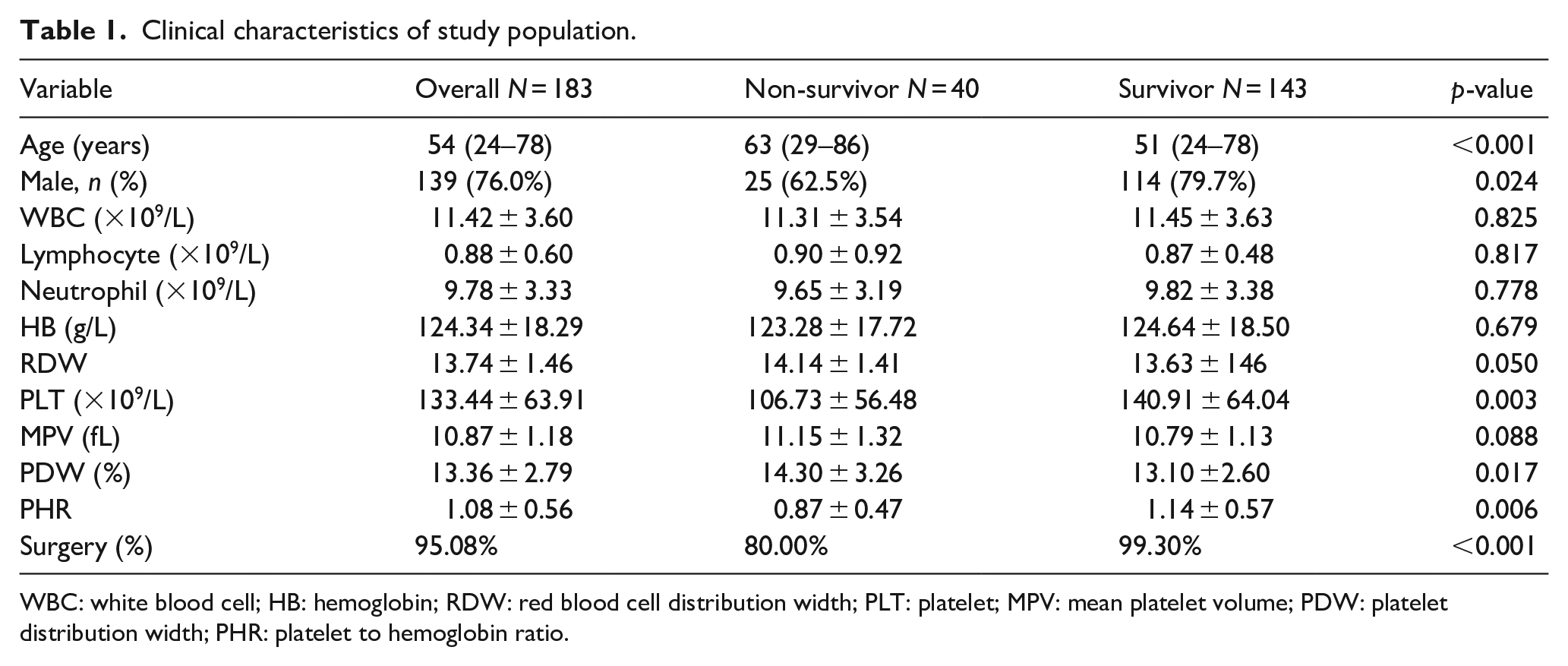
WBC: white blood cell; HB: hemoglobin; RDW: red blood cell distribution width; PLT: platelet; MPV: mean platelet volume; PDW: platelet distribution width; PHR: platelet to hemoglobin ratio.
Multivariate logistic regression
For the purpose of checking whether serum PHR was an independent factor to predict in-hospital survivor of type A AAD patients. We included continuous variable (age, serum platelet, PDW and PHR) and categorical variable (gender) selected by univariate analysis with p < 0.05 in a multivariate model. The result exhibited that serum PHR (hazard ratio (HR): 2.831; 95% confidence interval (CI): 1.108–7.231; p = 0.030) and age (HR: 1.064; 95% CI: 1.028–1.101; p < 0.001) were independently associated with in-hospital mortality (Table 2). In addition, to in-hospital surgical type A AAD patients, PHR remains an independent risk factor (Supplementary Table 1).
Multivariable logistic regression of in-hospital mortality for patients with type A acute aortic dissection.

CI: confidence interval; OR: odd ratio; PHR: platelet to hemoglobin ratio.
ROC analysis
The values of serum PHR were determined by ROC with highest Youden’s index (Sensitivity + Specificity − 1). The results indicated that for serum PHR, 0.8723 was selected as the ideal cutoff level with a sensitivity of 64.3% and specificity of 72.5% for the prediction of in-hospital mortality. In addition, the area under the curve (AUC) was 0.693 (95% CI 0.599–0.787, p < 0.001) (Figure 1). For patients with serum PHR > 0.8723, 11 out of 103 died and for patients with serum PHR ⩽ 0.8723, 29 out of 80 died.

Receiver operating characteristic (ROC) curve of PHR for predicting in-hospital mortality in patients with type A AAD.
Discussion
The results of the present retrospective investigation pointed out that there was a relationship between serum PHR and in-hospital mortality among patient with type A AAD. Multivariate analysis confirmed that there was a positive association between elevated serum PHR and in-hospital survivor. In addition, when the best cutoff value 0.8723 was selected, the specificity 72.5% and sensitivity 64.3% for in-hospital mortality were obtained. Thus, serum PHR was favorable for stratifying the high-risk patients with type A AAD.
Prior studies had displayed that high values of admission ischemia-modified albumin and low levels of admission fibrinogen were helpful for distinguishing type A AAD patients with high risk in-hospital mortality.13,14 Huang et al. 15 indicated that high levels of admission d-dimer had a positive relation with elevated risk in-hospital mortality and emergent surgery while there was no obvious statistics association between admission d-dimer values and long-term mortality. Gao et al. 7 suggested that serum albumin 34 g/L may be another useful index to stratify high-risk patients with both type A and type B AAD. Levels of MPV/platelet were a strong factor for both in-hospital complications and long-term mortality in patients with type A AAD. 11 Although researchers have made great efforts and achieved certain results, there are far from meeting the clinical needs, as these indicators are either not universal, expensive or time-consuming, new markers are required.
PLT plays a key role in the process of coagulation and type A AAD. 9 To patients with percutaneous coronary intervention (PCI), PLT acted a major role in the progress of negative outcomes. 16 In this study, we found that the levels of serum PLT in the survivor group were higher than those in non-survivor group, this was consisted with previous studies. 17 HB and PLT are related to inflammation. Luo et al. 18 reported that inflammation plays a key role in the development and progression of aortic dissection. In addition, PHR has been used in the diagnostic of colon cancer and rectal cancer, the prognostic of patients with PCI.16,19,20 Therefore, PHR may be a useful bio-marker to stratify patients with AAD at an early stage.
In the current study, we found that levels of serum PLT and PHR were higher in the survivor group than that of non-survivor group, further, multivariate analysis confirmed that serum PLT was not an independent marker regardless of whether serum PHR was included in the model while serum PHR was an independent marker of short-term mortality no matter whether serum HB was included. Then ROC curve exhibited that the AUC of serum PHR was 0.693 and 0.8723 was selected as the best cut-off value of PHR, that is to say, a patient with serum PHR > 0.8723 had a obviously elevated risk of in-hospital mortality compared with a patient with a serum PHR ⩽ 0.8723. At last, serum PHR could be easily acquired as it can be calculated with PLT and HB which were included in the complete blood count test with timely and inexpensive.
Limitations
As a respective observational study, several limitations that should be taken into consideration. First, bio-markers, such as CRP, fibrinogen and D-dimer are not be included the present study. Second, We only gathered the value of admission HB and platelet data, we could not dynamic monitoring the levels of PHR at different time points during hospitalization. Third, it is a single retrospective study. Thus, the results must be further confirmed in a prospective, large-scale and multi-center investigation.
Conclusion
Serum PHR is an independent predictor of in-hospital death for type A AAD patients. As a useful, simple, inexpensive and universally available bio-marker, serum PHR should be used early risk stratification of type A AAD patients.
Supplemental Material
sj-pdf-1-prf-10.1177_0267659120982226 – Supplemental material for The short-term prognostic value of serum platelet to hemoglobin in patients with type A acute aortic dissection
Supplemental material, sj-pdf-1-prf-10.1177_0267659120982226 for The short-term prognostic value of serum platelet to hemoglobin in patients with type A acute aortic dissection by Yu Wang, Tengfei Qiao and Jun Zhou in Perfusion
Footnotes
Declaration of conflicting interests
The author(s) declared no potential conflicts of interest with respect to the research, authorship, and/or publication of this article.
Funding
The author(s) received no financial support for the research, authorship, and/or publication of this article.
Statement of ethics
The study was conducted in accordance with the Declaration of Helsinki, and was approved by our Ethical Committee.

References
Supplementary Material
Please find the following supplemental material available below.
For Open Access articles published under a Creative Commons License, all supplemental material carries the same license as the article it is associated with.
For non-Open Access articles published, all supplemental material carries a non-exclusive license, and permission requests for re-use of supplemental material or any part of supplemental material shall be sent directly to the copyright owner as specified in the copyright notice associated with the article.
