






Abstract
Short-term mechanical circulatory support can be life-saving in the pediatric population with acute cardiogenic shock (ACS). However, recovery from MCS is a rare entity. MCS options are limited for low-body-weight children in Turkey. Over the last decade, extracorporeal membrane oxygenation (ECMO) has been the primary bridging modality for children with end-stage heart failure in our country. However, VA-ECMO may cause increased wall stress and oxygen demand, which may alter myocardial recovery. Here, we describe using a Levitronix CentriMag Systems for biventricular support as a bridge to recovery in a 16-month-old boy (weight, 11 kg; BSA, 0.5 m2) with type A influenza related-fulminant myocarditis (FM). Levitronix CentriMag System provides a safe and efficient short-term, biventricular, paracorporeal support for infants, and small children with ACS.
Keywords
Introduction
A growing number of pediatric patients with acute cardiogenic shock (ACS) or advanced heart failure require mechanical circulatory support (MCS). However, the rate of pediatric heart transplant rates has remained stagnant over the last decade. According to the PediMACS registry, 73% of the pediatric population presents with cardiomyopathy, followed by myocarditis (9%), congenital heart disease (18%), and other causes (1%). 1 The Levitronix CentriMag System (Thoratec Corporation, Pleasanton, CA, USA), a magnetically levitated paracorporeal VAD, can be configured as temporary biventricular support in adults and pediatric population.1,2
Fulminant myocarditis (FM) in children is a life-threatening condition with a rapid onset. The mortality rate ranged from 40% to 60%. Sometimes, it is refractory to inotropic support, anti-arrhythmic, antiviral, immune regulator treatments. MYKKE, the first cohort, prospectively analyzed the use of MCS in pediatric patients with myocarditis showed that fulminant form often affects the youngest age group, and the weaning rate from MCS was 43%. 3
Case history
A 16-month-old boy (weight, 11 kg; height, 83 cm; body surface area, 0.5 m2) was admitted to another hospital with a 2-week history of tachypnea and fever. Initial treatment was epinephrine, milrinone, and diuretics. He had developed ventricular tachycardia during his stay, followed by acute cardiogenic shock, and underwent emergency sternotomy for cardiopulmonary resuscitation (E-CPR). He was stabilized by central veno-arterial extracorporeal membrane oxygenation (VA-ECMO; Maquet, Rastatt, Germany) support in January 2018 and was transferred to our pediatric intensive care unit (PICU) because of heart transplantation possibility. On arrival, the temperature was 36.7°C, pulse 143/min, blood pressure 72/43 mm Hg, respiratory rate 21/min, and oxygen saturation 98%. Chest X-ray showed cardiomegaly and pulmonary edema. Transthoracic echocardiogram showed a severely dilated left ventricle with diminished ejection fraction (LVEF) of 23% and moderate mitral and tricuspid regurgitation with a tricuspid annular plane systolic excursion (TAPSE) of 5 mm. Laboratory results showed preserved renal and liver function, elevated brain natriuretic peptide (35,000 ng/L), and troponin levels (441 pg/mL; ref <19.8 pg/mL), suggesting acute myocardial injury. Influenza A was positive in throat swab PCR analysis, and oseltamivir was begun. Also, we commenced prophylactic piperacillin/tazobactam.
Despite maximal inotropic support on the third day of VA-ECMO run, left ventricular unloading was needed because of left ventricular distention and persistent pulmonary edema. The heart team decided to perform conversion to short-term biventricular support using two Levitronix CentriMag Systems (Thoratec Corporation, Pleasanton, CA, USA). For right ventricular support, an inflow cannula was placed in the right atrium, and an outflow cannula was inserted into a woven polyester graft, which was sewn to the main pulmonary artery. For left heart support, an inflow cannula was placed through the left ventricular apex (Figure 1), and an outflow cannula was placed directly into the woven polyester graft, which was sewn to the ascending aorta. Two purse-string sutures of 3-0 polypropylene were placed at the LV apex cannulation site for hemostasis, and sutures were tied around cannulae (Figure 2). Patient’s estimated cardiac output was 1.4 L/min at 2550–2650 rpm, and patient’s condition improved after biventricular support.

Schematic representation of biventricular support configuration using two Levitronix Centrimag Systems.

Intraoperative pictures of the inflow cannula placement technique through a small left anterior mini-thoracotomy.
Postoperative anticoagulation was started with intravenous heparin. Within the same week, we could wean the patient from the ventilator and inotropic support; LVEDD decreased to 29 mm, and mitral and tricuspid regurgitation reduced. Right ventricular circuit change is required on the eighth day of BIVAD support due to thrombosis in the circuit; however, we decided to wean the patient from right ventricular support and convert to temporary LVAD. On the second week of LVAD, LVEF had significantly increased to 64%, and any residual mitral and tricuspid insufficiency had resolved.
Oseltamivir was administered for 10 days, piperacillin/tazobactam was stopped on the 14th day of treatment because there was no proven bacterial infection. On the 12th day of admission to PICU, we could wean from ventilatory support. Also, the right ventricular function improved, decannulation was achieved on the 18th day of BIVAD support. We converted hemodynamic support from BIVAD to LVAD configuration. During the transition period, he developed ventricular tachycardia attacks. Finally, we successfully decannulated on the 31st day of LVAD support. Eventually, the patient was weaned from mechanical ventilation. Two weeks after BIVAD support, the patient’s chaotic ventricular tachycardia persisted for 1 month, was controlled amiodarone and flecainide. The infant was successfully discharged with diuretics, ACE-inhibitors, and anti-arrhythmic medication. After 1 year from his discharge, he was fully recovered without complications.
Discussion
Even though significant advances in MCS technology for low-body-weight children are still limited in Turkey. The most commonly used MCS systems in the pediatric population are VA-ECMO and short-term left ventricular assist devices. PediMACS registry data indicated that distribution between pulsatile (45%) and continuous-flow (55%). VAD types in children was roughly even. 1 Short-term continuous-flow VADs such as Levitronix Centrimag System or Maquet RotaFlow may provide essential alternative strategies. The absence of bearings and seals within the magnetically levitated design in the Levitronix Centrimag System results in minimal friction and heat generation. 2
From 1980 to the 2000s, VA-ECMO has been the sole and significantly improved MCS option in the pediatric population. 4 However, increased LV afterload, wall stress, and myocardial oxygen consumption may lead to LV distension and pulmonary edema and require LV unloading in patients with poor cardiac reserve supported with VA-ECMO. LV unloading can be achieved in the pediatric population by left atrial, left ventricular apical decompression, balloon atrial septostomy, or BIVAD support (Table 1). Indeed, many ECMO centers suggest early LV unloading rather than late decompression. Previously reported low-weight (<20 kg) pediatric VA-ECMO patients who underwent left ventricular decompression are summarized in Table 2. We closely monitor pulmonary arterial diastolic pressures and echocardiographic evidence of LV distention for the optimal timing of the LV unloading procedure. 5
Short-term biventricular mechanical circulatory support in low-weight (<20 kg) pediatric population.

VA-ECMO: venoarterial extracorporeal membrane oxygenation; BiVAD: biventricular assist device; LV: left ventricle; LA: left atrium.
Published literature of left ventricular decompression timing and strategies in low-weight (<20 kg) pediatric VA-ECMO patients.
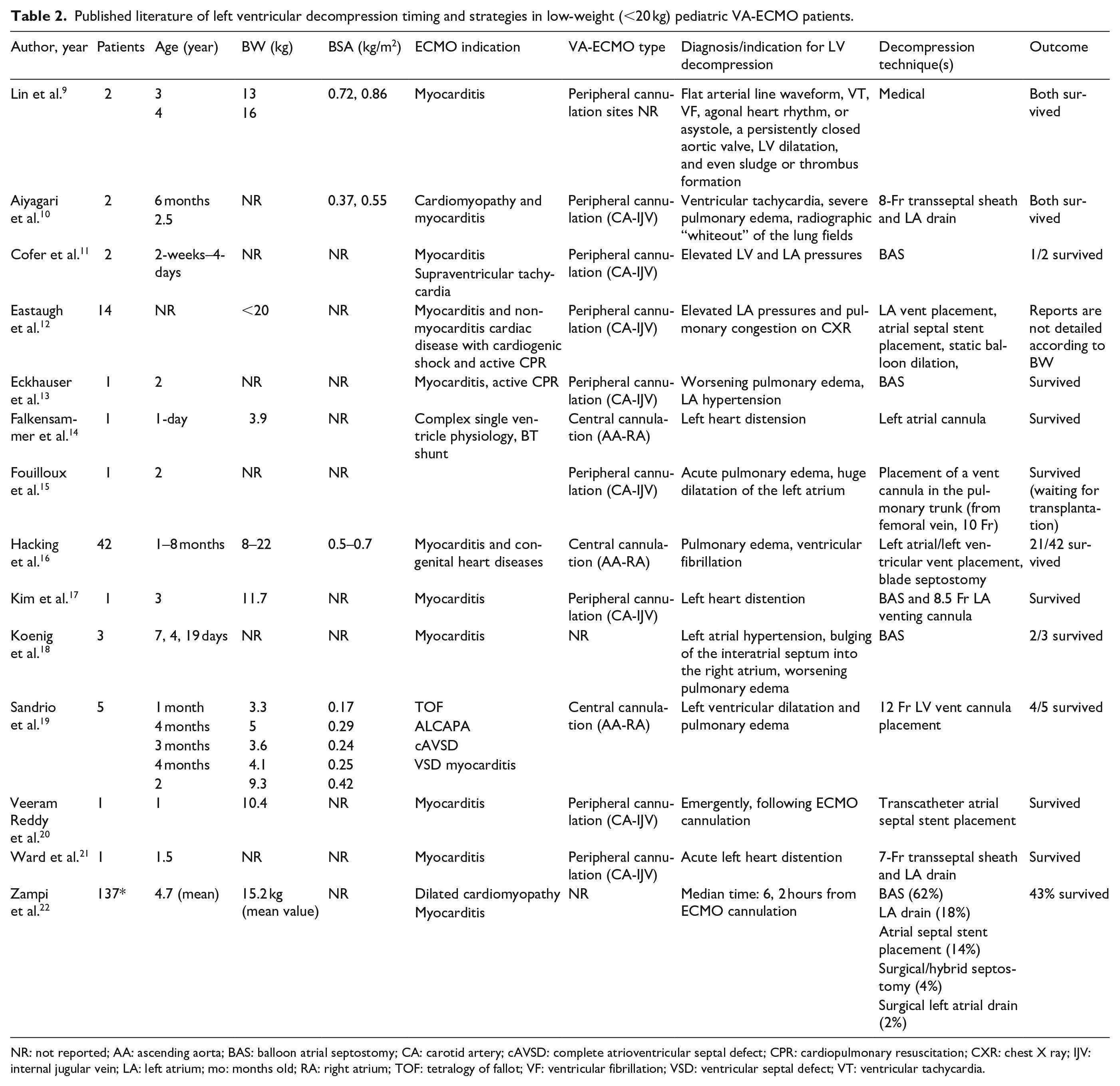
NR: not reported; AA: ascending aorta; BAS: balloon atrial septostomy; CA: carotid artery; cAVSD: complete atrioventricular septal defect; CPR: cardiopulmonary resuscitation; CXR: chest X ray; IJV: internal jugular vein; LA: left atrium; mo: months old; RA: right atrium; TOF: tetralogy of fallot; VF: ventricular fibrillation; VSD: ventricular septal defect; VT: ventricular tachycardia.
Since 2000s, longer bridging with paracorporeal VAD like Berlin Heart EXCOR® became available for the very young. 6 For long-term support, Berlin Heart EXCOR, a pneumatic, pulsatile, paracorporeal VAD is not available due to reimbursement issues in Turkey. The same situation is valid for Levitronix PediMag VAD, TandemHeart, and Jarvik 2015. Nevertheless, the Levitronix Centrimag system is an alternative for temporary and BIVAD dependent infants as in our patient. This MCS configuration supported our patient for 31 days without severe complications and is supplied to our patient in life without any sequel.
Larger children have benefitted from advances in MCS technology for adults. The volume of the pump, size of cannula, risk of thrombosis, hemorrhage, infection, and financial considerations are significant handicaps for smaller ones. 7
Mostly neurological morbidity (around 29% of survivors suffer from neurological dysfunction) and mortality (25% in the first year) remain high in children <18 years. Up to 25%–40% of the children <10 kg bridged with VAD develop an adverse event such as infection, mediastinal bleeding, and stroke. 8 Adverse event profiles vary according to types of devices. With continuous flow devices, only infection and bleeding generated event rates exceeding 10 per 100 patient-months. 1
Heart transplant waiting list mortality for the pediatric population remains high in Turkey. Temporary paracorporeal biventricular support bridging to recovery can be considered as a cost-effective and life-saving alternative for small children despite dimensional restrictions and financial considerations.
Footnotes
Declaration of conflicting interests
The author(s) declared no potential conflicts of interest with respect to the research, authorship, and/or publication of this article.
Funding
The author(s) received no financial support for the research, authorship, and/or publication of this article.
