






Abstract
Background
Ultrafiltration (UF) is a common practice during cardiopulmonary bypass (CPB) where it is used as a blood management strategy to reduce red blood cell (RBC) transfusion, minimize adverse effects of hemodilution, and reduce proinflammatory mediators. However, its clinical utilization has been shown to vary throughout the continents.
Purpose
The purpose of this investigation was to assess the distribution of UF use across the United States.
Data Collection
Data on UF use during cardiac surgery was obtained from a national (United States) perfusion database for adult cardiac procedures performed from January 2016 through December 2018.
Study Sample
Four geographical regions were established: Northeast (NE), South (SO), Midwest (MW) and West (WE). The primary endpoint was the use of UF with secondary endpoints UF volume, CPB and anesthesia asanguineous volumes, intraoperative allogeneic RBC transfusion, nadir hematocrit and urine output (UO). 92,859 adult cardiac cases from 191 hospitals were reviewed.
Results
The NE and the WE had similar usages of UF (59.9% and 59.7% respectively), which were higher than the MW and the SO (38.6% and 34.9%, p < .001). When UF was utilized, the median [IQR] volume removed was highest in the NE (1900 [1200-2800]mL), and similar in all other regions (WE 1500 [850-2400 mL, MW 1500 [900-2300]mL and SO 1500 [950-2200]mL, p < .001. Median total UO was lowest in the NE 400 [210,650]mL vs all other regions (p < .001), and remained so when indexed by patient weight and operative time (NE-0.8 [0.5, 1.3]mL/kg/hour, MW-1.1 [0.7, 1.8] mL/kg/hour, SO-1.3 [0.8, 2.0]mL/kg/hour, WE-1.1 [0.7, 1.3]mL/kg/hour, p < .001. Intraoperative RBC transfusion rate was highest in the SO (21.3%) and WE (20.5%), while similar rates seen in the NE (16.2%) and MW (17.6%), p < .001.
Conclusions
Across the United States there is geographic variation on the use of UF. Further research is warranted to investigate why these practice variations exist and to better understand and determine their reasons for use.
Introduction
In the United States, there are between 275,000 and 300,000 annual cardiac surgical procedures, 1 with greater than 85% performed using cardiopulmonary bypass (CPB). 2 The conduct of CPB necessitates that fluid-filled circuits be utilized with concomitant hemodilution.3–5 While an ideal prime volume has yet to be identified for adult CPB, 6 excessive hemodilution can result in a number of deleterious effects that include a reduction in plasma colloid oncotic pressure, reduced hemoglobin (Hgb) levels, decreased oxygen delivery, and coagulation disturbances all of which may contribute to renal dysfunction, myocardial as well as cerebral ischemia, interstitial edema, and increased mortality. 7
Many well-documented blood conservation techniques exist in cardiac surgery that can reduce allogeneic red blood cell (RBC) transfusion, 8 with some purported to decrease inflammation and improve hemostasis.9,10 Techniques that have been shown to reduce the likelihood for allogenic transfusion include acute normovolemic hemodilution (ANH), intraoperative autotransfusion (IAT), antegrade/retrograde autologous priming (AP) and ultrafiltration (UF).11,12 There is significant variation in the geographical use of ultrafiltrators during CPB, which ranges from 1.4% use in Australia and New Zealand to 41.8% in the United States.13,14 The purpose of this study was to determine if the use of UF varies by geography across the United States.
Methods
Consecutive cardiac surgical procedures where CPB was required on patients over 18-years of age were evaluated from a multi-institutional United States database 1 that has been previously reported.5,8 The time period of the study was between January 2016 and December 2018 with data abstracted from 191 hospitals. The human subject’s research protocol for this study was reviewed and approved by an independent Institutional Review Board. Institutional Review Board approval and waiver of the need for consent were obtained (SpecialtyCare Protocol # 012017, ADVARRA, Center for IRB Intelligence, 6940 Columbia Gateway Drive, Suite 110, Columbia, MD 21046).
Study design
The hospital distribution across the United States was determined as a factor of operational function and not by federal census determination. There were four operational regions: Northeast (NE), South (SO), Midwest (MW) and West (WE), and states with no hospitals identified (Figure 1). National policies and procedures on UF were established by the SpecialtyCare Medical Department using published clinical practice guidelines and peer-reviewed literature, and distributed to all hospitals.
11
There were no changes to the policies and procedures throughout the study period. The following variables were recorded: Patient demographics, intraoperative fluid volumes that included prime, cardiopulmonary and crystalloid cardioplegia volumes, anesthesia volumes, urine output, UF volume, zero-balance ultrafiltration (ZBUF) volume, post-CPB residual blood processing technique and volume of allogenic RBC transfusion. Distribution of states into four regions across the United States. Northeast Region: Pennsylvania, Maryland, New Jersey, Delaware, Washington DC. West Region: Washington, Oregon, Idaho, California, Nevada, Utah, Colorado, Arizona. Midwest Region: Minnesota, Wisconsin, Michigan, Iowa, Illinois, Indiana, Ohio, Kansas, Missouri, Kentucky. South Region: New Mexico, Texas, Louisiana, Tennessee, Alabama, Georgia, Virginia, North Carolina, South Carolina, Florida.
Data was obtained from the following procedures where CPB was utilized: Aortic surgery, isolated coronary artery bypass grafting (CABG), isolated aortic valve (AV) surgery, isolated mitral valve (MV) repair/replacement surgery, combined AV and CABG surgery, combined MV and CABG surgery, and other cardiac surgical procedures that included combination surgeries not listed, ventricular assist device insertions and heart transplants. Non-elective cases were those that were either classified as urgent, emergent, or emergent salvage procedures. Patients were not excluded if they were having a reoperative procedure. 1
Endpoints
The primary endpoint was of UF, with secondary endpoints of UF volume, CPB and anesthesia asanguineous volumes, intraoperative RBC transfusion, nadir hematocrit and urine output.
Statistical analysis
Patient demographics and operative data were summarized by geographic group using median and inter-quartile range or count and percentage, with the Kruskal-Wallis rank sum test or Chi-square test respectively, as appropriate. Mixed effects logistic regression was used to assess possible differences in the likelihood of receiving UF across geographic regions correcting for patient age, BMI, sex, first hematocrit upon entry to the OR, procedure type, whether or not an autologous ECC priming method was used, and duration of the procedure, with random intercept terms to account for possible variation in ultrafiltration use patterns by surgeon and by perfusionist. A second model (using the linear mixed effects method) was estimated in order to assess possible difference by geographic region in the total volume removed using ultrafiltration indexed by patient body weight and duration of the procedure (ml/kg/hour). This second model included all control variables described above and additionally included total urine output, patient estimated total blood volume using the Nadler formula, total volume of crystalloid cardioplegia, volume of other asanguineous fluids added intraoperatively, and packed RBC transfusion added during the intraoperative period. Post-hoc pairwise contrasts of region-specific model estimates were completed using the Tukey HSD method. Ultrafiltration survey responses were summarized as count with percent. All analyses were carried out within the R statistical computing environment (version 3.6.1) using the ‘compareGroups’, ‘lme4’, and ‘multcomp’ analysis packages.15–18
Results
Descriptive Statistics: patient and operative characteristics.

AV: aortic valve; CABG: coronary artery bypass graft; CPB: cardiopulmonary bypass; IQR: interquartile range; MV: mitral valve.
Intraoperative volumetrics.
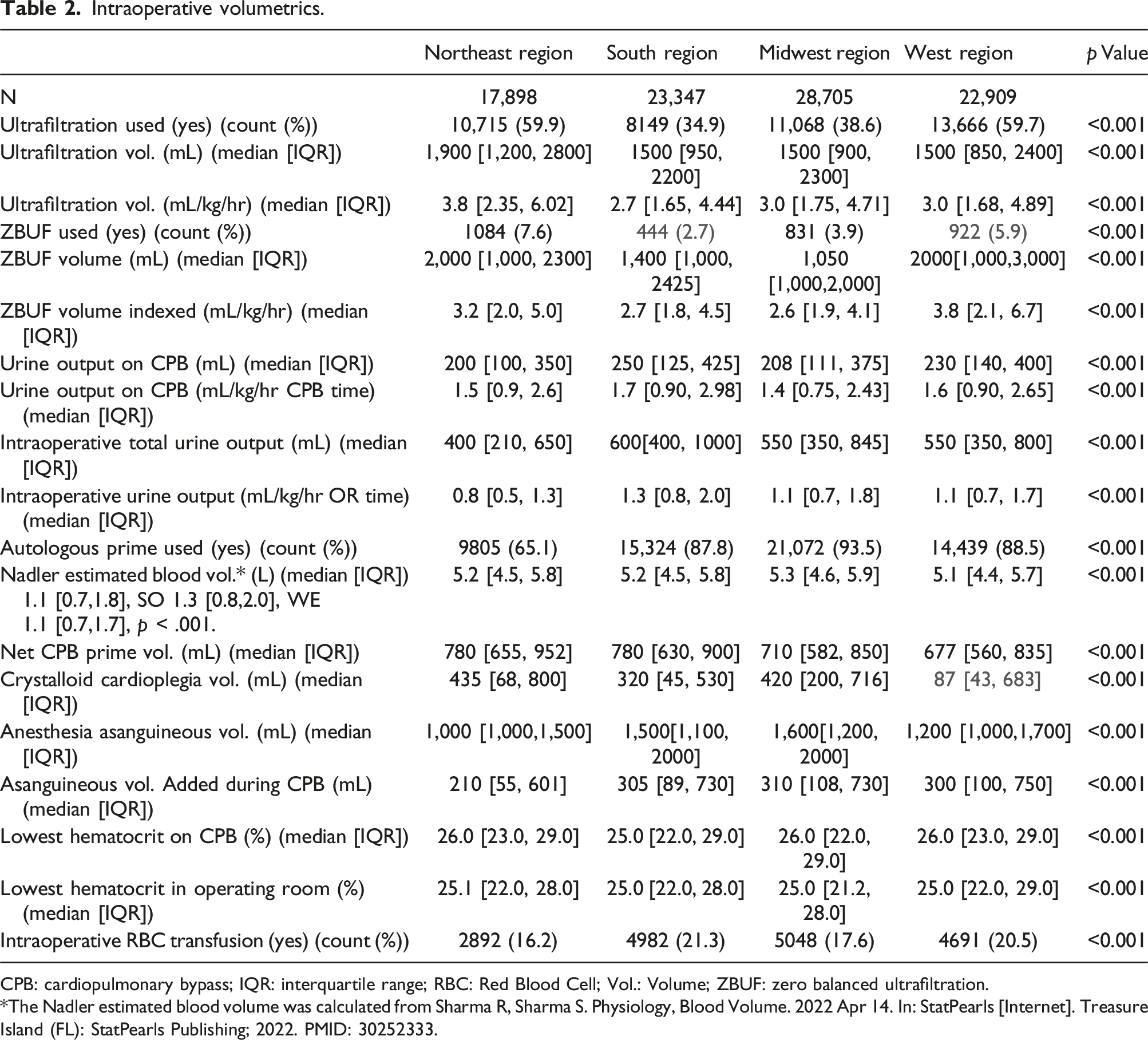
CPB: cardiopulmonary bypass; IQR: interquartile range; RBC: Red Blood Cell; Vol.: Volume; ZBUF: zero balanced ultrafiltration.
*The Nadler estimated blood volume was calculated from Sharma R, Sharma S. Physiology, Blood Volume. 2022 Apr 14. In: StatPearls [Internet]. Treasure Island (FL): StatPearls Publishing; 2022. PMID: 30252333.

Intraoperative red blood cell transfusion rates by region.
The model-adjusted percent of patients receiving ultrafiltration confirmed that the highest usage occurred in both the NE and WE regions (Figure 2). Rates of ultrafiltration use were statistically indistinguishable between the NE and WE and similarly between the MW and SO, however both NE and WE had higher adjusted ultrafiltration use compared to either/both the MW and/or SO (p < .001). Model-adjusted estimates of volume of UF removed adjusted for CPB time are given in Figure 3; the NE had greater volume removed than both SO and MW (both p < .01), and the WE region had greater volume removed than the SO region (p < .05). All other pairwise comparisons of model estimated volume removed by ultrafiltration were statistically unreliable (Figure 4). Model adjusted percent of patients who had ultrafiltration used during cardiopulmonary bypass across regions with 95% confidence interval. Model adjusted ultrafiltration volume per kg of body weight and hours of cardiopulmonary bypass time across regions (among cases where ultrafiltration was used) with 95% confidence interval.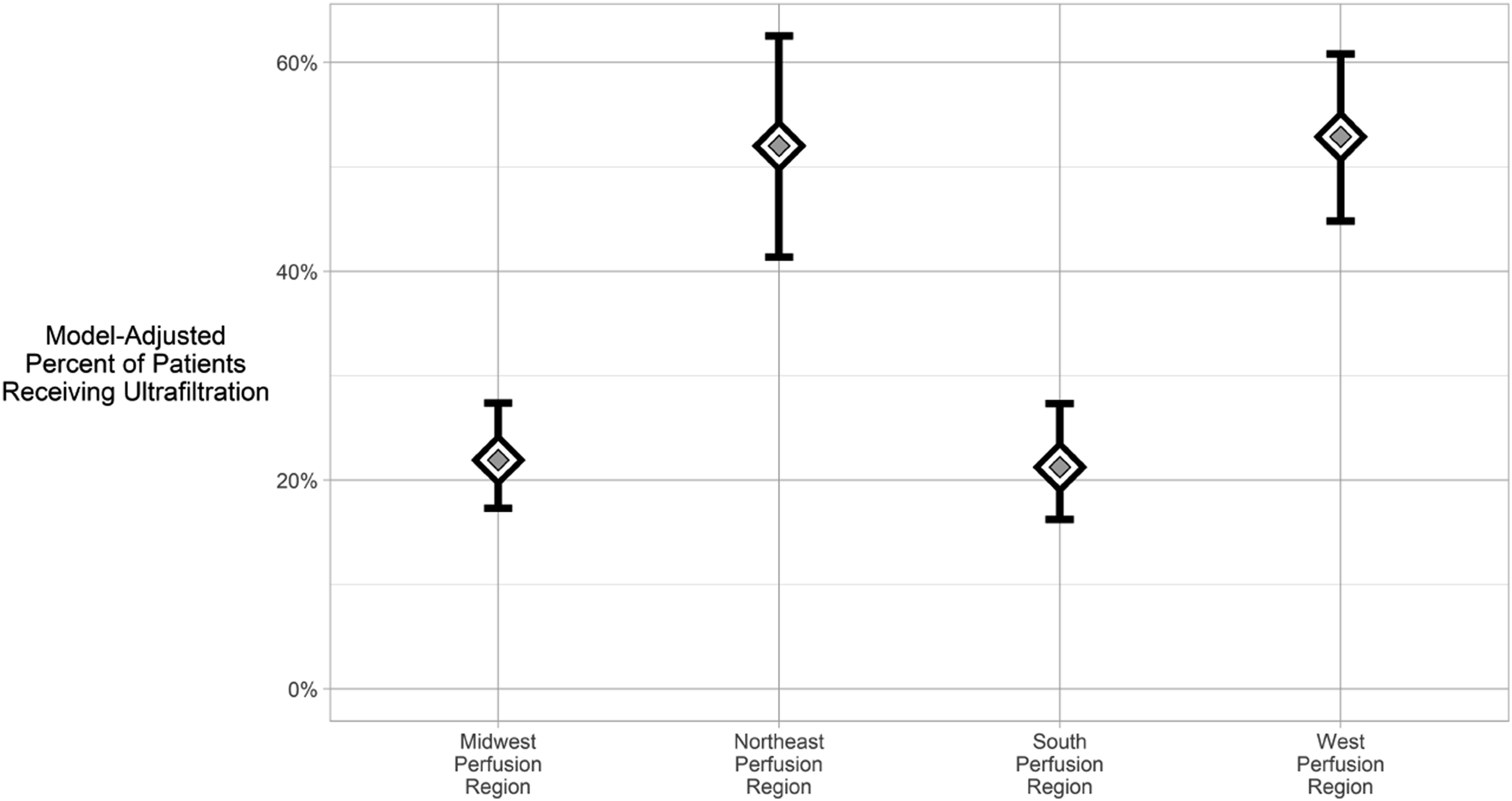
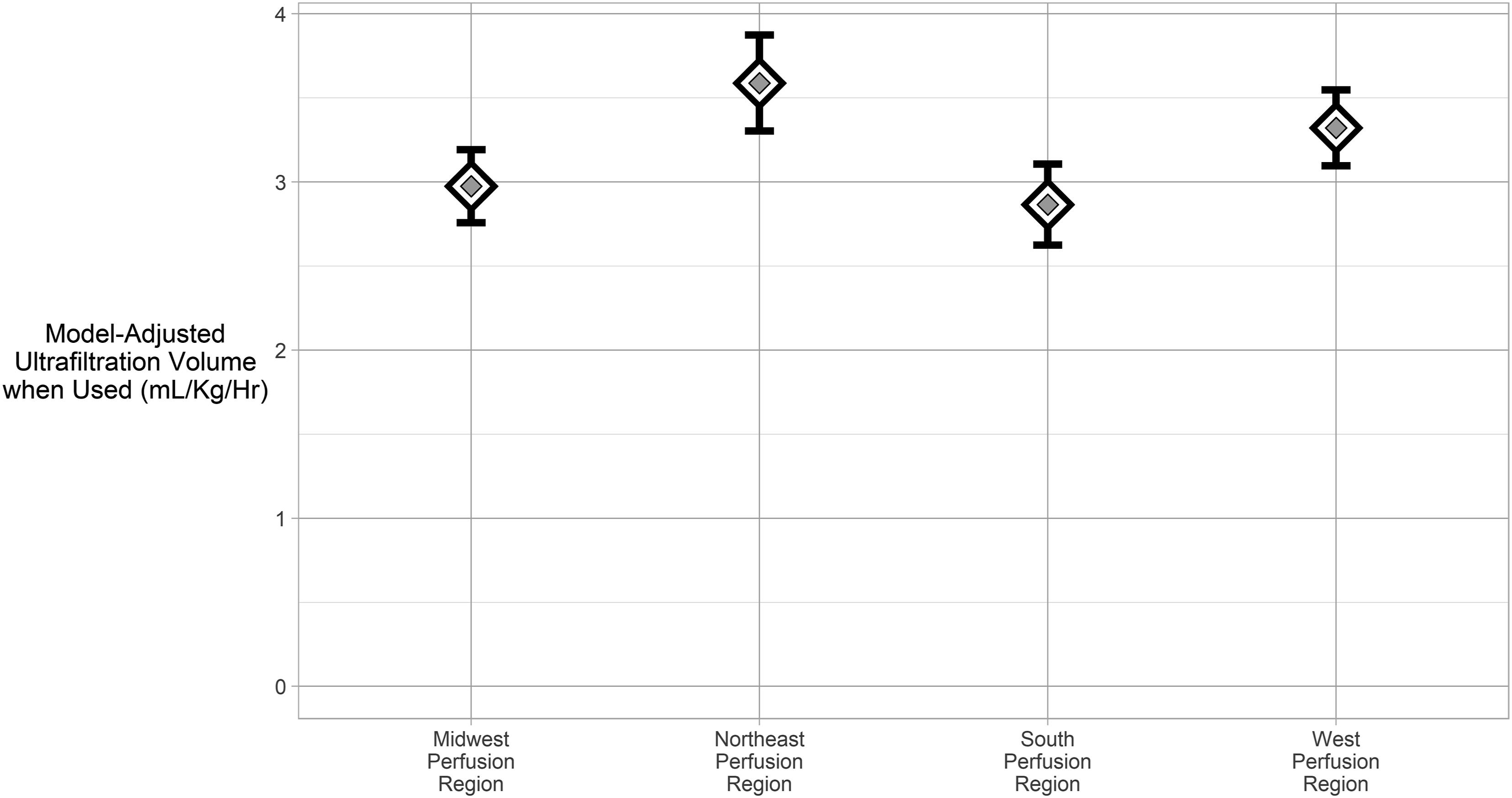
Similar findings were also found in the volume of UF removed adjusted for CPB time (Figure 3).
Discussion
The use of CPB for patients undergoing cardiac surgical procedures is a life-saving technology; however, its use has been known to cause many adverse physiological changes such as hematological alterations, neurological sequela, systemic inflammatory response syndrome and the negative effects of excessive hemodilution. Hemodilution occurs by interventions of both the anesthesia and perfusion teams when asanguineous solutions are added to maintain hemodynamic stability. During CPB, both circuit priming and the administration of asanguineous solutions alter the concentration of the formed elements of blood; hemodilution is often further exacerbated by the use of crystalloid-based cardioplegia solutions. 19 There are many blood conservation strategies that have been shown to reverse or minimize the extent of hemodilution; all are performed with the goals of maintaining red blood cell mass and coagulation factors, and reducing the potential for allogeneic blood transfusions. During and after CPB UF has been shown to be a helpful modality to achieve these goals. 20
The use of UF in cardiac surgery evolved from renal dialysis as a means to remove excess plasma water through the use of a semipermeable membrane and hydrostatic forces. This process maintains the formed elements of blood along with proteins and coagulation factors.21,22 Additionally, low-molecular-weight molecules such as inflammatory mediators are also removed by UF, which has been shown to improve both pulmonary and renal function.20,23–25
According to the recent patient blood management guidelines from The Task Force on Patient Blood Management for Adult Cardiac Surgery of the European Association for Cardio-Thoracic Surgery and the European Association of Cardiothoracic Anaesthesiology, there is a consensus that most studies have demonstrated the beneficial effect of UF on postoperative transfusion requirements, especially in the presence of preoperative anemia. 26 In a large randomized controlled trial the rate of respiratory, neurological and gastrointestinal complications, as well as requirements for blood transfusion, were all lower in patients who had UF compared to patients in whom an UF was not used. 27 An older meta-analysis by Boodhwani et al reported on 10 randomized UF trials showing that the combination of modified UF and conventional UF resulted in lower units of postoperative blood transfusion (−0.73 [1.16, −0.31], p = .001). 19 More recently a mixed analysis of various types of UF has reported small but significant differences in intensive care unit length of stay, ventilation time and incidence of pneumonia when UF was used. 28
It is well documented that various medical practices and strategies have been found to have significant geographic variations with economic challenges being a major driving force. 29 This maldistribution implies that individuals may be receiving suboptimal care or that there is a misuse of health care resources. 30 O’Connor and colleagues investigated geographic variation in treatment of acute myocardial infarction (AMI) using a large cohort involving over 185,000 patients with confirmed acute myocardial infarction. 31 They were able to demonstrate that geographic variations existed and that there were gaps between knowledge and practice, which translated to negative consequences.
Over the last several decades, there has been an increase in published literature aiming to demonstrate the significant disadvantages of blood transfusion on cardiac surgical patients.4,12 Cardiac surgery is one of the highest consumers of blood products using up to 15% of the blood supply, despite such use having been shown to increase morbidity and mortality in patients who receive allogeneic transfusions. 32 While it would be beneficial to have the Hgb of all cardiac surgical patients optimized prior to surgery, this is often not achievable, with many patients, even with various blood conservation strategies applied, susceptible to both anemia and allogenic transfusion.2,3
While the use of UF has shown to be beneficial in reducing hemodilution, its effects on kidney function have not been extensively studied. In recent years, there has been an increased awareness on the influence of UF on intraoperative and postoperative urine output, and if the impact of UF has any implications on postoperative renal function.5,20,33 In a prospective randomized study of CUF in adult cardiac surgical patients, Kuntz and associates found no differences in CPB or operative urine volumes, but non-CUF patients had significantly higher 24-h urine than CUF patients. 20 Paugh and colleagues demonstrated in an observational study that patients exposed to UF had a higher adjusted risk of postoperative acute kidney injury (AKI). 34 The risk of AKI is impacted by renal perfusion and removal of excessive UF volume can lead to renal hypoperfusion. Urine output is well documented as surrogate for adequate perfusion during CPB and a possible indicator for determining renal injury. 35 Our study examined urine output and its association with UF volume removed. An inverse relationship was noted; however, no inferences on causality can be made. The direct impact of UF use on postoperative renal function needs further study to determine if such a relationship exists. Over the years numerous studies have been done to compare methods of blood conservation and volume management in terms of safety, patient outcomes, and cost effectiveness, often with equivocal or contradictory results. 19 An understanding of the existence of variation during CPB is imperative, and consistent with efforts to reduce unwarranted practices, and use the best available evidence, to standardize the conduct of extracorporeal circulation as a facet of optimizing care. 36
Our analysis demonstrated that UF use varies by geography with the highest usage in the Northeast and West and less use in the Midwest and Southern regions (Figure 2). This variation was also shown on RBC transfusion rates and total urine output, where an inverse relationship was noted between UF volume removed and both RBC transfusion rates and total urine output less than one quarter (69.6%) of cases.
While the present study was not powered to address additional factors that affect the geographical variation in UF use across the United States, there may be topographical and demographic factors that are influential. Residents at higher altitudes have been shown to have increased erythropoiesis and higher hemoglobin levels resulting in populations with less anemia and lower levels of erythropoiesis-stimulating drugs. 37 There exists wide geographic variation in body surface size across the United States, with increased rates of both obesity (body mass index of 30 kg/m2 or above, and severe obesity (body mass index of 35 kg/m2 or above) shown in the southern and Midwest states, with lower levels in western and northeastern states. 38 Another factor that may influence UF use is the distribution of AKI requiring dialysis treatment. Sibbel and colleagues have shown that the highest use of dialysis dependent AKI occurred in the South and Midwest regions of the United States with similar distributions in the occurrence of end stage renal disease. 37
Limitations
Several limitations are evident in this large multi-institutional study. The analysis was completed using retrospective data from a database used primarily for quality improvement and benchmarking of performance. The study does not demonstrate any cause and effect relationship, but does demonstrate interesting descriptive observations regarding a possible preferential utilization of UF during CPB that varies by region. As shown in Figure 1 there are a number of states where data was unavailable, which was a result of out-sourced perfusion services not provided and hence, no data collected for analysis. Protocols and logistics for UF were specific to each individual hospital, and no effort was made to standardize these protocols across facilities; therefore, differences in practice patterns involving the utility of UF varied across all hospitals.
Conclusions
Although the use of UF during CPB is common, substantial geographical variation exists in its use across the United States, with the highest usage seen in the Northeast and West regions. Greater UF utilization was concomitant with higher ultrafiltrate volumes removed. Further research is warranted to investigate why these practice variations exist, and if these variations have an impact on other variables associated with cardiopulmonary bypass and especially outcomes.
Footnotes
Acknowledgements
The authors wish to express their sincere gratitude to the perfusion associates of SpecialtyCare who participate daily in the quality improvement process that is dedicated to improving patient outcomes.
Declaration of conflicting interests
The author(s) declared no potential conflicts of interest with respect to the research, authorship, and/or publication of this article.
Funding
The author(s) received no financial support for the research, authorship, and/or publication of this article.
