







Abstract
Background
Increasing regulations and requirements of advisory bodies, in particular the Joint Federal Committee and the Medical Service of the health insurance funds, make it necessary to employ only demonstrably well-trained perfusionists. The minimum requirement for this staff is EBCP certification. Currently there is limited availability of such specialists on the German market. Therefore, the qualification of young people in this area is of central importance. The aim of this paper is to strengthen the training of perfusionists at our centre, to standardise the process and to provide the respective student with a “roadmap” to their internship.
Material & Methods
The structure is based on a rough division of the 24 weeks of internship. This is described in detail in the following and is backed up with the learning objectives for the respective time periods.
Results
At our centre, practical training has been standardized and clear responsibilities have been defined. Furthermore, as a centre of maximum care in the field of cardiac surgery, we can offer students the necessary number of perfusions in just six months to meet the requirements of the ECBP for practical training. According to this concept, 20 perfusionists have been successfully trained in the last 8 years. All of them have passed the exams and have been certified according to EBCP.
Conclusion
The aim of the practical semester is for the student to be in a position at the end of the semester to independently supervise simple cardiac surgery procedures with the aid of the Extra- Corporal Circulation (ECC) and to carry this out in accordance with the currently valid guidelines and directives (1–8) and the departmental procedural instructions based on them. Great emphasis is placed to the students becoming aware of their competence to act, knowing their limits and being able to assess when these limits have been reached and the involvement of experienced colleagues is necessary to ensure patient safety.
Keywords
Introduction
“The special qualification of the perfusionist as a profession is neither recognized by federal law in Germany, nor are there nationwide requirements in order to be able to fundamentally understand the range of activities of the perfusionist.” For the federal state of Berlin, on the other hand, there is a state regulation according to which the professional title and the activity as a “Kardiotechniker” (Perfusionist) are protected (Law on Medical Professions of 15.06.1983 [MedFBerGBE], furthermore there is also a training and examination regulation for perfusionists [KardTechAPrO]). 1 This nationwide gap is to be closed by joint recommendations on the necessary knowledge, special tasks and responsibilities of the perfusionist. 2 The minimum qualification to be allowed to work as a perfusionist in Germany should be determined according to the joint recommendation of the participating professional societies2–6 be proven by a recognized certificate. At the European level, this is currently the European Certificate in Cardiovascular Perfusion (ECCP), which is awarded by the European Board of Cardiovascular Perfusion (EBCP). These recommendations are the basis of the contents of the practical training at the Heart and Diabetes Centre North Rhine-Westphalia (HDZ-NRW). There are three training centres throughout Germany that have accreditation to train according to the requirements of the EBCP. These are the Academy of Perfusion in Berlin (AfK), the Furtwangen University (HFU) and the University of Applied Sciences in Münster. In cooperation with these three centres, we carry out practical training at the HDZ-NRW according to the specifications of the EBCP.
Structure of the induction process
The implementation of the practical semester at the HDZ-NRW is divided into three major areas: • Orientation to the facilities, the equipment as well as the clinic’s own procedural instructions and standard operating procedures (SOP)of the Perfusion Department. • Learning the basics of extracorporeal circulation (ECC)and related techniques and equipment. • Training in special perfusion techniques and in-depth application of the basics learned in point 2 with final clinical testing according to EBCP guidelines.
See Figure 1: Overview of the three major areas during the practical internship semester. Overview of the three major areas during the practical internship semester.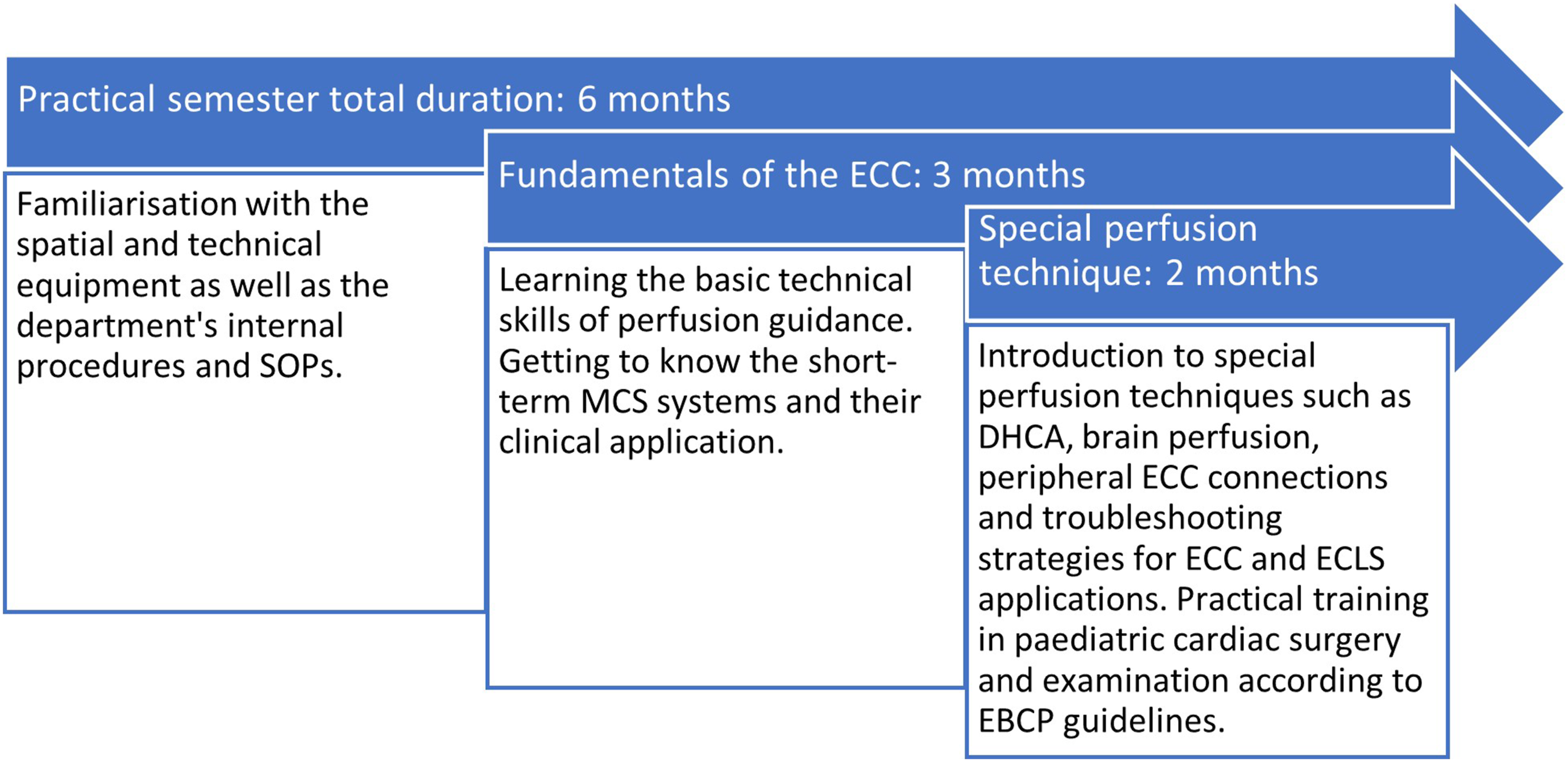
Orientation to the facilities of the HDZ-NRW
The HDZ-NRW is a maximum care hospital in the field of cardiac surgery, cardiology, electrophysiology, paediatric cardiology and paediatric cardiac surgery. The centre was founded in 1984 as a centre for heart and circulatory diseases with an attached diabetes clinic. Since 1989, the centre has been part of the University Hospital of the Ruhr University Bochum. With a focus on heart failure, the centre is Germany’s largest heart transplant centre. Since 1989, more than 2700 heart transplants have been performed at the Bad Oeynhausen site. Every year, approximately 36,000 inpatients and outpatients are treated at the centre. Since the opening of the extension in 2012, the centre has nine operating theatres. Of these, five are conventional cardiac surgery rooms, two hybrid operating rooms, one paediatric cardiac surgery room and an emergency operating room attached to one of the intensive care units. Across all areas, the centre has about 100 intensive care beds and a total bed capacity of about 500 beds. The hospital is 100% owned by the state of North Rhine-Westphalia.
The first elementary component of the practical semester is getting to know the centre, the location of the intensive care units and the usual routes that patients take to and from the operating room.
Anaesthesiologic management
The concept of “Early Risk stratification and strategy (ERSAS)” is performed day prior surgery in every patient to stratify in low, intermediate and high risk. Tools of risk stratification include scores, biomarkers, laboratory parameters, diagnostics of cardiac comorbidities, renal and liver function, diabetes mellitus. Furthermore, a preoperative frailty assessment (Friedmann frailty Test, Mini-COG, Delirium Screening) is performed in patients older than 70 years. All patients who receive cardiac surgery receive general anaesthesia. Patients are treated with basic monitoring and, depending on the procedure, with extended monitoring in accordance with the S3 guideline 7 of the Association of the Scientific Medical Societies in Germany (AWMF) supplied.
The necessity of the individual accesses is determined by the anaesthesia department in the premedication rounds and carried out by an anaesthesiologist on the day of the operation. The induction takes about 30–60 min from the smuggling of the patient to release in the operating room.
Surgical techniques
An elementary component of the study to become a perfusionist is the knowledge of surgical techniques and their processes. This includes learning the individual steps of the operations, a rough overview of their risks and the respective relevance for the daily work of the perfusionist. After induction, the student should be able to assess the risk of the procedure based on the medical history and the diagnoses made in conjunction with the planned operation. Based on this assessment, the student must in turn plan the resulting equipment requirements, initiate any deviations from the standard procedure and be able to ensure safe perfusion care for patients even in emergency situations.
Care in the intensive care unit/“early recovery after cardiac surgery” unit (ERACS-unit)
Postoperatively, patients are transferred either to the ERACS-Unit or to the intensive care unit, depending on the procedure. In the ERACS Unit (i.e. single valve procedures, CABG surgery with and without CBP) patients receive regional analgesia techniques (paravertebral, parasternal blockade via ultra-sound technique) prior ultra-fast track extubation within the first hour after surgery. This allows early control of neurological monitoring.8,9 After a few hours patients are transmitted for one night to the Intensive care Unit. If there are no complications in the intensive care unit, patients can usually be transferred to a monitoring unit the next morning.
Perfusion
The Heart-Lung Machine (HLM), the daily work tool and the management of the extracorporeal circulation is the predominant activity of the perfusionist in a cardiac surgery clinic. At HDZ-NRW, the HLM used is the Model S5 (Liva Nova, Milan). Of these, nine are standard HLM for use in adult patients and one HLM for minimized extracorporeal circulation (MiECC) is available. In addition, two HLMs are configured for use in paediatric and infant procedures.
Perfusion guidance is a standardized procedure, the implementation of which is regulated at the HDZ-NRW in numerous procedural instructions/SOPs and is based on the recommendations of the European Board of Cardiovascular Perfusion (EBCP), European Association of Cardiothoracic Anaesthesiology and intensive Care (EACTAIC) and the European Association for Cardio- Thoracic Surgery (EACTS) on the use of extracorporeal circulation (ECC) from 2019. 3 Students are encouraged to familiarize themselves with the procedural instructions and to align their work with them. The ECLS therapy is the second major field of activity of the perfusionist at the HDZ-NRW. Every year, more than 260 patients are treated with an ECLS system at our centre. Up to 30 patients per year are implanted in external clinics by a team from the HDZ-NRW. The deployment of the team takes place either with our ECLS-Mobile, which is operated in cooperation with the local fire brigade, or airborne in cooperation with the air rescue. A landing pad is available on the roof of our centre for helicopter use. As part of the therapy, the systems mainly used are venoarteriall for circulatory support (ECLS). The second group of patients is provided with a Veno venous system for lung support. This is the Extracorporeal Membrane Oxygenation Therapy (ECMO). The third and smallest group are patients who need both circulatory and pulmonary support. In these patients, mixed forms of the two aforementioned therapies are used. In these systems, blood is taken from the patient’s vein and returned arterially and venously (V-AV).
Literature
The contents of the practical semester cannot be achieved through practical instruction and instructions alone. It is therefore expected that the student will read up on the contents in the current literature and also work out the basics outside the clinic. Scientific articles on all topics of medicine and perfusion can be found at https://www.pubmed.gov/ via the search engine on the website, which is published by the National Library of Medicine (NLM) is offered. The primary literature on the subject of perfusion is Rudolf Tschaut’s book Extracorporeal Circulation in Theory and Practice, the cardiopulmonary bypass guideline from 2019 3 and the Extra- Corporal life Support Organisation (ELSO) Redbook this three are also the basis of the examination for the EBCP certificate. The necessary knowledge of anatomy is very good in the book Functional Anatomy by Phillip Zimmer described. The basics of physiology are described in Silbernagel’s standard work, the Pocket Atlas of Physiology vividly depicted. A deeper insight is provided by the book Human Physiology with Pathophysiology by Ralf Brandes. Another important component of theoretical knowledge is the theory of disease and the knowledge of the pathophysiological significance of the clinical pictures. This is described by Dr. Med. Gerd Herold in his lecture-oriented treatise Internal Medicine. This book is also the standard work of clinicians in the field of internal medicine and is updated annually. Furthermore, the prospective perfusionist must deal with the topic of anaesthesia and intensive care medicine. This field is described very clearly in the textbook Anaesthesia and Intensive Care Medicine by Reinhard Larsen depicted. The core area of the work in the intensive care unit is the care of the systems for circulatory and pulmonary support, these areas convey the ELSO Red Book, the German-language work ECMO by Daniell Räpple, as well as the basics in the Tschaut.
Material and methods
Procedure of the briefing practice EKZ
The practical training in perfusion guidance takes place in the daily practice on the patient during the routine cardiac surgery program. For this purpose, the student is assigned two experienced practical instructors. It is from these two colleagues that the student is guided and accompanied for most of the training. The student is not entitled to perform perfusions during his internship semester without his internship instructor. The perfusions are always carried out under the supervision and/or guidance of a practice instructor. During or after each perfusion, a discussion must be held about the positive and negative aspects of the perfusion performed, as well as the aspects to be optimized, further learning objectives must be set and documentation must be included in the EBCP logbook 10 perform.
Intensive care units and associated intervention areas at the HDZ-NRW.
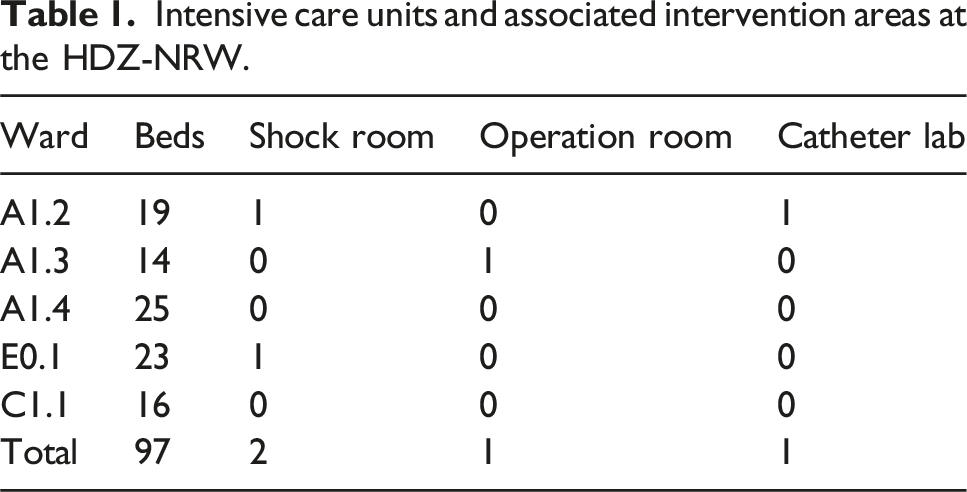
The student accompanies his mentor in the daily work and receives the first instructions and instructions regarding the EKZ. The student should also get to know the anaesthesiologic care of the patients and the individual steps of the initiation of the patients. The observation of the processes of the surgeon’s work from the thorax opening to the cannulation of the patient, the recording of the ECC, the administration of cardioplegia, the weaning from the ECC, the de-cannulation of the patient and the thoracic occlusion are in the foreground of the training in this phase. The progress should be made in the checklist are documented and signed.
After achieving a certain routine and the manual ability to safely manage the ECC under routine conditions under supervision, training in more complex operations can now be started (
After the progression of training in the field of adult perfusion, we offer our students • Accompaniment of at least five paediatric heart surgeries • Understanding the pathophysiological mechanisms and their corrections • Preparation of five short reports on accompanied paediatric heart surgeries
In addition, the students can sit in on catheter-supported valve implantation and repair and gain initial experience here. We also offer the opportunity to be admitted for transplantation regarding organ removal and to participate in organ removal. In addition, you can sit in on the preparation of homografts in our cryobank. In the context of external ECLS implantation, participation in implantation and patient transport may be possible. Figure 2 Schedule of activities of the 6-month internship semester Schedule of activities of the 6-month internship semester.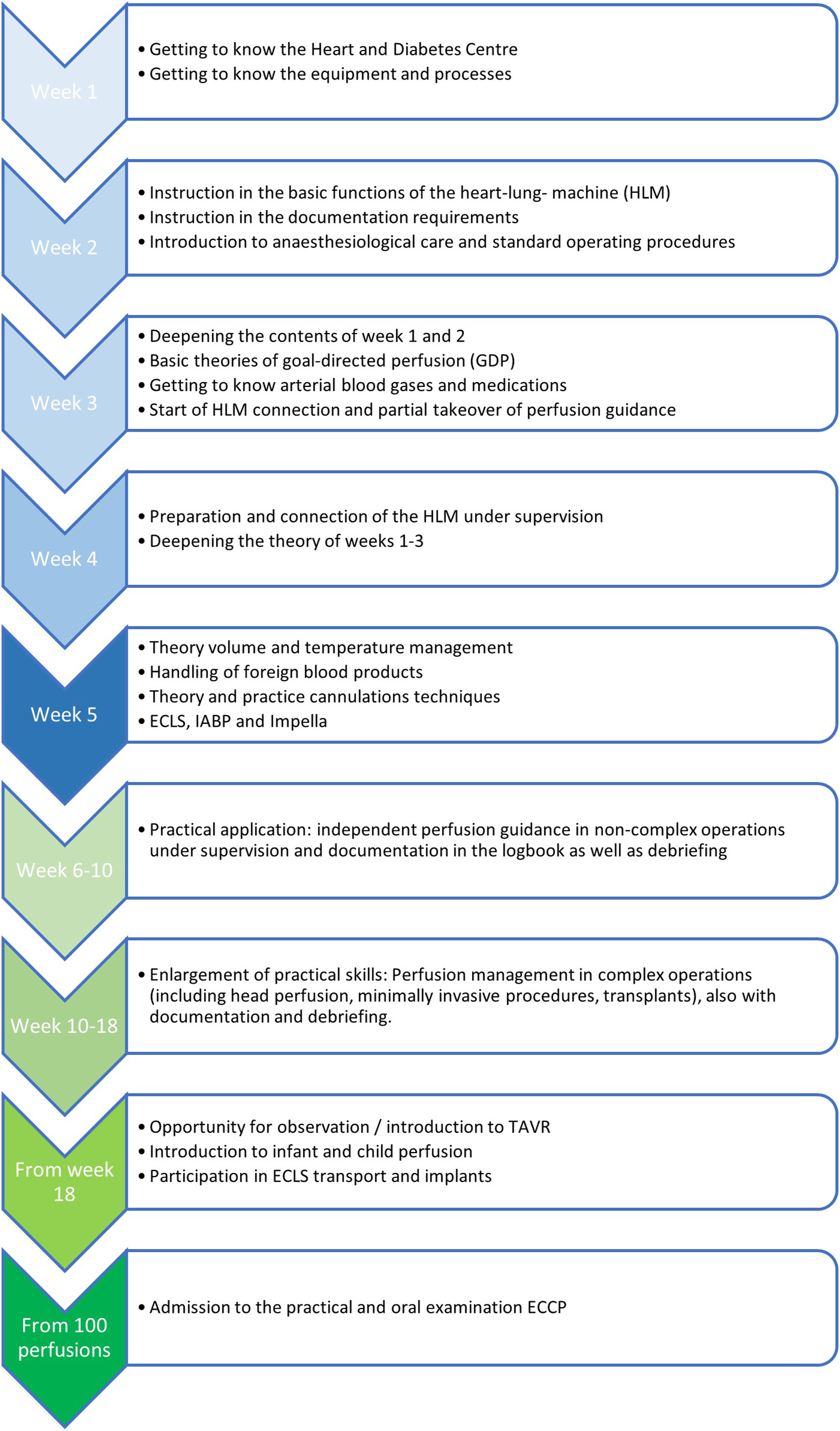
At the end of the assignment and after documentation of at least 100 perfusions, which were carried out independently as the first perfusionist, the practical examination according to EBCP guidelines is due. This is done by a representative of the university, the chief perfusionist and/or the practical instructor in the department’s routine program. The exam is divided into two parts. In the first part, the examiner prepares a perfusion independently, presents the data of his examiner and performs the perfusion independently. After perfusion, all necessary follow-up work is carried out and the equipment is prepared for the next use. This part of the exam is discussed by the examiners and evaluated separately in the practical exam sheet. In the second part of the exam, the perfusion is discussed in an expert discussion and questions that have arisen in the course of the perfusion are asked to the examinee. The answers to these questions are documented in the oral part of the exam and evaluated individually by each examiner.
Results
The EBCP certificate is the basic qualification to work as a perfusionist in Germany. The certificate is awarded after successful training at a university accredited by the EBCP, in conjunction with a practical part and an examination in a cardiac surgery centre. At our centre, practical training has been standardized and clear responsibilities have been defined. Furthermore, as a centre of maximum care in the field of cardiac surgery, we can offer students the necessary number of perfusions in just 6 months to meet the requirements of the ECBP for practical training. According to this concept, 20 perfusionists have been successfully trained at HDZ-NRW in the last 8 years. All of them have passed the exams and have been certified according to EBCP. Of these 20, nine perfusionists are still working at our centre. Another 20 perfusionists have completed their paediatric perfusion internship for EBCP certification. As part of the academization of education in Germany, we are increasingly supervising bachelor’s and master’s theses in our centre.
Discussion
Since there are hardly any qualified perfusionist on the German market, the development and training of young people is of central importance. In addition, increasing regulations and requirements from advisory bodies, in particular the Federal Committee and the Medical Service of the Health Insurance Funds, make it necessary to employ only demonstrably well-trained specialists. The minimum requirement for these professionals is EBCP certification.
In our perfusion department, the age structure currently shows a rate of 48% of employees who are older than 55 years. In total, there are 23.5 full-time positions at our centre. These are staffed by 27 perfusionists, 15 full-time employees and 12 part-time employees with a range of 30% to 91% of a full-time position. To meet the need for perfusionists in our department and to counteract understaffing, it is necessary to train one or two talents in our centre every year. A similar picture can be seen in almost all cardiac departments in Germany. In addition, due to legal regulations, it is necessary to comply with the recommendations for the minimum qualification of perfusionist. In practice, this means that a perfusionist must have the ECCP certificate to meet the requirements in Germany. If German hospitals employ perfusionists without ECCP certification, health insurance companies may no longer pay for medical procedures. The concept presented here aims to give students the opportunity to receive structured and comprehensible training on patients. Due to the size of our centre, unlike smaller centres, it is safe to reach the minimum number of 100 perfusions required by the EBCP within just 6 months and then be able to take the exam. The assignment of two permanent mentors, who are responsible for the student for the entire period of the training, has led to strict adherence to the training structure and thus to standardization. In addition, it resulted in a much better planning of training and a reduction of non-availability of an assigned mentor. Mentors also play an important role as models in the development of the student’s personality and his or her ability to self-reflect. These and other personal competencies that go beyond purely technical knowledge are objectively difficult to measure. Therefore, the close cooperation between mentors and students allows for a better assessment of these soft skills. From our point of view, such a training concept is generally transferable to other hospitals. Limitations may result from the size of the clinics, the range of services offered by the specialist departments and the number of surgical cases. If important training content such as ECLS, VAD and paediatric cardiac surgery cannot be taught locally, cooperation with partner clinics should take place.
Footnotes
Declaration of conflicting interests
The author(s) declared no potential conflicts of interest with respect to the research, authorship, and/or publication of this article.
Funding
The author(s) received no financial support for the research, authorship, and/or publication of this article.
