







Abstract
Objective
Myocardial protection research in adult cardiac surgery has increasingly examined single dose del Nido cardioplegia alongside conventional multidose blood cardioplegia. Using a scientometric modeling approach, this study aims to quantitatively evaluate whether the thematic emphasis of this literature has expanded over time from pure protection efficacy toward workflow-related procedural parameters.
Methods
A total of 269 focal publications published between 2000 and 2025, representing a 25-years analytical period, comparing myocardial protection strategies were analyzed using the Web of Science (WoS) Core Collection database. Author keywords were stratified by two independent reviewers into two predefined conceptual domains: the Efficacy Domain, including terms related to physiological myocardial protection (e.g., troponin, ischemia-reperfusion), and the Efficiency Domain, including workflow-related procedural parameters (e.g., cross-clamp time, minimally invasive surgery, single dose cardioplegia), with strong inter-rater agreement (Cohen’s κ = 0.92). Temporal trends were quantified using weighted linear regression models to evaluate the association between publication year and the relative prominence of efficiency-domain terminology.
Results
Analysis of publication volume reveals a marked increase in literature, particularly from 2018 onwards. Keyword network analysis identified three distinct clusters: (1) traditional blood cardioplegia, (2) modern adult surgery/minimally invasive applications, and (3) evidence synthesis. Trend analysis demonstrated a statistically significant increase in the prominence of efficiency-related terms over the study period (β = 0.027 per year, 95% CI 0.014–0.040; p for trend <0.01).
Conclusion
This scientometric analysis indicates an increasing emphasis in the literature on workflow-related procedural parameters in the evaluation of cardioplegia strategies in adult cardiac surgery. Contemporary studies increasingly report workflow-related procedural parameters such as uninterrupted surgical flow, cross-clamp time, and compatibility with minimally invasive or robotic techniques in the evaluation of cardioplegia strategies. These findings indicate an expanding investigational emphasis within the literature toward workflow-related procedural parameters alongside traditional efficacy and safety-oriented outcomes.
Keywords
Introduction
The foundation of successful outcomes in cardiac surgery rests upon an effective and reliable myocardial protection strategy. For many years, multi-dose blood cardioplegia, popularized by Buckberg et al., has been accepted as the “gold standard,” particularly in adult cardiac surgery, due to its physiological superiority and reliability. 1 While this method supports aerobic metabolism of the myocardium and minimizes ischemia-reperfusion injury, the requirement for repetitive application every 15–20 min interrupts surgical flow and prolongs procedural time.
Over the last decade, the increasing complexity of surgical techniques and the widespread adoption of minimally invasive and robotic procedures have been accompanied by an increasing research interest in protection strategies that enable uninterrupted operative flow. In this context, del Nido cardioplegia, originally developed for pediatric and congenital heart surgery, 2 has been increasingly investigated in adult cardiac surgery literature, particularly in studies examining single dose delivery strategies. 3 In recent years, publications examining del Nido cardioplegia in adult cardiac surgery have increasingly evaluated workflow-related procedural parameters alongside conventional biochemical markers of myocardial protection. 4 From a perfusion standpoint, single dose cardioplegia also simplifies circuit management by reducing repeated cardioplegia delivery, minimizing line manipulation, and supporting more stable cardiopulmonary bypass conditions during complex procedures.
The literature contains numerous retrospective studies, randomized controlled trials (RCTs), 5 and meta-analyses 6 comparing del Nido with blood cardioplegia. However, almost all of these studies focus on clinical outcomes such as postoperative enzyme release, ejection fraction, or hospital length of stay. While valuable, these comparisons are insufficient to explain when the research focus shifted or how the evolving research emphasis is reflected in academic literature. Traditional narrative reviews are limited by the subjective viewpoints of the authors. 7
This study aims to fill this gap by quantitatively modeling the conceptual evolution of myocardial protection research over the past 25 years using a bibliometric framework. Unlike traditional narrative or systematic reviews that aggregate clinical outcomes across individual studies, this approach evaluates structured publication metadata to identify temporal shifts in research emphasis within academic literature.
The core hypothesis of the study is that the research emphasis in the myocardial protection literature has expanded over time to include workflow-related procedural parameters alongside traditional efficacy-related outcomes, particularly in the context of minimally invasive surgical approaches. By revealing the intellectual structure and temporal evolution of literature with quantitative data, this article aims to provide an objective overview of the evolving evaluative dimensions within the academic literature on myocardial protection strategies. It should be emphasized that procedural efficiency is not intended to replace effective myocardial protection but may represent an additional dimension of evaluation in settings where comparable protection has already been demonstrated in prior clinical studies.
Materials and methods
Data source and search strategy
This bibliometric analysis was conducted using data retrieved from the Web of Science (WoS) Core Collection database (Clarivate Analytics). The Web of Science database was selected for this scientometric analysis due to its well-established citation indexing structure and standardized keyword metadata, which are particularly suitable for network-based visualization using VOSviewer. To ensure a comprehensive overview, no chronological restrictions were applied. The final dataset included publications published between 2000 and 2025, the search encompassed the entire database archive from its inception up to the retrieval date of January 5, 2026. The specific search string employed was: TS = ((“del Nido” OR “del-Nido” OR “single dose cardioplegia”) AND (“blood cardioplegia” OR “myocardial protection” OR “cardiac surgery” OR “CABG” OR “valve replacement”)).
Study selection
The inclusion criteria were strictly limited to “Original Articles” and “Reviews” published in peer-reviewed journals. Editorial materials, letters to the editor, and meeting abstracts were excluded to minimize bibliometric noise. Only English-language publications were retained. Based on these criteria, a final dataset of 269 publications was identified.
Bibliometric analysis parameters
Scientometric mapping was conducted using VOSviewer software (version 1.6.19). 8 To ensure methodological transparency and reproducibility, specific analysis parameters were rigorously standardized. Fractional counting was employed to mitigate the disproportionate influence of highly collaborative publications, while link strengths were normalized using the Association Strength method. A minimum occurrence threshold of 4 was applied to exclude transient terms and focus on core concepts. Prior to network construction, an iterative thesaurus standardization process was implemented to harmonize spelling variants, abbreviations, and synonymous expressions. Conceptually identical terms (e.g., “del Nido cardioplegia,” “del Nido,” and “DNC”) were merged into single preferred keywords, whereas semantically distinct terms were intentionally preserved to prevent over-aggregation. The clustering resolution was maintained at the default value of 1.0.
Keyword classification and statistical trends
To statistically evaluate the hypothesized paradigm shift, author keywords were stratified into two distinct conceptual domains: the Efficacy Domain, encompassing terms related to physiological protection (e.g., troponin, ischemia-reperfusion, creatine kinase), and the Efficiency Domain, comprising terms associated with surgical workflow (e.g., cross-clamp time, minimally invasive surgery, single dose). These domains represent conceptual keyword groupings derived from publication metadata rather than direct clinical outcome measures. To minimize classification bias, this stratification was performed by two independent reviewers, achieving strong inter-rater reliability (Cohen’s Kappa coefficient, κ = 0.92). Disagreements were resolved through consensus, and only unambiguous keywords were assigned to a specific domain. For the temporal analysis, an annual “efficiency prominence index” was calculated as the proportion of efficiency-domain keywords relative to all domain-labeled keywords per year. The temporal trend was assessed using weighted linear regression models, weighted by the total annual keyword count. The association between calendar year and efficiency prominence was quantified using Beta coefficients (β) with 95% Confidence Intervals (CI), with statistical significance defined as a two-sided p-value <0.05.
Since this study is a bibliometric analysis of publicly available metadata from the Web of Science database and does not involve human or animal subjects, institutional review board (IRB) approval was not required.
Results
Publication volume and trends
A total of 269 publications published between 2000 and 2025 were analyzed. Annual publication output demonstrated a marked upward trend, particularly after 2018, reflecting the growing research attention toward single dose cardioplegia strategies in adult cardiac surgery. This increase coincides with a growing number of publications addressing minimally invasive surgical approaches in academic literature.
Conceptual structure and keyword clusters
Co-occurrence analysis of author keywords revealed the intellectual structure of the field, visualized as three distinct clusters in Figure 1. The Red Cluster represents the historical and congenital foundations of the domain. Dominated by terms such as “blood cardioplegia,” “HTK solution,” and “infant,” this group reflects the developmental roots of myocardial protection strategies and the pediatric origins of del Nido cardioplegia.
2
In contrast, the Green Cluster represents publications in which del Nido cardioplegia is evaluated in the context of adult cardiac surgery and minimally invasive approaches. This cluster is characterized by strong associations between “del Nido cardioplegia,” “adult cardiac surgery,” and “minimally invasive surgery,” including workflow-related terms such as “cross-clamp time” that co-occur with del Nido cardioplegia within the analyzed publication dataset. Finally, the Blue Cluster encompasses evidence synthesis and safety assessment. Defined by keywords such as “meta-analysis” and “propensity score matching,” this cluster includes studies employing comparative methodologies such as meta-analysis and propensity score matching to evaluate cardioplegia strategies.
6
Keyword co-occurrence network. Visualization of author keyword co-occurrence in the myocardial protection literature. Node size reflects keyword frequency, and link strength indicates co-occurrence intensity. The analysis identifies three primary clusters: (i) traditional physiology/congenital surgery (Red), (ii) modern adult practice/efficiency (Green), and (iii) evidence synthesis/safety (Blue).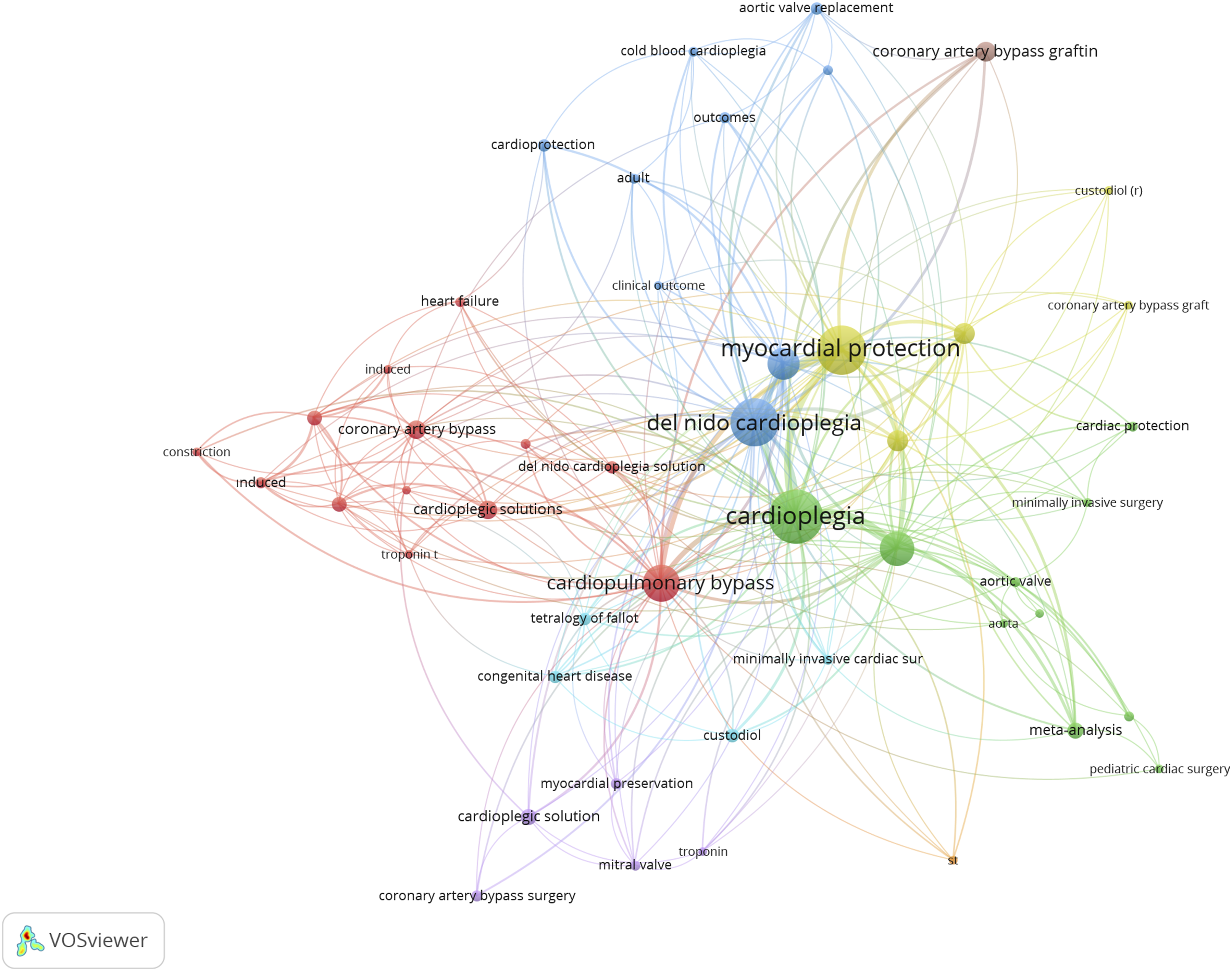
Temporal evolution and domain trend analysis
Overlay visualization (Figure 2) illustrates the average publication year of frequently co-occurring keywords within the analyzed dataset. Temporal changes in research emphasis were evaluated using the annual efficiency prominence index and weighted linear regression analysis. Annual domain-based keyword stratification demonstrated a progressive increase in the relative prominence of efficiency-related terminology over the 2000–2025 analytical period. Temporal overlay visualization. Network map colored by the average publication year of keywords. The color scale ranges from blue (earlier average publication year) to yellow (more recent average publication year). This visualization reflects the temporal distribution of frequently co-occurring thematic keywords within the analyzed publication dataset and does not represent clinical adoption patterns or predefined conceptual domain classifications.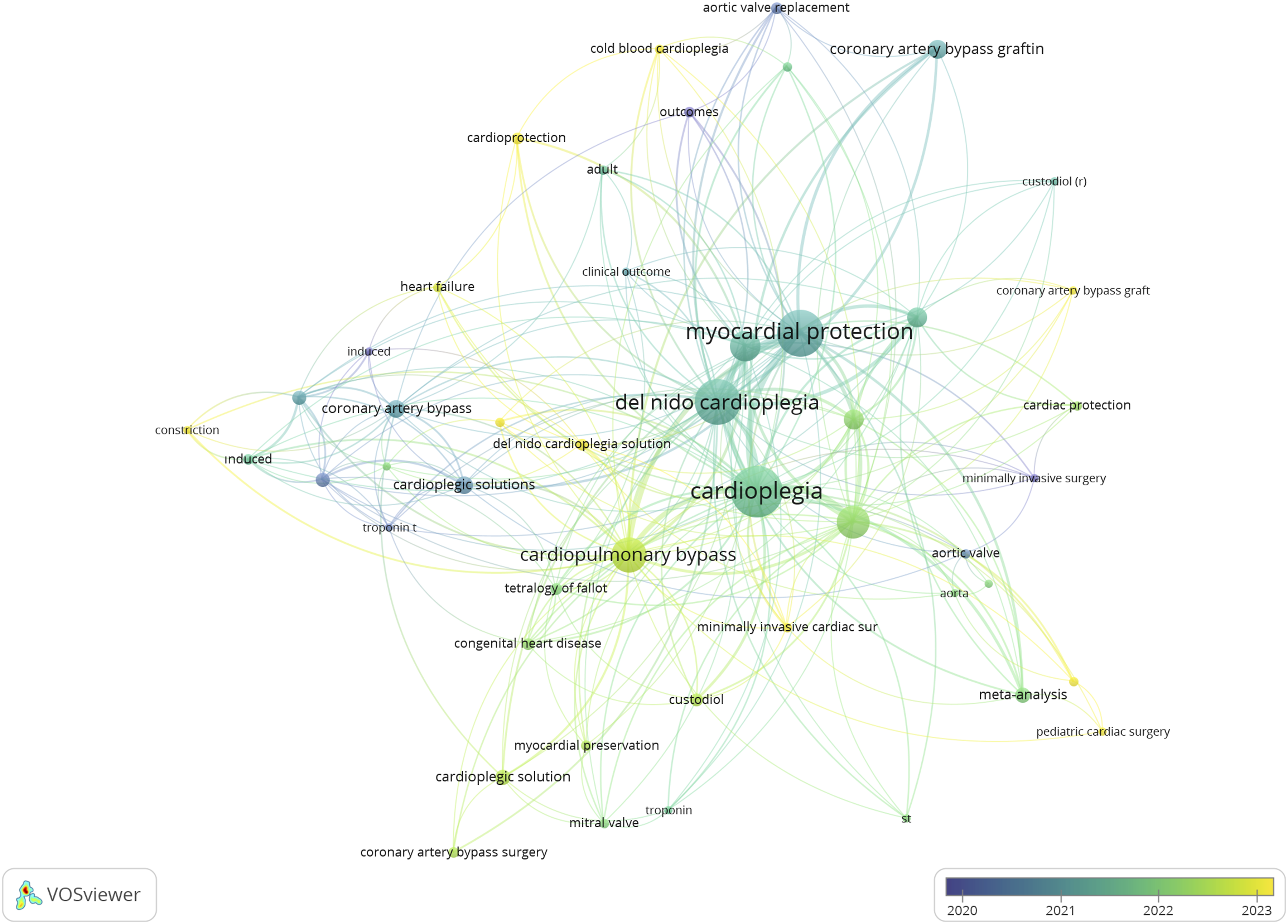
The efficiency prominence index was calculated annually as the proportion of efficiency-domain keywords relative to all domain-classified keywords and evaluated using weighted linear regression models, with weights based on total annual keyword counts. Statistical trend analysis confirmed a significant positive shift in the efficiency prominence index over time (β = 0.027 per year, 95% CI 0.014–0.040; p for trend <0.01). This quantitative finding indicates an increasing representation of workflow-related terminology in the academic literature over time.
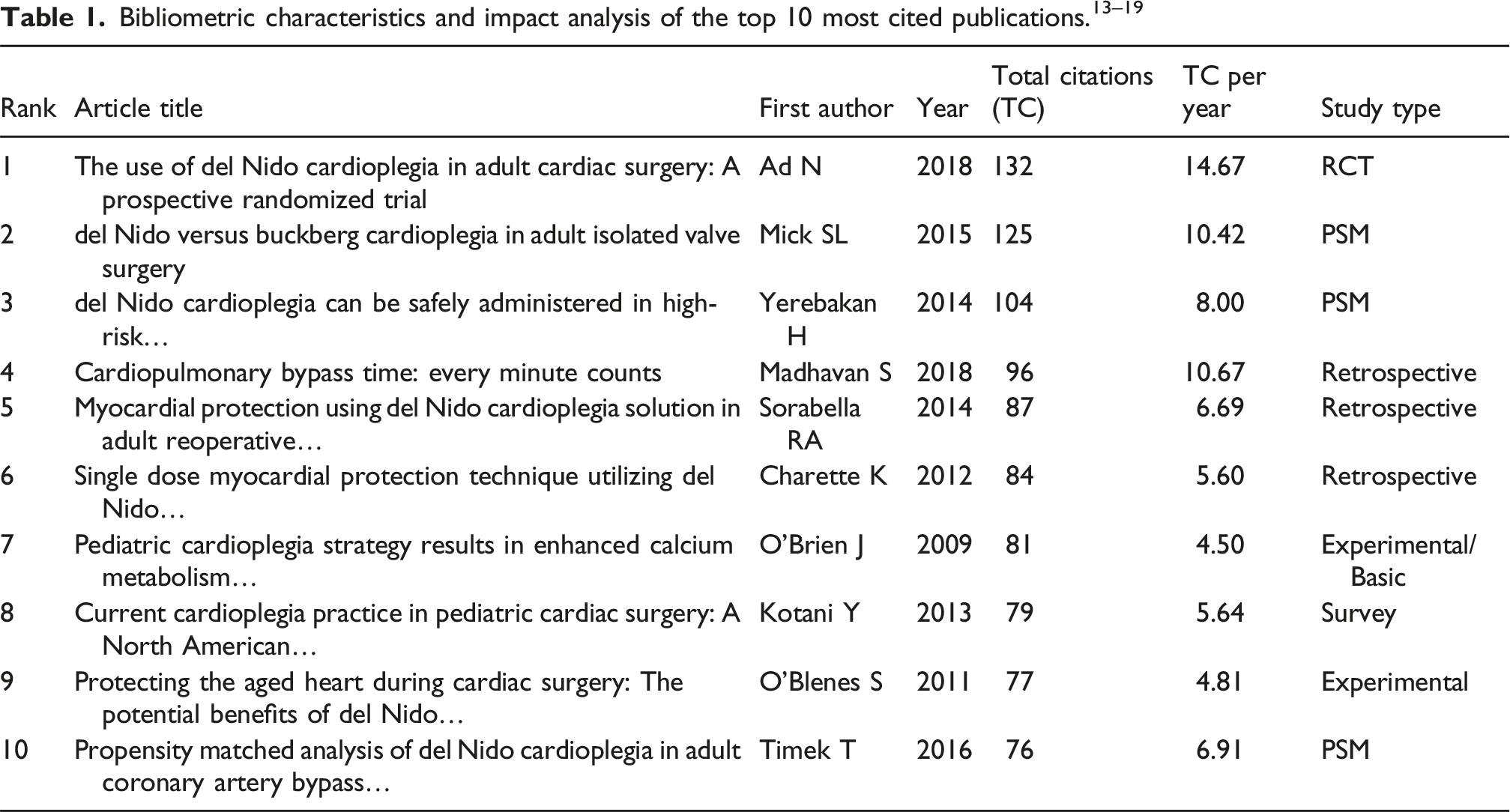
Impact analysis
Discussion
This study represents one of the first scientometric analyses specifically examining myocardial protection strategies in adult cardiac surgery. Analysis of 269 focal publications from the Web of Science confirms that recent publications increasingly evaluate del Nido cardioplegia alongside workflow-related procedural parameters within adult cardiac surgery contexts. Unlike narrative or systematic reviews that simply summarize clinical outcomes, the present study quantitatively tests a hypothesis regarding the drivers of surgical innovation, providing quantitative insight into the evolving thematic emphasis within the academic literature on myocardial protection strategies.
The conceptual separation observed in the keyword networks clearly reveals the dynamics of this paradigm shift. The literature cluster associated with traditional blood cardioplegia has historically focused on myocardial enzyme release (CK-MB, Troponin) and cellular-level protection mechanisms. 9 In contrast, the focus of the current literature cluster shaping around del Nido cardioplegia has shifted from biochemical markers to operative processes. The frequent co-occurrence of terms such as “cross-clamp time,” “bypass duration,” and “single dose” with del Nido cardioplegia reflects an increasing research interest in workflow-related procedural parameters within the academic literature. Workflow continuity has emerged as a commonly evaluated parameter in studies investigating single dose cardioplegia strategies. 10 This evolving emphasis is also reflected in studies evaluating perfusion management parameters in the context of cardioplegia delivery strategies. Procedural efficiency should not be interpreted as an alternative to myocardial protection, but rather as a contextual procedural parameter that may be discussed in the literature in relation to ischemic exposure (e.g., interruption frequency), without implying that efficiency supersedes protection.
Another notable observation of this bibliometric study is the frequent co-occurrence of minimally invasive surgical terminology within publications evaluating del Nido cardioplegia in adult cardiac surgery. Temporal trend analysis based on the annual efficiency prominence index demonstrated a progressive increase in workflow-related terminology over time, reflecting the concurrent presence of studies addressing minimally invasive surgical approaches in the academic literature. In minimally invasive mitral valve repairs or robotic procedures, which require a more limited field of view and more complex techniques compared to traditional sternotomy, repeating cardioplegia every 15–20 min disrupts the surgeon’s ergonomics and concentration. 4 The central position of terms “minimally invasive surgery” and “port-access” within the del Nido cluster in our maps suggests that studies evaluating del Nido cardioplegia frequently examine its use within technically demanding operative settings. 11
Regression-based temporal analysis illustrates the evolving academic focus on del Nido cardioplegia in adult cardiac surgery over the analyzed period. As expected, the early period of the literature was dominated by congenital heart surgery and pediatric cases; whereas the middle period (2012–2018) saw a concentration of terms such as “meta-analysis,” “propensity score matching,” and “safety.” This finding reflects the academic community’s initial skepticism regarding the safety of this pediatric solution in adults. 12 However, the fact that almost all publications in the last 5 years cluster around terms like “adult cardiac surgery” and “CABG” indicate that recent publications increasingly evaluate del Nido cardioplegia in adult cardiac surgery contexts.5
This study has certain limitations. The analysis was limited to the Web of Science database and excluded publications in national indices or non-English languages. Additionally, citation analyses inherently favor older “seminal” studies, which may mean that the impact of innovative studies published in the last 1–2 years that have not yet reached high citation counts is not fully reflected in the maps. However, these solutions were frequently captured indirectly through comparative studies indexed under myocardial protection or blood cardioplegia. In addition, geographic variation in research trends was not evaluated in the present analysis and may represent an area for future bibliometric investigation.
Conclusion
In conclusion, this scientometric analysis demonstrates that the academic literature on myocardial protection has progressively expanded from a predominantly protection-oriented focus to also include performance and process-related considerations. With the rise of minimally invasive surgery and the increasing importance placed on operating room efficiency, del Nido cardioplegia has been increasingly evaluated in contemporary academic literature, particularly in the context of minimally invasive surgical approaches. Future research is expected to focus on long-term outcomes of this strategy in specific high-risk patient groups rather than general safety comparisons.
Footnotes

Ethical considerations
Since this study is a bibliometric analysis of publicly available metadata and does not involve human or animal subjects, institutional review board approval was not required.
Author contributions
[B.B.B.] conceived and designed the study and performed data acquisition and analysis. [F.K.] contributed to data interpretation and critical revision of the manuscript. All authors contributed to manuscript drafting and critical revision, approved the final version, and agree to be accountable for all aspects of the work.
Funding
The authors received no financial support for the research, authorship, and/or publication of this article.
Declaration of conflicting interests
The authors declared no potential conflicts of interest with respect to the research, authorship, and/or publication of this article.
Data Availability Statement
The data supporting the findings of this study are available from the Web of Science Core Collection database. Restrictions apply to the availability of these data, which were used under license for the current study. Data are available from the corresponding author upon reasonable request and with permission of Clarivate Analytics.