







Abstract
Aim
The aim of the present study was to show that an increase in weight leads to the aggravation of limited joint mobility.
Method
One hundred sixteen patients with varicose veins of the lower limbs and body mass index (BMI) higher than 30 kg/m2 were evaluated at the Belczak Clinic in Maringá, Brazil. All patients were evaluated by the same physician, and the goniometric readings were performed on all patients by a physiotherapist. The participants were then divided into three groups based on BMI: Group I—BMI between 30 and 40. Group II—BMI between 40 and 50, and Group III—BMI > 50.
Results
There is a significant difference between the groups detected.
Conclusion
The present findings show that an increased BMI in obese individuals with chronic venous disease is associated with a progressive limitation of ankle mobility.
Introduction
Studies report a significant correlation between the body mass index (BMI) and clinical classes of chronic venous disease in women, but not in men, and confirm the negative impact of obesity on the severity of chronic venous disease.1,2 A recent study associates obesity with the development of systemic lymphedema as well as a novel concept-denominated subclinical systemic lymphedema, determined using bioimpedance analysis.3,4
Studies involving animal models show that obesity leads to the occurrence of changes in the lymphatic system, mainly affecting the lymphatic pump, capillary permeability, immunological defense, and the inflammatory process.5,6 Other studies report that weight loss is associated with an improvement in edema.7,8 The data suggest that obesity affects the lymphatic system, constituting an aggravating factor of edema in cases of chronic venous disease. Thus, weight loss is one of the few options in the reduction of obesity-associated edema. These studies demonstrate what we have observed in clinical practice, namely, an important reduction in edema with the loss of weight in obese patients.
Studies have shown that lower-limb muscle strength is affected in Clinical-Etiology-Anatomy-Pathophysiology stage C3 of patients with chronic venous insufficiency. 9 A meta-analysis shows an improvement in the ejection fraction with exercises, but no significant differences in the residual venous fraction or range of ankle motion (ROAM) in comparison to a control group. 10 One study found that active exercises (vigorous dorsiflexion of the ankle, plantar flexion with 250 N, and the flexion force of all toes) led to higher mean peak systolic velocity compared to baseline. 11 A study involving a specific lymphatic drainage technique reports improvement in limb mobility. 12 These studies emphasize the improvement in joint mobility, but the interference of physiopathological processes in each patient is suggested. The aim of the present study was to show that an increase in weight leads to the aggravation of limited joint mobility.
Methods
Patients and setting
One hundred sixteen patients with varicose veins of the lower limbs and BMI higher than 30 kg/m2 were evaluated at the Belczak Clinic in Maringá, Brazil.
Inclusion criteria
Consecutive patients with various veins of the lower limbs and BMI higher than 30 kg/m2 were included.
Exclusion criteria
Patients with BMI lower than 30 kg/m2 and those with other causes of edema identified during the patient history were excluded.
Selection participants
Patients who met the inclusion criteria were included in consecutive order upon arrival at the clinic Belczak-Maringa.
Statistical analysis
Descriptive statistics were performed, and comparisons were made using the Mann–Whitney U test, considering a 5% alpha error.
Ethical considerations
The study was approved by the Ethical Committee Centro Universitário de Maringa (CESUMAR)-Brazil#240\09
Development
All patients were evaluated by the same physician, and the goniometric readings were performed on all patients by the same physiotherapist. The participants were then divided into three groups based on BMI: Group I—BMI between 30 and 40, Group II—BMI between 40 and 50, and Group III—BMI > 50.
Results
Mean and standard deviation values of ROAM in different BMI groups.
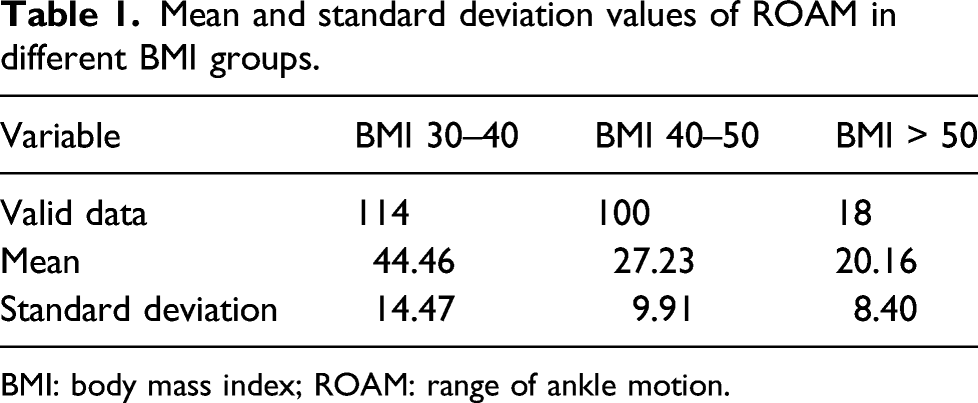
BMI: body mass index; ROAM: range of ankle motion.
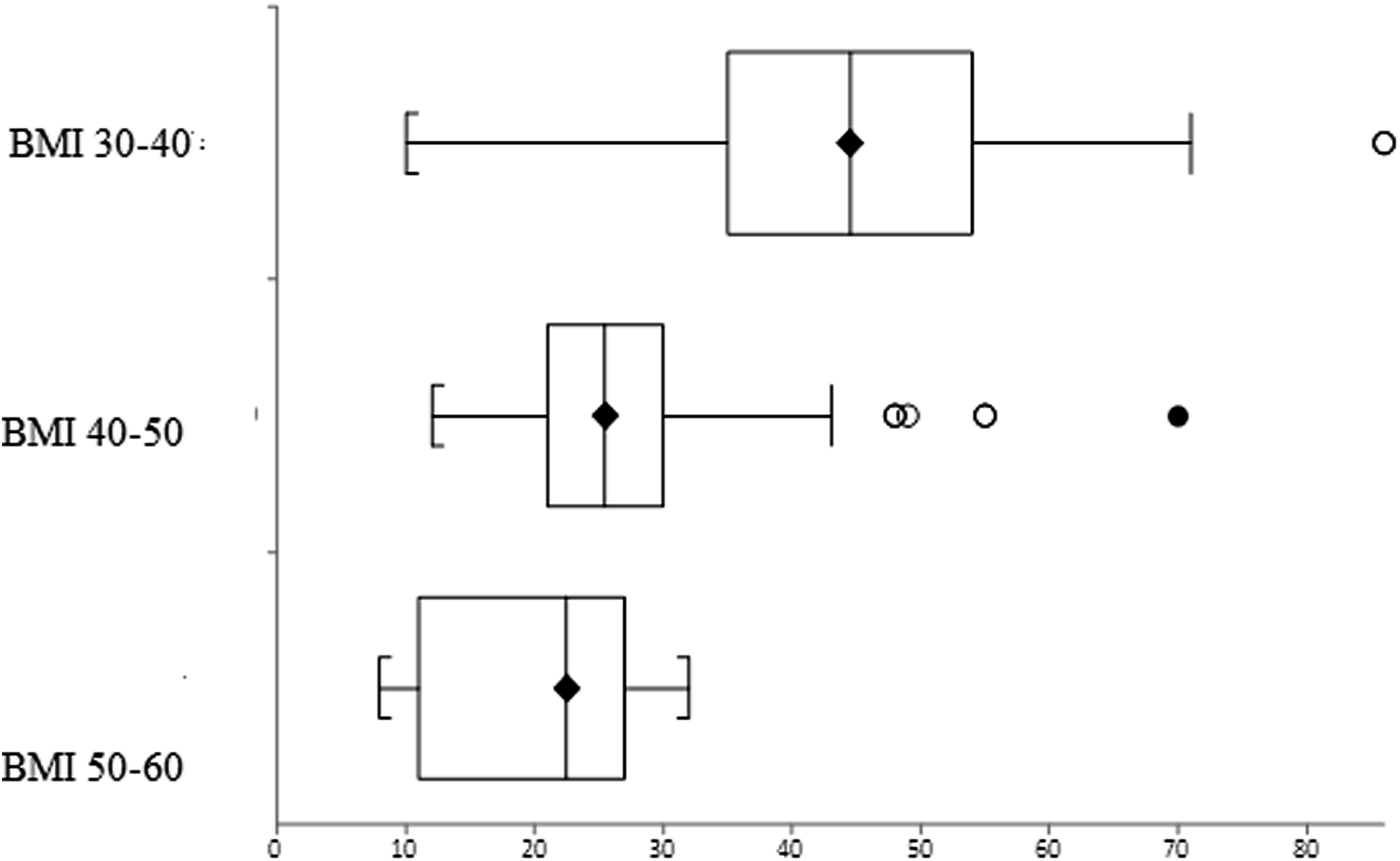
Variations in median ROAM in three BMI groups.
Results of comparisons between three groups (Mann–Whitney test).

BMI: body mass index.
Discussion
The present study shows the effect of obesity on ankle mobility, with a significant reduction in ROAM with the increase in BMI. Few studies in the literature have investigated the impact of obesity on joint mobility.1,2 One study evaluated open PA ankle fractures are more often associated with obesity (BMI > 30 kg/m2) than are other open ankle fractures. Patients with open PA ankle fractures associated with obesity require more reoperations and are more likely to require arthrodesis or below-knee amputation than patients with other open ankle fractures. 13 The progression of chronic venous disease also exerts an effect on joint mobility. 14 A previous study found significant restrictions in ankle mobility (measured using goniometer) in stage C5 of chronic venous disease, but significant changes in the venous filling index were found in stage C2, and changes in the ejection fraction and residual volume were found in stage C4. 14
Knowledge on the association between lymphatic damage and an increase in weight found in animal models contributes to a better understanding of these physiopathological processes. The association between obesity and the development of clinical and subclinical systemic lymphedema suggests a physiopathological process that requires further study. The reduction in edema that accompanies weight loss suggests a physiopathological process independent of obesity that damages the lymphatic system and aggravates diseases of the venous system. Exercise as a form of therapy to improve joint mobility can affect the physiopathology of obesity-related lymphedema if it contributes to weight loss. Meta-analysis study that included literature Medline and Medline In-Process, EMBASE, the Cochrane Central Register of Controlled Trials, the Cochrane Database of Systematic Reviews, Web of Science, LILACS, CINAHL, SPORTDiscus, PEDro, and PubMed searched up to June 2017: Selecting BMI of ≥ 35 kg/m2, and age 18 years or older, and supervised physical training program; randomized controlled trial; physical fitness outcome (muscular strength, muscular endurance, cardiovascular endurance, and/or flexibility); in English or Portuguese; and available full-text article. Was analysed 9460 articles, of these were included included 26 articles being eight meta-analysis and in results conclued that combination of aerobic exercise and resistance exercise, in addition to diet may improve cardiovascular and muscular endurance in individuals with class II and III obesity beyond articular mobility. 15
There are several physiopathological processes involved in the occurrence and aggravation of chronic venous disease. The therapeutic approach needs to address these processes in order to establish the physiological aspects of venous/lymphatic circulation. The present findings demonstrate the progressive loss of joint mobility with the increase in weight. However, further investigation of the evolution of edema in patients with obesity could provide information on the physiopathological aspects of obesity in chronic venous disease. The current literature offers few data regarding the effect of morbid obesity on the physiopathology of edema, but it seems that the inflammatory process is of fundamental importance. Moreover, there are no data on how to reduce edema without weight loss.
Conclusion
The present findings show that an increased BMI in obese individuals with chronic venous disease is associated with a progressive limitation of ankle mobility.
Footnotes
Declaration of conflicting interests
The author(s) declared no potential conflicts of interest with respect to the research, authorship, and/or publication of this article.
Funding
The author(s) received no financial support for the research, authorship, and/or publication of this article.
Ethical approval
The study was approved by the Ethical Committee Centro Universitário de Maringa (CESUMAR)-Brazil#240\09.
Contributorship
Design and conduct of the study: Belczak SQ, Neves RR, and Godoy JMP; Collection data: Belczak SQ, Neves RR, and Godoy JMP; Management: Belczak SQ, Neves RR, and Godoy JMP; Analysis and interpretation of the data: Belczak SQ, Neves RR, and Godoy JMP; Preparation: Belczak SQ, Neves RR, and Godoy JMP; Review: Belczak SQ, Neves RR, and Godoy JMP; Approval of the manuscript: Belczak SQ, Neves RR, and Godoy JMP; Decision to submit the manuscript for publication: Belczak SQ, Neves RR, and Godoy JMP. All authors agreed with the manuscript.
