






Abstract
Background
Endothermal ablation (ETA) is a well-established treatment for chronic venous insufficiency (CVI). However, its effectiveness in patients with concomitant lipedema remains poorly described. Given the distinct pathophysiological features and symptom burden of lipedema, outcomes may differ in this subgroup.
Methods
We conducted a prospective cohort study of patients with CVI alone and those with CVI plus lipedema. All patients underwent ETA, with adjunctive phlebectomies as indicated. Quality of life (QoL) was assessed using the EQ-5D-VAS and CIVIQ-20 questionnaires before surgery and at 3 months postoperatively. Demographic and clinical variables included age, body mass index (BMI), waist-to-height ratio (WHtR), waist-to-hip ratio (WHR), and symptom profile. The primary outcome was the change in CIVIQ-20 score at 3 months. Secondary outcomes included changes in EQ-5D-VAS and postoperative complications (hematoma, paresthesia, superficial and deep vein thrombosis).
Results
A total of 48 patients were included (32 with CVI alone, 16 with CVI and lipedema). Preoperative QoL impairment was significantly greater in the lipedema cohort (median CIVIQ-20: 61.0 [49.5–69.5]) compared with CVI alone (46.0 [33.0–56.0], p = .001). At 3 months, both groups demonstrated significant improvement (p < .001 for within-group change). However, the magnitude of improvement was greater in CVI alone (median reduction: −13.5 [−19.5 to −5.0]) than in CVI plus lipedema (−4.0 [−7.0 to −1.5]; p = .012). Multivariable regression identified higher baseline CIVIQ-20 (β = 0.60; SE = 0.09; p < .001) and lipedema status (β = 12.44; SE = 2.43; p < .001) as independent predictors of poorer postoperative CIVIQ-20 outcomes. Paresthesia was more frequent in lipedema patients (25.0% vs 18.8% at 1 month; 12.5% vs 6.2% at 3 months).
Conclusion
While ETA significantly improves QoL in patients with CVI, those with concomitant lipedema experience smaller gains and a higher rate of postoperative paresthesia. These findings highlight the importance of setting realistic expectations and counseling lipedema patients regarding potential outcomes of venous interventions.
Introduction
Chronic venous insufficiency (CVI) is a prevalent and often debilitating condition that affects nearly one-third of the population. Current international guidelines recommend endothermal ablation (ETA) over traditional high ligation and stripping for the treatment of superficial venous reflux.1,2 Among ETA modalities, endovenous laser ablation (EVLA) 3 and radiofrequency ablation (RFA) have demonstrated the highest rates of vein closure 4 and durable symptom improvement.
Lipedema, in contrast, is a chronic and underrecognized disorder of subcutaneous adipose tissue mainly affecting women in the lower extremities and, less commonly, the arms. It is characterized by symmetrical, bilateral adipose tissue accumulation resulting from adipocyte hypertrophy and hyperplasia. The diagnosis is made clinically, with pain being the leading symptom and the major contributor to impaired quality of life (QoL). Although its natural history remains debated, the coexistence and clinical implications of venous disease in lipedema patients remain poorly described.5,6
While ETA has proven effective in managing CVI, it is not without risk, including bruising, paresthesia due to nerve injury, and endothermal heat-induced thrombosis (EHIT). Given the limited evidence regarding ETA in patients with concomitant CVI and lipedema, this study aims to evaluate its role in this specific population.
Methods
Study design
This is a prospective cohort study including patient with CVI alone (Group A) and those with concomitant CVI and lipedema (Group B), recruited from 2 vascular centers (one public and one private center) with more than 200 cases per year load. The study adhered to the Declaration of Helsinki, and written informed consent was obtained from all participants (EC 285/23).
CVI diagnosis was established through duplex ultrasound (DUS) and clinical examination, both by one experienced vascular surgeon. Lipedema was diagnosed clinically by the same vascular surgeon and confirmed by either a rehabilitation specialist or another vascular surgeon with expertise in lipedema. Disease staging followed the German expert consensus classification, endorsed by the German Society of Phlebology. 7 To summarize, lipedema was diagnosed as per the presence of painful, disproportionate symmetric distribution of adipose tissue of the extremities. Both, stages and types are described. In stage 1, the skin has a smooth texture with subdermal pebble-like feel due to underlying loose connective tissue fibrosis. Lipedema Stage 2 women have more lipedema tissue than women with Stage 1 and skin dimpling due to progressed fibrotic changes and excess tissue. Palpable nodules may be more numerous and larger. Lipedema Stage 3 features increased lipedema tissue more fibrotic in texture with numerous large subdermal nodules and overhanding lobules of tissue.
Types I to V describe the locations of lipedema tissue. Type I, lipedema tissue is present under the umbilicus and over hips and buttocks, Type II, under the umbilicus to knees, Type III, under the umbilicus to ankles, Type IV, arms and Type V, lower legs. 8
Interventions
All patients underwent ETA with or without adjunctive phlebectomy. One center (private) exclusively performed endovenous laser ablation (EVLA), while the other (public) utilized radiofrequency ablation (RFA). Treatments were conducted under local tumescent anesthesia by an experienced vascular surgeon (with more than 100 ETA treatments per year).
DUS was performed in the upright position, and the great saphenous vein (GSV) or anterior saphenous vein (ASV) was marked. Percutaneous access to the most distal insufficient GSV segment was achieved with an 18-G needle, followed by placement of a 6-F, 11-cm sheath. In the EVLA center, a 1470 nm radial two-ring laser fiber (ELVeS, Biolitec, Vienna, Austria) was advanced under ultrasound guidance; in the RFA center, The Covidien (Medtronic) VNUS Closure Fast™ system (Covidien LP, 710 Medtronic Parkway Minneapolis, MN, USA) was used.
The fiber tip was positioned 1–2 cm distal to the saphenofemoral junction, below the superior epigastric vein. Peri-venous tumescent anesthesia (0.05% lidocaine in cold saline, 5–10°C) was administered under ultrasound guidance with a roller pump (Nouvag Dispenser DP30, Goldach, Switzerland). Fiber position was rechecked and adjusted as necessary. Post-operative venous thromboembolic prophylaxis was used according to individual Caprini Score.
Outcomes and variables
The primary outcome was the change in CIVIQ-20 from baseline to 3 months. Secondary outcomes included changes in EQ-5D-VAS and the occurrence of complications such as hematoma, paresthesia, superficial vein thrombosis (SVT), and deep vein thrombosis (DVT). Clinical variables included age, body mass index (BMI), waist-to-height ratio (WHtR), waist-to-hip ratio (WHR), and symptoms.
Postoperative care and follow-up
All patients were prescribed class II (23 -32 mmhg) circular-knitted elastic compression stockings for at least 1 month after the procedure. Technical success was evaluated at 1 month by clinical examination and DUS. QoL was assessed using the EQ-5D-VAS and CIVIQ-20 questionnaires at baseline and at 3 months post-procedure.
Statistical analysis
According to their distribution, continuous variables were summarized as mean ± standard deviation (SD) or median and interquartile range (IQR). Normality of continuous variables was assessed using the Shapiro–Wilk test. Categorical variables were expressed as absolute numbers and percentages [n (%)]. Between-group differences for continuous variables were analyzed with Student’s t test or the Mann–Whitney U test for independent samples, as appropriate. Categorical variables were compared using the χ2 or Fisher’s exact test, depending on expected cell counts. The paired Student’s t test or the Wilcoxon signed-rank test was used for continuous measurements, as appropriate. All statistical tests were two-sided; a p-value <.05 was considered statistically significant.
A multiple linear regression analysis was conducted to identify independent predictors of the postoperative CIVIQ-20 score at 3 months. Predictors included lipedema status, age, preoperative CIVIQ-20 score, and variables that showed significant differences in univariate analyses. A backward stepwise elimination procedure removed variables if p > .10. Regression coefficients (β) with their standard errors (SE) were reported, and model performance was assessed using the coefficient of determination (R2) and the adjusted R2. Marginal means for each group with 95% confidence intervals (CIs) were calculated and plotted. All statistical analyses were performed using R software, version 4.5.1 (R Foundation for Statistical Computing, Vienna, Austria).
Results
Clinical features of the study population.
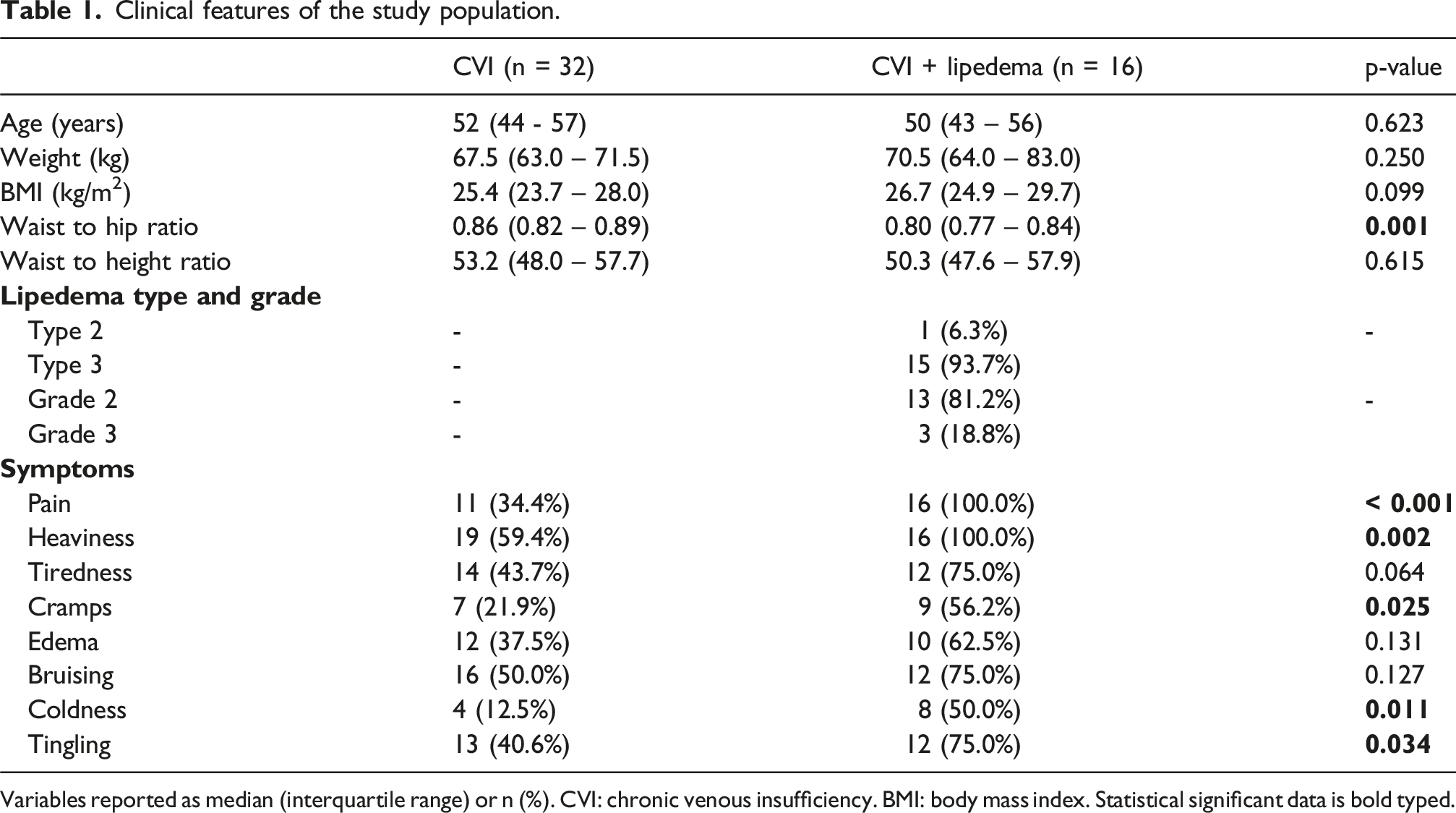
Variables reported as median (interquartile range) or n (%). CVI: chronic venous insufficiency. BMI: body mass index. Statistical significant data is bold typed.
Venous characteristics of the study groups.
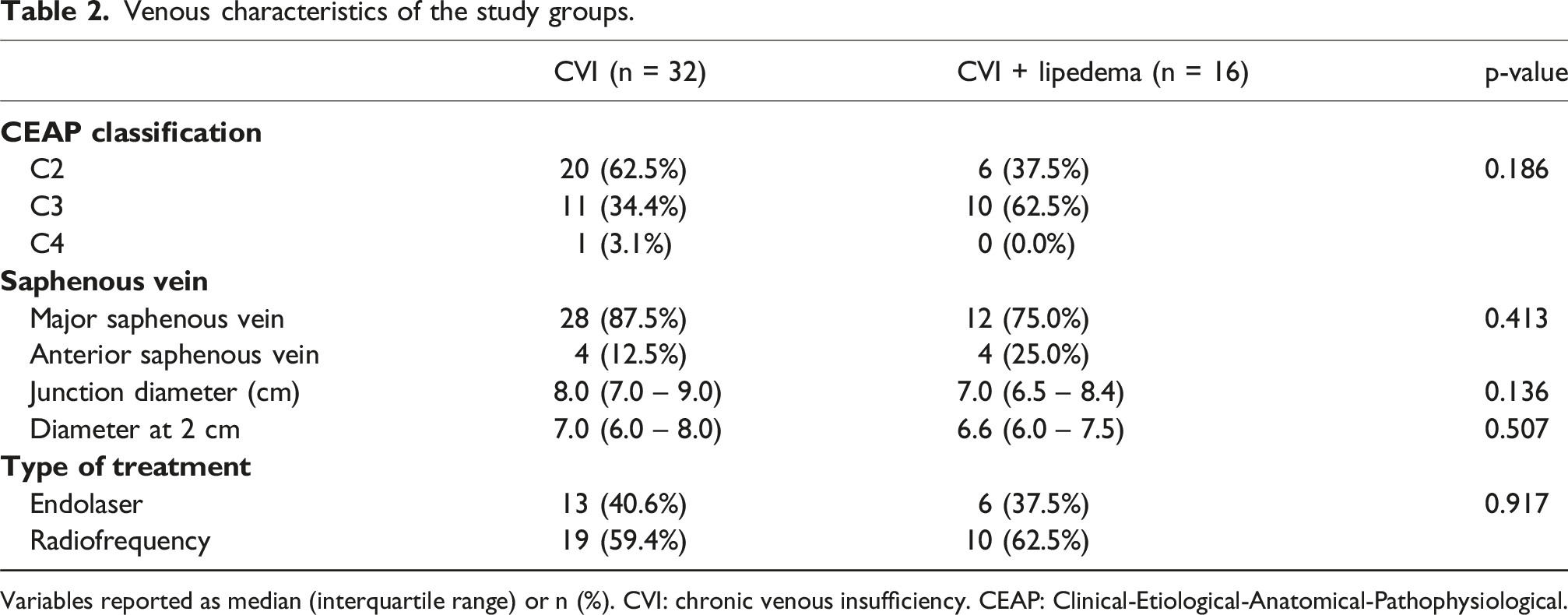
Variables reported as median (interquartile range) or n (%). CVI: chronic venous insufficiency. CEAP: Clinical-Etiological-Anatomical-Pathophysiological.
Complications
Complications one and three months after surgery.
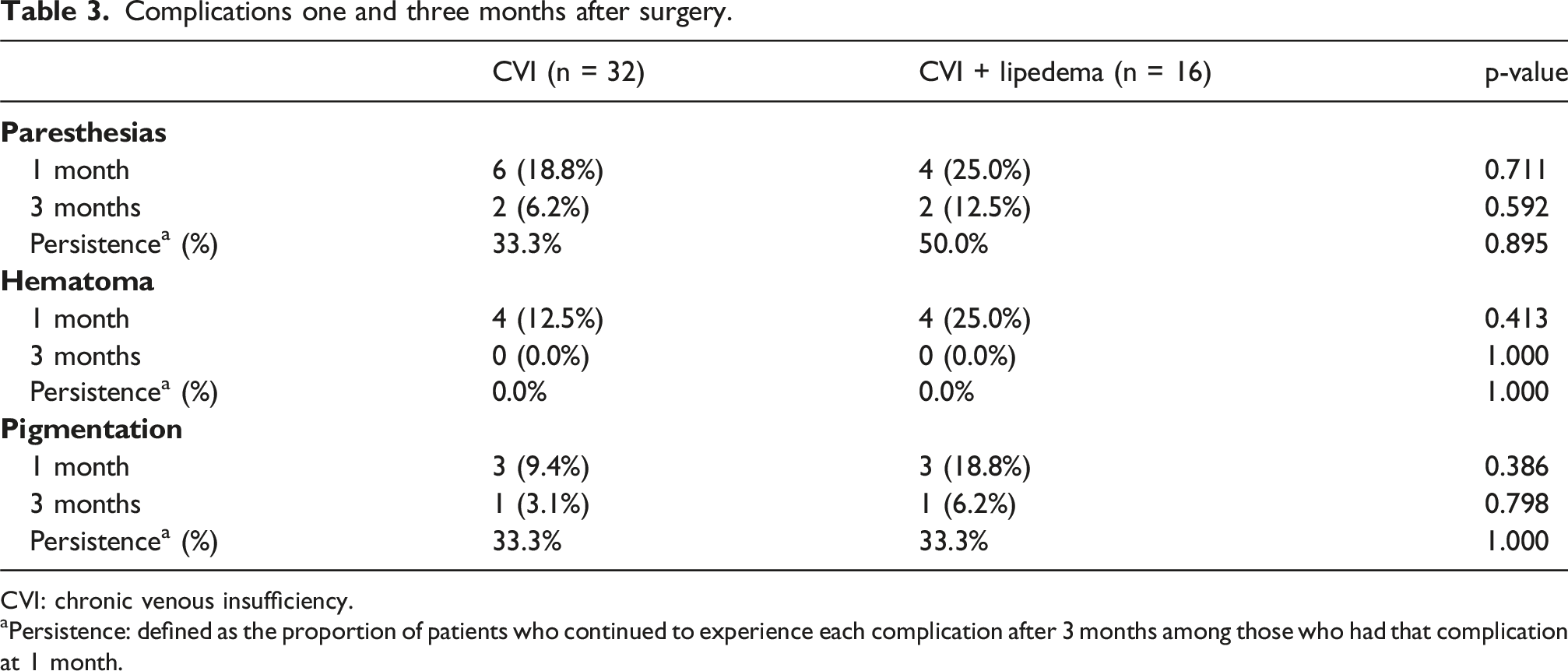
CVI: chronic venous insufficiency.
aPersistence: defined as the proportion of patients who continued to experience each complication after 3 months among those who had that complication at 1 month.
Quality of life
Quality of life scores (CIVIQ-20 and EQ5-VAS) at baseline and three months after surgery.
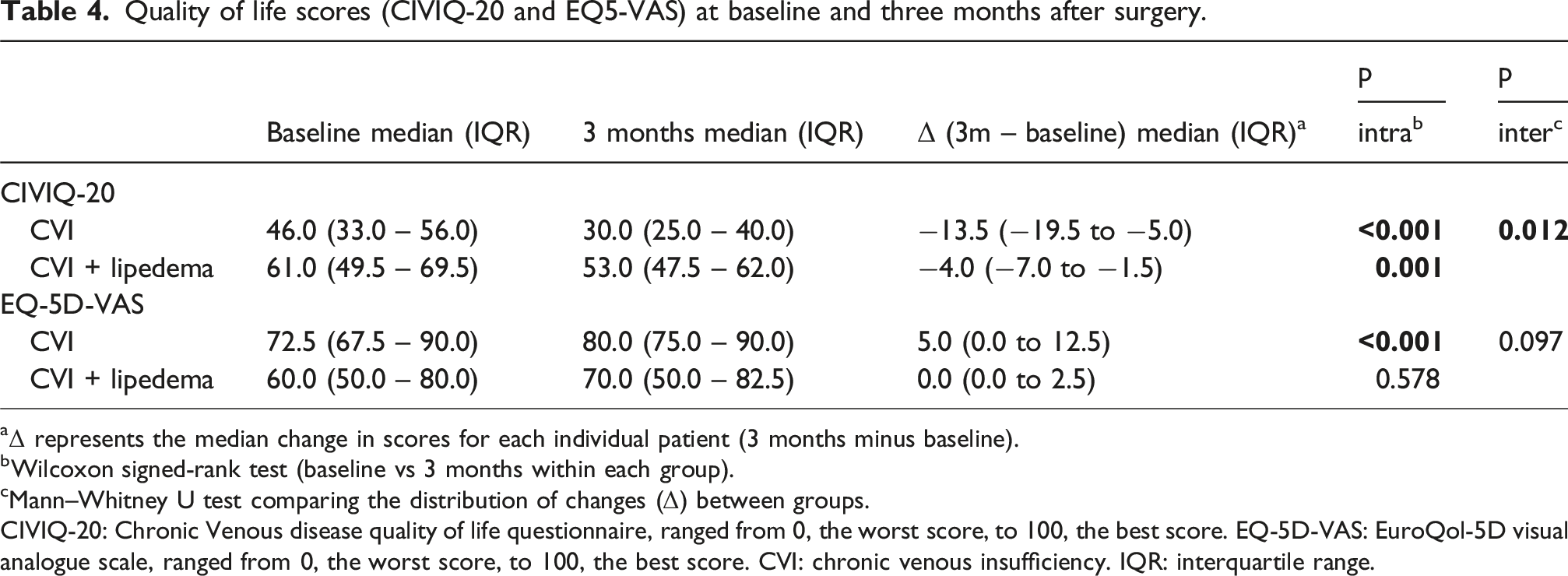
aΔ represents the median change in scores for each individual patient (3 months minus baseline).
bWilcoxon signed-rank test (baseline vs 3 months within each group).
cMann–Whitney U test comparing the distribution of changes (Δ) between groups.
CIVIQ-20: Chronic Venous disease quality of life questionnaire, ranged from 0, the worst score, to 100, the best score. EQ-5D-VAS: EuroQol-5D visual analogue scale, ranged from 0, the worst score, to 100, the best score. CVI: chronic venous insufficiency. IQR: interquartile range.
Predictors of postoperative CIVIQ-20
In multiple linear regression, the preoperative CIVIQ-20 score (β = 0.60; SE = 0.09; p < .001) and lipedema status (β = 12.44; SE = 2.43; p < .001) were independently associated with the CIVIQ-20 score 3 months after surgery. The regression equation was:
CIVIQ-20 3 months = 5.55 + 0.60× CIVIQ-20 preoperative + 12.44 × Lipedema (1 = yes). According to the model, predicted postoperative scores were consistently higher (worse) in patients with lipedema for any given baseline CIVIQ-20 value (Figure 1). Together, these variables explained 77% of the variance in the outcome (R2 = 0.77; adjusted R2 = 0.76). Predicted CIVIQ-20 scores at 3 Months according to baseline CIVIQ-20 Score and lipedema status. Solid blue and red lines represent the predicted postoperative CIVIQ-20 (Chronic Venous Insufficiency Quality of Life Questionnaire–20) scores at 3 months for patients with chronic venous insufficiency (CV) alone or with lipedema, respectively, based on the multiple linear regression model. Shaded areas denote the corresponding 95% confidence intervals (95% CIs) for the marginal means at each baseline CIVIQ-20 value. The gray dashed line indicates identity (postoperative = baseline). Vertical dashed lines show the baseline CIVIQ-20 thresholds above which the model predicts postoperative scores lower than baseline (i.e., expected improvement) for each group (≈13.8 for patients without lipedema and = 44.6 for patients with lipedema). The double-headed arrow illustrates the predicted difference (Δ) between groups across baseline CIVIQ-20.
According to the derived linear model, for any given baseline CIVIQ-20 score, predicted postoperative values were consistently higher (worse) in patients with lipedema than in those with CVI alone. The model also identified different thresholds for expected improvement in quality of life 3 months after surgery. In patients without lipedema, postoperative scores were predicted to be lower than baseline for CIVIQ-20 values above 13.8, whereas in patients with lipedema, this occurred only for baseline values above 44.8.
Discussion
Current knowledge of CVI treatment in lipedema patients is scarce. 9 Our results show that patients diagnosed with lipedema may not achieve the beneficial symptomatic effects of ETA treatment, as demonstrated by the control group outcomes.
The clinical symptomatic benefit for those patients associated with CVI and lipedema is achieved at higher CIVIQ-20 scores, starting at 45 points. Moreover, patients associating CVI with lipedema showed higher initial CIVIQ-20 scores than the CVI alone group. The median reduction in CIVIQ-20 was larger in the CVI group than in the lipedema group for the between-group difference. The EQ-5D-VAS scores increased in both groups without significant differences in the magnitude of change. All these findings highlight the relevance of Lipedema in avoiding the expected clinical improvement after ETA treatment for their venous disease.
Additionally, there were more than 60% of patients with C2 vein disease in the CVI alone group and nearly 40% in the CVI and lipedema group. Further evaluation into the need of surgical treatment of these subgroups of patients, especially with concomitant lipedema should be given. Although, it should be clearly stated that lipedema disease should not be considered a contraindication for surgical treatment of C3-C6 vein disease as the benefit/risk ratio is certainly outweighed.
The role of ETA treatment for CVI has mainly been described10,11,4 and recognized in recent guidelines as the first option for treatment. These treatments are heat-based, while any heat treatment should be avoided in lipedema due to the inflammatory condition in its physiopathology. This correlation may be related to the worse symptomatic evolution in the post-operative period.
Identifying patients with lipedema affected by other diseases 12 is crucial for QoL improvement, as lipedema may alter or hinder treatment outcomes. 13 One good example is a recent description (scoping review) in obese patients treated with metabolic bariatric surgery, 14 where 49 patients reported having increased pain after surgery, measured by the VAS scale, even with 70% excess weight loss. By other means, Ekti et al. described the deleterious effects of those patients associating lipedema and CVI with osteoarthritis (OA) when compared to those with OA alone. They concluded that both lipedema and CVI accompanying knee OA increase the existing disability due to OA by negatively affecting patients regarding pain, QoL, and physical functioning. 15
Also, a trend was found that more patients were developing paresthesia in the post-operative period. Previous studies have reported around 1.5% up to 18%3,11,4 of paresthesia in the post-operative period of ETA techniques. Our results (18.8% for CVI alone and 25% for CVI and Lipedema group) are quite higher than those reported in previous studies, even for the CVI alone group. This might be explained by the need for phlebectomies in all patients or the underuse of medical stockings in some patients. However, these findings were considerable reduced at the 3-months clinical evaluation without any further treatments.
There are some descriptions on staged vein truncal and collateral treatment. It might be of interest to analyze if patients with lipedema may benefit from these approaches where phlebectomies are delayed and usually not required. 16 Lipedema’s inflammatory and pain pathway and basis are still a matter of study but might have a role in such findings. 17 Therefore, appropriate and intensive tumescence should be provided intra-operatively; also, post-operative stockings are highly recommended. Whether other therapies like non-thermal techniques may be offered for lipedema patients associated with CVI should be a matter of study. As much as every vein treatment may produce an inflammatory response, comparative studies between non-thermal ablation and ETA may give a better understanding of CVI’s best treatment in this specific and unique group of patients, where intrinsic pain and inflammation may mislead treatment outcomes.18,19
Limitations
The present study has several limitations. First, this study is limited by its modest sample size, single-country setting, and use of two different ETA modalities; although procedural distribution was balanced between groups, patient’s inclusion may be biased. Second, despite the groups being mostly comparable, a propensity score matching analysis was not possible due to the limited number of patients; moreover, not allowing analysis and conclusion related to CEAP classification. The continuation of the current study will hopefully give insights into such analysis. Third, follow-up was restricted to 3 months, precluding conclusions about the long-term durability of symptom and QoL outcomes. Despite all the limitations, our study provides proper real-scenario evidence of ETA treatment when concomitantly dealing with this unique disease. Furthermore, it may help physicians to inform patients with lipedema to whom ETA therapy is supplied about the hindered clinical symptomatic relief after venous treatment (as their lipedema disease is not surgically corrected) and the potential higher post-operative paresthesia.
Conclusion
Patients with concomitant lipedema and chronic venous insufficiency should be counseled about the potential for limited clinical improvement despite appropriate surgical management of CVI. In addition, these patients appear to face a higher risk of postoperative paresthesia, which warrants careful preoperative discussion. Our findings emphasize the significant contribution of lipedema to functional impairment and symptom burden, highlighting the need for tailored management strategies and further research to optimize outcomes in this complex patient population.
Footnotes

Author contributions
Andrés Reyes Valdivia is the first and corresponding author.
Remaining authors contributed equally in conception and revision of the manuscript.
Funding
The authors received no financial support for the research, authorship, and/or publication of this article.
Declaration of conflicting interests
The authors declared no potential conflicts of interest with respect to the research, authorship, and/or publication of this article.
Guarantor
RV. A is the guarantor for this article and assumes full responsibility for the veracity and integrity of its content, including the accuracy and appropriateness of the reference list.