







Abstract
The emergence of “big data” offers organizations unprecedented opportunities to gain and maintain competitive advantage. Trying to exploit the strategic business potential embedded in big data, many organizations have started to renovate their business models or develop new ones, giving rise to the phenomenon of big-data business models. Although big-data business model research is still in its infancy, a significant number of studies on the topic have been published since 2014. We thus suggest it is time to perform a critical review and assessment of the literature at the intersection of business models and big data (analytics), thereby responding to recent calls for further research on and sustained analysis of big-data business models. In particular, our review uses three major criteria (big-data business model types, dimensions, and deployment) to assess the state of the big-data business model literature and identify shortcomings in this literature. On this basis, we derive and discuss five central research perspectives (supply chain, stakeholder, ethics, national, and process), providing guidance for future research and theory development in the area. These perspectives also have practical implications on how to address the current big-data business model deployment gap.
Keywords
Introduction
The past decade has witnessed the exponential growth of what is described as “big data” (hereafter, BD; Chen et al., 2012; Goes, 2014; Günther et al., 2017). Extant research typically defines BD in terms of four characteristics: the amount of data captured or processed (volume), the range of data sources and types (variety), the speed or frequency with which data are recorded and analyzed (velocity), and the reliability of the captured data (veracity; e.g. Chen et al., 2017; Hartmann et al., 2016; Schroeder, 2016; Yoo, 2015). Practitioners and scholars alike acknowledge the strategic business potential embedded in BD (e.g. Agarwal and Dhar, 2014; Babiceanu and Seker, 2016; Brynjolfsson et al., 2011; Constantiou and Kallinikos, 2015; George et al., 2014), highlighting that data are “the new oil” (Hartmann et al., 2016: 1382). For example, Chen et al. (2017) note that BD offer unprecedented opportunities to gain and maintain competitive advantage, thus considering it as “one of the most significant technology disruptions for businesses since the meteoric rise of the Internet and the digital economy” (p. 19). This view is supported by empirical findings, which suggest that firms leveraging BD outperform those that do not in terms of both productivity and profitability (McAfee and Brynjolfsson, 2012; Quaadgras et al., 2014).
In parallel, the business model (BM) concept has gained increasing attention from both practice and research since the dotcom revolution in the 1990s (El Sawy and Pereira, 2013; Klang et al., 2014). A BM can be defined as a “blueprint of how a company does business” (Osterwalder et al., 2005: 2); that is, how a company creates and captures value (Kavadias et al., 2016). To prepare their BM for the digital future, organizations are increasingly trying to leverage the BD obtained from new digital technologies such as wearable mini-sensors and the Industrial Internet of Things (e.g. Ehret and Wirtz, 2017; Marabelli et al., 2017; Woerner and Wixom, 2015; Zuboff, 2015), giving rise to a phenomenon known as “big-data business models” (BDBMs; Schroeder, 2016). The rise of BDBMs underlines that BD and related technologies should no longer be seen as simple assets or resources, but rather as a set of strategic capabilities that can support organizational value creation and capture (Akter et al., 2016; Bharadwaj et al., 2016; Bhimani, 2015; Gupta and George, 2016). Yet, pursuing a BDBM can also entail severe consequences such as those recently experienced by Facebook when it faced public backlash over data privacy (Guzdial and Landau, 2018). Since users’ privacy is “kryptonite” to Facebook’s BDBM, the situation will not be remedied “unless they fundamentally change their business model” (King, 2018: 2).
While research on BDBMs is still in its infancy, recent years have seen a significant growth in studies on the topic. We thus suggest that information systems (IS) scholars and practitioners—especially those engaged in strategizing processes (cf. Priem et al., 2018)—would benefit from a critical review of the literature at the intersection of BD and BMs. This is consistent with recent calls for further research in the area (e.g. Loebbecke and Picot, 2015; Mikalef et al., 2020), highlighting that BDBMs “have not received sustained analysis” (Schroeder, 2016: 2). In particular, in this study, we set forth to assess the current state of the BDBM literature, to identify and problematize key shortcomings in this literature, and to derive a multiperspective research framework that can guide future research on BDBMs.
Our review contributes to the IS and related literatures in several ways: first, it provides a critical assessment and forward-looking analysis of a cutting-edge phenomenon (BDBMs) that is applicable and strategically relevant to a broad range of organizations, including both for-profits and non-profits. Second, analyzing BD applications through a BM lens, our literature review offers a unique perspective that helps shed light on the strategic implications of BDBMs (Veit et al., 2014). Third, our critical review integrates and extends recent literature reviews and commentaries related to BDBMs (e.g. Loebbecke and Picot, 2015). For example, among the three review articles included in our sample, two are topical—meaning that they have an explicit focus on a particular process (supply chain; Shen and Chan, 2017) or industry (agriculture; Wolfert et al., 2017); the third one touches on BD-driven BMs only tangentially (Günther et al., 2017). Fourth, our critical review of the BDBM literature canvases several application domains and industries as well as academic disciplines, making our work interdisciplinary in nature—another key difference to the review articles mentioned above. Finally, from a practitioner’s view, the derived multiperspective framework offers important implications on how to address the so-called “deployment gap” (Chen et al., 2017: 20), which refers to the paradox between the enormous potential of BD across industries, on one hand, and the observation that actual deployments of BDBMs remain scarce, on the other hand (Gartner, 2014).
In the next section, we provide an overview of the conceptual foundations of BDBMs. We then describe how we conducted our critical review and assess the studies identified against three broad review criteria. Based on this assessment, we present a multiperspective framework for future BDBM research. We conclude with a discussion of limitations and implications of our review results.
BDBMs: conceptual foundations
BDBM types
Generally speaking, a BM represents a blueprint of how an organization conducts business (Osterwalder et al., 2005). While more precise definitions vary across studies, most scholars would likely agree that a BM describes how an organization creates and captures value (e.g. Amit and Zott, 2001; Chesbrough and Rosenbloom, 2002; Hedman and Kalling, 2003; Kavadias et al., 2016; Osterwalder and Pigneur, 2010). In this context, Wixom and Ross (2017) note that, these days, “most companies are awash in data” and highlight three ways of how companies can derive value from BD: first, companies can use BD and analytics to improve internal processes. Second, they can use BD (analytics) to enrich their products, services, and customer experiences, referred to as “wrapping information around products” (Wixom and Ross, 2017: 11). Third, companies can monetize their internal data by selling it to external parties. On this basis, one can differentiate between two basic types of BDBMs, namely, data users, which leverage BD for internal purposes, and data suppliers, which aim to market BD (cf. Schroeder, 2016). In addition, Schroeder (2016) describes a third BDBM type—referred to as data facilitators—supplying data users and suppliers with BD infrastructure solutions (e.g. hardware and software tools) as well as BD-related services (e.g. consulting and outsourced analytics services). The three basic BDBM types are outlined in Table 1.
BDBM typology (based on Schroeder, 2016).
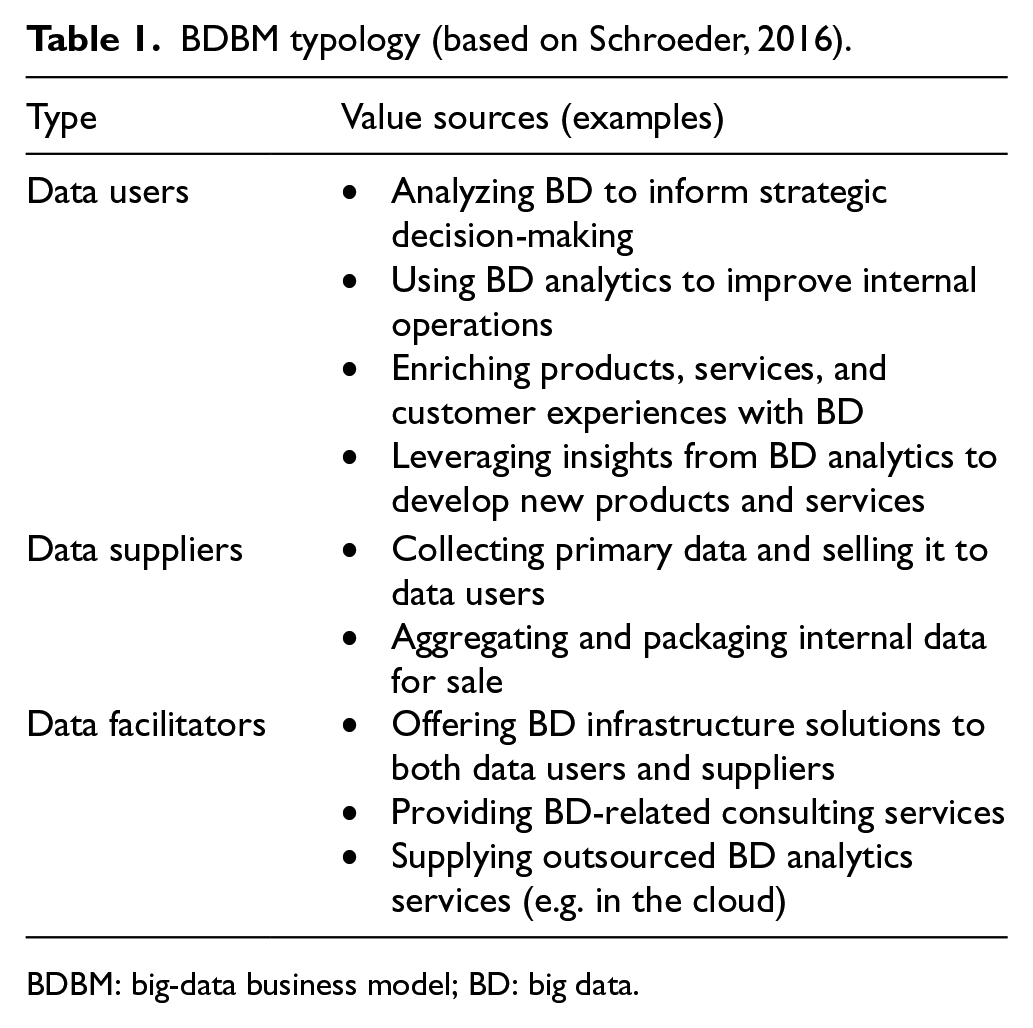
BDBM: big-data business model; BD: big data.
BDBM dimensions
To describe the elements that constitute a BM in general, existing research has typically adopted a multidimensional view (Wirtz et al., 2016). Corresponding studies propose numerous conceptualizations of the BM concept. In this study, we draw on Al-Debei and Avison (2010), who conducted a comprehensive review of 22 BM conceptualizations to derive a unified framework consisting of four BM dimensions: (1) Value proposition—describes the market offerings (products and/or services) of an organization as well as its interactions with the targeted customer group(s) (cf. Hedman and Kalling, 2003; Magretta, 2002; Osterwalder et al., 2005); (2) Value architecture—refers to an organization’s core resources and capabilities, as well as their configurations, required for producing the market offerings (cf. Hedman and Kalling, 2003; Osterwalder et al., 2005; Venkatraman and Henderson, 1998); (3) Value network—depicts the interactions and relationships of an organization with key external partners and other stakeholders (cf. Osterwalder et al., 2005; Timmers, 1998); and (4) Value finance—captures an organization’s economic configuration, including its cost structures, pricing methods, and revenue streams (cf. Magretta, 2002; Osterwalder et al., 2005; Timmers, 1998). While the first three BM dimensions (value proposition, architecture, and network) are mainly concerned with the creation of value, the fourth dimension (value finance) is primarily concerned with how a company is able to capture the value created.
In the specific context of BDBMs, the nature of the four BM dimensions is, at least partly, dependent on the BDBM type under consideration. For example, while BD can be primarily seen as a key resource in the value architecture of a data user’s BM (e.g. Hartmann et al., 2016), BD represent the actual value proposition of a data supplier’s BM. Similarly, BD analytics can be part of a BM’s value architecture (data user) or denote its value proposition (data facilitator). Furthermore, as highlighted by Schroeder (2016), the three BDBM types are closely interrelated. For example, on one hand, data suppliers and/or facilitators may represent key partners in the value network of a data user’s BDBM; on the other hand, both data suppliers and data facilitators are reliant on data users that purchase their BD products and services.
BDBM deployment
The commonly used analogy, “data is the new oil” (e.g. Hartmann et al., 2016), hints at the magnitude of the ongoing hype around BD. This hype has led many organizations around the globe to invest heavily in, and experiment extensively with, BD technologies, often with the goal of “renovating” their traditional BM (e.g. Chen et al., 2017) or deploying entirely new BDBMs (e.g. Schüritz et al., 2017). Here, although the anticipated benefits and business value of BD arguably represent one key driver of BDBM deployments, recent research has found that relative advantage is a necessary but not sufficient condition for BD adoption (Chen et al., 2015b). To explain this finding, Chen et al. argue that the decision to adopt BD is less straightforward than, and thus quite different from, past decisions to adopt enterprise IT innovations, such as enterprise resource planning (ERP) software and service-oriented architecture (SOA) solutions, which back then addressed existing system-integration and interoperability issues plaguing many companies. In contrast, BD is often not solving a well-defined problem and is thus sometimes described as “a hammer looking for nails” (Chen et al., 2015b: 11). Taken together, the above points toward a diverse set and complex network of drivers promoting the adoption of BD and ultimately the deployment of BDBMs.
Moreover, despite the BD hype, a deployment gap has been identified (e.g. Chen et al., 2017; Gartner, 2014). For example, Chen et al. (2017) note that “as of the end of 2014, even though many enterprises had indicated their intention to adopt [BD], actual deployments were still scarce” (p. 20). In this regard, Chen et al. (2015b) observe that many organizations get stuck in a “limbo stage”; that is, while they intend to deploy BD, they are unable to do so and thus remain “in the experimental stage for years” (p. 9). These empirical observations are indicative of the significant and manifold challenges associated with the deployment of BDBMs. On a related note, extant research points out that organizations currently suffer from a lack of understanding regarding the deployment process through which new BDBMs emerge, or existing BMs evolve into BDBMs (Schüritz and Satzger, 2016).
Review methodology
To assess the current state of BDBM research and guide future research in the area, we conducted a critical review of the literature at the intersection of BD and BMs. While this particular review type is described in different ways (e.g. Cooper, 1988; Paré et al., 2015; Rowe, 2014) and does not necessarily concern the assessment of a specific research method, data-analysis technique, or concept, it generally attempts “to critically examine contributions of past research” and “critically consolidate the existing literature on a given topic” (Rowe, 2014: 242). The critical review type thus incorporates strengths that apply to the specific scope and goals of our study: first, a critical review suits a literature body addressing a broad topic (Paré et al., 2015)—BDBMs in the case of this study. Second, it typically draws on both conceptual and empirical studies (Ortiz de Guinea and Paré, 2017; Paré et al., 2015). Third, a critical review takes a reflective account of existing studies in the research area of interest and assesses their viability by holding each study up against a set of criteria (Ortiz de Guinea and Markus, 2009; Paré et al., 2015). On this basis, it aims to identify thematic gaps, highlight weaknesses that require further research attention, and suggest future research directions (Ortiz de Guinea and Paré, 2017; Rowe, 2014). In doing so, a critical review “can constructively inform other scholars and strengthen knowledge development by giving a focus and direction to studies for further improvement” (Paré et al., 2015: 189). To guide our critical review of the BDBM literature, we defined a set of three review criteria (cf. Paré et al., 2015; see also examples in Kitchenham et al., 2009; Lacity et al., 2011; Lane et al., 2006) that are specific enough to compare the studies in our sample and, at the same time, broad enough to assess the current state of the literature:
The BDBM type(s) a study focuses on. This criterion indicates the extent to which existing research accounts for the existence of different types of BDBMs. Drawing on Schroeder’s (2016) typology, we used the following four categories to assess this criterion: (a) data user, (b) data supplier, (c) data facilitator, and (d) combinations of these three types.
The BDBM dimension(s) a study considers. This criterion indicates the extent to which prior literature acknowledges the multidimensionality of the BDBM concept. We assessed it along the BM dimensions proposed by Al-Debei and Avison (2010): (a) value proposition, (b) value architecture, (c) value network, and (d) value finance.
The BDBM deployment aspects a study discusses. This criterion indicates the extent to which extant research considers the deployment of BDBMs. In light of the current deployment gap (Chen et al., 2017), our analysis focused on three key aspects capturing the “ongoing” nature of phenomena involving the implementation of new technology in organizations (Markus, 2004): (a) deployment drivers (promoting factors), (b) deployment challenges (hindering factors), and (c) deployment process (dynamicity).
Literature search
To begin with, it should be noted that no one literature search approach exists for specific review types (Vom Brocke et al., 2015). The approach we used to identify relevant research and collect our review sample incorporated a broad sampling frame covering a wide range of academic disciplines (e.g. computer science, engineering, IS, strategy), which is in line with the interdisciplinary nature of our review topic (BDBMs). More specifically, to identify a base set of representative studies, we searched the Web of Science (WoS) Core Collection (cf. Meho and Yang, 2007). The WoS is a multidisciplinary (citation) database that covers “the most significant journals, conference proceedings and books across a range of disciplines including the sciences, social sciences and humanities” (Ritchie et al., 2018) and is considered one of the “two most extensive” and “most widespread [online] databases” of scientific work (Chadegani et al., 2013: 18). Across disciplines, the “WoS has been used in thousands of published academic studies over the past 20 years” (Li et al., 2018: 1; cf. Guz and Rushchitsky, 2009; Vom Brocke et al., 2015), including literature review articles published in top-tier IS and management journals (e.g. Lane et al., 2006; Schepers and Wetzels, 2007).
Using the WoS, we first ran separate searches with the following four search terms: (1) “business model” AND “big data,” (2) “business models” AND “big data,” (3) “business model” AND “data analytics,” and (4) “business models” AND “data analytics.” Our search was limited to the publication title, abstract, and keywords and included publications until December 2017. The WoS searches returned a preliminary list of 84 distinct studies. Second, we systematically screened the content of each study for relevance to the scope of our literature review. Based on this initial screening, we excluded four studies that had no original content (e.g. announcements or editorials) or resulted in journal articles (if content was largely identical; Vom Brocke et al., 2015). Two members of the author team then scanned and assessed, in parallel, all remaining studies (80) to make sure that their content is relevant to the review scope (i.e. showed a clear focus on both BD and BMs). The assessment results were compared and discussed among all authors, and any inconsistencies were resolved. In particular, given the omnipresence of the terms “big data (analytics)” and “business model(s)” at the present time, we carefully discarded 35 studies making only passing references to these terms (e.g. only a sentence or two in the abstract or introduction section); that is, the WoS searches resulted in a base set of 45 BDBM studies. Third, to supplement this base set of relevant studies, we performed backward and forward searches (e.g. Vom Brocke et al., 2015; Webster and Watson, 2002). Specifically, we first sorted the “base” studies identified in the previous step by the number of citations. Starting with the most frequently cited study, we then reviewed each study’s reference section in order to determine prior publications relevant to our review scope (backward search) and used Google Scholar to search for relevant publications that have cited the previously identified studies (forward search). Through this iterative snowball approach, we identified 13 additional studies. We stopped the backward and forward searches when we failed to find new themes in the studies that surfaced (Webster and Watson, 2002). Fourth and finally, using the search terms listed above, we searched the AIS Electronic Library (https://aisel.aisnet.org) to ensure wide coverage of the discipline to which we aim to contribute with our critical review. In addition, to make sure that we had not overlooked key studies (outside of IS), we searched the EBSCO Business Source Complete, Elsevier ScienceDirect, and ProQuest ABI/INFORM Global databases. Compared to the WoS search results, these additional searches showed very similar, if not identical, results and did not reveal any new studies. We thus determine our final review sample of 58 studies (see also Figure 1) to be representative of the BDBM literature.
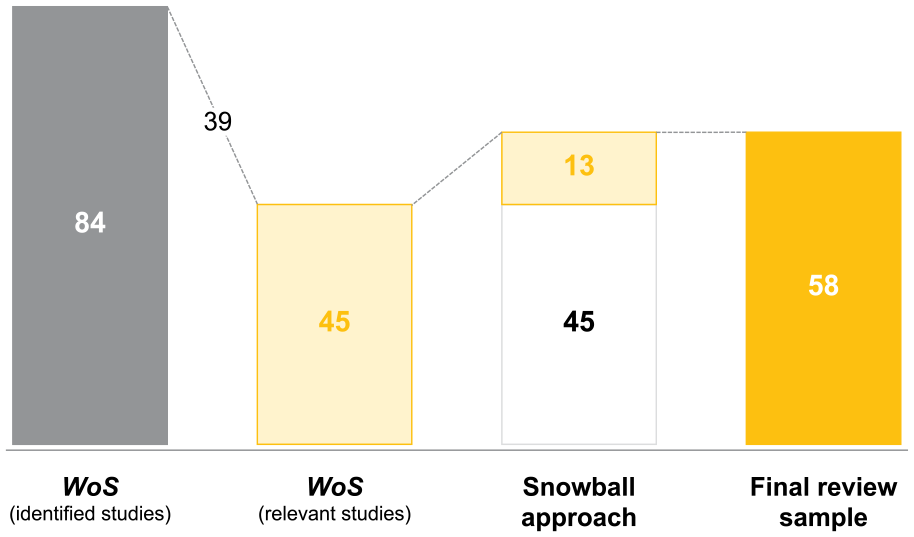
Overview of literature search process.
It is worth pointing out that while we attempted to identify as many representative studies as possible, critical reviews “rarely involve a comprehensive search of all of the relevant literature” (Paré et al., 2015: 189). Thus, our literature search prioritized representativeness and manageability over comprehensiveness (cf. Jones and Gatrell, 2014; Vom Brocke et al., 2015). In particular, we sought to ensure that the coverage of the literature was representative by (1) comparing our review sample with the bibliographies of a few highly cited studies on the topic (e.g. Chen et al., 2015a; Dremel et al., 2017; Martin, 2015); (2) determining that we had a reasonable, yet manageable, number of relevant studies, including conference papers, which tend to be underrepresented in citation databases but play an important role in disseminating research on emerging topics such as BDBMs (Vom Brocke et al., 2015); and (3) making sure that our search process uncovered studies across a range of disciplines and not just in the IS discipline.
Literature analysis
Our final review sample of 58 representative BDBM studies was analyzed in two cycles. In a first cycle, we employed a mix of attribute and initial, also called open, coding to assess each study against the three criteria introduced above. Attribute coding is for “setting/context codes” and is often associated with sociodemographic data and various descriptors (Saldaña, 2015). We used attribute coding to code publication type (conference paper vs journal article) and year, academic discipline of the publication outlet, author (employment) country, application domain and industry of the BDBM under study, BD characteristics (i.e. volume, variety, velocity, and veracity), type of knowledge gaining (conceptual vs empirical vs literature review), and underlying theoretical lens(es) (e.g. resource-based view, transaction cost economics). Initial coding is a line-by-line type of coding, which breaks qualitative data into discrete components that are then examined and compared with one another for similarities and differences (Saldaña, 2015). We used initial coding for BDBM types (data users, suppliers, and facilitators), BDBM dimensions (value proposition, architecture, network, and finance), as well as for BDBM deployment drivers, challenges, and process. Each member of the author team, separately, coded a subset of the 58 studies included in our review sample (see coding examples for the four BDBM dimensions in Appendix A). Each study was coded by at least two authors. After each coding iteration, we compared our preliminary coding results, discussed and resolved any differences (Saldaña, 2015), and—if necessary—refined our coding scheme. As we recognized patterns of similarities and differences, we organized and grouped similarly coded data into categories and subcategories. For example, external BDBM deployment drivers were grouped into the categories of “technology push” and “demand pull.” The categories and subcategories for deployment challenges are displayed in Appendix B. The initial intercoder agreement for the first review criterion (BDBM types) and the descriptive attribute coding categories ranged from 86% (type of knowledge gaining) to 100% (author country), which exceeds the 80%–90% range that Saldaña (2015) recommends. While we did not calculate initial agreement for the other criteria, we managed to resolve any critical differences in how the BDBM dimensions and deployment aspects were coded through extended discussions. Engaging in regular discussions also enabled us, as coders, to share our understanding of the meanings of specific codes, when applying the coding scheme (i.e. to reach consistency in their application). Furthermore, we employed tools such as fields in the coding form and annotations. We did this using NVivo® software, which supported document storing and helped us capture the rationale for code assignments in challenging categories.
In a second analysis cycle, each co-author searched the coding results for emerging patterns and wrote short analytical memos to document and explain the patterns identified. We used the memos to critically reflect on relevant topics in the BDBM literature and to identify shortcomings and weaknesses in this literature (Ortiz de Guinea and Paré, 2017). Based on the overlaps we found across our individual memos, we performed code reduction (cf. Markoczy and Goldberg, 1995) and ended up with an agreement of five overarching themes, referred to as research perspectives hereafter. These perspectives give focus and direction to future BDBM research, thereby strengthening knowledge development in the research area (Paré et al., 2015).
Review results
In this section, we first provide descriptive information on our review sample (see Appendix C for an overview and classification of all 58 studies). We then present the results of our literature assessment using the above-introduced review criteria: BDBM types, BDBM dimensions, and BDBM deployment drivers, challenges, and process.
Descriptive analysis
Our review sample consists of 53 journal articles and 5 conference papers, representing a wide array of academic disciplines. In particular, while 14 of the studies in our review were published in IS outlets (e.g. Journal of Management Information Systems, Journal of Strategic Information Systems, and MIS Quarterly Executive), our sample also includes studies from management (12), marketing and entrepreneurship (2), as well as from technical disciplines such as engineering (9) and computer science (3). Furthermore, a considerable portion of the publication outlets characterize themselves as interdisciplinary (14). Our findings about the broad range of disciplines publishing at the intersection of BD and BMs differs from Günther et al. (2017), who find that “the discussion [of BD phenomena] thus far resides within the IS community for the most part” (p. 192). Yet, it matches with Markus’ (2017) observation that “lawyers, anthropologists, ethicists, sociologists, statisticians and economists in growing numbers are contributing to knowledge about datification” (p. 233).
Similarly, the studies in our review sample examine BDBMs in a wide range of industries (e.g. agriculture, airline, automotive, education, energy, entertainment, financial services, healthcare, Internet/social media, manufacturing, oil and gas, retail, and tourism) and application domains (e.g. service innovation, smart cities, and supply chain management). Consistent with reviews by Shen and Chan (2017) and Wolfert et al. (2017), we find that most authors are working at universities and organizations in Europe and the United States. Although the location of the institution where people are working does not necessarily represent the country or culture where they were raised, this finding may still point to a serious bias in the BDBM literature toward Western “worldviews.” Furthermore, while the reviewed studies cover the past decade, the bulk of them (52) was published between 2015 and 2017 (see Figure 2).
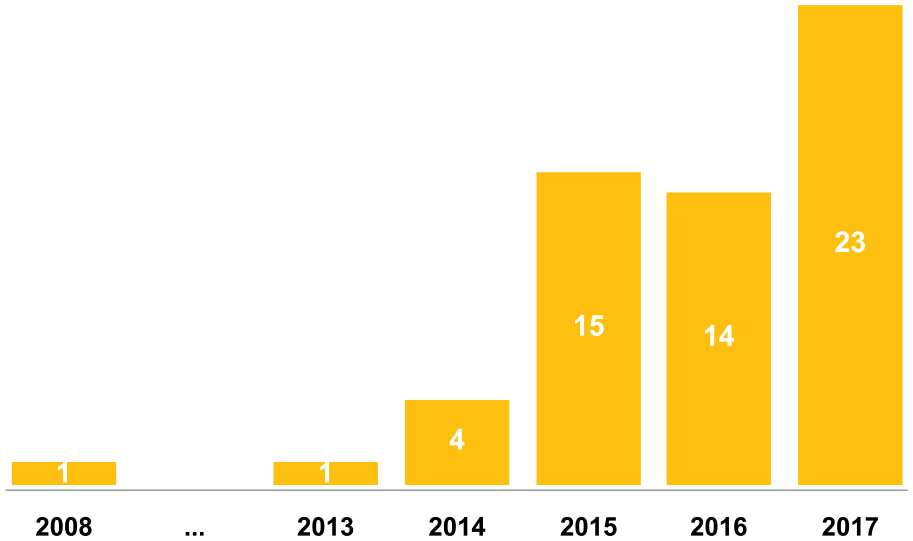
Number of BDBM studies over time (2008–2017).
In terms of conceptual underpinnings, most studies define BD in terms of data volume (48 studies), variety (44), and velocity (44), whereas only 31 studies refer to veracity. In terms of methodological underpinnings, the majority of the studies are conceptual in nature (29), including straightforward descriptions of BDBM applications, as well as research commentaries and opinion/position papers. In contrast, empirical studies (26) are relatively underrepresented. Again, this observation is consistent with Markus (2017) who—referring to the BD literature—indicates that “much of our current literature is conceptual, not empirical” and that “many opportunities for empirical datification research by IS scholars remain” (p. 234). As noted above, our sample also includes three literature reviews. Finally, in terms of theoretical underpinnings, most studies we reviewed do not draw on a clear theoretical basis (and are not concerned with theory building). In particular, we coded only 16 studies as theory-based, drawing on established theories and theoretical frameworks such as transaction cost economics (4 studies), dynamic capabilities (3), resource-based view (3), and Schumpeterian innovation (3).
Criterion 1: BDBM types
Our critical review and analysis of a representative sample of 58 BDBM studies indicates that the primary focus of the literature is on data users (42 studies), with a particular focus on the question of how BD can be used to create value within an organization (Schroeder, 2016). In contrast, there is only a limited focus on data suppliers (three studies; Rambe and Moeti, 2017; Spiekermann and Novotny, 2015; Vezyridis and Timmons, 2015). These three studies broadly represent data suppliers ranging from Massive Open Online Course (MOOC) providers to personal health information (PHI) vendors. For example, when studying African universities’ adoption of MOOCs, Rambe and Moeti (2017) take a critical stance on the advancement of MOOC offerings by Western consortia. In particular, they argue that MOOC providers’ complex BMs—involving the sale of student BD (e.g. learning analytics) for profit—is at odds with claims about philanthropic and egalitarian considerations driving MOOC offerings. On a related note, Vezyridis and Timmons (2015: 113) question whether the development of PHI records by independent vendors really empowers patients, arguing that the “proclaimed ‘consumer empowerment in healthcare’ is an attempt to introduce [. . .] a business model for centralizing all relevant PHI to render them economic.” Further exploring user concerns, Spiek-ermann and Novotny (2015) point to the open conflict between companies’ demand for data—“the new oil”—and consumers’ intensified desire for privacy, fueled by recent data breaches and abuses. They highlight that, by now, “no true answer is in sight of how to resolve this conflict” (p. 181) and propose a vision of a four-space market model ensuring the privacy of personal data. Also, one study in our review sample focuses exclusively on data facilitators: Drawing on prior work, Assunção et al. (2015) discuss requirements for cloud-based BD analytics services along with three potential BMs (e.g. hosting of customer analytics jobs in a shared platform).
In some cases, the extant literature considers multiple BDBM types in a single study. For instance, four studies in our representative sample look at both data users and suppliers (Bram et al., 2015; Martin, 2015; Schüritz et al., 2017; Trabucchi et al., 2017). Bram et al. (2015), for example, analyze challenges related to reliable data collection in developing countries, as well as discuss ways that the data can benefit users. They propose four community health worker-centric BDBMs that provide incentives and accountability structures, facilitating the collection of healthcare data in low-resource settings. Four additional studies examine both data facilitators and users (Dimitrov, 2016; Lokshina et al., 2017; Rehman et al., 2016; Zhang et al., 2015). For example, Dimitrov (2016) argues that a new type of facilitator, referred to as “digital health advisors,” will emerge and play an increasingly important role in helping patients interpret and understand health and wellbeing data. Relatedly, addressing the question of BM scalability, Zhang et al. (2015) propose three mechanisms by which digital BMs attempt to gain scale (engaging both paying and non-paying users, allowing self-customization, and orchestrating networked value chains) and present examples of data users and facilitators to illustrate the proposed mechanisms.
Finally, four studies in our review sample consider all three BDBM types. Three of these studies derive BDBM-related typologies and taxonomies (Hartmann et al., 2016; Kamoun, 2008; Schroeder, 2016). In the fourth study, Vega-Gorgojo et al. (2016) describe an “ecosystem” of new BDBMs in the oil and gas upstream industry in the Norwegian Continental Shelf. This emerging BDBM ecosystem includes equipment manufacturers offering data-driven services (data users), firms specializing on collecting and selling seismic data (data suppliers), as well as companies processing and analyzing well data on behalf of data users (data facilitators).
Criterion 2: BDBM dimensions
The results of our critical review suggest that existing research focuses on three of the four BDBM dimensions proposed by Al-Debei and Avison (2010): value proposition (53 studies), value architecture (52), and value network (49; see also Appendix C). For example, related to value proposition, studies on data-user BDBMs refer to the personalization of market offerings (e.g. Chen et al., 2017; Fernández-Manzano et al., 2016), the creation of novel and “smarter” services (e.g. Gretzel et al., 2015; Guesmi, 2014), and the introduction of entirely new BMs (e.g. Ehret and Wirtz, 2017; Günther et al., 2017). With respect to value architecture, studies emphasize the value potential of BD for the improvement of managerial decision-making (e.g. Loebbecke and Picot, 2015), the optimization of internal processes (e.g. Ehret and Wirtz, 2017; Yue et al., 2015), and the prediction and proactive handling of critical events (e.g. Chandy et al., 2017; Chen et al., 2017). Regarding the value network of data-user BDBMs, studies discuss the value originating from sharing data across organizational units and with business/supply-chain partners (e.g. Bogle, 2017; Chen et al., 2015a; Lindgren and Aagaard, 2014; Sorescu, 2017; Vega-Gorgojo et al., 2016), as well as the importance of open data that are freely available (e.g. Chandy et al., 2017; Günther et al., 2017; Hashem et al., 2016; Kshetri, 2016; Malomo and Sena, 2017; Schroeder, 2016). Furthermore, some studies point to the provision of BD infrastructure solutions and analytics capabilities through external partners (e.g. Dremel et al., 2017) and partner networks (e.g. Gretzel et al., 2015).
In contrast, a considerably smaller portion of the BDBM studies in our representative review sample (36 studies) considers the value-finance dimension, which captures the cost structure along with the pricing and revenue models of a BDBM (Al-Debei and Avison, 2010). This shortcoming seems to apply to extant research on all BDBM types (see Appendix C). Our analysis results thus point to a lack of research on how organizations are able to capture the value created in BDBMs. Also, the studies that do consider a BDBM’s value-finance dimension tend to provide only anecdotal evidence and examples of companies that were able to successfully develop notable BD-based revenue streams (e.g. Bram et al., 2015), introduce BD-enabled pricing methods (e.g. Chandy et al., 2017; Kamoun, 2008; Kavadias et al., 2016), and improve their cost structures through BD analytics (e.g. Chen et al., 2017). For instance, Bram et al. (2015: 65) provide the example of patient-data trading in the healthcare industry, where intermediaries, such as IMS Health, “purchase aggregated data from individuals or countries [and] are able to sell it as de-identified patient data for billions of dollars annually.” Moreover, while value-capturing mechanisms represent a crucial aspect of any BM (Amit and Zott, 2001; Osterwalder and Pigneur, 2010), only one study in our sample focuses explicitly on how organizations are able to capture value from BD: examining 100 startup firms, Schüritz et al. (2017) find that BDBMs are most commonly based on a subscription revenue model, but also that “more innovative approaches such as gain sharing and multi-sided revenue models are gaining traction among start-ups” (p. 9).
Criterion 3a: BDBM deployment drivers
According to our review results, factors driving the deployment of BDBMs can be divided into internal and external drivers. In terms of internal drivers, studies refer to the anticipated benefits of BD (analytics) and potential business value of BD-enabled BM transformation and innovation (e.g. Chen et al., 2017; Dremel et al., 2017). In particular, 36 of the 58 studies included in our representative sample of the BDBM literature highlight the impact that BD are expected to have on the incremental improvement of existing business processes and product/service offerings (e.g. Cheah and Wang, 2017; Hartmann et al., 2016; Kshetri, 2016; Rehman et al., 2016), as well as the development of new market offerings and BMs (e.g. Chandy et al., 2017; Günther et al., 2017; Marabelli et al., 2017; Yrjölä et al., 2017). Interestingly, only five studies in our review sample address the importance of organizational readiness factors—including top management support and compatibility between the value potential of BD analytics and the configuration of a firm’s current BM—in driving the deployment of BDBMs (Chen et al., 2015a, 2017; Dremel et al., 2017; Günther et al., 2017; Malomo and Sena, 2017). For example, viewing BD analytics as a dynamic capability and emphasizing the path dependency of such capabilities, Chen et al. (2015a) find that both anticipated benefits and technological compatibility have a direct influence on the deployment of BDBMs.
In terms of external drivers, the majority of the reviewed studies (34) points to new technologies as key drivers of BDBM deployment (technology push), along with their growing diffusion and convergence (e.g. Chandy et al., 2017; Cheah and Wang, 2017; Ehret and Wirtz, 2017; Gretzel et al., 2015; Günther et al., 2017; Marabelli et al., 2017; Schlesinger and Doyle, 2015; Strandhagen et al., 2017). Corresponding studies, for example, highlight the influence of major technological advances and innovations in the areas of ubiquitous wireless communication (e.g. 5G standard), Industry 4.0 (e.g. intelligent sensors and the Internet of Things), cloud computing, fault-tolerant databases (e.g. “Not only SQL”), and distributed data storage and processing (e.g. Apache Hadoop). These and other technologies are found to be instrumental in providing organizations with access to unprecedented amounts of data at relatively low cost (e.g. Assunção et al., 2015; Hashem et al., 2016; Kamoun, 2008; Kavadias et al., 2016; Lokshina et al., 2017; Malomo and Sena, 2017; Schroeder, 2016), as well as new capabilities such as high-performance computing, real-time analytics and machine learning (e.g. Bogle, 2017; Chen et al., 2015a; Kshetri, 2016; Loebbecke and Picot, 2015; Trabucchi et al., 2017; Yrjölä et al., 2017).
However, our literature review also reveals that studies addressing how market needs drive BDBM deployment (demand pull) remain underrepresented (11 studies). Notable exceptions in our review sample include Bram et al. (2015), Chandy et al. (2017), Giagnocavo et al. (2017), Kavadias et al. (2016), and Kshetri (2016). For example, Kshetri (2016) sheds light on how BD transforms established BMs in the financial-service industry, and the role of emerging BDBMs in granting Chinese low-income families and micro enterprises access to financial services. In this regard, Kavadias et al. (2016: 92) emphasize: “although new technologies are often major factors, they have never transformed an industry on their own. What does achieve such a transformation is a [BM] that can link a new technology to an emerging market need,” such as the growing diversity of consumer preferences and the rise of input costs (e.g. labor and transportation).
Moreover, the results of our review suggest that extant research widely neglects other external BDBM deployment drivers. For instance, only six studies in our review sample indicate that organizations deploy a BDBM in response to pressure from institutional forces (Kamoun, 2008; Lindgren and Aagaard, 2014; Simons, 2014; Strandhagen et al., 2017), or as an attempt to adopt strategies that are similar to those of competitors and/or trading partners (e.g. Chen et al., 2015a; Engelbrecht et al., 2016). Kamoun (2008) offers an example concerning major US retailers (e.g. Best Buy, Target, and Walmart) and government agencies (e.g. Department of Defense), which require their suppliers to use RFID (radio-frequency identification) tags on pallets and cases. Relatedly, Gretzel et al. (2015) find that, in some Asian countries (e.g. China and South Korea), there is a mix of strong institutional pressure and support by governments to realize BDBMs (cf. Cheah and Wang, 2017).
Criterion 3b: BDBM deployment challenges
In terms of factors hampering the deployment of BDBMs, our critical review points to a strong focus on internal, mostly operational, challenges related to the management and governance of BD, the technical and human infrastructures required for handling such data, and the significant costs associated with BDBM deployment. For example, 19 studies in our representative sample point to data-access challenges by indicating that some of the most useful data are not captured (e.g. Chen et al., 2017) or that structural data silos (e.g. Malomo and Sena, 2017) and internal politics (e.g. Schroeder, 2016) prevent access to these data. In addition, 21 studies point to critical data-quality challenges, including the collection of reliable data (e.g. Bram et al., 2015), the verification of external data (e.g. Chen et al., 2017), and the overhead associated with preprocessing tasks such as data cleansing and reduction (e.g. Assunção et al., 2015). A related challenge, as represented by four studies, concerns the loss of data context (e.g. metadata), especially when datasets are combined or are sourced through third parties (e.g. Günther et al., 2017). Moreover, 23 studies highlight that the success of a BDBM is, and will be increasingly, tied to assuring data privacy and security, including assurance of data confidentiality (e.g. Kamoun, 2008), de-identification of personal data (e.g. Malomo and Sena, 2017), and protection against cyber threats (e.g. Vega-Gorgojo et al., 2016).
In terms of infrastructural challenges, 17 and 18 studies point to an insufficient scalability of existing IT architectures, software systems, and algorithms (e.g. Assunção et al., 2015; Cheah and Wang, 2017; Hashem et al., 2016) and a lack of internal BD analytics knowledge and skills (e.g. Dremel et al., 2017; Kshetri, 2016; Malomo and Sena, 2017), respectively. For example, Hashem et al. (2016) point out that relational-database technologies and traditional algorithms (e.g. neural networks and genetic algorithms) are unable to handle BD. Relatedly, Dremel et al. (2017) and Chen et al. (2017) highlight challenges regarding the development and acquisition of the capabilities required for deploying a BDBM.
Additional internal challenges arise from the tension between the (anticipated) BD cost and value: On one hand, 20 studies in our review sample hint at organizations’ inability to discover innovative use cases and thus to recognize the value of BD (e.g. Chen et al., 2017; Rehman et al., 2016; Trabucchi et al., 2017), along with the uncertain payoff of BD investments (Chen et al., 2015a; Günther et al., 2017). On the other hand, 16 studies stress the need for large up-front investments in BD (analytics) infrastructure and skill development (e.g. Bogle, 2017; Chen et al., 2017; Lokshina et al., 2017), as well as organizations’ tendency to underestimate the operational costs of running a BDBM (e.g. Assunção et al., 2015; Schroeder, 2016). The latter may include opportunity costs resulting from “mindless” data capturing and analysis (Gretzel et al., 2015; Günther et al., 2017).
Furthermore, some of the representative studies we reviewed point to organizational-context challenges. Specifically, seven studies discuss transformational challenges with regard to breaking free from the constraints of existing organizational structures and processes (e.g. Kamoun, 2008; Vega-Gorgojo et al., 2016), as well as developing and establishing a data-driven organizational culture (Dremel et al., 2017; Engelbrecht et al., 2016). On a related note, eight studies refer to challenges arising from the potential need to blend “the old with the new” (e.g. Chen et al., 2017; Pousttchi and Hufenbach, 2014; Schlesinger and Doyle, 2015). Here, Hartmann et al. (2016: 1383) note that startups have “the advantage of starting from a blank page,” while established firms face the challenge of either integrating BD analytics into their existing BM or developing a BDBM in parallel and operating with dual BMs (cf. Günther et al., 2017).
In contrast, existing research appears to be less concerned with external, and arguably more strategic, BDBM deployment challenges. For instance, challenges associated with the weak regulatory environment are discussed by only 11 studies. Among other things, these studies find that regulations around BD lag behind current business practices (e.g. Dimitrov, 2016), lack transparency (e.g. Schroeder, 2016), and vary across countries/regions (e.g. Vega-Gorgojo et al., 2016) and industries (e.g. Günther et al., 2017). A related external challenge, mentioned in six studies, concerns the lack of common standards (e.g. Hashem et al., 2016; Malomo and Sena, 2017; Schroeder, 2016), which can lead to interoperability and data exchange/integration issues (e.g. Bogle, 2017; Zhou et al., 2016), thereby fueling vendor lock-in risks (Assunção et al., 2015). At the same time, scholars foresee that the commoditization of BD (analytics) tools and solutions will give rise to new challenges (Kamoun, 2008; Loebbecke and Picot, 2015). Specifically, they argue that, with growing adoption and standardization of BD technologies, it will become difficult to sustain a competitive advantage from “out-of-the-box” solutions. Furthermore, Loebbecke and Picot (2015: 150) point to the strategic challenge, or risk, that the increasing deployment of BDBMs may give rise to “oligopolistic or even monopolistic [market] structures” (cf. Wolfert et al., 2017). Adding to this, a few studies in our review sample serve as a reminder that problems with local infrastructures—such as inconsistent power supplies and spotty Internet access—continue to be key BDBM deployment challenges, especially in developing countries (Bram et al., 2015; Rambe and Moeti, 2017).
Finally, 15 studies—including two of the three studies that focus exclusively on data suppliers (Spiekermann and Novotny, 2015; Vezyridis and Timmons, 2015)—highlight that ethical concerns and related privacy concerns represent an increasingly important challenge for the deployment of BDBMs (e.g. Guesmi, 2014; Günther et al., 2017; Kshetri, 2016; Marabelli et al., 2017; Martin, 2015; Sax, 2016). For example, Günther et al. (2017) discuss ethical and legal deployment barriers; Marabelli et al. (2017) elaborate on the ethical issues that crop up when individuals allow automobile insurance companies to monitor their driving style under the lure of lower premiums and at the expense of their privacy; Martin (2015) singles out industries where BDBM deployments lead to both beneficial (mainly for businesses) and questionable (mainly for individuals) results; and Sax (2016) questions organizations’ ethical judgment in relation to appropriating value from BD insights. A tabular summary of the BDBM deployment challenges identified through our review is provided in Appendix B.
Criterion 3c: BDBM deployment process
The results of our critical literature review are indicative of a scarcity of research on the BDBM deployment process. Specifically, only six studies in our review sample analyze dynamic aspects of how BDBMs are deployed over time. Perhaps the best description of a BDBM deployment process is provided in the study by Dremel et al. (2017), which examines how German car manufacturer Audi established BD analytics in the digital transformation of its BM. Based on their case analysis, the authors propose a three-stage process model to describe the evolution of BD analytics capabilities at Audi: (1) Advancing—development of basic analytics capabilities along with first reporting and descriptive analytics services; (2) Enabling—provision of technology support for BD analytics enabling the development of advanced descriptive analytics services, which in turn help promote the value of BD analytics among decision makers; and (3) Leveraging—central provision of advanced (descriptive and predictive) analytics methods “as a service” and leveraging of additional (operational) data sources. Chen et al. (2017) also discuss BDBM deployment over time when they report on the BD-enabled renovation of Lufthansa’s BM. Their study outlines the three phases of the top-down innovation process used by Lufthansa to discover BD value. Relatedly, Kamoun (2008) identifies three dynamic phases of RFID-enabled BDBMs (proof of concept, rollout, commercialization). The other three studies report on the sequential process of how Chinese manufacturers and retailers discovered, created, and captured value from BD (Cheah and Wang, 2017); how a local government deployed an integrated data model for children services (Malomo and Sena, 2017); and how the traditional BM of two newspapers shifted toward a BDBM over time (Schlesinger and Doyle, 2015). In defense of extant research, it is worth noting that several studies in our sample showcase BDBMs that had not yet been fully deployed, or if they had, it had only been for a relatively short period of time.
Summary
The criteria we adopted for our critical review are useful for looking across the representative studies in our review sample, reflecting on the status of the BDBM literature in terms of current research foci and gaps/shortcomings, as well as deriving relevant perspectives for future BDBM research. Two overarching findings of our review concern the weak theoretical underpinnings of current BDBM studies, as well as their strong emphasis on value creation, at the expense of value capture. This is not surprising, as BDBMs represent a relatively new phenomenon and as capturing value has been a well-known issue in contexts involving newly emerging technologies since the outset of the dotcom revolution (Teece and Linden, 2017). However, as many dotcoms had to experience painfully: being able to create value with new technologies, such as BD, does not equate with being able to capture the value created, making it highly relevant to consider both basic functions of a BM. Furthermore, our review results point to a strong research focus on data users (BDBM types) and the creation of organizational value by means of sharing internal data and exploiting open data (BDBM dimensions). Given this focus, the reviewed studies tend to treat a BDBM as an essentially closed system, thereby neglecting other relevant stakeholders. We therefore suggest that future BDBM research would benefit from a broadened scope, which considers how data users co-create value with data suppliers and facilitators (supply-chain perspective) and how the deployment of BDBMs affects stakeholders at various levels, including the individual and societal levels (stakeholder perspective).
Similarly, the review results reveal that the discussion of BDBM deployment drivers and challenges is largely focused on internal factors, and especially on the internally perceived value potential of BD and the operational challenges associated with the management and governance of BD. This focus on internal BDBM deployment aspects also indicates that past research is mainly concerned with examining BDBMs from the perspective of the focal organization, and that future studies would do well to incorporate the perspective(s) of other stakeholder groups (stakeholder perspective). Furthermore, in terms of challenges, our review results indicate that research on ethical issues (and related privacy concerns) is still underrepresented in the BDBM literature, and often limited to the study of data suppliers. Anecdotal evidence, however, suggests that ethical issues are equally relevant to all types of BDBMs (e.g. see data user-related example in Schroeder, 2016: “how Target exposed a teen girl’s pregnancy”), since corresponding issues concern all stages of the BD lifecycle—from data collection to analysis and use (Martin, 2015). Consequently, developing a more comprehensive and differentiated understanding of the ethical issues associated with the (successful) deployment of BDBMs appears to be a particularly important and promising path for future research (ethics perspective). In addition, most studies in our review sample are static in nature, and thus fail to capture how BDBM deployment activities and stages unfold, and interact with each other, over time. This suggests that future research should engage in dynamic aspects of BDBM deployments (process perspective). Finally, the descriptive analysis of our review sample points to a potential bias toward Western worldviews in the current literature and thus to the importance of incorporating national perspectives in future BDBM research.
Table 2 summarizes the results of our critical literature review. In the next section, we combine the perspectives derived from our results in a multiperspective research framework on BDBM value creation and capture and discuss each individual perspective.
Summary of review results and emerging research perspectives.
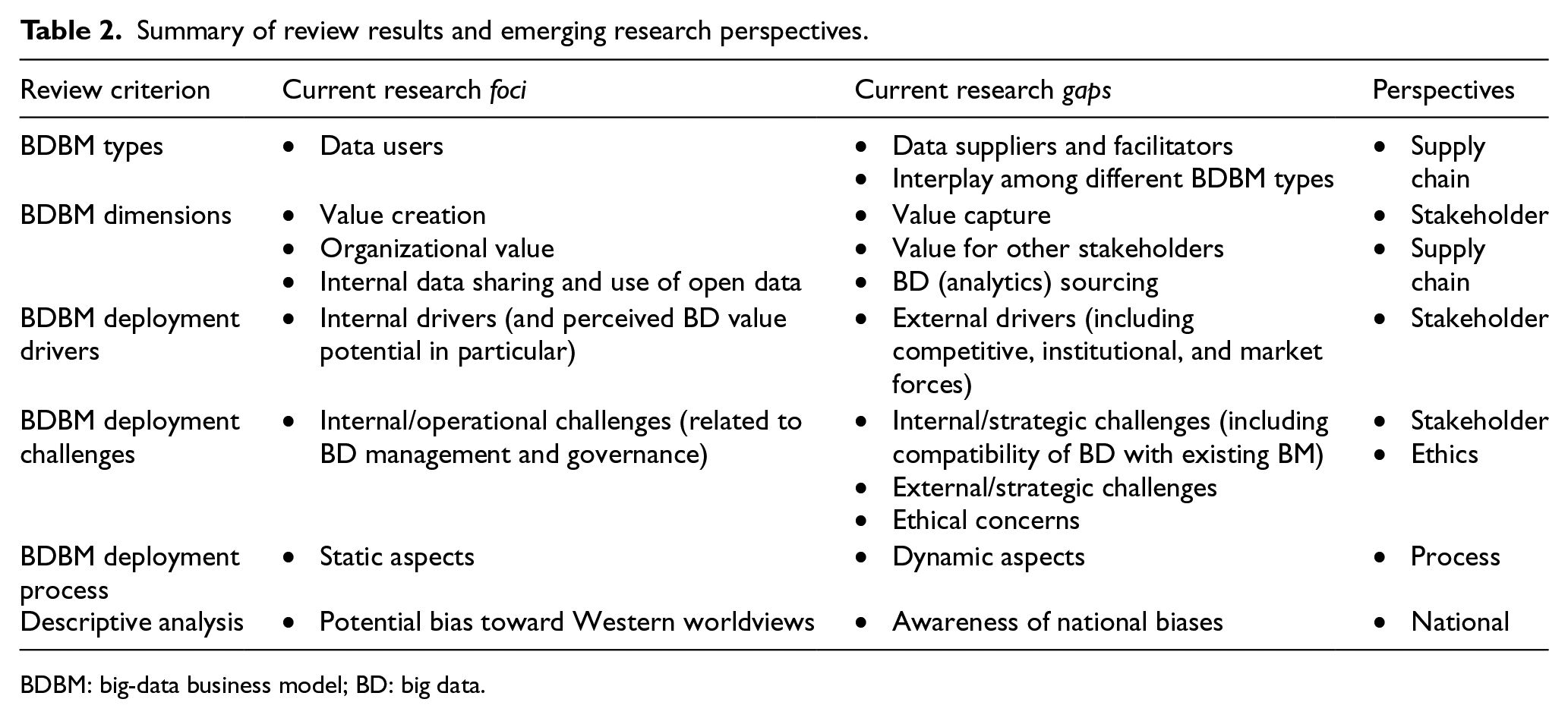
BDBM: big-data business model; BD: big data.
A multiperspective framework for BDBM value creation and capture
So far, our critical review has focused on assessing the current state of the BDBM literature. In this section, we reflect upon the insights gained from our review and provide theoretical and methodological guidance for future BDBM research. We do so by discussing five emerging research perspectives (supply chain, stakeholder, ethics, national, and process), also referred to as thematic gaps (Rowe, 2014), which challenge and broaden the current way in which scholars and practitioners look at BDBM value creation and capture.
Supply-chain perspective
Virtually absent from the current literature is serious consideration of the interplay among the three BDBM types, such as when data-user BDBMs utilize supply-chain partners for the collection/generation (data suppliers) and the analysis (data facilitators) of BD. In this regard, several studies in our review sample suggest that data-user organizations tend to exhibit a high level of vertical integration, including not only the storage and processing but also the supply of BD. Such organizations (often large ones) run their own data centers (Assunção et al., 2015; Dimitrov, 2016; Wolfert et al., 2017; Yue et al., 2015) and are, for example, challenged by the need to provide professional data security services, either internally (Zhou et al., 2016) or within a network as in the context of smart cities (Hashem et al., 2016; Pramanik et al., 2017). This observation is consistent with previous findings, indicating that the sourcing of BD and related services is an emerging and thus challenging market (Ardagna et al., 2016). Consequently, only a few of the reviewed studies touch on the role of BDBMs that center on gathering/packaging BD for sale to data users (e.g. Marabelli et al., 2017; Schroeder, 2016). Nevertheless, going forward, interfirm exchanges can be expected to play a critical role in BDBM value creation and capture, as not all organizations will be able to adequately internalize the capabilities needed to exploit BD. In other words, a focus on specialization and core competences (Bharadwaj, 2000; Gupta et al., 2009; Teece and Pisano, 1994) will require these organizations to rely more heavily on external partners (i.e. data suppliers and facilitators).
On a related note, very few studies discuss issues related to purchasing BD from external data suppliers through complex supply-chain systems (e.g. Bogle, 2017; Günther et al., 2017; Schroeder, 2016). To this end, a major challenge derives from the collection of sensitive information by third parties (Colombo and Ferrari, 2015; Günther et al., 2017), because doing this does not absolve the “data user” from various legal liabilities (Marabelli and Markus, 2017; Vega-Gorgojo et al., 2016). Again, this highlights the need for future research on the complex relationships between data users, suppliers, and facilitators (Schroeder, 2016). Corresponding research would benefit from adopting a (dynamic) BDBM ecosystem perspective (Lindgren and Bandsholm, 2016; cf. Moore, 1993) and can build on, and extend, established theories—such as network theory, resource-based view, and transaction cost economics—that can contribute to understanding such ecosystems.
In addition, adopting a supply-chain (or ecosystem) perspective can help understand the impact of emerging BDBMs on existing markets. For example, in an attempt to commandeer the first link of the BD supply chain, several major, data-driven firms—such as Google, Amazon, and Apple—have entered the smart-devices market. On a related note, the current BD revolution (McAfee and Brynjolfsson, 2012) also strongly impacts traditional supply chains (e.g. Rehman et al., 2016; Shen and Chan, 2017). For instance, in the context of smart farming, studies suggest that the newly available and granular insights derived from BD will lead to significant power shifts along the supply chain in the food industry (Wolfert et al., 2017).
Stakeholder perspective
Broadly speaking, the stakeholder perspective concerns the question of for whom BDBMs create (and capture) value. Here, our review results emphasize that existing studies focus mainly on the focal organization operating with a BDBM and barely consider other BDBM stakeholders (e.g. Chen et al., 2012). That is, past research often neglects to acknowledge that BDBMs do not operate in isolation and are unlikely to carry benefits for ‘everyone’; rather, they are embedded in a broader organizational environment that includes diverse stakeholder groups, ranging from individuals to governments and society. Considering these additional BDBM stakeholder groups can be expected to yield additional insight into how BDBMs can create and capture value that goes beyond organizational value.
At the individual level, the datification of BMs sets the stage for a potential revolution of the traditional organizational roles of professional workers (Galliers et al., 2017). These changes can be analyzed from, at least, three viewpoints: (1) data-driven approaches to managing employees (Bersin, 2015; McLean et al., 2016; Waber, 2013), (2) data-driven decision-making (McAfee and Brynjolfsson, 2012), and (3) data scientists (Akter et al., 2016). First, BD gathered from monitoring can be used advantageously to manage workers, control their activities, and suggest optimal ways to complete their tasks (Cram and Wiener, 2020; Wiener and Cram, 2017). Yet, the few works in our sample that touch upon beneficial data-driven approaches to managing employees do so only marginally (Colombo and Ferrari, 2015; Lokshina et al., 2017; Rehman et al., 2016). Furthermore, virtually none study the “dark side” of data-driven approaches to managing employees (see also Ethics Perspective below). This includes the discrimination, or unjust classification, of potential employees, as well as the overly tight control of employees (O’Neill, 2016). Second, in BDBMs, algorithmic decision-making can pose serious problems if decisions are not correctly and carefully interpreted by employees (Jago, 2017). For example, workers may rely too heavily on BD-driven decisions without adequately reflecting upon the implications of these decisions (e.g. Malomo and Sena, 2017; Vezyridis and Timmons, 2015). Again, this issue is weakly addressed in the BDBM literature (e.g. Dremel et al., 2017; Vega-Gorgojo et al., 2016). Third, past BDBM research places scant emphasis on the role of data scientists (e.g. Chen et al., 2017; Rehman et al., 2016; Vega-Gorgojo et al., 2016) as change agents leading the deployment of BDBMs (LaValle et al., 2011), or as individuals who can connect the technical/analytical and business/strategic aspects of the BDBM phenomenon.
Furthermore, governmental stakeholders are important to BDBM research for at least two reasons. First, their legislating influence may enable or constrain BD uses (Hartmann et al., 2016). Second, local and national governments are increasingly attempting to use BD to assist their citizens (e.g. Malomo and Sena, 2017), as well as for control and security purposes (Newell and Marabelli, 2015). At the societal level, while private consumers and citizens are unlikely to craft their own BDBMs, they are likely to be affected by BDBMs crafted by private and public institutions. For example, BDBMs for smart cities often emerge in a bottom-up fashion, requiring citizens to be proactive and actively contribute to their successful deployment, for example, through e-participation (Gretzel et al., 2015; Hashem et al., 2016; Sivarajah et al., 2016).
To account for the impact of governmental and other stakeholders on the deployment of BDBMs, future studies may want to extend existing theories and take further the analysis of the influence laws and regulations have on BDBM value creation and capture. This, for example, could be accomplished by applying an institutionalism lens (DiMaggio and Powell, 1983; Powell and DiMaggio, 1991). Alternatively, researchers may want to develop their own theories using existing “theorizing tools” such as multilevel theorizing, which focuses on how constructs are changed through emergent influences that move either upward or downward (e.g. from the governmental to the individual level) (Kozlowski et al., 2013; Kozlowski and Klein, 2000). These influences can change the nature or characteristics of BDBM-related phenomena—such as trust, power, or resistance—as they move from one level to the next. Although Kozlowski et al. (2013) acknowledge that emergence is often from the bottom-up, it can also be top-down, as “higher level phenomena constrain, shape and influence different lower level phenomena (i.e. cross-level effects)” (p. 582). Multilevel theorizing might, for example, be appropriate for explaining how one stakeholder group (e.g. employees) is embedded in a “larger” stakeholder group (e.g. organization). Here, as BD enables organizations to enact more fine-grained control over employees, the resulting behaviors of these employees will impact those of other employees, as well as performance at the organizational level. In this example, multilevel theorizing can help explain what the deployment of a BDBM focused on achieving internal work efficiencies means for individual employees and their organization. Also, since the BDBM literature typically does not consider multiple levels of stakeholders—especially analyzed jointly—and given the current focus on the organizational level in this literature, a top-down multilevel theory focused on how BDBM deployment affects employees in their organizations would probably be the most natural place to start.
Ethics perspective
As indicated above, only a few BDBM studies specifically address ethical issues (e.g. Günther et al., 2017; Malomo and Sena, 2017; Marabelli et al., 2017; Martin, 2015; Sax, 2016; Vezyridis and Timmons, 2015). One way to consider the ethics perspective is to apply Mason’s (1986) Privacy, Accuracy, Property and Accessibility (PAPA) framework. Privacy, or the capability of individuals to personally control information about themselves, remains poorly addressed in today’s “BD world.” For example, many BDBMs are based on the growing diffusion of devices that capture the minutiae of our lives (Hedman et al., 2013; Venturini and Latour, 2010). They have thus led to major privacy concerns because device users—referred to as “walking data generators” (McAfee and Brynjolfsson, 2012: 5)—are often not asked for their permission to use their data for business purposes, such as predicting market trends (Newell and Marabelli, 2015). It can be considered an invasion of privacy when the information people provide, either willingly or without their knowledge, is used to identify their personal preferences or history when they do not want those preferences or history to be known. Also, information provided for one purpose may result in discriminatory practices (due to BD predictions) that are detrimental to people’s wellbeing or careers (Newell and Marabelli, 2015).
Related to privacy are the governmental and institutional efforts that are being undertaken to ensure individual privacy. Examples include (1) recent amendments to HIPPA’s (Health Insurance Portability and Accountability Act) privacy rules that regulate healthcare data in the United States and involve exchange and classification of patient data for clinical research purposes; (2) the European Union’s (EU) proposed e-privacy regulation to allow individuals to personally control privacy-sensitive information on any of their devices or in machine-to-machine transmissions such as those in the Internet of Things; and (3) the EU’s GDPR (General Data Protection Regulation) with provisions and requirements concerning personal identifiable information of EU residents that impact organizations around the globe doing business in the EU area. In a nutshell, privacy is destined to impact BDBMs worldwide, mainly because of the need to comply with regulations such as those discussed above. While one might argue that obeying data privacy laws does not mean an organization does so with the goal of being ethical, clearly, emerging regulations will enforce basic ethical principles concerning the protection of individual privacy and thus require firms with BDBMs to seriously respond to ethical challenges.
Looking to the future, other promising areas of ethics-related BDBM research—besides privacy—pertain to the remaining three dimensions of Mason’s (1986) PAPA framework (i.e. accuracy, property, and accessibility). While these ethical issues are underresearched and under-appreciated, they are equally important. Here, the accuracy, or correctness, of BD data is likely to be especially problematic. As BD is aggregated or subjected to data-reduction procedures, it becomes virtually impossible to delete obsolete or inaccurate data over time. Questions about property, or who owns the data, are addressed by Sax (2016) who disavows the Finders-Keepers conception of property (Kirzner, 1978). Incorporating Sax’s view of ownership should prove especially fruitful in exploring ethical issues faced by data suppliers and facilitators. Finally, accessibility, or the capability of obtaining data, needs to be considered in myriad ways including protecting data and ensuring that adequate control and security measures are in place to protect it. For instance, the intense use of BD analytics in healthcare, as part of the industry’s “BM” (Stanimirovic and Vintar, 2015; Wang et al., 2018), requires addressing ethical concerns related to protecting data from access by unauthorized/inappropriate parties.
In sum, as ethical issues and related consumer concerns will likely proliferate (Kshetri, 2016; Lokshina et al., 2017), it becomes increasingly important and strategically relevant to deploy BDBMs in an ethically responsible way (Marabelli et al., 2017; Vega-Gorgojo et al., 2016). For example, consumers are very sensitive to unethical behaviors by companies, as was evident from the outrage over Facebook’s recent disregard for the privacy of its users (King, 2018). It is thus strategic—not only “good” or “fair”—for organizations to embed ethical conduct into their BDBMs (Marabelli and Markus, 2017), and theoretical frameworks such as Mason’s PAPA can help researchers evaluate the extent to which firms are doing so. In this context, however, scholars and practitioners should keep in mind that the deployment of BDBMs can also help address ethical issues, as highlighted by Vega-Gorgojo et al. (2016) who point to safety and environmental advantages of BDBMs in Norway’s oil and gas industry.
National perspective
The studies in our representative review sample describe BDBMs in a broad range of national regions, including the United States, Netherlands and Denmark (Lindgren and Aagaard, 2014), Norway (Vega-Gorgojo et al., 2016), Germany (Dremel et al., 2017), Italy (Marabelli et al., 2017), as well as China (Kshetri, 2016) and Singapore (Zheng and Wu, 2017). Nonetheless, most of these studies either do not mention differences across nations (and cultures), or they look at the BDBMs of global companies such as Amazon and Google without discussing the national and localized implications of their use.
In other words, current BDBM research is characterized by superficial discussions and myopic consideration of differences in national regulations and cultural views on privacy. However, some studies compare and contrast privacy regulations in the United States with those in the EU (Marabelli et al., 2017; Martin, 2015; Montgomery, 2015); others focus on cultural differences and different perceptions of privacy (issues). For example, the Korean government’s low degree of regulation about privacy might be because the Korean culture is less concerned about privacy when compared with European and US cultures (Kshetri, 2016). A theory that may help in more deeply understanding cultural nuances in designing, deploying, using, and managing BDBMs is Leidner and Kayworth’s (2006) Theory of IT Culture Conflict, which addresses cultural values at the national, organizational, and subunit levels. Related to the example above, Leidner and Kayworth (2006) report that countries high on individualism tend to have less government involvement in privacy regulations and conclude that managers of global companies need to apply very different approaches in dealing with what is considered unethical behavior across nationalities. Also, their theory suggests that, in order for a BDBM to be accepted, there must be a fit with the values embedded in the “system” and the people designing and using it (Leidner and Kayworth, 2006). This is consistent with Fernández-Manzano et al.’s (2016) argument that a BDBM needs to adapt to regional and national differences, as manifested in how Netflix addressed the internationalization of its BM by varying underlying algorithms by region.
Overall, the heavy emphasis in the BDBM literature on applications in Western countries may preclude the recognition of promising opportunities and might lead to negative and unintended consequences. Examples from our research sample suggest that BDBM deployment holds significant potential for smart farming, averting illegal deforestation, or migration studies in developing countries (cf. Chandy et al., 2017; Wolfert et al., 2017). Furthermore, while some countries, such as China, are “rolling in data,” other countries—where data may still be stored in stacks of yellowing papers in dusty rooms—are wallowing in data poverty. In these countries, BD capabilities and processes need to be developed, and policymakers need to provide leadership in BD-driven innovation (Chandy et al., 2017). For example, studying data-quality problems in developing countries, Bram et al. (2015) suggest paying community health workers to collect accurate data. With such data, health trends and epidemics can be forecasted (Chandy et al., 2017), limited healthcare resources can be better allocated and managed, clinic wait times can be reduced, and immunization coverage can be better tracked (Bram et al., 2015). On a related note, Kshetri (2016) points out that China is already the largest market in the world for machine-to-machine connections (Internet of Things) and that Chinese banks can harvest vast amounts of mobile-communication, social-media, and other data. Of course, to reap the benefits of this “data treasure,” formal and informal factors—specific to the national context—must be considered during BDBM deployment. Again, the theoretical framework offered by Leidner and Kayworth (2006) may be useful in conducting future research about the context-specific factors influencing the design, deployment, use, and management of BDBMs.
Process perspective
Although there are multiple ontological process views, many IS studies adopting a process perspective assume that the phenomenon under study, such as a BDBM, changes over time (Burton-Jones et al., 2015). Process studies are interested in sequences of events involving focal actors. They focus on patterns of influence that are applied to a change or transformation process (Dansereau et al., 1999) and explore how this process unfolds over time and how temporal aspects impact it (Van de Ven and Poole, 2005), rather than “simply” trying to define process inputs and outputs (Langley and Tsoukas, 2010). Unfortunately, most reviewed studies remain silent on how (mechanisms) and when (conditions) companies are able to create and capture value through BDBM deployment.
The few representative studies that look at the BDBM deployment process adopt what is called a synoptic process perspective (e.g. Bakken and Hernes, 2006; Tsoukas and Chia, 2002), meaning that they focus on the sequence with which deployment-related activities take place. In contrast, none of the studies uses a performative process perspective, which conceives processes as emergent and interwoven tasks, with uncertain outcomes (e.g. Heracleous and Barrett, 2001; Maguire and Hardy, 2006; Tsoukas and Chia, 2002). Furthermore, the studies that more fully explore sequences (e.g. Chen et al., 2017; Dremel et al., 2017; Kamoun, 2008) do so by noticing patterns that take place at particular points of time and then using these patterns to describe stages (or phases) in the BDBM deployment process. Although the stage models are to be commended for introducing a process perspective that views change as ongoing, they fall short in capturing the emergent and unpredictable nature of the phenomenon. They also are inadequate for dealing with the complexities of strategic ventures and for capturing the multiple possible progressions that may occur (Van de Ven, 1992).
Moving forward, we suggest that more future research should collect longitudinal data and be based on process theory, aimed at unveiling details on dynamic BDBM aspects such as how startups deploy BDBMs, how established organizations embed BD applications into their existing BM, as well as how BDBMs unfold over time. Some guidance for building process theory can be found in the work of Van de Ven and Poole (1995, 2005, Van de Ven, 1992; see also Burton-Jones et al., 2015). In this regard, conceptions of causality represent one useful “precursor” for thinking about and developing process theories, as reasoning about causality is essential to IS theorizing (Markus and Rowe, 2018). A dimension of causality that seems to be of particular relevance to theorizing about BDBMs dynamics is causal autonomy, or a theorist’s view about the role of human/social actors and technology in effecting change. Here, Markus and Rowe (2018) distinguish between three types of causal autonomy: (1) human sovereignty (i.e. when technology is an inanimate product created from the intentional use of humans), (2) technology autonomy (i.e. when technologies affect social actors and can operate with minimal human intervention), and (3) relational synergy (i.e. when the outcomes of technology use are the product of interactions between technologies and humans/social actors). Most studies seem to adopt a human-sovereignty conception of causality, which views BD as a tool or instrument that managers can use for transforming and innovating their organizations’ BM; that is, human actors are seen as being in the ‘driver’s seat.’ An example of a human-sovereignty conception emerges from a 2015 Capital City Foundation report on the use of BD in New York City. The authors of this report state that being a data-driven organization “is not primarily a challenge of technology; it is a challenge of direction and organizational leadership” (Malomo and Sena, 2017: 22). However, by adopting this conception of causality (i.e. human sovereignty), scholars and practitioners alike risk overestimating the extent to which humans, especially managers, can drive and/or control the deployment of BDBMs, as well as risk underestimating the influence of technological affordances and constraints (cf. Leonardi, 2011).
More nuanced studies in our sample seem to question the oversimplification of assuming humans can “lead” technology (Orlikowski, 2007; Orlikowski and Scott, 2008) and, instead, adopt a relational-synergy conception of causality that considers human sovereignty and technology autonomy equally important to BDBM deployment. For example, in her study of Facebook, Doyle (2015) shows not only how the social-networking platform alters user behavior, but also how user behavior affects the configuration of the platform (e.g. in terms of news feeds being shaped by earlier posts). Such an approach offers rich opportunities for further theorizing on the agency of digital materiality such as BD and the underlying analytics (Leonardi, 2010; Yoo, 2012), as well as on how BDBM deployments evolve over time. In addition, existing research describes how emerging BDBMs are increasingly based on intelligent algorithms and learning machines (Newell and Marabelli, 2015), which ultimately could make their own decisions on behalf, or in place, of humans. Yet, only a few studies (Sax, 2016; Schüritz et al., 2017; Yue et al., 2015) consider BDBMs from a technology-autonomy conception of causality. In this context, Markus (2017) highlights two emerging trends: “the increasing use of machine learning, in which designers may not understand, or be fully responsible for, what their algorithms do [and] the move toward automation of automation design, for instance in financial trading” (p. 235). To better understand these two emerging trends, scholars might benefit from adopting a technology-autonomy conception of causality when theorizing. This conception may also help address challenging questions around potential discriminations resulting from algorithmic decision-making (Ananny and Crawford, 2018; Diakopoulos, 2016).
Discussion and practical implications
In this study, drawing on a critical literature review, we assessed the current state of BDBM research along three key criteria: BDBM types, BDBM dimensions, and BDBM deployment (drivers, challenges, and process). On this basis, we identified five perspectives that can guide future BDBM research: supply-chain, stakeholders, ethics, national, and process perspectives. Before discussing the contributions of our study, three limitations should be acknowledged. First, since BDBMs are a relatively new research area, many studies in our sample lack the theoretical foundation that would lend itself to deep conceptual analysis. Second, we used the WoS Core Collection as a primary source and starting point for our literature search (cf. Meho and Yang, 2007). While critics note that the WoS has some coverage bias toward North American and Western European publication outlets and toward peer-reviewed journals with impact factor in general (Meho and Yang, 2007), it is still considered to be one of the most extensive collections of scientific work (e.g. Chadegani et al., 2013) and is often used in review articles (e.g. Li et al., 2018). Also, to complement our use of the WoS, we conducted multiple iterations of backward and forward searches (using Google Scholar), followed by additional keyword-based searches in scholarly databases (AIS Electronic Library, EBSCO Business Source Complete, Elsevier ScienceDirect, and ProQuest ABI/INFORM Global). Third and relatedly, even though we are confident that our sample is representative of the current BDBM literature, it may not be comprehensive. This is a limitation our study shares with other literature reviews following a critical approach (Paré et al., 2015).
A key contribution of our critical review lies in identifying major shortcomings in the BDBM literature. In terms of BDBM types, there currently is a clear focus on data users. This is not entirely surprising, because, as happens with most emerging technologies, organizations are still trying to figure out how BD can be exploited. However, as scholars move forward with BDBM research, they will likely benefit from studying other BDBM types (i.e. data suppliers and facilitators) and, notably, their interplay, which is most clearly manifested in the supply-chain perspective of our research framework. In terms of BDBM dimensions, our review reveals a strong focus on value creation, at the expense of value capture. Therefore, another contribution of our work relates to refining the view of “value realization” (Günther et al., 2017), which seems to combine value creation and value capture into one concept. Relatedly, and interestingly, while our review results indicate a clear focus of BDBM research on value creation (as opposed to value capture), just the opposite seems to be true for strategy research. For example, Priem et al. (2013) suggest that “knowledge accumulation from strategy research [. . .] would be stimulated with more balanced attention not only to value capture for the firm but also to value creation for the firm’s customers and, ultimately, consumers” (p. 471). This implies that a promising avenue for future research would involve adopting an expanded perspective, including existing strategy research (on value capture) within the BDBM research “umbrella” (cf. Priem et al., 2018). Furthermore, in terms of BDBM deployment, our review points to a research focus on internal drivers and challenges, as well as an insufficient understanding of the deployment process. In this regard, Günther et al. (2017) called for more process thinking and interdisciplinary research. Through our interdisciplinary review, we have extended their work and added a more granular level of specificity about deployment processes through our process perspective.
A related and overarching contribution of our study concerns the multiperspective research framework for BDBM value creation and capture. Consisting of five perspectives derived from the literature review results, this framework contributes to the existing body of knowledge by furthering our understanding of the BDBM phenomenon, as well as by offering theoretical and methodological guidance for future research in the area. For instance, as noted above, our critical review surfaced only a limited number of studies (14) that adopt a clear theoretical basis. Obviously, as BDBM research progresses stronger theoretical perspectives will need to be embedded into future studies. Adding to this, although we presented the framework perspectives separately, and although it might not be feasible to address all five perspectives in a single study, valuable synergies and insights can be expected to result from considering two or more perspectives jointly. For example, a thoughtful examination of complex supply-chain systems could link the engagement of different players in the interorganizational fabric of BD (supply-chain perspective) to ethical concerns associated with data privacy (ethics perspective). Doing so is especially salient when data collection and analysis do not take place within the same organization and where it is not clear who is responsible for minimizing potential harms to individuals, or data owners (Fisk et al., 2015). Focusing on the relevance of embedding ethics in BDBMs, especially when data are shared across industries, appears to be an extremely relevant opportunity to extend current thinking assessing the bright and dark sides of BD with respect to society (e.g. Caplan and boyd, 2018; Eubanks, 2018). In addition, complex BD supply chains are unlikely to be static systems, which call for combining supply-chain and process perspectives. Here, IS scholarship will have manifold opportunities to contribute new insights by conducting field-based, and possibly longitudinal, research on how external processes involving different supply-chain partners, as well as internal processes, support the deployment of BDBMs over time.
In terms of practical implications of our study, some research perspectives we identified can also help explain the current BDBM deployment gap. For example, from a supply-chain perspective, our review results indicate that data-user organizations tend to be vertically integrated to the extent that they collect, store, manage, and process BD internally. Among other things, this high vertical integration can be attributed to problems in hiring data scientists and outsourcing BD processes (due to a market-supply shortage). Consequently, organizations that do not have the human and technical infrastructures internally may not be able to take advantage of the highly touted benefits of deploying a BDBM. This seems to be particularly problematic for small- and medium-sized enterprises (SMEs; Lokshina et al., 2017) and public organizations (Malomo and Sena, 2017), which often lack the financial resources to make the large up-front investments associated with the development and/or acquisition of BD capabilities. From an ethics perspective, our results suggest that ethical concerns represent a vital and increasingly relevant BDBM deployment challenge (e.g. Günther et al., 2017; Marabelli et al., 2017). This can be explained by the increasing public awareness of ethical issues, along with the growing resistance to organizations that are perceived to behave unethically and exploit the “vulnerable” (Günther et al., 2017). In addition, the results of our review imply that practitioners and researchers alike would do well to account for diverse national (and cultural) perspectives, thereby developing a more holistic view of BDBMs that goes beyond conventional assumptions in advanced Western economies. In particular, only looking at European and US organizations makes it difficult to appreciate the opportunities and challenges involved in BDBM deployment in much of the rest of the globe. It is here that the IS community should look “outside the box” and be more engaged in research focusing on understudied micro realities in countries where BDBMs might develop differently, because of the lack of competences and infrastructures or the burdens of colonialism.
Concluding remarks
When a new technological phenomenon such as BDBMs emerges, it is not unusual to find myriad studies describing the “nature of the beast.” This is what we found in early reports of electronic data interchange, e-commerce, enterprise systems, and virtual teams. And this is also what we are finding, for the most part, in the current BDBM literature. The number of BDBM studies that have been published since 2014 is impressive and encouraging. As the BDBM topic matures, its theoretical base will grow, and it is our hope that the insights and framework derived from our critical review of the BDBM literature can help inform future research and theory development in the area.
Footnotes
Appendix
Studies included in the review sample.
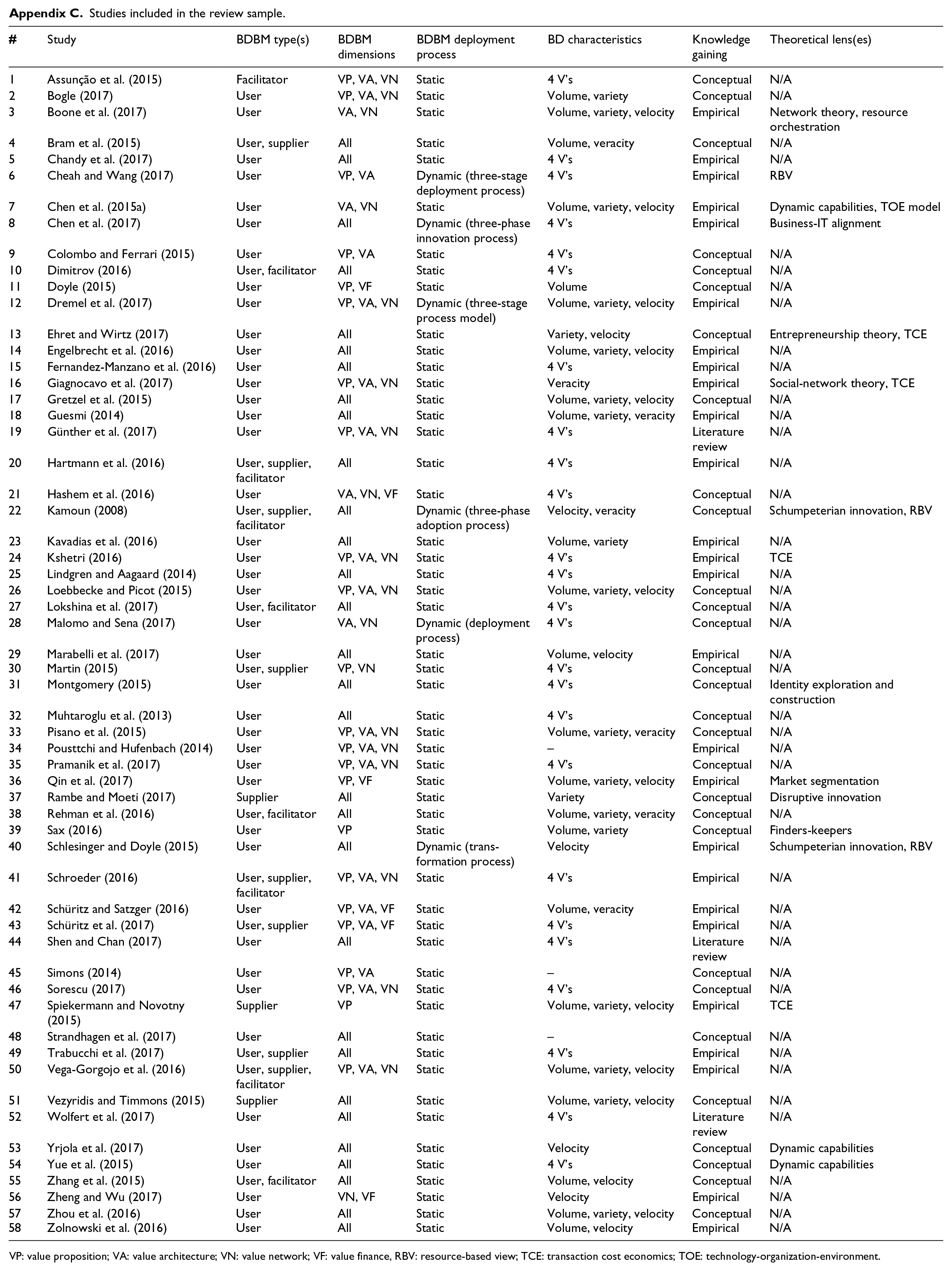
|
|
Study | BDBM type(s) | BDBM dimensions | BDBM deployment process | BD characteristics | Knowledge gaining | Theoretical lens(es) |
|---|---|---|---|---|---|---|---|
| 1 | Assunção et al. (2015) | Facilitator | VP, VA, VN | Static | 4 V’s | Conceptual | N/A |
| 2 | Bogle (2017) | User | VP, VA, VN | Static | Volume, variety | Conceptual | N/A |
| 3 | Boone et al. (2017) | User | VA, VN | Static | Volume, variety, velocity | Empirical | Network theory, resource orchestration |
| 4 | Bram et al. (2015) | User, supplier | All | Static | Volume, veracity | Conceptual | N/A |
| 5 | Chandy et al. (2017) | User | All | Static | 4 V’s | Empirical | N/A |
| 6 | Cheah and Wang (2017) | User | VP, VA | Dynamic (three-stage deployment process) | 4 V’s | Empirical | RBV |
| 7 | Chen et al. (2015a) | User | VA, VN | Static | Volume, variety, velocity | Empirical | Dynamic capabilities, TOE model |
| 8 | Chen et al. (2017) | User | All | Dynamic (three-phase innovation process) | 4 V’s | Empirical | Business-IT alignment |
| 9 | Colombo and Ferrari (2015) | User | VP, VA | Static | 4 V’s | Conceptual | N/A |
| 10 | Dimitrov (2016) | User, facilitator | All | Static | 4 V’s | Conceptual | N/A |
| 11 | Doyle (2015) | User | VP, VF | Static | Volume | Conceptual | N/A |
| 12 | Dremel et al. (2017) | User | VP, VA, VN | Dynamic (three-stage process model) | Volume, variety, velocity | Empirical | N/A |
| 13 | Ehret and Wirtz (2017) | User | All | Static | Variety, velocity | Conceptual | Entrepreneurship theory, TCE |
| 14 | Engelbrecht et al. (2016) | User | All | Static | Volume, variety, velocity | Empirical | N/A |
| 15 | Fernandez-Manzano et al. (2016) | User | All | Static | 4 V’s | Empirical | N/A |
| 16 | Giagnocavo et al. (2017) | User | VP, VA, VN | Static | Veracity | Empirical | Social-network theory, TCE |
| 17 | Gretzel et al. (2015) | User | All | Static | Volume, variety, velocity | Conceptual | N/A |
| 18 | Guesmi (2014) | User | All | Static | Volume, variety, veracity | Empirical | N/A |
| 19 | Günther et al. (2017) | User | VP, VA, VN | Static | 4 V’s | Literature review | N/A |
| 20 | Hartmann et al. (2016) | User, supplier, facilitator | All | Static | 4 V’s | Empirical | N/A |
| 21 | Hashem et al. (2016) | User | VA, VN, VF | Static | 4 V’s | Conceptual | N/A |
| 22 | Kamoun (2008) | User, supplier, facilitator | All | Dynamic (three-phase adoption process) | Velocity, veracity | Conceptual | Schumpeterian innovation, RBV |
| 23 | Kavadias et al. (2016) | User | All | Static | Volume, variety | Empirical | N/A |
| 24 | Kshetri (2016) | User | VP, VA, VN | Static | 4 V’s | Empirical | TCE |
| 25 | Lindgren and Aagaard (2014) | User | All | Static | 4 V’s | Empirical | N/A |
| 26 | Loebbecke and Picot (2015) | User | VP, VA, VN | Static | Volume, variety, velocity | Conceptual | N/A |
| 27 | Lokshina et al. (2017) | User, facilitator | All | Static | 4 V’s | Conceptual | N/A |
| 28 | Malomo and Sena (2017) | User | VA, VN | Dynamic (deployment process) | 4 V’s | Conceptual | N/A |
| 29 | Marabelli et al. (2017) | User | All | Static | Volume, velocity | Empirical | N/A |
| 30 | Martin (2015) | User, supplier | VP, VN | Static | 4 V’s | Conceptual | N/A |
| 31 | Montgomery (2015) | User | All | Static | 4 V’s | Conceptual | Identity exploration and construction |
| 32 | Muhtaroglu et al. (2013) | User | All | Static | 4 V’s | Conceptual | N/A |
| 33 | Pisano et al. (2015) | User | VP, VA, VN | Static | Volume, variety, veracity | Conceptual | N/A |
| 34 | Pousttchi and Hufenbach (2014) | User | VP, VA, VN | Static | – | Empirical | N/A |
| 35 | Pramanik et al. (2017) | User | VP, VA, VN | Static | 4 V’s | Conceptual | N/A |
| 36 | Qin et al. (2017) | User | VP, VF | Static | Volume, variety, velocity | Empirical | Market segmentation |
| 37 | Rambe and Moeti (2017) | Supplier | All | Static | Variety | Conceptual | Disruptive innovation |
| 38 | Rehman et al. (2016) | User, facilitator | All | Static | Volume, variety, veracity | Conceptual | N/A |
| 39 | Sax (2016) | User | VP | Static | Volume, variety | Conceptual | Finders-keepers |
| 40 | Schlesinger and Doyle (2015) | User | All | Dynamic (trans-formation process) | Velocity | Empirical | Schumpeterian innovation, RBV |
| 41 | Schroeder (2016) | User, supplier, facilitator | VP, VA, VN | Static | 4 V’s | Empirical | N/A |
| 42 | Schüritz and Satzger (2016) | User | VP, VA, VF | Static | Volume, veracity | Empirical | N/A |
| 43 | Schüritz et al. (2017) | User, supplier | VP, VA, VF | Static | 4 V’s | Empirical | N/A |
| 44 | Shen and Chan (2017) | User | All | Static | 4 V’s | Literature review | N/A |
| 45 | Simons (2014) | User | VP, VA | Static | – | Conceptual | N/A |
| 46 | Sorescu (2017) | User | VP, VA, VN | Static | 4 V’s | Conceptual | N/A |
| 47 | Spiekermann and Novotny (2015) | Supplier | VP | Static | Volume, variety, velocity | Empirical | TCE |
| 48 | Strandhagen et al. (2017) | User | All | Static | – | Conceptual | N/A |
| 49 | Trabucchi et al. (2017) | User, supplier | All | Static | 4 V’s | Empirical | N/A |
| 50 | Vega-Gorgojo et al. (2016) | User, supplier, facilitator | VP, VA, VN | Static | Volume, variety, velocity | Empirical | N/A |
| 51 | Vezyridis and Timmons (2015) | Supplier | All | Static | Volume, variety, velocity | Conceptual | N/A |
| 52 | Wolfert et al. (2017) | User | All | Static | 4 V’s | Literature review | N/A |
| 53 | Yrjola et al. (2017) | User | All | Static | Velocity | Conceptual | Dynamic capabilities |
| 54 | Yue et al. (2015) | User | All | Static | 4 V’s | Conceptual | Dynamic capabilities |
| 55 | Zhang et al. (2015) | User, facilitator | All | Static | Volume, velocity | Conceptual | N/A |
| 56 | Zheng and Wu (2017) | User | VN, VF | Static | Velocity | Empirical | N/A |
| 57 | Zhou et al. (2016) | User | All | Static | Volume, variety, velocity | Conceptual | N/A |
| 58 | Zolnowski et al. (2016) | User | All | Static | Volume, velocity | Empirical | N/A |
VP: value proposition; VA: value architecture; VN: value network; VF: value finance, RBV: resource-based view; TCE: transaction cost economics; TOE: technology-organization-environment.
Declaration of conflicting interests
The author(s) declared no potential conflicts of interest with respect to the research, authorship, and/or publication of this article.
Funding
The author(s) disclosed receipt of the following financial support for the research, authorship, and/or publication of this article: Financial support from Bentley University’s Data Innovation Network (BDIN) is gratefully acknowledged.
