







Abstract
Enterprise information systems (IS) research has long emphasized the value of deep alignment between IS and the business contexts they serve. Yet this premise becomes increasingly problematic as enterprises operate across heterogeneous contexts whose structures, demands, and operating logics differ not only in degree but in kind. Under such conditions, deeper embedding in one context may weaken transferability, reconfigurability, and coherence across others. To address this tension and theorize the future of IS in the enterprise, we develop a process model of adaptive digital transformation (DT) and, from the insights it generates, introduce context-transcendent IS as a new paradigm for enterprise IS under conditions of contextual heterogeneity. Empirically, the paper draws on an in-depth case study of Geely, a multinational automotive enterprise confronting growing heterogeneity across brands, markets, and operations. We show how Geely responded through three recursively linked IT governance practices enacted across three stages of adaptive DT: synchronizing in value anchoring, recombining in capability orchestration, and diversifying in asset platformization. Together, these practices enabled the emergence of context-transcending IS and, ultimately, a more durable context-transcendent IS form. The study makes two contributions. First, it problematizes the conventional embedding premise in enterprise IS research by identifying contextual heterogeneity as a distinct source of enterprise-level tension. Second, it develops context-transcendent IS as a theoretically distinct and increasingly necessary form of enterprise IS for the future enterprise under sustained conditions of contextual heterogeneity in the operating landscapes.
Keywords
Introduction
Information systems (IS) have become the foundational infrastructure of the modern enterprise. Beyond technical utilities, they function as organic systems that weave together malleable IT artifacts, human actors, and organizational processes (Allen and Varga, 2006; Chatterjee et al., 2021), structurally shaping how value is defined, created, and delivered within their operating environment (Bharadwaj et al., 2013a; Morgan et al., 2013). Over the past two decades, the IS literature has increasingly converged on a foundational premise underlying this value-shaping role: The effectiveness of IS in enterprise is contingent on how well they are embedded within specific business contexts in which they are deployed, for example, aligning with task requirements, adapting to institutional logics, and becoming entangled with the social practices of a given business situation (Leonardi, 2011; Volkoff and Strong, 2013). This embedding premise, however, carries a critical blind spot: it assumes that context is a stable, predefined operating condition to which IS can be integrated. Consequently, while the extant literature explains how IS creates value within predefined contexts, it offers limited insights into how IS accommodates diverse contexts and generates value across emerging contexts that are fundamentally incommensurable. As modern enterprises increasingly operate across business units and markets shaped by fundamentally distinct value creation logics and institutional demands (e.g., Ashrafi et al. (2025)), addressing this blind spot becomes not only a pressing theoretical imperative but also a defining challenge for the design, deployment, and theorization of IS in the coming decade.
As a constitutive condition, business context is not merely a backdrop to IS development and deployment, but an evolving configuration of value imperatives, relational arrangements, and dynamic pressures that shapes what IS can meaningfully provide in a given setting (Avgerou, 2019; Orlikowski and Iacono, 2001). When such contexts differ fundamentally across business units and markets, embedding IS into each in isolation generates structural tensions: configurations optimized for one context resist integration with others, shared digital capabilities remain underdeveloped, and locally created value cannot be redeployed where it is most needed. These tensions are inherent to an IS logic that treats contextual conditions as locally bounded rather than mutually constitutive. Under these conditions, standardization, as a traditional response to cross-unit IS complexity (Davenport, 1998, 2000), often exacerbates rather than resolves the problem by suppressing contextual variation, accumulating architectural debt, and deepening sociotechnical misalignment across sites (Rinta-Kahila et al., 2023). Indeed, practitioner accounts confirm that enterprises remain caught in such cycles because generic embedding logics are ill-suited to context-specific value creation (Nieto-Rodriguez, 2026; Rigby and First, 2026). The core issue, therefore, is not implementation friction manageable through improved embedding, but a structural condition that necessitates a fundamentally different understanding of how IS relates to context.
In this article, we argue that addressing this structural condition requires a paradigmatic shift from embedding-based IS to what we term context-transcendent IS. Where embedding presupposes one-sided adaptation between IS and context, context-transcendent IS is governed by a logic of mutual constitution and generative transcendence, through which IT artifacts, people, and organizational processes are recursively reconfigured across heterogeneous contexts, allowing IS not merely to enact existing value creation logics but to generate new ones that are unattainable within any single context in isolation. To develop and ground this argument, we turn to digital transformation as our empirical domain. Digital transformation (DT), understood as the organizational process through which enterprises fundamentally re-conceive how IS, people, and processes are configured and evolved in response to shifting contexts (Vial, 2019; Wessel et al., 2021), represents a consequential contemporary arena in which the limitations of embedding-based IS become visible and the generative potential of context-transcendent IS can be theorized and observed.
How DT unfolds reflects how enterprises conceptualize the IS-context relationship, and it is where the limits of embedding-based IS become visible. Existing IS research points to two dominant DT pathways, each grounded in a distinct embedding logic. Business-driven DT follows an outside-in logic, actively aligning IS with strategic priorities and local business needs, but in doing so often privileges context-specific value imperatives at the expense of shared digital capabilities and cross-unit coordination. By contrast, IT-driven DT follows an inside-out logic, leveraging advanced IT artifacts to reshape business processes and value propositions, but this places heavy demands on business units’ sensemaking as they translate generic capabilities into locally meaningful action. Despite their differences, both pathways rest on a one-sided logic of conformity: either IS adapts to context or context adapts to IS. As this logic becomes untenable under contextual heterogeneity due to its structural limitations, enterprises instead require a paradigm in which IS and context continuously reshape one another across heterogeneous settings.
Against this backdrop, this study asks: how do enterprises enact digital transformation across heterogeneous business contexts, and what does this paradigm imply for the future of IS in the enterprise? To address these questions, we conducted an in-depth longitudinal case study of Geely, a Fortune 500 automobile manufacturer. By the late 2010s, Geely’s rapid expansion, from a single domestic brand to a portfolio of eleven marques spanning Volvo, Lotus, Lynk & Co, Zeekr, and others, had outpaced the information systems that once unified its operations. Each newly acquired or incubated brand brought its own market logic, regulatory environment, and customer expectations, yet the enterprise continued to rely on IS architectures originally designed for a single domestic automaker. The breaking point came when leadership recognized that systems tightly embedded in one brand’s context could not be reconfigured fast enough to serve another’s: what worked for Volvo’s premium European customers actively constrained Zeekr’s agile, digitally native go-to-market in China. Confronted with these limits, Geely restructured its IT department in 2021 into a Digitalization Center charged with orchestrating digital transformation across all brands simultaneously, making the enterprise an especially revealing setting for examining how organizations enact adaptive DT under conditions of contextual heterogeneity.
The study makes two related theoretical contributions. First, it develops a process model of adaptive DT that explains how enterprises sustain productive tension between business-driven responsiveness and IT-driven generativity across heterogeneous contexts. Second, based on the insights from adaptive DT, we further theorized the future of IS in the enterprise by advancing the concept of context-transcendent IS, specifying its defining dimensions, and showing how IS, people, and heterogeneous business contexts are mutually constituted as a trend of IS for future enterprise. For practice, the study offers guidance to senior leaders seeking to enact DT more adaptively amid contextual heterogeneity.
Literature review
IS in the enterprise: The embedding premise and emerging challenges
The nature of the contemporary enterprise is undergoing a profound transformation as digital technologies reshape the sociotechnical environments in which organizations operate (Grover and Lyytinen, 2023; Ignatiadis & Nandhakumar, 2007). Rather than merely automating existing processes, these technologies engender new sociotechnical configurations that transform how value is created, which actors participate in that process, and the organizational arrangements through which it is delivered (Hinings et al., 2018; Packard and Clark, 2020). This reconfiguration renders the IS application context a consequential theoretical object: not a neutral backdrop to organizational action, but an open and evolving configuration of value imperatives, relational arrangements, and dynamic pressures that jointly condition what IS can meaningfully provide within a given business situation (Orlikowski and Iacono, 2001; Tan et al., 2020).
The relationship between IS and the contexts in which they operate has evolved significantly over the last two decades. Early IS research conceptualized IS in the enterprise as context-independent tools: rational instruments evaluated primarily on their technical functionality and information-processing efficiency, with context treated as an external condition to be controlled rather than a constitutive force to be theorized in IS use (Markus and Robey, 1988; Orlikowski and Iacono, 2001). IS value was accordingly understood as intrinsic to the technical features of the system itself, that is, a well-designed and satisfactorily implemented system would deliver predictable returns regardless of the specific users, organizational situations, or value imperatives it encountered (DeLone and McLean, 2003; Goodhue and Thompson, 1995).
A decisive theoretical shift occurred from the late 2000s onward as IS research moved away from treating systems as context-independent utilities toward recognizing context as the medium through which IS value is defined and realized. The foundational insight is that IS properties are not fixed in initial design but emerge through recurrent, situated interactions among human actors, technological artifacts, and institutional arrangements, making what IS does and what value it generates irreducibly context-dependent (Orlikowski, 2000; Volkoff and Strong, 2013). At the enterprise level, this embedding premise carries three implications for theorizing IS in the enterprise. First, the IS value is defined and redefined iteratively within business contexts rather than predefined outside them, as organizational sensemaking rooted in core business contexts determines which IS capabilities become meaningful and which remain latent (Mueller et al., 2025; Tan et al., 2020). Second, embedding is generative rather than neutral: once IS becomes entangled with local arrangements, it privileges certain value creation paths over others, generating path dependencies that make subsequent reconfiguration increasingly difficult (Rolland et al., 2018). Third, IS-context fit is inherently temporal: as business contexts evolve, IS deployments that cannot accommodate ongoing reconfiguration become progressively misaligned, which incurs additional coordination efforts for IS-business alignment (Aral et al., 2024).
Grounded in the embedding premise that IS creates value through a deep alignment with the business contexts it serves, enterprise IS research has moved beyond static system views toward a more dynamic understanding of IS. This premise has been highly productive because it explains why IS value is not inscribed in design alone, but constituted through ongoing alignment between IS and business contexts. Complex adaptive systems (CASs) research, exemplified by Nan’s model of bottom-up IT use (Nan, 2011), extends this view by showing that IS features are emergent rather than linearly determined, arising from recurrent interactions among agents within an environment. From this perspective, enterprise IS is dynamic, multilevel, and interaction-driven, while context primarily enters as a structure that shapes how actions and interactions unfold. Similarly, the digital infrastructure literature shows that these dynamics do not remain episodic or localized, but become sedimented in evolving sociotechnical arrangements of interdependent technologies, processes, and organizational controls (Hanseth and Lyytinen, 2010; Tilson et al., 2010). The enterprise problem is thus recast from designing fit-for-purpose systems to governing ongoing infrastructural evolution as interdependencies accumulate and become increasingly generative, interconnected, and path dependent.
This study builds on these traditions, but shifts the analytical focus to a more specific enterprise IS tension. Enterprise IS research has largely been grounded in the embedding premise that IS creates value through deep alignment with the business contexts it serves, and has accordingly moved beyond static system views toward a more dynamic understanding of the IS-context relationship. Yet in both CAS and digital infrastructure research, context is treated mainly as the environment within which enterprise IS evolves, rather than as the central problem to be theorized. Drawing on Chatterjee and Davison (2021)’s problematization approach, we revisit a more basic assumption embedded in the literature: that deeper IS embedding within a focal context is generally conducive to alignment and value creation. We argue that this premise becomes limited under conditions of contextual heterogeneity. When business contexts differ substantially in structures, demands, and operating logics, deeper embedding in one context may come at the expense of transferability, reconfigurability, and coherence across others. Contextual heterogeneity, therefore, offers a sharper point of departure because it directs attention to the conditions under which the IS-context relationship itself becomes a source of enterprise-level tension.
Our review of recent literature on IS deployment and value creation suggests that three forms of heterogeneity are especially consequential. First, structural heterogeneity arises as increasingly interconnected digital infrastructures make configurations optimized for one setting resistant to integration with others, thereby intensifying tensions between local responsiveness and enterprise-wide coherence (Hanseth and Modol, 2021). Second, institutional heterogeneity emerges when enterprises operate across distinct regulatory and normative environments, such that the same embedding logic that enables value creation in one setting may undermine legitimacy in another (Lok, 2010). Third, temporal heterogeneity becomes salient as AI-enabled IS continuously learns from real-world data and updates its parameters, progressively reshaping the very context it was introduced to serve (Benbya et al., 2024). Taken together, these conditions render embedding not merely insufficient, but increasingly self-undermining as a dominant logic of enterprise IS design and deployment.
In other words, enterprises no longer need IS that simply fits individual contexts; rather, they need IS that is capable of continuously transcending contextual boundaries to enable value creation and delivery across heterogeneous settings. We term this new paradigm context-transcendent IS and argue that realizing it requires a fundamentally different logic for coordinating IT artifacts, people, and organizational processes in the evolution of IS. DT, as an enterprise-level process through which organizations reconfigure and continuously reshape these elements in response to shifting contexts (Vial, 2019; Wessel et al., 2021), provides the most consequential setting in which this shift becomes visible. As DT makes observable the ways in which IS and context recurrently reshape one another through ongoing reconfiguration, it offers a natural empirical terrain for examining and theorizing context-transcendent IS. We turn next to the prevailing paradigms of DT.
How IS was deployed: Existing paradigms of digital transformation
DT represents a fundamental shift in how organizations engage with IS, which are strategic and involve redefining what an organization offers and how it operates (Vial, 2019). Enabled by the emerging technologies, DT unlocks new opportunities, fostering new models of stakeholder engagement and user involvement in value co-creation (Tilson et al., 2010; Yoo et al., 2010). The cumulative body of work on DT has identified two major paradigms:
The business-driven perspective conceptualizes DT as a strategic and organizational transformation oriented toward redesigning business models, processes, and capabilities to enhance organizational competitiveness (Uhl and Gollenia, 2014). It follows an outside-in logic in which business needs and strategic priorities shape the development and deployment of information systems (Westerman et al., 2014), positioning DT as a vehicle for strategic renewal through managerial orchestration and deliberate planning. Within this view, IT is treated primarily as a strategic enabler that supports competitive positioning by delivering digital solutions aligned with business objectives (Morton et al., 2022). Accordingly, DT is expected to unfold through formal planning, structured change programs, and alignment mechanisms that connect digital initiatives to predefined business strategies (Hess et al., 2016). Hence, conventional wisdom positions business-driven DT as the dominant and most reliable pathway to organizational adaptiveness, grounded in the assumption that business units possess superior contextual knowledge because they are closest to market demands, customer expectations, and competitive pressures (Matt et al., 2015; Sambamurthy et al., 2003).
Business-driven DT becomes increasingly problematic under conditions of contextual heterogeneity. Its outside-in logic assumes that transformation objectives can be specified ex ante, IS can be designed around predefined plans, and outcomes can unfold in a predictable, sequential manner. This assumption breaks down where heterogeneity is most pronounced. Rigid planning cycles cannot accommodate the divergent value imperatives of different business units (Tallon and Pinsonneault, 2011), predefined alignment mechanisms struggle to keep pace with shifting institutional demands across markets (Boh et al., 2023; Liang et al., 2017), and business leaders often lack the expertise to recognize and evaluate the technological affordances that heterogeneous contexts render salient (Hsu et al., 2018). As AI systems become increasingly opaque across such conditions, this capability gap widens further, making formal alignment between business ambitions and IS capabilities progressively more fragile (Berente et al., 2021; Lebovitz et al., 2022).
IT-driven DT offers a contrasting logic in which digital capabilities, rather than predefined business objectives, become the primary force reshaping value propositions, business models, and organizational arrangements (Besson and Rowe, 2012; El Sawy and Pavlou, 2008). This inside-out orientation foregrounds the generativity of digital infrastructure and the ongoing recombination of capabilities, enabling IS to be reconfigured rapidly across contexts and opening innovation trajectories that business-driven planning could neither foresee nor direct (Bharadwaj et al., 2013a; Mikalef et al., 2020). By loosening the grip of locally dominant business preferences, IT-driven DT enables organizations to identify overlooked opportunities, experiment at scale, and pursue more radical forms of innovation under dynamic conditions (Ismail et al., 2017; Tan et al., 2009). Its distinctive strength amid contextual heterogeneity lies precisely in this cross-context generativity: rather than optimizing IS for a single setting, it leverages generative digital infrastructure to create value across heterogeneous contexts.
Yet IT-driven DT has its own structural limit under contextual heterogeneity. It’s inside-out logic, though generative across contexts, shifts the burden of interpretation and absorption onto business units, making outcomes difficult to predict ex ante (Bharadwaj and Dong, 2013; Kaganer et al., 2023). This challenge becomes even more pronounced when reusable digital capabilities extend to ecosystem partners, where differences in priorities, interpretive frames, and complementary resources make cross-context translation even less certain (Benbya et al., 2020). The result is a central paradox: the same generativity that enables rapid recombination across contexts can, without sufficient coordination and architectural ordering, produce fragmented architectures and isolated solutions that fail to consolidate into business value (Hanelt et al., 2021).
Our review of existing DT paradigms reveals a shared theoretical limitation: both reproduce the embedding premise in different forms. Business-driven DT subordinates IS to a strategically defined context, whereas IT-driven DT subordinates context to technologically defined possibilities. In both, the relationship among people, IT artifacts, and context remains one of one-sided conformity rather than mutual constitution, rendering each paradigm structurally inadequate in the face of contextual heterogeneity. Business-driven DT fragments the shared digital capabilities required for cross-context coordination; IT-driven DT generates capabilities that business units often cannot interpret, govern, or translate into locally meaningful value. Neither resolves these tensions, and their coexistence without a coordinating logic often reproduces them. What is required instead is a paradigm in which people, IT artifacts, and organizational processes are continuously reconfigured across heterogeneous contexts through the dynamic orchestration of business-driven responsiveness and IT-driven generativity. We term this
To explore adaptive DT as a new paradigm, a theoretical perspective is needed to illuminate how it unfolds in practice. Because our interest in DT lies in the organizing structures and implementation processes surrounding IT-based activities, an IT governance perspective provides a particularly valuable lens as it focuses on how organizations design, coordinate, and oversee IT-related decisions and actions to ensure that smooth value creation from IT activities (Tiwana et al., 2014; Wu et al., 2015). Given that the central challenge of adaptive DT concerns the governance of direction, integration, and alignment, we adopt this lens as a “sensitizing device” (Weick, 2007: p. 16) to guide an inquiry into how adaptive DT processes unfold under contextual heterogeneity.
Theoretical foundation: IT governance theory
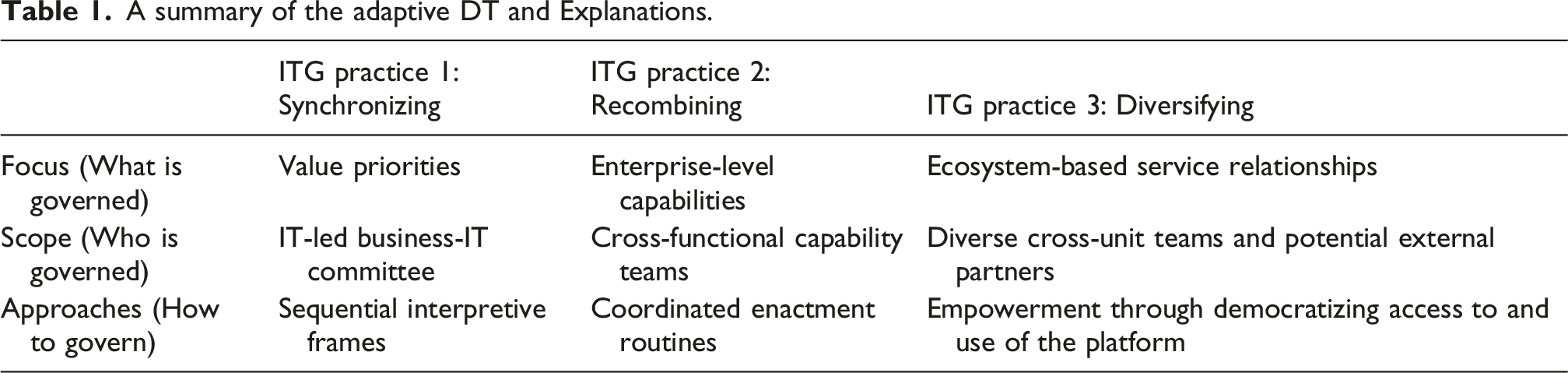
IT governance (ITG) refers to the organizational arrangements through which enterprises direct IS deployment toward strategic objectives, assign accountability for technology-related decisions, and realize business value through cost efficiency, asset utilization, and organizational flexibility (Tiwana et al., 2014; Weill and Ross, 2004). ITG is therefore not a fixed administrative structure, but a contingent organizational logic: effective governance depends on aligning decision rights and accountability structures with strategic priorities while continuously adapting them to technological complexity and shifting organizational conditions (Weill and Ross, 2004; Xue et al., 2008, 2021). To map this broad lens, this study draws on (Gregory et al., 2018) three-dimensional framework, which specifies: (1) the focus of governance: the governance objects, or the IT artifacts and activities that require oversight; (2) the scope of governance: the actors and organizational units involved in exercising decision rights and responsibilities; and (3) the approaches to governance: the mechanisms through which IT-related decisions are coordinated and enacted.
Over the past three decades, the focal concerns of IT governance have undergone a substantive evolution. In the 1990s and early 2000s, research and practice centered primarily on IT investment decisions, emphasizing how organizations could justify, allocate, and measure the returns of technology expenditures (Sambamurthy and Zmud, 1999). During the 2000s through the mid-2010s, attention shifted toward IT infrastructure and IT-business relationships, reflecting the growing importance of enterprise-wide architectures, integration capabilities, and alignment processes needed to support increasingly complex business operations. Since roughly 2015, the rise of pervasive digital technologies, cloud services, analytics, and platforms has redirected focus toward decentralized IT use and platform governance, highlighting distributed innovation, local experimentation, and the orchestration of digital resources in multi-actor environments (Tiwana and Kim, 2015). This trajectory illustrates how IT evolved from a budgeted organizational resource to a strategic asset that shapes how enterprises operate and compete.
IT governance archetypes vary along a centralization–decentralization spectrum, each allocating decision rights in distinct ways. At the centralized end, a business monarchy vests authority in senior business executives, often through executive committees that include, but are not dominated by, the CIO, thereby supporting strong strategic alignment and value realization in transformation contexts (Gerth and Peppard, 2016; Lowry et al., 2025). An IT monarchy, by contrast, concentrates decision rights within IT leadership, leveraging technical expertise to coordinate architecture and integration, though it risks becoming detached from enterprise strategy when technology trajectories diverge (Lorenz and Buchwald, 2023). Between these poles, federal configurations and IT duopolies distribute decision authority across corporate executives, business units, and IT leaders, balancing enterprise-wide standardization with local responsiveness; however, their collaborative structures are difficult to operationalize due to conflicting incentives and the need for robust coordination mechanisms (Brown and Grant, 2005). Toward the decentralized end, feudal governance grants local units’ autonomy over IT decisions, supporting responsiveness but often undermining enterprise coherence and cross-unit synergies. At the extreme, anarchy disperses decision rights to individual actors, enabling rapid action but sacrificing coordination, and is generally tolerated only in exceptional circumstances requiring ultra-fast responsiveness (Salameh and Bass, 2022).
The approaches to IT governance, in turn, are underpinned by a coordinated system of structural, processual, and relational mechanisms (Wu et al., 2015). These mechanisms collectively shape how IT decisions are made, enacted, and enforced across the organization, facilitating the deployment of decision-making structure, alignment processes, and communication approaches (Gregory et al., 2018; Weill and Ross, 2004).
While each mechanism provides distinct contributions, their effectiveness ultimately depends on how well they operate in an integrated and complementary manner (Buchwald et al., 2014). Such coordinated integration within a coherent governance configuration (Tiwana and Konsynski, 2010; Turel and Bart, 2014), forms a critical antecedent shaping the success of digital transformation initiatives. Therefore, adopting an IT governance lens enables an examination of the strategic direction, control, and flexibility required for enacting DT (Mulyana et al., 2021), and thus guiding this study’s investigation into how existing DT approaches can be reconfigured innovatively to achieve adaptive DT and enable the development of the context-transcendent IS for future enterprises to grow and thrive under contextual heterogeneity.
Research method
The case study approach was selected as it provides rich empirical descriptions of phenomenon-driven instances (Walsham, 1995), and is particularly suited for studying the unfolding processes (Urquhart et al., 2010) associated with adaptive DT. This approach allows the inductive development of theoretical insights while preserving the sociotechnical complexity of the phenomenon under investigation (Strong and Volkoff, 2010). It is therefore appropriate for theorizing underexplored phenomena situated in novel empirical settings, such as the enactment of adaptive DT under contextual heterogeneity, which diverges from the conventional IS research in which DT has been predominantly examined in business and IT-driven paradigms (Davison and Martinsons, 2016).
To investigate the phenomenon of adaptive DT, we established two criteria to guide case selection. First, the case should illustrate an adaptive approach to DT that enabled the creation of the IS that can be rapidly reconfigured across a heterogeneity of business contexts, such as technological discontinuities, market shifts, or rapid changes in the logic of value creation. This criterion ensures that the case reflects conditions of contextual heterogeneity, which is expected to characterize the competitive landscape for the future enterprise (Winter et al., 2024). Second, the case must provide evidence of successful DT outcomes, demonstrated through the effective implementation of governance mechanisms that reshape DT value creation for the enterprise. This enables the examination of ITG mechanisms that contribute to success. By theorizing from such a case, we ground our insights in proven practices, enhancing both the theoretical and practical significance of the study (Xiao et al., 2021).
Geely Automotive Group (hereafter “Geely”) was selected because it aligns closely with the established case selection criteria. First, Geely is a major player in China’s automotive sector and a leading domestic automaker with rapid international expansion. Since acquiring Volvo Cars in 2010, Geely has continuously expanded its brand portfolio to include 11 major automotive brands, such as Lynk & Co, Geometry, and Zeekr. It has also formed strategic partnerships with international manufacturers, including Proton and Lotus. This extensive expansion across product lines and geographic markets has generated significant contextual heterogeneity, making its DT both critical and challenging. During this time, the automotive industry has been undergoing profound technological shifts, including the rise of electrification, autonomous driving, and software-defined vehicles. In response to these shifts, Geely launched a different DT pathway, restructuring its IT department in 2021 into a Digitalization Center, supported by the Digital Service Sharing Center that leads DT initiatives across all brands. The enterprise has since demonstrated substantial DT achievements, including the deployment of cloud computing, Internet of Things infrastructure, big data analytics capabilities, and active exploration of AI solutions to strengthen its competitive positioning and operational efficiency. Given its novel DT approach and proven ability to deliver large-scale digital initiatives amid rapid expansion, multi-brand coordination, and enterprise-level restructuring that intensifies the heterogeneity of its information systems landscape, Geely represents an “extreme” case (Gerring, 2008: p. 653) that fulfills our selection criteria and provides rich insights for our investigation.
Data collection
The data collection process unfolded in two phases. The initial preparation phase, from July to August 2024, involved gathering secondary data to prepare the research team for fieldwork. This phase included collecting organizational documents from Geely’s official website, industry reports, and news articles (Gioia et al., 2013). The secondary data provided essential background information and informed the development of our interview protocol and questionnaire (Eisenhardt, 1989; Pan and Tan, 2011).
The primary data collection took place in September 2024 at Geely’s headquarters in China, involving a team of five researchers. The involvement of multiple researchers enabled the triangulation of observations and interpretations (Klein and Myers, 1999). This phase employed semi-structured interviews with informants from business units of the Digitalization Center and Digital Service Sharing Center, who have led and experienced Geely’s DT. Informants were identified through chain referral sampling based on a preliminary set of interview questions sent to a designated gatekeeper (Pan and Tan, 2011). This sampling strategy was appropriate given that the research team had no prior access to internal information to identify suitable informants directly.
Following the interview protocol developed in the preparatory phase (see Appendix A for the sample protocol), we asked standardized core questions about Geely’s digital transformation strategies, evaluations of these strategies, and the challenges encountered in the adaptive DT process. Additional questions were tailored to each informant’s role. For instance, senior management informants were asked about the formation of adaptive DT strategies, while first-line managers were interviewed about the execution and implementation of the ITG mechanisms. On average, interviews took around 60 minutes and were audio-recorded and transcribed for analysis and concept framing (Pan and Tan, 2011).
After data collection, each research team member independently analyzed the data and exchanged notes to ensure consistency in interpretation (Klein and Myers, 1999). In total, 21 informants were interviewed. Among them, 10 were senior management executives responsible for formulating and governing DT strategies, while 11 were first-line managers responsible for strategy execution and implementing governance mechanisms within their respective business units. Appendix B provides a detailed list of the informants.
Data analysis
Since our research aims to understand how adaptive DT is achieved, we employed narrative and visual mapping strategies as an initial step in analyzing the raw data (Langley, 1999). The narrative strategy involved constructing a story that provides contextual details of the adaptive DT phenomenon using “thick description” (Langley, 1999: p. 695). Meanwhile, the visual mapping strategy involved creating chronological event timelines and diagrammatic sketches to capture and document our emergent theoretical ideas. These initial sketches facilitated the organization of rich interview data by illustrating relationships between concepts at a higher level of abstraction, thereby enhancing the validity of our data interpretation and laying the foundation for theory development (Klein and Myers, 1999). After constructing the narrative and visual maps, we verified them with relevant informants and revised them as needed based on additional data. This process ensured the validity of both our interpretations of the informants’ accounts and the emerging theory (Pan and Tan, 2011).
Based on our initial process mapping, we adopted grounded theory techniques to code our data using open, axial, and selective coding (Strauss and Corbin, 1998). In the open coding, we focused on identifying and assigning descriptive labels derived directly from the data to form first-order concepts (Gioia et al., 2013). We delineated these labels from our data excerpts and conducted comparisons at the conceptual level (Corbin and Strauss, 2014). We sought to preserve the informants’ terms to ensure a truthful interpretation of the labels. Therefore, some labels were directly taken from the informant’s words, including “massive IT investments of 1000 projects per year across the whole corporation,” “anchor IT projects on driving business value creation,” and “business value network.” When a new data segment was conceptually similar to a previously coded label, we retained the same concept label to maintain consistency (Corbin and Strauss, 2014). As a result, our opening coding identified a total of 40 first-order concepts.
Axial coding was then used to relate the first-order concepts to a number of second-order themes (Gioia et al., 2013), we first applied axial coding to establish relationships between concepts (Strauss and Corbin, 1998), allowing us to describe and explain conditions, actions, interactions, and consequences of our investigated phenomenon (Strauss and Corbin, 1998). For example, concepts such as “massive IT investments of 1000 projects per year across the entire corporation” and “disconnected resource allocation between business and IT” were coded as “contextual pressures” because they capture the scale, fragmentation, and coordination demands that pressure IT governance and alignment within DT. In this process, we placed particular emphasis on concepts emerging from our data that were underdeveloped in existing literature or existing concepts that stood out beyond their original studied context (Gioia et al., 2013). For example, the second-order theme of “value anchoring” was derived from concepts such as “align business opportunities with IT capabilities for potential value realization” and “anchor IT projects on driving business value creation.” This theme reflects Geely’s approach to managing digital transformation through an IT-polycentric governance logic, requiring a joint force between IT and business to define how value is conceptualized and to determine the potential value contribution of IT initiatives and projects, a gap that remains underexplored in the existing DT literature. As a result of axial coding, we identified a total of 10 second-order themes.
Finally, through selective coding, we further examined the data to integrate and refine our first-order concepts and second-order themes. When data challenged previously identified concepts or themes, we revised the coding schema by adding, removing, or modifying codes as needed. In cases of disagreement within the research team, we revisited the data and resolved inconsistencies by refining theme names, discarding low-agreement themes, or breaking down complex themes until consensus was reached (Gioia et al., 2013). This stage distilled the findings into four aggregate dimensions (Gioia et al., 2013), extending our findings beyond descriptive accounts of the phenomenon and developing the theoretical conceptualization of adaptive DT.
As part of this process, we also iteratively compared our emerging concepts and themes with relevant literature to distinguish existing knowledge from novel insights (Corbin and Strauss, 2014). This iterative refinement shaped our coding structure until the theoretical saturation state was reached, where our inductively derived theory provided a comprehensive explanation of the investigated phenomenon, and further incremental learning became minimal due to established precedents in the existing literature (Eisenhardt, 1989; Gioia et al., 2013). These inductive iterations between theory and data gradually developed our theoretical framework, which is ultimately structured in our coding schema, as presented in Appendix C.
Findings
The Geely case reveals adaptive DT as a self-reinforcing cyclical process in which each cycle addresses the structural tensions imposed by contextual heterogeneity at a given moment, while generating the expanded capabilities and digital foundations that redefine the conditions of the next. Within each cycle, adaptive DT progresses through three interrelated stages: value anchoring, capability orchestration, and asset platformization. Each stage is underpinned by distinct IT governance practices that reconfigure the enterprise’s overall digital architecture, collectively reshaping how IS and people interact to sustain value creation across increasingly heterogeneous contexts. In what follows, we trace how each stage unfolds in Geely’s transformation (Figure 1 and Table 1). A process model of adaptive DT. A summary of the adaptive DT and Explanations.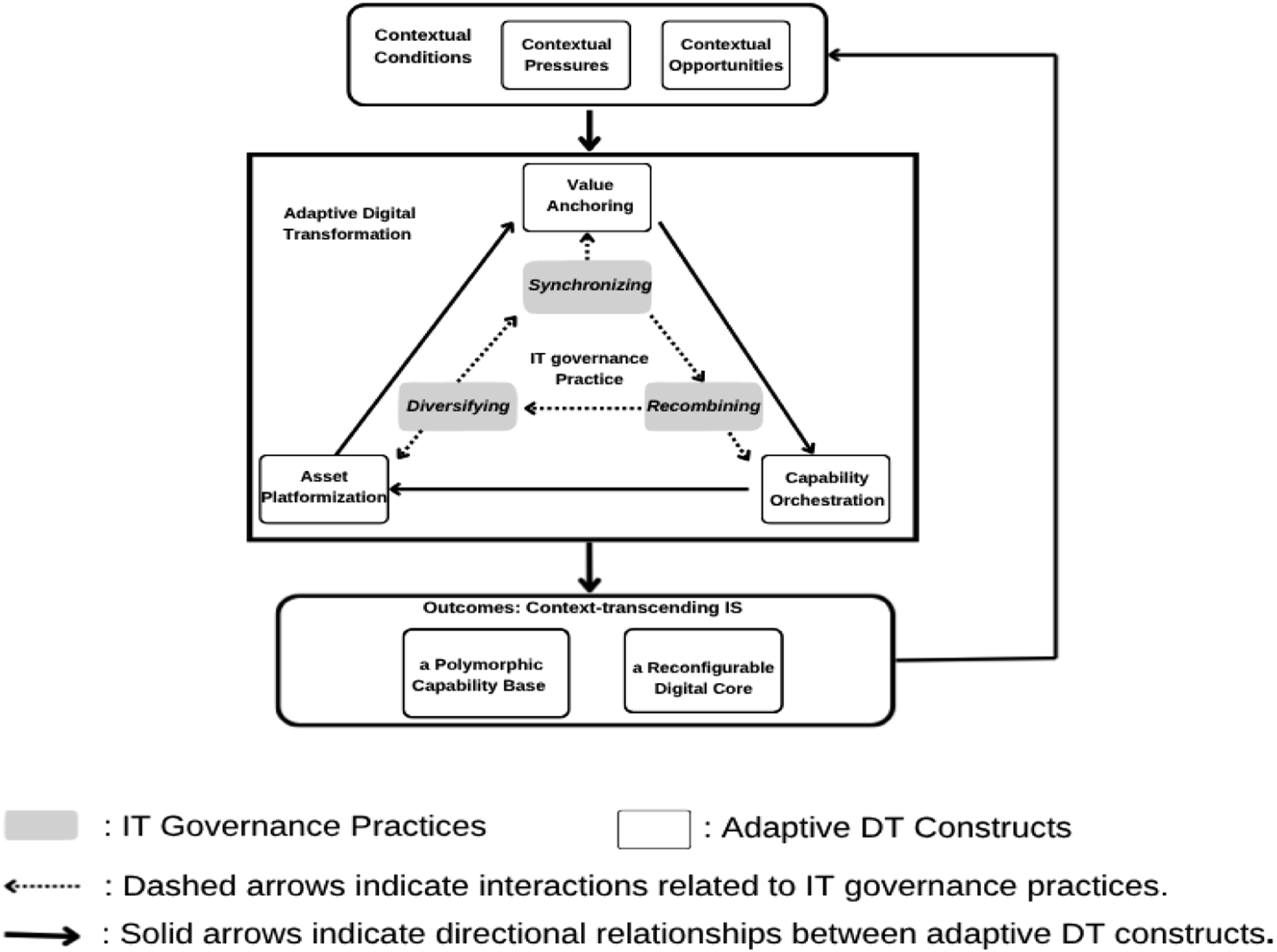
Triggers: Contextual pressures and opportunities from growing heterogeneity
Geely’s adaptive DT was precipitated by an escalating structural tension between its functionality-oriented enterprise architecture and growing contextual heterogeneity. From 2002 to 2015, rapid multi-brand expansion led to growing divergence among business units in operating logic, data standards, and value-creation processes. In response, Geely deployed standardization-oriented enterprise systems (e.g., mySAP ERP and SCADA) to enforce common processes and unified data structures. Although these systems stabilized early-stage operations, they institutionalized a process-centric architecture that became progressively misaligned with differentiated and evolving business requirements.
As product portfolio complexity deepened after 2015, this misalignment became acute. Despite sustained IT investment and an internal IT workforce exceeding 1400 employees, Geely remained unable to accommodate the scale and heterogeneity of business demands. The underlying constraint was structural: early governance arrangements premised on a vendor–client logic treated business needs as discrete, stable requests to be fulfilled by IT. As demands became increasingly context-specific, this logic fragmented coordination and reinforced an interpretive gap between IT and business departments, producing a vicious cycle of fragmented requests, an overloaded project pipeline, and progressively diminishing effectiveness in value creation. As the Chief Digitalization Director observed: “We were handling nearly 1000 projects per year in the automotive group alone, and despite having a 1000-person IT team, the business pressure was immense… Business doesn’t understand what IT can offer; the IT group doesn’t even understand business value…They have their own understanding, and they can always propose a functional requirement, but is it the most suitable one? Not necessarily, because he does not have a deep understanding of IT.”
These conditions constituted what we term
Yet the same heterogeneity revealed a countervailing dynamic. Operating across an extensive multi-brand portfolio, even marginal improvements in shared enterprise-level capabilities could generate disproportionately large gains when diffused across the entire organization for “We recruit nearly 30,000 people each year across highly diverse business units. The real opportunity is not in monitoring individual cases, but in improving the recruitment process itself. If we benchmark best practices across brands and units, identify where hiring cycles are shortest, candidate quality is highest, and onboarding is most effective, and then systematically transfer those capabilities across the portfolio, a single process improvement scaled across 30,000 hires can generate hundreds of millions in value.”
Recognizing these intertwined pressures and opportunities, Geely’s leaders concluded that incremental IT fixes were fundamentally inadequate. What was required was an enterprise-wide transformation capable of reconstituting the organization’s IT foundation and coevolving with shifting business contexts rather than merely responding to them. This recognition initiated the first cycle of adaptive DT, beginning with value anchoring: a deliberate process of reading the contextual pressures and opportunities generated by heterogeneous business demands and, on that basis, anchoring the direction of value creation that would orient subsequent IS-business interaction.
Phase 1 value anchoring: Addressing a structural misalignment
Geely’s first cycle of adaptive DT began with a structural misalignment that existing governance arrangements could not resolve. As business heterogeneity expanded, IT resources continued to be allocated through a vendor–client logic that treated business demands as discrete, stable requests to be fulfilled. IT leaders traced the root of this misalignment to a divergence in value orientation: business units defined value as rapid feature delivery, while the IT function recognized such accumulation as increasingly detached from enterprise-level needs. Feature delivery had become an intermediary that consumed IT resources without generating proportionate enterprise value. As Geely’s Chief Digital Officer observed: “A strategic shift from our traditional approach is a must. We used to respond passively to their recognized functional requirements, but now we focus on business value as a starting point to build a new transformation model…When driving digital transformation planning within an enterprise, it is challenging to push forward solely from an IT perspective without establishing a comprehensive strategic framework. Given this context, our starting point is to explore and define the core value of our enterprise.”
Geely’s response targeted not the volume or quality of IT delivery, but the governance arrangements through which value was defined and contested. Two challenges had to be resolved simultaneously. First, decision authority remained concentrated within individual business units, locking value perceptions into unit-specific logics and foreclosing enterprise-level prioritization. Second, existing coordination mechanisms mistook procedural compliance for interpretive alignment: formal routines could coordinate action without generating shared understanding, leaving IT and business actors oriented toward fundamentally different conceptions of what value was meant to achieve.
To address the first challenge, Geely instituted the IT Steward Committee, a co-governance structure designed to relocate value negotiation upstream of technical decision-making. Rather than receiving business requests as given, IT assumed a stewardship role in which the value premises of those requests were subject to joint interrogation before any technical commitment was made. This structure imposed a discipline on business units: they were required to articulate the enterprise-level value basis of their demands and negotiate priorities collectively. As one managing director of the Digitalization Center described: “On this digitalization committee, the purpose is not just to ensure representation, but to make both sides equally accountable for decision outcomes. In the past, it was always business versus IT, and I could never get on top of business requirements. Now I let the business side compete first. I list all your needs and prioritize them by value. This way, we make sure that every new action has both business and IT signatures on it.”
The structural effect was a redistribution of value judgment: business leaders became jointly accountable for determining where digital resources were directed, rather than delegating that determination to IT. To address the second challenge, Geely introduced value contracting, shifting evaluation criteria from functional specifications to shared business indicators and anchoring IT investment in collectively endorsed outcome commitments. The Chief Digital Officer described this through the notion of “North Star” indicators: “When we are doing this kind of transformation project, we must know what kind of North Star indicator we can find to measure the effectiveness of our project. We say we want to make a value structure. If these values are just qualitative values, then it will be very difficult. Now, this has become a story for everyone to tell together.”
Yet contractual alignment at the level of objectives left unresolved a more fundamental problem: metrics could align goals without aligning understanding, producing a persistent gap between value agreement and value realization. This gap was not bridgeable through further formalization. The IT group responded by instituting an iterative co-learning process in which both sides engaged in sustained, context-grounded dialogue to jointly construct shared interpretations of how contracted value could be translated into actionable digital capabilities. As the Associate Director of Business Architecture recalled: “Through internal meetings and co-creation sessions, including a ‘book club’ model I implemented, we read the same book together, sometimes on digital strategy or organizational change. And then we discuss it in the context of our actual projects. It’s not about training, but about building a common language and mindset so that IT and business can think through problems from the same perspective and the impact of divergence is minimized to a great extent.”
We conceptualize co-governance structure, value contracting, and iterative co-learning collectively as IT governance practice of synchronizing in value anchoring.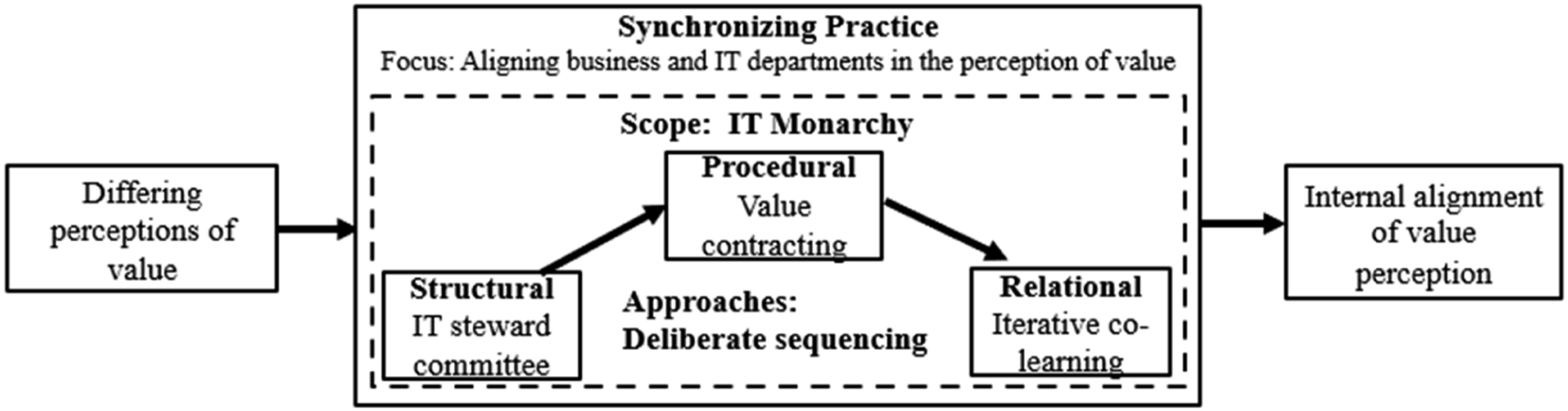
Value anchoring thus redefined IT’s organizational role, transforming it from a delivery function serving business requests into a governance actor that shapes how value is defined and contested across the enterprise. The alignment in interpretive frames, which establishes what is strategically meaningful before determining what is technically feasible, is analytically distinct from material practices that stabilize technical interactions (Leong et al., 2024). Without such shared grounding, digital initiatives remain locally rational but strategically incoherent, reinforcing silos and fragmented change trajectories (Nambisan and George, 2024). Yet alignment on strategic intent did not resolve the problem of realization. As shared agreement on what to pursue continued to coexist with divergent implementation logics, the limits of value alignment became increasingly apparent, setting the stage for capability orchestration.
Phase 2 capability orchestration: Reconfiguring IT capabilities for enterprise-level value creation
With interpretive alignment established through value anchoring, the central challenge shifted from defining what value to pursue to reconfiguring how that value would be created across heterogeneous contexts at enterprise scale. Under Geely’s existing implementation logic, business processes were tightly coupled to specific functional implementations, producing fragmented, linear value-creation structures that resisted recombination. The consequence was systemic: when new demands arose, the default response was new development rather than adaptation or recombination of existing capabilities. As the Director of the Digitalization Center recalled: “When a new employee joins, their information must be updated across multiple systems, from personnel, access control, to attendance, each requiring repeated entries. To build differentiated competitiveness, we must accumulate digital capabilities through scenario-based, personalized processes, unlocking the potential of capabilities to drive better operations.”
This fragmentation was not incidental but produced by governance. By locating decision authority within business hierarchies and organizing IT around discrete project delivery, the prevailing governance logic blocked the abstraction and reuse of capabilities across contexts, institutionalizing a premise of contextual embeddedness that Geely’s expanding heterogeneity had rendered untenable. The strategic response was to redefine the governance object itself: from isolated projects to continuous value streams, and from task handoffs to the interaction patterns that generate cross-functional value. The theoretical implication was decisive. Governance shifted from managing outputs to shaping the generative processes behind them, elevating adaptability from a byproduct of execution to a first-order governance concern.
Operationalizing this shift required dismantling the mechanisms that had trapped capabilities within project-specific solutions, making them neither discoverable nor reusable beyond their original deployment context. The structural response unfolded along two lines. First, IT governance was reconfigured around cross-functional representation so that capability-related decisions could integrate IS affordances with business relevance, rather than flow through a one-way request channel. Second, capability stewardship was redefined as shared accountability: cross-functional teams were established as end-to-end owners of value-stream capabilities, replacing oversight-based alignment with collective responsibility for the development, adaptation, and deployment of those capabilities. As the Chief Digitalization Officer explained: “I have my own business committee, and every proposed change is jointly evaluated there. Both business and technical representatives participate in all key decisions. When we review a change, the IT team articulates its architectural consequences, such as what it enables, what it constrains, and how it affects capability reuse, while the business team clarifies the operational objectives and value implications. It’s no longer one side reporting to the other; rather, it’s about co-owning the change.”
This structural shift reconstituted Geely’s governance from an IT monarchy to a polycentric structure: IT retained architectural authority, while business units gained substantive decision rights over the definition and abstraction of enterprise capabilities. Polycentricity enabled not merely broader participation but a qualitatively different decision logic that is oriented toward which capabilities to preserve, reuse, or retire across contexts, rather than which projects to approve. To sustain this logic beyond formal structures, Geely constructed a shared interpretive space in which IT leaders translated business goals into capability terms, establishing a common language through which technical and business actors could jointly reason about capability investments. As the Director of the Digitalization Center described: “When they are reporting, they would force themselves to say, ‘I can’t talk about projects, I have to talk about initiatives… Business teams often struggle with this level of abstraction, so the digital team plays a critical role in leading them to restate the requirements. As time goes on, initiatives and value become a new norm instead of projects.”
With a shared interpretive frame in place, the IT group moved from producing one-off solutions to systematically surfacing capabilities embedded in business workflows and rendering them reusable beyond their original contexts. This was operationalized through two interlinked practices: abstracting capabilities into transferable forms, and recombining them into enterprise-level digital assets. As the Deputy Director of Business Architecture described. As the Deputy Director of Business Architecture underscored: “Our IT team abstracts dispersed value points into standardized digital products, then classifies and recombines these products with the articulated business capabilities, and finally maps them onto the application architecture to enable strategic implementation. Through the logic of micro-services, each origin represents a service, and the orchestration of services can adapt to the rapid iteration of business nodes.”
Decoupling capabilities from individual projects was, however, a necessary but insufficient condition for cross-context reuse. The deeper obstacle was structural: resource allocation remained organized around a project-centric logic that tied talent, budgets, and technical capacity to specific initiatives, immobilizing capabilities within their original development contexts. The required intervention was therefore not technical but allocative: Geely reconfigured its resource base by pooling talent, budgets, and capacity into a centrally coordinated reservoir, decoupling resource ownership from individual projects and enabling capabilities to be enacted wherever enterprise needs demanded. As the Digital Governance Manager explained: “When the reservoir alone cannot meet the demand, I call upon what we jokingly refer to as the ‘Wolf Warriors,’ i.e., talent temporarily released by other business units who can reinforce critical initiatives. We redeploy people the way a military unit mobilizes its forces: wherever the enterprise priority is highest, that is where we concentrate our strength.”
We conceptualize this stage as IT governance practice of recombining in capability orchestration.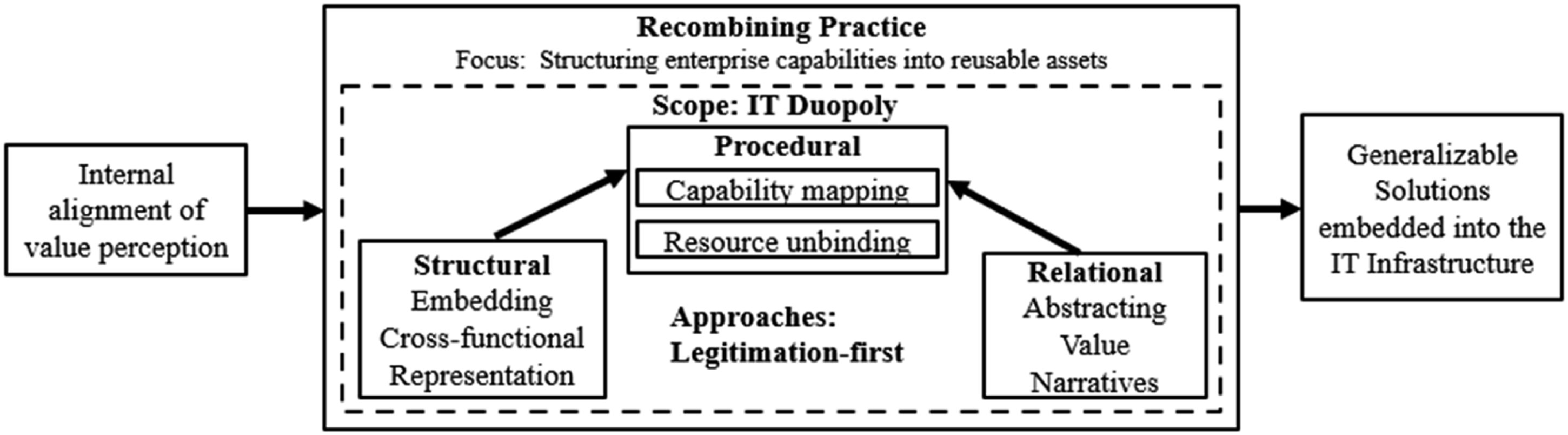
The outcome of this stage was a repertoire of generalizable capabilities abstracted from project-specific implementations and institutionalized as reusable enterprise assets, representing a structural transformation in the organization of value creation: from project-bounded execution to enterprise-level capability coordination. Yet accumulation itself generated a second-order governance problem. As the repertoire expanded, orchestrating capabilities on a case-by-case basis became increasingly resource-intensive, exposing persistent duplication and coordination overhead that the existing governance logic was structurally unable to absorb. The tension was not one of capability adequacy but of architectural scalability: liberating capabilities from project constraints had created the conditions for enterprise-level reuse but had not provided the mechanisms to consolidate those capabilities into a coherent platform. Resolving this tension required a further shift in governance logic that moves from capability liberation to platform consolidation, and from context-specific recombination to scalable, standardized value generation across the enterprise boundary.
Phase 3 asset platformization: Consolidating capabilities into scalable platform assets
As full-stack teams accelerated innovation across domains, the proliferation of parallel solutions exposed systemic inefficiencies: redundant construction of common functions, inconsistent data definitions, and rising integration costs. A widening gap emerged between front-end innovation velocity and the slower evolution of shared back-end capabilities. These tensions were not resolvable through further capability development; they demanded a reconstitution of the architectural logic governing how capabilities were held and accessed across the enterprise.
In response, Geely shifted IT governance from allocating resources to designing platforms, specifying the technical standards, service interfaces, and operating rules through which accumulated capabilities could be converted into shared and scalable assets. This shift took institutional form in the Geega industrial platform, launched in 2020. Rather than serving as another application system, Geega recomposed dispersed capabilities, such as equipment connectivity, production scheduling, asset management, and supply chain coordination, into standardized, API-accessible microservices. Its layered architecture reflected a combination of empowerment and integrity: the middle office operated as a centralized capability repository supplying stable, reusable components, while the front office retained autonomy to assemble them into differentiated business solutions. This separation of capability provision from capability application made the platform the primary mechanism through which accumulated capabilities became scalable enterprise assets. As the Manager of Operations described: “We built a global digital collaboration platform because we work with so many ecosystem partners, all using different systems and practices. The platform provides standardized interfaces so they can plug in directly. It’s not just an internal tool anymore; rather, it has become a leverage point for forming new value networks beyond Geely.”
As the platform architecture enabled autonomous capability use, Geely extended this logic to capability commercialization while retaining enterprise-wide coherence. Selected units, including logistics, warehousing, and energy management, were reorganized into semi-independent commercial entities tasked with adapting and packaging their capability bundles for external markets. In doing so, Geely introduced a market-oriented logic of value appropriation: internal capabilities were no longer treated as fixed cost centers, but subjected to competitive discipline. This external exposure imposed a precision in capability definition that internal governance alone could not generate. As the Deputy Director of the Digitalization Center noted: “Originally, our logistics center solely served Geely internally, handling vehicle and parts transportation within the company. However, we have transformed it into an independent logistics company, expanding beyond Geely Auto Group to serve brands like Zeekr, Volvo, Lotus, and Smart. It is now an external service provider, fully capable of operating beyond Geely’s scope.”
External commercialization generated a feedback dynamic that was distinct from revenue appropriation. As capabilities were deployed in novel operational environments, they encountered data patterns, usage conditions, and value requirements unavailable in internal settings, revealing limitations and opportunities that internal deployment could not surface. Commercialization, therefore, functioned not merely as a mechanism for capturing value, but as a mechanism for capability renewal. To exploit this dynamic systematically, Geely introduced joint evaluation practices with ecosystem partners, using emerging external scenarios as structured occasions to identify unrealized capability potential and guide iterative refinement. As the Manager of Operations reflected: “We define a standard API, but implementation flexibility remains with partners. For example, an AI provider can collaborate with us to explore a use case that neither side had anticipated in advance. If we both agree it creates value, we share the revenue rather than setting a fixed service fee. This is fundamentally different from a vendor relationship, as we are co-investing in capability discovery, not just exchanging services.”
External deployment also made visible a structural limitation: capability models developed under internal conditions were built on assumptions that external contexts repeatedly unsettled. The novel performance expectations, compliance requirements, and interaction patterns introduced through external engagements could not be accommodated through straightforward reuse. They required architectural revision. Each encounter with an unfamiliar context, therefore, functioned as a diagnostic, surfacing the boundaries of existing capability configurations and creating pressure for their refinement. In theoretical terms, this marked an important inversion: contextual heterogeneity, initially appearing as a governance liability, became a key driver of capability renewal and architectural generativity. As the Director of Operations emphasized: “Therefore, we understand the importance of system work because it solves a cluster of problems rather than single specific problems. System improvement is a continuous, ongoing process, not a quick, one-way route. Creating a new value track for our business, and promoting innovation in business value and the realization of competency. That is what we call New IT.”
We conceptualize this stage as IT governance practice of diversifying in asset platformization.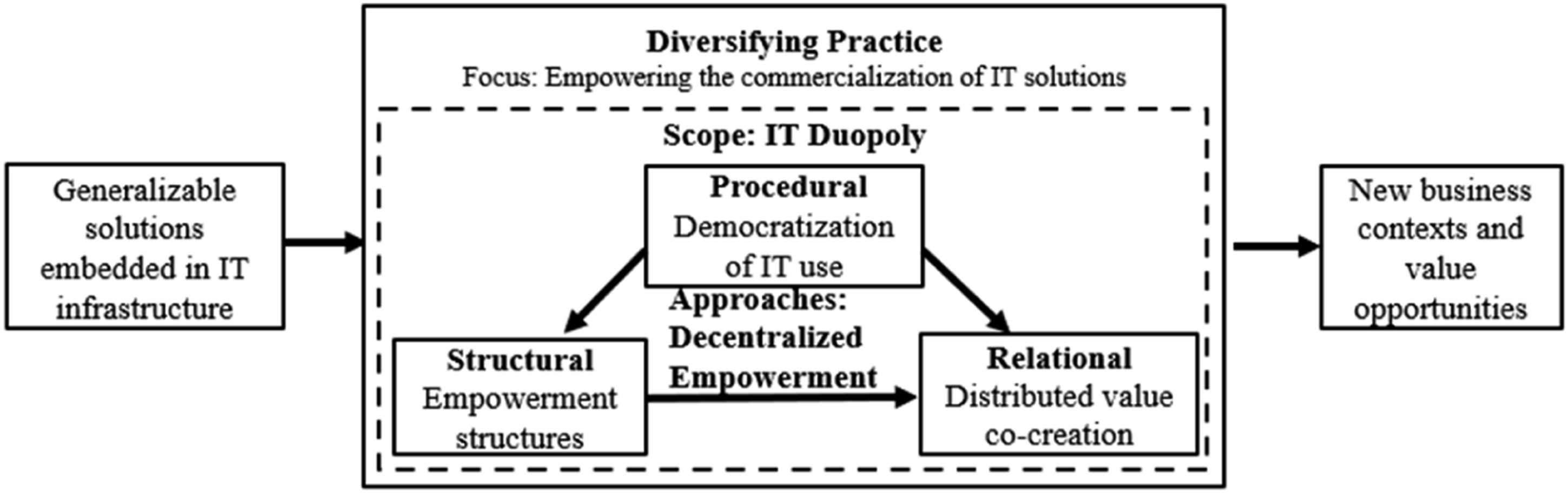
This stage marks both the completion of one transformation cycle and the onset of the next. The link between them is structural. As platformization capabilities travel across increasingly diverse external contexts, they confront value logics, operational demands, and usage patterns that were neither anticipated in their initial design nor contained within the interpretive consensus forged during value anchoring. As a result, the evaluative frame that had previously stabilized shared understanding of what digital transformation was for begins to unravel. The governance problem that value anchoring had temporarily resolved is thus reinstated, not as evidence of failure, but as the structural consequence of success: platformization partially resolves one configuration of contextual heterogeneity only to generate another that existing value commitments can no longer contain. A new round of synchronizing, therefore, becomes necessary, not to recreate shared understanding from scratch, but to renegotiate and re-anchor value in light of expanded capabilities and newly surfaced contextual demands. Each cycle re-engages the same governance logic at a qualitatively higher level of complexity, showing adaptive DT to be not a bounded initiative but a self-reinforcing process of organizational becoming. As the CDO observed: “Digitalization is not a project with a finishing line. Every time we deploy our capabilities in a new context, we learn something we did not know before, about what customers actually need, where our capabilities fall short, and what value really means in that setting. This forces us to go back and renegotiate what we should be building and why.”
Through this cyclical dynamic, adaptive DT reveals its defining structural property: not a finite initiative with determinate endpoints, but a self-reinforcing loop of discovery, consolidation, and expansion in which each iteration broadens the enterprise’s capacity to sense emergent opportunities and renew capabilities for sustained value creation across an irreducibly heterogeneous competitive landscape.
DT outcomes: Context-transcending IS
Taken together, the three stages constitute adaptive DT: an enterprise-wide transformation logic oriented not toward a fixed endpoint, but toward the ongoing reconfiguration of the conditions of value creation. The outcome is what we term
The first is a “Through this planning, we created an enterprise capability map that now drives our entire application architecture. It forced us to ask a different question - not ‘what system do we need to build?’ but ‘what capabilities does the enterprise actually possess, and how can they be made available across contexts?’ It integrates previously scattered capabilities into a coherent whole. And the starting point of this entire structure is not technology, it is our shared value logic.”
The second dimension is “Every time our capabilities enter a new scenario, the platform is forced to update itself. New requirements reveal what our current models cannot handle, gaps we would never have discovered by looking inward. We then evolve the architecture accordingly, not as a planned upgrade cycle, but as a direct response to what the environment is telling us. In that sense, renewal isn’t an add-on—it is built into how the system works.”
Through this recursive process, Geely’s IS evolved into a configuration that does not embed into a pre-given context but continuously transcends successive contextual boundaries through iterative cycles of value anchoring, capability orchestration, and asset platformization. Context-transcending IS, as we theorize it, is an information systems configuration whose value creation logic is not anchored in any single context but is constituted through the recurrent renegotiation of IT artefacts, people, and organizational processes across heterogeneous business situations, such that IS does not merely serve existing value creation logics but actively generates new ones that no single context could produce in isolation. This concept departs analytically from the dominant IS literature, which theorizes IS as context-dependent artifacts designed to fit or align with relatively stable organizational environments (Markus and Robey, 1988; Orlikowski, 1992). Under contextual heterogeneity, this embedding premise is structurally violated: no single context can serve as a stable anchor for IS design, and value creation requires IS to operate meaningfully across structurally, institutionally, and temporally divergent settings. Context-transcending IS addresses this condition precisely: its polymorphic capability base and reconfigurable digital core convert contextual pressures into architectural renewal imperatives and contextual possibilities into generative resources for value creation, transforming heterogeneity from a governance liability into the primary engine of enterprise-level generativity.
Discussion
Reflecting on adaptive DT: The nature and insights
Our case study of Geely reveals adaptive DT as a theoretically distinct paradigm whose adaptiveness resides not in any single stage or single entity but in the self-reinforcing logic that connects IT, business, and the heterogeneous contexts in which they operate into a continuously evolving whole. Unlike business-driven DT, which embeds IS into contexts defined by strategic intent (Bharadwaj and Dong, 2013; Uhl and Gollenia, 2014), or IT-driven DT, which embeds contexts into the possibilities defined by IS (Besson and Rowe, 2012; Tan et al., 2020), adaptive DT reconstitutes the relationship between these two logics entirely: rather than privileging one over the other, it institutionalizes their productive tension as the organizing principle through which IS capabilities are continuously reconfigured across heterogeneous contexts. Under adaptive DT, this tension is not a problem to be resolved but a structural condition to be governed, precisely because neither business-driven responsiveness nor IT-driven generativity alone can remain coherent across contexts that differ fundamentally in their value imperatives and institutional pressures.
Before elaborating on the theoretical logic of the three stages, two features of the model merit clarification. First, the contextual conditions that initiate each cycle, contextual pressures and contextual possibilities, are not separate antecedent variables, but dialectically related manifestations of the same structural condition: contextual heterogeneity. They are two sides of the same phenomenon because the challenges arising from divergent contexts are inseparable from the potential that their diversity also creates (See Nambisan and George (2024)). Second, although the model presents three stages in sequential order within each cycle, this linearity is theoretically necessary rather than empirically incidental. Each stage creates the substantive preconditions for the next. Value anchoring establishes a shared evaluative frame and governance legitimacy, without which capabilities cannot be recognized, prioritized, or coordinated across heterogeneous contexts. Capability orchestration then transforms these aligned value commitments into organized, reusable capability configurations, which in turn provide the material basis for asset platformization. Platformization is therefore not possible ex ante, but depends on capabilities first being made visible, governable, and recombinable. The sequence is therefore cumulative rather than merely chronological: each stage resolves the central governance problem that would otherwise block the next.
The intra-cycle linearity also reflects a logic of governance sequencing rather than an artificial simplification of organizational life. Across cycles, by contrast, the model is non-linear because each cycle does more than resolve an existing governance problem; it also generates the conditions of the next. As capabilities are accumulated, platformized, and deployed across new contexts, the enterprise confronts broader value demands, more varied usage conditions, and more complex coordination requirements than before. Each subsequent cycle, therefore, reactivates the same governance logic at a qualitatively higher order of complexity. What emerges is not recurrence in the sense of repetition, but a generative spiral in which contextual heterogeneity intensifies as transformation extends the enterprise’s reach across increasingly diverse contexts (Pavlou and El Sawy, 2011; Zollo and Winter, 2002).
The IT governance practices of synchronizing, recombining, and diversifying operationalize this logic, but their relationship to the three stages requires careful theoretical specification. Each practice is most prominently activated at its corresponding stage: synchronizing at value anchoring, recombining at capability orchestration, and diversifying at asset platformization. However, this correspondence reflects governance primacy rather than exclusivity. Synchronizing, which aligns actors’ interpretive frames around enterprise-level value, does not terminate at value anchoring; its logic persists as a background condition throughout capability orchestration and asset platformization, ensuring that architectural decisions and ecosystem relationships remain anchored in shared evaluative commitments. Similarly, recombining’s architectural logic extends into platformization, where the modular reconfiguration of capabilities provides the structural substrate upon which diversifying operates. The governance practices thus function not as episodic compliance mechanisms but as continuous background enablers that sustain productive tension between business-driven responsiveness and IT-driven generativity at every stage of the cycle, preventing the structural myopia of context-specific embedding while ensuring that cross-context generativity remains strategically directed rather than architecturally fragmented.
The two dimensions of context-transcending IS that emerge from this process, a polymorphic capability base and a reconfigurable digital core, are not separate outcomes but mutually constitutive dimensions of the same configuration. The former provides the capabilities that the latter organizes and renders deployable; the latter provides the architectural infrastructure through which those capabilities are recombined and renewed across heterogeneous contexts. This mutual constitution is generative: deployment in novel contexts produces feedback that refines the capability base and expands the reconfiguration possibilities of the core (Rolland et al., 2018; Tiwana et al., 2010). Importantly, the effects of one cycle do not simply flow outward to alter external contextual conditions. They transform the enterprise’s internal capability conditions, thereby reshaping how contextual heterogeneity is perceived and what counts as contextual pressure or possibility in the next cycle. Context-transcending IS is thus not merely the outcome of adaptive DT, but its generative infrastructure, enabling each successive cycle to operate at a higher level of contextual complexity and value-creation potential (Bygstad, 2017; Henfridsson and Bygstad, 2013).
This second-order capability unfolds through three theoretically necessary stages that together point to a counterintuitive insight: IS generates value not by transcending contexts from above, but by engaging them deeply enough to extract what can travel across them. Value anchoring provides this interpretative foundation by establishing that generative transcendence depends on deep contextual immersion (Similar to IT enactment proposed by Orlikowski (2000)). Capability orchestration then converts such contextual immersion into organizational value by identifying and recombining transferable capability patterns across heterogeneous contexts, thereby shifting the locus of IS value from system functionality to cross-context capability transferability. The generativity, in the form of a platform architecture, thus becomes an organizational accomplishment rather than a purely technical feature. Asset platformization completes the logic by turning these accumulated capabilities into a reconfigurable digital core. Instead of imposing a standardized platform on heterogeneous contexts, adaptive DT allows the core to emerge through repeated cycles of immersion, extraction, and abstraction, making its generativity a product of the context-transcending practices from which it was built.
Together, what emerges from adaptive DT is not merely a refined account of digital transformation practice but a fundamental challenge to the embedding premise that has governed IS theorization. As contextual heterogeneity deepens into the structural condition of the contemporary enterprise, the question is no longer how IS can be better embedded, but what becomes theoretically possible and necessary once the embedding premise is released. It is to this question that we now turn.
The future of IS in the enterprise: From context-embeddedness to context-transcendence
The preceding analysis has established that enterprise IS scholarship has long been organized around a foundational premise: IS value is constituted through embedding within specific business contexts, and the task of IS design, governance, and innovation is to achieve and sustain this embedding as effectively as possible (e.g., IT-business alignment, see Luftman et al. (2017)). The insights from Geely’s adaptive DT reveal the structural limits of this premise under conditions of contextual heterogeneity and point toward a fundamentally different trajectory for IS theorization in the future enterprise. Rooted in the context-transcending IS that emerged through Geely’s adaptive DT, we develop
We define context-transcendent IS as a paradigm of information systems whose value is generated through the recurrent traversal of heterogeneous contexts rather than through embeddedness in any single one. Where embedding-based IS treats context as a relatively stable condition to which IS must conform (Benaroch et al., 2006; Tarafdar and Tanriverdi, 2018), context-transcendent IS treats heterogeneous contexts as generative resources: extracting transferable capability patterns from each, abstracting them into reconfigurable assets, and redeploying them as cumulative generative infrastructure across the enterprise. This reconceptualization shifts the locus of IS value from the functional fit between a system and its host context to the cross-context transferability of the capability configurations that IS generates and accumulates (Henfridsson and Bygstad, 2013). The unit of value creation is accordingly reconstituted: no longer confined to discrete value points within a single context, but constituted across an expanding plane of interrelated contexts whose generative potential compounds as IS traverses settings of increasing heterogeneity.
With these disruptive characteristics, context-transcendent IS carries two important implications for existing intellectual conversations on enterprise IS design and development. Existing enterprise IS has often been organized around an integrated operational backbone, through which firms standardize core processes, consolidate data, and use modular interfaces and architectural controls to maintain enterprise-wide coherence while accommodating limited local variation (Ng and Gable, 2010; Wagner et al., 2012). Despite the value-creation performance achieved through local context embedding in existing enterprise IS implementation practices, it is important to reconsider the IS-context relationship within the enterprise for sustained value creation amid contextual heterogeneity in two ways. First, as business increasingly needs to handle the pressures and opportunities of new contexts, it is of strategic value to shift from context-specific fit alone to assessing whether such embeddings also produce enterprise capabilities that remain transferable across heterogeneous contexts, without reverting to repeated one-off customization (Rai et al., 2010). Second, along with this shift, it suggests that IS value should be theorized less as a static achievement within a focal context and more as a broader value surface unfolding across contexts over time. As enterprise IS increasingly takes the form of a nexus of interrelated systems rather than a single bounded system, value may reside not only in local performance improvements, but in the continued articulation, redeployment, and recombination of capabilities across multiple operating environments (Baskerville et al., 2022).
In the development of context-transcendent IS, although the Geely case reveals only partial manifestations of context-transcendent IS, our analysis identifies three constitutive dimensions that define its cross-context generative logic. The first is
The generative potential of context-transcendent IS is conditioned by its structural openness to heterogeneous contexts, that is, the broader the permeability of IS in contextual variation, the richer and more transferable the capability patterns available for abstraction and redeployment across the enterprise.
Second,
The abstraction potential of context-transcendent IS depends on the depth of its constitutive engagement with each context it enters. The deeper the engagement, the richer the capability patterns available for abstraction and redeployment across the enterprise.
Where permeability and immersion establish the conditions under which IS can be shaped by heterogeneous contexts,
The generative potential of context-transcendent IS compounds with the degree of heterogeneity traversed, that is, the greater the structural, institutional, and temporal differences among the contexts through which IS moves, the richer the accumulated capability patterns and the more expansive the generative infrastructure available for future contexts.
Having established the three constitutive dimensions of context-transcending IS, we now turn to the structural conditions that make its emergence organizationally possible. From the case study of Geely, we identified key conditions that differ from what is widely accepted in enterprises but are important for the enactment of these practices, enabling IS to navigate diverse contexts for value creation. The first condition is the decomposability of business processes. Conventional enterprise IS was built on the assumption that business logic should be encoded in tightly integrated, process-centric architectures, that is, a design principle that maximized operational efficiency within stable contexts but rendered reconfiguration across heterogeneous ones structurally prohibitive (Davenport, 1998). What the Geely case reveals is that context-transcendent IS becomes organizationally achievable only when business processes can be disaggregated into modular, recombinable capability units that retain coherence independently of the specific contextual arrangements that produced them. As such, decomposability is the organizational precondition for context transferability: capabilities locked within monolithic process architectures cannot be extracted, abstracted, or redeployed across contexts, regardless of how immersive or permeable the IS configuration may otherwise be (Sunyaev et al., 2023). This is not merely a technical design choice but a governance commitment: decomposability requires that the enterprise actively resist the organizational tendency toward process entrenchment and capability boundedness that conventional IS governance reinforces (Rinta-Kahila et al., 2023; Rolland et al., 2018). We therefore propose:
Decomposability of business processes is a necessary condition for the emergence of context-transcendent IS: the greater the modularity of business capabilities, the greater IS’s capacity to extract, abstract, and redeploy transferable patterns across heterogeneous contexts.
The second condition is the institutionalization of heterogeneity as an operant resource. Prevailing IS governance has treated contextual heterogeneity as a structural liability to be minimized through standardization, harmonization, and the enforcement of uniform operating logics across business units (Kettinger et al., 2010). This governance orientation reflects that contextual difference is a coordination cost to be reduced rather than a generative condition to be cultivated. What Geely’s adaptive DT demonstrates is that context-transcendent IS requires a fundamental reorientation of this logic: heterogeneity must be actively institutionalized as an operant resource: recognized in governance arrangements and embedded in the organizational routines through which IS capabilities are developed and deployed. This reorientation matters at two levels. At the governance level, enterprises must resist premature standardization, namely the impulse to suppress contextual tension through uniform IS logic before its generative value has been extracted (Hanseth and Modol, 2021). At the architectural level, IS must be designed to accommodate contextual variation rather than convergence. Otherwise, heterogeneous contexts will continue to be treated as barriers rather than generative resources, and the conditions for context immersion and permeability will remain systematically underdeveloped. We therefore propose:
Context-transcendent IS is conditioned by the institutionalization of heterogeneity as an operant resource: enterprises that govern contextual heterogeneity as a strategic asset rather than a governance burden are better positioned to cultivate the permeability, immersion, and transferability through which context-transcendent IS generates and accumulates value.
The two organizational conditions identified above, the decomposability of business processes and the institutionalization of heterogeneity as an operant resource, have not yet been widely met across enterprises of varying size and digital maturity. Their co-presence in the Geely case reflects the organizational consequences of operating at the intersection of extreme business complexity and accelerated digital maturity: Geely’s multi-brand, multi-market architecture rendered the tension between IS and heterogeneous contexts structurally unavoidable, while its digital maturity enabled the rapid reconfiguration of business processes in response to shifting value priorities. Yet as more enterprises grow through diversification, multi-market expansion, and the multiplication of business models, contextual heterogeneity is becoming a structural condition that no enterprise can indefinitely defer. Thus, Geely is not an anomaly but an early and unusually visible instance of a trajectory that is becoming generalized: one whose organizational complexity has rendered the future of IS legible ahead of its time, and whose adaptive practices provide the empirical foundation for our theorization of context-transcending IS. What this theorization ultimately traces is an evolutionary arc in the relationship between IS and value creation: from IS as the automation of discrete processes, to IS as the enabler of value within a given context, to IS as the generator of value across heterogeneous contexts.
Implications and conclusions
Our study offers several important implications for two knowledge areas. We discuss each of these areas in the subsections that follow.
Theoretical implications
Implications for theorizing IS for the future enterprise
Echoing our discussion on the implications of context-transcendent IS for enterprise IS, our study makes two related contributions to theorizing IS for the future enterprise. First, we advance understanding of how IS can remain generative under contextual heterogeneity, an increasingly inevitable condition for enterprises of different sizes and levels of digital maturity (Winter et al., 2024). More specifically, rather than transforming the logic of business processes directly (Baiyere et al., 2020), Geely restructures the enterprise around modular, recombinable digital capabilities that function as the building blocks of a shared digital infrastructure. In doing so, it loosens the tight coupling between IT systems and business workflows, enabling capabilities to be deployed and redeployed across diverse contexts. In this process, IT-business alignment is no longer treated as a static achievement (Luftman et al., 2017), but is reconstituted as a continuously negotiated accomplishment in which business units shift from passive recipients to active leaders of IS-based changes, developing the interpretive and structural capacity to initiate, steer, and justify IS reconfiguration (Boh et al., 2023). Through this shift, the scope of business activity is reconceptualized beyond predefined processes (Venkatraman, 1994). As a result, business contexts, rather than processes, become the new locus of value creation, with value emerging from the organization’s ability to selectively recombine a stable capability core in response to context-specific demands. This marks a pivotal departure from traditional process-centric logics by positioning contextual variation as a primary driver of value creation.
Building on this first contribution, we develop context-transcendent IS as a new conceptual framing for the future of enterprise IS. Rather than predicting a single trajectory of IS evolution, this framing reorients attention to a different underlying logic of change. Existing accounts often assume that enterprise IS develops within relatively stable sociotechnical configurations, with adaptation proceeding incrementally until more radical change is triggered in episodic moments. This assumption is reflected, albeit in different ways, in punctuated equilibrium models (Lyytinen and Newman, 2008) and the windows of opportunity perspective (Tyre and Orlikowski, 1994). What these views share is the image of stability as the normal condition and substantial change as temporally exceptional. Under contextual heterogeneity, however, this image becomes difficult to sustain. Enterprises operating across divergent contexts confront not a single environment but multiple environments whose differences are both qualitative and quantitative. Under such conditions, sociotechnical configurations are not periodically disturbed from a stable baseline; they are continuously exposed to heterogeneous demands that unsettle coherence across contexts. Context-transcendent IS captures an alternative possibility: enterprise IS development as a recursive and cumulative process in which governance and architectural arrangements are institutionalized precisely to absorb, recombine, and leverage contextual variation as an enduring source of renewal and generativity. In this way, the study moves theorizing beyond process-centric and fit-based assumptions toward a view of IS as an evolving organizational configuration whose value lies in its capacity to remain generative amid intensifying heterogeneity. This perspective opens several directions for future research, including the organizational and architectural conditions under which context permeability, immersion, and transferability become mutually reinforcing, the governance mechanisms through which enterprises sustain these dimensions over time, and the boundary conditions under which context-transcending IS enhances or constrains enterprise adaptability.
Digital transformation
In addition to its implications for the future development of IS, our adaptive DT framework makes several theoretical contributions to the discussion of DT.
More specifically, our study challenges the long-standing assumption that digital transformation should be predominantly business-driven (Uhl and Gollenia, 2014). Prior research has argued that DT succeeds when IT is closely aligned with pre-established business strategies and when business units maintain primary control over IT resources (Westerman et al., 2014). This logic presumes a stable landscape in which business needs are transparent, predictable, and can be translated into function-oriented IT requirements. However, our findings show that in enterprises experiencing rapid growth, expanding product portfolios, and rising contextual heterogeneity, business-driven DT would cause inefficiencies and value destruction. As Geely evolved into a multi-business organization, business-driven DT reinforced a siloed sensemaking, widening the gap between IT and business departments and exacerbating the need for value creation in the enterprise.
By contrast, Geely’s shift toward adaptive DT reconfigured the locus of strategic direction, positioning IT not as a service function that follows business requirements but as an active actor. In this configuration, IT does not override business priorities; instead, it provides the architectural and interpretive scaffolding through which business units collectively redefine what value is, how it should be created, and how capabilities should be recomposed across contexts. This differs from existing IT-driven pathways in that it is a one-way adaptation. Moreover, our framework demonstrates that while adaptive DT is to some extent IT-driven, it is not inherently rigid or top-down like IT monarchy; rather, when structured through practices such as synchronizing, recombining, and diversifying, it becomes an IT duopoly to democratize the access and use of IT resources when businesses are decoupled from functional IT governance (Gregory et al., 2018).
A second contribution, alongside the optimized paradigm, is that our study extends discussions of both IT- and business-driven DT by showing how their strengths can be reconfigured into adaptive DT, that is, one in which transformation unfolds as a cyclical, self-renewing process rather than a deterministic, linear progression. While prior work has emphasized the generativity of digital artifacts and infrastructures (Yoo et al., 2010), far less attention has been given to the governance mechanisms required to steer and coordinate generativity as it spreads across divergent business contexts. Our findings show that Geely’s cyclical sequence of value anchoring, capability orchestration, and asset platformization, enables heterogeneous contexts to function not as obstacles but as productive inputs for capability recombination and renewal. Through this cycle, novelty generated in one domain becomes a reusable capability for others, turning localized innovation into enterprise-wide value.
In doing so, we demonstrate that the core challenge in IT-driven DT is not merely to spark pockets of new business processes (Baiyere et al., 2020), but to institutionalize their reuse, coherence, and scalability across an expanding landscape. This recasts adaptive DT as a process of continuous reframing and restructuring, one that repeatedly realigns value, restructures capabilities, and redistributes participation as the enterprise encounters unanticipated value opportunities. Such a perspective complements and advances the existing literature by showing that effective DT depends on a flexible governance structure that can enhance generativity without losing coherence (Miremadi et al., 2023), enabling the enterprise to adapt and evolve in a sustained and systematic manner.
Practical implications
Beyond its theoretical implications, our work offers actionable guidance for organizations across different stages of maturity. For large incumbents operating at scale, our findings illustrate how IT can be repositioned from a reactive service provider to a proactive orchestrator of transformation by leveraging its generative potential across heterogeneous business contexts. In such environments, value cannot be predetermined through fixed process designs for predefined business contexts; instead, identifying and cultivating core digital and business capabilities as strategic assets becomes essential. This shift requires rethinking the division of labor and accountability between IT and business units. Rather than isolating IT at the periphery of business decision-making, incumbents should establish a more agile governance structures that enable continuous joint sensemaking and co-ownership of value creation, ensuring that digital transformation remains both technically feasible and strategically coherent at scale.
For start-ups and digital-native firms, the model highlights the importance of building modular, recombinable capability cores early, even before rapid growth and expansion generate a heterogeneity of contexts that incur architectural debt and coordination tensions. While start-ups often prioritize speed and experimentation, our findings suggest that they benefit from investing in flexible capability architectures that can accommodate future heterogeneity without costly redesign. By adopting governance practices that support shared interpretation of value (synchronizing), structured capability reuse (recombining), and broad participation in innovation (diversifying), start-ups can scale more smoothly and avoid the architecture lock-in that often hinders later-stage digital transformation.
For policy makers and industry regulators, the model underscores the need to view digital transformation not merely as technology deployment but as the cultivation of adaptive digital capability ecosystems. Policy interventions should therefore facilitate the development of shared digital infrastructures, interoperable standards, and cross-organizational coordination mechanisms that support distributed innovation. Encouraging modularity, open interfaces, and the recombination of inter-firm capabilities would lower barriers to collaboration and enable both large enterprises and smaller firms to participate in innovation-driven ecosystems. As digital infrastructures become more complex and interdependent, policies that promote transparent governance, cross-sector learning, and capability sharing are essential to sustain competitiveness and ensure that digital transformation yields broad societal benefits.
Limitations
Our study is not without limitations. First, the findings are derived from a single case within the automotive industry, which raises the familiar challenge of external validity in interpretive case research (Walsham, 2006). Although our model provides a theoretically informed account of adaptive DT, its robustness and boundary conditions must be further examined through comparative or multi-case designs across industries with different levels of complexity, regulation, and technological maturity (Eisenhardt and Graebner, 2007). Future research could apply or extend our framework to sectors such as finance, healthcare, logistics, or public services to assess its scope of applicability and refine its generalizability.
Second, our theorization is inevitably shaped by the empirical materials available to us. While we observed a rich, longitudinal process of adaptive DT in Geely’s practice, other configurations, that is, whether IT-driven or business-driven, may unfold differently and also support the development of IS in the future enterprise. Variations in sociotechnical elements (Sarker et al., 2019), such as organizational culture, governance structures, legacy architectures, and market conditions, could produce alternative pathways that were not captured in our data. Subsequent studies should therefore explore different transformation trajectories, with additional forms of IS development, to challenge and extend the model proposed here.
Together, these limitations underscore the need for future work to deepen, refine, and broaden the empirical base for understanding how enterprises build adaptive information systems under increasingly dynamic and heterogeneous conditions. Despite these limitations, we believe our findings will contribute to understanding the future of IS in the enterprise and how it can be developed through a new pathway of DT for competency building.
Supplemental material
Supplemental material - Developing context-transcendent information systems for the future enterprise: Theory and insights from adaptive digital transformation
Supplemental material for Developing context-transcendent information systems for the future enterprise: Theory and insights from adaptive digital transformation by Dongdi Chen, Belinda Wang, Evelyn Ng, Barney Tan, Yuan Sun in Journal of Information Technology
Footnotes

Funding
The authors disclosed receipt of the following financial support for the research, authorship, and/or publication of this article: This work was supported by Zhejiang Provincial Natural Science Foundation (LR23G020001), Major Project of National Social Science Fund of China (21&ZD119), National Natural Science Foundation of China (72172143).
Declaration of conflicting interests
The authors declared no potential conflicts of interest with respect to the research, authorship, and/or publication of this article.
Supplemental material
Supplemental material for this article is available online.
Author biographies
References
Supplementary Material
Please find the following supplemental material available below.
For Open Access articles published under a Creative Commons License, all supplemental material carries the same license as the article it is associated with.
For non-Open Access articles published, all supplemental material carries a non-exclusive license, and permission requests for re-use of supplemental material or any part of supplemental material shall be sent directly to the copyright owner as specified in the copyright notice associated with the article.
