






Abstract
How can incumbent firms reconfigure their legacy Enterprise Information Systems (EIS) for enterprise renewal? We address this question by developing an empirically grounded, mechanism-based theory of legacy EIS reconfiguration in incumbent firms that reconciles two opposing perspectives in IS research: legacy EIS as sources of technical debt that constrain agility, and legacy EIS as installed bases that can be leveraged for digital reinvention. Specifically, we draw on findings from a multiple-case study of five German incumbent manufacturing firms to identify four generative mechanisms through which incumbent firms leverage operational stability of their legacy EIS for digital pilots, activate historically accumulated data through analytics, augment legacy EIS with middleware interfaces, and retrofit legacy EIS for recurring revenue models. When enacted, these mechanisms reconfigure legacy EIS into ambidextrous EIS landscapes that preserve operational stability through contained and selectively reduced technical debt, while expanding potential options for future digital initiatives. We conclude by outlining actionable guidance for practitioners and a research agenda on how legacy EIS reconfiguration, rather than replacement, can serve as a foundation for enterprise renewal.
Introduction
Enterprise Information Systems (EIS) enable and integrate core enterprise operations such as enterprise resource planning (ERP) (Gattiker and Goodhue, 2005), customer relationship management (CRM), and supply chain management (SCM) (Cao et al., 2022) – along with the standardized process (Ross et al., 2006), data (Lehrer et al., 2018), and control logics (Aral et al., 2024) supporting these operations. Importantly, the long-established role of EIS as the transactional backbone organizations rely upon is evolving. While ERP, CRM, or SCM continue to ensure reliability, control, or process integration, such EIS are often augmented by complementary Information Systems (IS) that extend existing process, data, or control logics (Aryal et al., 2023) and thereby act as drivers of digital transformation and enterprise renewal (Lokuge et al., 2025). We thus conceptualize an organization’s suite of existing or ‘legacy’ EIS and complementary IS as the EIS landscape: a portfolio of interconnected IS that collectively support current enterprise operations and future enterprise transformation.
The future of IS in enterprise contexts increasingly unfolds within the EIS landscape rather than within the transactional backbone of legacy EIS alone. Traditionally, organizations pursued this evolution through two distinct strategies intended to ‘future proof’ their EIS landscapes – the wholesale replacement of legacy EIS (Willcocks et al., 2016) and platformization (Sebastian et al., 2017). Both approaches either replace or restructure legacy EIS, require substantial architectural change, as well as organizational disruption. In addition, both approaches also contend with the underlying complexity of integrating multiple systems into a cohesive EIS landscape (Aryal et al., 2023). This is especially true for incumbent firms, where entrenched organizational structures and vendor-controlled legacy EIS constrain efforts to achieve both ongoing enterprise operations and future transformation (Ross et al., 2019). Incumbent firms responded to this challenge by reassessing whether their legacy EIS remain aligned with evolving operational and strategic objectives (Grover and Lyytinen, 2023). Whenever this is not the case, legacy EIS have been framed as sources of technical debt to be replaced or removed (e.g., Rinta-Kahila et al., 2023), which creates a persistent tension between ongoing enterprise operations and future transformation.
Against this backdrop, prior IS research has focused on technical debt as a central construct for understanding how short-term design and implementation trade-offs shape the long-term evolution of IS in enterprise contexts. Here, technical debt has typically been associated with outdated IT artifacts (Magnusson et al., 2018) that, in the context of legacy EIS, may include codebases (Li et al., 2015), enterprise architectures (Kruchten et al., 2012), or specific functionalities (Sculley et al., 2015). However, we observe a critical tension in the existing literature, where legacy EIS are simultaneously framed as sources of technical debt that result in a liability when unmanaged, and as an asset for organizational renewal when effectively controlled.
Specifically, one literature stream frames legacy EIS as sources of technical debt, arguing that technical debt accumulates over time through complex socio-technical processes (Rolland et al., 2018), whether intentionally (Yli-Huumo et al., 2014) or unintentionally (Klinger et al., 2011). As such, legacy EIS can increase maintenance costs (Ramasubbu and Kemerer, 2016), reduce organizational flexibility (Banker et al., 2021), or hinder the adoption of other IS (Fürstenau et al., 2019). Conversely, a second literature stream draws on Hanseth and Lyytinen’s (2010) installed base perspective to frame legacy EIS as generative infrastructures, arguing they may be leveraged as assets to foster organizational renewal (Lokuge et al., 2025). For example, Sutcliff et al. (2019) argue that the historically embedded processes in legacy EIS may serve as a foundation for “digital reinvention” (2019: 4). This argument is echoed by De Cuyper et al. (2020) and Leiting et al. (2022), who suggest legacy EIS may be ‘reconfigured’ for future benefits – a process involving the merger or extension of current organizational capabilities with emerging digital technologies, thereby preserving legacy EIS as stable systems of record, and augmenting these with complementary IS.
We acknowledge the valuable insights provided by prior IS studies related to legacy EIS and technical debt more generally (e.g., Banker et al., 2021). However, we also note that our discipline has yet to explain how organizations operationalize the apparent tension underpinning legacy EIS as liability versus asset in practice, which could resolve the underlying tension between ongoing enterprise operations and future transformation. This knowledge gap is consequential as it limits our ability to explain how EIS landscapes evolve, and to thereby understand their role in future enterprise contexts. Our study therefore aims to address this gap by asking how incumbent firms reconfigure their legacy EIS for enterprise transformation, and by examining this question through a multiple-case study of five German manufacturing incumbents that developed novel approaches to leveraging their legacy to support transformation. To do this, our study adopts a mechanism-based theorizing approach (Bygstad et al., 2016) and draws on Woodard et al.’s (2013) design capital framework as our analytical lens. We provide three important contributions to the IS discipline:
First, our theoretical contribution consists of an empirically grounded, mechanism-based theory of legacy EIS reconfiguration in incumbent firms (Bygstad et al., 2016), which explains how incumbent firms preserve the operational stability of their installed bases of legacy EIS, while reconfiguring these into EIS landscapes that facilitate enterprise renewal. Specifically, we identify four generative mechanisms – recurring chains of causal action and interaction that explain how similar outcomes are produced (Ylikoski, 2019) – and delineate their causal powers, boundary conditions, as well as outcomes. By framing these through Woodard et al.’s (2013) design capital framework, we explain how legacy EIS can be transformed from debt-constrained states in which options for enterprise renewal exist but are costly to exercise, toward EIS landscapes that make such renewal more affordable and less risky. In doing so, we extend related IS research on EIS transformation that examined isolated technologies (Brown et al., 2010) or discrete, one-off transformation initiatives (Rinta-Kahila et al., 2023), and explain how the tension underpinning legacy EIS as liability versus asset can be operationalized.
Second, we contribute detailed empirical evidence from five German incumbent manufacturers, showing how these organizations leveraged the operational stability of their legacy EIS for digital pilots; benefitted from historical data embedded in legacy EIS through business analytics; augmented legacy EIS with middleware interfaces; and retrofitted legacy EIS for new revenue models. The context of German manufacturing incumbent firms is especially suitable for this study as these organizations are characterized by long operational histories, extended product life cycles, and stringent reliability requirements, which are enabled by deeply embedded, vendor-controlled, and customized EIS. Consequently, these legacy EIS exhibit both assets in the form of installed bases and sources of technical debt. In this empirical setting, reconfiguring, rather than replacing, legacy EIS therefore emerges as the dominant mode of enterprise transformation, which renders the underlying processes observable. Empirically, our study extends prior IS research that portrays legacy EIS replacement (e.g., Willcocks et al., 2016) and complements emerging work on installed bases (e.g., Dias et al., 2023) by specifying how EIS reconfigurations unfold.
Third, our normative contribution consists of actionable guidance for practitioners seeking to benefit from their legacy EIS. Specifically, our findings and associated managerial guidelines offer an alternative pathway to the ‘rip-and-replace’ approaches to managing legacy EIS as ‘technical debt’ often advocated for (e.g., Willcocks et al., 2016), arguing these are neither feasible nor desirable. Instead, we guide practitioners to identify reusable assets embedded in legacy EIS and recognize the constraints that may limit their reuse. In doing so, we enable them to turn legacy EIS from a perceived burden into a foundation for future enterprise renewal.
Theoretical background
The evolution of information systems in the enterprise
The role of EIS in enterprise contexts is evolving. For some time, EIS were considered the transactional backbone that enabled organizations to standardize core enterprise processes such as supply chain management (SCM) (Cao et al., 2022) and enterprise resource planning (ERP) (Gattiker and Goodhue, 2005), thereby supporting enterprise-wide operations (Aral et al., 2024), data management (Lehrer et al., 2018), or organizational control processes (Ross et al., 2006) under increasingly complex and uncertain market conditions (Sambhara et al., 2022). For example, a manufacturing firm may have relied on ERPs like ‘SAP S/4HANA’ to standardize its production, logistics, or financial processes in increasingly competitive global markets.
Today, organizations no longer rely on EIS alone, but manage broader EIS landscapes, which are portfolios of interconnected IS intended to complement the transactional backbone. While an organization’s legacy EIS (e.g., CRM systems) continue to ensure standardization and operational stability, the broader EIS landscape emerges as a locus of enterprise renewal (Lokuge et al., 2025). For example, the same manufacturing firm using ‘SAP S/4HANA’ to standardize its production processes could complement this legacy EIS with ‘Salesforce’ or ‘Amazon Web Services’ to benefit from real-time data insights, to adapt production processes to market changes, or to create novel customer experiences (Mikalef et al., 2021). This shift has important implications for IS research and practice.
Overview of strategies to ‘future proof’ EIS landscapes.
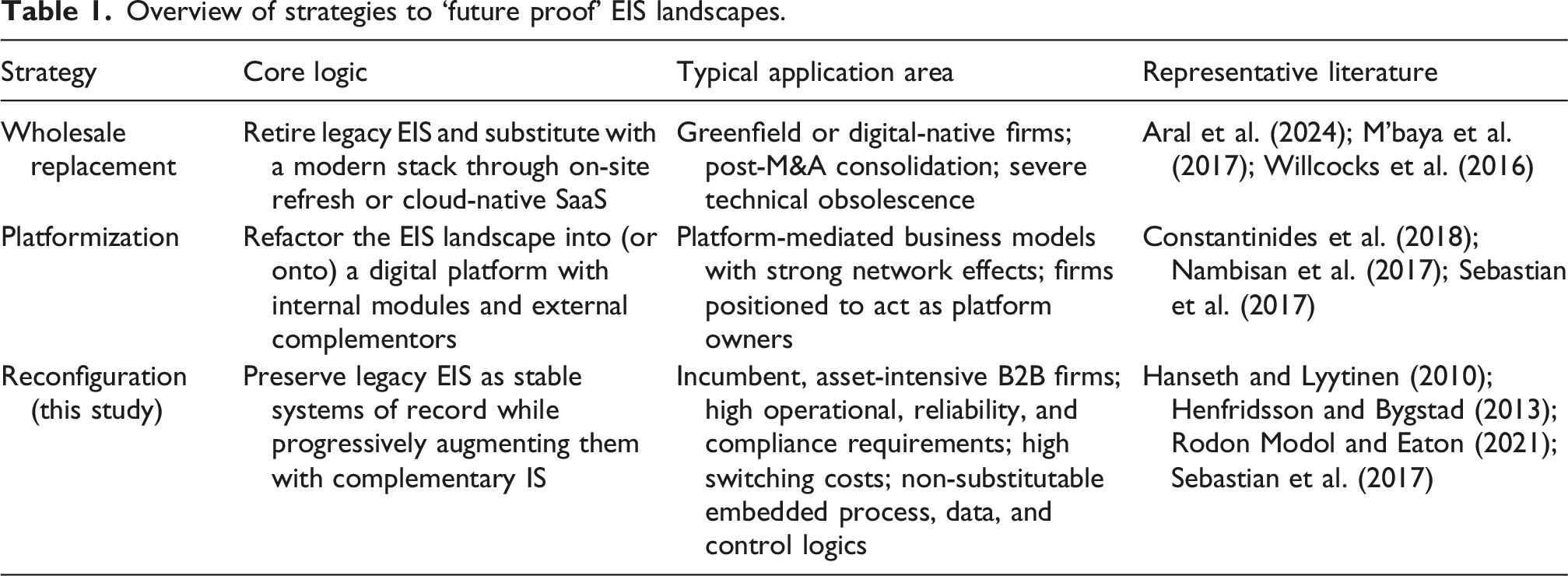
In practice, ‘future proofing’ EIS landscapes is particularly challenging for incumbent firms (Aryal et al., 2023). These organizations operate within deeply entrenched organizational structures and rely heavily on vendor-controlled EIS, which constrain their ability for system modification (Ross et al., 2019). To mitigate these constraints, incumbent firms typically reassess whether their legacy EIS remain aligned with evolving operational and strategic objectives (Grover and Lyytinen, 2023). Whenever this is not the case, legacy EIS are considered sources of technical debt (Avgeriou et al., 2025) that should ideally be replaced (e.g., Rinta-Kahila et al., 2023). Yet, such ‘clean-slate’ replacements are often misaligned with ongoing operations (Hanseth and Lyytinen, 2010). This creates persistent tensions between legacy EIS constraints and ambitions for enterprise transformation, and positions technical debt as a central construct for investigating the evolution of IS in enterprise settings more broadly. In what follows, we explore the intersection of EIS and technical debt in more detail.
Enterprise information systems and technical debt
Concepts, antecedents, and consequences of technical debt and legacy EIS.
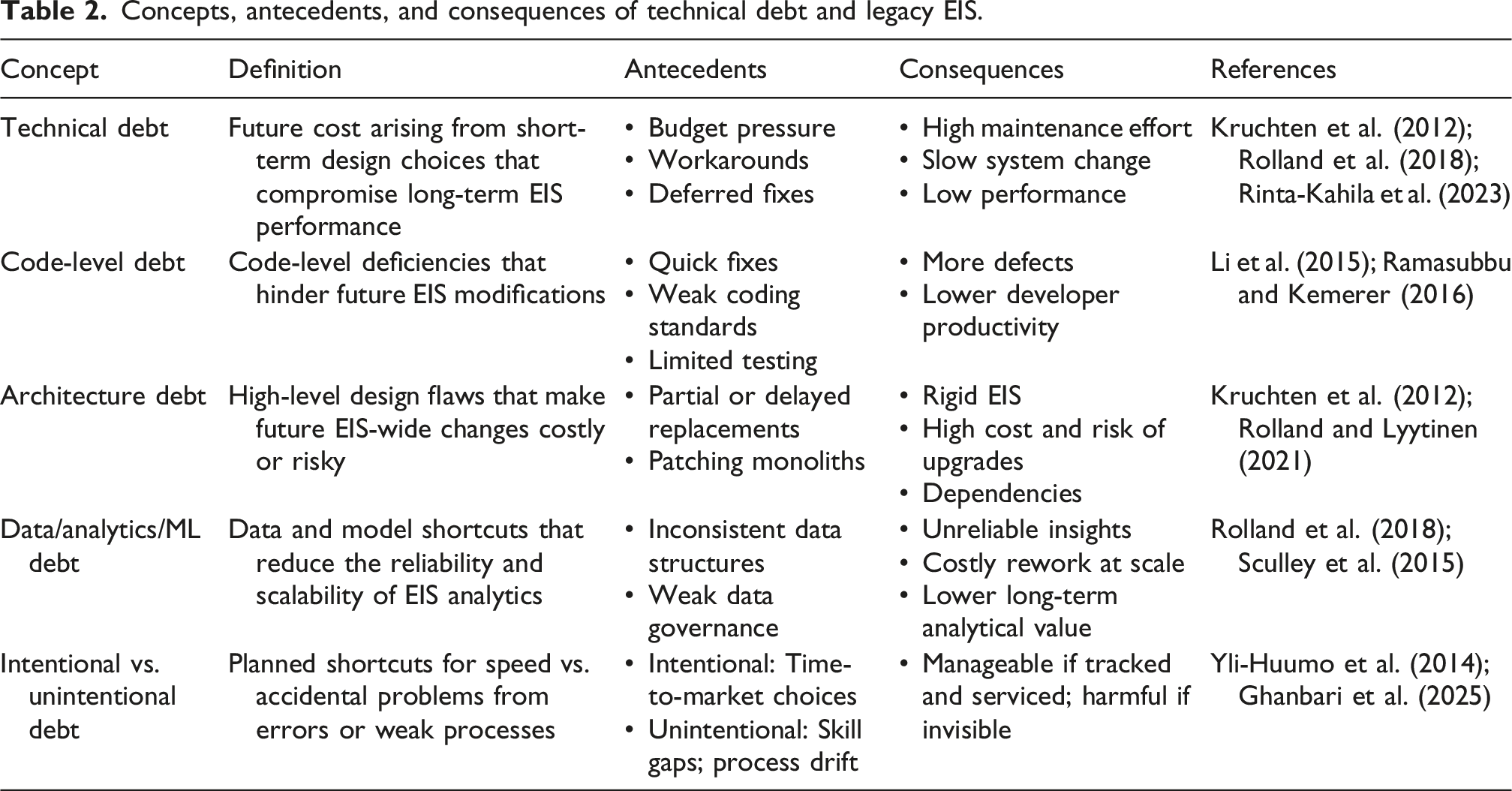
IS research has investigated the role, implications, and management of technical debt (e.g., Ampatzoglou et al., 2015; Magnusson et al., 2018). Indeed, this literature provides many valuable insights related to technical debt as it relates to the codebase (Li et al., 2015), enterprise architecture (Kruchten et al., 2012), and specific functionalities (Sculley et al., 2015) of legacy EIS (e.g., Banker et al., 2021). However, we also observe a critical tension in this literature, wherein legacy EIS are simultaneously conceptualized as liabilities when unmanaged and as assets when effectively controlled.
One dominant literature stream considers legacy EIS as sources of technical debt (e.g., Banker et al., 2021; Fürstenau et al., 2019; Rinta-Kahila et al., 2023), resulting in organizational inflexibility (Banker et al., 2021), increased maintenance costs (Ramasubbu and Kemerer, 2016), or the inability to adopt new digital technologies (Fürstenau et al., 2019). However, equating legacy EIS with technical debt constitutes an analytical oversimplification, since legacy EIS do not inherently represent technical debt per se; rather, technical debt emerges in relation to how legacy EIS are developed, extended, and embedded in organizational contexts. Technical debt, therefore, is one outcome of complex socio-technical processes that may be intentional (Yli-Huumo et al., 2014) – for example, to enable rapid experimentation (Brown et al., 2010) – or unintentional (Klinger et al., 2011) – for example, arising from coordination breakdowns. Put differently, while legacy EIS themselves are not technical debt in every instance, the ways in which these systems are extended, modified, or embedded can create liabilities (Rolland et al., 2018). These liabilities, in turn, may result in diminished organizational performance (Rolland et al., 2018), increased cost (Rolland and Lyytinen, 2021), or reduced staff productivity (Ramasubbu and Kemerer, 2016).
A second literature stream draws on Hanseth and Lyytinen’s (2010) installed base perspective to frame legacy EIS not as technical debt, but as generative infrastructures, arguing they may represent assets, as potentially untapped sources of future enterprise transformation (Avgeriou et al., 2016; De Cuyper et al., 2020; Leiting et al., 2022; Sutcliff et al., 2019). This work builds on earlier IS contributions showing how firms intentionally accumulate technical debt, for example by deliberately postponing costly replacements to prioritize rapid market responsiveness (Brown et al., 2010) or by retaining legacy EIS while incrementally modernizing their EIS landscape through APIs, microservices, or cloud extensions (Sebastian et al., 2017). More recent work argues that legacy EIS embody stable transaction logics, standardized processes, or historical datasets, which may be leveraged to foster organizational renewal (Lokuge et al., 2025). As such, legacy EIS can serve as a much-needed foundation for “digital reinvention” (Sutcliff et al., 2019: 4), an argument echoed by De Cuyper et al. (2020) and Leiting et al. (2022), who suggest legacy EIS may be ‘reconfigured’ – a process involving the merger or extension of current capabilities with emerging digital technologies. This view contrasts starkly with prior work that adopts a technical debt perspective and advocates for large-scale system overhauls, such as replacing legacy EIS with cloud alternatives (M’baya et al., 2017) or shifting them to external providers (Willcocks et al., 2016).
Ultimately, the unresolved tension between legacy EIS as a liability versus asset in the IS literature motivated us to explore the changing role of EIS in enterprise contexts by asking how incumbent firms reconfigure their installed base of legacy EIS for enterprise renewal.
Design capital as an analytical lens to explore legacy EIS reconfiguration
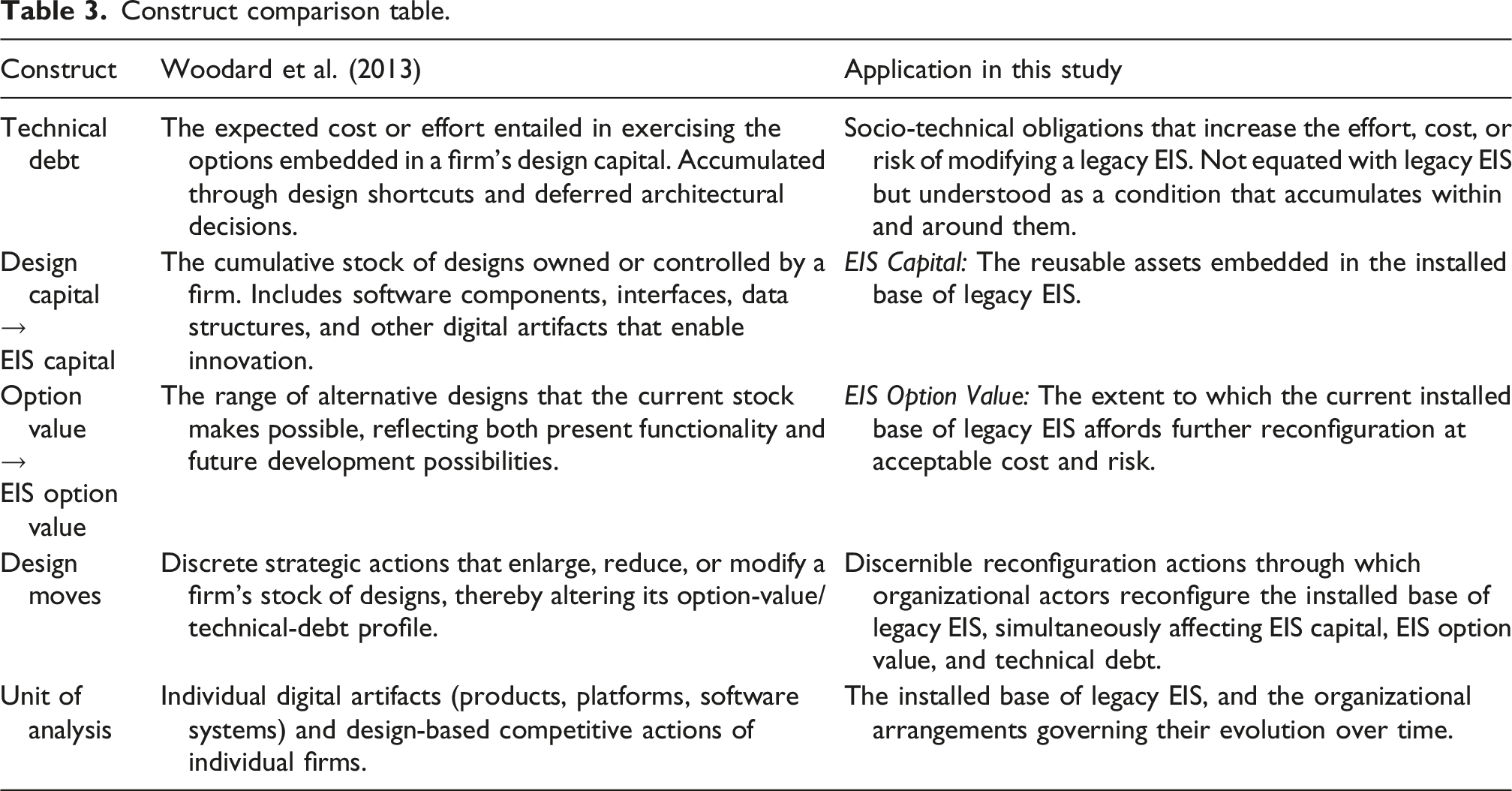
To capture and describe how incumbent firms reconfigure their installed base of legacy EIS for enterprise renewal, we draw on Woodard et al.’s (2013) design capital framework as our analytical lens. This framework offers a well-established vocabulary for theorizing how digital resources are mobilized under technical debt constraints and has increasingly been applied in IS research to study technical debt at the organizational level. Prior studies, for example, used Woodard et al.’s (2013) design capital framework to examine the effects of technical debt on enterprise software reliability (Ramasubbu and Kemerer, 2016), its implications for firm performance (Banker et al., 2021), or the dynamics of legacy IS discontinuation (Rinta-Kahila et al., 2023). Building on this precedent, we here use Woodard et al.’s (2013) constructs to investigate legacy EIS reconfiguration as follows:
First, following Woodard et al. (2013), we conceptualize technical debt as socio-technical obligations that increase the effort, cost, or risk of modifying an existing IS. In the context of legacy EIS, such obligations may manifest as rigid architectures that resist extension, fragmented data structures that impede analytics, or governance arrangements that complicate modification (e.g., Kruchten et al., 2012). This conceptualization of technical debt is important because we do not equate legacy EIS with technical debt per se; rather, we conceptualize technical debt as accumulating within and around legacy EIS as they evolve over time.
Second, Woodard et al. (2013) conceptualize design capital as the cumulative stock of reusable assets embedded in the IS that are available to an organization. We thus refer to EIS capital as the cumulative stock of reusable assets embedded in the installed base of legacy EIS, including standardized process logics, historically accumulated and organizationally validated data, and established control structures, and the organizational knowledge associated with legacy EIS use and governance.
Third, Woodard et al. (2013) define option value as the range of possible future initiatives (e.g., the development of a new digital market offering) that an organization’s design capital can support at acceptable cost and risk. Accordingly, we conceptualize EIS option value as the extent to which an installed base of legacy EIS enables reconfiguration.
Construct comparison table.
Research method
Research design
We selected a research design that enables us to explore, explain, and build theory from the phenomenon of legacy EIS reconfiguration. Multiple case studies are considered especially suitable for this purpose (Eisenhardt, 1989; Yin, 2015) as they allow us to examine variations in legacy EIS reconfigurations across different organizational contexts. We furthermore employ Bygstad et al.’s (2016) mechanism-based theorizing approach. Consistent with other IS studies pursuing mechanism-based theorizing in case research (e.g., Henfridsson and Bygstad, 2013; Lehmann et al., 2022; Stohr et al., 2024), our research thereby intends to identify generative mechanisms – “the causal structures that may or may not be activated in order to produce a certain ‘outcome’” (Øvrelid and Bygstad, 2019) and explain “how the cause produces its effects by describing the process by which this happens” (Ylikoski, 2019: 16). Specifically, generative mechanisms explain the causal paths (Sayer, 1992) with which incumbent firms reconfigure their installed base of legacy EIS for enterprise renewal, the contextual factors underpinning this process, and the outcomes thereof (Ylikoski, 2019). Conversely, research designs like variance-based quantitative work (Mohr, 1982) would have required stable, comparable constructs and large-sample measurement over time, which would have been difficult given the path-dependent and heterogeneous character of EIS reconfiguration trajectories. Similarly, a purely interpretive qualitative approach (Klein and Myers, 1999; Walsham, 1995) would foreground meanings and sensemaking but would not, by itself prioritize the causal process explanation that is central to our study, and mixed methods (Venkatesh et al., 2013) would be better suited for subsequent testing once mechanisms have been specified.
Case selection
We selected cases through criterion-based theoretical sampling – that is, the deliberate inclusion of research settings that meet specific theoretical or empirical criteria relevant to the phenomenon under investigation (Yin, 2015). We ensured that all cases (1) were comparable; (2) sufficiently represented legacy EIS reconfiguration as our phenomenon under investigation, and (3) provided empirical access. Indeed, the analytical, rather than statistical, generalizability of multiple case studies follows a replication logic in which each additional case either confirms or extends emerging theoretical insights, and each case “serves as a distinct experiment that stands on its own as an analytical unit” (Eisenhardt and Graebner, 2007: 25). A case protocol (Yin, 2015) helped us structure our criterion-based theoretical sampling process:
First, to ensure all cases were comparable and that our phenomenon of interest was observable, the empirical setting had to be deliberately bound – an inevitable trade-off between generality and specificity (Weick, 1979). We therefore identified incumbent firms within the German manufacturing sector, a context where legacy EIS reconfiguration is especially visible. Specifically, German manufacturing incumbents have operated consistently for multiple generations (Carroll and Hannan, 2000), experience long product life cycles measured in decades, serve export-oriented B2B customers with stringent reliability and compliance requirements, and sustain vertically integrated industrial operations (Porter, 1985). Many exhibit governance characteristics associated with the German “Mittelstand” tradition, including specialized market positions, continuity-oriented family ownership, and strong regional embedding, which creates a comparatively conservative organizational culture that favors incremental rather than disruptive change. Consequently, in this setting, legacy EIS reconfiguration emerges as the dominant mode of enterprise transformation, making the underlying mechanisms observable.
Second, we aimed to identify incumbent firms who successfully reconfigured their legacy EIS over time. We defined success as instances wherein the installed base of legacy EIS remained operational as the incumbent firm’s transactional backbone (that is, no ‘rip-and-replace’ occurred) and wherein the incumbent firm had pursued a reconfiguration trajectory that culminated in an operational EIS landscape that facilitated the incumbent’s enterprise renewal objectives – for example, by creating new digital offerings, servicing existing operations more efficiently, or generating new revenue streams. Incorporating successful instances of EIS reconfiguration was desirable because incumbent firms who succeeded in this process likely overcame challenges in doing so, and participants would therefore be able to explain how they accomplished it. This would, in turn, enable us to delineate effective managerial guidelines.
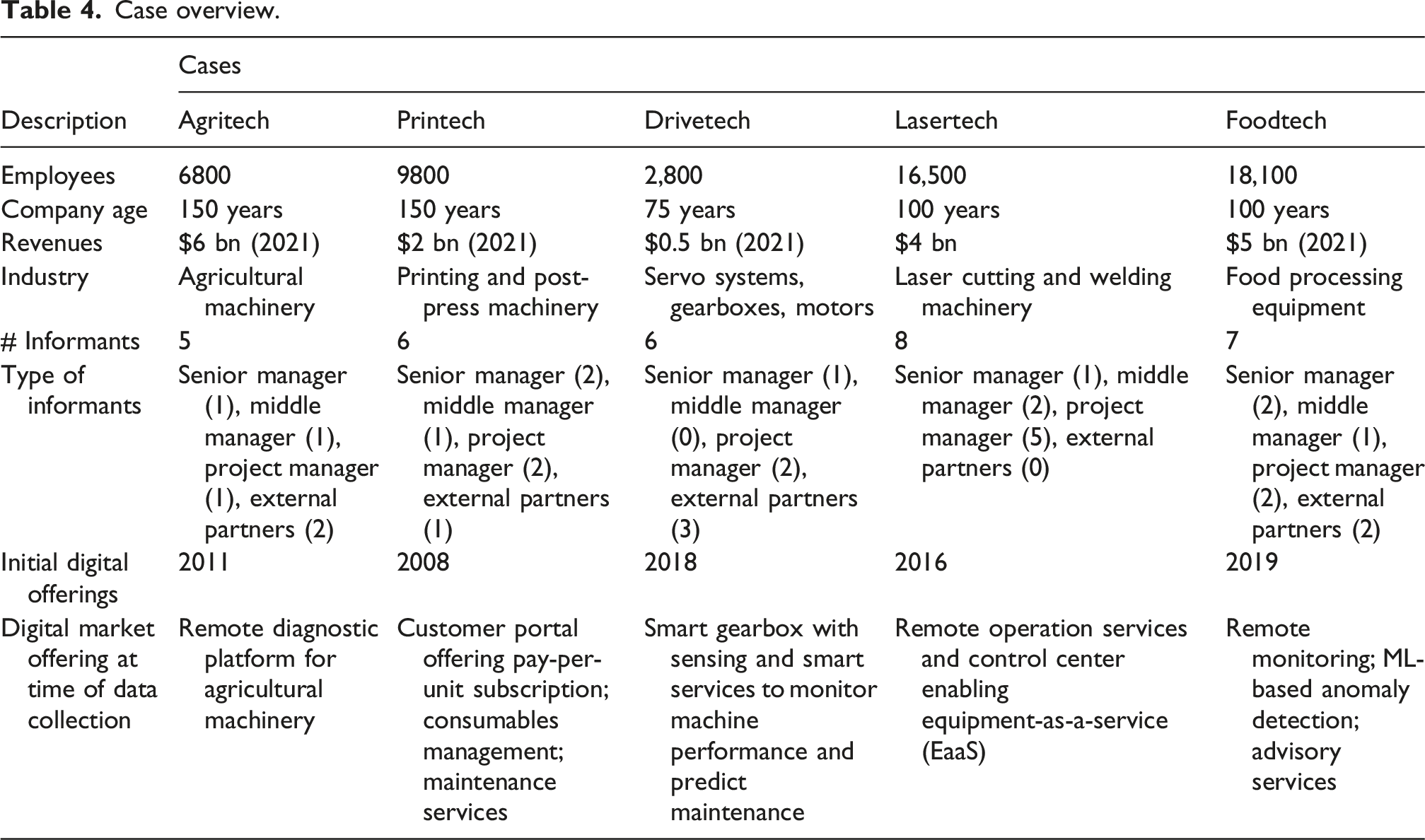
Case overview.
Overview of legacy EIS across cases.
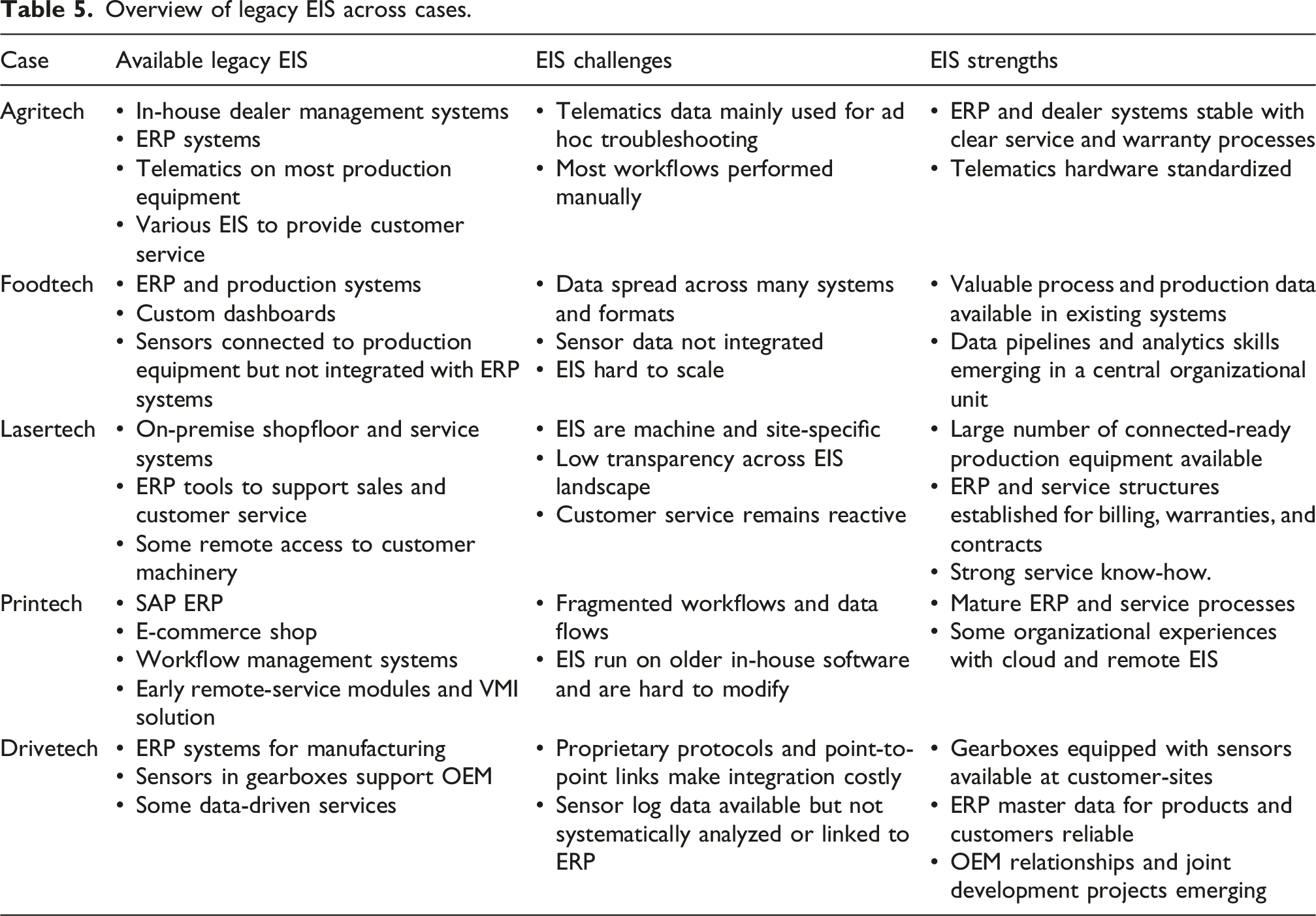
Data collection
We collected primary data through semi-structured interviews with 32 key informants. These include EIS users and managers across roles described to us as senior executive, project manager, middle manager, or external partners involved in the management of legacy EIS. Specifically, we followed Merriam and Tisdell’s (2016) advice to select participants able to provide “specialty rather than average opinion” (2016: 96) and recruited individuals “from different hierarchical levels, functional areas, groups […] who view the focal phenomenon from diverse perspectives” (Eisenhardt and Graebner, 2007: 28). Appendix C provides an overview of our informants.
Each semi-structured interview took place face-to-face, lasted approximately 60 minutes, and was audio recorded. Interviews focused on the historical evolution of each incumbent’s EIS landscape, decision-making and governance around legacy EIS, challenges encountered during reconfiguration, sector-specific constraints, and participants’ assessments of the outcome of their EIS reconfiguration journey. We used a common interview protocol developed from relevant literature (Rubin and Rubin, 2011), but avoided academic terminology so that participants could express ideas freely and articulate experiences in their own terms (Coviello, 2005; Myers and Newman, 2007). Consistent with Eisenhardt (1989), we asked each informant the same core questions but iteratively refined follow-up questions as new insights emerged. All interview recordings were transcribed verbatim. Our interview protocol is available in Appendix D.
We also collected 1300 pages of secondary data in the form of field notes, case-documentation, archival documents (e.g., corporate regulatory filings and reports), industry whitepapers, and press releases. Utilizing multiple sources of evidence was appropriate given our intent to build theory (Eisenhardt, 1989) and given the multiple case study method (Yin, 2015). We used the secondary data to document and track the progression of key events that took place within our case organizations (e.g., the critical events indicated in Appendix B) and to corroborate their timing and the descriptions discussed in interviews. For example, product and service descriptions from Foodtech’s website and announcements in an external industry newsletter helped us document the introduction and evolution of enterprise-wide digital offerings referenced by interviewees, here indicated as critical events F10 and F13 in Appendix B. We ceased all interviewing and secondary data collection once additional data no longer generated substantively new insights (Merriam and Tisdell, 2016).
Data analysis
Our data analysis aimed to uncover the generative mechanisms through which incumbent firms reconfigured their legacy EIS. To do so, we followed Bygstad et al.’s (2016) mechanism-based theorizing procedure, iterating through seven steps: (1) constructing event histories, (2) mapping socio-technical structures, (3) abductively re-describing the phenomenon using Woodard et al. (2013) as our analytical lens, (4) inferring affordances and constraints, (5) analyzing design moves (retroduction), (6) composing mechanisms, and (7) validating them across cases. Throughout this process, and in line with Bygstad et al. (2016), we iterated between within-case and cross-case analysis, gradually moving from descriptive narratives to explanatory mechanisms. Table 6 summarizes these steps before we explain each step of our mechanism-based theorizing procedure. Step 1: Identify critical events. We constructed detailed event histories for each case to anchor our mechanism discovery in transparent accounts of how legacy EIS and EIS landscapes evolved (Bygstad et al., 2016). We identified critical events, such as the launch of new digital offerings or changes to IT governance, using interview transcripts and corroborated the timing and descriptions using secondary data. For each event, we noted triggering conditions, focal actions, and resulting consequences for legacy EIS. We also noted the wider organizational and market context, to support later causal reasoning. Step 1 of our analysis culminated in case-level timelines and event tables (e.g., A1–A13, P1–P15), which we depict in Appendix B. Step 2: Map socio-technical structures. We identified how socio-technical structures shaped each case (Wynn and Williams, 2012). To do so, we identified and documented relevant actors (e.g., EIS architects), organizational units (e.g., digital hubs), technology artifacts (e.g., legacy EIS), and external partners (e.g., technology vendors). We also captured contextual conditions like regulatory constraints. The resulting structural maps captured how the installed bases of legacy EIS, governance arrangements, and actor relationships conditioned the reconfiguration process. Step 3: Abductively re-describe the phenomenon. As indicated in the background section of this article, we adopted Woodard et al.’s (2013) design capital framework as our analytical lens to reframe our phenomenon under investigation (Bygstad et al., 2016). We therefore conceptualized each case’s installed base of legacy EIS as a configuration of technical debt, EIS capital, and EIS option value. This process involved identifying which parts of an installed base function as liabilities (technical debt), which as assets (EIS capital), and how specific decisions made by relevant actors shape the extent to which given assets support future digital initiatives (EIS option value). This process of abduction helped us understand, for example, that telematics stacks in the case of Agritech could be interpreted as EIS capital. Step 4: Infer affordances and constraints. We used Bygstad et al.’s (2016) affordance-based procedure to clarify how specific socio-technical configurations might generate observed outcomes. To do so, we (1) identified immediate outcomes stemming from legacy EIS reconfigurations (e.g., improved data availability), (2) analyzed socio-technical interactions (e.g., EIS architects working with API gateways), (3) proposed affordances (e.g., exposing functionality via APIs), and (4) specified the stimulating or releasing conditions (e.g., data quality issues). Step 5: Analyze design moves (retroduction). Because some observed patterns were not isolated affordances but sequences of purposeful actions, we conducted a design-move analysis, using Woodard et al.’s (2013) work. We catalogued observed actions as design moves and traced their temporal and causal dependencies. For each design move, we coded its effect on technical debt (e.g., containing architecture debt), on EIS capital (e.g., stabilizing master data), and on EIS option value (e.g., making new services or revenue models credible at acceptable cost and risk). Triangulation of interviews and secondary data improved the robustness of these inferences. Step 6: Compose mechanisms. To compose potential generative mechanisms, we integrated insights across event histories, structural maps, affordance analyses, and design-move sequences to construct higher-level explanatory mechanisms (Bygstad et al., 2016). We identified recurring patterns across cases, dependencies among affordances and design moves, and linkages between micro-level actions and macro-level architectural shifts. We then asked under what conditions these patterns tended to occur, what actions they involved, and what outcomes they produced in terms of technical debt containment and EIS capital activation. This process yielded four generative mechanisms (M1-M4), each characterized by (1) triggering conditions, (2) key design moves, and (3) outcomes expressed as shifts in technical debt, EIS capital, and EIS option value. Step 7: Validate mechanisms. Finally, we refined each proposed generative mechanism, using process tracing, cross-case comparison, and searches for disconfirming evidence (Bygstad et al., 2016; Wynn and Williams, 2012). Within each case, we examined whether alternative explanations could account for the observed patterns without invoking the mechanism. Across cases, we used replication logic to assess whether mechanisms generalized and to refine scope conditions. Each generative mechanism was retained only when it consistently explained the design moves and associated shifts in technical debt, EIS capital, and option value across cases. Data analysis procedure underlying mechanism-based theorizing (adapted from Bygstad et al., 2016).
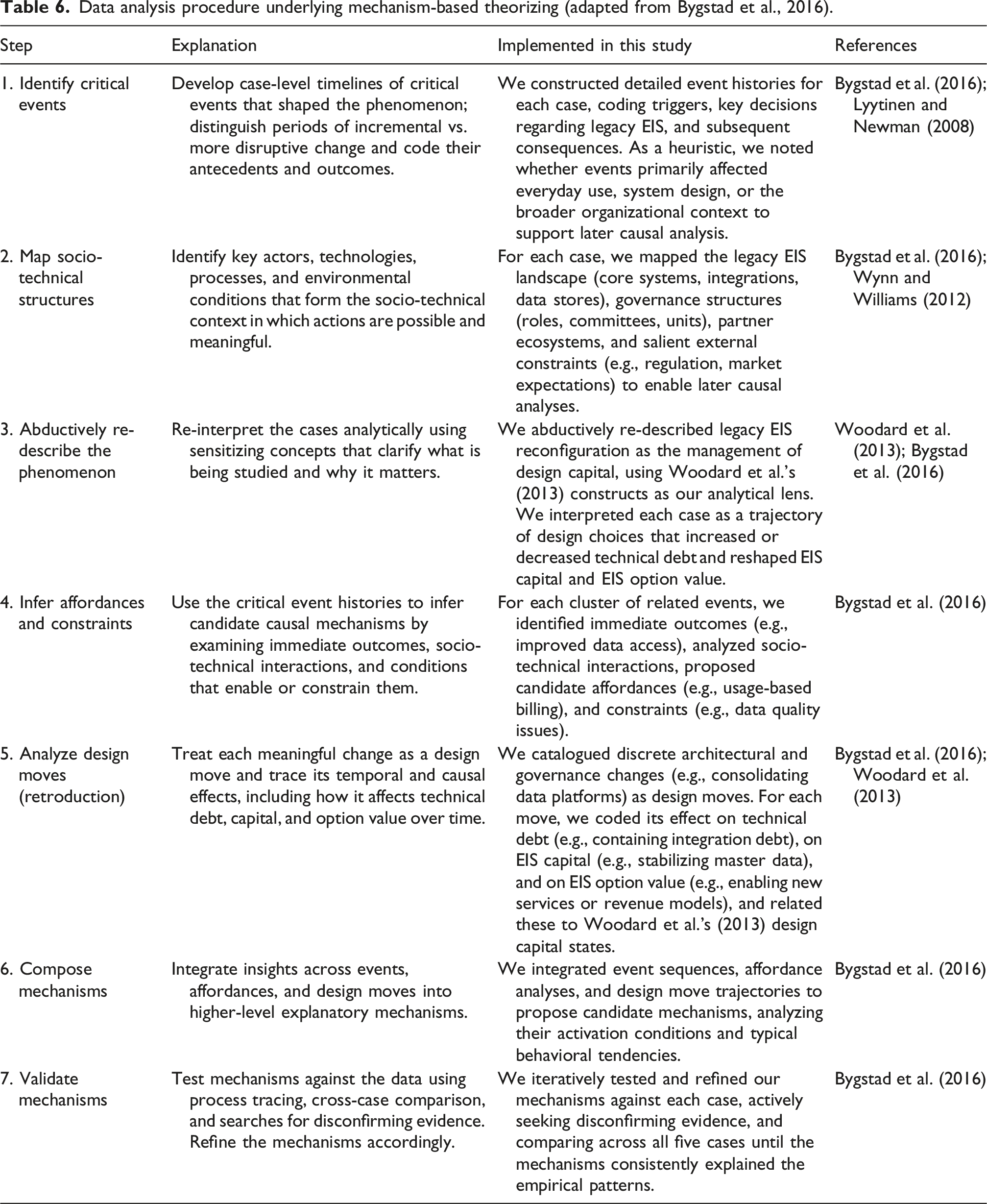
How incumbent firms reconfigure legacy EIS for enterprise renewal
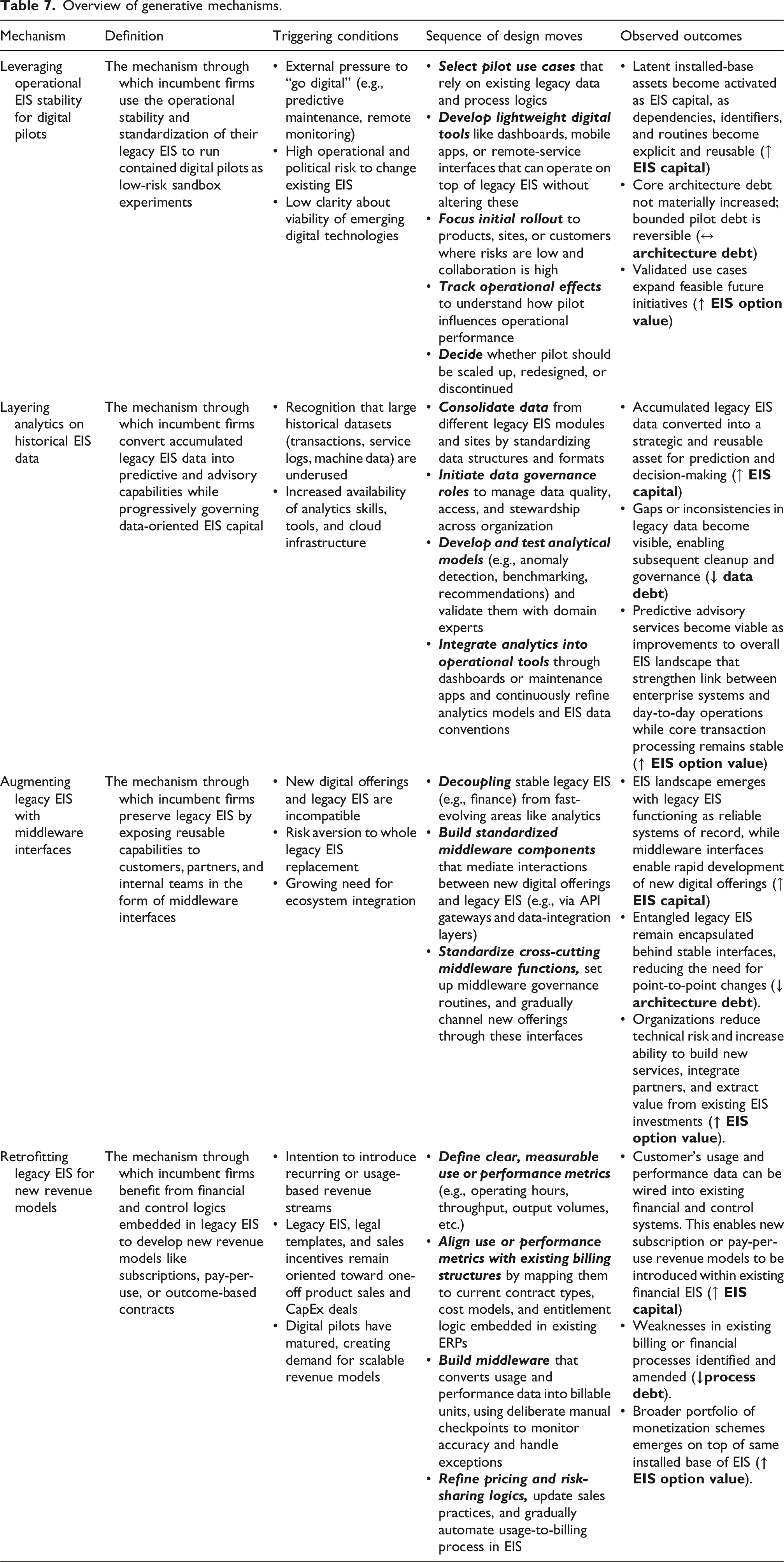
Overview of generative mechanisms.
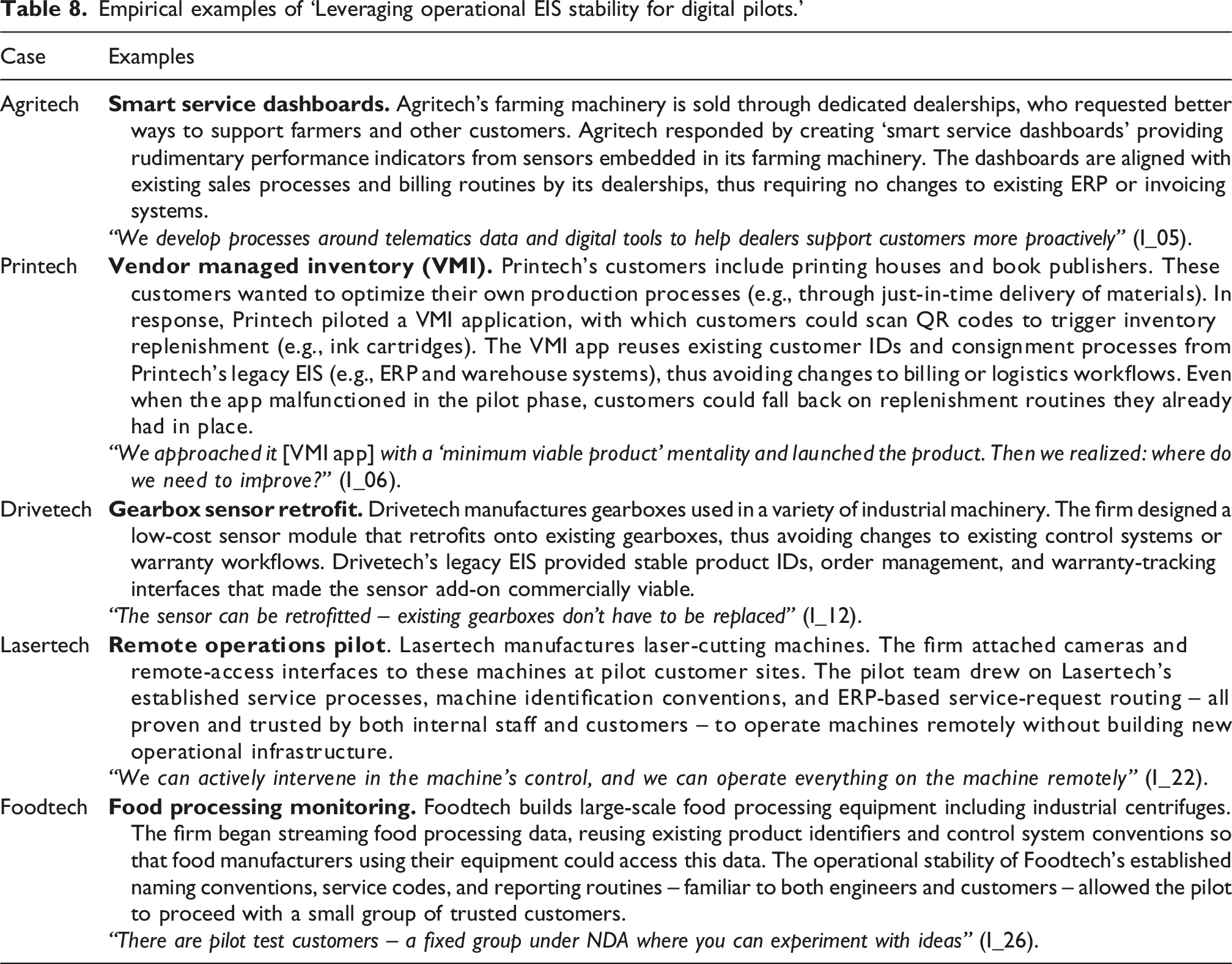
Empirical examples of ‘Leveraging operational EIS stability for digital pilots.’
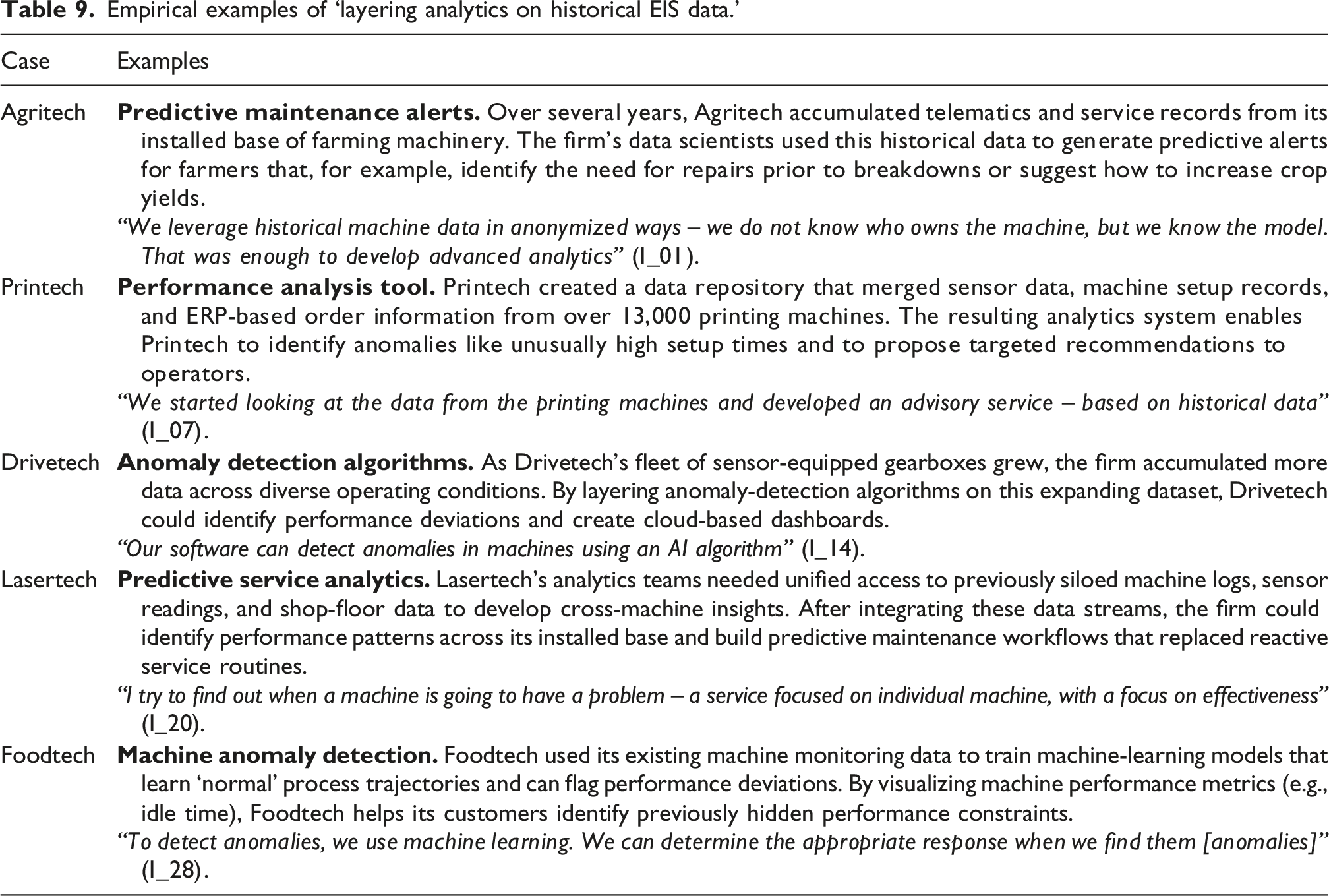
Empirical examples of ‘layering analytics on historical EIS data.’
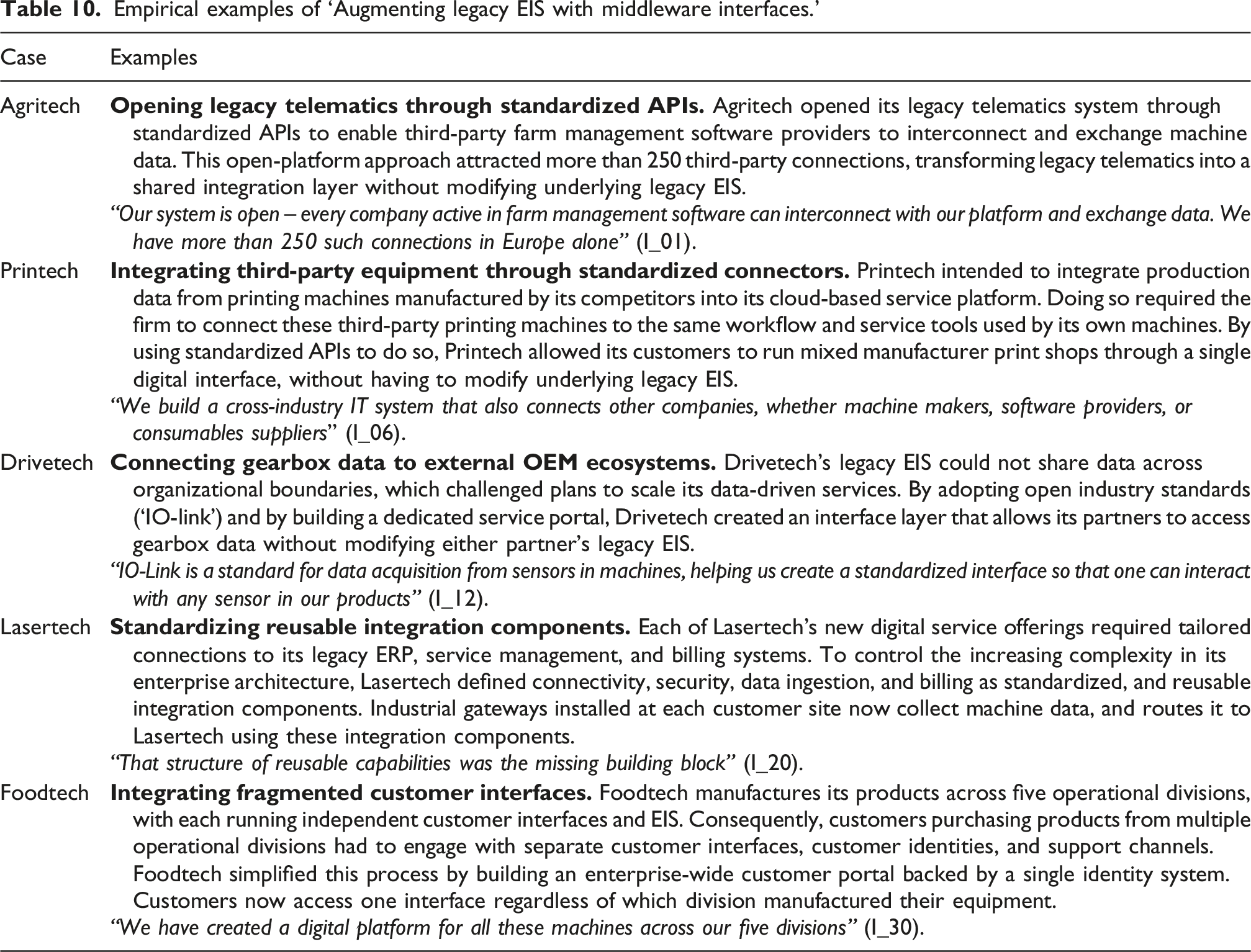
Empirical examples of ‘Augmenting legacy EIS with middleware interfaces.’
Leveraging operational EIS stability for digital pilots
The first generative mechanism (M1) that we identified describes how incumbent firms leveraged the operational stability embedded in their legacy EIS – that is, the reliability of established processes, billing routines, system interfaces, and user familiarity that had accumulated over decades of uninterrupted operation – to initiate new digital pilot projects that would have otherwise been unfeasible. Vignette 1 contextualizes M1 using the case of Foodtech, while Table 8 provides empirical examples for each of our five incumbent firms. We describe the specific context, the design moves, and outcomes for M1 as follows. Foodtech described its first digital pilots as ‘lighthouse projects’. These self-contained, time-bound experiments relied entirely on the operational stability of its existing installed base of legacy EIS and were run by its new digital division that operated as a ‘corporate startup’. As such, this division could draw on established customer relationships, proven service processes, and existing machinery from within Foodtech. As the Chief Digital Officer described, the key advantage was “immediate customer access. I can travel to any country, interview customers, identify customer problems, and find my pilot customers in the established market” (I_26). Each lighthouse project was set up “to try out, develop, and test things” (I_29). One such pilot involved the development of a new condition monitoring system for industrial centrifuges used in food production. Rather than purchasing or building new EIS infrastructure to facilitate this project, the team instead chose to build on what was already there: “our machines are of course equipped with sensors that are needed for machine control. In the first step we did not focus on new sensor hardware; rather, we thought: let’s try to use what we already have” (I_28). The resulting condition monitoring system was a simple, minimum viable product: “a manually triggered system” with “a one-to-one relationship between machine and [user]” (I_28) – and underpinned by existing service-level agreements the team adapted from established service contracts. To keep the scope of the project manageable, Foodtech’s digital division engaged only with a small group of pilot customers under NDA, “where you can test out an idea before scaling” (I_26). The first iterations of each lighthouse project were what the team described as “low-hanging fruits”, such as simple dashboards that presented existing machine data so customers “can immediately see how their machine is running, where there are improvement potentials, or where there are problems” (I_28). However, by validating these ‘lighthouse projects’, Foodtech was able to gradually expand these with more advanced capabilities like anomaly detection. As such, the operational stability of legacy EIS infrastructure, including its sensors, processes, or customer relationships, served as a critical foundation on which digital pilots could be built, tested, and refined without disrupting core operations.Vignette 1. Foodtech
Context
All incumbent firms faced a distinct challenge. Their customers no longer wanted to merely purchase the industrial machines each incumbent had produced and relied on for decades as source of revenue. Instead, customers increasingly requested complementary service offerings like predictive maintenance, connected support, or inventory automation. Our participants further recognized that creating and delivering such services would require significant changes to their legacy EIS, which included ERP, SCM or CRM systems but also highly customized shop-floor production systems. Indeed, one of Agritech’s managers emphasized that even minor modifications to legacy EIS would risk disrupting invoicing processes, delay deliveries, or could interfere with production control: “someone comes along and says, let’s shake it [legacy EIS] up – let’s flip it on its head. It’s disruptive and scary […] it is risky [for us]” (I_05, Agritech). Consequently, early proposals to ‘rip and replace’ legacy EIS failed to pass internal approval processes, as they were ultimately perceived to carry high operational risk without demonstrable short-term benefits. At the same time, the incumbent firms had limited experience using then-emerging technologies such as cloud platforms or embedded analytics, which were considered a prerequisite to create the digital service offerings customers requested. Consequently, each incumbent firm needed to find novel ways to leverage their existing legacy EIS, in ways that would preserve their operational stability, while also allowing for digital pilot projects to experiment with new digital service offerings. One manager explained, “we don’t want to completely overturn this [legacy EIS], but slowly enrich it” (I_29, Foodtech).
Design moves
Table 7 describes the specific sequence of design moves with which the incumbent firms leveraged the operational stability of their legacy EIS for digital pilots. For one, this involved selecting pilot use cases for new digital service offerings. Our participants considered it critical that their digital pilots could rely on existing operational processes, billing routines, or system interfaces already embedded in their legacy EIS. Printech, for example, “didn’t need to retrofit specific sensors” but instead built on existing customer and inventory processes, approaching their digital pilot by “looking at what we already have and [then] figure out how we can use it” (I_06, Printech). The second design move involved the development of lightweight digital tools such as dashboards or apps that operated ‘on top’ of legacy EIS. These were then launching through initial rollouts that were typically limited to specific products, sites, or customers where operational risks were low, and trust was already established. For example, Printech’s vendor-managed inventory (VMI) initiative targeted established customers who were “much more relaxed” when the pilot of its VMI application failed because they could rely on established paper-based routines (I_09, Printech). For example, when the VMI malfunctioned, these customers “would call us 10 minutes later and say ‘there’s a bug, have a look and let me know when it works. I’ll write with pen and paper for now” (I_09, Printech). Consequently, each incumbent firm could test its new digital services in settings where workarounds were available and where potential disruptions could be contained. Across all cases, incumbents tracked the operational effects of their digital pilots, using indicators such as machine uptime, service response times or, in the case of Foodtech, by measuring “Euro [earned] per day” (I_26, Foodtech). These metrics helped firms assess technical feasibility and organizational impact, informing subsequent v) decisions about whether to scale, redesign, or discontinue the pilot.
Outcomes
Leveraging the operational stability of legacy EIS for digital pilots ultimately enabled the incumbent firms in our study to make previously implicit aspects of their installed base of legacy EIS visible and usable. For example, linking existing telemetric data to customer service records required Lasertech’s team to clarify how product IDs, maintenance histories, and customer accounts were structured in their legacy ERP system. In doing so, Lasertech explicitly documented what elements of their installed base were reusable, thus effectively expanding the pool of accessible EIS capital. Similarly, because digital pilots were deliberately designed not to replace or modify legacy EIS, architecture-level debt remained constant. However, our incumbent firms incurred limited forms of what may be described as ‘bounded pilot debt,’ such as temporary workarounds or duplicated interfaces. These were typically easy to reverse – either refactored whenever a digital pilot was scaled or entirely abandoned when a digital pilot was discontinued, without affecting the underlying legacy EIS. Finally, running digital pilots under live conditions allowed incumbent firms to shape tentative ideas into credible options. As one Lasertech manager described the moment a remote operation pilot first succeeded: “suddenly you realize: wow, something like this actually works” (I_22, Lasertech) – thereby expanding EIS option value at acceptable cost and risk.
Layering analytics on historical EIS data
The second generative mechanism (M2) describes how incumbent firms converted long-accumulated data within their legacy EIS into new analytic capabilities. Our incumbent’s legacy EIS contained extensive historical production or usage data that had been collected over decades for administrative or reporting purposes. These historical datasets emerged as critical EIS capital. Importantly, unlike M1 (which addressed uncertainty about whether any digital initiatives were feasible), M2 was triggered by recognizing that valuable data already existed but was trapped in administrative silos. As such, the uncertainty was not about viability, but about data access, data quality, and data governance. Table 9 exemplifies how each incumbent firm layered analytics on historical EIS data. Vignette 2 contextualizes M2 using the case of Drivetech. We then describe the specific context, the design moves, and outcomes of M2. Drivetech had accumulated years of gearbox performance data, including vibration readings, temperature logs, and torque measurements collected by sensors embedded in every unit sold. Previously, this data was used primarily for administrative purposes, such as tracking warranty obligations. The turning point came when Drivetech recognized that these data records could be repurposed. As one product manager explained, Drivetech had chosen to “collect data over the complete lifespan of the gearbox […] And then, when we get the gearbox back in for service, we can look at the data and see how we can improve our gearbox so that [this service incident] doesn’t happen again” (I_13). However, transforming these accumulated data records into actionable insights proved challenging. As an external partner noted, “When you start collecting data, at some point you realize: we now have a lot of data, what do we do with it now? […] When it comes to interpreting the data, it simply becomes difficult because you need so much domain knowledge about the machine, about the component you’re tracking” (I_15). To address this issue, Drivetech began to build analytics capabilities on top of its existing data infrastructure. Specifically, rather than restructuring its legacy EIS (e.g., databases), the firm introduced monitoring dashboards that visualized gearbox performance in real time, followed by the development of anomaly-detection machine-learning models, which did not rely on legacy systems. As one engineer described, “we are working on software that can detect anomalies in machines using an AI algorithm” (I_14), with early versions already tested in live customer settings. For customers, these developments translated into immediate operational benefits. Tasks that previously required manual analysis; for example, spreadsheets with performance data were replaced by automated, cloud-based dashboards, so that customers no longer had to “sit in front of [their] Excel spreadsheet every day and calculate [faults] manually” (I_15).Vignette 2. Drivetech
Context
Across all cases, the incumbent firms recognized that accumulated data (e.g., service logs, sensor readings, production records) were underused but potentially valuable. However, concerns regarding data quality, inconsistent data coding conventions, or fragmented legacy EIS storing this data raised doubts about whether these records were suitable for predictive analytics applications. The key challenge was therefore aligning existing data with potential analytics capabilities within the complex socio-technical constraints imposed by each incumbent firm’s suite of legacy EIS: “We’re still surprised what data we have and how we can use it – even after 15 years” (I_07, Printech).
Design moves
Table 7 depicts the design moves through which the incumbent firms layered analytics onto historical EIS data. This involved first consolidating data from disparate legacy EIS systems by standardizing key identifiers, data structures, and formats, thereby enabling historical records to be read and queried across previously isolated silos. For example, Foodtech “built a data architecture to store data in Azure […] as foundation for analysis” (I_28, Foodtech), Lasertech developed a Data Integration Platform that “unites previously separated databases” from different protocols (I_18, Lasertech), while Printech had been collecting data “since 2000” across “around 3000 sensors” per printing machine, with “over 13,000 machines connected” (I_06, Printech).
A second design move involved introducing data governance roles to manage data quality, access, and stewardship. Within each incumbent firm, dedicated analytics teams coordinated access to shared datasets, resolved inconsistencies, and mediated between domain experts and data scientists. At Agritech, this took the form of institutionalized “machine health teams” in every factory, composed of “data scientists, data engineers, system engineers, product development engineers” (I_01, Agritech), who were responsible for developing and maintaining product-specific analytics models.
A third design move focused on developing and testing analytical models, such as anomaly detection, benchmarking, or recommendation systems, which were iteratively validated with domain experts. Lasertech, for example, described this as “a test and learning phase, where customers pay for participation” (I_18, Lasertech). Finally, these analytics capabilities were integrated into operational tools, including dashboards or remote-operation workflows. For example, Printech’s Performance Advisor identified that a customer needed “20% more setup time” than comparable installations before recommending adjustments (I_06, Printech). Drivetech’s dashboards combined supplier and OEM data (D7), while Foodtech streamed process data to visualize previously unrecognized performance patterns (F7, F8).
Outcomes
Layering analytics on historical EIS data transformed historically accumulated records of data into analytically usable EIS capital. Instead of re-instrumenting their installed base of legacy EIS, the incumbent firms drew on existing log data, sensor readings, or workflow traces to develop new analytics offerings, thus creating strategic options for new data-driven services. In this process, legacy EIS shifted from being primarily systems of record to active sources of operational insight, while newly introduced analytics capabilities enabled rapid experimentation and iterative refinement.
Making historical data analytically accessible exposed gaps and inconsistencies in underlying datasets. For example, missing values, ambiguous identifiers, or uneven data coverage became visible when data were consolidated and analyzed across previously disconnected silos. At Printech, for example, machine sensor data and workflow software collected performance metrics independently, which forced the firm to resolve which source to trust: “sometimes the same data is collected once from the machine and once from the software. Which data do we take?” (I_09, Printech). This challenge ultimately triggered data governance efforts, allowing incumbent firms to incrementally reduce accumulated data debt while improving their analytics capabilities.
Finally, by layering analytics capabilities onto legacy systems, our incumbent firms introduced new predictive and advisory services without disrupting core operations. These services also strengthened the link between legacy EIS and day-to-day decision-making – for example, by embedding recommendations into production workflows. Ultimately, the range of feasible data-driven initiatives expanded, thereby increasing EIS option value.
Augmenting legacy EIS with middleware interfaces
The third generative mechanism (M3) describes how incumbent firms avoided wholesale EIS overhauls by strategically augmenting their legacy EIS through middleware interfaces. As we already explained, discarding or fully replacing monolithic legacy EIS systems was not feasible. Instead, our incumbent firms created EIS landscapes that preserved the operational stability of legacy EIS, but connected these to modern front ends (e.g., cloud environments) through middleware like APIs or microservices, which created interfaces between legacy EIS and digital technologies necessary for enterprise renewal. Table 10 summarizes how incumbent firms augmented legacy EIS with middleware interfaces. Vignette 3 contextualizes this generative mechanism. We then outline the context, design moves, and outcomes for M3. Printech’s customers struggled to engage with the firm’s fragmented landscape of digital user interfaces, which required them to use separate portals for orders, service management, and to production workflows. When Printech began to introduce digital service offerings (e.g., AI-based performance advisors), this fragmentation became untenable. Printech could not replace its suite of underlying legacy EIS, but instead built a unifying middleware layer on top of its existing digital user interfaces, connecting these to a single customer touchpoint in the form of a digital platform. A product manager described Printech’s approach: “we will develop new [user] features in the cloud only, which is connected to this on-premise [legacy] system. Information is exchanged between the cloud and the on-premises workflow” (I_10). Printech thereby explicitly rejected wholesale legacy EIS replacement. As one product manager described: “we don’t do what [software vendor] does, forcing our divisions to move to the cloud all at once. We have a good [EIS] already. We develop new functions in the cloud, but they are connected to the [legacy EIS]” (I_10). Key to this augmentation strategy was the idea that a single customer portal with a single login could address the well-known struggles Printech’s customers had experienced for some time. As one manager explained, “the customer now has only one portal. He needs only one login […] and with one login can access all the functionalities that Printech offers in the digital area. That’s certainly the biggest advantage for the customer” (I_08). While Printech’s augmentation strategy improved customer experiences, the firm’s legacy ERP, production workflow system, and service systems continued to operate as stable systems of record, thus making the augmentation approach financially advantageous. The production workflow system itself, which had evolved over 30 years, served as the architectural ‘spine’. As one manager described, “we integrated the production systems so that the customer can control their complete production with this single system” (I_10). Crucially, Printech’s platform could “receive data from all machines, also third-party ones”, thus integrating equipment by other manufacturers (I_08). This multi-manufacturer integration approach, implemented through standardized APIs, allowed Printech’s customers to manage all equipment through a single interface without reconfigurations needed to Printech’s suite of legacy EIS or to third-party systems.Vignette 3. Printech
Context
Each incumbent firm attempted to scale digital services (e.g., after completion of M1). However, new limitations in their legacy EIS emerged. For example, delivering services like connected support, remote monitoring, or use-based subscriptions required incumbents to connect their legacy EIS to those operated by external partners or customers, adapt underlying processes, and exchange data across organizational boundaries. However, the incumbent’s legacy EIS were not designed for this purpose. Replacing legacy EIS was, once again, not a viable option. At the same time, attempts to create ad hoc interfaces between legacy EIS and EIS operated by external partners increased system complexity, thus effectively deepening architectural debt. Faced with this dilemma, each incumbent firm sought alternative approaches to scale their digital service capabilities, while protecting the operational stability of their legacy EIS. As one Printech manager explained: “what do we have? And how can we leverage it?” (I_06, Printech).
Design moves
Augmenting legacy EIS with middleware interfaces began by decoupling operationally stable legacy EIS domains (e.g., Finance, ERP) from fast-evolving areas requiring rapid change (e.g., analytics, customer-facing services). At Printech, this design move was enacted by introducing a unified customer portal with “one portal, one login” (I_10, Printech) that connected to the underlying legacy systems via APIs, allowing the firm to develop new service functions “only in the cloud” (I_10, Printech) without modifying core legacy EIS. Similarly, Drivetech adopted an industry communication standard and a service portal as a “landing page for every product” (I_12, Drivetech), thus effectively creating an interface layer between customer interaction and underlying legacy systems.
Second, incumbents built standardized middleware components that mediated interactions between new digital services and legacy EIS. These middleware components (e.g., API gateways), provided standardized interfaces through which data and functionalities could be accessed without modifying legacy EIS systems. For example, Agritech’s telematics infrastructure generated performance data from farming machines that its dealers could not access directly because the data was locked inside legacy diagnostic systems. Rather than replacing these legacy systems, Agritech built cloud-based delivery layers between its legacy diagnostic systems and dealer-facing applications that exposed selected telematics data through standardized APIs. A data-consent middleware governed which data could be forwarded to dealers for service delivery versus retained internally for product improvement, ensuring that dealers could access actionable machine insights without direct access to underlying legacy systems. This allowed Agritech to package its services under a common brand – “We are using a common brand for these services, called [brand name]; you will find different packages: select, premium, ultimate” (I_01, Agritech) – without altering the underlying telematics systems.
Third, incumbents standardized cross-cutting middleware functionalities, such as user authentication and billing interfaces, that multiple digital services relied on. This design move reduced the need for individual legacy EIS to be integrated with each newly introduced service offering. At Foodtech, a single identity and access management layer replaced five previously disconnected login systems, giving customers access to dashboards and machine monitoring tools via a single-entry point (I_28, Foodtech). Conversely, Lasertech modularized connectivity, security, and billing logics into individual middleware components. In doing so, every new service that the firm introduced could reuse these middleware interfaces, which the firm called “reusable capabilities” (I_21, Lasertech).
Outcomes
By augmenting their legacy EIS with middleware interfaces, the incumbent firms created an ambidextrous EIS landscape wherein legacy EIS could continue to function as stable systems of record, while other digital technologies (e.g., platforms) enabled the delivery of new service offerings at scale. Indeed, exposing their legacy EIS through middleware interfaces (e.g., APIs, shared identity services), these systems became accessible and reusable, thus effectively increasing EIS capital. Furthermore, augmenting legacy EIS with middleware interfaces reduced the need to modify legacy EIS, which minimized architecture debt. Finally, by decoupling the development of new services from transaction processing in legacy EIS, the incumbent firms reduced technical and operational risk, consequently expanding their EIS option value, as the resulting EIS landscape could support a broader range of future digital service initiatives at lower cost and risk. As one Lasertech R&D director reflected, “once you have a reusable, capability-based infrastructure, you suddenly get emergent behavior – someone who would never have done this before suddenly develops on an edge device where he only needs to write a little software, because he doesn’t have to worry about identity management or connectivity” (I_21, Lasertech).
Retrofitting legacy EIS for new revenue models
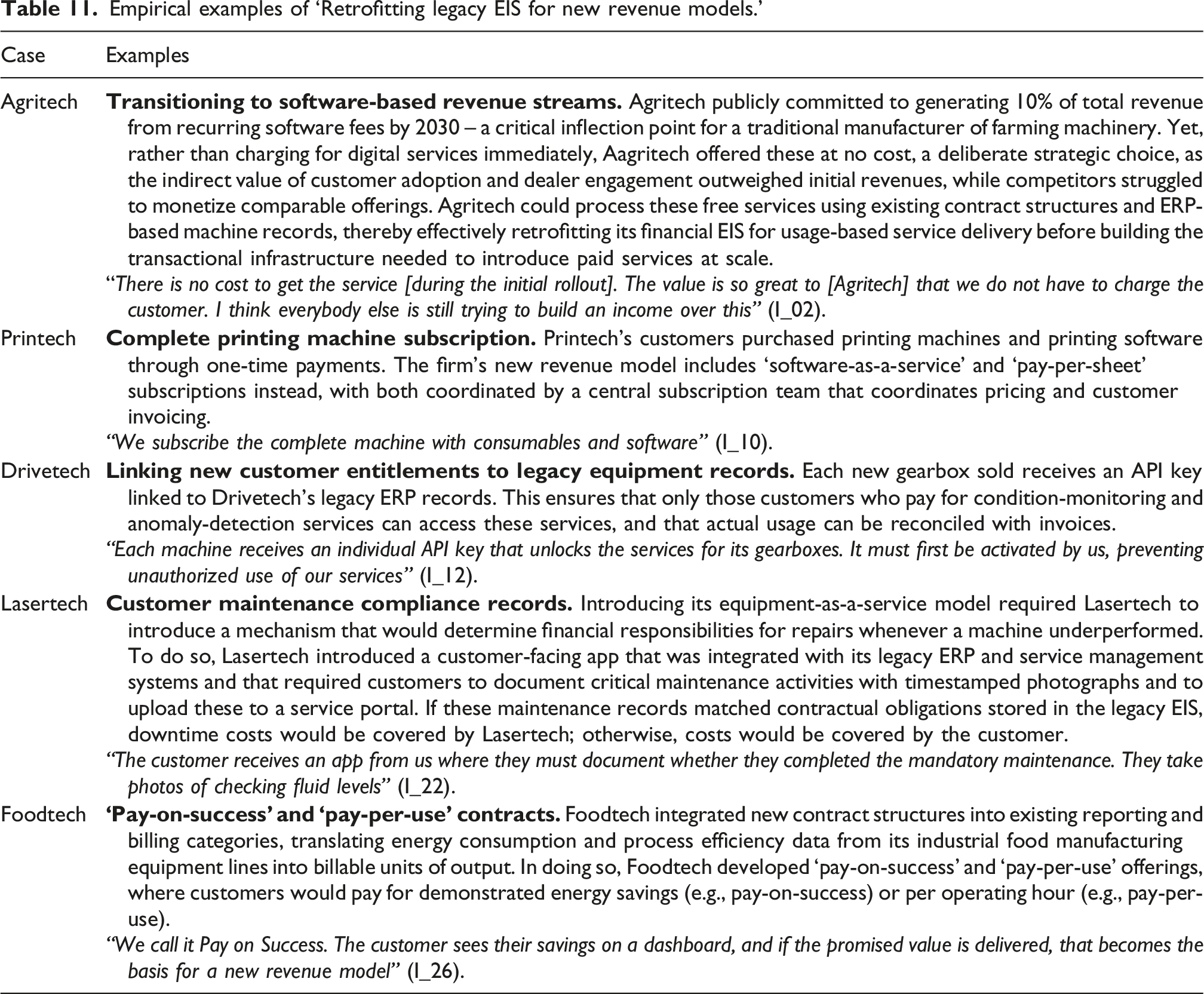
Empirical examples of ‘Retrofitting legacy EIS for new revenue models.’
Vignette 4. Lasertech
Rather than selling laser-cutting tools, Lasertech introduced a new Equipment-as-a-Service (EaaS) revenue model, wherein customers pay ‘per part produced’ rather than purchasing machines outright. However, introducing EaaS required Lasertech to rethink how its legacy financial EIS handled billing and sales incentives. One R&D manager explained: “the customer says what part they want. We quote a price, they say ‘yes,’ and then we produce that part at the pre-agreed costs on the machine standing on the customer’s shop floor” (I_20).
Lasertech’s EaaS offering required the firm to convert machine use data (e.g., parts produced, operating hours, or material consumption) into monthly invoices that could be processed by its existing SAP-based ERP system. Yet, no suitable interface existed because each invoice required manual checks before being passed to Lasertech’s billing department: “we have a system that tells us the invoice amount per month […] but that doesn’t go directly into SAP because we need manual verification somewhere, ‘Is this really correct? Hasn’t anything been forgotten?’” (I_24). While this semi-manual approach initially allowed Lasertech to identify and fix pricing errors or missing cost allocations, it also served as a stepping stone for incrementally wiring billing logic into the legacy EIS – thus deliberately retrofitting, rather than replacing, existing SAP-based processes to save cost: “you always have to ask yourself, how much money do I invest to fully automate from scratch?” (I_24).
EaaS also exposed a deep misalignment in Lasertech’s existing sales incentives. Sales representatives earned commissions on one-time machine sales, but EaaS subscriptions did not provide these, which one salesperson explained: “if I have to convince a customer of something that only brings me monthly payments of 9.99 Euros, then I simply won’t do it” (I_19). Lasertech responded by reconfiguring its ERP-based commission templates around recurring revenue, embedding new cost-sharing and risk-sharing rules directly into the financial EIS: “if the machine stands idle, the customer loses money, but we also lose money. So, we’re invested in the machine being productive” (I_22). This structure, eventually wired into existing ERP and contract frameworks, made outcome-based pricing operational without having to replace financial legacy EIS.
Context
All incumbent firms began to shift their revenue model from one-off machine sales to recurring, subscription-based revenue models that monetized actual use or outputs. However, their financial legacy EIS, reporting routines, legal templates, or sales incentives remained geared to one-off sales, and that had resulted in rigid billing, contracting, and sales routines. Building new financial EIS risked loss of control and compliance. Replacing old ones would jeopardize current operations. However, the digital pilots from M1 eventually matured to the point where usage-based revenue models became possible, and incumbents identified new ways to retrofit their installed base of financial legacy EIS accordingly.
Design moves
The incumbents retrofitted legacy EIS for new revenue models through four interrelated design moves that we summarize in Table 7. First, they defined clear, measurable use or performance metrics such as operating hours or output volumes, which served as the foundation for invoicing. For example, at Printech, pay-per-sheet subscriptions depended on accurately measuring print-volumes, and linking these to customers, machines used, and contracts in the existing ERP system (P2, P3, P8, P12). Similarly, Drivetech assigned each gearbox an API key tied to ERP equipment and contract records so that “billing and license management [for the digital services] is clean” (I_12, Drivetech), while Lasertech’s equipment-as-a-service concept defined pay-per-part arrangements based on output, albeit initially “checked manually” (I_22, Lasertech).
Second, incumbents aligned use or performance metrics with existing billing structures by mapping them to ERP fields, contract types, and cost models embedded in legacy financial EIS. Rather than introducing entirely new billing logics, the incumbent firms extended existing ERP configurations to accommodate usage-based pricing, thereby ensuring that new revenue streams could be processed within established financial processes. While this appears as a seemingly mundane configuration task, it proved foundational. For example, Agritech extended existing ERP fields for machine serial numbers to accommodate digital service metrics (A11, A12), while one of Lasertech’s managers described this design move as “the proper setup of SAP processes so that monthly payments work well” (I_18, Lasertech).
Third, incumbents built middleware to convert usage and performance data into billable units. This required aggregating machine and operational data and translating these into units recognizable by legacy ERP and CRM systems (e.g., sheets, parts, operating hours, or efficiency gains). Initially, this was deliberately implemented in a semi-manual manner, so staff could monitor calculations, handle exceptions, and learn where pricing or allocation logic failed. For example, at Printech, mispriced pay-per-sheet contracts that “pop up in every meeting” (I_07, Printech) revealed inconsistencies in cost assumptions and usage profiles. At Drivetech, subscription options and “drive solutions as a service” relied on manual validation before scaling (I_12 and I_13, Drivetech), while Lasertech’s pay-per-part billing exposed integration and pricing challenges in financial legacy EIS (L9, L11).
Fourth, incumbents refined pricing and risk-sharing logics, updated sales practices, and gradually automated the full usage-to-billing process. For example, Printech established new sales teams that were “incentivized on successful pay-per-use partnerships” (I_06, Printech). Drivetech strengthened the revenue mandate of its digital unit “to generate earnings from digitalization” (I_12, Drivetech) while developing new contract templates (D14), and Lasertech “integrated EaaS into the mainstream organization” (I_20, Lasertech) by working with insurers to define outcome-based risks because “if real production takes twice as long, it is our risk as provider rather than the customer’s” (I_19, Lasertech).
Outcomes
Retrofitting legacy EIS for new revenue models enabled the incumbent firms in our study to integrate performance data like output volumes, operating hours, or efficiency measures from industrial machinery into their legacy financial EIS, and to thereby introduce new subscription, pay-per-use, or outcome-based revenue models. As such, previously separate operational and financial data became integrated and usable, thereby increasing EIS capital. As one manager reflected, “all intelligence that is technologically extractable from the machine makes the overall billing process much simpler” (I_10, Printech).
Implementing new billing logics, however, also exposed weaknesses in existing financial and control processes. Issues such as incomplete contract structures, misaligned cost models, or gaps in billing logic became visible when usage-based data was translated into invoices. At Lasertech, the manual billing bridge between the EaaS system and SAP revealed where contract structures and cost models needed updating (L9, L11). At Printech, mispriced contracts served as learning opportunities: “we have performance-based, usage-based pricing for the end customer […] the customer gets everything from us and we measure usage and based on usage they get an invoice” (I_11, Printech). Rather than bypassing these limitations, incumbents amended their legacy EIS and processes, introducing new rules, templates, and controls. These adjustments reduced accumulated process debt by improving the consistency and reliability of financial operations.
Finally, by building new capabilities on top of the installed base of legacy EIS, a broader portfolio of monetization schemes emerged. The incumbents were no longer limited to one-off machine sales, but could combine subscriptions, pay-per-use, and outcome-based pricing using the same legacy EIS. This expanded the range of viable revenue models without requiring fundamental system replacements, thereby increasing EIS option value and strengthening the ability of each incumbent’s EIS landscape to support future enterprise renewal. As one Foodtech manager described, the progression from “subscription models for digital services” to measurable outcomes “carries the title ‘Pay on Success’ for us” (I_26, Foodtech).
Discussion
The IS literature previously framed legacy EIS as sources of technical debt that can result in a liability when unmanaged (e.g., Kruchten et al., 2012) as well as an asset for organizational renewal when effectively controlled (Sutcliff et al., 2019). However, how organizations can – or should – manage this tension remained underexplored. This is problematic because, without a clearer account of how technical debt accumulates in and around legacy EIS, and how organizations can contain its effects while simultaneously mobilizing their legacy EIS for enterprise renewal, IS scholarship cannot fully explain EIS modernization trajectories and their future socio-technical evolution – a central focus of this Special Issue in the Journal of Information Technology. Likewise, limited empirical evidence leaves practitioners without guidance where legacy EIS replacement is neither feasible nor desirable (e.g., Rinta-Kahila et al., 2023).
Against this backdrop, we empirically investigated how five German incumbent firms set in the manufacturing sector successfully reconfigured their legacy EIS, and applied Bygstad et al.’s (2016) mechanism-based theorizing approach to uncover the generative mechanisms through which this process is enacted. We identified four generative mechanisms, their causal powers, boundary conditions and outcomes, and explained how each contained or reduced technical debt, reshaped EIS capital, or expanded EIS option value (Woodard et al., 2013). As such, our study extends IS contributions that framed technical debt as a simple liability to be overcome (e.g., Banker et al., 2021; Kruchten et al., 2012; M’baya et al., 2017), early studies that suggested incumbent firms may benefit from their installed bases of legacy EIS (De Cuyper et al., 2020; Leiting et al., 2022), but also contributions that investigated how platforms, cloud-based systems or data can serve as a foundation for digital innovation (e.g., Nambisan et al., 2017). Specifically, in positioning our study in relation to the extant IS literature, we acknowledge that platform, data and cloud technology themes are represented in our findings, but note that prior IS research investigating these themes typically did not focus on technical debt or legacy EIS; instead, IS research either investigated causal links between cloud or platform capabilities and innovation outcomes (e.g., Battleson et al., 2016) or explored digital transformation processes irrespective of an installed base of legacy EIS (Mann et al., 2022). In what follows, we delineate and discuss the theoretical implications that arise from our work.
Theoretical implications
Our theoretical contribution consists of an empirically grounded, mechanism-based theory of legacy EIS reconfiguration, which explains how incumbent firms reconfigure installed bases of legacy EIS into EIS landscapes that preserve operational stability while simultaneously facilitating enterprise renewal. Woodard et al.’s (2013) design capital framework enabled us to interpret and conceptualize legacy EIS landscapes as portfolio-level configurations of EIS capital, technical debt, and EIS option value. This reframing foreground that technical debt is not a single deficit located in ‘the legacy EIS’, but a configuration of obligations across code, architecture, data/analytics, and processes that raise the cost and risk of future digital change. Figure 1 visualizes the theoretical core of our argument. Table 12 summarizes each generative mechanism we identified. We here delineate propositions as testable theoretical claims to specify the boundary condition under which each mechanism is enacted (e.g., a specific debt configuration), the transformation it enables (e.g., the relationship between EIS capital and technical debt), and the outcomes it produces (e.g., shift in EIS option value). Visualizing a mechanism-based theory of EIS reconfiguration. Legacy EIS reconfiguration mechanisms and propositions.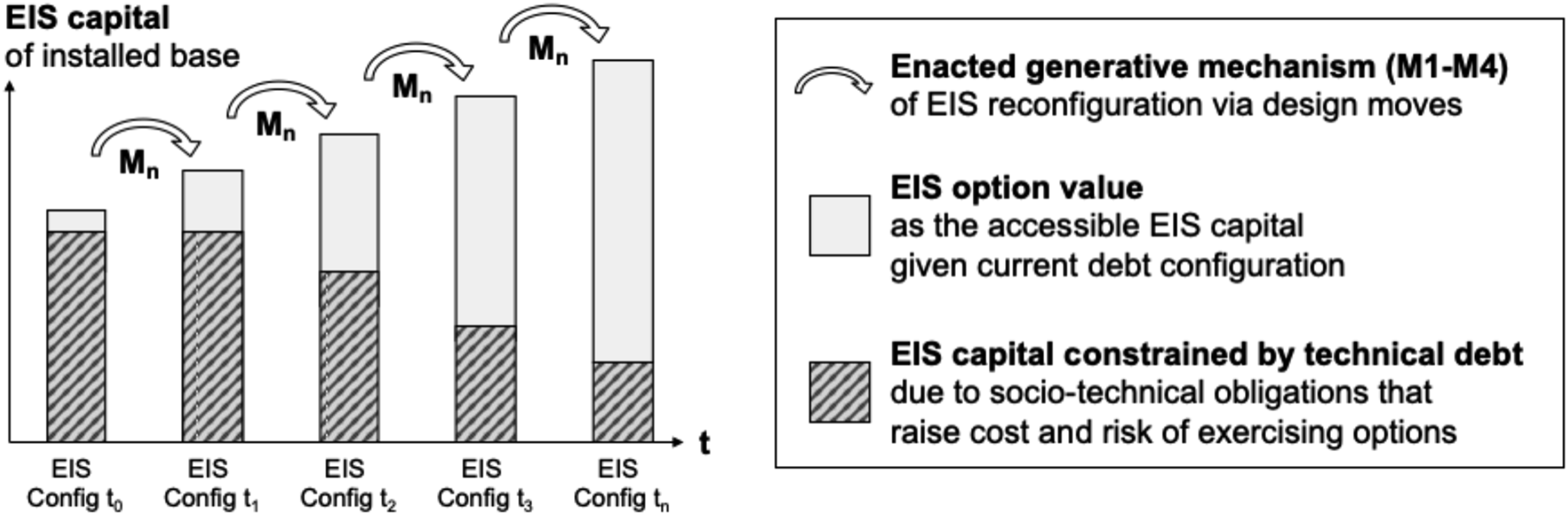
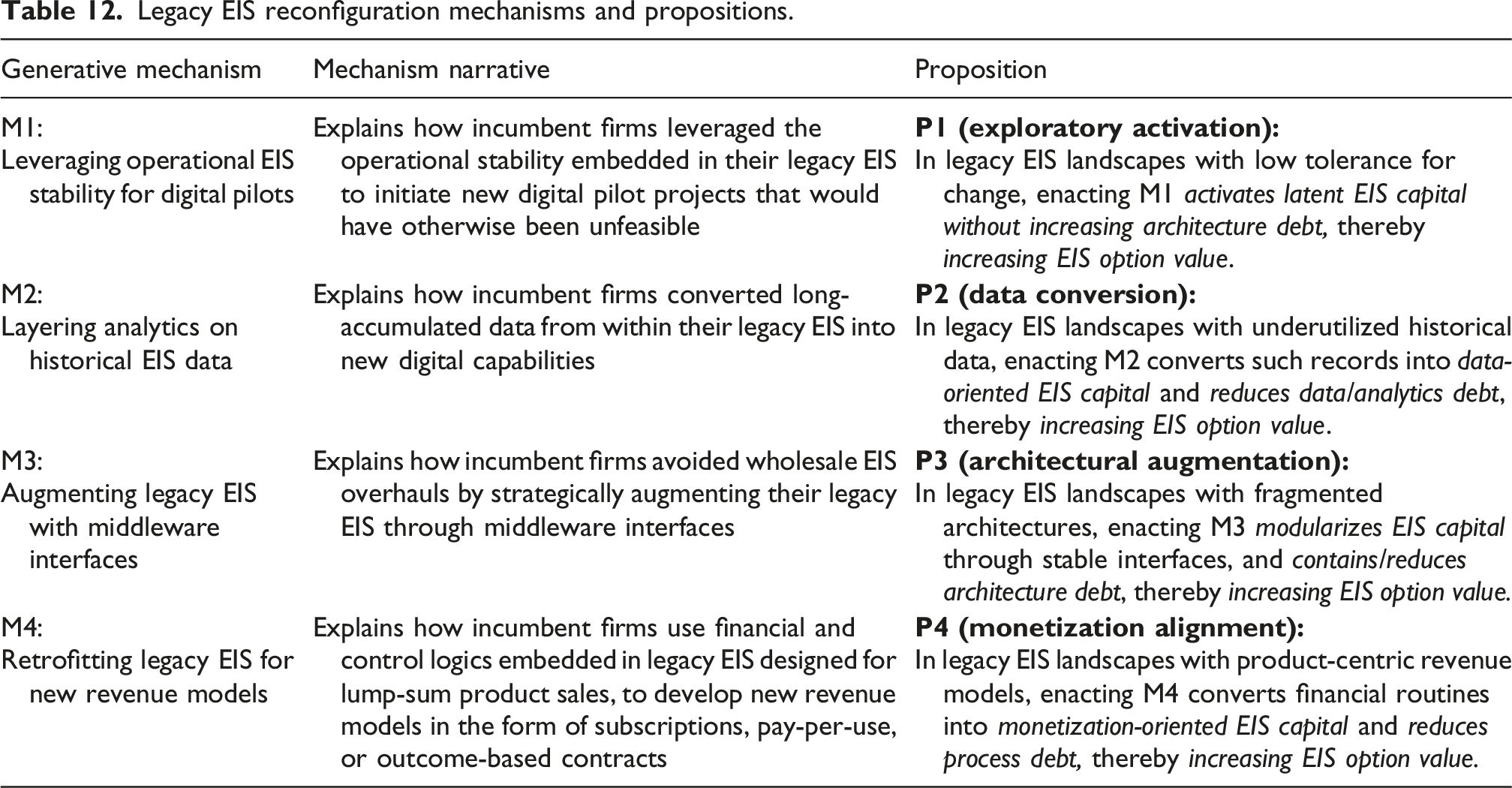
Each vertical bar in Figure 1 represents the EIS capital provided by the installed base of an organization’s legacy EIS at successive points in time. The total EIS capital represented by each bar is depicted as a configuration consisting of a portion that is constrained by technical debt (hatched bar) and another portion that is accessible for reconfiguration (grey bar), which represents the organization’s EIS option value. The curved arrows denote that a generative mechanism has been enacted (M1-M4), with its underlying design moves transitioning the total EIS capital provided by the installed base of legacy EIS from one configuration (tn) to the next (tn+1). Building on Table 12 and Figure 1, we now put three interrelated theoretical claims forward:
First, the process of legacy EIS reconfiguration is cumulative and path dependent. Specifically, each successive configuration of available EIS capital (tn) inherits the EIS option value and residual technical debt of its preceding configuration (tn–1), meaning that enactments of each generative mechanism can only build on – rather than replace – earlier configurational states of available EIS capital.
Second, total EIS capital grows over time. This is because the design moves underlying each generative mechanism introduce new digital capabilities onto the installed base; while either reducing configurations of technical debt or keeping existing level constant; this captures our finding that incumbent firms expanded their EIS capital through reconfiguration rather than by replacing or removing legacy EIS.
Third, and most critically, the generative mechanisms ensure that technical debt does not scale proportionally with EIS capital growth; instead, each enacted generative mechanism selectively contains or reduces specific types of technical debt (e.g., architecture, data, process debt) while making a successively larger proportion of the installed base of legacy EIS accessible.
Taken together, our theoretical claims challenge the prevailing assumption that legacy EIS and technical debt stand in a zero-sum relationship with EIS option value. Instead, the four generative mechanisms we identified explain how organizations can progressively make their installed base of legacy EIS accessible and reusable, ultimately increasing EIS option value. Consequently, rather than treating the management of legacy EIS as a binary choice of either keeping or replacing legacy systems, our work introduces a novel contingency-oriented question: ‘which generative mechanism is appropriate given a particular debt configuration’, and ‘which sequences of design moves activate EIS capital while keeping obligations manageable?’. This fundamental theoretical reframing of technical debt is valuable because it challenges comparatively narrow lenses related to the construct, including the ‘technical debt trap’ (e.g., Rinta-Kahila et al., 2023) narrative through a novel account that shows how debt-laden legacy EIS can be reconfigured into more durable sources of digital option value.
Ultimately, our study addressed critical challenges linked to the future of EIS. First, the installed bases of legacy EIS in many organizations are growing rather than contracting (Lokuge et al., 2025), and so does the technical debt that accumulates with them. The question of how organizations can ‘future proof’ their EIS landscapes without disrupting operational stability will become more consequential, not less, in the years ahead. Our mechanism-based theory provides a vocabulary for analyzing and guiding this evolution through sequences of design moves rather than as a series of discrete modernization projects. Second, emerging enterprise technologies like analytics or AI necessarily layer onto, rather than replace, legacy EIS. To function effectively, these systems depend on historically accumulated data, standardized process logics, or organizational control structures. The question of how legacy EIS can ensure the feasibility, reliability, and scalability of AI-enabled enterprise renewal is, in our view, amongst the most critical emerging questions, with our M2 and M3 providing suggestions for how this development may be facilitated. Third, the economic logic of enterprise operations has been shifting from product-centric transactions to outcome-, usage-, or subscription-based revenue models for some time (Sebastian et al., 2017), a trend that is increasing already (Heinz et al., 2022). One implication of this shift for the future of EIS is that financial legacy EIS must support revenue architectures that blend transactional lumpsum and outcome-based billing. This shift places financial legacy EIS under increasing pressure to evolve, with our M4 demonstrating how it may proceed without replacement. Finally, legacy EIS reconfiguration is, of course, but one of several potential future-proofing strategies available (cf. Table 1), and our findings should not be read as universal prescription. Whenever organizations operate as platform mediators or pursue greenfield digitalization, strategies such as wholesale replacement or platformization may be more appropriate. Conversely, legacy EIS reconfiguration is most consequential in incumbent, asset-intensive contexts where legacy EIS embody non-substitutable organizational assets, where deeply embedded process, data, and control logics constitute genuine sources of value, and where reliability, compliance, or switching-cost considerations render wholesale replacement infeasible (Grover and Lyytinen, 2023). The focus of our present work was precisely to address the challenges associate with ‘future proofing’ EIS landscapes in these contexts. The four generative mechanisms (M1–M4) we put forward offer a vocabulary and operational pathway for reconfiguring legacy EIS into ambidextrous EIS landscapes that sustain operational stability while enabling enterprise renewal in incumbent firms. In this sense, our contribution to this Special Issue’s effort to chart the future of IS in the Journal of Information Technology, is not only by clarifying what one such future may look like, but also by specifying when and where it can apply.
Managerial implications
Digital leaders are often blamed for clinging to legacy systems, tolerating technical debt, or failing to build ‘digital native’ capabilities. Indeed, the managerial discourse views technical debt as a largely self-inflicted obstacle to digital change (Banker et al., 2021; Fürstenau et al., 2019; Sebastian et al., 2017). We counter this framing: incumbent firms can work with, not against, their legacy EIS. Instead of relying on heroic ‘rip-and-replace’ programs, we encourage practitioners to draw upon the design moves we identified within each generative mechanism to, for example, leverage operational stability, activate data-oriented EIS capital, or retrofit financial systems for new revenue models. We now translate our findings into actionable managerial insights:
First, treat legacy EIS as a starting point for digital change rather than a barrier. Legacy EIS embody substantial EIS capital: consistent data structures, reliable processes, established workflows, and other reusable assets are instances of EIS capital that can trigger the development of new digital capabilities. Instead of asking “how do we remove old systems?”, managers should ask, “where is our installed base stable enough to support safe experimentation?” For example, telematics stacks or shop-floor routines can be low-risk sandboxes for piloting IoT features, AI-driven analytics, or predictive maintenance. Similarly, decades of operational data can be cultivated as EIS capital for failure prediction, performance optimization, or advisory services. In any case, we suggest selecting pilot use cases that deliberately reuse existing identifiers or workflows; and to overlay new dashboards or apps on top of legacy EIS.
Second, adopt a revenue-generating lens on what others label ‘technical debt’. Legacy EIS contain domain knowledge and financial logics that can be reconfigured to support new revenue models. For example, existing ERP structures can be adapted to support subscriptions, pay-per-use, or outcome-based contracts, often with minimal changes to legacy EIS. However, this requires viewing technical debt and EIS capital through a revenue-generating lens. Rather than asking “what does our architecture prevent us from doing?”, leaders can ask, “which parts of our legacy EIS can we reuse to make new revenue-generative approaches feasible?” This may include using existing finance modules to handle recurring charges based on operating hours; leveraging established contract templates to manage risk in outcome-based agreements; or redefining incentives (e.g., subscription sales) so that recurring revenue is supported rather than penalized.
Third, bridge rather than replace; build ambidextrous architectures. For many incumbents, operational continuity is mission-critical, whereas wholesale EIS overhauls are infeasible. We instead suggest managers bridge legacy EIS with cloud and API-driven middleware interfaces to create EIS landscapes wherein legacy EIS remain stable systems of record while new digital tools foster rapid change. We demonstrated how each incumbent separated stable domains (e.g., finance) from fast-changing domains (e.g., analytics); exposed capabilities of the former via APIs, before routing new digital initiatives through shared platform components. To replicate these undertakings, managers should use cloud-based technologies to augment legacy systems rather than replacing them; define and enforce interface contracts that shield fragile cores while making their capabilities accessible; and establish dedicated teams to manage these assets. Ultimately, the challenge managers face is not a binary choice between keeping or replacing legacy EIS, but orchestrating design moves that rebalance technical debt and EIS capital so that their installed base becomes an enabler, rather than barrier, of enterprise renewal.
Limitations
We acknowledge possible limitations related to our method, research context, as well as the conceptual framing of our theory building process. First, as value-aware researchers, we acknowledge that any reality examined is imperfectly apprehensible, and that our findings are only probably true (Guba and Lincoln, 1994). Participants had to rely on memory when answering questions and may have attempted to influence us. We minimized potential biases by collecting secondary data, by engaging informally with participants on-site, and by conducting interviews across hierarchical levels. At the time of each interview, none of the EIS reconfiguration projects had been completed for more than 12 months so that participants could recollect events well.
Second, like other empirical IS studies, our data collection took place in a specific socio-cultural context and during a particular point in time, specifically within the German manufacturing sector. While this analytically informative empirical setting was deliberately bounded to ensure comparability of findings, we cannot claim that our findings are context independent. As such, we do not claim to provide statistical, but instead analytic generalization through the empirically grounded, mechanism-based theory of EIS reconfiguration in incumbent firms. Importantly, mechanism-based theorizing does not identify deterministic mechanisms, and our mechanism-based theory of EIS reconfiguration in incumbent firms should not be interpreted as such (Sandberg et al., 2020). Other organizations in contexts resembling ours may thus achieve comparable outcomes through alternative pathways, and the mechanisms we identify are not claimed to be necessary or sufficient for successful reconfiguration in every instance. Specifically, while we presented each generative mechanism separately, organizations may mix or sequence them to suit local circumstances, further underscoring the study’s context-sensitive nature. We suggest that our findings are most transferable to other incumbent, asset-intensive B2B organizations in which legacy EIS remain critical to ongoing operations; where ongoing digital initiatives are layered onto, or tightly integrated with, an installed base of legacy EIS; and where reliability, compliance, or switching-cost considerations constrain wholesale replacements of these legacy EIS. As such, transferability of our findings is likely less pronounced to greenfield or digital-native settings, or in industry contexts where future proofing strategies like wholesale replacement or platformization are better suited. The contextual conditions in our CMO narratives should therefore be read as scoping conditions that help readers assess whether, and to what extent, our insights are applicable in other scenarios.
Finally, the literature included in the conceptual framing of our theory-building process may constitute another limitation. We followed Eisenhardt’s (1989) recommendations and initially compared our emerging empirical findings with relevant literature, such as work on technical debt (e.g., Rinta-Kahila et al., 2023) or the role of EIS in organizational settings (e.g., Henfridsson and Bygstad, 2013). However, work from other disciplines may have contributed findings that could be equally applicable. Therefore, we do not claim that the literature included here has been presented in its entirety. Ultimately, “no methodology is perfect” (Leonard-Barton, 1990: 260), and the limitations we identified stand in contrast to the choices we made.
Future research opportunities
Our study presents an important foundation for future research. The first avenue involves extending the conceptual foundations of legacy EIS reconfiguration. Like all social processes, EIS reconfiguration is affected by its settings (Leidner and Kayworth, 2006), which provides the opportunity to further examine underlying boundary conditions, such as how constructs like stereotypes (Huetten et al., 2019) or trust (Someh et al., 2019) may affect each generative mechanism. In addition, other theoretical lenses, such as organizational imprinting (Dias et al., 2023), might provide insights into how legacy EIS could be viewed as ‘imprints’ to digital innovation. For example, the question arises as to whether incumbent firms are more likely to actively re-imprint themselves through internal agency or be re-imprinted by their environment.
Second, future research could provide additional contextual insights. This includes replication studies in other contexts such as healthcare (Huetten et al., 2019), financial services (Tana et al., 2023), or even developing countries (Ramadani et al., 2023), as these offer exciting possibilities to provide novel complementary perspectives on how legacy EIS are used and reused.
Finally, new methodological avenues, including ethnographic or longitudinal research may be useful. Future studies could explore the long-term effects of legacy EIS reconfiguration on firm performance and organizational culture. These questions could be explored through polar case studies that compare successful and unsuccessful instances of legacy EIS reconfiguration. Additionally, the mechanism-based theory we developed could be further explored or empirically tested through agent-based simulations (Torres Pena and Breidbach, 2021) or action research approaches (Sein et al., 2011), which could also foster academic-practitioner collaborations to maximize the practical contributions of future research (Baskerville et al., 2023; Davison, 2023).
Conclusion
We empirically investigated how five German incumbent firms in the manufacturing sector reconfigured their legacy EIS for enterprise renewal. We propose a new mechanism-based theory of legacy EIS reconfiguration in incumbent firms, which explains how these organizations can preserve the operational stability of installed bases of legacy EIS under technical debt constraints while simultaneously reconfiguring them into EIS landscapes that enable enterprise renewal.
Supplemental material
Supplemental material - A mechanism-based theory of legacy enterprise information system reconfiguration in incumbent firms
Supplemental material for A mechanism-based theory of legacy enterprise information system reconfiguration in incumbent firms by Daniel Heinz, Christoph F. Breidbach in Journal of Information Technology.
Footnotes

Ethical considerations
The Karlsruhe Institute of Technology approved our study involving human participants on September 25th 2022.
Consent to participate
Respondents gave written consent prior to each interview and agreed to conversations being audio-recorded.
Author contributions
Daniel Heinz: Conceptualization, Methodology, Formal Analysis, Investigation, Writing – Original Draft.
Christoph Breidbach: Conceptualization, Methodology, Writing - Original Draft, Writing – Review & Editing.
Funding
The authors received no financial support for the research, authorship, and/or publication of this article.
Declaration of conflicting interests
The authors declared no potential conflicts of interest with respect to the research, authorship, and/or publication of this article.
Supplemental material
Supplemental material for this article is available online.
Note
Author biographies
References
Supplementary Material
Please find the following supplemental material available below.
For Open Access articles published under a Creative Commons License, all supplemental material carries the same license as the article it is associated with.
For non-Open Access articles published, all supplemental material carries a non-exclusive license, and permission requests for re-use of supplemental material or any part of supplemental material shall be sent directly to the copyright owner as specified in the copyright notice associated with the article.
