







Abstract
The goal of this article is to highlight the major trends in the establishment of public libraries in developing countries under conditions of globalization. Based on a review of research from library history and the sociology of culture, the author develops hypotheses about the conditions under which public libraries are likely to be established in relatively large numbers in developing countries. Analysis of historical trends in library establishments and crisp-set qualitative comparative analysis of UNESCO data on public libraries in six developing nations reveal that globalization is associated with decreasing or flat numbers of public libraries on a per capita basis. The only observed exceptions are Malaysia and Chile, where public libraries have been established in large numbers partly for purposes of national integration as a counter to sectarian and ethnic heterogeneity. Implications of these findings for research in the information society paradigm, and for development theory, are discussed.
Introduction
Worldwide, public libraries, including rural and urban local and branch libraries, provide citizens of all ages with valuable cultural resources including access to books and other media, calm and quiet settings for reading, support for formal education and public spaces for community events. They provide the unemployed and underemployed with access to information about jobs, particularly during economic downturns. Public libraries with Internet connections provide citizens with access to e-government services and information on educational opportunities, business and health. They provide physical infrastructure for adult and other non-formal education programs, such as language classes and programs for new immigrants. More broadly, public libraries encourage global cultural exchange: in many communities, a local library, reading room, or mobile library may be the only available source of access to books, newspapers and the Internet. On a macro scale, public library services provide long-term advantages for developing nations by building human capital (Goulding, 2004, 2008; Vårheim, 2008) through children’s and adults’ linguistic and cognitive development, and by fostering educational advancement, more efficient labor markets, innovation and entrepreneurship (see Bleiweis, 1997; Dent, 2007; Glass et al., 2000; Lynch, 2001; Miele and Welch, 1995; Moules, 2007; Riechel, 1994; Walzer, 2007; Welch, 2005).
Governments of wealthy countries generally recognize the social and economic benefits of public libraries, as well as the complementarity of libraries and the Internet. For example, in the 1990s the European Union initiated a series of programs to implement an ‘information society’ (Castells, 2000) model of socioeconomic development (see European Commission, 1994; Raitt, 2000). One of the best-known successful implementations of this model is Finland, which has evolved an ‘informational welfare state’ (Castells and Himanen, 2004; see also Blom et al., 2002; Kekki, 2001; Kopomaa, 2000) in which public libraries play a central role (Wigell-Ryynänen, 2007). Another notable success has been Estonia’s ‘Tiger Leap’ program, an initiative launched by the country’s education ministry in 1996 to introduce information and communications technology to the educational system and public institutions. Most other European countries have implemented information society-related initiatives that make similar use of public libraries (Raitt, 2000).
In the US, where public libraries were established in large numbers beginning in the late 19th century, the most recent available data show a steady increase in the annual circulation of public library materials between 1998 and 2007, from approximately 6.6 to over 7.4 items per capita (IMLS, 2007: 6). Visits per capita steadily increased from 4.2 in 1998 to over 4.9 in 2007, and total circulation of public library materials in the US in fiscal year 2007 was 2.2 billion, up from 2.1 billion in 2006. Provision of public library services in the US is highly unequal: wealthier metropolitan public libraries offer more services, and have longer hours, larger staffs and larger collection sizes than do libraries in lower-income and rural neighborhoods (Sei-Ching, 2009). Nevertheless, for many advanced industrialized countries, and in particular for wealthier communities within advanced countries, public libraries are durable institutions that have expanded during the Internet era.
In the early 21st century, trends in public library establishments in developing countries merit particular attention because of the increasing centrality of information access for economic and social development (e.g. Afele, 2003; Castells, 2000; Neef, 1999; Paganetto, 2004). Citizens without access to books, newspapers, or the Internet have little if any legal opportunity to develop the human capital needed for socioeconomic advancement. Thus public libraries would seem to be more indispensable than ever, at least for those nations seeking to move up the global value chain from agriculture and low value-added manufacturing to knowledge-intensive services and research and development.
For social scientists, public libraries in developing nations represent an unsolved puzzle. In terms of both rational-choice and class conflict theoretical paradigms, it is hard to conceive of why public libraries exist. They are complex and costly to operate, and produce little in the way of tangible short-term economic returns. In many countries building them is not particularly politically popular, as there is not often much public demand for local library services. Rather, libraries are often viewed as foreign institutions, and book reading is an unfamiliar custom (Asheim, 1966: 49). Unlike large urban libraries and university collections, accessible public libraries do not confer much status on the nation, or on philanthropic national elites. But for elites, public libraries do entail significant risks. Insofar as they encourage public literacy and a relatively free flow of information to ordinary citizens, they may function as breeding grounds for anti-hegemonic, heterodox ideological currents, such as Marxism, atheism, ethnic separatism, or minority religious traditions. And importantly, by providing non-elites opportunities to gain scarce cultural capital, knowledge and skills, community libraries may threaten elites’ social reproduction (Asheim, 1966: Ch. 2).
Studies in library history and comparative librarianship show that modern public libraries, defined as libraries that are intended to make information easily accessible to a broad public, are, unsurprisingly perhaps, not common in developing countries (Dubey, 1986). In cases where developing countries have established libraries of one kind or another, these tend to be located in political capitals and other major cities, and to be built to burnish the state’s image in the eyes of the public and of foreign governments and institutions. Discussing his decades spent visiting libraries in the developing world, Lester Asheim, who served as director of the American Library Association International Relations Office, noted that:
. . . the first thing that the North American librarian notices . . . is the almost total absence of public libraries in the sense of an open collection of general materials designed for use by anyone who seeks information, recreation, self-education, or esthetic pleasure. There are so-called libraries in some places, meaning that admission is not denied to anyone who wishes to enter, but . . . by our standards, these libraries would be seen either as public study rooms, primarily for students using their own books, or as special libraries for scholars browsing through the rare books, old books, and manuscripts that – in our country – would seldom find their way into public libraries at all. (Asheim, 1966: 3–4)
Where elites in developing nations have invested in public libraries, they may have done so as part of a transition to a democratic political system and society (see Kranich, 2001), one in which modern citizens are empowered to make their own decisions about what to read and think (see Meyer, 2010). On the other hand, there is a large historical literature that shows that the establishment and expansion of developing countries’ public library systems has generally occurred during periods of either colonial administration or of elite-led nation-building, has almost always been accompanied by heavy censorship and has been carried out for purposes of social control (Ignatow, 2009). Examples are legion. Arguably the earliest modern public libraries, established in Scotland in the late 17th century, were partly based on the circulating library, but much more on the subscription library, an institution that was sharply divided along class lines. Development of working-class subscription libraries was promoted by paternalistic lead mining companies (Jackaman, 1980), whose aim was to create well-disciplined miner communities (see Crawford, 1997). Harris (1973, 1986) pioneered a revisionist turn in American library history by detailing how the major benefactors of America’s earliest public libraries were conservative elites, and the libraries they supported were authoritarian and elitist institutions (Du Mont, 1977). The public library in 19th-century America was to serve as a stabilizing force during a period of mass immigration and high levels of social unrest and urban crime. Libraries would educate the masses so that they would follow the ‘best men’ and not demagogues, they would ‘stabilize the republic’ and aid in the education of the elite minority who would someday lead the nation. Public libraries in pre-state Israel were created by Maskilim, westernizing Jews engaged in a bitter internecine culture war, in both Palestine and Europe, with highly religious and traditionalist Hasidim, who opposed the establishment of secular libraries on holy land (Schidorsky, 1982). In Germany in the 1930s, after a massive ideological purge of the country’s libraries, the Nazis expanded the German public library system, particularly into rural areas (Steig, 1992), to serve as instruments of fascist propaganda. During the Cold War, the US and USSR fought a ‘cultural Cold War’ (Saunders, 2006) in non-aligned nations, with the Soviets building libraries in these nations, donating massive numbers of books and training foreign library professionals in Soviet library programs (Andersen et al., 1985; Richards, 1999). The US responded by providing funding for libraries and information centers in the third world through the United States Information Agency (Bogart, 1976; Elder, 1968; Snow, 1998). These funds almost entirely evaporated with the end of the Cold War (Nye, 2004). South Korea’s public library system was built up first by Christian missionaries, then Japanese colonial occupiers, who used them for propaganda purposes in an effort to stamp out Korean national identity, and later by American agencies during the Cold War (Chang, 2000). British colonial investment in Kenyan libraries was only initiated as part of a propaganda campaign during the Mau Mau peasant uprisings of 1952–1960 (Rosenberg, 1993; also Olden, 1995). The imperial Russian investment in public libraries in the Caucasus and Crimea, implemented by transplanted Europeans and Russians, was initiated in the 19th century as part of a program of cultural ‘Russification’ (Jersild and Melkadze, 2002). The ‘Gardens of Reading’ (Taman Puska) system of 2500 public libraries in the Netherlands’ East Indies colony (now Indonesia) was established by the Dutch colonial government between 1918 and 1926 in an attempt to ‘inculcate “Western” values and further the colonial situation’ (Fitzpatrick, 2008: 270) in the face of a growing nationalist movement, and at the same time to cultivate markets for Dutch manufactured goods (Fitzpatrick, 2008: 274).
It appears that resources have flowed to public libraries in the developing world when colonial or national elites have calculated it to be in their interest to promulgate particular ideological justifications for large-scale development programs (cf. Ditzion, 2007 [1947]; Shera, 1949 on the US; Traue, 2007 on colonial New Zealand). Increases in human capital generated by these libraries, and public libraries’ later use in ‘information society’ initiatives, appear to have been byproducts of erstwhile investments in libraries by elites concerned with the maintenance of their own social position and their regime’s legitimacy during periods of social unrest and upheaval.
Public libraries in the modern sense are a mostly western institution that has been adopted, with local variations, in many parts of the world. As such, libraries can be argued to be agents of western cultural imperialism (e.g. on Indonesia, see Fitzpatrick, 2008; on Africa: Amadi, 1981; Ochai, 1984; Odi, 1991). Yet scholars of cultural imperialism and cultural globalization have not had much to say about developing countries’ public libraries. Nor have sociologists of education, or researchers working in the ‘network society’ paradigm developed by Castells and others. Since the 1966 publication of Asheim’sLibrarianship in the Developing Countries, there has been almost no research that has attempted to develop a global understanding of trends in public libraries in developing nations, a point noted by comparative library scholars (Harvey, 1973; Stueart, 1997; Wiegand, 1999). But there are many informative case studies of the establishment of public library systems in individual countries, and there are pertinent sociological studies of the global diffusion of other cultural institutions (e.g. Kaufman and Patterson, 2005). These literatures inform the hypotheses developed in the following section.
The article proceeds as follows. Following reviews of relevant social science literatures, I set out hypotheses on the effects of globalization on developing countries’ public libraries, and the relations between national wealth, democracy, international non-governmental organizations and religious and ethnic heterogeneity, and libraries. To identify basic historical trends in public library expansion and contraction, I plot public libraries per capita vs a measure of globalization for Bulgaria, Lithuania, Chile, Malaysia, Vietnam and Turkey, and discuss historical studies that illuminate trends in public libraries for each country. To more clearly identify the main causes of variation in rates of public library expansion in these nations, I perform crisp-set qualitative comparative analysis (Rihoux and De Meur, 2009) on UNESCO data on public libraries per capita for each country. The main findings are that increasing globalization is associated with slow or no growth, on a per capita basis, of these nations’ public library systems, except in the cases of Malaysia and Chile, the countries that are by far the most religiously heterogeneous (Malaysia and Chile) and ethnically heterogeneous (Malaysia) in this group. I argue that these findings are consistent with both critical library history and sociological studies of the global diffusion of cultural institutions, and that the findings have relevance for research in the information society paradigm and for development theory.
Literature review and hypotheses
Although very little systematic comparative research has been done on developing countries’ public libraries, there has been a great deal of relevant research on other public educational and cultural institutions. Specifically, there are substantial literatures that explore the effects on public institutions of: (1) economic liberalization and migration, (2) economic development, (3) democracy, (4) international non-governmental organizations and (5) ethnic and religious homogeneity and heterogeneity.
Economic liberalization, state retreat and brain drain
Analysts have argued since the late 1970s that accelerating global economic integration has led to state retreat (Strange, 1996), or ‘disétatization’ (Pakulski and Waters, 1996), in developed and developing countries alike. In the welfare states that prevailed during the two decades after the Second World War, states had come to assume a wide variety of social and economic obligations. They strove to curb business cycles through fiscal and monetary policies, and directed such policies toward public investment in health care, social security, education and housing. Beginning in the 1970s, as financial markets became more globally interdependent and competitive, the ability of states to offer their citizens economic security diminished, and many traditional areas of state responsibility were increasingly coordinated on an international or intergovernmental basis. This obliged states to surrender sovereignty within larger political units (e.g. ASEAN and the EU), multilateral treaties and international organizations. Many government services were opened to competitive bidding between public and private sectors, and many state-owned industries were privatized.
While public libraries have not been privatized, they are not-for-profit enterprises, so it comes as no surprise that global economic integration seems to have negatively affected state-funded public library systems (Hunt, 2001–2; Rikowski, 2002), particularly in developing countries (e.g. Brazier, 1993; Knutson, 2007).
The collapse of the Soviet Union is a particularly dramatic example of disétatization (see Derluguian, 2005). The end of the Soviet Union led to the dismantling of Soviet programs for international information infrastructure (Andersen et al., 1985). The Soviet overseas international assistance program, which peaked in the early 1980s, ‘dwarfed that of the American government’ (Richards, 1999: 206):
In 1982 alone the Soviet Union produced 74.5 million books in fifty-six non-Soviet languages, a large proportion of these being in scientific and technical fields. That year they published 24.3 million English language books – more than in any other language the Soviets published. By 1986 one out of every four books produced in the world was published in the Soviet Union, and the Soviet publishing industry was translating more titles than any other country. (Richards, 1999: 212)
These programs were all terminated in the aftermath of the collapse of the Soviet system. The Krupskaia Institute of Culture, once the hub of the Soviet library system, graduated its last Moscow-subsidized foreign students in 1998. Together with the possibilities of free higher and continuing education, the subsidized flow of scientific and technical information from Moscow to its former client countries also stopped. And western and international agencies that had subsidized information to developing countries in the 1970s and 1980s radically cut their assistance. UNESCO began downsizing after the American and British withdrawal in 1984, and the once lavish book distribution programs of USAID were downsized (Crossette, 2000; Pear, 1990), while the United States Information Agency was dissolved in 1999 (Nye, 2004). Thus as of the late 1990s, according to Richards (1999: 213), the developing world was:
. . . littered with centralized, government-operated information centers operating in a virtual vacuum ever since the disappearance of the Soviet information supply upon which they depended. This vacuum can be expected to continue far into the twenty-first century unless another substitute for the market system is found to replace the Soviet Union’s assistance programs. For over thirty years they offered a window on the international world of science and technology to countries unable to pay the market price for such access. The officials of a number of developing countries remain convinced today that the Soviet system offered greater advantages to emerging countries than does international capitalism. (Bui,1997:102)
In addition to the damage economic globalization appears to have wrought on developing nations’ public library systems, it is also possible that exposure to global media and enhanced opportunities for emigration have led to ‘brain drain’ (see Portes, 1976) of the skilled and educated citizens who, had they stayed in their home countries, might have helped to establish and support public libraries. Finally, globalization can damage public faith in public institutions (Pakulski and Waters, 1996), and so may weaken citizens’ willingness to support government spending on public libraries. We can summarize all of the above in terms of a simple hypothesis: economic globalization has caused a reduction of states’ investments in public libraries in developing countries (H1econ.glob).
Economic development
It seems reasonable to assume that among developing countries, wealthier countries will generally invest more in their public library systems than will poorer ones, simply because they have more to invest, and because they will have been better positioned to resist possible negative effects of economic globalization. Theories of resource mobilization support this line of reasoning, although these theories are generally applied to non-governmental organizations rather than to public ones. Still, these theories posit that a wide variety of social, political and cultural organizations are more likely to develop where material and human resources are plentiful. In wealthier nations, such organizations have larger potential support constituencies, particularly of affluent and educated individuals who are more able to contribute resources (McCarthy and Zald, 1977). As resource mobilization theories imply that public libraries are more likely to be established in wealthier countries that have sufficient resources to build them, so the postmaterialism thesis (Inglehart, 1990) implies that rich countries have citizens with more postmaterialist values, who are less concerned with day-to-day survival and more with society’s general welfare, education and culture, and who are therefore more willing to provide financial support for non-profit educational and cultural institutions. Both resource mobilization and postmaterialism theories inform a hypothesis that wealthier developing countries establish more public libraries than do poorer ones (H2wealth).
Democracy
Perhaps a country’s wealth is a less important causal factor in the establishment of public libraries than is its level of political democracy. Public libraries would seem to be inherently democratic institutions (e.g. Ditzion, 2007 [1947]; Shera, 1949; Tyckoson, 2000; Wellard, 1937). In his analysis of the success of the American public library movement of the late 1800s, the library historian Sidney Ditzion argued that American democracy was a crucial element:
The privileged in England feared popular education. Those in power in American society favored it. Even when the arguments were similar in the two countries their flavor varied. Thus the humanitarian in England often spoke as if he were raising a brute class to the level of civilization by establishing libraries. The American purveyors of uplift were generally egalitarian and thoroughly democratic in their approach. (Ditzion, 2007 [1947]: 2–3)
It is also a standard assumption of a large body of library and information sciences scholarship that public libraries are inherently democratic institutions, both causes and effects of democracy (e.g. Kranich, 2001). These historical and contemporary analyses suggests a straightforward hypothesis: more democratic developing countries establish more public libraries than do less democratic ones (H3democracy).
International non-governmental organizations
Students of global civil society, and theorists of ‘world society’ (Meyer, 2010; Meyer et al., 1997), propose that national politics are increasingly influenced by a global network of international non-governmental organizations (INGOs). Virtually all nations are connected to global civil society to one degree or another. However, some nations are more tightly linked than others, housing within their borders larger numbers of INGOs. World society theorists argue that global civil society promotes cultural and political globalization: it incubates and then diffuses modern practices and ideals, such as human rights, gender equality and notions of universal public access to information. In the public library non-profit field, several prominent INGOs, such as the Gates Foundation, the Soros Foundation, and Room to Read (Wood, 2006) invest heavily in public libraries in developing nations. World polity theorists (e.g. Meyer et al., 1997) posit that states learn from INGOs such as these that they are responsible for building public libraries, and that by building libraries, they can legitimize themselves in the eyes of global civil society. Thus we can hypothesize that developing countries more connected to global civil society, with more INGO offices within their borders, are more likely to establish public libraries than are countries less connected to global civil society (H4INGOs).
Religious and ethnic heterogeneity
The critical library history studies reviewed in this article’s introduction suggest that public libraries in developing countries have often been established by elites for purposes of national integration and social control. A number of studies from the sociology of culture make similar arguments with regard to the establishment of various types of cultural institutions, including institutions that have no obvious relation to public libraries. For example, in a 2005 study of the global diffusion of cricket, Kaufman and Patterson make the very general argument that the diffusion of transnational cultural practices needs to be seen as systematically influenced by national elites. They show how in Africa, India, Asia, Australia and North America, the degree to which national elites chose to either appropriate cricket and deter others from participating, or else to actively promote it throughout the population for hegemonic purposes, largely determined the game’s success. English elites in colonial India encouraged their subjects to play cricket for ‘hegemonic reasons’, for the game’s professed ability to ‘discipline and civilize men, English and native alike’ (Kaufman and Patterson, 2005: 91). Colonial elites in India, comfortable in their place atop the social hierarchy, had little reason to discourage those beneath them from playing a game that reinforced British cultural hegemony. Kaufman and Patterson claim that in contrast to the pattern in India, in Africa the relatively small size of the dedicated white settler population contributed to a ‘garrison mentality’ in which the English sought to mollify, rather than civilize, their subjects. The situation in the US and Canada differed from that in both India and Africa. In North America it appears that it was the very lack of a rigid social system that encouraged elitist attitudes toward cricket. There cricket became a marker of high social status, and as such was not promoted among the general population. Thus Kaufman and Patterson argue that the relative stability of elites’ social position strongly influenced the spread of cricket throughout the British colonial system.
In a study of 19th-century moral reform movements in the US, Beisel (1997) argues that the success of Anthony Comstock’s crusade to establish ‘Societies for the Suppression of Vice’ in New York, Boston and Philadelphia differed due to differences in elites’ social positions in the three cities. Beisel focuses on how Comstock worked on the anxieties of the upper classes of each city, and suggests that his censorship crusade was more successful in New York and New England than in Philadelphia due to New York and New England elites’ fears of immigration. Comstock linked the moral corruption of elites’ children to immigration, and his tactic of playing on elites’ fears succeeded in New York and Boston, where minorities posed a political threat to the upper classes. Elites came to see immigrant culture (i.e. liberal cultural standards) as a threat to their cultural reproduction, and in response attempted to control children’s environments through the creation of elite boarding schools and the formation of a Eurocentric high culture that united the country’s upper class. Beisel’s study differs from Kaufman and Patterson’s in terms of the precise mechanisms by which elites’ social position influences the diffusion of cultural practices. In the case of cricket, colonial elites’ relative security allowed them to make cricket accessible to the general population at little social cost. In the case of Anthony Comstock’s moral reforms, elite insecurity was the crucial ingredient. In both cases, elites’ social positions, and threats to those positions, were crucial elements determining the success or failure of attempts to create new cultural institutions.
These sociological arguments suggest two hypotheses. First, following Kaufman and Patterson (2005), we can hypothesize that, under conditions of cultural and political globalization, developing countries that are ethnically or religiously homogeneous are more likely to establish public libraries than are those that are ethnically or religiously heterogeneous (H5Aethnic homog and H5Brelig. homog.), because in homogeneous countries elites are less threatened politically by minority groups, and so are more willing to share access to libraries with the masses. The second hypothesis, following Beisel (1997) and critical library history, is that countries that are ethnically and religiously heterogeneous are more likely to establish public libraries than are homogeneous countries, because elites in heterogeneous countries establish public libraries for purposes of social control during periods of widespread unrest or of national mobilization and modernization (H6Aethnic heterog. and H6Brelig. heterog.).
Globalization and public libraries
What are the major trends in public library establishments in developing countries under conditions of globalization, and what are the main causes of these trends? To address these questions, I exclude from consideration both advanced democratic countries and underdeveloped countries, thus limiting the sample to developing countries between these extremes for which public libraries could plausibly be a worthwhile investment for further socioeconomic development. Though limiting the universe of potential cases this way is unusual in cross-national studies employing multiple regression techniques (these studies generally seek to maximize numbers of cases), in small- to medium-N qualitative comparative analysis it is necessary to balance the need to maximize N with the need to maintain comparability of sample countries on dimensions of substantive and theoretical interest (see Ebbinghaus, 2005; Ragin, 2006: 635–37). Thus the sample includes only countries rated from 0.4 to 0.9 on the 1993 UNDP Human Development Index (HDI), 1993 being the earliest year for which several former Soviet bloc countries were included in the rankings. The HDI includes measures of life expectancy, education and GDP per capita (GDPPC). The least developed nation in the sample, Vietnam, had an HDI of 0.47, which was just below the UNDP’s threshold of 0.5 separating ‘low’ from ‘medium’ development. Lithuania, the most developed country in the sample in 1993, had a score of 0.88, just above the UNDP threshold between ‘medium’ and ‘high’ development of 0.8. The other countries within the 0.4–0.9 range that consistently reported public library data to UNESCO are Chile (0.86), Bulgaria (0.85), Malaysia (0.79), and Turkey (0.72). These six countries constitute the sample for the analysis that follows. 1
Table 1 is based on public libraries data reported by national governments to UNESCO for each of the six countries. The six data points after 1999/2000 were collected from government reports and from the International Federation of Library Associations (IFLA). The table reveals order-of-magnitude differences between the former Soviet bloc countries (Bulgaria and Lithuania) and the others. Clearly the Bulgarian and Lithuanian public library systems include many small units, consistent with the Soviet principle that a library should be available to every citizen within a 15-minute walk from his or her home (Knutson, 2007: 716; Kuzmin, 1995). Still, even if these figures count as public library units that would elsewhere be counted as branch libraries, they also reflect the Soviets’ massive investment in libraries (Richards, 1999).
Public libraries per million population
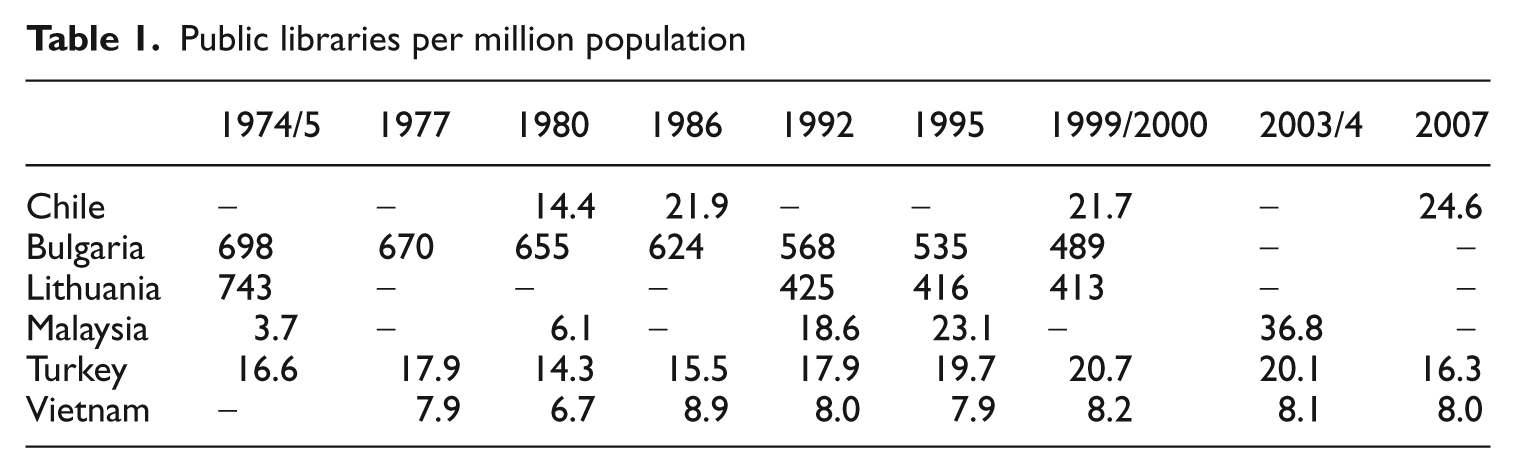
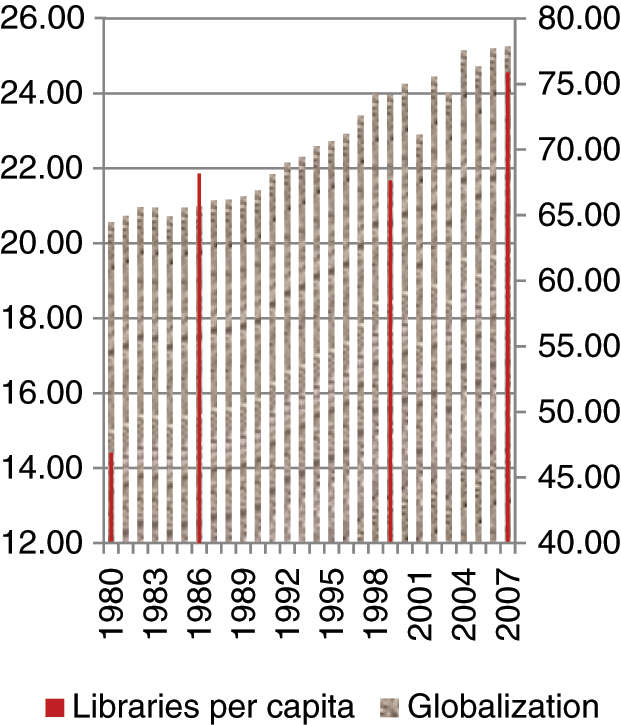
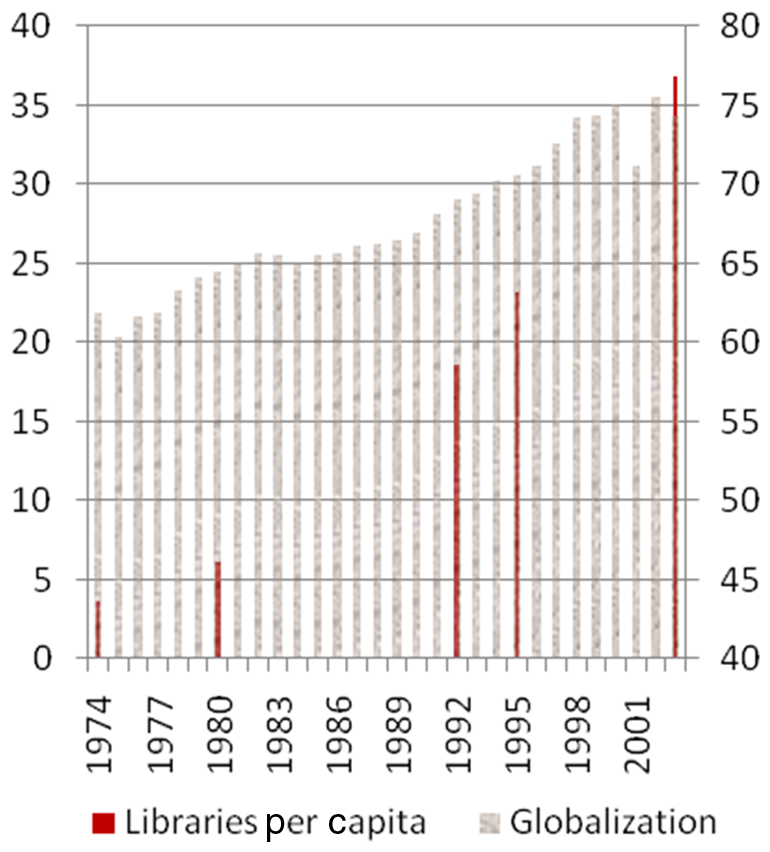
Figures 1–5 plot libraries per capita against a measure of economic globalization from the KOF Index of Globalization (Dreher et al., 2008). This index includes measures of foreign trade as a percentage of GDP, foreign direct investment and other trade and investment flows, as well as restrictions including tariffs and taxes. For each country, I included all the public libraries data that was available from UNESCO, as well as data from publicly available government reports and IFLA documents. Some countries in the sample began reporting data to UNESCO in 1974, others in 1980. As the economies of Bulgaria, Lithuania 2 and Vietnam became more globalized, particularly during the 1990s, the number of public libraries per capita decreased or remained flat. This appears to be evidence of state retreat or disétatization, an interpretation supported by case studies of public library systems in these countries since the 1990s (e.g. Brazier, 1993; Richards, 1999; Tran, 1999) and other countries (e.g. Vasova, 1995). For example, Vietnam introduced a set of neoliberal economic reforms in 1986 (the Doi Moi reforms), which were followed during the initial period of their implementation by a steep drop in the number of public libraries per capita (see Brazier, 1993). The same basic pattern holds for Turkey, although in this case the decrease over time is uneven. There is an immediate drop after the 1980 military coup, then gradual recovery in the 1990s (Turkey joined the WTO in 1995) followed by another precipitous drop beginning in the early 2000s, a period of dramatic change in Turkish politics (Tepe, 2005) and of defunding of the country’s public library system (Yalvac, 2004: 18) and devolution of library authority to provinces. By 2007 Turkey had approximately the same number of public libraries per capita as it did in the immediate aftermath of the 1980 coup.
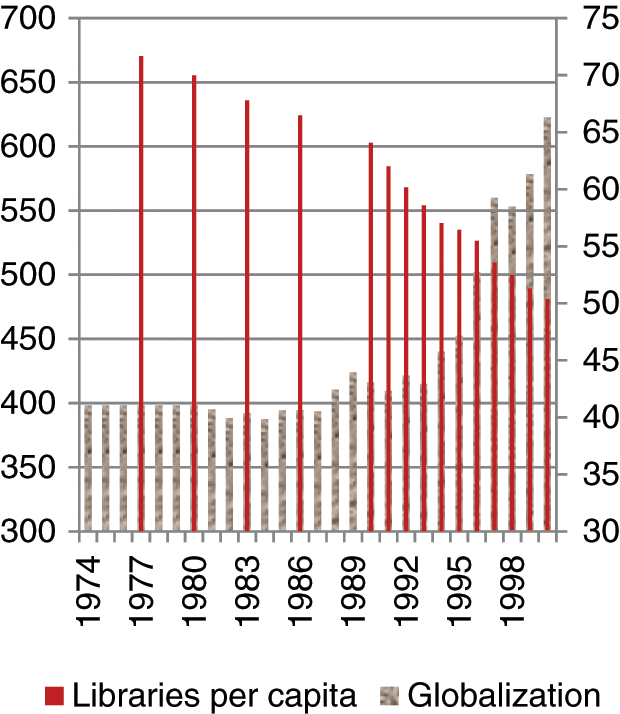
Bulgaria
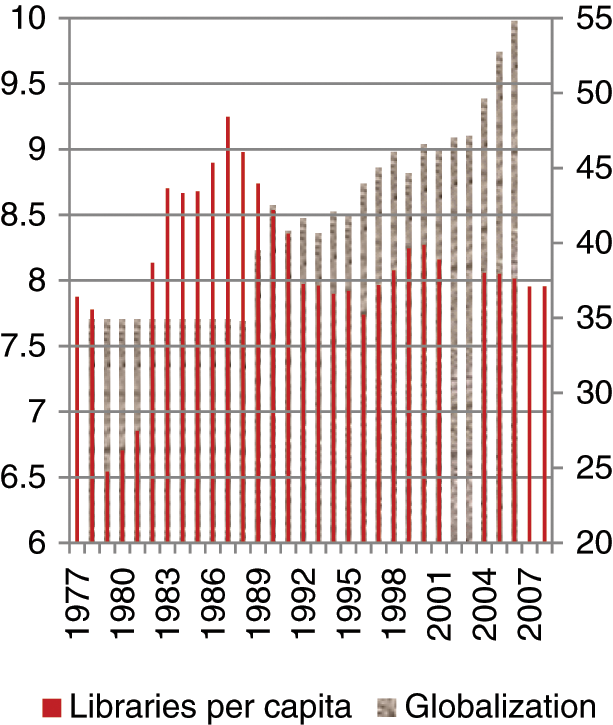
Vietnam
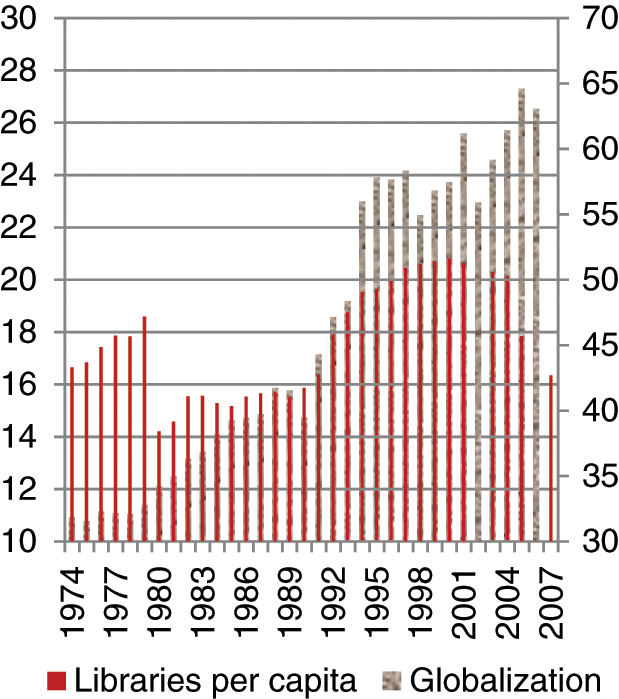
Turkey
Chile
Malaysia
The trends in Chile and Malaysia stand in stark contrast to those for the other four countries in the sample. Although Chile was under authoritarian rule for much of the period under consideration, under Pinochet the state made sufficient investments in public libraries to keep up with population growth (although as Austin [2003] and Sinay [2004] have shown, Chile’s library collections were forcibly brought into line with neoliberal ideology). But it is Malaysia that is the most exceptional case. In 1974 the country had the fewest libraries per capita of this group; by 2003 it had the most outside the former Soviet bloc countries (Table 1). Economic globalization in Malaysia was implemented gradually. The country was a founding member of ASEAN (Association of Southeast Asian Nations) in the late 1960s, and joined APEC (Asia-Pacific Economic Cooperation) in 1989 and the WTO in 1995. And as Figure 5 shows, the Malaysian government invested more heavily in public libraries as the country integrated into the world economy.
To address the question of what factors account for Chile and Malaysia’s exceptionally high levels of investment in public libraries, in the next section I employ qualitative comparative analysis (QCA), a method of analysis designed for small- and medium-N comparative historical analysis (Rihoux and Ragin, 2009).
Crisp-set qualitative comparative analysis
What factors are necessary or sufficient to cause a developing country to invest heavily in public libraries? With a sample of only six countries, standard multiple regression techniques cannot be applied to the available data. And while six historical case studies would produce rich empirical detail, case studies do not allow for systematic identification of the most important causal factors. Qualitative comparative analysis (QCA), developed by Ragin (2000) and others, allows for more systematic comparisons than do case study methods, and for an infusion of theoretical and substantive knowledge into calibration of data samples and measures. QCA is based not on linear algebra, which is the basis of multiple regression techniques, but on Boolean algebra. Because there are only six cases, and the outcome, public library system expansion, includes many negative cases (most of the countries examined did not expand their public library systems, on a per capita basis, during the years under consideration), I chose to use crisp-set (Grofman and Schneider, 2009; Rihoux and De Meur, 2009) rather than fuzzy-set (Ragin, 2000) QCA. Crisp-set QCA requires ‘crisp’ dichotomization of causal factors and outcomes, and the creation of a truth table which can be analyzed using Boolean logic to determine which causal factors, or combinations of factors, are necessary or sufficient to produce the outcome.
For the dichotomization of data (Table 2) and creation of a truth table (Table 3), I follow the ‘good practices’ for csQCA delineated by Rihoux and De Meur (2009). These include dichotomizing data along ‘natural’ breaks between values while attempting to produce roughly equivalent numbers of true and false conditions (1s and 0s). Table 2 shows the dichotomization of the outcome and the causal factors. As the outcome of interest is whether a given nation established a relatively large number of public libraries during the period examined, the raw data are the percentage change in libraries per capita between the earliest and latest year for which data are available. The outcome was dichotomized with a qualitative limit of +50%, so that Malaysia (+903%) and Chile (+71%) count as 1s, while the other four countries, which ranged from –28% to +1%, count as 0s. A similar dichotomization was performed for each hypothesized causal factor (Table 2). In total, there were 14 1s (trues) and 22 0s (falses).
Outcomes and causal factors: data and crisp-set memberships
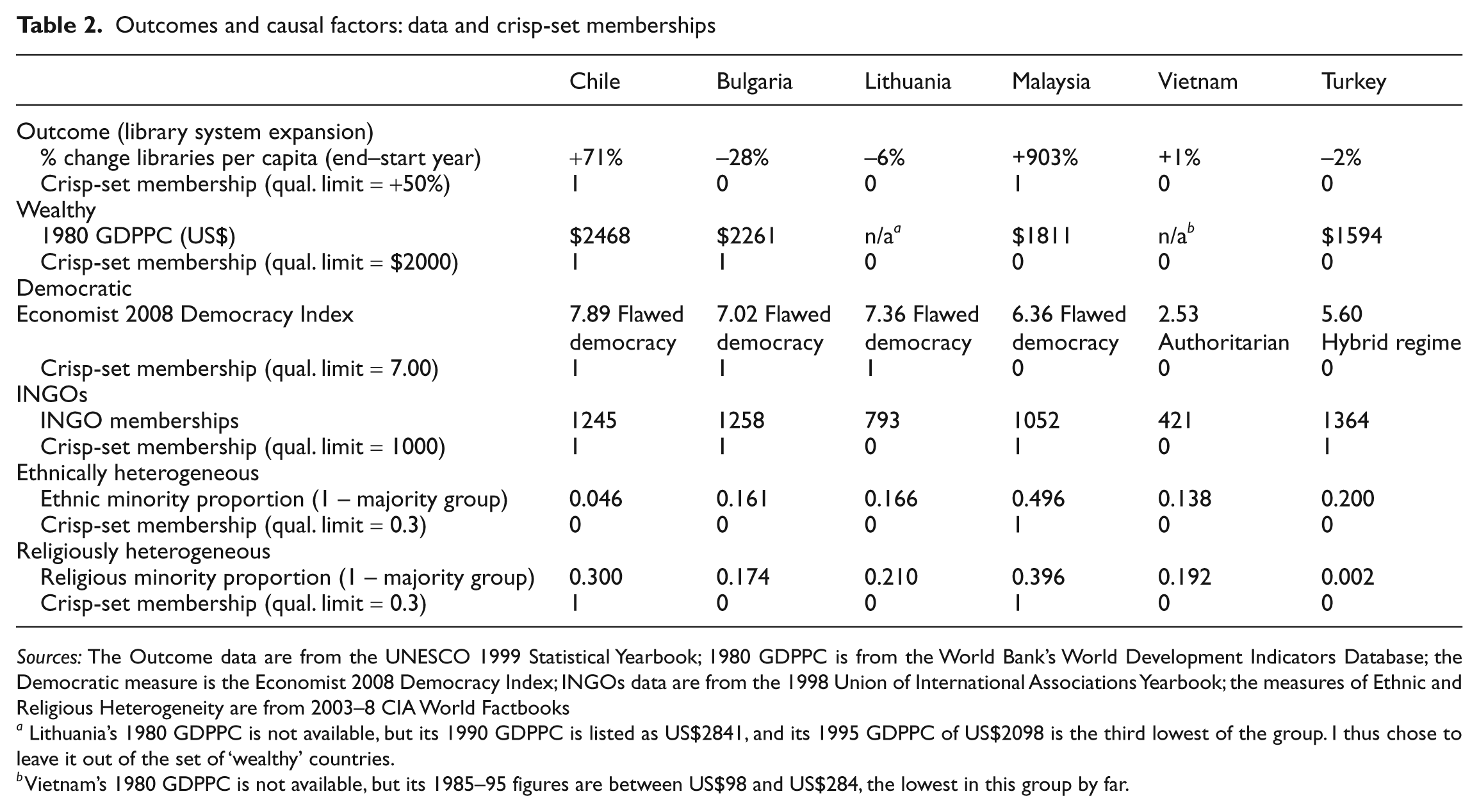
Sources:The Outcome data are from the UNESCO 1999 Statistical Yearbook; 1980 GDPPC is from the World Bank’s World Development Indicators Database; the Democratic measure is the Economist 2008 Democracy Index; INGOs data are from the 1998 Union of International Associations Yearbook; the measures of Ethnic and Religious Heterogeneity are from 2003–8 CIA World Factbooks
Lithuania’s 1980 GDPPC is not available, but its 1990 GDPPC is listed as US$2841, and its 1995 GDPPC of US$2098 is the third lowest of the group. I thus chose to leave it out of the set of ‘wealthy’ countries.
Vietnam’s 1980 GDPPC is not available, but its 1985–95 figures are between US$98 and US$284, the lowest in this group by far.
Truth table of outcomes and causal factors
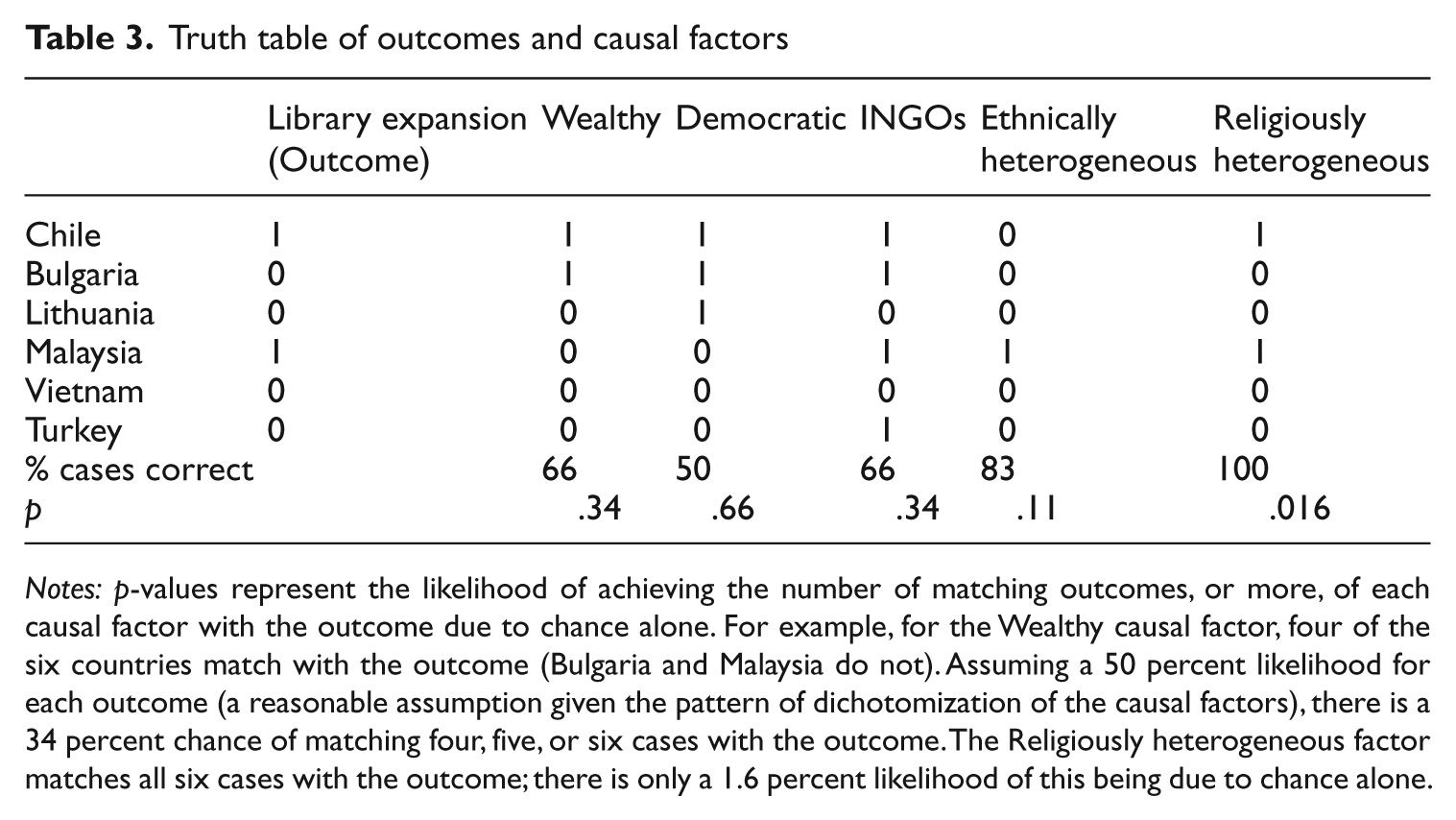
Notes: p-values represent the likelihood of achieving the number of matching outcomes, or more, of each causal factor with the outcome due to chance alone. For example, for the Wealthycausal factor, four of the six countries match with the outcome (Bulgaria and Malaysia do not). Assuming a 50 percent likelihood for each outcome (a reasonable assumption given the pattern of dichotomization of the causal factors), there is a 34 percent chance of matching four, five, or six cases with the outcome. The Religiously heterogeneousfactor matches all six cases with the outcome; there is only a 1.6 percent likelihood of this being due to chance alone.
Table 3 is a truth table based on the dichotomized data. Because interpretation of the table is very straightforward, Boolean logical operations are unnecessary. The statistical significance (p) for each factor, in the bottom row of Table 3, represents the likelihood that the pattern of six 1s and 0s for each factor with the outcome would occur by chance alone. It is possible to rule out wealth (H2) and democracy (H3) as necessary causal factors, because within this group Malaysia was neither relatively wealthy (at least as of 1980) nor relatively democratic, yet it is the country that experienced the greatest expansion of its library system. Having strong connections to global civil society, as operationalized by large numbers of INGOs within the country (H4), may well be necessary for the outcome, a finding that follows from world polity theory (Meyer et al., 1997), as well as from studies of Chile (see Austin, 2003). But INGOs are not a sufficient cause of library expansion as defined in this article, because both Bulgaria and Turkey have large numbers of INGOs but did not expand their public library systems during the period under consideration.
Consistent with critical library history and studies from the sociology of culture, religious heterogeneity appears to be a necessary condition for library expansion in these countries, while ethnic heterogeneity is an important additive factor. There is a roughly 11 percent probability that the correspondence of the ethnic heterogeneity causal factor with the outcome is due to chance alone, while for the religious heterogeneity factor the probability is only 1.6 percent. To be sure, religious and ethnic heterogeneity in several of these countries is not a straightforward matter. Turkey has a large Alevi religious minority that may or may not be counted as Muslim (Shankland, 2007), as well as a large Kurdish population. And while Chile claims to be ethnically homogeneous, the country is still sharply divided along racial lines (Merino and Mellor, 2009). Nevertheless, the associations of the religious and ethnic heterogeneity factors with the outcome support the religious and ethnic heterogeneity hypotheses (H6A and H6B). The most religiously and ethnically heterogeneous country in the sample by far, Malaysia, also experienced far and away the most growth of its public library system. The second most heterogeneous country, Chile, had the second highest rate of growth. The other four countries are all much more religiously and ethnically homogeneous. It is not difficult to think of examples beyond the six countries examined here that support this explanation. As was mentioned earlier in this article, Estonia, which is divided between ethnic Estonians and Russians, as well as Ukrainians and other groups, and includes a wide variety of Christian denominations and a large percentage of citizens without a religious affiliation, has a large and Internet-connected public library system. The late 19th-century United States is another supporting case (Du Mont, 1977; Harris, 1973).
Malaysia merits closer examination because it is such an exceptional case within this group. Today Malaysia has elaborate national cultural policies that were initiated in the early 1970s as part of the country’s ‘New Economic Policy’, a system of affirmative action for ethnic Malays. The NEP was introduced during a two-year period during which parliament was suspended. The impetus for this suspension of democracy was the 1969 Sino-Malay race riots in Kuala Lumpur, in which hundreds and perhaps thousands of people were killed in a series of riots between 13 May and 31 July. The cause of the riots is generally understood to be the deep economic and social inequalities between mostly Muslim ethnic Malays and wealthier Chinese and Indian Malaysian citizens (Bowie, 1988; Mehmet, 1986). One result of the riots was the introduction of Rukunegara, the Malaysian state’s official national ideology (Milne, 1970). Rukunegarais a pragmatic ideology that emphasizes national unity, multiculturalism, economic redistribution and national progress through modern science and technology. It enshrined the affirmative action system for ethnic Malays and the status of Malay as the official national language, and outlawed racially inflammatory speech. From its inception, Rukunegarawasimplemented by a newly formed National Unity Department through Malaysia’s state information infrastructure of schools, libraries and community centers, all of which were expanded into rural areas and poor urban neighborhoods to promote the Malay language and official Malaysian culture. Malaysia’s national cultural policy of state-sponsored performances, exhibitions and educational programs continues to the present, 3 as does its heavy investment in public libraries (Abu Bakar, 1998).
Conclusions
The six countries in this project’s sample represent various continents, religious traditions and political systems. While the present data are not sufficient for more rigorous multivariate analysis, this situation is unlikely to be remedied in the near future, as neither UNESCO nor any other organization has collected global data on developing countries’ public libraries since 1999. Nevertheless, using the data that are available, qualitative comparative analysis has yielded clear results that are consistent with a large empirical literature and body of social science theory. The analysis does not turn on the dichotomization of any one factor (see Table 2), a concern frequently raised with regards to QCA techniques (Goldthorpe, 2000: 51).
This article’s main finding – that under conditions of globalization, sectarian and ethnic heterogeneity can lead governments of developing countries to invest heavily in their public library systems – has relevance to research in the ‘information society’ paradigm (Castells, 2000, 2005; Castells and Himanen, 2004). The findings show the continuing influence of colonial history, as well as the history of postcolonial nation-building, on developing countries’ information policies and cultural institutions (Bail [2008] and Prasad [2005] have recently made similar arguments). While the information society paradigm can be applied to comparative studies of developing countries (Castells, 2005; Castells and Cardoso, 2006), emendations may be in order with regard to the role of sectarian and ethnic group dynamics in ‘societies in transition’ (Cardoso, 2006) to the network society model. Himanen (2006) has delineated three models of ‘network society’: the neoliberal Silicon Valley model, the Singapore model in which states strive to attract multinational corporations and the Finnish model of an informational welfare state (Himanen, 2006: 343). In addition to these, for countries in transition to a network/information society, it may be worth adding a ‘Malaysia model’ in which elites in multireligious and multiethnic nations build information society infrastructure in order to ameliorate sectarian and ethnic tensions and inequalities.
Development scholars have long debated the effects of religion, ethnicity and political stability on economic growth and social welfare (Alesina et al., 1996; Huntington, 2006 [1968]; Lian and Oneal, 1997; Montalvo and Reynal-Querol, 2005). A plausible, if somewhat general interpretation of the present study’s findings is that for developing countries to keep pace with the dynamism and instability brought on by globalization, a degree of instability in domestic politics may be beneficial. It appears that, in Malaysia and perhaps other cases (Yang, 2006), official recognition of sectarian and ethnic diversity can encourage development by creating incentives for elites to make long-term investments in public cultural and educational institutions.
Footnotes
Acknowledgements
For their assistance and support, as well as suggestions and criticisms, I would like to thank BulentYilmaz, John Wood, Ami Ehrlich, Rachel Schutt, and IddoTavory.
This research received partial funding from a $5000 Research Opportunity Grant from the University of North Texas Office of Research and Economic Development.