







Abstract
Cosmopolitanism increasingly features as a reference to describe contemporary structures of a globalized world. This article adds a critical examination of micro-level dimensions of such cosmopolitanism vigilant to the ideas about specific attitudes and global community. Who shares cosmopolitan orientations or sees oneself as world citizen? Are country differences attributable to globalization? Using data from the World Values Surveys 2005–8, cross-national comparative analyses suggest that various manifestations of cosmopolitanism – ethics, politics and identity – relate differently to socioeconomic characteristics and degrees of globalization. The study provides evidence that cosmopolitan orientations are more often found in the globalized world but, surprisingly, global identity is more widespread in other parts of the world. Implications of these findings are discussed.
Introduction
The concept of cosmopolitanism has gained much attention in recent scholarly descriptions of the globalized world. An emerging body of literature engages with cosmopolitanism in relation to current global challenges and proposes perspectives on and growing evidence of global governance, democracy, economy, civil society, justice, ethics, solidarity and community (e.g. Anheier et al., 2001; Bohman, 2007; Brock and Brighouse, 2005; Calhoun, 2007; Derrida, 2001; Faist, 2009; Held, 1997; Küng, 2002b; Nussbaum, 2006; Pogge, 2008; Smith and Wiest, 2005; Szerszynski and Urry, 2006; Teune, 2002).
Although some of the notions of cosmopolitanism are highly contested, the broader consensus is that globalization is the driving force of contemporary cosmopolitanism. Increasing levels of interconnectedness and interdependence between states and people in economic, political, cultural and social terms are believed to continue to alert to cosmopolitanism. Yet, such an outlook does not go unchallenged as international terrorism, nationalism, poverty, anti-foreigner sentiments, aggressive domestic and foreign politics are also seen as consequences of globalization (e.g. Falk, 2002; Sen, 2006), which clearly undermine the belief in a world becoming cosmopolitan.
Following from these opposing observations, it could be misleading to conceive of a coherently cosmopolitanizing world. First, cosmopolitanism might characterize the aforementioned domains – e.g. global ethics, politics and community – to different degrees. Second, different economic, cultural and social contexts might lead to different realizations of cosmopolitanism around the globe and, more importantly, different understandings of cosmopolitanism. Hence, cosmopolitanism may not develop simultaneously or be evenly spread across the globe. Likewise, people’s perceptions of the world may rest upon different premises and provoke different reactions to globalization – some might be more cosmopolitan than others, depending on the circumstances people live in (see also Dower, 2002).
This article aims to explore such variation in manifestations of cosmopolitanism from the perspectives of individuals, examining their cosmopolitan orientations and identity. This provides a much needed addition to the majority of available studies whose prime foci are on structural, macro-level analyses of contemporary cosmopolitanism (see, for instance, Delanty and He, 2008). To examine micro-level cosmopolitanism, our research then tries to answer three important questions: To what extent have people developed cosmopolitan orientations and do they see themselves as citizens of the world? What are important covariates and/or sources of these orientations and identities? And, finally, does globalization explain the emergence of such cosmopolitanism? Using quantitative survey data, we provide cross-national evidence of cosmopolitanism grounded in specific attitudes of an ethical and political nature inasmuch as in identity. Our analyses examine issues of social stratification of these orientations and identity and show in what ways globalization is associated with country differences in cosmopolitanism.
Cosmopolitan orientations and identity
Ideas about cosmopolitanism were first formulated by the Stoics in Ancient Greece as well as by Mencius (1970) in Eastern philosophy. Kant arguably reintroduced cosmopolitan thought in his philosophical works on international relations in the Enlightenment. In sociology, Merton (1964 [1949]) first distinguished ‘cosmopolitan’ from ‘local’ people based on their broader orientation and identity reaching beyond the confines of their immediate environment while conducting a study during the Second World War. Cosmopolitanism has then steadily gained more attention in the social sciences. First, research on global mass media, mobility and migration assessed implications for local life (cf. Albrow, 1997). More recently, the concept has been used in a reaction to understand globalization and its social, political and cultural consequences and implications for individuals (e.g. Beck, 2006; Delanty, 2006; Held, 2000; Roudemetof, 2005). Since it is widely argued that increasing levels of global exchange establish contact, familiarity and shared knowledge around the world and forge perceptions of a global community in the making, this ‘new’ cosmopolitanism more broadly points towards political, ethical, humanitarian and value-based aspects of life in times of intense globalization (e.g. Beck, 2006; Breckenridge et al., 2002; Chaudhuri, 2009; Fine, 2007; Hofmeister and Breitenstein, 2008).
In an effort to understand the growing usage of the concept in the social sciences, Vertovec and Cohen (2002) suggest a multidimensional perspective on cosmopolitanism and dissect philosophical, cultural, political, attitudinal and practical understandings. In moral and legal philosophy, cosmopolitanism sustains the idea of world or universal citizenship, human rights and duties (see also Varsamopoulos, 2009). It works on principles of global justice and presupposes an affinity to dialogue, tolerance, awareness of diversity and difference, respect, future-orientedness, openness and other similar characteristics (for instance, Appiah, 2006; Beck, 2002; Küng, 2002a; Roudemetof, 2005). More generally speaking, a ‘shared understanding of what needs to be done to safeguard the human future’ (Falk, 2002: 28) is what binds world citizens together. Such global belonging is often regarded as seeing oneself as an integral part of the world and sharing additional concerns transcending the own country/locality (Dye, 1963; Merton, 1964 [1949]; Nussbaum, 1996; Pollini, 2005).
Cultural cosmopolitanism expresses itself in increased adaptations of elements from diverse places such as food, fashion or music. Although the idea of an emerging common global culture (e.g. Drori, 2005; Featherstone, 1990) remains heavily contested, the underlying argument is that unprecedented levels of global exchange of goods and services ‘have all wrought a socially and culturally interpenetrated planet’ (Vertovec and Cohen, 2002: 9). In this vein, practical cosmopolitanism goes beyond this more or less ‘consumer-goods’ based understanding by emphasizing certain behaviours and skills enabling people to proactively and reflectively interact with, participate in and understand different cultures.
The political dimension of cosmopolitanism covers issues of global governance (e.g. Mann, 1997), global social movements and multiple political affiliations at local, national and global levels (Vertovec and Cohen, 2002). While a link to philosophical cosmopolitanism cannot be denied, global political challenges – environmental issues, peace, foreign aid, labour – necessitate practical collaboration and collective conflict resolution according to this argument. In addition, emerging international and global political actors establish opportunities for new individual affiliations (e.g. Beck and Grande, 2007; Thomas, 2002). Their politics aim to create, among other things, new identities and self-views among affected citizens so that a global identity cannot only be the outcome of a world-view (cosmopolitan philosophy) but could also stem from institutional efforts.
Finally, cosmopolitanism is supposed to manifest itself in specific orientations towards numerous social, cultural, political and economic aspects of life. Cosmopolitans are believed to be open-minded towards the otherness of the other (Beck, 2002), able to process equivocal meanings of local, national and global phenomena and manage this diversity, and respectful and tolerant towards other ideas, opinions and cultures. The ‘willingness to engage with the Other’ (Hannerz, 1990: 239) makes cosmopolitans think differently about themselves and their relation to the outside world. More specifically, this cosmopolitan disposition infiltrates thinking about foreigners, different religions, social groups, politics, or protectionism of national and local cultures in more open-minded ways (Roudemetof, 2005).
This variety of interpretations offers the opportunity to study cosmopolitanism in manifold ways. While normative contributions help understand the meanings and potential promises of a cosmopolitan world, empirical studies shed light on contemporary expressions of such cosmopolitanism in societal structures, institutional actors and individuals’ orientations and sense of belonging. As for the latter, cosmopolitanism might rather alter existing orientations and identities in ways transcending previous boundaries, e.g. national ones, and making them more open to and integrative of the world as a whole.
Previous empirical studies and hypotheses
While the majority of studies deal with cosmopolitanism at the macro-level, a growing body of research using survey data scrutinizes the various understandings from an individual, micro-level perspective. Norris and Inglehart (2009) examine attitudes towards national belonging, on the one hand, and trust in foreigners and different people as separate dimensions of cosmopolitanism, on the other. The above authors claim that weaker national identity and pride inasmuch as tolerant attitudes to and trust in others can be seen as individual expressions of cosmopolitanism. Mau et al. (2008) equally look at attitudes towards foreigners, but they also include measures of political cosmopolitanism such as people’s ‘assignment of accountability to the world society’ with respect to certain policy challenges. Olofsson and Öhman (2007) elaborate on Roudemetof’s (2005) uni-dimensional measure of cosmopolitanism and propose two-dimensional cosmopolitanism, distinguishing between a ‘global–local’ identity continuum and a ‘protectionism–openness’ attitudinal dimension. Their measures refer to levels of solidarity with local and national communities, on the one hand, and protective orientations towards national economy and culture, on the other. Pichler (2008, 2009b) also operationalizes cosmopolitanism along the distinction between a subjective component (identity) and more objective elements found in a series of concern for and attitudes towards others (prejudice), international political cooperation and immigration. Studies also provide evidence of rather weak linkages between global identities and cosmopolitan attitudes – only people holding the strongest cosmopolitan orientations appear to be considerably more likely to hold global self-views (see Pichler, 2009b). That is, the various notions of cosmopolitanism do not seem to be very strongly correlated though the more normative literature evokes the impression that different understandings of cosmopolitanism go together (Vertovec and Cohen, 2002).
In contrast to these previous studies, we propose a more nuanced view on cosmopolitanism using a three-dimensional perspective on cosmopolitanism to accommodate a greater diversity of cosmopolitan expressions as outlined in the literature. We integrate two kinds of orientations and, third, identity with a view to Vertovec and Cohen’s (2002) distinction of the various understandings of cosmopolitanism. First, we differentiate between ethical cosmopolitan orientations and political ones where the former encapsulates ideas of trust in different people, tolerance and attitudes towards diverse society and should bring more closely together the philosophical and attitudinal sides of cosmopolitanism. The latter concentrates on issues of (moderated) national identity and global political decision-making, reconciling political and attitudinal understandings of cosmopolitanism. The third dimension then is subjective and concerns aspects of identification. Global identities should mirror people’s self-views as global citizens as well as potential multiple affiliation as outlined as another dimension of cosmopolitanism by several authors (Appiah, 2006; Nussbaum, 1996; Vertovec and Cohen, 2002).
Previous studies claim that cosmopolitanism is socially stratified with younger, educated people, higher social classes and people in urban areas showing larger commitment to cosmopolitan ideals. We would thus assume that age, education, occupational status and income may increase the likelihood to see oneself as a global citizen or embrace cosmopolitan attitudes according to elitist or avant-garde notions of cosmopolitanism (e.g. Chaudhuri, 2009). The place of residence could also matter since people living in urban areas are generally more exposed to global others (e.g. foreigners, tourists) than people residing in the countryside. Political orientation (left–right) could also have an influence on identity and orientations since the left and the right might buy into different ideas about identity and orientation concerning a cosmopolitan world. Finally, religious denomination could also play a role. Broadly speaking, world religions have developed different notions of a global community of believers, such as Christianity’s concept of ‘Christendom’ or ‘Global Umma’ in Islam. Consequently, this may convey different meanings and the importance of such a community to their members.
At the country level, we would expect that cosmopolitan orientations and global identities are more frequent in the most globalized and richest countries. Since globalization is a driving force behind cosmopolitanization (Beck, 2006), it should explain a large share of cross-national variation in its cosmopolitan consequences such as levels of global identity and cosmopolitan orientations. Recently, Norris and Inglehart (2009) have concluded that country-level cosmopolitanization has a notable impact on orientations. Their ‘Cosmopolitanization Index’ – consisting of measures of economic globalization, press freedom and economic development – was found to be strongly associated with national averages of cosmopolitan orientations. While this measure provides a fresh approach to the cross-national study of cosmopolitanism, it could also be criticized for not going much beyond the ideas of globalization itself. Rather, the index neglects many of the theoretical considerations about cosmopolitanism and potentially disguises more nuanced explanations why some orientations may have become more cosmopolitan while others may have not. We are therefore intrigued by the questions whether cross-national differences in cosmopolitan orientations and global identities could be more accurately explained by different levels (or stages) of economic, social or cultural globalization on the one hand and democratic freedoms or economic development on the other. We hypothesize that cosmopolitan orientations would be more influenced by economic and democratic considerations of globalization, while emerging self-views as global citizens could be more closely related to social globalization.
Data and methods
While most studies use data from European countries (see Mau et al., 2008; Olofsson and Öhman, 2007; Pichler, 2009a), we draw on data from 49 countries across the globe 1 using the latest wave (wave 5) of the World Values Surveys (WVS, 2005–8). Fieldwork for WVS5 took place between 2005 and 2008 – 12 national surveys were conducted in 2005, 18 in 2006, 15 in 2007 and four in 2008. The large number of countries with different economic, social, cultural and political backgrounds as well as survey traditions exacerbates the use of a shared survey methodology. While all national surveys are conducted using random sampling methods, the available documentation hints at some differences in the details of the sampling design with implications for cross-national data comparability (see WVS, 2005–8). However, data are always collected using personal interviewers but sample sizes vary considerably from 954 respondents (New Zealand) to 3051 respondents (Egypt). The 2005–8 WVS, then, comprises a number of indicators to grasp both people’s self-views as world citizens and cosmopolitan orientations.
Respondents could either ‘strongly agree’, ‘agree’, ‘disagree’ or ‘strongly disagree’ with ‘seeing oneself as a world citizen’. We derive two dichotomous measures of global identities: strong global identity juxtaposes a ‘strongly agree’ answer with the remaining ones, while a weak global identity also acknowledges an ‘agree’ answer. Since large majorities see themselves as national citizens (in 30 countries, the absolute majority ‘strongly agrees’ with seeing oneself as a national citizen, in the remaining countries this share varies between 49 and 23 percent), a strong global identity can be viewed as more substantial on the one hand and, in the majority of cases, in addition to national identity rather than opposing feelings of national belonging on the other hand. The weaker global identity measure, however, also remains interesting since theory argues that some limited sense of global belonging already contributes to a cosmopolitan outlook (e.g. Turner, 2002). 2
Cosmopolitan orientations are measured in multidimensional ways. First, we examine the level of trust in people with different backgrounds, especially in foreigners and those of different religious denomination (see also Norris and Inglehart, 2009). 3 The two variables are highly correlated (r = .713) and suitable for a scale (Cronbach’s α = .83). Second, we use four variables measuring the levels of tolerance towards different people. Those variables ask whether people would mind neighbours of a different race, immigrants, religion or language. A count index ranging from 0 to 4 is derived, on which high values indicate tolerance. 4 Third, people’s attitude towards ethnic diversity in society is taken as an indicator for cosmopolitan openness. 5 Fourth, we consider whether respondents favour political decision-making beyond the nation-state in the areas of ‘peacekeeping’, ‘protection of the environment’, ‘aid to developing countries’, ‘refugees’ and ‘human rights’. 6 The resulting count index ranges from 0 to 5, where high values denote favouring politics beyond the nation-state. Finally, we include a measure of nationalism, rather a lack thereof, by using four variables denoting the strength of national and regional identities, national pride and willingness to go to war. 7 The equally weighted composite measure is derived from Norris and Inglehart (2009) and ranges from 0 to 12, where high values denote a non-nationalistic orientation (see Table A1 in the Appendix for descriptive statistics of all individual-level variables). 8
A principal component analysis shows that those five aspects of cosmopolitan orientations – trust, tolerance, diversity, international politics and absence of nationalism – can be summarized using two dimensions which retain 48 percent of the observed variances. The first component captures variability in trust in different people (loading of 0.633), tolerance towards diverse people (0.679) and openness towards diversity (0.576). We call this first component ‘ethical cosmopolitan orientation’, capturing the ideas of openness and recognition of otherness. The second component summarizes attitudes towards global political decision-making (loading of 0.742) and nationalism (0.544). We call this the political dimension of a cosmopolitan orientation, strongly embracing the lack of national preoccupations. Two equally weighted indices of cosmopolitan orientation – ethical and political – were computed and rescaled to a range of 0 to 100, where high values reflect a strong sense of cosmopolitanism (see Table A1). Both indices comprise a considerably larger number of indicators than have been included in previous studies. Therefore, they promise a more comprehensive measurement of cosmopolitan orientations.
At the country level, we use a series of indicators which have been recently connected to cosmopolitan theory and empirical research (Norris and Inglehart, 2009). First, we use KOF globalization indices, differentiating between an overall index and sub-indices for economic, social and political globalization. 9 The KOF economic globalization indicator consists of measures of flows of capital and goods (e.g. trade, foreign direct investment but also income payments to foreign nationals) and trade restrictions such as hidden import barriers, tariff rates and capital account restrictions. The KOF social globalization index comprises data on personal contact between countries (e.g. telephone traffic, tourism, international letters), information flows (e.g. internet use, television) and cultural proximity measures (number of McDonald’s restaurants, Ikeas and trade in books). KOF political globalization pays attention to the number of embassies in a country, membership in international organizations and international treaties. The overall KOF Globalization Index is then a weighted index of the aforementioned three dimensions, where higher values indicate higher levels of globalization (for more information see Dreher, 2006; Dreher et al., 2008).
Second, we use Freedom House (2009) measures of press and media freedom in the world, ranging from 0 to 100. We have, however, reversed the original measurement so that high values indicate press freedom. The Freedom House index captures legal, political and economic environments in a country and assesses them in terms of free flows of news and communication. It comprises, among others, constitutional guarantees for freedom of expression, independence of the judiciary, editorial independence of state- and privately owned media, official censorship, and the structure, transparency and concentration of media ownership (for more details, see Freedom House, 2009).
Third, we use Gross National Income (GNI) in purchasing power parities measured in constant international US dollars (World Bank, 2009). Finally, we draw on Norris and Inglehart’s (2009) Cosmopolitanization Index, which combines the KOF Globalization Index, Freedom House’s freedom of press index and the World Bank’s GNI (see Appendix Table A2 for a description of all country-level variables). All indices are used in standardized form to make comparisons of their effects possible.
Using hierarchical regression models, we regress measures of global identity and cosmopolitan orientation on a series of socioeconomic characteristics. Since our data are nested – we observe individuals within countries – multilevel models warrant the correct and robust estimation of regression coefficients and their standard errors, thus improving the accuracy and precision of the findings. We include all explanatory variables as fixed effects, that is, there is no variation in their effect sizes across countries. 10 However, we include a random intercept to control for different means across countries. This model can be shown in the following equation:

For models exploring the dichotomous measures of global identity, Yij is the logit of seeing oneself as global citizen for individual i in country j. For models examining ethical and political cosmopolitan orientation, Yij is the continuous score on the ethical and political cosmopolitan orientation indices. β0ij includes a fixed intercept γ 00 , purporting to the grand average logit/score across all countries, a random part u0j allowing for deviations from the average group logits/scores in country j and an individual-level error term eij.

β 1 (in equation 1) includes fixed regression coefficients corresponding to independent variables summarized in the matrix Xij, while, in extended models, matrix Zj represents a country-level variable and its regression coefficient, β 2 .
After presenting statistical descriptions of our data, we explore the relationships between global identity and cosmopolitan orientations on the one hand and socioeconomic characteristics on the other. In separate models, we add country-level variables since the rather small number of countries constrains further statistical analyses.
Results
Cosmopolitan orientations and global identity
Descriptive statistics show that global identity is considerably widespread across the world and that ethical cosmopolitan orientations are more widespread than political ones (proportions and means for every country can be found in Table A2 in the Appendix). However, cross-national variability in self-views as global citizens on the one hand and cosmopolitan orientations on the other is substantial. Only 13 percent of people living in China strongly see themselves as global citizens whereas this share equals 62 percent in Mali, though the average over all countries amounts to 29 percent. Similarly, weaker global identities (average of 77 percent) vary between 46 percent (Bulgaria) and 98 percent in Rwanda. Examining ethical cosmopolitan orientations (average score of 63 on a 0–100 scale), we find that those are weakest in Jordan (score of 33) and strongest in Sweden (80). As for political cosmopolitan orientations, people in Georgia score lowest (mean of 24) while people in Japan express the most cosmopolitan political orientations (61) with an average country score of 42. Figure 1 shows some of the global variation in all of these four measures.
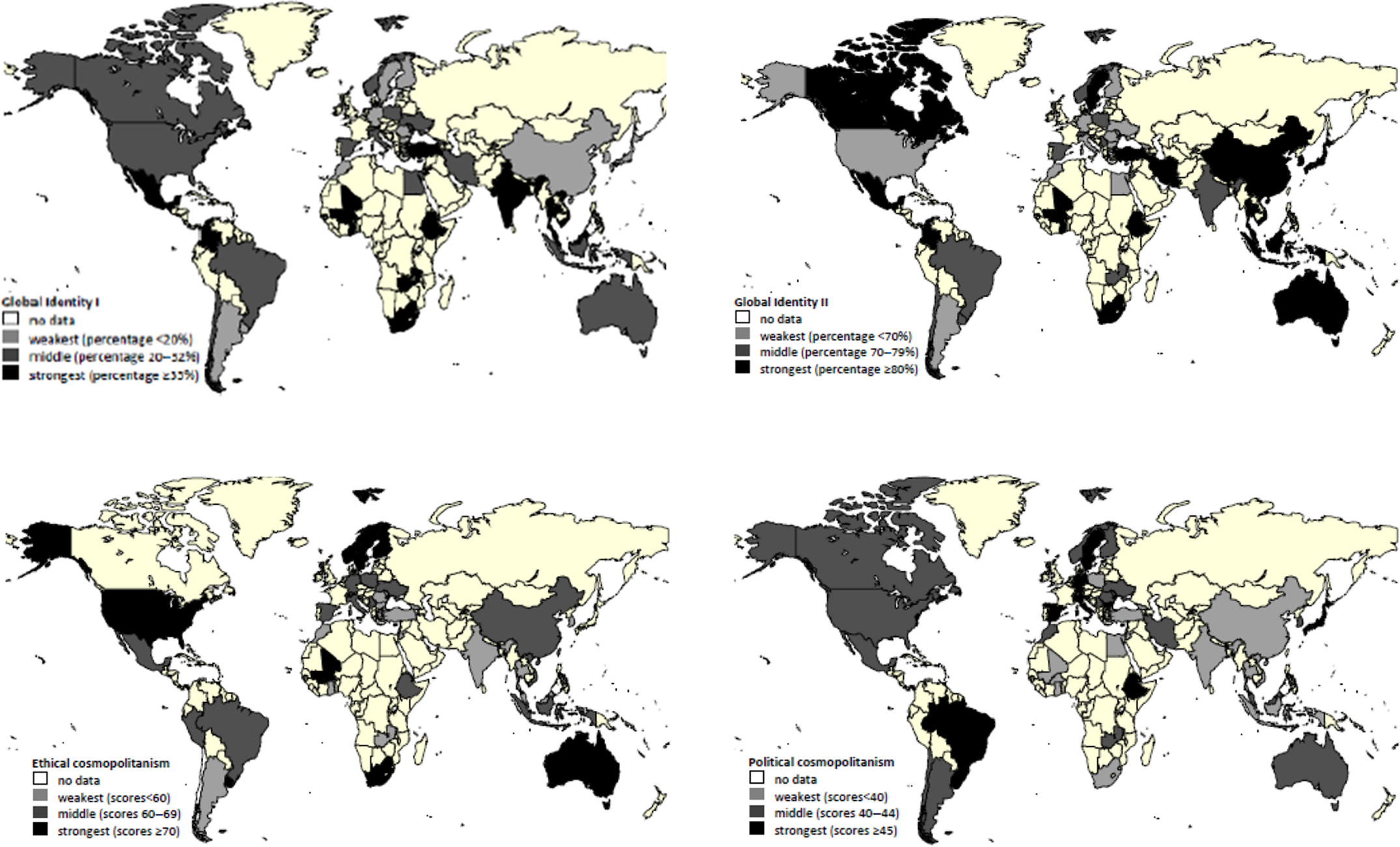
Global identity and cosmopolitan orientations: share of population seeing themselves as global citizens and mean scores on measures of cosmopolitan orientations
Although the threefold distinctions in higher/middle/lower scores made in Figure 1 cannot reveal the total variation, strong global identities (upper-left map) tend to be more widespread in non-western societies, especially in Africa and South-East Asia. Weaker global identities (upper right) follow a similar trend but those are also frequently found in western societies (Australia, Canada, Japan and Sweden). A different picture emerges for cosmopolitan orientations. Ethical cosmopolitanism (lower left) is considerably more widespread in the USA, many European countries and Australia than in Asia and most African countries (with the exceptions of Burkina Faso, Mali and South Africa). The same holds for political cosmopolitanism (lower right). Here, a regional trend appears to be the most pronounced since North American and European countries tend to score higher than the rest (with the exception of South American countries). Statistical tests (see also Table A2) then show significant mean differences across continents in strong global identities (p < .01), ethical and political cosmopolitan orientations (p < .05) while differences are not significant for weak global identities at the 5 percent level (p = .18).
In the following, we aim to explain this cross-national/regional variation in measures of global identity and cosmopolitan orientation. However, before turning to country-level explanations we examine the effects of socioeconomic characteristics to isolate compositional effects. Table 1 illustrates the results of fixed effects logistic hierarchical models for global identity and linear models for measures of cosmopolitan orientations. It should be noted that individual-level correlation between those four measures is rather low indicating separate dimensions of cosmopolitanism. 11
Explaining cosmopolitanism: Fixed effects hierarchical regression models on global identities and cosmopolitan orientations

Notes: Hierarchical logistic regression models for global identity, hierarchical linear regression models for ethical and political cosmopolitan orientations. Missing values dummied out, non-significant effects of categorical variables not shown.
Reference categories in parentheses.
Some countries have to be put in the fixed part (instead of being part of random variation at the country level) since their residuals (relatively large aggregate values in the dependent variables) threaten the assumption of normally distributed residuals at the country level.
C = regression coefficient, SE = standard errors.
p < .01; *p < .05 (two-tailed tests).
Random parts at country level without continent: 0.21, 0.56, 45 and 20 respectively.
Source: World Values Survey 2005–8.
Socioeconomic effects – gender, age, education, occupational status, household income, place of living, political orientation and religious denomination – are statistically significant in all four measures. As for global identities, education, place of living and religion play the largest roles. Less educated people are usually more reluctant to see themselves as global citizens, while people with a university degree are much more likely to identify themselves as global citizens as indicated by odds ratios of 1.25 (logit of 0.23) 12 and 1.23 (0.20) respectively. While people living in rural areas are less likely to identify strongly as world citizens, we also find that weaker global identities are somewhat more widespread in smaller cities of 50,000–500,000 inhabitants than the mega cities or the countryside. The right are slightly more likely to report strong global identity (logit of 0.01). Interestingly, global identities are less widespread among the Orthodox (odds ratios of 0.80 and 0.87 respectively) than the Roman Catholic, while Muslims more often identify strongly as global citizens (odds ratio of 1.27).
For cosmopolitan orientations we find the same effects for education, occupation, place of living and religion. Highly educated people score higher on both ethical and political cosmopolitanism, as do professionals and people in urban areas. The right express considerable lower levels of ethical cosmopolitan orientations (–0.43 index points for a one-unit change in the 10-point left–right scale) while there is no difference in political cosmopolitan orientations. Muslims report stronger ethical cosmopolitanism (1.58). Additionally, women generally express stronger ethical and political cosmopolitan orientations than men. Finally, household income is positively associated with ethical cosmopolitanism (effect of 0.41) while age (effect of –0.05) plays a negative role in political cosmopolitanism. Differences across continents are noteworthy as people in Africa are more likely to express strong global identities (odds ratio of 1.88) while being less cosmopolitan in political terms (effect of –4.82). In Asia, people more frequently report weaker global identities (odds ratio of 2.20) but reveal considerably lower levels of cosmopolitan orientations (–7.61 for ethical and –5.10 for political cosmopolitan orientations).
When we compare the amount of variation at the individual level to baseline models (not shown), there is reason to believe that despite significant effects of many socioeconomic characteristics, the explanatory power of the above models is rather low. As for cosmopolitan orientations, the individual-level effects can approximately explain 3 percent of the variance in its ethical dimension (variance component of 264, see Table 1, as compared to the baseline 274) and just 2 percent in its political dimension (284 as compared to 290). 13 Yet, we believe that the reason for this weak explanatory power lies in the modelling of fixed effects. Separate models (not shown) for each country illustrate that explanatory power and effect sizes vary considerably across countries. For instance, socioeconomic characteristics can explain up to 18 percent in weak global identities in Ethiopia, 20 percent in ethical cosmopolitan orientations in Taiwan and 16 percent in political cosmopolitan orientations in Cyprus. In this respect, fixed effects are a very strong assumption but the limited number of countries inhibits the inclusion of random effects for statistical reasons.
Country-level explanations of differences in global identity and cosmopolitan orientation
In all four hierarchical regression models, variation at the country level is statistically significant and accounts for from 7 percent of the total observed variation in the case of strong global identities up to 20 percent in the case of ethical cosmopolitan orientations. Could globalization explain this variation across countries? We draw on Norris and Inglehart’s (2009) Cosmopolitanization Index but we also think of separate sub-indices of globalization (economic, social and political), press freedom and development as potential and probably more pointed explanations (Dreher, 2006; Dreher et al., 2008).
Table 2 presents statistical associations between these indices on the one hand and aggregated proportions of people expressing global identity and means of cosmopolitan orientations on the other hand. Not surprisingly, all indices are strongly associated with each other though political globalization seems to be the least related to other measures of globalization, economic development, press freedom and cosmopolitanization. These indices are also associated with the country-level averages of measures of global identities and cosmopolitan orientations. We find substantial positive associations, especially between the ethical dimension of cosmopolitan orientations and measures of press freedom (r = .52), economic development (.46) and cosmopolitanization (.44), while political cosmopolitan orientations appear to be more closely related to globalization (.39) – and especially social and political globalization (.41 and .40 respectively). Surprisingly, however, we find large negative correlations between the indices and strong global identity at the country level indicating a reverse relationship between global identity and globalization/cosmopolitanization of which high social globalization (r = –.50) tends to revoke the strongest rejection of world citizenship. Weaker global identities are hardly associated with measures of globalization and/or cosmopolitanization at the country level.
Country-level Pearson correlations between aggregated measures of global identities, cosmopolitan orientations and structural variables pertaining to measures of globalization, freedom, development and cosmopolitanization
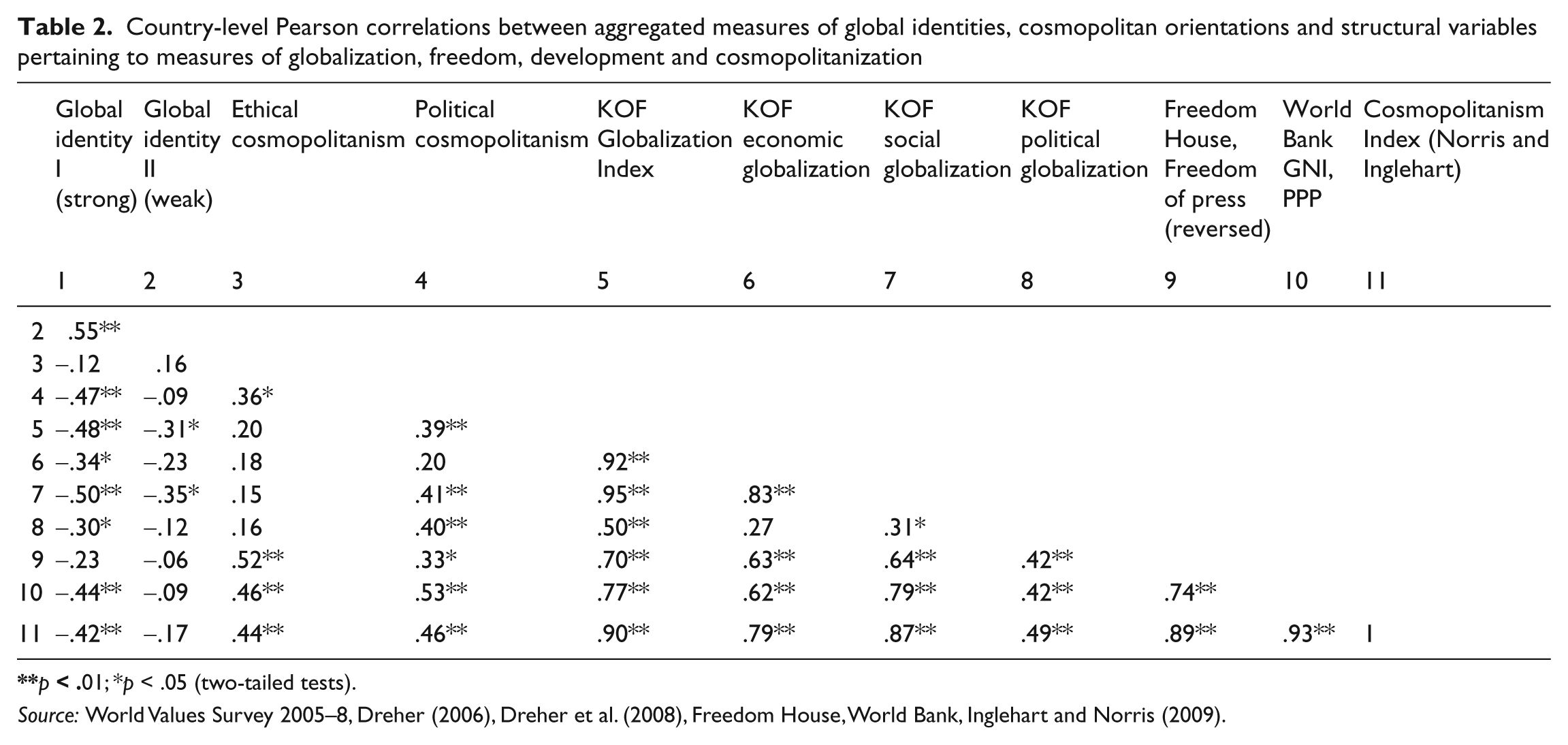
p < .01; *p < .05 (two-tailed tests).
Source: World Values Survey 2005–8, Dreher (2006), Dreher et al. (2008), Freedom House, World Bank, Inglehart and Norris (2009).
These correlations help gain a first insight into possible explanations of cross-national variation in global identities and cosmopolitan orientations. Most likely, press freedom, economic development and cosmopolitanization will be strong predictors of the ethical dimension of cosmopolitan orientations while globalization will be an additional strong predictor of political cosmopolitan orientations. As for identities, we could now assume that social globalization, economic development and cosmopolitanization at the country level make people less likely to strongly see themselves as world citizens. In the following, multilevel models will shed more light on these preliminary insights.
Table 3 then shows the effects of these country-level variables on individual-level global identity and cosmopolitan orientations as well as the reduction in cross-national variation (explanatory power at the country level). As already mentioned, we are constrained to estimate separate models for these effects since the small number of countries precludes their joint assessment on statistical grounds. Results indicate that all seven indices have a significantly negative effect on strong global identity after controlling for individual-level socioeconomic characteristics. Social globalization tends to explain country-level variation to the greatest extent (effect size of –0.21, explaining 20 percent of the country-level variance). As for weak global identities, overall (–0.33), economic (–0.26) and social globalization (–0.34) indices matter most, while press freedom, economic development and cosmopolitanization do not have significant effects. Cross-national variation in ethical cosmopolitan orientations is best described by freedom of press (effect size of 4.03), followed by economic development (2.82) and cosmopolitanization (3.18). Finally, differences in political cosmopolitan orientations are grounded in globalization, press freedom, economic development (strongest effect of 2.18, explaining 24 percent of the country-level variance) and cosmopolitanization at the country level. The only non-significant explanation here is the sub-index of economic globalization.
Explaining global identity and cosmopolitan orientations at the country level: effects of globalization, press freedom, economic development and cosmopolitanism (all standardized) on cosmopolitan orientations and global identities
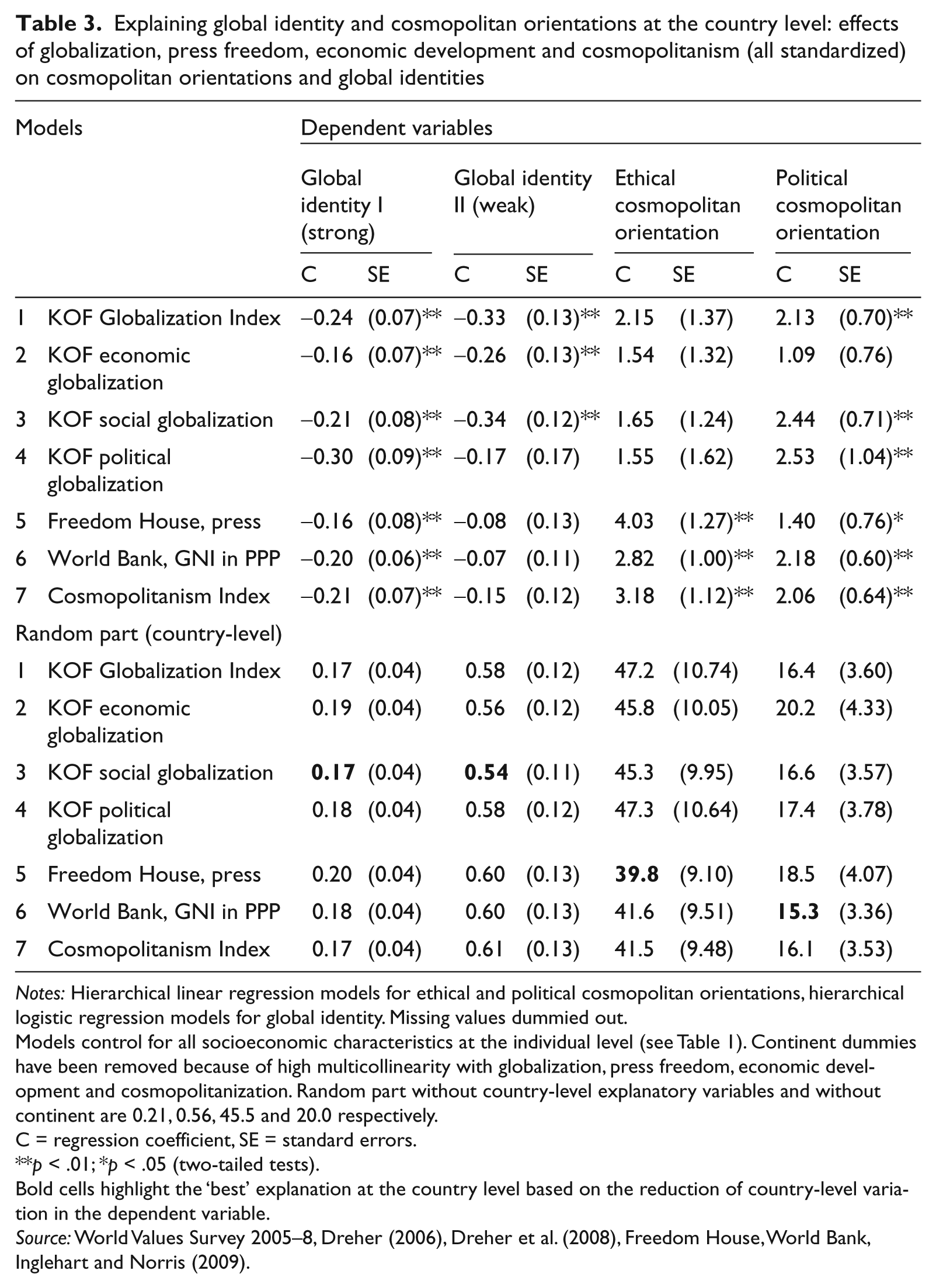
Notes: Hierarchical linear regression models for ethical and political cosmopolitan orientations, hierarchical logistic regression models for global identity. Missing values dummied out.
Models control for all socioeconomic characteristics at the individual level (see Table 1). Continent dummies have been removed because of high multicollinearity with globalization, press freedom, economic development and cosmopolitanization. Random part without country-level explanatory variables and without continent are 0.21, 0.56, 45.5 and 20.0 respectively.
C = regression coefficient, SE = standard errors.
p < .01; *p < .05 (two-tailed tests).
Bold cells highlight the ‘best’ explanation at the country level based on the reduction of country-level variation in the dependent variable.
Source: World Values Survey 2005–8, Dreher (2006), Dreher et al. (2008), Freedom House, World Bank, Inglehart and Norris (2009).
To summarize, cross-national differences in various dimensions of cosmopolitanism are grounded in differences in globalization, press freedom, economic development and cosmopolitanization. Arguably, the indices measure very similar things – globalization is associated with economic development and press freedom, which, in turn, are the building blocks of the Cosmopolitanization Index proposed by Norris and Inglehart (2009). It is somewhat surprising that sub-indices of globalization play different roles in explaining these country differences. Moreover, these findings indicate that political cosmopolitan orientations are partially a product of political and social globalizations but not associated with economic globalization; by and large, ethical cosmopolitan orientations appear to be independent from globalization and stronger global identities seem to be constrained by higher levels of globalization.
Discussion and conclusion
This article aims to contribute to the literature on cosmopolitanism by presenting an empirical study using survey data from all regions of the world. Its merits lie in using refined measures of cosmopolitan orientations, the inclusion of identity as another theoretically grounded aspect of cosmopolitanism and discovering more detailed explanations for country-level differences in the above using a series of recently developed societal-level indices depicting globalization and cosmopolitanization.
The most surprising findings are, first, that rather large proportions of populations see themselves as world citizens though these identities are significantly more frequent in less developed countries (especially in their stronger form). This finding indicates that global identities do not contradict or replace national and/or local identities (see Linklater, 1996). Second, socioeconomic properties of respondents play a certain role, though their explanatory power is weak – indicating modest social stratification of global identities and cosmopolitan orientations. Yet, analyses also point towards different levels of social stratification of cosmopolitan attitudes and identities across countries, disputing the idea of an evenly balanced emergence of cosmopolitanism among social groups. Third, cross-national explanations for differences in the levels of global identity and cosmopolitan orientations can be found in globalization, freedom of press and economic development. Yet, globalization has ambivalent effects on manifestations of cosmopolitanism. Cross-national differences in global identity are negatively associated with globalization. Political cosmopolitanism is positively influenced by social and political globalization (not economic globalization though) and ethical cosmopolitanism appears to be independent of globalization.
Starting with global identities, these puzzling empirical results suggest different contextual meanings of a global community. While weaker expressions of global identities are almost equally spread across continents, why are stronger global identities significantly more often found in less globalized, less developed, less free and less cosmopolitan societies? While our analyses cannot provide a final answer to this question, one could speculate about global identity relating to different cultural and political conditions in a given country (see also Entrikin, 1999; Parekh, 2003). States in which many people see themselves as world citizens tend to be internally very heterogeneous, younger, less integrated and more contested, probably even ‘failing’ nation-states (especially in Africa). Maybe because of these shortcomings of nationalization in comparison to the ‘older western states’, global identities provide a more meaningful expression of self and belonging in an internally and externally poorly functioning state upon which the concepts of nationality were quite recently superimposed. Hence, people could be more willing to express strong global identities instead of weak ones, assigning greater personal meaning to global identity in such environments. Alternatively, national and global identity could be loaded with different meanings making it ‘easier to assume global citizenship’ as compared to prevailing understandings in more globalized countries. Here lies a convincing argument to include a context-embedded, that is, nationally framed perspective in the study of global identities and critically assess the influence of immediate social structures on one’s identity and its meanings in the future. Critical engagement with the meaning of the underlying global community or humanity as a whole would thus be crucial to better understand ‘feelings of global belonging’. Yet, these empirical findings could also be the result of more mundane errors such as methodological bias often involved in comparative survey research. The application of different survey methodologies, but also translation issues, could have produced these results leading to more widespread strong global identities in less developed parts of the world. There could be a response bias in question wording due to social meanings of global identity driving respondents to report strong rather than weak forms of identification as a world citizen. However, with a view to expected findings concerning cosmopolitan orientations (cf. Norris and Inglehart, 2009), it is debatable why method bias – apart from contextual meaning – should occur overwhelmingly in the measurement of global identities.
Especially since social globalization is most strongly and negatively associated with global identity, one could also speculate in another direction: social globalization erodes the foundations of a global community. In particular, the index of social globalization is based on measures of personal contact (tourism, foreign residence, telephone traffic), information flows (internet users, numbers of TV, newspaper trade) and cultural proximity measured by the number of McDonald’s restaurants, Ikeas and trade in books (Dreher, 2006; Dreher et al., 2008). One could argue that these measures pose a threat to one’s own culture – much more so in the West than in the South. Instead of embracing these elements, the idea of a global (cultural) community built on such aspects is rejected. The upshot, however, is that future studies – using mixed methods – are needed to shed more light on people’s understanding of the global community, their sense of belonging to such and the reasons behind their global identities. Since global identity appears to be a highly contested construct, future research is well advised to continue disputing the common misperceptions that the notions of global community or citizenship are clear-cut or tangible. Furthermore, the findings partially question the usefulness of currently available measures of globalization and cosmopolitanization. Data on information flow, contact with people in other countries and the number of McDonald’s or Ikeas may capture something, but do they really measure social aspects of globalization? What if personal contact or phone calls to people living in other countries is frequent, but only because of transnational networks or people who are temporarily working abroad? We also wonder what is social about the number of McDonald’s restaurants (or Ikea stores) in a given country, when fast food export mainly reflects business interest and, some might even claim, ‘cultural colonialism’. Likewise, do indicators or complexly constructed indices of globalization, democracy and economic standing really reflect a cosmopolitan disposition broadly understood as an open-minded engagement with the otherness of the other (Beck, 2002)?
The second major finding of this study is that globalization plays different roles in explaining cosmopolitan orientations. Differences in the level of globalization cannot explain cross-national differences in the ethical dimension of cosmopolitanism. Rather, these rely on economic development and democratic freedoms as expressed in free speech and free press. This casts some doubt on the capacity of further globalization resulting in a more cosmopolitan world. Cosmopolitan ethics are certainly not unknown in less globalized societies; rather what counts is the political and economic climate to develop trust in other people, tolerance and openness to diversity. ‘More globalization’ has surprisingly not shown to be a predictor of stronger ethical cosmopolitan orientations. Here, one could also speculate about the difficulties in measuring cosmopolitan orientations with survey data. Do available indicators really portray the relevant aspects of what cosmopolitanism is meant to be? Despite the growing body of social research providing theoretical grounding and empirical evidence of the validity of these instruments (Mau et al., 2008; Norris and Inglehart, 2009; Olofsson and Öhman, 2007, Pichler, 2008, 2009b; Roudemetof, 2005), contemporary surveys could nevertheless be problematic in depicting the subtleties of (reported) cosmopolitan orientations.
As for political cosmopolitan orientations, which are generally less developed than ethical ones, levels of globalization play a large role. In particular, political globalization is positively related to favouring global decision-making inasmuch as more open national identities. When looking at the variables used in the KOF sub-index of political globalization (number of embassies, memberships in international organizations, participation in UN missions and international treaties), one is, however, less surprised to find people in politically globalized countries favouring global policies and negating stronger expressions of nationalism.
To conclude, our study has shown that aspects of cosmopolitanism – identity, ethics and politics – do not necessarily go together. This makes it more difficult to talk about cosmopolitanization of the world as a whole than previously acknowledged. Rather, the picture emerging from our study reveals ambiguous trends. People in more globalized societies buy more into political aspects of cosmopolitanism as compared to people in less globalized regions, but they have not developed a stronger cosmopolitanism in an ethical sense nor do they embrace global identities to the same extents. To explain these country differences, competing cross-national explanations of cosmopolitanism make it worthwhile to use specific rather than overall indices such as the KOF Index of Globalization or Norris and Inglehart’s (2009) Cosmopolitanization Index, where the latter can also be criticized for not engaging enough with various normative understandings of cosmopolitanism since it almost exclusively relies on economic aspects. With ongoing globalization and cosmopolitanization in the majority of societies, one could expect that cosmopolitan orientations are on the rise. Surprisingly, however, empirical evidence does not suggest expecting a global community to develop from these processes. Whether that then implies a future world in which people hold cosmopolitan orientations without having a strong sense of shared belonging remains to be seen.
Footnotes
Appendix
Global identities, cosmopolitan orientations and macro indicators: country-level means
| Country | Global identity I (strong) | Global identity II (weak) | Ethical cosmopolitanism | Political cosmopolitanism | KOF globalization | KOF economic globalization | KOF social globalization | KOF political globalization | FH freedom of press (reversed) | WB GNI, PPP, in US$1000 | Cosmopolitanization Index |
|---|---|---|---|---|---|---|---|---|---|---|---|
| Europe | .24 a | .69 b | 65.5 c | 45.9 d | 79.0 | 76.7 | 77.5 | 85.4 | 73 | 23.2 | 3.0 |
| Andorra | .25 | .87 | 75.6 | 51.7 | 86 | ||||||
| Britain | 79.5 | 79.7 | 84.0 | 71.7 | 82 | 32.9 | 4.1 | ||||
| Bulgaria | .18 | .46 | 60.0 | 48.7 | 73.1 | 72.2 | 66.3 | 85.9 | 65 | 9.3 | 1.1 |
| Cyprus | .29 | .74 | 56.9 | 42.9 | 82.5 | 87.1 | 91.7 | 59.2 | 78 | 21.3 | 3.2 |
| Finland | .18 | .65 | 71.6 | 40.5 | 84.8 | 86.9 | 80.3 | 88.7 | 91 | 30.9 | 4.7 |
| France | 83.5 | 77.1 | 81.6 | 97.6 | 80 | 30.9 | 4.2 | ||||
| Germany | .18 | .53 | 63.3 | 56.4 | 81.2 | 73.3 | 82.4 | 92.4 | 84 | 31.7 | 4.2 |
| Italy | .20 | .62 | 63.7 | 50.4 | 78.2 | 73.8 | 71.9 | 96.4 | 65 | 28.0 | 3.0 |
| Moldova | .27 | .65 | 55.3 | 42.5 | 63.1 | 68.2 | 65.5 | 50.4 | 35 | 2.5 | −1.4 |
| Netherlands | 90.1 | 92.3 | 86.5 | 92.5 | 89 | 35.0 | 5.3 | ||||
| Norway | .31 | .78 | 74.2 | 44.9 | 81.4 | 76.3 | 82.1 | 88.6 | 90 | 47.6 | 5.8 |
| Poland | .22 | .74 | 64.6 | 39.0 | 76.5 | 71.8 | 70.9 | 93.6 | 80 | 13.5 | 2.2 |
| Romania | .17 | .54 | 58.3 | 41.0 | 70.8 | 70.2 | 59.8 | 90.3 | 53 | 9.3 | .4 |
| Russian Federation | 64.8 | 56.8 | 61.3 | 84.0 | 32 | 11.6 | −.6 | ||||
| Serbia | .32 | .78 | 62.8 | 40.5 | 60 | 8.6 | |||||
| Slovenia | .18 | .74 | 59.6 | 45.3 | 82.0 | 79.5 | 86.6 | 78.2 | 81 | 23.3 | 3.5 |
| Spain | .24 | .79 | 65.2 | 53.4 | 83.2 | 80.5 | 79.3 | 94.5 | 78 | 27.0 | 3.7 |
| Sweden | .18 | .84 | 80.2 | 47.5 | 88.4 | 88.3 | 83.6 | 96.4 | 91 | 32.7 | 5.0 |
| Switzerland | .32 | .78 | 72.5 | 47.5 | 90.1 | 83.8 | 93.7 | 94.8 | 89 | 39.1 | 5.6 |
| Ukraine | .28 | .60 | 63.3 | 42.5 | 68.8 | 62.2 | 67.4 | 82.0 | 41 | 5.5 | −.5 |
| North America | .25 a | .77 b | 72.0 c | 41.5 d | 79.7 | 71.4 | 79.1 | 94.5 | 83 | 38.3 | 4.6 |
| Canada | .29 | .86 | 40.4 | 86.3 | 79.9 | 87.4 | 95.0 | 83 | 34.4 | 4.7 | |
| USA | .21 | .69 | 72.0 | 42.6 | 73.1 | 62.9 | 70.8 | 94.1 | 83 | 42.1 | 4.5 |
| Central/South America | .27 a | .79 b | 68.6 c | 43.5 d | 64.5 | 64.9 | 55.9 | 78.1 | 60 | 9.6 | .3 |
| Argentina | .16 | .69 | 73.4 | 44.5 | 65.2 | 54.5 | 59.9 | 92.3 | 59 | 10.4 | .4 |
| Brazil | .27 | .78 | 67.8 | 46.3 | 61.3 | 59.1 | 45.0 | 92.2 | 60 | 8.3 | .0 |
| Chile | .28 | .71 | 66.0 | 41.1 | 75.0 | 84.5 | 58.4 | 87.2 | 76 | 11.1 | 1.8 |
| Colombia | .41 | .96 | 61.0 | 63.2 | 57.3 | 63.4 | 37 | 7.0 | –1.1 | ||
| Guatemala | 59.8 | 54.5 | 53.7 | 78.8 | 42 | 4.0 | –1.2 | ||||
| Mexico | .35 | .91 | 64.6 | 41.4 | 64.9 | 64.1 | 62.0 | 71.1 | 58 | 12.4 | .5 |
| Peru | 61.3 | 62.8 | 64.5 | 48.5 | 84.2 | 60 | 5.9 | –.1 | |||
| Trinidad and Tobago | .25 | .73 | 73.1 | 39.0 | 61.4 | 71.4 | 58.8 | 49.1 | 76 | 17.9 | 1.4 |
| Uruguay | .19 | .79 | 74.0 | 48.9 | 68.8 | 68.8 | 59.6 | 84.5 | 71 | 9.4 | 1.0 |
| Australia | .22 a | .80 b | 70.7 c | 44.4 d | 79.4 | 72.8 | 82.9 | 84.3 | 85 | 26.7 | 3.7 |
| Australia | .22 | .80 | 70.7 | 44.4 | 77.2 | 67.9 | 78.8 | 89.9 | 82 | 30.5 | 3.8 |
| New Zealand | 81.6 | 77.8 | 87.0 | 78.8 | 88 | 22.9 | 3.7 | ||||
| Asia | .29 a | .83 b | 56.1 c | 38.1 d | 60.3 | 59.8 | 50.5 | 77.5 | 48 | 11.3 | −.6 |
| China | .13 | .84 | 64.0 | 38.8 | 59.1 | 60.3 | 43.2 | 84.0 | 18 | 4.1 | –2.2 |
| Georgia | .24 | .48 | 57.7 | 24.2 | 56.1 | 64.5 | 56.2 | 42.0 | 44 | 3.6 | –1.4 |
| Hong Kong | 72 | 35.7 | |||||||||
| India | .37 | .78 | 50.0 | 30.7 | 49.7 | 43.7 | 31.5 | 90.6 | 62 | 2.2 | –1.2 |
| Indonesia | .31 | .92 | 63.7 | 36.8 | 58.3 | 66.8 | 35.2 | 83.1 | 42 | 3.0 | –1.4 |
| Iran | .30 | .82 | 44.7 | 38.1 | 27.0 | 32.1 | 66.8 | 20 | 9.1 | –3.1 | |
| Iraq | 30 | ||||||||||
| Japan | .15 | .94 | 61.3 | 64.1 | 55.0 | 58.3 | 88.9 | 80 | 31.0 | 2.8 | |
| Jordan | .36 | .72 | 33.4 | 39.9 | 74.9 | 73.6 | 70.1 | 85.3 | 38 | 4.5 | –.3 |
| Malaysia | .41 | .90 | 58.3 | 41.6 | 75.1 | 76.7 | 69.0 | 82.5 | 31 | 11.2 | .0 |
| South Korea | .14 | .80 | 54.3 | 43.7 | 65.7 | 59.1 | 60.4 | 85.6 | 71 | 22.8 | 1.9 |
| Taiwan | 65.1 | 79 | |||||||||
| Thailand | .33 | .96 | 51.6 | 26.5 | 65.3 | 67.7 | 54.5 | 79.4 | 58 | 6.4 | .0 |
| Turkey | .39 | .85 | 57.5 | 34.9 | 67.7 | 68.0 | 53.7 | 90.9 | 52 | 10.9 | .3 |
| Vietnam | .34 | .93 | 61.1 | 34.3 | 49.1 | 55.5 | 41.7 | 50.8 | 18 | 2.1 | –3.0 |
| Africa | .40 a | .80 b | 63.2 c | 38.9 d | 52.7 | 49.4 | 40.4 | 78.8 | 49 | 2.4 | –1.5 |
| Burkina Faso | .45 | .86 | 71.7 | 37.7 | 45.6 | 39.6 | 36.5 | 71.1 | 60 | 1.0 | –1.7 |
| Egypt | .28 | .57 | 37.2 | 61.2 | 54.6 | 49.4 | 92.2 | 32 | 4.3 | –1.5 | |
| Ethiopia | .42 | .92 | 61.5 | 46.9 | 42.5 | 38.1 | 24.7 | 79.8 | 32 | .6 | –3.0 |
| Ghana | .46 | .86 | 53.8 | 33.8 | 56.2 | 49.5 | 47.1 | 83.0 | 74 | 1.2 | –.4 |
| Mali | .62 | .95 | 71.4 | 33.9 | 46.9 | 55.5 | 22.7 | 73.3 | 77 | 1.0 | –.9 |
| Morocco | .16 | .46 | 54.2 | 41.8 | 62.9 | 50.2 | 60.0 | 88.9 | 37 | 3.5 | –1.2 |
| Rwanda | .43 | .98 | 39.4 | 36.8 | 32.1 | 28.2 | 59.3 | 16 | .8 | –4.0 | |
| South Africa | .43 | .86 | 71.4 | 37.1 | 66.5 | 67.2 | 54.3 | 86.1 | 74 | 8.3 | .9 |
| Zambia | .33 | .72 | 58.6 | 42.4 | 55.4 | 57.9 | 41.0 | 75.2 | 35 | 1.1 | –2.0 |
| All | .29 | .77 | 63.5 | 42.0 | 67.6 | 65.7 | 61.4 | 81.5 | 61 | 15.3 | 1.0 |
| Min | .13 | .46 | 33.4 | 24.2 | 36.8 | 27.0 | 22.7 | 42.0 | 16 | .63 | –4.03 |
| Max | .62 | .98 | 80.2 | 61.3 | 90.1 | 92.3 | 93.7 | 97.6 | 91 | 47.6 | 5.8 |
| Mean | .29 | .77 | 63.5 | 42.0 | 67.6 | 65.7 | 61.4 | 81.5 | 61.0 | 15.3 | 1.0 |
| SD | .10 | .14 | 8.6 | 7.0 | 13.4 | 14.4 | 18.5 | 13.5 | 22.4 | 13.2 | 2.6 |
| N | 47 | 47 | 43 | 46 | 52 | 52 | 52 | 52 | 57 | 54 | 52 |

Mean differences in reported strong global identities across regions/continents are statistically significant at p < .01 (two-tailed tests).
Mean differences in reported weak global identities across regions/continents are statistically not significant at p < .05 (two-tailed tests).
Mean differences in reported ethical cosmopolitan orientations across regions/continents are statistically significant at p < .05 (two-tailed tests).
Mean differences in reported political cosmopolitan orientations across regions/continents are statistically significant at p < .05 (two-tailed tests).
Source: World Values Survey 2005–8, Dreher (2006), Dreher et al. (2008), Freedom House, World Bank, Inglehart and Norris (2009).
This research received no specific grant from any funding agency in the public, commercial, or not-for-profit sectors.