







Abstract
This study brings trust into the study of confidence in the police and in the courts – two order institutions – and tests the utility of a statistical model developed in the West in two other culturally distinct countries (Taiwan and Turkey). The conceptual model is tested using structural equation modeling techniques. Results show that the data fit well with theory-based predictions for the US and Turkey. In-group trust is found to be associated with confidence in all three societies. Those who score high in in-group trust and those who believe in democracy have higher confidence in the order institutions. The findings cast doubt on the tendency to laud the positive effects of out-group trust while neglecting the study of in-group trust. The same model, however, does not fit well with data from Taiwan – a Confucian society. The implication of these results is discussed within the limitations of the study.
Social life is difficult without trust, and trust ‘is never to be taken for granted’ (Bellah et al., 1992: 284). From Hobbes’ Leviathan, to de Tocqueville’s grassroots democracy, to Marx’s class-oriented analysis, to Durkheim’s organic solidarity, to Weber’s Protestant ethic, and to Freud’s superego, trust has been consistently hailed as an indispensable social element and a solution to the inescapable conflict between individual insatiable desires and the civic requirements of society. Contemporarily, trust is regarded as the core component of social capital (Coleman, 1990; Putnam, 1993), as the moral foundation (Uslaner, 2002), as a social virtue for economic prosperity in a society (Fukuyama, 1995), and as constituting the essence of a good society (Sturgis and Smith, 2010).
Since the beginning of the 1990s a burgeoning literature on trust has emerged in the social sciences, particularly in economics, political science, and sociology (Coleman, 1990; Fukuyama, 1995; Glaeser et al., 2000; Han and Chi, 2011; Inglehart, 1997; Messner et al., 2004; Nannestad, 2008; Putnam, 1993; Sturgis and Smith, 2010; Uslaner, 2002; Welch et al., 2005). With few exceptions, this body of literature has not yet made its way into the study of confidence in the police and/or in the courts (Cao, 2015; Cao et al., 2012; Correia et al., 1996; Garcia and Cao, 2005; Ivković, 2008; Jackson and Bradford, 2009; Lai et al., 2010; Reisig and Parks, 2000; Sampson and Jeglum-Bartusch, 1998; Sun et al., 2014; Sunshine and Tyler, 2003; Wu, 2014; Wu and Sun, 2009). Neither the in-group nor the out-group form of trust has been used to predict public confidence in the police and courts (for a noteworthy exception, see Freitag and Traunmuller, 2009) even though confidence in the police is often considered as a part of the larger confidence complex (Stack and Cao, 1998).
The study of trust and confidence in order institutions, of which the police and the courts are the key components, is important because these institutions are critical to democratic governance insofar as they provide ongoing services to the public and virtually all elements of society (Cao et al., 2012; Easton, 1965; Fukuyama, 1995; Levi and Stoker, 2000; Lipset and Schneider, 1987; Putnam, 1993; Uslaner, 2002; Wu, 2014). Furthermore, the order institutions of a democracy provide a unique vantage point because they are less partisan than the executive and legislative branches of government. They are both mandated to enforce the legal system that represents the entire social order and reflects the moral consensus of a nation’s citizens (Stack et al., 2007; Sunshine and Tyler, 2003). A positive image of the order institutions is essential for the criminal justice system to function effectively (Cao and Burton, 2006; La Porta et al., 1997; Ren et al., 2005; Stack et al., 2010).
If trust is pivotal to a democratic society as social scientists have frequently argued, it should play a major role in predicting citizen assessments of the order institutions. Without taking trust into consideration, previous models of citizen support of order institutions are under-specified, and conclusions drawn from these studies on public confidence are incomplete. Cashing in on a new battery of survey items from the World Values Surveys, separating in-group trust from out-group trust, this study has the dual purpose of (1) bringing the two forms of trust into the study of public confidence in the police and the courts and (2) examining whether the same model would fit well in three distinct cultures. Specifically, in-group trust and out-group trust are hypothesized to strengthen confidence in order institutions in Taiwan, Turkey, and the US.
We begin our article with a review of trust-related theories and attempt to disentangle the relationship among in-group trust, out-group trust, and trust in the order institutions followed by the rationale used in selecting the three nations – the US, Turkey, and Taiwan – for this study. In the methods section we describe our data and explicate the conceptual model used in the structural equation modeling (SEM). We then report the major results of our analyses and in our final section we discuss the implications of our results.
The study of trust
In social sciences, trust and social capital are highly related concepts and sometimes are used as synonymous terms (Han and Chi, 2011; Welch et al., 2005). Social capital is commonly defined as shared trust among citizens in a community, active involvement with various types of social networks, and broadly shared norms of reciprocity (Coleman, 1990; Delhey et al., 2011; Putnam, 1993; Rothstein and Stolle, 2008). In this regard, trust constitutes the core element (Freitag and Buhlmann, 2009; Fukuyama, 1995) or the main component of social capital (Newton, 2001). Within criminology, trust is commonly taken to be the core of social capital (Messner et al., 2004) and an important ingredient of collective efficacy (Gibson et al., 2002; Sampson et al., 1997). Although the definition of trust is relatively narrower than social capital, trust remains a rather elusive and often contested concept (Newton, 2001).
Theoretically, trust can be considered as a phenomenon embedded in a logic of consequentiality or in a logic of appropriateness (Nannestad, 2008). Levi and Stoker (2000) define trust as relational in nature, and argue that ‘it involves an individual making herself vulnerable to another individual, group, or institution that has the capacity to do her harm or to betray her’ (2000: 476).
In recent years, two forms of trust have received much attention in the quantitative criminology literature – in-group trust and out-group trust (Delhey et al., 2011; Freitag and Traunmuller, 2009; Han and Chi, 2011; Sturgis and Smith, 2010; Welch et al., 2007). In-group trust is often called particular, private, thick or specific trust, a relational bond that commonly involves a narrow circle of familiar others such as family members and close friends. In contrast, out-group trust is viewed as a reflection of generalized trust – thin and diffuse trust of a wider circle of unfamiliar others (Putnam, 2000; Uslaner, 2002) such as strangers, or people of different religious beliefs. This type of trust has also been referred to as social trust. It serves as the basis of reciprocity, social connectedness, collective action for public goods, social inclusiveness, and tolerance, confidence in institutions, and for democracy itself. In short, it has been exalted as the ‘civic lubricant of thriving societies’ (Delhey et al., 2011: 787).
Most studies in this area (Bjornskov, 2006; Glaeser et al., 2000; Nannestad, 2008; Sturgis and Smith, 2010; Welch et al., 2005) have focused on documenting the sources of generalized trust. Recently, Freitag and Traunmuller (2009) added to our understanding by producing empirical evidence of two distinct types of trust in a study conducted in Germany. They labeled these two forms of trust particularized and generalized, and found them to be highly correlated but nonetheless distinct in their respective effects on human cognitions and behavior. The question of how these two distinct types of trust are related to public confidence in order institutions, both in a single country and in different countries, has not been investigated; these questions are addressed in this article for the first time.
Notwithstanding criticisms (e.g., Hardin, 1998), most social scientists believe that political trust or confidence in institutions is at the heart of a democratic society (Easton, 1965; Levi and Stoker, 2000; Lipset and Schneider, 1987; Putnam, 1993). Democratic governments are commonly divided into three branches: the legislative, the judiciary, and the executive. A long history of citizen surveys demonstrates that there is considerable variation in the level of citizen trust or confidence (thereafter) in these branches (Jackman and Miller, 1998; La Porta et al., 1997; Levi and Stoker, 2000; Rothstein and Stolle, 2008). Rothstein and Stolle (2008) find that the relationship between confidence in partisan institutions – parliament, political parties, and the executive branch of the government – and generalized trust is both negative and low, while in stark contrast the relationship between order institutions (the courts and the police) and generalized trust is rather strong at the macro level. Levi and Stoker (2000) observe that public confidence in the legislative and the executive branches of government is influenced by political affiliation. Theoretically, in democratic societies, the criminal justice systems should be competent, fair, equitable, honest, efficient, and responsive to society’s need to resolve conflicts in a fair, timely, and judicious way. Similarly, the police are expected to display competence, incorruptibility, equitable treatment, efficiency, and responsiveness to the public’s need for public safety. In light of the recent separation of trust into in-group trust and out-group trust (Delhey et al., 2011; Freitag and Traunmuller, 2009), whether these two kinds of trust will influence confidence in similar or different ways has not been tested adequately with data. The current study fills this lacuna in the research literature.
Disentangling in-group trust, out-group trust, and confidence in order institutions
In this study we examine the relationship among in-group trust, out-group trust, and confidence in the two order institutions of the courts and the police. It is important to note that the forms of out-group trust and the radius of trust are used interchangeably. In addition, since we are interested in trust in order institutions, we refer to this trust as confidence because citizens largely trust these institutions as a competent and impartial service provider (Luhmann, 1988).
Survey-based research on trust has generated an impressive amount of evidence about trust and its correlates (Glaeser et al., 2000; Nannestad, 2008; Sturgis and Smith, 2010; Welch et al., 2005). Welch et al. (2007) examine trust in strangers and trust in acquaintances separately in the US, and find that these two types of trust are positively related. The causal sequence of this relationship is identified in the literature: trust is implanted at home and nurtured among friends and neighbors, and once such a ‘habit of heart’ (Bellah et al., 1992) is developed, it is ready to extend to strangers and to other social institutions, including order institutions. In-group trust is thus considered as the cradle of out-group trust (Freitag and Traunmuller, 2009; Glanville and Paxton, 2007; Uslaner, 2002).
A review of relevant research shows that the relationship between trust and confidence is likely interdependent and interactive. Two approaches to causality in this relationship can be identified: the trust-centered approach and institutional-centered approach. The trust-centered approach proposes that trust is embedded in and linked to the political context as well as to formal political and legal institutions (Brehm and Rahn, 1997; Freitag and Buhlmann, 2009; Freitag and Traunmuller, 2009; Newton, 2001; Paxton, 2002; Rothstein and Stolle, 2008). A high level of social trust is a consequence of an inclusive and open society. Government institutions and policies create, channel, and influence trust-building among citizens.
In contrast, the institution-centered approach posits that trust in others might explain developments of confidence in institutions (Lipset and Schneider, 1987; Uslaner, 2002). Uslaner (2002: 46) contends that ‘There is a linkage between confidence in the legal system and trust in people; the direction of causality goes from trust to confidence in the legal system.’ Other noted scholars such as Putnam (1993), Inglehart (1997), Fukuyama (1995), and Coleman (1990) also follow this logic that it is the trust that is the predictor of confidence in government. Using longitudinal World Values Survey data, Inglehart (1997) demonstrates that trust and membership in voluntary associations are significant predictors of stable democracy, and the shifts to democracy witnessed between 1990 and 1995 in several Eastern European countries would seem to support this claim. While we can find in-group trust in virtually all communities, we are more likely to find out-group trust in modern democratic societies (Uslaner, 2002). In this study, we are interested in whether the institution-centered approach can meet the empirical test of prediction at the micro level. With a new battery of items distinguishing between in-group and out-group trust, we assess whether these two forms of trust will condition confidence in order institutions in similar or different ways.
At the macro level (e.g., national or community level), Rice (2001) reports that interpersonal trust is positively related to both government responsiveness and effectiveness in Iowa. Knack (2002) finds that social trust measured as the percentage of survey respondents who agree that ‘most people are honest’ is only related to government performance. Based on longitudinal survey data, Chanley (2002) and Levi and Stoker (2000) independently show that over the past 25 years citizens have developed more confidence in some of their social institutions; both the federal government and state governments are among these social institutions so regarded. In a cross-national study, La Porta et al. (1997), combining data from different sources, conclude that out-group trust is a significant predictor of public perceptions of the efficiency of the judiciary. In their study of 51 nations, Delhey et al. (2011) used the level of trust and radius of trust to predict a number of dependent variables, including institutional confidence, democratic awareness, and level of democracy attained. They found that level of trust was a significant predictor of institutional confidence while radius of trust was significantly associated with democratic awareness and perception of level of democracy attained.
At the individual level, Brehm and Rahn (1997), using data from the General Social Surveys 1974–1994, reveal that trust, measured as an index of generalized trust or out-group trust, predicts both the levels of civic engagement and public confidence in government (executive, legislative, and the US Supreme Court). Their study, however, does not have a measure of in-group trust. Freitag and Traunmuller (2009) conducted survey research in Germany in which they measured two different forms of trust – namely, particularized trust and generalized trust. They find that people with high levels of particularized trust tend to also be high in generalized trust. In addition, confidence in the authorities and confidence in the police are both associated with particularized trust. Following Delhey et al. (2011), we adopt their measures of particularized trust and generalized trust and re-label them as in-group trust and out-group trust respectively. In addition, we are interested in how these forms of trust affect the order institutions, while Freitag and Traunmuller were more interested in the sources associated with these forms of trust.
In sum, the literature review set forth here indicates that most previous studies measure trust with a single item, which is seriously under-specified, and use trust as the endogenous variable at the macro level. Little research has investigated the intuitively beneficial effects from trust treated as an independent variable, and few inquiries have been conducted at the individual level of analysis (Nannestad, 2008). In seeking to predict confidence in public institutions, a majority of the prior studies do not differentiate different branches of government or explore the impact of trust on confidence in the order institutions. In addition, the prior studies do not measure in-group trust and out-group trust as two distinct factors or latent constructs, and they pay little attention to the fact that the concept of trust may be differently understood in different cultural settings. To fill the void in the literature, we attempt to examine the influence of two forms of trust on confidence in order institutions and to test whether a model developed for US application is equally applicable to two other cultural settings.
Why these three nations?
The three countries selected for this study were not chosen at random. Rather, these countries were selected because of a combination of theoretical importance and availability of data. First, the three societies fall squarely into the three categories of Huntington’s (1996) classification of three civilizations: the US is a nation of Judaism-Christianity, Turkey is a Muslim society, and Taiwan is a country with a tradition of Confucianism. Huntington (1996) argues that the fundamental source of conflict in the post-Cold War’s new world will not be ideological or economic, but rather will be cultural clashes along the traditional line of Judaism-Christianity, Muslim, and Confucian cultures. In Turkey and Taiwan the ruling elites of both countries have accepted the values of democracy and have been attempting to reform their traditional political structures accordingly. Huntington refers to societies that are seeking to affiliate with another civilization as ‘torn countries.’ Turkey’s history, culture, and traditions are derived from Islamic civilization, but Turkey’s elite, beginning with Mustafa Kemal Atatürk who took power as the first President of the Republic of Turkey in 1923, imposed Western-style institutions and embraced the Latin alphabet; later leaders have joined NATO and are seeking membership in the European Union. Despite many years of efforts to democratize Turkey, it is important to note that the country is considered to be a semi-democratic society according to Freedom House (2012); on that same continuum Taiwan is rated as a fully democratic country. The rationale for selecting Taiwan is that the country is one with a long history of Confucian dominance.
Second, the World Values Survey archives feature data for all three societies in its latest wave. China is excluded from this study because it is not a democratic state and because the critical data are missing due to the fact that one third of the Chinese respondents did not answer all the questions on trust. Trust theory is strongly linked to theories of civic society and democracy (Inglehart, 1997; Newton, 2001; Paxton, 2002; Putnam, 1993; Zhao and Cao, 2010). Comparing nations with different political regimes adds another layer of complexity which would unduly obfuscate any findings derived (Lai et al., 2010). The question we are interested in is whether a person in a Confucian society would interpret trust in a way similar to how a person in a non-Confucian society would, holding the nature of political regimes constant. The overwhelming majority of residents in Taiwan are Chinese, with only about 2% being aboriginals. Taiwan is a full democracy after many years of democratic transition, while China remains a communist state under single-party rule (Freedom House, 2012).
In this study, we elevate the comparative study to our focal concern. Trust is important for both Muslim and Confucian societies (Cao and Burton, 2006; Fei, 1992; Karakus et al., 2011; Lin, 2012). Like Christianity and Judaism, trusting strangers, moreover, is a virtue of Islamic teaching. Trust of either the in-group or out-group form has not been used as a predictor in the study of confidence in the Turkish police (Cao and Burton, 2006; Karakus et al., 2011). In contrast, trusting a stranger is not a part of Confucian ethics (Fei, 1992; Han and Chi, 2011; Lin, 2012). Sun et al. (2014) find that trust in neighbors could predict trust in the police. Other studies of trust in the Chinese literature (Li and Liang, 2002; Lin, 2012) remain largely descriptive with some rudimentary statistics. By differentiating in-group trust and out-group trust, we hypothesize that the model of confidence developed from the Western literature may be a better fit for Turkey than for Taiwan because, as Delhey et al.’s study has shown, generalized trust is interpreted differently in Confucian societies, where the cultural norm emphasizes collectivism, distributive justice, family, guanxi, respect for authority, non-confrontational conflict resolution, and shame (Cao and Hou, 2001). Trusting strangers, however, has never entered into the picture of Confucian ethics (Fei, 1992; Han and Chi, 2011; Lin, 2012).
Methods
Data
The data used for the current analyses are derived from the European and World Values Surveys Non-OECD Split Version, 2005–2006. The survey is designed to examine and understand basic values and attitudes in a wide range of concerns in cross-national studies. The wording of the questions, answer categories, and sequencing are identical in all languages. The data are based on national representative samples of the adult population aged 18 and over. The sampling methods used in the data collection were either full probability sampling or quota sampling. The model of data collection for the 2005 World Values Survey was face-to-face interviews (for detailed information see: www.thearda.com/Archive/Files/Descriptions/WVS2005.asp).
Dependent variable
The dependent variable is formed with a latent construct tapping into the concept of confidence in the order institutions in their respective countries. Two observed items are used to measure this construct. A respondent was asked to answer the following two questions: how much confidence do you have in the police, and in the courts, rated 1 (none at all), 2 (not much confidence), 3 (quite a lot of confidence), and 4 (a great deal of confidence) (reverse-coded from the original coding). We reverse the order so that the higher score represents more confidence. Since the police and the courts are empowered to enforce the law, this latent variable captures the core of the order institutions in the view of the public.
Explanatory variables
Four demographic variables are controlled in this study with the fifth for the US only. Gender is coded as 1 (male) and 0 (female). Age is measured by the age of a respondent at the time of the interview. Educational attainment is an ordinal variable, ranging from 1 (no formal education), 2 (incomplete primary school), 3 (complete primary school), to 9 (university-level education with degree). Economic status is measured as the respondent’s subjective evaluation of the social class to which they think that they belong. Its values range from 1 (lower class), 2 (working class), 3 (lower middle class), 4 (upper middle class), to 5 (upper class) (reverse-coded from the original coding). It is a subjective assessment of a respondent’s social status. Finally, race is included only in the US sample because race has been one of the most consistent correlates of confidence in order institutions (Lai and Zhao, 2010). Race is coded as 1 (African Americans) and 0 (all others).
There are three latent and mediating variables in the statistical model. In-group trust is measured by three items. The respondents were asked ‘Could you tell me for each whether you trust people from this group?’ The three items include: ‘Your family,’ ‘Your neighbors,’ and ‘People you know personally.’ Out-group trust is represented by three items: ‘People you meet for the first time,’ ‘People of another religion,’ and ‘People of another nationality.’ These items were rated on an ordinal scale of four values ranging from 1 (not at all), 2 (not very much), 3 (somewhat), to 4 (completely) (reverse-coded from the original coding).
The third mediating variable is comprised of two items measuring the levels of public perception of democracy. The first item asked ‘How democratically is this country being governed today?’ Respondents answered the question on a scale ranging from 1 (not at all democratic) to 10 (completely democratic). Respondents were asked to rate the second item ‘How much respect is there for individual human rights nowadays in this country?’ on a scale ranging from 1 (no respect at all), 2 (not much respect), 3 (fairly much respect), to 4 (a great deal of respect for individual human rights). Together, these two items constitute the levels of democracy in one’s country.
Statistical model
Structural equation modeling (SEM) is used for the analyses because it can control for the direct and indirect effects of exogenous and endogenous variables simultaneously (Schumacker and Lomax, 2004). In addition, it has the advantage of using latent variables derived from observed measures and it can model the structural relations pictorially to enable a clear conceptualization of the theory under study (Byrne, 2010). In this study, all analyses were conducted by using Mplus version 6, and parameters were estimated using the maximum likelihood (ML) algorithm.
Conceptual model
We apply the model derived from the institution-centered approach to three samples collected in Taiwan, Turkey, and the US, respectively. There are four endogenous variables. First, in-group trust is hypothesized to have a positive effect on both out-group trust and democracy (Freitag and Traunmuller, 2009; Glanville and Paxton, 2007; Uslaner, 2002). Second, out-group trust is hypothesized to be correlated with the public perception of democracy (Delhey et al., 2011). Then, all three endogenous variables are hypothesized to exert a direct influence on confidence in order institutions. Finally, the four demographic variables are commonly identified as important characteristics in the research on confidence in the police and the court system (Lai and Zhao, 2010; Lai et al., 2010; MacDonald and Stokes, 2006). We hypothesize that the four demographic variables have direct effects on all four endogenous variables.
Findings
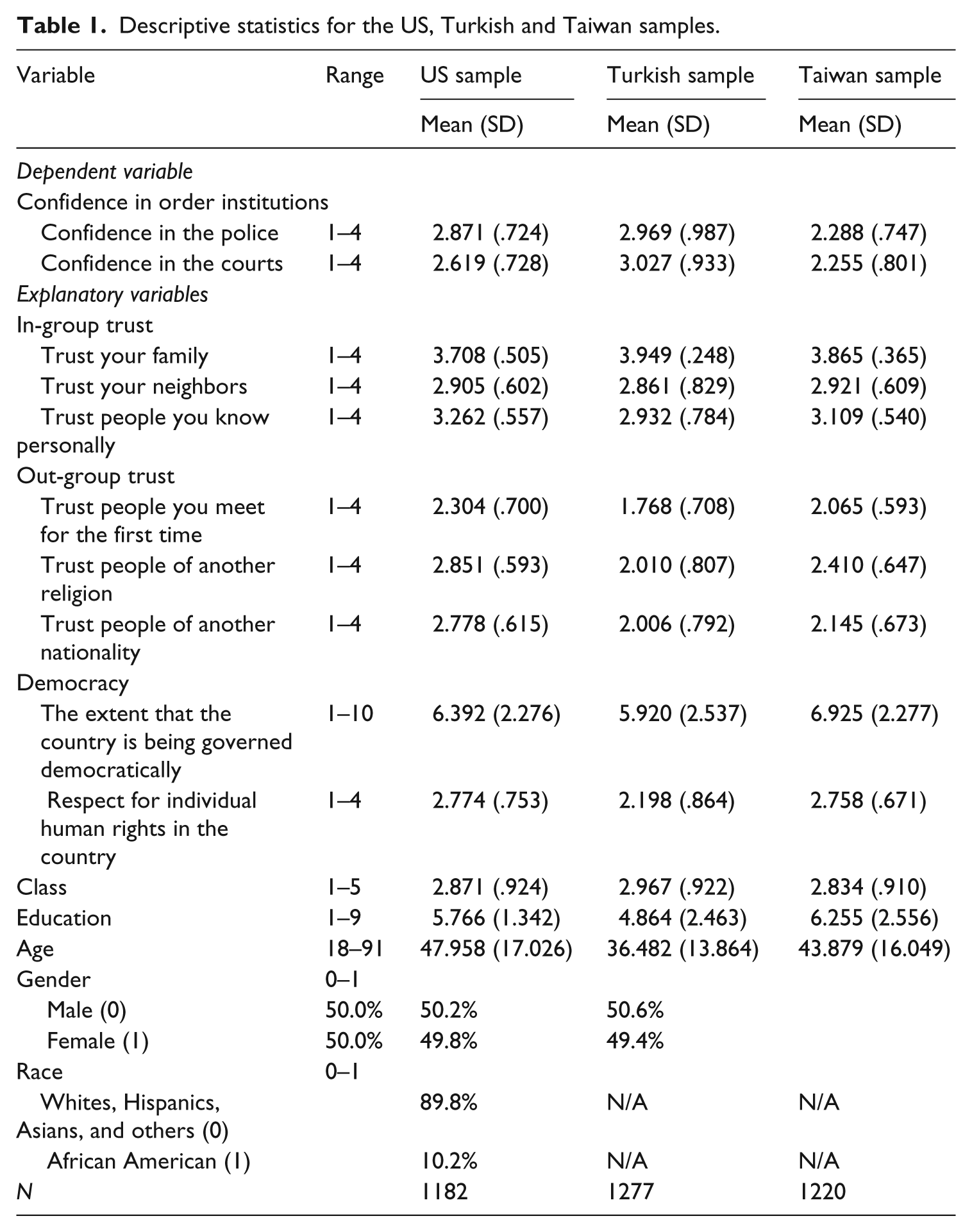
The descriptive statistics for the three countries are reported in Table 1. Respondents in Turkey rated their order institutions (2.969 and 3.027, respectively) higher than did respondents in the US and Taiwan. The levels of confidence in the police and courts were the lowest among Taiwanese (2.288 and 2.255, respectively). Overall, respondents in all three countries shared higher levels of in-group trust than out-group trust. Comparatively, the ratings of out-group trust were the highest for the US sample and the lowest for the Taiwanese sample. Most respondents believed that they were in the range of the middle and upper middle class (2.871 in US, 2.967 in Turkey, and 2.834 in Taiwan). The Taiwanese sample reported the highest level of education, followed by the US and Turkey. Gender was equally distributed in these three samples.
Descriptive statistics for the US, Turkish and Taiwan samples.
Using SEM, we ran three models for Turkey, US, and Taiwan. The purpose is to examine the similarities and differences across the three samples. In the Turkish sample, the model fits the data well, with CFI (.980) and TLI (.967), both are well above the recommended value of around .95 as a good fit. In addition, the value of RMSEA was .032, below the cut-off point of .05, and the χ2/df = 2.295. The R square for confidence in the police and courts was quite high at .512. The confirmatory factor analyses revealed two distinct factors representing in-group trust and out-group trust. Results show that the four demographic variables have limited impacts on the four endogenous variables. Education is negatively correlated with in-group trust and positively associated with out-group trust. Social class is a significant predictor of out-group trust (–.097) and democracy (.163). Age has no significant impact on any of the four endogenous variables. In-group trust is a significant predictor of out-group trust. In turn, both in-group trust and out-group trust are significantly associated with democracy, and all three endogenous variables have significant impacts on confidence in the order institutions. Results for the Turkish sample are shown in Table 2.
The standardized direct, indirect, and total effects: In-group trust, out-group trust, democracy, demographic variables, and confidence in the order institutions (COI) in the Turkish sample (N = 1277).
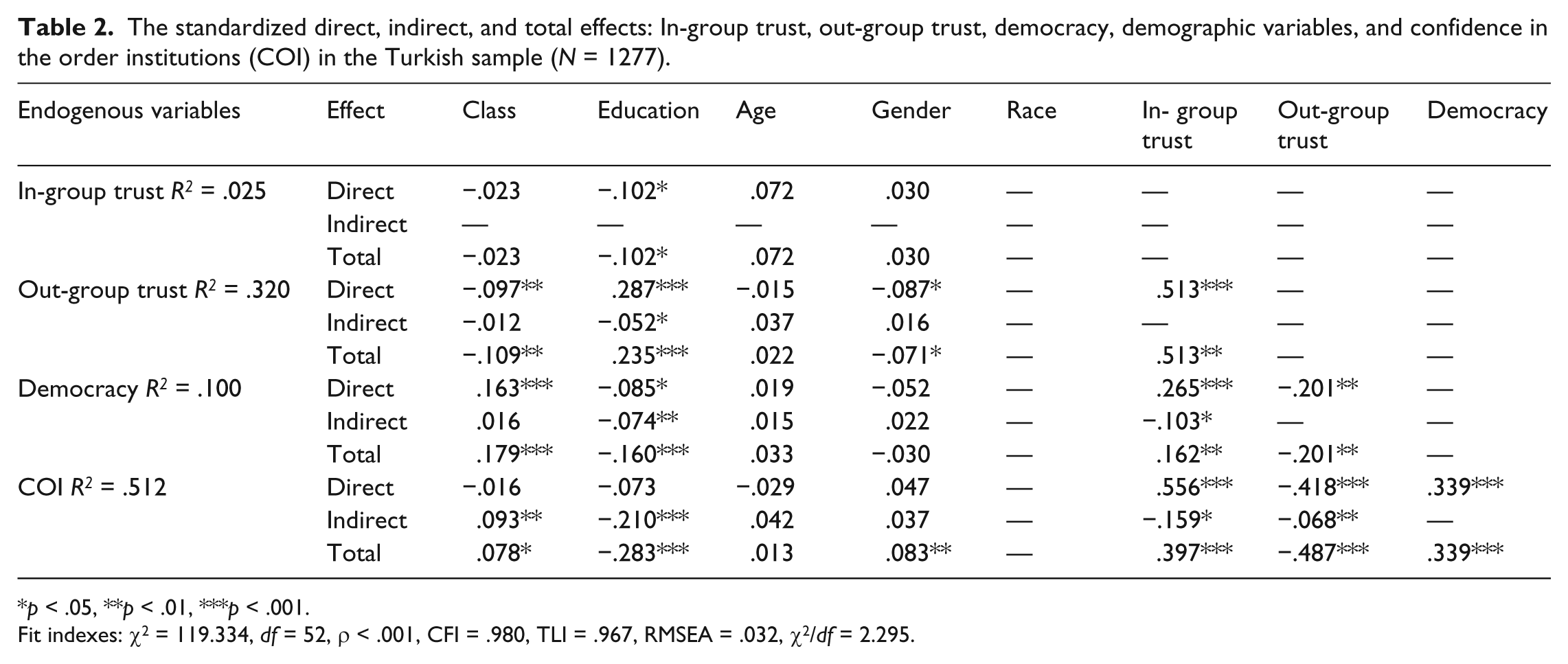
p < .05, **p < .01, ***p < .001.
Fit indexes: χ2 = 119.334, df = 52, ρ < .001, CFI = .980, TLI = .967, RMSEA = .032, χ2/df = 2.295.
Turning our attention to Figure 1, three observations need to be highlighted here. First, the standardized coefficient of in-group trust is positively associated with democracy (.265) and confidence (.556). Second, results suggest that the out-group trust is negatively correlated with democracy (–.201) and confidence (–.418). Though the relationship between in-group and out-group is positive and significant (.513), their respective effects on democracy and confidence in the order institutions are different. Finally, democracy is positively associated with confidence, suggesting that Turkish respondents’ evaluation of the police and the courts is strongly affected by their perceptions of democracy.
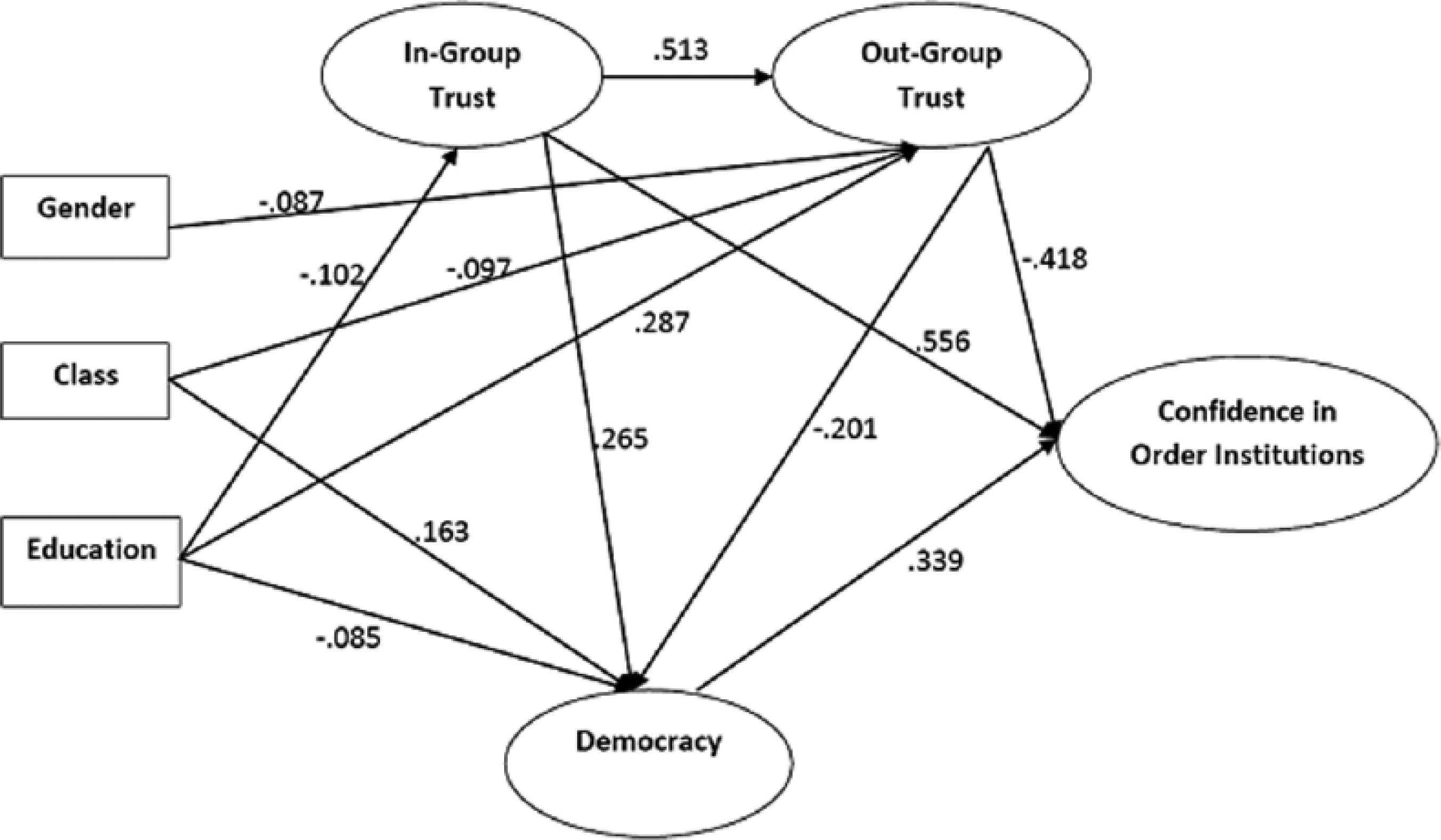
Empirical model of the Turkish sample.
For the US sample, the model fits the data well, with CFI (.974) and TLI (.958) around the recommended value of .95 as a good fit. In addition, the value of RMSEA is .037, below the cut-off point of .06, and the χ2/df = 2.597 (see Table 3 and Figure 2). The R square for the model of the order institutions is .289. In-group trust and out-group trust are loaded on two distinctive constructs. The four demographic variables have significant impacts on in-group trust and the R square is .133. An increase in social status, education attainment, and age leads to higher levels of in-group trust. Female respondents reported significantly higher levels of in-group trust than their male counterparts. Education and age have significant direct and indirect effects on out-group trust. In-group trust is a significant predictor of out-group trust. In addition, social class manifests a significant and positive effect on democracy (both direct and indirect effects). Gender is found to be negatively associated with democracy. Class has no appreciable direct effect on the order institutions. Finally, both in-group (.309) and democracy (.319) have significant and positive impacts on confidence in the order institutions. Out-group trust, however, has no significant effect on confidence. African Americans (–.134) have significantly lower levels of confidence than other racial and ethnic groups in the US sample.
The standardized direct, indirect, and total effects: In-group trust, out-group trust, democracy and demographic variables, and confidence in the order institutions (COI) in the US sample (N = 1182).
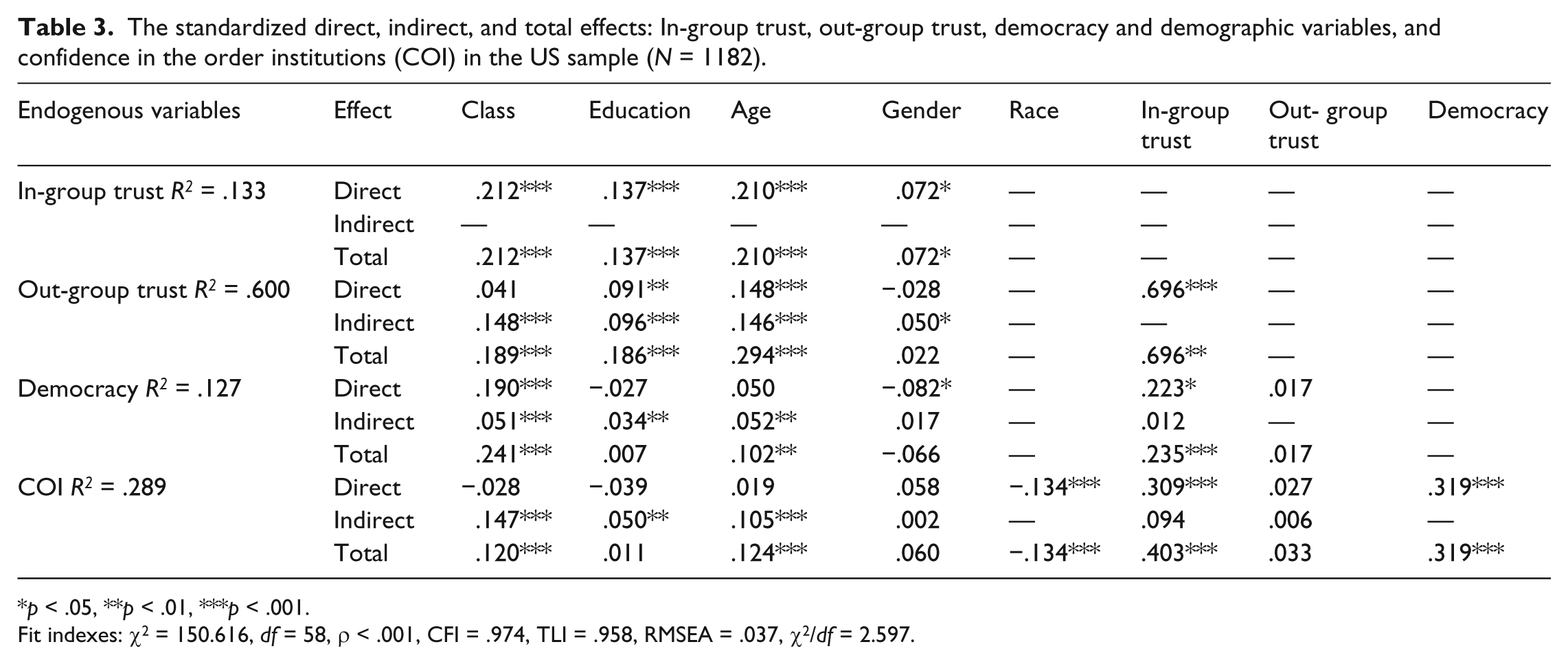
p < .05, **p < .01, ***p < .001.
Fit indexes: χ2 = 150.616, df = 58, ρ < .001, CFI = .974, TLI = .958, RMSEA = .037, χ2/df = 2.597.
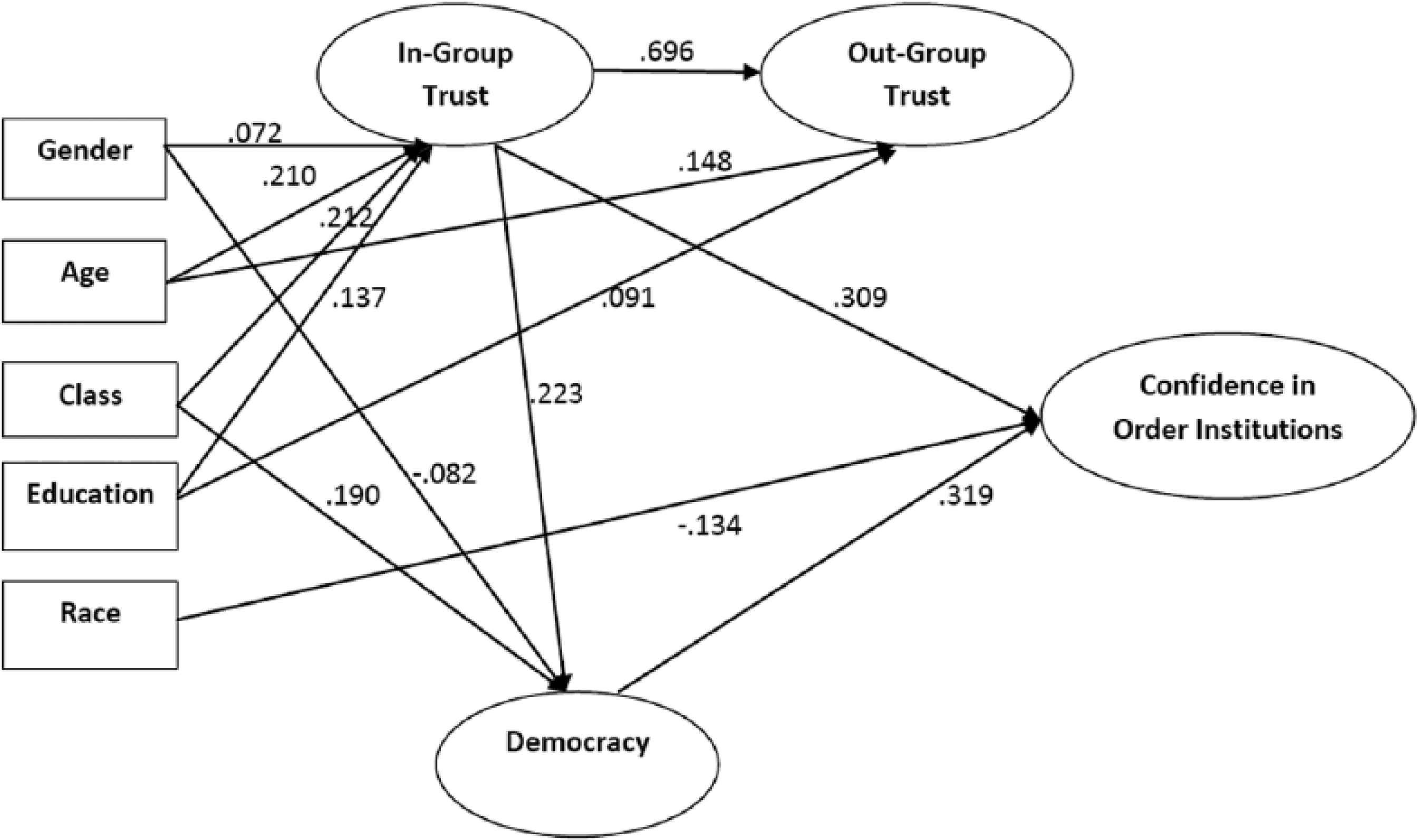
Empirical model of the US sample.
For Taiwan, the model does not fit the data well, with CFI (.90) and TLI (.84) below the recommended value of CFI around .95 and TLI above .90 as a good fit. In addition, the value of RMSEA is .062, very close to the cut-off point of .06, and the χ2/df = 5.668. The R square for the model of the order institutions is the lowest of the three models at .09. Limited by the space requirement here, we omit these results, but they are available upon request.
Discussion and conclusion
We set out with three goals in mind. First, we wanted to introduce trust into the study of citizen confidence in the police and the courts – a popular topic of criminological/sociological study; second, we sought to advance our understanding of the relationships among in-group trust, out-group trust, and confidence in the order institutions by using SEM; and third, we attempted to address the imbalance of knowledge produced by criminological orientalism and to contribute to an interactive global outlook. Our results indicate that it is fruitful to bring trust, especially in-group trust, into the study of confidence in the order institutions.
Regardless of the model fit, in-group trust and out-group trust are conceptually distinct and they are also positively related to each other in all three societies – both findings are consistent with the literature (Freitag and Traunmuller, 2009; Glanville and Paxton, 2007; Welch et al., 2007). In addition, in-group trust and democracy directly influence confidence in order institutions in all three countries. This is consistent with Boix and Posner’s (1998) theoretical expectation; trust produces good governance to the extent that it makes citizens sophisticated consumers of politics, reduces the costs of enforcing and implementing governmental policies and regulations, and fosters civic virtue among the citizenry. Those who score high on the indexes of in-group trust and democracy are also more likely to report higher confidence in the courts and in the police. These results provide evidence for the argument that in-group trust is an antecedent of confidence in order institutions (Brehm and Rahn, 1997; Delhey et al., 2011; Glanville and Paxton, 2007; Rothstein and Stolle, 2008), and it is an important ingredient of democratic societies, regardless of being oriental or occidental.
Out-group trust, in contrast, functions differently and its impact is elusive. For the Taiwan and US samples, the effect of out-group trust is not significant while for the Turkish sample it is. The insignificant effect of out-group trust for the US sample seems to support Hardin’s (1998) argument that trust in government is important, but it is not necessary. The significant effect of out-group trust in Turkey, however, is in the opposite direction. That is, the effect of out-group trust is negatively related to confidence in order institutions. Turks who trust strangers more are less confident in the courts and the police. As Turkey is one of the ‘torn’ countries (Cao and Burton, 2006; Huntington, 1996), it is possible that our model may have captured the discrepancy between the elite culture and the traditional culture in Turkey. The political elite of Turkey has long been pushing the nation toward greater industrialization and more complete modernization, while the popular culture in the country remains traditional and Muslim. This tension results in popular mistrust of the government, including order institutions, while trusting strangers fits well with the long-standing Islamic teaching of loving your neighbors. Furthermore, those scoring high in out-group trust do not support democracy, which is considered a Western ideology. Caution must be exercised that the inconsistency in the effect of out-group trust is not unique to this study. Others have reported that the effect of out-group trust was puzzling in Western large urban-industrial societies too (Nannestad, 2008; Newton, 2001). More research is needed to resolve this particular puzzle.
Taken together, these results seem to cast doubt on the contentions that laud the positive effects of out-group trust (Fukuyama, 1995; Putnam, 1993; Uslaner, 2002) while conjecturing in-group trust in a negative way. We argue that in-group trust can give rise to malevolent social phenomena such as ethnocentricism, cohesive terrorist cells, and criminal gangs. However, we should always remember that, like in-group trust, out-group trust has its dark side as well; it is risky, it has a cost, and it is sometimes unwarranted (Hardin, 1998). Like compassion for your enemies, out-group trust is a virtue that should be applauded and extolled, but its effect on confidence has not been supported empirically. In-group trust, in contrast, is found to have independent effects on confidence in all three societies, a finding that is consistent with previous results on this association (Glanville and Paxton, 2007; Uslaner, 2002). We argue, therefore, that in-group trust should be regarded as an important antecedent of confidence in order institutions (Freitag and Traunmuller, 2009). The study of in-group trust deserves more attention on the research agenda on confidence in order institutions.
Our results demonstrate the utility of the institution-centered approach advocated by Inglehart (1997), Lipset and Schneider (1987), Putnam (1993), and Uslaner (2002). Our study, however, is limited because of the likelihood of model misspecification resulting from omitted variables. In the study of confidence in order institutions, the police contact and victimization variables are found to be important (Reisig and Parks, 2000; Ren et al., 2005; Sun et al., 2014). In addition, it is not the purpose of this article to call into question the casual ordering assumptions of the trust-centered approach. Our data are cross-sectional, which means that even though we use SEM we can only satisfy two criteria (correlation and theoretical rationale) out of four for establishing a firm causal order (the other two being time sequence and the absence of spuriousness). A definite refutation of the contradictory arguments from the institution-centered approach vs. trust-centered approach has to come from well-designed longitudinal data. Our concern in this study, however, is whether citizens’ evaluation of order institutions is universally affected by in-group and out-group forms of trust and whether culture plays a role in shaping the development of trust model. Although we did not measure culture directly, our separate analyses inexplicitly produce the results germane to cultures.
Finally, it is important to note that data from Taiwan do not fit well with the statistical model. The model fit statistics are the advantage of the SEM over OLS regression. Had we used OLS regression, we would have missed the point. This result is consistent with our expectation that culture matters in the study of order institution. The poor fit model for Taiwan is an indirect piece of evidence that a universal culture of cosmopolitanism has yet to emerge.
In sum, as the world is becoming increasingly interdependent in the shrinking ‘global village’ (McLuhan, 1962), this study contributes to build up situated knowledge in the peripheral regions (Aas, 2012). The SEM represents a rigorous form of theory testing. Our results show, tout court, that in-group trust is associated with confidence in order institutions in all three countries and it should occupy a central place in all future comparative studies. The three cultures, although restricted as a tip of the iceberg in a numerous and diversified world, represent the recrudescence of emerging criminology/sociology and reveal the potential dynamics of research in the contact zones.
Footnotes
Funding
This research received no specific grant from any funding agency in the public, commercial, or not-for-profit sectors.