







Abstract
Population aging is a nearly universal trend that is placing new importance on how societies view and treat their elderly. Past research has established that perceptions of the elderly vary across countries. This article empirically explores three competing theoretical explanations on potential reasons for these differences: the Value Orientation perspective, the Competition over Resources perspective, and Political and Economic Structure. Using Wave 6 of the World Values Survey, various sources of country-level data, and hierarchical logistic regressions the article provides insights as to which theoretical position holds the most weight. The analysis improves on past research by using a large and diverse sample of countries from every region of the world. Contrary to popular thought, and the traditional Value Orientation perspective, it is found that Asian, Middle Eastern, and Sub-Saharan African countries have significantly more negative views toward the elderly than Western countries. In addition, the study finds that countries with higher average lifespans and more elderly as a proportion of the total population actually have more favorable attitudes toward the elderly.
Introduction
Older individuals (60 years plus) are the fastest growing segment of the world’s population. By 2050, it is estimated that the number of older individuals will more than double to 2.1 billion worldwide (United Nations, 2015). This trend has important consequences for societies, and will impact how this segment of the population is accommodated. The global concern for population aging is still relatively new, but how we view and treat the aging population is gaining attention as an important area of study (Olshansky et al., 2011). Recent research suggests that this demographic change is a central factor in shaping societal attitudes toward the elderly (Löckenhoff et al., 2009). The public’s perception of the aging population can be an important marker of the overall wellbeing of the aged. Furthermore, a strong body of research reveals that public opinion greatly influences public policy (Burstein, 1998), which is important for older adults who often rely heavily on publicly funded social welfare programs.
Old age is one of the few social categories that all or most persons eventually join, or anticipate joining (Kite and Wagner, 2004). It comes with prescribed norms for how to think, behave, and participate (or not participate) in the larger society (Desmette and Gaillard, 2008; North and Fiske, 2012, 2013a, 2013b, 2013c, 2015a, 2015b, 2016). One of these norms is the transition out of the paid workforce and into retirement after a certain age (Desmette and Gaillard, 2008). One question being debated as people live longer, healthier lives is: when ‘should’ older adults relinquish their jobs to younger people in society in order to keep unemployment low, encourage financial stability in the young, and promote child-bearing? This becomes wrapped up in the discussion about the capabilities of older adults as technology, values, and kinds of work change. Another discussion playing out around the world is: what is the responsibility of society-at-large to support older adults? As we discuss below, elder care is increasingly thought of as a public good, and less so as a private family matter (for a discussion of the impact on families, see Bengtson et al., 2003). Therefore, the elderly as a group are often seen as dependent on, and a burden to, the working-age population. This is evidenced in how we describe our very measures of the size of the elderly population. For example, the World Bank reports the Old-Age Dependency Ratio as the percent of the population over 64 years old to the percent of the population between 15 and 64 years old. The implication is that at 65, people transition into a new category called ‘dependent.’
Sociologists have been largely left out of the discussion of what influences attitudes toward older individuals, as much of the work on attitudes toward the elderly has been by psychologists. Psychologists tend to distinctively focus on the subjectivity of attitudes more than on how the social and economic structural environment affects attitudes. Voas (2014: 1) argues that attitudes are ‘normative statements about the social order rather than as subjective expressions of individual likes or dislikes.’ Attitudes toward the elderly are formed through the social environment, and have varied over time and place. Just thinking about simple demographics is illustrative. Compare South Africa, which has a GDP per capita of $12,446, and a life expectancy of 57, versus Turkey, which has a GDP per capita of $18,869 and a life expectancy of 75. In crude terms, the average South African still does not reach the age at which they are ‘burdensome’ to society, while in Turkey the average person spends 10 years as a ‘burden’ to society, with a similar GDP per capita to South Africa. Life expectancy and average income are only two factors that may affect attitudes toward the elderly.
Early work on comparative attitudes toward the elderly stemmed from the assumption that negative attitudes toward this group were widespread, and increasing as globalization and modernity extended to every corner of the globe. Therefore, the common sense assumption has been that those living in more developed, ‘modern,’ neoliberal societies hold more negative perceptions of the elderly, while those living in developing or underdeveloped, ‘pre-modern,’ traditional societies hold more positive perceptions. However there is limited empirical evidence to support this hypothesis. An advantage of cross-national studies is that we can test how development, social structure, societal religion, and more affect attitudes toward the elderly. The cross-national work that does exist usually compares two different countries held up as ideal-types of their region or level of development, which is problematic as it can mask differences within these country groupings. By looking at attitudes toward older adults in a cross-national, comparative way we can see how different social, political, and economic environments produce different evaluations of the elderly. This research will add to our understanding of the link between culture and attitudes toward the elderly, which has implications for social policies such as healthcare, pension plans, housing, food security, and end-of-life planning.
In this study, we address the absence of comprehensive comparative work on attitudes toward older adults by using a standardized, cross-national dataset of attitudes in 55 countries combined with country-level cultural and structural indicators to examine how different societal structures influence individuals’ attitudes toward older adults while controlling for important individual characteristics. With these attitudinal and country-level data, we are able to use hierarchical modeling to investigate a diverse set of countries with the three most widely used theoretical perspectives, described below. By using a sociological lens we gain a more comprehensive understanding of how the societies in which we live influence our attitudes toward this growing segment of the population. Also, we use two distinct ways of measuring attitudes toward older adults, and demonstrate that how survey researchers conceptualize the social worth of the elderly affects our understanding of attitudes toward this marginalized group. Therefore, we ask the following research questions: (1) What predicts an individual’s attitudes toward older persons? (2) How do the culture, social structure, and the political and economic structure of a country influence individuals’ attitudes toward older adults?
Theoretical background
Attitudes toward older adults ultimately lie with individuals, but are shaped by culture, history, social structure, and demographics. Previous research has investigated potential reasons for societal differences among attitudes toward older adults (Fung et al., 2016; Kite and Wagner, 2004; Kite et al., 2005; Löckenhoff et al., 2009; North and Fiske, 2015b; Zhang et al., 2016). Three competing theoretical frameworks have emerged as potential explanations.
First, and mostly widely used, is a Value Orientation perspective (Fung et al., 2016; Giles et al., 2003; Löckenhoff et al., 2009; North and Fiske, 2015b). This perspective posits that some societies hold older adults in higher regard than other societies because of strong collectivist traditions. The majority of this research compares and contrasts Eastern and Western countries (see North and Fiske [2015b] for a review). The notion is that Asian societies promote more positive attitudes toward the elderly because of their Confucian values of filial piety and ancestor worship, whereas Western countries value youth, leading to more negative views toward the elderly (North and Fiske, 2015b) and a lack of support for social programs that benefit the elderly (Gilderbloom and Rosentraub, 1990). Beyond this, there is a tendency to view societies in the Global South as more ‘traditional,’ and traditional societies are expected to place a greater emphasis on reverence for the elderly and the importance of learning cultural history through oral telling and retelling. The Value Orientation perspective has a tendency to conflate the primary religion of a place with other aspects of its social structure. Certainly, religion is an important component of society, but we can find in all major world religions an emphasis on reverence for tradition, a respect for human life, and a custom for elder respect. Therefore, the issue may not be one of type of religion, so much as of secularization.
In Sacred and Secular, Norris and Inglehart (2011) tackle the question: do modernization and economic development come with secularization and a decline in religiosity? They cite philosophers and social scientists from the Enlightenment until the present who argue that industrialization will lead to a decline in traditional religions. This decline in traditional religion could be good for societies: a casting off of tradition may be necessary for invention, entrepreneurship, risk-taking, and further economic growth. The downside, it is posited, is that a decline in religion will be accompanied by a decline in the traditional bonds that held families, neighborhoods, communities, and societies together. As people come to see themselves as less tied to a strong social anchor like a church, synagogue, mosque, or temple, their motivation to take care of others fades away. In a sense, then, developed societies are accused of having lost their traditions and replaced them with capitalism as the driving social force. And because older adults transition out of the workforce and into retirement – through choice, physical decline, or skill changes – they may be viewed as less valuable to the maintenance of the market economy, and pushed to society’s margins.
The Value Orientation perspective has recently come under criticism for its lack of inclusiveness of countries that do not fall into the classification of Eastern or Western. It also disregards the variation among Asian countries (Löckenhoff et al., 2009), and minimizes the fact that societies can exhibit traditional aspects, particularly with regard to intergenerational family relations, and high capitalist orientations at the same time (Lin and Yi, 2013; Yi, 2013). Although most research in this field has used this perspective, the findings are mixed and still unclear. Some find support for Eastern countries having more positive attitudes toward the elderly (Tan et al., 2004; Zhang et al., 2016), yet others have found the opposite. North and Fiske’s (2015b) meta-analysis found that cultural individualism (i.e., Western values) actually predict more positive attitudes toward the elderly than collectivist values. Löckenhoff et al.’s (2009) study of 26 countries suggests that population structure may be the reason for reports of differences between Western and Eastern countries. A more nuanced approach is needed in terms of the influence of societal values on the perception of older adults.
The second potential explanation for varying attitudes toward the elderly is what we call Competition over Resources. This perspective recognizes the effects population dynamics may have over resource allotment for competing social groups – the elderly being one of these social groups. Some psychologists refer to this process as ‘succession,’ whereby younger persons may grow to resent older persons (North and Fiske, 2013c), who they see as having more than their fair share of jobs, wealth, and political influence. Economists have studied these issues as ones of ‘intergenerational equality’ in terms of fairness in the distribution of public funds across generations (Williams, 1997). From this standpoint, population aging would predict an increase in negative attitudes toward older individuals who are seen as dependent on others. An increasing population of the elderly may be blamed for burdening the healthcare system, social services, and the labor market (Börsch-Supan, 2003; WHO, 2011). North and Fiske (2015b) found in their meta-analysis that negative attitudes toward the elderly are correlated with the rate of population aging. Other studies using experimental designs found older workers received the lowest level of allocated training resources, particularly when the participant was younger (North and Fiske, 2016). However, this perspective is under-theorized in past research, leading to inconclusive results. Alternatively, an increasing aging population may not be viewed as a drain on resources depending on the health of social safety nets in place.
Third, Economic and Political Structure may shape attitudes regardless of culture or population structure. The idea is that higher levels of economic development and industrialization are associated with more negative attitudes toward the elderly, because modernization erodes the role and status of older adults, and their value as knowledge keepers is decreased and means of production moves from the family to the public sphere (Inglehart and Baker, 2000; Nelson, 2005). According to this perspective, higher levels of economic development and industrialization are expected to be associated with more negative attitudes toward the elderly. On the other hand, the elderly are typically seen as a predictable group of voters, who can be counted on to consistently turn out for elections, and support candidates who favor strong old-age benefits (Pampel and Williamson, 1985). Therefore, democratic systems give a lot of de facto power to older adults, and as populations continue to age, the share of power going to older adults increases. How should this affect attitudes toward the elderly? On the one hand, ‘elderly’ is the one social category that all people can belong to at some point, if they live long enough. Therefore, democracies should contain people with more pro-elderly attitudes. By this line of reasoning, the current older voters are setting the stage for all of us who can reasonably expect to need the social programs that are being built now. Evidence shows that both the elderly and non-elderly tend to support old-age social safety nets (Coughlin, 1979; Tomasson, 1984). On the other hand, the elderly may be seen as receiving a disproportionate share of a society’s resources, particularly in poor or developing countries, which could drive increases in negative attitudes toward older adults (North and Fiske, 2015b). The distribution of tax and other government revenue is a zero-sum game: when one coalition ‘wins’ some resources, other coalitions ‘lose’ them. For example, Fernández and Jaime-Castillo (2013) found in their cross-national investigation of 27 countries that country-level characteristics were important indicators of individual attitudes toward pension systems. They found that in countries with higher rates of poverty, citizens were less likely to support cuts to pension systems; whereas in countries with robust pension systems citizens where less like to support increases to these systems. The elderly are competing with public works projects, the unemployed (Fraile and Ferrer, 2005), public health advocates, food-insecure children and adults, and the list goes on and on. Accordingly, richer countries should have more pro-elderly attitudes than poorer countries, because there would be more resources to go around.
One interesting take on the topic of resource allocation comes from Fernández-Alonso and Jaime-Castillo (2016), who flip the question of which kinds of societies do redistribute resources on its head, by asking: in which kinds of societies do people expect welfare state support versus family support? They compare the ‘Scandinavian model’ (represented by Norway) to the ‘Mediterranean model’ (represented by Spain), and find that in the Scandinavian model, people are more likely to expect formal help from the government throughout the life course than in the Mediterranean model, where family is expected to shoulder more of the burden. Importantly for the current study, Fernández-Alonso and Jaime-Castillo (2016) find that older people in Spain are much more likely to expect their families to support them than older Norwegians. They conclude, ‘A more generous welfare state provides better standards of living for older people and therefore they are less dependent on their families’ (Fernández-Alonso and Jaime-Castillo, 2016: 51). We ask, then, how do country-level differences in dependence affect attitudes toward older people?
Spain and Norway, of course, have differing levels of resources that affect the ability of any government to provide formal support to its citizens, regardless of individual expectations of support (Esping-Anderson, 1990). The Spanish state is weaker, with a less comprehensive welfare state regime, especially in relation to a country like Norway, which has a much more comprehensive set of functioning social welfare programs and policies (Esping-Anderson, 1990). In this article, we move beyond cross-cultural expectations of support and focus on how socio-cultural factors and economic/structural resources shape attitudes toward older populations.
Overall, there is limited evidence to conclusively support any one of these theoretical perspectives on cross-national differences in perceptions of the elderly over another. Also, past research is limited in two significant ways. First, it is limited by the comparison of a small number of countries in most studies. Most research only compares two countries, although a few studies have compared five or six countries (see Giles et al., 2003; Harwood et al., 1996, 2001), one study has compared 11 countries (see Giles et al., 2000), and one study compared 26 countries (see Löckenhoff et al., 2009). Second, the majority of these studies are done by psychologists, and rely on data collected from college students and not the general public. This may bias the findings. To date few studies have empirically examined the three theoretical explanations using a large, diverse sample of countries. Using Wave 6 of the World Values Survey coupled with other country-data allows us to explore cross-national differences in individual attitudes toward older adults in 55 countries. Also, this study is important as one of the few that implement multilevel modeling to investigate contextual effects on individual attitudes toward older adults while controlling for individual characteristics. We explore which of the theoretical perspectives holds the most weight by testing the following hypotheses:
Value Orientation
H1: Countries with dominant religions that are less individualistic will have more favorable attitudes toward the elderly.
H2: Non-Western countries will have more favorable attitudes toward the elderly.
Competition over Resources
H3: Countries with lower unemployment will have more favorable attitudes toward the elderly.
H4: Countries with lower age-dependency ratios will have more favorable attitudes toward the elderly.
Political and Economic Structure
H5: Countries with stronger tax-based pension systems will have more favorable attitudes toward the elderly.
H6: Countries with more rigorous public health systems will have more favorable attitudes toward the elderly.
H7: Democracies will have more favorable attitudes toward the elderly than non-democracies.
Data and methods
Wave 6 of the World Values Survey (WVS, 2014) was collected in 58 countries or territories between 2010 and 2014. Three of the geographical units, Taiwan, Hong Kong, and Occupied Palestine, are not recognized independent nation-states, and therefore do not have country-level covariate data. We include Taiwan, Hong Kong, and Palestine in our descriptions of elder-attitude trends, but do not include them in the analyses. The World Values Survey is a nationally representative common questionnaire survey of opinions, attitudes, behaviors, and demographics conducted approximately every five years since 1990, although the first wave was in 1981. Wave 6 surveyed the largest number of countries and territories to date, and includes far more countries from the Global South than previous waves. It contains responses from over 85,000 respondents, with a minimum sample size of 1000 in each country. A local team in each country is tasked with carrying out the face-to-face survey in the appropriate native languages, and with the appropriate country-specific responses for items like educational attainment. The WVS organization then amalgamates these surveys into a large panel of data that is comparative across place.
Only cases with valid responses were included in the analyses. After deleting missing cases, the resulting sample consists of 63,180 respondents from 55 countries. The average number of observations within a country is 1154.4 with a range of 345–2942 respondents. 1
Dependent variables
In Wave 6, for the first time, respondents were asked if they strongly agree, agree, disagree or strongly disagree with the following statements: (1) older people get more than their fair share from the government, and (2) older people are a burden on society. We collapsed the categories so that strongly agree and agree both indicate agreement with those statements, and disagree and strongly disagree indicate disagreement. We test both variables – Older Share and Older Burden – and describe below how differences in question wording may affect our understanding of attitudes toward the elderly.
Independent variables
Value Orientation
We operationalize the value orientation of countries through two measures: (1) major religion and (2) region. Data on major religion are from the Association of Religion Data Archives (ARDA, 2011). We use the measure of major religion according to proportion of the population, and create a set of dummy variables for Christian, Muslim, Buddhist, and Other. Christian is the reference group. We considered defining major religion by using the proportion of the World Values Survey sample who adhered to each, but elected not to because several countries in Wave 6 of the survey did not ask respondents to report denomination (Bahrain, Kuwait, Qatar, Egypt, South Korea). This would have caused us to drop these countries from our set. The ARDA is a well-established dataset that has been used in conjunction with individual-level survey data, including the World Values Survey (e.g., Adamczyk and Hayes, 2012; Berggren and Bjornskov, 2011; Stavrova et al., 2013). The ARDA categorization of countries was checked for consistency with the WVS sample proportions, resulting in only one discrepancy. The ARDA defines Kazakhstan as a Christian country, but 50.3% of the WVS Kazak sample defined themselves as Muslim, 26.7% as Orthodox Christian, and a full 21% report no denomination. We elect to keep the ARDA definition for all countries to maintain consistency. We define regions as the West, Latin America and the Caribbean, the Middle East and North Africa, Sub-Saharan Africa, and Asia. We use the West as the reference group.
Competition over Resources
To operationalize competition over resources, we examine the effect of (1) age-dependency ratio and (2) the total unemployment rate. We use age-dependency ratios in our analyses, measured as the ratio of people older than 64 to the working-age population. Unemployment is the percent of the potential labor force that is currently not working but is actively seeking employment. We use 2005 data unless otherwise noted, to capture cultural lag effects.
Political and Economic Structure
We use four measures to capture the effect of state-level policies on attitudes toward the elderly, including (1) social security coverage, (2) percent of GDP spent on public health, (3) percent of GDP spent on pension systems, and (4) level of democracy. From the International Labor Organization (ILO), we use the ‘old age contributors ratio,’ which is calculated by dividing the number of current contributors to a social security fund by the total working-age population (International Labor Organization, 2015). Second, we include the percent of GDP spent on public health (World Bank, 2014). Third, we include the percent of GDP spent on pension systems (World Bank, 2014). 2 And fourth, we use the Freedom House (2014) combined political rights and civil liberties scores to capture the effect of political system. Higher numbers mean that the country is more democratic, while lower numbers reflect more authoritarianism. As above, we lag these measures.
At the country level we also control for life expectancy at birth (World Bank, 2014).
Individual-level variables
We include two variables that measure value orientation at the individual level. We use Inglehart’s 12-item scale to measure an individual’s materialism value orientation, where 0 represents materialist values and 5 represents postmaterialist values (Inglehart, 1971, 1977). If the value orientation thesis holds, we would expect those with more materialist (traditional) values to disagree that the elderly are a burden or get more than their fair share from the government, and those with more postmaterialist (modern) values to agree. We measure religiosity with a four-item scale consisting of frequency of religious attendance, frequency of prayer, the importance of God in life, and the importance of religion in life (alpha = .78) (Price and Peterson, 2016). According to a Value Orientation perspective, more religious individuals are less likely to agree that the elderly are a burden or get more than their fair share. We include two variables, income and education (highest level of education obtained), to measure personal resources. Income was measured on a 10-step scale where respondents were asked to place their household on one of the steps, where 0 indicates the lowest and 9 indicates the highest income group. We also control for several important demographic individual-level covariates that have been found to influence attitudes (Löckenhoff et al., 2009; Zhang et al., 2016). The demographic statuses include gender (dummy variable 1 = male, 0 = female), and age (age in years). Table 1 presents correlations for all measures used in the analyses, and Table 2 presents the descriptive statistics.
Correlations.
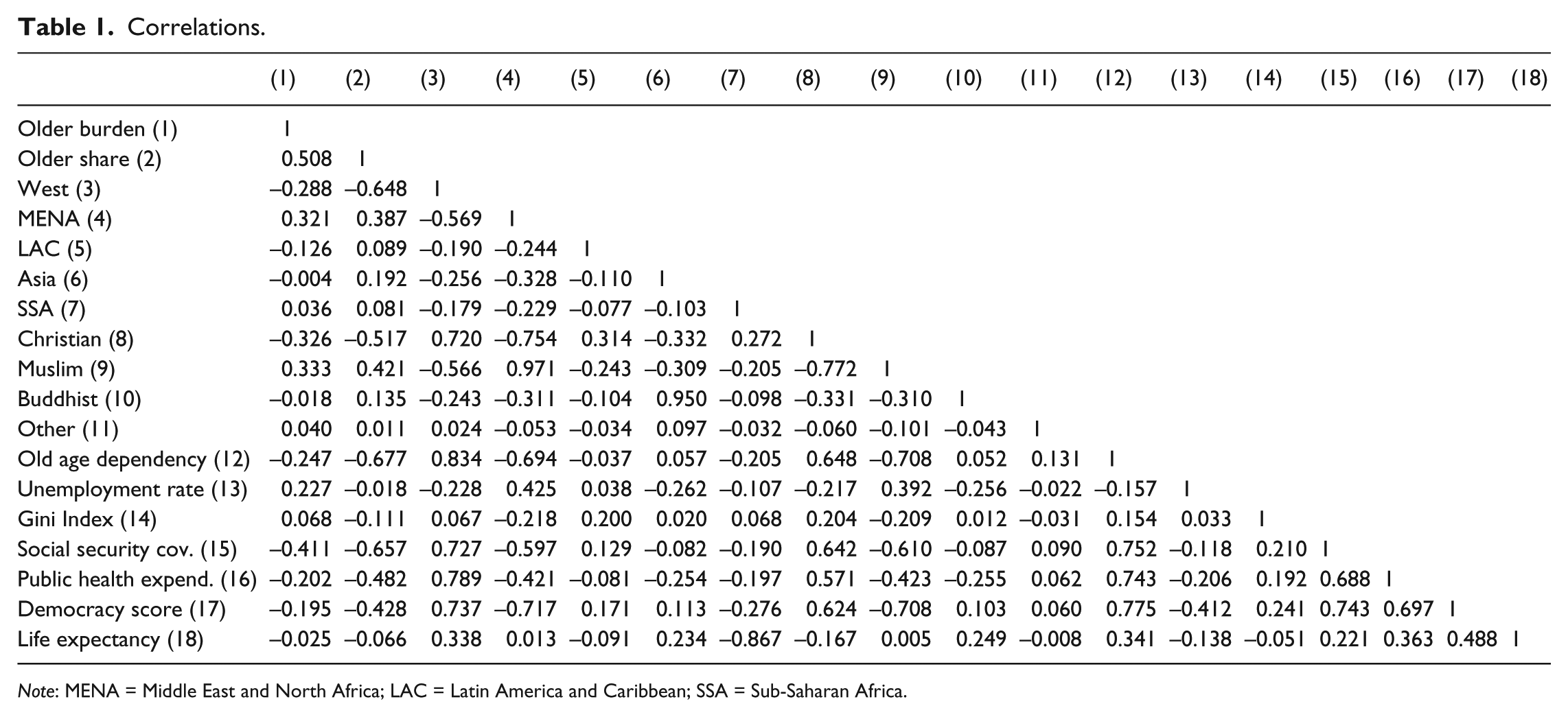
Note: MENA = Middle East and North Africa; LAC = Latin America and Caribbean; SSA = Sub-Saharan Africa.
Descriptive statistics.
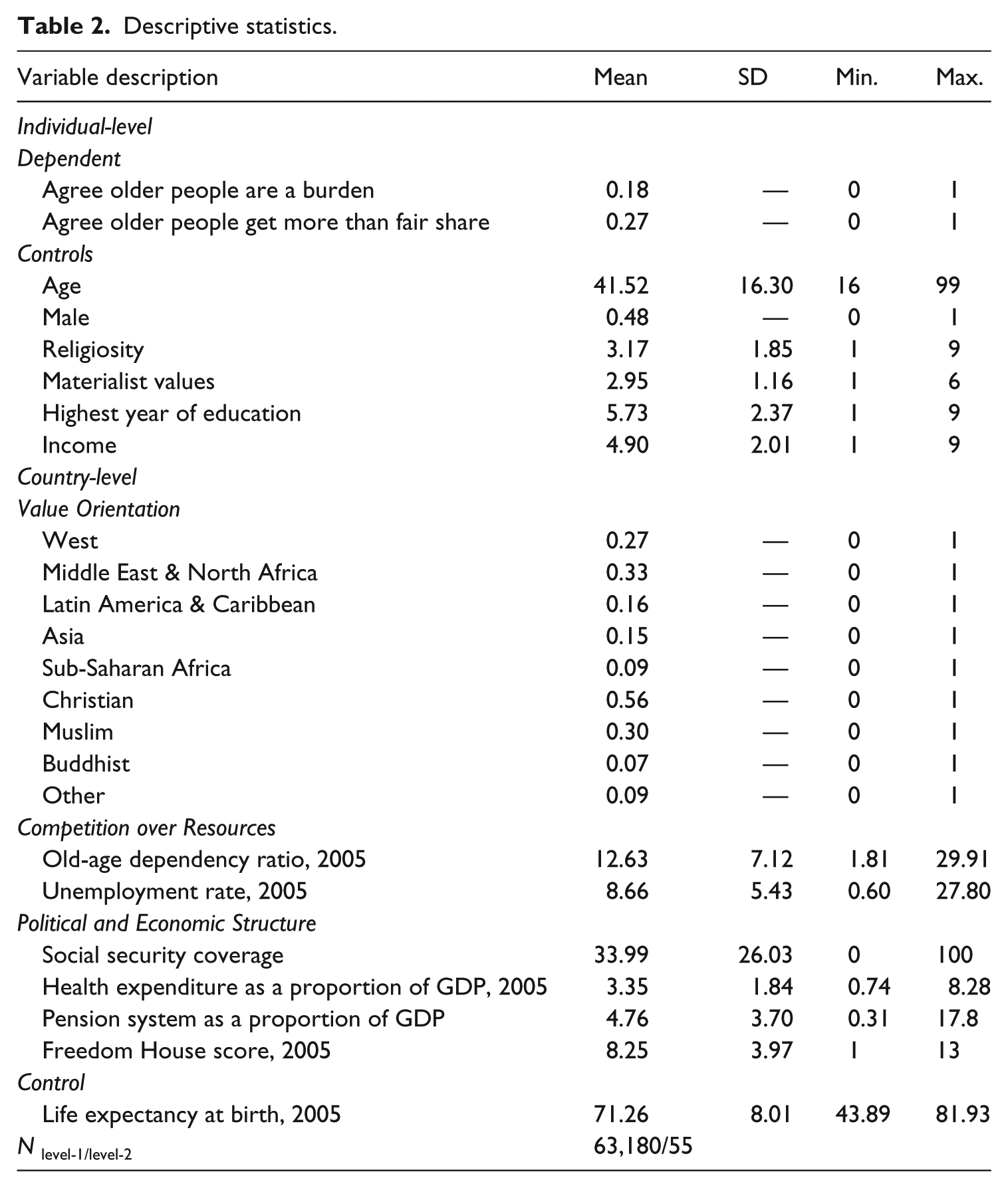
Analytic strategy
All analyses were conducted using Stata 14 (StataCorp, 2015). Hierarchical logistic regression was used with individuals that are nested within countries to assess the effects of country characteristics while controlling for individual characteristics. Deviance tests or likelihood ratio tests were used to compare the relative fit of models, and Snijders and Bosker (2011) criteria for model fit were used; all models presented meet these criteria.
Results
Figures 1 and 2 show the distribution of attitudes toward the elderly for each of our dependent variables by country. When it comes to the question ‘are older people a burden?’ the 10 countries with the highest levels of agreement are Bahrain, South Africa, India, Nigeria, Lebanon, Ghana, Turkey, Rwanda, Slovenia, and Pakistan. The 10 lowest are Uzbekistan, Qatar, New Zealand, Japan, Australia, Cyprus, Netherlands, Trinidad and Tobago, Azerbaijan, and the United States. While the relationship is not perfect, it does appear that poorer countries are more likely to see their elderly as a burden, and rich countries are less likely to see them that way.
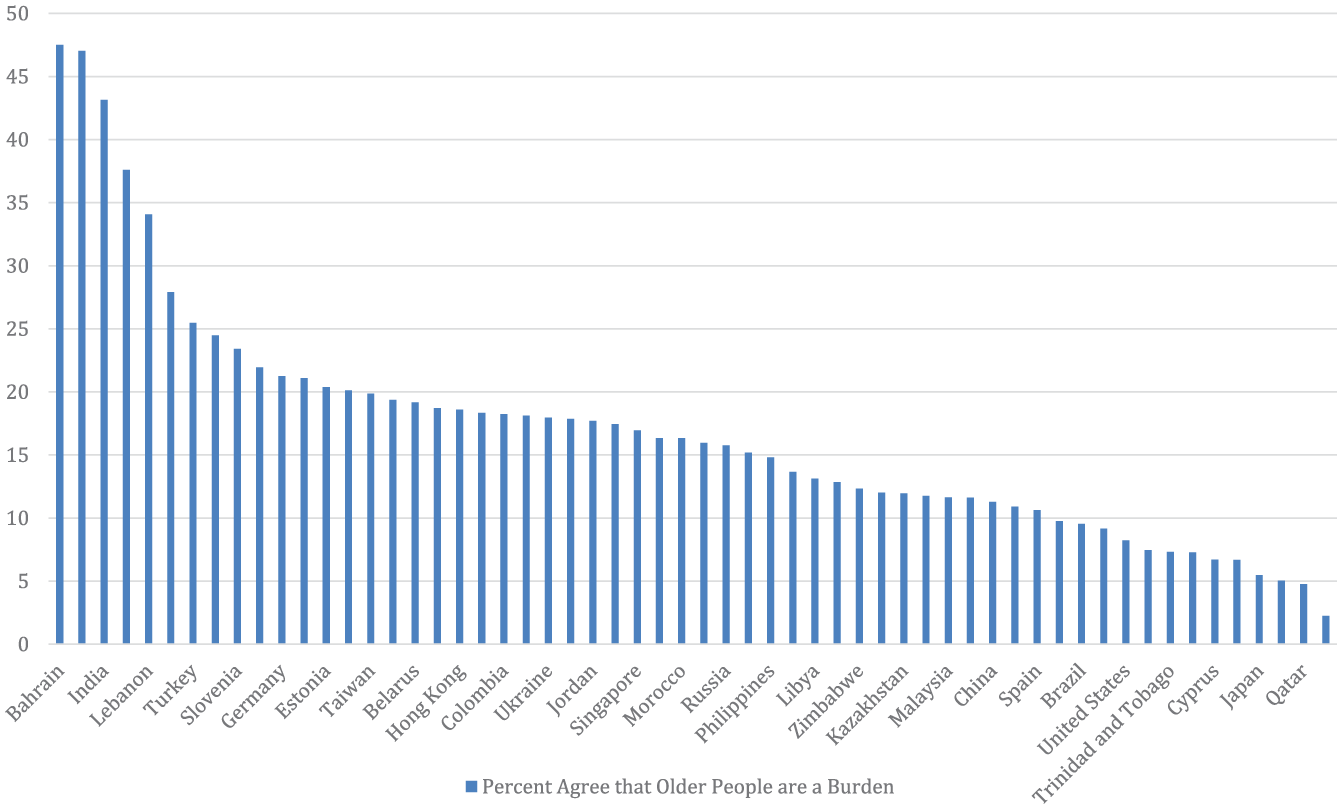
Percent agree that older people are a burden.
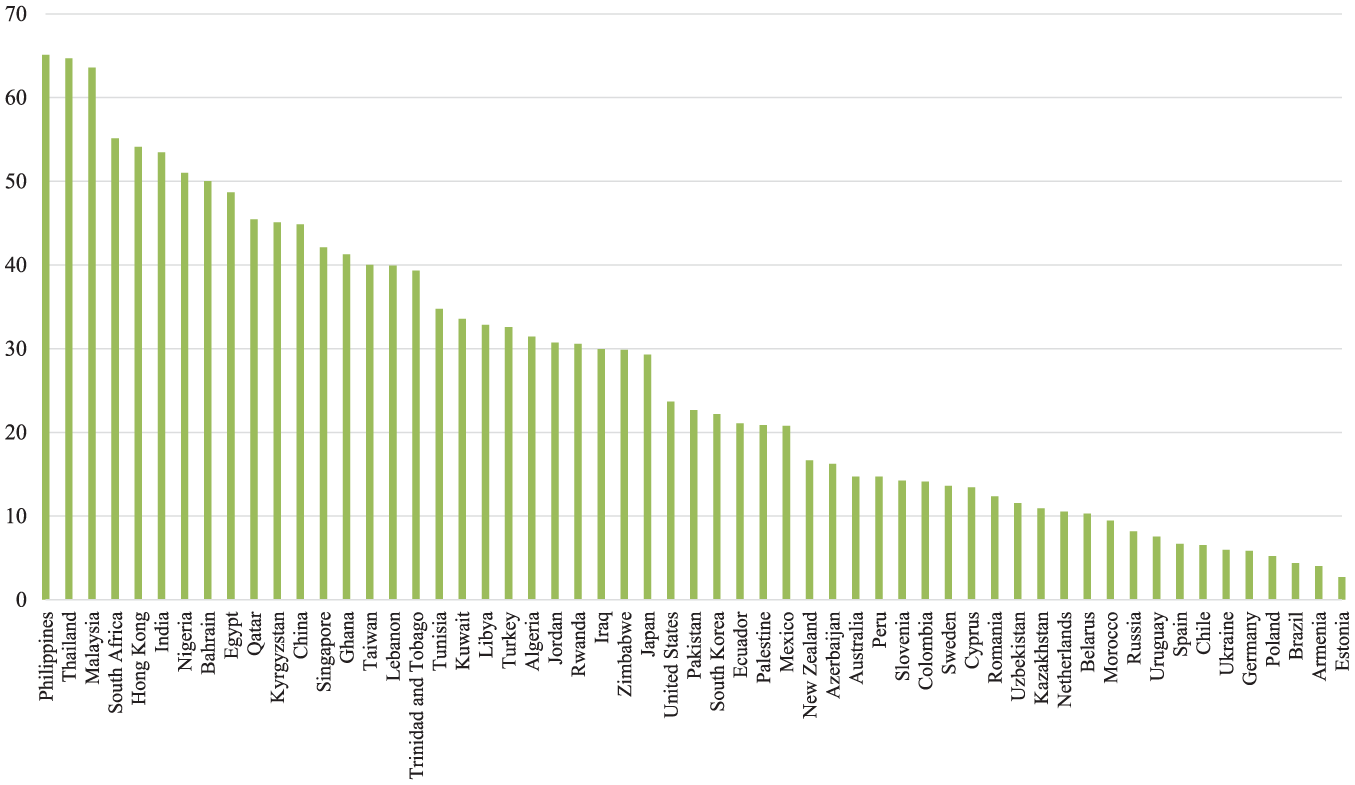
Percent agree that older people get more than their fair share.
We see a somewhat different picture when we look specifically at the distribution of resources. In Figure 2, the 10 countries with the highest levels of agreement that older people get more than their fair share from the government are the Philippines, Thailand, Malaysia, South Africa, India, Hong Kong, Nigeria, Bahrain, China, and Egypt. The 10 lowest are Armenia, Germany, Estonia, Spain, Brazil, Uzbekistan, Ukraine, Chile, Uruguay, and Russia. Six out of the top 10 countries are in East or South Asia, which have traditionally been viewed as a region where elders are revered and appreciated. This evidence suggests that while South and East Asians may report that their elderly are not a burden, they may also resent the distribution of resources toward the elderly at the same time. Also of note, the 10 lowest countries are primarily composed of Latin American and Eastern European countries, which have stronger histories of socialism and favoring government redistribution overall.
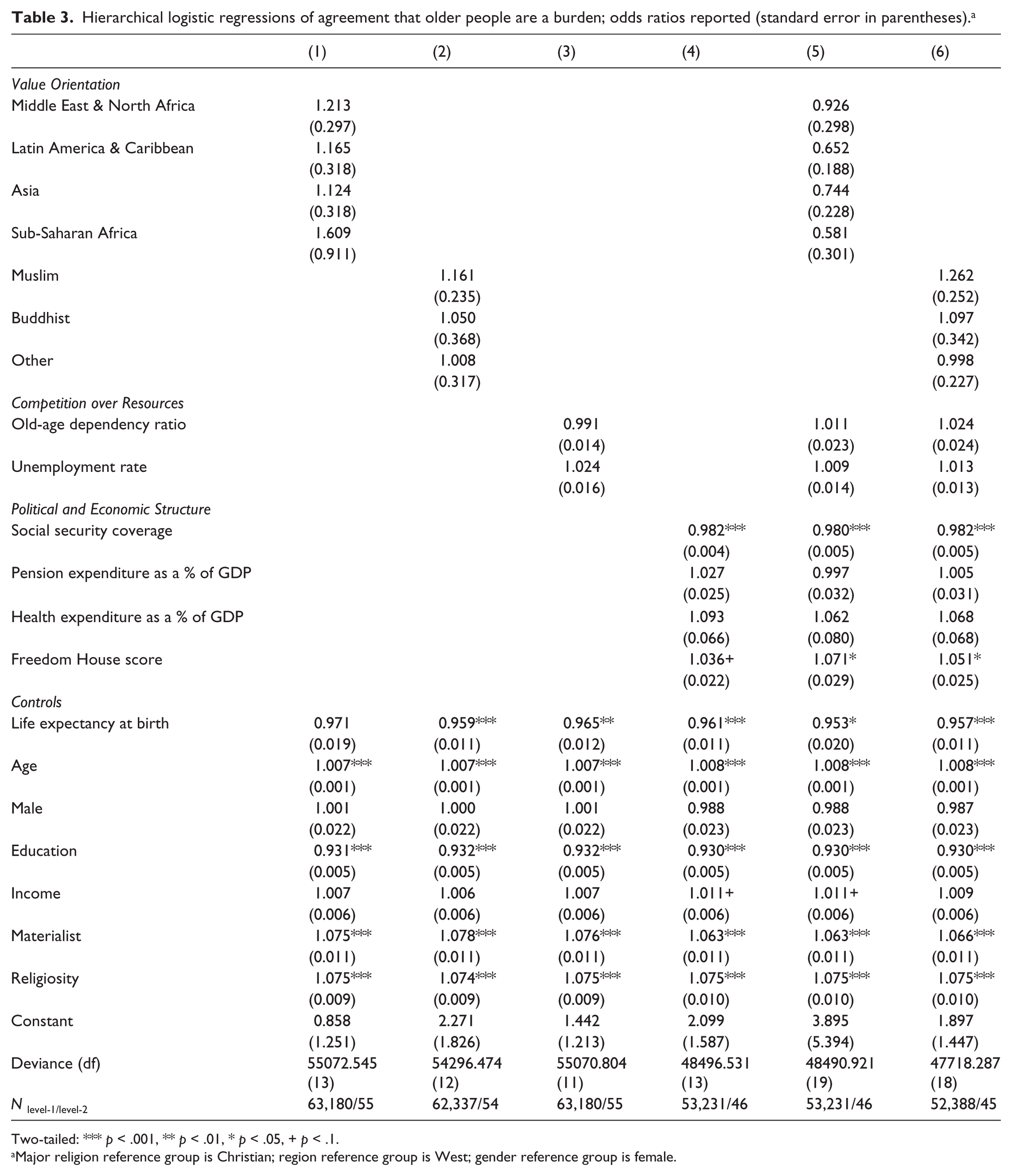
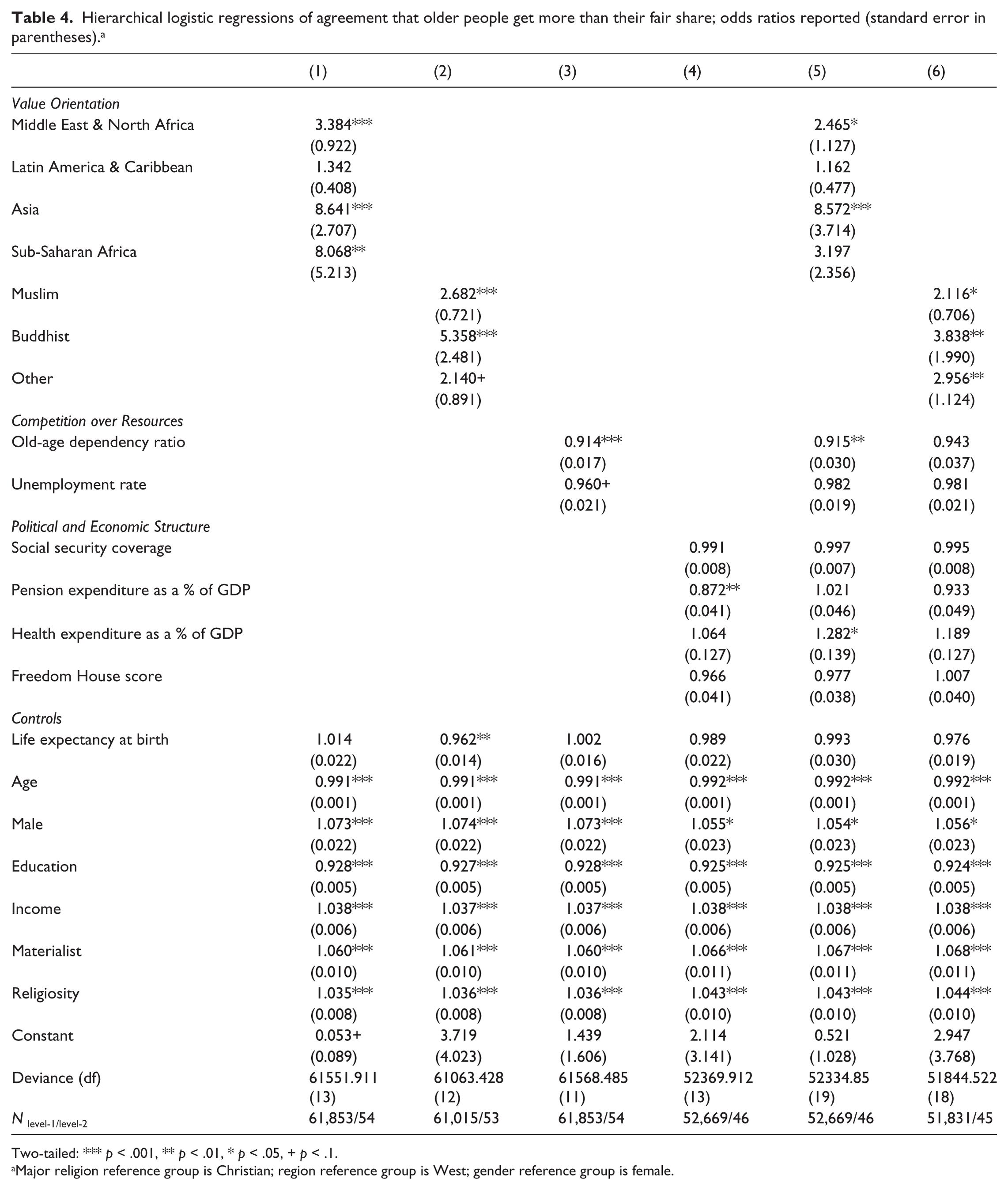
Next, we turn to the hierarchical logistic regression results. Table 3 presents the findings for the dependent variable of agreeing that older people are a burden, while Table 4 presents the findings for the dependent variable of agreeing that older people get more than their fair share from the government. The models are presented as separate theory-blocks for Value Orientation, Competition over Resources, and Political and Economic Structure, and then combined into the same model. We use two different models for testing Value Orientation: Region and Major Religion, and therefore provide two combined models (Models 5 and 6) as well. We include the control variable of life expectancy at the country level and individual controls in each of the models. The model structure and variable inclusion are identical for both Tables 3 and 4, and the odds ratios and standard errors are presented. We first ran empty (random intercept only) models for both dependent variables to determine if there is significant variation in attitudes toward older persons at the country level. We calculated the interclass correlation based on the suggested equation of Snijders and Bosker (2011). We found the interclass correlations for Older Burden to be 0.131 and 0.259 for Older Share. This indicates that 13.1% of the variance Older Burden is at the country level and 25.9% of Older Share is at the country level.
Hierarchical logistic regressions of agreement that older people are a burden; odds ratios reported (standard error in parentheses). a
Two-tailed: *** p < .001, ** p < .01, * p < .05, + p < .1.
Major religion reference group is Christian; region reference group is West; gender reference group is female.
Hierarchical logistic regressions of agreement that older people get more than their fair share; odds ratios reported (standard error in parentheses). a
Two-tailed: *** p < .001, ** p < .01, * p < .05, + p < .1.
Major religion reference group is Christian; region reference group is West; gender reference group is female.
Looking first at the results for Older Burden (Table 3), the more general of our dependent variables, we find that Value Orientation as measured by region and religion has no effect on attitudes. Likewise, we find no effect of the age-dependency ratio or unemployment rate. The Political and Economic Structure model (Model 4) shows that as the percent of the population covered by old-age social security plans increases the odds that an individual agrees older persons are a burden decrease. Unexpectedly, we find that after controlling for life expectancy and other political and economic structure variables, countries with stronger democracies have higher percentages of agreement that the elderly are a burden. In the combined models (5 and 6), these significant findings for social security coverage and democracy remain significant.
Our control variables at the country and individual level also produce interesting findings. Throughout all of the models, we find that as life expectancy increases, the odds that an individual would agree older persons are a burden decrease. For our demographic individual-level characteristics we find that gender and income do not have significant influences on Older Burden. Unexpectedly, across all models we find age slightly increases the odds of an individual agreeing older persons are a burden. The more education a person possesses the less likely they are to agree older persons are a burden. Interestingly, the odds of agreeing that older persons are a burden increase with increasing religiosity and postmaterialist values.
Next, we examine the results for Older Share (Table 4). Here, we find strong, significant results for the impact of region and religion. In Model 1, we find that individuals in Middle Eastern and North African, Asian, and Sub-Saharan African countries have significantly higher odds of agreeing that older people get more than their fair share from the government than individuals in Western countries. Model 2 demonstrates a similar result: individuals in Muslim and Buddhist countries have significantly higher odds of agreement that older people get more than their fair share from the government than individuals in Christian countries. In Model 3, we find that the old-age dependency ratio has a significant effect on attitudes, but perhaps not in the expected direction. As the proportion of elderly in the country to the working-age population increases, the odds an individual will agree that older people get more than their fair share from the government decrease. In Model 4, we find that as with Older Burden, as pensions expenditure increases, the odds of agreeing that older people get more than their fair share from the government decrease.
In the combined Model 5, we find that some of the previous findings hold. When controlling for political and population structure, the effects of Sub-Saharan Africa drop out, but individuals from the Middle East and North Africa and Asian countries have significantly higher odds of agreeing that older people get more than their fair share from the government than individuals from Western countries. Pension expenditure loses its significance in Model 5. The results are similar in Model 6. We find that the effect of Muslim has dropped out, but that those in Buddhist countries are much more likely to agree that older people get more than their fair share than those in Christian countries. Interestingly, we find that the effect of Other religion becomes positive and significant too, which warrants further exploration. In Model 6, we also find that higher old-age dependency ratios significantly decrease percent agreement regarding distribution to the elderly.
The individual-level variables show a similar pattern across all models in Table 4 as they did in Table 3, except for three interesting differences. First, age decreases the odds that a person would agree that older persons get more than their fair share from the government. This seems more intuitive then the finding in Table 3. Second, in Table 4 gender is a significant predictor across all the models. Men have greater odds of agreeing older persons get more than their fair share from the government than women. Lastly, income is a significant predictor of Older Share. Interestingly, individuals with higher incomes have greater odds of thinking older persons get more than their fair share from the government.
Discussion and future directions
Our article significantly extends past research on the cross-national difference in attitudes toward the elderly population in three important ways. First, our analyses are based on 55 countries covering every region of the world. Particularly, we include Latin American and African countries that traditionally have been left out of this type of research. Second, our analyses empirically test three competing theoretical explanations for differing attitudes. We are able to more fully explore the popular Value Orientation explanation by testing it against a Competition over Resources and Political and Economic Structure explanation. Third, we demonstrate that how attitudes toward the elderly are measured is important, and affects the results. A more general question like ‘are older people a burden?’ does not provide a clear pattern across countries. However, when you ask a specific question like ‘do older people get more than their fair share from the government?’, more definite patterns emerge.
Our findings do not support a Value Orientation perspective in the common sense direction. Instead, we find that Asian and Middle Eastern countries have significantly higher percent agreement that older people get more than their fair share from the government than Western countries. This finding holds true when we look at religion instead of region. Buddhist and Muslim countries have significantly higher agreement that older people get more than their fair share from the government compared to Christian countries. This finding is in line with North and Fiske’s (2015b) meta-analysis where they found individuals from Eastern cultures to have more negative attitudes toward the elderly compared to Western cultures.
We also demonstrate the importance of using multiple indicators to measure attitudes toward the elderly, as we found differing results across our two dependent variables. How can we explain what seems like a counter-intuitive finding that the very places we think of as valuing their elderly are also the places that see the elderly as disproportionately taking from society? First, it is important to note that we did not find an effect of region or religion when we tested the measure of ‘are older people a burden on society?’ This highlights the importance of appropriate operationalization of concepts. It appears that for people in countries deemed more ‘traditional’ there is some cognitive dissonance at work. These people cannot say, straightforwardly, that they believe older people are a burden. Very likely, they are thinking of the elderly in their own family or community. It is difficult for a person to state in the affirmative that these people who they hold dear, and likely in high regard, are burdensome, even if objectively they are a strain on family and community resources. However, asking ‘do older people get more than their fair share from the government?’ is not necessarily a negative connotation but opens up space to think about the elderly as an abstract group, and shifts the focus to a more rational calculation over societal resources. These differences among measures are also reflected in our findings, given that the individual control variable of age, which decreased the odds that a person would agree that older persons get more than their fair share from the government and increased the odds that they agree that older persons are a burden. As people get older they likely begin to feel their own physical limitations, and fear that they are or will become a burden. However, they still feel entitled to the benefits they earned in their more economically and socially productive years.
We may also consider Inglehart’s 12-item materialist/postmaterialist index as a measure of Value Orientation at the individual level, and here our findings are more in line with the traditional thesis. As people become more postmaterialist, meaning more focused on ideas, freedoms, and rights, and less on security, economic growth, and stability, they are more likely to see the elderly as both a burden and as individuals who get more than their fair share from the government. This finding demands more exploration in future research, but we posit two explanations here. First, those with more materialist orientations are more ‘traditional’ in their views, and see older adults as standard bearers of this tradition across generations. Second, we may have found some of the limits of postmaterialism: older adults are undervalued by those very people who see themselves as focused on justice, equality, and expression.
The Competition over Resources and Political and Economic Structure perspectives also provided some unexpected, but explainable, findings. In general, we find that countries with higher average lifespans and more elderly as a proportion of the total population actually have more favorable attitudes toward the elderly. We hypothesized that as the elderly become a larger part of society, attitudes toward them would become more negative. A possible explanation for the reverse finding is that people in these countries are living longer, more productive, healthier lives, and working later in life. Old age is not seen as only a time of decline before death. Importantly, we did find in countries where more is spent on pensions, there is less agreement that older people are a burden. This finding could be attributed to individuals feeling secure in the countries’ social safety nets.
What does all of this mean for the future of our aging societies? First, we need to shed our old notions about the relationship between tradition and care for the elderly. Many of those societies considered most traditional are also among the poorest in the world. Because people are living longer in them, without necessarily seeing a corresponding boost in incomes, distribution of wealth, or government policy protection, families and communities will be increasingly burdened with elder care. Tradition, then, is a double-edged sword. Reverence and respect for the elderly is coming into conflict with the care and cost that many older people need. On the opposite side, we did not find that what might be considered more advanced, secular, modern societies necessarily hold their elderly in low regard.
In the future, research should examine more possible country-level covariates that explain attitudes toward the elderly, and, if possible, examine more countries. We have unpacked new and exciting evidence that the shape and structure of societies affect attitudes toward the elderly. Further, the World Values Survey does not capture the poorest of the poor countries in the world or ones that are embroiled in conflict. It is likely that extreme poverty and conflict both affect societal evaluations of the elderly.
Second, examining changing attitudes over time is an important step. We have a cross-section of countries at one point in time, so we cannot make statements about how attitudes within a country change as their demographics, economics, or politics change. This leads to a third future direction –linking together attitudes and policies. How do attitudes toward the elderly shape country-level policies toward them? Do more negative attitudes, and beliefs about unfair distribution of resources, lead to future anti-elderly policies and a redistribution of resources away from the elderly?
In conclusion, we call for more research on how attitudes toward the elderly affect this group’s standard of living, both within and across societies. In richer countries this group will make up an even larger share of the population in the near future, as population pyramids start to look more like population rectangles with declining birth rates. Will there be a point at which attitudes toward the elderly reverse in these countries? And, how will developing countries that have both large youth and increasing elder dependencies cope with the elderly in the future, particularly in the face of stagnating economic growth around the globe?
Footnotes
Acknowledgements
We would like to thank Dr Rachel Allison for her help on this article. Authors are listed alphabetically and were equal contributors.
Funding
This research received no specific grant from any funding agency in the public, commercial, or not-for-profit sectors.