







Abstract
Philippine scholars have largely interpreted Duterte’s support among the upper and middle class as a rejection of the previous administration’s incremental reformism. They also point to the growing appeal of a politics of discipline. These explanations are insufficient. They cannot tell us why the upper and middle class supported Duterte when they did in 2016. The Aquino administration was not the first to disappoint and Duterte hardly the first avatar of discipline to appear on the political scene. In this article the author argues that we need to understand support for Duterte as having crystallized over time with respect to a series of events. Specifically, we need to account for the trajectory of democracy in the Philippines and the contingency of support for him. By placing this support in conjunctural context, we are better able to understand the upper and middle classes’ predisposition to ‘strong leaders’ and their turn to Duterte in 2016.
Scholars have linked the rise of exclusionary regimes to the explosive growth of the middle class in the developing world (Bello, 2018; Blom Hansen, 1999; Chatterjee, 2004; Kurlantzick, 2013). They point to ‘conservative middle-class revolts’ in several countries, including the Philippines. In the 1980s, the Filipino middle class was the leading group behind democratization and helped bring about the ouster of dictator Ferdinand Marcos in 1986. In 2016, however, the upper and middle class largely voted for Rodrigo Duterte, the country’s most anti-democratic president since Marcos. They showed the strongest support for his candidacy early on and throughout the race. The exit poll shows Duterte to have won the most votes among the upper classes and college graduates (Social Weather Stations, 2016). Upper- and middle-class support was particularly pronounced in Metro Manila (Figure 1). Moreover, the upper classes stuck with Duterte once the autocratic character of his administration had become apparent. The latest survey showed that 84% of this group expressed satisfaction with Duterte’s performance as president (Social Weather Stations, 2020).
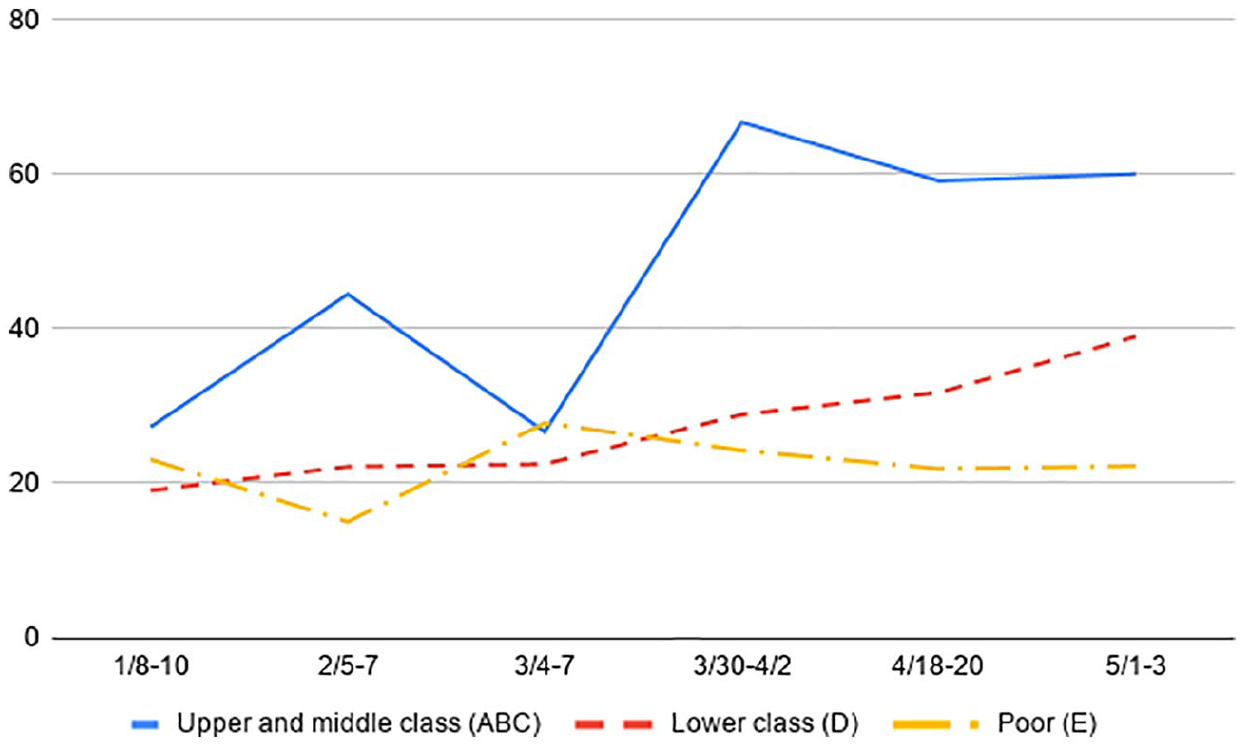
Support for Duterte in the lead-up to the presidential election in May 2016 (percent): Metro Manila by social class.
Generally, Philippine scholars have interpreted Duterte’s upper-class support as a repudiation of elite politics and, in particular, of the previous administration’s ‘liberal reformism’ – its pursuit of reforms through institutional avenues such as legislation, courts, and government agencies (Teehankee and Thompson, 2016; Thompson, 2016). They argue that President Benigno ‘Noynoy’ Aquino’s efforts to eradicate corruption did not go far enough. These efforts, moreover, were politically biased. Aquino targeted political enemies while sparing allies. The sense developed among segments of the middle class that a stronger medicine was required, hence they rejected Aquino’s chosen successor along with other establishment candidates running in 2016. More broadly, Duterte’s election represented a break from 30 years of what Bello (2017) calls the ‘Edsa system,’ the liberal democratic regime brought into being by Edsa 1, the demonstrations leading to Marcos’s ouster. The election was a repudiation of a democracy regarded as elite dominated, endemically corrupt, and ultimately ineffective in improving people’s lives (Casiple, 2016; Curato, 2017; Heydarian, 2018; Teehankee, 2016; Timberman, 2016).
Scholars also point to the growing appeal of a politics of discipline. Webb (2017) asked middle-class informants in Metro Manila and the Central Visayas region about their views on democracy. Democracy means freedom, they told her, but freedom must be balanced by ‘discipline’ and ‘restraint.’ Timberman (2016) suggests that disiplina has more to do with constraint from above. He describes it as something imposed by a strong ruler. Webb’s informants likewise called for strong leadership. McCoy (2017) roots the appeal of a strong leader in traditional conceptions of political authority, Timberman (2016) in the exposure of overseas Filipino workers especially to authoritarian forms of government in Singapore and the Middle East, and Webb (2017) to the continuing draw of the Marcos era. The passage of time, Timberman notes, has rendered the worst abuses of dictatorship abstract. Curato (2017) suggests that Duterte tapped into this ‘authoritarian fantasy.’ The politics of discipline offer a model for governing democracy in ‘dark times.’ In another paper (Garrido, n.d.), I elaborate a view of the democratic state as a source of disorder and the fantasy of a disciplinary state, mainly in the form of a ‘strong leader,’ imposing order.
I would argue that while these explanations are generally sound, they are insufficient. They cannot tell us why the upper and middle class supported Duterte when they did in 2016. After all, Aquino’s was not the first administration to fall short of expectations. Indeed, it was reasonably accomplished by most accounts (De Castro, 2013; Hernandez, 2017; Sidel, 2015). Further, Duterte was hardly the first avatar of discipline to appear on the political scene. Strongmen candidates have sought the presidency in nearly every election since democratization in 1986, and every time they have been rejected as either unwinnable or too severe. So why did Duterte win this time around?
The question of timing is critical to accounting for the support of the upper and middle class. As Tilly (1984) observed, when things happen affects how and even why they happen. It is crucial, therefore, that we incorporate qualities like sequence, timing, and build up into our accounts. They are ‘context’ in the sense not of background but of constitutive milieu, and thus essential to explanation. For Tilly (as well as Abbott, 1991; Griffin, 1992; Quadagno and Knapp, 1992; Sewell, 2005; Somers, 1996), explanation takes a particular form. Causality is not some outside force acting upon individuals; it inheres in a contingent series of actions unfolding over time. Things happen because people make choices according to their sense of a situation at the time. These choices accumulate and shape the trajectory of the situation. The logic of explanation is conjunctural. It becomes necessary, therefore, to explain an outcome with reference to the sequence of events leading up to it and how actors understand this flow of events – that is to say, their developing sense of how events connect to and inform one another (Aminzade, 1992). These two components, sequence and interpretation, constitute the narrative at stake. A conjunctural explanation means situating the outcome within this narrative.
We need to understand upper- and middle-class support for Duterte as having crystallized over time with respect to a series of events. In this article, I seek to situate this support in its political contexts. To do so, I will account for the sequence of events leading up to Duterte’s election and the upper classes’ developing interpretation of these events. Here I draw upon several years of qualitative research on the upper and middle class in Metro Manila. The formal component was conducted between 2009 and 2014 and consists of 81 interviews.
Specifically, I will argue that we need to account for the trajectory of democracy in the Philippines and the contingency of support for Duterte. Taking trajectory into account means recognizing that people’s dispositions take shape over time and with respect to a particular sequence of events. Their disposition towards democracy reflects learning and an accumulation of sentiment. I will show that informants experience democracy as ‘unsettled times,’ have grown increasingly frustrated with it, and, consequently, remain open to less-than-fully democratic forms of government. Taking contingency into account means recognizing that political outcomes are constituted in relation to a host of various other events. I will show that informants evaluated Duterte ‘laterally’ and retrospectively, that is, in relation to the politicians around him and preceding him. His election had about as much to do with the discrediting of other presidential contenders and disappointment with the previous administration as it did with the appeal of Duterte’s politics. The election presented a unique opening for the politics of discipline.
My explanation lies at the conjunction of these two elements; trajectory speaks to frustration with democracy and contingency to the opportunity to act upon it. The move is not just to situate events in time but, rather, to portray their location in time, with respect to both the democratic period and the political moment, as decisive. This is different from the prevailing explanations, which largely treat the sequence of events leading up to Duterte’s election as so much background information. At the crux of these accounts are structural factors, including elite democracy, the social position of the middle class, the support of overseas Filipino workers and urban voters, and the greater use of social media in political campaigns (Cook and Salazar, 2016). In my account, conjuncture is causal, and attending to trajectory and contingency crucial to explaining Duterte’s election. These elements help us better understand the upper and middle classes’ predisposition to ‘strong leaders’ and their turn to Duterte in 2016.
Furthermore, a conjunctural account discloses aspects of the situation that a purely structural account would miss. It allows us to observe political learning, and thus we see democratic dispositions evolve out of an ongoing conversation about democracy. It reveals the contingency of political outcomes. We see that Duterte’s election was not predetermined or simply given by structural conditions but largely a precipitate of the political moment. Thick description of people’s experience of politics, meanwhile, shows democratic attitudes to be fluid. Most of my informants are neither committed democrats nor autocrats but ambivalent about democracy, which means that they can lean one way or another depending on circumstances. In short, an account steeped in time provides us with a more sophisticated understanding of how an exclusionary regime came to power.
In the next section, I describe my qualitative data and methods. Following, I discuss the trajectory of democracy in the Philippines with respect to both the relevant sequence of events and the upper and middle classes’ interpretation of these events. I then discuss the contingency of support for Duterte. Finally, I make the case for constructing ‘thick’ accounts of the global authoritarian turn attentive to multiple registers of causation.
Data and methods
I conducted 81 interviews with upper- and middle-class residents of Metro Manila: 66 with the residents of four subdivisions and 15 with members of government, civic, and business organizations, including the National Housing Authority, the Makati Business Club, two life insurance companies, and a human resources company. Organizations, being a different kind of site, represent an effort to approach the upper- and middle-class population in a different way. Interviews were collected over the course of 16 months between 2009 and 2014. They were conducted in English and Filipino, recorded, and transcribed. I also engaged in extensive participant observation – formally, by attending various meetings convened by middle-class groups (including Rotary Clubs, homeowners associations, a prayer group, a group of lawyers, and a business association) and, informally, as a result of living in several middle-class households over the course of a cumulative three and a half years working in the Philippines as a fieldworker for a development NGO, a journalist covering Philippine politics, and an academic researcher since 2005.
I selected subdivisions based on their class reputations. The subdivisions in New Makati are well known to be upper class, while the ones in Quezon City (Phil-Am Homes and Don Antonio Heights) and Parañaque (BF Homes) are reputedly middle class. These reputations are borne out by the physical aspect of the subdivisions and by the higher occupational status of the residents interviewed. I obtained interviews with residents by approaching the homeowners association of each subdivision. In each case, I was referred to the residents serving on the board. I began by interviewing them, and then obtained referrals from them to other residents. I proceeded, in other words, by snowball. I continued until I had around 15 interviews per site. I selected organizations based on their kind – government, civic, and business – in an effort to cover different domains of middle-class activity. I obtained interviews with their members through personal contacts.
I present a profile of informants in Appendix 1. Almost all informants were old enough to remember the people power protests leading to the country’s democratization in 1986. In fact, many had personally participated in these protests. Almost all were college educated and in professional occupations or small business owners. The profile describes persons whom, locally, would be considered middle to upper middle class and upper class. Notably, the lower middle class are missing from my ‘sample.’ Their omission follows from my focus on subdivisions within Metro Manila. I draw attention to the oversight as a blind spot potentially biasing my analysis.
The data featured in this article come from a line of questioning about Philippine politics. I asked informants about the presidential race underway in 2010. I asked them about their views on every presidential administration from Marcos onward and about their sense of the democratic period as a whole. The shape of these conversations was remarkably standard in retrospect. Informants made sense of the topics in similar ways. Doubts about democracy were widely shared even if people disagreed about how to proceed. After enough interviews, I was able to identify a ‘common sense’ about democracy that seemed particular to the upper and middle class because it had been worked out in interaction with like others within the relatively coherent social circle of the group (for the views of the urban poor on democracy, see Garrido, 2019). The interview provided informants with an opportunity to rehearse a view and vision that had been developed collectively, not individually, and represented the state of the conversation about democracy at the time.
Finally, I would note that my qualitative data were collected a few years before Duterte burst on the national scene and so cannot speak to support for him specifically. Nonetheless, they provide considerable insight into why the upper and middle class would support someone like him. The fact that my research predated Duterte’s election may even be taken as analytically beneficial insofar as it rules out post-hoc justifications of support. Rather, the data highlight the receptiveness of informants to autocratic leadership, and thus help us understand why so many in the upper and middle class – the ‘natural constituency of democracy’ (Bautista, 2001), so-called – flocked to Duterte in 2016.
The trajectory of democracy in the Philippines
Aminzade (1992) uses the word ‘trajectory’ to capture the cumulative aspect of change over time. The concept is a way to get at people’s developing experience of a particular sequence of events. It allows us to capture an aspect of democratic politics in the Philippines that more static conceptions miss. For example, Thompson (2010) describes democratic politics as a cycle of reformist and populist challenges to ‘traditional’ or patronage politics. As we have seen, scholars also highlight Duterte’s break with liberal democratic norms. I would argue that we can better explain cycle and break with reference to trajectory. We might think of trajectory as a conversation, in this case, about democracy. The conversation does not reset to zero after every turn or political development. Knowledge and feelings accumulate, steering it in new directions. By focusing on trajectory, we are able to account for the progress of this conversation, and for the role of learning and the building up of sentiment in driving it forward. I will depict the trajectory of democracy in the Philippines as a jagged line, that is, in terms of instability, and underscore people’s growing frustration with politics as usual. I will show that these experiences profoundly shape the democratic disposition of informants. They help us understand their ambivalence towards democracy, yearning for change, and increasing openness to authoritarian forms of government.
Democracy as unsettled times
Ann Swidler (1986) argues that during ‘unsettled times’ or periods of social transformation, the ideological character of social structures becomes evident. That is to say, they no longer appear natural or inevitable. They can no longer be taken for granted. People openly question them and even contest their value or suitability. New or different ways of doing things are thinkable, but their viability, Swidler contends, depends on the availability of structural opportunities for their realization. I would argue that the democratic period in the Philippines represents unsettled times. It has been characterized by extreme instability largely due to political events in the form of corruption scandals, ousters, coup attempts, impeachment efforts, and mass protests. This instability has kept democratic mores from ‘settling’ in Swidler’s sense; that is, from becoming institutionalized or ‘consolidated’ in the language of political science. As a result, support for democracy is largely conditional, and many people remain open to the possibility of authoritarian forms of government. In the following paragraphs, I recount the democratic period by presidential administration, describing how informants generally remembered each one, and then present survey data highlighting Filipinos’ ‘ambivalence’ towards democracy.
The dictator Ferdinand Marcos was ousted in 1986 by a massive demonstration known as Edsa 1 (Edsa being short for Epifanio de los Santos Avenue, the staging ground of the protests). A new democratic period was inaugurated and Corazon Aquino installed as president. Aquino was the wife of Marcos’s slain political rival and the figurehead of the opposition. She had her work cut out for her. In the wake of democratization, the country found itself in the grip of political turbulence, economic recession, and general disorder (Hernandez, 1988). Aquino had to hold elections and draft a new constitution. She had to deal with a newly free press, three separate insurgent groups, and repeated coup attempts (there were a total of nine in the course of her six-year term). In Metro Manila, crime was rampant, particularly the kidnapping of Chinese Filipinos for ransom, power outages or ‘brownouts’ struck periodically, uncollected garbage rotted in the streets, and traffic jams routinely paralyzed the metro (Timberman, 1990). Given the scale of the problems at her feet and her own tenuous grip on power, Aquino governed conservatively. She leaned on the military for support, took care not to alienate powerful landed interests (undercutting her own agrarian reform legislation), and chose to honor rather than repudiate the enormous international debt Marcos had incurred (Brillantes, 1993). The euphoria that had greeted her accession turned to disappointment. Informants recalled ‘Tita Cory’ (Aunt Cory) with affection, as good hearted and personally clean, but also as politically timid and ultimately ineffective in setting a new standard for politics. They pointed, for instance, to her inability to stem the rent-seeking of her own relatives and allies.
Fidel Ramos succeeded Cory in 1992. Ramos was a hero of the People Power revolution, a high-ranking military commander who had broken away from Marcos and helped trigger the demonstrations. His administration successfully managed to restructure the Philippine economy (De Dios and Hutchcroft, 2003). It moved to liberalize trade and investment regimes, deregulate industry, privatize public enterprises, and break up corporate monopolies. These efforts brought about sustained economic growth for the first time in a decade but did little to alleviate Manila’s chronic problems. The country’s economic boom came to a temporary halt with the Asian Financial Crisis in 1997. While most informants remembered Ramos as an effective leader, his administration was not free of scandal. He was accused of benefiting from a large-scale government project involving the reclamation of Manila Bay. He also encountered opposition to his efforts to change the form of government from a presidential to a parliamentary system. The move was seen as an attempt to continue on as prime minister and prevent the populist Joseph Estrada from becoming president (Romero, 1998).
Estrada won, nevertheless. The former movie star and city mayor ran on the promise of alleviating poverty. His election marked the first time that social class, more than geography, gender, or age, determined the presidential vote (Mangahas, 1998). Estrada’s administration was plagued by scandal from the very beginning. His cronyism was flagrant. He distributed luxury vehicles seized by the Bureau of Customs to Cabinet members and political allies, used government pension funds to support a crony’s corporate takeover, and helped another crony manipulate the stock market (Bolongaita, 2000). My informants were mortified, moreover, by Estrada’s vulgar persona and haphazard style of governance. They pointed to his ‘midnight cabinet’ – late night drinking and gambling sessions with cronies – and to the mansions he had acquired for his several mistresses. Estrada was considered an embarrassment to the office of president. In 2000, one of Estrada’s cronies, having been cut out of a deal, publicly accused him of receiving kickbacks from an illegal lottery. The allegations led to his impeachment. When the trial was derailed by his supporters in Congress, it sparked massive demonstrations lasting a week and culminating in Estrada’s ouster. The protests were known as Edsa 2.
It was not long before Edsa 3 came along. Estrada was replaced by his vice-president Gloria Macapagal-Arroyo. Given the manner of her accession, Arroyo’s claim to the presidency was contentious. Contention came to a head when Arroyo ordered Estrada’s arrest, triggering a demonstration by his supporters that was even more massive than the one that had deposed him. The difference was its composition. Many of the demonstrators were poor. Although Edsa 3 came to naught, it underscored the divisiveness of Arroyo’s presidency. She sought to shore up her legitimacy by playing politics, but these efforts only succeeded in further undermining her credibility (Coronel, 2003). Eventually, Arroyo renounced an independent bid for president in the 2004 election. The move went over well, that is, until she reversed course nine months later, ostensibly in response to the public clamor for her to run and prevent the election of Fernando Poe, Jr., an Estrada ally and an even bigger movie star than he was. She won the election in 2004 but was discovered to have interfered in the process. A recording surfaced of her instructing the elections commissioner Virgilio Garcillano to guarantee her a certain margin of victory. She apologized publicly for the incident, but the ‘Hello Garci’ scandal marked a turning point for many of my informants. They had supported her initially, but as the evidence of her corruption mounted, turned against her with a vengeance.
People took to the streets following Hello Garci, and Arroyo’s political opponents tried to have her impeached (the first of three attempts), but she proved too adept at patronage politics. She cultivated key allies in Congress, the military, and Catholic Church, and repressed political protest. Contingent events, meanwhile, aligned in her favor. Her presidential rival, Fernando Poe, Jr., suffered a stroke and died a few months after the 2004 election. His death deprived the opposition of a figurehead. Arroyo’s vice-president, Noli de Castro, the anchor of a popular news show, was not a particularly compelling option. He was seen by many as a political lightweight and unqualified for the post (Hutchcroft, 2008). Finally, there was a feeling of ‘people power fatigue’ in the air (Coronel, 2007). People were disillusioned by the political fallout of Edsa 2 and wary of resorting to the same tactics that had led to the installation of Arroyo in the first place. Surviving the Hello Garci scandal apparently emboldened Arroyo because a string of further scandals followed. She remained extremely unpopular over the course of her term. According to one survey (cited in Hicken, 2008), people considered her more corrupt than Estrada and even Marcos (quite a feat considering the competition). Arroyo spent 10 years in office altogether, serving the four-year balance of Estrada’s term plus her own six-year term – a full third of the democratic period.
Benigno ‘Noynoy’ Aquino ran as the most credible anti-Arroyo candidate in the 2010 election and won on these grounds. Informants had doubts about his capability, but they saw him as being trustworthy and clean like his mother Cory Aquino. To them, the moment demanded some sort of riposte, an antidote to Arroyo’s legacy of corruption. Sure enough, Aquino pursued a reform agenda aimed squarely at combating corruption called Daang Matuwid or ‘the straight path.’ The first item on the agenda was prosecuting Arroyo and her associates. Aquino had Arroyo arrested and the Chief Justice of the Supreme Court, an Arroyo appointee, removed. He made headway in other areas as well. Tax collection improved during his presidency, and the Reproductive Health Law passed (the law guaranteed universal access to contraception, a controversial issue in the Philippines). Scandal visited his administration too, however. In 2013, it was revealed that 10 billion pesos (US$200 million) in discretionary or pork barrel funds had been diverted to shell companies and into the pockets of members of Congress and government officials (Sidel, 2014). Aquino came under fire for holding his political opponents to account while overlooking the involvement of his political allies. Critics painted his anti-corruption efforts as one-sided and politically motivated (Teehankee and Thompson, 2016). Aquino’s reformist bona fides were further undermined by his administration’s clumsy and lackluster handling of relief operations in the wake of the destructive Typhoon Haiyan.
Rodrigo Duterte’s election in 2016 represented a break from politics as usual in terms of both style and substance. Duterte’s style has been described as blunt or brusque, but more than this, it is actively transgressive. He delights in crossing the line of acceptable political discourse. He has joked, for instance, about joining in the gang rape of an Australian missionary and publicly cursed Barack Obama, UN Secretary General Ban Ki-moon, Pope Francis, and God. On the one hand, this performance, like Estrada’s, conveys a disdain for polite society; on the other hand, unlike Estrada’s performance, it bespeaks a strength of will rather than incompetence.
Certainly, the politics of ‘I will’ (Curato, 2016) has been on display from the very beginning of Duterte’s term. The centerpiece of his administration has been a ruthlessly prosecuted war on drugs. Human rights groups put the casualties of the drug war at a staggering 12,000 to 20,000 people (HRW, 2018). Duterte has also pursued a more independent foreign policy, pivoting away from the Philippines’ historic alliance with the United States. He has pledged himself to the fight against corruption but, unlike Aquino, not hesitated to clean house, summarily removing department heads and Cabinet secretaries on the mere whiff of scandal (Tigno, 2018). These efforts have blurred into the repression of political opponents and critics. Duterte has had the former human rights commissioner arrested, barred his vice-president from attending Cabinet meetings, threatened the Ombudsman with impeachment, stripped opposition party senators of their position, and unleashed the Bureau of Internal Revenue on a critical media outlet (Timberman, 2019). These moves amount to the subversion of democratic norms and institutions.
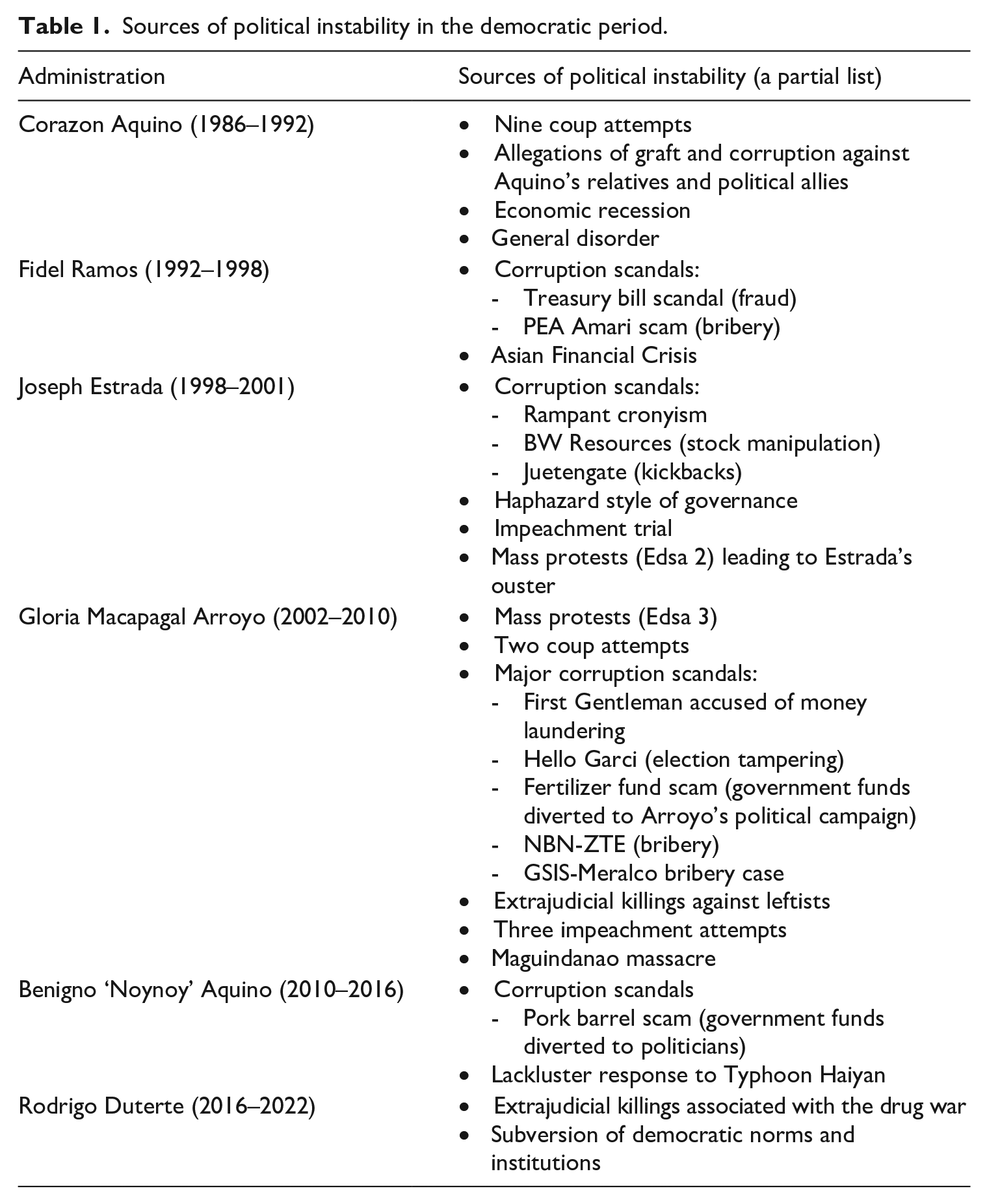
I would argue that we can only understand Duterte’s appeal in the context of an experience of democracy as ‘unsettled times.’ In the course of the last 30 years, political instability has become normal. Consider Table 1, which highlights the frequency of political disruption during the democratic period. There were a dozen coup attempts, dozens of corruption scandals, three impeachment tries and one impeachment trial, the ouster of one president by mass protest, and the near ouster of the succeeding one by an even more massive protest. These events are merely symptomatic of the raucous nature of democratic politics, which have had enough drama – scandals, betrayals, reversals, j’accuse! moments – to rival the most riveting telenovelas. In their everyday lives, meanwhile, the upper and middle class in Metro Manila have had to contend with various forms of disorder, including crime, petty corruption and rule-bending, rampant squatting, spotty infrastructure, arthritic traffic, and dirty air (Garrido, 2020). 1
Sources of political instability in the democratic period.
Such instability inevitably colors how people feel about democracy. It is no wonder that satisfaction with it has been fickle, largely varying with administration (see Figure 2). Satisfaction slumped during Arroyo’s administration, remaining below 50% for almost the entirety of her tenure. It spiked with Noynoy Aquino’s election and attained new heights following Duterte’s. This is ironic considering that Duterte has been the most anti-democratic president since Marcos. The extent of variation over the period is remarkable. Satisfaction with democracy has swung from a low of 28% to a high of 86%.
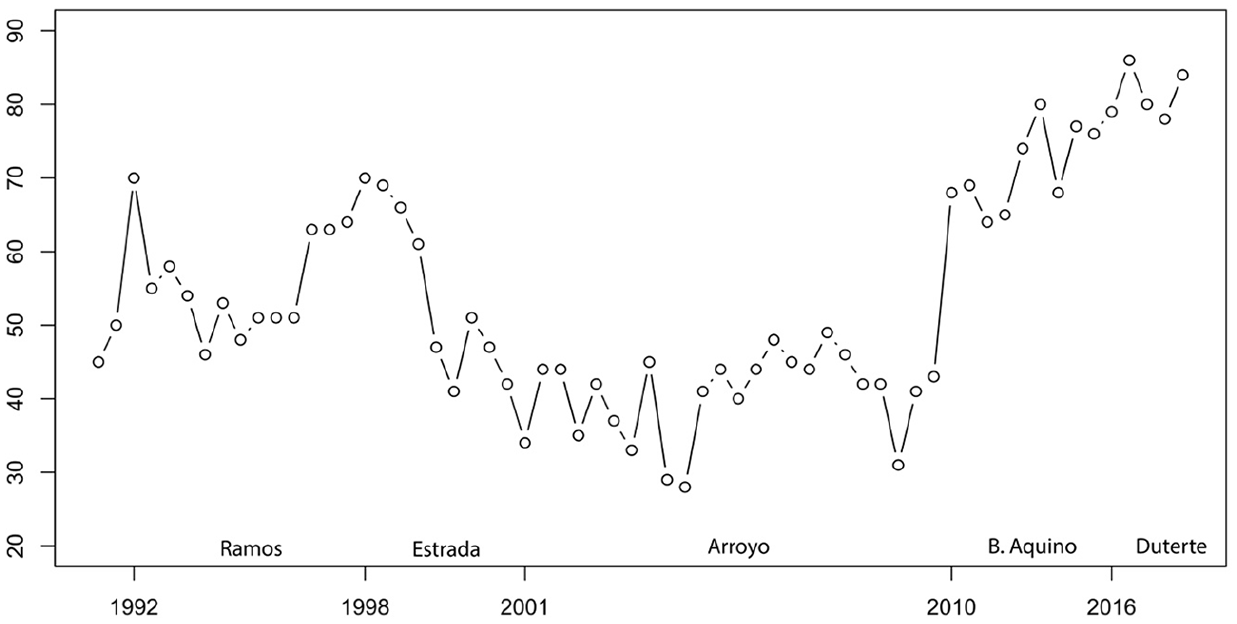
Satisfaction with the way democracy works (percent).
For many people, moreover, support for democracy appears to be conditional (see Table 2). The percentage of people who view democracy as ‘always preferable’ – so-called committed democrats – is between 47 and 64%. Meanwhile, the percentage of people who view authoritarianism as ‘sometimes preferable’ is between 18 and 27%. If we add people who disavow the choice, claiming that ‘it does not matter to them,’ the figure rises to between 36 and 52%. We might view this figure as representing the percentage of people who are less than fully committed to democracy. There does not seem to be a clear trend in either direction; that is, support for democracy does not appear to be growing or diminishing overall. Rather, the proportions of committed and less-than-committed democrats have fluctuated over the years but within limited ranges. The central tendency of each is roughly 55% for the former and 45% for the latter. These contradictory attitudes may be taken as indicating a durable ‘ambivalence’ towards democracy (see Webb, 2017).
Preference for democracy (percent).
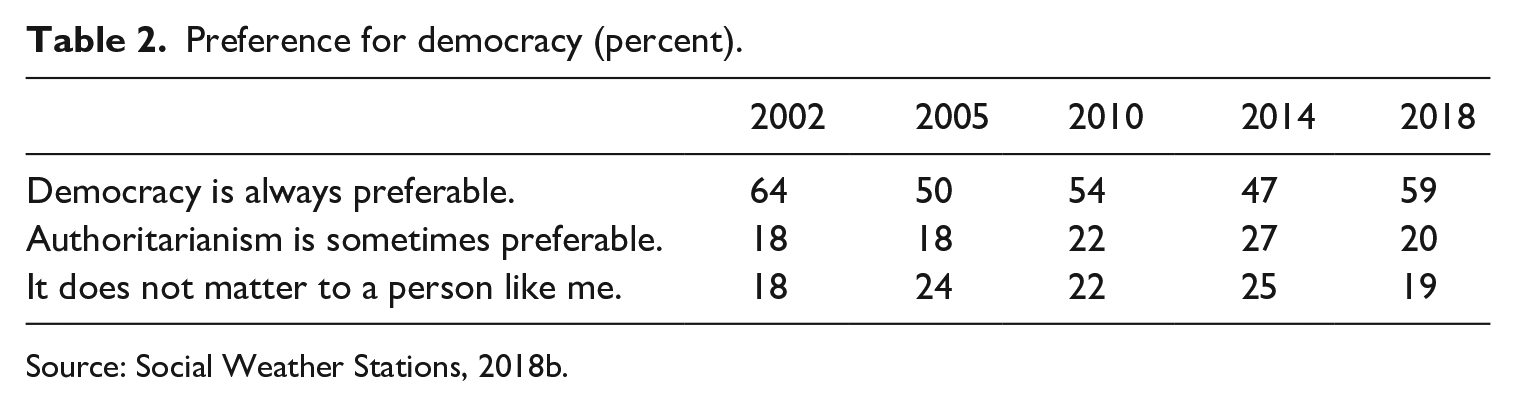
Source: Social Weather Stations, 2018b.
The data featured in Table 3 expand on this picture. They suggest that many people remain open to authoritarian forms of government, including rule by a strong leader, the military, or experts, or elections limited to one party. While less than a third of respondents supported any single option (with the notable exception of rule by a strong leader), a majority (52–60%) entertained at least one option. These data give us a sense of people’s general orientation towards democracy, but in order to truly understand Duterte’s appeal among the upper and middle class, we must zoom in further and provide a thicker account of their experience of democracy. The following section aims to unpack this experience and show how it informed their susceptibility to ‘strong leaders.’
Openness to authoritarian options (percent).
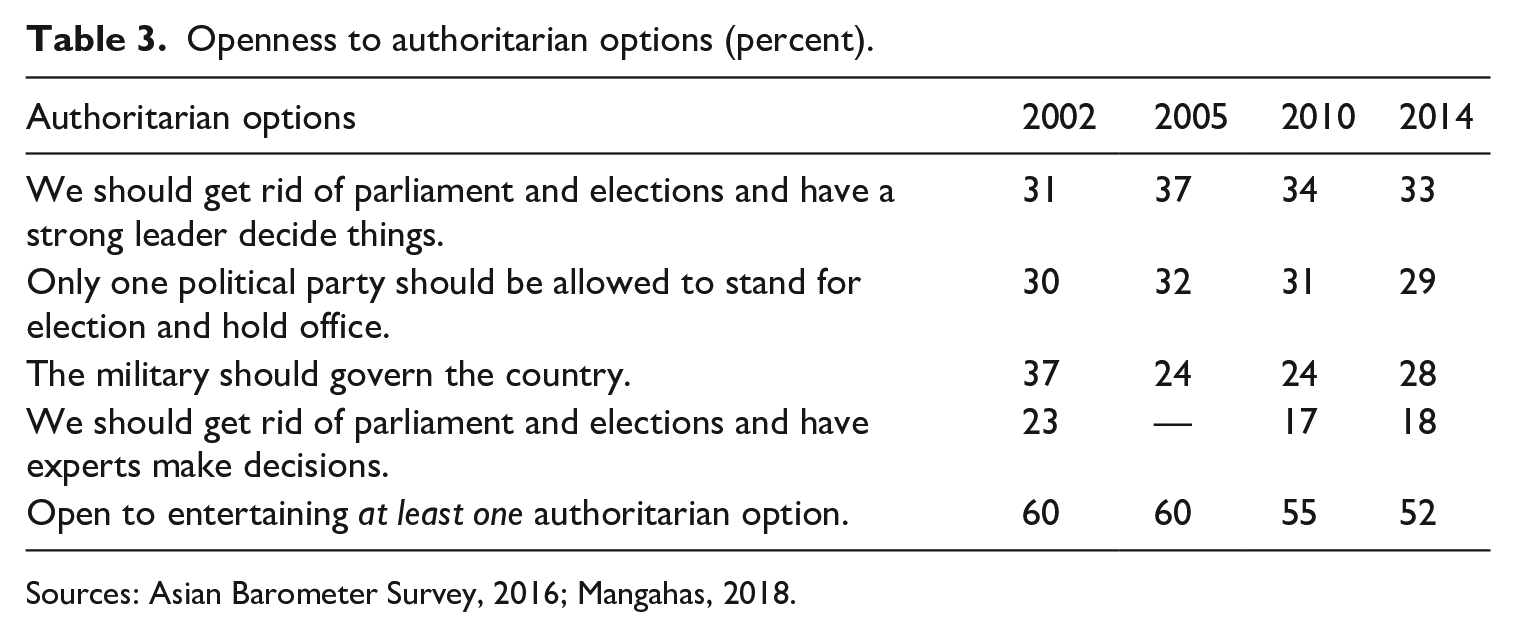
Sources: Asian Barometer Survey, 2016; Mangahas, 2018.
The experience of democracy
It’s like waiting for Christ to return
I visited Artemio, a corporate lawyer in his seventies, in his condominium in Makati. His daughter met me at the door and led me to his study, where he sat hunched over the newspaper. Noting that I was studying in the United States at the time of the interview, he brought up the fact that he had sent his four children to Europe and America for college and graduate school, ‘but when I sent them to study, I made them promise that they would return to the Philippines,’ he said, adding, ‘although now I have doubts about whether that was the right thing to do.’
‘Why?’ I asked.
‘Because things have gone from bad to worse in this county. Since the 80s, worse and worse. Marcos was corrupt but Arroyo is ten times worse.’ He ranted about the NBN-ZTE deal and then, collecting himself, lamented, ‘everything here is upside down. You don’t pay taxes, and if you do, you cheat, because no matter what you do, the [Bureau of Internal Revenue] will claim that you’re violating some law or regulation. And they’ll be correct. They’re always correct, and you’ll have to pay more.
‘You work hard, but if you don’t have the right connections you can’t go far. If you break the law but know someone in politics or government, you can get away with it.
‘You stop at a red light and the guy behind you bumps you [because he doesn’t think to stop]. If you get pulled over, you give the cop one hundred pesos to go away. If you do what you’re supposed to and surrender your license, you’ll end up spending half the day trying to retrieve it and paying a lot more than a hundred pesos.’
‘What do you think the problem is?’ I asked.
‘I think that American-style democracy is not for the Philippines because the average Filipino has no money. So what does he do? He sells his vote. The politician that buys it, when he’s elected, he feels that he owes the people nothing because he paid for his victory. The problem is that we’ve adopted American democracy without American [social] conditions.’
He proceeded to recount the democratic period as a series of disappointments. Artemio’s cousin was a Marcos crony, but ‘my whole family voted for Cory because I felt that, for the sake of my children, things had to change.’ But they didn’t, not with Cory. He voted for Estrada with the same hope. ‘I mean I’m ashamed to admit it, but I did vote for him. Of course it turned out that Estrada was a big fraud. He was only pretending to be pro-poor.’ He voted for Arroyo but regrets it deeply. ‘In retrospect, anyone would have been better than Gloria,’ he sighed. Now he had his hopes pinned on Noynoy Aquino.
‘Maybe what we need is another Marcos. If we get another Marcos, this time people will accept martial law. There are people now who believe in dictatorship. I, for one, I believe.’ He paused for a moment to consider the possibility. ‘The only trouble is, you get a dictator and he’s bad, it’s very difficult to replace him.’ He backtracked. ‘If you ask me, we don’t need a dictator. And yet the idea of a strong leader clearly had appeal; maybe not Marcos but someone like him, someone better.
‘You know, during martial law, everyone followed the law. People paid their taxes. They were afraid, even policemen. You try to give them money and they wouldn’t accept it. That’s what we need right now.’
He spoke some more about it and then about other things, and towards the end of the interview he returned to the topic. ‘We might still produce a leader who will change things,’ Artemio said, the sentiment belied by the sound of defeat in his voice. ‘But I’ll admit, it’s like waiting for Christ to return.’
‘It sounds,’ I said tentatively, ‘like you would advise your children differently this time about coming back to the Philippines.’
‘If they were just leaving now, I would tell them, “Look, here’s your chance to leave the country for good. Make good use of it.” That’s what I’d tell them.’
‘And you, would you leave?’
‘My daughter wants to petition me. She said that I can get a green card in as little as six months. I told her no way. To me, this is home. When I visit the US, people ask “Why do you want to go back? It’s so corrupt over there.” I tell them, “Piglets. You remove them from the mud and they start howling. You put them back and they’re happy.” That’s how I feel. I’ve learned to live with all this foolishness.’
Sayang
As a young man, Ruben worked as a lawyer for the Development Bank of the Philippines [DBP]. This was during the Aquino and Ramos administrations. He now works for a private firm. We spent hours in the boardroom of a law office talking about the ups and downs of Philippine politics. The glass walls had darkened in the interim. We talked about Edsa 1, in which Ruben had participated; Edsa 2, which he had supported; and Arroyo, for whom he had voted, regretfully.
‘There’s one word for all of it, Marco,’ he said, sadly. ‘Sayang [what a waste!] Just look at what happened to the DBP. Back then it was almost bankrupt. We had to borrow funds just to meet payroll. Secretary Estanislao and Secretary De Ocampo, they did a fine job of turning things around. They made people feel proud of working there. Now all that progress has been lost. The values that we imbued in the people there, lost. We were very serious about serving the government, and we trained people to be honest and efficient in their work. We promoted them because of merit. But when Estrada became president our people were replaced by people from the outside with friends on the Board. They grew demoralized and retired early. Everything we created, there’s nothing left.’
He blamed Estrada’s election on the poor being ignorant and easy to mislead, and the conversation turned to the subject of democracy. I asked Ruben whether his thinking about democracy had changed after 25 years. He had spoken so passionately about Edsa 1, describing ‘the wonderful feeling’ of being swept up by a righteous cause. Instead of taking a more lucrative job in the private sector, he chose to work for the government because of his dedication to that cause. Did he still believe in democracy?
‘Not the free democracy that we have now. It depends a lot on who the leader is. We need someone who is firm and fair, who won’t kowtow to other politicians. Once you’re elected, you shouldn’t give a damn about anything else but serving the people. The problem is, elected officials have debts to pay.’ He thought for a moment. ‘We need someone like Lee Kwan Yew [Singapore’s autocratic prime minister],’ quickly adding, ‘but not as strict.’
Escape plan
Leon spoke of plotting his ‘escape’ from the Philippines. The building manager had just gotten married and now had a five-month-old to think about. He and his wife decided that they needed ‘an escape plan.’ ‘The US, Saudi, Australia, wherever.’
‘After Marcos people were hopeful, and then, when we ousted Estrada, hopeful again. Now? I don’t know. I’m so sick of it. Fed up. It’s just more of the same with GMA [Gloria Macapagal Arroyo]. I’m out of patience. I’m out of options. And it’s not just me. A lot of people feel this way. I’d say that eight out of ten nurses plan to leave the country. I’m just guessing, but a lot of my classmates, and my niece, are nurses, and that’s how they’re thinking. It’s easy to be patriotic, to say that you want to stay and serve the country, if your last name is Aquino or Teodoro or,’ he scoffed, ‘Villar [presidential candidates in 2010, all very rich].’
In his view, the country needed a ‘revolution’ or some kind of radical break in order to correct its wayward course. He pointed to the execution of drug lord Lim Seng in the early days of martial law. Lim Seng was convicted and pleaded guilty, counting, it seems, on being able to use his considerable wealth and connections to escape punishment. Marcos had other ideas, however. He had just declared martial law and wanted to demonstrate his seriousness. He had Lim Seng executed by firing squad. Leon reported looking for the video on YouTube (it has since been uploaded on Facebook). He had not yet been born when the execution happened but had heard so much about it and was eager to view it for himself.
Edsa fatigue
Elmer and Emma had been activists in college only a few years before I spoke with them. They had participated enthusiastically in Edsa 2. By the time I interviewed them, however, they had all but sworn off ‘politics.’ I asked them how they went from being politically active to being, I stumbled to find the word . . .
‘Apathetic?’ Emma offered. They were busy with work, for one. Emma taught kindergarten and Elmer worked in a bank. But more than that, they had come to view political involvement as a dead end.
‘I just don’t see why I should put effort into [politics] when in the end nothing comes of it,’ Elmer said.
‘What would make you take to the streets?’ I asked.
‘It’s not that we’re lacking reasons,’ Emma said quickly. ‘There are plenty of reasons. If it’s not NBN-ZTE, it could be . . . .’
‘Hello Garci.’
‘Yeah, Hello Garci. The streets don’t really appeal to us anymore. Fine, go rally, but what’s the point? It just goes down the drain.’
I nodded.
‘Fine, go to Edsa, say for ZTE,’ she repeated. ‘Get rid of Gloria. Then what? Who would you get to replace her?’
The feeling of ‘Edsa fatigue’ was palpable: disillusion with people power as a means of bringing about political change, disappointment in Arroyo, and a general sense of impotence regarding politics.
Political learning
Cary and Ging were talking about how much Marcos had accomplished. The two men were managers at the same conglomerate. We spoke at a local McDonald’s. They pointed to highways and hospitals and the extent to which people followed the rules. Under democracy, they lamented, this order had begun to unravel.
‘It sounds like you’re sick of democracy,’ I remarked.
‘No, no, no,’ Cary insisted. ‘That’s not it.’
‘That’s not it exactly,’ Ging agreed. ‘It’s that I’m frustrated with democracy. This [he waved his hand] is not what I wanted to see after 20 years.’
‘We could have done more, achieved more.’
Frustration with the state of politics in 2010 led some informants to re-evaluate past leaders as being less bad than they had previously thought. Marcos, in particular, appeared to be undergoing a rehabilitation in light of the disastrous Arroyo administration. The data provide a firsthand account of ‘authoritarian nostalgia’ – as identified by Chang et al. (2007) through survey data – crystallizing. I talked to Seb, who directs a nonprofit organization.
‘My sense is that right now a lot of people feel . . . I don’t know if nostalgia is the right word, but they don’t see Marcos as having been that bad anymore. Why? It’s only because they’ve found people who are worse. He used to be the benchmark of bad, but now not anymore. You see his kids running for office and their family name isn’t held against them. They’re not seen as being as bad as Arroyo’s kids. This is amazing when you think about it because Marcos was in power for so much longer. And then Estrada, as bad as he was, I mean, now people just see him as having been mildly bad and mostly stupid. People used to act as if he were evil incarnate. Now he’s just a guy who loved life a little too much.’
There was a definite sense of having learned from experience. Informants brought the trials of the past 25 years of democracy to bear on their consideration of the present moment. Certain options, having been tried and having failed, were taken off the table. Now informants were willing to entertain new possibilities.
‘We need a leader who is strong,’ Cary averred, ‘someone with the political will to change the way things are done here. You need to be determined because you’re the guy who’s going to change things. I thought that person was GMA. I used to think it was Cory.’
‘In Edsa 1,’ Ging recalled, ‘people were optimistic that they could change things. So, okay, next time the president doesn’t work out, we’ll resort to People Power. But then Edsa 2 led to Gloria . . . .’
‘Now no more,’ Cary continued.
‘Change will have to come in a different form.’
While some informants suggested authoritarian options, most, like Artemio, remained wary of full-blown dictatorship. More often, informants called for a strong leader. ‘I’m for Gordon,’ Alice declared. Richard Gordon ran for president in 2010 promising to bring ‘discipline’ to the country. ‘Many of the people who worked for Gordon, they don’t like him. He’s so aggressive, they say. Aggressive and arrogant. But if that’s what it takes to get the job done . . . .’ Gordon lost miserably in 2010, garnering less than 4% of the presidential vote in Metro Manila. His candidacy, however, represented a brand of politics – neither quite reformist nor populist – that was increasingly being seen as viable. Within upper- and middle-class circles, the sense was developing that someone like Gordon, a strong leader, had become necessary. This sensibility, as we have seen, was informed by the entire trajectory of democracy. It was also, however, the precipitate of the political moment.
The contingency of support
Frustration with democracy alone cannot explain Duterte’s election. People have been frustrated for some time, after all, and there have been numerous opportunities to elect a strongman or Duterte-like figure for president before 2016. It is not simply a matter of people having become more frustrated either. Indeed, the survey data show, ironically, a decline in their willingness to entertain authoritarian options from 60% to 52% between 2002 and 2014 (Table 3). We also need to take into account the timing of Duterte’s candidacy. His election was contingent on the state of the Philippine political field at the time. Filipinos evaluated Duterte ‘laterally’ and retrospectively, that is, in relation to political actors around him and preceding him. On the one hand, the competition was serially discredited over the course of the campaign period. Aquino’s designated successor, Mar Roxas, was weighed down by criticism of his handling of relief efforts following Typhoon Haiyan. (Roxas was the official initially put in charge of the operation.) Jejomar Binay inherited the populist mantle from Estrada but was unable to shake corruption allegations from his time as mayor of Makati City. Grace Poe, the daughter of Arroyo’s presidential rival in 2004 and a reformist candidate, was discredited for having acquired US citizenship. Miriam Defensor-Santiago had stage-four lung cancer.
Duterte, meanwhile, benefited from entering the race late and representing a genuine alternative to the usual bevy of establishment, reformist, and populist candidates. He promised change and could point to his bailiwick, Davao City, as evidence of his ability to deliver. Duterte was infamous, renowned in some quarters, for having stamped out the city’s unruly elements – criminals, drug users, and Communist rebels – by taking a hardline approach, including the use of extrajudicial killings. His simple message struck a chord given the particular political moment. Moreover, the luster of Aquino’s reformist agenda had faded in the face of persistent corruption (the pork barrel scandal, particularly), rampant smuggling, chronic deficiencies in infrastructure and public services, and rising crime and drug use. To many, the limits of reformism within the framework of democratic institutions had become apparent (Curato, 2016; Holmes, 2016; Teehankee and Thompson, 2016; Thompson, 2016).
Duterte’s election represented a ‘structural opportunity’ in Swidler’s terms: it allowed for a line of action, previously submerged, to be realized. This opportunity, we might say, had been years in the making. Duterte’s brand of politics was not entirely new, after all. Strongmen candidates have sought the presidency in nearly every election since democratization. In 1998, there was Alfredo Lim, who acquired the moniker ‘Dirty Harry’ for his tough-on-crime policies as mayor of Manila City. Panfilo Lacson, who ran in 2004, was linked to the extrajudicial killing of criminals during his time as Chief of the Philippine National Police. In 2010, Richard Gordon and Bayani Fernando campaigned on a platform of transformation through ‘discipline.’ Both men had cut their teeth as quasi-autocratic city mayors. In every election until 2016, strongmen candidates had been rejected as either unwinnable or too severe. The issue was not necessarily that they lacked appeal.
At the time of my fieldwork, informants were thinking about the 2010 presidential election, mere months away. Allan spoke at length about the merits of Dick Gordon as a candidate. He thought that Gordon displayed ‘executive ability’ during his tenure as chairman of the Subic Bay Metropolitan Authority and the Red Cross. ‘But do I think he’s going to win?’ he asked, a question put to himself as much as to me.
‘Do you?’
‘He has the chance of an ice cube in hell.’
Carla also liked Gordon, but as soon as she told me, she dismissed him. ‘He’s not going to win,’ she said, ‘so what’s the use of voting for him.’ In fact, she reasoned, voting for Gordon would only take votes away from Noynoy Aquino, a candidate with crossover appeal, and it was better that he win than Estrada or Villar, the two populist candidates. She emphasized the need to be pragmatic.
The 2016 election presented a unique opening for the politics of discipline. At another moment, Duterte may have been sidelined as other strongmen candidates had been, but at this moment, given people’s disappointment with the Aquino administration and the discrediting of other contenders, Duterte struck enough people as the right answer to the question of the hour. His candidacy gained momentum, in Manila particularly, where the percentage of people preferring Duterte for president jumped from 7% to 40% in the year preceding the election (Holmes, 2016: 34). He won with 39% of the vote, decisively but not overwhelmingly. His election, nonetheless, altered the course of Philippine politics. It legitimized the politics of discipline as a form of democratic politics.
Conclusion
The article provided a conjunctural account of upper- and middle-class support for Duterte. It situated Duterte’s election in two nested contexts: the trajectory of democracy in the Philippines and the political field in 2016, representing upper- and middle-class support as growing out of an ongoing conversation about democracy on the one hand and a precipitate of the political moment on the other. By attending to trajectory and contingency, I have argued that we are better able to understand the upper and middle classes’ predisposition to strong leaders and their turn to Duterte in 2016. These elements ‘thicken’ existing explanations by embedding them in ordinary people’s developing experience of democracy over time.
A thick account includes multiple registers of causation (Sewell, 2005). It takes into account the structures, conjunctures, and contingencies bearing on the event in question: in this special issue, the rise of exclusionary and quasi-authoritarian regimes around the world. A thick account enables us to make better comparisons. For instance, we might identify a set of cases on the basis of similar structural conditions (e.g., middle-income developing country democracies). Conjunctural patterns provide a crucial source of variation and help us account for different outcomes within this set. Thus we might distinguish between countries where democracy has contracted and countries where it has expanded on the basis of different narratives around democracy. Contingent events provide a further source of variation, enabling us to make finer distinctions. They help us account for differences in the timing of the authoritarian turn in the first group. They may help explain why countries with similar structural and conjunctural conditions have not ‘turned’ (and why they might be at risk of turning). In short, different registers of causation afford distinct sources of analytical leverage, and thus enable us to construct explanations that are not only more complete but more complex.
A thick account provides leverage in another way. It points us towards a more sophisticated account of the ‘big story’ concerning the rise of exclusionary regimes globally. In Brubaker’s account (2017) of populist insurgence in Western Europe and the United States, he points to structural transformations, opportunistic leaders framing contingent events as crises, and the articulation of a narrative of insecurity. This insecurity was physical and economic but also cultural insofar as people felt that their identities as European or American, white, Christian, etc. were being eroded or diminished (see also Berezin, 2009). Notably, this is a different narrative from the one at stake in the Philippines and possibly other middle-income developing country democracies. There the story is about the failures of democracy, about lost promises and intractable problems. We are led to conclude that there is not just one but multiple ‘big stories,’ and that illiberal or exclusionary politics may be disaggregated into different types: the protectionist politics of insecurity and the punitive politics of discipline. These differences are significant, and it is important not to lose sight of them.
In seeking to account for global phenomena, therefore, we cannot just focus on the role of ‘big structures,’ as Tilly (1984) called them. Big structure explanations link cases to a set of causes operating more or less everywhere and thus articulate all of them within the same story; e.g., neoliberal capitalism broadly; specifically, the freer flow of capital disrupting markets and people’s ‘habitation’ (as Polanyi put it) and the freer flow of labor making people feel like their national and ethnic identities are under assault. These stories leave little room for contingency and agency. Their emphasis on global forces obscures local dynamics and the sheer contingency of outcomes. Local actors, meanwhile, come across as little more than structural dopes. Further, we may be led to see cases not for themselves but merely as instances of a larger trend, whether authoritarian populism, democratic recession, or a third wave of autocratization. Cases appear to belong together because of how they are framed and how little we know about them individually. Consequently, we end up imposing a false coherence on global events. In order to counteract these tendencies, we need to understand how big structures play out in particular places, how they come to be articulated and bear on local politics. That is, we need to identify the narratives on the ground. Supplying context in this sense – not background but the milieu in which meanings are constructed – is essential to grasping the larger phenomenon.
Footnotes
Appendix
Informant profile.

| N | 81 |
| Average age | 57 |
| Sex (%) | |
| Male | 58 |
| Female | 42 |
| Occupation (%) | |
| Executive/manager | 14 |
| Small business owner | 33 |
| Professional | 36 |
| Government official | 13 |
| Unemployed/retired | 5 |
| Final level of education completed (%) | |
| Postgraduate | 35 |
| College | 63 |
| Vocational | 2 |
Declaration of conflicting interest
The author declared no potential conflicts of interest with respect to the research, authorship, and/or publication of this article.
Funding
The author received no financial support for the research, authorship, and/or publication of this article.
