







Abstract
Local wisdom is increasingly crucial to preserve rural societies’ self-confidence and solidarity spirits in boosting economic growth. Notwithstanding the success of microfinance groups in East Sumba, Indonesia, the problem related to a small capital base exists. In this respect, adhering to local wisdom likely develops social entrepreneurship to strengthen the microfinance group’s capital base. This research investigates how local wisdom affects social entrepreneurship and microfinance sustainability. Data are collected by distributing questionnaires to microfinance stakeholders and analyzing the partial least squares-structural equation model. The findings show that local wisdom plays an essential role in social entrepreneurship development to ensure the stability of microfinance. In other words, rural microfinance sustainability can perform the mediating role as hypothesized. It implies that policy-making by the local government related to social enterprise development and microfinance sustainability may consider local wisdom. Thus, all stakeholders need to create conducive environments to increase the development of social entrepreneurship.
Introduction
The Covid-19 pandemic that began to spread in 2020 has adverse economic effects. Many countries have implemented social distancing policies that threaten business survivability to constrain the Covid-19 infection. Consequently, these countries have experienced economic collapses, falling stock prices, rising unemployment rates, and increasing banks’ non-performing loans. The pandemic has also hit Indonesia. Several months of large-scale social distancing policies have eroded economic growth and eventually expanded unemployment. However, Indonesia still performs better than other countries. Its demand-driven economy is relatively robust due to stable domestic demand for goods and services. In this respect, Indonesians’ social capital, popularly known as gotong royong (joint burden-bearing), is believed to explain the pandemic’s resilient Indonesian economy.
The crucial role of social capital in Indonesian society is closely linked with Indonesian communal society’s nature. Indonesians are greatly attached to their culture that appreciates being social in their daily lives. They are then motivated to avoid social sanctions. Their social lives are governed by local values that bind the society and are commonly known as local wisdom. Local wisdom is crucial in developing social activities such as rural microfinance (Atahau et al., 2020; Soegiono et al., 2019). Local wisdom–inspired microfinance development potentially stimulates other social activities such as the social entrepreneurship (Srivetbodee et al., 2017). Social entrepreneurship refers to developing innovative solutions by exploiting ideas, capabilities, resources, and social agreements to overcome urgent social problems (Alvord et al., 2004; Thompson et al., 2000). Hence, social entrepreneurship actors are encouraged to generate profits and, at the same time, solve social issues and create social values.
Establishing small enterprises for female microfinance members in rural areas is essential because it will improve microfinance institutions’ (MFIs) funding and resources in the long run. Rural microfinance is more likely to sustain with more substantial capital bases. Moreover, MFIs can provide more loans to develop social entrepreneurship with solid capital bases. Ferdousi (2015) notes that the proponents of inclusive financial growth believe that giving non-poor or near-poor entrepreneurs relatively higher loans is MFIs’ response to existing and potential entrepreneurs’ demands. Loan capital can boost entrepreneurs’ income where markets are less developed, and innovation may have little impact on revenues (Bradley et al., 2012). Yet, lack of capital prevents the poor from increasing their incomes through entrepreneurship. Thus, developing local wisdom–based social entrepreneurship is an alternative way to achieve microfinance sustainability.
Sumba is an Indonesian island with a strong marapu belief, significantly influencing their local wisdom. Marapu becomes a shared identity that plays a role in maintaining community social ties as a source of strength. The Sumbanese believe that the marapu ancestors passed them down as the core of the social bond. Every member of society tries to maintain that identity. Violation of marapu’s values is seen as an act that violates the collective identity. The effort to maintain the identity was carried out through punishment for those who violate it and through cleansing rituals to refresh people’s knowledge about the meaning of collectivity. Strengthening shared identity will ultimately enhance solidarity in the form of Sumbanese local wisdom such as pawandang (taking turns), panjulurung (cooperation), rotu padang (consensus), patembi (gathering), and mandara (bridging needs).
Soegiono et al. (2019) show the important role of local wisdom in microfinance sustainability in Sumba. Local wisdom greatly helps rural societies preserve self-confidence and solidarity spirits. However, the microfinance group still suffers small capital base problems. Thus, emphasizing local wisdom likely develops social entrepreneurship to strengthen the microfinance group’s capital base. Previous studies have analyzed local wisdom and social entrepreneurship (Hibbert et al., 2002; Nega and Schneider, 2014). Their findings show that entrepreneurial activities prioritize social ends over profits and use them for social purposes. Social entrepreneurship plays an essential role in rural development by promoting indigenous, sustainable, community-centered organizations that draw on local culture and institutions. Sud et al. (2009) have also studied the relationship between social entrepreneurship and microfinance. The findings confirm that the need for microfinance sustainability inherently limits social entrepreneurship’s nature and scope since the financial focus tends to subsume social missions. This condition is commonly known as a mission drift where MFIs’ greater funding reliance on banks and other financial institutions has shifted their missions from social to commercial ones (Mia and Lee, 2017). Nonetheless, no previous research studies local wisdom–based social entrepreneurship development to achieve rural microfinance sustainability. Srivetbodee et al. (2017) state that the energy of local wisdom drives the development of social entrepreneurship. Thus, this research investigates how local wisdom affects social entrepreneurship and links it to microfinance sustainability.
Literature review and hypothesis development
Theories related to local wisdom, social entrepreneurship, and MFIs’ sustainability
Soegiono et al. (2019) propose a local wisdom–based microfinance development framework. The study confirms local wisdom’s role as valuable social relationships between individuals and networks of microfinance sustainability links. Local wisdom is increasingly crucial to rural society to preserve self-confidence and solidarity. Recent studies by Aryani (2019) and Srivetbodee et al. (2017) demonstrate that local wisdom drives social entrepreneurship development. Social entrepreneurship refers to creating innovative solutions by working on ideas, capabilities, resources, and social agreements to overcome urgent social problems (Alvord et al., 2004; Thompson et al., 2000). Thus, social entrepreneurship actors are encouraged to generate profits, solve social issues in their environment, and eventually create social values.
Hibbert et al. (2002) observe that entrepreneurial activities prioritize social ends over profits and use any profit for social purposes. By promoting indigenous, sustainable, community-centered organizations that draw on local culture and institutions, social entrepreneurship plays an essential role in the rural development (Nega and Schneider, 2014). Yet, formal credit institutions view only wealthy clients as real entrepreneurs and fail to consider the value of social collaterals in crediting the poor. Financial institutions should develop sustainable economic and financial structures by providing credits to clients who have traditionally been excluded from the formal banking system (Lopatta et al., 2017). Nevertheless, MFIs have mainly concentrated on their profitability in recent decades rather than helping low-income clients. They find that both extensive outreach and profitability contribute negatively to development. In this case, the problem of mission drift is especially pronounced for non-profit-oriented MFIs. One solution to solve this problem is to treat owners of MFIs as social entrepreneurs (Yunus, 1998). MFIs’ board members are more socially focused than the MFIs’ financially motivated executives and credit officers (Serrano-Cinca et al., 2016). García-Pérez et al. (2017, 2018, 2020) indicate that MFIs need to incorporate the sustainability factors in cultural, social, and environmental terms. Therefore, the multidimensional approach can explain MFIs’ sustainability. In order words, developing local wisdom–based social entrepreneurship is a way to attain rural microfinance sustainability.
The impact of local wisdom on MFIs’ sustainability
Soegiono et al. (2019) emphasize the urgency of developing microfinance in rural areas by considering local wisdom because most villagers encounter restricted access to formal financial services. They believe that villagers’ local wisdom in saving and investing solves the limited access to formal financial services. Besides, there is proof of community development using a bottom-up approach by understanding poverty reduction’s local wisdom by microfinance development. In this respect, culture-led development offers an alternative to domestic government policies in ensuring MFIs’ sustainability. Besides, local knowledge that underlies microfinance formation maintains natural harmony (Busch et al., 2016; Scholtens, 2008; Starik and Kanashiro, 2013; Van Marrewijk, 2003). It will create sustainable conditions by harmonizing cultural, economic, social, and environmental aspects (García-Pérez et al., 2017, 2018, 2020).
Similarly, Soegiono et al. (2019) built an integrated rural microfinance model based on local wisdom. Their model is consistent with Elkington’s (1998) triple bottom line principle (people, profit, and the planet). The natural environment is the principal source of production activities. Hence, it is essential to protect the natural environment based on local wisdom. The microfinance social gathering described it as a form of rural microfinance. Microfinance can be the mainstream of poverty alleviation in rural areas by fostering local wisdom. Based on these discussions, the following hypothesis is suggested:
Hypothesis 1. Fostering local wisdom accelerates the development of MFIs’ sustainability.
The impact of rural MFIs’ sustainability on social entrepreneurship
Ferdousi (2015) notes that the proponents of inclusive financial growth believe that giving non-poor or near-poor entrepreneurs more loans is MFIs’ response to existing and potential clients’ demands. She seeks to assess the efficacy of these micro-enterprise loans in entrepreneurs’ income and innovation. Her findings support the advocates of giving loans to entrepreneurs. Specifically, the results indicate that more loans increase revenues, but less creative business practices likely threaten such increased income. MFIs carefully screen and evaluate micro-enterprise loans in business skills, documentation, and technologies to ensure effective loan capital use. Loan capital can boost entrepreneurs’ income where markets are less developed, and innovation may have little impact on revenue (Bradley et al., 2012). Yet, lack of capital prevents the poor from increasing their incomes through entrepreneurship.
Emphasis on microfinance sustainability creates tensions and needs compromises that weaken social entrepreneurship. Microfinance sustainability needs to limit social entrepreneurship’s nature and scope, and financial results tend to subsume social missions (Sud et al., 2009). Furthermore, social entrepreneurship is arguably crucial in development. However, social entrepreneurship has limited potentials for structural transformation and poverty alleviation, calling current social entrepreneurship priorities (Nega and Schneider, 2014). Finally, microfinance appears to raise financing for large firms, turning into significant job creation drivers (Bateman and Chang, 2012). Based on these findings, we propose the following hypothesis:
Hypothesis 2. The presence of MFIs’ sustainability will increase social entrepreneur-ship.
The impact of local wisdom on social entrepreneurship
Whether entrepreneurs are born or made is still debated. Henry et al. (2005) argue that entrepreneurship is knowledge, education, and training. Besides, Ahsan et al. (2016) find that local wisdom creates the entrepreneurial spirit. A practical-wisdom mechanism explores how businesses become more efficient (Pache and Chowdhury, 2012). The practice-wisdom perspective integrates competing values into the practice’s cognitive and affective dimensions (Friedl et al., 2014). Although rural communities may lack expertise, technology, equipment, and funds, they also have many alternative resources found only in the local area (Wu et al., 2018). Therefore, Srivetbodee et al. (2017) state that the energy of local wisdom drives the development of social entrepreneurship. Based on these findings, the following hypothesis is suggested:
Hypothesis 3. Fostering local wisdom increases social entrepreneurship.
The mediating effect of microfinance sustainability on the relationship between local wisdom and social entrepreneurship
Soegiono et al. (2019) show the power of local wisdom in microfinance sustainability. The study confirms local wisdom as valuable social relationships between individuals and networks of microfinance sustainability links. Local wisdom is increasingly crucial to rural societies to preserve self-confidence and solidarity in a growth cycle. Furthermore, Sud et al. (2009) have examined the relationship between microfinance and social entrepreneurship. The findings confirm that microfinance sustainability inherently limits social entrepreneurship’s nature and scope when the financial focus subsumes the social mission. MFIs then experience a mission drift where their greater funding reliance on banks and other financial institutions has shifted their focus from social purposes to commercial ones (Mia and Lee, 2017). Srivetbodee et al. (2017) reveal that local wisdom’s energy drives the development of social entrepreneurship. Thus, local wisdom–based microfinance likely contributes to the success of social entrepreneurship. Based on these findings, the following hypothesis is proposed:
Hypothesis 4. Microfinance sustainability mediates the significant effect of local wisdom on social entrepreneurship.
Research methods
Population and sample
This study focuses on a female farmer group (Tapa Walla Badi) in Mbatakapidu village, East Sumba regency, Indonesia. It is the oldest female microfinance organization in the regency that has survived for over two decades (Atahau et al., 2020). Besides, it has also developed some social entrepreneurship activities. The sample size was selected based on the sample size required for the partial least squares-structural equation model (PLS-SEM) study (Hair et al., 2017). Statistical power and the number of pointing arrows are the most important factors determining the sample size (Cohen, 1992). The minimum sample size with a statistical power of 80% with four pointing arrows is 91 samples. The study’s population comprises all 175 members of the group. To collect the sample, we utilized purposive sampling. Apart from questionnaires, we employed the focus group discussion (FGD) with the group members. From December 2020 to January 2021, we performed a survey poll sent to the entire population. Although we intended to research the whole population, we ended up with 150 samples because more than 25 responses were missing or incomplete. We consider 150 sample size is sufficient because it exceeds the minimal criterion of 91 samples. Apart from the questionnaire distributions, we also conducted an FGD. Seven key informants were invited and attended the FGD. The FGD participants were a wunang (traditional spokesperson), a government officer, two female group leaders, and three representatives of custom figures. Topics discussed in FGD related to marapu and types of local wisdom in maintaining the harmony of people, profit, and the planet. FGD was held in an open space in the village where they met on a regular basis. The discussion was held for 2 hours with interesting dynamics in which each participant expressed their opinion and understanding toward types of local wisdom. The presence of wunang enriches the discussion, especially regarding the philosophy behind the marapu belief and the influence of Christianity on the existing marapu belief. Wunang drew a meeting point of marapu and Christianity in regard to maintaining harmony between people, profit, and planet.
The methodological implication of this study relates to the usage of primary data from questionnaire development which was analyzed quantitatively using bootstrapping in the PLS-SEM (Hayes, 2013). In bootstrapping technique, subsamples are increased to ensure data consistency. A small number of bootstrap subsamples are employed for the initial evaluation (e.g. 500). This technique is repeated until many random subsamples have been generated (e.g. 5000). Besides, a variable is considered a mediator if it conveys the impact of one independent (exposure) variable to one dependent (outcome) variable, according to the Sobel test.
Latent variables and indicators
In our concept operationalization, we refer to the definition of each concept (local wisdom, microfinance sustainability, and social entrepreneurship). As displayed in Table 1, this analysis uses the following indicators in latent variables.
Latent variables and indicators.
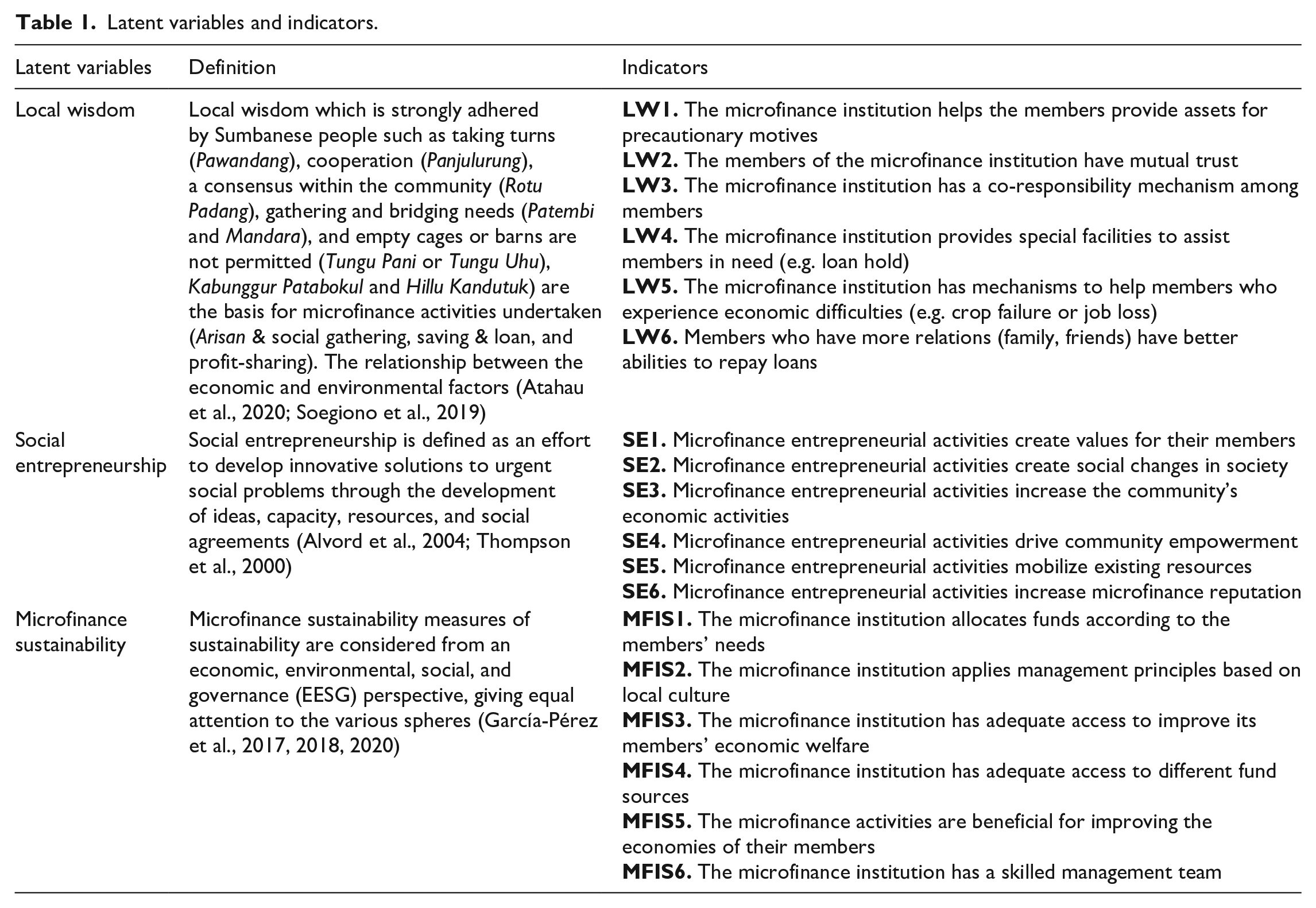
Measurement of the variables is conducted using theory construction framework where variable or construct known as definiendum should have definition which consists of genus proximum and differentia specifica (Ihalaw, 2008). Genus proximum as the general term determines the scale of measurement (nominal, ordinal, interval, and ratio), while the differentia specifica determines the empirical indicators. It is expected that the empirical indicators fully reflected the construct to achieve the isomorphic condition. Empirical indicators for local wisdom and sustainability indicators are derived and adjusted from Soegiono et al. (2019), Atahau et al. (2020), and García-Pérez et al. (2017, 2018, 2020), while the empirical indicators of social enterprise are derived from Alvord et al. (2004) and Thompson et al. (2000).
Data analysis
The PLS-SEM is used to test our local wisdom–based social entrepreneurship model to achieve rural microfinance sustainability. PLS-SEM consists of a set of multivariate techniques that are confirmatory rather than exploratory in testing whether models fit with data. We propose four testable hypotheses by using SmartPLS 3 version. Figure 1 displays the interrelationships between MFIs’ sustainability, local wisdom, and social entrepreneurship.
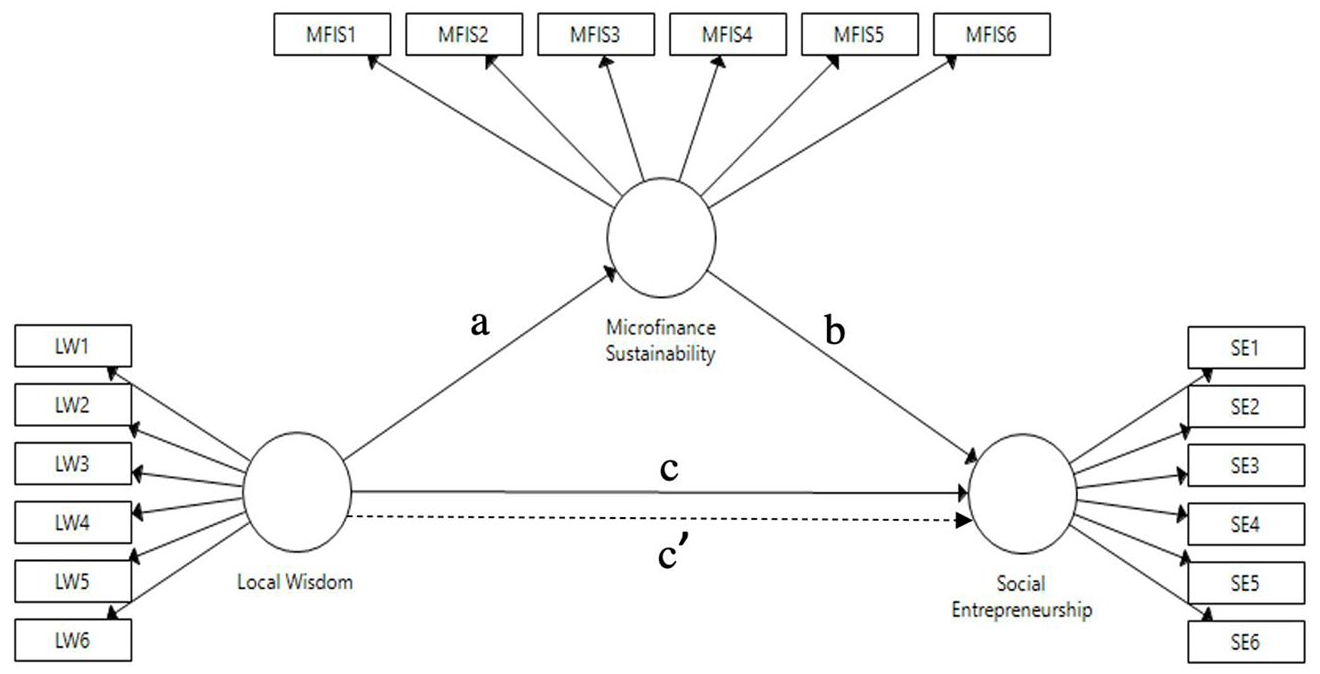
Mediation framework.
Figure 1 presents the mediation framework that represents these connections. It shows that microfinance sustainability has six indicators, local wisdom includes six indicators, and social entrepreneurship consists of six indicators. There are three equations derived from Figure 1. They are presented below



We evaluate the reflective measurement models criteria, such as internal consistency (Cronbach’s α and composite reliability) and convergent validity (average variance extracted and indicator reliability). In this respect, the indicator reliability should be higher than 0.5 (Hair et al., 2014). Cronbach’s α should be greater than 0.7 (Hair et al., 2014). The average variance extracted should be larger than 0.5. Composite reliability should be bigger than 0.7 (Fornell and Larcker, 1981). The goodness-of-fit (GoF) index was also used as model appropriateness in this study (Henseler and Sarstedt, 2013).
Analysis and discussion
Descriptive statistics
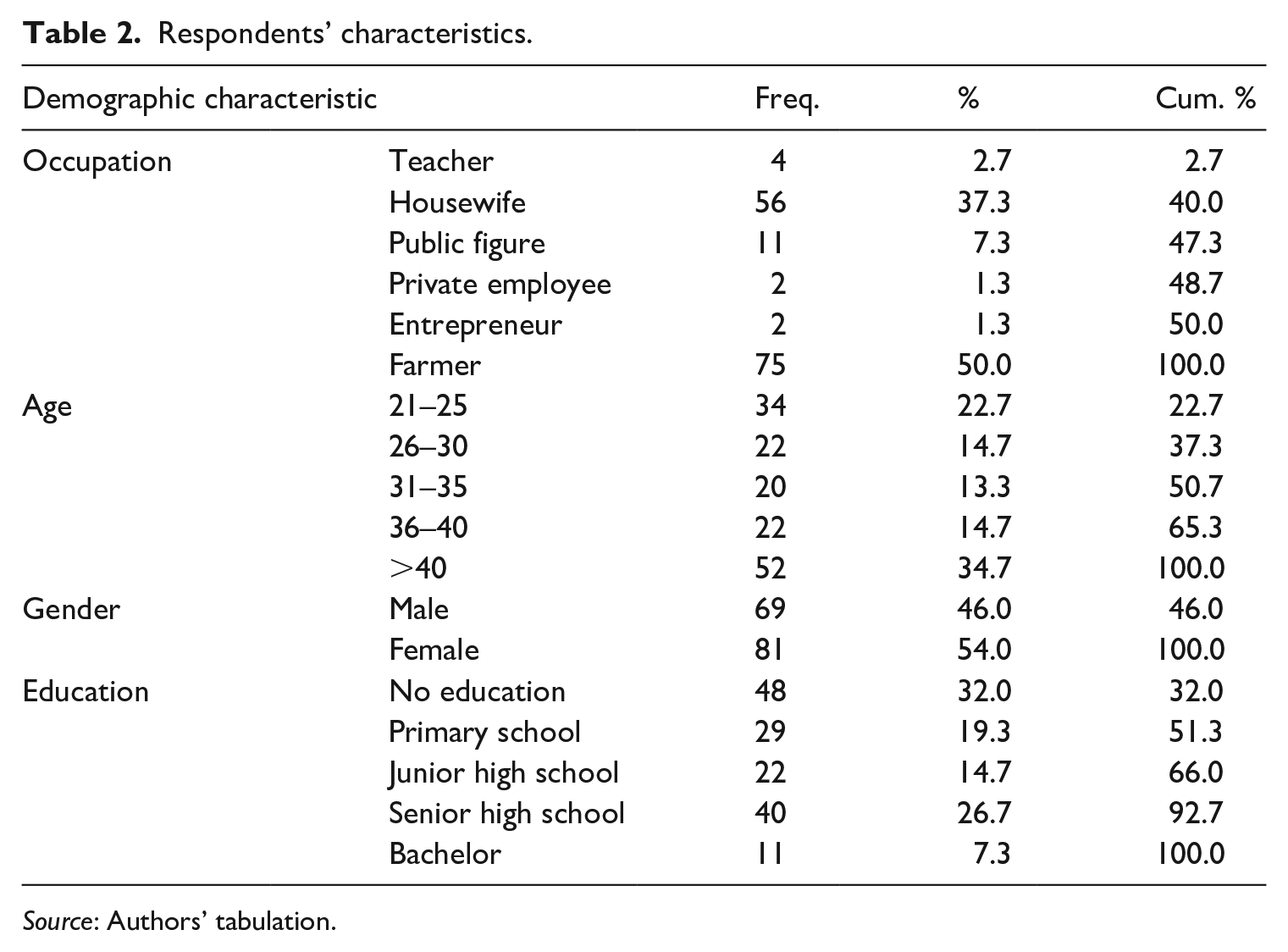
Table 2 shows respondents’ demographic characteristics. Most respondents are females aged more than 40 years and work as housewives. Interestingly, some male respondents were also found in this women farmer group, which indicated the ability of the group to involve men to participate in their activities. The demographic data fit villagers’ characteristics in poor areas.
Respondents’ characteristics.
Source: Authors’ tabulation.
Half of the respondents are farmers (50%) with no education (32%). The data indicate that the informal sector becomes an alternative for low education members to participate in.
Scoring of indicators
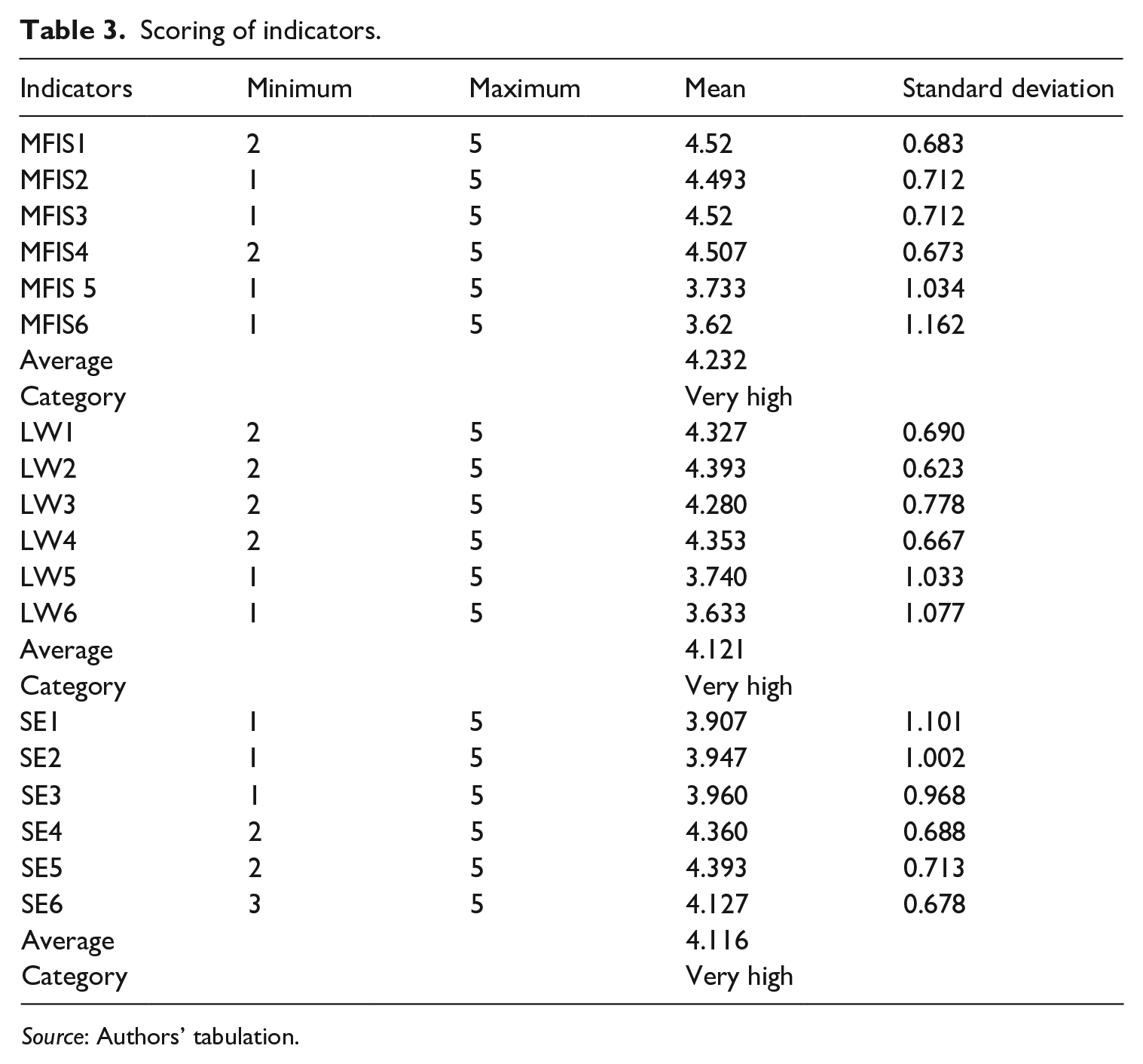
Table 3 shows the descriptive statistics of empirical indicators. All variables fall into a very high category, with microfinance sustainability having the highest score (4.232). Because the respondents are the oldest MFI members in East Sumba, they acknowledge microfinance’s long-run ability to sustain. Among all empirical indicators for microfinance sustainability, there is an awareness of the MFI management team’s inadequate managerial skills, as reflected by the lowest score of MFIS6 (3.62).
Scoring of indicators.
Source: Authors’ tabulation.
In contrast, the highest score for MFIs (MFIS1 and MFIS3) indicates the MFI’s empathy toward members’ needs because of local wisdom adherence. The argument aligns with the highest local wisdom score (LW1), which relates to mutual trust. Surprisingly, the lowest score for LW2 is related to family support. The members’ relationships are arguably close, and the respondents turn to fellow members rather than families when facing financial difficulties. The conjecture is also supported by the highest score for the social entrepreneurship variable related to MF’s ability to mobilize members’ existing.
Reflective measurement models and hypothesis testing
This study uses the two-stage examination approach to evaluate the reflective measurement models and hypothesis testing. The measurement model’s internal validity and convergent validity were assessed in the first stage (Table 4). Cronbach’s α values range from 0.771 to 0.853, implying good internal consistency. In a similar vein, the composite reliability varies from 0.815 to 0.884. In convergent validity, extracted average variance values vary from 0.558 to 0.562. Similarly, the indicator reliability is higher than 0.50, suggesting convergent validity is fulfilled.
Reflective measurement models.
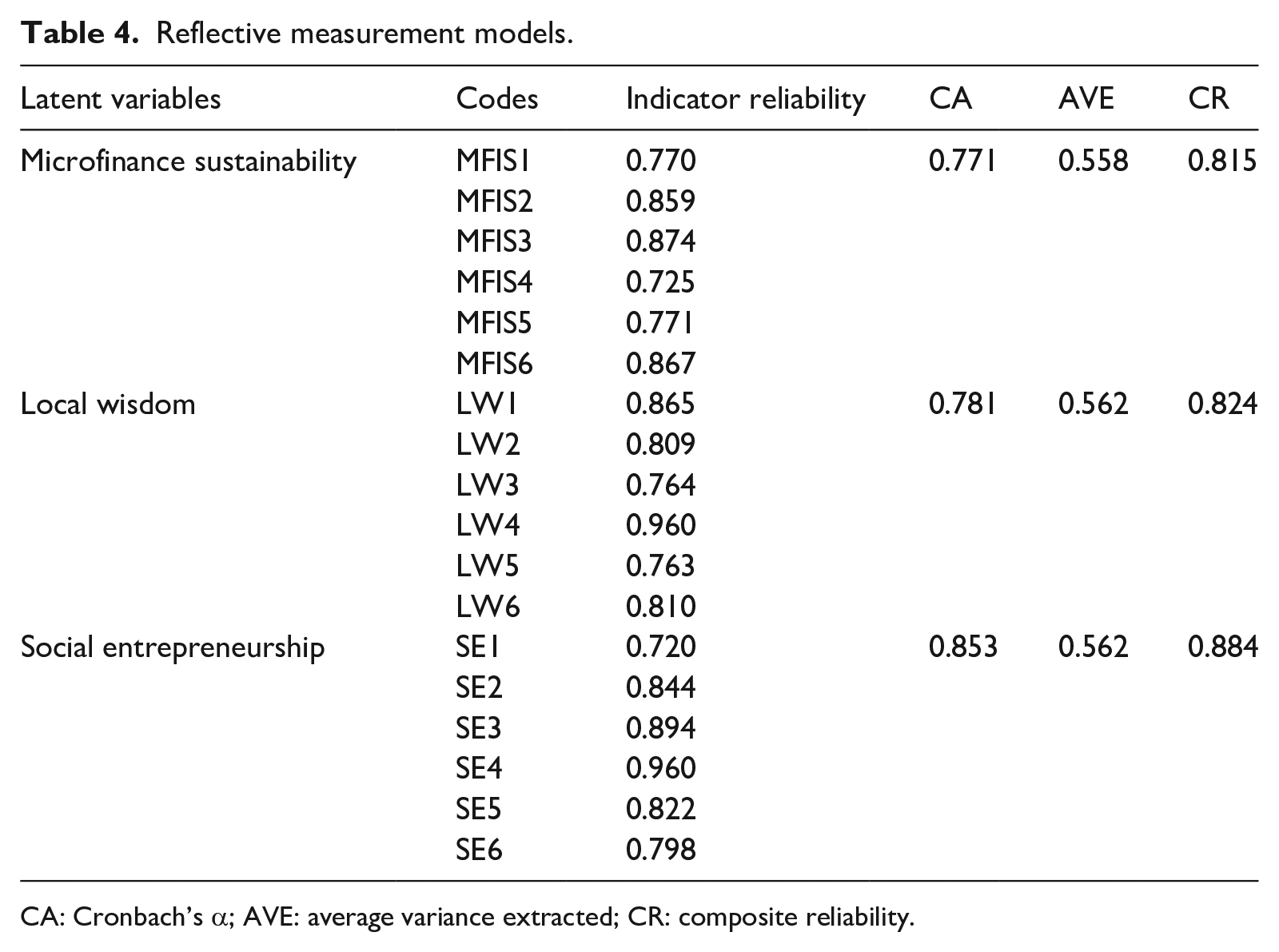
CA: Cronbach’s α; AVE: average variance extracted; CR: composite reliability.
The second stage evaluates the hypothesis testing. Figure 2 and Tables 5 and 6 present the direct and indirect (mediated) effects of employed bootstrapping until 500 subsamples.
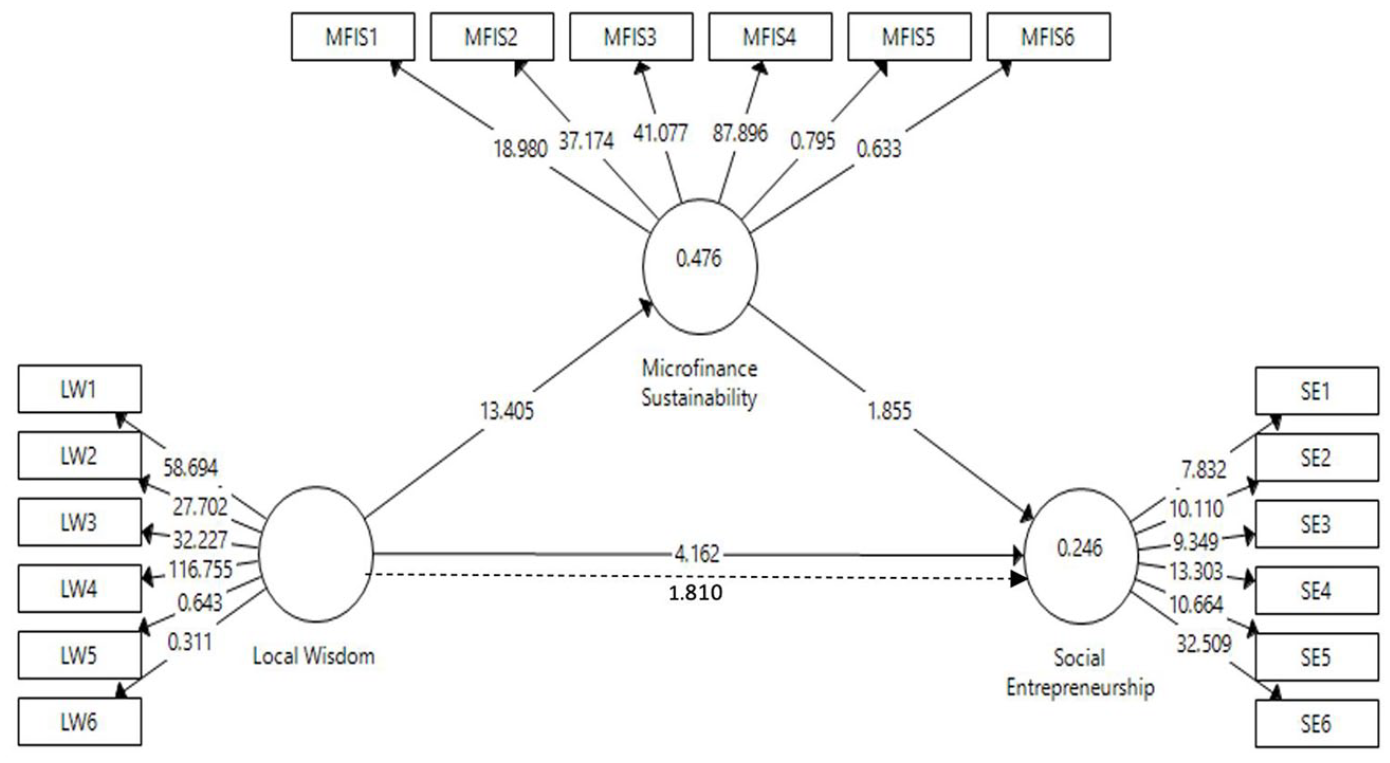
PLS-SEM framework output.
The goodness-of-fit index.
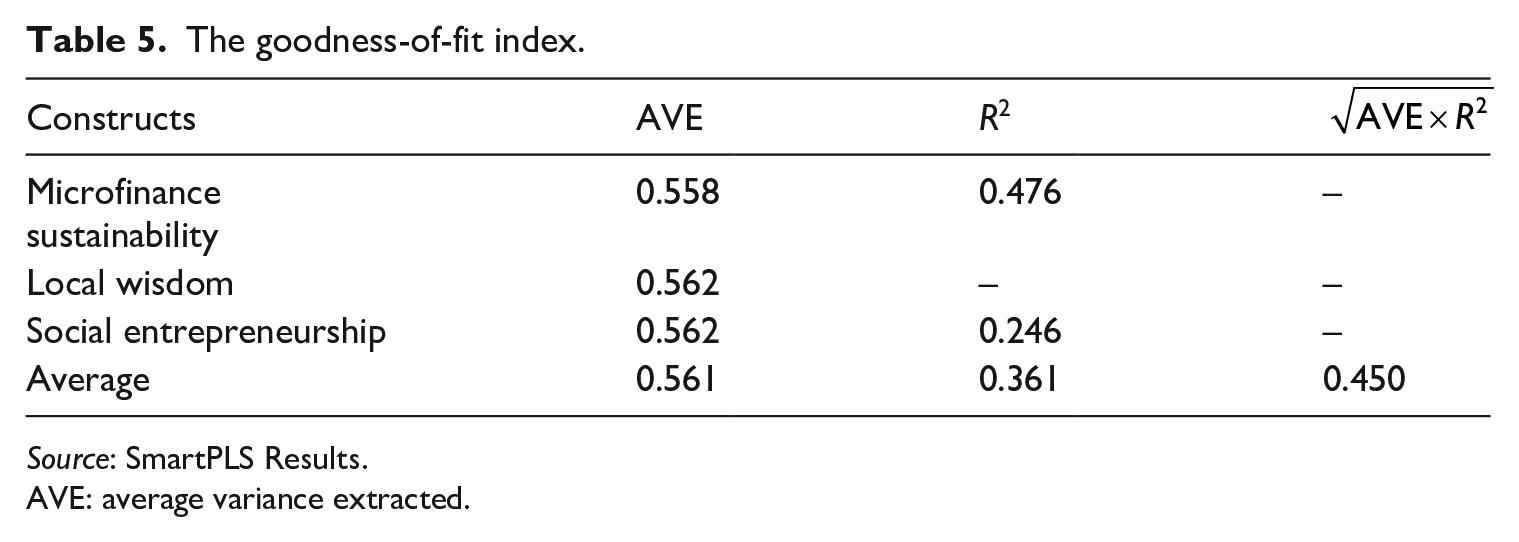
Source: SmartPLS Results.
AVE: average variance extracted.
Hypothesis testing.
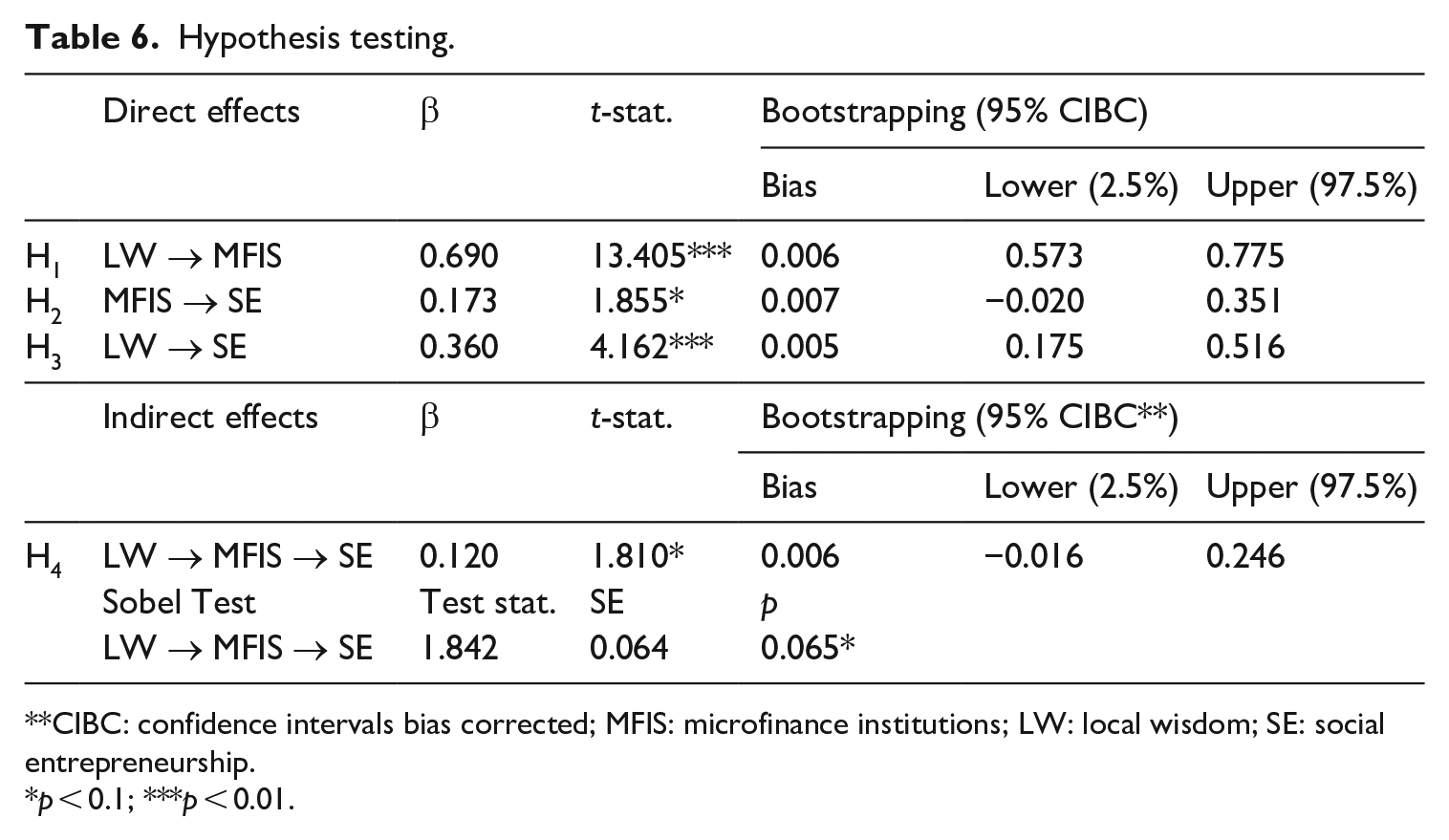
**CIBC: confidence intervals bias corrected; MFIS: microfinance institutions; LW: local wisdom; SE: social entrepreneurship.
p < 0.1; ***p < 0.01.
Values 0.476 and 0.246 represent R2 values of microfinance sustainability and social entrepreneurship, respectively. The R² denoted the percentage of the exogenous variable variation that the predictor justified. Figure 2 shows that local wisdom could explain variations in microfinance sustainability as 47.6% (0.476). However, local wisdom can explain variations in social entrepreneurship as 24.6% (0.246).
The geometric mean of average communality and R² were applied to measure the model appropriateness. The result demonstrates that the model value is 0.450, suggesting the model is satisfactory.
Table 6 shows that the direct effect of local wisdom on microfinance sustainability (β1 = 0.690; p = 0.000; confidence intervals bias corrected (CIBC) [0.573–0.775]) is positive and significant at 1% level. The direct effect of microfinance sustainability on social entrepreneurship (β2 = 0.173; p = 0.064; CIBC [−0.020–0.351]) is significant at 10% level. In a similar vein, local wisdom has a positive and significant impact on social entrepreneurship (β3 = 0.360; p = 0.000; CIBC [0.175–0.516]) and is significant at 1% level. Thus, the three hypotheses (H1, H2, and H3) are empirically supported. Similarly, the indirect (mediated) effect of local wisdom on social entrepreneurship through microfinance sustainability (β4 = 0.120; p = 0.07; CIBC [−0.016–0.246]) is also significant at 10% level. Therefore, H4 is supported by the empirical results. Based on the Sobel test, microfinance sustainability has mediated the relationship between local wisdom and social entrepreneurship (test stat. = 1.842; p = 0.065).
Discussion
We empirically support the first hypothesis that fostering local wisdom accelerates MFIs’ sustainability development. Local wisdom is increasingly crucial to rural society to preserve self-confidence and solidarity in a growth cycle. Developing microfinance in rural areas by considering local wisdom is essential because most villagers have limited access to formal financial services (Soegiono et al., 2019). The findings support the arguments that local knowledge underlying microfinance creation maintains natural harmony (Busch et al., 2016; Scholtens, 2008; Starik and Kanashiro, 2013; Van Marrewijk, 2003) and creates sustainable conditions by harmonizing cultural, economic, social, and environmental aspects (García-Pérez et al., 2017, 2018, 2020). Thus, local wisdom-based microfinance is arguably the mainstream poverty alleviation in rural areas (Atahau et al., 2020).
The FGD has indicated that the Tapa Walla Badi microfinance group uses its local wisdom to overcome the limited access to formal financial services. As stated by wunang, microfinance forms in Sumba Island cannot be separated from the spirits of ancestor values (marapu) adopted by its communities. The encounter between the gospel (Christianity) and marapu raises awareness from the priests that Sumba’s customs and culture are neutral elements of infidel beliefs. Marapu values have been able to develop a work ethic for the Sumbanese by underpinning the values of local wisdom.
As said by the government officer and female group leaders, the indigenous people in Mbatakapidu still use marapu values to carry out various activities in their lives. Rituals carried out based on marapu belief can be seen in the activities of clearing land, planting, until the harvest stage. The process of praying to ancestral spirits has implications for economic life, the environment, and the kinship system. The unique thing found in Mbatakapidu village is that there is no conflict between the values contained in the imported religion (Christianity) and local customs. Interestingly, it is able to create a survival strategy for its residents.
The female group leaders and custom figures emphasized that the female farmer group’s saving and loan activities always consider the justice and survival aspects, known as pawandang (cooperation) and panjulurung (taking turns). They do not impose formal sanctions on members’ inability to pay because of patembi (empathy) local wisdom. The form of patembi was shown by granting interest-free loans (1 month’s term-borrowing loans) to assist members with an urgent need, principally about funding the children’s studies. These are in line with Soegiono et al. (2019) that local wisdom–based microfinance has been able to preserve microfinance sustainability in improving the poor’s financial access (Soegiono et al., 2019).
The second hypothesis predicting the relationship between MFIs sustainability and social entrepreneurship is also supported. According to Ferdousi (2015), giving non-poor or near-poor entrepreneurs more loans will increase revenues. Loan capital can boost entrepreneurs’ income where markets are less developed, and innovation may have little impact on revenue (Bradley et al., 2012). Yet, lack of capital prevents the poor from increasing their incomes through entrepreneurship. These findings might be explained by Bradley et al. (2012) that MFIs’ loan capital may have less impact on the enterprise’s revenues where markets are less developed. Wunang stressed in the focus discussion group that business without morality is not allowed in marapu belief. The findings are in line with one of the seven deadly social sins by Mohandas Gandhi. Optimization is the keyword for individuals in each economic behavior (Yuwono, 2013). Optimization can only be done by choosing the right one from various options based on rational principles without leaving ethics. The economic behavior is based on the norms or values adopted in the marapu. The trade’s morality system, the ranking order of goods and services exchanged, and reciprocity-based transactions represent justice for traditional local communities. Bargaining and reciprocity are two issues frequently faced by traditional local communities (Vel, 1994). For instance, Mbatakapidu’s crops have drawn many businesspersons from Bali and Sumbawa. However, many crops are unsold, and sellers’ bargaining power diminishes while buyers’ bargaining power increases. The market is saturated when villagers sell crops to the Waingapu market due to competition from crops grown in Lambanapu (East Sumba) and Kiritana (East Sumba) imported from the West Sumba, Central Sumba, and Southwest Sumba regencies. Hence, sellers’ only option is to sell all remaining crops to buyers from Bali and Sumbawa because of the perishable nature of the crops. The reciprocity-based transactions become unbalanced in rural areas because of this bargaining process. Overall, the absence of inclusive markets resulted from what is called by Mair et al. (2012) as institutional voids call for an attempt to build an inclusive market. By doing so, the impact of MFI loans on the enterprise’s revenues is greater since markets are more inclusive.
The third hypothesis predicting the impact of local wisdom on social entrepreneurship is empirically supported. Thus, our result supports Ahsan et al. (2016), who find that local wisdom creates entrepreneurial spirit. It is also likely that Pache and Chowdhury’s (2012) practical-wisdom mechanism argument in exploring how businesses become more efficient is evident in East Sumba. Based on the focus discussion group, the Mbatakapidunese have been very familiar with thrifty living principles (e.g. trading) since ancient times. They will not spend money until coming home. Wunang highlighted that the Sumbanese perform rotu padang or mihi parotu (fishery preservation), a type of saving activity.
Furthermore, specific values guide the Mbatakapidunese’s trading behavior, such as not taking profits greedily (rotu padang), fairness (panjulurung), empathy (patembi), and solidarity (mandara). Rotu padang attempts to preserve the assets owned to limit the greedy behavior of the short-term consumptions (Atahau et al. 2020). They base their activities on reasonable and ethical optimization from their local wisdom to facilitate more effective economic decisions. The finding also supports Srivetbodee et al. (2017), who argue that local wisdom drives social entrepreneurship development. East Sumba’s communal characteristics enable local wisdom to become an essential component that drives many activities, including social entrepreneurship.
Finally, this study documents the indirect (mediated) effect of MFIs sustainability on the relationship between local wisdom and social entrepreneurship. These findings are in line with Soegiono et al. (2019), Sud et al. (2009), Srivetbodee et al. (2017), and Mia and Lee (2017). The critical role of local wisdom in achieving microfinance sustainability and social entrepreneurship development has been supported empirically. Hence, it calls for all stakeholders’ efforts to create conducive environments to enhance MFIs’ capacity in developing social entrepreneurship. Thus, our proposed model for policy-making based on the research results is depicted in Figure 3:
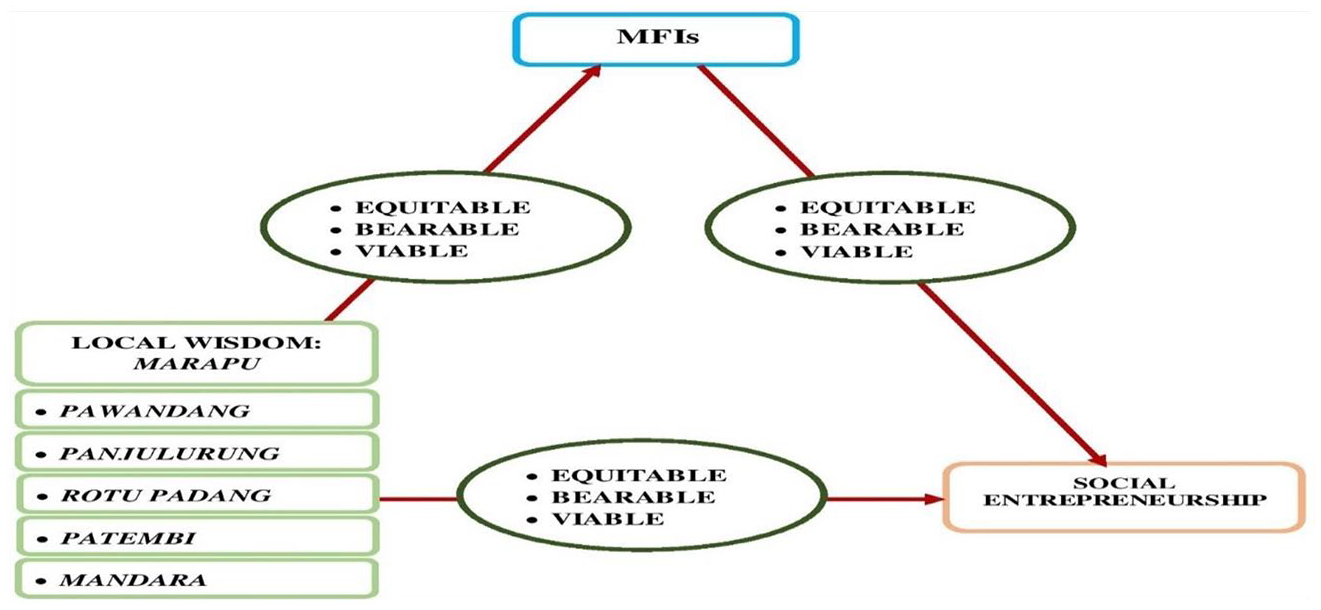
Proposed model of local wisdom–driven social entrepreneurship.
Local wisdom, which serves as the basis of rural microfinance sustainability activities and social entrepreneurship, is taking turns (pawandang), cooperation (panjulurung), a consensus within the community (rotu padang), gathering (patembi), and bridging needs (mandara). Viability, equitability, and bearability result when local wisdom drives microfinance and social entrepreneurship activities. In the long term, the viability, equitability, and bearability lead to the sustainability of both MFIs and social entrepreneurship activities. Hence, this model offers the implementation of culture-led policy to sustain microfinance and social entrepreneurship.
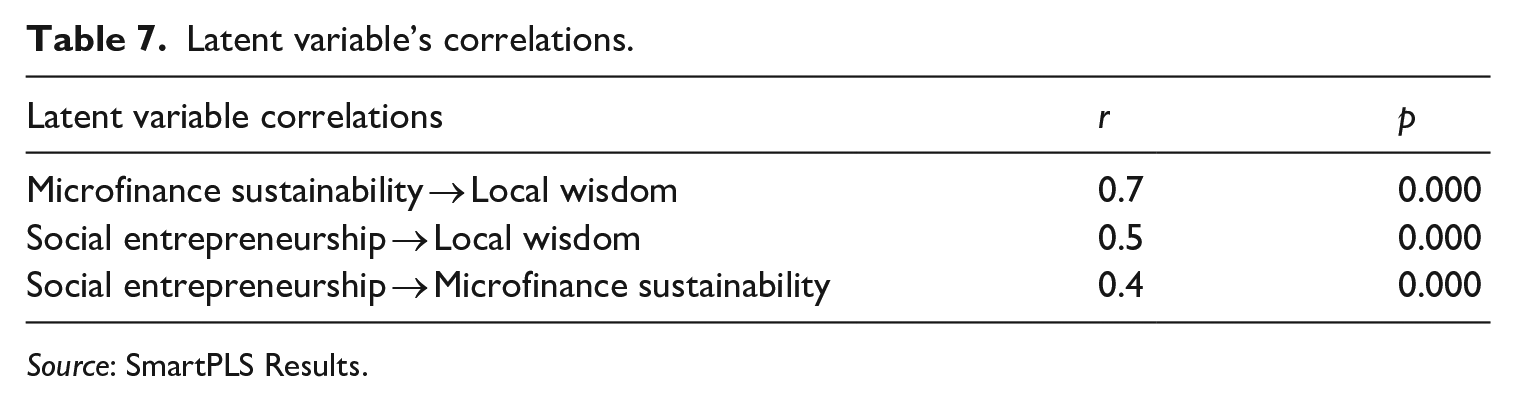
A robustness check was carried out to examine the sensitivity of the results. The correlation between latent variables can be seen in Table 7.
Latent variable’s correlations.
Source: SmartPLS Results.
Table 7 shows that the correlation among latent variables is between 0.4 and 0.7. It indicates a moderate positive relationship between latent (Ratner, 2009). Therefore, a bunch of survey responses that we would expect to be correlated are in fact correlated.
Conclusion
Our results empirically show that local wisdom affects microfinance sustainability and social entrepreneurship. The findings highlight that local wisdom is crucial in developing social activities such as rural microfinance (Atahau et al., 2020; Soegiono et al., 2019) and social entrepreneurship (Alvord et al., 2004; Srivetbodee et al., 2017; Thompson et al., 2000). The Sumbanese communal culture supports social activities with a solid adherence to local values and norms known as local wisdom. Our study also shows the relationship between microfinance and social entrepreneurship. Similarly, microfinance sustainability’s indirect (mediated) effect on the relationship between local wisdom and social entrepreneurship is empirically supported. Hence, it is evident that developing local wisdom–based social entrepreneurship is an alternative way to achieve microfinance sustainability. The indirect (mediated) effect may take a longer time to materialize, but the empirical evidence from this study provides a significant relationship between microfinance and social entrepreneurship.
Theoretical, social, methodology, and policy implications related to the findings are also drawn. This theoretical research implication provides empirical evidence on the direct and indirect relationship between local wisdom and social entrepreneurship through sustainability of rural microfinance. Thus, it contributes to research on the importance of local wisdom in developing social entrepreneurship and ensuring microfinance sustainability. The social implication is the importance of all stakeholders to create conducive environments to increase the development of social entrepreneurship, such as providing entrepreneurship training for MFI management teams and financial literacy to MFIs’ members. The methodological implication is the quantitative analysis using PLS-SEM with bootstrap and Sobel test for primary data. Increasing the sample size using bootstrapping can increase the reliability of findings.
The local government policy-making related to social enterprise and microfinance development which considers Sumbanese local wisdom serves as the policy implication. As stated in the introduction, Indonesian rural social lives are governed by local values that bind the society and are commonly known as local wisdom. Later, the findings confirm local wisdom’s effect on microfinance sustainability and social entrepreneurship. The results imply that local wisdom serves as one of the social capital in Indonesia. It enhances society’s resiliency in facing challenges such as the Covid-19 pandemic. The severity and massive pandemic scale have also affected household income in Sumbanese rural areas. However, the rural society manages to lessen the impact by adhering to local wisdom such as pawandang (joint-burden bearing). Based on these findings, the local wisdom-based policy seems relevant to enhance community resiliency, especially during crisis times such as the Covid-19 pandemic.
Accordingly, we suggest future research to add financial literacy and managerial skills to independent variables other than local wisdom. Furthermore, the Covid-19 pandemic has significantly limited our ability to collect extensive data from online surveys and collaborate with a local university to generate the data. Future studies can enhance their research quality through observational data collection once the pandemic has been neutralized. In addition, future research can use mixed methods. Therefore, this analysis is followed by a qualitative analysis to further explore the sustainability of MFI.
Footnotes
Acknowledgements
We dedicate this paper to late Like Soegiono, our team member who passed away at this project’s initiation. The memories of her will always be in our hearts forever. Also, we would like to thank the Research, Publication & Community Service Bureau of the Satya Wacana Christian University for their support during the publication of this article. We thank Mrs Alliny Namilana Rambu Hutar and the Wira Wacana Christian University teams for their help during the data collection process in Waingapu-East Sumba and Mrs Korlina Konda Ngguna from the Women Farmer Group ‘Tapa Walla Badi’ for her valuable information and assistance in the questionnaire distribution and FGD.
Declaration of conflicting interests
The authors declared no potential conflicts of interest with respect to the research, authorship, and/or publication of this article.
Funding
The authors disclosed receipt of the following financial support for the research, authorship, and/or publication of this article: This research receives any specific grant from the Research, Publication & Community Service Bureau of the Satya Wacana Christian University – Indonesia, 2020.
