







Abstract
The analysis presented in this article tries to address a puzzle – the widely recognized process of democratic backsliding in Poland was accompanied by a steady increase in popular support for democracy. It poses a question if the two phenomena are substantively related. To establish possible connections between them, I test three hypotheses involving populist winner effect, deepening of socio-political cleavage, and generational change. The first one assumes that democracy is more supported by populists when they form a government; the second one – to the contrary – states that populist polarization creates a wider gap in support for democracy, while the third one proposes that the relation is spurious, as trends in attitudes represent a gradual, long-term social change, at least in part related to generational replacement. Results show that the direct link between populist democratic backsliding and pro-democracy surge is relatively weak, while both processes can be related to a deeper sociological process of ‘splintering’ within Polish society.
The puzzle
In recent years, Poland has often been indicated as a primary example of democratic backsliding in Central and Eastern Europe (CEE) (Bernhard, 2021; Karolewski, 2021; Sadurski, 2018; Sitter and Bakke, 2019; Stanley, 2019a; Vachudova, 2020). Along with Hungary, it has even been dubbed a ‘paradigmatic’ case in the discussion ((Bakke and Sitter, 2022; Cianetti et al., 2018). Most often, this diagnosis referred to the policies implemented by the Law and Justice party (Prawo i Sprawiedliwość, hereafter abbreviated as PiS) after its ascend to power in 2015 (Grzymala-Busse, 2019; Przybylski, 2018; Zamęcki and Glied, 2020). The thread of literature on democracy and populism in the region – which will be discussed in the next section – proposes varied explanations of the recent democratic setback in Central and Eastern Europe, ranging from economic, sociological, and institutional to purely political factors. Notably, Ireneusz Karolewski (2021) argues that the case of backsliding should be considered in at least three aspects: societal (changes within society), institutional (changes in institutional setup), and processual (chain of events). It seems reasonable to suspect that along with changes in politics, there might have been sociological conditions that allowed for such a turn at the ballot boxes. Along this assumption, several explanations have been proposed to connect the erosion of democracy with changes of attitudes in society – if not to outright anti-democratic, then at least linking backsliding to a crisis of democratic legitimacy, civic disengagement, or the ‘hollowing’ of democracy (Mair, 2013).
Meanwhile, positive attitudes to democratic principles have been on the rise in Poland, both before and after populist parties came to power. Figure 1. shows the changes in support for democracy in the 1995–2017 period in one of the longest, methodologically consistent survey programs conducted on Polish nationally representative samples. This is, however, not a single source indicating that democracy, rather than being uprooted, got a more robust backing in Polish society. The average trust in the Parliament has been on a steady rise in the 2002–2018 period, according to the European Social Survey data and domestic panel data (see Kołczyńska and Sadowski, 2023). Ewa Marciniak (2023) applied a typology of attitudes toward democracy to show that in the early 1990s, it was the ‘non-democrats’ that were most numerous in Poland, but their numbers dwindled, and in the past 15 years, the ‘true democrats’ became a dominant category (with ‘indifferent democrats’ decreasing in numbers). At the same time, a higher civic engagement could be observed, particularly in the voter turnout. It was below the 50% threshold during the 1997, 2001, and 2005 elections, to then reach 53.9% in 2007 and remain close to 50% in both 2011 and 2015. However, the turnout reached 61.7% in 2019 and a record 74.4% in the recent 2023 elections. According to national polling data, between 1998 and 2024, there was a concurrent increase in the majority of types of civic participation (CBOS, 2024). The V-Dem expert evaluation also indicates a steep rise in mass mobilization in Poland after 2015 (Coppedge et al., 2024).
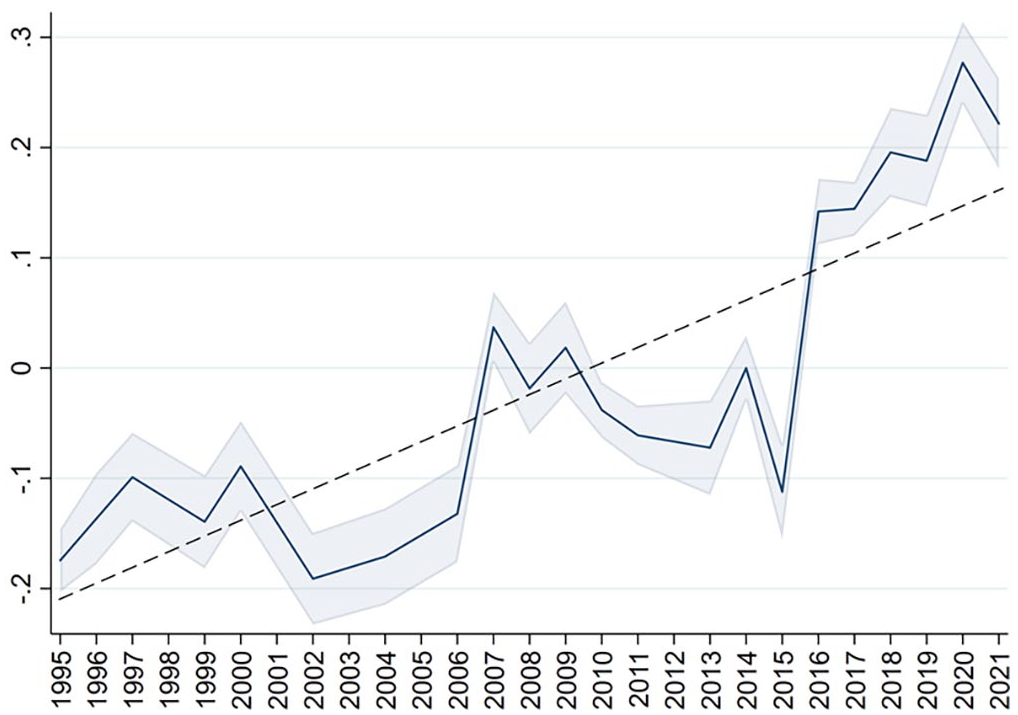
Attitudes toward democracy in Poland by year.
In light of the outcome of the 2023 parliamentary elections, it seems reasonable to pose a question on the nature of the anti-democratic turn in the past decade, as it was accompanied by the civic engagement usually associated with a consolidating democracy. Are the positive attitudes toward democracy only spurious, or a bias in the referenced indicators? Or perhaps they are decoupled from the political system despite open and competitive elections being held in Poland? Or rather, as Buštíková and Guasti (2017) argue, the political shakeup in Poland should be considered an ‘illiberal swerve’ in a chaotic trajectory of CEE politics rather than a turnaround in an otherwise stable democracy. In other words, the backsliding thesis might have had overly optimistic assumptions about the state of democracy in ‘new’ EU countries to begin with (while the literature from the 1990s was more somberly skeptical about the stability of democracy in the region). Finally, and this is our own conjecture, perhaps the attitudes toward democracy do not preclude populist turn in politics but rather preclude populists from staying in power if a dismantling of democracy goes too far. To address such general questions, we first have to dissect the pattern visible in Figure 1 and ascertain whether it can be primarily linked to endogenous developments in the field of politics or allow for a substantial, sociological explanation that links social changes and political trends. This is the primary aim of this article.
Theoretical background
The intrinsic question in the literature on populistic turn and democratic backsliding in CEE concerns the social rooting of democracy and possibly a lasting anti-democratic change in politics within the region. The consideration is much broader in many cases, as it is linked to a populist and nativist turn around the world, notably in the United States, Brazil, India, Turkey, and some ‘old’ EU countries. As mentioned, the proposed explanations revolve around three main areas: internal politics (especially party systems), institutional and international context (changes in different countries seem related), and social changes. Those can be arguably linked, at least to a degree, that is why interest in one cannot disregard others.
Karolewski (2021) argues that backsliding thrives on how the citizenry behaves while seeing the evolution of citizenship toward passive spectatorship. This view concurs with the one of Wojciech Sadurski (2018), who diagnoses a ‘populist syndrome’ that emerges due to a low level of trust in society and a related low quality of public discourse. Meanwhile, Bela Greskovits (2015), comparing Latvia and Hungary, came to the conclusion that the ‘hollowing’ of democracy, that is, low civic engagement, is not directly related to backsliding. In his view, widespread activism neither precludes nor invites democratic backsliding, as the actual politicization of specific issues is far more important. This is not the only issue concerning the robustness of democracy in CEE that there is no consensus on. Lisa Herman (2016) posed a question about the role played by democratic consolidation in maintaining a democratic system. In her, as in many other authors’ views, procedural democracy is insufficient in this respect. She lists three preconditions of necessary consolidation: elite’s commitment to a democratic process, its capacity for citizen mobilization, and finally – socialization of citizenry by political parties. This approach acknowledges the relevance of attitudes in society but puts an agency in politicians. Much in line with this argument, Zsolt Enyedi (2016) proposed that it was not the sheer issue of a structure of representation but rather (an assumingly designed) populist polarization that led to the political change. In particular, he tries to show that fragmentation and under-institutionalization of a party system were not a driving factor. It was a new kind of affective division imposed by radical political parties that caused the new cleavages to emerge. In both explanations, changes in political attitudes are treated as an outcome rather than a cause.
In turn, Sheri Berman (2019) treats populism as a symptom of dissatisfaction with how current political elites run the state. If the government fails to address popular concerns, the author claims that democracy itself is threatened. In this argument, a crisis of representation becomes a focal point. Several other propositions follow the same assumption – of a mismatch between political supply and demand. According to Hooghe and Marks (2018), the existing party cleavages could not accommodate new divisive issues, while Ben Stanley (2019b) argues that a lack of proper representation drove Polish voters to populism. In short, those who rejected the liberal orthodoxy of some prominent policies were not provided with adequate choice by largely consensual politics at the time. While focusing on parties, this explanation assumes a profound attitudinal reorientation in society. The programmatic mismatch occurred due to a shift in opinion and a lack of adequate response in politics, which is, in fact, an inverse of the socialization thesis. Notably, Andrzej Rychard (2020) explains the defeat of Polish liberals in 2015 by pointing out that the three key transitional ‘promises’ – of free market, democracy, and European integration – have ceased to fuel the electoral success in Poland. In a similar vein, Michał Gulczyński (2020) noted: Once the common goals bonding Polish society—civil rights, a market economy, accession to the European Union, and NATO accession—had been achieved, a large part of Polish society rejected economic liberalism and the unannounced cultural change resulting from the postcommunist transformation.
Along these lines, Cas Mudde has earlier foreseen both a populist surge in the new EU states (Mudde, 2004) and subsequently diagnosed it as an outcome of the TINA paradigm (Mudde, 2016).
Seemingly, the debate on whether political elites failed to remain in lockstep with political ‘demand’ remains most fervent. Its hotspot lies in the interpretation of whether the populist surge has been, in essence, a democratic reaction to misrepresentation of interests and values in society; or to the contrary – it undermined the essence of democracy by disrupting its fundamental building blocks. Sadurski (2018), who disputes Mudde’s argument, points out that liberal policies of the period preceding populist rule had been democratically legitimized, while one of the main targets of the populists in power is the sheer principle of fair elections. Similarly, in two detailed accounts concerning the rise of illiberal democracy in Hungary, the first one – ‘Post-Communist Mafia State’ by Bálint Magyar (2016) – tells a story of cynical state capture, while the other – ‘The Retreat of Liberal Democracy’ by Gabor Scheiring (2020) – looks into structural roots in the evolution of vernacular authoritarian capitalism. The debate seems far from being settled.
While not all the literature on democratic backsliding in the CEE directly addresses sociological factors, it is hard to avoid logically relating institutional to social changes. First, a complete disregard for the linkage between parties and policies on the one hand and voters on the other would – paradoxically – render democracy a mere façade. There would be hardly anything to backslide from. In turn, the narrow approach, abstracting democratic politics from a societal context, is only sectional and might omit critical factors. A danger involved might be a failure to foresee long-term implications. In the case of populism and democratic backsliding, this risk is especially valid, as there are conflicting accounts of how consolidated the democracies were in countries like Poland and Hungary before populists came to power and implemented their agendas. Buštíková and Guasti (2017) see such political turns and swerves – including prominently the occasional setbacks of young democracies in CEE – as an expected phenomenon. Rychard (2024) considers the political events of the 2015–2023 period as a symptom of the deconsolidation of democracy in Poland, yet, argues that the changes at institutional and individual levels had different directions. In a way, populists’ take on the reforms of the state, which damaged the robustness of democracy, was decoupled from what happened at the individual level. Such deconsolidation might have been expected to be temporary, as the divergent vectors of the democratic system had to gravitate back to an equilibrium sooner or later. Perhaps this would be a likely explanation of the contrast between the trend we see in Figure 1 and a political timeline, and at the same time, allow us to predict the outcome of the 2023 elections. A few years earlier, Rychard (2020) saw the diagnoses of democratic setbacks in Poland as overly pessimistic because they did not consider the deeper structural changes that have permeated Polish society. Also, Christian Welzel (2021) sees the turns toward illiberal populism as merely a corrective effect of ‘regression toward the mean’ caused by the overly liberal transformations (relative to attitudes in the general population). Yet, there is no consent on that either. As Mudde (2016) notes: ‘Many scholars contend that European populism is an episodic phenomenon – that it creates moments rather than eras – and that although populists can succeed in opposition, they inevitably fail once in power. That is wishful thinking’.
Conceptual framework
The departure point of my study was an observation that support for a democratic regime has generally increased in the 1995–2021 period, especially after 2015, when the PiS populist party came to power. The main puzzle is the proper attribution of the time-related (secular) trend and its relation to shifts in national politics. Such an empirical investigation seems important, as the evidence can at least falsify some of the general assumptions made about the social underpinnings of democracy. One of the strongest being that the fate of the democratic system is contingent almost entirely on political dynamics, relatively independent of society, as the attitudes are malleable by efficient political actors. Another, conversely, stipulates that politics and institutions follow relatively independent public opinion. This is actually implied by the modernization theory. During the 30 years of transition from communism, the Polish economy experienced unprecedented growth and entailed progressive changes in various aspects of state and society. As Przeworski et al. (2000) claimed, social and economic development works – with respect to democracy – as a ratchet wheel. While it does not guarantee a country to adopt a democratic regime, it most probably does not allow a democratic regime beyond a certain level of modernization to slide back into autocracy. It is hard to directly test this thesis in the isolated context of the Polish transition, yet the observed divergence between political and social developments seems striking. The seemingly paradoxical situation of divergence between attitudes in society and political practice creates an opportunity to address some possible explanations. In this article, I test three hypotheses to draw conclusions concerning democratic backsliding in Poland. The first one draws from the known phenomenon of more volatile views on democracy in populists, the second reviews polarization argument by looking for underlying divergence in attitudes, while the third one looks into a broader process of change in society embodied in the relay of generational replacement. I explicate each of the three hypotheses below.
Hypothesis 1: Populist mobilization
Figure 1 shows two particular surges in pro-democracy: in the 2006–2007 period and the one beginning in 2015. This coincides with the populists coming to power in Poland and, thus, substantiates the hypothesis that the pro-democracy hikes can be related to the populist winner effect (Anderson et al., 2005; Nadeau et al., 2023). Several literature threads substantiate such a possibility, however, the implied mechanisms vary. First of all, a part of the electorate that hitherto felt politically disenfranchised might reinforce its trust in democracy by an undeniable proof of inclusion. As Pippa Norris (1999: 219) put it: ‘if we feel that the rules of the game allow the party we endorse to be elected to power, we are more likely to feel that representative institutions are responsive to our needs so that we can trust the political system’. Likewise, Merkel and Scholl (2018) argue that whether right-wing populist parties pose a threat to democracy depends on whether they are a part of a government or an opposition. In essence, authors claim, in established democracies right-wing populist parties are anti-liberal, not anti-democratic; they rather escalate socio-political divides and undermine institutional order, but their aims – contrary to popular claim – fall short of dismantling democracy altogether. The study by van der Brug et al. (2021), conducted using the 2019 survey data on EU societies, has empirically shown that support for democracy as a general concept is similar in populists and all the other voters. However, there is a difference in the acceptance level for particular rules and institutions of liberal democracy. Authors have shown that there is a substantial difference between supporters of a party in power and those in opposition, while also pointed to an interaction between the winner effect and populist party support. The differences, however, were the slightest when the general support for democracy was concerned. In a similar vein, Cohen et al. (2023) analyzed data from Brazil and concluded that support for democracy has increased in Bolsonaro’s voters after his electoral victory despite their parallel acceptance of institutional ruptures. In effect, the winner-loser gap has narrowed, but the exact views concerning democratic order in the supporters of the government and of the opposition remained different. Finally, Marta Kołczyńska (2023) documented that in a broader European context, when it comes to trust in parliament – a primary democratic institution – there is a significant winner effect in populist voters. Primarily, in CEE countries, trust in parliament was moderated by interaction of populism and support for a governing party (Kołczyńska 2023). In other words, populists’ voters tend to trust parliament substantially more when their party assumes power. Given the established spill-over effects, it substantiates the increased legitimacy of the democratic system in Poland (see Kołczyńska and Sadowski, 2023).
Does this imply that populist voters’ support for democracy is strictly conditional on their favorites being in power? Not necessarily. First of all, the referred studies documented a subtle catalyst effects rather than a strict causal relationship, and in most cases, it was winning, not party manifestos, that played a primary role. Second, there are studies showing different patterns. The analysis of the survey data concerning a referendum in the Netherlands showed that – contrary to the authors’ original hypothesis – populist voters not always delegitimize unfavorable outcomes (Werner and Jacobs, 2022). Another literature thread assumes that it is rather electoral losers, not the electoral winners, who are able to boost the overall support for democracy. In this case, we would expect an increase in pro-democratic attitudes among opposition voters rather than government supporters (Claasen, 2020). Such an alternative hypothesis claims that political mobilization was simply a reaction to democratic backsliding in CEE (Blackington et al., 2024).
Hypothesis 2: Socio-political cleavage
Previous research has shown increasing polarization in Poland, in particular, a widening trust gap between supporters of competing political blocs (Kołczyńska and Sadowski, 2023). While the cleavage itself is well documented, a question if it is a top-down, or bottom-up phenomenon, that is, whether it was induced by political entities, or first emerged in society to be subsequently represented in politics. Several authors argue that it was the political realm that spawned and reinforced the divisive discourse (Cinar, Nalepa 2022; Enyedi, 2016; Tworzecki, 2019). Hubert Tworzecki (2019), while observing structural differences in the original electorates of two main parties in the 2015 elections, PiS and PO (Platforma Obywatelska; Civic Platform), calls it ‘more of social sorting than polarization’. Here, we approach a framing dilemma because some authors referenced earlier (e.g. Hooghe and Marks, 2018; Rychard, 2020; Stanley, 2019b) associate the sorting with the representation crisis which was strategically used by populist parties. If the supply side of politics is effectively managing social divisions, is this a basic polarization already? Markowski and Tucker (2010) conducted a study which showed that the emergence of two populist parties – Self-Defense (Samoobrona) and League of Polish Families (Liga Polskich Rodzin, LPR) in Poland in the 2001 elections to significant political forces was an outcome of attracting 18% of eurosceptic voters. The europscepticism in part of the electorate clearly predated those parties’ successful bids in 2001 and 2005. While in 2001 party identification with populist parties was still weak, this attachment later grew to higher than average in 2005. Parties first supplied the political agenda which suited a demand in a part of society, to further develop political articulation later on.
In line with the classic cleavage theory (Lipset and Rokkan, 1967), we might expect that different social contrasts and conflicts create more or less stable political polarizations. It is widely acknowledged that the reorientation of a primary cleavage was institutionalized in Poland in the 2005 elections (Jasiewicz, 2009; Letki, 2013; Sadowski, 2013; Wenzel and Żerkowska-Balas, 2020). However, as was shown, it is not settled whether social contrasts arose over the several decades of Polish transition. Divisions can be hypothesized to encompass political values and most probably be linked to the social structure. Social inequalities in Poland dramatically increased during the transformation of the economy after 1989. According to Słomczyński and Janicka (2008), the class gap has steadily kept widening further on, which authors interpreted in terms of the Matthew effect and deepening polarization of social structure. The implication was a growing widespread recognition that transformation produced ‘winners’ and ‘losers’. Such perception had a broader relevance for social attitudes, especially the ones on social inequalities and the economic system (Sadowski and Mach, 2021; Słomczyński et al., 2017). An emerging socio-political cleavage related to the social structure’s polarization can be tentatively called ‘splintering’ (to distinguish strictly partisan polarization from the one rooted in social structure).
Along these lines, we could expect further intensification of partisan polarization across levels of education, a known predictor of democratic attitudes. Education remains a preferred indicator of possible social contrasts, as occupational class or place of residence are less efficient in this respect, while valid measurement of income in CBOS surveys is not available. In the end, the latter three variables are strongly correlated with education, which, in effect, can serve as a proxy for social position. The stable increase in discrepancy of attitudes between people contrasted by social position would imply that the social (class) cleavage was deepening, producing new grounds for political representation. Such an effect can be mitigated by the fact that Poland experienced an educational expansion during this period, which made college diplomas much less exclusive. This, in turn, might reduce the importance of education in shaping democratic values. Especially statistical control for cohort effect might disprove this hypothesis. If there was no rising divide along class lines in the 1995–2021 period, then it would strongly suggest strictly political origins of polarization in Poland’s electorate.
Hypothesis 3: Social change
The third possible explanation assumes that the change was gradual and has been produced by a long-term process, less evident against the backdrop of a short-term political timeline. If so, both before and after Polish accession to the block, we would observe a similar pattern of change. At the same time, if we look for a change in values and attitudes, then the most efficient way is usually related to generational replacement, as the social changes are inscribed either in institutions or differences between birth cohorts (Ryder, 1965; Sadowski, 2023). In his seminal work on value change, Inglehart (1971) observed that such change is an early sign of a forthcoming revision in political paradigms. The relevance of generational replacement to contemporary politics seems little disputed (Fisher, 2020; van der Brug and Franklin, 2018). At the same time, Welzel (2021) pointed out that actual backsliding into authoritarianism is contingent on the underdevelopment of emancipative values, while in the younger generations, those are clearly increasing. In Poland, it is especially probable, as the younger generations were socialized under completely different economic and political regimes (Sadowski and Mach, 2021). While the oldest cohorts entered adulthood under a centralized, planned economy, authoritarian regime, and in the Soviet bloc of communist countries, the youngest ones grew up under free market and competitive democracy and spent their adult life with Poland in the EU and NATO structures. Given the well-established correlation between age and party preference in Poland, which has further increased in recent years (Markowski, 2020), we can suspect that the patterns presumed in Hypotheses 1 and 2 can be more nuanced.
Hypotheses 2 and 3 can complement each other, as they both substantively assume that the rise of populism can be treated as a political symptom of a new cleavage in societies (presumably, this is not limited to Poland or CEE). More precisely, support of a populist agenda might be a reaction to a new progressive agenda that has risen to prominence with the youngest generations coming to age. In this scenario, a populist surge is treated as a political ‘contraction’ related to a relatively fast social change – that is, a conservative reaction to the new political ideas and trends, prevalent especially in older birth cohorts. Such a political generational gap may occur due to the younger generation increasingly challenging existing economic order and values driving traditional politics, mostly by strongly politicizing environmental, emancipation, and identity issues (see Blühdorn et al., 2022; Green, 2017; Henn et al., 2022).
Data and analysis
In this analysis, I use survey data gathered by the state-financed polling agency Public Opinion Research Center (Centrum Badania Opinii Społecznej, or CBOS). The available data cover the 1995–2021 period, with 35 surveys administering three questions concerning democracy in general. Namely, respondents from the nationally representative samples were asked whether and to what degree they agree or disagree with the following statements: ‘It does not matter if the government is democratically elected or not’. ‘Democracy has advantages over all the other forms of government’. And ‘Sometimes undemocratic government is better than democratic one’. Since the recorded responses were strongly correlated, I used factor analysis to establish a single latent variable. The correlation between the factor and the three statements is, respectively, –0.78, 0.60, and –0.79. 1 In other words, positive values indicate stronger support for democracy. While CBOS also asks about satisfaction with the current state of democracy in Poland, I decided to go with indicators of general attitudes toward democracy as a political regime. Some authors caution that indicators of the current satisfaction with democracy can be insensitive to actual democratic quality (Stanley, 2019a). They are also known to be correlated with the opinion of a current government.
To verify Hypothesis 1, concerning the role of political actors, I employ declarations concerning the party of choice in the most recent parliamentary elections. When it comes to the selection of parties and the profile of the party, the study is designed to test the effects of all the parties that have at least once alternated between opposition and government in the 1995–2021 period. In fact, all the main political parties on the Polish political scene in the last three decades have met this condition. In addition, each party was assigned scores according to VDem’s populism scale (Lindberg et al., 2022; Pemstein et al., 2020). I also take into account whether the party of a respondent’s choice was in government at the time of the survey, as this is a key variable expected to come into interaction with populism. Below, in Figure 2, I illustrate the aggregated support for democracy in voters of eight parties, which are ordered by their average populist rhetoric according to V-Dem coding (lowest on the left, smaller parties and non-voters added for comparison at the right-hand side).
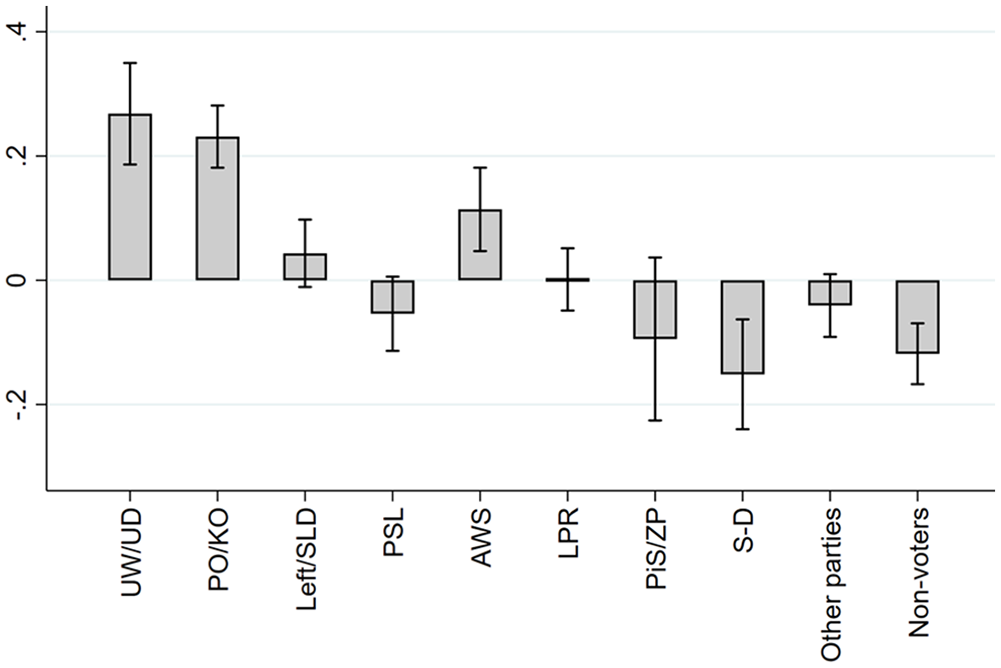
Attitudes toward democracy (factor) in Poland by party support (1995–2021).
Much as expected, supporters of Unia Wolności (UW; Freedom Union; coding includes a combination of Unia Demokratyczna and Kongres Liberalno-Demokratyczny, before they merged to create UW) and Platforma Obywatelska (PO; Civic Platform; coding also includes Nowoczesna, which joined PO forming Civic Coalition in 2018), usually branded as liberal, were on average most supportive of democratic order. The Left, which includes parties that joined forces or split over the years but remained largely related to the Alliance of Democratic Left and at times enjoyed wide voter support (especially in 2001 elections), falls close to an average in terms of attitudes toward democratic order. Polskie Stronnictwo Ludowe (PSL), a peasant party, had the support concentrated in rural areas, where anti-liberal and less pro-democratic traditionally prevailed. This underlines the necessity of controlling for the place of a respondent’s residence, as it should be distinguished whether it is party cues or structural factors that impact the attitudes to a more considerable extent. Another peasant party is Self-Defense (Samoobrona), which was widely deemed as right out populist, and this is consistent with the VDem coding (also see Mudde, 2004). At the same time, its voters were most likely to favor undemocratic forms of government. Finally, there are three rightist parties which create a discrepancy between ordering in V-Dem coding and in democracy support. Liga Polskich Rodzin (LPR; League of Polish Families) was a fervently traditional and anti-European political group, which joined Self-Defense, and a major coalition party – Prawo i Sprawiedliwość (PiS; Law and Justice) in the 2005–2007 government. PiS, at that time, had not yet been classified as the most clearly populist political power in Poland. In fact, it was one of the successor parties to a broad rightist and reformist coalition Akcja Wyborcza Solidarność (AWS, Solidarity Election Action 2 ), which was a main coalition partner in the 1997–2001 government (with UW as the minor partner). Some of the AWS’ politicians joined the UW in creating PO, while some others, joining forces with other rightist politicians, formed PiS. However, the 2005–2007 government formed by PiS, LPR, and Self-Defense proved to be much consequential for the future profile of PiS, as in the turbulent events that led to snap elections, this party was able to widen its voter base by ‘consuming’ the more ideologically extreme ‘starters’ (as the junior coalition partners were then popularly called). In the aftermath, PiS adopted much more populist rhetoric and agenda, finally winning the party’s little-anticipated landslide victory in the 2015 parliamentary elections. This fact suggests that the changes in the party system followed rather than preceded the representation logic.
Other independent variables employed in the analysis involve the passage of time. To avoid the so-called ‘APC conundrum’ (Glenn, 2005) and the collinearity of different ‘clocks’, I separately use the numerator of the Parliament cadence, a year within a particular cadence, and the respondent’s year of birth divided by 10 (for cohort effect) 3 . I also employ education, place of residence, and gender, as they can be related to both: age and support for democracy, while are indicated in the literature as correlates of right-wing populist electorate (Merkel and Scholl, 2018).
The analysis uses mixed regression, with respondents nested within 32 CBOS surveys from the 1995–2021 period, spanning from the middle of the second to the middle of the ninth cadence of Polish Sejm.
Results
Table 1 reports coefficients along with the Z-scores (coefficient divided by its standard error) of 6 models aimed at verifying the presented hypotheses. The M1 model presents the baseline for all the subsequent models, showing the impact of key control variables. First of all, the sequence of cadences of the Parliament – the main indicator of the passage of time – remains significant. However, as a stand-alone predictor, it reaches the coefficient of 0.08; with control variables, it goes down to 0.043 to reach 0.025 in the most complex model M5. We can see that there are predictors relevant to the overall trend from Figure 1 in the models. The passage of time within each cadence, while showing a predictable, positive sign, does not reach significance. Predictably, in all the models, the size of the place of residence is positively correlated with pro-democratic attitudes. The same goes for the level of education and gender.
Two-level regression models dissecting attitudes toward democracy (Z-scores in parentheses).

N = 28,010 respondents in the 1995–2021 period (32 surveys).
Populism scale can only be defined for party supporters, hence in M6 N = 15,124. Deviance, AIC, and BIC are not directly comparable with those in M1–M5.
To test Hypothesis 1, M2 involves the major political parties of respondents’ choice, divided into two possible states: being in government or being in opposition. The reference point here is all the voters of parties that have never entered into governing coalitions. As we can see, the electorates of UW/UD and PO/KO, the primary liberal parties, and the voters of the leftist parties become more supportive of democracy when their representatives fail to reach power. Curiously, the same goes with supporters of LPR and S-D, the populist parties. Only AWS, and to a much lesser degree, PiS voters were more supportive of democracy when their favorites were in power. What is perhaps more important, all those differences are not significant, as further tests have shown. We do not see a clear support for either Hypothesis 1 or its immediate alternative in model M2.
Model M3 aims to address Hypothesis 2. Along with control variables, including a three-category variable coding the level of education (which proved sufficient to show the main contrasts), it introduces two interaction terms between education and the passage of parliamentary terms. What we see is a strong and significant effect, showing that with each 4-year period (and one 2-year period in one instance), the gap between those with primary and vocational schooling on one hand, and those with tertiary education significantly increased. The marginal values from the M3 model show this gap to increase from 0.32 in the second term of Sejm (and 0.27 in the third) to as much as 0.57 in the ninth term, while this increase was more or less gradual within this timeframe. Hypothesis 2, involving a deepening social cleavage, seems to be prima facie supported. Yet, this effect has to be further confirmed with the cohort effect being controlled (as the subsequent generations became better educated during the studies period).
Model M4 is related to Hypothesis 3, connecting increased support for democracy with social change, with the effects of generational replacement serving as a primary indicator. Hence, the year of birth, measured in decades (as the variable spans 101 years), has been added here. Generations separated by every 10 years differed significantly to produce a cumulative effect of about 0.1 between the oldest and the youngest one. This is substantially less than the cumulative effect of cadences (which amounts to about 0.3 in 8 cadences) yet shows that an important, independent social ‘clock’ contributed to the initially observed secular trend.
Model M5 takes into account all sets of independent variables simultaneously to check the robustness of separate results. As can be seen, all the described effects remain significant, while with the political parties in the model, the cohort effect almost doubles in its predictive power (suppressor effect). In effect, the total cohort effect increases to 0.21, which surpasses the effect connected to the time trend (0.025 * 8 cadences = 0.2). In all five models, some basic fit statistics, as well as the random intercept for the survey effects, have been reported. The survey effect remains high in all the models. Further tests for measurement invariance showed that CBOS data are not ideally calibrated between the samples, and the optimal choice seems to account for that in the model. The deviance (–2LL), Akaike information criterion (AIC), and Bayesian information criterion (BIC) all point to an M5 model as best fitting the data. A comparison of the M2-M4 suggests that differences between parties account for the majority of variance in support for democracy, which means that the issue itself is politically relevant. However, growing social divisions and generational differences significantly add to the explanation of attitudes toward democracy. Model M6 additionally checks whether the combined effects of party support and winner/loser status could help verify Hypothesis 1. While the results confirm that populism was, on average, related to lower support for democracy, the populist party’s status of being either in government or in opposition does not significantly contribute to the explanation. Thus, we receive an additional basis to conclude that neither the populist winner effect nor the anti-populist reaction to a populist rule has significantly influenced the general support for democracy.
Finally, to better grasp the relation between proposed explanations, I propose a simple structural model with two equations – one with populists’ support (coded with V-Dem) at the left-hand side and another with the support for democracy at the left-hand side. For better comparability of coefficients, all the variables have been standardized. Results in Figure 3 serve rather as an illustration than outright evidence (the validity of V-Dem coding can be disputed) but allow us to collate the effects and evaluate theoretical explanations more directly.
First of all, the surge of populism in Polish politics was accompanied by social divergence related to class and generational change. This amounts to effective ‘sorting’ of electorates, perhaps also constituting social conditions of polarization. Additional analysis showed that this process certainly has not been limited to the post-2015 period (actually, it is stronger and more significant before, not after 2015). Second, the populist turn diminished support for democracy, but its impact was, in fact, rather weak (especially compared with the impact of education). Populists used both anti- and pro-democracy rhetoric, sending mixed cues to the electorate. It agrees with the general tendency of populists in power to delegitimize some institutional arrangements while legitimizing democracy as a regime. Perhaps it is worth noting that PiS has not disputed the results of the 2023 parliamentary elections (which happened in some other democracies).
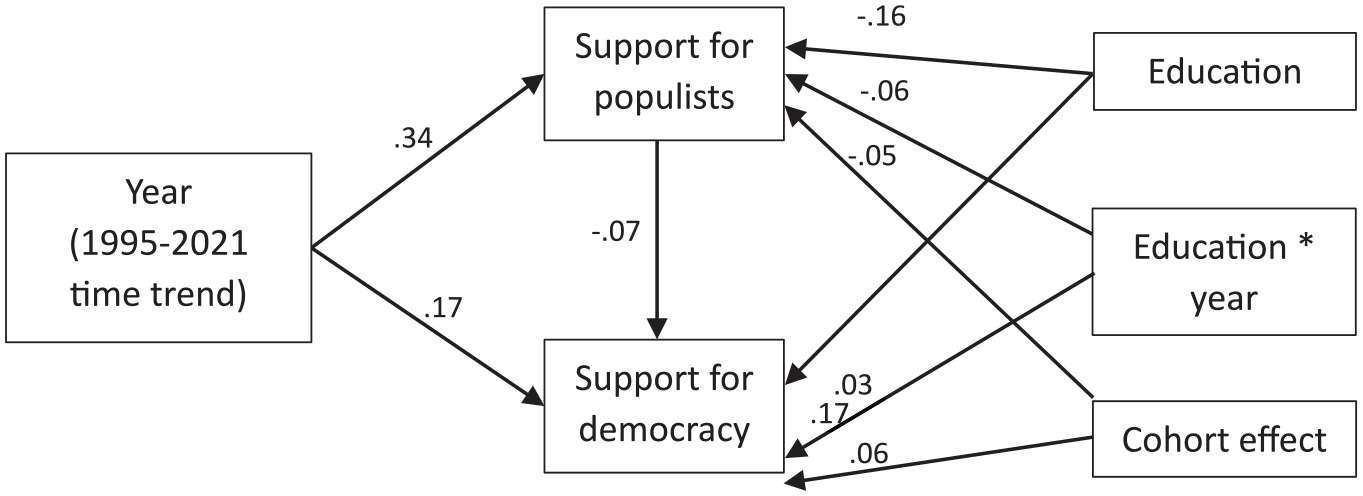
Direct and indirect effects on support for democracy in structural equation model.
Third, while it was said that the parallel hikes in support for populist parties and for democracy are weakly related, they are linked by both being conditioned on the same social circumstances. The ‘splintering’ in Polish society likely fueled an anti-elitist populist agenda while also becoming a catalyst for the legitimization of a democratic system. Fourth, while the trends in populist politics and in support of democracy were parallel, their pace was much different. At the same time, the total (direct and indirect) impact of generational and class ‘splintering’ on attitudes toward democracy was clearly higher than that of support for populists.
Conclusions
In this article, I have turned to indicators of the social legitimacy of democracy to show its nontrivial relation to the processes deemed as undermining democracy. The investigation’s departure point was that democratic backsliding in Poland took place against the backdrop of increasing pro-democracy attitudes. I hypothesized about three possible connections between those facts: (1) populist mobilization and two possible underlying social processes, namely, (2) deepening social cleavage and (3) social change related to generational replacement. The empirical test of the first hypothesis assumed that it was the electoral winner effect in populists that could have made them more supportive toward democratic order. The second hypothesis was operationalized regarding social divergence in attitudes between people of different social statuses. Deepening social divisions could have been a fertile ground for both – populism (as a reaction in lower strata) and support of democracy (as a reaction to populist politics). The third hypothesis assumed that similar reactions could also be related to generational change.
The outcomes of the analysis give no support for the populist mobilization hypothesis. While increased adoption of populist rhetoric was a clear predictor of decreased support for democracy, there is no significant difference between supporters of populist parties when they are in government and in opposition. In other words, the attitudes toward democracy in populist voters proved less volatile than expected. Results also do not fully support the opposite – that liberal voters generally valued democracy more while populist parties ruled the country. Similar reactions were observed in the electorates of populist parties (LPR, Self-Defense). Meanwhile, there seems to be relatively robust support for the hypotheses assuming attitudinal ‘splintering’ along class and generational lines. The effect of having a high education on support for democracy increased each year. At the same time, the effect of having low education on supporting populist parties also increased each year. Similar divergence was also observed in consecutive birth cohorts. At the same time, each new cohort was better educated – according to CBOS data, the percentage of those with tertiary education has increased from 7% in 1995 to as much as 28% in 2021 (a similar increase is documented in the Eurostat data). The studied period overlaps with the educational expansion in Poland. Nonetheless, the effects of education and generational change are mostly independent of each other. Even if we control the effect of education (and its increase in the population), a sheer year of birth still plays an important role in both – susceptibility to the charm of populist rhetoric and support for the democratic system. In other words – younger generations are more pro-democratic not only by virtue of being more educated.
Substantially those results paint a picture of a parallel change in politics and society – stronger polarization in the first case, which follows a deepening divergence of attitudes between social strata. The latter is represented by education in the analysis, however, results are similar when I replaced interaction involving education with the one involving place of residence. Results would probably be the same in regard to income. It is important that such slow but steady ‘splintering’ can be observed throughout the 1995–2021 period, not only for the post-2005 or the post-2015 period – it is significant in the long run. This suggests that the electorate has slowly organized along the class lines, and sudden increases in strictly political polarization after 2005 and then after 2015, although not directly dependent on the deeper sociological trend, amounts to a political reaction to widening social divisions. Those divisions, when we look at the direction of the divergence, are mainly related to embracing a more progressive orientation in a more liberal electorate. Such possibility is further evidenced by the fact that the same pattern relates to generational replacement, with younger cohorts embracing more progressive values.
The Polish case, along with the presented results, seems to be much in line with the argument made by Christian Welzel (2021) on account of a ‘revisionist camp’ (as he calls it). In his view ‘dissatisfaction with the functioning of democracy in practice does not turn people away from democracy as a norm. . . . Instead, revisionists cite evidence that support for democracy as the most desirable form of government persists . . . More importantly, revisionists stress that the tectonic cultural shift from authoritarian to emancipative values has strengthened people’s commitment to the most primordial principles of democracy, in particular freedom of choice and equality of opportunities’ (Welzel 2021: 993). Welzel, as some other authors referenced earlier, sees the illiberal populist turn in CEE and elsewhere as a reaction to overly progressive pushes in politics. Pippa Norris and Inglehart (2019) argued that the results of their analyses concerning the disruptive effects of populists on support for democracy are mixed. Authors pointed out that populist politics deepen political polarization and, in some countries, damage checks and balances. On the other hand, there is little evidence that the surge in populism has globally diminished trust in democratic institutions while it has made mainstream elites pay more attention to new public concerns. Such conclusions convey a mismatch between political demand and supply rather than an increasing taste in society for an authoritarian government (as there is little sign of concurrent faltering public trust or failure of civil society).
The Polish 2023 parliamentary elections results have shown that the illiberal turn was rather easily reversible, despite the institutional backsliding observed for as much as 8 years. As I have shown, long-term trends have seemingly impregnated the resilience of democratic sentiments in society, thus making political and electoral competitiveness more entrenched. In each subsequent generation, acceptance of authoritarian regimes diminished, yet the valence of particular political issues varied. This is well represented by the protest mobilization during the 2015–2023 period. In the early years of PiS rule, protests focused on judiciary reform, and older cohorts were clearly overrepresented among the participants. During its second term, the governing party has sparked much wider protests by changing the status quo concerning abortion rights. This time, the younger generation, especially young women, walked the streets. Those protests proved to be much more consequential. Populist policies seem to have been accepted as long as they largely aligned with the interests in society (this prominently included direct money transfers to young parents, as well as several other new social benefits). It is also telling that the mainstream parties have seemingly learned their lessons about the current political demand, as the political agenda of the recently elected government does not show any intent to roll back many of the policies introduced by the preceding populist government (including those concerning child benefits, national security, and immigration controls).
The presented analysis has several limitations. First, the results should be further confirmed with different data, as the CBOS surveys expose some reliability issues (high measurement variance between surveys). Additional verification using other indicators of social position, like disposable income, could shed new light on the alignment of social structure and public opinion. Some reservations apply to political indicators as well. The validity of V-Dem coding of a party’s populism might be disputable. In the case of Polish parties, the difference between coding of, for example, Sojusz Lewicy Demokratycznej (SLD, Alliance of Democratic Left) and AWS might seem exaggerated. Finally, similar analyses in other CEE countries, especially Hungary, might further support or undermine the presented conclusions.
Footnotes
Acknowledgements
The author would like to thank Marta Kołczyńska for the intense discussions, which led to a more refined manuscript and single authorship.
Declaration of conflicting interests
The author(s) declared no potential conflicts of interest with respect to the research, authorship, and/or publication of this article.
Funding
The author(s) received no financial support for the research, authorship, and/or publication of this article.
