







Abstract
The article investigates how rural businesses demonstrate resilience when faced with adversities and the processes they utilise to survive. The work explores rural resilience through the use of learning and innovation in small rural enterprises. Drawing on case study work from rural England the results indicate that individual businesses find ways to overcome adversities and, through learning how to cope with them, create a resilient culture. Individuals businesses use various resources, and in some cases innovate, in order to continue business operations during difficult times. Continual learning becomes an important aspect of incremental innovations which are required merely for the business to survive. The work is timely as many small enterprises face difficulties in the wake of instability in the economic world.
Introduction
Resilience is attracting increased academic attention in exploring business activity in regions, as regional development research moves away from the historical preoccupation with growth (Dawley et al., 2010). Regions are vulnerable to crises (Hudson, 2010) and this makes them an interesting subject to explore resilient behaviour. As Simmie and Martin (2010: 1) state there are ‘all sorts of interruptions and disruptions: periodic economic recession, the unpredictable rise of major competitors elsewhere, unexpected plant closures, the challenges arising from technological change and the like’. Studies exploring resilience in changing contexts have emerged from the USA (e.g. Foster, 2007; Pendall et al., 2010) and Europe (e.g. Colbourne, 2008; Edwards, 2009; Folke et al., 2002). However, the role of innovation and learning in creating resilient organisations is developing as a fruitful area for research with work focusing on policy (e.g. Hauser, 2010) and adaptability as a form of resilience (e.g. Martin and Sunley, 2006; Simmie and Martin, 2010).
This article seeks to contribute to the growing resilience literature by investigating resilient behaviour in rural England; exploring the role of innovation and learning in small firms in developing resilience as a capability, using 10 farm businesses as case studies. Rural enterprises, like other small enterprises, are currently experiencing times of change, exacerbated by the global interdependency and integrated economies (Hudson, 2010). One of the main rural enterprises across the UK is the farm business. Small enterprises operating in the agricultural sector also have to deal with constant natural challenges (for example BSE crises, Foot and Mouth Disease and Bluetongue) increasing their appeal to explore resilience. Their survival is also important as the social fabric of the countryside depends heavily on developments in the farming and food industry (Curry et al., 2002).
Without agriculture, many rural communities would simply disappear. Agriculture is still an important activity in rural and remote areas, and farms are an important source of employment (Kazakopoulos and Girdarakou, 2003), as agriculture is often the only viable industry in rural areas. Farms may be the only employer and there is often little public transport that enables people to work further afield (Martin et al., 2002). There is also a clear interdependency between agriculture and other rural industries (Donaldson et al., 2002; Scott et al., 2004). For example, farming families support an array of small rural businesses, such as village shops and post offices, as well as providing support for other rural institutions, for instance schools and churches. As pointed out by Franks et al. (2003: 160) changes in the structure of farming, diversification and off-farm employment has ‘increased integration and interdependency between farm households and the rural economy’. Resilient agricultural businesses can contribute to creating resilient rural regions. Without farming, the social structure of rural areas would be quite different. The article contributes to the agricultural, rural and small business literature on resilience and explores how different resources are used in the business and how business owners learn and innovate.
The article is structured as follows: first, the theoretical literature on resilience is presented before moving onto the learning and innovation literature. The article then goes on to focus attention on farm businesses and includes a relevant section on family firms as most farm businesses operate as family owned entities. It then goes on to detail the methods used before presenting the findings. The article provides a discussion, including implications and suggestions for future research directions, before ending with a conclusion.
Resilience
Resilience has emerged as a useful framework to study complex dynamic human-environment interactions (see, for example, Berkes and Folke, 1998; Carpenter and Gunderson, 2001; Walker and Salt, 2006). Resilience ‘stresses the importance of assuming change and explaining stability, instead of assuming stability and explaining change’ (Folke et al., 2003: 352). Boss (2002: 179) pointed out a need for future research to ‘merge the two streams of resilience work from psychology and family studies to understand both family and family member responses to stress and crisis’.
Luthar and Cicchetti (2000) argue that the process of resilience involves adversity and adaptation: the challenge for resilience researchers is to identify the underlying mechanisms or processes of resilience and to ensure that resilience-enhancing interventions are soundly based upon theory and research findings. Chenoweth and Stehlik (2001) suggest that resilience at the individual and community level is the key to managing significant stressors present in rural communities, such as drought. Therefore, resilience at the individual level assists both the resilience of the farm business and the farming community as a whole. Buikstra et al. (2010) found that farming people took the good with the bad. Wilson (2010) explored rural community resilience suggesting it is the balance between economic, environmental and social needs of rural communities – in other words, resilience is about communities being able to successfully endure change. Such resilience can be expressed through ‘the robustness, rapidity, redundancy (extent of substitution) and resourcefulness of a community’ (Wilson, 2010: 368). This is also applicable at the farm business level.
Research has explored resilience in the small firm sector (however, often agricultural small firms are excluded from these types of studies). Work has examined factors such as economic and political pressures, the role of autonomy and the psychological composition of small business owners (Goldthorpe et al., 1980; Kets de Vries, 1977; Storey, 1994). Organisational resilience is a relatively new field of research (Dewald and Bowen, 2010; Lengnick-Hall and Beck, 2005) and includes, for example, work that has explored maintaining routines in defiance of pending environmental change (Edmondson, 1999), positive changes under challenging conditions (Weick et al., 1999), production in the face of targeted industry threats (Gittell et al., 2006), and capacity to adjust organisational routines to adapt to untoward events (Lengnick-Hall and Beck, 2005; Sutcliffe and Vogus, 2003). These perspectives are consistent with psychological studies of resilience, which focus on the ability of individuals to adapt and grow in the face of adversity (Dewald and Bowen, 2010; Masten and Reed, 2002; Richardson, 2002).
Organisational resilience, therefore, is manifested through cognitive and behavioural resilience. Cognitive resilience is a decision-making intention based on decision makers’ ability to ‘notice, interpret, analyze, and formulate responses’ (Dewald and Bowen, 2010: 199) to pending environmental change (Gittell et al., 2006). On the other hand, behavioural resilience represents the action of implementing the formulated response or intentions developed through cognitive resilience (Dewald and Bowen, 2010). In demonstrating resilient capabilities small firms, including small family farm businesses, can draw on learning and innovation when faced with adversities.
Learning and innovation
Increases in competition, globalisation and the speed of change in business environments have helped to highlight the importance of the capacity for learning in small businesses, key to survival and success (Dumphy et al., 1997; Easterby-Smith et al., 1998; Fulmer et al., 1998). Collis (1996) suggests two critical factors in building organisational capability: (1) the ability to innovate; and (2) the ability to learn. In terms of learning, Gibb (1997) recognised two types of learning derived from Argyris and Schon (1978) and Senge (1990) – adaptive learning (learning in order to cope with change, which would be closely associated with resilience), and generative learning (the capacity to forward think, which could include contingency planning). Learning concepts applied beyond solely individuals to whole social entities can be found in the field of organisational learning (Argyris and Schön, 1996; Lundholm and Plummer, 2010; Senge, 1990; Wenger, 1998).
Organisational learning has been cited as the key to this process (Cahill, 1997), allowing small business to cope with that ‘open-ended change’ described by Stacey (1996). Through organisational learning, small firms also develop wider flexible relationships with customers and suppliers to promote growth (Cahill, 1997; Deakins, 1996). Organisational learning allows the company to cope with open-ended change through the development of communication within the company and across firms (Martin, 2001). Organisational learning is based on the premise that an organisation is capable of collective thinking, drawing upon an unwritten body of knowledge that stems from learned, problem-solving behaviour (Prahalad and Bettis, 1986).
In solving problems, on-the-job learning can occur in a number of different ways (Rowden and Conine, 2005). Watkins and Marsick (1992) identified three different forms of workplace learning: formal, informal and incidental. Formal learning involves training and instructing people how to perform specific defined jobs through planned events, typically institutionally sponsored and highly structured. Informal learning can occur in institutions, not typically classroom based or highly structured, with learning in the hands of the learner, not the organisation (Rowden and Conine, 2005; Watkins and Marsick, 1992). Incidental learning occurs as ‘an unintended by-product of other activity, such as trial-and-error experimentation or interpersonal interaction’ (Rowden and Conine, 2005: 217). All three types of learning can help individuals’ cognitive and behavioural resilience.
Shipton et al. (2002) believe that workplace learning occurs through a dynamic interaction between formal and informal learning; formal learning stimulates informal learning and that informal learning often leads to participating in more structured learning activities. However, Leslie et al. (1998) revealed that workplace learning does not occur for its own sake, but rather as a means of achieving organisational and individual goals. Organisational goals include: increased worker participation in decision making; and expanded job responsibilities, whereas individual goals include the need for: personal achievement and development (pride in quality workmanship, sense of contribution to a greater endeavour); recognition and acceptance (sense of belonging to a social group, esteem gained from recognition); and financial requirements (financial security, advancement in terms of income and earning potential) (Rowden and Conine, 2005).
Therefore, firms which can harness all of their internal resources and extend these by linking with external sources of support, have a competitive edge in innovation. The most successful innovations are prosaic, they exploit change; thus the discipline of innovation (and it is the knowledge base of entrepreneurship) is a diagnostic discipline: a systematic examination of the areas of change that typically offer entrepreneurial opportunities (Drucker, 1985: 31).
Organisational learning has been cited as the key to the process of harnessing resources for innovative activity (Cahill, 1997), allowing small business to cope with that ‘open-ended change’ described by Stacey (1996). Innovation is positively related to business performance in small firms, whether demonstrated by the introduction of new products, services and processes or by the re-innovation of existing products and processes (Cosh and Hughes, 1992, 1996; Deakins, 1996; Woo et al., 1989, among many). Innovation is seen as a complex process, based on interactive network learning and processes of trial and error on the shop floor. Innovative companies are built on their own core competence (Dosi, 1988). The embeddedness of innovations within this core competence and the internal learning processes is the best protection against imitation. This forms the foundation of theories around the learning organisation (Nieuwenhuis, 2002). However, small companies, such as in agriculture, are depending on external knowledge infrastructures for effective innovation (Nieuwenhuis, 2002). The next section explores the context of the research in this article and provides details on agriculture and family farm businesses.
Agriculture, family business and resilience
As Howarth (1990) discusses, agricultural activities are unique; farmers face different production processes compared to other industries. The fundamental difference is that the countryside is not a factory (Fitzgerald, 2003). Farmers have had to develop systems that allow them to maintain production, in an environment in which physical conditions and economic circumstances may vary from year to year (Lev and Campbell, 1987). Despite modern technology, fields and animals are not machines hence farmers cannot guarantee a pre-determined production level for a given period. A machine can be programmed to produce a specific output per hour (Fitzgerald, 2003), yet farmers have to gauge output for the coming year, based on output and price in the current year. There is also a time lag between planning output and produce eventually reaching the market. In dairy farming production changes must be planned years in advance because it is nearly two years before cows start to produce milk. Many uncontrollable factors (disease, weather, natural disasters) affect the time, volume and quality of production, thus increasing the risks for the farmer. In order to survive these constant disruptions farmers must be prepared to develop resilient strategies as each change provides an opportunity to learn and innovate, as well as demonstrate levels of resilience in each small farm business, surviving each adverse situation.
The physical limitations imposed by nature have been circumvented by the endless possibilities of technology and science, and these, in turn, have transformed both the farmers’ and consumers’ experience (Fitzgerald, 2003). According to Cochrane (1979), the individual farmer is on a ‘treadmill of technology’ and this sentiment is still valid today. As more and more farmers adopt improved technology, output increases against a static demand, thereby over supplying the market and reducing the price of the product (Howarth, 1990). The average farmer must adopt innovation merely to survive; in effect, farmers have to run harder to stay in the same position, as all adopters achieve normal rather than supernormal profits (Howarth, 1990).
British agriculture has experienced many changes over the years including swings in supply and demand, quota restrictions and changes in the macroeconomic climate, all of which have resulted in sector specialisation (the concentration on fewer activities at the farm level). The key change in this respect has been declining numbers of mixed and general cropping farms (Furness, 1983; Haynes-Young and McNally, 2001; Lobley et al., 2002). Specialisation (and consolidation) is particularly visible in the dairy sector, where there has been a greater concentration of productive resources in the hands of fewer farmers (Lobley et al., 2002; van der Ploeg and Long, 1994). However, when compared to other industries, there are still a large number of individual small enterprises supplying the market. In 2003, there were approximately 23,000 dairy farmers in the UK (DEFRA, 2003). In January 2012, producer numbers for England and Wales stood at 10,733 a fall in numbers of 272 (2.5%) over the last 12 months (DairyCo Datum, 2012).
The dairy industry occupies a special socio-economic position because milk is produced every day, giving a regular income to numerous small-scale producers. These producers are generally operating as family businesses.
The problems facing a family business cannot be completely avoided – they must be managed (Dyer, 1986). The family can foster high ethical standards, positive commercial values and a sense of responsibility, which can contribute to the transfer of entrepreneurial skills from one generation to the next (Poutziouris et al., 2004). However, advocates of professional management argue that family businesses are unable to react to changing environments owing to the conflicting goals of the family and the business (Dash, 2003). The experience of most family firms is one of frustration, conflict and unfulfilled dreams. However, family firms represent relatively stable systems, so long as the founding entrepreneur is in place (Morris et al., 1996).
Succession is the ultimate test of success for the family business; this is a process that occurs over a long period of time, not as a single event (Gersick et al., 1997). Many family farm businesses have achieved this success, surviving to the third and fourth family generation – almost one-third have farmed in the same area for over a century (Lobley et al., 2002) – whereas only 24% of UK family businesses survive through to the second generation, and only 14% make it beyond the third generation (Martin et al., 2002).
Therefore, it could be argued that the English farmer is sometimes quite a remarkable entrepreneur and producer for the market, even though s/he has nearly always rented his/her estate (Gerth and Wright Mills, 1993). The family farm is flexible in its response to changes in its environment, and: ‘family ties have the strength, longevity and resilience to meet the requirements of modern production techniques (Francis, 1994: 10). Farm families adapt themselves in varying ways to the legislative, political, economic, social and religious influences which impinge on their lives (Gasson and Errington, 1993). A strategy may be in place, although not formalised as in larger corporations. The behaviour of farm families, the way they organise work and make decisions in the farm business, and their reactions to the rapidly-changing climate for agriculture, cannot be predicted entirely from knowledge of structural constraints, hence decisions are not always entirely rational, in the strict economic sense, i.e. to maximise profits (Gasson and Errington, 1993). For example, in some cases an outside observer would question why the farm has not been sold to capitalise on the assets if the business is running at a loss.
Family business owning families, including family farm businesses, can build a resilience capacity; when changed is encountered, the store of trust and creativity in problem solving can be more easily and quickly adapted to new situations (Danes et al., 2002, 2009; Sundaramurthy, 2008). Resilience is thus the owning family’s use of an ability to adjust resource and interpersonal processes to change (Danes, 2006) in either family or firm (Danes et al., 2009). In the agricultural literature studies have also explored resilience as an alternative to sustainability in agricultural research (e.g. Darnhofer, 2010), and others have explored resilience from a health care perspective (Kraglund-Gauthier, 2009). This article seeks to add to the growing literature by exploring resilience in family farm businesses.
Approach
The farms.
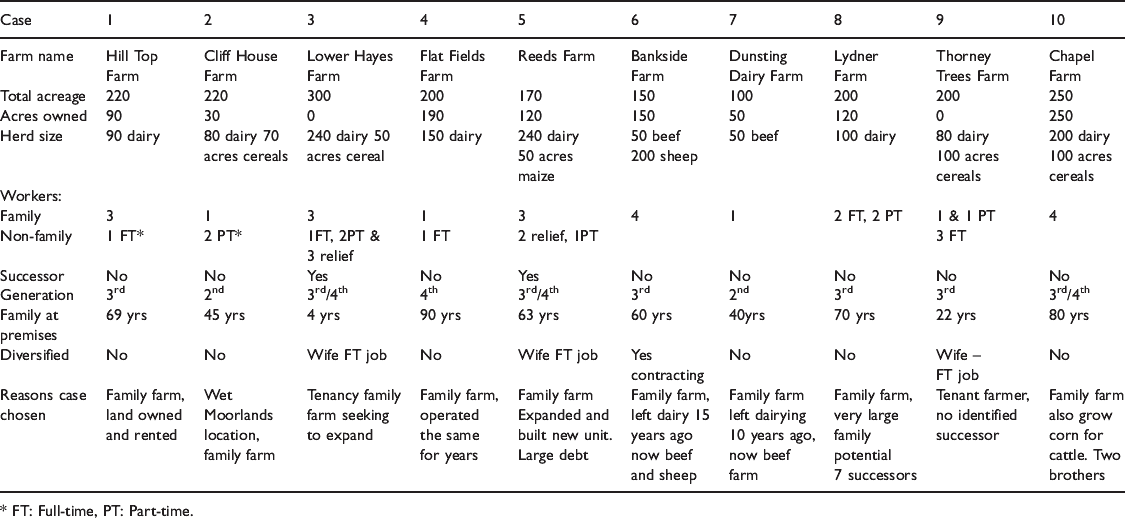
FT: Full-time, PT: Part-time.
Semi-structured interviews can provide rich and detailed accounts of the individual’s experience, and also allow for flexibility (Cassell and Symon, 1994; Kvale, 1983, 1996), adapting to each context, organisation and individual (Correia and Wilson, 1997).Each case represents a family dairy farm business. In total, 10 case studies were selected through theoretical sampling, each comprising of a minimum of one interview, yielding a total of 21 interviews. In order to comprehend the behaviour of subjects (farmers and their family) in their natural and everyday settings (the farm) (Gill and Johnson, 2002), case studies were chosen as the research method. A case study strategy is preferred when the inquirer seeks answers to ‘how’ and ‘why’ questions (Macpherson et al., 2000). Yin (2003: 1994) states that: ‘the case study method allows retention of the holistic and meaningful characteristics of real-life events, such as individual life cycles, organisational and managerial processes, neighbourhood change, international relations and the maturation of industries’. Case studies are especially useful where it is important to understand social processes in organisations and environmental contexts (Symon and Cassell, 1998), a key aspect of this research.
Using case studies, the case study researcher faces a strategic choice in deciding how many cases to use and the complexity of each case that is studied (Macpherson et al., 2000; Yin, 2003). Case study research produces rich understanding of social sites (family, family farm business) and the structure of meanings created by the actors who operate there (Macpherson et al., 2000). Yin and Heald (1975) point out that each case study provides rich insights into a specific situation but may not be suitable to base generalisations on. Case study research is robust in internal validity, whilst external validity is often considered weaker in case study research; this study used multiple cases to increase the level of external validity (Yin, 2003). Using multiple case studies, theoretically selected, enables the theory to be developed based on replication, strengthening the validating process.
Evidence from multiple cases is often considered more compelling, with the overall study being more robust (Burton, 2000; Herriott and Firestone, 1983; Macpherson et al., 2000); allowing comparisons and differences to be identified across cases and between the people interviewed (Burton, 2000), known as comparative analysis (Glaser and Strauss, 1967). Using multiple cases can support arguments for the legitimacy of case studies (Macpherson et al., 2000: 56). Both Yin and Ragin advocate the use of multiple case studies, suggesting the single study has several limitations regarding analytical power and pervasiveness and generalisability (Verschuren, 2003).
Using multiple cases means that variations with respect to each farm business including farmers, their spouses and children, and their respective behaviour, as well as variations with respect to the businesses can be investigated through comparative analysis.
Cases were identified and subsequently chosen to fill theoretical categories which: extend the emerging theory; replicate a previous case; further test the emerging theory (Huberman and Miles, 2002; Yin, 2003); or offer a polar (contrasting) case (Glaser and Strauss, 1967). Thus, cases are selected for their theoretical merits, rather than facing the problems of representative samples (Curran and Blackburn, 2001). Yin (2003: 47) states that: The logic underlying the use of multiple case studies requires each case to be carefully selected (through theoretical sampling) so that it either: (a) predicts similar results (a literal replication) to extend and test the theory; or (b) predicts contrasting results but for predictable reasons (a theoretical replication) to extend the theory.
Findings
Category and codes.
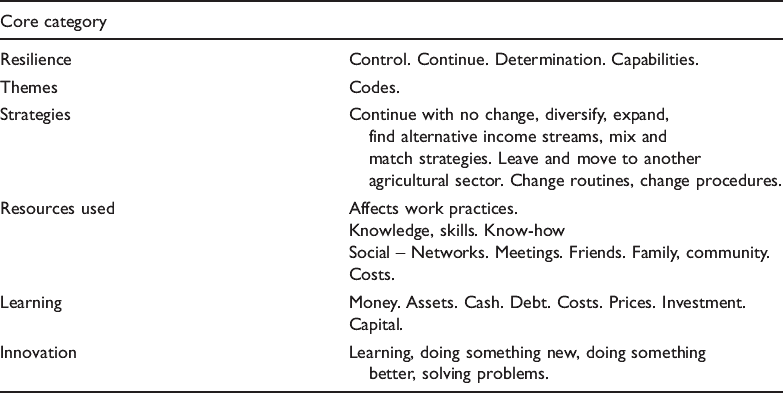
Theme 1: Strategies
Each of the farms followed a strategy which confirms previous actions identified in the organisational resilience literature; however, some farms could be seen to follow more than one strategy. Maintaining routines in defiance of pending environmental change (Edmondson, 1999) was apparent in each cases, as farmers were having to develop ways to overcome new legislation relating to the storage of slurry and complying with nitrate vulnerable zone (NVZ) regulation (each farm was situation in an NVZ), ‘we have changed the way we keep animals over winter to reduce slurry we now operate a loose housing system’ and ‘so we now divert the rainwater away from the slurry store, collect it and use it for washing down with’. This also demonstrates how changes to one part of the business can help another as water bills have been reduced on the farm.
Positive changes under challenging conditions (Weick et al., 1999) were identified in two cases where farmers had positively changed the business operations in order to overcome challenges surrounding milk price: ‘we have changed how we do some tasks in order to make them more efficient and less labour intensive, this has saved us some money’ and ‘we have invested in a new, second hand, milking parlour having had it for a couple of months it looks like it will save us a load of corn a month, roughly £3000’. Two had expanded the main farm business: ‘we have expanded the business to gain some economies of scale’, and three had diversified as one farmer said: ‘we took a risk and moved into cheese-making to increase the income we generate from our milk’, demonstrating prosperity in the face of targeted industry threats (Gittell et al., 2006). However, an industry threat in the form of low prices and concentrated power in the hands of buyers, was a problem for all cases. The capacity to adjust organisational routines to adapt to untoward events (Lengnick-Hall and Beck, 2005; Sutcliffe and Vogus, 2003), was evident in three cases where the dairy herd has contracted bovine TB: ‘you have to change things, you can’t sell any animals, so you lose an income stream as we used to sell in-calf heifers and in-milk heifers, now we’ll have to buy in to replace the cows we’ve lost’. Therefore, the four main strategies identified from the cases were depicted as: defy, change, adapt and prosper.
Theme 2: Resources used
In each case, the use of social networks whether formal or informal was a major factor in developing resilience: ‘the national farmers’ union [NFU]can be helpful, we lost all our animals in the Foot and Mouth crisis, the NFU helped us get back on track’. This was particularly the cases for farm businesses suffering with bovine TB issues: ‘we spoke to other farmers in our situation and we discussed how hard it was and why we carry on and what can we do’. Farmers often confided in fellow farmers rather than seeking professional help from support agencies such as rural stress network and so on: ‘if I have a problem or I need to talk to someone then I’ll speak to my farming friends, I feel more comfortable talking to them and feel that they know where I’m coming from’. However, in the case of the Foot and Mouth outbreak networks were broken down: ‘I was left alone on the farm isolated during the outbreak my children were sent away when our animals were destroyed and I didn’t see them for three weeks, I also couldn’t go and see friends, I could only talk to people on the phone’.
Another major factor in helping resilience was the nature of the job and not only the resources used but the resources farmers had to care for: ‘we have got to look after the animals we can’t neglect them just because we are in this situation’. This was a response from a farm that endured the Foot and Mouth crisis and could not sell animals and was on the point of being over-stocked.
In many cases, where financial resources were minimal, farmers would often use this as an opportunity to innovate; for example they would learn how to fix things themselves ‘at the moment we haven’t got the spare cash lying around, so you tend to try and fix things yourself’.
Farm resources could also be used to create new business ventures, particularly in providing finance through mortgages, for example ‘we used the farm to gain access to finance to start the holiday cottages’.
Theme 3: Learning
It was evident that in each of the cases farmers would draw on the knowledge they had from previous experiences and previous learning events, or they learnt from the experiences of others: ‘we knew our neighbour had previously had problems with TB so we would talk about our situations, and you find out how people have dealt with these problems’. Some farmers said that they learned to ‘fear the worst’ in some situations (i.e. Foot and Mouth after the BSE crisis) and this then gave them hope that circumstances or opportunities would get better: ‘you think, well things can only get better – surely?’.
Learning is a constant part of the business: ‘in farming you’re always learning, you’ll always have small set-backs so you learn from that experience and you move on’. A good example of learning to be resilient was given by one farmer who had TB in his herd for the first time: ‘the first time you lose your animals it’s heartbreaking, devastating, but the more it happens the harder you become and you almost try not to feel like the animals are yours, you learn to… be less emotional’. Farmers learn from previous experiences in order to deal with issues they face in the present day: ‘we have overcome falling milk prices before and we will get over falling milk prices now, you just learn to do more with less’. Another example relates to their resourcefulness: ‘we have problems with the feeders in our parlour I think they have gone wrong so many times we are now experts in repairing them’. This demonstrates a high level of adaptability and continued resilience in making the old feeders work rather than purchasing unaffordable new ones.
Theme 4: Innovation
Innovation was often evident as a way to survive, rather than the usual notion of innovation as doing something new, new product, etc. as a way to increase income. Through learning farmers were often resilient and engaged in innovative activity just to continue business operations. This was particularly evident when farmers talked about the Foot and Mouth crisis in 2001: I remember we couldn’t sell animals and we were over-stocked, as soon as the movement restrictions were lifted we signed up for a virtual market run by the local auctioneers whereby they would send pictures of your animals to prospective buyers and they could come to your farm and buy from you, we did this with a couple and now we sell directly to them.
Discussion
The results indicate that individual businesses find ways to overcome adversities and through learning how to cope with these adversities create a resilient capability. Individual businesses use various resources, and in some cases innovate, in order to continue business operations during difficult times. Continual learning becomes an important aspect of incremental innovations, which are required merely for the business to survive. Change is a constant theme in agriculture and provides farm businesses with ample opportunity to develop resilient capabilities. Adaptability was a factor in both utilising resources and innovative behaviour in the farm businesses; previous research has explored the important role of adaptability in old industrial regions (Fitzgerald, 2009; Gonzalez, 2006; Johnson, 2010).
The work also confirms previous work by Buikstra et al. (2010), in relation to individual resilience, who found that the features of the natural environment were credited with feelings of well-being for some, while others indicated that the climate was the source of character building. Learning to deal with climatic events, such as drought, hail and frost, built resilience among the farmers (historically and in the present day). This was evident in the three cases who had built a resilient capacity in order to cope with bovine TB.
Lifelong learning was a key factor in determining the success of each case’s resilient capability, therefore resilience as well as learning becomes a developing process (e.g. Rutter, 1987). In learning to be resilient, particularly in the face of industry turmoil, farmers were often innovative, as the quotes in the findings highlight. Fraser et al.’s (2006) observations about farming communities and mental health, found that the combined environmental, economic and social exigencies of farming were seen as positive resilience-building factors, not merely as stressors. Therefore, in order to develop resilient capabilities stress factors must have been experienced by those in the small firm. In the context of natural resources management, Pahl-Wostl et al. (2007) further suggest that social learning results from an interplay among three elements: context formed by a given governance and physical system, process formed by the actual management practices, and a series of outcomes that feed back into the original context as changes in the institutional and environmental systems.
The main reason farm businesses in this research were forced into a situation of resilient behaviour was either lack of money or profits in the sector and disease outbreak in the dairy herd. What was also clear from the case studies is that individual firms will respond in a different way, often using a blend of strategies available to them in a way which they see is the ‘best fit’ for their own needs. Kenyon and Gilbert (2005) found that, in their research exploring rural businesses, the Foot and Mouth crisis did not have any impact on the business. This contrasts to the findings from this research that disease outbreaks significantly affect the business and require a resilient capability to continue business operations. This could be explained by the fact that Kenyon and Gilbert (2005) focused on non-farm businesses.
The importance of the support provided by family, friends or networks based upon shared cultural, economic or recreational interests, i.e. fellow farmers, confirms Buikstra et al. (2010) and, despite differences found discussed above, Kenyon and Gilbert (2005) found that rural firms in their study favoured private sources of advice rather than public ones. Social support was also a factor in helping farmers to learn from their experiences. Buikstra et al. (2010) suggest that individuals learn from their early experience to develop characteristics of positive outlook, sense of purpose, leadership and beliefs. However, during the Foot and Mouth crisis networks were broken down (Donaldson et al., 2002), which marginalised those affected by the disease. Safford’s (2009) study of Allentown, a former USA steel town, points to the pivotal role of social networks in developing joined-up city-wide resilience in responses to crises and demonstrate the need for social networks for business resilience in rural and urban areas.
Kulig and colleagues (Kulig, 2000; Kulig et al., 2005, 2009), identify a set of social values, for example sense of purpose, beliefs, leadership, embrace differences, early experiences, positive outlook and social support service. This is extended by Buikstra et al. (2010) recognizing environmental and economic factors, infrastructure and support services, as enhancing resilience. This was also found in the cases in this research, particularly previous experiences and social support.
Implications
The study provides interesting findings for those involved with the sustainability of rural communities, particularly during difficult economic times; and for members of the rural community, particularly those operating small businesses, providing examples of how to deal with difficult times and create a resilient capability. The work confirms previous research but also suggests that those helping small firms should encourage them to create a blend of strategies in order to develop a resilient capability. Future research may want to focus on how other types of small firms learn from challenging times and the effect of resources and lack of resources on how they demonstrate their levels of resilience. Research may benefit from comparative studies exploring resilience in family versus non-family firms, or firm location, for example rural versus urban.
Conclusion
The results indicate that individual businesses find ways to overcome adversities, and through learning how to cope with these adversities create a resilient culture. Individual businesses use various resources, and in some cases innovate, in order to continue business operations during difficult times. Continual learning becomes an important aspect of incremental innovations, which are required merely for the business to survive and can be part of the resilient capacity of the farm business. To develop this area of research, future research should focus on exploring the links between learning, innovation and resilience capabilities of small firms.
Footnotes
Funding
This research received no specific grant from any funding agency in the public, commercial or not-for-profit sectors.