







Abstract
Juba, the capital of South Sudan, is the fastest growing city in Africa, exhibiting the most rapid urban expansion and growth ever to take place in the region. Despite its explosive demographic and infrastructural expansion, the urban explosion has received virtually no attention from urban scholars. A grey literature on the city and its context is emerging but no assessment of this knowledge base has been undertaken. This article synthesizes reports from international governmental and non-governmental organizations, aerial and satellite images, and firsthand experiences in the city to develop an understanding of the interaction between the internationally-driven Development Complex (international organizations, foreign investment) in South Sudan as a whole, local development opportunities and the spatial organization of Juba. Our contribution takes stock of the interactions between international and local political forces in the boomtown, and discusses ways forward for urban planning, the international development and local business communities.
Introduction
Juba, the capital of the Republic of South Sudan, has since 2005 recorded spectacular urban expansion: at upwards of 12.5% per annum, the city’s growth is among the fastest rates of urbanization in human history (Martin and Mosel, 2011). The population grew from 10,600 at Sudan’s independence in 1956 to 250,000 by the time the second civil war ended with the 2005 Comprehensive Peace Agreement (CPA), and has more than doubled in the past seven years to at least 500,000–600,000 by 2012 (Martin and Mosel, 2011:3). The emergence of South Sudan as the world’s newest independent state as of 9 July 2011, and the history of conflict and ethnic tensions point to the importance of assessing Juba’s unique urban-economic dynamics in the specific geographical and political context rather than turning to conventional historical explanations of urban population growth and development.
In order to explain Juba’s exceptional dynamics of urban development since 2005, we propose the concept of ‘Development Complex-Driven Urbanization’, in which the Development Complex, comprising international governmental organizations (IGOs) and non-governmental organizations (NGOs), has largely determined the geography of urban development as well as (to some degree) rural-urban relations. Development Complex-driven rapid urbanization entails a peacetime expansion, spearheaded by a large influx of international development organizations (at least 700 since 2006) (Martin and Mosel, 2011) that is combined with a corresponding expansion of domestic civil society organizations and their personnel. The sudden and massive influx of development aid and investment drives local property and consumer markets, and is manifested in the spatial organization of the city by clearly demarcated and segmented urban spaces with high densification, upgrading and fortress architecture.
An enormous NGO/IGO apparatus was put in place to support the newly formed government as it transitioned from an autonomous region to a new state; considerable effort focuses on devising strategies to manage tidal waves of immigrants and migrants (internally displaced persons (IDPs), returning refugees and economic migrants) that decided to settle in Juba (there were an estimated 87,000 IDPs in Juba as of 2005, and many have decided to stay in the city) (Martin and Mosel, 2011; Pantuliano et al., 2011). Beyond the obvious need to stabilize the political situation (especially between Sudan and South Sudan), jump-start economic development, and solve outstanding issues with neighbouring countries, South Sudan must introduce urban planning to a war-ravaged environment, resettle IDPs and other migrants and ensure that food insecurity does not undermine fragile political, economic and urban contexts. In Juba’s case, these requirements are compounded by the potential move of South Sudan’s capital to Ramciel, which would take away considerable interest and investment from Juba.
Juba is the capital of Central Equatoria State as well as the federal capital of South Sudan. The urban settlement runs along the fertile banks of the Bahr al-Jebel, or White Nile (known as ‘the green zone’ of South Sudan) in a land-locked but strategic location, in close proximity to Uganda, Kenya, Tanzania and Congo (see Figure 1), and is well located to develop river transportation to the north. Despite its rich agricultural potential, Juba is situated in one of the least-developed and most oil-dependent countries of the world. Oil accounts for more than 95% of the national budget. Half of the population is below the poverty line (earning US$25 or less per month), one-third is moderately or severely food insecure, and the country’s infrastructure is in appalling condition: for example, only seven miles of paved road had survived by 2005 (Oakland Institute, 2011: 8). In addition, South Sudan lacks manufacturing capacity. Thus Juba’s market relies heavily on imports from neighboring countries—South Sudan accounts for 12% of Uganda’s total exports (Martin and Mosel, 2011). Prolonged years of conflict and economic stagnation have virtually eliminated the formal economy outside of the government and oil-related industry: 90% of the population depends on the informal economy, and many rural areas rely on subsistence farming and the traditional cattle economy rather than participating in the country’s cash economy (Sommers and Schwartz, 2011). Juba functions within a highly unequal cash economy: while Juba can be among the most expensive cities in Africa (for example US$200 for a basic hotel room and seasonal food price hikes); simultaneously, subsistence wild food harvesting is necessary for many food-insecure urbanites.
Map of Juba and the East African region.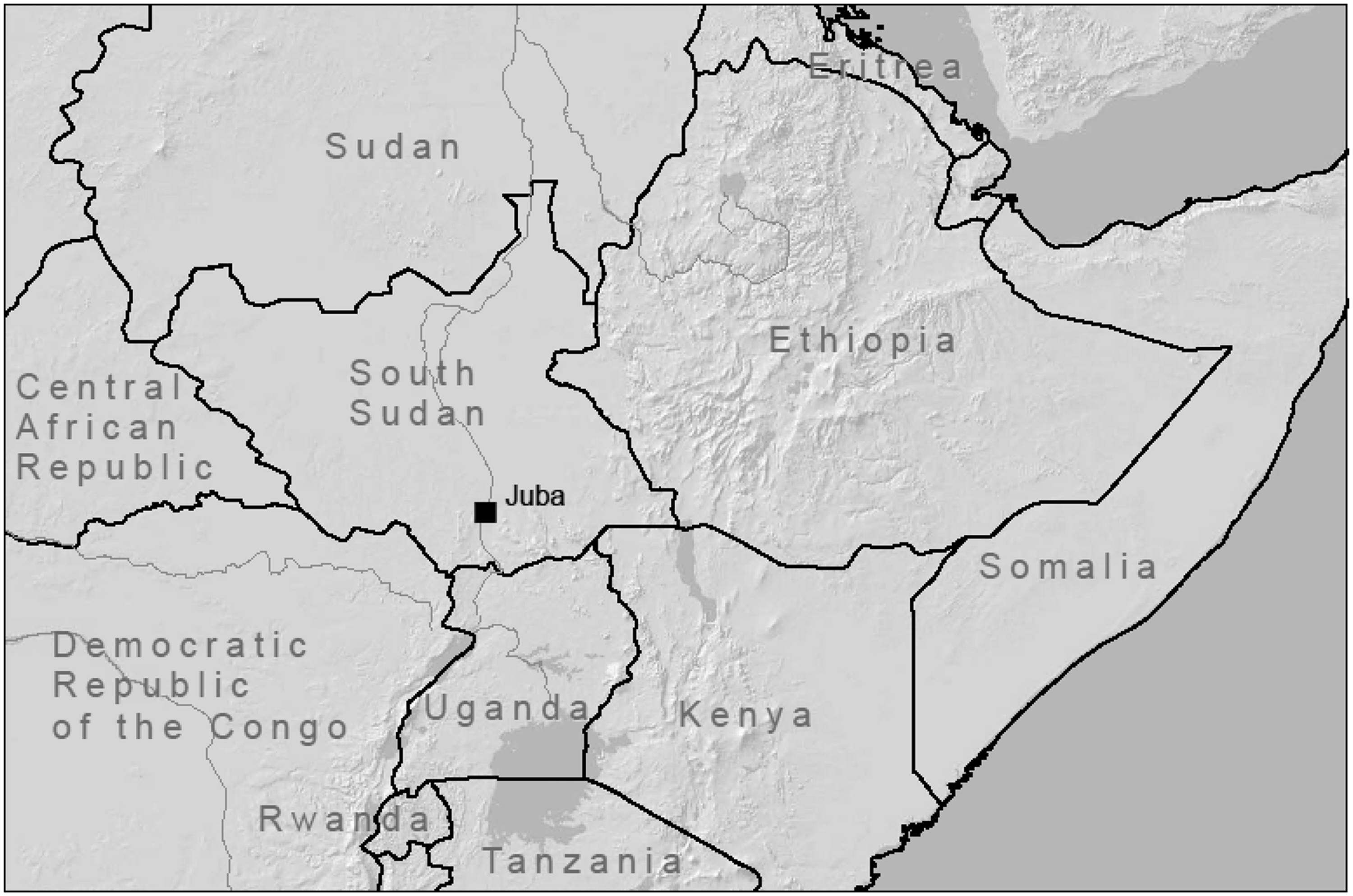
In the agricultural sector, the government of the Republic of South Sudan has emphasized a national economic policy framework that prioritizes international large-farm investments. This policy emphasis is quite risky considering past difficulties—political and practical—in attempts at large-scale irrigation (for example the Jonglei Canal and irrigation for agriculture schemes at Gezira) and the considerable ecological critique (Howell et al., 1988). This time around the Government is even more pressured to fulfill its agricultural potential based on the prospect of an expanding population, unsustainable low levels of development and a renewed interest in the country resources by a growing list of international suitors.
Motivated by analyses showing approximately 5% of total land is under cultivation and land is underutilized, the Government considers (and international financial institutions (IFIs) support this kind of thinking) that foreign direct investment (FDI) in land will be followed by large infrastructure spending on irrigation, transportation, storage and processing (FAO/WFP, 2012). So far, two FDI surges into South Sudan have been registered: in the first wave FDI inflows targeted telecommunications, construction and tourism, and in the second wave FDI targeted large tracts of land in rural areas. Some (e.g. GRAIN, 2012) have termed this as a ‘land and water grab’). Importantly, rural rather than urban development has been emphasized and urban planning in Juba and other cities still remains at the conceptual stage (USAID, 2005).
Outline of the article
There is no scholarly literature on Juba’s urbanism. A gray literature, mostly focusing on land issues, exists (De Wit, 2008), and specific studies have been commissioned by international organizations on specific urban topics (e.g. Overseas Development Institute (ODI) studies; Martin and Mosel’s (2011) study on urban vulnerability; Martin’s (2010) on gender, violence and survival; USAID’s (2005) Town Planning Assessment; and USAID’s (2007) study on community planning for resettlement). There is also a gray literature on South Sudan that has relevance to Juba with regard to urban food security (FAO/WFP, 2012) and foreign land investments (Oakland Institute, 2011). Moreover, a wide variety of organizations produce and disseminate regular (monthly) briefings on South Sudan on food prices and food security (FAO), general security and criminal activity (US Department of State, UN) and economy and financial developments (Africa Research Bulletin). These various reports have not been synthesized and assessed to date. We draw on these reports as well as observation on the ground in Juba (from June and December 2011 and September 2012) to present an up-to-date assessment on Juba’s urban transformation and local economic development.
Our analysis of Juba is framed within a growing literature on globalizing urban Africa (Grant, 2009) and globalizing dynamics in the region (De Bruijn et al., 2012): we draw specifically on the concepts of ‘wounded city’: in Mogadishu (Myers, 2011), ‘pathological urbanism’ in Khartoum (Sudan) (Assal, 2012) and ‘fortress architecture’ in Johannesburg (Murray 2011) that may shed light on Juba’s situation. Myers’ (2011) concept of wounded city captures the essence of urbanism within an atypical social order punctuated by a loss of relevance of the state and urban dynamism being inextricably linked to diaspora networks that connect diverse places. Assal’s (2012) pathological urbanism emphasizes rapid urbanization without social integration, largely a mode of urbanization as a response to a post-conflict situation and countryside collapse. This finds salient expression through a ‘ruralization of the city’ as migrants assemble self-help systems to navigate the harsh new urban realities, but urban living and surviving fails to mitigate ethnic division or difference and subsistence livelihoods dominate. Murray (2011) highlights the securitization of urban space in Johannesburg’s inner city, where fortress architecture is deployed to secure the corporate citadel amidst adjoining immigrant enclaves and informal economic spaces. We use these three notions of the wounded city, ruralization of the city and fortress control enclaves as a framework for our assessment of Juba’s dynamics.
Our article is organized as follows. The next section discusses Juba in the context of South Sudan’s history. The third section focuses on local economic development and explores the transnational economic development of Juba centering on the development complex as well as transnational control of import trade. The final section offers a series of concluding comments on the future of Juba and urbanization in South Sudan.
Juba: A brief history
Founded around 1920 as a southern outpost in the British administration of Sudan, by the eve of Sudan’s independence in 1955 Juba had become the capital of the Southern Sudan administrative area and a site of intense political debate regarding the future of Sudan. The 1947 Juba Conference determined that South Sudan and North Sudan, (administered previously under distinct British policies that engendered large regional disparities in wealth, education and development), would become independent as a unified country. Unsurprisingly, the lack of development in the South and the uneven center-periphery relations that favored Khartoum at the expense of the Southern population, triggered war on the eve of independence. Juba for nearly the next two decades was a contested city, though conflict primarily took place outside of the municipality and the urban area remained, for most of this period, under Khartoum’s control. During the period of peace from 1972–1983, Juba was the seat of Southern political power, and became known as a center of government corruption and opulent spending by politicians, a site somewhat separated from the rural livelihoods sought by ordinary Southerners (Nyaba, 1997: 22).
When the Second Sudanese Civil War broke out in 1983—this time with an increasingly organized rebellion led by the Sudan People’s Liberation Movement/Army (SPLM/A)—Juba likewise remained a stronghold of the North while the SPLA took control over most of the South (Akol, 2007). While conflict remained mostly outside of the town itself, Juba was at the center of the civil war as the SPLM/A sought to gain control over the southern capital, a stronghold of Northern forces. When the SPLA appeared to be near capturing Juba in 1991, the rebel army split into two rival factions that then further divided until virtually all of central South Sudan was embroiled in intense internecine conflict, allowing the National Islamic Front (NIF) Government in Khartoum to maintain control of Juba and surrounding areas in the far south while ethnic conflict raged in the toich—the swampy areas along the Nile. Although armed conflicts remained largely outside of Juba during the war, this should not be taken to mean that Juba was a peaceful town during this time: prisoners were kept there, executions occurred, and much of the Southern civilian population of the town and surrounding areas were forced to flee.
As the civil war ground slowly to a halt from 2002–2005 and the area grew safer and more stable, Juba began to increase in importance to the international community. As the seat of southern government once again, Juba became the primary location for the offices of foreign companies and NGOs looking to assist the Government of South Sudan (GoSS) with restructuring, infrastructure development, and peacemaking between warring groups during the periodic bouts of ethnic violence. Increasing aid flows into the bustling town were manifested by an increasing presence of ‘expat’ compounds and offices surrounded by barbed-wire-topped fences or walls, armed security guards, and airport-style security screening upon entry, leading the city towards what in the South African case has been deemed ‘fortress architecture’ (Murray, 2011) (see Figure 2, image of UNCIEF Compound, 2012).
The UNICEF compound in Juba.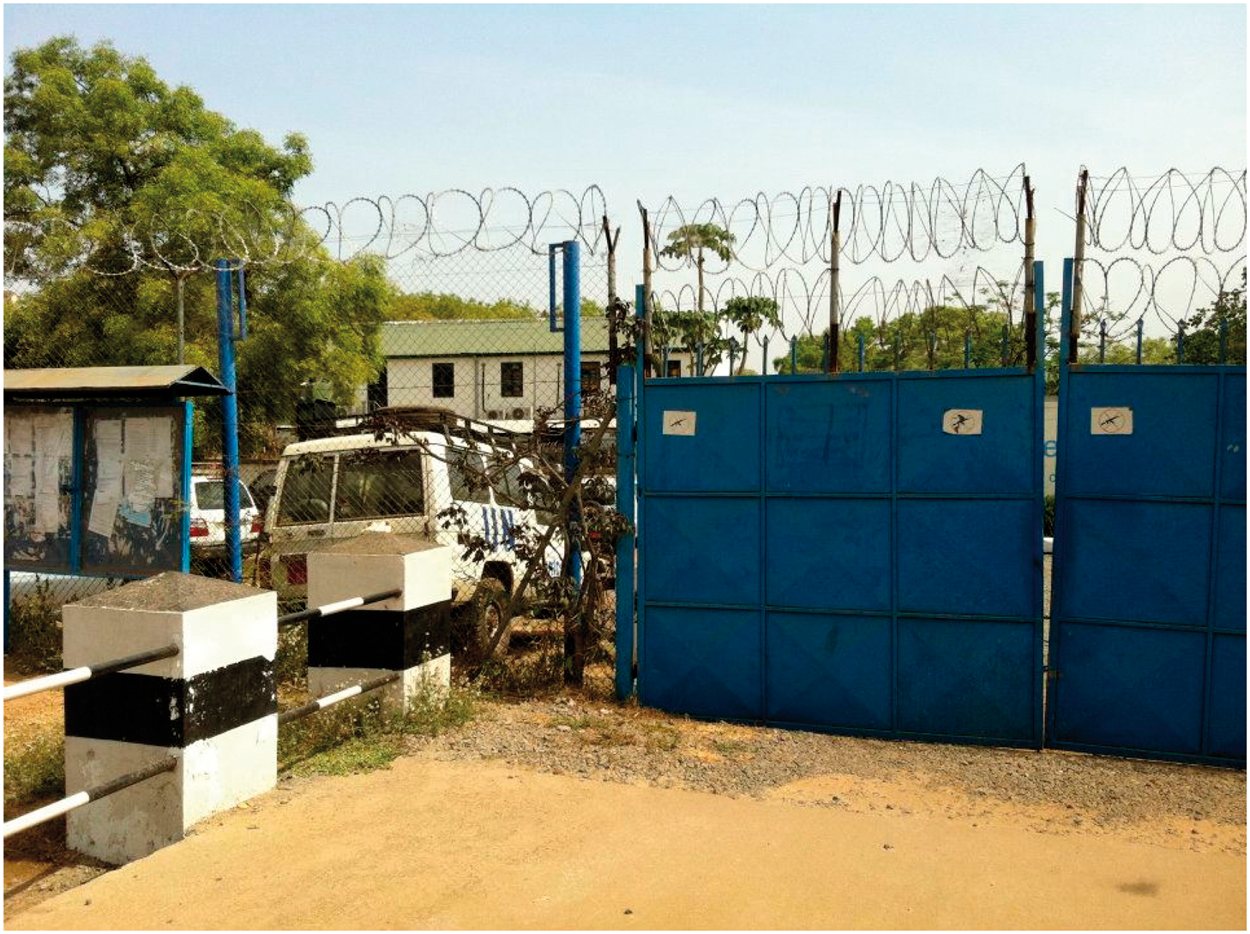
Juba in peacetime
After the war ended, Ethiopian and Eritrean capitalists, as well as businesspeople from other neighboring countries, invested in the hotel and restaurant businesses catering to the expat population. As has been the case in other conflict cities such as Mogadishu, the import of aid personnel caused rampant price spikes in the city and, in a sense, created a division between the locally-driven and transnational-driven economies of the city. Goods in South Sudan cost more than in surrounding countries largely due to difficulties in importing goods via a neglected and often non-existent infrastructure network (most are routed through northern Uganda along a highway that is severely neglected from Gulu to the border at Nimule). Parts of Juba operate within a ‘bubble’, where expats pay approximately US$150.00 for a sparsely furnished room in a portable building at the New York Hotel in Hai Malakal and US$30.00 for dinner at the up-market Juba Grand Hotel next door. Although many of these establishments are owned by migrants from elsewhere in East Africa, locally-owned restaurants like Home and Away also cater to the population of expat workers and South Sudanese Government officials.
Juba’s boom is also being fueled by the lucrative prospects of oil development in South Sudan, infrastructural development opportunities and security contractors, for example Washington, DC-based PAE (Pacific Architects and Engineers), owned by private equity firm Lindsay Goldberg, LLC (Africa Research Bulletin, 2010: 18906; see also World Bank/International Finance Corporation, 2011). Consultancies with various ministries of the South Sudanese Government have also provided well-financed positions for development specialists. The presence of IFIs like the World Bank seems to duplicate these positions as they provide their own economic advisers to the government. While it is rather unsurprising, given the low levels of education in South Sudan as a whole, that development advisers should come from abroad, locals are even often excluded from the formal business environment in Juba, a trend reinforced by the influx of foreign capital. Start-up costs for businesses run at about 250% of per capita income, more than twice the average for Africa south of the Sahara (World Bank/International Finance Corporation, 2011). A few NGOs and IGOs have focused on transfer of skills to the local population; however, the larger organizations such as the UN have done little in this regard, and even tend to exclude locals from their organizational structure. Despite the Government prioritizing the transfer of skills to locals, human capital investment is particularly weak.
Influxes of international workers and international offices have driven the rampant expansion and densification of Juba’s urban area since the end of the civil war. This urbanization is by no means even, and is to some extent determined by the divergence in the economy between foreign-owned formal businesses and locally-owned informal ones. The master plan for Juba was developed by the Japan International Cooperation Agency (JICA), and has been criticized for its top-down approach that favors low-density settlement around central government areas, requiring relocation of people to overcrowded peripheral settlements (Pantuliano et al., 2011: 3). With the intensification of fortress architecture in the center, much of the local population, except for affluent government officials and businessmen, are excluded from the securitized areas and confined to peripheries, a trend exacerbated by the lack of property rights allocated to those occupying Juba’s land before and during the civil war. Furthermore, IGOs oftentimes determine international staff access to areas of the city, with instructions on which areas of the city they are allowed to visit, going above and beyond specifying safe and dangerous zones. The UN Department of Safety and Security (UNDSS) can on occasion declare specific neighborhoods or specific venues off-limits to its staff. Many organizations follow UN protocol, so areas deemed dangerous may immediately lose significant business, potentially contributing to further segmentation of the city between the wealthier, ‘safe’ areas and the poor, ‘dangerous’ ones. On the other hand, the micro-geography of safe and dangerous can be highly fragmented: a venue might be declared off-limits while a restaurant next door remains a popular meeting place for government officials and development/security experts.
Despite the focus on ‘development’, particularly on infrastructure development such as the proposed oil pipeline to Kenya, most of Juba itself lacks such basic infrastructure as an electricity grid, a sewer system, and potable water sources. Much of the peacetime population growth has taken place through the densification of informal housing within the city and on the urban periphery. Construction has preceded service provision throughout the city. On main roads, streetlights are individually powered by solar panels; government and NGO/IGO compounds utilize generators for electricity, and water trucks filled with water from the Nile provide water to neighborhoods. The lack of planning and extremely rapid urbanization has heightened the tendency toward unregulated informal urban sprawl. These areas often intertwine rural livelihoods and urban settlement: for example, much of the settlement in Gumbo, across the Nile from the central city, is occupied by families of cattle-keepers who bring their herds to market in Juba. Concurrent with the resumption of revenue flows from oil in October 2012, the Government has planned to begin demarcating areas of the city to determine property rights and to begin planning service delivery for certain areas. However, it is certain that this will be a lengthy process and lead to more tensions over land than those that have already sparked violent disputes between the local Bari community and larger ethnic groups such as Dinka and Nuer (Sudan Tribune, 2011). The process will doubtless be lengthened by the numerous approvals that must be made for land allocation due to communal ownership of property.
Local economic development and transnational-driven development of Juba
Large investments in industrial farms in South Sudan were initiated after the 2005 CPA. Since 2005, 1.7 m hectares has been acquired for ecotourism and 600,000 (that could rise to 1 m) has been allocated for agro-fuels and subsequent deals converted a part of the agro-fuel deal into agro-forestry and mining (oil, gas and other unspecified mining) (Oakland Institute, 2011). Forecasts of falls in domestic oil production (by 50% within the five years) have intensified government efforts to boost FDI in land. Speculation about unexplored deposits of natural resources (e.g. copper, gold, tin and uranium) motivated early investors (Oakland Institute, 2011). The Government believes large-scale farming is the shortest route to boost food production and alleviate food deficits. Between 2007 and 2010, 8% of South Sudan’s total land area was acquired by international private interests (firms from the US, Egypt, UAE, and UK are the largest investors) (Oakland Institute, 2011: 2). International land acquisition occurred outside of an adequate regulatory framework and without appropriate local consultation: ‘Juba intellectuals’ came forward to negotiate on behalf of communities and persuaded community leaders to sign land agreements without understanding the terms (Oakland Institute, 2011: 25). Furthermore, GRAIN (2012) warns that the irrigation needed for fully operational large-scale farms slated for the entire Nile basin (from South Sudan-Egypt) would exceed the capacity of the Nile, causing the river to ‘run dry’.
Within the city itself, the Development Complex economy incorporates not only the many workers that are directly employed, but also auxiliary businesses that depend on its spending power (hotels, restaurants, transport, logistics, security firms, etc.) and consumption of food and other commodities such as vehicles that are imported to cater for their needs. Development employment provides stable and secure work. Nevertheless, firms from neighboring African states dominate various sectors of the Juba economy. For instance, 500 construction firms are registered in Equatoria State: most firms originate from Ethiopia, Kenya, Uganda and Somalia. Martin and Mosel (2011: 13) highlight that few business of medium-size are owned by South Sudanese and firms from Khartoum are larger players than Southern Sudanese firms. Moreover, most profits from this urban-economic sector are not reinvested in Juba or even South Sudan but bypass the national banking system and leak into neighboring countries (Martin and Mosel, 2011).
The emphasis on international large-farm investments has led to the neglect of urban agriculture. During the war years, urban agriculture was widely practiced in peri-urban Juba. Indeed, peacetime has seen an urban agriculture contraction at the same time as food scarcity leads to price hikes on imported foodstuffs. According to the FAO (2012) 5% of Juba’s land is under urban cultivation. Urban infilling and residential development have put urban agriculture under severe pressure and insecurity outside of the government/IGO/NGO-dominated neighborhoods has curtailed in situ urban subsistence farming, indicating the manner in which pathological urbanism is worked out. Instead, the urban poor concentrate on firewood collection, informal construction (digging pit latrines, stone breaking, and mudding traditional dwellings), charcoal making (exacerbating deforestation), petty trade (tea and food selling), motorcycle taxi (boda-boda) driving, and brewing alcohol. Building and food supplies originate from neighboring countries and the trade is dominated by international enterprises from throughout the region. High cross-border transport costs (including taxes at illegal checkpoints that can add 75% to costs) are incorporated into Juba prices (Martin and Mosel, 2011). The urban food economy, in particular, is very lucrative for international traders and it has intensified food insecurity as the urban poor cannot afford to pay imported prices. Malnutrition is now more prevalent as the urban poor skip meals and depend on food aid and wild food when it is available. Profits are so high on food smuggled from Sudan to South Sudan that the Khartoum Government was forced to introduce a state of emergency in 2012 to curb cross-border clandestine food trade (FAO/WFP, 2012). Lack of opportunities, except at the bottom level of retailing, has meant the petty trade is overcrowded, forcing some more vulnerable members of the urban poor into occupations at the margins; for example, prostitution and other casual exploitative employment arrangements.
Conclusion
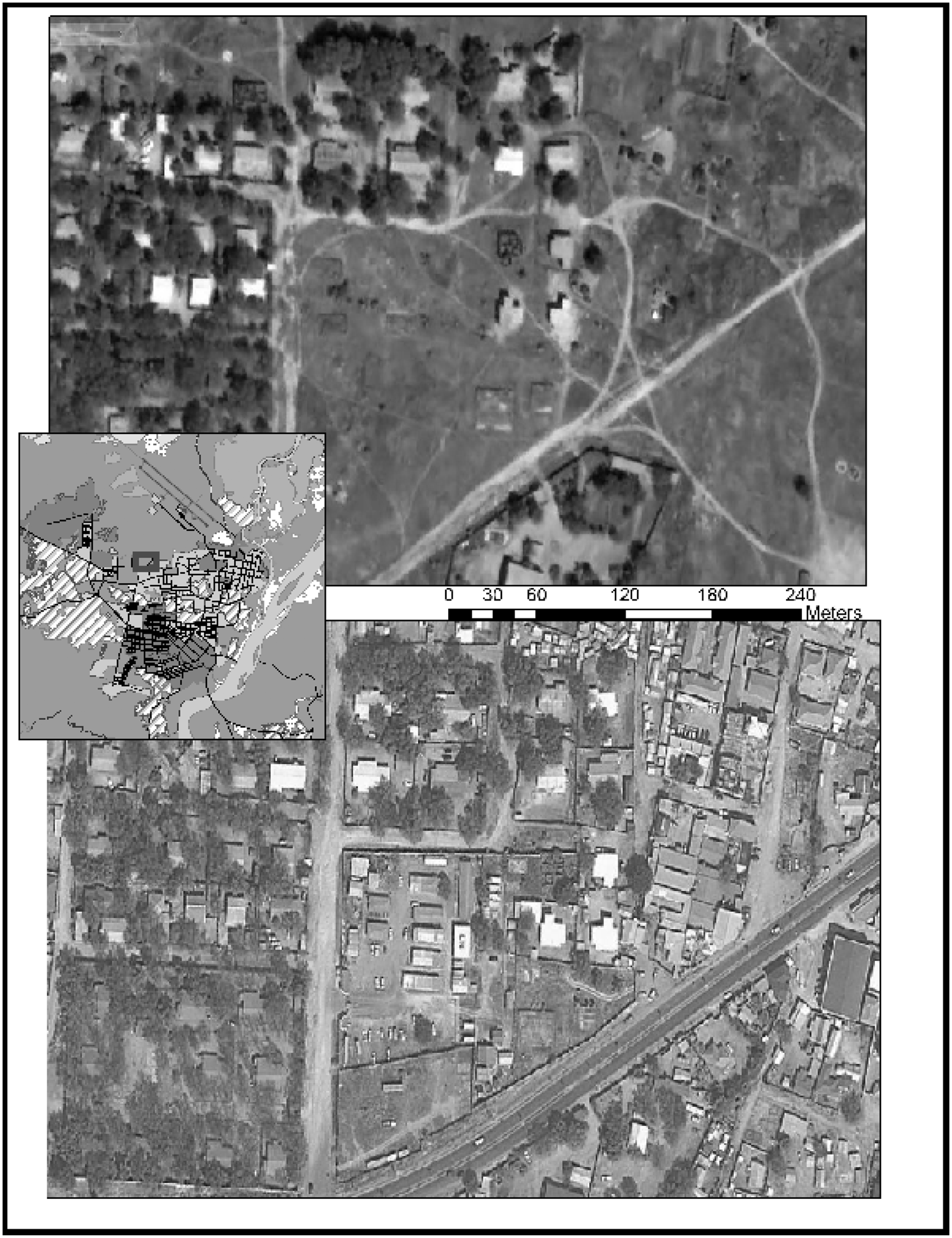
The Development Complex-driven urban economy provides direct employment opportunities (for office workers/drivers/security guards) and indirect employment to ancillary industries (construction, hospitality, logistics, food and consumer imports) for both locals and migrants in Juba. This leading edge of the economy attracts more transit migrants into the city supposedly on route to their home village—in many cases this migration has become more permanent as the restructuring of the rural economy has not yet materialized and money remains ‘trapped’ in circulation around government and IGO/NGO areas of Juba. Although international investors have begun to purchase land, farming projects remain sidelined due to the volatile political-security situation, and many of those involved in the planning of rural projects remain in Juba, meeting with various development experts and government officials. The Development Complex has contributed to changing the geography of Juba and urban infrastructure development and office and residential development have been drawn to this focal area, leading to densification, as well as segmentation, by walling off areas. Satellite imagery from 2003 and 2012 shows the densification of settlement to the south and east of the area that is now a UNDP compound, alongside a walling-off of the low-density housing around the compound (see Figure 4). It is evident that this post-conflict ‘wounded city’ provides a fertile ground for specific kinds of investments, and regional players are the first to enter local economic development while the local population is largely left behind.
Map of Juba’s urban expansion 2003–2012. Source: Google Earth. Satellite imagery of UNDP compound (top, 2003; bottom, 2012). Source: Google Earth. Source of shapefiles in inset: Baseline Mapping of Juba Town by the Regional Centre for Mapping of Resources for Development (RCMRD).
The Government of South Sudan has not engaged with the realities of urbanization, leaving Juba urban planning in a state of relative chaos. This is partly due to the lack of funds brought on by the shutdown of oil production during 2012 and the focus on national issues such as border demarcation between Sudan and South Sudan. However, corruption and oversight have played a role as well. The important role that urban growth and development plays in driving regional and national economies has been overlooked. In focusing on large-scale agriculture, the potential of urban agriculture to contribute to national (or even local) food security and indigenous entrepreneurship has not been prioritized. High start-up costs exclude locals from Juba’s formal sector, and the Government has been content to allow the Development Complex to steer urban development, allowing the informal sphere to dominate and regional entrepreneurs reap the benefits by controlling supply networks. To cope, urbanites have established self-help and survivalist livelihoods similar to those of migrants to Khartoum (see Assal, 2011). Lack of planning and failure to come to grips with the spatial fragmentation of Juba is now likely to continue as the Government explores building a new capital city at Ramciel rather than overhauling Juba.
President Salva Kiir’s decision to relocate the national capital from Juba to the center of the country, in Ramciel (Lakes State) revives an earlier plan proposed by the SPLM but shelved due to local opposition. A lucrative contract to design Ramciel was awarded to the Pan-China Construction Group in October 2011, and a South Korean company is undertaking a feasibility study that is scheduled to be delivered in October 2012 (Sudan Tribune, 2012). The reasons behind the move include not only land disputes within Juba, but also the poorly planned infrastructure of the capital city. Initial construction would be ‘partially borne by the government with assistance from donors or loans from the World Bank and International Monetary Fund’ (Amos, 2011). Critics question the expense of building a new capital in a deeply impoverished country, but others contend that a new capital represents an important new beginning (Marlow, 2011). Other critics claim the proposed move of the capital is simply a ruse to pressure the local government into ceding Juba’s land to the federal government. The prospects of further development in Juba would likely diminish if the Government follows through on relocation and would be followed by IGOs, NGOs, and IFIs, potentially leaving the urban poor behind in Juba. Still, Juba would likely retain its important market function as an import node.
The construction of a new capital is of course not without precedent. Besides western cities like Washington, DC, several colonial primate cities in Africa have been relocated to new locations (e.g. Nouakchott (Mauritania), Gaborone (Botswana), Lilongwe (Malawi), Dodoma (Tanzania), Abuja (Nigeria) Yamoussoukro (Cote D’Ivoire).] Clearly the issue of spatial centrality, rational planning, and administration efficiency as well as a new symbol of national pride is behind many of these moves (Potts, 1985; Schatz, 2004) as well as some ethnic favoritism in many of the examples (e.g. Lilongwe and Ramciel). However, it is clear that capital relocation does not solve nation building dilemmas. Strikingly in the case of South Sudan the Chinese model of building a new city from a virgin ground upwards is the basis of the planning model rather that any of the earlier African efforts. In this regards the Development Complex-Driven Urbanization looks set to continue as the modus operandi.
Juba’s situation provides insight into post-conflict urban dynamics in today’s world of competitive development and foreign investment apparatuses. Post-conflict urbanism is a particularly weak area for urban theory, policy and planning. Standing back and/or letting the market do the work does not appear to be providing equitable development, either in Juba or South Sudan as a whole. Mechanisms to include local participatory involvement in the policy and planning process as well as to meaningfully connect with diaspora networks and local civil society presence would be a far more fruitful direction. With its proximity to international borders, Juba offers a very strategic location for businesses in South Sudan and it is high time that policymakers and the international development community introduced an urban plan that would enable Juba to serve local interests while tapping the influx of foreign investment and highly-trained foreigners.
Footnotes
Funding
This research received no specific grant from any funding agency in the public, commercial or not-for-profit sectors.