







Abstract
Community empowerment is a core element of area regeneration policy in the UK. In this article we question whose purpose the policy goal of community empowerment serves by examining the policy from three ‘actor’ perspectives in a neighbourhood regeneration setting: the Housing Association, a campaign group that became a Registered Tenants Organisation and residents living in the area. Using a model of community empowerment developed, we conclude that the ‘wider community’ was not empowered by the processes but that community empowerment was used by other parties to legitimate their aims. We make three conclusions in relation to: the relevance of community empowerment alongside other objectives; policy oversight and regulation; and, the relationship between community empowerment and representative democratic structures.
Introduction
The language of community empowerment has permeated regeneration policies for disadvantaged communities in recent years, with this notion subscribed to by service providers, implementation agencies and professional groups. In this article we examine how community empowerment plays out in practice, in the context of such a ‘community mobilisation’ discourse (Raco, 2003: 235) through examining the case of neighbourhood regeneration in a major Scottish city.
The role of the community has been increasingly emphasized since the late 1990s as a core element of area regeneration policy and ‘neighbourhood renewal’ throughout the UK reflecting government’s ‘favoured’ mode of governance, namely partnerships between government and civil society in which individuals and communities accepted more responsibilities to help themselves, and to work in a joint endeavour with government (Imrie and Raco, 2003). This agenda was taken forward in a different guise by the Conservative-Liberal coalition government elected in 2010, with its focus on the ‘Big Society’ and the devolution of power to the local level (DCLG, 2010).
This community-focused policy approach is particularly prominent in Scotland. Since devolution in 1999, a series of policy statements from successive governments have highlighted the role of the community in regeneration and the fundamental importance of community empowerment in two main areas: public services to disadvantaged areas and the social capital of communities (Scottish Executive, 2002a), as well as a community learning and development strategy (Scottish Executive, 2002b, 2003). The SNP minority government, elected in 2007, published a Community Empowerment Action Plan that articulated the benefits of community empowerment for public policy. Namely that it is: more creative, so local people could devise successful solutions to problems; more effective, in that ‘communities doing things for themselves can sometimes be the best way of delivering change’ and more democratic, because community involvement in local affairs increases people’s interest in and engagement with national and local government activities (The Scottish Government, 2009). The SNP majority government, re-elected in 2011, took this further in introducing a Community Empowerment and Renewal Bill.
In the context of neighbourhood regeneration, community empowerment implies a rebalancing of power between stakeholders: the rebuilding of community and the participation of local communities is seen as prerequisite for the success of the regeneration process (Mayo, 2004). However, despite the importance put upon community empowerment in policy there is a vagueness regarding how it plays out in real terms: the term is used uncritically and can be a catch-all to further or legitimate policy. There is little evidence that the many initiatives with an empowerment focus actually empower communities (Rogers and Robinson, 2004; Wallerstein, 2006). Somerville (2011: 91) observes that successive governments have offered a ‘vision of empowerment to communities that is largely illusory’ and Fuller and Geddes (2008) suggest a tickbox control mechanism to enmesh communities into a largely preordained state-driven neoliberal governance process (see McGuiness et al., 2012).
The aim of this article is to question whose purpose the policy goal of community empowerment serves in neighbourhood regeneration. We start by looking at some concepts important to understanding community empowerment and set out a model of it. Through empirical research we examine how the policy plays out from three ‘actor’ perspectives in a neighbourhood regeneration setting. From this we make three key conclusions relating to how community empowerment as a policy goal in regeneration can be taken forward.
Community empowerment: Some concepts
The wide literature on community empowerment is from a range of fields including health (Laverack, 2007; Wallerstein, 2002), social capital (Mohan and Stokke, 2000; Woolcock and Sweetser, 2002) and community development (see Skerratt and Steiner, 2013). We are interested in how community empowerment relates to regeneration policy: here, the notion of community is about a spatial, geographical area which assumes homogeneity of interests, where residents ‘belong’ or are ‘members’ of the community. The implication is that there is common interest among residents who will want to engage with processes of transformation. The reality is that communities are fragmented, diverse and based on interest and identity as well as on geographical location. There can be tensions between cohesion and diversity. Similarly, there may be very different concerns between individual and community needs, and ideas of belonging and freedom (Henderson and Versceg, 2010).
Typically, neighbourhoods undergoing regeneration have further issues stemming from deprivation; they may be ‘inhabited by shifting and multiply fractured populations’ (Fuller and Geddes, 2008: 262) or be the sites of ‘fragile and temporary settlements’ (Amin, 2005: 66). They can be areas of contestation, division and social closure (see Wallace, 2010). There is a long tradition of suspicion about the intentions of regeneration initiatives and antipoverty programmes in poor areas and their ability to operate in the best interests of residents (McCulloch, 2004). Poorly planned empowerment initiatives can create further exclusion and disengagement, possibly even disempowerment (Attree et al., 2011).
Issues about community representation have been well documented. However, little is known about how communities understand and confer legitimacy on their representatives and what alternatives they seek if these are not adequate. If power is handed to a small group, the mechanisms for holding them to account, if they do not act in the best interests or the wishes of the wider community who are to have decisions made on their behalf, is not clear (Taylor, 2003, 2007). There are tensions between representative and participatory forms of democracy, and debates about who is really most accountable and representative of communities: elected representatives or ‘community leaders’. Much of the literature here dwells on the negative, with the proponents of each side accusing the other of not being accountable or representative (Gaventa, 2004).
In the context of top-down policy initiatives, there can be considerable resource and capacity imbalance between communities and other stakeholders with fundamental inequalities in the bargaining positions of different partners (Jones, 2003). It is argued by some that communities can be easily recruited, and possibly manipulated, into empowerment initiatives where they gain little or no benefit, but where those who initiate such processes use participation for their own ends (Banks and Shenton, 2001; White, 1996). Evidence suggests that community voices can be excluded by the ‘rules of the game’ and ‘traditional routines’ that are taken for granted by other partners (Foley and Martin, 2000; Taylor, 2003). If people are not aware of their real interests, simply creating greater opportunities for involvement and participation will not be sufficient to empower them to argue for or make necessary changes.
There is little evidence to say how community empowerment is achieved. Previous research has identified that there is still an ‘implementation gap’ (Taylor and Wilson, 2006) that must be addressed if such policies are to be effective. There is therefore a need to address how policy rhetoric can work in practice through an enabling policy environment or, as an alternative view, whether community empowerment, particularly in the context of neighbourhood regeneration, is a useful goal to have at all.
A model of community empowerment
In order to make an assessment of how community empowerment can be achieved, we have developed a model of it, drawing on the World Bank’s definition as a community’s ‘capacity to make effective choices, and then to transform those choices into desired actions and outcomes’ (Alsop et al., 2006: 10). Our model has three key elements (Figure 1) and is based on what can potentially be achieved given that structural conditions and the policy context are to a degree fixed. We use the term community to refer to people living in the locality: an outer circle represents the ‘wider community’ and the inner circle refers to those involved in some form of community organization.
A model of community empowerment.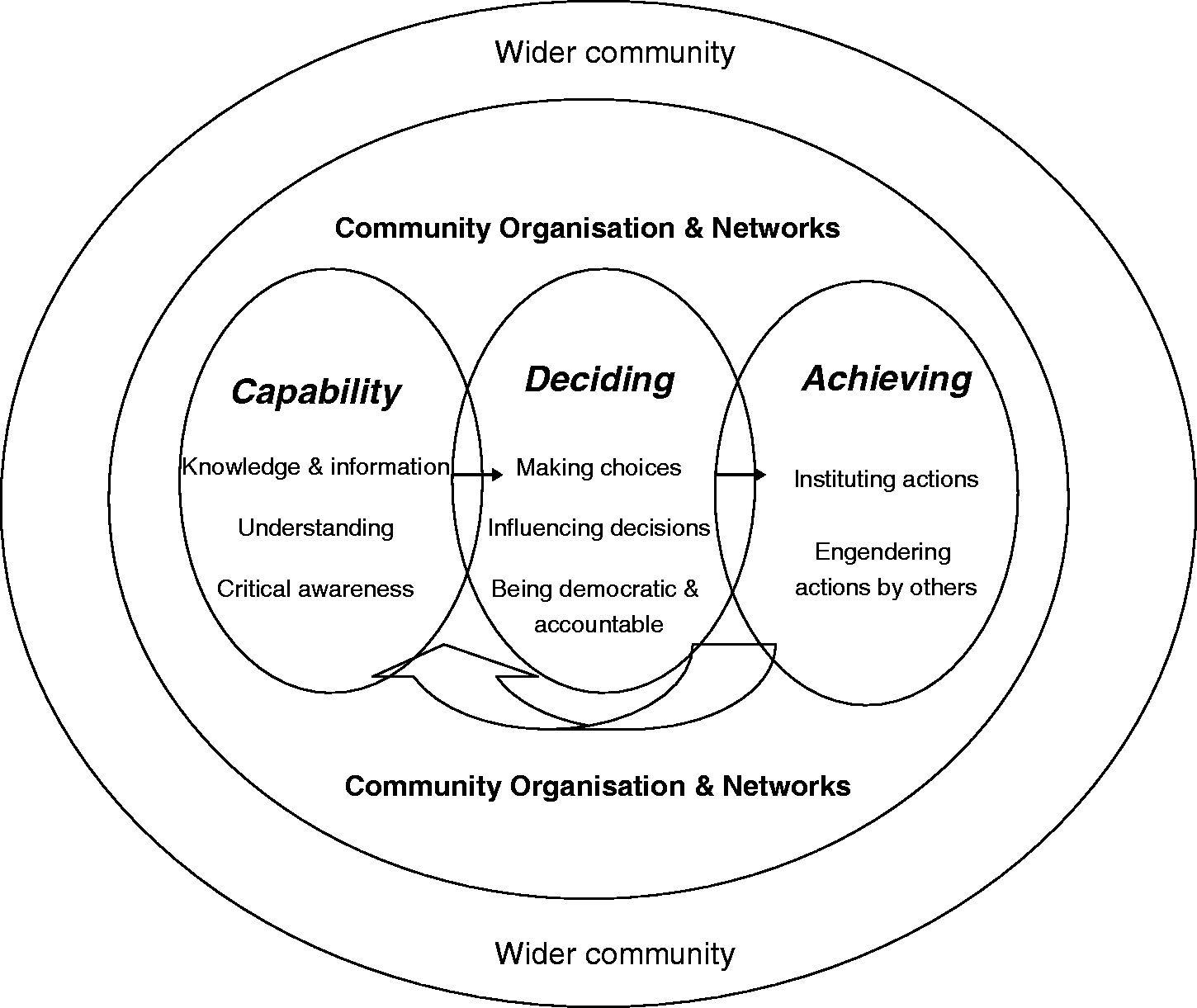
The first element in the model is capability, acknowledged in policy statements about ‘capacity-building’, which has three components: knowledge, understanding and critical awareness. A well-informed community is central to community empowerment. Clear, relevant and accessible information can not only inform communities about what is happening but can be key to enabling people to have some involvement or play a role in an area’s regeneration (see Taylor, 2003). Studies have shown that communities are often excluded and disempowered by having no knowledge of what is going on in their neighbourhoods or of the opportunities that may exist (Wallace, 2010). Secondly, in order to argue their case convincingly, communities also need to understand the language, parameters and constraints of practitioners, so that they can mount convincing arguments for what they want, rather than being seen as participants who ‘know what they want, but understand nothing’.
The third component is critical awareness, whereby people become more engaged and thereby more reflective and challenging (Ledwith, 2007). The process of ‘conscientisation’ has been described as a process of emancipation through learning or education that may enable communities to mount arguments and actions to change the underlying political, economic and other circumstances that affect their lives (Freire, 1998; Laverack, 2007; Mayo, 1997). If communities understand their position, they may be more able to be critical, reflective and pragmatic about where they want to be and how they want to get there.
The second element is Deciding. Somerville (1998: 253) states that by whatever means empowerment takes place the key question is ‘… whether it helps to place residents in a position where they can choose their own way forward’. The capacity to make effective or informed choices is shaped by a community’s ability to consider and purposively choose options and by having the opportunities that enable them to do so (The World Bank, 2005). In situations where the community is not in a position to decide things, it may feel more empowered if it is able to influence those decisions. Since the community’s input is often made through selective or representative processes, then to be empowering of the wider community, decision-making also has to be democratic and accountable with feedback arrangements.
The third element is Achieving. Community empowerment can only be attained if there is the ability to institute actions directly, or engender appropriate actions by others, based on the decisions made. In this way communities may achieve their aims, and the process is not simply one of making abstract choices that do not lead to change (Lawson and Kearns, 2010). To institute such actions, it may also be important for community organizations to be part of wider partnerships and networks which give them access to power circuits, resources and opportunities (Gilchrist, 2004). Communities can operate within established partnerships and existing governance arrangements, or through self-organization in a more organic process. Where communities choose the latter, this can provide a space for them to develop their own narratives and voices (Taylor, 2007: 311).
Community empowerment initiatives should benefit the wider community and not be to their detriment; this relates to issues of representativeness and accountability as previously discussed. The outcomes of community empowerment should be about communities being or feeling more in control and/or gaining the ability to change or influence aspects of their homes, neighbourhoods and communities (individually and collectively). There are degrees of community empowerment in all three constituent domains; it is not an either/or attribute.
Aims, context and methods
Aims
Our main aim was to question whose purpose the policy goal of community empowerment serves in neighbourhood regeneration, by examining it from the perspective of each of the main ‘actors’ involved. Specifically, we were interested in exploring the relative importance of community empowerment alongside regeneration objectives and the relationship between community empowerment and representative democratic structures.
The Clydemount1 estate
Timeline of Clydemount’s history.
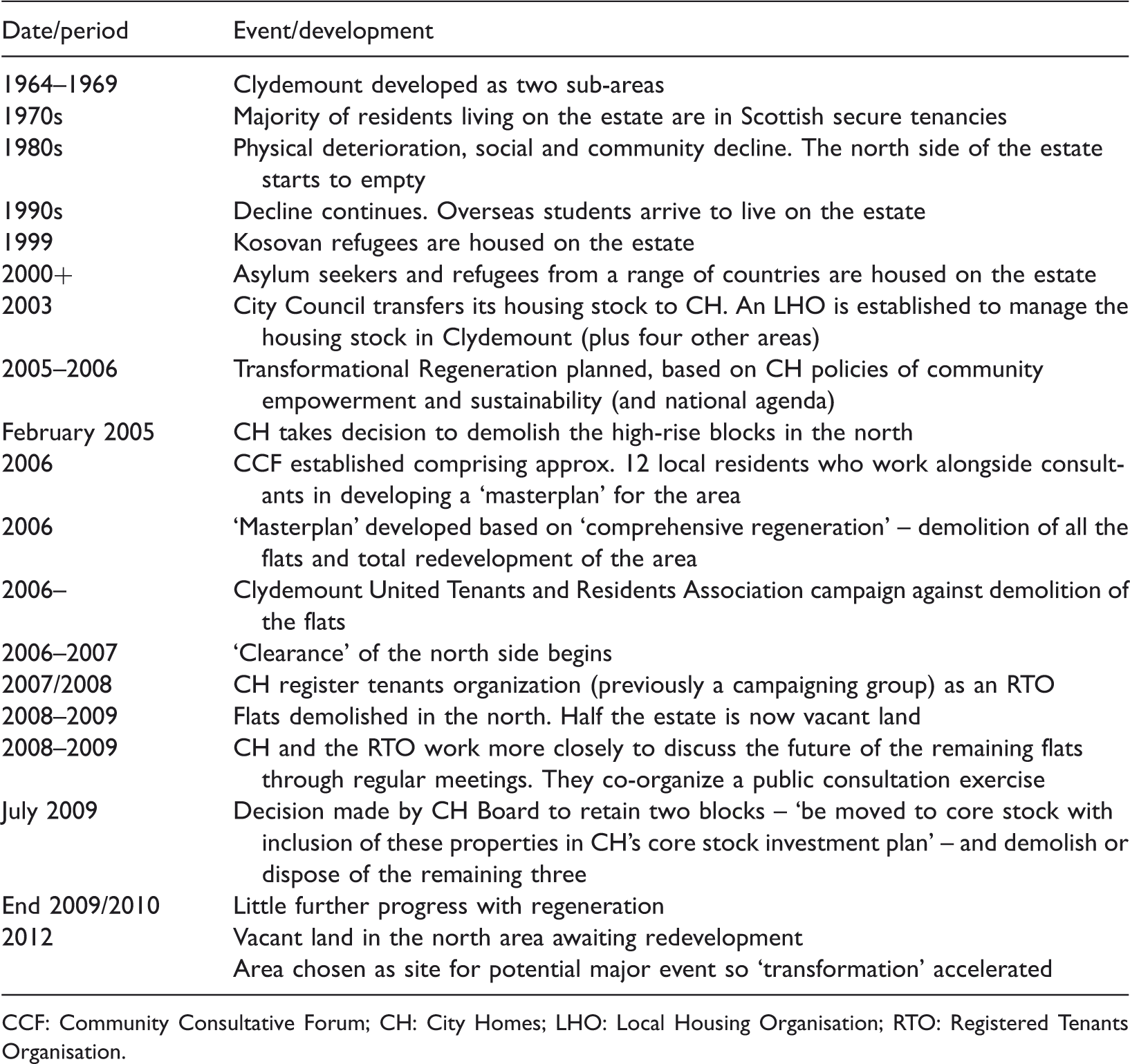
CCF: Community Consultative Forum; CH: City Homes; LHO: Local Housing Organisation; RTO: Registered Tenants Organisation.
The City Council’s housing stock was transferred into the ownership of City Homes2 (CH) in 2003, following a ballot of the city’s tenants. Within CH’s structure, the day-to-day management of the estate became the responsibility of the Local Housing Organisation (LHO). CH’s strategy and promise to tenants was to convert the ex-council housing stock into part of ‘a sustainable housing system’ in the city by 2013 (City Homes, 2004). By 2005, CH identified Clydemount as an estate requiring large-scale regeneration (City Homes, 2005b) and the decision was taken by CH’s Board (on the recommendation of its Regeneration Committee) to demolish the flats in the northern half of the estate, which was considered to suffer the worse problems of low demand (City Homes, 2005a); clearance of the blocks ensued and demolition took place 3 years later. In 2006, Clydemount was identified by CH as one of eight Transformation Areas in the city, for which CH considered itself as having a ‘pivotal role in brokering solutions with partners consistent with its locus as custodian of its tenants’ interests and as catalyst of the regeneration process’ (City Homes, 2006: 6). With the City Council, CH identified the need for a joint ‘special purpose vehicle’ to be set up to deliver regeneration in the eight areas (City Council, 2007; City Homes, 2006).
Processes of community engagement in regeneration in Clydemount, 2004–2009.

CCF: Community Consultative Forum; CH: City Homes; CSOH: Clydemount Save Our Homes; RTO: Registered Tenants Organization.
Method
A qualitative research approach was adopted using a range of methods between 2006 and 2009, although we have observed and monitored developments until 2012. Interviews and discussions were undertaken with key informants at various points in time. We also used documentary review – previous surveys, committee reports and minutes, written communication and official strategies and reports published by or through CH – in our analysis. Interviews were carried out with CH senior personnel responsible for regeneration, design and community engagement (n = 4); LHO staff (n = 3) and consultants who were commissioned by CH to work with the community to develop plans for the estate (n = 2); members of the Registered Tenants Organisation (RTO) group as a whole (n = 7, on two occasions) and individual members (n = 2); a group discussion with members of the Community Consultative Forum (CCF) who worked with the consultants (n = 10) and a series of individual interviews with residents (n = 18) who were recruited and interviewed in local venues. Each perspective has been constructed through thematic analysis of the data (interview data and supporting documents), and its interpretation, by two researchers.
Three perspectives about community empowerment in Clydemount
City Homes
CH is the owner of the buildings on the estate and landlord/factor for all the residents. Within the CH organizational structure, the estate itself is managed by a subsidiary Local Housing Organisation (LHO).
CH placed a strong emphasis on community engagement in its phase of activity between 2006 and 2007, employing consultants to work with residents through a CCF over several months, building their capacity to understand the issues facing the estate and the complexities of regeneration itself. It was stressed that ‘… the community must be at the heart of the study’, which would ‘deliver an authoritative option appraisal with a costed development plan capable of realizing a vision for a sustainable Clydemount’ (Clydemount Development Study Team, 2007: 7). The outcome was that the option to demolish and redevelop the entire estate was supported over an option to retain and refurbish the blocks in one half of the estate whilst redeveloping the other half. The conclusions of the Development Study were recognized by CH as being ‘underpinned [by] the LHO and wider community engagement’, with the ‘preferred option’ being supported in CH’s words by both the LHO and the CCF, and having ‘majority support locally’, even if ‘not a wholly unanimous view’ (CH Regeneration Committee Report, April 2007). The consultants produced a Masterplan for the new Clydemount, in line with the ‘preferred option’, that was supported and promoted by the LHO.
At this point, however, CH did not make a decision about the estate’s future, stating an intention to have further discussions with the community and other stakeholders. Little progress was made over the period 2007–2009, and the lack of continuing community engagement reflected uncertainties about delivery of the ‘preferred option’ which faced organizational, financial and political difficulties.
Between 2008 and 2009 CH began to have regular discussions with a small local group, Clydemount Save Our Homes Campaign, who campaigned against the demolition of the flats. It permitted the group to be recognized officially as the RTO for the area, despite the fact that the group had no members beyond its committee, all of whom were opposed to any demolition in the area, a position clearly at odds with the evidence CH had to hand on community opinion at that time through its own consultation exercise.
Rather than pursuing what was termed ‘the preferred option’, CH’s later account was that the development study was intended merely to inform the development of regeneration options which would be ‘tested for their deliverability … [against] local and strategic objectives, leading to the identification of a preferred option to be progressed’ (CH written communication). According to CH, through the development study they ‘were getting clearer about what the community’s aspirations were for [the] area … [but] they [the community] were never asked to make final decisions’ (CH written communication).
This account is at odds with the views of the CCF and LHO at the time, who understood that the ‘preferred option’ of complete redevelopment was the one to be progressed by CH. It is also revealing about the basis on which CH was prepared to enter into privileged negotiations with the opposition group, at a time when no further dialogue was taking place with the community, since the group were not expressing the community’s aspirations. Having registered the group as the RTO, CH then accepted, or assumed, that the group had ‘broadened out [its] objectives’ from campaigning to representing tenants. CH stated that they had an obligation to discuss things with the group, which now as an RTO had ‘a legitimate right to be involved to influence what was going on’ (CH senior staff).
Together with the RTO, CH organized a further community consultation exercise in 2009 (see Table 2), followed by a public meeting to present the refurbishment option, and thereafter decided to retain two of the remaining blocks and demolish or ‘dispose’ of (i.e. sell) three others; this marked the end of the master plan from 2006/2007. On the basis of a re-analysis of housing demand, the retention of two blocks (rather than all five) was deemed a ‘viable solution’. The aim was no longer necessarily for the ‘best’ solution for Clydemount, and in response to concerns expressed about the implications for the Clydemount masterplan, it was merely stated that the master plan would be ‘refreshed’ (CH Board minutes, May 2009). CH staff now argued that the advice from 2007 consultants on poor stock condition and inhibitive improvement costs had been wrong and that ‘structurally these buildings are as sound as a pound’ (CH staff). Furthermore, at a public meeting in Clydemount before the decision, CH staff declared that, at a lower cost than previously estimated, the dwellings could be improved to ‘show flat’ quality. The decision was also said to ‘reflect the diverse opinion of the local community and is based on the studies and analysis carried out’ (CH Board Paper, May 2009). In fact, the only supporting evidence cited for the decision was that from the 2009 consultation exercise (the smallest such exercise to date), which in fact showed the lowest level of support being that for the partial retention/demolition solution proposed (see Table 2). Nevertheless, CH’s view was that they were ‘keeping everybody happy’, and that to continue, they would have to implement ‘appropriate consultation’ about the design of the refurbished blocks.
The final justification was that the decision ‘would unlock the future for our tenants … and enable investment to be planned’ (CH Board paper, May 2009). It was noted however that a risk in proceeding along these lines would be that if the regeneration of the remainder of Clydemount did not proceed, then the retained blocks may not improve their performance as per the first reason for retention. Furthermore, the City Council had expressed concerns that the retention of the blocks might undermine the attraction of the private sector to the area and the long-term sustainability of housing demand in the area. No detailed response was made in relation to these concerns (CH Board paper and minutes, July 2009).
After another period of little progress, in 2012 the City Council announced that the area had been chosen as the preferred site for a major event and that ‘transformation’ of the area would go ahead which involved demolition of all the flats. CH would build homes for social rent on the site. The plans are remarkably similar to what was proposed in the Masterplan in 2007 so that the intention for the estate’s redevelopment has gone from total demolition to partial demolition, to total demolition once again.
The RTO
Clydemount RTO is the official representative of the tenants on the estate in relation to CH and the LHO. The RTO was originally ‘Clydemount Save Our Homes’ comprising a small group of residents living on the estate. The group had campaigned against any demolition in Clydemount since 2004, claimed to have widespread support amongst residents and from local and national politicians, and had regular coverage in local newspapers. They were often presented as the ‘voice of the community’ saying the community preference was for the retention of the flats.
Instead of pursuing redevelopment of the estate in line with the expressed majority community opinion, the group held a public protest against the CCF’s findings, pointing out that ‘these people were not elected by anybody … they don’t represent anybody bar themselves’. This ignores the fact that to date the Forum has been the most informed and deliberative process undertaken with the community. The campaign group also criticized the findings of the independent research study that found that most people supported demolition, on the basis that it implied there were more finalized plans for replacement than actually existed.
Their strongest criticisms were initially of CH, particularly the lack of information being provided to the community about the regeneration process and of CH’s decision-making arrangements: ‘Before they did any of these surveys, they should have come up with a game plan for Clydemount so people could see what they were voting for … there was no context’ (RTO member). They felt CH had neglected the area, allowing it to rundown in order to bolster the case for redevelopment and had made promises it could not keep in order to win over residents. They were sceptical of CH’s ability: ‘CH cannot deliver … they’ve never said they’re going to deliver anything’ (RTO member).
In 2008–2009 relations changed as the group became the RTO for the area, enabling CH to hold discussions with it as the community’s representative. The decision on partial retention of the flats, reached after their jointly organized consultation process, was presented as a victory for tenants and the product of a listening landlord. The local newspaper headline was ‘Tenants win battle to keep [the] high flats’ (Evening Times, June 2009), and CH was quoted as saying ‘we recognize the great sense of community [here]. People are at the heart of what we do and these plans show we mean what we say’. The RTO now trust CH and take this at face value: ‘They want to have the community in with what they want … and I believe them’ (RTO member).
The group itself is weak in terms of its membership, elections, democratic decision-making and accountability, and it is not clear how well it meets the registration requirements on tenant representation (City Homes, undated). During the period in question, the RTO had no membership list, asserting that everyone in the area was de facto a member and could attend meetings; it is also not evident that the committee themselves were competitively elected rather than being a self-selected group (a major criticism they levelled at the earlier CCF). According to the RTO there have been many public meetings and AGMs, but there was no routine means of publicizing these, and there is no readily available public record of their attendance or proceedings or any regular means of communication with residents.
The group’s other main earlier concerns were about uncertainty in the plans, scepticism about cost and delivery and vagueness about the consequences of decisions for individuals and the community. The RTO appeared to have accepted the new position, notwithstanding the fact that these issues all remain, though in slightly different form. The RTO members were enthusiastic about the refurbishment plans which they described in terms such as ‘like a hotel’, ‘luxury’ and ‘quite high tech stuff’, without questioning a proposed cost roughly half that of the earlier improvement estimate.
Similarly, where the group once argued about important questions of the consequences of regeneration for residents in terms of access to new build housing, right of return and retaining one’s neighbours, they supported an option without obtaining any further clarity on rehousing processes or the guarantees they demanded earlier. Whilst they thought they had partially achieved their goal of block retention, the decision made in 2012 for transformation of the area and demolition of the flats overturned this.
The residents
The only group of residents (apart from the RTO members) who reported any sense of empowerment as a result of the regeneration process were the CCF members, interviewed the year after they helped produce the master plan for the area. Most enjoyed working alongside the consultants through ‘capacity building’ and learning about regeneration and felt they had had a say and were listened to in a transparent process. As well as being optimistic, they were also realistic: ‘See none of us is under any illusions you know, that it’s going to happen … there’s nothing final’. There was a degree of assertiveness among the members: ‘I think we’ve let them know … that we’re no for sitting back and taking it’, and ‘we don’t want to be fobbed off … If we’re in on it, we’re having a wee shot at the driving an all’. However, the Forum was not reconvened thereafter so no community group was involved in monitoring progress with the masterplan.
The majority of residents interviewed – after all the processes in Table 2 had occurred – felt that they did not have any influence in decisions about the area and were not aware of any opportunities for doing so. Only a few people who were involved with a local organization of some sort felt they had more chance to have a say about the area. One resident put it that ‘people here have no influence at all’, and another expressed resignation that ‘nobody’s had enough say. Don’t think a lot of people really think that if they open their mouth they’re gonna be heard anyway. They’re gonna do what they want’. There was also widespread distrust of CH: ‘it takes them such a long time to make any kind of decision anyway … even when they make it, you’re still on tender hooks (sic) wondering if they’re gonna change their mind’; and also cynicism about consultation: ‘they decide everything and then kid on they’re asking for our opinion’. The independent research study found that by 2008 only two-in-five residents in three transformation areas, including Clydemount, felt informed about regeneration, and only a third felt there were opportunities to have a say.
Residents made no mention of the RTO which was ostensibly their representative body, but did talk about the campaign group to keep the flats. Some interviewees considered that the group were expressing the views of older residents and were out of touch with wider community opinion. One woman put it: ‘it’s alright them saying “save our flats”, but we still got to live up here and bring up weans and granweans’; others thought ‘they’ve saved just two blocks … you’d be as well just to take them all down and build new houses’, and ‘I just don’t see why people want to keep them’. Older respondents were more positive about the possibility of having their flats refurbished. However, whatever their view on whether to keep the high flats, most were relieved that a decision had been finally made, describing ‘the last couple of years when there was doubt it was pretty unsettling’, and declaring that ‘people are a lot quieter now, they seem to have a lot more peace within themselves because a decision has been made’.
Residents’ most common complaint was the lack of information from CH and its LHO, with concerns about the process and the end state to come. A typical view was that ‘they don’t give you details and tell you what’s coming down, when they’re doing it or anything like that’. The main source of information was the local press and word of mouth, and all participants were aware of the 2009 decision to keep two blocks, though vague on the details. There were differing expectations as to whether or not people would be decanted during refurbishment and whether the community would be ‘broken up’ as a result. People were confused about what Clydemount would be like in the future, both socially and in terms of amenities: ‘they were maybe going to build a hotel or something … we don’t know, somebody told us that was a load of crap’; and, ‘it was meant to be half council houses and half private … dunno how that’s going to work out either’.
Discussion: Weaknesses of community empowerment
The main aim of this article was to question whose purpose the policy goal of community empowerment serves in neighbourhood regeneration, by examining it from the perspective of each of the main ‘actors’ involved. In our case study of the Clydemount estate, the two main actors involved, CH and the RTO, initially negotiated an outcome for the estate and claimed to have empowered the community, whilst the wider resident group did not feel any sense of empowerment. CH, in particular, used the available community engagement processes to garner support for its preferred outcome at any point in time, shifting from a preference for full demolition of the estate to a preference for partial retention. The RTO similarly shifted from opposition to any demolition, to acceptance of retention of only a small part of the estate. Community empowerment was used by the two parties to legitimate these shifting positions but the outcome was anything but empowering for the wider community. The story has now gone full circle as subsequent to this research a decision was made jointly by CH and the local authority to redevelop the estate as part of the preparations for a major event, involving wholesale demolition of the flats and their replacement by mixed tenure housing, a new school and green space.
We can reconsider these events in order to reflect upon the components in our model of community empowerment. In terms of the first component, capability, CH’s lack of information and feedback to the Clydemount community over long periods contravened its own policy statements on engagement (City Homes, 2007b). Ignorance, uncertainty and confusion on the part of the community are disempowering, eventually leading people to be grateful for any decision, whether in their best interests or not. We have seen that where engagement involves capacity building, learning and deliberation over a period of time, people make different choices to those reported by ad hoc processes, which do not allow people to be reflective or to consider the consequences of different choices. Informing the community needs to be ongoing rather than being ad hoc and occurring only when the main parties involved deem it necessary.
With regard to the second component, the processes by which communities are asked to decide or make choices are open to manipulation and often employ weak methodologies. If a consultation exercise produces a result which can be presented as in accord with the wishes of a main actor, it will be presented as valid and authoritative irrespective of issues of its size, scope or representativeness. Furthermore, extensive community engagement can still leave communities unaware of who is deciding their fate, when and how; indeed the community may even think it is deciding things, when it is not.
So whilst the language of community empowerment is used in policy, the processes instituted in its name often do not offer power or control to the community. A further weakness here is the failure to give the community any purchase over the actions required for achieving any given choice, relevant to the third component of our model. Notwithstanding repeated processes of engagement/consultation, none of the residents in our study had any idea how the plans for the estate as a whole were to be progressed, when and by whom – though they understood their landlord would be refurbishing their flats. They also had no awareness of the constraints on the delivery of regeneration, stemming from planning, finances or other factors. Thus, the community was not well placed to ask about progress, nor was anyone made answerable to them for progress.
Conclusion
Community empowerment is portrayed as being a key objective of neighbourhood regeneration. However, according to our model, community empowerment was not achieved in the case we have studied over a 7-year period, and neither has it appeared to be a priority for the key players. We would argue that the policy has not served the community but has enabled other stakeholders to legitimate what they wanted to do in furthering more important objectives. We make three key inter-related conclusions.
Policy oversight and regulation
The vagueness of community empowerment policy, and its lack of clear definition and a shared concept, means it can be (and was) used in a flexible way. Further, the lack of scrutiny means that the many processes undertaken appeared to be empowering but in fact were not. Oversight of national policy looks for evidence of engagement processes more than it considers whether empowerment is manifest in the role which communities play or in how communities feel about their position and treatment. Even here, however, scrutiny often ignores the question of feedback to the community, focusing almost exclusively on the initial consultation processes. Furthermore, the focus on planning, and not implementation, raises issues about involving communities in making decisions if these cannot be realised. Communities should not be put in situations where they can opt for an outcome which has little or no possibility of becoming a reality, whilst they do not know this, which may ultimately lead to disempowerment. Lastly, we have seen that once community organizations attain a position of perceived moral authority it is possible that few questions are then asked about their legitimacy or effectiveness as the voice of the community.
Relevance of community empowerment to regeneration in a city-wide context
The key objective of regeneration (in our example) has been developing and implementing a final plan for the neighbourhood in the context of the city’s strategic renewal; a complex process involving a range of stakeholders, technical experts, the integration of social and economic development with physical renewal, large-scale demolition, new social and private sector housing development, amongst other things. Indeed, a major city event with the assurance of finance, public and private sector involvement and higher political support, can accelerate regeneration enabling it to be definite, but with competing objectives. Whilst it is imperative that the best interests of the ‘community’ are central to regeneration, we question whether community empowerment in regeneration processes is possible where there are also city-wide strategic objectives at stake. Indeed, we must also countenance that communities may be happy for others to make decisions on their behalf, if proper structures are in place so that they feel included and are kept informed.
Relationship between community empowerment and representative democratic structures
Where other objectives (e.g. city renewal) take precedence, community empowerment as a policy does not sit easily both in terms of practice and politics. Critics argue that participatory approaches weaken the coordinating role of local government, are too confusing and messy. The political consensus for ‘localism’ (Boyle, 2009) contains inherent dangers of undermining local democracy rather than enhancing it, unless more questions are asked about how diverse views within communities are represented and reconciled through democratic and accountable processes. This however is not a story of deliberate intention to mislead. There is a challenge that has to do with how more direct forms of community empowerment, and those who occupy community roles, link to roles of authority and representation found in more traditional forms of representative democracy – simultaneously focusing both on community empowerment and supporting the capacity of local officials to understand and respond to that empowerment.
Footnotes
Acknowledgements
The authors thank all those who participated in this study.
Funding
The study was funded by the Scottish Government and other public sector partners.