







Abstract
This paper examines a single pre-employment training programme for the unemployed. The training aimed to prepare unemployed participants for work on the front-line of telephone call centres. Drawing on participant observation and semi-structured interviews, the paper analyses one area in particular; the training participants received to enhance their soft skills, particularly as they relate to the concept of ‘aesthetic’ labour. Through providing an in-depth account of the training the paper offers a critique of the programme and identifies the potential drawbacks associated with offering this form of ‘employability’ training for those who face many barriers to employment.
Keywords
Introduction
This paper is based on the author’s overt participant observation research of a specialised pre-employment training programme. The programme was designed to provide participants with an opportunity to develop the requisite skills and competencies to gain entry-level jobs as a telephone operator in a call centre. The programme is illustrative of mandatory supply-side training interventions designed to ‘push’ the unemployed into low-skilled, typically ‘contingent’ work. Serving ‘clients’, mainly through the welfare-to-work programme, the training displays many of the characteristics associated with ‘work-first’ approaches to employability training (Jessop and Peck, 2000; Lindsay et al., 2007; Peck, 2001; Peck and Theodore, 2000a, 2000b). As such, the solution to unemployment is to emphasise the need to address an individual’s limitations and improve their ‘employability’ (Peck, 2001).
Despite the proliferation of work-first approaches to employability training for the unemployed and the burgeoning of call centre employment over the past 20 years, there remains little academic research in this area, particularly through in-depth accounts of pre-employment training programmes (Belt and Richardson, 2006: 65). This paper seeks to contribute to filling that gap. Additionally, there is also little research which focuses on the development of ‘soft’ skills in pre-employment training programmes, particularly those relating to the development of ‘aesthetic labour’; the skills associated with ‘looking good’ and ‘sounding right’ (Warhurst et al., 2000). This form of training involves a significant amount of work on the ‘self’ to ensure prospective employees adopt and display appropriate attributes, dispositions and attitudes demanded by employers. Furthermore, prospective workers must be able to give appropriate stylised performances and ensure their vocal displays and associated enactments of the ‘self’. Therefore, individuals who participate in training are seen to need to undergo a process of ‘re-making’ the self, to bring their identities in line with the expectations prescribed by employers.
This case study presents an analysis of a pre-employment training programme designed for the unemployed; who had no work, were on welfare benefits and ‘needed’ to enhance their employability (McQuaid et al., 2006; Peck, 2001; Peck and Theadore, 2000b). Therefore, a detailed account of their ‘performance training’ is provided. Impression management through the giving of particular performances and displays has been argued to be central to the delivery of aesthetic labour (Warhurst et al., 2000). As such, the case study presents a range of practical exercises in which trainees engaged to develop techniques that enabled the production of a seemingly seamless outwardly competent vocal and verbal performance over the phone. However, despite these intentions the paper also highlights the scheme’s limitations and the problems associated with training the unemployed in aesthetic labour skills, particularly for those who faced multiple barriers to employment. Therefore, the appropriateness of call centre employment training for this group is also questioned.
Welfare-to-work, workfare and work-first approaches to ‘aesthetic’ skills training
This research is set within the contemporary discourse around the ‘regulation’ of workfare and the neo-liberal orthodoxy which has underpinned successive UK governments’ approaches to welfare-to-work (McQuaid et al., 2006; Peck, 2001). While workfare is recognised as being associated with a variety of meanings, the various definitions share common characteristics. Peck (2001: 6) exemplifies the outstanding features of this regulatory project, ‘Contemporary workfare policies … are more concerned with deterring welfare claims and necessitating the acceptance of low-paid, unstable jobs in the context of increasingly “flexible” labour markets. Stripped down to its labor-regulatory essence, workfare is not about creating jobs for people that don’t have them; it’s about creating workers for jobs that nobody wants’.
Within this welfare-to-work context it has been shown that work-first approaches to employability are the archetypal model; implemented to get people to work as quickly as possible. Again, like workfare, work-first has been multiply defined but these approaches share certain characteristics, such as prioritising training to match local employer demand; securing attachment to the labour market as quickly as possible; trainees directed into low-quality, high turnover jobs; emphasis placed on initial transition to employment above trainees’ career aspirations or transfer into longer-term sustainable work; a belief that any first job is the right job and any job is the ‘first step on the ladder’ which means future career progression is possible. However, plenty of evidence exists to contradict each of the assumptions that underpin this form of welfare-to-work intervention (see Dean, 2003; Lindsay et al., 2007; Peck, 2001; Peck and Theadore, 2000a, 2000b). In reality, the outcomes for a significant proportion of those captured within the work-first welfare-to-work system are that they remain trapped in ‘secondary’ labour markets where work can be characterised as low-skilled, low-paid, contingent employment which means they often bounce from welfare support to work and back again; and/or being confined to in-work poverty (Lindsay and McQuaid, 2004; Oppenheim, 1998; Peck, 2001).
With an emphasis on re-training to meet the needs of local employers, the overriding objective of these programmes is ‘no less than a thoroughgoing overhaul of the client’s attitudes, behaviour, and self-image, as themes from dress code to posture, telephone manner to interpersonal style are all addressed’ (Peck, 2001:169). This approach is reflected in the case study presented in this paper, in that training it was used to augment individuals’ attitudes, self-presentation and impression management, and enhance their technical and job-search skills to make them ‘job-ready’ for the call centre industry. With the unemployed and long-term unemployed compelled to take up this training to enhance their employability the reality for many is that participants engaged as ‘unwilling conscripts’ (Peck and Theadore, 2000b).
It is within the context set out above that the issue of aesthetic skills development through pre-employment training for the unemployed is examined. It is widely recognised that call centre management seeks to recruit telephone operators’ with ‘social’ skills and often seeks to enhance them through training (Callaghan and Thompson, 2002; Sturdy, 2000; Thompson et al., 2000). Callaghan and Thompson (2002), for example, point out that the social skills and competencies demanded by employers are notoriously difficult to define and are regularly conceptualised in a variety of ways. Most often these social, or soft, skills relate to descriptions of an individual’s personality and communication skills that are to some extent linked to forms of impression management and emotion management (see Belt et al., 2002; Callaghan and Thompson, 2002; Fielding, 2003). Importantly, these are considered by many to be the skills which the ‘new’ economy increasingly demands. Nickson et al. (2012) coin this term ‘aesthetic’ labour which involves ‘looking good and sounding right’. There is a reliance on ‘physical appearance, or the modulated voice and understated accent or more specifically, the embodied characteristics and attributes of those to be employed’ (Nickson et al., 2003: 190). These skills lie at the core of all interactive service work and reflect the need for social competencies which also involves, ‘interpersonal and intrapersonal abilities to facilitate mastered performances in particular contexts’ (Hurrell, 2009: 937 cited in Nickson et al., 2012). Yet, the challenge of developing these aesthetic skills in pre-employment training is not a simple one since it is precisely these skills which authors Belt and Richardson (2006) and Nickson et al. (2012) have identified as those which are likely to be most lacking among the ranks of the unemployed. Besides, Warhurst and Nickson (2001) have observed that it is rather ironic that it is this group of people who are least likely to possess the social and aesthetic skills demanded by the very growth sectors of the economy which are most likely to need, and be able to, recruit them. Despite this fact, the case study pre-employment programme discussed in the following sections attempted to foster performative or aesthetic skills which were enhanced through a series of practical exercises and role-plays.
The case study initiative and methodology
The initiative, funded by the European Regional Development Fund, was run out of a city centre-based Further Education (FE) college in the East Midlands and offered a range of call centre training programmes accredited through the National Vocational Qualifications framework. For the unemployed, programmes included a level one foundation call centre techniques course. For those in employment, a number of programmes were available, including: a level two programme in call centre operator techniques; a level three for advanced call handling or staff supervision and team leadership and a level four call centre management qualification. Programmes ran during the week which involved attending for two or three days either with a total of 60 or 90 hours contact time over a four- or six-week period, respectively. The programme also ran on one evening a week over 20 weeks, with a total of 60 hours contact time. The shorter 60-hour programmes were intended for participants who possessed ‘superior’ technical computer and keyboard typing skills, demonstrated through an assessment of the employment track record. The longer 90-hour programme was designed for those who were identified by the tutors as lacking technical computer and keyboard competencies. This group was considered to require additional time to enhance their technical competence in this specific area in order to pass the foundation programme.
Programme participant characteristics
The foundation level call centre techniques programme was designed for the unemployed 1 and the overwhelming majority of participants were in receipt of some form of out-of-work related benefit, referred to the programme by Jobcentre Plus. Three men and four women took part over the duration of the programme and completed the course. All participants were White and were indigenous to the city in which the programme was delivered. Five of the participants were unemployed, two of which were long-term unemployed, while untypically two were employed, one of whom already worked in a call centre and the other worked in a high-street fashion retail outlet. The age of participants varied from their early 20s, 30s and one older person in his 50s. The participants characteristics, the tutor reported, were fairly representative except for the narrow ethnic makeup. The day groups tended to be comprised of people from a wider range of ethnic backgrounds and participants were less likely to be indigenous inhabitants.
The training environment
Training took place in a ‘simulated’ call centre environment. The office furniture was arranged in the same way as would typically be found in any call centre. Six ‘workstation pods’ were clustered together in a circle in the centre of the small room. Trainees sat at one of the ‘pods’ which were configured so they faced the centre of the circular workstation. There were also rows of desks around two sides of the room which faced the walls. Each pod was separated by small screens or desktop dividers that demarcated the boundaries between each pod. The equipment on each desk was also typical of that found at a call centre workstation. Each had a PC, monitor, mouse, telephone turret (one that could be connected to an automatic call distribution system) and headset.
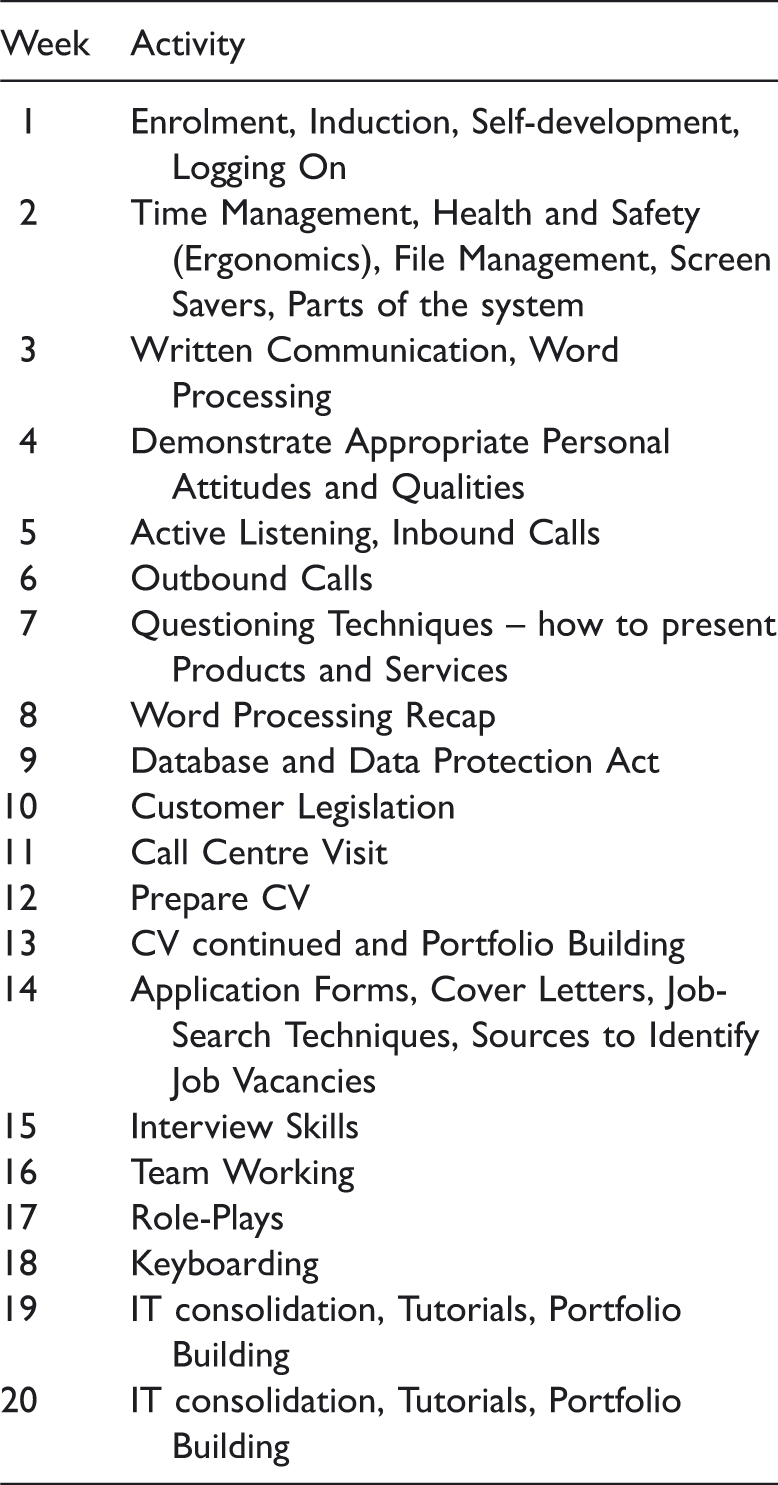
Programme content
Programme of activities.
Research methods
Data on the foundation level pre-employment training initiative for the unemployed were collected using participant observation during the spring and summer of 2002. The researcher observed and fully participated in each of the 20 sessions over a five-month period. All other course participants and the tutor were aware of the researcher’s status. In addition to participating and observing the taught sessions, practical exercises and completing the evidence-based portfolio, the researcher also spent time with participants during breaks in the college canteen and other informal settings. This involved ‘hanging around’, drinking coffee and engaging in ‘banter’. The researcher did not make notes during the sessions; instead, he wrote one word reminders or ‘memory joggers’ on course materials handed out during sessions which were taken home and observations and reflections written up after each session (Crang, 1994).
Participant observation was supplemented with a range of face-to-face, semi-structured interviews with local policy makers and other staff from education and training organisations, skills development agencies and economic development practitioners. In addition, the researcher observed and participated in employer-led partnership meetings which aimed to support the development of the call centre industry in the locality. Employers, training providers and government bodies both local and central attended the bi-monthly meetings.
Performance and aesthetic labour training
This section presents an analysis of the activities introduced to encourage trainees to engage with self-conscious impression management strategies and consider the telephone encounter as a performance. It is argued that the performance of the call operator role involved an appreciation of work as being closely stage-managed through the self-conscious manipulation of identities, attitudes and voices.
Impression management and performance training
Role-plays and scenarios took a central role in encouraging participants to think self-consciously about their presentation of self over the phone. This form of interaction and the dramatic or theatrical nature of interactions are a core aspect of the front-line operators’ role (Brannan, 2005; Cameron, 2000; Clarke, forthcoming). Vocal and verbal forms of impression management are argued to represent a key soft skill that call centre operatives possess and develop to enable them to function effectively. Further, these competencies in communication and self-presentation are also those which prospective employers have been shown to actively seek out in the recruitment of new staff (Belt et al., 2002; Callaghan and Thompson, 2002). The intentional and explicit focus on such important core competencies within the pre-employment programme can be seen as an attempt to ensure that the trainees, at least, had consciously thought about their self-presentation during telephone interactions and developed an awareness of the many factors that influence spontaneous vocal and interactional performances. The exercises also demonstrated how constructed a seemingly unplanned telephone interaction could be, particularly through developing an appreciation of the ‘work’ that goes on behind the scenes and the amount of effort required to manage impressions and present various ‘selves’ during encounters. The purpose, of course, was to influence the social interaction in order to exercise control over the direction and flow of the encounter (Leidner, 1993; Warhurst et al., 2000).
While the tutor regularly referred to and discussed the soft skills and techniques required of the telephone operator role, this account reports on the element of the programme where the full focus was dedicated to developing techniques for self-conscious impression management. This form of impression management training mirrors that reported in other academic studies of employees’ initial call centre training albeit in a shorter more superficial form (Callaghan and Thompson, 2002; Sturdy, 2000). The training in soft skills marks an important departure from the traditional focus of pre-employment programmes on technical competencies such as keyboarding and IT, to one that seeks to foster the qualities and skills associated with the ‘aesthetic’ labour market. It is also illustrative of an example of ‘identity’ training that seeks to manipulate and shape trainees’ thought processes, behaviour and attitudes in order for them to give self-conscious vocal performances.
The session began with a video played to the group which focused on describing how to smoothly navigate a telephone interaction from beginning to end. The video presented ideas about the typical structure and content of a telephone call, the importance of self-presentation, timely deployment of appropriate questioning techniques, the need for self-confidence in enabling a convincing performance, or at least sounding right to give off an air of competence. In addition, the video presented the case for not only staging self-conscious vocal performances but also promoted the idea that vocal displays could be used to communicate – both implicit and explicit – messages or impressions about personal dispositions, attitudes, emotional states and moods to callers. This approach, according to the tutor, could influence how callers may react to operators, as well as having the potential to alter their emotional states and responses. The video clearly articulated the benefits of role performance and playing at various roles but also the value of emotional labour and emotion management to the front-line operator in controlling encounters with customers (Bolton, 2005; Goffman, 1959; Hochschild, 1983). The video was followed by a discussion with the tutor leading the group re-articulate and think in more depth about the benefits to modulating their voices and managing their emotional displays in the context of call centre work.
Role-plays were used to practice their vocal performance. Divided into pairs participants took turns playing the part of the customer and telephone operator. Through practical exercises participants practiced managing their voices and the impressions they gave off. In addition, they experienced those performances through playing the role of a customer, hearing and engaging with the call operator’s performance. Importantly, the first set of role-plays involved focusing on vocal and verbal interaction. Participants were not required to use the computer or keyboard to input details into any software systems. Despite seeming simple, participants found the task a considerable challenge as the following excerpt makes clear: The scenarios were a real source of anxiety for most of the students … we spent quite some time preparing to make and take the telephone calls, much longer than I’d imagined we would. This involved getting used to the telephone headsets and working out how to use the telephone turrets. A few members of the group found this particularly difficult. (Research Diary Excerpt)
The diary extract below highlights additional fundamental challenges that confronted many participants. The extract reflects on a second set of role-pay exercises, which involved engaging in a fictional encounter with a customer while utilising the PC keyboard and navigating the onscreen software application which required manipulation and the inputting of information (imparted by the customer), all at the same time: We then went back and did another role-play but significantly this time with a computer system to add the complexity dimension. This again added more tension and nerves. This surprised me but it seemed to make a real difference to peoples’ perceptions; some are scared of IT generally, some of particular [software] applications and some just following sequences. (Research Diary Excerpt)
Following the role-plays the group spent considerable time analysing their conversations as the tutor played the recordings back. The tutor picked out excerpts or specific instances that illustrated points she wished to make. Participants were encouraged to discuss ideas about how they could display certain attributes, qualities and or even convey certain emotions or feelings through the sound of their voices, achieved through a range of strategies and techniques such as altering the pitch of the voice or changing the pace of a conversation. The group discussed the benefits of consciously manipulating their voices, and considered situations when altering their vocal performance would prove beneficial. They discussed scenarios around dealing with angry or upset customers, recognising the need to placate or calm them to ‘get the job done’. They thought about how modulating their voices, slowing the pace of talk, speaking in a soft, smooth or ‘soothing’ voice would help to alter the caller’s behaviour or modify their feelings, and consequently their behaviour.
The vocal performance was not the only tactic trainees learned which they could deploy to assist them in managing interactions. Other strategies included the use of open and closed questions and their deployment at the right time, displaying active listening to convey implicit messages such as that ‘call operators’ were fully attentive, understood their needs while giving the impression that the caller’s needs were being taken seriously and would be met. Again, the tutor suggested these techniques would also help ‘smooth’ the interaction and thereby make the job easier to perform. They also discussed how to pick up on particular verbal cues through ‘reading’ a caller’s voice and the manner in which they approached the encounter. The tutor encouraged participants to think about how the customer may display, through intonation in their voice, certain feelings, moods and attitudes. Participants would be able to interpret through the caller’s voice how best to approach the encounter, by making assumptions or judgements about the caller’s mood or attitude. Taking these insights or clues into account it was, according to the tutor, possible to shape or change the role trainees might play to deal with the particular caller’s character.
The session ended with a self-assessment exercise and one that sought to encourage participants to think about the qualities inherent in their own voices. Engaging in this self-assessment exercise led participants to share that the exercise resulted in a greater appreciation of their own ‘voice personalities’. By thinking about their ‘telephone voices’ they assessed themselves against a number of predetermined criteria; the key components that make up a persons’ voice personality, according to the tutor. Each trainee scored themselves against the components that were identified. Following that the scores were totalled up and the figures were plotted on their individual voice personality matrix (see Figure 1). The elements of the voice were considered to be pitch, clarity, breathing, rhythm and pause. The tutor told the group that each of these elements displayed different parts to their performances, those being meaning, confidence, stress, punctuation and pace, respectively. Whether this form of assessment was reliable or even realistic is questionable. However, it illustrates that the tutor considered impression management through vocal interaction over the telephone was an essential element to playing the front-line operator role and that effective performances required the self-conscious appreciation of how to manipulate the self through vocal impression management.
The researcher’s voice personality.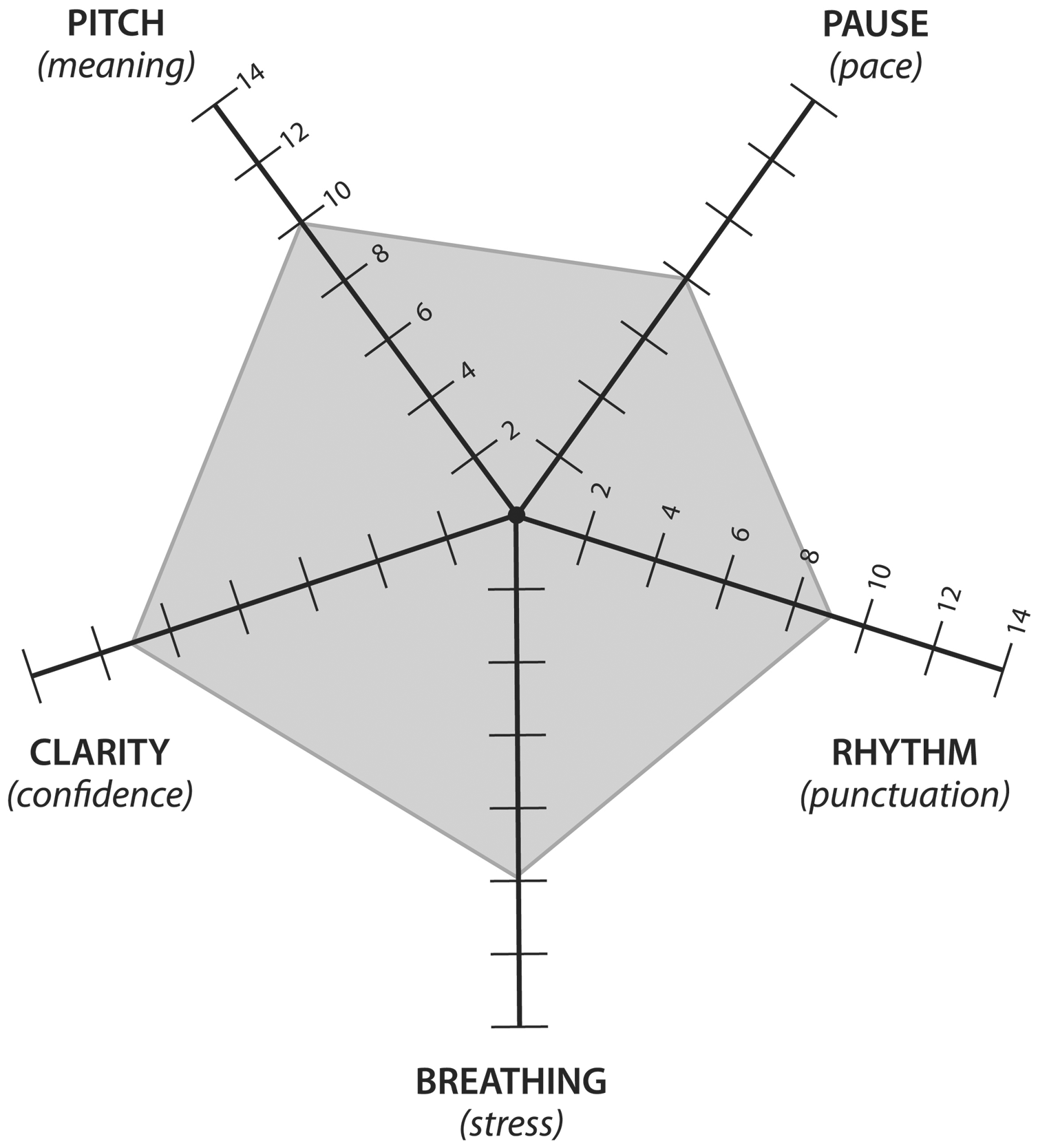
The ‘voice personality’ exercise led participants to consider the components of a vocal performance. It also encouraged participants to consider how they might appear to others through their own voices over the telephone. As a self-awareness and reflection tool, the ‘voice personality’ exercise worked to a certain degree. However, once the exercise was completed it was never repeated. None of the voice role-plays and telephone techniques exercises were repeated. While useful in developing self-awareness of core aspects of the role, the restricted exposure to these exercises rather limited the value and opportunity to enhance these skills further.
Discussion
This section offers an analysis of the programme within wider academic and policy debates that relate to welfare-to-work and work-first approaches for the unemployed. Initially, the discussion revolves around an evaluation of the programme’s aims and intended employment outcomes for participants. The expectation was that all trainees would find employment in call centres. Yet, considering participant’s personal characteristics and backgrounds the likelihood of that outcome is questionable, particularly for unemployed or long-term unemployed. An FE college manager’s observations exemplified this argument, ‘It’s far more deep-seated than one training course can resolve … if they’re not buying into it at the point at which you remove all the barriers then there really isn’t much point going on but what they do is go round the system again’. Like many other programmes delivering welfare-to-work contracts the scheme benefited those who were already the most employable or ‘job ready’. However, the majority of participants did not meet this definition for a range of reasons. For example, many lacked a combination of the following, each of which represents a barrier to call centre employment: any or a sufficiently consistent employment track record; technical IT and keyboard skills; adequate competence in written or spoken English; lack of confidence; basic work skills (being able to turn up on time; be appropriately presented and/or maintain acceptable basic personal hygiene standards; lacking an ability to concentrate; unable to sit upright on a chair and listen attentively for more than short periods of time) or ability to engage in the display of appropriate ‘feminine’ attributes and dispositions (Mirchandani, 2012) and juggle the demands relating to simultaneously operating the keyboard, manipulating software applications and talking/performing at the same time (Whalen et al., 2002). This list includes generic employability and specific call centre skills which combined represented significant challenges to many, and particularly those who were unemployed and had no previous experience of office work. The college tutor pointed out that ‘Lots of them have come in to us from the factories … ’ and this view was reinforced by another FE college representative, ‘They’re coming in stuffing boxes and that sort of thing … ’. Additionally, some had no employment track record, as the tutor explained ‘One girl has no work history at all so we might struggle a little bit with her’ and others were limited by their grasp of spoken English, ‘Like with [two participants] their English was a little difficult … So there are problems with spoken English’. These barriers are also seen to be exacerbated by the recruitment practices of employers. One FE college manager explained they’re [employers] are not prepared to meet the under skilled people half way, so for the people who have been unemployed for a long time they need a lot of confidence building … and we get them to a certain level but some of those interview techniques are not appropriate for those people who are trying to gain confidence … and they are rejected out of hand, in fact they are barriers … but if they fall at the first hurdle then it knocks them and it’s just a vicious circle for them.
The scheme also lacked aspects of the Human Capacity Development (HCD) approach which would be likely required to assist this group of participants overcome their individual barriers to employment (Dean, 2003). The barriers they faced would unlikely be overcome through such a short-term and narrowly focused intervention. For example, evidence from other sectors highlights the benefits associated with introducing alternative activities that support transition into work, such as voluntary work-based placements. Evidence suggests this form of HCD intervention had successful outcomes for the unemployed and long-term unemployed (see Lindsay and Sturgeon, 2003). Considering the length of the programme it could be argued that it provided little more than an extended ‘taster’ session, being 60 or 90 hours in duration. The intervention was too short to tackle the technical, soft or other skills deficiencies and other barriers experienced by the long-term unemployed. This view was shared by the programme tutor when describing the benefit of the programme, ‘I think it’s not necessarily what they learn but I think it’s cause they’ve had their eyes opened into what it’s like and what to expect … ’. This issue raises questions about the placement of unemployed participants on the course. Evidence suggests that people were being recruited, particularly those from the ‘mandatory’ group, who were less likely to gain positive employment outcomes. Those participants who faced more complex barriers to employment, particularly call centre employment, may have benefited more from participating in alternative schemes which did not demand the combination of skills which call centre work requires. An FE college manager reflected this view who observed ‘I don’t think we really heavily screen them now when they come for mandatory places cause they’re really not suitable for working with high level customer service interface, they need to do something that doesn’t allow them to interact with anyone else … perhaps some of them should not have been enticed into thinking they are capable of working in a call centre’. This challenge is a consequence of the unique nature of call centre work which requires competence in oral and written English in combination with soft performance and technical IT skills. Therefore, certain mandatory groups would benefit from training in alternative sectors, such as retail, which do not make the multiple ‘aesthetic’ and technical skills demands found within call centre roles.
The above concern regarding the relevance of call centre training for the unemployed is backed up by research by Lindsay and McQuaid (2004) who assessed the attitudes of the workless towards call centre employment. These researchers found that call centre work was considered to be the least attractive form of employment – compared with retail and hospitality – for all unemployed job seekers, irrespective of their gender, age and employment track record. Call centre employment, according to Lindsay and McQuaid (2004: 311) was particularly unappealing or likely to be ruled out by older men, people with no previous employment track record in services, and those with few or no qualifications. Yet, these were the very characteristics possessed by the majority of participants involved in this study. Lindsay and McQuaid (2004: 310) summarise their findings, ‘In almost all cases, members of all job seeker groups were rather more likely to rule out call centre work than other service jobs’. It appears the unemployed select themselves out of the opportunity to work in call centres, citing a variety of reasons including their lack of perceived ‘soft skills’, low pay and the reputation of work for being boring and repetitious. The findings illustrate the challenge faced by organisations seeking to train the unemployed for this type of work.
A further point relates to the programme content, which following the typical work-first model was aligned with the perceived needs of employers. However, there is a significant body of evidence that identifies a gap between what call centre employers perceive as the core skill requirements of the front-line operator role and those reported by employees’ themselves (see Belt, 2002; Belt et al., 2002; Callaghan and Thompson, 2002; Deery et al., 2002; Mirchandani, 2012; Thompson and Callaghan, 2002; Thompson et al., 2000). Unlike the schemes identified by Belt and Richardson (2006), the training programme’s content focused entirely on the needs identified by employers and neglected the important ‘coping’ and stress management skills which evidence suggests are the key skills employees’ report as those most needed to cope with the negative aspects of call centre jobs. This represents an important omission in training provision and one which may impact on the programme’s graduates’ on-going, long-term, employment in call centres.
Finally, there appears to be a potential fundamental limitation with the programme and one that was either overlooked or ignored by those who ran the course. It is not a limitation that is unique to this scheme but represents a key limitation of the work-first model to employability (Lindsay et al., 2007; Peck, 2001). It relates to the manner in which ‘successful’ outcomes were measured. In this instance, success was defined in terms of programme participants gaining some form of employment following the course. It emphasised an individual’s first destination rather than using sustained employment 2 as the measure of success. With the range of issues facing course participants it is not unrealistic to predict that many of those who found employment in call centres would struggle to keep up with the demands of the job, making it significantly more likely they would not be retained by an employer or that they may well have chosen to leave their own volition. No tracking of programme graduates was made once it was identified they had obtained their first employment destination. However, without sustained support, such as those present in HCD approaches, participants with significant issues would be significantly more likely to fail to gain work sustain that employment.
Conclusion
While there has been less emphasis on training interventions within active labour market policy, there has been a relatively recent shift away from solely focusing on securing transition to the labour market towards supporting the sustainability of employment and progression in work for those who have been workless (National Audit Office [NAO], 2007; UK Commission for Employment and Skills [UKCES], 2011). Both the New Labour and Coalition Government’s welfare policies have shifted to promote not only preparation for work and entry into the labour market but also job retention. However, in this context, evidence suggests that programmes which include training interventions have a greater longer term impact on sustained employment than approaches which strictly follow the work-first model. In addition, there is further evidence that training has a positive effect on the low pay no pay cycle which characterises the life experiences of many participants on this course (UKCES, 2011).
Described by Jones (2012: 433) as an ‘activation regime’, various government’s policies have introduced mechanisms to promote sustainable employment. This policy shift occurred during the lifetime of the training programme which formed the focus of this study and recent examples include the introduction in 2007 of cross-government public service agreements which set out a commitment to sharing measures for sustainable employment and progression (NAO, 2007: 10). While the New Deal programme included a rather short-term measure of sustained employment, defined as 13 weeks, the target has been extended by the Coalition Government’s Work Programme. Arguably seen as a response to criticisms of previous employment programmes the Work Programme has been designed to emphasise job retention as well as avoiding ‘parking’ those individuals who experience the more challenging barriers to securing attachment to the labour market (UKCES, 2011). The Work Programme has introduced innovative differential payment mechanisms which have been designed to reward job retention which include enhanced financial incentives for achieving successful outcomes for individuals who face the most significant barriers to employment (Jones, 2012; UKCES, 2011). This differential pricing model therefore seeks to counter the issue of ‘parking’ those who are least ‘job ready’ and focusing on those who would most easily access employment (UKCES, 2011). The issue of job retention in the call centre industry is complex, not only for the unemployed seeking to secure employment. The industry is renowned for its high levels of staff turnover, which are caused not only by the nature of the labour process but also exacerbated by the use of temporary and short-term contracts and human resource management practices which promote the disposability of labour (Taylor and Bain, 1999; Wallace and Eagleson, 2000).
This case study provided detailed insights into one supply-side pre-employment training intervention for the unemployed, which included a significant element of soft skills development associated with the concepts of performance and aesthetic labour. While the account provides insights into the training of soft skills which has traditionally been down played in pre-employment training programmes, important questions remain particularly with regard to the depth of the learning experience. The intervention’s limited duration raises questions about the potential impact and quality of outcomes for participants, particularly those who faced a range of barriers to employment. It is likely this intervention would help those participants who already possessed ‘employability skills’ and were closest to being ‘job ready’, while leaving behind the people the intervention was originally designed to assist; the long-term unemployed. These individuals faced many barriers to employment which were unlikely to be remedied by the type of work-first intervention identified here. Echoing other writers such as McQuaid and Lindsay (2006) and Peck (2001) this one-size-fits-all approach to work-first training fails to deal with the complex needs of the unemployed. Furthermore, there remains a lack of research in this area to inform policy and as such this paper offers a contribution to filling that gap. While evidence of soft skills training is presented in this case study, particularly around aesthetic labour and related skills development, there remains little understanding of the benefits or outcomes for graduates of these work-first welfare-to-work interventions, particularly as they relate to employment outcomes and the sustainability of that employment in call centres.
Footnotes
Funding
This research was funded through a PhD University Scholarship Award at the University of Nottingham, UK.