







Abstract
The objective of this research is to take a single-case approach to evaluate the role of entrepreneurs and enablers in the effective regeneration of a town centre, and the consequent social and economic impacts. The study is in Rotherham in South Yorkshire, which was selected to receive national funding as part of the Mary Portas initiative. Secondary research was based on relevant bid documents prepared by Rotherham Investment and Development Office. Primary research included semi-structured interviews with several retailers in the regenerated Rotherham high street, local enablers who had a direct impact on the entrepreneurship and external stakeholders with a relevant perspective and interest in the events. In addition, visitors to the high street in Rotherham were sampled and questioned on their feelings and experiences. This paper will help those interested in the regeneration of our town centres and high streets to understand better both the challenges and possibilities for creating sustainable social and economic value and improvement. The basic premise is that initiatives such as the Portas project need the engagement and intervention of local entrepreneurs and enablers if they are to result in valuable outcomes. It is what actually happens and the execution of the ideas proposed in bid documents more than the creativity and persuasiveness of the bid itself that matter. By taking a people-centred approach to the investigation and analysis, valuable insights into town centre regeneration can be provided.
Keywords
Introduction
The terms ‘town centre’ and ‘high street’ are typically used interchangeably for the physical and metaphorical heart of towns and cities. That said, some town centres have obvious central high streets; others do not. Town centres (and high streets) are places where people meet – for a reason (Portas, 2014). People shop; they access services such as banks and solicitors, dry cleaners and sometimes buses; and they socialise with coffee and snacks. Town centres are community resources, perhaps even communities themselves; if they are unattractive destinations people are unlikely to come unless they have a real need to visit a specific place. Realistically, they are the collective responsibility of multiple stakeholders – the public sector, including the local authority, private sector businesses and services, local residents and visitors. Invariably, the local authority will be viewed as the lead opinion, and those ‘external’ enablers who wish to play a role and make an impact will need political nous.
A Deloitte report (Deloitte LLP, 2013) concludes that 80% of people in the UK live within 5 miles of their local town centre and 38% visit the town ‘almost daily’. Long-time residents can invariably describe the extent to which the physical infrastructure has changed in their lifetimes – driven by a host of reasons, including changes to the needs of businesses, services and professions, the growth of universities, the expansion of supermarkets, changes to chain retailers and department stores, (some) shoppers’ preference for out-of-town retail parks where parking is generally easier and cheaper and the subsequent decline of small, specialist independents. Views and opinions on the outcomes vary markedly; whilst there are supportive customers, there are many opponents of the number of charity shops and betting shops, for example. Behind this detail is the ‘big picture’ issue of how well those involved in driving the changes have understood local needs, feelings and priorities. Simply, many town centres have declined to a point where they have needed re-imagining (Portas, 2014) – and many are being transformed. This research (and this paper) examines and contextualises the role of people in this transformation.
Whilst there is general agreement on the need for a healthy, beating and vibrant heart for towns and town centres, regardless of their size, each town has distinctive features and local factors and there is no ‘one size fits all’ solution. It would be a fair conclusion that some towns and cities have performed better than others when it comes to the preservation of ‘a healthy heart’. Some have neglected the problem and witnessed serious economic and social decline – although in other developments locally, there may have been economic growth and prosperity. An example would be a prosperous retail park away from the town centre, creating jobs and bringing in visitors to the area. Researchers and observers have identified and explored the issues; in recent years, national government funding (driven in part by the Portas Review, 2011) has supplemented local initiatives for stimulating and rejuvenating town centres and high streets.
In this paper, we summarise the key conclusions and recommendations from key reviews and develop a conceptual framework that emphasises the role of the people who actively bring about the changes. Included here are both the entrepreneurial retailers and those people who provide an essential enabling contribution that affects (either or both) the infrastructure and the business owners. It is a case of regeneration by local action, bottom-up. It is our contention that – and given most people will have a view – there needs to be a clear, shared and appreciated vision for what is required, and what the rejuvenated town centre should be, together with the necessary committed entrepreneurs and enablers. Without these, the various initiatives and incentives are unlikely to result in positive and effective regeneration. ‘Give an entrepreneur a sniff of an opportunity and a chance of a profit and they will create businesses and fill empty units’ (Portas, 2014). Nevertheless, it is also essential that key barriers are dismantled as far as they realistically can be. Difficulties with local planners, parking problems and charges, business rates and long leases can all be issues. Some of these are down to local councils, but others are affected by private sector property landlords.
Changes to any town centre will involve decisions and acts that affect the physical infrastructure, including recreational areas and the type of shops and other services. There are, therefore, physical, economic and social themes; ideally these will all be measured to evaluate effectiveness. The way these all come together and support each other will influence how residents and visitors react, and whether there is a belief there is a ‘good fit’ between supply (‘what's on offer’) and people's expectations – which is the ultimate test of sustainability. Potential customers have in their minds some picture of what they would like to find; this will fit into their wider perceptions of how they plan to use town centres, out-of-town shopping centres, multiples, supermarkets and specialist stores, corner shops and the internet. Those retailers who hope to succeed on the high street, and those who support them, will need insight into these expectations and seek to exploit this with what they offer.
We have tested our assumptions in one town, Rotherham, which was successful in drawing down government funding after the Portas Review (thus becoming a Portas Pilot town) as well as other financial incentives. Rotherham's town centre had been hit seriously by industrial decline and nearby shopping centre developments. Portas (2014) has described the outcome as ‘one of the best town revivals I have seen’.
Background
Otsuka and Reeve (2007) have identified various mechanisms for regenerating town centres (in the UK), highlighting both the state of the physical infrastructure and the need for a clear vision. They argue those responsible must embrace the wider social objectives alongside economic motives. Earlier, Berry et al. (1992) highlighted the relevance of rejuvenation (but using different approaches) for towns of various sizes. They conclude that projects must be relevant for local needs. Hudson (2001) explores the significance of why the community in question might have become depleted and argues that the way forward involves both space (physical environment and infrastructure) and place (the community). Pratt (2009) similarly emphasises the necessity of understanding the local culture – and in parallel, Wrigley et al. (2002) stress the importance of local partnerships. There is multi-level governance involved (Bache, 2008; Bache and Flanders, 2004) and dynamic interactions between various stakeholders who shape, influence and deliver policy. Other studies have focused on particular events and impacts: Wrigley et al. (2002) explore the impact of large supermarket developments; Lowe (2005) looks at the impact of inner city shopping centres. Relating to the arguments on both vision and partnerships, Warnaby et al. (2005) stress the significance of effective promotion to generate visibility for proposals and secure local commitment. Previously, Warnaby et al. (1998) had produced a review, synthesis and research agenda for UK town centre management. Thus, when a series of reports – which all had overlapping policy implications and subsequent impacts – were published between 2011 and 2013, the arguments were contemporary and relevant, but not necessarily new, per se. In 2010, Thompson emphasised the key role of ‘entrepreneurship enablers’ who work alongside local entrepreneurs in economic and social regeneration. He argued their role is often unsung and unquantified – this might be extended into a proposition that without effective entrepreneurs and enablers, policy initiatives are likely to result in under-achievement and disappointing outcomes.
The Portas Review (2011)
The Government-requested Review by acknowledged retail expert Mary Portas led to a number of towns and cities (27 in all from over 400 applications) being awarded funding to support local town centre initiatives following a bid and review process. The intention was these would build on existing initiatives and reduce shop vacancy rates. The key selection criterion related to innovative ways to trial something linked to one or more recommendation from the report.
The conclusion: change is required. But it has to be ‘change forward’ and not a nostalgic return to past practices, per se, although a new perspective on old ideas could add real value. Portas came up with a number of recommendations. Linked to the theme of enabling, she argued that aspects of infrastructure and accompanying regulations should be examined to make sure they are encouraging rather than discouraging. The high street should be advantaged rather than disadvantaged within the ‘big picture’ priorities for an area. Local champions from both the public and private sectors should seek to promote the town. Competition is real and large stores will fight for their share of consumer spending, but the managers of large stores should be encouraged to mentor the new business owners opening and running small, specialist stores. Retailers can all help each other; they may be rivals, but there is an equally critical rivalry with other towns and out-of-town shopping centres. People willing to experiment with fresh ideas, such as pop-up shops, should be helped – planning and lease issues will clearly encourage or discourage such initiatives. Finally, although the focus will be on retailing, it should never be overlooked that town centres are more than this.
The Right to Retail (ResPublica)
This parallel 2011 report by Schoenborn had localism as its theme. One key focus was the decline of small, independent grocery stores – which have been replaced by a mixture of large and small stores, but dominated by the supermarket groups. Over time the extent of this concentration has led to greater value for money for consumers but some very powerful players who have deliberately and inadvertently caused many independents to close down. Rejuvenation requires new solutions; taking a strong local perspective should help enable communities to collectively decide what is best for them. In the end, ‘shops’ should be regarded as valuable community assets, but this begs the question of what constitutes community value and how it should be measured. This report also recommended ‘Neighbourhood Plans’ – without providing specific answers on who should own the plan and thus be driving the vision – and suggested that responsibility for delivery should be ‘handed over to entrepreneurs’ rather than reside within the public sector. Related to this point, bids for Portas pilot project funds were to be made by designated Town Teams which needed to come together and represent both the public and private sectors.
Beyond Retail (2013)
Whilst the Portas Review was led by an individual, this government-funded report (by the Distressed Town Centre Property Taskforce) looked to engage a range of interested opinion leaders and stakeholders and reach a collective view on what was needed to ‘redefine the shape and purpose of town centres’. It took a wider perspective. Like Portas, it concluded that the ‘change implications are the greatest since the Victorian era’. This report was circumspect about the existence of constraints; some things that might be ‘dreamed’ are unrealistic. A typical UK town cannot be converted into a model garden city, with businesses, shops and services, residential and green areas all carefully positioned to work with and for each other, for instance.
Simply, there are too many empty shops in town centres because supply exceeds demand as a consequence of out-of-town and online growth. Town centres need to become relevant social community assets; they are more than retailing. Typically communities will feature an ageing population and their needs should be paramount as they are less mobile and less internet savvy. Local issues and idiosyncrasies are paramount as these affect both the nature and timing of demand. Is the town centre near to where there are large groups of workers; and, if so, what type of employment is involved? Are there extensive leisure and social activities? The answers to these questions affect daytime and evening, and weekday and weekend, patterns. The existence of, and desire for, green areas also has an influence. However, most of the responsibility and leadership should rest with the local authority, members of which will be required to articulate and champion a vision and also put in place the requisite infrastructure.
Beyond Retail also identified the importance of preserving (or rebuilding) markets and opening ‘emporiums’ where a number of businesses share space and thus reduce their overheads. Both of these had some relevance for the developments in Rotherham.
Partly influenced by these reports, there have been, and there continue to be, changes which affect local developments, business rates and parking charges. These will often be positive in their impact – and they matter. Without the ‘right’ people becoming engaged, such policy changes will have only a limited effect.
The case of Rotherham
Rotherham thrived historically as a steel town; it is a little over 5 miles from Sheffield. But cutbacks to the steel industry, and the decline of coal mining in the local area, especially in the 1980s, heralded a decline in both economic and social wealth. Since this decline European investment has supported some re-industrialisation whilst two significant out-of-town shopping centres have been opened, both owned by British Land. Parkgate is 1 mile north of Rotherham town centre and features stores such as Argos, BHS, Boots and Currys PC World – but there are no banks, post office or hairdressers. By size, Parkgate is the fifth largest retail park in the UK. Meadowhall is further away, but still only 2.5 miles to the south-west. Located close to the M1 it has a wide catchment and boasts nearly 300 shops, including M&S, Debenhams and House of Fraser department stores as well as numerous specialist and fashion label stores. It was clear that a return by the leading retail chain stores to Rotherham town centre was highly unlikely in the foreseeable future. Something imaginative and different, possibly radically different, was required for a town that has ‘one of the highest levels of retail competition in the UK’; the chosen focus was small, independent, distinctive retailers.
Initiatives to support regeneration in the town centre began several years ago; the 2009 Retail Vitality Grant Scheme offered capital grants (towards the cost of new ‘fit-outs’) and limited period rent support (50% in Year 1, 25% in Year 2) for selected new retail propositions. The key criterion was that the proposal filled an identified gap in the retail offering. Business plans were required and these were carefully scrutinised; all applicants have been interviewed and the criteria tightened since the start. Discussions with those involved suggest the business idea was perceived to be more important than the person, although the latter was clearly a factor. An initial application for Portas Pilot status and funding was rejected, but a rewritten bid, which focused on encouraging and supporting specialist independent retailers, was successful. This 2012 bid was championed by a Town Team largely comprising staff from the Rotherham Investment & Development Office (RiDO). Rotherham was awarded £100K, match funded by money from British Land. In parallel RiDO further promoted its ‘Shop Local’ loyalty card scheme. The £200K was later supplemented by a successful application to the Government's High Street X-Fund, which had a renewal focus and required the town to show how it was moving forward from the Portas Pilot experience and also involving the local community. In 2013, Rotherham received £268K from a nationwide allocation of £1 million from this fund. These grants were all awarded against written bids; there were no face-to-face interviews. There was, therefore, evidence of a positive cycle, as success with one initiative led to further support and funding.
The Portas money financed a customer service survey (shop owners received quick feedback on the results), a customer service improvement grant scheme, marketing grants, business development grants and funding for a trial pop-up shop opportunity, where would-be retailers could trial their ideas. Rents were waived for three months, and then introduced gradually; retailers had an easy opt-out after a 12-month trial if their ideas were not progressing. Overall some 20 businesses have received direct support. The Council was able to fund retail unit renovations – improved stores on the central high street were given a consistent heritage-look facelift. The High Street X-Fund money paid for the pop-up shop opportunities to be extended, with the leases for three units covered. Two were for sole occupancy; the third, and largest, is a 3000 square foot Makers' Emporium for up to 30 artisan and craft businesses. In the past, this unit had been a pub and music club. The Emporium is managed by a consortium including RiDO and Rotherham Youth Enterprise, but a team of retail experts – including The Source Retail Academy – provides advice and support. Rotherham College also provides skills support. The training on offer is subsidised. The most obvious outcome is a number of distinctive independent retail businesses along a restored and historic High Street, which had been looking neglected, with several empty units. This central high street, though, also offers Primark, Subway and J.D. Wetherspoon.
These initiatives have involved the RiDO Team, Rotherham Council, The Source Retail Academy, Rotherham College (Skills Academy), the local Chamber of Commerce and British Land working in harmony. These enablers, and the ‘entrepreneurs’ they have backed, largely (because some new independent retailers are near to, but not in, the central high street) form the sample for our primary research exploring the impact of these interventions – which have been supported by other improvements in the town's physical infrastructure. These include new residential homes in the town centre, transport accessibility considerations, affordable parking policies and strong marketing promotions – such as a ‘shop local’ campaign. These have also emphasised the ‘feel’ and ambience issues. The major multiple stores are mostly located away from the town centre, many of them at Parkgate, although there are branches of Boots, Wilko and WH Smith still in the centre – which still has a strong presence of restaurants, fast food outlets, nightclubs, charity shops, betting shops and pound shops. There is a newly created ‘green’ area (outside the Minster) and gallery space, which has been developed by a local champion, in part using an Arts Council grant. There has been real and significant change, and changes are still ongoing, but it is gradual rather than ‘wholesale’ change.
Over three years (2010–2013), RiDO was able to demonstrate a number of economic benefits with 86 new businesses receiving support and retail vacancy rates reducing from 20% to the national average of 14%. The number of people shopping has increased by 13%. Significantly shopping appears to have become the main reason for most visitors to the town centre (RiDO, 2014; Rotherham Voice Retail Forum, 2014; Springboard Retail Intelligence, 2014). The pop-up shops theme has been extended to an experiment with a transferable pop-up high street, where retailers have been offered opportunities at local events. They have also been offered the opportunity to trade at Parkgate. However, many of the new retail initiatives have benefited from development grants, and over time they will become increasingly dependent on footfall and customer spending, which will depend on other changes to the town centre area, including in particular leisure facilities. Work with this is ongoing and the social impacts will, therefore, require more time. These issues will become the real test of the sustainability of the regeneration.
Conceptual framework
There seems to be general agreement amongst the various authors of reports and papers that a number of issues need to be addressed in town centre regeneration, and these might be summarised as:
Creating a vision for the outcomes of any interventions, which relies on An appreciation of local needs and priorities – many would assume this responsibility lies with the Committed and engaged local authority – which may or may not represent the collective views of all relevant stakeholders – the outcome might be conflict when it needs to be harmony The potential to develop the local infrastructure – including new builds and renovations as well as taking down ‘eyesores’ The willingness to alter factors that are acting as restrictions and constraints – including access and parking Funding opportunities – to pay for new initiatives and sometimes offer grants or concessions A skilled, capable and enthusiastic workforce.
It is less common to see an eighth factor listed as critical; this is the people who will make it all happen. We, however, believe it is people that hold the key to effective regeneration. We need individual business owners to become engaged (without debating the appropriate use of terminology, let us call them all ‘entrepreneurs’, accepting some authors would see this as loose practice). They need to see and seize opportunities, find the resources they need (including both money and staff) and ‘get on and do it’. The success of their businesses will to some degree be affected by the originality and distinctiveness of their business idea and the potential to attract customers. It will also be affected by how well they run their businesses; it is here they can benefit from support from professional advisors and ‘friendly mentors’. A whole range of people, with an equally wide range of motives and expectations, could well become engaged in this essential ‘entrepreneur enabling role’. Where development grants are involved, for example, the selection of those who will be supported represents a form of enabling. This line of argument aligns with a view often expressed on the TV programme, Dragons’ Den, where the investors will declare they are backing the person rather than the idea. The reason: they have people on their team who can work on the business idea and strengthen it; it is harder to change the person.
At the same time, the seven factors listed earlier do not happen and come together because they have been identified in a report. The vision, the developments, the funding and the encouragement and championing again all come down to people. Some people take a lead role; others ‘sign up and commit to the cause’. Some are easily identified; others prefer a much lower profile. Collectively, they create and sustain a supportive local environment. Thompson (2010) has described these people as ‘entrepreneurship enablers’. Collectively, they may declare a shared vision for the direction of the transformation, but this is not essential. However, there does need to be a driving vision that is championed by an individual or lead organisation, one which doesn't create serious conflict, and one which others can ‘buy in to’ and support.
Although certainly not a universal truth, there is an element of conventional wisdom that takes the view that regeneration depends on initiatives and interventions. Certain things need to happen; specific support programmes are instrumental. The reports cited earlier – and the list of seven factors – feature the types of intervention that are relevant. The Portas Review came up with a number of recommendations along these lines, and it was neither unusual nor controversial in this respect. The Portas Pilot towns were then selected because they were offering innovative ideas on how to tackle at least one of these issues and recommendations. Whether their idea – and indeed the Review recommendation – is ‘good’, and will have a positive impact, is one test of ultimate effectiveness. One key test is whether the views of local people have been fully embraced and they become supporters and users of whatever changes take place. Those involved will typically mix explicit evidence (from surveys) with their own insight and understanding. But the outcomes and effectiveness are also going to be affected by whether the ‘right’ people become involved as entrepreneurs and enablers. Sometimes they will be chosen or invited; on other occasions some entrepreneurs and enablers will simply ‘invite themselves to the table’.
There is a case to be made that the ‘right’ people would have made an impact without the policy intervention – but perhaps a lesser impact. Arguably, these are the people who actually saw the potential opportunity in the policy intervention and sought engagement – but ‘they would have done something anyway’.
Figure 1 attempts to capture these points. The perceived quality of the initiative is shown on the left; and here, of course, hindsight is wonderful! That said, there is often the opportunity to trial an idea before fully committing. Similarly the distinction between ‘right’ and ‘wrong’ people (along the horizontal) involves both judgement and hindsight. Ideally new initiatives will be sustainable and have a lasting, positive impact.
The initiative-person matrix.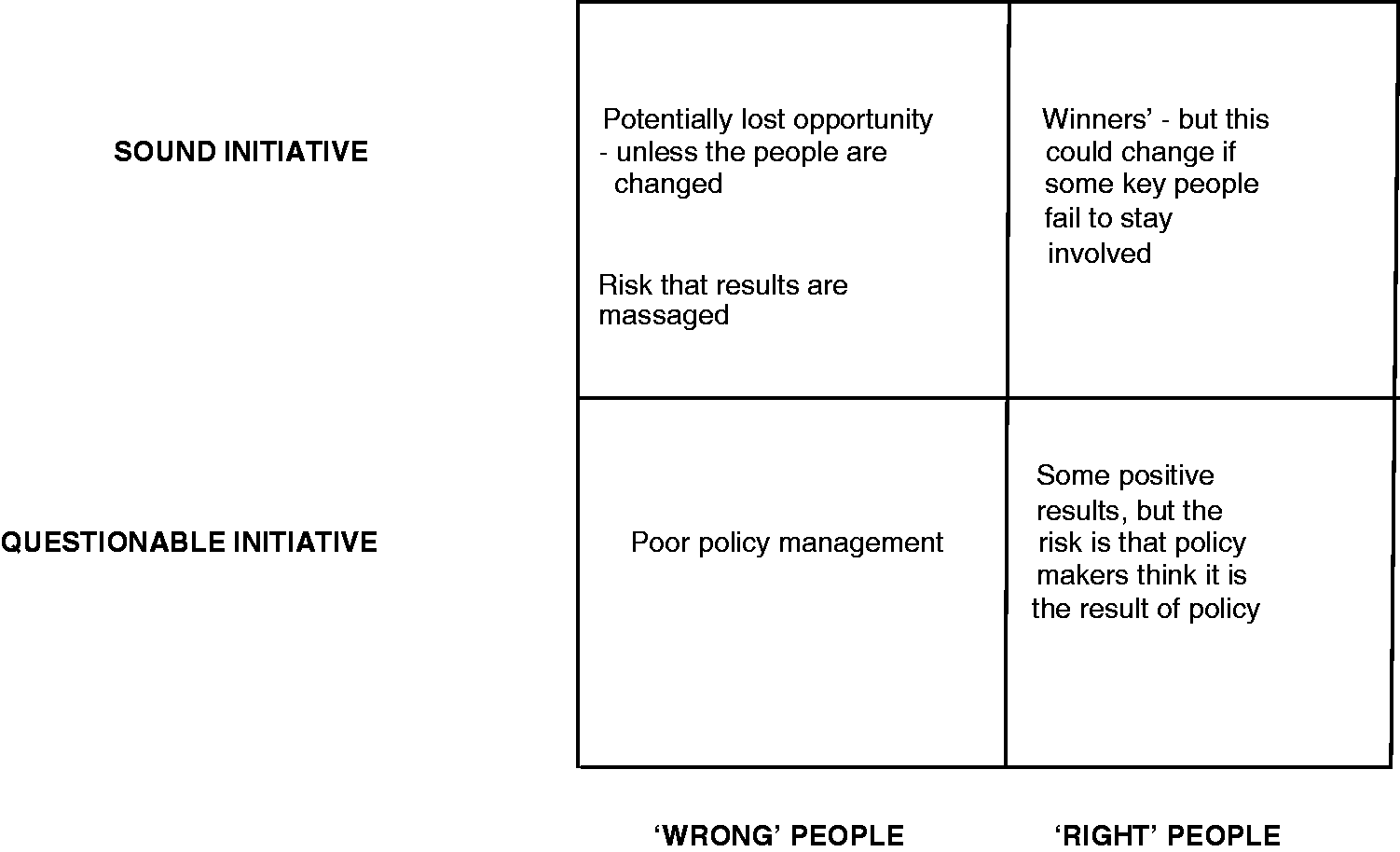
The matrix attempts to identify some of the risks involved in each quadrant. Sustainability of good initiatives (top right box) relies on either the same key people staying involved, or, should they depart, their replacements also being strong. Whilst having the ‘wrong’ people engaged in a potentially good initiative can be disappointing – with sometimes an opportunity to act on the people element – there is always the risk that results will be massaged and presented in a way that suggests they have achieved more than really they have (top left). When good people deliver results – often through effectual changes that are partly hidden from observers – with relatively weak ideas, there is always the risk that policy makers believe the modest successes are down to the policy itself and fail to appreciate the real reasons (bottom right).
Our investigation, which involved interviews with key people in Rotherham's regeneration, thus took a person-centred approach. We were interested in the following themes: WHO were (are) the key actors? The entrepreneurs who have done things and the enablers who (sometimes behind the scenes) inspired and helped to engineer what happened. WHAT each of them contributed – this could encapsulate the important need for inspiration and a driving WHY they did it. This encapsulates their motives – regardless of whether they were personal (social/community as well as monetary) or job-related or both HOW they did it – specifically aided by grant and other opportunities that still needed to be grasped – and here What are the OUTCOMES – economic, social, and environmental; how they might be evaluated; how they relate to the expectations of multiple stakeholder groups.
Research method
The secondary data (outlined earlier) were used alongside personal observations to create the conceptual framework described. To explore this further, we were adopting a single-case approach as advocated by Yin (2013) with our study of Rotherham. This town, as we have seen, has experienced both economic (and social) decline and some rejuvenation in recent years. This single case, therefore, looks behind what happened in one town that appears to fit in the top right-hand box of Figure 1; the research does not set out to test the matrix by examining events and outcomes in a range of towns. We were tracking the impact of policy intervention, and, within the case, we were particularly interested in a selection of both the key small business owners (and how they contributed to the regeneration) and the relevant enablers (and how they helped create opportunities for retail development and also supported the business owners). Although not the only explanation for what happened in Rotherham, the Portas Pilot status (and the subsequent funding from the High Street X-Fund initiative) made a significant and positive contribution. The contribution of the people involved might have been focused on this initiative, but it might have been wider and pre-dated Portas; this was not seen as significant as this research was not testing the robustness of the Portas recommendations and pilot town initiative. Additional data were collected from a sample of town centre visitors; we talked to 44 people, selected largely at random, over a three-day period in a single week. We used three separate questionnaires, which all used relatively closed questions but allowed the opportunity for the interviewer to dig more deeply.
Although the empirical data from the single case are not generalisable or representative, the qualitative analysis of the interviews (with 12 business owners and eight enablers) provides novel theoretical and empirical insight into the social and economic role and contribution of the people engaged in the regeneration. The research thus contributes insight into issues of both policy and practice.
All the interviews were conducted by one member of the team. The visitor questionnaire was issued (verbally) to a random selection of people in the town centre at certain chosen times, but there was some attempt to obtain a balance of men and women, and also across age and ethnic groups. Responses were noted for later analysis. The interviews with business owners (entrepreneurs) and enablers were pre-arranged; we used leads and introductions to set up the interviews. We believe the number and variety gives a genuine insight into the issues without necessarily uncovering everything that happened. These interviews were all recorded for later analysis. The interviewer, however, was also taking notes and building an ongoing picture of the emerging themes. The data were subjected to a manual qualitative analysis of the text from the interviews.
The main themes with the business owners were: who they are and how they came to do what they did in Rotherham; why they did just what they did and how well their business has performed; how they fit, work alongside and collaborate with the other businesses; their future expectations and ambitions; who helped and supported them, how and why; their current challenges; their perceptions of the changes in Rotherham and what they believe is required to maintain the momentum of the rejuvenation. We concluded with two more general questions on what constitutes a successful high street (anywhere) and what factors act as key restraints; these were included to help contextualise our case within the more general review findings.
The main themes with the enablers were: the nature of their role and whether they are paid as employees for their contribution; their enabling past and motivation; their views on the significance of key policy initiatives and interventions; who they helped, how and why; how they would describe their contribution (terms such as ‘adviser’ and ‘mentor’ were prompts); their views on the ongoing support that is required to maintain momentum; how they evaluate the changes in Rotherham and any perceptions they might have in comparison with other towns they are familiar with. The two general contextualising questions used with business owners concluded the interview.
With the members of the public we were interested in: whether they are locals; how and why they visit and use the town centre; where else they shop; whether they have ever worked in retailing themselves; their perceptions of the changes and improvements; their level of satisfaction with the choice and service they receive; what they see the role of Rotherham town centre to be, given the competitive context; and whether they have any knowledge of the Portas programme.
The entrepreneurs and enablers
It is not appropriate for this paper to attempt to produce a comprehensive list of all the businesses (and business owners) involved in Rotherham's rejuvenation, nor is it possible to appreciate all the enablers involved. But certain enablers (and organisations) have been identified as ‘key players’ – many of the named individuals will have had backing and support from others – and certain businesses and entrepreneurs have typically been featured in press and other stories because of their distinctive contribution. Their inclusion here provides some insight into the changes.
Both bids for Portas Pilot funding – together with the High Street X-Fund application – were written by RiDO staff. Bernadette Rushton had previously worked in town centre management (in Rotherham) and understood the marketing challenges as well as having insight into local opinion; her networks beyond Rotherham are extensive and influential in her perspective. Martyn Benson had a background in retail banking. Other RiDO staff (including Tim O’Connell, the Head) as well as local Council staff were instrumental with their support both before and after the bidding process. Executives from British Land also made a major (financial and other) contribution. Store managers from, amongst others, Boots and Wilko – and recruited in the large part by RiDO – have provided help and support to both the council and small business owners. Interestingly, these managers typically travel to work from some distance away; they are not ‘Rotherham locals’.
A very significant contribution as both an entrepreneur and an enabler was made by Chris Hamby, who has been a retailer for over 40 years, running his own family shoe shop and antiques centre in the High Street; he had a vision to renovate five buildings along the High Street and introduce new retail opportunities. He first negotiated a loan with Rotherham Council to allow him to buy the properties and then bid for other grants to help fund the restorations.
There appears, then, to be a clear recognition that all these stakeholders can benefit from a stronger retail offering in Rotherham town centre.
Located in one of these restored units is Chris Paston, whose business is called ‘Things That Boy's Like’; this covers a range of fashion and gift items, gadgets, posters and toys. Chris lives above his shop and his wife, Danni, also has a shop in the High Street – ‘Yella Brick Road’ sells clothes, jewellery, shoes, bags and accessories for ‘girls’. Another distinctive gifts shop is called ‘Patchwork Pig’ and is owned by Charlotte Scothern, who received Rotherham Youth Enterprise Support to help her start up. Kara and Tony Chapman are third generation confectioners; in 2010 they opened a small shop selling traditional sweets. It proved successful and Portas Pilot support allowed them to move into larger premises and extend their offering – they also sell cakes and gifts and host Yorkshire's only temperance bar. In addition, they host sweet-making workshops and children's parties. In and amongst these businesses are more fashion and sweet shops, a boutique selling vintage clothes and ‘retro’ items such as record players and other curiosities and collectables, and another offering customised T-shirts; there are also specialist food retailers and a number of individual restaurants, cafes and coffee shops. Many of the entrepreneurs are relatively young. Parallel to the retail developments, Karen Sherwood was instrumental in attracting Arts Council funding to very significantly develop ROAR (Rotherham Open Arts Centre) into an important working arts centre – and set up Imperial Buildings as a pilot base for arts-based enterprises – thereby enabling the creation of 15 businesses in total.
Main findings and analysis
Most business owners in the heart of the town centre rent their premises – some from Rotherham Council, others from private landlords. Using a variety of opportunities and initiatives, they have typically enjoyed some form of rent reduction; the majority readily admit they would have struggled without this incentive. The new retailers to open typically had prior retail experience, but this was not exclusively the case. They were attracted to Rotherham by both the opportunity and the support on offer, which they mainly learnt about through their personal and business networks. Trading successes and profitability vary, but targets are largely being met; there is a general optimism but some residual concerns. Many of the businesses opened up during the recession and have ambitions to grow if Rotherham's transformation can be sustained. To remain viable – especially if their overhead costs grow – shopper footfall and spending will have to continue to grow.
Views on parking charges in the town centre vary. Some store owners are not convinced that parking charges are a deterrent, whilst others continue to argue they should be removed – as do many shoppers. Their motivation for doing this might be opportunism rather than necessity, of course. Car parking is already free at Parkgate and, for a limited period, at the Tesco store some 300 yards away. A free bus service operates between Parkgate and the town centre. Tesco is relocating from its existing site northwest of the town centre to open a new 110,000 square foot Tesco Extra store which is more north-easterly, but equidistant. Any implications for footfall are as yet unclear. The future re-development of the existing Tesco site clearly has implications. The Council has purchased the land and drawn up outline plans for a new cinema and theatre, accompanied by new store units, restaurants and a budget hotel on the site – which could bring many positive benefits, especially with evening restaurant customers. At the moment, with the main leisure provision being pubs and some clubs, there is only limited demand for town centre restaurants after the shops close – and this naturally affects supply and choice.
Business owners praise the efforts that have been made to promote the town centre to shoppers, recognising they also rely on people who work elsewhere in the town centre as well as those whose main reason to visit is a bank, post office or hairdresser. The concentration of the ‘big names’ at Parkgate is inevitably a concern, but the free bus service helps people to move between the two (and benefit from free parking). The attractiveness of street and indoor market traders is recognised; the ongoing presence of discount stores is less popular with high street traders and some shoppers as they are not attracting the customers who will be drawn towards the specialist niche stores that are opening up. In this regard, it is clear that RiDO have been selective in the types of business they have encouraged and supported; and, overall, there is a real sense of complementarity and mutually beneficial ‘friendly competition’ amongst the store and café owners. Basically, the ‘town centre has become a community’; the mix of businesses is seen as more of a positive than a negative, but it ‘could be improved’. This is a view shared by shoppers, who also confirm they believe there has been a real transformation in the retail offering and the environment overall. Only half of the shoppers we surveyed, however, were satisfied with the current mix of shops; they would like to see an increase in the number of distinctive shops. A similar number said the town centre fulfilled a clear need.
These shoppers were predominantly local people, whose main reason to visit was shopping, although some clearly had come in to access other services and leisure provision. They routinely shop in other places, citing Meadowhall and Parkgate extensively. Only one person in our survey shopped regularly online.
There is, though, a concern with store owners that ongoing marketing and promotions ‘by the Council’ will be essential to maintain footfall. The situation is not yet self-sustaining. It is perhaps a reasonable expectation that the business owners will also need to be actively engaged and to champion initiatives.
All the business owners surveyed talked positively about the advice and mentoring support they had received from Council staff and other enablers, both paid and volunteers. The words ‘knowledgeable, supportive, friendly and easy to access’ were used repeatedly. It was commented that ‘the Council staff have less experience in running businesses than in attracting them in’ and that the support from the experienced retailers was invaluable. The enablers, and particularly those who volunteer, believe Rotherham, whilst transformed, remains a ‘work in progress’ and more remains to be done. The momentum must not be lost – ‘there are still empty units in the town centre and the leisure provision needs strengthening’.
There is a strong view that the renovation and exterior improvement of properties has made a vital contribution, as has the general ‘tidying up’ of the town centre, which has made it more attractive to walk around. This, of course, has again relied on external funding – which has been put to good use, but may not automatically continue. One might query whether there is a risk that the centre might deteriorate again in the future if ongoing improvement and maintenance cannot be sustained.
Many business owners and enablers commented positively on the value of ‘joined up thinking’ and partnership working. The activity mix matters as there is a systemic effect. Specialist retailers and cafes keep visitors interested in the town centre; these visitors include local workers (many in the public sector offices and service industries), particularly at lunchtimes, and those visitors whose primary reason to be in the town centre is the local council offices and other services, as well as people who come primarily to shop. Clearly, also, a large Tesco store brings in shoppers, some by car, some on public transport – the question is the extent to which they also shop elsewhere in the town centre as part of their journey. The food offerings that are popular during the daytime may not be relevant in the evenings, depending on who uses the leisure facilities. If leisure opportunities change, there is likely to be an impact on cafes and restaurants. They are all inter-dependent and the overall offering should be relevant for all users.
Commentary and policy issues
This research has explored one case of social and economic regeneration in the context of very serious economic and market forces. Such forces can have a traumatic impact; equally they can be a catalyst for innovation by providing opportunities for new business owners if the right people come forward and the right support is available to them. In Rotherham, key stakeholders took advantage of relevant policy initiatives to try out new ideas; in this case, members of the public and private sectors came together and invested both time and money in new ideas and in selected individual business owners. Bids for Portas pilot funding had to be made by town teams backed by a relevant local authority; the team element was therefore always a key feature. The bidding team was awarded grant funding; their challenge then was to find and encourage other people to do things. Pump-priming funding needed to get to the people who would do things and deliver; not those who told the best stories of what they would like to do. Both business owners and enablers were required. In the end, a large network of people all contributed. This required leadership and co-ordination and a driving vision for the desired outcomes. Those involved believed the ‘space’ should be filled with small independent retailers but that the overall ‘place’ issues must also be addressed to ensure the mixed retail, leisure and food offering that the local community demanded. Even if this vision was not articulated widely, it was shared widely amongst the enablers.
In the end, town centre rejuvenation will require a balance of supply and demand. A centre needs the ‘right shops selling the right products and services at the right prices’ for the relevant target market. The environment needs to be pleasant and easily accessible. Even then, it is not automatically a case of ‘if you build it they will come’. Shoppers have to be attracted, new ones all the time – and existing ones have to return. The levels of customer service matter. This involves a lot of people, who need to work together and recognise their inter-dependency. Very few of the shoppers we surveyed agreed that Rotherham stood out as a distinctive town centre when compared with other local (rival) towns; roughly one-third of them were aware of the Portas pilot initiative.
Rotherham's revival has featured a number of differentiated independent small retail businesses, each with an offering that distinguishes them from the larger, publicly owned chain stores, where product ranges are similar, if not the same, regardless of where the store is located. Both can work in the short term; both can fail; both can be sustainable with improvement and change. So far the results have been positive – although this is not the perceived outcome for every Portas Pilot town. Putting Rotherham into a wider context, a two-year review of the first 12 Portas Pilot projects (Hopkinson, 2014) concluded that the town centres in question had 53 fewer shops than before the initiative was launched. Further analysis implied the existence of a lag effect and real improvements beginning to come through. A number of the key policy initiatives highlighted in the Portas (and other) reports – including free parking and cheaper business rates – remain at best a ‘work in progress’. It is perhaps fair to argue that it is still too early to evaluate conclusively what were always meant to be pilot projects. Metaphorically the jury is still out.
Moreover, the new businesses in the centre of Rotherham may or may not prove to be sustainable. Longer term, and as financial support for particular policy initiatives is reduced, footfall and customer spending will be critical variables. Once any rent and rate reductions end, if access and parking becomes more difficult and if local authority marketing support is cut back, the relative profitability of individual businesses is likely to change. Profit margins will be squeezed; prices may have to harden; shoppers will or will not be convinced by the products and services on offer and continue to visit. Ongoing innovation and improvement is likely to be essential.
Hence the unknowns – and the critical questions that go beyond any policy intervention are:
Are the retail propositions sustainable (without financial support)? Are the shop owners entrepreneurial and able to deal with future changes, opportunities and setbacks? Will appropriate, albeit different, enabling mechanisms remain in place?
Furthermore, it is not unrealistic to comment that results can be massaged and presented carefully to argue a case either for or against a particular initiative. Specific local factors can always be cited to justify a ‘special case’ situation. Measurement and evaluation is essential; it needs to focus on outcomes, impact and sustainability rather than short-term ‘hits’; it also needs to be objective and stand up to scrutiny. What appears to be the case in Rotherham – so far, at least – is that their initiatives have succeeded for their town centre. This might well imply that the policy initiatives that have been trialled have real merit – we also believe that the people involved have been instrumental in the progress that has been made.
Rotherham, then, has succeeded because there was a plausible vision, good people came forward and became engaged, and the various elements became integrated. However, it is probably fair to argue that the results in Rotherham were neither accidental nor carefully engineered and that there was evidence of ‘smart luck’. RiDO and others made it possible for good people to come forward, but the ultimate outcome would inevitably depend on who did come forward as entrepreneurs and enablers. One difficulty for a researcher is assessing the relative contribution of each of these groups of players. Another difficulty is in judging the extent to which the lessons might be replicable elsewhere. The people who do become engaged need to be aware of the opportunity; they also need to feel welcome and believe they can either benefit or bring benefit – or ideally both. The would-be entrepreneurs should not simply be attracted by the grants on offer – although the grants are an essential element – and they should be willing to take advantage of the support available and become actively engaged in the town centre community.
Whilst there might have been smart luck, there has also been bad luck in recent months. The very visible and much-reported child sex exploitation scandal has encouraged a number of weekend demonstrations in the centre of Rotherham and both footfall and trading have been affected quite significantly. The effects were evidenced by direct observation, anecdotal comments from retailers and footfall statistics. This naturally creates ongoing uncertainty for all the stakeholders.
Strategic management texts consistently argue that strategy is as much about (if not actually more about) strategy execution and implementation as it is about the chosen option. The same arguments apply to policy. Strategy and policy implementation are both people dependent. For that reason, the people who draft policy, the people who seek to provide evidence in support of a policy option and all those charged with delivering policy (including those who evaluate bids and those who win grants) all matter significantly; and, in turn, they cannot realistically ignore the people who will be engaged in execution and implementation – if they want to maximise the potential benefits from the policy and the intervention.
The ‘big picture’ thus comprises two overlapping mini systems, as we illustrate in Figure 2. Very loosely these represent policy creation and policy implementation systems – and joining them together to create a seamless whole that needs to happen. The first system links policy makers, delivery agencies and bidders; together they decide policy, how policies will be put into practice and who will be charged with trialling policy. The second links the people who will ultimately determine the outcomes for all concerned – namely delivery agencies (and their monitoring of activity), enablers and the relevant business owners. As the bidders are also likely to act as enablers there is further overlap between the two systems. To achieve effective outcomes, the policy makers’ perception of the local need must be aligned with the parallel perceptions of both the key enablers and the relevant local businesses. Any significant gap would be an issue. Both groups will measure outcomes, using a mixture of formal and informal means. Again we are looking for a shared view, and again any significant gap would be an issue.
Policy implementation.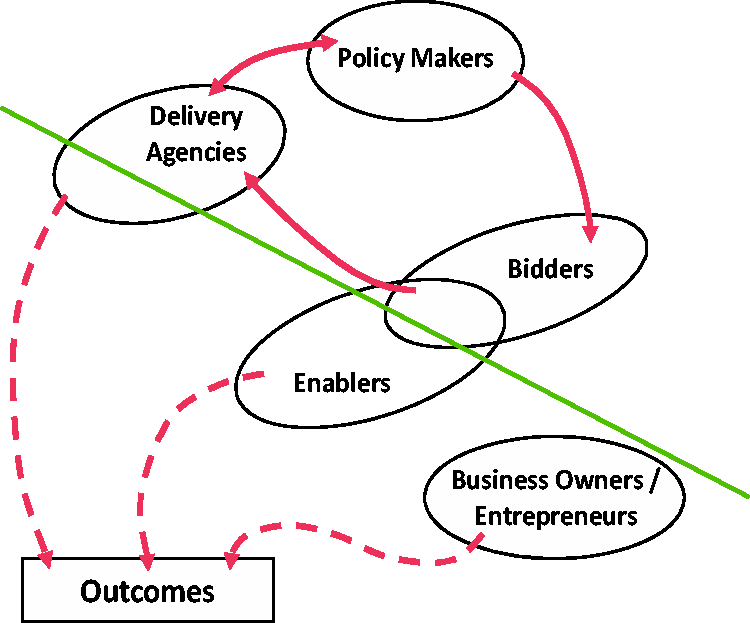
The case of Rotherham appears to confirm that ‘joined up thinking’ can bring positive results and outcomes. Given that parallel evidence from other towns with funding for different pilot projects is less positive (again, so far), we are still left to query the extent to which what happened in Rotherham was fortuitous serendipity – the right people and ideas all came together – and also the means by which (and the extent to which) key people can all be brought together with appropriate leadership and a motivation to work together to bring about a shared vision.
Our question for policy makers, then, is: to what extent do you/could you/should you factor in the relevant people aspects when setting criteria for evaluating bids and tracking the progress of those who are awarded grants? Contextually, the Portas and High Street X-Fund grant awards did not involve personal interviews; they relied on evaluating written submissions. That said, persuasive sales people in front of a panel might make spurious or exaggerated but still believable claims. Might there, then, always be reluctance to focus on people when the answers will involve personal judgement and subjectivity? This despite acknowledging that more specific output measures can be massaged. It is tricky. Basically good people are likely to produce good results from good policy – and sometimes even from poorly crafted policy! Yet finding winners is never easy. There is no guarantee that good people will automatically come forward and seize the opportunities from new policy initiatives; sometimes they have to be sought and found. What Rotherham does appear to confirm is that enthusiastic people can be found and they can benefit from the right support and enabling – and this is not a one-size-fits-all issue.
Footnotes
Funding
This research received no specific grant from any funding agency in the public, commercial, or not-for-profit sectors.