






Abstract
This study investigates the successful conditions and implementation strategies of local currency movements. Data for this study were collected using semi-structured interviews with six presidents or managers from five separate local currency agencies in the US, Canada, and the UK. Applying a grounded theory approach, this study finds that conditions associated with successful local currency movements include being located in less populated areas, in a small community with comparatively lower levels of household income, and in a community with prior experience with alternative economic movements. Successful implementation strategies include organizational strategies for seeking seed funding and merchant engagement, operational logistics, and communication and marketing skills. Additional leadership strategies comprise leaders’ previous experiences with community projects and their commitment to the community, employing a full-time coordinator, and engaging a group of leaders. Conclusions suggest practical implications to groups that may want to initiate local currency movements in their own communities.
More than 4,000 community currency systems are in circulation worldwide (Lietaer and Dunne, 2013). Community currency refers to complementary money that is generated and circulated only within the boundaries of a discrete geographic community (North, 2010). Community currency is also referred to as transition currency, complementary currency, alternative currency, green money, or regional currency. A key rationale for using community currency is to contribute to the economic and environmental sustainability of a community (Williams, 1996). Using community currency can also prevent money from draining out of a community, create local jobs, and increase tax revenues by strengthening local businesses. It can also decrease fuel consumption and carbon dioxide emissions by shortening the distance of product delivery (North, 2010; Woods and Muske, 2007).
Types of community currencies
Due to blurred borders and the rapid innovation of local economies, there is not yet a common typology of the diverse forms of community currencies (Blanc, 2011). However, two general types of community currency strategies have been identified. The criterion for categorization typically depends on the value base of the currency—being backed by either services, goods, time credit, or national currency (Thiel, 2011).
One type of community currency is based on “community-oriented trading networks” (Lee, 1996: 1378). The most commonly known examples in this category include Timebanks and Local Exchange and Trade Systems (LETS). Unlike traditional one-to-one barter systems, LETS and Timebanks systems enable members to register their “wants” and “offers” in a local directory, after which a central broker arranges the members’ trades (Seyfang, 2006). In a Timebanks system, time credits are earned by providing service to someone within the group. These time credits can later be used within the group to purchase other members’ services (Williams, 2008). Alternatively, the credits can be donated to someone else within the group or may be saved for future use (Gregory, 2009; Seyfang and Longhurst, 2013). While the value of everyone’s time is equal in Timebanks systems, the value of services or goods is negotiable in LETS.
The primary purpose of both Timebanks and LETS systems is to help participants—especially marginalized people—to access goods and services while developing social networks with their neighbors (Cooper, 2013). In the trade process of Times Bank and LETS, members use either virtual or paper currency as a payment unit among their members (Granger et al., 2010). However, the virtual or paper community currency is not backed by national currency and cannot be converted into national currency. Other well-known models of this type of community currency include Ithaca Hours in the US and Acorns in Totnes, UK.
Local currencies are a form of community currency but are geographically bounded and paper-based. Local currencies operate parallel to a national currency system and are typically backed by a national currency (Seyfang and Longhurst, 2013). Usually, non-profit organizations or civil society organizations issue and circulate local currencies. The primary purpose of a local currency is to contain the circulation of money within a limited geographic area. Limited circulation of currency aims to encourage shopping in local businesses by restricting the “leakage” of money from the local economy (North, 2010; Ryan-Collins, 2011).
In many cases, local currencies can be converted to national currency. Exchange points are located throughout a community where residents can exchange national currency for local currency. Participating businesses can redeem the local currencies accepted from customers in exchange for national currencies. Some organizations charge a redemption fee, which supports the management of an exchange and circulation system. Perhaps the most well-known models of local currency are BerkShare in the US, and Lewes Pounds in the UK.
Research aim
The focus of this paper is local currency. Because Timesbanks and LETS were introduced into many western countries in the 1980s, there is more research on community currencies than on local currencies. Although the origin of local currency can be traced back to the 18th century in some European countries (Graugaard, 2009), the modern type of local currency was essentially suspended until the early 1990s (North, 2013), when the world economic recession began to seriously impact the resilience of local economies. Since the 1990s, local currency systems have spread to many parts of the world. In Seyfang and Longhurst’s research (2013), local currency strategies comprised 243 (7.1%) of the 3,418 community currency projects identified in six countries and four continents.
Despite the prevalence of local currencies, relatively little academic research has been dedicated to understanding local currency systems. The subsequent lack of available information about the mechanisms and strategies of local currency movements may prevent communities from establishing local currencies as a community development tool. Better understanding of the conditions and implementation strategies associated with successful local currency movements could help many communities establish their own local movements. Hence, this study aims to identify principles of effective local currency movements by analyzing the key conditions and implementation strategies of five local currency cases in the US, UK, and Canada. After analyzing factors associated with these local currency movements, we consider major implications and recommendations for successful local currency systems.
Research on local currencies
Only a handful of researchers have investigated the conditions and implementation strategies associated with local currency movements from a comparative perspective. Collom (2005) investigated the context and conditions of community currencies in the US; however, the samples chosen for this research included both community (e.g. LETS) and local currency systems, which limits comparability and generalization. Nonetheless, Collom (2005) identified a number of successful conditions for community currency movements, including communities located in more liberal or progressive areas; in close proximity to other successful local currency systems; with more heterogeneous populations; with younger and more educated residents; with higher income inequality; and with a larger percentage of self-employed residents.
North (2010) also included several local currency cases in his research, and identified additional success strategies for the cases he investigated. North noted a number of conditions associated with successful local currency movements including: a large independent business sector, a highly educated and progressive local populations, economic downturns, and prior experience with local currencies in a community. North (2010) also described the implementation process of successful local currency movements. In the case of BerkShare, North argued that BerkShare’s survival was dependent on the leadership role and strong networking ability of a grant mechanism (i.e. the Schumacher Center for New Economics), the high quality of the currency design, and the involvement of local banks. One major limitation of this research is that North’s methods relied primarily on literature review and observation.
Several other studies have provided additional empirical research on local currency. Graugaard’s (2012) research focused on the Lewes Pound local currency in the UK. He evaluated whether the model was capable of building community resilience. Graugaard found evidence that the Lewes Pound had resulted in positive social and environmental outcomes by increasing social interactions, changing consumption patterns, and strengthening local identity. However, economic localization, which is a key indicator of economic outcomes, was not evident in this research.
Graugaard also described a major challenge related to the implementation strategies of the Lewes Pound. Even though one of the main goals of this local currency was to encourage localization of production and consumption, most participating businesses could not pay their suppliers in Lewes Pounds. This challenge was also identified in North’s more recent research (2013), which included six local currency cases in the US, the UK, and Germany. This research concluded that businesses could not find local suppliers to accept local currencies and/or customers did not want to receive change in local currencies. Therefore, improving localization of production and consumption were limited; local currency activists need to bridge local suppliers with businesses better, and to identify locally producible and consumable items.
Other findings emerging from North’s (2013) research relate to attitudes of local businesses toward local currency. North found that the owner of ‘medium-sized stores’ with adequately loyal customers and without local supplier relationships did not believe that accepting local currency would benefit their businesses. Reasons for this skepticism included the perceived disadvantages of a fee deduction, more complicated accounting procedures, and difficulty locating local suppliers that would accept the local currency. Local currency was more acceptable to ‘member-owned co-operative grocery stores’. These stores were concerned about being penalized by their community-minded customers for non-participation. In addition, ‘ethically and environmentally focused shops’ that sell organic food and health product were more motivated to accept local currencies. Because these types of shops usually sourced their products from locally owned suppliers who happily accepted the local currency, local currency did not conflict with their business logistics or philosophy (North, 2013). This finding implies that, during the initial stages of a local currency movement, activists need to contact ‘ethically and environmentally focused shops’ first in their communities in order to build the foundation for wider business participation.
Additional economic challenges of local currency movements were identified by Ryan-Collins (2011). Ryan-Collins examined four local currency movements—Totnes, Lewes, Stroud, and Brixton—all in the UK. He argued that these four local currency systems all lacked an economic incentive. Because the four systems did not provide any compulsory discount to customers, local currencies were not attractive to customers without explicit ethical motivations. In other words, local businesses that used the currency did not add new customers beyond those that already patronized local businesses. In addition, in terms of financial sustainability, Ryan-Collins argued that the lack of a revenue stream and sustainable funds, along with a limited banking infrastructure made local currency movements highly dependent on a volunteer labor structure, which imposed limitations on business promotion efforts.
Despite recent research on local currency, each context is distinct. Additional information on the conditions of successful and failed local currency movements, as well as other detailed implementation strategies that could help some local currency movements achieve their aims is needed (Seyfang, 2013). As a major limitation across all of the prior studies that have explicitly investigated local currency movements, they have only included successful movements as case studies (Collom, 2005; Graugaard, 2012; North, 2010, 2013; Ryan-Collins, 2011). Thus, we have a limited understanding of counterfactual practices and conditions. Existing studies provide an incomplete narrative to describe why some local currency movements succeeded in introducing and sustaining local currency systems, while other movements were less successful or failed.
By analyzing the ideas and principles that emerged from interviews with various leaders of successful and less successful local currency movements, this study uses a grounded theory approach to explore successful conditions and implementation strategies associated with local currency movements. Findings from this study suggest practical implications to groups that may want to initiate local currency movements in their own communities.
Methodology
Participants
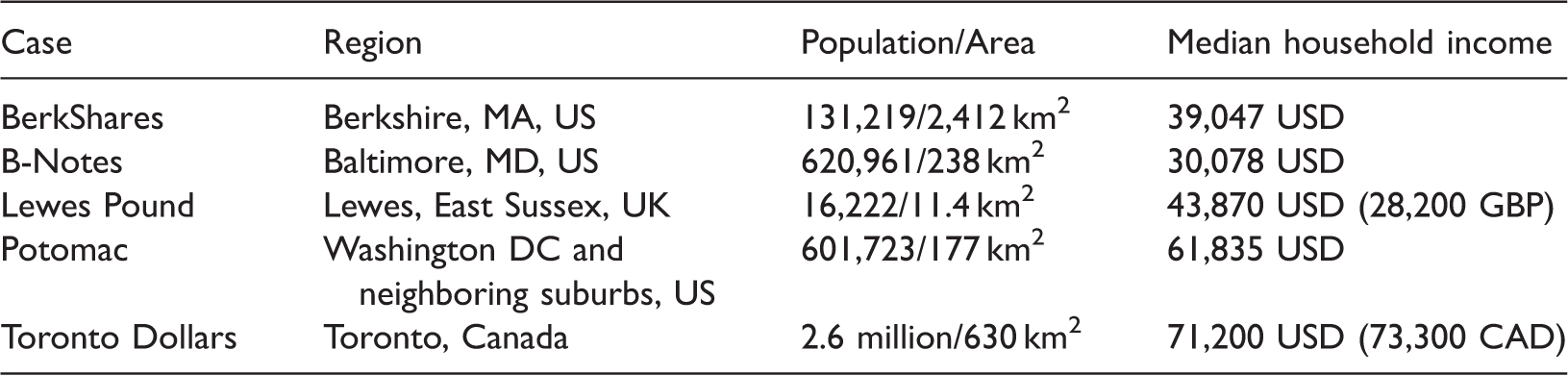
Geographical and economic conditions of sampled local currency movements (2012).
Descriptive information about sampled local currency systems.
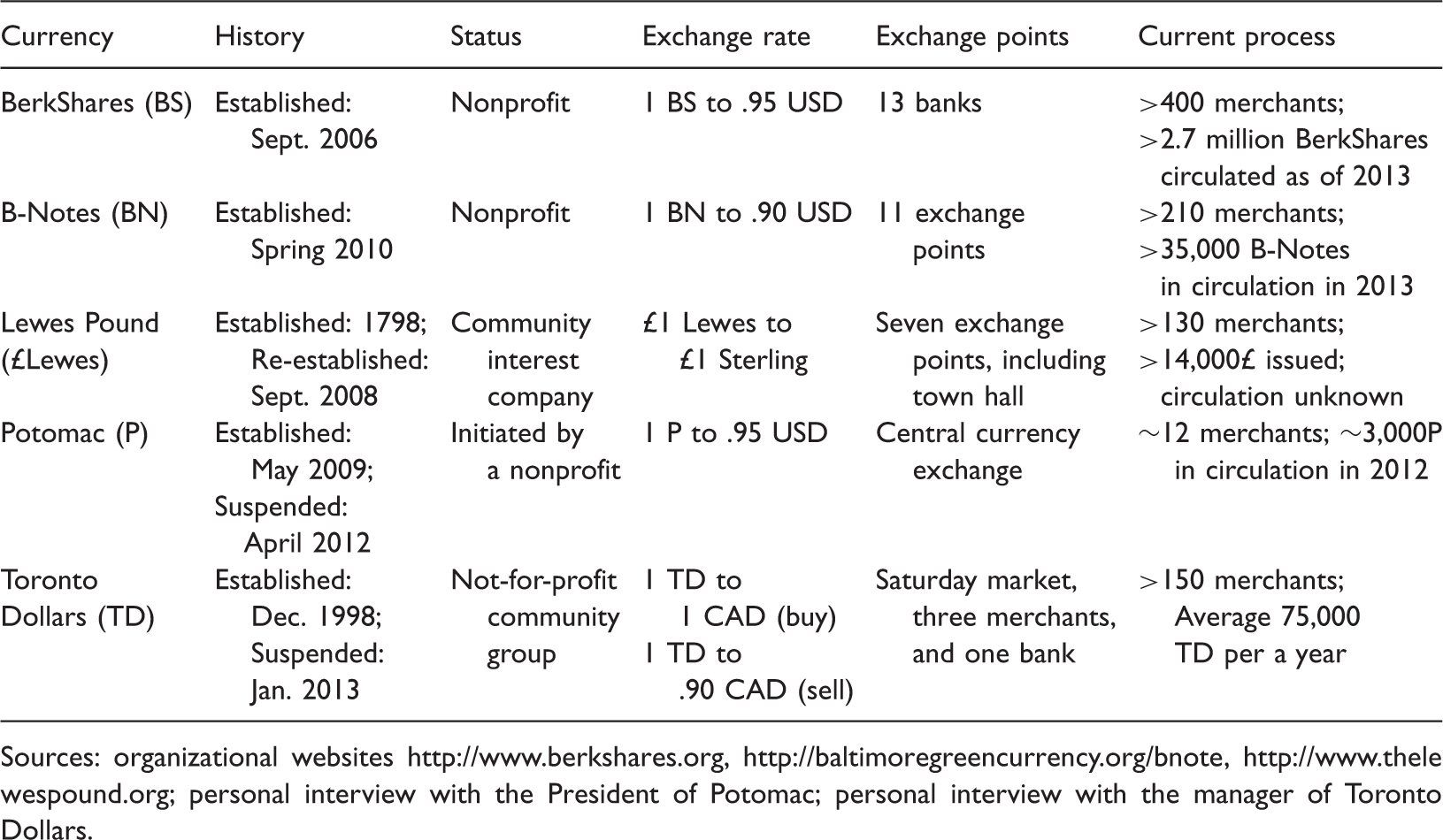
Sources: organizational websites http://www.berkshares.org, http://baltimoregreencurrency.org/bnote, http://www.thelewespound.org; personal interview with the President of Potomac; personal interview with the manager of Toronto Dollars.
Data collection
Data for this study were collected using semi-structured interviews with administrators of the five local currency agencies in the US, Canada, and the UK. These local currency agencies were BerkShares (Berkshire, MA), B-Notes (Baltimore, MD), Potomac (Washington, D.C), Lewes Pound (Lewes, England), and Toronto Dollars (Toronto, Canada). Because the interviewees were in charge of operating a local currency system in their agencies, a potential reliability concern is that local currency leaders could have a tendency to hype the success of their own systems; nonetheless, the focus of this research is not to evaluate the outcomes of the movements but to explore their successful conditions and strategies. Leaders were selected to participate because strategic priorities and detailed information about implementation strategies were not likely well understood by average participants in the movements. Interviewing leaders of the five local currency movements was perceived as the most appropriate method to obtain reliable answers to the research questions.
The research team contacted the agencies by email or phone and asked whether they would like to be interviewed. Three interviews were conducted between September 2012 and March 2013 and consisted of a combination of face-to-face and phone/video-conference interviews lasting approximately 60 minutes. The semi-structured interviews included questions about initial and current leadership, implementation strategies, challenges, strategic and operational issues, and evaluation systems. The same semi-structured interview questionnaire was used for all interviews.
In addition to three virtual interviews, two researchers triangulated methods by conducting fieldwork and participant observation in Baltimore (B-Notes) and Washington, DC (Potomac) for three days in 2013. Three face-to-face interviews were conducted in a local café and during a weekly member meeting site for 60 minutes. Two interviewees were the presidents of B-Notes and Potomac, and one was the manager of B-Notes. In addition, the researchers observed a weekly meeting of B-Notes for 80 minutes. All interviews were audio or videotaped and transcribed. In addition, handwritten field notes of the researchers’ on-site observations were collected for analysis.
Data analysis
As an emerging area of research, the a priori constructs and hypotheses identifying successful conditions and implementation strategies of local currency movements were minimal—based on the community and local currency research described in the preceding section. Therefore, data analysis primarily followed a grounded theory approach in which transcriptions were inductively coded to identify common themes and patterns related to successful movements (Glaser and Strauss, 2009).
Three researchers were involved in coding and analysis of the data to enhance the validity of findings. The principal investigator developed an initial coding list that reflected the on-site data collection and earlier discussions with team members. Two additional investigators discussed and revised this coding scheme prior to qualitative analysis. Data were then coded using Atlas.ti® software to focus the inductive analysis and to compare the initial codes with emerging themes. During qualitative analysis, investigators added two core codes to the coding scheme, as well as a number of new sub-codes. Following the initial coding, findings were reviewed by other investigators on the team. The analysis was further deepened by comparing substantive conditions with established concepts identified in previous literature.
Findings
Conditions and contexts
The interviews uncovered a number of conditions and contexts that were associated with more successful local currency movements. These conditions included being located in less populated or isolated geographic areas with comparatively lower levels of household income, and having a history of alternative economic movements. These conditions all seemed to pave the way for successful currency movements. Although pre-existing conditions were not insurmountable, they appeared to make it easier for the local currency movements to succeed.
Small population or geographic isolation
With the exception of B-Notes, all successful movements were located in less populated areas where a sense of belonging and community support were often evident. A spirit of cooperation, solidarity, and belonging were all frequently used by participants to describe successful movements. Likewise, pride in the community was associated with a desire to support local businesses. A manager at BerkShares believed their movement was successful largely “because it’s a very small community and people are very tied together...so business people all know each other.” Likewise, a manager at Lewes claimed that a major advantage of their movement was that she could “walk from one end of the town to the other in about 45 minutes,” which allowed her to meet regularly with merchants and other stakeholders.
B-Notes, which circulates widely through more populated Baltimore, was a noticeable exception to operating in an area with a low population; however, it was operating in a relatively isolated area within the larger area. B-Notes started in Hampden, a remote area of Baltimore. As their founder stated, they chose to start in Hampden because it had “a very small town feel, a lot of independent businesses, a lot of young people coming in, and was sort of geographically secluded.” In fact, a president of Potomac cited this B-Notes strategy as one likely reason why Potomac failed while B-Notes succeeded: “B-Notes started in a very small, very concentrated area … whereas we don’t have that kind of small self-contained neighborhood here in D.C. …we do have neighborhoods, but they are much more diverse and cosmopolitan and spread out.” Although Toronto Dollars eventually folded, its launch in the more secluded market neighborhood of St Lawrence allowed it to operate and grow for more than 15 years before other factors led to its suspension.
History of alternative economies
Two of the most successful movements, Lewes Pounds and BerkShares, had a history of alternative economic movements in the communities that predated the current system. Lewes first introduced its own currency in 1789 (Lewes Pounds, 2014), and operated for more than a century. Likewise, beginning in the early 1990s, BerkShares started a number of experiments with local currencies to help farmers obtain capital. Successful movements also tended to be located in communities where farmers’ markets, cooperatives, and alternative and left-leaning political movements were already supported by many members of the community.
Lower-income areas
Finally, in communities where movements were successful, the median income of households fell well below the income of communities where movements were unsuccessful (see Table 1). Although this is likely related to the location of the communities in more rural and isolated areas, it might also suggest that lower-income households have greater economic incentives to participate in local currency movements.
Implementation strategies
Start-up considerations
Respondents identified a handful of key implementation strategies that were important during the early startup phase of their currency movements. The most common factors included implementation strategies for initial funding, early membership recruitment, and operation logistics.
One of the largest and most successful movements, BerkShares, was able to obtain about $60,000 in seed funding to design and print currency, market the program, and pay for staff time, insurance, and filing fees. Likewise, B-Notes obtained an initial grant to cover three months of a stipend for a staff member, and Lewes located a sponsor to support printing of their currency. In contrast, Potomac lamented that, because they had no seed funding, they often “had to improvise”—such as self-printing their currency on an inkjet printer. Seed funding alone was not sufficient, however. As a counterexample, Toronto Dollars initially obtained a $90,000 grant to support their movement, yet a manager described how “they weren’t able to meet any of their goals” that were planned in the initial grant application, which the administrator mainly attributed to the frequent turnover of leadership in the early movement.
The number and type of businesses first approached may also make a difference. However, because all local movements sampled in this study implemented a similar strategy, there is no strong counterfactual evidence to refute a different approach. All the sampled movements started by engaging a limited number of businesses in the center of town. Many movements initially targeted businesses that gave the appearance of high social consciousness, such as the local food co-op or farmer’s market. These strategies dovetailed nicely with the conditions and contexts discussed in the previous section and were feasible due to the smaller size and progressive climate of the communities. As a manager of Lewes explained, by “starting out small … you really galvanize people to use it [i.e. local currency]. Once people start using it more, then that persuades other businesses to get on board because they’re not stupid; because they can see if something is happening.”
Exchange, recirculation, and logistics
Logistics of the various movements were the most frequently discussed topics during the interviews. The movements in the sample differed in their exchange systems, recirculation strategies, bookkeeping and tracking systems, and revenue strategies—among others. Each of these was linked in some way to the successes of the different currency movements.
The exchange rate from local to national currency varied significantly from program to program. As Table 2 illustrates, the rate of exchange was not clearly associated with the success of the movements. However, respondents expressed strong opinions that a front-end buyers’ discount should act as a positive incentive for the consumer, while also acting as a disincentive for merchants to exchange local currency back to national currency. Three of the five programs had a buyers’ discount for exchange. Most respondents agreed that an equal one-to-one exchange rate was easier to understand and to sell to merchants. However, a significant downside of equal exchange was the loss of a built-in incentive for participation. Recognizing this advantage in retrospect, the leadership of Toronto Dollars tried to introduce a buyers’ discount a few years later, but received solid resistance from merchants. A manager of Lewes Pound also asserted that “[although] we’ve pegged the Lewes Pound absolutely one-to-one against sterling, I think that’s a big mistake.” Although the two movements without a buyers’ discount both expressed a preference to change the policy in order to strengthen their financial model, they found it very difficult to implement change once the system was in place.
In addition to the front-end buyers’ discount, all programs (with the exception of the Lewes pound) had a back-end conversion charge to merchants ranging from 5 to 10 percent. In order to optimize the impact of local currencies on local economies, financial disincentives encouraged merchants to purchase goods and services from other participating businesses—thereby acting as a built-in incentive to keep money circulating locally.
In addition to instituting a built-in cost to merchants when local currency was exchanged back to national currency, the most successful movements stimulated recirculation by encouraging retailers to: (1) buy from suppliers using local currency, (2) pay employees in local currency, and (3) pay local taxes in the local currency. Clearly, the more expansive and varied the network of participating businesses, the easier it was for merchants to recirculate their currency.
The strategy to work with a bank or other fiscal sponsor to monitor and track currency was also viewed as a major advantage. An administrator of BerkShares noted that their collaborations with the Chamber of Commerce and banks are “very helpful because we don’t have to do the accounting; accounting takes so much time and energy and the banks already have those systems.” An administrator of Toronto Dollars lamented that they didn’t have a sponsoring system to maintain their finances. As the following quote illustrates, this lack of partnership can be quite labor intensive: It’s a big piece of work maintaining control of the flow of Toronto Dollars; it’s like a bank, money coming in, money going out. And the inventory—there are consignments out to the various people who are selling Toronto Dollars. Then there are the redemptions! I’ve been doing the redemptions every second week going around and visiting the merchants and writing a check if they have Toronto Dollars.
Revenue stream was a final logistical area associated with success. All movements, except Lewes Pound, were able to use the return exchange rate as a built-in revenue stream to cover operating costs. Toronto Dollars was an exception because they used the 10 percent difference in exchange to cover a grants fund for community organizations. Although there was an attempt to later divert a portion of this grants fund to merchant groups and to cover operating costs, this move was not supported by all stakeholders. BerkShares was the only group that decided to charge a membership fee to participating merchants ($25 per year). Potomac also investigated requiring an annual contribution of around $200 for merchants, though this was never implemented. BerkShares was the only group successful at receiving continued support from an external grant agency. The Schumacher Center for New Economics funded a coordinator for BerkShares and also accepted large tax-free donations for the currency movement, as donations made directly to BerkShares would not be tax-free. Furthermore, BerkShares raised $1,500 in 2012 by selling “education packets” to buyers and currency collectors that reside outside of the city. Overall, the more successful programs charged merchant fees and were more innovative in their use of other fundraising strategies, though most did not appear to have a strong revenue plan.
Communication and marketing strategies
Regular and repeated communication with merchants was viewed as critical to success. For users on both the supply and demand side of the equation, local currency can be a mystery. The most successful movements frequently communicated with merchants to explain how local currency could help to expand their business, develop customer loyalty, and provide an alternative advertising stream. Leaders of the movements also organized events to facilitate merchant-to-merchant communication as a means of enhancing merchant buy-in and recirculation partnerships.
Communicating with, and getting buy-in from, merchants was viewed as essential because users are far less likely to buy local currency if their spending options are limited. A significant struggle for Potomac was the low number of participating merchants (around 12 compared to a minimum of 130 in the other case studies). As an administrator of Potomac declared: I have been to almost every nonprofit in D.C. to give presentations and talks and things, and unless you get the merchants involved, it’s fine, they [the users and nonprofits] will support you in theory, but if there is nowhere to go and spend it, it doesn’t go anywhere.
Although successful movements were often located in areas where left-leaning alternative movements and projects were common, informants cautioned against making too strong of a political splash. For instance, an administrator of BerkShares advised against arguing too strongly against big-box and chain stores, which can easily “turn people off.” An administrator of Potomac also discovered that what “business owners are saying is that they don’t want to necessarily identify as being super left wing and liberal” and that they get “squeamish” about being identified as overly progressive in their business environment. Therefore, emphasizing the concrete benefits to businesses was viewed as potentially more important than the progressive social benefits.
In addition to gaining the initial support of merchants, communication and regular engagement were seen as important strategies to keep merchants interested and involved over the long term. Toronto Dollars reported that engaging merchants was a noticeable weak spot in their strategy, and found that issues became much more magnified when merchants were neglected. As an administrator of Toronto Dollars stated: Looking back in hindsight, we didn’t do a good job in involving merchants. In my time, there’s only been one merchant on the board and he came to one meeting … I think there is a case to be made that Toronto Dollars was of value to merchants, but we didn’t press that and we didn’t engage the merchants well. If businesses can identify their re-spending route, then they are much more enthusiastic about taking Lewes Pounds, and they are much more articulate in engaging in conversations with their customers about what the point is, and why it’s a good thing.
Leadership factors
As relatively young movements, leadership strategies were frequently discussed as important factors for success. Leaders of the movements stressed a number of leadership factors, including their previous experiences with community organizations, their commitment to the community, and the duration of time leaders had lived in the community. Moreover, supporting a full-time coordinator and engaging a group of leaders were viewed as important leadership strategies.
The founder’s previous experience and commitments to other community projects brought a certain intellectual capital and a base of knowledge to the BerkShare movement. Because the leader of BerkShare already established strong social networks and trust with diverse community groups over several decades, community members recognized her leadership prior to her initiation of the BerkShare movement. As an administrator of BerkShares explained: She knows everybody in the area so she’s worked on other projects such as the Share program starting in the 80’s, here … and brings a certain intellectual capital and a whole base of knowledge and experimentation that have already been tried so people recognize that here and are willing to look to her as a leader.
In the case of B-Notes, where funding to support a full-time coordinator was not available beyond start-up, success was attributed to a shared leadership model. Administrators of B-Notes reflected that they “have attracted some very good people” who all have specific skill sets, which are “all pieces of the puzzle.” In contrast, the manager of Lewes Pounds asserted that without her the program would not be sustainable because of the very specific set of management skills and relationships she brought to the table. An administrator of Potomac provided an example of this limitation, stressing that their movement suffered because of frequent turnover of leadership, as the initial stakeholders upholding the movement “fell away after a while, lost interest, or moved.” Likewise, Toronto Dollars also went through three to four different part-time paid coordinators, making it difficult to sustain the movement. Comparing the two suspended programs with more successful models, when full-time paid staff members cannot be supported and sustained, a shared or group leadership model may be preferable to individual leadership.
A manager of BerkShares was particularly vocal in her estimation of the importance of engaging people from the local community as leaders in the movement, including members of the board of directors. The primary administrator of BerkShares had lived in the community for more than 30 years; she grew up in the community and continues to make her home there. In connection with knowledge and the trust of the community, the leaders’ previous experience with community organization, high levels of commitment, an enthusiastic attitude, and a committed vision to sustain the movement through difficult times were also reported as critical to success—as emphasized by B-Notes and BerkShares in particular.
Due to limitations in funding and leadership, the managing of volunteers emerged as an important theme. Volunteers varied in their levels of commitment and skills, and successful movements were able to create an environment that retained and consistently engaged volunteers. An administrator of B-Notes emphasized the importance of organizing weekly meetings or other activities with volunteers. An administrator of Lewes Pounds said, “To begin with, it’s all very exciting, but you need to keep plowing energy and enthusiasm into it if you haven’t got some sort of sustainable model, economic model, financial model.” In contrast to the experience of these programs, an administrator of Toronto Dollars believed that they could have done more work to engage volunteers in an interesting way: The whole thing of volunteer management is something that has been so important and something that we haven’t done well. I think doing it again, I would want to see more attention paid to volunteer management in the sense of support for volunteers and volunteer appreciation.
Discussion and conclusions
As this study of five local currency movements illustrates, conditions associated with successful local currency movements include being located in less populated or geographically isolated areas in a community with comparatively lower levels of household income, and in a community with prior experience with alternative economic movements.
One of the reasons local currency movements may be more successful in less populated and geographically isolated areas may be due to a stronger sense of belonging and community support. This may in part be a function of the rural, isolated location of the communities, although the findings also suggest that households with lower levels of income may have greater economic incentives to explore local currency movements. These findings are consistent with previous findings that indicate that a community’s historical experience with local currencies and economic marginality has worked as condition for successful local currency movements (Collom, 2005; North, 2010).
Findings highlight the importance of engaging with local businesses such as local food coops or farmer’s markets, particularly in smaller communities with a progressive climate. As a result, effective implementation strategies that should be prioritized during the early startup phase of the currency movements include locating seed funding and increasing the number of merchants engaged during initial deployment.
The other implementation strategies that were identified for success (i.e. employing innovative fundraising strategies, charging merchant fees, and using the return exchange rate to generate revenue to cover operational costs) are consistent with Ryan-Collins’s (2011) finding about the economic challenges of local currency movements such as the lack of sustainable funds and a consistent revenue stream. The success of the BerkShare case demonstrates that establishing sustainable financial system is a key success factor for local currency movements.
In summary of leadership strategies, successful movements in this study frequently communicated with merchants to explain how to use local currency to expand their business, to increase the loyalty of customers, and to tap into the advertising opportunities from local currency. Leaders of the movements also organized local events to strengthen communication among merchants, to increase merchant buy-in, and to encourage recirculation of local currency. In addition, leaders in the movements emphasized the importance of using marketing and advertising strategies, such as public media campaigns, setting up booths at community events, distributing mailing lists and newsletters, canvassing locally, and having an online presence. Leaders’ previous experiences with community projects, commitment to the community, and the duration of time leaders had lived in the community were all important leadership factors. In addition, hiring a full-time coordinator and engaging a group of leaders were emphasized as important management factors of leaders.
This study indicates that establishing a successful local currency system requires not only investing significant time and resources in the start-up and maintenance of the movement, but also employing effective strategies in suitable geographic, social, economic, and political conditions. Although there have been many attempts to develop local currency systems in diverse communities, only a small number of these initiatives have successfully been implemented, and only a handful of these initiatives have survived for longer than a few years (North, 2010).
The key lessons derived from this study imply that groups desiring to initiate sustainable local currency movements in their own community may want to carefully identify and compare the geographic, social, economic, and political conditions of their community with the conditions and contexts of successful movements. Leaders of these movements may also choose to adopt many of the implementation strategies described in this study to mitigate any conditional weaknesses identified in advance.
Footnotes
Declaration of conflicting interests
The author(s) declared no potential conflicts of interest with respect to the research, authorship, and/or publication of this article.
Funding
The author(s) disclosed receipt of the following financial support for the research, authorship, and/ or publication of this article: The authors would like to thank the Graduate College at University of Illinois at Urbana-Champaign for providing the Focal Point Research Fund for this research.