







Abstract
Successful leadership in local development requires not only a vision, but good communication skills, stakeholder involvement, strategic planning and coordination and popular support via public participation. Our empirical study contributes to filling the gap in the literature about the role of non-profit leadership in urban and regional development. We study the characteristics of politicians in civil society and that of civil society’s leaders in politics as a prerequisite for successful local development. For this, we draw on the survey data of 374 local politicians from four large cities in Central Europe: Prague, Bratislava, Budapest and Poznań. The research affirms that non-profit non-governmental organisations do play an important role in local development and reveals similarities in all analysed cities, though with some variance. Local political elites are identified as engaging significantly in civil society organisations, despite low levels of general trust in these countries. About two-thirds of the local politicians who took part in the survey participate actively in civil society organisations in their respective cities but not coming from a previous non-profit non-governmental organisation employment. Not only are they active, but many of them also have positions as managers or directors, or as members of the board of directors in these organisations. Although neither membership nor leadership in non-profit non-governmental organisations appears to increase a local politician’s chance of being elected, except when those are engaged in local development or environmental issues. As spatial leadership plays an important role in the construction of new agendas and identities we have also investigated the views of local politicians on decentralisation, government service provision efficiency and the importance of several local policy topics, and found some puzzling differences across our V4 cities that possibly reflect cultural differences. Non-profit leadership in urban development is a neglected topic so far in the literature, our study adds empirical results from Central and Eastern Europe, yet there is ample room for future research.
Keywords
Introduction
The growth and diversification of cities raises new challenges for governing urban areas (Cassiers and Kesteloot, 2012) and redefines the role of the public and private sector, as well as that of non-profit non-governmental organisations (NPOs). These developments have increased the need for stakeholder participation in urban development. Competent leadership is therefore crucial for the successful development of urban areas.
There are three main factors that are prerequisites for successful leadership in local development. The first of these is the society’s openness towards public participation and power sharing which prompt social support (Stimson et al., 2009; Van den Berg et al., 2003). Second, there is a need for the leader to have vision and good communication skills (Horlings and Padt, 2013; Stough, 2010; Van den Berg et al., 2003) and an entrepreneurial approach (Stimson et al., 2009). However, having a vision by itself is not a sufficient condition for success (Beer, 2014). Third, political factors are necessary, such as political support including funding (Horlings and Padt, 2013; Johnson and Osborne, 2003; Stough, 2010), and strategic networks with stakeholders (Horlings and Padt, 2013; Sotarauta and Beer, 2016; Stough, 2010; Van den Berg et al., 2003), together with flexibility and creativity (Stimson et al., 2009; Stough, 2010).
Our study is highly relevant to countries in Central and Eastern Europe which share a similar development concerning NPOs’ participatory role in policymaking as in the Czech Republic, Slovakia, Hungary and Poland (Baun and Marek, 2008; Nałęcz et al., 2015). There is a broad consensus that NPOs in these post-socialist countries were weak in their overall capacities (e.g. Fagan, 2006; Frič, 2004; Rose-Ackerman, 2007).
These issues raise the following questions: Do NPOs play an important role in local development? Is non-profit leadership present in local and regional development, and how is it manifested? What are the factors that support or hinder the participation of civil society’s leaders in political life?
In order to provide answers to these questions, we analysed the participation of local politicians in NPOs in the Czech Republic, Slovakia, Hungary and Poland (hereafter the Visegrad countries or V4). We investigated the engagement of civil society activists in institutionalised political life as well (i.e. political parties and political movements) across four large cities of these four central European countries. The research is based on a survey conducted among local politicians in Prague, Bratislava, Budapest and Poznań.
Such a study is particularly important for the Visegrad countries, since they have experienced fundamental socio-political and socio-economic changes over the last 25 years, including changes in the structure of their urban populations. These changes have had a clear impact on the democratic development of these countries’ societies and principally in shaping civil society as a vibrant and essential factor for stimulating local and regional development.
The persistence of the dominance of public authorities and central governments in political representation has been disillusioning for many civil society organisations. Nevertheless, according to some recent studies (Potluka and Liddle, 2014), partnership is quite strong at a local level. This observation, however, is not evidenced for all Central European countries. Data at the local level show that, even if local civil society organisations have higher acceptance levels in local political decision-making, this is not generally the rule (Potluka, 2009; Potluka and Liddle, 2014).
The remainder of the article is organised as follows. In the next section, we discuss the theme of leadership in urban and regional development with emphasis on non-profit leadership. ‘Data and methodology’ section concerns the data collection procedure, variables selected and the methodology used. ‘Results and discussion’ section discusses the results of the analysis with emphasis on the diffusion of politicians within NPOs and non-profit leaders within politics. The final section concludes.
Leadership in local and regional development, and NPOs in local governance
NPO leadership involves persuading other people to do something and requires these individuals are voluntarily willing to follow the leader’s visions, objectives and strategies. Research on leadership has become very complex, as the variety of leadership theories is inexhaustible. In a recent study, Dinh et al. (2014) define nine established leadership theories (e.g. neo-charismatic theories, leadership and information processing theory, and social exchange/relational leadership theories) and eight emerging theories (strategic leadership approaches; team leadership; systems thematic perspectives on leadership with contextual, complexity, social network and integrative approaches; leader emergence and development approaches; moral leadership theories; leading for creativity, innovation and change; identity-based leadership theories; and other nascent approaches).
In the current economy, leadership constitutes a significant human and economic factor. It is commonly seen as an organisation’s key tool for shaping and achieving the organisational and business success of an enterprise. A brief study of the leadership concept (Clark, 2015; Dansereau et al., 2013; Kempster and Parry, 2011; Oc and Bashshur, 2013) confirms that it can be understood as a process and as a particular property. In terms of an organisation’s procedural processes, leadership shapes the organisations’ group objectives and motivates and directs people’s efforts in achieving these objectives. In turn, leaders must have specific personal characteristics, like conductive properties, which enable them to motivate people to accomplish tasks over a succession of process stages (i.e. leaders must have the capacity to influence other people’s behaviour and their authority should warrant the respect of others). It is undeniable that this concept of leadership is mainly associated with individuals who are entrusted with the responsibility of ‘making change happen’ and improving the performance of an organisation, system or jurisdiction (Hemphill et al., 2006; OECD, 2015b).
Leadership in regional and local development
The understanding of leadership has a socio-political relevance when it is associated with considerations of jurisdictional leadership, e.g. legal authority over cities, regions or rural communities (Beer and Clower, 2014). In regional and local development, leadership has been studied at the level of the individual as a (neo-)charismatic leadership (Van den Berg et al., 2003). However, as Sotarauta (2014) and Sotarauta and Mustikkamäki (2012) point out, place-based leadership is by its nature a collective form of leadership (Friedrich et al., 2009). The importance of this type of leadership is also stressed by Pearce and Manz (2014) who identify the effectiveness of shared leadership in comparison with self-leadership. Spatial leadership increasingly moves away from vertical models of authority and is no longer restricted to organisational, sectoral and territorial domains, but operates with increasing flexibility, mediating in multi-stakeholder arenas between actors in government, civil society, academia and the private sector.
Place-based leadership is much more complex than in a hierarchical organisation, such as a company or public administration (Horlings and Padt, 2013; Sotarauta, 2014). At the local level, the responsibility for economic development does not lie within the statutory competence of governments alone but is also shared with civil society organisations. Leaders living in particular places endeavour to generate both new insights and new ways of working together with due regard for the feelings and attitudes of others (Hambleton, 2015). The role of leaders is crucial for local communities, because it strengthens social participation in political decision-making. This personal aspect of leadership is especially important when an organisation is involved in the concerns that the particular place faces. In this context, despite some legal underpinnings, NPO governance depends on trusteeship. The role of a trustee is to take the responsibility for establishing and defining the identity and mission of an organisation. NPOs have public beneficial mission instead of interests of owners or shareholders and they are focused on serving a public purpose. Their leaders must take into consideration interests of different stakeholders. Trusteeship plays a unique and privileged role here. It shapes a future direction for a particular organisation that is faithful to its obligations and consistent with its role in the community (Rosenthal, 2012; Smith, 1995).
Spatial leadership plays an important role in the construction of new agendas and identities. It can enable communities and regions to follow a new path in order to create a more balanced and sustainable development. In these contexts, leadership is not a solo activity, but a multi-agency and multi-level activity, present on different scales and shaped differently according to various institutional and cultural contexts (Sotarauta and Mustikkamäki, 2012). Thus, the main concept of leadership that underlies our research is place-based leadership with horizontal and vertical forms of leadership in place-making (Collinge and Gibney, 2010a, 2010b).
NPOs in regional and local governance
Regional development projects promote the participation of local inhabitants in political life in order to develop a place and community (Paarlberg and Yoshioka, 2016), but the political interests of local governments and NPOs are split. For example, the newcomers do not have the same political interests as the residents (Collin and Robertson, 2005). Strom (2008) refers to the ‘wider participation of private sector in the urban political economy and the renewal of the city downtown areas. It is, however, difficult for inhabitants to influence final decisions (e.g. see the case of Norway in Hanssen (2010)). Although local leadership could change the governance structure, internal tensions could develop and the process would not run homogeneously because of different stakeholders’ capacities (Cornforth et al., 2015; Eizaguirre et al., 2012). Thus, the urban development is a dynamic process in which NPOs could play a role of brokers between political representation and inhabitants.
Discussions about the role of NPOs in regional or local development have shown that the role of leadership is usually hidden behind the NPO and not explicitly displayed. Leadership in regional or local development has been studied mainly in smaller communities which were seen as more problematic, where competent leadership is more critical (Beer and Clower, 2014; Hyde and Meyer, 2010; James et al., 2015). This is due to the concentration of social problems that need to be solved or is a result of private activities. These findings present further theoretical and empirical issues that need to be resolved. Our research analyses the relationship that exists between the members of NPOs and political leadership in four cities of Visegrad countries.
The European cities selected for this study present four case studies where a strong local civil society and NPO participation can be observed (Cassiers and Kesteloot, 2012; Luria et al., 2015). Where there is conflict between stakeholders and the populace, decisions can have negative impacts on under-represented groups of population owing to informational asymmetry that puts them at a disadvantage. Thus, NPOs could play an important role by disseminating information to the public and including those people in the decision process who would otherwise be excluded from it. NPOs become mediators between individuals and municipalities, as they represent a broad range of opinions and can suggest alternative approaches and strategies for solving problems to the public. In order to do this, NPOs need experienced leaders. On the other hand, public participation does not automatically increase democratic legitimacy and social justice. To ensure such an ethos, political conditions with motivated leaders and institutions must be provided to promote it (Fung, 2015).
Economic issues in urban development
Globalisation has brought delocalisation (Paarlberg and Yoshioka, 2016) which has led to the increasing importance of local engagement and local voluntary activism to solve social issues. Wollmann (2006) refers to enterprises which used to be locally based and locally owned, but which are now globally owned and do not have an adequate relationship with the place in which they operate. Furthermore, local leaders are often long-standing residents, as Sotarauta and Beer (2016) found in the case of Finland and Australia. Thus, the scope for public participation in policymaking is considerably larger in such countries (e.g. OECD, 2001, 2003) and specifically in the field of regional development (Bache, 2010; Batory and Cartwright, 2011; Polverari and Michie, 2009; Potluka and Liddle, 2014; Williamson et al., 2000). Still, it is not clear whether the participation in policymaking should include all members of the local population. From this perspective, the community leadership model (Osei, 2010) is thus a key approach for understanding identities and local development participation.
Although self-organised local communities have proven their capacity to adapt to natural and social disturbances, often without assistance from any external authority, their importance is still overlooked and needs to be examined more closely. In the age of globalisation, local communities are facing social dilemmas in which conflicts of interest within the civil population are growing. The governance of communities and localities has therefore become a challenging field of economic research and policy (Kluvánková-Oravská et al., 2013).
In order to influence the political decision-making process at a local or regional level, civil society needs leaders to represent them in particular governmental bodies (Bjørnå and Aarsæther, 2010; Dekker, 2016). We have therefore decided to examine the characteristics of ‘rootedness’ regarding the cultural identity of a politician in civil society and that of a civil society leader in politics, as a potential prerequisite for successful local development. As Rodríguez-Pose (2013) notes, one can expect endowments of social capital in development programmes (i.e. the voluntary services of members of associations and interest groups) to promote a faster rate of economic development.
Civic society and local political systems in four selected countries
For our analysis, four large cities from Central and Eastern Europe were selected. These cities belong among 500 largest European cities. Three of them are capital cities: Prague, Bratislava, Budapest, and one – a second-tier city of great economic importance – Poznań (second wealthiest city in Poland).
Characteristics of political and economic systems of the four cities analysed.
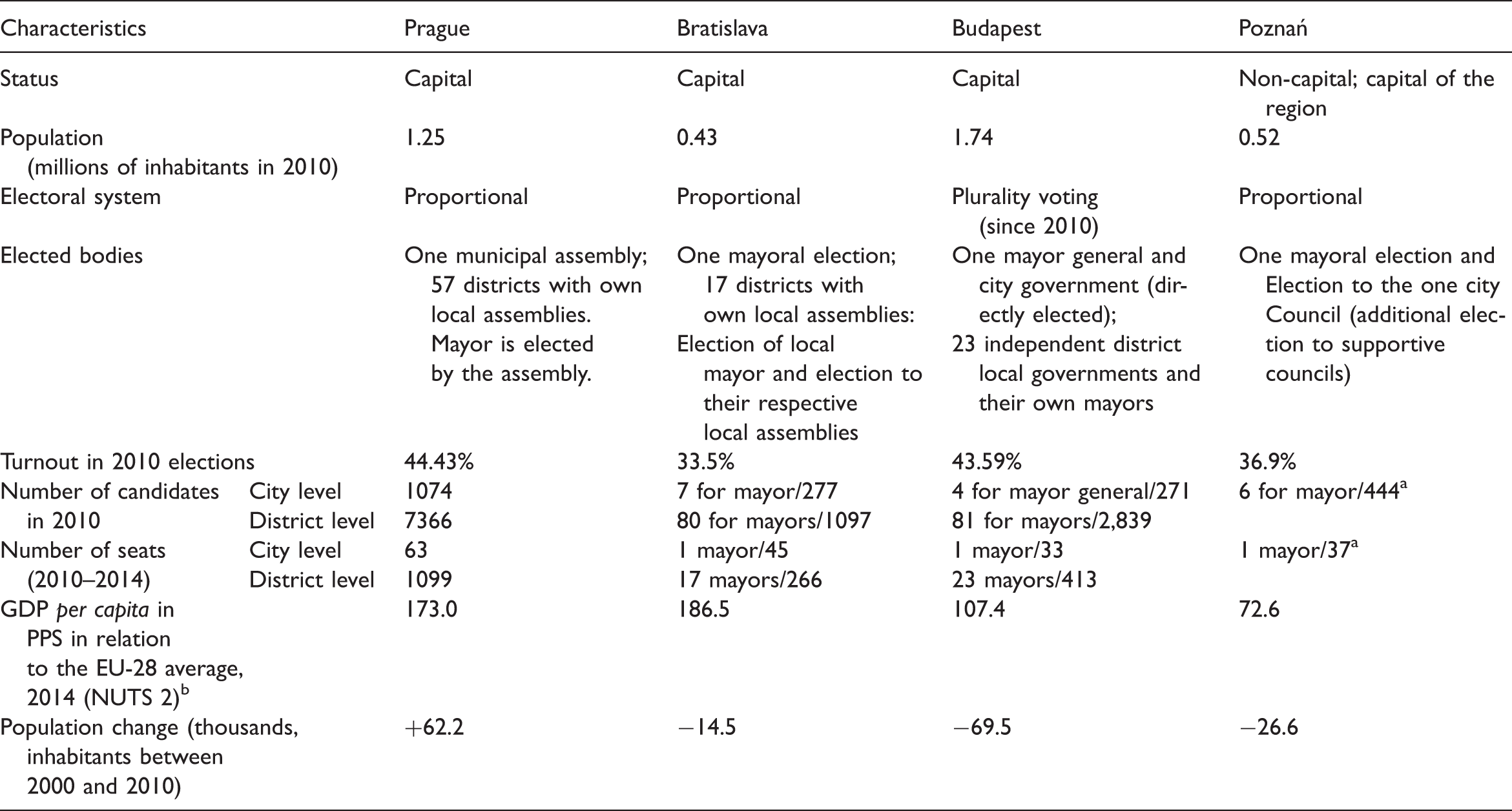
Source: Own elaboration.
GDP: gross domestic product; NUTS: Nomenclature of Units for Territorial Statistics; PPS: purchasing power standard.
The city of Poznan is divided into 42 districts (settlements) that act as auxiliary entities without independent legal status. Their organization and scope of activity is outlined by the council of the city in a separate statute. They have own legislative and executive bodies (district councils are elected directly by citizens and executive boards are elected by and from within the district council) but do not take part in the decision-making process at the local level.
Eurostat (2016).
The decentralisation helps governments to respond better to local needs. Some authors (De Mello and Barenstein, 2001; Enikolopov and Zhuravskaya, 2007; Fisman and Gatti, 2002) highlight the negative relationship between decentralisation and corruption, i.e. the larger the degree of decentralisation, the less severe government corruption is, precisely due to better responsiveness, accountability and greater budget pressure on the efficiency of government at the local level. On the other hand, Fan et al. (2009) found that the more levels of government there are, the more ‘pockets’ there are to fill, i.e. the danger of uncoordinated rent-seeking.
The common trait of societies of post-communist countries is the relatively low level of trust (European Social Survey, 2006, 2008, 2012) and the low level of participation in national and local elections. Among the analysed countries, Hungarians were found to trust each other most in 2012 (approx. 28% of people), while Poles and Slovaks had the lowest levels of trust (approx. 18% of the people). In some cases, the local elections are characterised by an even lower turnout than in national elections (e.g. Hungary, Poland). This level of turnout is common for all the countries of Central and Eastern Europe (Potluka et al., 2014: 18).
In local elections, citizens vote for political parties or, recently, for leaders of civic movements. The votes for the representatives of civic movements and NPOs were hard to identify in the body of official statistics on local elections in 2010. In the survey, we decided to ascertain whether the candidates for a seat in the city assemblies in the four selected cities are also members of any NPO and what areas they are specialised in. In all Visegrad countries, NPOs can collaborate with the local and regional self-governing bodies and may perform tasks delegated to them by the governmental authorities: in this capacity, they are independent, as they can oppose the incumbents. They operate in a broad range of areas, such as education, culture, transportation, environmental protection and the social economy.
Citizen participation in the NPOs is rather low and social activities such as work brigades, assistance to senior citizens, the activities of religious organisations, cultural and social events or interest group activities (e.g. musicians, gardeners) dominate. In some of the countries during the period from the mid-1990s until 2008, civic participation decreased (visible particularly in Slovakia). In the Czech Republic, however, almost 47% of the populace were involved in social activities or participated in an NPO at least once (Vajdová, 2005), albeit on an occasional basis.
We grouped active organisations according to the following social objectives: culture and art, research and education, health care and social services, environment, human rights, equal opportunities, local development, youth work, recreation, sport and tenant protection (rented accommodation and land).
In all of the countries, there was a drop in the sustainability of NPOs at the beginning of the 2000s. After this point, the situation started to vary among the countries. The situation improved in the Czech Republic and Poland, but deteriorated with a decreasing trend in Slovakia and Hungary. Nevertheless, for the selected cities, the percentage of registered NPOs is above their respective national averages (Potluka et al., 2014: 22). We observed that many of the organisations across all the analysed countries began to specialise in this period. After entry into the EU, NPOs started to use EU funding to increase their capacities. Since the introduction of the partnership principle, NPOs have become more involved in enlisting the support of public consultation to devise development strategies and foster local development projects.
All four cities in our sample are important centres of growth. Their citizens choose political leaders when electing city assemblies. The election system to general assemblies is proportional, except in Hungary. The three capital cities are divided into districts for which a district mayor and an assembly are elected. In the case of Poznań, a mayor and a city council are elected, while the regional councils are predominantly civic in character, but they have only supportive and not decision-making role. In all the cities, the 2010 election turnout was not higher than 45% (see Table 1). The surveyed election term covers the years 2010–2014 for all four cities.
Data and methodology
The empirical analysis presented in this study builds on data collected through a survey conducted among candidates who stood in local government elections to the assemblies (not mayoral elections) in 2010. The investigation area covers four large cities in Central Europe: Prague, Budapest, Bratislava and Poznań. The questionnaire used for the research had the same form for all four cities. The questionnaire survey was distributed among candidates, regardless of whether they were successful or not in the municipal elections.
The electronic questionnaire was created and distributed to respondents during the summer of 2014 (June–August). The list of candidates for all local elections was obtained from databases provided by the Czech Statistical Office, the Hungarian National Elections Office, Statistical Office of the Slovak Republic and the National Electoral Commission (Poland). After this, we compiled an email address list with the secretariats of all the political and civic movements which had candidates standing in local elections in 2010 for each city. The same work was done to reach independent candidates. In the next step, we contacted the candidates with a request to participate in the research.
The distribution of questionnaires was twofold. In the first wave, we asked local secretariats of political parties and civic movements to help us with distribution of the questionnaire among candidates. Based on responses, we were able to identify which secretariats were prepared to help us, so that the second wave could target the individual candidates, especially independent candidates, for whom an email contact had been found. In addition, in the case of the city of Poznań, the questionnaires were distributed among the City Council’s councillors during the meeting held at the beginning of July. As a result, we managed to obtain 374 responses (i.e. 205 in Prague, 78 in Budapest, 72 in Bratislava and 19 in Poznań). The sample contains data from 237 elected representatives and 130 unsuccessful candidates (by cities, respectively, 122 and 83 in Prague, 56 and 16 in Budapest, and 40 and 31 in Bratislava). As for the city of Poznań, we obtained a total of 19 responses from the 37 councillors who were contacted. In the group of unsuccessful candidates, no response was received in Poznan despite many contacts and renewed requests to participate in the research. This can be explained by a general lack of interest to participate in the research, as the candidates were preparing for their forthcoming local elections held in Poland in November 2014. Another issue concerning the unsuccessful candidates in all countries is that it was often extremely difficult to acquire their email or contact addresses, and even the political parties’ secretariats were unable to help.
We are aware of some issues in the data. First, none of the samples is statistically representative enough. For example, 7366 candidates were standing for a seat in Prague in 2010. This means, that, for a standard 5% margin of error and a 95% confidence level, we needed 366 responses. Second, for Poznan, we only have responses from 19 elected councillors and none from non-elected candidates. Moreover, the system used to recalculate votes to seats is problematic: As the D’Hondt’s system is applied, almost all parties invite people who never intend to join politics, but only added their names to the list of candidates. The parties do this in order not to lose votes because of their list of candidates is incomplete.
Finally, as the data are mainly nominal in character, we refer mostly to descriptive analysis and cross-tabulation; chi-square tests were applied to reveal whether there are statistically significant relationships between selected answers from the questionnaire survey.
Results and discussion
Politicians’ membership in NPOs
We study the non-profit leadership represented at the NPOs level, thus we concentrate more on place-based and collective leadership (Sotarauta, 2014) than individual, even if it is represented by a proxy variable of leadership in an NPO. Our assumption behind is that participative management approaches and public beneficial orientation in NPOs cause transformation of individual leadership into collective.
Two-thirds of the respondents are members of an NPO, while roughly one-third has leadership role in an NPO (see Table 2). The Polish and Hungarian respondents report higher levels of participation in NPO leadership. Even when discounting the Polish respondents owing Poland’s small sample size, the Hungarian respondents still report a higher participation in NPO leadership (the Pearson chi-square is 0.063). Budapest’s higher participation in NPO leadership is potentially due to the fact that local governments set up several NPOs in the 1990s, in order to put their people into leadership roles so that they would comply with requirements set for ‘social consultation’ or, alternatively, in order to outsource the provision of certain services (e.g. in education, social and health). Some critics interpret this behaviour as resulting from civil society’s lack of independence and self-determination (although several independent NPOs do exist as well) and as a sign of political incarceration (Soós and Kálmán, 2002). On the other hand, only eight mayoral candidates (10%) were representatives of NPOs in Budapest, and of these, only one was elected. Moreover, all four candidates for the post of Budapest’s Grand Mayor had been nominated by national political parties, i.e. reflecting the strong dominance of party politics.
Membership in an NPO.
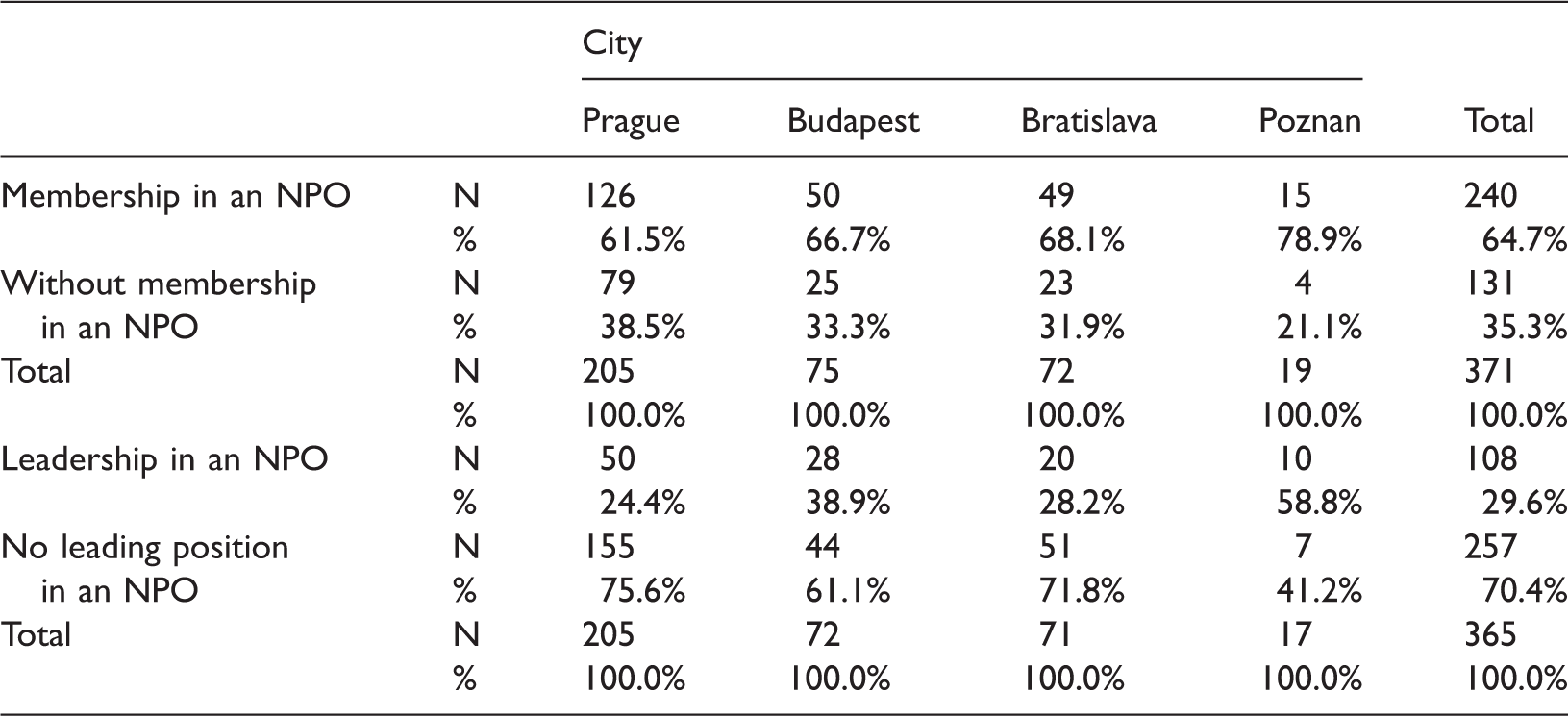
Source: Survey, own calculations.
NPO: non-profit non-governmental organisation.
Pearson chi-square for leadership in an NPO is 0.005.
Membership and leadership in an NPO as a factor of winning a seat in elections in 2010.
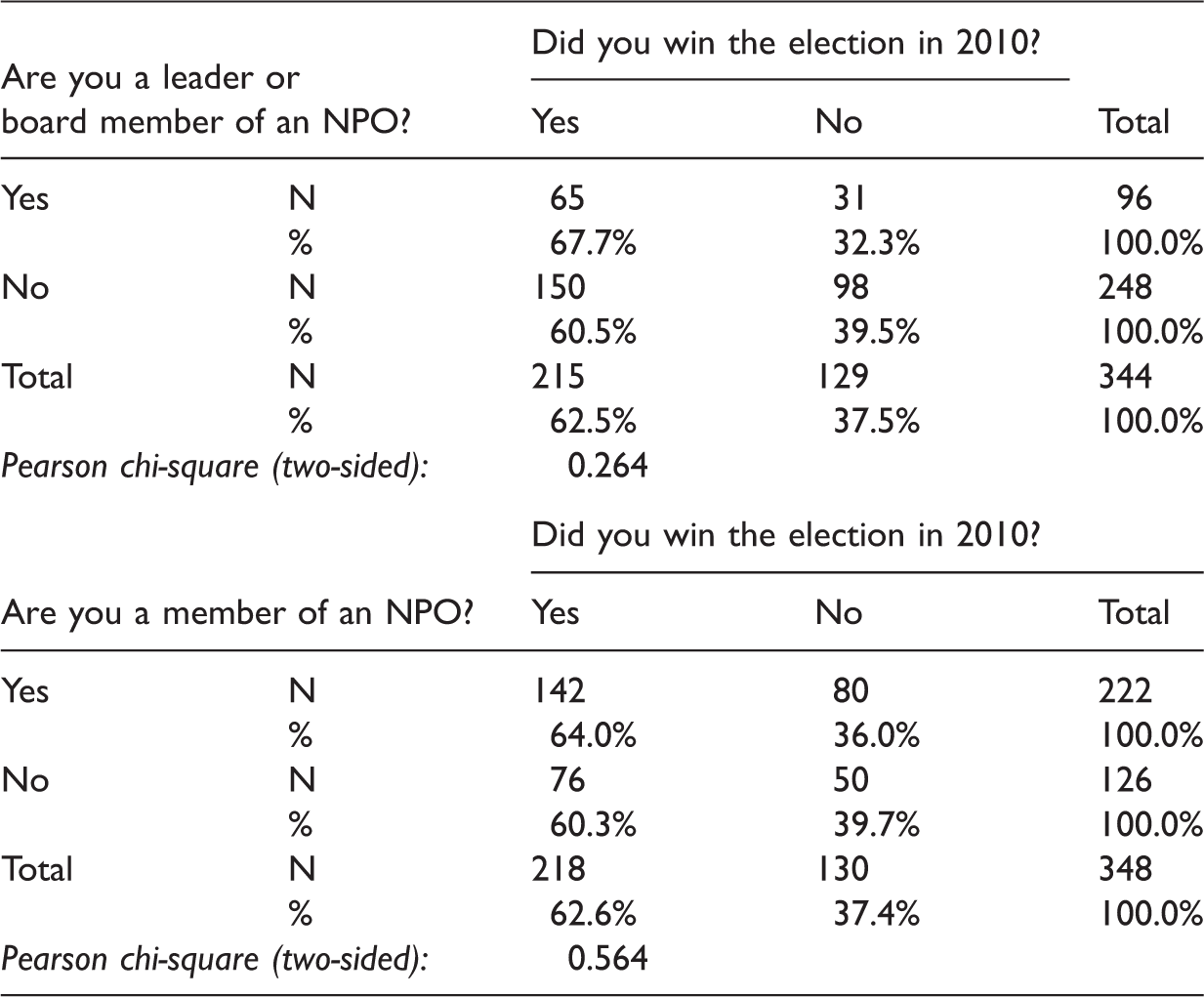
Source: Survey, own calculation.
NPO: non-profit non-governmental organisation.
Membership in an NPO by main area of its activity and winning a seat in elections in 2010.
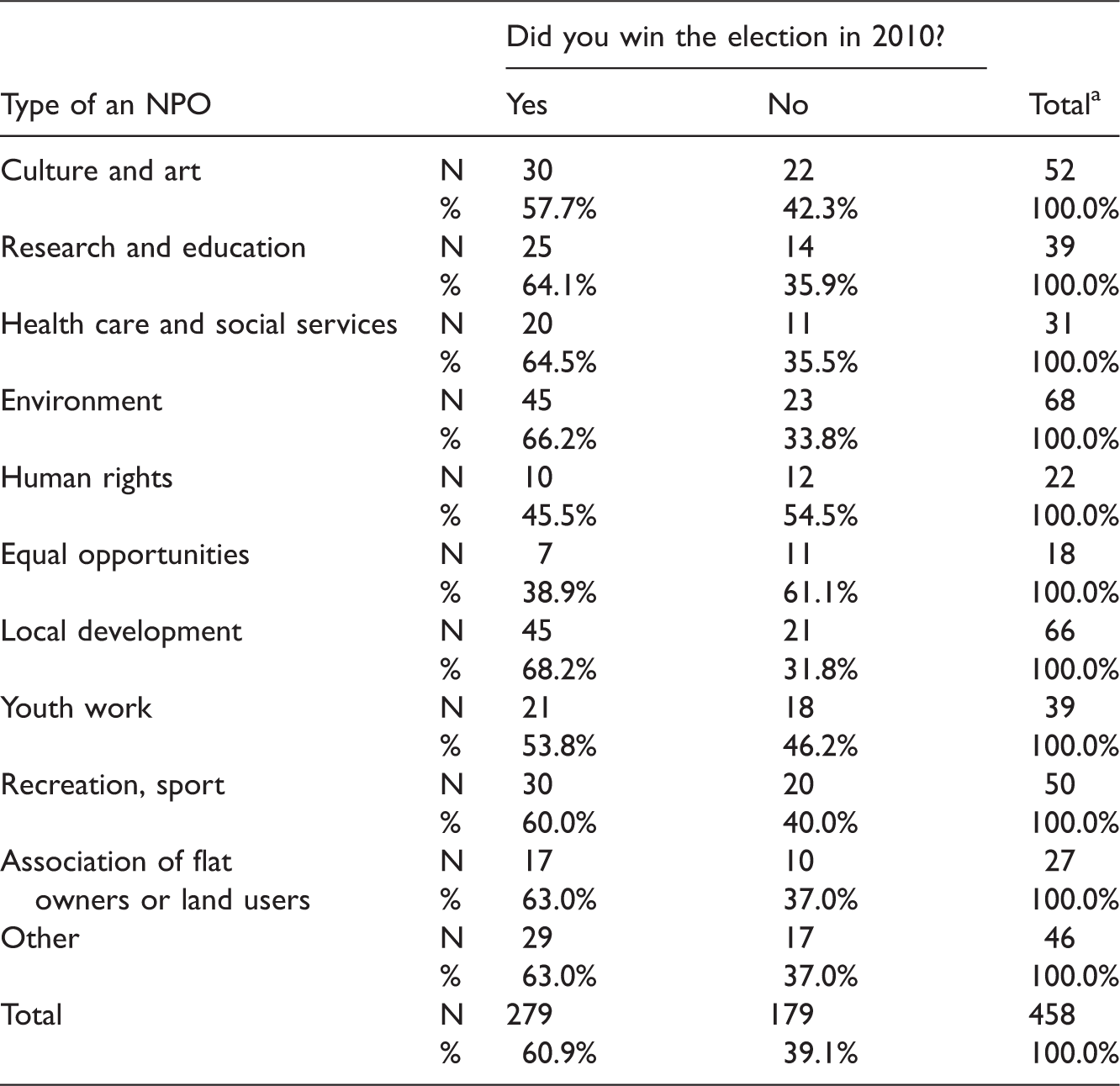
Source: Own survey.
NPO: non-profit non-governmental organisation.
Some NPOs are active in several fields.
Strategies to influence political decision-making.
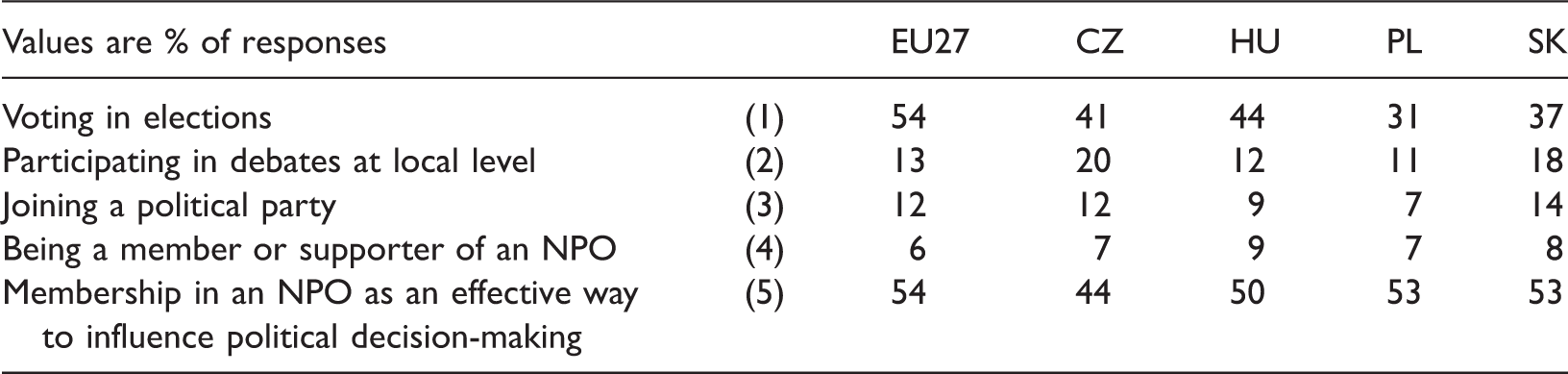
Source: TNS Opinion&Social (2012: 46) and row (5) TNS Political&Social (2013: 25).
NPO: non-profit non-governmental organisation.
As shown above, two-thirds of local politicians in the sample are active in NPOs, hence we can confirm that local political elites have strong roots in civil society across our four cities – although we find no statistically significant relationships between NPO membership or leadership and winning local government seats, so political ambition does not appear to be their motive.
Previous jobs
To find out more about the background and the social roots of local assemblies’ members in the V4 cities, we collected information on politicians’ jobs prior the year 2010. We found that the majority of local assembly members (56.2%) come from the private sector, of which only 2.6% come from the civil society sector (NPOs), and 53.6% from private businesses, and the rest come from the public sector, being either politicians (11.2%) or public servants (32.7%). These results reflect the somewhat biased selection mechanism involved in standing for a seat and being elected to political office, as the average bandwidth of public sector employment across the Visegrad countries is 25–35%, with the Czech Republic having the highest average, and all being above the OECD average of 21.3% (OECD, 2015a: 84). Thus, the percentages indicate that an above average contingent of local government candidates come from a public sector background. The rather low contingent of assembly members who previously held an NPO job reflects the low employment rate in this sector across these countries, where most civil organisations run the majority of their activities with the help of voluntary activists and can afford to employ only a few staff. NPOs represent 2.0% of total employment in the Czech Republic (CZSO, 2015) and 1.19% in Slovakia in 2010 (Kuvíková and Svidroňová, 2013). While this share is 4% in Hungary (KSH, 2014), it must also be noted that only 16% of Hungarian civic organisations could afford to pay for employees (KSH, 2014). In Poland, NPOs represent 0.9% of total employment (GUS, 2014), and 20% of these have full-time employees (Adamiak et al., 2016).
Preference for decentralisation
We could assume that local politicians who are also members of civil society organisations would prefer a decentralised system, which would explain the differences between the cities in the sample. The share of NPOs’ members who are local politicians is almost the same across all cities involved (see Table 1). Thus, cultural explanations for the results are more illuminating.
One-third of Budapest’s respondents said they prefer centralisation – a somewhat puzzling answer from local politicians, especially with high rates of NPO involvement (see Table 6). This opinion can be linked to a general shift within Hungary. On one hand, a kind of backlash appears to have developed as a result of dissatisfaction with the transition, a kind of longing for strong leadership, irrespective of party colour. For some people, it is nostalgia for ‘good old socialist times when things went better’. On the other hand, Hungary is actually undergoing a process of recentralisation, especially since 2010, with the central government taking major functions away from local governments since 2012 onwards (education and health services). Perhaps, some people agree with these trends which started back in 2010 and think that the provision of services is more efficient, or less costly, if managed at centrally. Such a trend, however, means less autonomy for local governments, even though their representatives are not perturbed yet.
Assessment of government efficiency
Preference for a political system.
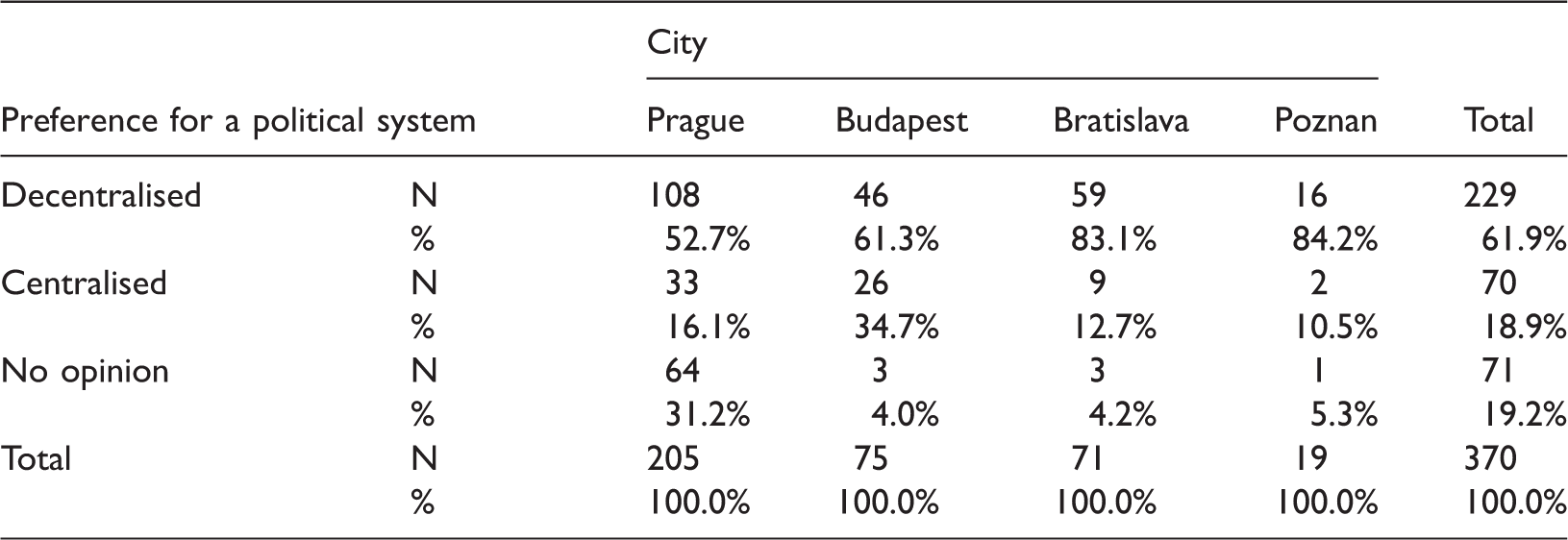
Source: Own survey.
Assessment of government efficiency.
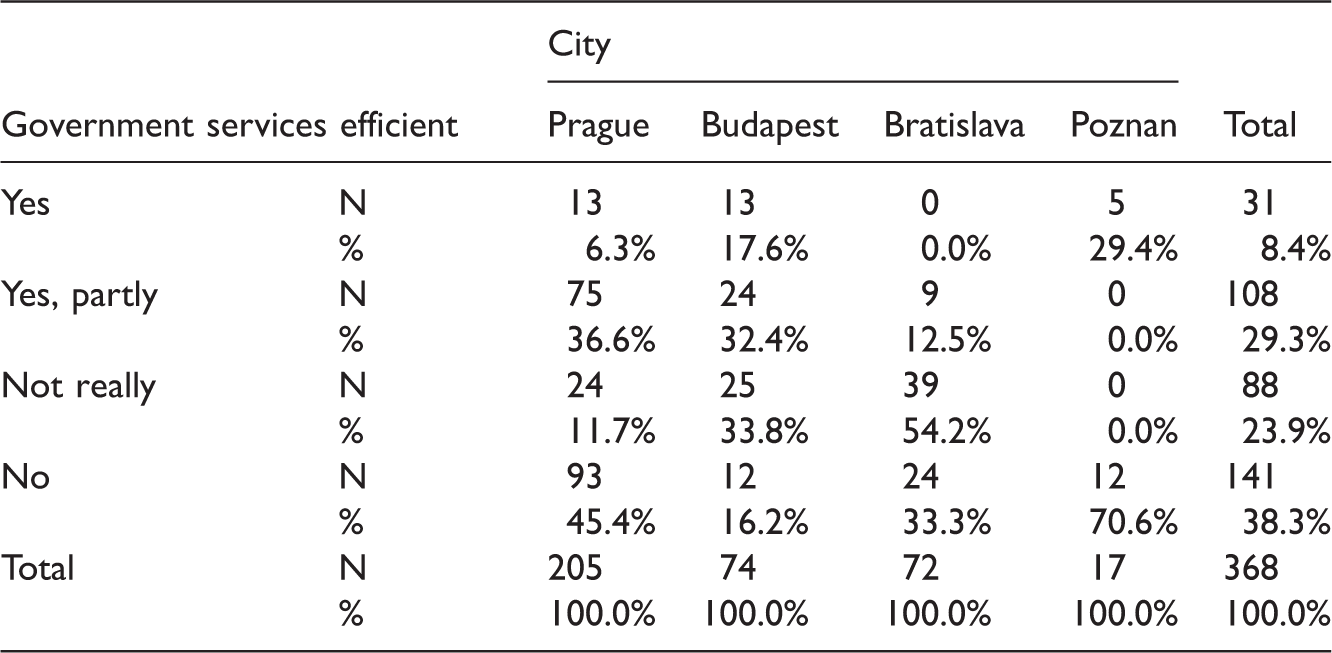
Source: Own survey.
Conclusions
In order to play an effective role in solving local social problems, NPOs and engaged citizens need leadership at both an individual and collective levels. Solitary actions show lower chances of success. Thus, strategic connections and coordination between NPOs and policymakers is an important motive for urban development.
Our research affirms that NPOs play an important role in local development in Central and Eastern European cities. All four cases display homogeneity among the Visegrad countries with regard to local politics and local civil society engagement. Despite the factors embedded in the low level of trust in the Visegrad countries, local political elites are identified as engaging significantly in NPOs. About two-thirds of the local politicians taking part in the survey participate actively in civil society organisations in all surveyed cities. Not only are they active, but almost one-third of them are non-profit leaders, slightly higher among Polish and Hungarian respondents. Their participation is likely to create opportunities for introducing some changes in local policymaking.
Our results revealed that neither membership in an NPO nor a leadership position has an effect on electoral success, so political ambition does not appear to be their motive for civic activity. The rather low contingent of assembly members who previously held NPO jobs reflects the generally low employment rate in this sector across Central and Eastern European countries (CEEC).
NPO leaders seem to have higher chances of electoral success if the NPO’s activity is linked to the environment or development. Activities which have no impact on an NPO leader’s electoral success are linked to equal opportunities and human rights, because these issues are debated at the level of national politics and have less of an impact on the local electorate. Thus, a NPO’s field of activity is an important factor influencing perception of local policymakers about local issues.
Along the logic of our hypotheses about NPO participation contributing to more inclusive and open societies and since spatial leadership plays an important role in the construction of new agendas and identities we have also investigated the views of local politicians on decentralisation, government service provision efficiency and the importance of several local policy topics, and found some puzzling differences across our V4 cities that possibly reflect cultural differences.
Our empirical study provides a scientific basis for discussing the role of non-profit leadership in regional development. It adds to filling the gap in knowledge of non-profit leadership in urban and regional development, but further studies have to be conducted in four dimensions at least.
First, our results are indicative of general relationships which can be analysed in depth in a more complex study. Future research demands larger data samples, more cities, e.g. of different size and level of wealth, and panel data to take dynamics of the development into consideration, hence allow for comparison across countries and time.
Second, the growth of NPOs in place-based leadership is a dynamic process that legitimates needs to incorporate the interest of people living in the cities. Where both public and private sectors fail to serve the people’s demand, NPOs play a crucial role. Still, non-profit leadership in urban development is a neglected topic so far in the literature.
Third, new trends have started to be particularly visible recently in some of the analysed cities, and the impact of decisions made at national level as well as interrelations with the multi-level governance structures must also be examined in the future.
Fourth, EU membership has had an impact on the redesigning of governance structures in member states – thus its effects should be analysed more deeply in the case of CEECs as well. It concerns both inter- and intra-sectoral relationships.
Taking into account the above-mentioned issues, future research could provide the possibility of assessing the long-term impact that local governance mechanisms, on the one hand, and involvement of civil society and non-profit leaders, on the other hand, have on the economic development and governmental efficiency of these cities.
Footnotes
Declaration of conflicting interests
The author(s) declared no potential conflicts of interest with respect to the research, authorship, and/or publication of this article.
Funding
The author(s) disclosed receipt of the following financial support for the research, authorship, and/or publication of this article: This publication was written within the project 21320074 “Leadership and Urban and Regional development” funded by the International Visegrad Fund.