







Abstract
The practice of cities and regions nurturing external and international relations has been part of their roles and functions literally for millennia. More than ever, in an era of globalisation, international breakdown and dysfunction, local leaders need to look outward, identify their localities' international opportunities and challenges, and put in place measures to address them. This viewpoint is based on a briefing the author produced for LGIU (Local Government Information Unit -a think tank owned by UK local authority members) in November 2016. It outlines the case for UK LAs, with neighbours and partners as appropriate, to recognise the importance of a coherent approach to international affairs through the BREXIT negotiation period and beyond. It suggests a framework for formulating this approach, and draws on some examples of internationalisation that are already established and operating. It also suggests opportunities for local government as a sector to influence Government’s priorities and approach. This may be better promoted across relevant LA associations, with partners (e.g. LEPs, universities, NGOs, etc.) and at UK as well as individual nation level.
Introduction
At a recent workshop of a local leadership team in non-metropolitan England, one delegate commented ruefully “With Trump and Kim Jong-Un competing for the ‘most irrational, most unstable global leader' designation, and the UK determined, at best, to provoke a period of intense turmoil in relations with our nearest and closest neighbours, how can I lead public policy development for cities and communities in my area?”.
It is a fair question! And although I gave a ‘simple' answer, executing my response is far from easy.
More than ever, in an era of globalisation, international breakdown and dysfunction, local leaders need to look outward, identify their localities' international opportunities and challenges, and put in place measures to address them.
Formulating and delivering an international strategy might not appear a top priority amidst immediate economic, societal, and financial pressures. But it may be an essential part of positioning cities and communities for long run success.
This practitioner viewpoint draws heavily on a briefing the author produced for LGIU (Local Government Information Unit – a think tank owned by UK local authority members) in November 2016 (Marlow, 2016). It sets out the rationale for and parameters of such an exercise, and how it might be delivered.
Background
The practice of cities and regions nurturing external and international relations has been part of their roles and functions literally for millennia. City states preceded nation states by many centuries. For smaller municipalities and rural areas, activities like town-twinning have been a feature of civic relations for well over a century.
In the UK – arguably the most centralised of modern advanced economies – sub-national foreign relations have tended to be frowned upon by national government. The public and media also scrutinise foreign relations (especially overseas visits) particularly closely and often critically.
Nevertheless, there have been very significant external initiatives of sub-national tiers of government in the UK, taking many forms.
The Scotland Government seeks a high international profile. London’s recognition as Europe’s premier ‘world city’ involves deep and broad international relations. Overseas offices of English regions have been operated (in the RDA era). Brussels offices and participation in international and particularly EU transnational programmes by local authorities have continued under Coalition and Cameron governments. Cities and regions bid to host international events – including recently the Tour de France in Yorkshire and Birmingham’s bid for the Commonwealth Games in 2026.
Following the EU referendum, the UK’s positioning internationally will change profoundly. National government’s major tasks for an extended period will focus on BREXIT and its knock-on consequences. The involvement of Scotland, Wales, Northern Ireland governments, English intermediate (e.g. London and Combined Authorities) and local government (LA) in this process is uncertain and contested.
Given how controversial and distracting the referendum fall-out is, and will continue to be, the local temptation to ‘keep one’s head down’ and ‘stick to the knitting’ will be intense. However, cities and regions who wish to achieve their economic and social ambitions need to understand the specific international context in which they are operating, leverage the opportunities these present and mitigate the risks.
The case and agendas for LA international strategies
The argument that in an era of increasing globalisation place becomes more, rather than less important is well established (see for instance, Barca et al., 2012). Capital, goods, people and ideas can travel between places at unprecedented pace – but they tend to concentrate and agglomerate in specific metro economies and accessible, attractive neighbours.
In the UK context, Philip McCann's (2016) diagnosis of the UK regional problem is getting widespread exposure and debate. His recent presentation at the City Horizons event restated the profound, extreme and increasing spatial imbalances across the UK in almost every aspect of economic and social prosperity. These are essentially between a London mega-region, to a lesser extent Scotland, and ‘the rest'. The highly centralised UK state, with its ‘fastest growing' narrative based on the distortions of the world city, is chronically incapable of addressing these divergences.
These challenges may be anticipated to increase as the uncertainties of BREXIT negotiation and new top down national policies unfold. They will play out differentially in, for instance, the London mega-region, devolved nations and different areas of England. For local authorities, and LA-led intermediate sub-regions or regional structures, understanding and acting on their positioning in the global economy will become increasingly important economically and socially.
The ‘business cases’ for making this effort (in a time of already large complex agendas and resource constraints) is compelling. LA place and community-leadership roles make them the necessary enablers of any place-based international review – singly or with relevant neighbours and partners.
The post-referendum context raises several strategic place-based international questions that LAs need to work with partners to answer.
Profile and reputation
How do cities and regions wish to be known internationally? In a period where Government policy is detaching the UK from the EU and seeking to restrict movement of people, how can cities and regions present themselves as welcoming generally, and open for business?
Different LA areas, city and sub-regions have differential challenges and starting positions in this regard. For instance, rightly or wrongly, the perception of the average LEAVE area in many key national and global markets is ‘older, rural, less skilled, and living outside the metropolitan centres’. The perception of REMAIN areas tends more to ‘younger, urban, skilled, and from a major city’. In the longer run, the types of (high value, knowledge-based) businesses and talented people cities and sub-regions seek to attract for their local growth ambitions are more likely to gravitate towards areas with REMAIN characteristics.
Local economic and business impact
Understanding the local economy and anticipating exposure of local business to trade and investment changes will be particularly important. The LAs role includes advocating business priorities and concerns to Government; giving local businesses confidence that they will be supported during periods of uncertainty; and coordinating local responses to any economic shocks and setbacks.
A key dimension of business and employment impact concerns the reliance of particular industries on migrant workers. For instance, NHS and care sector non-UK employees nationally amount to around 15%. Land-based and agricultural processing industries are also heavily reliant on migrant workers. LAs may wish to:
understand which local businesses and services rely particularly on non-UK labour reaffirm that non-UK workers are welcome and valued in their area track national and regional policy changes vis-a-vis migrant workers (for instance, there have been suggestions that some migrant worker policies might come within scope of devolution agreements)
Inward investment
Beyond the existing local economy, LAs need to contribute to their area’s new offer in global markets. UK has been the largest recipient of foreign direct investment (FDI) for a number of years. At the least, this will change as we cease to be the obvious location of choice as the gateway to the EU internal market. Clarifying, developing and promoting the area’s assets, capabilities and offer to global investors requires reworking post-referendum. Establishing arrangements with new national departments and approaches (BEIS, DIT, etc.) should be part of this process.
Immigration and social cohesion
LAs have different levels and character of resident ethnic communities living and/or working in their areas. In the UK as a whole, latest ONS figures identify the non-UK population as 13% of all residents, with just under 5% from the EU. However, non-UK densities range from over 50% in three London boroughs and 35% in Leicester to under 6% in the North East and Wales.
Understanding the dimensions of these very different local communities, reassuring and supporting them where necessary, working with them as positive assets of the area will be important and potentially highly positive aspects of any new international strategy. At the same time, LAs will have concerns to mitigate localised hate crimes and community tensions.
International students and universities more generally
The future scale and character of international students studying in the UK will have a major impact on local universities and thereby their roles as anchor institutions in cities and towns. There are over 300,000 international students currently studying in UK universities. This represents approaching 10% of undergraduates and 30% of post-graduates. Typically, non-EU students pay much higher fees than UK students.
Whilst the decline of £sterling may make UK programmes more competitive, the potential rise in fees for EU students AND the continued insistence by May (although not shared by some of her Cabinet) of including student numbers in the immigration regime is forecast to lead to declines in numbers over the BREXIT period.
Some universities are particularly exposed to any dramatic drop in international intake. Thirteen universities are reported as having more than 20% international undergraduates (eight in London, but also St Andrews, Buckingham, two in Liverpool and Lancaster). Seven universities have more than 50% international postgraduates (three in London, Cardiff Metropolitan, Coventry, Sunderland and Birmingham).
Alongside students, many universities are highly reliant on international (including EU) research and development income, and ALL have benefitted from the UKs former profile as a very open, welcoming country.
Local universities will be major role players and participants in any refreshed local international strategy. There is a genuine set of risks that BREXIT will represent an existential threat to some university anchor institutions – with huge implications for the future of their local areas. LAs need to work closely with their local universities to attempt to mitigate adverse impacts.
Funding and programme relations
Some local authorities and/or local partners (including businesses, universities and civic/community groups) benefit significantly from participation in EU and other international collaboration programmes. The EU Interreg programmes, for instance, have a budget of €10bn up to 2020 covering a breadth of themes of interest to LAs. There are also non-EU sources of international LA cooperation resources.
These types of programmes provide useful co-financing for LA R&D activity and can sometimes lead to wider relations with partner places.
These sources of funding are likely to be submerged in the larger issues of UKs changing relations with EU structural funding and EIB. Nevertheless, individual LAs should assess their participation in current international funding programmes of this character – with a view to either orderly withdrawal, or for alternative sources of finance. Collectively, there may be merit in the LA sector (with partners) ensuring future international funding for collaborative programmes is on the agenda of the UK negotiating teams.
LA associations
Many UK LAs are active participants in EU and international LA associations (e.g. Eurocities, IULA, City Mayor’s Foundation, etc.). Refreshing how and when to engage in international associations is another task some LAs may wish to consider as part of any review of their international positioning. It might also be a collective agenda for the sector (e.g. in terms of status within EU LA-based institutions).
Societal challenges and organisational learning
Underpinning much of the case for LA-based international strategy is the character of societal challenges faced by all leaders of place (aging, migration, climate change, sustainable development, etc.). Connectedness and learning from ‘best of class’ globally are essential to addressing these challenges effectively. Any international review should at least consider existing relations for their contribution to tackling these issues locally; and appraise proposals for new relations in these terms (in addition to any immediate local economic or social dividends).
Putting the above together, an illustrative starting framework for producing the ‘business case’ for future international strategy at LA, city-region and sub-regional levels is shown below. This will also include consideration of specific LA dimensions of the overall UK BREXIT negotiations process.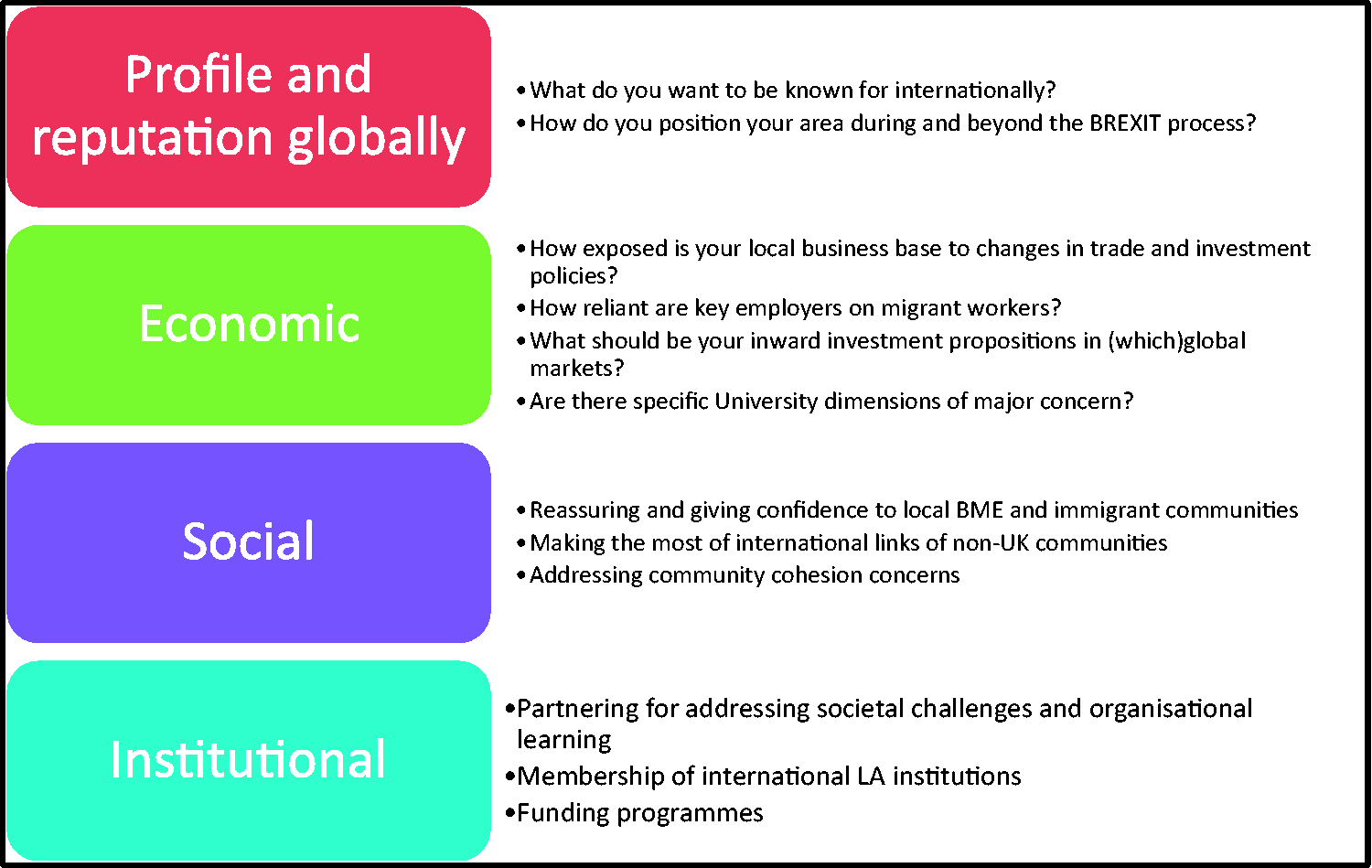
Applying the agendas – Selected examples
If the above framework is considered useful, a follow-up question concerns learning from current ‘best practice’ in LA strategic approaches to internationalisation.
Greater Manchester (GM) is a reference point of what can be achieved collectively by LAs and partners working across a functional economic area. The GM approach includes:
Clear international references in the Greater Manchester Strategy ‘Stronger Together’ – albeit this stops short of an explicit international chapter. Future LA, city or sub-region growth strategies should include international insight and consider the case for a distinctive section or strategy. A major institutional delivery body. Greater Manchester Growth Company is an umbrella for the group of companies that deliver GMs economic development priorities. In terms of internationalisation, it includes, an international advisory board, Marketing Manchester, Visit Manchester, MIDAS (inward investment agency), and a branded Trade Advisory Service. A number of specific strategies by subject (e.g. Visitor Economy) or partner (e.g. most universities have their own explicit international strategy or chapter in their strategic plan). These strategies focus on distinctive elements of Manchester’s international agenda. A profile and some protocols with relevant arms of Government – DIT (formerly UKTI), Visit England, Innovate UK, etc. These are sometimes two-way – for instance GMs own China Forum and Wuhan sister-city agreement assisting DIT as well as DIT supporting Manchester.
It is challenging for smaller city regions or individual LAs to replicate the sophistication and reach of the GM arrangements. However, LAs need to be aware that many aspects of these agendas are competitive. Places with global ambitions do resource these functions seriously – both in the UK and internationally. London and Partners and Scottish Development International (SDI) have even more extensive programmes than GM, as do many European (e.g. FRM GmbH Frankfurt) and international (e.g. Invest-Toronto) cities.
As recognised above, it is easier to mobilise these types of approach at scale and with an existing international brand. However, mid-size and smaller places are also able to deliver significant international benefits locally.
For instance, Essex County Council’s links with Jiangsu Province in China over 25 years has brought economic but also civic exchange, and even influenced activity in the county (e.g. the Chinese language learning programmes in schools).
Leicester has nurtured strong business and community links with India, China (partly through its indigenous BME communities) and is now developing relations with Thailand following Leicester City FCs Premier league success under its Thai owners.
Many LAs (and partners like universities) use EU regional collaboration programmes to strengthen or build civic links – and vice versa (i.e. use civic links to anchor bids for transnational funding).
Most local authorities offer some levels of support to inward investment and to wider international business and civic links.
The challenge is to put all these interventions together into a coherent whole, to nurture and leverage them for mutual value over the longer term.
Towards differential international regimes during the BREXIT process?
A further major issue for LAs is whether Government will either choose or be compelled to negotiate differential post-BREXIT regimes in different geographies of the UK.
This will absolutely be required with Northern Ireland and the open border with the Republic. Scotland Government seems determined to craft a distinctive relationship with the EU post-BREXIT, with an option of considering a second independence referendum should the UK government be overly obstructive. Were Scotland to win concessions, these are likely to also be sought by Wales and probably some England regions and sub-regions.
Government itself has indicated that it could seek special status for either specific industries or those areas where those industries are concentrated. The NISSAN example and Sunderland is probably the most notable example to date. Although Government has avoided spelling out details, options like ‘free zones’ around ports and/or in supply chain clusters have been mooted.
Similarly, further special dispensations for post-BREXIT asymmetric regimes have been suggested bottom up – for the City of London financial services sector; for regional or city immigration quotas; for special treatment of Universities and international students among others.
Whilst undoubtedly these types of proposition add complexity to Government BREXIT negotiations, there is no reason for LAs not to formulate and campaign if there is a valid local benefit to accrue. There are various national and EU legal foundations for these deals – from the legislation establishing the devolved Governments and London’s arrangements to potentially the Sustainable Communities Act and the European Grouping for Territorial Cooperation (EGTC). We know from Nissan that Government will make ad hoc deals, although whether they can deliver them is another matter!
LAs, CAs and partners should consider what international regime would best support their ambitions, and then formulate a proposition to promote this ‘ask’. The LA sectors – in England, Scotland, Wales and Northern Ireland – may wish to collaborate to press the case for LA having influential strategic voice(s) in negotiations which fundamentally change the international context in which their cities and communities can flourish.
Conclusions
The EU referendum and the May Government’s execution of the result have fundamentally changed the way UK cities and communities will be impacted by and engage with globalisation in the future. It has not, though, removed globalisation’s impact and the need for ambitious places to engage.
This viewpoint outlines the case for LAs, with neighbours and partners as appropriate, to recognise the importance of a coherent approach to international affairs through the BREXIT negotiation period and beyond. It suggests a framework for formulating this approach and draws on some examples of internationalisation that are already established and operating.
Ongoing BREXIT negotiations may present opportunities for LA as a sector to influence Government’s priorities and approach. This may be better promoted across relevant LA associations, with partners (e.g. LEPs, universities, NGOs, etc.), and at UK as well as individual nation level.
As stated in the introduction, the argument is relatively simple. But doing this type of work well is not easy. However, the alternative is essentially a default to government to determine local places international positioning top down. For the devolution practitioner, now is the time to step up and look outwards.
Footnotes
Declaration of conflicting interests
The author(s) declared no potential conflicts of interest with respect to the research, authorship, and/or publication of this article.
Funding
The author(s) received no financial support for the research, authorship, and/or publication of this article.