







Abstract
This study aims to reflect on the views of public sector managers in relation to possible ways to cope with austerity budgeting and its impact on public services provided to local communities across a subregion. The investigation draws on empirical research based on a series of facilitated strategic workshops delivered to over 400 UK local authority middle managers. The findings indicate a suggested process model and framework to enable the implementation of a customer-driven approach to the delivery of local community public services. The intent of this study was to enable understanding of a particular case and to share that new understanding more widely. The overall approach is based on a ‘common-sense’ view of generalisability, in which readers will find value if the material resonates with their experience. This study is of potential benefit to researchers and those involved in developing effective and sustainable methods of coping with increasingly severe budgetary constraints on public sector local community provision. The study contributes to the extant literature by investigation of practitioner perspectives on these issues.
Keywords
Introduction
The way in which services are delivered in the United Kingdom’s local communities has been a subject of debate for some considerable time (see Alford, 2009; Bovaird, 2007; Hastings et al., 2015; Lawler and Hearn, 1995; McEldowney, 2016; Stewart and Clarke, 1987; Varney, 2006). Given few signs of imminent improvement to national economic outlook, there is every prospect that recent public sector austerity budgets will be with us for some time to come. Indeed, with the uncertainties facing the UK following the formal triggering of moves to leave the EU, local authority finances may be squeezed even further. Regardless of criticisms that austerity measures are actually counterproductive in the management of a struggling economy (Blyth, 2017), local public services must find a way to deal with them. Overmans and Noordegraaf (2014) identified four responses for managing austerity in local government: decline, cutbacks, retrenchment and downsizing. Hastings et al. (2015) also include retrenchment in the three strategic approaches they suggested, along with efficiency and investment. McEldowney (2016) refers to the increasing need for local authorities to address austerity by finding their own resources. In the UK, one recent proposed mechanism to deal with fiscal constraints was the concept of ‘Whole-Place Community Budgets’.
Partly in response to wider budgetary constraints imposed by the broader economic situation, Whole-Place Community Budgets have been trialled in several UK local authorities. Such programmes aspire to deliver the following outcomes: improvements in the cost-effectiveness of service delivery (some based on clearer incentives to achieve these), supplier access to resources and overall outcomes for citizens (Morse, 2013). The overall intent of this initiative was to ensure that future local authority focus was to be on the building of services around people and communities. This meant that in future, local public service providers jointly were to be accountable to their local communities for the delivery of a whole-place community budget. This new focus on joint accountability for co-ordinated joint provision of public services was underpinned by the need to view service user experience and outcomes as the fundamental starting point.
This is another of the biggest drivers in public sector strategic thinking, localism: the move towards a more person-centred provision of public services and with it the need for a new perspective on customers and their involvement in the service process (Bunt and Harris, 2010; Calderwood and Davies, 2013; Jones et al., 2012; Leach, 2013). The 2011 Coalition Government white paper on open public services (HM Government, 2011) expressed their intent to give the public greater control over their local services. Increasingly, that has meant ongoing movement towards the provision of such services that fit personal needs, giving people much more choice and control in their lives (Think Local, Act Personal, 2011). The Coalition Government was also keen to implement service delivery efficiencies by capitalising on cross-boundary co-operation, increasing use of non-public sector provision and encouraging localism (Communities and Local Government, 2011). Such moves have not been without their critics however. For example, Lowndes and Gardner (2016) allude to localisation as a strategy really designed to implement even deeper funding cuts, a form of decentralised, super-austerity.
Rising to the challenge of addressing all of these drivers has implied a significant cultural shift for public sector service providers. One such shift has been a growing realisation that, where their citizens are concerned, local community services need to focus more on the way services are delivered. One key to meeting the financial, operational and ideological constraints being imposed on them is to develop services that are actually customer driven. Customer-driven services hold the potential to provide citizens with a clear increase in choice, control and involvement in their public services. This contrasts ‘with approaches that treat people as passive recipients of services designed and delivered by someone else’ (Needham and Carr, 2009: 1) and ‘emphasizes that the people who use services have assets which can help to improve those services, rather than simply needs which must be met’ (Needham and Carr, 2009: 1). Making better use of these assets will have a considerable impact on the local communities of which they are a part, and therefore on the local economies which underpin these communities.
The following section considers some key issues which underpin the meaning of ‘customer’ in relation to public services. It explores nuances of the provider–customer relationship, ranging from the idea of customers as citizens, to emerging approaches which view customers as co-producers of public services. Against this background the paper explores the nature of customer-driven services and their importance in the context of ‘Whole-Place Community Budgets’ in particular, and the broader economic and political climates in general. The paper sets out the research methodology and then presents the views and perspectives of a group of middle and front-line managers, responsible for delivering public services to the diverse communities within the boundaries of an English local authority. Conclusions are then presented drawing on a summary of this practitioner feedback, with implications for both further research and practice.
Service in public and private sectors
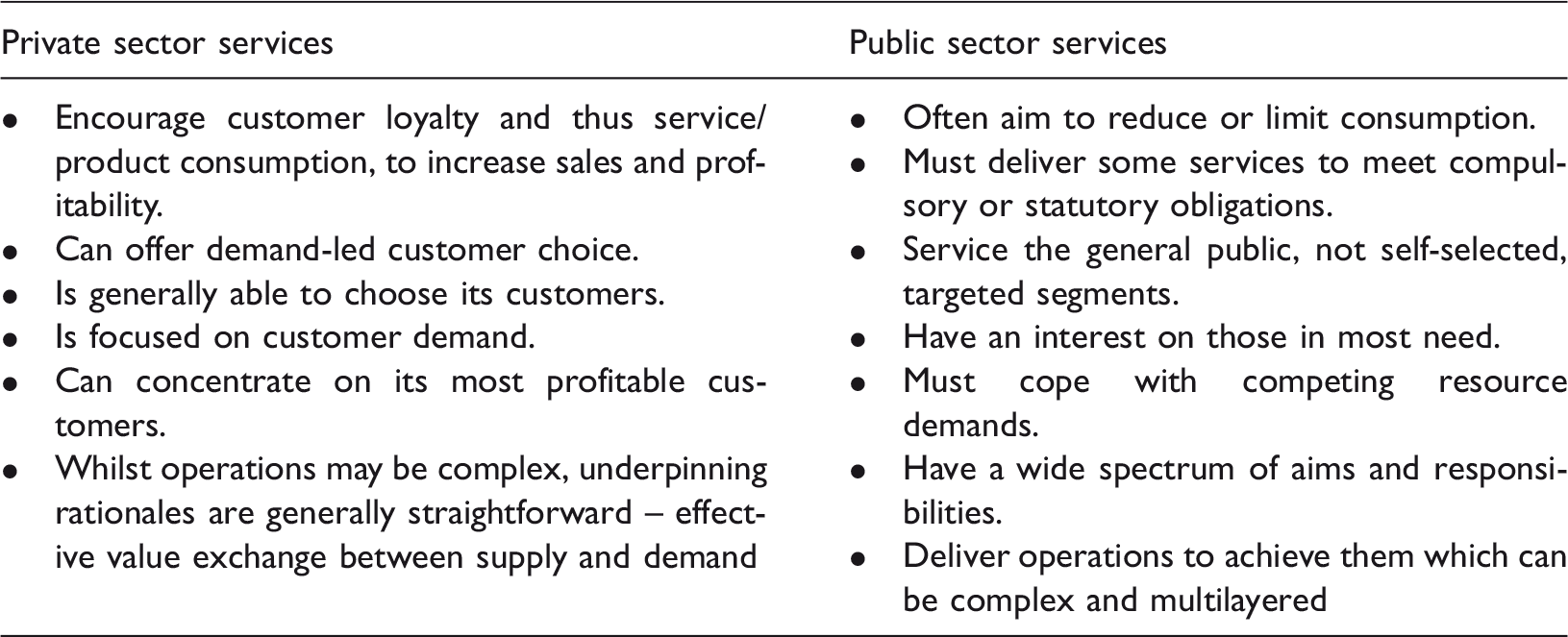
Key differences between private and public service providers.
Public sector: Customers, clients or citizens?
Notwithstanding these similarities, or perhaps because of the differences, there is some debate about the extent to which the word customer is actually appropriate for people using public services. Clarification of such terminology is important for any public sector organisation seeking to address the issues facing local economies. Although this paper uses the term customer throughout, regardless of reference to private or public sectors, it must be acknowledged that not everyone is happy with such shorthand when applied to the latter. Some public service providers prefer to use words such as client or citizen to better illustrate the nature of the service provided and of their relationship with users (Shirley and Melville, 2010; Simmons et al., 2009). So what are some of the tensions between citizen and customer focus? The key differences have been summed up in the Varney Report (2006), which states that customer focus is about doing things right (quality of service delivery), managing better services, providing expected and needed resources, high quality services fitting individual needs and consideration of needs and expectations. Whereas provision based on citizen focus means doing the right things (what public services provision should be), managing best value, rationing scarce resources, providing value for money and addressing rights and responsibilities (Varney, 2006).
However we choose to label them, the journey towards public services that satisfy customers begins with a change in the way we think about customers. Stewart and Clarke’s (1987) influential paper led the call for public services to treat people as customers. Their central suggestion was the need for public services to change emphasis towards ‘service for, not to, the public’. They suggested that managers must know the services wanted by the public; be close to the customer; and seek out customer views, complaints and suggestions. The central implications of their work were three-fold: (1) the quality of services must be judged by customer standards not by an organisation’s or professional standards, (2) managers need to spend far more time understanding and learning about their customers and (3) customers need to be involved in decisions on the services provided (Steward and Clarke, 1987).
It could be argued that there are other good reasons why there is growing use of the word ‘customer’ in public services. This point is well made by Svara’s (2017) 10 principles for reinventing and redesigning local government, which included the need for ‘customer-driven government’. The way we change our use of language often signals change. Using the term customer signals a change in thinking about public services. For example, referring to people as customers helps to instil a certain ‘mindset’ or ‘culture’, as well as giving a focus to internal restructuring. Or it may be a matter of more obviously meeting public expectations, whereby Britain’s public services are only responding to a ‘need to start treating users and the public as customers in the same way that the private sector does’ (Needham, 2007: 173). A customer care approach in public service delivery might also be a response to the greater public appetite for choice and personalisation of services (Needham, 2007).
Personalisation and engagement
As powerful as Stewart and Clark’s argument may have been, there are still reasons to maintain a broad and rich interpretation of the word customer in relation to public services, which embraces notions of both citizen and customer focus. Whether in private or public sector organisations, the challenge is to move away from services that are too impersonal and transactional in nature. Large bureaucratic organisations tend to struggle to be genuinely responsive and flexible to customer needs, and too often develop services which suit the organisation as opposed to the customer. This is as much an issue for local communities, served by large bureaucratic local authorities as it is for regional or national public bodies. However, in a number of public services at all geographic scales, the ideas behind more personalised services are being piloted and implemented. For example, in the continuing ‘drive towards the personalisation of public services’, which can be seen in elements of the UK’s Health and Adult Social Care services (Carr, 2010). These are generally guided by central government policies but delivered in local communities.
Whilst personalisation will not be the right approach for all services, Leadbeater (2004) adds it has real potential for services, which are face to face (such as education, non-emergency health care, social services and housing), relational rather than transaction and built on partnerships between customers and professionals so that the customer can play a significant part in shaping the service. Furthermore, Leadbeater (2004: 19) suggests that in essence, personalisation is a simple idea, in that: ‘putting users at the heart of services, enabling them to become participants in the design and delivery, services will be more effective by mobilising millions of people as co-producers of the public goods they value’.
This is the notion of co-production, another key factor which is shaping changes to the way public services are delivered to their customers (see also Alford, 2009; Barker, 2010; Bovaird and Loeffler, 2012; Higson and Sturgess, 2017; Horne and Shirley, 2009; Realpe and Wallace, 2010; Vanleene et al., 2017). There is an increasing perception that future public services will need to be delivered with and by customers, as this will reinforce the emphasis on place and community, opposed to delivering public services via traditional approaches which can be seen as services that are done to and done for the customer. The latter approach tends to see customers as passive recipients of services, designed and delivered by professionals. Rather than services done to and for customers, services will be characterised by engagement and mutual responsibility, with supplier and consumer together creating and delivering services. Services are inherently about engagement. Customers must engage, at least to some extent, in order to realise the benefits of the service. Indeed, many public services are most effective only when the customer contributes to the service delivery. For example, education works best when children engage in the process (e.g. McCulloch, 2009; Pemberton and Mason, 2009). In health services, patients benefit when they contribute to their own recovery, by following professional advice which is preventative, curative or both (e.g. Farmer et al., 2017).
At one level, engagement is a natural part of public service provision (Alford, 2009; Bovaird, 2007). However, it is often when customers don’t effectively engage with a service (or choose not to) that issues can surface. Where services are designed to pre-empt or prevent the need for more expensive provision, then poor customer engagement becomes a real problem. Or where customers don’t fully or properly engage, the result can be a need for services that are even more expensive, complex and demanding. Bovaird and Loeffler (2012) argue that although there are clear benefits to co-production, in reality customers are only likely to engage in co-production with a relatively narrow range of services. Thus, ‘co-production may be “value for money”, but it usually cannot produce value without money’ (Bovaird and Loeffler, 2012: 1119). Nonetheless, there is a perception that engaged customers reduce the need for public service, especially if such services can be deliberately designed to increase customer independence. Otherwise it could be argued that traditional public service delivery encourages and promotes the opposite: a dependency culture (see SOLACE, 2011). This is because of an emphasis on doing something to or for customers, who thus become (often passive) recipients of what professionals think is best.
Is co-production the answer?
Co-production is one answer to this issue (Barker, 2010; Bovaird, 2007; Cottam and Leadbeater, 2006; Ewert and Evers, 2012; Higson and Sturgess, 2017; Steen et al., 2016; Whitaker, 1980). It not only encourages independence but also promotes interdependence, at the same time fostering networks and connections in the wider community that make for more resilient and robust individuals and communities. Designing and delivering services with customers incorporates emerging approaches to service co-production. These are predicated on appreciation that the skills, expertise and insights of customers are more than a valued contribution, they are a key service delivery resource (Welsh NHS Confederation, 2010). Drawing on Cahn’s insights into ‘time-banking’, Realpe and Wallace (2010: 13–15) illustrate one central idea of co-production is the notion that people who use services are not just passive recipients, but are in fact hidden resources, with clear sets of skills to apply to the service situation. The inference to be drawn is that if such a valuable resource is ignored, then the service is inherently inefficient.
The notion of co-production is the realisation of the mutual benefits of professionals and customers finding solutions together. Services done by customers indicate a growing context in which customers are encouraged to independently meet their needs (perhaps using assistive technology) or to do so interdependently (using the resources and capability of their families, neighbours and communities). Achieving this change of focus requires a change in the relationship between professional and customers (see Needham, 2007; Needham et al., 2014). To encourage the latter to engage, the former will need to become ‘advisers, advocates, solutions assemblers, brokers […] not to provide solutions directly, but to help clients find the best way to solve their problems themselves’ (Leadbeater, 2004: 60).
Further insight is suggested by Needham (2007) who proposes a mutual benefit to be gained by professionals and customers working together and respecting each other’s expertise. She argues that co-production can have two powerful effects, acting as therapeutic tools and diagnostic tools. Therapeutic tools involve building trust and communication between participants, bringing the expertise of professionals and customers (with mutual respect). Diagnostic tools, alternatively, refer to revealing citizens’ needs, identifying the main causes of delivery problems and negotiating effective means to resolve them. These two potential benefits of co-production may be particularly appropriate in the context of constrained budgets and cost pressures. The first (therapeutic benefit) supports staff morale in difficult circumstances and reinforces their value. The second (diagnostic benefit) helps to ensure that delivery more effectively meets needs, cutting the waste of inappropriate services.
From customer service to customer-driven services
The changing emphasis of public services.
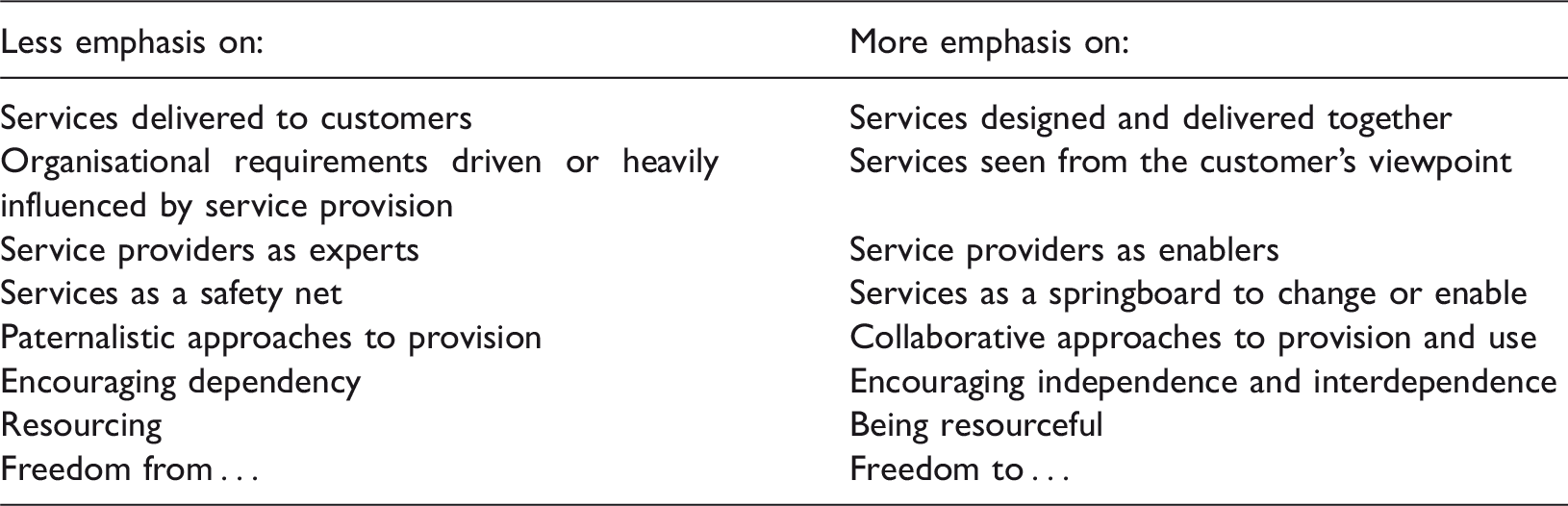
Source: Adapted from Department of Health (2009) and Public Services Trust (2010).
The implementation of community budgets has required a fundamental change in the way the public sector thinks about customer service (Morse, 2013). The emphasis is more than the provision of good services or of simply adopting private sector practices, however successful these may seem. As Parker and Heapy (2006: 7) state: It is not that public services need to be more like commercial service providers. It is that all service organisations need to find new ways of connecting intimately with their users and customers, of listening and responding in ways that reassure us all that we are being understood.
Further to the above mentioned points, valuing the contribution of customers should not come at the expense of devaluing the role of professionals. In fact the opposite should be the case. Putting customers’ first means putting staff first: ‘relational approaches to service put frontline professionals at the centre stage, alongside users, as key characters at the interface between people and services’ (Parker and Heapy, 2006: 58).So what of the view from within public services? This question was addressed by Needham (2006) when asking local and central government staff: ‘What do you think it means to treat local people as customers?’ The responses indicated five key factors: (1) personalising services around the user, (2) giving users a choice of services, (3) users paying for services, (4) treating users with courtesy and respect and (5) improving user access to services (see Needham, 2007).
Building on Needham (2007), one critical aspect in the development of new ways of working at local level is the need to deliver better value, albeit within increasing national government constraints. There is much that is good about existing practice within local authorities (Durose, 2009), so one method of both delivering better value and building on best practice is an appreciative or strength-based approach. This encourages an effective future focus by recognising the strengths of the current organisation and its people (Higson and Sturgess, 2014). One area of interest is to gauge the views and perceptions of professionals involved in the provision of local public services in one of the community budget regions. With this in mind, the research outlined in this paper records the views of practitioners across a range of local and regional public services, in order to gain their perspective on how service users and communities can be better involved in shaping the public services which are serving the needs of local economies.
Methodology
Five focus groups were conducted, with around 30 local and regional public service middle managers, from a range of service areas. As part of a large-scale management development programme, involving over 400 middle and senior managers, the focus groups were tasked with developing approaches to improving their local community services. These managers were all practitioners involved in one of the whole community budget pilots, and therefore all had knowledge and information about the merits of cross-organisational co-operation and of seeking innovative solutions to problems.
The sampling criteria were purposive, in that participants were selected because they would be able to provide a depth of information since they were involved with the whole community budget initiative (Saunders et al., 2003). Indeed the selection tended towards what Patton (2008: 236) refers to as critical sampling, an approach designed intentionally to ‘yield the most information and have the greatest impact on the development of knowledge’. Consequently, the participants provided good potential as information-rich focus groups, a central principle of purposive sampling (Patton, 2008).
The researchers conducting the focus groups also delivered workshops with associated tasks to identify elements and key factors central to an improved process for service delivery. The aim was to facilitate a customer-driven approach to local public service delivery. Each group was requested to develop its own framework or process model, and all participants were encouraged to express the elements as they saw fit. They were also asked to produce a diagram/image on a flip chart, which indicated key themes from their models, and illustrated their understanding of the connections and flows between them. This provided not just a range of participant themes, captured in their voice, but also their view about possible connections. The flipchart maps and notes produced by the focus groups were extremely helpful in making the connection between primary statements and researcher interpretations, which in turn led towards the conceptual framework. This supports Gioia et al. (2012), who recognise that themes and conceptualisations can be static, unless the dynamic interconnection and interplay are also considered. Each group then shared its ideas with the others via flipcharts, elaborated with verbal exposition, and responded to Q&A.
Interpretation of this study is based on an approach by Gioia et al. (2012), which advocates analysis of two ‘levels’ of coding. The first level conveying the voice of the informants, while a second level more clearly conveys the voice of the researcher. Such an approach to analysis demonstrates the links between the findings from ‘informants’ to the interpretations and concepts drawn by the researcher. Gioia et al. (2012) use the phrase, ‘1st order’ analysis, for data which remain true to the participants terms, and ‘2nd order’ analysis to distinguish the concepts and interpretations of the researcher.
However, there is a final stage in the approach proposed by Gioia et al. (2012). They argue that the data collected, whilst underpinning the conceptual elements of the study, are nevertheless a static representation of something that is actually more dynamic, and often with processual relationships (Clark et al., 2010; Gioia et al., 2012). For Nag and Gioia (2012: 436), a theory not only develops the concepts that make up the theory, but also the ‘linkages or relationships among those concepts in describing or explaining a phenomenon’. Therefore, the final stage, based on the participants own understanding of how their themes are linked, is to propose ‘the dynamic relationships among the emergent concepts that describe or explain the phenomenon of interest’ (Gioia et al., 2012: 22). The relationships and links between the concepts are thus described using a framework to represent the interconnectivity of the concepts: what Gioia et al. (2012) refer to as a dynamic theory model. After the focus groups and workshops, the research team collated and reflected on the responses then grouped and clustered key themes from each focus group, according to similarity. This enabled the creation of a process model which first identified a 10-step framework for the implementation of a customer-driven service strategy, which was then further condensed into four key conceptual stages (see Figure 1). The purpose of this approach was to create a process model which was of practical use in detailed implementation terms, but which also provided a pithy conceptual summary of the process.
Customer-driven services process model. Source: Higson and Sturgess (2017).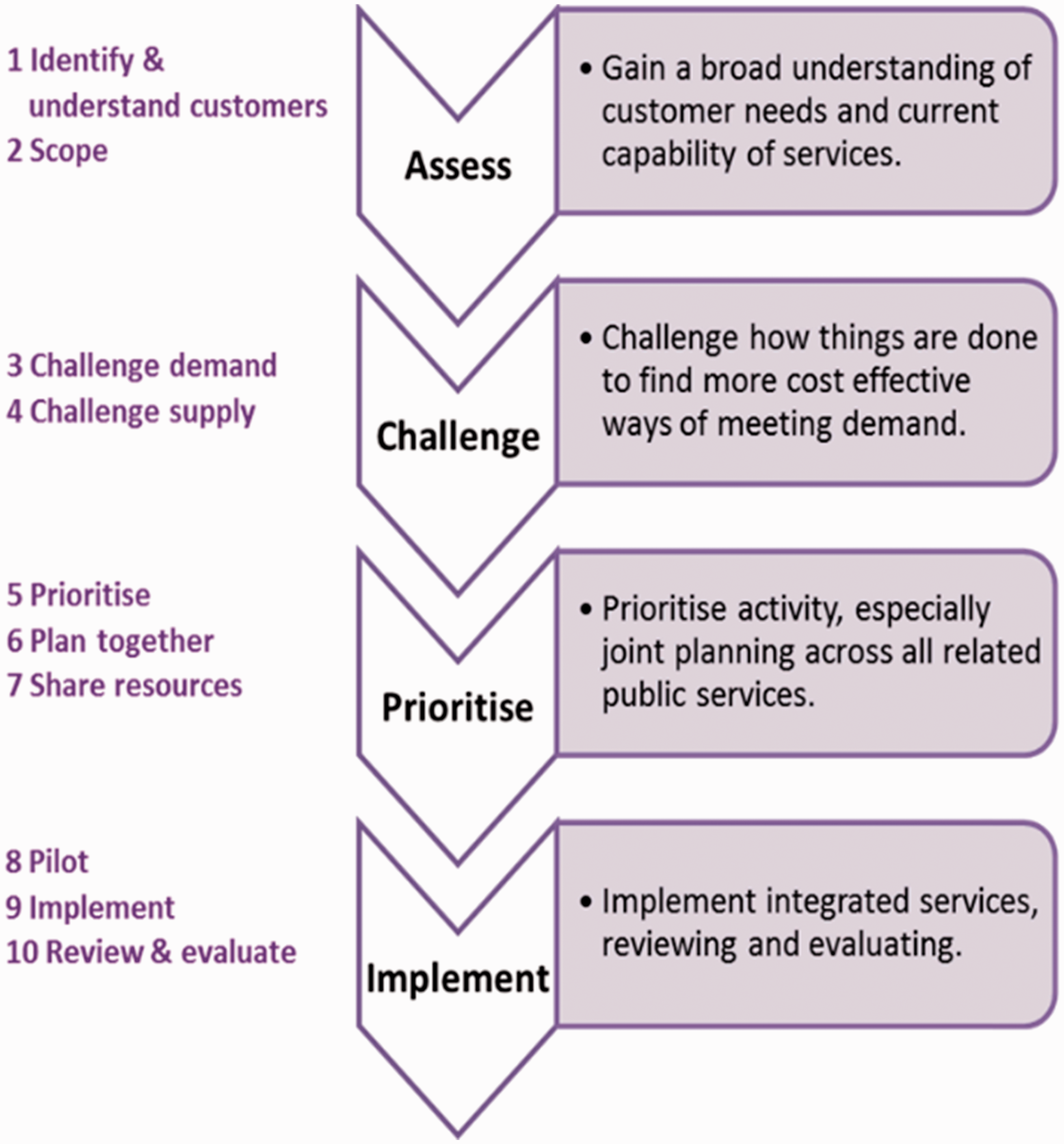
Customer-driven services process model
The following sections explain the process model, with some interpretation and elaboration of the data on which it is based. Each element of the process model is based on the development of four stages: (1) summary of first-order participant responses, (2) second-order interpretive summary, (3) aggregation to key process steps and (4) synthesis to conceptual model stages. The second-order interpretive summary informs and explains the 10-step framework which was designed to aid practitioners in the implementation of the process model. This was further condensed to create the broader, more conceptual four-stage model, designed to enable easy understanding, recognition and recall. After its creation, the process model and implementation framework were sent to all participants in the focus groups for comment. This resulted in a positive response, affirming both the research team’s interpretation of findings, and the design and usefulness of the model and framework.
Assess (Steps 1–2)
In order to develop a conceptual framework from participant responses, similar statements were grouped. These statements were brought together in the bullet point summaries below, to provide a rounded interpretation of what participants were articulating. So, for example, the first stage in the model calls for assessment of two key areas, reflected in the first two framework steps for implementation. Step 1 requires identification and analysis of the organisation’s customer base, with full assessment of customer needs. Participant groups stated that identifying, clarifying and understanding customer needs were all important. Most marketers would no doubt expect to find such comments; however, other statements point towards a more comprehensive interpretation of how customer-driven public sector organisations might function. For example, the need to share information and to use it more effectively were also highlighted as being particularly important within a public sector context. Facilitating advocacy of the customer’s ‘voice’ across shared services was another interesting finding from the responses, again of particular relevance to, for example, local community service providers. Step 1 was informed by first-order responses which the researchers summarised as:
Identifying who customers are, what matters to them and their key concerns. Clarifying their needs and wants. Sharing of information about customers. Better understanding of customers by experiencing their journey through priority public services. Facilitating advocacy – getting all agencies on-board, ensuring the ‘voice’ of the customer is heard. Mapping what is currently done. Identifying key stakeholders and priority issues.
However, it was apparent from analysis of participant responses that, whilst this sector appeared to be crucial, it wasn’t sufficient in itself. Another consistent view from the participant focus groups was the need for analysis of the scope of the current processes and capabilities. This was evidenced in participant statements about understanding current provision, identifying gaps and measuring outcomes. This led to the researcher interpretation of the need to scope the landscape of provision and delivery. Step 2 thus requires analysis of the scope of the organisation’s current service processes and capabilities. This step was informed by first-order responses which took the form of a series of key questions, summarised by the researchers as:
What resources do we have? What outcomes are being achieved? What do we do well? What needs to be improved? Where are the gaps? How do we share information, processes, services? Are there overlaps? Are there synergies?
These two steps: identification and scope combine to form the higher order ‘Assess’ stage of the customer-driven services model. This stage acknowledges not just the importance of early consideration of customer characteristics and needs, but also that such assessment must encompass holistic clarity, through a comprehensive analysis of shared service provision, in order to fully scope and understand the current context.
Challenge (Steps 3–4)
Further analysis of participants’ comments revealed a series of statements which seemed to logically follow the first two steps. Building on, but distinct from identification and scope was the need to consider two things. First, the current demand for services and second, the extent to which this demand might be managed. Thus, the second stage in the model (Challenge) is designed to promote creative thinking about demand and supply. The statements that informed the next step in the model addressed the desirability of identifying both the nature of demand and of the real customer needs which underpinned it. Of particular interest to public services is a perceived focus on whether demand might be better managed through better provision of information, including early intervention or diversion to other mechanisms to satisfy real customer needs. Therefore, Step 3 in the model calls for public service providers to challenge their thinking about current demand for their services, based on key questions summarised as:
What is the real customer need we are trying to meet? Are there other ways of satisfying these needs? Which other services can help? Can demand be managed by reducing, diverting? Can customer need be met by information? Is there an early intervention or prevention approach that is relevant? Can customers be involved in delivery (co-production)? Can customers be seen as part of the team?
The next set of statements also informed this notion of challenge, but these more particularly seemed to address the supply of services. This was informed by statements such as ‘services are based around customers, not [around] customers accessing various services’ and the need for staff to ‘think about the “whole” with customers [leading to] better interaction’. Other key statements underpinning the need to challenge supply perceptions included the desirability of ‘Working across services – bridging services’ and to build ‘on better partnerships where common activities can be shared’. Therefore, Step 4 of the model encourages thinking which might challenge existing supply conventions. For example:
Encouraging all stakeholders to challenge current way of doing things. Questioning how service providers might work together, to better deliver customer outcomes. How can data be shared to better understand customers? Identifying blinds spots – seeing things from other viewpoints – especially customers and insights from front-line staff. Clarifying staff understanding of what services do, how and why, relevant to the customer. Identifying potential for synergies across local and regional services. Seeking stakeholder ideas for income generation. Challenging perceptions on current and future operations – what should we be doing both now and in the future? Who should be doing what?
Prioritise (Steps 5–7)
Having identified the need to assess and challenge, the third stage of the customer-driven service model addresses the need to plan for effective delivery. The insights gleaned from participant feedback indicated that the key to success here was in prioritising. This stage (Prioritise) involves three steps which seek to facilitate holistic planning. Step 5 encourages a focus on priorities which will ‘yield the most impact’, which address ‘key areas for improvement’ or which prioritise ‘improved service user involvement and empowerment’. This step also identifies the need to consider supplier priorities, regardless of however customer driven the process aspires to be. The constraints of public sector provision in general, and local community services in particular, require that responsible service provision must also be grounded in the reality of the supply situation. Thus, participant responses which informed this step have been summarised as three questions:
What are the agreed multi-agency priorities? Is the service an improvement priority? What are the community priorities?
Whilst the synergies to be gained from shared use of resource might be obvious to many, realising this benefit can be most effectively achieved by ensuring that joint planning is a priority. Thus, the next step in the model recommends the embedding of shared planning as a mechanism for effective cross-service delivery – the need to ‘plan together’. This step in the model was informed by participant recommendations such as ‘plan for a seamless process by understanding each step’ and ‘work across services [to] bring talents and skills together’. The importance of customer input into this step was not neglected with an acknowledgement that shared planning includes giving the customer the confidence to ‘influence and input/change service for the better’. Step 6 therefore calls for a focus on the importance of joint planning by service providers, through:
Seeking moves towards offering seamless services across local provision. Identifying and exploiting cross-provider synergies. Better understanding of individual and joint services provision and how they might work together.
Step 7 builds on this joint planning approach by advocating more effective, practical sharing of service resources, processes and cross-agency co-operation. Participants stressed the need to ‘allocate resource where it matters most’ and to ‘align tasks [with] key strengths’ as mechanisms to use ‘existing resources to [the] best advantage’. With the overall aim of making ‘life easier for the customer’, sharing of resources was also seen to be reliant on encouraging an organisational culture in which staff think about customers more holistically. Key points identified by the researchers in Step 7 include questions around:
How to share resources and capability across a range of public services. The need to unlock budgets to enable the targeting of identified priority needs. Focusing resources to priorities and themes of Shared Community Budgets. Encouraging an organisational culture that takes a holistic view of customers, to discourage narrow, ‘silo’ perspectives.
Implement (Steps 8–10)
The fourth and final stage in the model (Implementation) involves three steps, designed to facilitate the implementation of customer-driven ideas. These steps relate to assessed pilot schemes, the full roll-out of a strategy, and effective monitoring and evaluation. The first of these, Step 8, calls for the creation, testing and evaluation of pilot schemes. This step was informed by participant statements calling for a review of best practice and the ‘use [of proven] expertise wherever appropriate’. It was also based on numerous statements which highlight the importance of the customer in this critical phase, as might be expected from a customer-driven approach to service design and delivery. For example, the need for ‘focus groups with customers throughout the process’ and insistence that ‘any redesign of services [should] be designed around the customer’. Perhaps more importantly still, that the pilot phase activities should be ‘designed including customers’, with their input into the subsequent analysis and action. The researchers’ summary of important responses underpinning this step indicated the importance of:
Adoption of ‘best practice’ evidence-based processes. Involvement of customers through each stage of pilot process. Identification of ‘quick wins’.
Step 9 involves the implementation of a finalised process, based on the results of the pilot stage. Underpinning this step, participants stressed the importance of ‘flexible team working (including budgets) – across teams, services and partners’, some advocating the need for ‘multi-agency task force[s], people from each organisation’, each appropriately empowered to deliver high service standards. They also noted that effective delivery was reliant on ‘clearly focused services’, ‘seamless transitions’ echoing the holistic nature of customer-driven services and of getting ‘the right people doing the right job’. Key aspects of this step were summarised by the researchers as the need for:
Clear aims, communicated via multi-agency advocates. Delivery with focus on flexible teams, across departments, services and partners. Critical involvement of informed, motivated, skilled, empowered staff. Creation of delivery systems which allow for effective feedback from front-line staff and customers.
The final stage of the customer-driven services model, Step 10, is the review and evaluation of the implementation process. As might be expected from any service delivery plan, evaluation of success includes some obvious supply metrics such as ‘evidence of cost savings/improvements’, or the need to ‘review, monitor and evaluate amend/adapt as required’, should these not be achieved. However, with customer-driven services, successful implementation clearly includes a substantial focus on the customer. This is evidenced by participant responses which included ‘significantly reduced customer complaints’, ‘greater levels of customer satisfaction’ and evidence of effective communication to customers ‘in lots of different ways’. Given the importance of staff involvement indicated in Step 9, it should be no surprise that one response indicated success measured by higher levels of staff motivation, fuelled by positive customer feedback. The overall interpretation of respondents’ comments indicated the most important aspects of this step to be:
Seeking and analysing detailed customer feedback. Learning from what has worked and making appropriate changes. Relating analysis to aims, e.g. significantly reducing customer complaints. Embedding customer response and insight data into continuous improvement reviews of service provisions. Communicating results to staff and customers. Continually monitoring and improving service delivery. Continually focusing on customer satisfaction.
The Customer-Driven Services process model was formulated using empirical research from a series of facilitated workshops, delivered to over 400 UK local authority middle managers. These workshops included a series of focus groups in which the managers were asked to consider how best to develop approaches to improving their local community services. The research team then collated and analysed their responses, identifying the key themes which emerged. The resultant process model identified a 10-step framework for the implementation of a customer-driven service strategy, which was then further condensed into four key conceptual stages. The researchers’ interpretations of participant responses were discussed at subsequent workshops along with the draft version of the process model. There was a consensus that this had accurately captured and developed the data collected from the original focus groups, and that a refined version of the process model would provide a practical tool to help local community managers deliver high quality services in times of ongoing funding constraints.
Conclusion
The study underpinning this paper illustrates how a sizeable number of experienced, practicing, public sector managers reflected on the opportunities for a more engaged and partnered way of providing local and regional public services. There were several notable features arising from their responses, which clearly echo the literature reviewed. First, and particularly noticeable, was their strong focus on the importance of customer and community engagement and participation in the shaping of public services, especially at the local community level. From the managers’ perspective, the reasons for this were two-fold: to enable them to gain clarity as to customer needs and to help local service providers better understand the service experience.
The managers also felt it was important to acknowledge that local public services should be, not only designed with customers, but that the latter should realise and act upon their ability to influence and change services. However, this confirmation of the importance of co-production was balanced by manager’s awareness of the raised levels of service quality, which their customers have come to expect. Given the resource constraints increasingly imposed by fiscal austerity, local government managers clearly perceived the growing importance of collaborative, seamless service provision, across departments, organisations and even sectors.
It is clear from the sources used in this article that such ideas are not necessarily new. However, it could be argued that they have become overlooked in recent years, perhaps due to an over-focus on the efficiency element of managerialism (Lawler and Hearn, 1995), something encouraged by the growing constraints of austerity budgets. Whilst that may be true, it could also be argued that the more widespread use of innovative approaches, such as the customer-driven services concept, might be a far more effective antidote to austerity affecting local community budgets. This arguably reflects the value of leaderism rather than managerialism (O’Reilly and Reed, 2010).
The language used by the managers involved in this research illustrates what might be called a step-change in how citizens, clients or customers are engaged in the delivery of their local community public services. In order to effectively implement customer-driven services at this level, customers need to be viewed as more than recipients, collaborators or even co-producers – they must be seen as part of the delivery team. Such an approach suggests a recognition that customers have invaluable expertise and experience, assets which must be fully utilised as part of any effort to improve local community service outcomes and efficiencies.
Footnotes
Declaration of conflicting interests
The author(s) declared no potential conflicts of interest with respect to the research, authorship, and/or publication of this article.
Funding
The author(s) received no financial support for the research, authorship, and/or publication of this article.