






Abstract
Working towards the ‘good society’ is an important aspiration to hold, but equally its subjectivity complicates the realisation for all – each person’s view of what ‘good’ means in relation to society differs. The notion is also open to statutory appropriation and mainstreaming using rhetoric to suggest its centrality to governmental thinking, but the reality reveals policy and practice, which undermines the accomplishment of social justice and thus a good society. This paper seeks to explore this complexity through dissecting the processes of representation of the ‘good society’ in theory and in practice. The paper will argue that the ‘good society’ might be termed a doxic construct. Bourdieu used ‘doxa’ to explain how arbitrariness shapes people’s acceptance of their place in the world, the covert process is ‘internalised’, seemingly objectively, into the ‘social structures and mental structures’, producing a universal and accepted knowledge of something (Bourdieu, 1977). The possibility of difference is undermined; thus, the varied needs and contexts of people’s lived realities are consumed within prevailing normative narratives. Foucault (cited in Simon, 1971: 198) referred to a ‘system of limits’ and Bourdieu (1977: 164) ‘sense of limits’, both authors will assist in seeking to uncover how such invisible practices limit and constrain the imagining of possibilities beyond the taken-for-granted. The paper argues that community development can be a catalyst to challenge this invisibility by utilising Freire’s (1970) conscientisation, enabling people to recognise structural oppression to challenge the status quo. This paper will draw on examples offered within a northern city to build on Knight’s, 2015 research, which posed the question ‘[w]hat kind of society do we want?’, identifying, when asked, a hunger for change. The paper explores whether there is a desire to overturn the predominant individualism of the neoliberal era to reignite the notion of the common good.
Keywords
Jake: It is possible though, just so you know, it’s possible I will have a better life than you. It’s possible the world will be better. More equal. Better. Just so you know. George: digests that with a smile George: If you try? Jake: Exactly. George: And will you try? Jake considers Jake: You’ve got to, right? I mean it’s sort of pointless, isn’t it? Not trying? I mean the world’s sort of pointless – if you don’t try George: Yes. Yes. It probably is. (Thorne, 2014: 95–96)
This is the script ending for Thorne’s play Hope, about a local council in the UK, which rejected austerity budget cuts. George is an elder ex local politician and Jake is late teens, son of the recent leader of the council. The conversation is preceded by George stating that although he had ‘had a hard life […] I look at you and know you’ll never have it as good as I have’ (Thorne, 2014: 95). Jake however, is willing to try to make a better life … which could be characterised as a ‘good society’!
This article begins with an exploration of what might constitute the common good, followed by an examination of the ideological context, which charts its demise. This leads into an examination of narratives-of-necessity, which are conceptualised as the stories that endorse the underpinning ideological perspective, which shapes the policy context and people’s lived experiences. These narratives encourage acceptance of the underpinning justifications through a hegemonic discourse, inculcated and taken-for-granted, which contributed to the fracturing of solidarities and the promotion of individualism during the mid to late 20th-century. Such framings prevent people from feeling that they can attempt to change society, which would offer possibilities of overturning the individualism of neoliberal times to rediscover a more communal lifeworld with shared values. The article explores how this process was exacerbated with the problematic internalisation in the 1980s of Thatcher’s [the former UK Prime Minister] mantra – TINA – ‘there is no alternative’, which created a barrier to exploring social and economic change in society.
This prompts the article to provide an exploration of the ‘invisible social processes’ (Schlosser, 2013: 32), which lead to unquestioning acceptance of this framing using conceptual constructions from two prominent authors to identify barriers to questioning the status quo, which align to become a ‘sense/system of limits’ (Bourdieu, 1977; Foucault, 1971) constructed by those in power – the ‘established/order of things’ (Bourdieu, 1977: 167; Foucault, 2002: 376).
In order to disrupt such false consciousness this article argues that radical community development is an approach that can facilitate challenge and change. To illustrate this approach, there is an exploration of a new initiative – #thehullwewant
1
a participatory action research project (PAR) (see also Knight, 2018). This article and the project discussed were inspired by Knight’s (2015) work in The Society We Want and subsequently with the three key questions cited in Rethinking Poverty (Knight, 2017: 2): What is a good society without poverty? How do we obtain that society? Who does what to implement a good society without poverty?
The common good – Setting the context
Ledwith (2016: 1) asserts that ‘[w]e are living in political times in which the
Standing (2017: xi) cautions that inequality is growing with similar levels of ‘resentment’, stating ‘[t]he mixture of anxiety, anomie, alienation and anger is creating a ‘perfect storm’, enabling populist politicians to play on fears in order to build support for agendas that have echoes of the ugly aftermath of the First Gilded Age’. This phenomenon will be discussed as ‘narratives-of-necessity’ below.
It is therefore, important to examine what ingredients might produce solidarities and consensus. The ‘common good’ is a useful construct to start with because a sense of shared values can override the cult of the individual to contribute to the wider ‘good society’. Etzioni (2015: 1) posits: The common good (alternatively called ‘the public interest’ or ‘public goods’) denotes those goods that serve all members of a given community and its institutions, and as such, includes both goods that serve no identifiable particular group, as well as those that serve members of generations not yet born. Is there a common good that still binds us together as Americans? That it’s even necessary to ask shows how far we’ve strayed. Today, some think we’re connected by the whiteness of our skin, or our adherence to Christianity, to the fact that we were born in the United States. I believe we’re bound together by the ideals and principles we share, and the mutual obligations those principles entail.
The rise and fall of the common good
Parts of the 20th-century demonstrated commitment to the common good in the UK. Cooper (2008: 48) cited Hughes and Edwards’ (2005: 16) who identified post-Second World War optimism claiming that it was ‘about the potential capacity and desirability to engineer social change and to usher in an end to poverty, deprivation and discrimination by direct state intervention’. Economically this offered confidence through commitment to full [male] employment to regenerate the country (McGaughey, 2018). There was a sense of entitlement through the creation of a social contract with the Welfare State, which challenged the ‘five giant evils’ for better health, education, housing, employment and social security (Timmins, 2017) to support the transforming landscape of society. Taxes would fund the services that the Welfare State would provide, which could suggest the epitome of the fiscal common good, people paid into a system from which they take out when needed – individuals contribute to support the collective (see Knight, 2018).
However, this was short-lived. Reich (2018: 3) reflects on being 14 in 1961 when he heard ‘John F. Kennedy urge us not to ask what America can do for us but what can we do for America’. However, he posits that fifty plus years later, with all of the inventions and social changes that people benefit from, life should be much improved. He considers that, although individually people are as ‘kind and generous as ever’ and contribute when crises occur, he feels what ‘we have lost … [since JFK’s call] is a sense of our connectedness to each other and to our ideals’ (Reich, 2018: 4). The change in commitment to the communal can be traced to the ideological shift from Post War Keynesian economic policy and the principles of social democracy to neoliberalism and marketisation.
Neoliberalism came to the fore in the 1979 Thatcher government to address a crisis in the economy but in turn, this eroded ideas of communal solidarity and care and the required deindustrialisation of manufacturing still reverberates in many communities today. McGaughey (2018) evidenced the impacts of ideological commitment by charting how levels of unemployment grew under US republican/UK Conservative regimes and dipped under US Democrat/UK Labour administrations, which related to the non/commitment of state intervention in the market. Knight (2017: 2) argues that both systems have now failed, asserting that the: …‘social administration’ approach, in which state policies [were] designed from the top down to meet social needs … worked reasonably well for three decades … lost its purchase … [but so too now has] the neoliberal narrative, [which was] pioneered by Frederick von Hayek and Milton Freidman … based on the idea of economic growth, a free market, low tax, individual liberty, rewards for entrepreneurs and ever-decreasing public investment.
The norm for voter turnout in Hull is traditionally low, in the 2018 local elections – 25%. Of 21 wards 17 had voter turnout below 30%, 6 of those under 20%, with the highest at 43% and the lowest 14% (BBC, 2018). However, in 2016 the Brexit vote in Hull was 66% (Conn, 2017), 76,646 for leave and 36,709 for remain with a turnout of 63% from an electorate of 180,230 (Electoralcommission.org, 2018), which demonstrates a fracturing within communities. This was exacerbated by analysis; identifying for example, the positioning of voting patterns by age – the old (seemingly Brexit) versus the young (seemingly Remain) further creating an atomised society (Rosenbaum, 2017). A key concern is how such phenomena lead people to attribute personal blame for social and economic issues rather than challenge the curators of policy, which fundamentally impacts their lives.
Government narratives-of-necessity: Managing inflation – Creating unemployment
A major constraint to debate is the production of narratives-of-necessity, which feed through from the hegemonic philosophical stance of those in power, to dictate the policies that follow and establish a common-sense rationale. Terminology utilised in neoliberal discourse suggested freedom, participation and choice, appealing to people’s desire for autonomy and control. Governments appropriate and thus mainstream constructs to their advantage. Massey (2015: 24) posited: The language we use has effects in moulding identities and characterising social relationships. It is crucial to the formation of the ideological scaffolding of the hegemonic common sense. Discourse matters. Moreover it changes, and it can – through political work be changed.
McGaughey (2018: 6) undermined such arguments positing they lacked evidence; however, the narratives resonated and in doing so he argued, produced a hegemonic discourse of blame that took root fuelled by: Political discourse [which] often does the subject little credit. In one corner it is common to hear the unemployed are responsible for unemployment, because they are lazy.
2
In another, it is often said there is a conscious plan to manufacture a reserve army of the unemployed, to press wages down.
3
However, the Thatcher government used TINA to manage inflation by regulating high wages and in turn Trade Union power, which further undermined by weakening collective bargaining power (McGaughey, 2018). This deconstruction of the communal is illustrated when Reich (2018: 4) posits that since … the late 1970s, Americans began talking less about the common good and more about self-aggrandizement … from the ‘Greatest Generation’ to the ‘Me Generation’… The past five decades … marked by growing cynicism and distrust toward all of the basic institutions of American society – government … There is a wide and pervasive sense that the whole is no longer working as it should. A growing number of Americans feel neglected and powerless.
Government narratives-of-necessity – The lazy unemployed and dependency
Situated alongside the economic, a cultural lens contributed to McGaughey’s (2018) contention about self-responsibility, emanating from the development of the ‘underclass theory’ in the USA associated with Murray et al (1996). Tyler (2013: 192) identifies that ‘[i]n 1989 the Sunday Times invited Murray ‘to investigate whether Britain had an “underclass”’ (Green cited in Murray 2001)’. Murray revisited 10 years later arguing there is a ‘class of violent, unsocialised people who, if they become sufficiently numerous, will fundamentally degrade the life of society’ (Murray, 2001: 3 cited in Tyler, 2013: 192). A key issue for Murray was the creation of welfare dependency – devoid of explications of NAIRU.
Lawler’s (2014) analysis of 1980s ‘underclass’ dependency theory, drew on the juxtaposed divide in society of the ‘deserving’ and ‘undeserving poor’, this continuity is represented in the 2000s, in the UK, as ‘striver’ versus ‘shirker’ articulated by Cameron (former UK Prime Minister [PM]) and Osborne (former Chancellor) (Jowitt, 2013). Such binary deployments are powerful devices to inform public judgement, particularly through tabloid headlines to create sympathy with the striver or revulsion at the shirker. McGaughey’s (2018) analysis above aligns with Toynbee (2011) who examined the language of the ‘feral underclass’ as utilised by the then UK Justice Minister, Ken Clarke, during the 2011 ‘riots’. Toynbee illustrates how ideological positions garner resentment and fuel judgement: Public perception of the shape of society has been so warped that most no longer know how others live, where they stand in relation to the rest, who earns what or why. By deliberate misrepresentation, drip, drip, week after week, the powerful interests of wealth deliberately distort reality. The best weapon in the class armoury fosters loathing of a ‘feral underclass’ – its size vague and never delineated, relying on anecdotes of extreme dysfunction, of which any society has plenty. One sneer cleverly elides millions of low-earning workers in equal chav contempt for all living on an estate, drawing any benefit – even if in work – as cheats, addicts and layabouts. That's the way to divert resentment from those above, to those below.
Lawler (2014) pointed to ‘usual subjects’ to identify the marginalised groups in society who break normative ideals; they ‘… are doubly pathologised in that not only are they seen as failing to conform to the ideal of social order and contemporary social citizenship, but this failure is understood in terms of their own, personal, psychological failure’ (Lawler, 2014: 88). Lawler (2014: 86) argued that parents were charged with responsibility for the production of ‘the ‘good child’ and thus the ‘good society’ but equally blamed for the opposite. People on the receiving end of such narratives continue to be impacted by economic policies; Standing (2011: 1) explicates a new layer of people derived from the results of ‘market principles’ where: ‘countries should increase labour market flexibility … transferring risks and insecurity onto workers and their families … [resulting in] the creation of a global ‘precariat’ … many millions … without an anchor of stability. They are becoming the new dangerous class’.
The notion of this dangerous precariat class, encapsulates the increasing casualisation of employment, with temporary and zero-hour contracts prevailing in many workplaces. People attempting to gain employment to overcome labels of ‘underclass’ and ‘lazy’ are subjected to inhumane employment practices, the nature of which prevents the envisioning of a ‘good society’ as planning is rendered impossible, with insecurity and fear dictating life choices.
Deconstructing the governmental narratives-of-necessity reveals explications of why communities fracture and judge each other; which Freire (1970) referred to as ‘horizontal violence … a form of divide-and-rule that is a symptom of the power relations of the top down system’ (Ledwith, 2016: 60). In this case related to being unemployed and in poverty devoid of recognition that, in many cases, policy drivers have created the situation to maintain inflation figures (McGaughey, 2018).
The ‘othering’ of people who do not conform to the norm creates judgement, scrutiny and regulation, which can impede engagement in alternative ways of organising communal life and possibilities to reconfigure society beyond the failings of capitalism (Knight, 2017). Ledwith (2016: 76) explored Stuart Hall’s contention ‘that Thatcher had succeeded in selling free market neoliberalism as a common-sense alternative to the welfare state’. This became a logical given situated within the dominant discourse of TINA; Fisher (2009: 8) stated; ‘[t]he 80s were the period when capitalist realism was fought for and established, when Margaret Thatcher’s doctrine that ‘there is no alternative’ – as succinct a slogan of capitalist realism as you could hope for – became a brutally self-fulfilling prophecy’. It is important to unsettle such prohibitive narratives to generate spaces which explore alternative possibilities, ultimately sounding the death knell for TINA to allow for TIAA ‘There Is an Alternative’ and the production of new ideological framings to flourish through hope, optimism and possibilities (Hughes and Cooper forthcoming).
The ideals of the common good suggest the desire for harmony and ‘fellowship’; however, these are interrupted by a combination of differing elements, including these two major governmental narratives-of-necessity, which challenge holistic endeavour. To question and raise critical consciousness is all the more complex because the constructs involved are often normative, subjective and generally contested, thus could be described as ‘doxic’.
Doxa and the invisible practices which contain and constrain challenge
It is important therefore, to understand processes that take place, which impede the development of critical consciousness and prevent challenge of the dominant discourses within society. Ledwith (2016: 28) draws on Freire to articulate ‘the way that poverty works [is] to silence and dehumanise people’. She continues with this point that people become oppressed through ‘cultural invasions’, explicated as: … the imposition of the values and beliefs of the dominant culture in ways that marginalise people in order to dominate them, result[ing] in dehumanisation. This is often related to a culture of silence, generating apathy, hopelessness, loss of self-belief and resignation to the way things are. (Ledwith, 2016: 62)
Although Foucault and Bourdieu did not collaborate (Callewaert, 2006), it is possible to identify similarities in their thinking. Both were interested in examining the lived experience of people on the margins of society and how invisible practices came to inculcate arbitrarily developed norms for ways of living (Hughes, 2016). Both authors sought answers through historicising their research to identify dis/continuities, which shape or change society, institutions, practices and people temporally, spatially and contextually.
Foucault’s work examined social constructions within which knowledge, practice and rules formulate to develop a particular narrative, dictating ways of thinking and being (Garland, 2014), which can be seen in the neoliberal narratives-of-necessity above. Foucault explained: What I am trying to do is grasp the implicit systems which determine our most familiar behavior without our knowing it. I am trying to find their origin, to show their formation, the constraint they impose upon us; I am therefore trying to place myself at a distance from them and to show how one could escape. (Foucault in Simon, 1971: 201)
The ‘good society’ could be deemed a doxic concept in that it is seemingly taken-for-granted as something everyone would universally want. Bourdieu warns that the possibility of re-conceptualising doxic constructs is rarely considered because of the politically motivated, invisible inculcation: Schemes of thought and perception … produc[e] misrecognition of the limits of the cognition that they make possible, thereby founding immediate adherence, in the doxic mode, to the … ‘natural world’ and taken for granted. The instruments of knowledge of the social world are … (objectively) political instruments which contribute to the reproduction of the social world … undisputed, of which they are a product and of which they reproduce the structures in a transformed form. (Bourdieu, 1977: 164)
Bourdieu (1977) recognised the power invested in the ideological authority of the system as all encompassing. The ‘political function’ of classification maintains the status quo, signifying ‘mechanisms of the reproduction of the social order’ (1977), which suits those in the most powerful positions, subjugating people in poverty through arbitrarily developed narratives-of-necessity. Bourdieu (1977: 165) connotes that it is important not to concentrate solely on cognition but also the implicit way that ‘symbolic power’ drawn from political theory assist in the development of ‘social reality’, which is central to the power within politics.
Bourdieu’s explication that power of ‘subjective experiences’ is endorsed by ‘the reassuring unanimity of … [the] socially approved … authority and necessity of a collective position’ (1977: 167, original emphasis) underpins why ‘worlds conform to myths’ (p. 167). This is interesting because although there was a move to individualism there is an irony in collective acceptance of the myths. Toynbee (2011) above illustrates Bourdieu’s misrecognition in acceptance of the narrative and prevention of challenge. The use of doxa and misrecognition successfully mask the arbitrary production of ‘what is essential goes without saying because it comes without saying: the tradition is silent, not least about itself as a tradition’ (Bourdieu, 1977: 167). This aligns with the ‘culture of silence’ articulated by Freire (1970).
This tradition is presented as common-sense, Foucault’s (2002) ‘order of things’ attempted to make visible such processes, which were generated by those in authority (experts/politicians), to construct lifeworld practices. Foucault identified his mission to demystify the ‘implicit systems in which we find ourselves prisoners: what I would like to grasp is the system of limits and exclusion which we practice without knowing it; I would like to make the cultural unconscious apparent’ (Foucault in Simon, 1971: 198 [3.3.1], added emphasis).
Foucault recognised that invisible processes were setting ‘limits’ to exclude people from aspects of life. He saw it was necessary to reveal how processes of inculcation, produce unquestioning normative ‘docile bodies’ (Foucault, 1977). Bourdieu’s (1977) thinking around the ‘established order’, similarly explicates the arbitrary way that such expectations are created but how, with ease, they become naturally self-evident to create ‘a ‘sense of limits’ (p. 164, added emphasis). Bourdieu’s ‘established order (1977) with Foucault’s ‘order of things’ (2002) conjoin to become the ‘established/order of things’, providing a heuristic devise to examine the power within invisible processes to establish from where and by whom the narratives derive and why. This aligns with ideas of an arbitrary ‘sense/system of limits’, put in place to suit the purpose of the powerful in retaining the status quo through constructing inculcated barriers (Hughes, 2016), such as the constraints of TINA thus, change is seemingly not possible. Bourdieu illustrates how processes develop and influence lived experience: Every established order tends to produce (to very different degrees and with very different means) the naturalization of its own arbitrariness. Of all mechanisms tending to produce this effect, the most important and the best concealed is undoubtedly the dialectic of the objective chances and the agentic aspirations out of which arises the sense of limits, commonly called reality. (Bourdieu, 1977: 164)
The invisible processes of internalisation and acceptance enables the government to preside over the fragmentation of community, because whilst people engage in ‘horizontal violence’ (Freire, 1970) by judging each other they are not addressing anger towards the ideological creation of structural inequality, which has a direct bearing from and on the economy and people’s experience within it. The philosophical position taken by those in power clearly impacts on how well people are supported by the state or required to make provisions for their own well-being. The challenge is how to break the internalised taken-for-granted sense/system of limits. This article argues that radical community development is a means to trouble the self-evident through processes of questioning resulting in raising consciousness, which should lead to challenge of the doxic status quo.
Tear up the script, start with a blank page and change the narrative – TIAA #thehullwewant
This title is drawn from an event in Hull in 2015, Community Action in an Age of Austerity, co-facilitated by Knight (2018), which is where #thehullwewant began its development. A group of community activists and academics identified the need to challenge the current ‘established/order of things’ encapsulated in government scripts by requiring a blank page for communities to change the narratives – to identify TIAA – There is an Alternative. The ambition is to reinvigorate solidarity, care and connectedness alongside the need to rethink poverty for making the good society. Contributing to the whole will provide individual fulfilment and the generation of a ‘we-not-me’ attitude to build a shared vision with a sense of relational connectedness, which, as discussed, resonated in parts of the 20th-century and now nostalgically dreamt of in the C21st.
The University of Hull is hosting #thehullwewant, with a wide range of community partners. Knight (2017: 122) cited Kate MacDonald from Timebank at a later Webb Memorial Trust event in Hull; ‘people and places like Hull are too often defined by a deficit – what they lack – rather than an asset, what they have’. Hull is often referred to as one of the most deprived cities in the UK; however, despite austerity funding cuts there remain many creative and resourceful people and projects, which work in participatory ways, to develop a better quality of life. This provides resources to contribute to rethinking poverty and deprivation within communities.
Radical community development – Breaching the narratives-of-necessity
Reich (2018: 6) suggested that there is a need to consider whether there is an element of shared good in common, he queried ‘what has happened to it, and what might we do to restore it’. Reich (2018: 6) calls for people to debate these points, not necessarily to achieve a consensus on the common good but in order to ‘get in the habit and practice of thinking and talking about it, and hearing one another’s views’. This is where a radical community development approach to working with communities can play a part in developing these dialogues. It is crucial to contextualise the impact of structural policies, born from ideological thinking, which shape society from an economic imperative (Freire, 1970; Ledwith, 2016).
Radical community development raises people’s consciousness to examine experiences within society in a wider context, challenging the ‘established/order of things’, formulated by the powerful, which also assist in deconstructing individualised blame and undermining the barriers enshrined in the ‘sense/system of limits’. #thehullwewant project aims to develop a collective response to addressing the structural impacts. It has identified an urgent need to facilitate dialogue within some communities to research barriers generated by the narratives-of-necessity and the subsequent construction of arbitrarily formed borders between people intergenerationally and interculturally where responsibility and blame may fracture communal solidarity.
Ledwith (2016: 21) suggests the major task is to ‘find a way through the hopelessness that oppression usually brings. Subordination robs people of self-belief. The challenge … is to create the conditions for people to become confident and autonomous’. This article argues that community development as a process can assist to accomplish this. Gilchrist and Taylor (2016: 4) explain its focus on assets, power and action: … involves changing the relationships between ordinary people and people in positions of power, so that everyone can take a part in the issues that affect their lives. It starts from the principle that within any community there is a wealth of knowledge and experience which, if used in creative ways, can be channelled into collective action to achieve the communities’ desired goals.
Freire was a political educator and advocate of critical pedagogy in Latin America, this politicising process seeks to raise consciousness with local people to challenge the oppressive ‘pathologising’ of communities by examining the wider context (Ledwith, 2016: 41). Freire’s (1970) seminal work ‘The Pedagogy of the Oppressed’ offers an influential philosophy underpinning community development practice. Freire was committed to enabling people to collectively use a ‘problem-posing’ approach, which facilitated conversations as a means of learning and sharing related to everyday realities. This developed praxis – where ‘theory is embedded in everyday practice’ (Ledwith, 2016: 62). Exploring lived experience in the wider socio-political, economic and cultural context identifies common issues around which to coalesce, to subsequently act collectively by challenging the systemic oppression and generating a sense of the common good.
To assist in this process Reich’s suggested debate provides an opportunity to explore what connects than divides people, which is an important role for those who act as community connectors. This is central to #thehullwewant and is practiced though the use of ‘working with’ promoting community members as partners, co-creators, if not the initiators of the process, rather than doing things ‘for’ or ‘to’ people, which is less than empowering. This language illustrates philosophically and practically a move towards participatory power sharing, grassroots activity – with active participants not passive recipients, countering the prevailing deficit discourse emanating from Murray (1996) of dependent and apathetic communities reproduced by the ‘established/order of things’ via politicians and the media (Toynbee, 2011).
Ledwith (2016: 62) asserts ‘[t]he challenge for community development workers is to establish relationships based on mutuality, reciprocity and trust in order to break through the ‘culture of silence”. It is clear why the narratives-of-necessity are powerfully articulated as a means to silence and prevent facilitated dialogue, because questioning those in power would, through community development, risk sharing decision-making and power.
Building relationships takes time but this article argues that it is central to establishing connectedness within communities. Generally facilitators collect data from people and when necessary constructively challenge any negative dialogues for example; that nothing will change or suggest an alignment with the narratives-of-necessity with Freire’s (1970) ‘horizontal violence’ placing responsibility for societal issues on other community members, and in some cases laid at the door of new communities.
#thehullwewant – Methodology
Knight (2017) saw an energy in the city for challenging the ‘sense/system of limits’ and the ‘established/order of things’ by engaging in a different way of thinking and doing, centred on mutuality and reciprocity, through practice supporting the state in the spaces it now struggles to fill post austerity.
The project takes an interpretative, qualitative research approach developed with PAR articulated by Bradbury-Huang (2010: 93, original emphasis) as: Action research is an orientation to knowledge creation that arises in a context of practice and requires researchers to work with practitioners. Unlike conventional social science, its purpose is not primarily or solely to understand social arrangements, but also to effect desired change as a path to generating knowledge and empowering stakeholders. We may therefore say that action research represents a transformative orientation to knowledge creation in that action researchers seek to take knowledge production beyond the gate-keeping of professional knowledge makers.
The data generated will contribute to the recent growth in the body of knowledge related to researching with communities (for example Connected Communities 5 supported ‘Re-imagining contested communities’ Campbell et al. 2018) and Rethinking Poverty 6 as supported by the Webb Memorial Trust, which includes Goldstraw (2018), Orton (2018) and Knight (2015, 2017, 2018) to foreground the importance of community voice, to create solidarity, embrace hope and generate action. These initiatives are central to tackling the authoritative ‘established/order of things’ as articulated by Foucault and Bourdieu by revealing the underpinnings of doxic conceptualisations.
Looking back to understand the future
The project found it necessary to examine the past to enable people to develop critical consciousness to explore the present and future. This sits with the approach of Freire (1970: 84) who identified that ‘problem-posing theory and practice take the peoples historicity as their starting point’ and aligns with Foucault and Bourdieu’s ambitions (discussed above) to examine the genesis of invisible practices for contextual understanding.
Both Foucault et al. (1988) and Bourdieu and Passeron (1990) sought answers in the past to identify dis/continuities, which shaped or changed societal norms, institutions and people. Ball (2013: 13–14) articulated Foucault’s approach to be: ‘… at the nexus where the history of practices meets the history of knowledges. The intertwining of the two within praxis is the distinctive move of genealogy … “which was the target of social regulation at a given moment”’ (Foucault, 1983, lecture 6: 2).
Figure 1 demonstrates a layered exploration, which forms the process of making visible the practices that lead to fixity and acceptance of the narratives-of-necessity. Thus, dialogue begins with history to identify the formation of narratives and scripts, which frame analysis through ‘the established/order of things’, thus creating the ‘sense/system of limits’, which assist to maintain misrecognition of the possibilities of alternative conceptualisations. To begin the process, it became essential to establish what a ‘good’ society may look like where the past held positive memories. This process also identified where myths circulate to pinpoint ‘dangerousness’, which Foucault explicates in his methods:
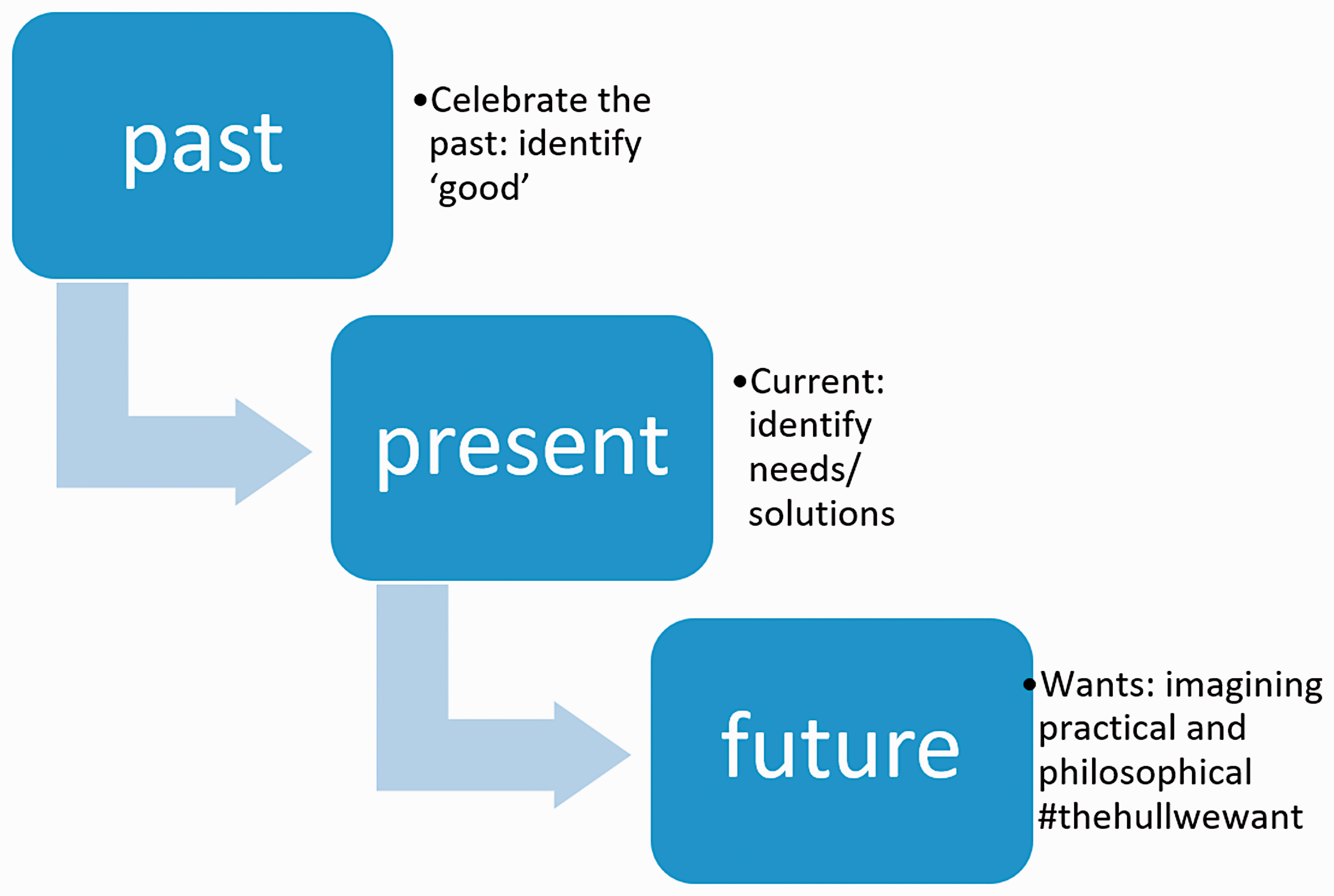
Three layered process.
My point is not that everything is bad, but that everything is dangerous, which is not exactly the same as bad. If everything is dangerous, then we always have something to do. So my position leads not to apathy but to a hyper – and pessimistic activism. I think that the ethico-political choice we have to make every day is to determine which is the main danger. (Foucault, 1983: 231–232)
Foucault’s focus is the interrogation of ‘problems’ to seek out the historical origins, Freire’s (1970) process of raising critical consciousness can assist to identify ‘dangerous’ by revealing invisible practices of power as active and within relationships that facilitate or impede connection. Bourdieu’s (2000) concerns foregrounded classification as a crucial tool in ‘structuring structures’; shaping the way people think to accept the ‘social order’. Identifying ‘the main danger[s]’, and ‘something to do’ can unsettle prevailing self-evident discourses and internalisation of powerlessness, demonstrating that people can make a difference once they understand how and where the constraints manifest.
Hughes (2015: 239) noted that ‘[i]magining otherwise’ with no experience in challenging the norm is difficult’ and results in ‘tinkering with the system’ than changing it. Thus, it has been crucial for #thehullwewant to embrace the thinking of Foucault, Bourdieu and Freire, with the latter’s approach generating conversation through which people can come to recognise that; ‘[p]roblem-posing education is revolutionary futurity. Hence it is prophetic (and, as such, hopeful) … looking at the past must only be a means of understanding more clearly what and who they are so that they can more wisely build the future’ (Freire, 1970: 84). This entails facilitators following Freire’s principle of ‘starting where people are’ to enable debate and constructive critical questioning to rupture the ‘sense/system of limits’, particularly when new ways of thinking and alternative ways of working are added into the discussion with asset-based community development and the tools and projects of mutual aid. Where people feel that nothing can change it is important to demonstrate TIAA. The Timebank 7 initiative is a useful starting point to value people’s skills, knowledge and abilities, people can give an hour’s contribution to receive an hour – time is the currency rather than monetary value. This recognises that everyone has something they can offer and that funding is not always a barrier. In Hull the growing Mutual Aid Network 8 ethos is of ‘connect, collaborate, create and celebrate’ drawing out the assets of individuals and communities to prompt reciprocal relations and to recognise abundance. #thehullwewant demonstrates the possibilities of working differently by utilising the resources that are within the community and those that can be generated through building relationships and connectedness across sectors to draw from allies.
Securing support from the powerholders
People in power often determine what a city and its people need, justified through ‘narratives-of-necessity’; however, it is important to recognise what the citizens want. Thus, as discussed, #thehullwewant team act as facilitators and catalysts building trusting relationships to gather data through a variety of participatory methods. Interim findings provide insight from conversations within the community, interviewees (long-term activist/workers), and with providers and focus groups. In the process of identifying needs and dreams, the project collates evidence for commitment to the ‘common good’; by making visible where people offer shared social values.
Knight (2015, 2017) articulates that the origin of the Welfare State, as conceived by Beatrice Webb and Beveridge, was not to be solely in the state’s jurisdiction, but a combination of contributors. In this volume Knight identifies how its all-encompassing approach undermined mutuality. The #thehullwewant aims to address issues raised with a layered, interactive and action focused approach.
The project foregrounds the voice of the people to influence and impact structurally by feeding through to service providers and policy makers locally, regionally and nationally to generate community influenced changes. As such, the ‘actions’ from PAR findings present opportunities for significant impact. For example, in September 2018 the Leader of the Council, Stephen Brady, endorsed the project live on BBC Radio Humberside, where #thehullwewant hosted the whole of the David Burns show, broadcast in the east of the city, negative narratives were countered evidenced by the assets of the community – namely the people and the provisions on offer who were interviewed on the day. Stephen Brady said that HCC would listen to the voices of the community: I think it is great to get people’s views where they open up and say what they would like to see … what they can contribute and what the council do in making their lives better and … about getting those raw ideas from people.
This commitment from the Leader of the Council was crucial, his reflection on contribution aligns with the approach that people can, and do, make changes themselves, and can also influence decision-making where there is a need for statutory input and thus enter into the process of power sharing.
The presence of the common good?
Looking forwards data identify that many people’s reflections on the past hold dreams for the future for connected and supportive communities. The #thehullwewant research team identifies or initiates events to bring people together to build on friendships and support networks. One focus group, across four generations, explored dreams for Hull as a ‘good society’ generated: ‘People to interact more. Friendship, love, respect, loyalty, togetherness, trust. Happy, loving friendly. For the kids to have the growing up we did. More activities for all’. These dreams are replicated in data from across the city throughout events and encounters, which is heartening in difficult times. There are clearly communal shared social values evident, with possibilities for collective action and revisiting the notion of the common good.
Conclusion
This article argues for the deconstruction of the narratives-of-necessity, produced by those in power through the maintenance of the ‘established/order of things’, which creates barriers – the ‘sense/systems of limits’, to prevent challenge to the status quo. The article identifies the importance of radical community development as a means to facilitate critical consciousness to enable people to recognise these invisible practices and doxic constructs to redress the balance of power for collaborative, relational engagement.
The necessity for continuance of this action research is clear, to further explore the underlying issues impacting communities to work with the participants and partners of influence to construct socially just ways of addressing such problems and feelings to effect social change for a ‘good society’. The data identify common issues across communities and a wealth of evidence to suggest that there are shared dreams to build on – the next phase of #thehullwewant will be working to build connections between differing groups, intergenerationally and interculturally, to build on the commonalities they share. The project is building on a ‘we-feeling’ to generate understanding across divides to reaffirm established and form new solidarities, through identifying shared values. This article has argued that taking a Freirian approach does assist to breaking down the ‘established/order of things’ and its creation of a ‘sense/system of limits’, which impedes some community members ability to generate a ‘can-do’ approach.
By identifying alternative ways of thinking and practising there is a need to feed into, share and exchange with wider national and global repositories, including Compass’s new influential initiative; The Common Platform (see Knight, 2018). There is much to learn and share through collaboration between academics and practitioners who are facilitating research and development work in the UK and globally.
This article identifies with Jake’s contention ‘I mean the world’s sort of pointless – if you don’t try’ to make a difference; this project is finding commitment to explore alternative ways of re-thinking poverty to identify the common good and develop the ‘good society’.
Footnotes
Declaration of Conflicting Interests
The author(s) declared no potential conflicts of interest with respect to the research, authorship, and/or publication of this article.
Funding
The author(s) disclosed receipt of the following financial support for the research: thehullwewant project received a small grant from Webb Memorial Trust.