Abstract
With few recent exceptions, the concept of entrepreneurial ecosystems (EEs) is typically applied to conventional enterprises. However, the mutual support and collaboration inherent in EEs encourage exploration of diverse economic organizations where solidarity and community are core values. This paper examines cooperative networks of worker-led companies (WLCs) in Hamburg and Berlin, discussing how these more-than-capitalist networks can be conceptualized as Transformative Entrepreneurial Ecosystems (TEEs). TEEs are seen as collaborative corporate networks involving various economic and institutional actors that enact practices beyond profit accumulation and economic growth. The WLCs in Hamburg and Berlin illustrate how TEEs can shape local economic structures and institutional frameworks through collaborative actions. In-depth interviews reveal differing focal points and cooperation strategies, disclosing strong cross-linkages and collaboration based on shared values and industrial intersections. Moreover, empirical insights reveal where TEEs meet the barriers of a mostly capitalist-oriented market system in Germany. Thus, certain practices and structures of economic organizing are privileged over others. Under this consideration, we propose an analytical lens of ‘economic othering’ to capture this prevalence and its impact on diverse economic organizing. The study contributes to a more diverse and nuanced understanding of EEs, expanding the theoretical framework of the concept.
Keywords
Introduction
The concept of entrepreneurial ecosystems (EEs) is well established to grasp how communities of enterprises can foster and support each other within the current market system. Most commonly, it is assumed that the enterprises in question are capitalist ones that have economic growth and surplus values creation as their main objectives.
Yet, although definitions of EEs vary (see Malecki, 2018 for an overview), a capitalist orientation is not inherently part of EEs if understood as ‘a set of interdependent actors and factors coordinated so as to enable productive entrepreneurship’ (Stam, 2015: 1765). Beyond functional and productive coordination, EE literature also emphasizes the role of sociocultural elements such as entrepreneurial beliefs, social networks, cooperation and supportive actors as importance parts of the ecosystem (e.g. Schäfer and Mayer, 2019; Spigel, 2017; Stam, 2018). Against this backdrop, it is striking that the so-called ‘other’ or ‘alternative’ companies that prioritize cooperation and solidarity over economic growth (e.g. Banerjee et al., 2021; Gibson-Graham, 2008; Hug et al., 2022) are so far not central in EE research.
To address this gap, this paper explores collaborative networks of more-than-capitalist companies and suggests the concept of transformative entrepreneurial ecosystems (TEEs). The term ‘transformative’ aligns with ongoing discourses of ‘transformative geographies’ (Hug et al., 2022; Schmid, 2019) in economic geography. It refers to forms of (economic) re-organization that transcend growth and accumulation (Schmid, 2019), including practices of regionalized economic cycles, sufficiency or alternative ownership (Hug et al., 2022).
A particular focus is on drivers and barriers to implementing more-than-capitalist practices that extend beyond the scope of a single company and can therefore be understood as inter-entrepreneurial. As EE research increasingly diversifies in terms of actors and forms (De Bruin and Swail, 2025; Lois et al., 2026), we find the empirical example of collaborative networks between worker-led companies (WLCs) particularly interesting because they (1) enhance the spectrum of potential entrepreneurial actors by focussing on organized groups of workers and (2) increase the diversity of company forms through the example of collective internal structures.
As established in earlier work, the term ‘worker-led companies’ serves as an umbrella term summarizing the variety of forms and models of diverse economic organizations (e.g. worker cooperatives, employee-owned firms and worker-owned businesses; see Grenzdörffer, 2022). They are often discussed as case examples to show how companies and production structures can be organized more democratically and collaboratively, thus contributing to a more diverse picture of economic places (e.g. Azzellini, 2016; De Peuter and Dyer-Witherford, 2010; Gibson, 2020). Furthermore, current research on WLCs also suggests that they are often motivated by values beyond the generation of profit and capitalist market incentives (e.g. Castellini, 2021; Kokkinidis, 2015; Larrabure, 2017).
To expand and pluralize existing conceptions of EEs, the illustrative case examples of WLC networks in Hamburg and Berlin serve as a cornerstone for exploring how EEs can emerge and persist beyond current economic market logics, as well as where more-than-capitalist economic networks confront the barriers of a predominantly capitalist-oriented market system in Germany.
We suggest a lens of ‘economic othering’ to examine how the prevalence of a capitalist-oriented market system influences ‘other’ forms of economic organizing both concerning internal attitudes and values and external (institutional) barriers. Inspired by, for example, Franz et al. (2018) or Lange and Bürkner (2021), the term is understood as the formal and informal institutional privileging of growth-oriented economic practices over more-than-capitalist ones, which impedes economic diversity and context-sensitive solutions. While the term ‘othering’ might appear to reproduce the binaries it seeks to challenge, a relational understanding allows to address power dynamics and diverse economic positionalities in a more nuanced way. In this regard and through a geographical lens, the different spatial contexts and their implications for economic activities are particularly interesting. In the context of WLCs, existing research already revealed how different country-specific institutional frameworks and overall economic conditions influence the occurrence of WLCs (e.g. Grenzdörffer, 2022; Raffaelli, 2017; Vieta, 2015). Based on a nationwide survey in Germany (Grenzdörffer, 2022), the cities of Hamburg and Berlin revealed a particularly high density of WLCs and therefore seem suitable for further investigations. The database consists of in-depth qualitative interviews, document analysis as well as relevant data from the aforementioned survey. The cases of Hamburg and Berlin are exposed to the same national institutional framework and have the same political status as city state in Germany. Thus, as an expansion to existing research (e.g. Spicer and Zhong, 2022), the local particularities in the form of specific material, social and cultural attributes can come to the fore, allowing for a completer and more heterogeneous picture (Burke, 2023).
Embedded in the described theoretical framework, this paper’s comparative study between collaborative WLC networks in Hamburg and Berlin is guided by the following research questions: (1) In what ways can more-than-capitalist collaborative networks of companies be conceptualized as transformative entrepreneurial ecosystems (TEEs)? (2) What role do the different material and sociocultural local attributes in Hamburg and Berlin play for the establishment and maintenance of TEEs? (3) How does a lens of ‘economic othering’ help to understand drivers and barriers for the establishment and maintenance of TEEs?
To address these questions adequately, the paper is structured as follows. At the intersection of diverse and transformative economy perspectives and more conventional EE literature, we develop the theoretical framework of transformative entrepreneurial ecosystems (TEEs) and introduce the concept of economic othering in the second section to better understand the challenges of TEEs in current market conditions. In the third section, the methodology and the choice of cases will be introduced. The fourth section presents the results of the comparative case study between Hamburg and Berlin, whereas the fifth section discusses and contextualizes the findings regarding TEE as concept to expose local entrepreneurial ecosystems with norms and values that go beyond capitalistic ones. Section five closes with some brief theoretical reflections and suggestions for future research avenues.
Transformative entrepreneurial ecosystems (TEEs): A more-than-capitalist perspective
The concept of entrepreneurial ecosystems first emerged in the USA and Canada in the mid-2000s and became popular in different disciplines, such as management studies, entrepreneurship studies, and later in economic geography (Malecki, 2018; Schäfer and Mayer, 2019). Its popularity among policymakers is reflected by Brown et al. (2023) recently calling it the latest regional policy blockbuster. When the concept became more popular in Europe, several European scholars set it in a broader conceptual context, comparing it with established, similar concepts, such as clusters and regional innovation systems (Brown et al., 2023; Rocha and Audretsch, 2022). Key differentiating characteristics are ‘[…] the stronger focus on agency in terms of the key entrepreneurial actors, the lack of industrial focus and a stronger emphasis on the socio-economic and cultural aspects underlying entrepreneurship […]’ (Brown et al., 2023, 385). Schäfer and Mayer (2019) identify four key topics of recent research on the concept, namely, the evolution of entrepreneurial ecosystems (see also Brown et al., 2023), relational aspects, (Spigel, 2017), issues related to measuring entrepreneurial ecosystems (Stam, 2018) and the extension of different actors in entrepreneurial ecosystems.
To capture different crucial characteristics of local economic conditions for the establishment and maintenance of EEs, Spigel (2017) differentiates between material, social and cultural attributes, which we will use as analysis categories for our case study (for the sake of conciseness, we will summarize social and cultural into one category: sociocultural attributes). According to Spigel (2017), material attributes include attributes with a ‘tangible presence’ such as physical infrastructures, support services, (local) policies and governance and open markets. In contrast, sociocultural attributes include underlying beliefs towards entrepreneurship, a supportive culture, (local) histories of entrepreneurship on the one hand, and networks, mentors and role models on the other hand. To have a comprehensive overview, we illustrate Spigel’s (2017) categorization in Figure 1. Material and sociocultural attributes of EEs according to Spigel (2017), own illustration.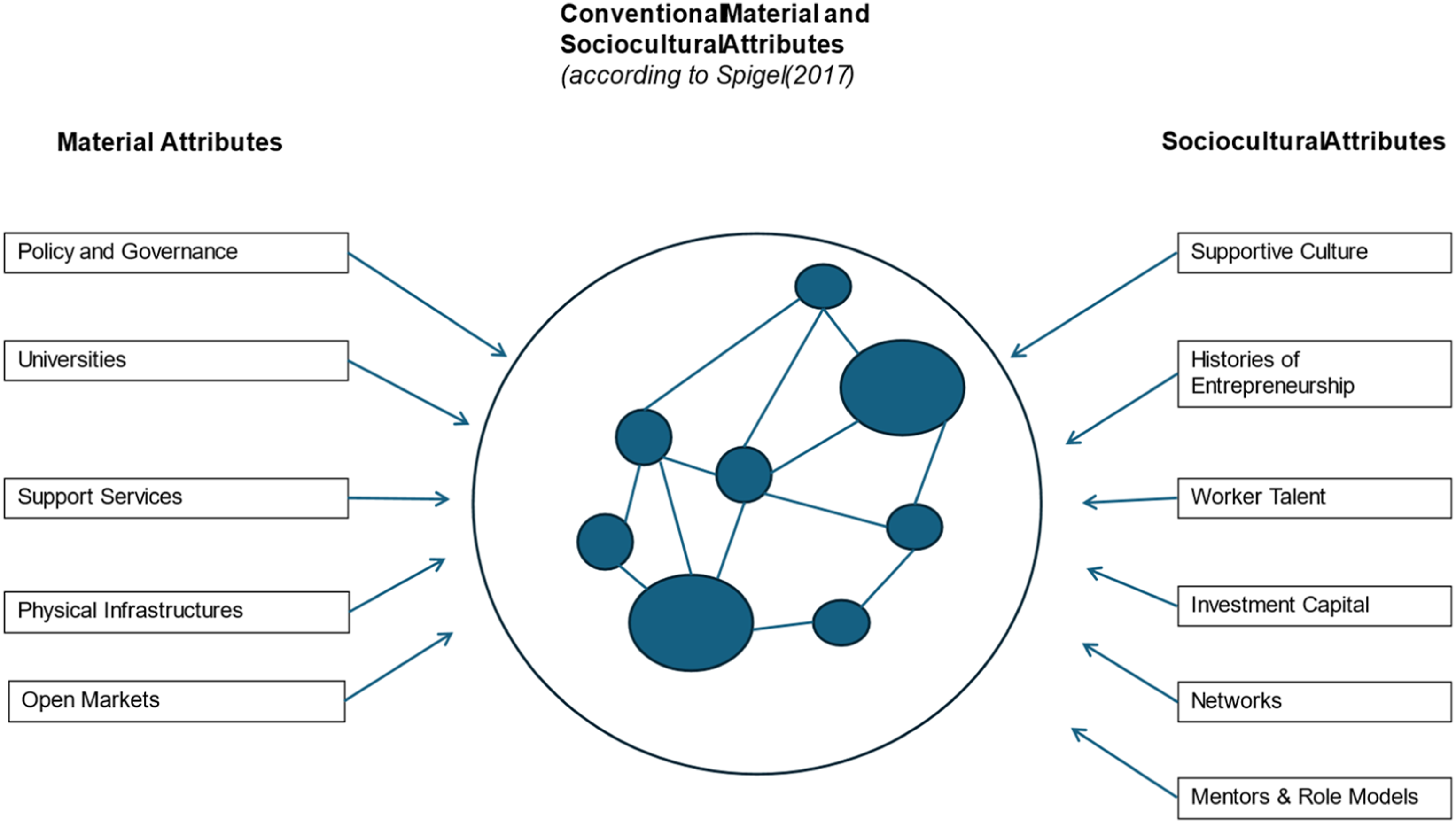
Traditionally, relational and network aspects of EEs are discussed as beneficial factors to ensure competitive advantage for the included actors (e.g. Brown et al., 2023; Spigel, 2017; Stam, 2018) as is also mirrored in the wording of the attributes Yet, recently, research on EEs has been diversifying into different sub-groups, reflecting the increasing differentiation of norms, values and motivations for entrepreneurship. Examples are sustainable entrepreneurial ecosystems by Theodoraki et al. (2022) and Volkmann et al. (2021) 1 as well as social entrepreneurial ecosystems (De Bruin et al., 2023). Moreover, the economic space of EEs is perceived as relational based on constant reciprocal interference between economic actors and their material and sociocultural context. Or in the words of Fredin and Lidén (2020: 95) ‘an EE is in a state of continuous transformation and adaptability’. Inherent to this relational perspective, is an increasing attention to the diversity of key entrepreneurial actors and their hampered or supported agency within (conventional) EEs, as, for example, discussed by Lois et al. (2026).
In concert and in enhancement of these observable directions in EE research, this paper offers a diversification of the EE concept both in terms of entrepreneurial key actors and in terms of possible understandings of entrepreneurial forms that do justice to a more-than-capitalist and diverse economic structures and practices (e.g. Chatterton and Pusey, 2020; Gibson-Graham, 2008; Schmid, 2019). Against this background, we suggest the term ‘transformative entrepreneurial ecosystems’ (TEEs) to describe collaborative corporate networks of different economic and institutional actors who enact economic practices next to and beyond practices of profit accumulation and economic growth. In this paper, we discuss collaborative networks of worker-led companies (WLCs) as illustrative examples of TEEs. This example is chosen as WLCs are centred around local expressions of ‘transformative labour agency’ understood as workers consciously using their central role in production structures to actively alter and re-interpret economic systems and related production structures (Grenzdörffer, 2022). Thus, WLCs put workers in the limelight of economic action and therefore diversifies the set of key actors in EEs. Furthermore, WLCs challenge conventional company forms through their various legal constructs, which enhances and broadens existing EE literature in terms of considered entrepreneurial forms.
While Spigel’s (2017) proposed attribute categories provide solid bases to conceptualize and understand transformative more-than-capitalist EEs due to a shared attention to socio-cultural norms and values that is equally present in transformation research (e.g. Hastings, 2016; Hug et al., 2022; Schmid, 2019), we see the necessity to slightly adapt some of the attributes to suit a higher diversity of entrepreneurial forms, as is displayed in Figure 2. Material and sociocultural attributes of TEEs adapted from Spigel (2017), own illustration.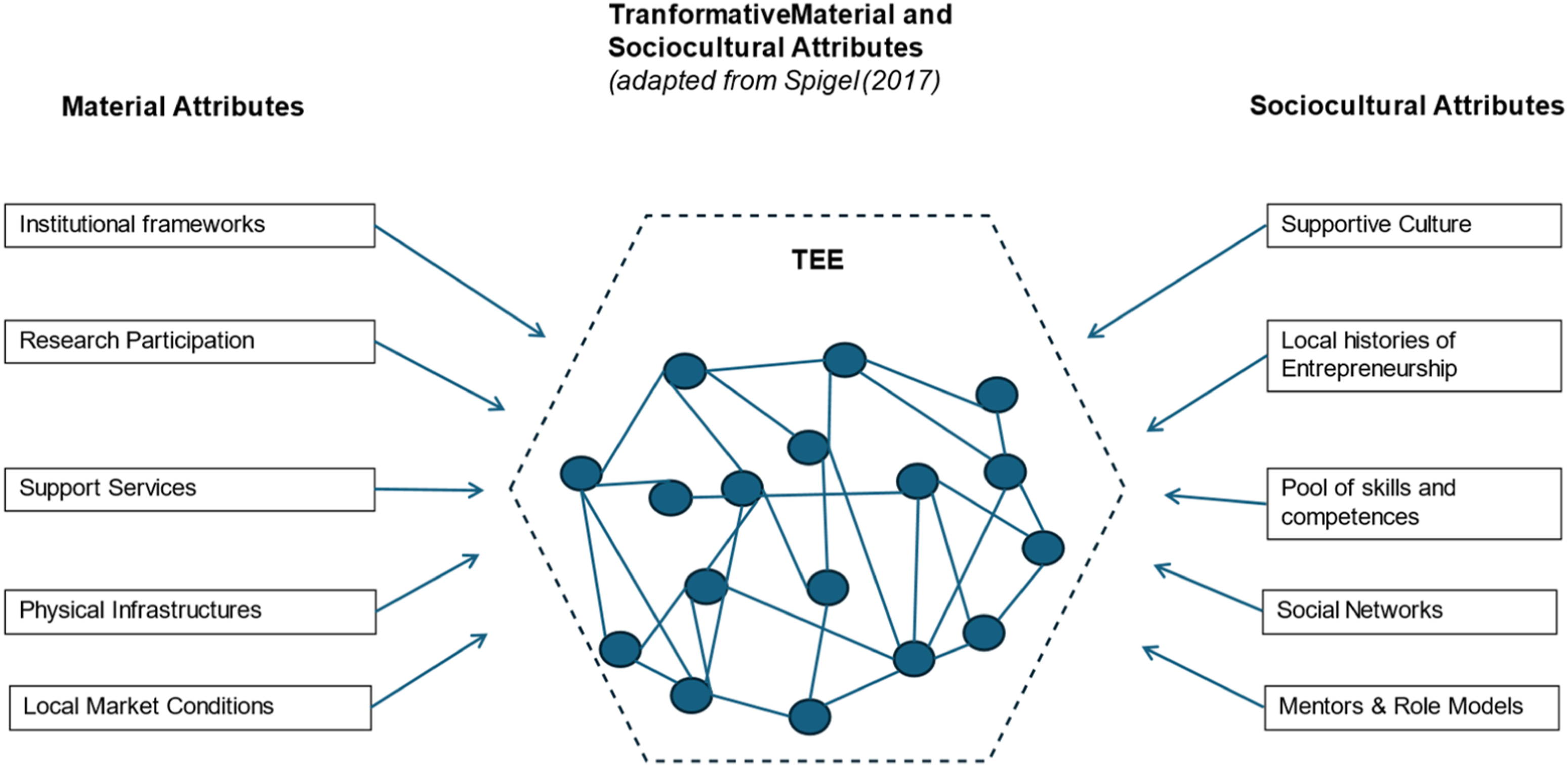
Firstly, Spigel (2017) speaks of ‘worker talent’ to competences that people exchange for money. To capture the attitude of the examined companies, we reframe the label ‘worker talent’ as ‘skills and competences’. Secondly, he also includes investment capital in the category of social attributes, which do not match the empirical data at hand. Therefore, we did not include this category. Thirdly, Spigel (2017) includes an extra category for ‘universities’ as institutionalized external collaboration partners and supporting actors. However, the empirical data revealed only weak evidence for university collaboration in the examined cases. Thus, we decided to include them in the broader category of ‘institutional frameworks’ together with ‘policies and governance’. Lastly, we adapted the label of ‘open market’ to ‘local market conditions’ to counter-narrate a neoliberal free market narrative and allow for a more pluralistic market understanding.
Most EE infrastructures are tailored to growth-oriented forms of entrepreneurship, while more-than-capitalist forms are often narrated as the ‘other’ or ‘alternative’ form and remain to date rather at the margins of scientific and political attention. Considering this, we found the theoretical conceptualization of ‘othering’ as a practice to be suitable for better grasp the internal and external dynamics of ‘alternative other’ entrepreneurial ecosystems. The term has its origin in the context of postcolonial studies and power dynamics and degradation practices connected to race (Bhabha, 1994; Said, 2003). In recent years, there has been increasing attention to markers of difference (i.e. age, race, gender and class) and how they affect economic possibilities of ‘othered’ individual entrepreneurial actors (e.g. Kaasila-Pakanen and Puhakka, 2026; Van Merriënboer et al., 2025). Furthermore, the concept has also been used to highlight organizational social difference that goes beyond individual actors. Examples are Franz et al.’s (2018) analysis of South-North firm acquisitions and Lange and Bürkner’s (2021) research on post-growth geographies in Eastern Germany. The common argument throughout all of these papers is that the process of othering includes a sense of superiority and an external framing of a certain group as different by the majority/hegemonic group.
While the term ‘othering’ is helpful to understand structurally practiced forms of alienation, it also comes with the risk to reproduce the power structures it is addressing. For example, in the context of racial microentrepreneurs (Van Merriënboer et al., 2025) disclose dynamics of downplaying or embracing their othered identity to legitimate their entrepreneurial status. In a similar vein, Lange and Bürkner (2021) show how the self-identification of East German economic actors as opponents or ‘underdogs’ in resistance to hegemonic Western German postgrowth advocators risks accepting this position rather than changing it. Lange and Bürkner (2021) thus invite for a more differentiated view on ‘deviant’ practices and actions, both within and outside of ‘alternative’ forms of economies.
These different nuanced applications of the concept of othering correspond well to a more relational understanding of the term, which ‘[…] is not limited to a two-dimensional dynamic of majority and minority or the powerful and powerless, but rather attunes our attention to the operations and effects of different and differential degrees and manifestations of privilege and penalty’ (Dhamoon, 2021: 875). To capture the nuances between forms of relational othering, Dhamoon (2021) further suggests differentiating between multiple binaries beyond singular categorizations of majority/minority, good/bad or dominant/subordinate. Instead, she invites to investigate how a multitude of contrary, entangled and historically formed binaries are constructed and how they mutually influence each other as well as the range of action attached to different positionalities. Going beyond individual markers of difference, Merino et al. (2025) draw similar conclusions in the context of ‘economic alterity’, advocating for explorations of economic difference that go beyond the mainstream-alternative binary. In their paper and in other similar research (e.g. Ehrnström-Fuentes and Böhm, 2023; Kothari et al., 2019; Leitão, 2023; Ramcilovic-Suominen, 2025), the Zapatista concept of a ‘pluriverse’ is a strong point of reference to challenge ontologies of a universal social, environmental, cultural, political or economic reality.
In the context of this paper, a lens of economic othering that considers a more nuanced perception on constructions of difference imposed on transformative economic practices can help to understand patterns of marginalization by simultaneously recognizing power positions and potentials for transformative agency. By understanding the limitations through marginalization, this perspective also allows for the development of context-sensitive approaches with a differentiated use of economic logics (including capitalist and more-than-capitalist ones equally) adapted to the particular local environments. Furthermore, going beyond singular binary perceptions of mainstream-alternative, capitalist-solidary etc. can open pathways towards a higher diversity of economic solutions to current societal challenges.
Applied to the case of WLCs, workers own and manage a company collectively and hence hold a double role as entrepreneurs and workforce simultaneously (e.g. Larrabure, 2017; Vieta, 2016; Webb and Cheney, 2014). In consequence, they already inherently combine two elements that are often framed as opponents to each other and consequential mutual ‘others’. Yet, externally, they are still part of, and embedded in (mostly) capitalist market structures, which necessitates that WLCs need to position themselves within these structures. Through the lens of economic othering, we were able to grasp how an external framing of ‘other’ or alternative not only creates institutional barriers but also affects the internal socioeconomic identity of the WLCs and their consequential actions. Yet, their transformative interpretation of conventional economic practices also demonstrates the relational character of economic agency and power, paving the way towards more heterogeneous possibilities to create T/EEs.
Methodological framework
To examine transformative entrepreneurial ecosystems, we chose a comparative case study design, which was inspired by a study on Canadian cases of worker cooperative ecosystems (Spicer and Zhong, 2022). The argument from Spicer and Zhong (2022: 617) is convincing as they were able to ‘[… ] eliminate cross-national policy variation as a confounding factor, while further exposing sub-national variegation as a key consideration’ through a case selection within the same country. This is particularly relevant considering the introduced analytical lens economic othering and the focus on identifying transformative economic potentials: while the same national framework allows to identify structural limitations, the analysis of two different local contexts within the same framework allows for a more nuanced view on transformative potentials of EEs. This corresponds to Spicer and Zhong’s (2022) insights who show that not only the national context matters but also different local particularities can play a decisive role for the functioning and maintenance of more-than-capitalist EEs.
Regarding the case choice, a previous nationwide survey in 2021 revealed that Hamburg and Berlin had the highest density of WLCs at the time of our empirical work. Moreover, the results of the same survey revealed a high density of cross-references among the WLCs in each city, which suggested the presence of organized collaborative networks.
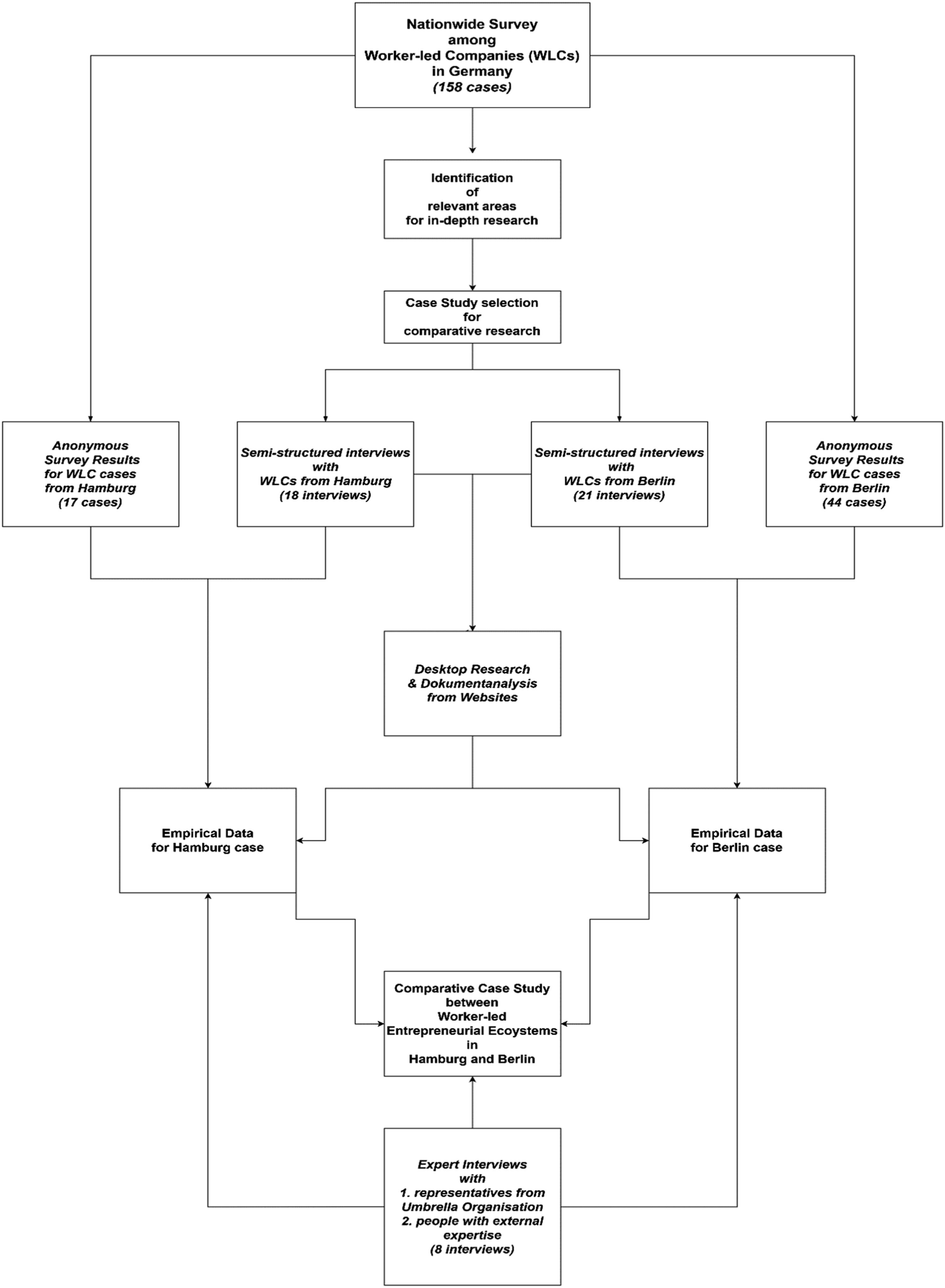
While the quantitative results of the survey helped us to identify the case examples, the in-depth analysis in this paper is based on the qualitative elements of the survey with a focus on inter- and intra-industrial collaboration. To gain more in-depth insights into the network structures and forms of collaborations, we further carried out qualitative semi-structured interviews in each city between February 2022 and January 2023. Additionally, we included expert perspectives from legal advisors and umbrella organizations in Hamburg and Berlin, as well as from researchers with expertise on WLCs in Germany. As a result, we developed a data base of survey data from 61 WLCs in both Hamburg and Berlin from a total of 158 cases and qualitative interview data from a total of 47 interviews with WLC members and experts from both locations. To ensure the actuality of the data, we had a short exchange via phone, email or voice notes with most of the interviewed WLC as well as some of the experts in Autumn 2025. All collected data were transcribed and coded in an iterative process guided by the principles of qualitative content analysis (Kuckartz, 2018). Furthermore, preliminary findings were communicated back to the participating WLCs to ensure that their perspectives were interpreted and displayed in alignment with the registered conversations. This collection of data allowed us to systematically compare between TEEs in Hamburg and Berlin. A more comprehensive illustration of our research design (Figure 6) can be found in the Appendix.
Findings: The role of material and sociocultural attributes in TEEs
While both cities are embedded in the German legal framework, the local institutional context and related forms of support and networks influence the different ways in which WLC networks are organized and embedded in Hamburg and Berlin. Both in Hamburg and Berlin, the internal organization of WLCs in the form of democratic decision-making and shared financial ownership reaches beyond the scope of a single company. Understood as community of local entrepreneurs embedded in different material, social and cultural contexts, WLC networks in Hamburg and Berlin reveal characteristics of EEs in several regards. In addition, there are two different kinds of cooperation that both play a decisive role: industry-based cooperations and value-based cooperations.
In terms of industry-based cooperations, our findings revealed that both local networks contain intra-industrial and inter-industrial forms of collaboration, which corresponds to traditional characteristics of EEs. However, while in Berlin the food industry (including beverages) and the construction industry, Hamburg’s WLC network is more centred around the coffee and the IT industry. We illustrated both the Hamburg network and the Berlin network in greater detail, which can be accessed under the provided links. Beyond these more functional forms of collaboration, the insights from Hamburg and Berlin revealed a high degree of value-based collaboration, which seems more prominent than in traditional EEs.
In creating and cultivating these collaborative relations, the embeddedness in the local economic context seems crucial in terms of (1) material attributes and (2) sociocultural attributes. However, our findings also show how the collaborative networks of WLCs are re-interpreting and transforming existent structures and practices when they are exposed to structural barriers against their more-than-capitalist collaborative practices, which supports the argument to conceptualize them as Transformative Entrepreneurial Ecosystems (TEEs). In the following, we will describe these results in more detail.
Materialities at the margin
Grounded in our adaptation of EE material attributes by Spigel (2017) (see Figure 2), the following figure (Figure 3) provides a comparative overview of the cases of Hamburg and Berlin in this regard.
Thus, in terms of material attributes the collaborative networks of WLCs show strong parallels to traditional examples of EEs. As can be seen, in both cases, the interviewed WLCs consider the urban environment with connected access to a broad client network and access to (digital) infrastructure as beneficial.
Beyond this more general observation, there are specific location factors that differ between the two cases. In the case of Hamburg, the harbour plays a crucial role for the coffee WLCs in Hamburg as it enables short transportation routes for the coffee beans as an import good. Here, it becomes already apparent how material attributes are interwoven with entrepreneurial norms and values because not only do the coffee WLCs see the benefits of reduced costs but also of reduced CO2 emissions. A specific relevant location factor of Berlin is the city’s political function as Germany’s capital: ‘Berlin is the capital of NGOs, and politics just takes place there. I think it's simply an important place to be present and to take part’ (Med3_B). ‘When you're in the capital, relatively quickly you get the feeling that there is a solution for everything. This is very encouraging. It's really cool that this network exists’ (FB4_B).
Moreover, Berlin has a strong reputation as a start-up hub and has a beneficial environment for social innovation (Kritikos, 2016; McFarlane et al., 2023; Wöbken, 2022). This includes support services, such as funding, conferences or consultancy, factors that create a beneficial climate for entrepreneurial creativity and risk taking. In a more emergent way, interview participants from Hamburg observe similar developments by referring to impact hubs or start-up events. Yet, it is quite apparent that the density of collaboration and the number of industries involved are relatively small compared to the collaborative WLC network in Berlin. This might be partly due to the generally higher density of enterprises in Berlin (over 60 cross-references identified, without claim to be exhaustive) compared to Hamburg (a concentrated core of around 20–30 WLCs). As a further material attribute that fosters proximity, some of Berlin’s WLC positively referred to ‘their Kiez’ – a local term used to describe small neighbourhood districts with coffee places, restaurants, parks, etc. with whom their inhabitants associate a sense of belonging and common social identity (Bentlin and Behrend, 2023). Particularly, in terms of shared infrastructure the combination of spatial proximity and social trust through a shared sense of belonging, the Kiez culture was considered as very beneficial for Berlin’s WLC collaborations.
The establishment and maintenance of shared spaces and infrastructures was a central element of cooperation in both cities. The interviewed WLCs in both Hamburg and Berlin reported on examples of shared infrastructure to reduce costs and support each other in their entrepreneurial activities. As illustrated in the following, these examples mainly evolve around specific industries, namely, the coffee industry in Hamburg: ‘We roast coffee at another Coffee WLC every three weeks. Then we rent a place there and pay a fee for roasting. There’s also some of our coffee in the cellar’ (Cof3, HH).
As the coffee industry is the most prominent one in Hamburg, they managed to set an example both for other non-coffee WLCs and for coffee non-WLCs. Particularly, the shared infrastructures fostered principles of mutual support and solidarity while simultaneously allowing for financial efficiency. In a similar vein, the construction industry in Berlin created shared infrastructures, including a shared pool of resources and a shared customer network: ‘In Berlin there are about five or six WLCs that are involved in the construction industry with different focal points. For example, there is a metalworking WLC. We always use their structures if we need to build something with metal. Or a painting WLCs from which we get our painting colors and wood oils. We’re also planning together construction sites, wherever it fits’ (Con3_B).
Also, a joint presentation at networking events was mentioned several times as illustrated by the example from the beverage industry in Berlin: ‘There was a trade fair “Future Festivals” […] and such a festival needs drinks. So we made a booth together with other WLCs […] We could share the cost of registration for a small stand there, where we then stood in the name of our four companies. The aim is that we are perceived together’ (FB1_B).
In concert with the material attribute of ‘support services’ in cases of traditional EEs, there is access to support organizations that offer advisory services for already existent and emerging WLCs, in both cities. However, while in Berlin, there is a variety of such support organizations, there is mostly one central contact point for WLCs in Hamburg: the umbrella organization KdS that was positively mentioned across most of conversations with Hamburg’s WLCs. Closely collaborating with the Free Workers Union Hamburg (FAU), they took it on as their task to provide information and support on how to build and maintain a WLC. Beyond these informational and advisory tasks, together they organize regular networking events to increase cooperation and exchange between WLCs in Hamburg, which were often a point of reference during the interviews, as expressed by one member of a Coffee WLC: ‘I am always at the collective networking meeting, which is once a month. An open meeting at the FAU, the “black cat.” And there are often other WLCs from Hamburg’ (Cof3_HH).
Yet, there appears to be very little supportive institutional infrastructure in the form of organizational or legal support besides the aforementioned umbrella organization. This is also pointed out by one of the coffee WLCs: ‘In Berlin, existing associations ensure that there are more well-founded foundations of collectives than in other cities. Here in Hamburg, we've had about 15 new collective foundations in Hamburg in the last few years. However, I wouldn't say that Hamburg is a stronghold of collectives. It's more like Berlin or Kassel or Wendland’ (Cof1_HH).
This observation corresponds to the data from Berlin that reveal a decentralized broader and more diverse set of actors and support services. This includes a set of organizational experts, diverse consulting companies who support and advise WLCs as well as legal experts who support WLCs to find an adequate legal form. Or as they describe it: ‘We took legal advice in the early days. I don't know if you know [Law Expert 2]. They are actually lawyers who do a lot of work in the collective field, including workshops. Together with them, we decided on this business model’ (EN3_B).
Thus, in contrast to the Hamburg case, WLCs in Berlin are additionally supported by assisting external actors, such as consulting associations/companies, umbrella organizations and legal experts. In consequence, some of the tasks that WLCs in Hamburg must integrate into their daily business can be externalized in Berlin, which fosters increased (productive) efficiency and leaves more time for other kinds of activities. Furthermore, several WLCs mention regular research participation to increase the visibility of their economic structures and practices. Yet, in a similar vein, research participation is often done outside of their regular company activities, leading to increased workload.
Overall, our findings indicate that material attributes that would typically support conventional EEs are only partially supportive of the examined cases. However, both cases show similar network structures grounded in a more-than-capitalist understanding of entrepreneurship, which supports their conceptualization of TEEs in terms of material attributes. Findings also revealed that the overall material context is more supportive in the Berlin case than in the Hamburg case, which underlines the importance to having a nuanced perspective on local context conditions within a broader national context. Lastly, while not unimportant, material attributes seem to play a rather secondary role compared to sociocultural attributes, which are presented in the following.
Practicing collaboration and solidarity beyond the scope of a company – Sociocultural values at the core
Visible in the examples of shared infrastructures and joint events, collaboration and solidarity play a major role within the explored WLC networks in Hamburg and Berlin. With a focus on sociocultural attributes, data from both cities disclose dense social networks both within and across industries (see Figure 4 below). Furthermore, interviewed WLC actors from both locations share a critical perspective on (purely) capitalist structures and the mission to combine entrepreneurship with societal and/or political engagement. This supports the suggested conceptualization of both cases as TEEs as both show characteristics of EEs, yet in a transformative manner.
While both cases share more-than-capitalist entrepreneurial beliefs, there are a few distinctions that can be attributed to the different local contexts. With respect to relevant industries, the coffee industry and the IT industry play a major role for the collaborative WLC network in Hamburg. Particularly two IT WLCs are politically engaged in beyond-capitalist forms of economy in connection with KdS. Moreover, there is a strong collaborative network among IT WLCs that have a ‘Genossenschaft (eG) 2 ’ and are engaged in improving conditions in Germany for eG as an alternative legal form to organize a company. As one reason for this, several of the interview partners point out the increased security of their legal form, as the company’s profit can legally only be used to serve its members. So private profit distribution for only a small number of people is impossible in their legal framework. An especially interesting case is IT13_HH where the former employers sold their company to their employees and changed the legal form for this purpose.
Collaboration and mutual support within the coffee industry could be observed in terms of shared infrastructure (as discussed in part IV.1), but also in creation of a joint product under the label of ‘solidarity coffee’. In 2025, 3 years after the initial interviews, they reported on a national collaboration network for coffee WLCs, which demonstrates that their efforts were fruitful. Beyond business relations, most of the surveyed and interviewed coffee WLCs do not only identify themselves as coffee companies but also as political actors, mostly with a critical perspective on current capitalist economic structures. Or in their words: ‘We do coffee trade and coffee trade is always based on disgusting colonialism and worst exploitation and destroys nature, no matter how we do it. It’s quite clear that if you still want to look in the mirror, you have to do things quite differently than usual. And you have to do it in a really reflective and careful way. The fact that we now only grow organic coffee is not enough’ (Cof1_HH). ‘It’s clear for me that there's a strong connection between political work and wage work. And it's stupid: if you do a lot of political work while also doing wage work that's not commercial, you can't have such a high hourly wage as if you're super-efficient and economically oriented in your job. If you reject all other activities that do not bring money, then you would have a higher hourly wage. But we don't want that’ (Cof3_HH).
An interesting aspect of this political activism is the international collaboration with Mexican Zapatista coffee cooperatives, which demonstrate how they implement their values beyond the local scale of their WLCs. Furthermore, they share the reference point to the Zapatista movement which is also well-established in more-than-capitalist theories and the notion of a ‘pluriverse’ (see Kothari et al., 2019 for an overview).
While so far, the differences to growth-oriented EEs have manifested rather implicitly, these quotes give insights into the underlying beliefs on entrepreneurship that go beyond a focus on growth and profit accumulation. Combining the need for economic security with a more-than-capitalist orientation, one coffee WLC is especially successful and therefore plays a major supporting role for others. In the interviews, they shared that from an early stage onwards they wanted to prevent themselves from becoming too ‘greedy’ in case of success. Hence, they established an internal contract to limit their profit and organize redistribution in the event they reached this limit. Being financially very successful, they can now implement their redistribution according to this plan. 3 Beyond financial support, they also provide advisory support and consultation to other WLCs, drawing on their own experiences. This corresponds well to findings from research on growth-oriented EEs and the attributed importance of role models and mentors.
Like the coffee industry in Hamburg, Berlin’s WLCs in the craft and construction industry identify strongly with left-winged political values. Organized in an informal industry-specific network, they do not only support each other with their expertise in different fields and collaborate in ongoing projects. They also engage politically and translate these values into their (daily) work. One example is the application of solidarity pricing and the implementation of projects that they are not paid for: ‘It’s not our free time; it’s our wage job. That's why we can't support all of them, but we try to redistribute a little bit. We adjust our prices when some projects have less [resources] and other groups have more, and we try to make that transparent. We also try to offer possibilities how we can make things less expensive. For example, we offer to teach how to do things yourself. You don't necessarily have to pay us for that’ (Con1_B).
Equivalent to Hamburg’s coffee role model, two woodwork and gardening WLCs in Berlin are important actors in the maintenance of their intra-industrial networks. While one is a little less financially successful, they both play a major supporting role for others. Particularly impressive for both is that they are not only engaged in collaboration and networking with other WLCs within and beyond their industry but also regularly participate in industry-specific events with more conventional companies, such as events by a nationwide federation for garden landscape construction. With this, they hope to increase the visibility of other forms of work and economic structures beyond their ‘social bubble’.
Regarding cross-industry collaboration, comparably few cross-industry relations could be observed in Hamburg. Several WLCs from different industries mentioned the difficulties to maintain networking activities that are external to their daily work and cannot directly be implemented in their respective productive and entrepreneurial activities, as illustrated by the following quote. ‘I watch with a quiet sorrow and a little guilty conscience how there's actually a lot happening right now. I see that and I read that and I think “I just don't have the energy to be there.” They always invite to new meetings. I think I'm supposed to go, but I can't get it done. I just… I'm doing 24-hour/week in our shop. I'm doing 20 hours/week on another project at the game studio, and I have two little kids’ (FB1_HH).
In consequence, it is unsurprising that the intra-industry cooperation is stronger and more densely organized than the cross-industry cooperative activities in Hamburg. In contrast, in the case of Berlin, it felt like a never-ending network as new relations and cross-references kept appearing during the process of interviewing and analysis. 4 Thus, in comparison, the WLC network in Hamburg still has a more emerging character. In this regard, it is interesting to observe that many of the interviewed WLCs in Hamburg mentioned cooperation with and inspiration from WLCs in Berlin. Thus, we can tentatively assume a pioneering role for the Berlin TEE in Hamburg.
The openness to finding intersections and collaborating between these different spheres was not only connected to the political environment but also to the overall cultural attitude and atmosphere in Berlin. There seems to be a high level of risk-taking and experimentation, which is combined with strong political and societal engagement, described as follows: ‘I think Berlin is like that because there’s a lot of people there, of course, and they just live differently, lead a different life. More freely and self-determined. Otherwise, they would not live in Berlin’ (CE1_B).
Another particularity of Berlin is its history of entrepreneurship. During the time of the GDR regime, worker cooperatives and production cooperatives were a common model: every seventh worker was working in a Genossenschaft at the end of the 1980 (Beywl, 1991: 37). Yet, in the transition processes of the reunification only a small number of the former Eastern German worker cooperatives survived: they either went bankrupt, got bought out or changed their legal form into a GmbH. 5 In research, reasons for this were seen in the lack of institutional support in the reunification processes, and in existing prejudices and reservations against this company model because it was associated to the GDR control regime (Metz, 1991; Schultz, 2008). These findings align with empirical insights from the qualitative interviews: some of the older WLCs had their roots in the Eastern German regime and could share firsthand experiences of the reunification process.
Beyond these city-specific sociocultural attributes, in both cases, the political engagement to change societal and economic structures is often based on a critical perspective of the involved actors towards capitalism. Many of the surveyed WLCs strive for – and already live – more-than-capitalist forms of economic organization. This is how two of them describe their visions and motivations: ‘We hope that we can contribute to spread emancipatory thoughts in society and that society will change its way of thinking. Or maybe just a large part of society, which would also have consequences. This includes throwing the capitalist logic of exploitation overboard, i.e. proceeding in a needs-oriented manner and also understanding that doing so harms no one’ (Con1_B). ‘We do not believe that we have the panacea for a better world. We just try to take up as much space as possible with our alternative thoughts, within the limits that the system shows us’ (FB3_B).Yet, as one of the interview partners observes, living utopia is also sometimes less glamorous than some might have imagined it: ‘Being in Berlin means for me that there are spaces of practice. One problem in France and in Paris was that many people have talked about the post-revolution as a kind of dream of “all problems are solved there.” Here, I find it exciting because I was ten years in different projects and I realized that the everyday reality is very basic, partly very boring stuff (laughs)’ (Med1_B).
A further observation is the apparent divide between left-wing political WLCs and those that identify with the social entrepreneurship sector. There seems to be little contact and cooperation among WLCs associated with the social entrepreneurship sector. Some even actively distance themselves from this sector. As one WLC describes it: ‘The problem is that the term “worker-led collective” is not protected. Any start-up can call itself a worker-led collective. But they are not a political collective, they just work together. They do have a boss and they're using these structures to act in a capitalistic way, in the sense that it's all about increasing capital and about [economic] growth. That's just not true for us. We don't want to grow for the sake of growth’ (EN1_HH).
In the Berlin case, despite the active political engagement equivalent to findings from Hamburg, there are much stronger ties to the social entrepreneurship sector. For example, some of the beverage WLCs maintain a close association with Berlin’s social entrepreneurship and start-up scene. In this context, several of them are also part of the so-called ‘Good Food Collective’, which also includes non-worker-led companies from the organic food and beverage industry.
The attitude towards social entrepreneurship and ‘new work’ in start-ups and progressive companies appears to remain a controversial topic across the industries and locations. While there is consent on the value of increased codetermination at work, the opinions differ on what is considered as a form of ‘democracy-washing’ and what is considered authentic and consequent enough. ‘I distance myself from the companies that say: “Hey, we are now the new society, the new New York. We are now doing holocracy, because that is the solution to all problems.” I sometimes have the feeling with organizations that this is such a hype right now. I believe that this doesn’t change the principles of work, but that it rather shifts the problem elsewhere’ (Med3_B). ‘The companies use this [democracy approach] for employer branding. That's just not okay. Like this, it’s under a cloak and then again, they just to do the same old crap. That can't be the solution’ (CE1_B).
Based on the fear of reproducing what they seek to change, this perspective reveals a strong group identity opposed to companies that prioritize economic growth. It also implies the acceptance of one’s own position as an economic ‘other’ in resistance to hegemonic profit-driven forms of companies. This is particularly interesting when analysed through the lens of ‘economic othering’, which will be taken up in the discussion.
In terms of cooperation, the embeddedness of WLC networks on a national scale is a final sociocultural attribute that we shortly want to highlight. As illustrated in the following quote, there are many relations and references to WLCs in other German cities and the participation in the nation-wide engagement for WLCs. ‘We are looking for committed nationwide networking in terms of higher-level solidarity and higher-level structures. We are thinking nationwide, and we will certainly establish structures for this in the next year and a half’ (Cof1_HH).
Similar observations could be made in the case of Berlin, both in intra-industrial and cross-industrial forms of cooperation. Furthermore, ongoing activities are underway to establish a nationwide collaborative WLC network, aiming to increase mutual support and skill sharing. In 2025, 3 years after the initial interviews, several WLCs reported that the nationwide umbrella organization for WLCs in Germany is now established. This aspect further supports the stated hypothesis that sociocultural attributes play a more relevant role in the establishment and maintenance of the analysed WLC networks than material ones. Overall, it became visible that more-than-capitalist entrepreneurial beliefs decisively influence the economic structures and practices within the examined networks. While they show sociocultural attributes that correspond to conventional EEs, they diverge from conventional EEs in the ways these attributes manifest.
Discussion: Collaborative WLC networks as (‘other’) transformative entrepreneurial ecosystems (TEEs)
As could be seen, WLCs in Hamburg and Berlin collaborate within and across industries based on their shared values and beliefs. Thus, similar to findings on growth-based EEs, social networks and shared values across different industries are responsible for the functioning of an EE that consists of WLCs. The cross-industrial character with a focus on ‘advantages […] related to resources specific to the entrepreneurship process’ (Spigel, 2017: 52; italics in the original) is one distinctive element that allows a transfer of the EE concept to the case of collaborative WLC networks. Our results show that most of the material and sociocultural attributes have a similar influence on both growth-based EEs and the examined case examples: attributes like a good and supportive social network or context-specific location factors affect both growth-oriented and transformative EEs equally.
Furthermore, mentors and role models are crucial for the emergence and maintenance of the ecosystem, particularly in facilitating the integration of start-ups. Yet, we can also see that the overall market environment in which they are embedded deprives them of certain support services and infrastructures, which we discuss through the lens of ‘economic othering’ below. Nevertheless, these structural barriers also foster experimentation and innovativeness in terms of transformative practices. Thus, these insights can contribute to a higher diversity of possible economic structures and practices that can be tailored to local particularities.
TEEs and entrepreneurial beliefs
The most striking difference is diverging ‘underlying entrepreneurial beliefs’ between examples from traditional EE literature and the examined cases. These divergences influence many aspects of the EEs and the entrepreneurial process. These underlying beliefs manifest themselves in several regards: In both cities, there seems to be a consensus to think and live work and production structures beyond profit accumulation.
For example, the role-model character of established WLCs that limit their profit or work with solidarity prices highlights the more-than-capitalist logic found in the examined EEs, which also leads to a different measurement of ‘success’ and of ‘good’ pioneering examples. Other examples are the sharing of tools, infrastructure and knowledge tailored to the skills and resources of the WLCs involved, or unpaid advice services from more established WLCs. This corresponds to already existing research insights of shared infrastructures and resources, which is viewed as beneficial both in terms of efficiency and productivity (e.g. Duran et al., 2025; Hajli et al., 2025; Muldoon et al., 2023) and as more-than-capitalist practice to counteract harmful tendencies of resource overuse (e.g. Chatterton and Pusey, 2020; Kanda et al., 2025; Liodaki et al., 2025). While in the cases at hand, these sharing practices are clearly linked to joint engagement in societal and political activities, this might be a potential common ground to bridge different entrepreneurial beliefs.
Contextual EE attributes compared with regard to economic othering and transformative practices.
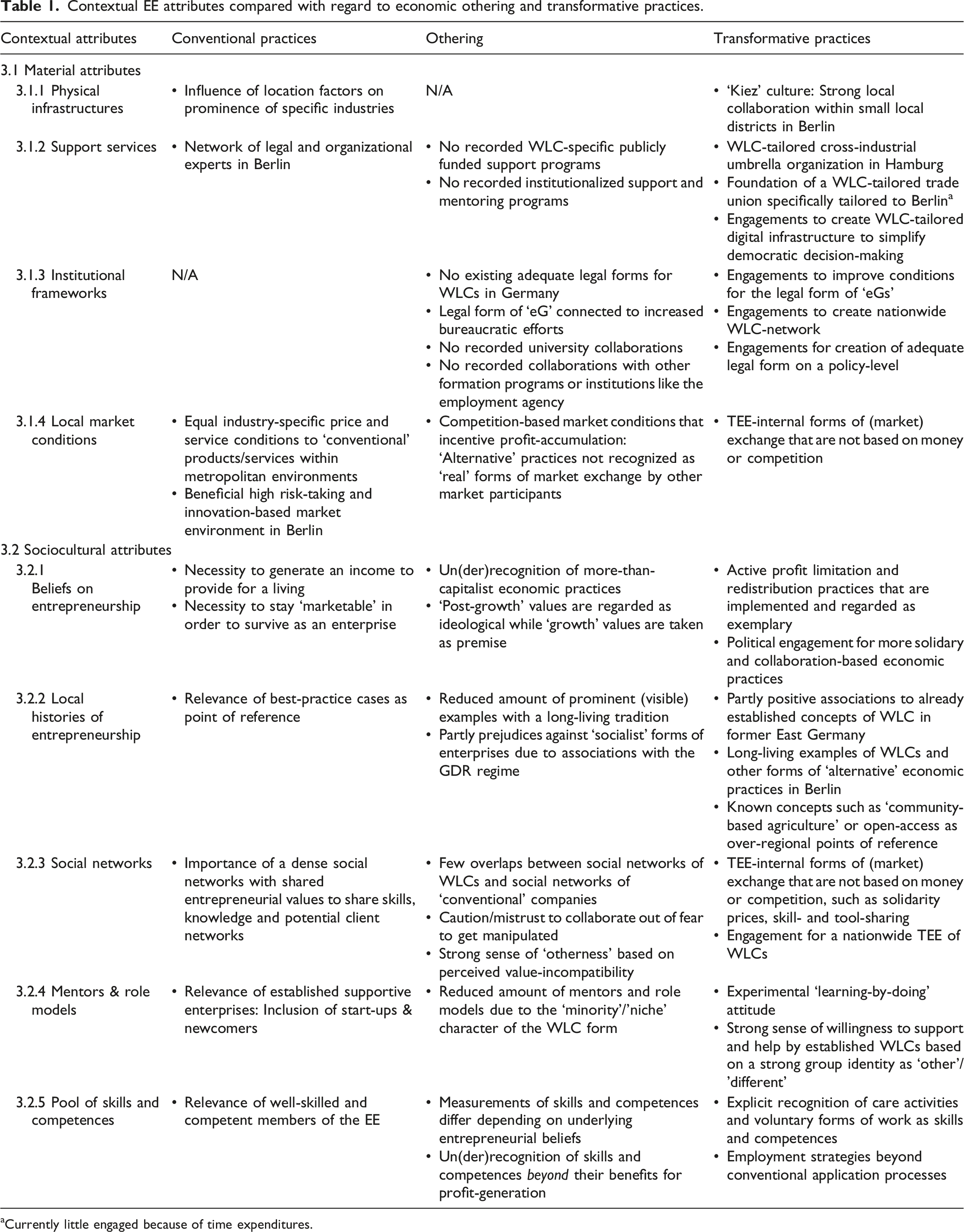
aCurrently little engaged because of time expenditures.
TEEs and economic othering
As a crucial difference to more traditional examples of EEs, it becomes evident that the analysed TEEs are neither ‘backed-up’ through policies or state-funded programs nor made visible through collaboration with public institutions such as universities or employment agencies, leading to relatively high bureaucratic, financial and temporal costs. While Spigel (2017) mentions institutionalized support services and funding support as well university collaborations as crucial attributes for a thriving EE, we did not find any evidence for such services, infrastructures or collaborations that tailored to more-than-capitalist economic structures and practices, which were not ‘self-made’ by the concerned WLCs.
As proposed in the theoretical part, we consider the perspective of ‘relational othering’ helpful: While growth-oriented forms of companies are mainstreamed as ‘normal’, different ways of economic organizing such as the illustrative example of WLCs are ‘othered’ as the so-called ‘alternative’ forms. This not only leads to a lack of recognition but also to a lack of institutionalized support tailored to WLCs. In 2025, 3 years after the initial interviews, several WLCs reported that the increasing popularity of right-winged political discourses and budget cuts in both the sustainable and cultural industries further increased these tendencies.
Perceived as ‘niche’ or as form of ideological experimentation, there is also a limited number of local histories of best practices, which in traditional EES is an important factor.
As displayed in Figure 5, this established historically grown predominance of growth-oriented structures and practices and the framing of diverging structures and practices as ‘other’ or ‘alternative’ prevents (infra-)structural and institutionalized support of transformative practices that might be more beneficial and efficient to achieve increased socioecological justice and well-being. Material attributes of TEEs in Hamburg and Berlin compared (own illustration).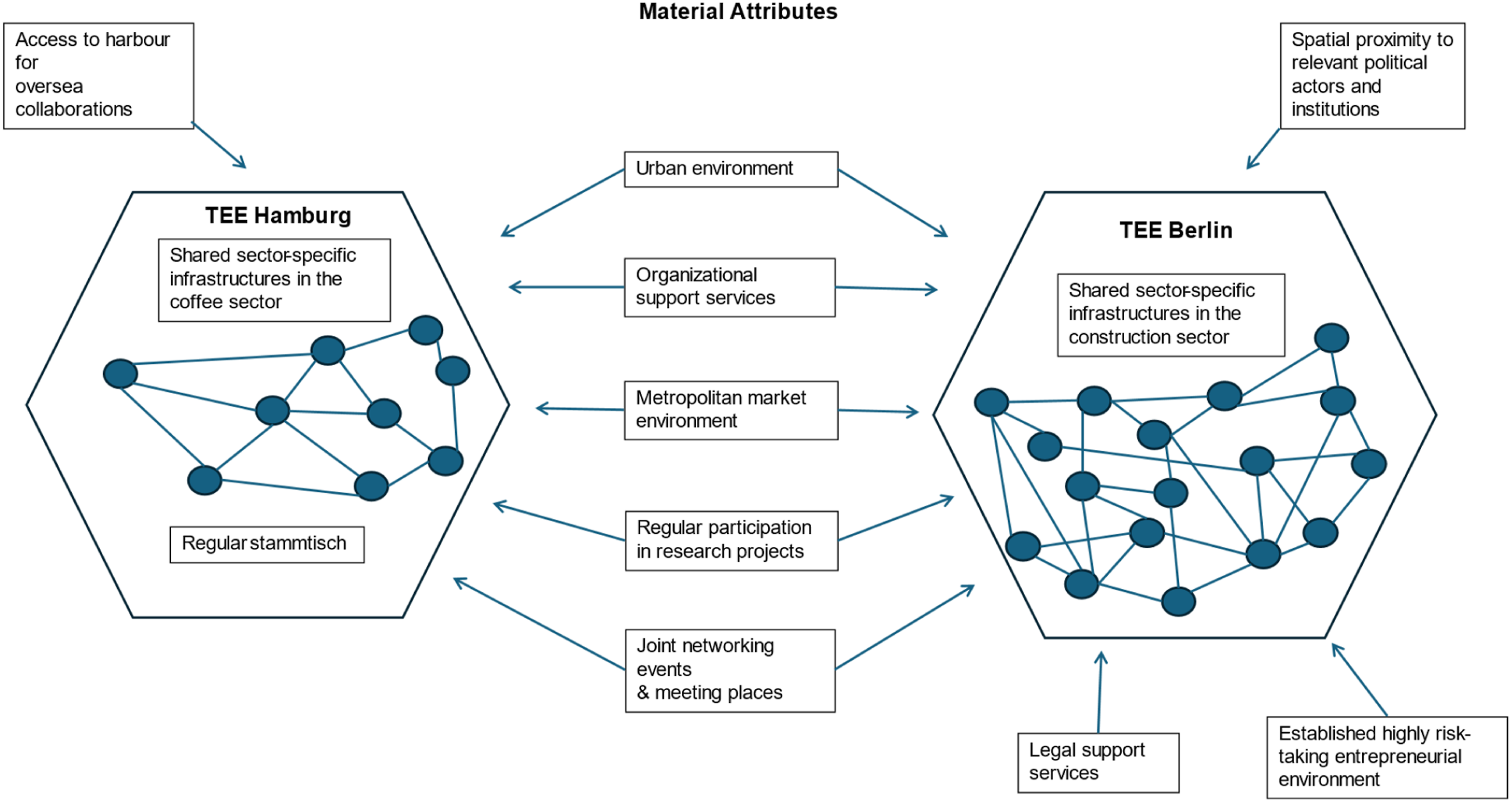
Furthermore, this binary conception of ‘the normal’ and ‘the other’ also prevents mutual learning potentials since strong group identities are built around being ‘the norm’ or ‘the other’. One of the consequences is the risk of a less nuanced view on which kinds of economic practices and structures make sense in which cases, grounded in loyalty towards the own group and the fear of identity loss. Afraid to reproduce the labour-exploitative structures they seek to transform, many WLCs see the danger of ‘democracy-washing’ and are cautious to collaborate with ‘conventional’ enterprises. Thus, while the fact of being ‘othered’ limits transformative economic action through institutional barriers, it simultaneously has a reinforcing effect on a joint group identity among ‘like-minded’ and a shared transformative agency, which we perceive as an interesting paradox. Corresponding to existing findings on dynamics of ‘othering’ from, for example,, Van Merriënboer et al. (2025) or Merino et al. (2025), this shows how the external framing as ‘other’ affects the internal socioeconomic identity of the WLCs. This partly leads to dynamics of strong resistance and opposition, yet increased solidarity within the ‘othered group’, which Merino et al. (2025: 4) frame as ‘alternative-oppositional’.
Yet, in conversations with the WLCs it also became obvious how many of their transformative practices are already challenging the constructed binary of ‘mainstream-alternative’ economies. In consequence, in cases where they managed to interpret and use existing structures in new ways they already enact more-than-one economic practices that correspond to the Zapatista notion of a pluriverse in which multiple world visions can not only coexist but also mutually enrich each other. Examples are the re-interpretation of existing legal frameworks, efficient collective decision-making strategies, profit-limitations that also can ensure long-term financial stability and caring work structures that prevent burnouts and health problems among the worker-owners. Going beyond framing of ‘the norm’ and ‘the other’, these experiences could be beneficial for any kind of EE, fostering a higher diversity of economic practices that can be adapted to the challenges at hand. Sociocultural attributes of TEEs in Hamburg and Berlin compared (own illustration). TEEs and economic othering (own illustration).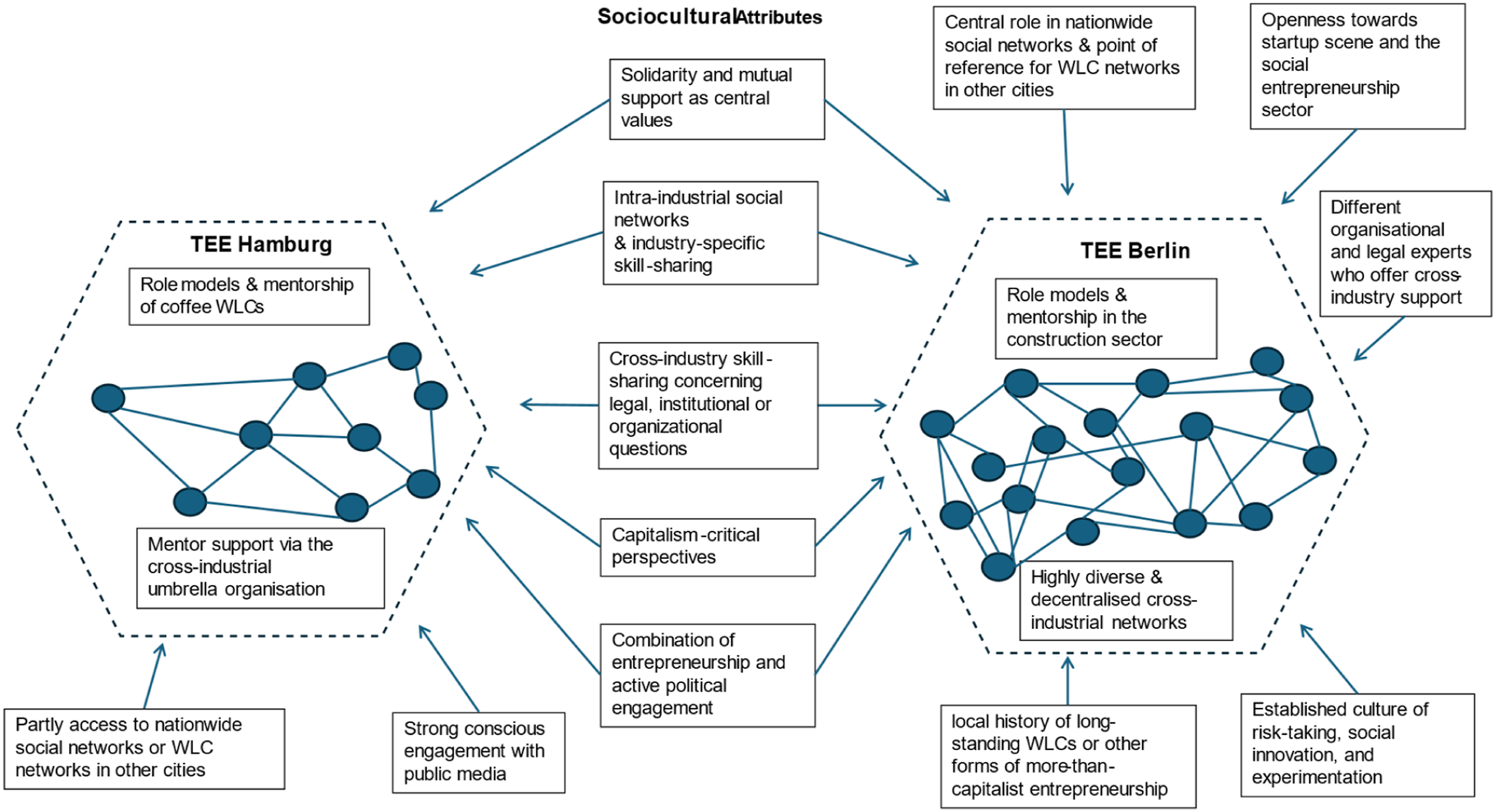
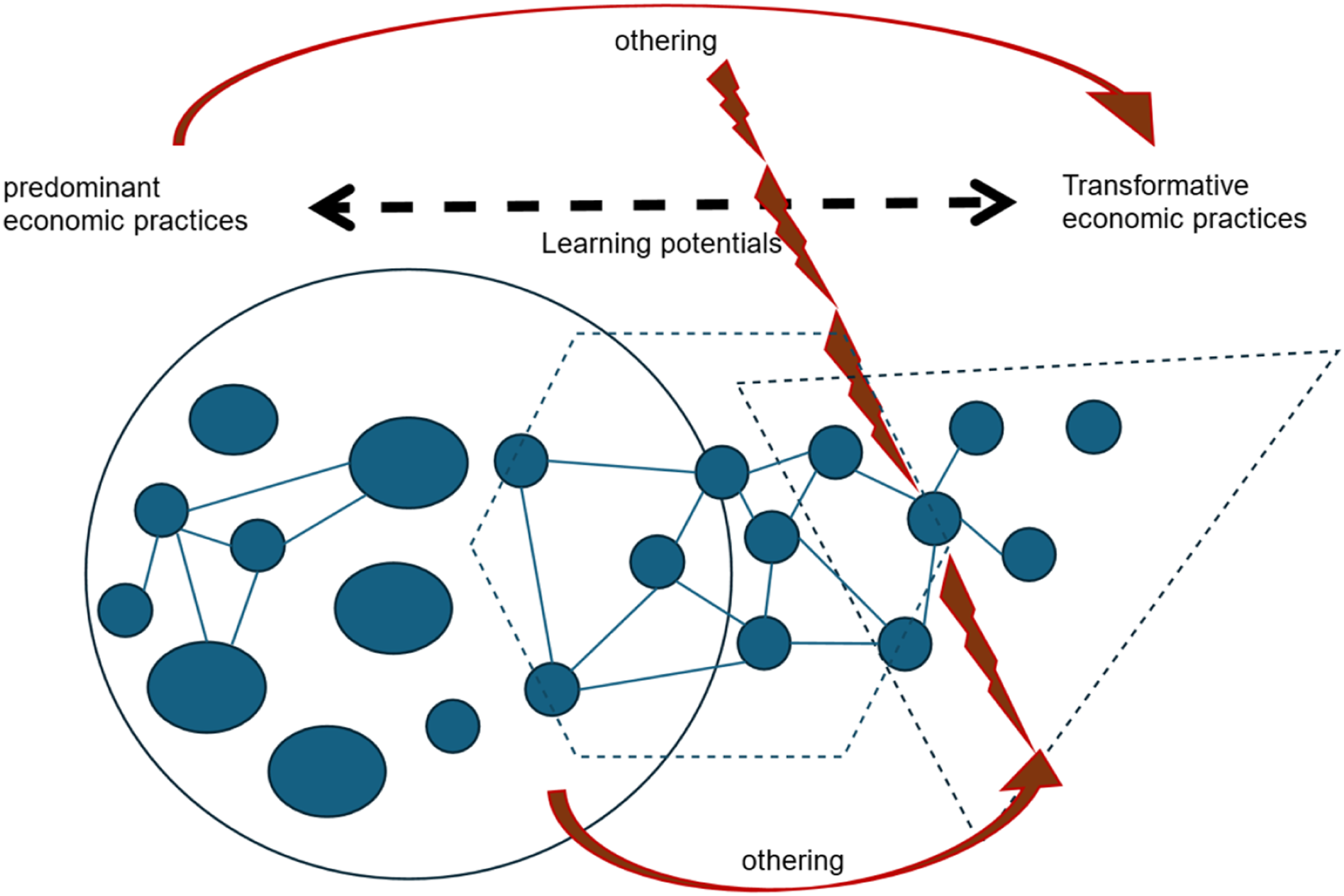
In terms of relational economic othering and global power dynamics, it is crucial to acknowledge that WLCs still hold a role as ‘conventional market players’ in the form of a company in the Global North embedded in global value chains. Here again, multiple binaries become visible as WLCs are ‘othered’ in some regards but also hold power and occupy hegemonic positions in other regards. Thus, their role as German companies positioned in a (global) competition-based market comes with privileges and limitations equally. Evidence from the interviews shows that there is an awareness of the own capacities and privileges, which is combined with a motivation to change harmful practices. Yet, WLCs still need to partly conform to growth-based incentives to ensure their survival, which runs the risk of reproducing the structures they seek to transform.
Conclusion and outlook
Overall, our analysis contributes to a more comprehensive and pluralistic understanding of entrepreneurial ecosystems and the role that different entrepreneurial norms and values play in their emergence and maintenance. In the context of traditional profit-oriented entrepreneurial values, future research on the concept of economic ‘othering’ and its related drivers and barriers for a more diverse understanding and implementation of entrepreneurial ecosystems may be fruitful. Moreover, since we only marginally touched upon the impact of TEEs on broader economic structures, such as, for example, value chains, or institutional and political structures, future research could focus on potential transformative effects on the surrounding local economies and beyond.
As a final thought, we see potential for increased dialogue and mutual learning between different and within local EEs in appreciation and recognition of the diverse forms economic action can take. Through the lens of an ecosystem, a more nuanced view of the heterogeneity of production structures might allow identifying fruitful synergies and cross-fertilization to create a balanced and socio-ecologically just economic environment. We therefore want to close with the invitation for an open mind and open eyes to pluralistic expressions of economic activities and structures and their place-specific particularities, or in reference to the Zapatista pluriverse: a multiplicity of possible economic worlds beyond hegemonial one-world-fits-all solutions.
Footnotes
Acknowledgements
Our assumption about knowledge creation and scientific writing is that they are highly collaborative processes rather than isolated ones. Therefore, we would like to express our gratitude to several people who contributed to this paper: First, we thank the editor and the anonymous reviewers for their insightful comments. Another important contributor was Robert Hassink, Sinje’s PhD supervisor, who decisively contributed to the development of this paper and accompanied the empirical process. Furthermore, thank you for all the fruitful discussions and insightful dialogues to the doctoral fellows within the transformation cluster of the Heinrich-Boll-Stiftung as well as to the Stiftung itself for the financial support of the PhD project. Finally, this paper would not exist without the openness and engagement of everyone who allowed us insights in their practical experiences with worker-led companies. Thank you so much for sharing your inspiring experiences and practices!

Ethical considerations
All research participants were informed beforehand about the context and the purpose of the study. All quantitative and qualitative data were only used when participants agreed to the use of their data and consequential publication. All data were anonymized.
Funding
The authors disclosed receipt of the following financial support for the research, authorship, and/or publication of this article: This paper is part of the PhD project ‘Worker-led Companies as Transformative Labour Geographies in Germany’ (successfully defended in August 2023), which was funded by the Heinrich-Böll-Stiftung, Germany, as part of their research cluster on socioecological transformation.
Declaration of conflicting interests
The authors declared no potential conflicts of interest with respect to the research, authorship, and/or publication of this article.
Data Availability Statement
The data that support the findings of this study are available on request from the corresponding author (SG). The data are not publicly available as they may contain information that could compromise the privacy of research participants, particularly regarding their political values.
Notes
Appendix
Research design (own illustration).