






Abstract
Objective:
To compare the efficacy of balance training associated with muscle strengthening or stretching, relative to no intervention, in the postural control of elderly women with osteoporosis.
Design:
A randomized, controlled trial.
Subjects and interventions:
Sample consisted of 50 women aged 65 years or older, with osteoporosis, randomized into one of three groups: strengthening group (n = 17) performed balance training with muscle strengthening; stretching group (n = 17) performed balance training with stretching; and control group (n = 16), no activities. Interventions lasted eight weeks, twice a week, 60 minutes a day.
Main measures:
Postural control was evaluated by the modified Clinical Test of Sensory Interaction for Balance (CTSIBm) and Limits of Stability Test. Strength was assessed by dynamometry and the shortening of the hamstrings by goniometry.
Results:
Relative to controls, participants in the strengthening group displayed significantly increased dorsiflexion strength and knee flexion strength, as well as centre of pressure velocity, directional control, and oscillation velocity (CTSIBm test). The stretching group had significantly improvements in hamstring length, knee flexion strength, centre of pressure velocity, and amplitude of movements. Relative to the stretching group, the strengthening group yielded better knee extension strength and directional control.
Conclusion:
The results suggest that both interventions are effective in improving postural control when compared to the control group, and the strengthening group was superior to the stretching group in knee extension strength and in directional control.
Introduction
Falls are the harbinger of death in the elderly. Reducing the risk of falls may reduce the risk of premature death. Postural control refers to the control of the body’s position in space for the dual purposes of stability and orientation. It reflects the limits of stability, the area where the centre of mass can be moved without changing the supporting base. 1 Deficient postural control seems to happen in the elderly, being a risk factor for falls and fractures, 2 mainly due to increased speed of oscillation of the body’s centre of pressure while in the vertical position. 3
Risk of falls in the elderly is determined by several factors, including the mechanical frailty that is secondary to changes in the microarchitecture of the bones, as well as the decreased postural control. 4 Consequences of falls are serious, since they are associated with high mortality rates (33% in the first year) and important morbidity. 5 In the UK alone, annual direct costs secondary to hip fractures approach GBP1.3 billion. 6 In the United States, annual costs are around US$17 billion. 7
Physical therapy consisting of different type of exercises, such as strengthening, balance training, endurance, agility and muscular stretching are effective in decreasing falls in the elderly.8,9 The efficacy in those with osteoporosis is less studied 10 and more controversial. Carter et al. 11 found no significant differences in the postural control after 10 weeks of strengthening, stretching, balance and coordination exercises. Madureira et al. 12 found improved functional balance and decreased number of falls after 12 months of intervention targeting balance and stretching. In individuals with osteoporosis, exercises may decrease the risks of falls and fractures by improving postural control and increasing bone mineral density. 13
There are few controlled studies on the subject focusing on specific populations, and therefore recommendations for individuals with osteoporosis are mostly based in studies that enrolled healthy participants. 14 Since individuals with osteoporosis may respond differently to exercises, by greater reduction in muscle strength or the greatest fear to fall, studies need to be conducted as a prelude to formulating specific recommendations. 10 Accordingly, the aim of this controlled study was to compare the efficacy of balance training associated with muscle strengthening or stretching in the postural control of elderly women with osteoporosis.
Methods
The study was a randomized controlled trial with three groups, a parallel design and an allocation ration of 1 : 1 : 1.
The sample consisted of women aged 65–79 years diagnosed as having osteoporosis and classified according to the criteria of the World Health Organization, 15 with bone mineral densitometry measured in the last 12 months reduced by at least 2.5 standard deviations when compared to young adults (region of lumbar spine). The sample was recruited from a Public Referral Hospital, Division of Rheumatology (São Paulo, Brazil).
Exclusion criteria included severe visual deficiency, physically incapable of participating in the tests, neurological disorders, amputations or prostheses, and use of medications which may affect balance. We excluded individuals with regular physical activities (twice or more per week) or who had recently participated in exercise programmes for muscular strength or balance. All participants signed informed consent forms, and this project was approved by the Research Ethics Committee. List of potential participants was obtained from the Osteoporosis League of the rheumatology service.
After applying the inclusion and exclusion criteria, 51 women were randomized, using the sealed opaque envelope method, in one of three possible study groups: the strengthening group, in which exercises for balance and improvement of muscular strength of the lower limbs were performed (n = 17); the stretching group, in which exercises for balance and improvement of muscular flexibility were performed (n = 18); and the control group, which consisted of women not practising exercises (n = 16). The random allocation sequence and the enrolled participants were generated by a trained researcher.
Assessments were conducted at baseline and after eight weeks of intervention by another investigator previously trained and blinded regarding the study group. For sample characterization a questionnaire was used to obtain information on age, education, history of falls, medications being used and habitual physical activity (Modified Baecke Questionnaire for older adults). 16 Weight and height were also collected. Isometric muscular strength (lower limbs) was assessed using a dynamometer; postural control by the Limits of Stability Test and the modified Clinical Test of Sensory Interaction for Balance (CTSIBm), both applied using a forceplate (Balance Master; Neurocom, Clackamas, OR, USA). 17 Hamstring muscular length was measured by goniometry.
The Limits of Stability Test measures the maximum angle that a person is able to shift his or her body anteriorly to the feet, without losing balance or modifying the base. Theoretic limits of stability are determined according to the height of the participant, and it is the starting point for determining eight targets, symmetrically distributed from a central point, that must be reached by tested individuals. Targets represent the maximum theoretical distance that individuals are capable of shifting the centre of pressure without losing balance or changing the position of their feet.
This test yields the calculation of four parameters:
Speed of movement, in degrees per second, is represented by the mean dislocation of the centre of pressure during the 8 seconds of the tests. Normal values for studied age are >3.5°/second.
Final point of excursion is the higher distance reached by the centre of pressure during the first attempt. It is represented by the percentage of distance reached in relation to the total distance to the centre of the target; when calculating these measurements, adjustments made after the first movements are not considered. Normal values for age are >69%.
Maximum excursion is the higher distance reached by the centre of pressure toward the targets during all attempts, expressed in percentage of the limits of stability (not considering adjustments made after the first attempt). Normal values for age are >86.8%.
Direction control is the percentage of permanence of the centre of pressure above the guideline previously drawn for the dislocation. Normal values for age are >73.5%. 17
The modified Clinical Test of Sensory Interaction for Balance (CTSIBm) measures static balance as a function of four sensorial conditions, while participants stand on the forceplate. Normal values for studied age are: stable surface and opened eyes: <0.37; stable surface and closed eyes: <0.41; unstable surface and opened eyes: <0.84; and unstable surface with closed eyes: <2.05. Subjects were tested in the orthostatic position, with bare feet and feet in one of the three recommended positions, with arms lateral to the body. The position of the feet was monitored during the test.
The experiment was repeated three times, for 10 seconds each, and the mean of the results was considered. In contrast to the unmodified CTSIB, which measures the visual analysis of velocity and the amplitude of corporal oscillation, the CTSIBm measures the centre of pressure velocity in degrees per second.
Tests measured the isometric strength for ankle dorsiflexion, in addition to knee extension and flexion. Volunteers were asked to perform two contractions (6 seconds each) for each situation, with 30 seconds of rest between the contractions. A dynamometer (CRF200; EMG system do Brasil, São José dos Campos, Brazil) with sensitivity of 0–100 kg was fixed to a wall and connected to subjects by the ankle (testing the knees) or to the dorsum of the feet (dorsiflexion), using inextensible synthetic tissue bands.
For extension and flexion of the knees, participants remained sitting, with chest in the vertical position and arms crossed on the chest, without touching the feet on the floor. Knees were maintained at 90°. For ankle dorsiflexion, participants remained in dorsal decubitus, with ankle at 110° of plantar flexion. Subjects were instructed to use maximum force as soon as requested. Root mean square was considered for each of the two repetitions.
Hamstring shortening was measured using the Active-Knee-Extension Test. 18 While in dorsal decubitus, hip and knees were placed at 90°, and leg was extended until maximum amplitude without moving the hip. To guarantee proper placement of leg, a wood support was used. Knee extension was 0° and the lack of knee extension was measured with a goniometer and considered to indicate hamstring tightness, an isolated measure of knee flexibility.
Intervention
The intervention programme lasted eight weeks, with a frequency of two sessions per week (total of 16 sessions), 60 minutes a day. The programme was supervised by the lead researcher, a physiotherapist, and participants were instructed to report any complaints, related or not to the exercises. All groups were instructed not to participate in any other formal physical activity during the duration of the study and not to conduct exercises while in their homes.
Strength group
The strength group conducted practices for improving balance and muscular strength of legs. 19 Exercises for balance as described by Suzuki et al. 20 and Tinetti et al. 21 were conducted in dynamic and static postures, with duration of 20 minutes. The sequence of exercises is described in Appendix 1 (online).
For muscular strength, extensors of knees and flexors of hip were targeted because of their importance in tasks such as transfers, standing from the seated position and for walking. Exercises also focused on the dorsiflexion and plantar flexion of the ankle, important for recovering balance while standing. 22
Initial intensity for exercises focused on ankles was defined by determining the maximum weight that participants could support for 10 repetitions. 23 According to Gardner et al., 23 initial weight in individuals around the age of 80 years ranges from 1 to 2 kg. Weight was increased if participants were able to satisfactorily repeat exercises 15 times. Between the three series of exercises, participants rested for 1 minute. For muscles of the ankle, intensity was calibrated according to the body mass being increased by changing support with both feet to one-leg support and in the accordance with a colour system that indicates increased resistance on the elastic band. 24
Participants were instructed to breathe properly and exercises were conducted at a slow pace.
Stretching group
Participants conducted balance training (identical to the strengthening group) associated with active segmental static stretching exercises, focusing on the main muscular groups of the legs. The protocol is described in Appendix 1 (online).
Static stretching was chosen since it has been found to be effective and safe for this age group. 25 It was maintained for 1 minute, since this duration properly improves articular amplitude in the elderly, 26 and repeated three times. There were 10-second intervals between each stretch. The participants were also instructed to breathe properly during the exercise.
Control group
Participants randomized to the control group did not receive any treatment. They received educational material about their disease, the importance of nutrition, risk factors, prevention and treatment. 12
Statistical analyses
All statistical tests were applied using software SigmaStat 3.5 (Systat Software, Inc., Germany). Data normality was assessed using the Kolmogorov–Smirnov test. For group comparisons, one-factor analysis of variance (ANOVA one way) (baseline), two-factor analysis of variance (ANOVA two way) (after intervention), followed by Tukey’s post-hoc test were used for normal data. For non-normal data, the Wilcoxon signed-rank test was used. Confidence interval was established at 95% and the significance level at 5%.
The required sample size was calculated using a 90% statistical power to detect a 20% difference in the intervention group, with a standard deviation of 15%, reaching the minimum number of 15 subjects per group.
In order to understand the magnitude of the effects of intervention, clinically relevant relative gains were calculated for each variable, considering its relationship with the control group and the baseline data. Negative gains indicate a worsening in the variable. Differences above 15% were considered clinically relevant for all variables. 27
Results
After the randomization process, 17 women (age 72.8 ± 3.6 years) were allocated to the strengthening group, 18 to the stretching group (age 72.17 ± 2.65 years) and 16 to the control group (age 74.4 ± 3.7 years). Figure 1 illustrates the study flow. After onset of interventions, one participant in the stretching group withdrew consent because of time constraints.
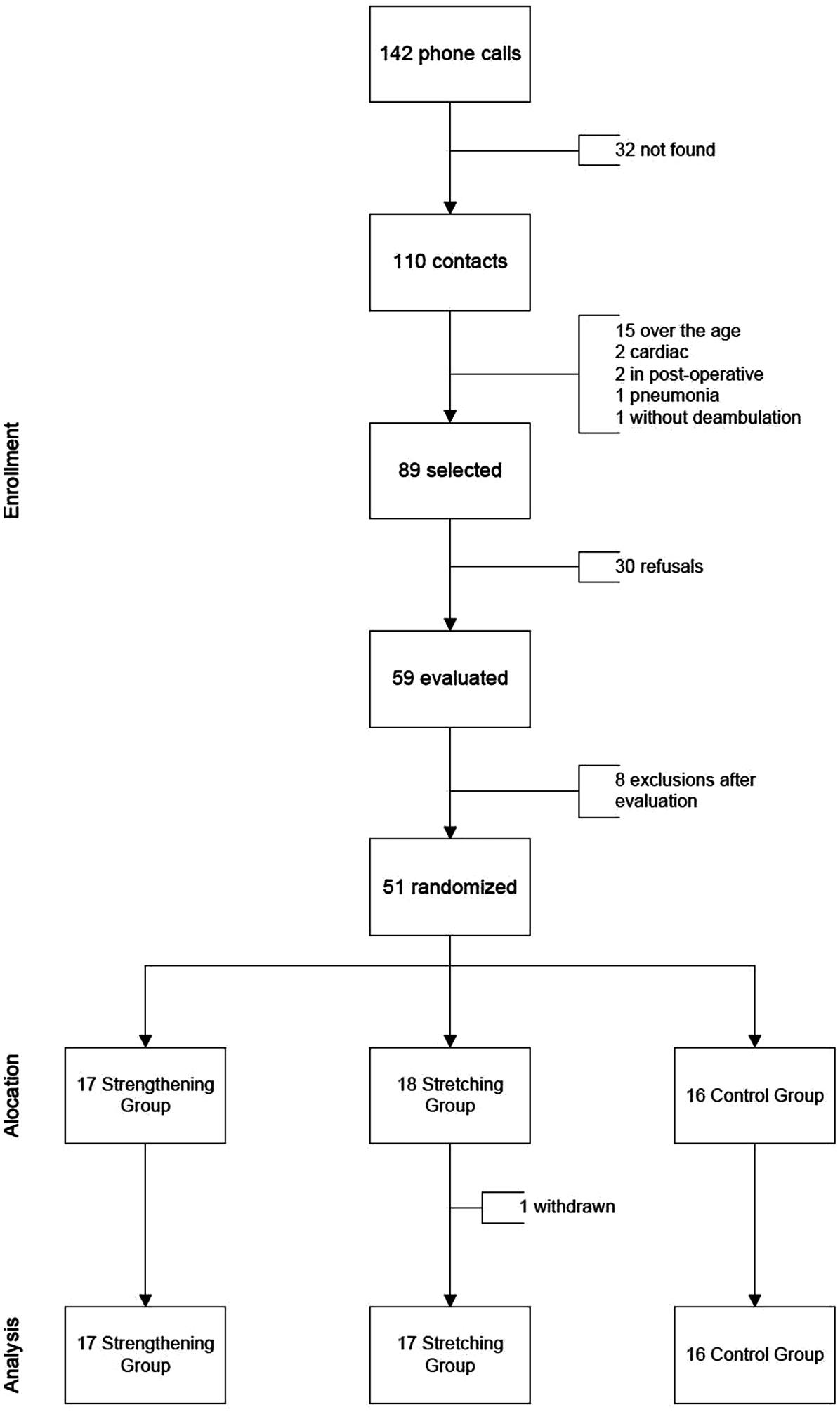
Participants’ selection flowchart.
Characteristics of the 50 participant subjects are described in Table 1. Groups were not significantly different according to any of the baseline variables. In the strengthening group, 94% of the participants used medications, including calcium supplementation vs. 52% in the stretching group and 56% in the control group.
Characteristics of the study population at baseline

P-value for ANOVA one way.
Adherence to treatment, assessed as the number of times that somebody attended the scheduled sessions, was 82.3% for the strengthening group and 76.4% for the stretching group. During the study, only one woman had a fall while coming to the study site (while being transported). No other participants had falls during the procedures or intervention sessions.
Table 2 displays the results for variables related to isometric strength and hamstrings shortening. Strengthening group was superior to control group for all strength variables. Stretching group was superior to control group for hamstrings shortening and isometric strength (knee flexion).
Hamstring shortening and isometric strength variables in each group before and after treatment

P-value for ANOVA two way.
in pairs, identify which values are statistically different between after multiple comparison test (ANOVA two way).
kgf, kilogramforce; CI, confidence interval of 95% (lower limit–upper limit).
Individuals in the strengthening group had significant improvement of isometric strength (knee extension) relative to the stretching group (P = 0.006), while the stretching group was not superior to the strengthening group in any of the strength variables.
Table 3 compares groups with regard to postural control variables. The strengthening group was superior to the control group in the CTSIBm test (unstable surface/closed eyes) and in the Limits of Stability Test (centre of pressure velocity and directional control). Stretching group participants were better than those in the control group in velocity of centre of pressure, and in variables related to amplitude of movement.
Postural control in each group before and after treatment

P-value for ANOVA two way.
in pairs, identify which values are statistically different between, after Multiple Comparison Test (ANOVA two way).
CTSIBm, modified Clinical Test of Sensory Interaction for Balance; CI, confidence interval of 95% (lower limit–upper limit).
The strengthening group was better than the stretching group for directional control (P < 0.001). The stretching group was not better than the strengthening group for any of the postural control variables.
When comparing the groups in the Limits of Stability Test, even though no statistically significant difference was found between them, there was a 25% relative gain in the strengthening group against 4% in the stretching group, indicating a clinically important improvement.
Discussion
The efficacy of two exercise programmes aiming to improve postural control in women with osteoporosis was assessed in this study. Positive results were found for both interventions, but with differential efficacies for specific variables. The strengthening group was superior to the control group in the CTSIBm test (unstable surface/closed eyes) and in the Limits of Stability Test (centre of pressure velocity and directional control). Stretching group participants was better than those in the control group in velocity of centre of pressure, and in variables related to amplitude of movement. The strengthening group was better than the stretching group only for directional control in the Limits of Stability Test, and the stretching group was not better than the strengthening group for any of the postural control variables.
Centre of pressure velocity increases with age 28 and this variable seems to correlate well with postural control in the elderly. 2 When assessments were done using a stable surface (with eyes opened or closed), results were within the expected values for age. The conditions of the test mimic those of daily life for socially active individuals such as the participants in this study (being able to walk without assistance and using the public transportation).
After the intervention, only participants in the strengthening group had significant reductions in centre of pressure velocity when tests were conducted on unstable surface with closed eyes (7%). Previous studies demonstrated the benefits of similar interventions in improving balance in the elderly. Hourigan et al. 29 also found significant improvement when on a stable surface with closed eyes (5%) and unstable surface with opened eyes (12%), although they also included middle-aged participants. Rogers et al. 30 found significant improvements in centre of pressure oscillation after a short duration training programme.
Limits of stability may be defined as the greatest distance (in any direction) that a person can lean away from a midline vertical position without falling, stepping or reaching for support. It is a function of area of support, height and vertical position of the centre of mass relative to the surface. 31 These parameters were similar across groups, facilitating the inference of the centre of pressure.
During the Limits of Stability Test, both interventions improved postural control relative to the control group. Furthermore, participants in the strengthening group had a 9% increase in their centre of pressure directional control, and this was significantly better than what was found for the stretching group and control group. Similar results were found by Ryushi et al. 32
Our data suggest that increased strength is associated with better directional control. According to Lord et al., 33 this may be explained by exercise-induced increased capacity of ankle dorsiflexion, flexion and extension of the hips and knee extension. Strengthening of the quadriceps also seems also to be of importance. 32
Stretching was the only intervention associated with increased centre of pressure excursion (end point excursion and maximum excursion), which may reflect better spacial perception of the centre of mass relative to the floor with consequent increased self-confidence for movements. Increased centre of pressure excursion may be indeed associated with increased range of movement. Rougier et al. 34 tested whether stretching of the triceps surae predicted balance and found that interventions increased sensorial perception (sensorial input to the central nervous system), probably allowing muscular actions to become faster and better coordinated.
Our findings therefore show that specific gains are exercise-dependent. Strengthening improved strength and some aspects of postural control, while stretching improved range of motion and other different aspects of postural control. Other differences emerged. Muscular strength for specific muscles improved in Strengthening group relative to the other groups, as described by others. 32 Observed gains seem to be secondary to better neuromuscular control of contractility which, in turn, is influenced by supraspinal mechanisms, including coactivation of antagonist muscles, better activation of synergistic muscles and effective coupling of spinal interneurons. 35 Activation of primary motor neurons synchronizes fast motor units, improving motor coordination and efficiency of contractility. 36
Positive results for muscular strength were also found in the stretching group, with gains in knee flexion strength. The increased range of motion may indirectly drive the increased strength in some muscular groups as reported by Shrier in a systematic review. 37 In the shortened position, the functional muscle length is reduced and the sarcomeres cannot develop maximum contractile force, since the ideal physiological overlap between the actin and myosin is lost. Flexibility training could restore the ideal overlap, allowing maximum force production.
Increasing muscular strength or at least decreasing progressive muscular weakness is an important aim to be obtained in the elderly, since these factors influence balance, especially in response to unexpected conditions, 1 which are, as a consequence, a risk factor for falls. 38
An important determinant of our study was the fact that all participants lived in close proximity to the training facility. They used public transportation and often came in a group, which facilitated their socialization, increased opportunities for sharing experiences and decreased feeling of loneliness, factors that may have influenced the good adherence to our programme (82.4% in the strengthening group and 76.5% in the stretching group). Other studies had higher drop-out rates. 39
Further studies are needed to investigate if longer periods of intervention are able to modify different aspects of postural control. A follow-up of these patients is also desirable to investigate if these gains remain after the end of intervention and have influence in reducing the number of falls and fractures in this population. The number of patients in each group is a limitation and the results need to be carefully analysed. The fact that the patients were motivated and healthy may have positively influenced the results.
In conclusion, eight weeks of balance exercises conducted in conjunction with lower limb strengthening or stretching exercises effectively improve postural control in elderly women with osteoporosis. Balance and strengthening exercises seem to be better for increased centre of pressure stability, while balance and stretching exercises improve the safe amplitude of centre of pressure displacement. Future studies should assess the benefits of combining both interventions.
Clinical messages
Eight weeks of balance exercises conducted in conjunction with lower limb strengthening or stretching exercises effectively improve postural control in elderly women with osteoporosis.
Balance and strengthening exercises seem to increase centre of pressure stability, while balance and stretching exercises improve the amplitude of centre of pressure displacement.
Footnotes
Funding
This study had public financial support of State of São Paulo Research Foundation (FAPESP), Brazil.
References
Supplementary Material
Please find the following supplemental material available below.
For Open Access articles published under a Creative Commons License, all supplemental material carries the same license as the article it is associated with.
For non-Open Access articles published, all supplemental material carries a non-exclusive license, and permission requests for re-use of supplemental material or any part of supplemental material shall be sent directly to the copyright owner as specified in the copyright notice associated with the article.
