






Abstract
Objectives:
To analyse the effectiveness of a combined procedure of massage and electrotherapy with interferential current in individuals with chronic non-specific low back pain of mechanical aetiology.
Design:
A single blinded randomized controlled trial.
Setting:
Clinical setting.
Participants:
Sixty-two individuals with chronic non-specific low back pain were randomly assigned to an experimental or control group. For 10 weeks the experimental group underwent treatment comprising 20 sessions (twice a week) of massage with interferential current in the lumbar and dorsal–lumbar area, and the control group received superficial lower back massage (effleurage, superficial pressure and skin rolling).
Main outcome variables:
Oswestry Disability Index, pain visual analogue scale, Tampa Scale for Kinesiophobia, Roland Morris Disability Questionnaire, McQuade Test, Side Bridge Test, quality of life scores and the range of trunk anteflexion motion, which were all assessed before the treatment and immediately after the last treatment session.
Results:
The 2 × 2 mixed model ANOVA with repeated measurements showed statistically significant group * time interactions for the visual analogue scale (F = 12.839; P = 0.001), Oswestry Disability Index (F = 5.850; P = 0.019), Roland Morris Disability Questionnaire (F = 8.237; P = 0.006) and quality of life (physical function (F = 16.792; P = 0.001), physical role (F = 14.839; P = 0.001) and body pain (F = 11.247; P = 0.001)).
Conclusions:
In individuals with chronic non-specific low back pain, interferential current electro-massage achieved a significantly greater improvement in disability, pain and quality of life in comparison to superficial massage after 20 treatment sessions.
Keywords
Introduction
Low back pain has long been a major public health problem in Western countries. 1 It affects up to 80% of the general population at some time in their life, and more working time losses and care costs are associated with chronic low back pain than with any other disease, because of its high incidence and recurrence rates, the chronic nature of the symptoms and secondary disabilities. 2
In clinical practice, passive and active treatments such as massage and others3–8 are commonly used for treating chronic non-specific low back pain. Some massage treatments applied to the skin overlying tender areas in the lower back have reduced pain, possibly via neurophysiological responses of cutaneous mechanoreceptors. When massage is applied to the skin, the duration of force is limited by the therapist and treatment time. The application of massage and another physical therapies may provide better results along the treatment time than massage therapy. Despite the large number of treatments being researched and used, there is no clear-cut good treatment. 8
Electrotherapy is a non-invasive, non-pharmaceutical procedure for back pain management that is mainly performed using interferential current. 9 Interferential currents were first applied in medicine in 1950, after experiments by Dr Nemec designed to find an electric wave that would reach deeper in comparison to other types of stimulating current and would allow high intensities to be used without discomfort. Interferential current therapy uses a medium-frequency alternating current with a carrier wave of around 4000 Hz and frequency-modulated amplitude (FMA) of 0–250 Hz.10,11 The skin offers lower impedance to the higher frequency carrier wave, which can therefore penetrate deeper into the tissue. 10 Interferential current not only reduces pain by stimulating thick nerve fibres but can also normalize the neurovegetative balance and thereby cushion the orthosympathetic system, facilitating muscle relaxation and circulation enhancement, which also contribute to the pain relief.12,13
The analgesic effect of interferential therapy can be explained in part by Wednesky inhibition of type C nociceptive fibres and action potentials in large-diameter myelinated afferent nerves. The action potentials travelling in large-diameter myelinated afferent nerves from cutaneous receptors compete for access to the central ascending sensory tracts in the dorsal horn of the spinal cord with those of small-diameter unmyelinated sensory fibres carrying pain information. 11 Large-diameter myelinated fibres are stimulated optimally at 100 Hz, and clinical experience indicates that interferential therapy at this frequency reduces pain markedly, especially when applied to acupuncture points. Pain will also reduce as motor stimulation increases the circulation of body fluid and promotes an efflux of pain-inducing chemicals from the site of damage.11–13 Interferential current–massage therapy is used clinically to induce analgesia, reduce oedema, obtain muscle contraction and modify the activity of the autonomic system.11,14
A few studies have shown that interferential current is effective in reducing pain, 15 whereas one group 14 reported no benefit from its use as a complement to exercise therapy for shoulder disorders, although researchers using different frequencies and electrodes did obtain pain reduction in patients with frozen shoulder. 14 The effects of interferential current have largely been studied in patients with painful chronic diseases such as knee arthrosis,16–24 chronic back pain,15,20,25 pain in soft tissues of the shoulder,14,18,26 fibromyalgia 27 and myofascial pain syndrome. 28 Few studies have analysed the analgesic effect of interferential current as a single therapeutic modality in a specific musculoskeletal disorder. Despite the extensive use of interferential current in managing different pain conditions, its analgesic effect combined with massage have not been elucidated.29,30
The objective of this study was to compare the effectiveness of a combined interferential current–massage therapy with that of superficial massage to produce immediate pain relief and improve muscle function and capacity in chronic non-specific low back pain patients, utilizing an interferential current procedure in which a medium-frequency electric current (4000 Hz IFC) is applied during massage with damp sponges.
Methods
Participants were patients with chronic non-specific low back pain referred by their primary care physician to the clinical unit of the Health Science School of the University of Almeria (Spain) between 1 September 2011 and 29 February 2012AQ1: Please check date. Does not exist. Chronic non-specific low back pain was defined as pain and discomfort localized below the costal margin persisting for 12 weeks or more. Inclusion criteria were: low back pain for ≥3 months, age between 18 and 65 years, score ≥4 on the Roland Morris Disability Questionnaire, not undergoing another physical therapy treatment and inability to achieve lumbar muscle flexion–relaxation in trunk flexion. Exclusion criteria were: clinical signs of radiculopathy, presence of lumbar stenosis, fibromyalgia or spondylolisthesis, a history of spinal surgery or neuromuscular kinesio tape therapy, treatment with corticosteroids in the past two weeks, and disease of the central or peripheral nervous system.
The study was performed in accordance with the Helsinki Declaration (2008 modification) on research projects and with national legislation on clinical trials (Law 223/2004, 6 February), biomedical research (Law 14/2007, 3 July) and participant confidentiality (Law 15/1999, 13 December). The study was approved by the ethics and research committee of the University of Almeria.
Patients provided demographic and clinical information and completed a number of self-report measures at baseline, which included an Oswestry Disability Index to measure daily life activity limitations, 31 the visual analogue scale for assessing the intensity of pain, Tampa Scale for Kinesiophobia to assess fear of movement, 32 the Roland Morris Disability Questionnaire for assessing disability, 33 SF-36 health questionnaire to assess self-perceived health-related quality of life, 34 the McQuade Test to measure isometric resistance of abdominal muscles, 35 Side Bridge Test to assess resistance on flexion contraction of lateral abdominal muscles 36 and lumbar mobility flexion. 37
The Oswestry Disability Index evaluates daily life activity limitations in 10 dimensions, each scored on a 6-point scale (0–5 points); the total points scored are expressed as a percentage, used to classify individuals as minimally disabled (0–10%), moderately disabled (20–40%), severely disabled (40–60%), crippled (60–80%) or bedbound (80–100%). 31 The visual analogue scale for pain intensity ranged from 0 = no pain to 10 = worst imaginable pain. The Tampa Scale for Kinesiophobia comprises 17 items on the fear of movement or recurrent lesion, each scored on a 4-point Likert scale from ‘completely disagree’ to ‘completely agree’. 32 The Roland Morris Disability Questionnaire is a self-administered disability measurement scored on a 24-point scale from 0 = no disability to 24 = severe disability. 33 SF-36 Health Questionnaire scores range from 0 to 100% and indicate the self-perceived health-related quality of life. 34 The McQuade and Side Bridge Tests measure the isometric resistance in seconds of abdominal muscles.35,36 Lumbar mobility in flexion was determined by measuring the distance from the tip of the third finger to the floor with a tape measure. 37
All data were gathered before the first treatment session (baseline) and immediately after the final treatment session by a trained physical therapist assessor blinded to the treatment allocation of the patients. After the baseline examination, individuals were randomly assigned to receive massage with interferential current in the lumbar and dorsal–lumbar area (experimental group) or superficial massage in the lumbar area (control group). Concealed allocation was performed using a computer-generated randomized table of numbers, created prior to the start of data collection by a researcher (ICL-P) not involved in either recruitment or treatment of the patients. Individually, sequentially numbered index cards with ratio of allocation 1 : 1 assignment were prepared. A second therapist (AMC-S) blinded to the baseline examination findings opened the envelope and proceeded with treatment according to the group assignment. All patients received the intervention on the day of the initial examination.
Electro-massage procedure
The interferential current (Endomed 682 V, Enraf NONIUS Ibérica, Spain) was administered by bipolar application with a carrier frequency of 4000 Hz at constant voltage and amplitude modulation of 80 Hz. The electro-massage was performed using two rubber electrodes (8 × 12 cm) to which sponges were fitted. The sponges were dampened with water and then moved over the lumbar and dorsal–lumbar region for 30 minutes at stimulation intensity of 30–50 mA, which was always below the pain threshold of the patient. Treatment comprised 20 sessions (twice a week).
Control procedure
The superficial manual massage session was performed with both hands and it comprised effleurage, superficial pressure and skin rolling on the lower back area for 20 minutes. Effleurage is a light, gliding motion over the skin that always maintains contact and directs the strokes towards the heart. Superficial pressure is a static, very light pressure performed on both sides of the spine. Skin rolling is a petrissage technique that lifts the skin between the thumb and fingers and gently rolls over the lower back area, very slowly. Treatment comprised 20 sessions (twice a week).
PASW Version 18.0 (SPSS Inc., Chicago, IL, USA)was used for data analyses. Prior to the study starting, sample size was calculated. The primary outcome measure was the change in the Roland Morris Disability Questionnaire score at the end of the 10-week study period. A difference of 2.5 points is considered to be the minimum clinically important difference in the Roland Morris Disability Questionnaire score. A sample size of 62 patients (31 per group) would enable detection of a 2.5-point difference between groups, given 80–90% power, a 5% (two-tailed) significance level and a conservative standard derivation of 5 points. Key baseline demographic variables and clinical measure scores were compared between groups by using independent Student’s t-tests for continuous data and chi-square tests for categorical data. Separate 2 × 2 mixed-model ANOVA with repeated measurements for the time factor need to be conducted in order to test between-groups differences in visual analogue scale, McQuade Test, range of trunk anteflexion motion, Oswestry Disability Index, Roland Morris Disability Questionnaire, Tampa Scale for Kinesiophobia and quality of life as the dependent variables, with group (electro-massage or superficial massage) as the between-subjects variable and time (baseline, post treatment). A paired t-test was performed to test within-group differences in score changes from pre to post treatment. Frequency counts were tallied in each group for subjects who experienced a clinically meaningful worsening of functional status (Roland Morris Disability Questionnaire increase of 2.5 according to baseline affection values points or more) such that absolute risk reduction (ARR), relative risk reduction (RRR) and number needed to treat (NNT) could be calculated. Effect size was test using Cohen’s d. 38 P = 0.05 was considered significant in all tests.
Results
Eighty individuals with chronic non-specific low back pain were initially recruited between 1 September 2011 and 29 February 2012. Informed consent to study participation was obtained from the 62 who met the eligibility criteria; their mean ± SD age was 48 ± 15 years, and 67.80% were female. They were randomly assigned to the superficial massage (n = 31) or interferential current electro-massage (n = 30) group. Figure 1 depicts the flow of patients through the study, giving the reasons for ineligibility and losses to the study. At baseline, the groups did not significantly differ in demographic characteristics or in test results (Table 1).
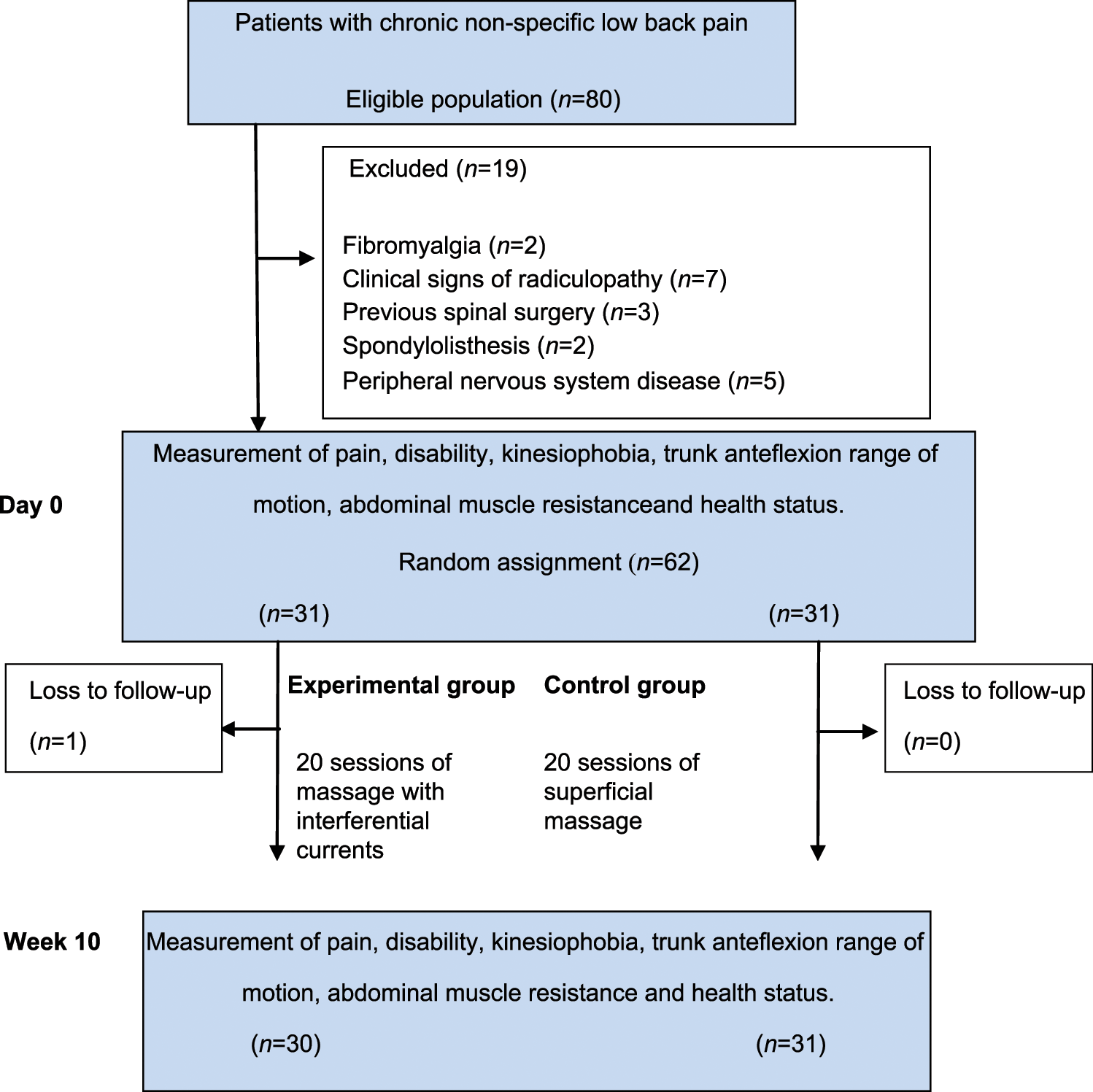
Study design and patient flow.
Baseline demographic data of patients

P-value of 0.05.
The 2 × 2 mixed-model ANOVA with repeated measurements showed statistically significant group * time interaction for visual analogue scale (F = 12.839; P = 0.001), Oswestry Disability Index (F = 5.850; P = 0.019), Roland Morris Disability Questionnaire (F = 8.237; P = 0.006) and quality of life (physical function (F = 16.792; P = 0.001), physical role (F = 14.839; P = 0.001) and body pain (F = 11.247; P = 0.001)). Table 2 shows baseline, post-intervention, within-group and between-group differences with associated 95% confidence intervals (CI) for quality of life SF-36.
Baseline, post-treatment and change scores for quality of life SF-36

Values are expressed as mean ± standard deviation for baseline and immediate post-treatment means and as mean (95% confidence interval) for within- and between-group change scores.
Significant group * time interaction (ANOVA, P < 0.05).
The group * time interaction for the 2 × 2 mixed ANOVA did not find a statistically significant for the Side Bridge Test (F = 1.523; P = 0.055), McQuade Test (F = 2.599; P = 0.112), range of trunk anteflexion motion (F = 3.291; P = 0.062), Tampa Scale for Kinesiophobia (F = 0.210; P = 0.649) and quality of life (general health (F = 4.535; P = 0.077), vitality (F = 1.639; P = 0.205), social functioning (F = 2.233; P = 0.140), emotional role (F = 1.766; P = 0.189) and mental health (F = 1.809; P = 0.184)). Table 3 shows baseline, post-intervention, within-group and between-group differences with associated 95% CI for McQuade Test, Side Bridge Test, visual analogue scale, Tampa Scale for Kinesiophobia, Oswestry Disability Index and Roland Morris Disability Questionnaire.
Baseline, post-treatment and change scores for McQuade Test, Side Bridge Test, visual analogue scale, range of trunk anteflexion motion, Tampa Scale for Kinesiophobia, Oswestry Disability Index, Roland Morris Disability Questionnaire

Values are expressed as mean ± standard deviation for baseline and immediate post-treatment means and as mean (95% confidence interval) for within- and between-group change scores.
Significant group * time interaction (ANOVA, P < 0.05).
VAS, visual analogue scale; RTAM, range of trunk anteflexion motion; TSK, Tampa Scale for Kinesiophobia; ODI, Oswestry Disability Index; RMDQ, Roland Morris Disability Questionnaire.
In paired comparison to baseline values, the electro-massage group showed post-treatment improvements in McQuade Test (P = 0.004), pain visual analogue scale (P = 0.001), Roland Morris Disability Questionnaire (P = 0.038), range of trunk anteflexion motion (P = 0.004) and quality of life (physical function (P = 0.001), physical role (P = 0.001), body pain (P = 0.001), general health (P = 0.021), vitality (P = 0.036), social functioning (P = 0.002), emotional role (P = 0.049) and mental health (P = 0.011)), whereas the superficial massage group showed significant differences in physical function (P = 0.044) and range of trunk anteflexion motion (P = 0.048).
Three of the 30 treatment group subjects completing the study had a clinically meaningful worsening of function, compared to 4 of 31 subjects in the control group who increased their Roland Morris Disability Questionnaire scores by 2.5 points or more over the 10 weeks of the study; with an absolute risk reduction (ARR = 4.4%), relative risk reduction (RRR = 6.5%) and number need to treat (NNT = 22.7).
Discussion
In this series of adults with chronic non-specific low back pain, interferential current electro-massage achieved a significantly superior improvement compared with superficial massage in pain, disability, physical function, physical role and body pain at the end of a 20-week course of twice-weekly sessions. Cohen’s effect size showed significantly greater reductions in pain and disability immediately after treatment by the participants who received interferential current electro-massage group than by those who received superficial massage application. In addition, the level of adherence was high in this study; it was one loss to follow-up during the study only. The effect of the electro-massage was relatively medium. The medium score (1.67 cm on the 10-cm visual analogue scale) was below the minimum clinically worthwhile effect of 2 cm, although the upper limit of the 95% CI did reach this threshold. 39 A reduction in pain and disability after interferential current application has been observed in previous studies. 12 This treatment also significantly improved the low back pain perceived by these individuals, in agreement with previous studies using this technique in low back pain and cold-induced pain.13,15 But this is the first study demonstrating that interferential current electro-massage was also effective for reducing pain and disability in patients with chronic non-specific low back pain.
In this study one limitation is that we used a sample of workers in the university, which may not be representative of the entire population of individuals with chronic non-specific low back pain within the external validity. We only investigated the short-term results of electro-massage and cannot draw conclusions about its longer term effects, which deserve investigation in future randomized clinical trials. Our ethics committee did not permit a patient follow-up because they are going to begin a physical therapy programme in the back school of University of Almeria. In the clinical setting, patients are unlikely to receive electrotherapy as sole treatment, and future studies are warranted in chronic non-specific low back pain patients on the effects of electro-massage in combination with other therapies.
It has also been reported in single- and double-blinded conditions that the pain threshold of osteoarthritis patients is significantly lower after interferential current than after simulated electrotherapy treatment.23,40 The degree of pain relief obtained varies according to the patient population and the selection of electrodes, parameters and adjuvant therapy. Thus, different results were obtained after application for frozen shoulder according to the selection of parameters, and better results were obtained in one study with the use of cupping glasses.14,18
People with low back pain typically rate an improvement of 6 points on the Oswestry Disability Index as at least ‘moderately’ better, 41 and this has therefore been considered a ‘worthwhile effect’. 42 Some authors recommend an even higher threshold. 43 Our estimate of the effect of the electro-masage on disability measured on the Oswestry Disability Index did include 6 points at the upper confidence limit. The estimates was that Oswestry score improved by 5.47 points by the electro-massage. Our estimate of the effect on the Oswestry score and its confidence limits is medium in comparison to the range of possible scores on the Oswestry Disability Index (0–100). However, our estimate of the effect of interferential current electro-massage on the Roland Morris score at 10 weeks, an improvement of 2.37 points is below the minimum clinically worthwhile effect of 2.5–5 points, which has been derived for this outcome from people with non-specific low back pain for at least six weeks. 44
Interferential current electro-massage reduced the Roland Morris Disability Questionnaire-assessed disability level of our patients, consistent with reports on interferential current outcomes in other chronic diseases.12,13,45 The analgesic mechanisms of interferential current are not fully understood, although it has been suggested that they may be similar to those of transcutaneous electrical nerve stimulation.29,30
In the present study, we used sponges rather than the suction electrodes proposed for soft massages by some authors, 18 because they allow the current to applied simultaneously with the massage. This type of electrotherapeutic massage produces cutaneous stimulation of sensory nerves and mild vasodilation, which can have positive effects on pain, disability and quality of life.45,46–50 Although no proof has been provided, researchers have considered that the active component of interferential current therapy is the modulated amplitude of the wave frequency and that the different physiological effects are produced by the distinct electrical characteristics of this wave.49,50
In conclusion, individuals with non-specific chronic low back pain experienced a significant improvement in pain level, disability, and quality of life after 20 interferential current electro-massage sessions, but these effects may be medium to be clinically worthwhile. Further research is warranted on outcomes after electro-massage therapy for longer time periods and/or in combination with exercise programmes.
Clinical messages
The effect of interferential current electro-massage was relatively medium on the disability and pain level to be considered worthwhile by typical patients with chronic non-specific low back pain.
Twenty interferential current electro-massage sessions improved isometric resistance of abdominal muscles, range of anteflexion motion and quality of life in individuals with non-specific chronic low back pain.
Footnotes
Conflict of interest
None declared.
Funding
This research received no specific grant from any funding agency in the public, commercial, or not-for-profit sectors.