






Abstract
Objective:
To evaluate the predictive value of preoperative psychosocial factors on the perceived and observed postoperative patient’s functional recovery during the post-hospital phase and up to 12 months after hospital discharge of patients who underwent total knee or total hip arthroplasty.
Methods:
A systematic review was performed. MEDLINE, CINAHL, EMBASE and PsychINFO were systematically screened in order to find prospective longitudinal studies. Risk of bias was assessed using a modified version of a 27-item checklist for prognostic studies, as previously used by Veerbeek. A qualitative analysis was performed using the method of Zwikker.
Results:
A total of 26 studies, with a total of 11,020 patients, were included. In total, 22 studies were judged as having a high risk of bias. Overall, no longitudinal association with perceived or observed functional recovery was found in all of the seven preoperative psychosocial categories: A: mental well-being, B: cognitions, C: beliefs, D: expectations, E: coping, F: social support or G: personality traits in total joint arthroplasty. Mental well-being seems to be the exception in one time period (>6 weeks through ≤3 months) and change score in observed functional recovery, but only in patients awaiting total knee arthroplasty (100% and 75% of the variables were significantly and consistently associated, respectively).
Conclusion:
Overall, the results of this systematic review suggest that there is no longitudinal association between preoperative psychosocial factors and perceived or observed patient’s postoperative functional recovery after total joint arthroplasty. The psychological category mental well-being is related to observed postoperative recovery >6 weeks through ≤3 months and to change score after total knee arthroplasty.
Keywords
Introduction
A substantial group of patients (20%–50%) experience continuing functional disability after total knee or hip knee arthroplasty.1,2 Numerous studies attempted to identify preoperative factors that explain the variability in postoperative functional recovery.3,4 Knowledge of preoperative predictors has implications for selecting and advising patients at risk of delayed functional recovery in order to optimize the preoperative status of high-risk patients awaiting total knee or total hip arthroplasty. Many studies focus on preoperative demographic factors and functional status, but a substantial amount of patient variance in functional recovery remains unexplained. 5 Some of the remaining variance could potentially be explained by preoperative psychosocial factors. Factors such as distress, anxiety, coping style, social support, locus of control and depression have been reported to be predictors of functional recovery in general surgery.6,7
Five systematic reviews have studied the predictive value of preoperative psychosocial factors on postoperative outcome (patient satisfaction, pain and/or function) after total knee or total hip arthroplasty.8–12 All referenced authors were unable to determine the most relevant or the most appropriate way to assess psychosocial factors. Recently, a methodology has been developed by Zwikker et al. 13 to structure, categorize and collate psychological factors in systematic reviews, in order to tackle the problem of heterogeneity between individual studies. This method allows us to analyze a relatively heterogeneous group of individual studies, by pooling longitudinal associations within a psychosocial category on the basis of their significance and direction. Additionally, increasingly robust conclusions can be drawn regarding the predictive capacity of psychological factors on postoperative functional recovery after total knee or total hip arthroplasty.
The aim of this systematic review is to evaluate the predictive value of preoperative psychosocial factors on the perceived and observed postoperative functional recovery of patients who underwent total knee or total hip arthroplasty during the post-hospital phase and up to 12 months after hospital discharge. Moreover, as postoperative functional recovery changes over time, 14 we analyzed the results in four time periods: 0–6 weeks, >6 weeks to ≤3 months, >3 months to ≤6 months and >6 months to ≤12 months.
Methods
A systematic review was undertaken and reported along the recommendations of Preferred Reporting Items for Systematic Reviews and Meta-Analyses (PRISMA).15,16 The online databases MEDLINE®, CINAHL®, EMBASE and PsychINFO (through to June 2017) were searched. With the Boolean terms “AND” and “OR”, the first author combined the following three groups of key words, synonyms and MeSH terms: (1) hip prosthesis, knee prosthesis, total hip, total knee; (2) recovery of function, treatment outcome, functional recovery, length of stay; and (3) mental health, psychology, psychosocial, self-efficacy and patient expectations. All full electronic search strategies were peer reviewed by M.E.d.G.-V. and T.J.H. In Supplementary Appendix A (available online), the MEDLINE® search is presented. Relevant articles were also identified by a manual search of references. Authors were contacted when full text was unavailable.
Studies were included if they fulfilled the following inclusion criteria: (1) the study included patients (>18 years) undergoing a primary, elective total knee or total hip arthroplasty; (2) the psychosocial factors were measured in the preoperative phase; (3) study aim was to identify preoperative psychosocial factors to predict postoperative functional recovery (functional recovery measured by perceived or observed outcomes); (4) the study used a prospective longitudinal design with associations reported up to 12 months after surgery; and (5) full text of the study was available. Exclusion criteria were as follows: (1) duplicate publications; (2) studies in languages other than Dutch or English; (3) aggregated figures, statistics and interpretations of results of combinations of patients undergoing total knee or hip arthroplasty; and (4) functional recovery solely measured by a generic instrument as 36-item short-form health survey or Functional Limitations Profile. There were no limitations set on publication date. Titles, abstracts and full texts were independently evaluated by two researchers (A.N.B. and M.E.d.G.-V.) based on the eligibility criteria. Disagreements were resolved by consensus. If necessary, a third reviewer (T.J.H.) made the final decision.
The following information was extracted from each study: (1) first author and publication year; (2) patient characteristics (country, clinical setting, number of patients, loss to follow-up, sex, age, marital status and follow-up time); (3) preoperative psychosocial predictors, postoperative functional outcomes; and (4) results (univariate and multivariate associations and conclusion). Data were structured into two extraction files: one summarizing the studies concerning patients that underwent total knee arthroplasty and another that had undergone total hip arthroplasty.
Data extraction was performed by the first author. In all, 10% of the studies were checked for errors by M.E.d.G.-V. If disagreements were found, all articles were checked for errors. Disagreements were resolved by dialogue till a consensus was reached. In case of ongoing disagreement, a third reviewer (T.J.H.) made the final decision.
The methodological quality of prognostic studies was assessed with the 27-item checklist of Veerbeek et al., 17 which was modified to meet the study populations of this review (Supplementary Appendix B, available online). Six major potential risks of bias domains were addressed: study design, study attrition, predictor measurement, outcome measurement, statistical analysis and clinical performance/validity. Each item was graded positive, “Y” (sufficient information, meet the item criteria, 1 point assigned), negative, “N” (sufficient information, does not meet the item criteria, 0 points assigned) or partial/unknown, “?” (insufficient information, 0 points assigned). A total score was obtained by summing all Y items-gradations that were scored. Studies scoring ≥20 points (75% of the maximum score) and ≤19 points were considered to be at low and high risk for bias, respectively. 17 Quality assessment of the studies was done by two independent reviewers (A.N.B. and M.E.d.G.-V.). Disagreements were discussed until consensus was reached. In the case of ongoing disagreement, a third reviewer (T.J.H.) made the final decision.
Included studies were considered heterogeneous on the base of psychosocial predictors, functional outcomes and time periods. Therefore, a qualitative analysis was considered to be appropriate. 17 The associations between psychosocial factors and functional outcomes were qualitatively synthesized in three steps based on the method of Zwikker et al. 13 In step one, each psychosocial predictor was classified into one of seven categories: A: mental well-being, B: cognitions, C: beliefs, D: expectations, E: coping, F: social support or G: personality traits by A.N.B., T.J.H. and J.E.V. In step two, for each psychosocial predictor within a category and within a study, the presence of a significant univariate and multivariate association with functional recovery was determined (P < 0.05). In step three, results within studies were synthesized per psychosocial factor and psychosocial category. If ≥75% of variables within a single category were significantly and consistently (i.e. same predictors in the same direction) associated with functional recovery, a “YES” was assigned (i.e. association present). If ≥75% of variables were significantly, but inconsistently, associated (e.g. two were positively and two were negatively related to functional recovery), the term “CONFLICTING” was assigned. If ≤75% of the variables were significantly and consistently associated, a “NO” was assigned. Multivariate results were preferably used to synthesize results in this step. When multivariate results were not reported, univariate results were used.
For each psychosocial category, data were synthesized and analyzed per time period, excluding studies which assessed change score in functional recovery. The following time periods were used: 0–6 weeks, >6 weeks to ≤3 months, >3 months to ≤6 months and >6 months to ≤12 months. A sensitivity analysis was performed on studies that presented absolute change scores, rather than relative change scores, in functional recovery.
Results
Study selection
The flowchart of the study selection process (Figure 1) shows that the search strategy resulted in 1843 records. A total of 26 studies were found appropriate to be included. Contacting authors for unavailable full texts (n = 2) resulted in one additional included study. Of the 26 studies, 17 studies included patients awaiting total knee arthroplasty,18–35 7 studies included patients awaiting total hip arthroplasty36–42 and 2 studies included patients awaiting either total knee or total hip arthroplasty.43,44 In total, 11,020 patients were included.
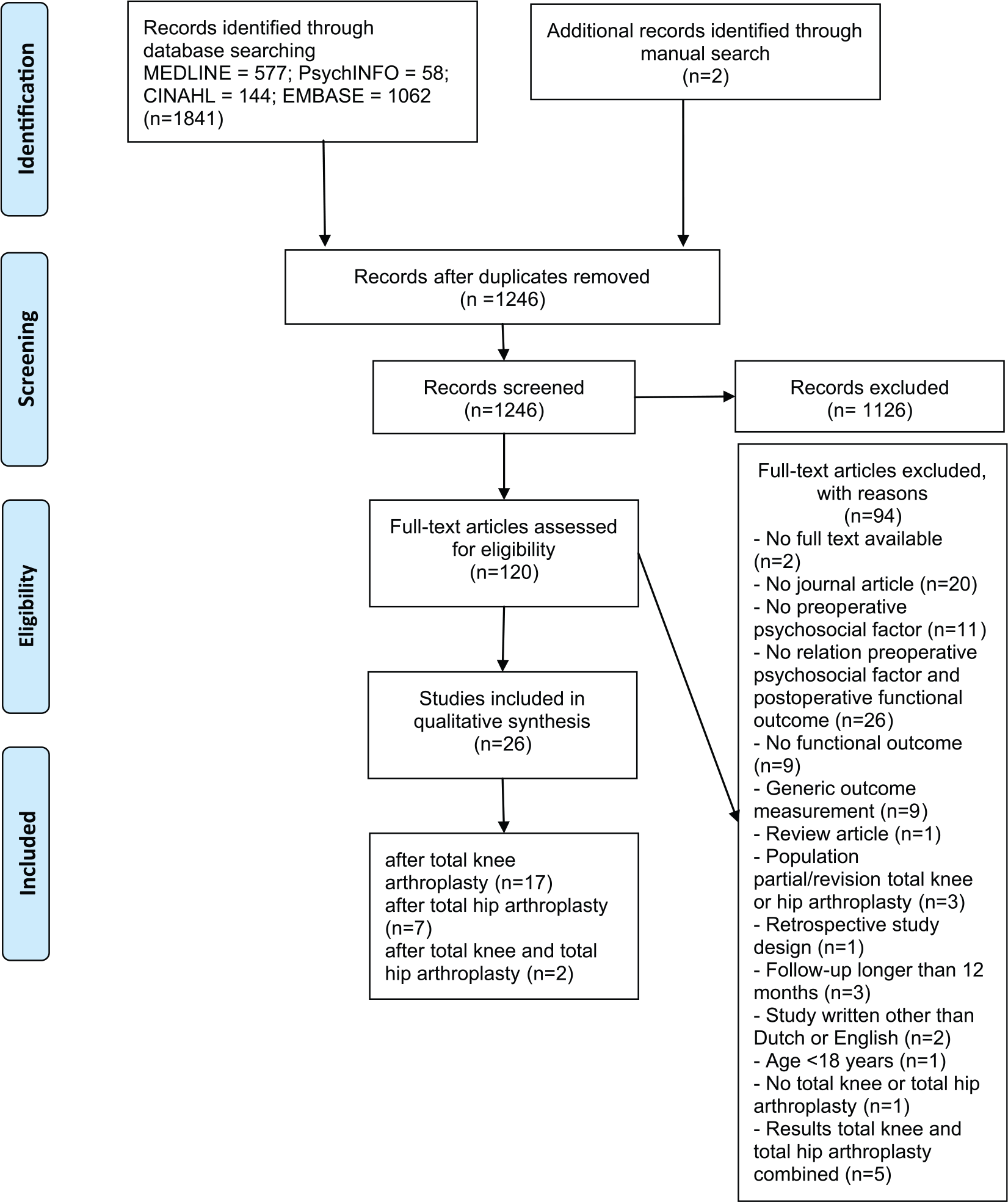
Flow diagram of the study selection process.
Study characteristics
Characteristics of the included studies are described in Table 1. Analysis by M.E.d.G.-V. showed no disagreements. The number of patients awaiting total knee arthroplasty ranged from 40 18 to 1765 34 with a total of 7088 subjects. The mean age ranged from 65 26 to 73 years. 30 The studies reported a sex distribution of 45% 22 to 74% 34 female patients. Follow-up time ranged from four weeks 34 to 12 months.20,22–25,29–33,35,43,44 In total, 18 studies evaluated the perceived functional recovery18–33,35,43,44 and one study evaluated the observed functional recovery. 34 The three most commonly evaluated psychosocial categories were mental well-being,18,20,22,23,25,26,28–30,32,34,35,43 beliefs21,22,26,27,31 and personality traits.21,26,27,44
Characteristics of the included studies.

NR: not reported; Pt: patients; Co: controls; IQR: interquartile range.
Country extracted from employment place of first author.
Sex and age before lost to follow-up.
Median (IQR) was transformed into mean (SD) by formula of Cochrane Handbook.
Gender and age before inclusion of the study group.
The number of patients awaiting total hip arthroplasty ranged from 79 39 to 1327 37 with a total of 3932 subjects. The mean age ranged from 62 42 to 69 years.40,41 The studies reported a sex distribution of 48% 38 to 76% 45 female patients. Follow-up time ranged from one week 42 to 12 months.37,43–45
All nine studies on total hip arthroplasty evaluated the perceived functional recovery.36–44 The three most commonly studied psychosocial categories were personality traits,42,44 mental well-being38–40,42,43,45 and social support. 41
Quality assessment
Supplementary Figures 2 and 3 show the overall assessment of risk of bias for patients awaiting total knee and total hip arthroplasty, respectively. Supplementary Appendix C (available online) shows the assessment in individual studies. A total of 702 bias domains were judged (26 studies by 27 domains). Initially, A.N.B. and M.E.d.G.-V. agreed on 526 domains (75%), partially agreed (? vs. yes or? Vs. no) on 125 domains (17.8%) and fully disagreed (yes vs. no) on 51 domains (7.2%). All disagreements were resolved by A.N.B. and M.E.d.G.-V. The median risk of bias score of the included studies after total knee arthroplasty was 15 points (range, 1227,44–2022,23). Two of the nineteen studies were of low risk of bias scoring >20 out of 27 points.22,23 The median risk of bias score of the included studies after total hip arthroplasty was 16 points (range, 11 39 –2140,41). Two of the nine studies were of low risk of bias scoring >20 out of 27 points.40,41 The most prevalent shortcomings in both groups were regarding study attrition, statistical analysis and clinical performance/validity.
Preoperative psychosocial predictors on functional recovery
In case there were no consistent differences between patients awaiting total knee or total hip arthroplasty, we reported the groups together, as total joint arthroplasty. Exceptions are reported in the text, while every result per joint group can be found online (Supplementary Appendix D.1 and D.2).
The psychosocial categories “expectations” and “mental well-being” were in 55% and 50%, respectively, of the associations statistically significant (P < 0.05) in people undergoing total joint arthroplasty (Table 2). In the psychosocial categories “cognitions,” “beliefs,” “coping,” “social support” and “personality traits,” a significant result was shown in 30%, 22%, 33%, 15% and 3% of the associations, respectively. Based on step three of the method of Zwikker et al., ≤75% of the variables were significantly and consistently associated and a “NO” was assigned for all psychosocial categories. The latter suggests that a longitudinal association with perceived or observed functional recovery is absent in patients awaiting total joint arthroplasty.
Synthesizing per psychosocial category and psychosocial factor.

Supplementary Table 3 shows the time frame per psychosocial category. There is an absence of longitudinal association with perceived or observed functional recovery in all psychosocial categories in all time periods. There was one exception, namely, “mental well-being” was statistically significantly longitudinally associated with perceived functional recovery >6 weeks to ≤3 months after total knee arthroplasty in two out of two (100%) associations.18,25 One of these two associations was univariate.
Sensitivity analysis: absolute change scores
Change scores in functional recovery were assessed in 16 associations in patients awaiting total joint arthroplasty.20,30,33,34,43 There is an absence of longitudinal association with change score in perceived or observed functional recovery in all psychosocial categories (≤75% of the variables were significantly and consistently associated). Again, there was an exception. Among patients awaiting total knee arthroplasty, six of the eight (75%) associations found that higher values on a “mental well-being” scale were longitudinally associated with (1) greater improvements in perceived functional recovery before and 12 months after surgery 20 and (2) greater improvements in perceived functional recovery 3 and 12 months after surgery.30,43
Discussion
The results of this systematic review suggest that there is no longitudinal association between preoperative psychosocial factors and perceived or observed postoperative functional recovery in patients who underwent total joint arthroplasty, during the post-hospital phase and up to 12 months after hospital discharge. Mental well-being seems to be the exception in one time period (>6 weeks through ≤3 months) and change score in observed functional recovery, but only in patients after total knee arthroplasty. We know that there is considerable variance in the outcomes of patients recovering from total knee or total hip arthroplasty, where some patients achieve better levels compared to others. From anecdotal evidence, we know that healthcare providers stress the importance of a patient’s psychosocial state in relation to their functional recovery. However, our study suggests that healthcare providers who take care of patients awaiting total joint arthroplasty should not overestimate the role of these preoperative psychosocial factors.
The absence of longitudinal association could potentially be due to the fact that all studies did not use a psychosocial model to strengthen their hypotheses about the expected associations (data not shown). Since there are numerous psychosocial factors to explore, choosing factors randomly could potentially lead to results by chance. Therefore, in our opinion, it is important to choose psychosocial factors based on a psychological model as the health action process approach (HAPA) developed by Schwarzer. 46 The HAPA consists of various constructs which can explain and predict individual changes in health behaviors. Besides, all studies used self-reported questionnaires to measure preoperative psychosocial factors. These questionnaires only give insight into conscious and reflective factors. However, health actions are also guided by a non-conscious, impulsive and associative system. 47 In addition, under conditions of cognitive load, a major life event such as a total knee or total hip arthroplasty, it is difficult and often not successful in suppressing habitual responses. 48 Conceptually, habitual responses can be linked to the trait versus state paradigm. A prototypical trait is a relatively stable long-lasting, internally caused individual characteristic and a prototypical state is a “temporary, brief, and externally driven” characteristic of one’s behavior. 49 It is plausible that a major life event such as a total joint arthroplasty state characteristics are more prominent. A study by Auerbarch 50 evaluated the effects of surgery-induced stress on anxiety and the relationship between preoperative state anxiety level and postoperative adjustment. Auerbarch 50 found that state anxiety was related to worries regarding hospitalization and decreased in the postoperative period. However, trait anxiety remained stable and was not related to postoperative adjustment measured by Hospital Adjustment Inventory. In our review, mental well-being (state characteristic) did show a longitudinal association in some situations. A better mental well-being positively affected perceived functional recovery in the time period >6 weeks through ≤3 months after total knee arthroplasty. Besides, higher values on a mental well-being scale were longitudinally associated with a greater improvement in functional recovery after total knee arthroplasty.
Another clarification on the absence of longitudinal association could be the use of self-reported questionnaires to measure postoperative functional recovery with the exception of Pua et al. 34 who measured gait speed. The disadvantage of self-reported questionnaires is the role of bias in response, like response bias, misinterpretation of the questions and social desirability answers. 51 For these reasons, it is advisable to add performance-based measures postoperatively. Enhanced prediction of functional recovery can potentially be better using performance-based measures added to self-reported outcomes. This was demonstrated in a study by van den Akker-Scheek et al. 52 In this study, preoperative self-efficacy was a significant predictor of long-term postoperative walking speed with higher self-efficacy resulting in faster walking speed six months after total joint arthroplasty. This association was not significant on two self-reported outcomes (36-item short-form health survey and The Western Ontario and McMaster Universities Osteoarthritis Index).
The last clarification we want to mention is that the included studies in this systematic review were poorly designed. The assessment of risk of bias resulted in 22 of the 26 studies as having a high risk of bias. The most prevalent shortcomings were found in the domain study attrition, statistical analysis and clinical performance/validity. The domain study attrition concerned the number of loss to follow-up, reasons for loss to follow-up, methods to deal with loss and comparison completers and non-completers. Number of loss to follow-up was reported in 19 of the 26 studies after total joint arthroplasty. In six studies, loss to follow-up was ≥20%, indicating a high risk of attrition bias which is commonly seen in prospective longitudinal studies. 53 Patients who feel little or no improvement in functional recovery could complete the questionnaire incomplete or refuse further follow-up examination. Therefore, selective attrition takes place and comparison of completers and non-completers should be done to investigate any significant differences between these two groups. Unfortunately, only two of the included studies performed this analysis. Also, methods of dealing with missing data were described in only four studies. Other major shortcomings concern techniques to assess internal validity and external validation of the prediction model in a second independent group of patients awaiting total joint arthroplasty. This was not performed in any of the studies. These techniques are time-consuming, expensive and need another cohort of patients with total joint arthroplasty. This could clarify the lack of testing internal and external validation.
To our knowledge, five systematic reviews have been done on preoperative psychosocial factors predicting the outcome after total knee or total hip arthroplasty.8–12 Inclusion criteria were, at some points, different from our review. In our review, follow-up time was up to 12 months after hospital discharge and also a distinction of four time periods was made. This is different from Vissers et al. 8 who included studies with a minimum follow-up of six weeks and made a distinction of two time periods (shorter and equal or greater than 12 months postoperatively). Khatib et al. 9 and Lungu et al. 11 included studies with a minimum follow-up of six months. Follow-up time of Hofstede et al. 12 and Alattas et al. 10 was minimum 12 months and maximum 6 months, respectively. The objective of these systematic reviews was to examine the predictive value of psychosocial factors on outcomes after total knee and/or total hip arthroplasty which in our opinion is not clear or specific enough. We focused on functional recovery, perceived and observed, which is closely connected to the clinical implication. We also made a first step to assess the predictive value on the change in functional recovery. Vissers et al. 8 and Khatib et al. 9 found no evidence of any of the psychosocial factors in predicting functional recovery up to 12 months after total knee or total hip arthroplasty. Alattas et al. 10 and Lungu et al. 11 determined that preoperative depression and/or anxiety do predict a reduced positive outcome after total knee arthroplasty. This finding is in line with our systematic review in two analyses (>6 weeks through ≤3 months and change score in functional recovery), as we classified anxiety and depression into the psychosocial category mental well-being. However, all research groups concluded that the included studies were considered too heterogeneous in terms of both psychosocial predictors and outcome measures to draw firm conclusions. To counteract this problem, we used the method developed by Zwikker et al. 13 to increase the homogeneity of the included studies. Homogeneity was reached by categorizing all psychosocial factors into seven psychosocial categories. This is an important step, as there are many psychosocial factors to explore. Additionally, we split the results in four time periods to increase the homogeneity of follow-up time.
This systematic review has limitations that must be kept in mind. First, despite a sensitive search, studies may have been missed due to poor indexation of the literature reporting observational studies, including prognostic research. 54 Second, methodological quality was evaluated by a 27-item checklist originally developed for patients with stroke. 17 In this systematic review, items were adjusted to patients with total joint arthroplasty. Although the checklist was peer reviewed, we cannot draw conclusions regarding the internal and external validity of our methodological checklist. Third, included studies were heterogeneous in terms of self-reported questionnaires measuring functional recovery. We did not use a method to categorize these measures as it included a small number of studies, especially in patients awaiting total hip arthroplasty. The last limitation is the combination of univariate and multivariable analysis results. Multivariable results were preferably used to synthesize results. When multivariate results were not reported, univariate results were used. For example, in the study of Hanusch et al., 22 a total of 12 associations between preoperative psychosocial factors and postoperative perceived functional recovery after total knee arthroplasty was studied. In 8 of the 12 univariate analysis (66.6%), a significant association was found. In the multivariate analysis, a significant association was found only in 3 of the 12 associations (25%). Significant results in a multivariable model are dependent on factors such as number of variables, number of patients and selected variables. Therefore, the explained variance of psychosocial factors could be small in a multivariable model.
One of the strengths of this systematic review is that the quality assessment was performed by two independent researchers. Disagreements were all resolved, so a final decision of a third researcher was not necessary. Additionally, 10% of the data extraction was checked by a second researcher. Psychosocial predictors were also classified into seven psychosocial categories in collaboration with a psychologist.
This review made a first step to use a method which structured, categorized and collated psychosocial factors to reduce heterogeneity between individual studies. 13 We have chosen to synthesize the results in three of the four steps. The fourth step, the best evidence synthesis, could not be performed. One study could be accounted for in more than one time in a certain psychosocial category. For example, in the group of patients awaiting total knee arthroplasty, Duivenvoorden et al. 43 measured four associations within the psychosocial category mental well-being. Our review made a distinction of change score in functional recovery, which was not done in previous reviews.8,9 Results of change scores cannot be interpreted in the same way as scores at one time point. In our systematic review, especially in patients after total knee arthroplasty, it appears that change scores show more favorable results.
Prediction plays an important role in evidence-based decision-making in the preoperative phase of patients awaiting total joint arthroplasty. Screening for preoperative predictors can identify patients at risk of complications in functional recovery postoperatively. However, in the present systematic review, we did not find longitudinal associations between functional recovery after total joint arthroplasty and any of the seven psychosocial categories: A: mental well-being, B: cognitions, C: beliefs, D: expectations, E: coping, F: social support or G: personality traits. Mental well-being seems to be the exception in one time period (>6 weeks through ≤3 months) and change score in observed functional recovery, but only in patients after total knee arthroplasty. Most of the included studies did not meet the requirements for high methodological quality. Future studies should focus on a psychological model to strengthen the study objective and meet the requirements for high methodological quality. Using a method to structure, categorize and collate psychosocial factors to reduce heterogeneity between individual studies is recommended.
Clinical Messages
There is no longitudinal association between preoperative psychosocial factors and patient’s postoperative functional recovery after total joint arthroplasty.
Overall, there are no specific differences between total knee and total hip arthroplasty concerning the predictive value of preoperative psychosocial factors on patient’s functional recovery.
The psychological category mental well-being seems to be the exception, as it is related to postoperative recovery >6 weeks to ≤3 months and to change score in postoperative functional recovery after total knee arthroplasty.
Our study suggests that healthcare providers who take care of patients awaiting total joint arthroplasty should not overestimate the role of preoperative psychosocial factors.
Footnotes
Acknowledgements
We would like to acknowledge Jacquei Burgin for her suggestions regarding the English grammar and wording.
Declaration of Conflicting Interests
The author(s) declared no potential conflicts of interest with respect to the research, authorship, and/or publication of this article.
Funding
The author(s) received no financial support for the research, authorship, and/or publication of this article.
References
Supplementary Material
Please find the following supplemental material available below.
For Open Access articles published under a Creative Commons License, all supplemental material carries the same license as the article it is associated with.
For non-Open Access articles published, all supplemental material carries a non-exclusive license, and permission requests for re-use of supplemental material or any part of supplemental material shall be sent directly to the copyright owner as specified in the copyright notice associated with the article.
