






Abstract
Objective:
To determine the feasibility and short-term efficacy of caregiver-directed constraint-induced movement therapy to improve upper limb function in young children with hemiplegic cerebral palsy.
Design:
Randomized controlled trial with masked assessment.
Setting:
Community paediatric therapy services.
Subjects:
Pre-school children with hemiplegic cerebral palsy.
Interventions:
Caregiver-directed constraint-induced movement therapy administered using either 24-hour short-arm restraint device (prolonged) or intermittent holding restraint during therapy (manual).
Main measures:
Primary measures include Assisting Hand Assessment (AHA) at 10 weeks. Secondary measures include adverse events, Quality of Upper Extremity Skills Test and Pediatric Quality of Life Inventory. Feasibility measures include recruitment, retention, data completeness and adherence.
Results:
About 62/81 (72%) of eligible patients in 16 centres were randomized (prolonged restraint n = 30; manual restraint n = 32) with 97% retention at 10 weeks. The mean change at 10 weeks on the AHA logit-based 0–100 unit was 9.0 (95% confidence interval (CI): 5.7, 12.4; P < 0.001) for prolonged restraint and 5.3 (95% CI: 1.3, 9.4; P = 0.01) for manual restraint with a mean group difference of 3.7 (95% CI: −1.5, 8.8; P = 0.156) (AHA smallest detectable difference = 5 units). No serious related adverse events were reported. There were no differences in secondary outcomes. More daily therapy was delivered with prolonged restraint (60 vs 30 minutes; P < 0.001). AHA data were complete at baseline and 10 weeks.
Conclusion:
Caregiver-directed constraint-induced movement therapy is feasible and associated with improvement in upper limb function at 10 weeks. More therapy was delivered with prolonged than with manual restraint, warranting further testing of this intervention in a longer term trial.
Keywords
Introduction
Around one-third of children with cerebral palsy present with hemiplegic cerebral palsy. 1 Upper limb spasticity, weakness, dystonia 2 and sensory deficits 3 are commonly seen and can lead to poor grasp 4 and poor object release. 5 Children favour their unaffected limb, amplifying the problem 6 and require long-term family, healthcare and social support. 7
Interventions to improve the use of the impaired limb are an important component of a rehabilitation programme, but high quality evidence is lacking.8,9 Constraint-induced movement therapy aims to overcome non-use of the affected limb through movement restriction of the unaffected upper limb and intense training of the affected upper limb.10,11 A Cochrane systematic review 12 concluded that it was a promising therapeutic approach for children with hemiplegic cerebral palsy.
Studies to date have lacked systematic comparison of the critical variables including type of restraint (full-arm cast to gentle parental holding), duration of restraint (1–24 hours per day) and intervention duration (1 hour therapy per week to 7 hours per day).13,14
Caregiver-directed rehabilitation is an important component of therapy in the National Health Service (NHS) enabling increased dose. A number of studies have explored the effect of caregiver-directed constraint-induced movement therapy.15–17 This approach has advantages especially in terms of therapy resources and improvement demonstrated in bimanual function, but two of the studies reported high (30%) dropout rates16,17 and another stated that although most parents (96%) found it worthwhile, many (75%) had some difficulty with implementation. 15
We explored the short-term efficacy of a novel caregiver-directed prolonged constraint-induced movement therapy intervention, comparing it with intermittent manual constraint-induced movement therapy which is sometimes used in current NHS practice. Based on clinical experience and parent consultation, the latter was considered unlikely to be effective in this clinical context and therefore suitable as a control intervention. The interventions were delivered within usual NHS community paediatric therapy services. The study also tests the feasibility of multicentre trials in this population and setting.
Methods
This parallel-group, randomized, controlled trial with blinded assessment was conducted in NHS community paediatric therapy services. A favourable opinion was received from the South Birmingham Research Ethics Committee (ref. 10/H1207/36). It was sponsored by the University of Birmingham and registered with International Standard Randomised Controlled Trial Number (58484608). The study was funded by a West Midlands Strategic Health Authority Clinical Academic Doctorate Fellowship awarded to P.M.C. and the Nancie Finnie Cerebral Palsy Charity. Two centres were recruited directly by the investigator and the others after national publicity via professional networks. Site physiotherapists or occupational therapists were experienced in treating children with cerebral palsy and received a 2-hour face-to-face training session on the trial protocol.
Eligible children were identified from treatment databases of participating NHS services by their therapist. The therapist approached the parents and, if interested, the parent and child attended a face-to-face session. The treatment options and treatment allocation were discussed, and the parent received an information sheet. Support from an interpreter was provided if required. Parents had at least 24 hours before giving informed consent.
Children with a diagnosis of hemiplegic cerebral palsy irrespective of cognitive impairment aged between 18 months and four years were eligible. Exclusion criteria were patients presenting with a contra-indication to the intervention such as a skin condition that prohibited the use of a persistent immobilization device, and patients must not have received an episode of prolonged constraint-induced movement therapy lasting two weeks or more in the previous six months.
Following informed consent and the baseline assessment, the site therapist telephoned the Primary Care Clinical Research and Trials Unit at the University of Birmingham for randomization. The unit was independent of the research team ensuring concealed allocation. A balanced blocked randomization schedule stratified by centre (nQuery Advisor 7.0, Statistical Solutions, USA) generated by a statistician was used.
Outcomes were measured at baseline, immediately post intervention at the 10-week follow-up and 24-week follow-up. Baseline and 10-week assessments were conducted at the usual therapy location during a face-to-face visit by P.M.C., who was blind to patient allocation and the site therapist. The 24-week follow-up was conducted through postal questionnaires.
The primary outcome measure was bimanual performance of the affected upper limb measured using the Assisting Hand Assessment18,19 assessed at baseline and at the 10-week assessment by P.M.C., an accredited assessor. The child took part in a 15-minute semi-structured video-recorded play session. This was scored on a 22-item schedule divided into general usage (three items), arm use (four items), grasp-release (seven items), fine motor adjustment (three items), coordination (two items) and pace (three items) using a 4-point criterion referenced rating scale (1–4) for each item with higher scores indicating better function. Total scores were reported using a logit-based 0–100 unit scale. The smallest detectable difference of the Assisting Hand Assessment is 5-logit 0–100 units. 20
Secondary outcome measures were as follows:
Upper limb quality of movement assessed using the Quality of Upper Extremity Skills Test (QUEST)21,22 at baseline and 10 weeks to evaluate benefit to the affected upper limb and possible harm to the unaffected upper limb through immobilization.
The Pediatric Quality of Life Inventory 4.0 Generic Core Scale 23 was combined with the Pediatric Quality of Life Inventory 3.0 Cerebral Palsy Module 24 for children aged two years or more was used at baseline, the 10-week and 24-week assessments. The Pediatric Quality of Life Inventory Infant Scale 25 was administered for children who were younger than two years.
The Birmingham Bimanual Questionnaire is a trial specific, parent-reported measure to assess pre-requisites for bimanual function and bimanual tasks in the affected upper limb. It was included at baseline, the 10-week and 24-week assessments (see Supplementary Appendix 1, Figure 2).
Adverse events were recorded by the therapists following weekly contacts with caregivers, reported to the trial team and were reviewed clinically by a consultant paediatrician.
Feasibility was assessed on recruitment numbers, recruitment rate from eligible families recorded on screening logs, retention, completeness of outcome measure data, the child’s cooperation with restraint and the amount of therapy delivered. The amount of prescribed therapy delivered and child’s cooperation was recorded by the caregivers in a daily diary and through a weekly face-to-face or telephone questionnaire administered by the site therapist. The responses were collected on a five-point Likert scale. For the therapy dose, when asked how many of the 60 minutes were completed they could respond ‘hardly at all’ (=1), ‘less than 30 minutes’ (=2), ‘for 30 minutes’ (=3), ‘nearly 60 minutes’ (=4) and ‘all 60 minutes’ (=5), and for the child’s cooperation, the responses included ‘never’ (=1), ‘seldom’ (=2), ‘about half the time’ (=3), ‘usually’ (=4) and ‘always’ (=5).
Safeguards were put in place to maintain blinding of the assessor because families and therapists could not be blinded to group allocation.26,27 These included reminder to parents not to discuss group allocation in front of the trial assessor, research notes kept in a locked filling cabinet, adverse events reported to the trial coordinator rather than the principal investigator, data analysis commencing after the trial database was locked, reminder on the trial assessor’s mobile phone and email not to disclose group allocation. Inadvertent un-blinding was recorded on the trial database.
The caregiver-directed constraint-induced movement therapy interventions used either a 24-hour short-arm device (prolonged) method of restraint applied by the therapist or hand-over-hand holding of the unaffected upper limb (manual) 28 carried out intermittently through the day (Table 1), by the caregiver. Training on the allocated restraint for the caregiver was conducted by the site therapist during an initial face-to-face session with fortnightly face-to-face and weekly telephone contact although caregivers could telephone in-between.
Description of methods of restraint.
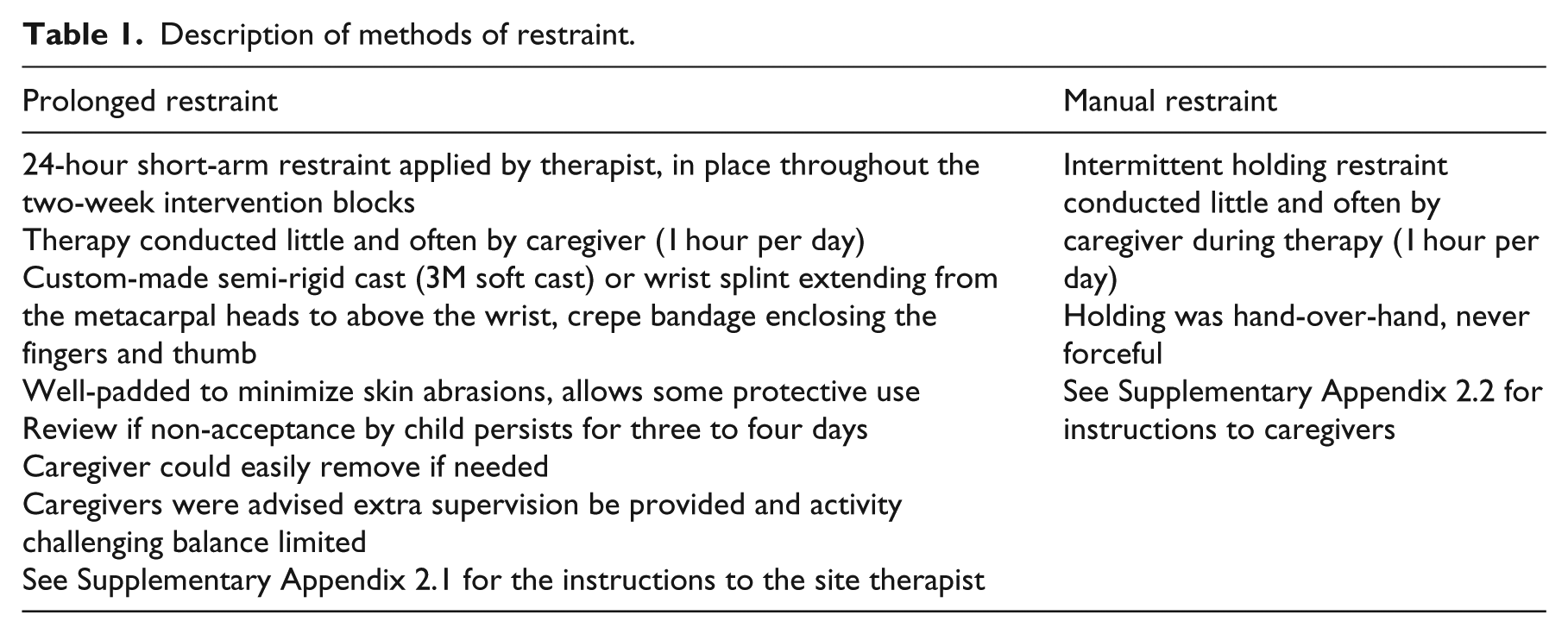
In both groups, therapy was administered for 1 hour each day in the child’s usual setting by caregivers (parents and pre-school workers) for six weeks (three blocks of two weeks) interspersed with two weeks of rest to promote adherence and reduce the potential for adverse events. Intervention period timing was flexible to fit with family life, but was completed within 10 weeks.
The interventions aimed to promote mass practice of the affected upper limb to improve grasp, release, reaching, in-hand manipulation and use as an assisting hand during bimanual activity. The practice was embedded in the context of functional tasks or usual child-friendly play for a total of 1 hour, which could be divided to fit with the child’s usual routine. To encourage participation, the activity aimed to be enjoyable with substantial verbal encouragement and praise. If the therapist found there were no toys available, a small number of suitable toys were provided. The instructions are outlined in Supplementary Appendix 2.3. The amount of prescribed therapy delivered and the child’s cooperation was recorded by the caregivers in a daily diary and through a weekly face-to-face or telephone questionnaire administered by the site therapist.
The sample size calculation was based on 90% power in a two-sample t-test to compare change in outcome from baseline between the groups with α set to 0.05. Eliasson et al. 29 conducted a study of constraint-induced movement therapy in young children with hemiplegic cerebral palsy using the Assisting Hand Assessment as the primary outcome measure. The treatment effect was 1.16 at the end of the therapy period (two months) and demonstration of a similar short-term effect would justify a larger multicentre trial. Given these assumptions, 23 participants in each group would detect an effect size of 1.0 following treatment between groups. Participant retention was estimated at 70%, which gave a total sample size of 60 participants.
An intention-to-treat analysis was conducted. A between-group comparison of the primary and secondary outcomes and mean change were computed at each time point. Interval data were analysed with independent t-tests and categorical data with the chi-square test. Within group comparison at baseline and 10-week assessments was made using dependent t-tests. Effect sizes were calculated where appropriate. Non-parametric tests were used where parametric assumptions were not met.
The responses and scores in the daily diaries and weekly questionnaires were analysed with descriptive statistics. The median and interquartile ranges (IQRs) were calculated from the daily diaries and weekly questionnaires for therapy dose and cooperation of the child after the missing responses had been removed. Alpha-level was set at 0.05 for all statistical analyses, which were conducted using a statistical software package SPSS version 20 (SPSS Inc., Chicago, IL, USA).
Results
Sixteen community paediatric therapy services across England and Wales recruited 62 out of 81 eligible participants (76%) between June 2010 and January 2012 (See flow diagram, Figure 1). Reasons for declining participation were child’s behaviour (n = 2), child’s independence (n = 2), child’s health (n = 3), attendance at an educational placement (n = 2), healthcare and other commitments (n = 2), did not want intervention (n = 2) and did not want to participate in research (n = 1). Five parents gave no explanation. The first and largest centre set up before further centres were recruited following national advertising recruited 19 out of the centre’s 21 eligible patients. The remainder of centres recruited between one and four patients, after inviting between one and seven. Reasons for declining participation were child’s behaviour (n = 2), child’s independence (n = 2), child’s health (n = 3), attendance at an educational placement (n = 2), healthcare and other commitments (n = 2), did not want intervention (n = 2) and did not want to participate in research (n = 1). Five parents gave no explanation. No patients met the exclusion criteria. Data were collected from all participants at all time points except from two at the 10-week assessment and three at 24-week assessment. Baseline information across groups showed some imbalance for age (Table 2).
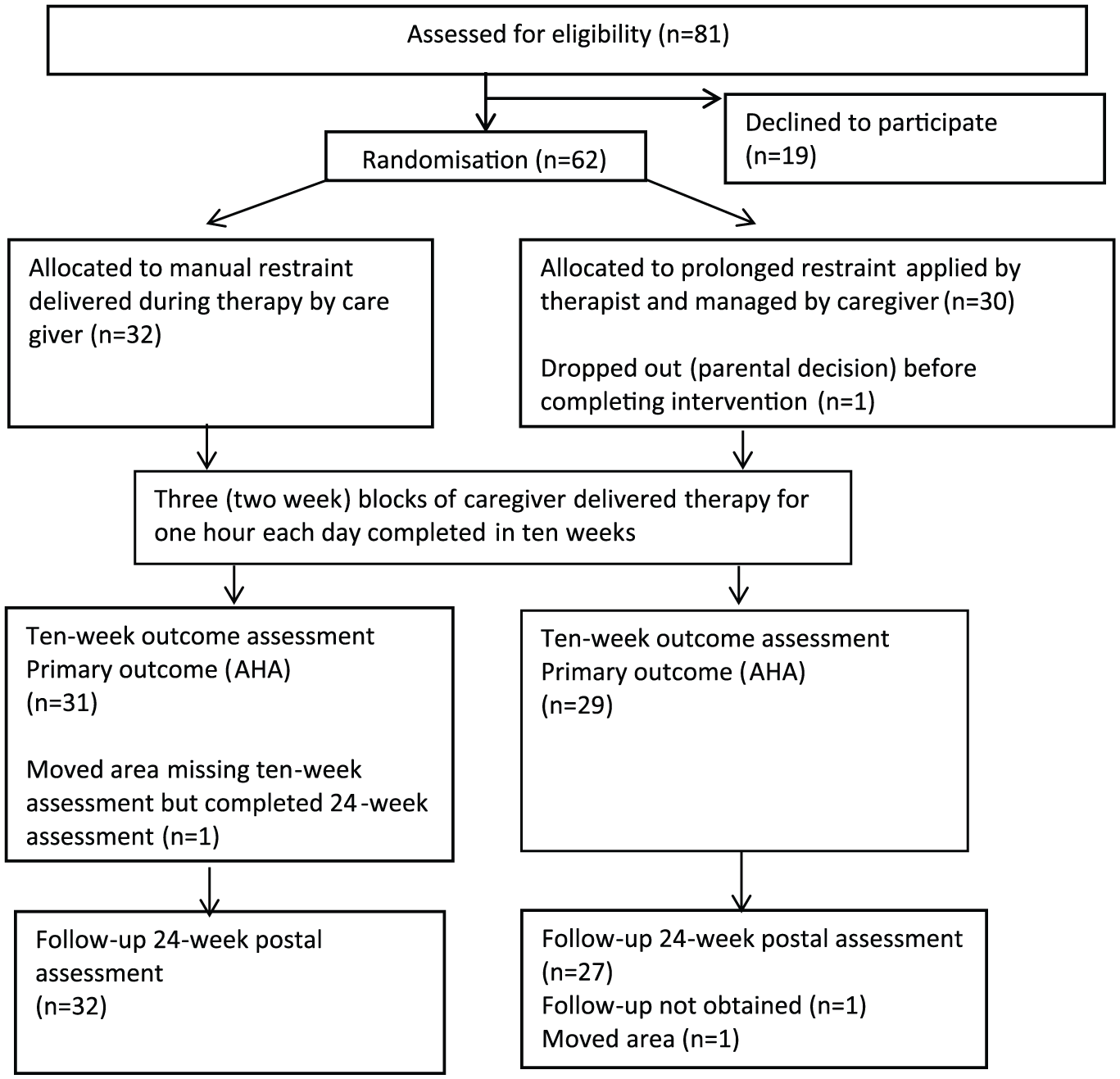
CONSORT diagram of participant flow through trial.
Baseline characteristics across group.
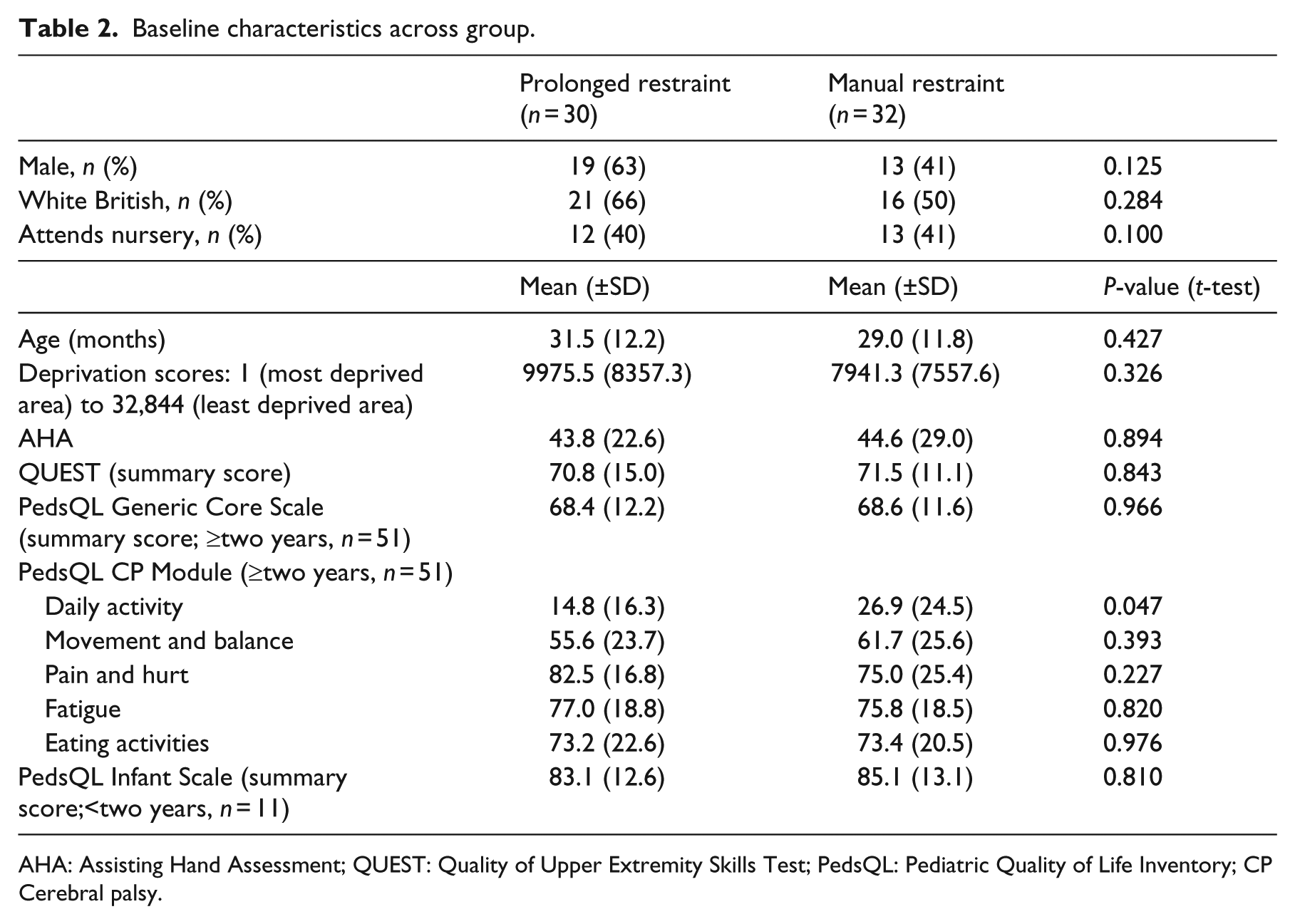
AHA: Assisting Hand Assessment; QUEST: Quality of Upper Extremity Skills Test; PedsQL: Pediatric Quality of Life Inventory; CP Cerebral palsy.
Outcome measures were well completed with no missing data for the Assisting Hand Assessment. The QUEST was 89% (55/62) complete at baseline and 91% (55/60) at 10 weeks. The Pediatric Quality of Life Inventory in combination with the Cerebral Palsy module was returned for 96% (49/51) at baseline and 94% (48/51) at the 10- and 24-week assessments. The Pediatric Quality of Life Inventory infant scale was 100% (11/11) complete at all time points. The Birmingham Bimanual Questionnaire response was 81% (50/62) at baseline, 97% (60/62) at 10 weeks and 95% (59/62) at 24 weeks. There was a 94% (58/62) response rate for the diaries and 87% (54/62) for the parent questionnaires. The assessor was aware of group allocation for only 8% (5/62) of the participants.
The mean change in bimanual performance between groups measured with the Assisting Hand Assessment logit-based 0–100 unit from baseline following the 10-week intervention was 9.0 (95% confidence interval (CI): 5.7, 12.4; P < 0.001) units for prolonged restraint and 5.3 (95% CI: 1.3, 9.4; P = 0.01) units for manual restraint with a mean group difference of 3.7 (95% CI: −1.5, 8.8; P = 0.156) units (Table 3).
Mean difference across groups of the change in the Assisting Hand Assessment (primary outcome) and the Quality of Upper Extremity Skills Test from baseline to the 10-week assessment.
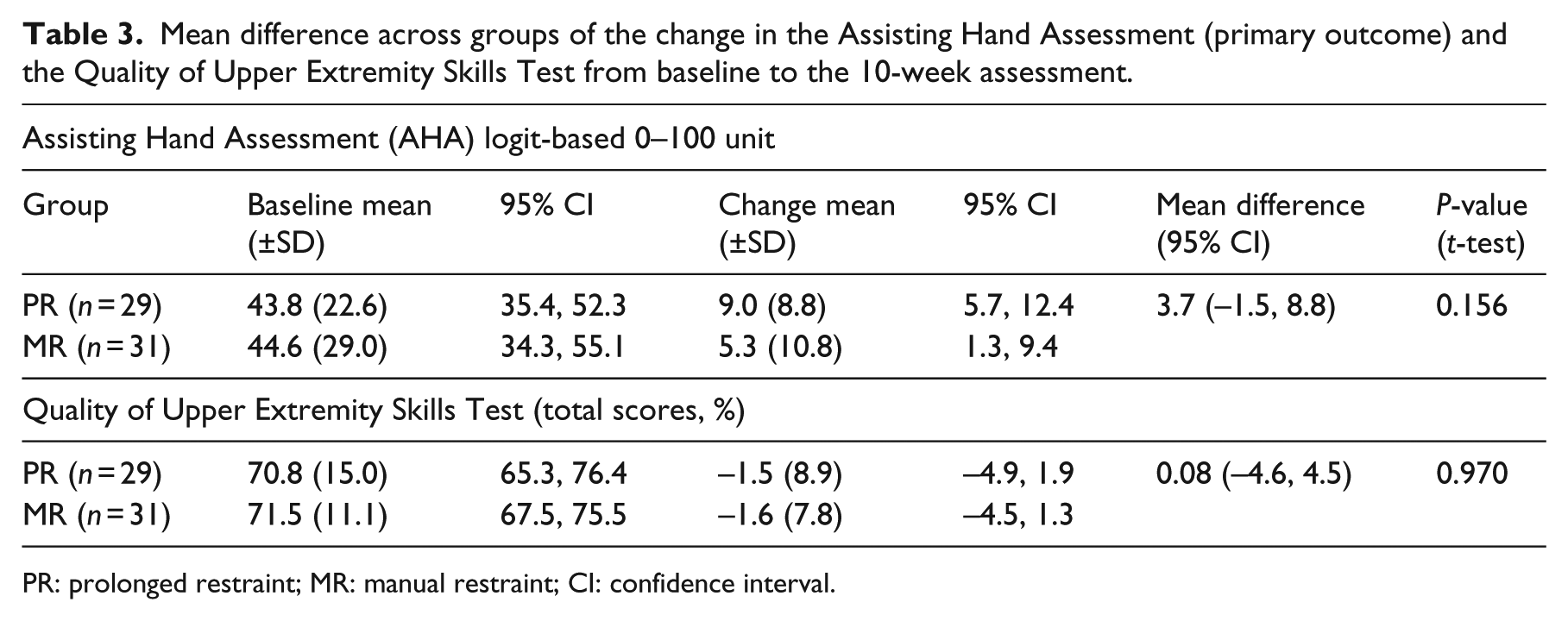
PR: prolonged restraint; MR: manual restraint; CI: confidence interval.
Upper limb function of the upper limbs measured with the QUEST at 10 weeks was similar to baseline for both groups (see Table 3 for total scores and Supplementary Appendix 1, Table 4 for the QUEST subgroup scores).
There was no significant between group differences for children aged two years and above at baseline or in change from baseline to the 10- or 24-week assessment on the Pediatric Quality of Life Inventory Generic Core Scale and Pediatric Quality of Life Inventory Cerebral Palsy Module. Nor were there differences for younger children (less than two years) in change from baseline to 10-week assessment or from 10- to 24-week assessment on the Pediatric Quality of Life Inventory Infant Scale. There was a significant difference in the mean change from baseline to the 24-week assessment on the Pediatric Quality of Life Inventory Infant Scale (6.9; 95% CI: 2.8, 11.1; P = 0.006) with a greater mean deterioration observed in the manual restraint group (−9.4; SD: 3.2) compared to the prolonged restraint group (−2.5; SD: 1.6) (Supplementary Appendix 1, Tables 5–7 and 9–11).
There was a statistically significant improvement in motor skills measured on the Birmingham Bimanual Questionnaire in the prolonged restraint group compared to the manual restraint group at 10 weeks, 16.9 (95% CI: 2.9, 30.9; P = 0.019). This was not sustained at 24 weeks, 1.1 (95% CI: −12.5, 14.6; P = 0.873) (Supplementary Appendix 1, Tables 8 and 12).
Three serious adverse events were reported in the prolonged restraint group (hospital admission for flu induced wheeze, accident and emergency attendances for chest infection and a total body rash) and one in the manual restraint group (hospital admission following a fit): these were considered unrelated to the interventions. Of the 15 non-serious adverse events, 12 were considered to be related to the prolonged restraint including two children who had minor bruising because of a fall and 10 with small areas of skin abrasions. The three remaining non-serious adverse events in the prolonged restraint group were not considered related to the intervention. See Supplementary Appendix 1, Table 13.
The median therapy dose reported by parents (data available for 54 out of 62 patients) was significantly greater (P < 0.001) in the prolonged restraint group (4.2; IQR: 0.9) compared to the manual restraint group (3.6; IQR: 1.3). Children (response: 53/62) were more cooperative in the prolonged restraint group (4.7; IQR: 1.0) than in the manual restraint group (3.0; IQR: 1.7) (P < 0.001).
An exploratory regression analysis was carried out with the logit-based 0–100 Assisting Hand Assessment unit scale at the 10-week assessment as the dependent variable. Group allocation, participant age, baseline clinical presentation (measured with QUEST and the Assisting Hand Assessment), amount of therapy delivered and cooperation with the restraint of the delivered intervention were the independent variables in the model: none made statistically significant contributions to the model.
Discussion
Bimanual performance of children with hemiplegic cerebral palsy after 10 weeks of therapy was similar in the two groups of children using different methods of constraint-induced movement therapy. Both groups improved by more than the minimal detectable difference on the Assisting Hand Assessment, but the threshold for clinically significant improvement on this measure is unclear. Reported adherence was good. Children were more cooperative and received a higher therapy dose with prolonged restraint but adherence was better than expected in the manual restraint group, reducing the difference between the groups. Recruitment in the NHS community setting was feasible, although more sites than anticipated were needed as there were fewer eligible patients below the age for UK compulsory education than expected. There was excellent follow-up of more than 95% at 10 and 24 weeks with satisfactory data completion. Broad inclusion criteria enhanced generalizability.
The improvement in bimanual performance at 10 weeks irrespective of the type of restraint applied is consistent with a previous Cochrane systematic review 12 and further studies.13,14 Previous meta-analyses in neurological rehabilitation have emphasized the importance of dose,30,31 and in our study, the caregiver-directed prolonged restraint method was associated with a greater dose than manual restraint. As with other studies using a prolonged restraint approach, there was minimal reporting of adverse events.6,32,33
In contrast to previous studies of caregiver-directed constraint therapy,16,17 there was excellent adherence and follow-up rates with both intermittent manual holding and prolonged restraint with a short-arm device left in situ. A novel aspect of the prolonged restraint protocol was that caregivers administered only the mass practice with application and removal of the restraint being carried out by the therapist. This may have reduced the burden on parents, increasing acceptability and improving adherence. As prolonged restraint was associated with delivery of more therapy and is acceptable to parents, it is our preferred method in further effectiveness research.
The trial has some limitations. Only caregiver reported assessment of adherence to treatment was possible. Although masking was largely successful, the assessor was aware of group allocation for 8% of the participants at the 10-week assessment. Resource constraints meant the trial was powered to evaluate 10 weeks, not long-term outcomes.
We have shown in multiple centres that constraint-induced movement therapy can be successfully administered in NHS community paediatric therapy services with caregiver-directed therapy. Our study suggests prolonged restraint results in more intense therapy and can be used safely. Children in the prolonged restraint group had more risk of skin abrasions: this risk was managed by using a short easily removable padded device that allowed some protective extension. Parents were advised to give more supervision on the stairs and in situations where the child’s balance was challenged. All adverse events resolved quickly. Minor bruising from falls and skin abrasions are common in this age group and may have occurred in the intermittent holding group, but not have been reported. There was no difference in function of the immobilized limb at 10 weeks suggesting no harm from restraint.
This is one of the largest randomized controlled trials conducted to investigate constraint-induced movement therapy in young children with hemiplegic cerebral palsy: we are not aware of other multicentre pragmatic community-based randomized controlled trials. An adequately powered trial with longer term, blinded outcome assessment is required. As caregiver-directed constraint-induced movement therapy delivered more practice, may lead to a better outcome than manual restraint, and is acceptable to parents and patients, this method of restraint is our preferred intervention. A control intervention with no constraint therapy (e.g. waiting list, attention control and usual therapy) would increase the statistical power of the study by increasing the contrast between the expected group outcomes. Such a trial is needed to evaluate the long-term clinical and cost effectiveness of community-based constraint-induced movement therapy.
Constraint-induced movement therapy for children with hemiplegic cerebral palsy can be successfully delivered by caregivers.
Prolonged restraint delivered more intense upper limb therapy than manual restraint, but was not more effective.
A randomized control trial of prolonged restraint versus no constraint therapy is warranted and feasible.
Supplemental Material
Supplementary material
Appendix
Footnotes
Acknowledgements
The authors thank the children and their families who participated in the study. The authors acknowledge the support and effort of the physiotherapists and occupational therapists at the 16 NHS community paediatric therapy services that participated in the research. They are listed in Supplementary Appendix 1,  . Authors also thank the contribution made by the members of the Trial Steering and Data Monitoring Committee, with special thanks to Dr Anne Aukett (independent chair and trial medical expert) and Julie Markell (service user). Furthermore, authors acknowledge the support given by the Primary Care Clinical Trials Unit at the University of Birmingham and Dr Tom Hoppitt and Mr Adam Walker.
Declaration of conflicting interests
The author(s) declared no potential conflicts of interest with respect to the research, authorship, and/or publication of this article.
Funding
The author(s) disclosed receipt of the following financial support for the research, authorship, and/or publication of this article: P.M.C. was funded by the West Midlands Strategic Health Authority as part of a Clinical Academic Doctorate Fellowship. C.S. was supported by a NIHR Senior Investigator’s award and C.C. receives funding from the National Institute for Health Research (NIHR) Collaborations for Leadership in Applied Health Research and Care for West Midlands Programme (CLAHRC-WM). The Nancie Finnie Cerebral Palsy Charity provided funding for the project. This article presents independent research partly funded by the National Institute for Health Research (NIHR). The views expressed are those of the author(s) and not necessarily those of the NHS, the NIHR or the Department of Health.
Supplement material
Supplementary Material is available for this article online.
References
Supplementary Material
Please find the following supplemental material available below.
For Open Access articles published under a Creative Commons License, all supplemental material carries the same license as the article it is associated with.
For non-Open Access articles published, all supplemental material carries a non-exclusive license, and permission requests for re-use of supplemental material or any part of supplemental material shall be sent directly to the copyright owner as specified in the copyright notice associated with the article.
