






Abstract
Objective:
To test whether rhythmic auditory stimulation (RAS) training reduces the number of falls in Parkinson’s disease patients with a history of frequent falls.
Design:
Randomized withdrawal study design.
Subjects:
A total of 60 participants (aged 62–82 years) diagnosed with idiopathic Parkinson’s disease (Hoehn and Yahr stages III or IV) with at least two falls in the past 12 months.
Intervention:
Participants were randomly allocated to two groups and completed 30 minutes of daily home-based gait training with metronome click–embedded music. The experimental group completed 24 weeks of RAS training, whereas the control group discontinued RAS training between weeks 8 and 16.
Main measures:
Changes in clinical and kinematic parameters were assessed at baseline, weeks 8, 16, and 24.
Results:
Both groups improved significantly at week 8. At week 16—after the control group had discontinued training—significant differences between groups emerged including a rise in the fall index for the control group (M = 10, SD = 6). Resumption of training reduced the number of falls so that group differences were no longer significant at week 24 (Mexperimental = 3, SD = 2.6; Mcontrol = 5, SD = 4.4; P > 0.05). Bilateral ankle dorsiflexion was significantly correlated with changes in gait, fear of falling, and the fall index, indicating ankle flexion as a potential kinematic mechanism RAS addresses to reduce falls.
Conclusion:
RAS training significantly reduced the number of falls in Parkinson’s disease and modified key gait parameters, such as velocity and stride length.
Introduction
Falls are among the biggest contributors to loss of independent living, long-term institutionalization, and increased mortality. 1 It has been estimated that up to two-thirds of people with Parkinson’s disease experience falls annually,2,3 and over 50% of patients fall recurrently.3,4
The loss of the ability to produce a steady gait rhythm, which increases stride-to-stride time variability, has been associated with increased risk of falling.5,6
This temporal variability in gait kinematics in persons with Parkinson’s disease is in concurrence with a large number of research studies that have shown difficulties in persons with Parkinson’s disease when performing self-paced automatic, sequential, and rhythmic movement patterns. 7 Parkinsonian movement patterns, especially when sequential and rhythmic, are characterized by slowness, temporal variability in kinematic gait patterns, and freezing.8,9 These findings suggest, therefore, a significant association between compromised internal timing functions in gait motor control and increased risk of falling.
The focus on internal timing functions underlying temporally stable rhythmic gait kinematics provides an interesting argument for the use of rhythm-based gait training techniques to prevent or reduce falls. Rhythmic auditory stimulation (RAS) is such a technique that synchronizes gait movements to predictable time cues.8,10 Research in RAS has shown promising success rates in improving kinematic stability,11,12 reducing freezing episodes, 13 and improving temporal variability in stride times.10,14
RAS would, therefore, appear to be a promising candidate in gait training to reduce the risk of falling, since it directly addresses temporal instability as one of the most detrimental variables associated with falls. However, such study regarding falling in Parkinson’s disease has not been undertaken to date. Therefore, the purpose of this study was to explore whether a home-based RAS gait training program will decrease the number of falls and improve associated clinical and kinematic parameters in persons with Parkinson’s disease with a history of falling.
Material and methods
This randomized controlled trial was conducted in collaboration with Colorado State University and the Poudre Valley Health System, Fort Collins/Colorado, between August 2009 and August 2011. All procedures were approved by the internal review boards of Colorado State University (reference number: 09-1271H) and the Poudre Valley Health System Fort Collins/Colorado (reference number: 09-785), and registered at ClinicalTrials.Gov (NCT03316365). Written informed consent was obtained from all study participants.
Study participants were randomly selected from referral lists of local Parkinson’s disease support groups and neurology practices. All subjects had a primary diagnosis of idiopathic Parkinson’s disease. Inclusion criteria were disease severity indicated by a Hoehn and Yahr (H&Y) Parkinson’s scale stages III or IV, 15 at least two falls in the past 12 months, a stable antiparkinsonian medication regime, and the ability to ambulate independently for at least 50 m. Subjects were excluded if they had other neurological or orthopedic conditions, medically diagnosed hearing loss, or dementia (Mini Mental Status Exam score < 24). 16
Subjects were randomly selected and assigned in an intent-to-treat design to the experimental and control conditions using a computerized random selector program implemented by a computer specialist external to the study to assure allocation concealment. Each patient received a unique computer-generated random code (1:1 simple randomization) concealed in a sealed envelope. The sealed envelope was provided to the study coordinator at baseline visit. The therapist was blinded to the allocation schedule, and participants were specifically asked not to discuss the intervention. All de-identified data files were securely stored at the Center of Biomedical Research in Music, Colorado State University, and not opened until completion of the study.
Assessments were completed at baseline, and at week 8, 16, and 24. The metrics assessed were: velocity, stride length, cadence, ankle dorsiflexion (range of motion in angle degrees), Berg Balance Scale, 17 Timed Up and Go, 18 Falls Efficacy Scale, 19 and the Fall Index. A computerized stride analyzer system (B&L Engineering) and a four-camera three-dimensional (3D) VICON-MOTUS video motion analysis system were used to collect data for velocity, stride length, cadence, and dorsiflexion angles. The stride analyzer system consisted of a portable microprocessor worn on a gait belt by the subject during the assessments, four sensors worn imbedded in the insoles of the subject’s shoes, a coupler system to download data from the microprocessor to the computer and data analysis software. Reflective markers on the ankle, heel, and toe were used to collect kinematic data related to dorsiflexion, which were analyzed using the digital PEAK video movement analysis system. The Timed Up and Go 18 and the Berg Balance Scale 17 assessments were administered by an experienced therapist blinded to the study design. The Berg Balance Scale is a 14-item list assessing impairment in balance function during a series of predetermined functional tasks, with each item consisting of a 5-point ordinal scale ranging from 0 to 4, with 0 indicating the lowest level of function and 4 the highest level of function. The Timed Up and Go test measures functions (e.g. rise from a chair, walk three meters, turn around, walk back to the chair, and sit down) with correlates to balance and fall risk. A faster time indicates a better functional performance. Falls Efficacy Scale (FES) 19 is a 10-item scale to assess fear of falling in older persons. Individuals are asked to rate on a 10-point scale (0 corresponding to not at all and 10 to completely) how confident he or she felt in performing 10 activities. The scores are added up to calculate a total score that ranges from 0 to 100. Higher scores indicate more confidence/less fear. The Fall Index was computed based on self-reports by subjects or caregivers and classified as 1 (incomplete fall and lost balance but stabilized by another person or object), 2 (complete fall and no injuries), or 3 (complete fall, injury, and medical attention required). A complete fall was defined as unintentionally coming to the ground with any body part above ankle. Higher Fall Index values indicate higher incidence of falls. Medication was monitored by the medical director of the research center to control for influences of change or fluctuations in medication on outcome measures. All testing was carried out 2 hours after medication intake. Home training instructions were provided by certified therapists blinded to treatment allocation of the subjects. Home exercise and fall incidence logs were kept by subjects and reviewed weekly by the therapists.
Following a randomized withdrawal/discontinuation design,20–22 the experimental group (continuous treatment) trained daily with RAS for 24 weeks, following a standardized prescribed 6-step training protocol. 23 The control group (withdrawn treatment) also trained daily with RAS but discontinued training between weeks 8 and 16, resuming training for the last eight weeks of the treatment. During treatment, subjects walked for 30 minutes in a home-based environment with metronome click–embedded music downloaded to an MP3 player and listened to either free-field or via headphones. The music consisted of folk and classical instrumental music with strong 2/4 tempo that was designed by research staff in the project and digitally recorded using keyboard sounds in order to modulate beat cadence rates. Metronome beats were inserted into the music to enhance beat perception. For the first eight weeks, subjects had three metronome rates available to choose from: 100%, 105%, and 110% of internal cadence, during the second eight weeks: 105%, 110%, and 115%, and last eight weeks: 110%, 115%, and 120%. The control group started their last training segment at 105%, 110%, and 115% but could request a change to the faster rates if comfortable.
A mixed-design analysis of covariance (2 × 4 factors) was used to test for differences between the two groups at baseline and to analyze changes of the dependent variables at the four repeated time points of baseline, 8, 16, and 24 weeks. To locate differences between groups at each time point, least squares mean differences were computed. To identify potential mechanisms driving fall reductions in RAS correlation analysis was applied to assess associations between specific kinematic gait parameters and falling incidences.
Results
A total of 85 patients were screened for eligibility, and 60 were included in the study. Of the included patients, 47 subjects completed the study protocol (Figure 1). Five subjects did not complete the study in the experimental group, and eight subjects in the control group withdrew from the program for reasons non-related to adverse events, such as family issues, traveling commitments, and change in medication regime. Group characteristics for patients at both groups at baseline are displayed in Table 1. All patients received standard care and optimal medical treatment during the study.

CONSORT diagram demonstrating study flow.
Comparison of the clinical characteristics of patients by group at baseline.
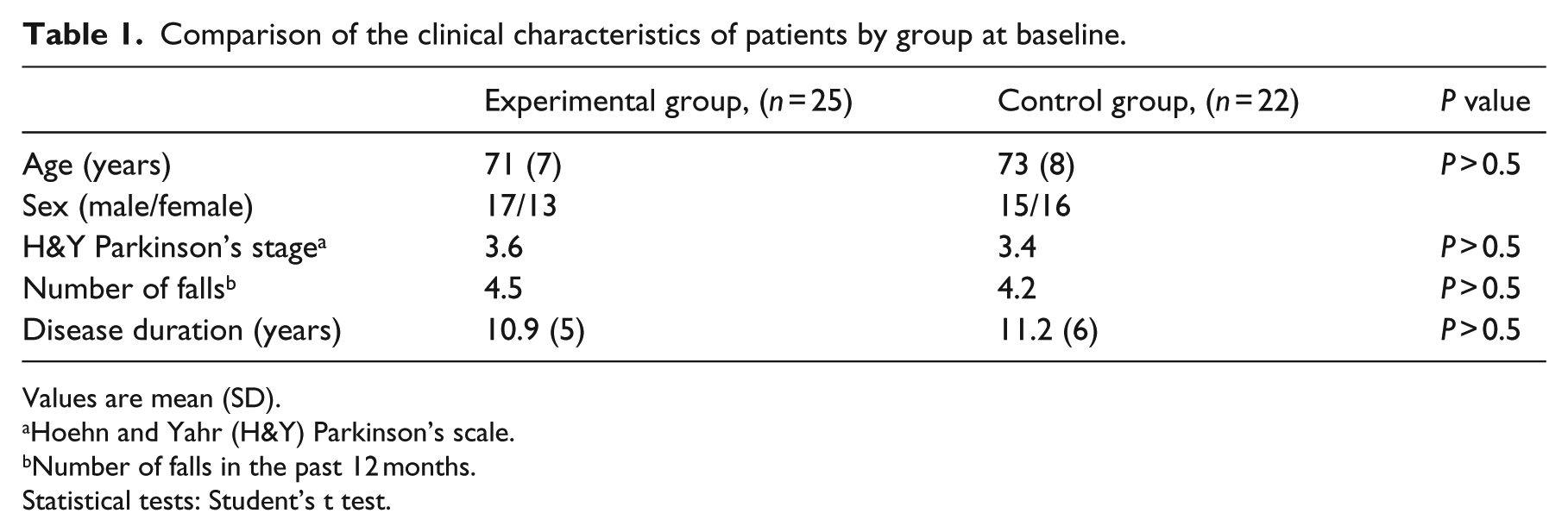
Values are mean (SD).
Hoehn and Yahr (H&Y) Parkinson’s scale.
Number of falls in the past 12 months.
Statistical tests: Student’s t test.
At week 8 of treatment there were no significant differences between experimental and control groups, indicating an equally significant improvement for both groups after the completion of the same RAS protocol (Table 2). At 16 weeks—after the control group had discontinued the training—significant differences in favor of the experimental versus the control group emerged for velocity, cadence, stride length, dorsiflexion of right and left ankles, fall index and fear of falling. Not only was there a significant difference between both groups, but the control group had also significantly deteriorated after discontinuing the RAS training between week 8 to 16 in velocity (P = 0.0001), stride length (P = 0.0001), both dorsiflexion metrics (Left: P = 0.0005; Right: P = 0.0001), and fall index (P = 0.0003). Cadence and fear of falling had decreased but non-significantly.
Group scores across all tested time points.

TUG: Time Up and Go; BBS: Berg Balance Scale.
Values are mean (SD).
P < 0.05; **P < 0.005.
At week 24—after the control group had resumed RAS training—significant differences remained between experimental and control group for velocity, stride length, fear of falling, both dorsiflexion metrics, and cadence. Resumption of training for the control group significantly reduced the number of falls, as measured by the fall index, such that differences between experimental and control group were no longer significant (Figure 2).

Average scores for the experimental and control groups at baseline and weeks 8, 16 and 24 for Fall Index (FI), Fear of Falling (FoF), Stride Length, Gait Velocity, and Ankle Dorsiflexion (Right and Left). Higher FI values indicate higher incidence of falls, higher FoF scores indicate less fear of falling.
An analysis of progress over time showed that the most significant gains were made in the first eight weeks of treatment for measures such as velocity (P = 0.0001), stride length (P = 0.0096), cadence (P = 0.0001), dorsiflexion (Left: P = 0.0001; Right: P = 0.0001), Fall Index (P = 0.0001), and fear of falling (P = 0.0027). Between week 8 and 16, the improvement curves showed a more mixed picture; only stride length (P = 0.0093), and fear of falling (P = 0.004) continued to improve significantly. Changes in both dorsiflexion metrics, fall index, cadence, and velocity were not statistically significant. Between week 16 and 24 only fear of falling (P = 0.0005) and velocity (P = 0.0325) continued to improve significantly. All other measures showed improvement, however non-significant (Figure 2).
Pearson correlation coefficients were computed between all variables at week 16 to assess for associations between changes in gait parameters after the control group had discontinued treatment. Since left and right dorsiflexion were highly correlated (r = 0.92; P = 0.001), they were treated as one combined variable. Dorsiflexion was the only measure with significant correlations with all other gait measures. Reductions in ankle dorsiflexion after RAS withdrawal were significantly correlated with increases in fall index (P = 0.01). Decreases in ankle dorsiflexion were also significantly correlated with Berg Balance Scale (P = 0.012), Timed Up and Go (P = 0.019), stride length (P = 0.02), velocity (P = 0.02), and fear of falling (P = 0.0358; Table 3).
Pearson’s correlation coefficient values between all outcome measures at week 16.

TUG: Time Up and Go; BBS: Berg Balance Scale.
P < 0.05; **P < 0.005.
Discussion
The study results indicate that RAS gait training significantly reduced the number of falls and modified key kinematics in gait control in patients with Parkinson’s disease. This conclusion can be drawn upon the observation that significant improvements related to fall incidents were observed in the first phase of the protocol in both experimental groups, while discontinuation of the RAS training protocol between weeks 8 and 16 led to a significant increase in the incidences of falling for patients in the control group. Moreover, once RAS training resumed for the control group, the number of falls again decreased, suggesting that RAS training was the primary factor for reduction of fall incidents.
While the most significant improvements in gait kinematic parameters (e.g. velocity and stride length) took place during the first eight weeks of training, measures associated with falling continued improving throughout the 24 week RAS training. Reduction of the number of falls and fear of falling were consistently observed in all time points assessments for patients in the experimental group, whereas discontinuation of the RAS protocol for the control group resulted in a significant increase in the number of fall incidents also associated with greater fear of falling. This suggests that the gradual decline of gait performance when RAS training was interrupted had important implications to patient’s mobility confidence, which is confirmed by a regain in confidence once RAS training was resumed for those patients.
Importantly, bilateral ankle dorsiflexion was significantly correlated with changes in all gait parameters (except cadence) and showed a similar response pattern to the fall index, indicating that appropriate ankle dorsiflexion during the swing phase of the gait cycle may be one potentially critical kinematic mechanisms in the prevention of falls. Further investigation of ankle angle dynamics during gait with and without RAS may elucidate if the enhanced anticipatory time information implicit in auditory rhythmic cues may have helped shape safer ankle dynamics during takeoff and landing of the foot. At this time, our findings are in line with Wilson and Davey 24 who found that music with strong rhythm influences the corticospinal drive to the ankle extensors and flexor muscles involved in foot-tapping synchronization to the musical rhythm.
Two additional factors of RAS in fall reduction may be considered. First, physiological priming and timing of the motor system has been observed via rhythmically accentuated music. RAS is proposed to work via entraining biological auditory-motor networks that create fast, temporally precise, stable, and predictable temporal synchronization mechanisms between sensory input and motor output. 25 Auditory-motor pathways have been described on multiple distributed levels from cochlear root neurons synapsing with reticulospinal neurons, to activating corticocerebellar pathways, 25 to cortico-striatal loops and fronto-temporal pathways, 26 and motor-temporal pathways 27 involving the arcuate fasciculus. 28 These physiological effects may facilitate anticipatory motor control mechanisms already at brain stem and spinal cord level. Second, the musical-rhythmic movement cues may have enhanced the attentional control of movement. It is known that music enhances auditory attention processes and that the temporal (rhythmic) structure in music can entrain anticipatory attention to the timing of musical events. 29 Since the temporal periodicity of the rhythmic-musical cue synchronizes motor events, RAS may increase oscillatory attention of the subjects to their walking resulting in more controlled and safer gait. 12 Due to low cognitive attentional load, RAS has been shown to be superior in maintaining gait performance during dual load tests when persons had to shift attention to a simultaneous task during gait. 12
The randomized withdrawal design protocol used in this study was particularly important to determine the role of RAS training on fall reduction. One of the positive aspects of this design is that the discontinuation of the training for eight weeks for one of the groups while maintaining treatment for patients in the experimental group allowed for a direct comparison of the effects of the training on the outcome measured and to identify the effects of short-term discontinuation of the intervention. These designs are frequently employed in drug trials and other studies comparing clinical treatment effects by offering direct evidence of treatment benefits in a single arm study design with smaller sample size requirements for statistical power.20–22 An additional advantage of our design was the return of treatment after withdrawal to provide evidence whether the original treatment effect can be restored. On the other hand, one limitation of this design is that patients did not receive an alternative treatment during the discontinuation phase of the protocol and the decline in gait performance during that period may have generated frustration and decreased motivation. Furthermore, the lack of an alternative treatment makes it difficult to extract whether the reduction in falls was specific to RAS or driven more generally by walking daily for 30 minutes. However, given the current status of the research, lacking strong evidence for successful programs of fall reduction and prevention in Parkinson’s disease, and the correlational findings between ankle kinematics and falling in this study, may suggest that RAS had a beneficial effect on fall reduction.
Future studies are needed to better understand the effectiveness of this rehabilitation technique in a larger sample including a control treatment and assessments of longer term effects of the intervention. It is also important to acknowledge that, although outcome measures such as the Timed Up and Go and the Berg Balance Scale were administered by an experienced therapist blinded to the group allocation, the assessment of fear of fall and the fall index were based on self-reports, thus subject to bias.
In conclusion, this study demonstrated that a home-based RAS gait training program significantly reduced the number of fall incidents, reduced fear of falling, and modified key kinematics in gait control in Parkinson’s disease patients with a history of frequent falls. This clinical investigation demonstrates that RAS gait training is a potential intervention to reduce the risk of falling, since it directly addresses temporal instability, which is one of the most detrimental variables associated with falls.
Clinical messages
Gait training with RAS reduced falls in PD, with strongest gains during first eight weeks of a 24 week training.
Discontinuation of RAS training increased falls and decreased ankle dorsiflexion and gait speed.
Reduction of falls was most noticeably correlated with improvements in dorsiflexion and gait speed.
Footnotes
Acknowledgements
MHT was responsible for the conception and organization of the research project; designed and executed the statistical analysis; and wrote and gave the critical review for the manuscript. RRP and CPH-T were responsible for the conception, organization, and execution of the research project; designed and critically reviewed the statistical analysis; and gave critical review for the manuscript. GCM conceptualized the research project, designed the statistical analysis, and gave critical review for the manuscript. T.B.J was also responsible for designing and executing the statistical analysis and also wrote and gave the critical review for the manuscript.
Declaration of conflicting interests
The author(s) declared no potential conflicts of interest with respect to the research, authorship, and/or publication of this article.
Funding
The author(s) disclosed receipt of the following financial support for the research, authorship, and/or publication of this article. The study was supported in part by the Charlene B. Flood Memorial Fund, San Diego California.
