






Abstract
Objective:
To examine the effectiveness of a set of rules for referral and therapy input in a three-tiered physiotherapy program on activities of daily living (ADL), motor function, and quality of life of stroke survivors.
Design:
Randomized controlled study.
Setting:
Rehabilitation departments of 11 teaching hospitals.
Subjects:
A total of 285 participants with stroke.
Outcome measures:
Primary outcome was ADL independence measured with the Modified Barthel Index (MBI) at weeks 3, 6, 9, 13, and 17. Secondary outcomes were motor function and quality of life measured with Fugel-Meyer Assessment (FMA) and Stroke-Specific Quality-of-Life (SSQOL) scale.
Intervention:
Two complementary sets of rules governing rehabilitation delivery were introduced: a set of criteria that determined when someone ought to move from tier 1 onto tier 2, and from tier 2 onto tier 3, and a second set of rules that determined the amount and type of physiotherapy input given in each tier. Control group participants received conventional rehabilitation without any specified guidelines.
Results:
With a difference of 3.97 (95% confidence interval (CI): 1.59–6.36), MBI increased stronger in the study group than in controls between baseline and week 3 (P = 0.001). This difference could be sustained until study end-point. No significant differences were found for FMA. Differences in increase of SSQOL were higher in the intervention than control at week 9 (P < 0.05).
Conclusion:
Introduction of a set of rules for referral and therapy input at different stages of rehabilitation partially improved patients’ ADL and quality of life, but did not improve motor function.
Introduction
Until today, rehabilitation service delivery in China has been mainly confined to inpatient rehabilitation within rehabilitation units of large central hospitals. 1 The system has been characterized by a lack of rehabilitation capacity at the community level and the absence of mechanisms for the systematic referral of patients between specialized central hospitals and community healthcare providers. 2 This has severely limited the extension of rehabilitative measures into the community and patients’ homes 2 and led to prolonged inpatient stay with low effectiveness and high costs. 3 In line with a plan of the Health Department of the People’s Republic of China to promote integrated rehabilitative care delivery from the hospital to the community in a three-tiered two-way referral system, pilot programs were launched in 46 cities from 14 provinces from 2011 onwards. These programs aimed at exploring ways how to organize the integrative delivery of rehabilitation services from the hospital to the community. 3
The present study presents data from a project aiming at the establishment of a three-tiered rehabilitation service delivery program for patients with stroke in Jiangsu province. In this program, Tier 1 comprised acute and early post-acute inpatient rehabilitation provided by rehabilitation departments of comprehensive university-, provincial-, and city-level hospitals. Tier 2 encompassed post-acute inpatient and outpatient rehabilitation delivered by rehabilitation departments of the same hospitals. Tier 3 included community-based rehabilitation measures involving home-based rehabilitation or outpatient rehabilitation supervised or delivered by smaller county- or community-level hospitals. Within this service delivery program, rehabilitation units of major hospitals need to provide acute treatment and early post-acute rehabilitation for stroke patients and make referrals to appropriate outpatient or community-based rehabilitation settings based on medical and functional improvement. In practice, however, referral and discharge decisions are often based on length of stay or other non-standardized criteria varying from hospital to hospital and doctor to doctor.
The present study thus aimed to examine the effectiveness of introducing two complementary sets of rules governing the delivery of rehabilitation: a set of specific criteria that determined when someone ought to move from tier 1 onto tier 2, and from tier 2 onto tier 3, and a second set of rules that determined the amount and type of physical therapy input given in each tier. We hypothesized that with the introduction of these sets of rules for referral and therapy input at each stage, key outcomes for patients with ischemic stroke including independence in activities of daily living (ADL), motor function, and quality of life could be improved.
Methods
From April 2014 to August 2016, we performed a multicenter, randomized controlled trial with two parallel groups that were followed up for 17 weeks. The trial was registered at the Chinese Clinical Trial Registry (No. ChiCTR-TRC-14004503). The study received ethical approval from the ethics committee of the First Affiliated Hospital of Nanjing Medical University (No. 2014-SR-60). All participants signed informed consent forms and were informed of their rights to refuse to participate and withdraw from the study at any time. If a patient participated in the entire study, they could receive a CNY2000 (about €260) rehabilitation medical expense waiver and CNY50 (about €6.5) per visit (up to three times) as an outpatient follow-up transportation allowance.
A total of 11 hospitals from eight different cities in Jiangsu participated in this study. Eligibility criteria for the hospitals were as follows: (1) comprehensive rehabilitation services delivery for stroke patients in the acute, early post-acute, and post-acute phase (Tiers 1 and 2), (2) delivery of stroke rehabilitation services since at least five years, (3) integrated into a local referral and discharge system including community-level healthcare providers (Tier 3), and (4) written agreement to follow the research protocol.
Eligibility criteria for those performing the interventions were being a certificated physical therapist with at least three years work experience on stroke physical therapy who had received training for all manipulations before the start of the trial.
Participants who had experienced a first cerebral infarction confirmed by computed tomography or magnetic resonance imaging (MRI) were recruited for this trial. The inclusion criteria were (1) aged 18–75 years; (2) time of onset 7–21 days; (3) clear consciousness, that is, Glasgow Coma Scale = 15; 4 (4) mild to moderate neurological impairment, with National Institute of Health Stroke Scale score ⩽16; (5) no serious aphasia or aphasia without affecting simple communication and response to instructions; (6) Fugel–Meyer Motor Assessment <85; 5 and (7) provision of signed informed consent. Excluded were participants (1) who had experienced more than one stroke; (2) with serious comorbid medical conditions including acute coronary syndrome, heart failure, fractures, and severe arthritis on the hemiplegic side; and (3) with severe mental illness or psychiatric symptoms.
Both groups received conventional hospital-based multidisciplinary stroke rehabilitation in a regional three-tiered rehabilitation service delivery system 3 under the lead of the rehabilitation departments of comprehensive central hospitals. Conventional rehabilitation consisted of physical and occupational therapy, swallowing and speech therapy, and measures to prevent complications. Simple instructions on what to consider after having been discharged to their homes were also provided to all patients.
Control group participants received conventional rehabilitation without any specified referral or discharge criteria and without any specific guidelines on content and volume of therapies which accordingly varied between hospitals and therapists (Supplemental Table S1). Physical therapy in the control group mainly consisted of basic active or passive joint mobilization, balance, physical fitness, and gait training and gradually moves from initial passive to active exercise. The training program was adjusted by the professional responsible for the treatment according to the patient’s condition. Decisions upon referral and discharge were based on individual negotiations between patients and responsible health professional.
Physical therapy in the study group was performed according to a protocol 6 which refined and standardized the content of conventional treatments. The physical therapy plan for each Tier primarily consisted of several categories of exercises with over 30 detailed items. Items in each category were sorted by priority and difficulty and patients were required to complete them in sequence. Once a patient completed a lower level training task, a higher task was assigned following predesigned checklists. Discharge and referral of patients between Tiers was based on predefined criteria including motor control and function and independence in ADL. A detailed description of the interventions as well as discharge and referral criteria is provided in Supplemental Table S1. Criteria 1 and 2 (see Supplemental Table S1) for referral and discharge were designed upfront based on evidence from previous research.7,8
Participation in the trial was stopped under the following conditions: (1) new episode of cerebral infarction or cerebral hemorrhage, acute cardiovascular events, severe infections, fractures, deep vein thrombosis, and other diseases or accidents that seriously affected rehabilitation and functional evaluation during the study period; (2) patients’ refusal to continue rehabilitation or participation in the study; and (3) subject treatment contravened the protocol and significantly affected efficacy evaluation. Any participant with aggravation of their condition received priority referral to Tier 1 hospitals and observation was stopped.
After randomization, a blinded uninvolved physician at each subcenter collected detailed subject information and completed a blank case report form. Data collected included social demographics (age, sex, marital status, and education level), body mass index (BMI), and disease characteristics (location of cerebral infarction, stroke severity according to the National Institute of Health Stroke Scale, 9 cognitive function according to the Mini–Mental State Examination, 10 and level of consciousness based on Glasgow Coma Scale 11 ). Information on comorbidities, including hypertension, diabetes mellitus, and cardiovascular diseases, was extracted from medical files at baseline.
Independent assessors at every center performed baseline and functional outcome assessment at each visit. The primary outcome was independence in ADL measured with the MBI 12 and assessed at baseline and weeks 3, 6, 9, 13, and 17.
Secondary outcomes were motor function and quality of life. Motor function of upper and lower hemiplegic limbs was measured with the Fugel-Meyer Assessment (FMA) at baseline and weeks 3, 6, 9, 13, and 17.13,14 Quality of life was assessed with the Stroke-Specific Quality-of-Life (SSQOL) Scale at baseline and weeks 3, 9, and 17. 15
Assessment and data recording of the corresponding time points were completed within ±3 days of each expected time point.
Sample size calculation was performed with Stata 14.0 (Stata Corporation, College Station, TX, USA). Sample size was determined to be 105 per group based on a power of 0.8, an alpha error level of 0.05, and an assumed correlation between repeated measurements of 0.6 in order to detect a moderate between-within effect of Cohen’s f = 0.2. Assuming a drop-out rate of about 30% on average, we aimed at recruiting about 140 patients per study group.
Simple randomization based on a computer-generated sequence of random assignments with a 1:1 allocation ratio was performed in this study. Allocation was concealed by central randomization. The random sequence was generated by and stored in the central study center that was not involved in eligibility evaluation. Participating hospitals which were responsible for patient recruitment did not have access to the random sequence at any point. Only after eligibility evaluation by doctors from rehabilitation departments of the participating hospitals and the patient having signed informed consent, hospitals contacted the central study center and the patient was allocated according to the sequence stored there.
Due to the character of the intervention, patients and therapists could not be blinded. Outcomes were, however, assessed by independent therapists who did not participate in the study and were blinded to the patients’ allocation. Outcome assessment took place in a separate room. Health professionals delivering co-interventions such as occupational therapists were also not blinded.
All analyses were performed with Stata 14.0 and were based on intention to treat. Alpha error level was set at P < 0.05 for all tests. Mixed-effects models featuring random intercept for subject and an autoregressive covariance structure of the residuals (assuming that measurements were more correlated between subsequent timepoints) were estimated for all outcomes. Likelihood ratio tests demonstrated superior fit of an autoregressive residual structure over an independent one. Fixed effects parts included group allocation, time point, and an interaction between group and time point. Wald tests were used to determine overall statistical significance of the time–group interaction, and partial interaction effects between reverse adjacent levels of timepoints were analyzed with analysis of variance (ANOVA)-style contrasts. Mixed-effects models have no problem dealing with missing data of certain assessment points for some patients and patients that dropped out of the study after commencement based on the assumption that data are missing at random. For sensitivity analysis, we also calculated above models for complete cases only, that is, for those patients who had completed the trial, per protocol and data from all assessment points were available.
Results
A total of 397 patients with ischemic stroke were admitted to the 11 designated hospitals during the recruitment period and 302 were deemed eligible for the trial. Figure 1 provides a study flow diagram and reasons for exclusion. Ultimately, 285 subjects were included in the study and randomly assigned to either the study group (n = 143) or control group (n = 142); 26 subjects dropped out before the first assessment, and finally, 123 patients participated in the control and 136 in the study group. In all, 102 patients in the control group and 113 in the study groups completed the evaluation of the primary outcome measures at all time points.

Flow diagram of participant recruitment and retention.
Baseline characteristic are summarized in Table 1. The mean time period from stroke onset for the intervention and control groups was 13.31 ± 5.28 and 13.63 ± 5.08 days, respectively. Two hundred twenty-three patients (82%) were assessed for moderate impairment with the National Institute of Health Stroke Scale, accounting for approximately five out of six in each group. According to the MBI score at baseline, all patients were at least moderately dependent and most patients showed severe dependence based on the common MBI classification system. 12 No adverse events or post-stroke complications were recorded in this study.
Baseline characteristics of participants.
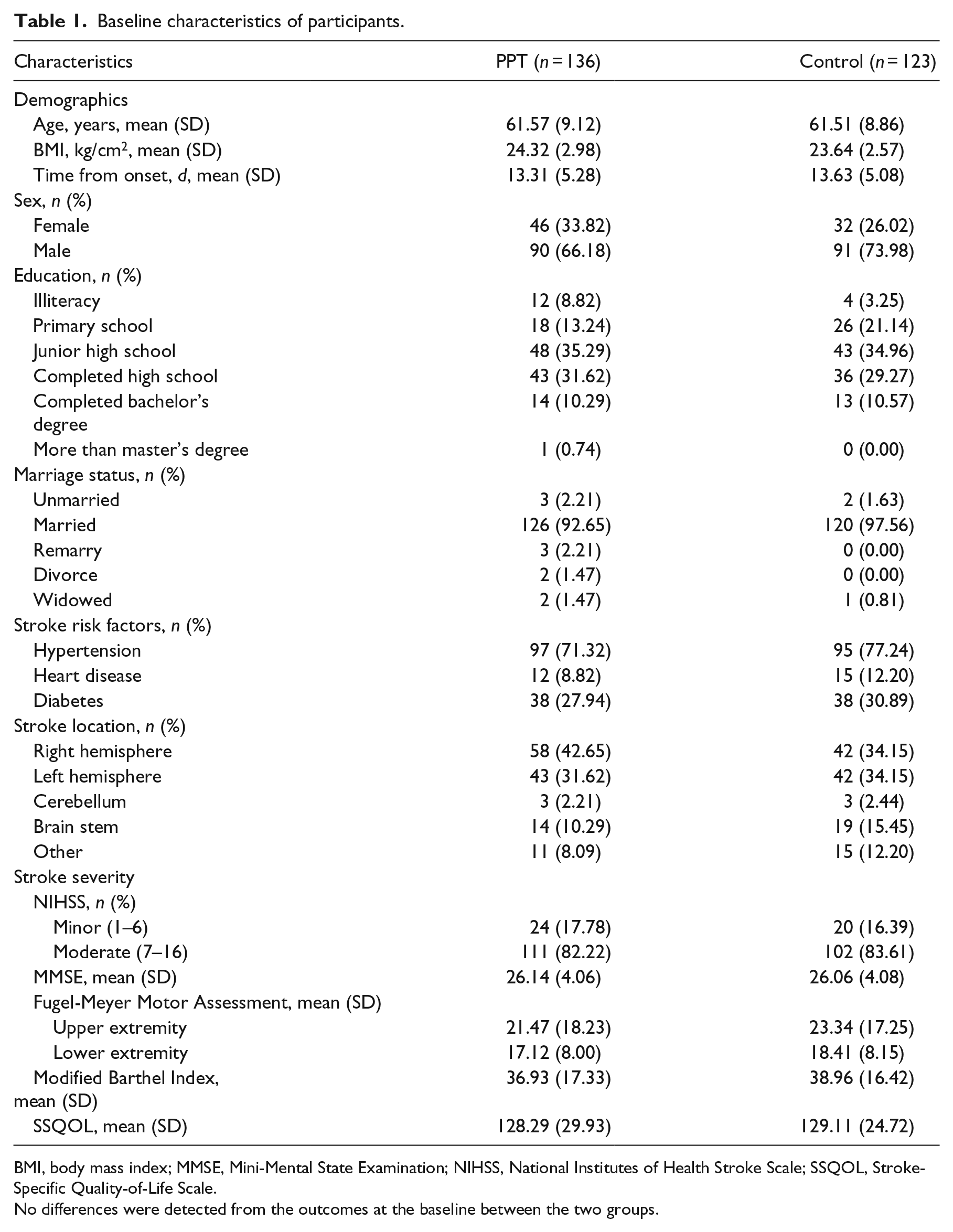
BMI, body mass index; MMSE, Mini-Mental State Examination; NIHSS, National Institutes of Health Stroke Scale; SSQOL, Stroke-Specific Quality-of-Life Scale.
No differences were detected from the outcomes at the baseline between the two groups.
Results of the mixed effects regression for the primary outcome measure MBI are provided in Table 2 and marginal estimation of means at each timepoint with 95% confidence interval (CI) is presented in Table 3. Mean scores improved in both groups over time and were on average 82.89 in the control group and 84.92 in the study group at study end-point. The interaction between group and timepoint was significant in favor of the study group. However, there was only one significant contrast between adjacent timepoints, that is, the increase in the study group between baseline and three weeks was 3.97 points larger than in the control group. This effect was sustained until study end-point.
Results from mixed effects regression for functional outcomes: Modified Barthel Index (MBI), Fugel-Meyer Assessment (FMA) scores, and Stroke-Specific Quality-of-Life Scale (SSQOL).
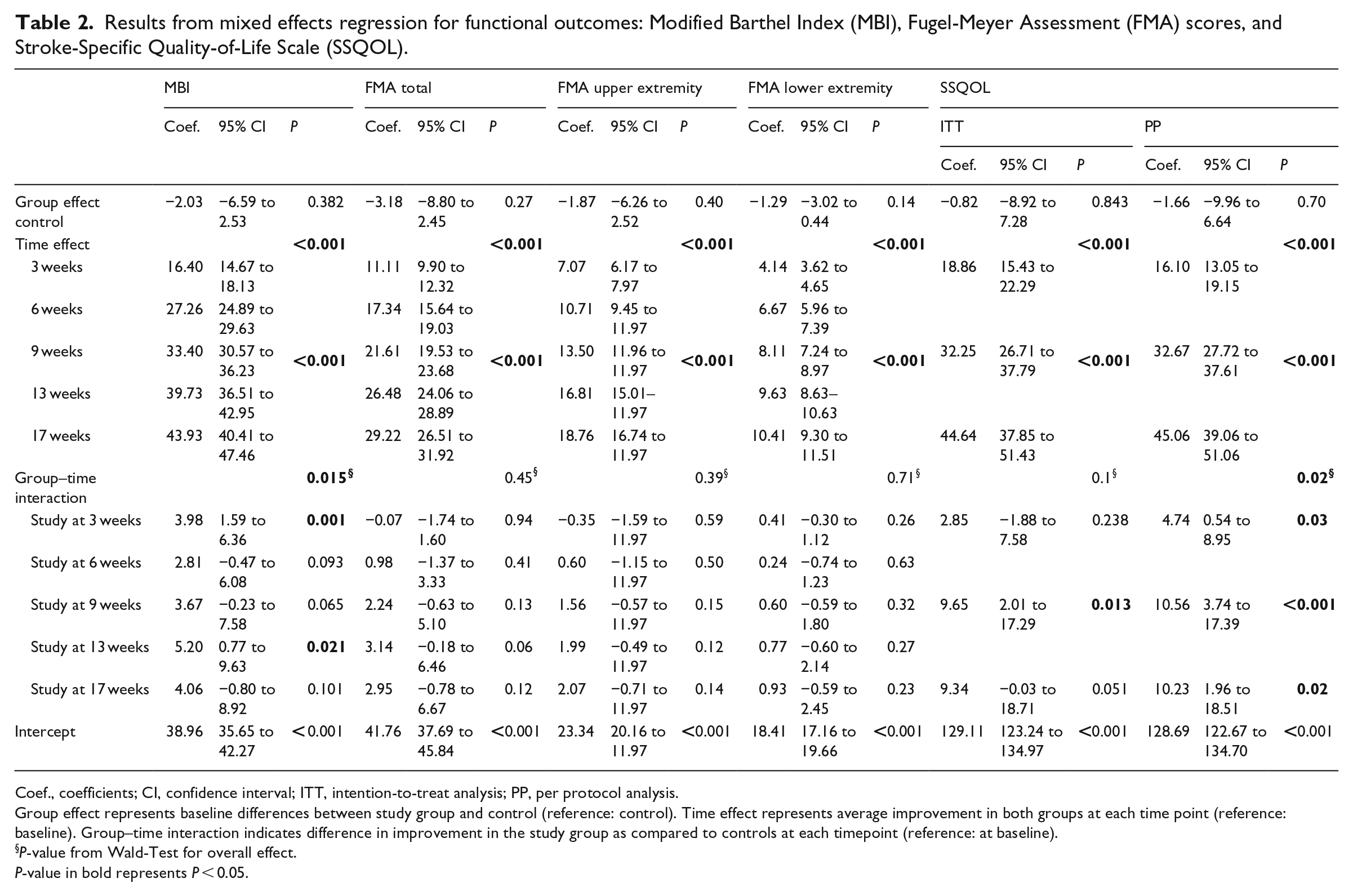
Coef., coefficients; CI, confidence interval; ITT, intention-to-treat analysis; PP, per protocol analysis.
Group effect represents baseline differences between study group and control (reference: control). Time effect represents average improvement in both groups at each time point (reference: baseline). Group–time interaction indicates difference in improvement in the study group as compared to controls at each timepoint (reference: at baseline).
P-value from Wald-Test for overall effect.
P-value in bold represents P < 0.05.
Group means of modified Barthel Index, Fugel-Meyer Assessment, and Stroke-Specific Quality-of-Life Scale by timepoints and 95% CIs.
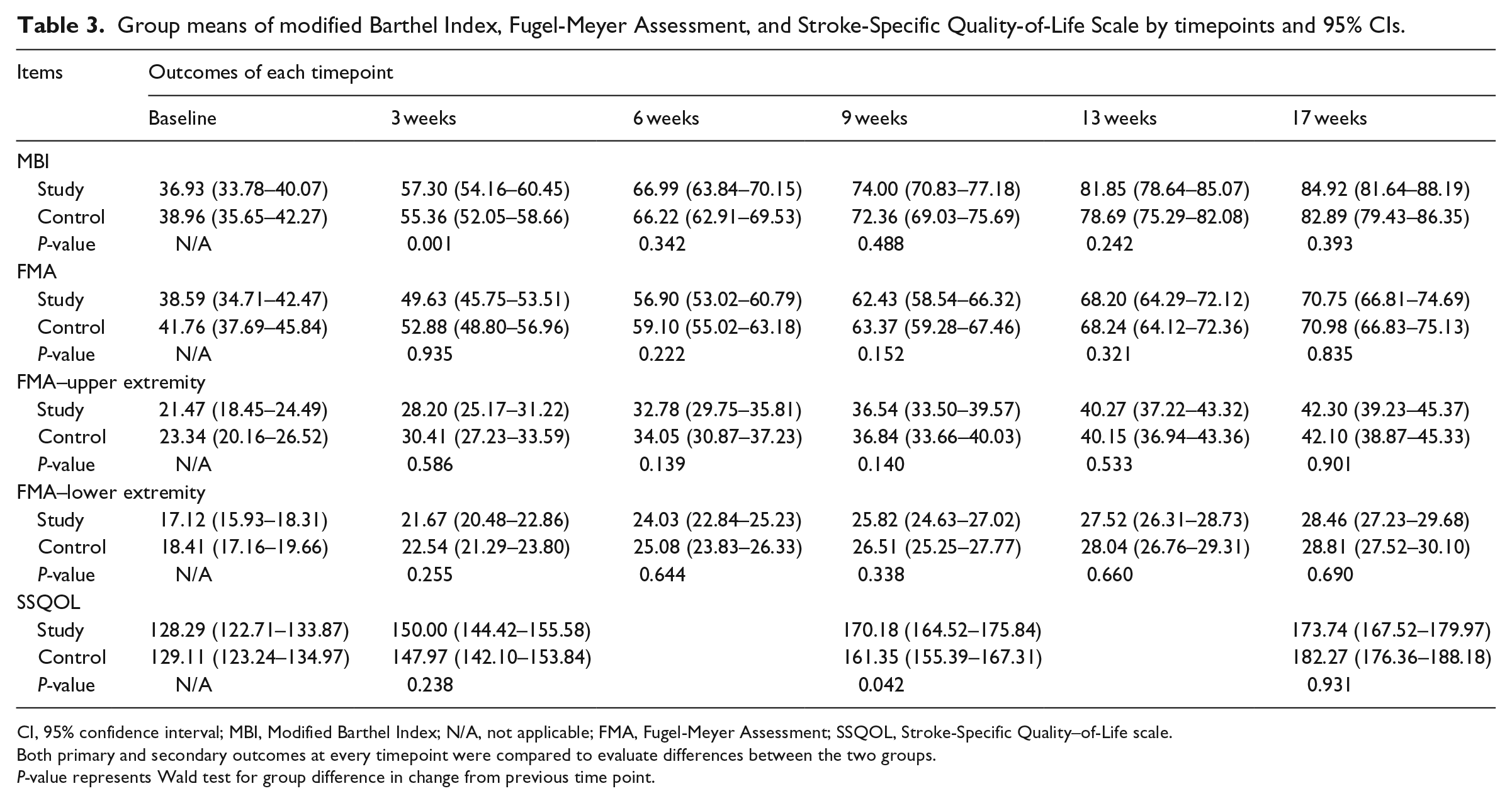
CI, 95% confidence interval; MBI, Modified Barthel Index; N/A, not applicable; FMA, Fugel-Meyer Assessment; SSQOL, Stroke-Specific Quality–of-Life scale.
Both primary and secondary outcomes at every timepoint were compared to evaluate differences between the two groups.
P-value represents Wald test for group difference in change from previous time point.
For the secondary outcomes of motor function and quality of life, both groups improved in motor function according to Fugel-Meyer scores over time. While this increase was somewhat stronger in the study group, we did not detect any significant group differences over time for the Fugel-Meyer total score as well as the Fugel-Meyer upper and lower extremity subscale scores (see Tables 2 and 3). Quality of life as measured with the SSQOL Scale improved over time in both groups. While the Wald test for the overall interaction between timepoint and study group was not significant, increase in SSQOL Scale scores as opposed to baseline was 9.65 points higher in the study group at nine weeks (P = 0.012), a difference that could be sustained until study end-point (see Tables 2 and 3). Contrasts between adjacent timepoints showed a significantly greater increase in the study group between weeks 3 and 9 (P = 0.042) but not for the other intervals.
Results for all functional outcomes from the analyses of patients who had completed all assessments per protocol were not different from intention-to-treat analysis. For the SSQOL Scale, however, the Wald test for the overall interaction between group and timepoint was now significant (P = 0.02) and differences in increase of scores as opposed to baseline were all significantly higher in the study group (see Tables 2 and 3). Contrasts between adjacent timepoints showed now a significantly greater increase in SSQOL Scale scores in the study group between baseline and week 3 (P = 0.027) in addition to week 3 versus 9 (P = 0.047).
Discussion
Participants with stroke receiving physical therapy within a three-tiered rehabilitation program which employed a set of standardized criteria for referral and therapy input at each tier showed greater improvement in ADL independence between week 3 and baseline. After three weeks, the groups developed similarly until study end-point and the effect in favor of the study group was sustained. We found no significant differences between groups for improvement in motor function. Quality of life improved to a greater degree in the study group between weeks 3 and 9 in intention-to-treat analysis and additionally between baseline and week 3 in per protocol analysis. This effect could be sustained until study end-point. Our findings regarding ADL independence are in line with results from previous studies which have found that recovery of ADL independence in stroke patients is strongest at about one month after onset, and the subsequent recovery process is relatively flat.16,17 The greater improvement found for the study group in this early phase may be due to earlier discharge from acute rehabilitation and referral to community-based outpatient therapy. 1 It is, however, also conceivable that those who did not reach the criteria for referral or discharge profited from longer inpatient therapy. It seems unlikely that group differences were due to improvements in motor function which did not differ significantly between groups.
Differences in increase in quality of life in favor of the study group were particularly accentuated in the per protocol analysis. This may indicate that patients who complied with the protocol and participated in the three-tiered rehabilitation program with standardized criteria for referral and therapy input over the full time of the study profited most in terms of quality of life. It could, however, also mean that those whose quality of life did not improve dropped out early. In general, the greater improvement in quality of life in the study group is likely to be owed to earlier and progressing referral to a community-based environment which for patients with mild to moderate neurological impairment usually occurs between three and nine weeks after commencement of therapy. Mayo and colleagues, for instance, have reported significant improvement in instrumental ADL, reintegration to normal living, and quality of life evaluated with the Medical Outcomes Short Form-36 for early supported discharge of stroke survivors at three months. 18 In a randomized controlled trial, Fjaertoft et al. also reported long-term effects of early supported discharge on quality of life for older stroke survivors. 19 Although a recent Cochrane review on early supported discharge for acute stroke provided limited evidence on improved functional outcomes in experimental groups, it demonstrated that patients with mild-to-moderate disability at baseline (similar to those included in the present study) may profit more from the intervention than those with more severe stroke in terms of a greater reduction in dependency. 20
No study apart from the present one has analyzed the effect of objective referral and discharge criteria in an integrated care delivery system for stroke patients so far. Due to poorly organized and highly fragmented transitional care for stroke patients, 21 further research addressing strategy and management of rehabilitation delivery is still needed to determine applicability to clinical practice.
Although this was a multicenter study, participating hospitals were from urban areas with a relatively well developed economy in China, limiting generalizability of results. Another limitation lies in the choice of the functional outcome measures, that is, both MBI and FMA suffer from ceiling effects making it more difficult to detect group differences, the longer the follow-up.14,22,23 This problem may have been enhanced through our decision to include only patients with mild motor impairments. Future studies need to expand inclusion criteria in this respect and will require comprehensive assessment and comparison of patients with different levels of dysfunction. Moreover, neither were soft outcomes such as patient and therapist satisfaction with care nor were economic indicators such as length of stay or treatment costs assessed in our study. In particular, lack of documentation of length of stay and hours of therapy in each Tier precluded the estimation of costs and evaluation of the cost-effectiveness of this strategy. It is recommended that future research encompasses the aforementioned outcomes. In addition, providing a monetary reward to ensure participants’ compliance may have motivated them to adhere to the program. Without such incentive patients might have stopped practicing earlier.
Conclusion
We found limited evidence for the effectiveness of a three-tiered rehabilitation program with standardized criteria for referral and physical therapy input on ADL independence and quality of life, particularly owed to faster improvement within the early and early-post-acute phase of rehabilitation. No effects on motor function were found.
Clinical messages
The introduction of rules concerning criteria determining transfer from setting to setting and therapy input in each setting made a limited difference to ADL and quality-of-life outcomes and no difference to motor function in the rehabilitation of stroke survivors with mild-to-moderate neurological impairments.
Effects on lengths of stay and costs of rehabilitation have yet to be determined.
Supplemental Material
Supplemental_Material – Supplemental material for Effects of the introduction of objective criteria for referral and discharge in physical therapy for ischemic stroke in China: a randomized controlled trial
Supplemental material, Supplemental_Material for Effects of the introduction of objective criteria for referral and discharge in physical therapy for ischemic stroke in China: a randomized controlled trial by Nan Xia, Jan D Reinhardt, Shouguo Liu, Juanjuan Fu, Caili Ren, Hongxing Wang and Jianan Li in Clinical Rehabilitation
Footnotes
Acknowledgements
We thank Dr Chunxiao Wan from Tianjin Medical University, Dr Deqiang Wang from Binzhou Medical College, Dr Wei Chen from the fourth Hospital of Xuzhou City, Dr Jie Xiang from Xuzhou Medical University, Dr Deliang Cai from Wuxi Tongren International Rehabilitation Hospital, Dr Weixin Yang and Min Su from the first Affiliated Hospital of Suzhou University, Huaping Pan from the Affiliated Jiangning Hospital of Nanjing Medical University, Dr Ling Feng from the people’s Hospital of Shaoxing City, Dr Guangyu Shen from the Affiliated Hospital of Nantong University, and Dr Beibei Wang from the Affiliated Mingji Hospital of Nanjing Medical University, for their help in recruiting patients. We also thank Prof. Rongbin Yu from Nanjing Medical University School of Public Health for data analyses and helpful comments.
Author contributions
Jianan Li and Hongxing Wang contributed to the conception of the study. Nan Xia wrote the first draft. Jan D. Reinhardt performed the data analyses. All authors revised the manuscript for critical content. All authors have read and agreed with the submitted version of the manuscript.
Declaration of conflicting interests
The author(s) declared no potential conflicts of interest with respect to the research, authorship, and/or publication of this article.
Ethics approval
Study participants voluntarily agreed to participate in the study and provided written informed consent prior to enrollment. The study was approved by the Ethics Committee of The First Affiliated Hospital of Nanjing Medical University (No. 2014–60).
Funding
The author(s) disclosed receipt of the following financial support for the research, authorship, and/or publication of this article: This work was supported by Science and Technology Projects in Clinical Medicine of Jiangsu Province (BL2012029) and Priority Academic Program Development of Jiangsu Higher Education Institutions (JX10231801; HW).
Trial registration
Unique identifier: ChiCTR-TRC-14004503

Supplemental material
Supplemental material for this article is available online.
References
Supplementary Material
Please find the following supplemental material available below.
For Open Access articles published under a Creative Commons License, all supplemental material carries the same license as the article it is associated with.
For non-Open Access articles published, all supplemental material carries a non-exclusive license, and permission requests for re-use of supplemental material or any part of supplemental material shall be sent directly to the copyright owner as specified in the copyright notice associated with the article.
