






Abstract
Objective
To identify and map the intervention models, outcome domains and evidence gaps of telerehabilitation studies initiated during the hospital-to-home transition after a stroke.
Design
A scoping review following the Arksey and O'Malley framework, reported according to the Preferred Reporting Items for Systematic Reviews and Meta-Analyses extension for Scoping Reviews.
Data sources
PubMed, Web of Science and Physiotherapy Evidence Database were searched from 2000 onward (original search: April 2025). An updated supplementary search using broader terms was conducted in the same three databases in May 2026, applying the same start date and the same eligibility criteria.
Review methods
Two independent reviewers screened the titles, abstracts and full texts. Data on the study design, participants, intervention characteristics, comparators and outcomes were extracted and descriptively synthesised. The studies were grouped by intervention model.
Results
Eighteen studies were included and classified into four models: caregiver-mediated exercise, technology-driven motor telerehabilitation, multidisciplinary transitional care and low-technology or mobile health-supported. Technology-driven models showed motor outcomes comparable to conventional rehabilitation but inconsistent between-group superiority. Caregiver-mediated models did not improve primary mobility outcomes but suggested benefits for caregivers and psychosocial outcomes. Multidisciplinary models frequently improved quality of life, self-management and broader outcomes. Participation-level outcomes remained under-represented in the literature.
Conclusion
Telerehabilitation during the hospital-to-home transition is feasible and has been delivered through diverse models. Future research should evaluate participation, community reintegration, caregiver outcomes and implementation fidelity.
Introduction
For stroke survivors, the transition from hospital care to home represents a critical stage, often marked by increased vulnerability due to gaps in support. Early Supported Discharge is recommended to address the challenges in this transitional phase. 1 Early Supported Discharge reduces hospital stay by providing intensive multidisciplinary rehabilitation at home post-discharge. Its effectiveness in promoting long-term independence and improving activities of daily living (ADL) has been confirmed by a Cochrane Review. 1 However, Early Supported Discharge implementation requires substantial medical resources and multidisciplinary collaboration. As eligibility is restricted to mild-to-moderate cases, fewer patients can benefit from this approach. 2 Many patients experience reduced rehabilitation services after discharge. Studies show that the number of individuals transitioning from ADL independence to requiring assistance increases within the first year after stroke. 3 This highlights the need for new support systems to address unmet needs post-discharge. 4
Beyond physical recovery, stroke survivors face challenges in resuming their social roles, community participation, and meaningful daily activities. Participation restrictions and reduced community reintegration are commonly reported unmet needs after discharge. 4 Informal caregivers also play a critical role during this transition, and their well-being may be affected by the demands of supporting recovery at home. Therefore, addressing patient participation and caregiver well-being alongside motor and functional outcomes is essential for comprehensive post-discharge rehabilitation.
Telerehabilitation, facilitated by information and communication technology, has emerged as a solution to address these issues by transcending geographical barriers and enabling continuous post-discharge intervention. Systematic reviews indicate that telerehabilitation is non-inferior to traditional in-person rehabilitation for enhancing motor function and ADL. 5 While evidence supporting telerehabilitation is growing, heterogeneity in delivery format (synchronous vs asynchronous), devices used and timing prevents definitive conclusions. 6 Among the 22 randomised controlled trials in the Cochrane Review, only eight studies enrolled participants immediately post-discharge. 6 Thus, the effectiveness of telerehabilitation during the immediate post-discharge period remains uncertain, and given the heterogeneity in intervention models and outcomes, meta-analysis requires initial comprehensive mapping of the research landscape.
While existing reviews, such as the Cochrane Review, have focused on chronic stroke or combined all phases, a gap remains in the literature. No scoping review has thoroughly examined telerehabilitation in stroke survivors during the transition from hospital to home. This scoping review aimed to identify, map and categorise the intervention models, outcome domains and evidence gaps of telerehabilitation studies initiated in the early post-discharge period. This review sought to provide a structured overview of the current evidence to guide future research priorities and inform clinical practice in post-discharge telerehabilitation.
Methods
Study design
This scoping review followed the methodological framework proposed by Arksey and O'Malley 7 and was reported in accordance with the Preferred Reporting Items for Systematic Reviews and Meta-Analyses extension for Scoping Reviews checklist. 8 As only published data were used, institutional review board approval and informed consent were not required. The study protocol was prospectively registered with the International Prospective Register of Systematic Reviews (registration number CRD420251029829). After the peer review, an updated supplementary search (6 May 2026) was conducted and documented as a protocol amendment without changing the review question, eligibility criteria or synthesis approach.
Eligibility criteria
The eligibility criteria encompassing participant selection, timing of intervention and intervention specifics were formulated based on the analysis of telerehabilitation for stroke patients by Laver et al., 6 with adjustments to emphasise the early post-discharge period of the intervention. The target population was adult stroke survivors (≥18 years) with a confirmed diagnosis of ischemic or haemorrhagic stroke who had been discharged from an acute, convalescent or inpatient rehabilitation hospital setting to their homes. Studies that included patients with other neurological disorders without comorbid stroke, patients younger than 18 years of age and patients discharged to facilities such as nursing homes, long-term care facilities or residential care institutions were excluded from the study.
The intervention of interest was home-based telerehabilitation that incorporated elements of physical therapy or occupational therapy and was initiated within six months after hospital discharge or explicitly bridged the transition from inpatient rehabilitation to the home setting. The six-month window was selected to capture the early post-discharge period during which functional decline is most likely to occur, and rehabilitation needs are greatest.3,4 Eligible interventions included programmes delivered via videoconferencing, web-based platforms, mobile applications, wearable devices, virtual reality systems, interactive digital media or other digital communication technologies. Hybrid models combining in-person sessions with remote rehabilitation components were eligible if the remote component supported post-discharge rehabilitation in a home setting. Telerehabilitation components embedded within Early Supported Discharge or transitional care models were also eligible. Interventions consisting solely of nursing care or speech-language therapy, remote medical consultation without a rehabilitative component or in-person rehabilitation without a telerehabilitation component were excluded from the study.
For controlled studies, eligible comparators included usual care, in-person rehabilitation, home-based rehabilitation without telerehabilitation components, outpatient rehabilitation, self-managed rehabilitation, waitlist control or another telerehabilitation model. Uncontrolled pilot, feasibility, cohort and case series studies were also eligible if they met the population, intervention, timing and outcome criteria.
This review included randomised controlled trials, non-randomised controlled trials, cohort studies, case series and pilot or feasibility studies. Single-case reports, study protocols, qualitative studies without quantitative outcomes, systematic reviews, narrative reviews, conference abstracts without full-text publications, opinion papers and editorials were excluded. Only articles published in English from 2000 onward were considered, reflecting the widespread introduction of modern telerehabilitation technology. No geographical restrictions were applied.
Information sources and search strategy
A comprehensive literature search was conducted in PubMed, Web of Science and the Physiotherapy Evidence Database, which together cover biomedical, interdisciplinary and rehabilitation-specific research topics. The original search was conducted on 12 April 2025. The searches were conducted using database-specific controlled vocabulary and free-text terms that combined four key concepts: (1) stroke, (2) early supported discharge or hospital-to-home transition, (3) telerehabilitation or remote rehabilitation and (4) activity, participation and post-discharge outcomes.
For PubMed, the original search strategy combined Medical Subject Headings and free-text terms across the four key concepts using Boolean operators. For Web of Science, topic searches combined stroke-related, discharge-related, telerehabilitation-related and rehabilitation-related terms. For the Physiotherapy Evidence Database, multiple simple searches using combinations of stroke and telerehabilitation-related terms were conducted and merged manually. The complete search strategies for all the databases are presented in Supplemental file 1.
In response to peer-review comments regarding the sensitivity of the search strategy, an updated supplementary search was conducted on 6 May 2026, in the same three databases, using the same start date (2000 onward) and the same eligibility criteria. This supplementary search used broader terms related to community rehabilitation, virtual rehabilitation, virtual reality, activity tracking, wearable devices, home-based rehabilitation, post-discharge rehabilitation, mobile health and web-based rehabilitation. The complete supplementary search strategies are also presented in Supplemental file 1. The supplementary search was performed to evaluate whether the original strategy had missed eligible studies relevant to the hospital-to-home transition period and was documented as an amendment to the registered protocol.
The reference lists of the included articles were also reviewed to identify additional eligible studies that might not have been retrieved through database searches. The complete original and supplementary search strategies are presented in Supplemental file 1.
Selection of sources of evidence
The search results from all databases were exported and consolidated, and duplicate records were removed. Two independent reviewers (HT and KY) screened the titles and abstracts to assess eligibility. This was followed by a full-text evaluation of potentially relevant articles by the same reviewers (HT and KY). Disagreements were resolved through discussion until a consensus was reached.
The same predefined eligibility criteria described above were applied to both the original and updated supplementary searches. The final set of included studies was summarised in a flow diagram following the Preferred Reporting Items for Systematic Reviews and Meta-Analyses extension for Scoping Reviews.
Data charting and synthesis
Data were extracted from each study using a structured approach developed by the research team. One reviewer (HT) extracted the data, and a second reviewer (KY) verified the accuracy of extraction. The extracted items included study design and setting, sample size and participant characteristics, timing of telerehabilitation initiation after discharge or during the hospital-to-home transition, duration, frequency and intensity of the intervention, technology platforms used, specific rehabilitation components, professional disciplines involved, comparator conditions when applicable, follow-up duration, outcome domains, main quantitative findings and safety outcomes.
The outcome domains included motor impairment, balance and mobility, ADL, functional independence, quality of life, self-efficacy, mood or psychosocial outcomes, caregiver-related outcomes, participation or community reintegration, healthcare use and adverse events. Studies without a comparator group were used to describe feasibility, safety, intervention characteristics, dose, adherence and implementation features but not to infer comparative effectiveness.
Given the heterogeneity of the populations, intervention models, outcome measures, study designs and follow-up periods, the results were synthesised descriptively. The included studies were grouped into four intervention models according to delivery method, rehabilitation content and level of professional or caregiver involvement: caregiver-mediated exercise, technology-driven motor telerehabilitation, multidisciplinary transitional care and low-technology or mobile health-supported models. The intervention model categories were not defined a priori but were developed inductively during synthesis based on the characteristics of the included studies.
Results
Literature selection
The original database search identified 70 records, of which 10 studies were included in the initial review. In response to the peer-review comments, we conducted an updated supplementary search on 6 May 2026, using broader terms related to community rehabilitation, virtual rehabilitation, virtual reality, activity tracking, wearable devices, home-based rehabilitation and post-discharge rehabilitation.
The updated supplementary search identified 1270 records: 239 from PubMed, 961 from the Web of Science, and 70 from the Physiotherapy Evidence Database. After removing 220 duplicates, of the 1050 records screened, 1040 were excluded after title and abstract review and 10 full-text articles were assessed for eligibility. Eight additional studies met the eligibility criteria and were included in this review. Two full-text articles were excluded: one because the report did not clearly specify discharge from hospital to home or intervention initiation within six months after hospital discharge, and the other because the study enrolled a mixed subacute and chronic stroke population without separable data for the predefined early post-discharge window.
Thus, 18 studies were included in this scoping review. The updated study selection process is illustrated in Figure 1.
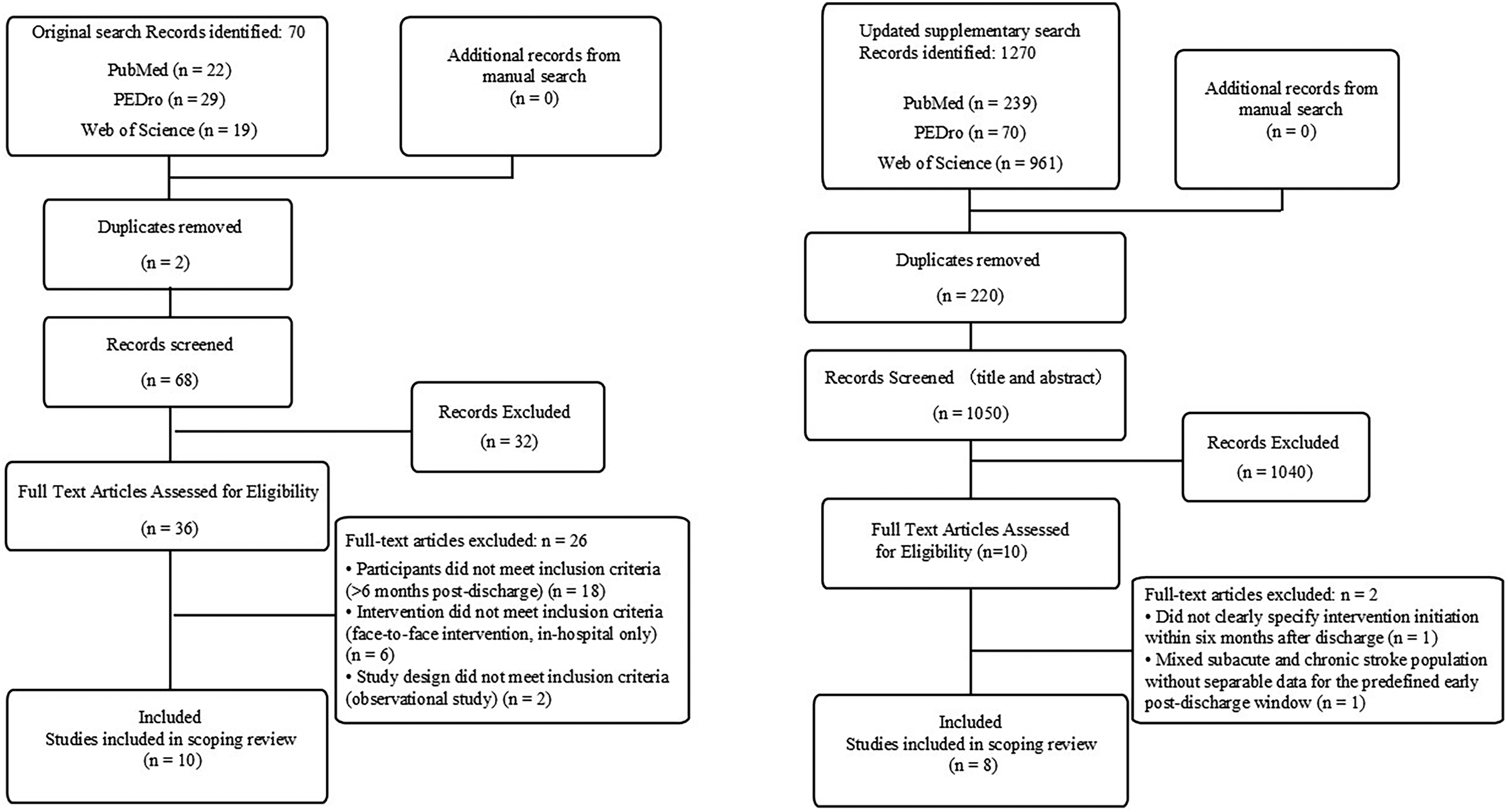
PRISMA flow diagram for the original and updated supplementary searches.
Characteristics of included studies
The characteristics of the 18 included studies are summarised in Table 1.9–26 The included studies consisted of randomised controlled trials,9–11,14,17–20,22,25 pilot or feasibility randomised trials,12,23,26 controlled studies13,16,24 and one uncontrolled feasibility study. 21 The studies were conducted in the United States, Netherlands, China, Canada, Australia, Spain, Singapore, New Zealand and other settings. The sample sizes ranged from 16 participants in a feasibility study to 200 participants in a post-discharge randomised controlled trial. Most studies enrolled stroke survivors during the early post-discharge or subacute recovery periods. One feasibility study was initiated during inpatient rehabilitation and completed in the home setting, and it was included as a hospital-to-home transition model rather than as comparative effectiveness evidence. 21
Characteristics and outcomes of telerehabilitation during the hospital-to-home transition after stroke.
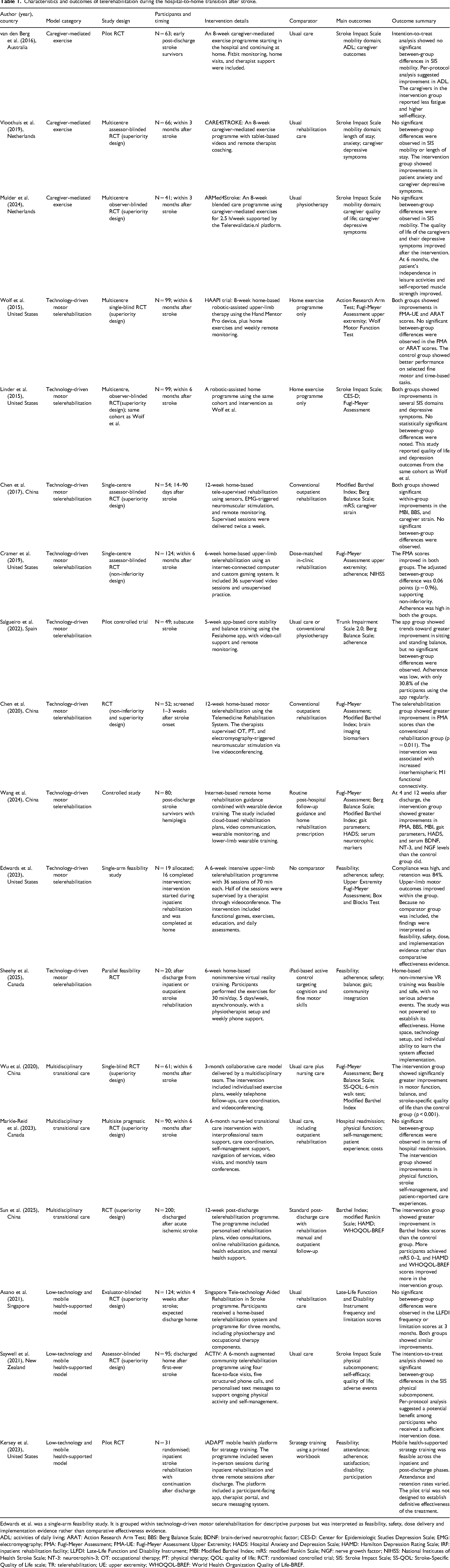
Edwards et al. was a single-arm feasibility study. It is grouped within technology-driven motor telerehabilitation for descriptive purposes but was interpreted as feasibility, safety, dose delivery and implementation evidence rather than comparative effectiveness evidence.
ADL: activities of daily living; ARAT: Action Research Arm Test; BBS: Berg Balance Scale; BDNF: brain-derived neurotrophic factor; CES-D: Center for Epidemiologic Studies Depression Scale; EMG: electromyography; FMA: Fugl-Meyer Assessment; FMA-UE: Fugl-Meyer Assessment Upper Extremity; HADS: Hospital Anxiety and Depression Scale; HAMD: Hamilton Depression Rating Scale; IRF: inpatient rehabilitation facility; LLFDI: Late-Life Function and Disability Instrument; MBI: Modified Barthel Index; mRS: modified Rankin Scale; NGF: nerve growth factor; NIHSS: National Institutes of Health Stroke Scale; NT-3: neurotrophin-3; OT: occupational therapy; PT: physical therapy; QOL: quality of life; RCT: randomised controlled trial; SIS: Stroke Impact Scale; SS-QOL: Stroke-Specific Quality of Life scale; TR: telerehabilitation; UE: upper extremity; WHOQOL-BREF: World Health Organization Quality of Life-BREF.
Characteristics of telerehabilitation interventions
The included studies were grouped into four intervention models according to delivery method, rehabilitation content and level of professional or caregiver involvement: caregiver-mediated exercise, technology-driven motor telerehabilitation, multidisciplinary transitional care and low-technology or mobile health-supported models.
Caregiver-mediated exercise models used structured home exercise programmes delivered by caregivers under therapist supervision. Vloothuis et al., Mulder et al., and van den Berg et al. evaluated caregiver-mediated exercise programmes supported by e-health systems, video materials, Fitbit monitoring or scheduled therapist contact.9,10,12 These programmes aimed to increase practice intensity after discharge while maintaining therapist oversight through remote support.
Technology-driven motor telerehabilitation models use digital systems to deliver task-specific motor training in home settings. Cramer et al. evaluated an Internet-connected upper-limb rehabilitation system with supervised video sessions and home practice. 14 Wolf et al. and Linder et al. reported outcomes from a home-based robotic-assisted upper-limb programme using the same study cohort.15,17 Chen et al. evaluated home-based telesupervised rehabilitation using sensors and remote monitoring. 13 Salgueiro et al. evaluated an app-based balance training programme in the subacute stage after stroke. 16 The supplementary search identified additional technology-driven models, including home-based motor telerehabilitation with live videoconferencing in Chen et al., wearable-assisted remote home rehabilitation in Wang et al, early intensive telerehabilitation initiated during inpatient rehabilitation and completed at home in Edwards et al., and home-based nonimmersive virtual reality training after discharge in Sheehy et al.21,23–25 These interventions primarily targeted motor impairment, balance, mobility and functional independence.
Multidisciplinary transitional care models combine telerehabilitation with care coordination, education, self-management support, psychological support and professional follow-up. Wu et al. evaluated a collaborative care model that included individualised exercise, multidisciplinary professional input and remote follow-up. 11 Markle-Reid et al. evaluated a nurse-led transitional care intervention for older stroke survivors with multimorbidity. 18 Sun et al. evaluated a 12-week post-discharge telerehabilitation programme for acute ischemic stroke survivors that included personalised rehabilitation plans, video consultations, online rehabilitation guidance, health education and mental health support. 22 These programmes were designed not only to deliver exercise but also to support the broader transition from hospital to home.
Low-technology and mobile health-supported models use readily available technologies, including telephone calls, text messages, mobile applications, web portals and secure messaging systems. Asano et al. evaluated the Singapore Tele-technology Aided Rehabilitation in Stroke trial, which used a home-based telerehabilitation system and programme during the first three months after stroke. 19 Saywell et al. evaluated the Augmented Community Telerehabilitation Intervention, a six-month programme using face-to-face sessions, telephone contact and text message reminders after discharge. 20 Kersey et al. evaluated iADAPT, a mobile health platform for strategy training initiated during inpatient rehabilitation and continued after discharge through remote sessions. 26 These interventions focused on maintaining rehabilitation engagement, supporting activity-based goals and improving continuity of care after discharge.
Effects of telerehabilitation and outcome measures
The effects of telerehabilitation varied according to the intervention model, study design, comparator and outcome domain. In technology-driven motor telerehabilitation trials, several studies have reported outcomes comparable to those of conventional rehabilitation or active control interventions. Cramer et al. reported that upper-limb Fugl-Meyer Assessment scores improved in both the telerehabilitation and in-clinic groups, with an adjusted between-group difference of 0.06 points (p = 0.96), supporting non-inferiority. 14 Wolf et al. and Linder et al. reported improvements in upper-limb function, quality of life and depressive symptoms in both robotic-assisted home therapy and home exercise groups, without consistent between-group superiority.15,17
Several additional technology-driven studies have reported favourable motor or functional outcomes. Chen et al. found that a 12-week home-based motor telerehabilitation programme significantly improved Fugl-Meyer Assessment scores compared with conventional rehabilitation (p = 0.011). 25 Wang et al. reported greater improvements in Fugl-Meyer Assessment, Berg Balance Scale, Modified Barthel Index, gait parameters, anxiety and depression scores, and serum neurotrophic markers at 4 and 12 weeks after discharge in the internet and wearable-assisted rehabilitation group compared with routine post-discharge guidance (p < 0.05). 24 Sheehy et al. found that home-based nonimmersive virtual reality training after discharge was feasible and safe, with no serious adverse events; however, the trial was not powered to establish effectiveness. 23 Edwards et al. reported high compliance, 84% retention and large within-group improvements in upper-limb motor outcomes after an intensive telerehabilitation programme initiated during inpatient rehabilitation and completed at home. 21 Because Edwards et al. had no comparator group, its findings were interpreted as feasibility, safety, dose delivery and implementation evidence rather than comparative effectiveness evidence. 21
In caregiver-mediated exercise models, the between-group differences in primary mobility outcomes were generally not significant. Vloothuis et al., Mulder et al. and van den Berg et al. reported no significant between-group differences in Stroke Impact Scale mobility outcomes.9,10,12 However, these studies suggested potential benefits for selected secondary outcomes, including caregiver depressive symptoms, caregiver quality of life, patient anxiety, self-reported muscle strength and independence in leisure activities.9,10,12
Broader benefits were more frequently observed in multidisciplinary transitional care models. Wu et al. reported significantly greater improvements in motor function, balance and stroke-specific quality of life in the collaborative care telerehabilitation group compared with control care (p < 0.001). 11 Markle-Reid et al. found no significant difference in hospital readmission, but reported improvements in physical function, stroke self-management and patient-reported experience. 18 Sun et al. reported that a 12-week post-discharge telerehabilitation programme improved Barthel Index scores, modified Rankin Scale outcomes, depressive symptoms and quality of life compared with standard post-discharge care. 22 In Sun et al., the Barthel Index improved from 65.4 ± 12.3 to 88.7 ± 9.6 in the intervention group and from 65.6 ± 12.1 to 74.9 ± 13.2 in the control group (p < 0.001). 22
Low-technology and mobile health-supported models produced mixed results. Asano et al. reported no significant between-group differences in Late-Life Function and Disability Instrument frequency and limitation scores at three months, although both groups improved. 19 The mean between-group differences were −3.30 points (95% confidence interval, −7.81 to 1.21) for the frequency score and −6.90 points (95% confidence interval, −15.02 to 1.22) for the limitation score. 19 Saywell et al. reported that the Augmented Community Telerehabilitation Intervention programme did not significantly improve the Stroke Impact Scale physical subcomponent in the intention-to-treat analysis, but the per-protocol analysis suggested a potential benefit among participants who received a sufficient intervention dose. 20 Kersey et al. found that mobile health-supported strategy training was feasible across inpatient rehabilitation and the post-discharge period, but intervention attendance and retention varied, and the pilot trial was not designed to establish definitive effectiveness. 26
Safety, feasibility and adherence
Feasibility and safety outcomes were reported inconsistently across the studies. Most studies that reported adverse events found that home-based telerehabilitation was feasible and did not increase serious adverse events compared with control conditions.14,21,23,25 Technology-driven and virtual reality models generally reported acceptable safety profiles, although adherence varied according to device usability, home space, technical issues, impairment severity and patient motivation.21,23,24
Pilot and feasibility studies provide important information on implementation barriers. Edwards et al. showed that intensive telerehabilitation could be initiated during inpatient rehabilitation and completed at home with high compliance and retention; however, the absence of a comparator group limited conclusions about comparative effectiveness. 21 Sheehy et al. reported that nonimmersive virtual reality training could be installed and used in the home setting; however, home space, technical setup and individual ability to learn the system affected implementation. 23 Kersey et al. found that a mobile health platform could support strategy training across inpatient and post-discharge phases; however, withdrawal and attendance issues indicated that additional refinement may be needed before definitive effectiveness testing. 26 These findings suggest that feasibility, usability, adherence support and technical assistance are central components of telerehabilitation delivery during the hospital-to-home transition.
Discussion
This scoping review identified 18 studies that examined telerehabilitation during the hospital-to-home transition after stroke and classified them into four intervention models: caregiver-mediated exercise, technology-driven motor telerehabilitation, multidisciplinary transitional care and low-technology or mobile health-supported. This framework illustrates that telerehabilitation during this transition is not a single type of intervention but spans high-technology motor training systems, caregiver-supported exercise programmes, multidisciplinary transitional care and pragmatic low-technology approaches using telephone calls, text messages, mobile applications and web-based platforms. Figure 2 provides a visual summary of the four intervention models, the main outcome domains assessed, and the evidence gaps identified in this review.
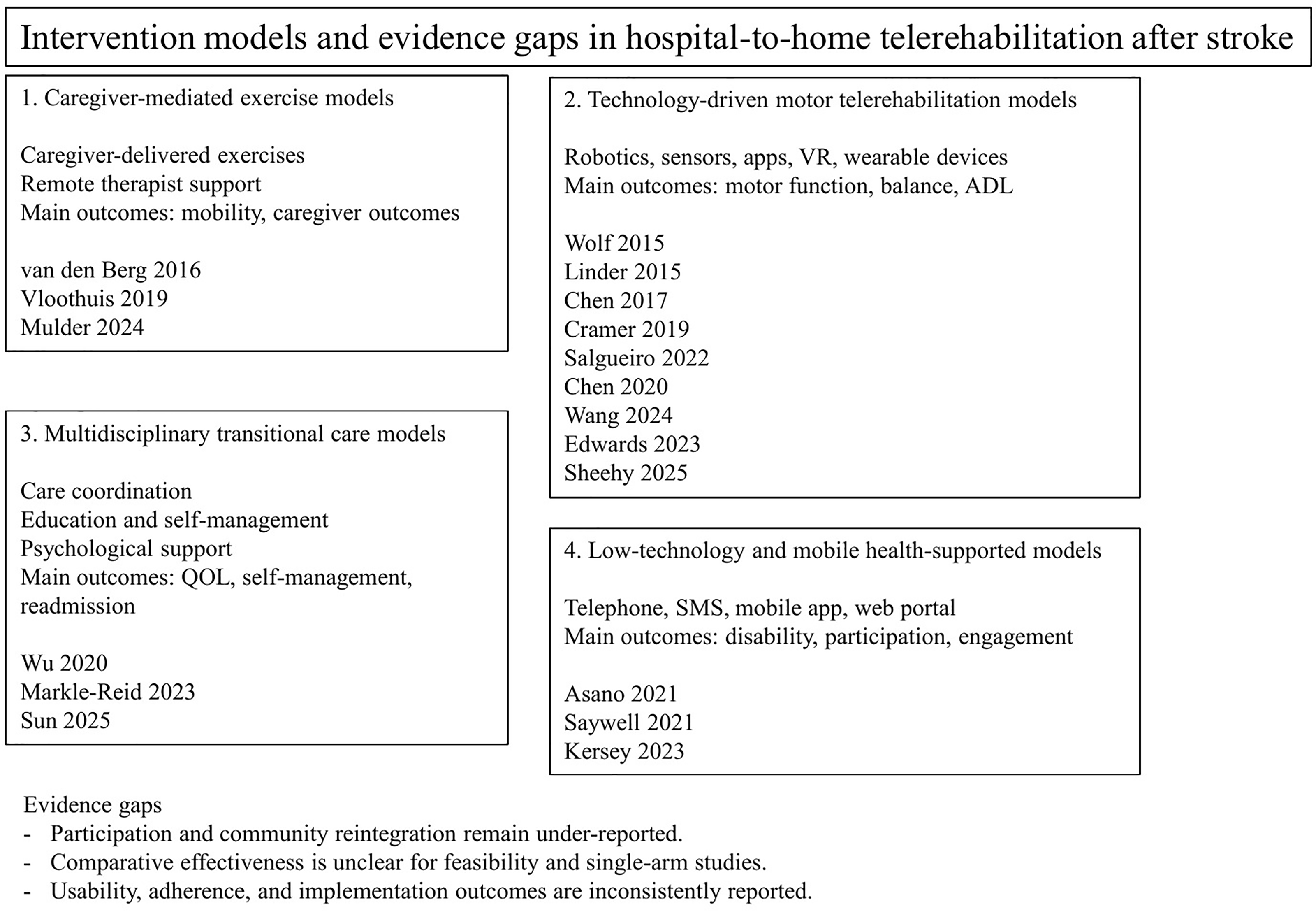
Overview of intervention models and evidence gaps in telerehabilitation during the hospital-to-home transition after stroke.
The main finding was that technology-driven motor telerehabilitation can provide a feasible way to continue task-specific rehabilitation at home; however, its comparative effectiveness remains inconsistent. Cramer et al. showed that home-based upper-limb telerehabilitation was non-inferior to dose-matched in-clinic rehabilitation for upper-limb motor recovery. 14 Chen et al. reported greater improvement in Fugl-Meyer Assessment scores after home-based motor telerehabilitation than after conventional rehabilitation. 25 In contrast, Wolf et al., Linder et al., Chen et al. and Salgueiro et al. reported improvements in both intervention and control groups without consistent between-group superiority.13,15–17 These findings suggest that technology-supported motor telerehabilitation may help preserve rehabilitation dose and access after discharge, but the added benefit over active rehabilitation comparators may depend on dose, patient selection, impairment severity, device usability and content of the control intervention.
The updated supplementary search added important evidence on virtual reality, wearable-assisted rehabilitation and early intensive telerehabilitation. Sheehy et al. showed that home-based nonimmersive virtual reality training after discharge was feasible and safe, although the feasibility design limited conclusions about effectiveness. 23 Wang et al. reported favourable motor, balance, gait, emotional and neurotrophic marker outcomes after Internet-based remote home rehabilitation combined with wearable device training. 24 Edwards et al. showed that intensive telerehabilitation could be started during inpatient rehabilitation and completed at home with high compliance and retention. 21 However, Edwards et al. was an uncontrolled feasibility study; therefore, its findings should be interpreted as evidence for feasibility, dose delivery, safety and implementation rather than comparative effectiveness. 21 These studies directly address the concern that search strategies limited to conventional telerehabilitation terms may miss emerging modalities such as virtual rehabilitation, wearable devices and activity tracking.
Caregiver-mediated exercise models form a distinct group. Vloothuis et al., van den Berg et al. and Mulder et al. used caregivers to support structured exercise practice after discharge, with therapists providing remote or e-health support.9,10,12 These models did not consistently improve primary mobility outcomes compared with usual care. However, they suggested potential benefits for selected secondary outcomes, including caregiver depressive symptoms, quality of life, patient anxiety, self-reported muscle strength and independence in leisure activities. This pattern indicates that caregiver-mediated telerehabilitation may influence the family context of recovery as much as motor recovery.9,10,12 Therefore, future trials should evaluate caregiver burden, caregiver confidence and family-level outcomes, along with patient mobility and ADL.
Multidisciplinary transitional care models are more likely to affect broader outcomes beyond motor impairment. Wu et al. reported significant improvements in motor function, balance and stroke-specific quality of life after collaborative care telerehabilitation. 11 Markle-Reid et al. did not reduce hospital readmission, but improved physical function, stroke self-management and patient-reported care experience. 18 Sun et al. reported improvements in ADL, disability, depressive symptoms and quality of life after a 12-week post-discharge telerehabilitation programme. 22 These findings suggest that the early post-discharge period requires more than exercise delivery. It also requires care coordination, education, self-management and psychosocial support, and timely professional follow-up.11,18,22
Low-technology and mobile health-supported models are clinically important because they may be easier to implement in routine care than device-intensive systems. Asano et al. found no significant between-group differences in self-reported disability outcomes between home-based telerehabilitation and usual care, although both groups improved. 19 Saywell et al. found no significant benefit of the Augmented Community Telerehabilitation Intervention in the intention-to-treat analysis, but the per-protocol analysis suggested a possible dose-related effect. 20 Kersey et al. showed that a mobile health platform could support strategy training across inpatient and post-discharge phases, but attendance and retention challenges remained. 26 These findings suggest that low-technology approaches may improve reach and continuity, but they still require careful attention to the intervention dose, engagement and patient support.
Participation and community reintegration remain under-represented. Several studies have broadened the outcome landscape by including disability, quality of life, self-efficacy, mood or community integration measures.19,20,23,26 However, most studies still prioritised motor impairment, balance, mobility or ADL. This creates a mismatch between the aims of transitional rehabilitation and the outcomes that are most often measured. During the hospital-to-home transition, patients must resume their daily routines, family roles, community mobility and social participation. 4 Consensus-based recommendations for standardised outcome measurements in stroke recovery trials have been proposed, 27 and their adoption in telerehabilitation research would improve comparability across studies. Therefore, future studies should incorporate participation-level outcomes, community reintegration measures, and patient-prioritised outcomes alongside conventional motor and functional scales.
These findings have several implications for clinical practice. First, telerehabilitation may be a practical option for maintaining rehabilitation access after discharge, particularly when outpatient attendance is limited by travel, fatigue, cost or service availability. Second, intervention selection should be matched to the patient's needs. Patients with clear motor goals may benefit from technology-driven motor telerehabilitation, whereas those with complex medical, psychosocial or self-management needs may require multidisciplinary transitional care. Third, hybrid models may be particularly useful in this regard. Several interventions combined in-person assessment, caregiver training, home setup, remote monitoring and asynchronous practices. This structure may improve safety and adherence while preserving flexibility in home-based rehabilitation.
However, implementation barriers remain important. Device-intensive interventions may be limited by home space, digital literacy, setup burden, Internet access, caregiver availability and technical problems.21,23,24 Low-technology interventions may improve accessibility but may have weaker mechanisms for monitoring exercise quality and progression. Feasibility studies have shown that adherence and usability are not secondary concerns; they are central determinants of whether telerehabilitation can deliver a sufficient rehabilitation dose.21,23,26 Future implementation research should report usability, adherence, technical support, intervention fidelity and reasons for non-completion in a standardised way. 27
This review has some limitations. First, as a scoping review, it did not include a formal risk of bias assessment or meta-analysis. The heterogeneity of study designs, intervention models, comparators, outcome measures and follow-up periods precluded a quantitative synthesis. Second, several included studies were pilot or feasibility studies, and one study had no comparator group. These studies were useful for mapping feasibility and implementation features, but should not be used to infer comparative effectiveness. Third, the original search strategy may have been insufficiently sensitive to identify studies described using terms such as virtual rehabilitation, virtual reality, wearable devices, activity tracking or community rehabilitation. We addressed this limitation by conducting an updated supplementary search using broader terms and applying the eligibility criteria. Fourth, the review was restricted to English-language publications from 2000 onward, which may have introduced language and publication biases. Fifth, the databases searched were limited to PubMed, Web of Science and Physiotherapy Evidence Database. EMBASE and CINAHL were not included, which may have resulted in missed studies indexed primarily in these databases. Updated supplementary search and manual reference list screening were conducted to reduce this risk; however, incomplete database coverage remains a limitation.
In conclusion, telerehabilitation during the hospital-to-home transition after stroke is feasible and has been delivered through a diverse range of models. Technology-driven motor telerehabilitation may help maintain rehabilitation dose and access, whereas multidisciplinary transitional care models may be better suited to address broader outcomes, such as quality of life, self-management, mood and care experience. Low-technology and mobile health-supported models may improve reach, but their effects depend on engagement and dosage. Future research should move beyond motor non-inferiority and evaluate participation, community reintegration, caregiver outcomes, implementation fidelity and equitable access to care.
Clinical messages
Four post-discharge telerehabilitation models were identified: caregiver-mediated exercise, technology-driven motor training, multidisciplinary transitional care and low-technology or mobile health support systems.
Multidisciplinary models improved quality of life and self-management more frequently than motor-focused models, which showed outcomes comparable to those of active controls.
Participation and community reintegration remain under-researched outcome priorities in the field.
Supplemental Material
sj-docx-1-cre-10.1177_02692155261465887 - Supplemental material for Telerehabilitation during the hospital-to-home transition for stroke survivors: A scoping review
Supplemental material, sj-docx-1-cre-10.1177_02692155261465887 for Telerehabilitation during the hospital-to-home transition for stroke survivors: A scoping review by Hiroto Takenaka, Hirotaka Iijima, Ryota Ashizawa and Keisuke Yamamori in Clinical Rehabilitation
Footnotes
Acknowledgements
AI-based language tools (Gemini, Google, ChatGPT, OpenAI and Paperpal, Editage) were used to support the English editing of this manuscript. All content was checked and approved by the authors.

Author contributions
Conceptualisation: Hiroto Takenaka, Hirotaka Iijima; methodology: Hiroto Takenaka, Hirotaka Iijima; data curation: Hiroto Takenaka; investigation: Hiroto Takenaka, Keisuke Yamamori, Hirotaka Iijima, Ryota Ashizawa; formal analysis: Hiroto Takenaka; validation: Keisuke Yamamori, Hirotaka Iijima; visualisation: Hiroto Takenaka; writing – original draft: Hiroto Takenaka; writing – review & editing: Keisuke Yamamori, Hirotaka Iijima, Ryota Ashizawa; supervision: Hirotaka Iijima; project administration: Hiroto Takenaka; resources: Hiroto Takenaka; funding acquisition: not applicable; final approval: all authors have read and approved the final manuscript.
Funding
The authors disclosed receipt of the following financial support for the research, authorship, and/or publication of this article: This work was supported by the Japan Society for the Promotion of Science (grant number JP25K20855).
Declaration of conflicting interests
The authors declared no potential conflicts of interest with respect to the research, authorship, and/or publication of this article.
Supplemental material
Supplemental material for this article is available online.
References
Supplementary Material
Please find the following supplemental material available below.
For Open Access articles published under a Creative Commons License, all supplemental material carries the same license as the article it is associated with.
For non-Open Access articles published, all supplemental material carries a non-exclusive license, and permission requests for re-use of supplemental material or any part of supplemental material shall be sent directly to the copyright owner as specified in the copyright notice associated with the article.
