







Abstract
Background:
When healthcare professionals or other involved parties prevent eligible patients from entering a trial as a research subject, they are gatekeeping. This phenomenon is a persistent problem in palliative care research and thought to be responsible for the failure of many studies.
Aim:
To identify potential gatekeepers and explore their reasons for gatekeeping in palliative care research.
Design:
A ‘Review of Reasons’ based on the systematic Preferred Reporting Items for Systematic Reviews and Meta-Analyses approach and a thematic synthesis.
Data source:
PubMed, Embase, Cumulative Index to Nursing and Allied Health Literature and PsycINFO from 2000 to May 20 2015 were searched. Studies in children (aged <18 years) and patients with dementia were excluded.
Results:
Thirty papers on gatekeeping in palliative care research were included. Five groups of potential gatekeepers were identified: healthcare professionals, research ethics committees, management, relatives and researchers. The fear of burdening vulnerable patients was the most reported reason for gatekeeping. Other reasons included ‘difficulty with disclosure of health status’, ‘fear of burdening the patient’s relatives’, ‘doubts about the importance or quality of the study’, ‘reticent attitude towards research and (research) expertise’ and ‘logistics’. In hospice and homecare settings, the pursuit of comfort care may trigger a protective attitude. Gatekeeping is also rooted in a (perceived) lack of skills to recruit patients with advanced illness.
Conclusion:
Gatekeeping is motivated by the general assumption of vulnerability of patients, coupled with an emphasis on the duty to protect patients. Research is easily perceived as a threat to patient well-being, and the benefits appear to be overlooked. The patients’ perspective concerning study participation is needed to gain a full understanding and to address gatekeeping in palliative care research.
Gatekeeping, predominantly by healthcare professionals, is often reported as a cause for recruitment problems in palliative care research.
Gatekeeping is often noted in the literature, but it is rarely specifically studied.
Researchers argue for measures to stop gatekeeping, but it is unclear how and by whom this should be realized.
This study identified five groups of potential gatekeepers.
This work gives a systematic overview of the reasons for gatekeeping per type of gatekeeper.
Gatekeeping is often a result of personal feelings, perceptions or intuitions rather than a deliberate assessment that involves the patient.
The role of the patient in recruitment should be enhanced.
This review shows that gatekeeping must be addressed by all those involved during research development and implementation to overcome unnecessary barriers in palliative care research.
An understanding of the reasons for gatekeeping as perceived by the gatekeepers is a starting point for the development of an approach to avoid unnecessary gatekeeping.
Insight into the views and experiences of patients concerning participation in palliative care research is needed.
To minimize paternalistic protection, an assessment of an individual patient’s vulnerability could be used to determine and facilitate an appropriate level of patient autonomy.
Introduction
Palliative care is a young discipline, and the need to strengthen its evidence base is currently widely acknowledged. To improve palliative care, good research on therapies, psychosocial interventions and the patients’ experiences and needs is essential. However, conducting such studies is problematic. Accruing and retaining patients with advanced illness or near death in clinical studies are challenging. As a result, study samples are much smaller than desired,1–4 and some studies are prematurely terminated without having enrolled a single patient. 5 The recruitment problems are often ascribed to the reluctance of healthcare professionals (HCPs) to include patients in palliative care research (PCR). 6 This phenomenon is usually referred to as ‘gatekeeping’ and has been defined as ‘the process whereby healthcare providers prevent access to eligible patients for research recruitment’. 7
In addition to the problem of recruitment, ethical arguments have been raised regarding gatekeeping. A major concern is that gatekeepers prevent the patients from making their own decisions regarding research participation, thereby overriding their autonomy. To preserve the patients’ right to decide for themselves, patients should at least be informed about the opportunity to participate in medical research. 7
Researchers have sought practical solutions to overcome gatekeeping, such as obtaining data from relatives instead of patients, adapting informed consent procedures or bypassing HCPs in the process of identifying and soliciting eligible patients.2,4,8,9 These solutions may enhance recruitment, but they may not be the best option from the perspective of research quality or the patient. To enhance research in palliative care, both in quality and in quantity, gatekeeping must be thoroughly analysed and adequately addressed.
A systematic review of the relevant literature was performed to identify gatekeepers in PCR and to determine their reasons for gatekeeping.
Method
Design
A ‘review of reasons’ was conducted, based on a model developed by Sofaer and Strech. 10 Their model integrates the systematic approach of the Preferred Reporting Items for Systematic Reviews and Meta-Analyses (PRISMA) statement for reviews 11 and the proper identification and management of arguments to address conceptual questions in ethics literature by means of analytical strategies typically used in qualitative research. 12 The current review was aimed at identifying and qualitatively synthesizing reasons for gatekeeping. Therefore, the synthesis relied on the method of thematic synthesis of qualitative research in a systematic review.13,14
Search strategy
A systematic search was conducted in PubMed, Embase, CINAHL and PsycINFO to identify relevant studies (20 May 2015). Preliminary searches showed that gatekeeping is seldom the primary objective of a study. Most papers referring to gatekeeping were focused on general problems in PCR. Therefore, a broad search strategy was used (Table 1), including a wide range of keywords related to gatekeeping: (gatekeep* OR gate-keep* OR impediment OR impediments OR barrier OR barriers OR challenge OR challenges OR refusal to participate) AND (palliative care OR end of life care OR end-of-life care OR terminal care) AND (particip* OR respondent OR respondents OR patient OR patients) AND (research OR clinical trial OR study) NOT (dementia OR newborn). The reference lists of the included studies were hand-searched to identify additional relevant studies.
PubMed search strategy.
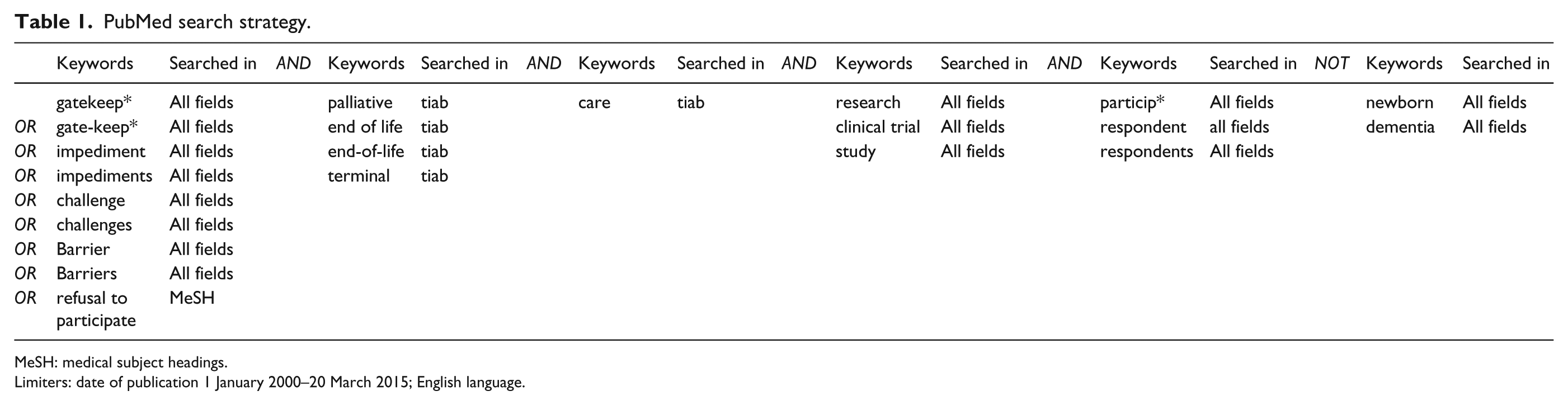
MeSH: medical subject headings.
Limiters: date of publication 1 January 2000–20 March 2015; English language.
Study selection
Two reviewers (M.C.K. and G.J.M.W.v.T.) independently reviewed all the abstracts to select studies eligible for review. Any disagreements were resolved in a consensus meeting. The remaining disagreements were resolved in consultation with the other members of the research team (R.v.d.G., A.d.G. and H.v.D.).
We included full-text original papers based on the following inclusion criteria:
Empirical end-of-life (EOL) studies and reports that presented retrospective analysis of empirical EOL studies.
Eligible studies that reported gatekeeping as a phenomenon in itself or described difficulties that fit our definition of gatekeeping.
The study population of the empirical studies was labelled as ‘hospice population’, ‘patients with advanced illness’ or ‘patients with a life expectancy of less than a year’, who are diagnosed as palliative care patients according to the World Health Organization definition of palliative care. Studies could also include research experiences of representatives and/or relatives and/or professional caregivers with research that included the aforementioned palliative care population.
The studies limited to incompetent patients, such as children (aged <18 years) or patients with dementia, were excluded. Because palliative care is a relative young discipline, as is research in the field of palliative care, and to understand gatekeeping in its current state, studies published before 2000 were excluded. The studies published in languages other than English were also excluded.
Data extraction and analysis
Qualitative techniques and software (NVivo 10) for data extraction and analysis were used. All the articles were read thoroughly by one of the two reviewers (M.C.K. and G.J.M.W.v.T.) resulting in the identification of five types of gatekeepers. They formed the main categories of the code tree. Subsequently, pdf versions of the selected papers were uploaded into NVivo10. An inductive coding process was begun, during which M.C.K. and G.J.M.W.v.T. working in close collaboration selected fragments representing reasons for gatekeeping and labelled them with a code. The data sets were merged several times, and consensus was continuously sought with respect to the content and meaning of the reasons that were identified. When coding difficulties arose, both researchers read the article to resolve the problem by consensus. Whenever possible, the reasons were assigned to the specific categories of gatekeepers. Subsequently, reasons for gatekeeping were analysed within and across the gatekeeper categories.
Results
In this search, 1855 unique papers were identified. Cross-referencing of the referenced studies yielded 10 additional papers. By screening the title and abstract, 51 articles were identified as eligible for review. After full-text screening, 30 papers published between January 2000 and 20 May 2015 were considered relevant to the research question (Figure 1).1–6,8,15–37 Seventeen studies were designed to identify barriers or ethical challenges in PCR and addressed gatekeeping as a study finding.6,15,16,18–22,24,25,28–31,34,35,37 Four studies used hypothetical vignettes to explore, among other themes, the willingness of professionals to include patients in PCR.6,15,27,31 Many articles presented experiences or process evaluations of already completed PCR that touched upon gatekeeping.1–5,8,17,23,26,32,33,36 In a few studies, gatekeeping was mentioned as additional information in the ‘Discussion’ section.8,22,24,27,29
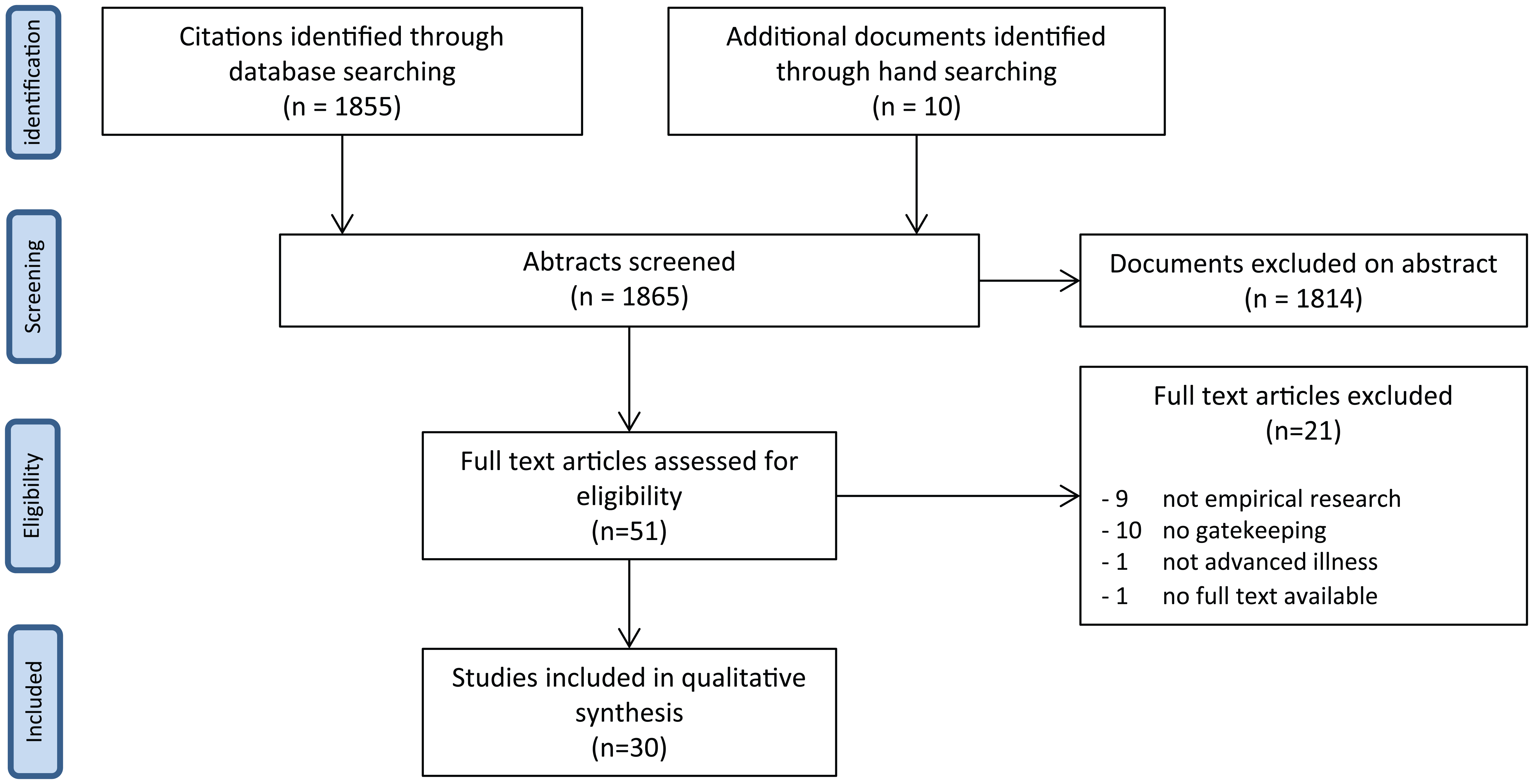
Flow diagram of search and reduction of results.
Table 2 shows our findings regarding the gatekeeper(s) identified in each article, the type of article and the country in which the study was performed. To enhance understanding of the context of gatekeeping, we listed the aim, method and data collection method for each of the original studies found in the literature search. For the process or evaluation reports in which gatekeeping was encountered, similar information was provided for the original study the evaluation was about.
Extraction of data from included studies.
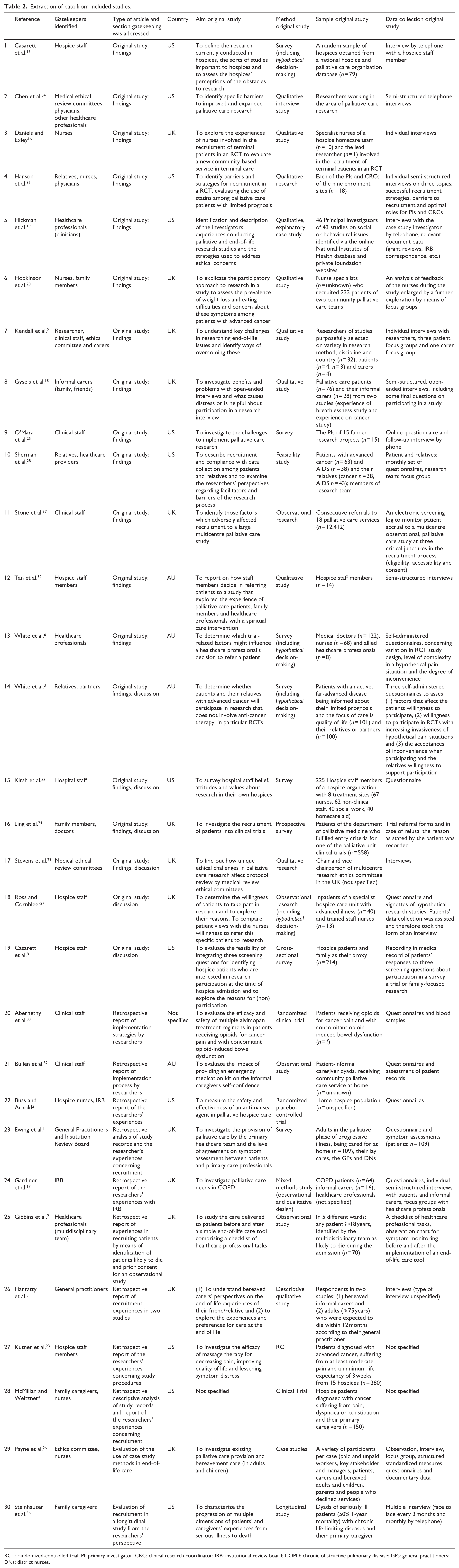
RCT: randomized-controlled trial; PI: primary investigator; CRC: clinical research coordinator; IRB: institutional review board; COPD: chronic obstructive pulmonary disease; GPs: general practitioners; DNs: district nurses.
Gatekeepers
Gatekeepers can be divided into five groups: (1) HCPs (physicians, nurses and allied healthcare workers), (2) research ethics committees (RECs), (3) management, (4) relatives and (5) researchers.
Reasons for gatekeeping
The reasons for gatekeeping can be divided into the following categories (see Table 3):
Fear of burdening the patient;
Difficulty with disclosure of health status;
Fear of burdening the patient’s relatives;
Doubts about the importance or quality of the proposed study;
Attitude towards research and (research) expertise;
Logistics;
Gatekeepers and the core reasons for gatekeeping.
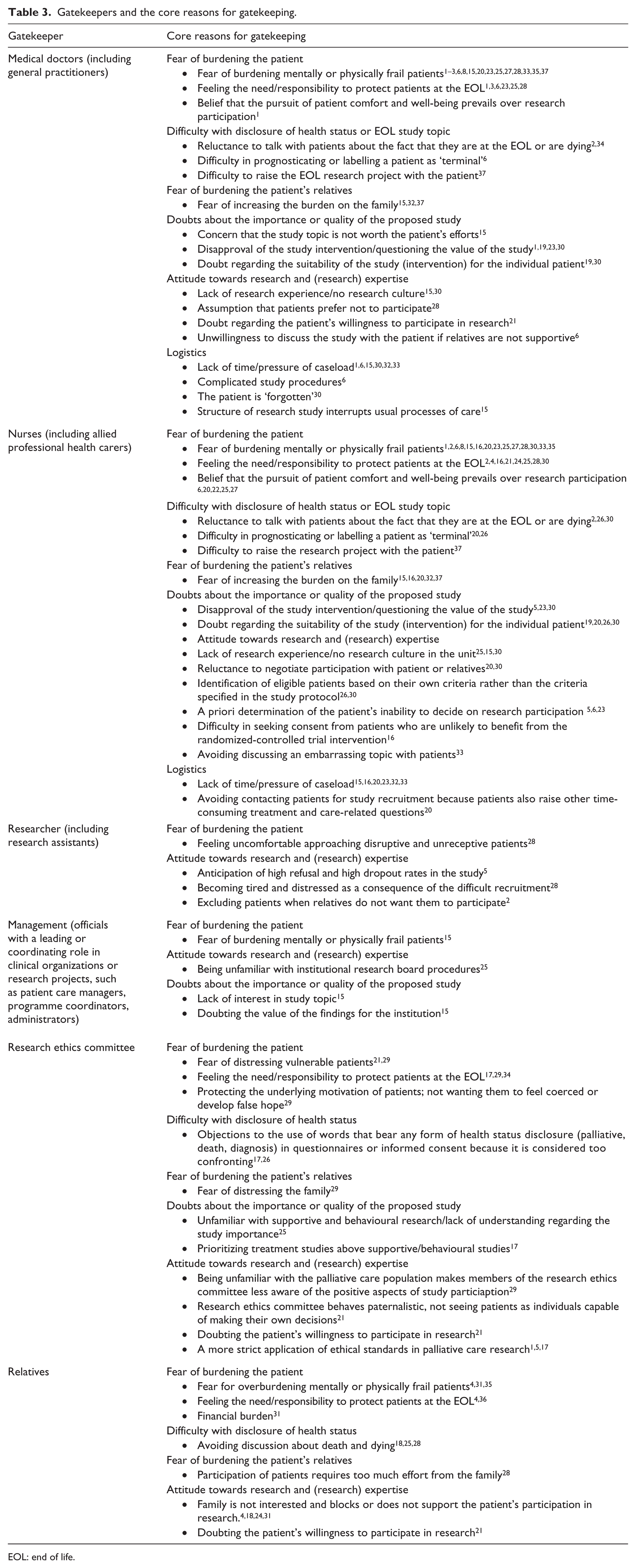
EOL: end of life.
Fear of burdening the patient
‘Fear of burdening the patient’ was by far the most frequently mentioned reason for gatekeeping in all five gatekeeper groups. This is true for studies in which potential gatekeepers were asked about hypothetical situations, as well as reports of original PCR findings and retrospective evaluations of PCR.
Gatekeepers perceived patients at the EOL as physically and mentally vulnerable. Study participation was viewed as a potential source of unnecessary psychological distress or physical discomfort for these patients. Increasing worries were reported when the patients were perceived as especially vulnerable or when the study was viewed as more burdensome, for example, due to invasive procedures, side effects or the requirement of substantial effort from the participants.6,8,15,31
HCPs experienced a tension between the pursuit of comfort for the patient, which is the main goal of palliative care, and study participation. The patient’s comfort and well-being often prevailed, especially in a homecare or hospice setting as well as among nurses.1,6,20,25,27 Several studies described an almost basic protective stance of HCPs towards patients with advanced illness. This became evident in the reported perception that patients at the EOL are in general too vulnerable to participate in research. The assumption that patients prefer not to participate in PCR also played a role in gatekeeping.21,28,30 In addition to HCPs, relatives were also inclined to be protective and therefore tended to be unsupportive of palliative care patients to participating in research.31,36 One study reported the concern that the opinion of third parties, such as HCPs and relatives, easily supersedes the autonomy of the patients. 6
RECs are accused of gatekeeping through overly restrictive application of legally justified procedures in studies involving patients with advanced illness. 34 Moreover, some RECs were unwilling to allow adaptation of study procedures to meet the needs of a population that may require a unique approach.1,5,17 For example, one REC insisted on face-to-face informed consent between a physician and the patients in their homes. Alternative options for obtaining informed consent, such as allowing a nurse rather than a physician to ask for informed consent, were rejected in this study. This policy would require the physician to visit all the eligible respondents in their homes, which substantially decreased the feasibility of the study. Only one study explored the perspectives of members of RECs, and it demonstrated that although many members felt that the ethical issues in general were not different from other medical specialities, the palliative area evoked feelings of protectiveness. 29 This was also the only study that mentioned the risk that dying patients might cling to any portion of a research project, that could be at odds with the goal of maintaining respect and dignity for the patient at the EOL. 29
Difficulty with disclosure of health status or EOL study topic
The PCR study protocols often implied some type of disclosure of the patients’ health status to the patients.2,6,20,26,30 HCPs and relatives cited this issue as a major reason for gatekeeping because they considered it a threat to the patient’s mental stability and worried about the patient becoming too distressed. They sometimes also had difficulty prognosticating or labelling the patient’s EOL status.6,26,34
Tan et al. 30 evaluated recruitment experiences in two studies and found that feeling uncomfortable with discussing death and spiritual matters had a negative impact on deciding to discuss the study with a patient. For some researchers, informing eligible respondents about research addressing an EOL topic caused feelings of uneasiness that resulted in gatekeeping. 37
Relatives also wanted to avoid confronting the patient with the EOL because they believed they would have ‘had to pick up the pieces’ afterwards. 18
Fear of burdening the patient’s relatives
Relatives may expect an increased family burden if their relative participates in PCR. 21 Both nurses and research assistants were often well aware of a patient’s dependency on family members and recognized the family burden as an aspect that impeded recruitment of patients for research.6,20,37 In one study, the recruitment of a patient was completely dependent on the relative’s wishes. 2
Doubts about the importance or quality of the proposed study
The perceived importance of the topic under study as well as opinions on quality of the study largely determined whether a study was successfully conducted. In some cases, managers or HCPs were not interested in the research question and therefore blocked the study or downgraded the researchers’ recruitment efforts. 15 Doubts regarding the quality of the study design or a negative attitude towards the study intervention also led to gatekeeping.5,23,30 For example, this occurred in a study on massage therapy to decrease pain; the HCPs associated massage with intimate touch and therefore sexual activity. 23 Gatekeeping also occurred when HCPs thought the intervention offered no benefit beyond that of conventional therapy or when the intervention disturbed conventional routines.5,15 O’Maraet al. 25 reported gatekeeping by institutional management and the REC by means of prioritization of medical intervention studies in favour of ‘supportive or behavioural research’.
Attitude towards research and (research) expertise
Several studies reported reasons for gatekeeping related to a lack of research expertise or a reluctant attitude towards research. In two studies, the authors reported a paternalistic approach on the part of the HCPs, whereby patients were not seen as individuals capable of making their own decisions. The authors explained the paternalistic attitude as a consequence of limited experience with PCR and the lack of a research-friendly culture in general.5,23
A limited understanding of the importance of recruitment according to the study protocol made caregivers apply their own recruitment criteria.5,26,30 Some nurses considered palliative care synonymous with terminal care and applicable only to cancer patients. They failed to broaden their recruitment activities to the target population, and therefore, the number of participants was much lower than that needed for the study. 26
Some studies reported a lack of expertise on the part of HCPs in discussing participation with the patient and relatives.20,30 However, if caregivers and research assistants became involved in a study, their confidence in recruitment increased and their negotiation skills improved.21,30 Struggles with discussing study participation with patients and the efforts needed to resolve recruitment obstacles could in turn increase gatekeeping, as did the self-fulfilling prophecy of expecting high refusal and high dropout rates in one study. 28
Logistics
Finally, logistics were a factor in gatekeeping. In general, the recruitment of patients in PCR was described as labour-intensive and was often conducted in a complex care setting. Consequently, a lack of time and a heavy caseload were mentioned as reasons for gatekeeping.1,6,15,16,20,30,32
Discussion
This review revealed that there are several groups of gatekeepers in PCR, and gatekeeping occurs for a variety of reasons. The most frequently mentioned reason for gatekeeping was the fear of burdening eligible participants. Other reasons included feeling uncomfortable with the disclosure of the patient’s health status, avoiding family burden, having doubts about the study method or the value of the study topic, the gatekeeper’s attitude towards research and (research) expertise, and logistics. Difficulty in recruiting patients at the EOL in clinical research was reported throughout the 15-year time covered by this study, indicating the persistence of this problem in PCR.9,38–41
To our knowledge, this is the first systematic review that provides insight into the reasons for gatekeeping in PCR. This search revealed a substantial and heterogeneous result: the findings captured studies with diverse methods, locations and study topics. Because the variety of the findings rather than the amount of studies ensures the validity of a qualitative thematic synthesis, we expect this review to present a rather comprehensive picture of the reasons for gatekeeping. 38 We did not weigh the reliability of the study findings nor did we provide weight to the identified reasons. This can be viewed as a limitation within the context of a review, but we consider it inevitable because half of the sample consisted of process-evaluations, which could not be assessed for their methodological reliability.
Consistent with earlier suggestions by Hudson et al., 9 gatekeeping is clearly not limited to HCPs but may include others involved in the research process. We propose to modify the definition of gatekeeping to ‘the process whereby actors involved in the research process prevent participation of eligible patients in clinical research’. HCPs, relatives and research assistants may intervene by gatekeeping throughout the process of conducting the actual study. RECs and institutional management are potential gatekeepers in the study development phase. It is arguable that RECs cannot be gatekeepers because inclusion and exclusion criteria (and thus the eligibility of participants) are final only after REC approval. However, during the process of obtaining REC approval for some studies, RECs demanded changes in the criteria for eligibility and informed consent procedures, resulting in changes in the target population of the study This is a form of gatekeeping. Therefore, we decided to include this type of gatekeeper in this review. A remarkable finding is that gatekeeping was even observed among researchers and research assistants who felt uncomfortable approaching potentially vulnerable patients.
The perceived vulnerability of the entire PCR population as well as of the individual respondent are key aspects in gatekeeping. Management and RECs as gatekeepers tend to assign an a priori vulnerability to the entire group of patients with advanced illness. This may be based on their image of extremely sick patients and the notion of palliative care being equivalent to caring for the dying. Their reticence to grant permission to PCR leads to gatekeeping by overly strict application of legal and ethical rules.1,17 HCP, relatives and also research assistants are in close contact with fragile patients which typically triggers a protective response. The meta-perspective of bringing forward evidence-based palliative care and the subsequent adoption of the study goals are easily subordinated when HCPs feel that the protection of their patients is paramount or when they face the fragility of a typical EOL patient during study recruitment.
The HCP’s difficulty with disclosing a patient’s health status is a major impediment to discussing PCR related to EOL issues with patients. This problem has also been reported in other aspects of EOL care, such as advance care planning. 42
Research participation at the EOL and gatekeeping have rarely been studied from the patient’s perspective. 35 In many studies, HCPs presumed that the patients did not want to participate. In some studies, it appeared that HCPs and relatives tend to ‘read’ the patient (based on assumptions and/or observations) instead of simply asking whether he or she wants to participate. A similar phenomenon was described by Arolker et al. 43 concerning the reticence of medical staff regarding student teaching in hospices. While hospital staff considered the presence of students without expertise in EOL care a threat, many hospice patients reported positive feelings caused by their contribution to facilitating student teaching. Respecting the autonomy of potentially vulnerable patients requires conscious efforts from the people surrounding them to involve them in decision-making regarding PCR. Therefore, an important first step would be to improve and use strategies for preserving autonomy as an aspect of palliative care, for instance, by informing patients about the possibility of being asked for research and train HCPs in recruitment conversations. Gatekeeping in the PCR literature is mainly approached from a researchers’ perspective and as such considered a barrier for recruitment and conducting valid and reliable PCR. 41 Recent studies focus on overcoming barriers in PCR, including gatekeeping.2,44–46 The reasons for gatekeeping described in this study can help identify potential problems as perceived by the gatekeepers and guide the development of solutions and the coaching needed to diminish obstacles as perceived by the potential gatekeepers. For the more practical aspects such as the lack of an infrastructure and personnel needed to perform research and the lack of understanding the role of inclusion criteria in research or of raising difficult topics with respondents, relative easy solutions can be sought in additional resources, standardization, education and training. The problem of gatekeeping as a result of the perceived overall vulnerability of the EOL population and the wish to protect the individual respondent from potential harm is far more difficult to address. Some researchers propose to replace HCP recruiters by trained research assistants who are less involved with the individual patient. 47 It also has been suggested that engaging clinicians as consultants or co-investigators in PCR will help to overcome gatekeeping.7,9,40 Steinhauser et al. 36 found that feelings of burden decreased and caregivers ‘moved out of the role of gatekeeper’ when dyads of patient and caregiver were enrolled.
In addition, collaboration between researchers, RECs and HCPs and representatives of patient organizations is essential to find the right balance between protecting patients and reaping the benefits of PCR. However, even when a right balance is agreed on at the level of the study, we cannot ignore the possibility that individual EOL patients might be in need of some protection from personal representatives or HCPs. Moreover, it is questionable that gatekeeping is negative by definition. In the light of study participation, there may be a need for a more structured assessment of the respondent’s vulnerability instead of relying on the opinion of an individual HCP or relative.
Many articles lacked a ‘thick description’ of reasons and motivations for gatekeeping. This limited our ability to grasp the underlying trade-offs, that is, the weighing of arguments that resulted in gatekeeping. In addition, it is conceivable that the reasons mentioned mask other reasons. Hopkinson et al. 20 found that non-recruitment was sometimes explained by the argument that eligible patients were ‘forgotten’ due to heavy caseload. However, the quotes used in the article indicated that the authors were not convinced that ‘forgetting’ was the actual reason for not recruiting a patient.
It is striking that although gatekeeping is touched upon in many studies, the phenomenon has not been studied in depth. Further analysis of the reasons and underlying justifications for gatekeeping is needed to address this problem in PCR. To better understand gatekeeping, future research could focus on the patients’ perspective and on other populations, such as patients with dementia. The experiences and views of palliative care patients regarding PCR participation should be explored to complement the views of gatekeepers.
Footnotes
Declaration of conflicting interests
The author(s) declared no potential conflicts of interest with respect to the research, authorship and/or publication of this article.
Funding
The study was sponsored by the Netherlands Organisation for Health Research and Development (ZonMw), Grant Number 80-82100-98-113.