







Abstract
Peer review is an important, yet contested, part of the academic publishing process. It is argued that it is foundational to the process of scientific research and publication. 1 Reviewers are asked to assess the quality of the research, identity potential issues or flaws and provide constructive feedback. Peer review is intended to improve the credibility, accuracy and rigour of academic research. As research can have far-reaching implications for science, individuals and society, peer review is seen as crucial to ensuring that reports of research undergo a process of quality control before they are published.
There are, however, major challenges in peer review processes. Reviewers are typically not trained in how to review manuscripts. They can potentially introduce biases, fail to spot problems, make incorrect suggestions or only make a cursory assessment. 2 People can be reluctant to act as peer reviewers. Peer reviewers are rarely properly acknowledged or remunerated. Reviewing tends to be an altruistic, unpaid activity done as part of the global scholarly effort rather than necessarily for individual reward. 3 These issues all add delay and challenge into the publishing process.
As editors of Palliative Medicine, we understand the strengths and limitations of peer review. Our aim in this editorial is not to critique the current peer review system (others have done this admirably4 –6). Rather, we would like to guide reviewers, authors and readers as part of an ongoing series of editorials 7 exploring issues associated with publishing processes. We want to be explicit about what we seek to publish, provide clarity as to the processes we follow and guide current and potential reviewers to perform their reviews in line with our hopes as editors.
Reviewing, not editing
Editors have responsibilities towards the authors who provide the content for journals, the peer reviewers who comment on the suitability of manuscripts for publication, the journal’s readers and the scientific community, the owners/publishers of the journals and the public. The primary role of the editors is to screen manuscripts against submission criteria and recommend and invite peer reviewers where a manuscript is identified as sufficiently strong to progress to the peer review stage. Therefore, we do not expect reviewers to act as editors. Rather we ask reviewers to provide informed and expert advice to the editorial team to enhance our capacity to make the soundest possible decisions. Whilst reviewers can give a recommendation as to whether to publish or not, the decision ultimately rests with the editorial team. The editorial team have already made an initial assessment of the manuscript and only send out for review a proportion of submitted manuscripts. We will also balance the (sometimes differing) views of reviewers together with the authors response when making ongoing decisions.
Areas to be assessed during the peer review process
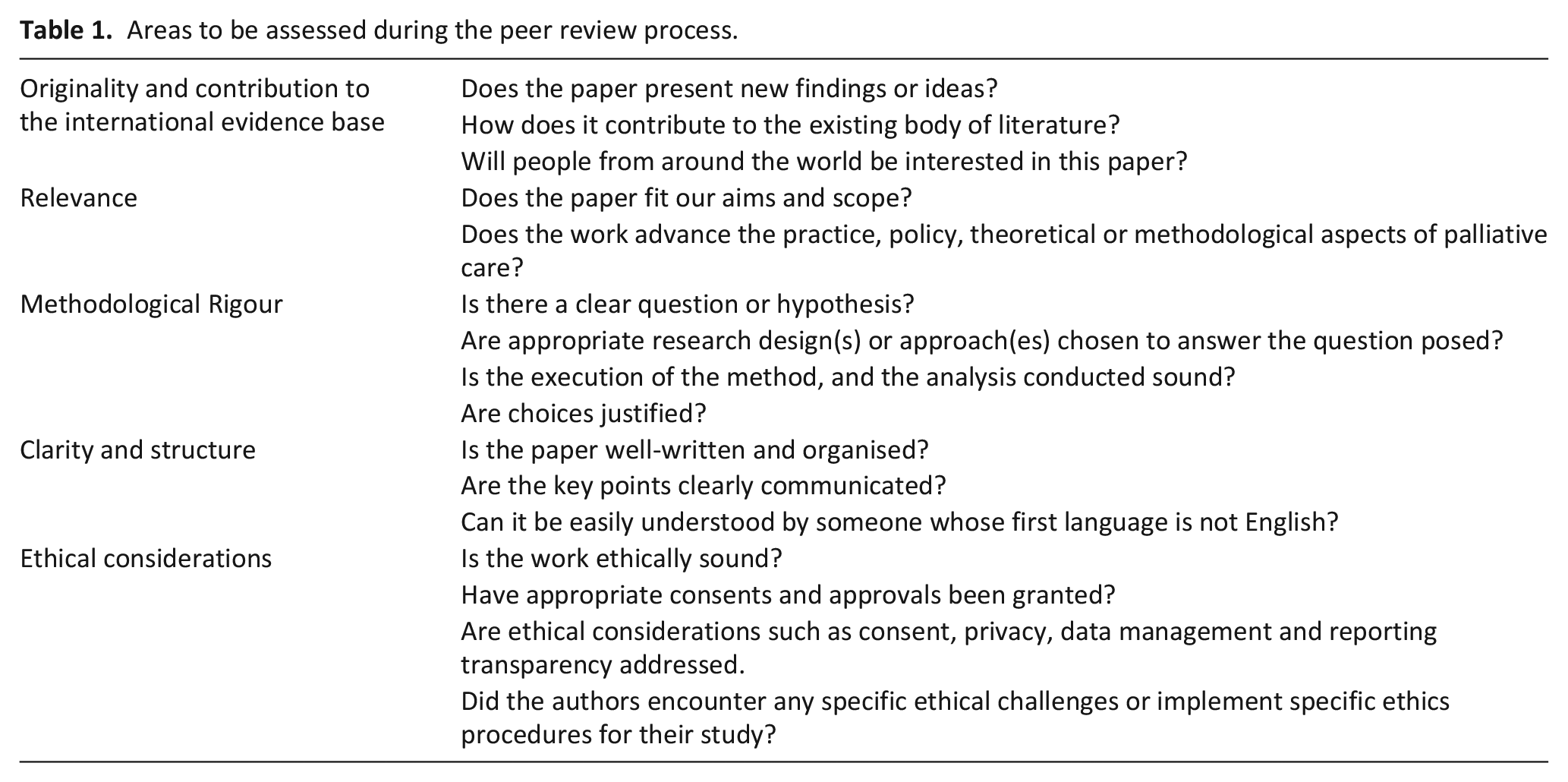
As an editorial team we seek reviewers with expertise in the topic area and/or design of the study to make a series of judgements on different areas of the manuscript. As editors, we hope that anyone accepting an invitation to review a manuscript considers that commitment as being of comparable importance to the other responsibilities of a busy researcher. 8 The overarching areas we suggest that are assessed within the manuscript are presented in Table 1.
Areas to be assessed during the peer review process.
Contribution and relevance
One of the first questions to ask is whether a paper makes a valuable contribution to our field of palliative care. Does it address an important problem, answer a significant question or propose new insights? We know that our journal audience is truly global. Whilst most of the work we publish is conducted in a single country, we ask that the work is positioned, explained and interpreted for this global audience. 7 We want the papers that we publish to be something that this wide readership would find engaging and important.
We seek to publish novel and significant work that can have relevant implications for palliative care clinical practice, education, research and/or policy. This may be work that advances knowledge or theory through innovative approaches and questions, or it could be a well justified replication that meaningfully adds to the international evidence base in a way that is not simply ‘me too’. We want systematically constructed literature reviews to have a clearly justified purpose, with additional insights presented from the synthesis or aggregation of existing data.
In the discussion section, the authors should interpret their findings in the context of existing international literature and acknowledge the implications of their research. You might want to consider if the authors properly situate and contextualise their study, comparing findings with the work of others. Do they discuss the broader implications of their findings? Do they over or under-state their findings and make conclusions that are supported by the data they present. Have they discussed avenues for future research, particularly to address any limitations of the study?
Methodological rigour
Methodological rigour is a central aspect of any research article, particularly for empirical studies. It is crucial to carefully evaluate whether the research design and methodology are appropriate for the research question and whether they have been executed properly. We ask that reviewers consider whether the design (e.g. experimental, observational and qualitative) is suitable for the question and purpose of the study and has been clearly justified. You might want to consider if issues such as whether the population, setting, sampling, recruitment and analytical approaches have been presented in a way that is congruent with the overall design, checking perhaps the reporting guideline submitted alongside the paper. This congruence is important as issues such as sample size or selection are presented and justified differently depending on the chosen approach. It is important that authors acknowledge the limitations of the study. Are there potential biases, confounding factors or threats to validity that the authors have overlooked? If any aspects of the methodology seem questionable or poorly explained, it is important to raise these issues in your review.
Clarity and structure
Even the most groundbreaking research can be undermined by poor writing. A well-structured paper with clear language ensures that the research is accessible and understandable to its audience. As a reviewer you might want to think about how the paper is organised, and if the structure is logical. Most papers in Palliative Medicine follow a typical structure (Introduction, Methods, Results and Discussion), but within that we find it is helpful if there are appropriate sub-sections (e.g. in the methods section detailing information in sub-headings on the research question, design, setting, population, sample, recruitment, data collection and data analysis can be helpful, adjusted as required for the specific study design). Authors will have submitted a relevant reporting guideline indicating where such information is to be found.
We prefer clear, concise and succinct writing that avoids jargon and complex sentence construction. Clear writing is essential for conveying complex ideas in a way that readers can understand. Look for areas where sentences or paragraphs can be more concise or better organized. We typically suggest that authors eliminate all acronyms and abbreviations. You can identify common errors such as misunderstanding the different functions of the introduction and discussion sections, or re-presenting findings in the discussion. If the author has included figures and tables then, reviewers might want to review if these are well-designed, clearly present any data and add to the narrative effectively and meaningfully.
Your job as a reviewer however is not to act as a copy editor or to re-write the paper – you do not have to pick up all errors of spelling, grammar and punctuation. However, if these are frequent or intrusive, you may wish to highlight the requirement for careful editing throughout.
Ethical considerations
We want reviewers to consider whether the work is ethically sound. In our perspective, this goes further than determining whether appropriate consents and approvals have been granted. Rather, authors and reviewers might want to think about whether issues such as informed consent, privacy and data management have been properly addressed. It is important to remember that whilst these core ethical principles apply to all research, the requirements for approval for different forms of research work vary tremendously across jurisdictions, and this should be accounted for. In addition, in the development of some studies, authors might have encountered specific ethical challenges or might have implemented specific ethics procedures. It might be highly valuable to share these ethical considerations and help others thinking more critically on the ethical implications of research.
Providing feedback
We ask that reviewers provide constructive, meaningful feedback. Rather than simply pointing out problems, aim to offer suggestions for improvement. Be specific in your critiques, providing examples from the manuscript where applicable. If you recommend changes to improve clarity, methodology or analysis, make sure to explain why these changes are necessary.
Additionally, remember to acknowledge strengths in the paper. Positive reinforcement is important and can motivate authors to continue improving their research. It is essential to remain objective throughout the review process. In Palliative Medicine, a single-blind peer review process is followed. Hence, although the name of the reviewer is hidden from the author, reviewers know the names of the authors of the manuscript they are reviewing. Reviewers should be particularly careful in terms of research integrity and avoid personal biases and focus on the content rather than the authors. Moreover, we expect that the same level of integrity and objective, critical analysis is applied to the assessment of the manuscript under review as it is applied to the reviewer’s own work. 8
The peer review process is a collaborative one, where the goal is to improve the quality of research, not to tear down the authors. Keep your tone professional, respectful and helpful. As editors, if reviewers are rude or dismissive or disrespectful of someone’s work, we will remove this from the review and/or withhold the review. However, authors should expect constructive critique of their work where this is justified, and hopefully accept this in the spirit in which it is offered.
As a reviewer you will be asked to make a recommendation to the journal editor. Your recommendation should reflect the overall quality of the manuscript and the extent to which the issues you’ve identified could be addressed. If there are areas where you are uncertain, or wish to recommend specialist review, please flag these to the editor. Indeed, you can communicate with the editor at any time, see this as a process. Remember that your view may differ from that of other reviewers or editors, and this is only a guide to the editor. When authors provide a response to reviewers and editors comments and revisions to the paper, you may be asked to assess these.
Conclusion
Peer reviewing is an important but sometimes challenging task. It requires a balance of critical thinking, attention to detail and constructive feedback. By carefully reading the manuscript, evaluating its methodology and significance, assessing clarity and providing respectful and actionable feedback, reviewers play a vital role in ensuring the integrity and quality of academic research. By following these guidelines, you can contribute to the advancement of knowledge in palliative care and support authors in producing their best work. At Palliative Medicine we really value your contributions and thank you for your contributions to our shared scientific endeavours.
Footnotes
Declaration of conflicting interests
The author(s) declared no potential conflicts of interest with respect to the research, authorship, and/or publication of this article.
Funding
The author(s) received no financial support for the research, authorship, and/or publication of this article.
