







Abstract
This article investigates how social workers’ interpretations of contextual factors and the relationship between victim and offender affect their understanding and assessment of male violent victimization. The study was designed as a multiple case study with a qualitative comparative approach. Focus group interviews supported by vignettes were used to collect data. Interviews were carried out with professional Swedish social workers working with victimized men and women at support units for young crime victims in Sweden. The results show that the social workers consider the violence that the young men are subjected to in cases of street violence and interpersonal violence to be unavoidable or even ‘natural’. The violence was in some cases considered to be dependent on the men’s own agency and in others on their lack of agency, when displaying traits of both more traditional and less traditional forms of masculinity respectively. The social workers’ talk about young male crime victims is interpreted as contributing to making the men appear as less legitimate victims. Even though the social workers argued that the victims’ own behaviour should not lead to any special considerations concerning help efforts, the possibility of upholding such a demarcation between explanations ascribed to the violent incident and help measures offered is problematized in the article.
Introduction
Gender can be viewed as a product of multiple ongoing interactions in different social contexts and on different levels (Kessler and McKenna, 1978; West and Zimmerman, 1987). This implies that our understandings of women and men in different situations, for instance as perpetrators or victims of violence, are gendered (see, e.g. Haines et al., 2016; Walklate, 1997). One consequence of such ongoing negotiations of identities and gender is that the understandings and explanations of the causes of violence are attributed differently for male and female victims. Such attributions are often based on preconceived notions about ‘common knowledge’ or memories from one’s own experience or other sources such as media (see, e.g. Greer, 2007; Flood and Pease, 2009). Research shows that such attributions are also present in professional helpers’ (e.g. social workers’, psychologists’ and physicians’) understandings and explanations of social problems, including victimization related to street violence (SV) and interpersonal violence (IPV) (see, e.g. Jägervi and Svensson, 2015; Kullberg and Skillmark, 2017a; Mendelsohn and Sewell, 2004).
For victimized men, and young men in particular, certain specific circumstances have been shown to be significant to how the victimization is interpreted. Research shows that professionals’ interpretations of circumstances having something to do with contextual factors are made relevant when they try to understand the victimization. Such contextual factors may include where the incident occurred (in public/on the street, or in private/at home), whether the victim had been using alcohol, and whether the victim acted in a challenging or provocative way that could be understood as having triggered the violence.
Concerning the location of the incident, some research done in Sweden shows that when men have been recognized as legitimate victims, and are being treated at victim support units, professional social workers interpret the severity of the incident quite differently depending on the context where the incident took place. It has been found that being exposed to intimate partner violence (IPV) is assessed by social workers as a greater threat to the victim’s self-image and self-worth than being exposed to SV (Street Violence) (Jägervi and Svensson, 2015; Kullberg and Skillmark, 2017a). At the same time, however, victimization of a man is not interpreted as being as serious, in absolute terms, as victimization of a woman. SV is a more common context of male exposure to violence than IPV. Studies of SV show that men are not interpreted as being victimized to the same extent as women, but are more likely to be viewed as young guys who go out and ‘get beaten up’ one night, and beat others up the next (Jägervi and Svensson, 2015; Kullberg and Skillmark, 2017b). It is highly likely that such preconceptions about young men subjected to SV are a result of the victim–offender overlap that has been proven to exist (see, e.g. Shaffer, 2003). Such research shows a frequent overlap between offenders and victims of violence involving socio-demographic as well as lifestyle factors (being young, male, single, from a working-class background, having an active nightlife, and so on). Research has also shown that this victim–offender overlap makes some groups of men especially prone to being both perpetrators and victims of violence (see, e.g. Schreck et al., 2017; Shaffer, 2003).
Another contextual factor that is made relevant when interpreting victimization is the victim’s alcohol use. Research shows that intoxicated male and female victims of various kinds of abuse are attributed more blame for their situation than victims who have not used alcohol (Aramburu and Leigh, 1991; Leigh and Aramburu, 1994; Richardson and Campbell, 1980; Stormo et al., 1997). There are also, however, results contradicting this finding. While Tryggvesson (2004) shows that young adults tend to interpret the actions of a victim of violence as more provocative when intoxicated by alcohol than when not intoxicated, in another study, with the same design, Tryggvesson and Bullock (2006) find that the amount of blame attributed to a perpetrator decreases when the victim is drunk compared with only mildly intoxicated. In a quantitative telephone survey using vignettes and conducted in Sweden, Tryggvesson (2008) also shows that young adult male respondents do not attribute greater blame to a drunk than a sober victim subjected to SV by a male offender. However, female respondents attribute more blame to a drunk than a sober male victim in cases of provoked violence, but show no difference in their assessments of a drunk and a sober victim when the violence is unprovoked (Tryggvesson, 2008).
Research also shows that victims’ actions play a significant role in the attribution of responsibility for their violent victimization. It is shown, for instance, that male victims of SV are interpreted as at least partly to blame for the harm inflicted on them (Kullberg and Skillmark, 2017b). Such research shows that interpretations of young male victims’ responsibility for SV are related to assessments of whether they have been careless in their choice of where they go and at what time, but also the extent to which they themselves ‘provoke’ the crime, so to speak. Actions that are considered provocative include behaving in an arrogant way or being verbally antagonistic prior to the assault (see, e.g. Jägervi and Svensson, 2015; Kullberg and Skillmark, 2017b).
Alongside contextual factors and the victim’s actions, research also shows that characteristics of the relationship between the victim and the offender play a significant role in interpretations of both the victim’s and the offender’s role in the incident. Research shows, for instance, that the degree of victim blaming varies depending on whether or not the victim and offender are acquaintances. For example, female rape victims of a male acquaintance are held more responsible than victims of stranger rape (see, e.g. Grubb and Harrower, 2008; Sleath and Bull, 2010; van der Bruggen and Grubb, 2014). A similarly higher degree of attribution of responsibility is apparent in cases where the female victim and the male perpetrator have previously had an intimate relationship (van der Bruggen and Grubb, 2014). Concerning attribution of responsibility for male rape victims, studies show that the stranger–acquaintance dimension operates in the same way as in male–female rape scenarios, in that attribution of victim responsibility is greater when the victim and offender are acquainted than when they are not (van der Bruggen and Grubb, 2014).
Support that can help adolescent victims apply adequate coping strategies is of the utmost importance for their recovery from the harm inflicted on them (see, e.g. Hassan et al., 2011). In Sweden, the social services have the main responsibility for supporting crime victims (however, different non-governmental organizations serve as an important complement). In the Swedish Social Service Act, children and young people are singled out as needing specific attention (Ljungwald, 2011). During the last two decades, Support Centres for Young Crime Victims [Stödcentrum för Unga Brottsoffer] (SYCV) have thus been implemented and are key providers of help for youths. Previous research on how Swedish social workers work with young crime victims is scarce. However, Löfstrand (2009) argues that two distinct approaches exist and are combined in actual support work at the SYCV. The first posits the professional helper as the active and competent party who implements techniques of normalization and presents explicit ways on how to ‘feel, respond and act’ (Löfstrand, 2009: 720) as a young victim of crime (for example, by using metaphors, diaries and other pedagogical tools). The second approach postulates that the client is active and competent with his or her own coping strategies, and the professional consequently functions more like a sounding board in order to give enough help for the client to help him- or herself. If the former approach dominates talk between professionals and victims, alternative and potentially successful coping strategies used by youth might go unnoticed.
Thus, professional helpers’ understandings of the victims’ role in, and degree of responsibility for, their violent victimization are decisive factors in help provision. It is therefore important to study social workers’ understandings and assessments of young men’s violent victimization. Such an investigation may contribute to the development of professionalism and improve our understanding of existing thought models among professional helpers.
The aim of the current study is therefore to investigate how social workers’ interpretations of contextual factors, and of the relationship between the victim and offender, affect their understanding and assessments of male violent victimization.
Study design and method
The study was designed as a multiple case study and adopted a qualitative, comparative approach using two different vignettes (cf. Ragin, 1987; Yin, 2003). The point of departure for the study was social constructivism, and central concepts such as ‘perpetrators’ or ‘victims of violence’ are accordingly understood as gendered constructions accomplished in multiple ongoing interactions in different social contexts and on different levels (see, e.g. Holstein and Miller, 1990). In line with this, focus group interviews were used to collect the data. The interviews were considered to be interactive events of ‘sense making’ in which the social workers constructed a shared understanding of male victims of violence, as well as reflecting on how male victimization is understood and dealt with in different social institutions (such as public authorities). Focus group interviews thus allowed the researcher to gain insight into the participants’ social representations and how, in their discussions, they understood and constructed men and male victims, as well as how they critically reflected on norms and activities that position men and male victims of violence in the gender order.
Population selection process and sample
Altogether, 14 social workers from five different SYCV units participated in the study. The participants were chosen from approximately 30 existing SYCVs, using purposive sampling. The criteria for selecting participating units were that there should be at least three professionals actively working at the unit, all of whom should be professional social workers with a BA in Social Work who provide support daily to young crime victims of both genders. Initially, the aim was to recruit six focus groups to participate in the research. However, availability within the project’s time frame rendered one of the five focus groups (which was carried out first) being treated as a pilot; it was therefore excluded from this article. The reason for this was that it became obvious in this focus group that one of the participants (a senior social worker) dominated discussions. The other two participants were recently recruited to the SYCV organization and had few examples and experiences of meeting victimized men and contributed very little to the discussion.
Construction of vignettes
Two different vignettes, each describing a situation where a young man is subjected to physical violence, were used as stimulus material. The vignettes were explicitly designed to depict two different contexts/situations, namely a typical situation where males are the majority of victims, and where male victimization is more often acknowledged (SV); and an ‘atypical’ context/situation of men’s victimization where men’s victimization is more uncommon and much less recognized, and instead is more ‘typical’ for female victims (IPV). The vignettes were designed to depict both a credible and more common/frequently occurring situation as well as one that is less common. The vignettes were based on findings from national Swedish as well as international statistics and previous research showing that the risk of being a victim of violence varies depending on gender, age and situation/context.
Research corroborating the construction of the SV vignette as a more typical situation/context for the young men’s victimization shows that young (16–24 years) men constitute the category with the greatest risk of being subjected to violence by others (BRÅ, 2009, 2012) and that public places other than the school is the context where they are most frequently exposed (Ungdomsstyrelsen, 2013). Research also shows that young men are at much greater risk of being victimized by SV than for instance young women (BRÅ, 2009, 2012) or men and women in older age categories (Ungdomsstyrelsen, 2013). Young men’s risk of SV is strongly related to having an active nightlife (Häll, 2004; Felson et al., 2013) whereas this correlation does not appear to be present for young women or other persons in older age categories (see e.g. Felson, 1997). Research also shows that there is a correlation between alcohol/drug use and victimization through SV at nighttime for adolescent men (see e.g. Lauritsen and Laub, 2007), but that such a correlation does not seem to exist for young women (see e.g. Ellonen and Aaltonen, 2012).
Research that shows the content of the construction of the IPV vignette to be a more atypical situation/context for young men’s victimization indicates that young men, in the Nordic Countries, are victims of IPV to a lesser extent than young women (see e.g. Schütt et al., 2008). Such results are in contrast with findings from the US which tend to show a rather similar degree of exposure to violence for young people in close/intimate relations, in the literature often referred to as for instance dating violence (see e.g. Bonomi et al., 2012). More qualitatively oriented research that also suggests the case to be atypical is that, in a similar way to violence between adult men against women, it is much more rarely young men than women who tend to end up as being victimized as a consequence of perceived weakness, inadequacy or other wrongdoings, which was a scenario that was intended to be portrayed in the constructed vignette (Gottzén and Korkmaz, 2013).
The vignettes were intended to allow for contrasts in the interpretation of the data and theory development. The use of vignettes in the interviews enabled the researchers to provide the participants with a uniform contextualization to make such comparisons and contrasts possible (cf. Brunnberg and Kullberg, 2013).
To function properly as stimulus material, the short vignettes contain somewhat more information compared with what social workers often have access to before meeting with victims face to face (the information provided by the police typically contains name and social security number, type of offence and where it happened). The information in the vignettes could be understood as a hybrid of the information in the police reports and a condensed version of an initial meeting with the young victim.
Content of the vignettes
The SV vignette describes a young man who is assaulted by an unknown male in a public place at night. The victim is 23 years old. Earlier that evening he has been thrown out of a bar for alleged disorderly conduct. Later, together with his friends at a hot-dog stand where people gather after the entertainment venues close, he gets into a verbal dispute with another young man. The other young man hits him in the face and then kicks him in the stomach as he is rising after the first blow. The young victim then leaves the place with his friends.
The IPV vignette describes a young man who is assaulted in the home by his female partner of a close/intimate heterosexual relationship. The victim is 23 years old and he and his partner have lived together for just over a year. The woman works at a clothing store and the man studies at university. Their income consists of his student loan and her salary. During an argument about how the two incomes are used, the woman claims that the man is wasteful, pushes him, and then gives him an open-handed slap on the face. The man falls to the floor but gets up quickly and runs to the bathroom where he locks himself in.
Each focus group discussed only one of the two vignettes. This choice was made on the grounds that, had the participants been aware of the comparative approach and the two situations, they might have answered in a more or less socially desirable way since gender can be considered a sensitive topic (cf. Brunnberg and Kullberg, 2013).
Focus group interviews
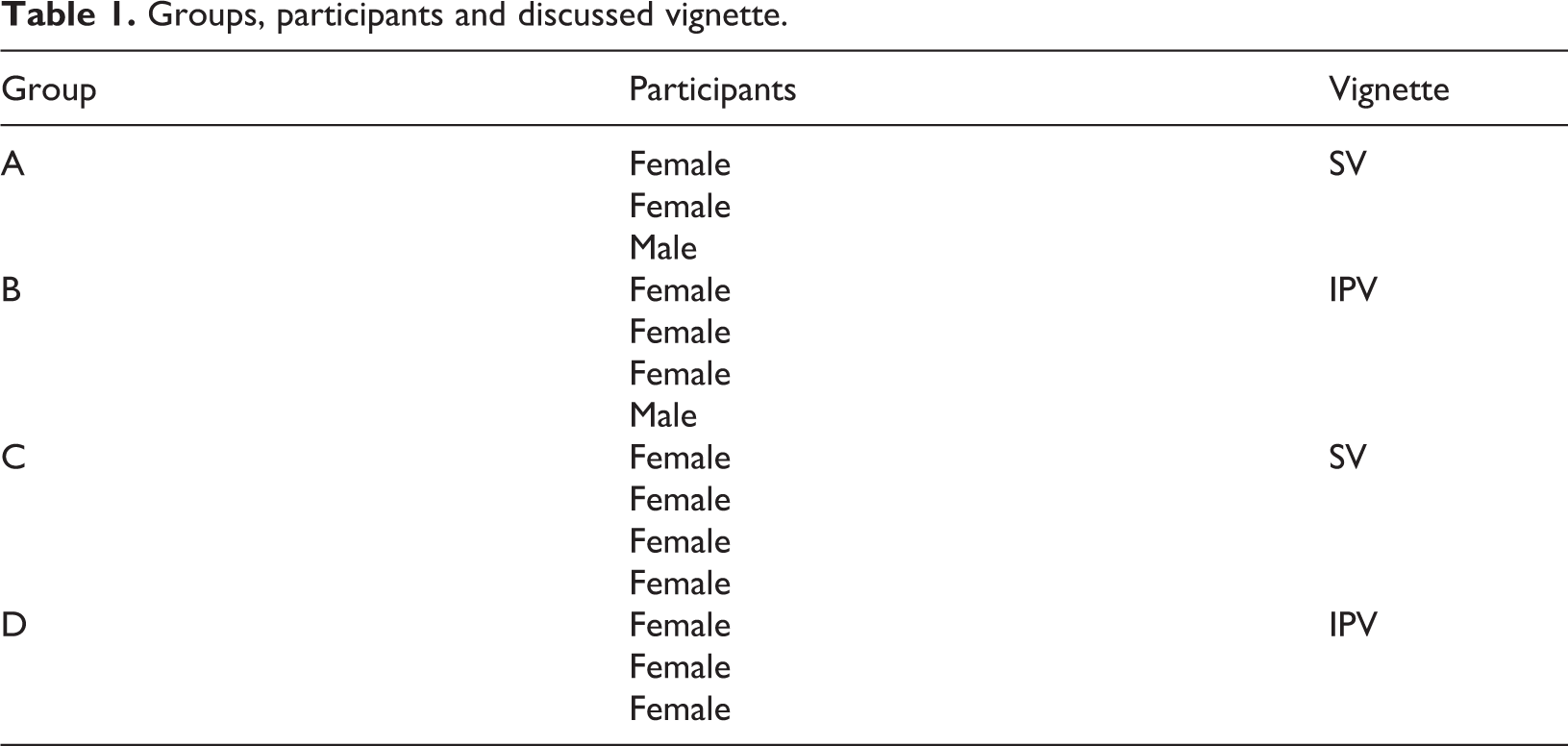
Interviews (labelled A–D) with three to four participants in each group were included in the study, and each focus group except for one consisted of existing work teams. The focus groups were held at the respondents’ workplaces and lasted from one and a half to just over two hours. Two of the groups were of mixed gender, while two included only women. None of the groups had more than one male participant (see Table 1). By combining the focus group method with vignettes using existing work teams, the researchers sought to create a situation that was as similar as possible to the circumstances in which the social workers jointly construct and reproduce young men as victims of violence in their ordinary work, such as in case-based group discussions and other work-related talk.
Groups, participants and discussed vignette.
Procedure
One of the two vignettes was sent to the participants at each unit prior to the focus group interviews. Before beginning the discussion, the participants and moderators read through the vignette. After two introductory questions concerning the participants’ assessment of whether the vignette credibly describes a situation that a male victim may have experienced, and therefore could be considered appropriate and meaningful (cf. ‘face validity’), the remainder of each session was devoted to discussing the questions or themes intended to promote discussions about men as victims of violence. The researchers asked questions about the following aspects: how contextual factors, as well as the victim’s actions, may have contributed to the escalation of the situation; the importance of the relationship between victim and perpetrator for the escalation of the situation; whether the victim could have chosen to act differently in any respect; how the respondents interpret the victim’s responsibility for the escalation of the situation; whether male victims, in some sense, have specific assistance needs; and finally if and how the respondents’ understanding of the situation would have differed if the victim had been a young woman instead.
Materials and analysis
The materials consist of 321 min of recorded focus group discussions ranging from 80–119 min each. The recordings were transcribed verbatim. A content-analytic approach was used for the analysis of the transcripts and recorded interviews (see Bryman, 2008; Hsieh and Shannon, 2005). In the analysis process, we used a thematic framework coding matrix to organize the material (cf. Ritchie and Spencer, 1994). The analysis was done in three steps. First the transcripts were read through and the recordings listened to several times. Second, the text parts of the conversations that in some way referred to the social workers’ overarching talk about men as victims of violence were identified. The terms used in this stage of the analysis process were closer to the raw data, but would later be refined during the development of the analysis. Examples of such terms from the early stage of the analysis are ‘defending oneself’, ‘feelings of shame’, and ‘reasons to seek help’. In the third step, further development of sub-categories was carried out. The analysis in this stage was done in dialogue with theory and previous research, and led to three overarching concepts that framed and summarized the social workers’ talk about men as victims of violence in the two situations discussed (SV and IVP). These concepts were ‘position’, ‘context’, and ‘relationship’; analysis of the second and third of these is reported in this article.
The study conforms to the ethical standards for humanities and social science research in Sweden and was approved by the Ethical Review Board in Sweden.
Results
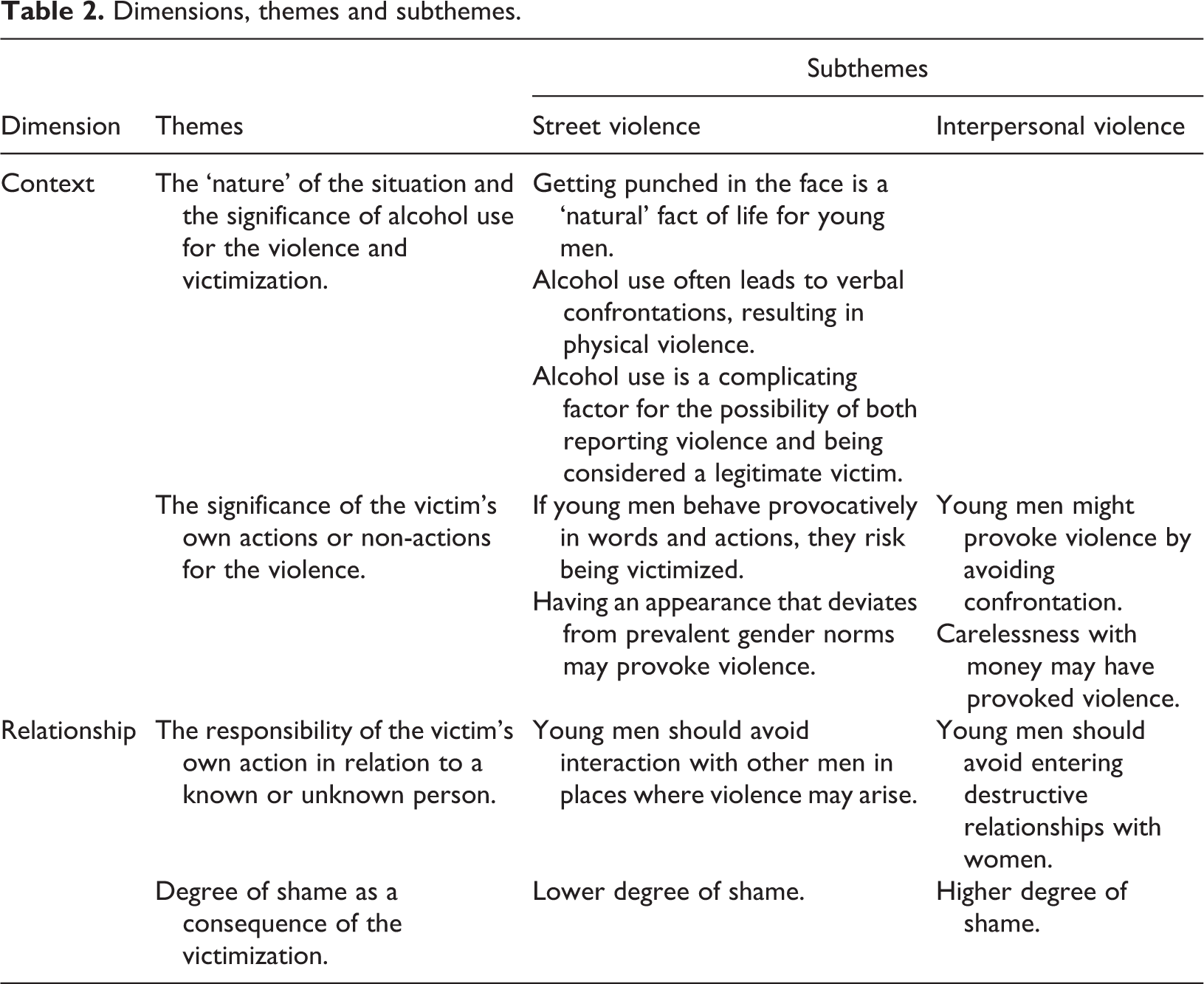
Four overarching themes emerged within the two analytic dimensions explored (see Table 2). The labels of these themes represent the essence of the social workers’ ways of talking about the exposure of the young men to violence in the two social situations, SV and IPV, which were used as stimulus material for the interviews. From the main themes, subthemes emerged reflecting differences in how the social workers talked about the young men in the different situations and contexts.
Dimensions, themes and subthemes.
Contextual factors
In the social workers’ discussions on contextual factors linked to the victimization, two themes were discussed. These were (1) the ‘nature’ of the situation and significance of the young man’s alcohol use in relation to the violence and his victimization, and (2) the significance of his own actions or non-actions in the violence he has been subjected to.
The ‘nature’ of things and the significance of the alcohol use for the violent victimization
Although the social workers were careful to stress that alcohol use, in itself, cannot justify the violence inflicted on the victim, they engaged in discussions that in many ways linked the young man’s own actions to the violence he has been exposed to. Most of these occurred in relation to the SV vignette and in focus group A. For example, on a few occasions, participants indicated that the victim ‘has himself to blame’ for what happened (A2 – the letter and number refer to the participant in the specific focus group). Alcohol was also mentioned as a typical ingredient that, along with being tired, queuing (at the hot-dog stand) and engaging in the verbal confrontation that arises, contributes to the violence that affects the young man. This is expressed, among other things, by the fact that this is ‘a classic situation where people have been drinking and are queuing close together, it’s late, and they’re tired’ (A1). Such situations ‘easily lead to commotion’ (A1).
Another social worker commented on urban nightlife, saying ‘it’s the nature of the situation, to get a punch in the face’ (A3) and that this seems to be something that men are aware of. It is interesting that such violence was described as something ‘natural’ when it occurs in this context. This is because concepts such as ‘natural’ and ‘unnatural’ can be interpreted as relating to biological or maybe even normative notions of a ‘natural order’, which includes taking for granted that men in general, and young men in particular, ‘by nature’ enact and are victimized by violence in this context. The respondent’s (A3) reference to the word ‘nature’ can therefore be interpreted as characterizing violence as a fact of life, or something that to a greater or lesser extent has to be accepted, rather than as an anomaly, deviating from what is or should be expected.
From the discussions, it is also apparent that the social workers viewed alcohol as a complicating factor, both when it comes to reporting a violent assault and in relation to being considered an acceptable victim by others. One example of this is that male victims who have been drinking censor themselves, to some extent, as victims. The social workers talked about this unwillingness to report being assaulted to the police in the following way: So the thing with alcohol is, you’ve been drinking, you get hit, and then you go home and wake up the next day and hardly remember what happened. And it also feels very embarrassing to go to the police and file a report. ‘I believe I got beat up yesterday’ (A3).
With regard to being considered an acceptable victim, the police’s response to young men reporting violent crimes was also discussed. The social workers were critical of the police in this regard, arguing that the police tend to trivialize violence against male victims when they have consumed alcohol prior to the incident. This is illustrated by the following excerpt, where a social worker recalls a client: The first reaction this guy got [after being assaulted] was hearing from the police, and reading in the report, that he was extremely drunk and there were questions about whether he’ll remember anything. He could give a detailed story and he said right away, ‘I was drunk’, but that’s no reason to…, sometimes it’s like they’re searching for an excuse, you were drunk, and so it’s OK that you got punched or head-butted (C2).
The relatively strong link between alcohol and perpetrating violence as well as being a victim is well-documented in research (Graham and Livingston, 2011; Shepherd et al., 2006). To some extent, the results presented here concerning how the social workers themselves [cf. the idea that the young men have themselves to blame, as A2 describes above] and the police attribute blame are in line with previous research showing that that male victims of violence who are intoxicated by alcohol are attributed more blame than other victims (Aramburu and Leigh, 1991; Leigh and Aramburu, 1994; Richardson and Campbell, 1980; Stormo et al., 1997). On the other hand, our respondents emphasized several times that victims’ alcohol use should not be viewed as justifying their victimization. The criticism of the police shows this standpoint. Our interpretation of the social workers’ references to victimized men’s alcohol consumption is therefore that it should be understood as part of a framework for interpreting possible causes of a violent incident, and that the young male victim’s drunkenness could be considered an explanation of the assault. However, it should not lead to any special considerations regarding the kind of help that should be provided by authorities and others. Research from an attribution theory perspective, however, suggests that such a demarcation between ideas about causation and help-giving are seldom upheld. Instead the degree to which the victim was able to influence or control the situation before it turned violent directly affects the attribution of responsibility for, and/or of agency in, the harmful outcome, which in turn affects the degree of blame attributed to the person (see, e.g. Shaver, 1985). Research further shows that the treatment that people in problematic situations receive from others is coloured by how their agency in the emergence of the problem is interpreted. Research from different problem areas shows that when professionals recommend treatment models, they actually select what they believe to be an appropriate treatment model according to how they attribute responsibility for the problem at hand. In a classic study, Brickman et al. (1982) show that attribution of responsibility correlates positively with placing the responsibility for solving the problem on the client him-/herself. In the light of such research, it appears unlikely that the social workers’ talk about the young men being ‘to blame’ (A2) would not, at least in part, influence the help the victims receive.
The significance of the victim’s own actions or non-actions in interpretations of violence
The young man’s physical or verbal actions immediately before or during the violent incident were discussed in relation to both vignettes. In the case of the SV vignette, the discussion concerned whether the young man might have a problem ‘following rules’(A1) in a more general sense, that is, whether the young man in the vignette ‘cuts in line’(A2, C3 and D3) or ‘mouths off’ (A3 and D3) and for that reason was exposed to the violence.
One of the focus groups (A) discussing the SV vignette talked about how men’s appearance can be provocative and contribute to violence and victimization. In this group, this aspect was highlighted as particularly important in relation to men who, in their appearance, diverge from what can be regarded as (traditional) masculinity. A concrete case was brought up in group A that concerned a young man who ‘wore makeup and was very unusual’(A2) and, because of this, was both threatened and abused. The discussion concerned the great difficulties that men face, compared with women, when they deviate from conventional ways of enacting what is expected of them because of their gender. The following quote illustrates the social workers’ talk about these difficulties: But it feels like many people are less provoked by a girl who wears a lot of makeup, or also the other way around, this rough manly style, that it’s more OK, or if you’re a young lesbian, it’s easier if you’re a girl [A2…nod in agreement’: ‘hum’ would be understood, but has a different meaning] (A1). But it’s incredibly provoking if a guy starts wearing makeup and has all these feminine attributes (A3). Yeah, that unleashes a whole lot of stuff (A1). Oh my God, how that gets things started (A3).
In comparison to the discussions about the situation in the SV vignette, which focused on what the man does, the discussions on the IPV vignette focused more on what the man does not do before or during the violent act. In group D, the young man’s avoidance behaviour when it comes to showing his feelings to his partner was mentioned when trying to understand the woman’s violence against him. Similar reasoning was found in group B. In their discussions, it was stated that: Well, to make a very hasty interpretation [of the vignette scenario], it might be that he doesn’t oppose her … he doesn’t raise his voice, he backs off and she’s provoked by that (B1).
In addition to this, in the groups discussing the IPV vignette, the young man’s use of the couple’s money was put forward as a possible explanation for the violence. The social worker chose to express this by saying that the young man ‘wastes her money’ (B4). According to the same social worker this might also have contributed to the escalation of the conflict, suggesting that ‘in a way you can understand [the violence he was exposed to]’(B4).
The results concerning the significance of the victim’s own actions for his violent victimization are to some extent consistent with previous research showing that in some situations behavioural blame is attributed to men for the abuse they have been subjected to. As mentioned in the introduction, this has been shown to occur in both SV and IPV contexts. This is manifested, for instance, in the behavioural blame attributed to male rape victims for not resisting abuse (see, e.g. Kassing and Prieto, 2003; van der Bruggen and Grubb, 2014) and to male victims of robbery for not fighting back and trying to escape (see, e.g. Howard, 1984a, 1984b).
To sum up, in the social workers’ discussions, the male victims’ responsibility for their situation was linked to two contradictory factors: on the one hand, the presence of traditional male characteristics and, on the other hand, the absence of such characteristics. The social workers in the groups that discussed the SV vignette claimed that both the presence of stereotypical masculinity (provoking the assailant by jumping a queue, arguing or disputing, and behaving drunkenly) and its absence (deviating in clothing style and other aspects of personal appearance like wearing makeup and displaying a different sexual orientation than the majority of men) were provoking to other men.
The same can also be said of the social workers’ interpretations of the young man’s behaviour in the IPV vignette: both the presence of traditional male characteristics (not being able to express his feelings in the conversation with his female partner) and their absence (being dependent on his partner’s income, wasting money, not raising his voice in the argument) were used as explanations of the outbreak of violence.
These somewhat contradictory ways of explaining the causes of the violent incidents are interesting. The emphasis on both the presence and absence of traditional male characteristics gave the impression that the social workers think, expect and anticipate that the risk of exposure to violence follows men as a group no matter what kind of masculinity they exhibit. Previous research shows that the presence of traditional masculinity manifested in action-orientation, toughness, aggressiveness, dominance and a willingness to use violence in interpersonal conflicts involves an increased risk of being exposed to violence (Daigle and Mummert, 2014; Messerschmidt, 1993). However, the significance that the social workers in the present study gave to a lack of traditional masculinity (particularly male homosexuals) as explaining the victimization may be comparable to other research showing that victims displaying a sexual orientation that differs from that prescribed by the majority society run an increased risk of being subjected to victim blaming (see, e.g. van der Bruggen and Grubb, 2014). This is because the discussions in our interviews showed that the social workers perceived heterosexual men to also run the risk of being victimized, and that an absence of traditional masculine features may in fact compound this.
Relational factors
There are two different aspects to how the influence of the victim–offender relationship is made relevant in the social workers’ discussions. The first concerns the responsibility the man has for his own actions and his relationship to the offender, and the second the differing amounts of shame the young man may experience, depending on who the perpetrator is.
The victim’s responsibility for his own actions and his relationship with the offender
The empirical material shows how the social workers discussing the IPV vignette viewed the victim’s responsibility for getting involved with the person exerting the violence, his partner. These discussions concerned how a man should act in order to avoid being exposed to violence. In the same way as you can talk with women about relationships, what makes them get into them, what patterns lead to their ending up in destructive relationships [you can also talk with men about it] (B1).
A similar discussion also appeared in the groups that discussed the SV vignette. Even if the social workers were not explicitly discussing relationships to other men, one can interpret their statements as implying the presence of such relationships. One example is when a social worker says ‘What you can talk about in a conversation is how “you” are perceived by others’(A2), implying that one’s appearance is important for how you are treated by other men, and that it is important to talk with the young man exposed to violence from other men about whether he personally can do anything to avoid it. The discussions in the SV groups also addressed the importance of avoiding certain places where there is a risk of encountering and engaging in interactions with other men who may become violent.
Amount of shame as a consequence of the victimization
In all the groups the participants reflected on the amount of shame the men are assumed to experience because of the violence. In the groups discussing the SV vignette, the connection between shame and the violent offender becomes apparent when the participants were asked to think about how the situation would differ if the offender were a female. On the one hand, the social workers responded to this by saying that ‘Perhaps it’s a bit prejudiced, but I can imagine that it wouldn’t be as bad for him’ (A1), ‘but it may well be that his honour has been violated’(A2), and ‘being hit by a women, his sense of being a man, it might be especially palpable’(C1). This can be interpreted as the social workers considering the physical harm perhaps to be somewhat milder for a man when hit by a woman, but that the consequences in terms of feeling shame on the other hand are all the graver, thus implying that it is not the victimization itself that causes the shame, but rather being assaulted by a woman.
It is primarily in the discussions about the IPV vignette that the theme of shame and the victim–offender relationship is developed. In these conversations, the participants agreed that being exposed to violence from a female partner is very shameful for a young man. The social workers who discussed this vignette talked about how there is ‘something humiliating’(B3) about being hit by a female partner.
In one of the groups, a social worker said that the shame is probably more serious for ‘a real man and not “one of those”’ (D1). The reference to the notion of ‘a real man’ can be interpreted as a man with traditional male attributes, while ‘one of those’ is interpreted as a young man enacting less traditional masculinity. Even though the last statement was quickly repaired by ‘no, now I’m being ironic’ (D1) we can still interpret it as a comment about male victims of IPV and the consequences for men who do not live up to what is expected of them in the hegemonic gender order (Connell, 2005).
Shame and the victim–offender relationship were also approached from another angle in the conversations, namely how the victim’s status relative to other men in his social network can shift after he experiences abuse, such as in the following quote: ‘what the hell, can’t you handle your wife?’ (D1). This implies that a young man who cannot maintain a traditional power balance in his relationship with a female partner (in which the man has a physical advantage and the ability to resort to violence) would be heckled by his mates.
Similar thoughts and comments have been found to be present in discussions among voluntary crime-victim helpers in Sweden when discussing a male victim of a female offender (Jägervi and Svensson, 2015). Here too the participants were concerned that the victim’s masculinity was threatened when a female offender inflicted bodily harm on him, and it was suggested that the risk was particularly high if she was his partner. Moreover, the same kind of joking appeared in these interviews as in the current study, namely, making fun of the victim but directly afterwards excusing oneself for making such comments. In the study by Jägervi and Svensson (2015), which was a vignette study covering both male and female victims, such jokes were not made about female victims of male offenders. Altogether these findings could imply that male victims are not taken as seriously by helpers as female victims, and that being a victim of violence from a female may make the man appear to be less of a man – less masculine – in the eyes of the helpers. These results concerning being joked about when one does not live up to traditional male expectations can be compared with other research showing that male victims suffering from post-traumatic stress are evaluated less favourably than female victims on social dimensions, such as ‘likability, attractiveness as a friend and romantic partner, intelligence, competence’ (Mendelsohn and Sewell, 2004: 105).
Discussion
The aim of the study was to investigate how social workers’ interpretations of contextual factors and the relationship between the victim and offender affect their understandings and assessments of male violent victimization. The method used in this study has some limitations, which will be addressed before we discuss the results. First of all, the data are limited in scope, which must kept in mind when considering the possibility of generalization from the study. Secondly, the fact that male victimization, proper treatment of men in social work, and gender equality in counselling can all be considered ‘sensitive topics’ for social workers may have influenced the focus group discussions. As a consequence of this, the interactions observed in the interviews may not correspond to the shared understandings and representations of young men as victims that the social workers have under other contextual conditions. Thirdly, the primary data in the study comprise social workers’ reflections within focus groups on hypothetical cases of male victimization, not on the actual work the social workers perform; the discussions in the focus groups tended to drift between experiences of the work that the professionals do and references to men, masculinity, and victimization in general. These circumstances obviously limited opportunities of referring to actual work performed by the social workers, and therefore reduced the possibility of drawing conclusions from the study.
Bearing these methodological limitations in mind, the results showed that explanations the social workers ascribed to the men for their violent victimization were related to perceptions of what could be described as relatively traditional expectations about masculinity. The social workers discussing the SV vignette tended to talk about male violent victimization as a natural occurrence in the context of urban nightlife. The findings also showed a tendency among the participants to consider both the enactment of a more traditional masculinity (drinking alcohol and getting involved in verbal disputes) and deviating from traditional masculine characteristics as explanations of men’s violent victimization. For example, in the SV discussions the man’s alcohol consumption was mentioned as a contributing factor in the violent incident, and appeared to be something that made it difficult for male victims to be considered legitimate victims. When discussing the IPV vignette, the social workers talked about how the fact the young man did not defend himself could have been a contributing cause of the violence he was subjected to. Such explanations bear similarities to the type of victim blaming that has been widely criticized by feminist scholars and professional helpers as one of the most harmful aspects of how female victims of male violence have been and still are treated in society, leading to passivity and hindering resistance and personal growth for those who are subjected to it (see, e.g. Roche and Wood, 2005). It is therefore somewhat alarming that such thoughts exist among professional helpers because, as discussed in the results section, it is quite likely that these ideas will spill over into the actual encounters with and treatment of young men in need of help, and lead to their receiving less practical and emotional support than others would have received.
Other research has shown that men tend to be less comfortable permitting themselves to feel and show emotions than women, and that such tendencies are associated with a higher occurrence of depressive symptoms (see, e.g. Flynn et al., 2010). A tendency among social workers to not fully recognize men’s victimization and to give them less emotional help could therefore be expected to be particularly counterproductive for their recovery. One might expect this risk to be particularly significant for men experiencing IPV since research shows that, due to pressure from a male-dominated society, they are especially at risk of internalizing self-blame (see, e.g. Eckstein, 2010).
The results show that in their discussions, the social workers at least to some extent oscillated between different explanations of the violent assault the young male victims in the vignettes were subjected to. They either explained the victims’ actions in more ‘traditionally male terms’ (cutting in line or mouthing off), or interpreted their victimization as being triggered by the opposite, ‘not being manly enough’ (for instance by wearing traditional women’s clothing or not raising their voice). This means that, in both cases, the social workers attributed agency to the young men and failed to interpret them to the full extent as ‘ideal victims’ (see, e.g. Christie, 1986). However, while the social workers exhibited a tendency to attribute responsibility for their victimization to the young men (regardless of whether they had behaved like traditional men), they also showed a clear tendency to understand the victimized men as secondarily victimized, saying that sometimes the police do not recognize their vulnerability, but instead question whether they really are victims, legally speaking (cf. Campbell and Raja, 1999). It was not possible, however, to derive from the discussions any real proposals for how alternative ways of helping vulnerable men could be designed to compensate them for shortcomings in their contact with the police. The possibility of offering what has been termed ‘gender-sensitive’ help was not introduced as a topic of discussion by the interviewers. Nor did the social workers show any awareness that men can benefit from different types of treatment. Instead, masculinity was discussed in rather simplistic terms, which did not go beyond referring to the victims in the vignettes as either a (real) ‘man’ or ‘one of those [others]’.
We believe that this points to an area where improvements could potentially be made in assistance offered to crime victims, and where more research is needed. This is because, as suggested by Eckstein (2010: 71), ‘programs tailored to male victims not only need to provide typical victim-aid resources (e.g., tangible, informational, and emotional support), but programs also should address personal masculinity concepts for individual men’. As Eckstein (2010) shows, men with different masculinity constructions interpret their situation and act differently when being victimized. This could mean that some men, rather than just receiving informational and emotional support, would be better helped by being encouraged to re-establish a sense of autonomy and the power of initiative, that is, traits often associated with the enactment of what Connell (2005) terms more hegemonic or complicit forms of masculinity, and what Anderson (2009) calls orthodox masculinity. Other men might instead be better helped by being validated and encouraged to develop contrasting masculinity constructions, what Anderson (2009) terms a more inclusive form, in order to better recover from the harm that has been inflicted on them. Support for the development of an inclusive masculinity might for instance take the form of encouraging young men to get in touch with their feelings, and to acknowledge their vulnerability and dependence on others. If such differentiated help could be provided to men with a more orthodox masculine orientation in a way that does not encourage thoughts and feelings that reinforce the more problematic sides of their masculinity, such as denigrating femininity, upholding the male breadwinner as a norm, and striving for power over women and other men, this might well be worth considering for professional helpers.
Such a multifaceted view on gender, discussed above, is in line with the theoretical starting point for this study, namely that gender is a product of multiple ongoing interactions in different social contexts and on different levels of society (Kessler and McKenna, 1978; West and Zimmerman, 1987). Such interactions have the ability to both reproduce and to change how women and men accomplish gender. In relation to this, research shows that changes among both women’s and men’s gender roles have taken place over the last 30 years, constantly, but slowly, narrowing the gender gap (see Haines et al., 2016). For example, young men today act differently and are less reluctant to seek help from professionals than older generations (cf. Chan and Hayashi, 2010). Despite this, research indicates that men’s and women’s perceptions/gender stereotypes concerning, for instance, expected traits, typical behaviours and physical characteristics of women and men have remained relatively unchanged during the last 30 years (Haines et al., 2016).
In line with such relatively unchanged perceptions, a tentative interpretation of the results concerning the social workers’ talk about young male victims of violence is that they possibly reflect the kind of lingering stereotypes shown in previous research. Such lingering attitudes are to a certain extent unexpected from a social role theory (SRT) perspective, which instead suggests that people’s perceptions adapt to women’s and men’s changing ways of accomplishing gender (see e.g. Eagly and Steffen, 1984). Despite this incongruence we adhere to the SRT hypothesis. At the same time, however, we believe that a likely explanation of the social workers’ relatively ‘traditional’ explanations of the young men’s victimization might be an existing delay in adapting to men’s and women’s changing ways of accomplishing gender (i.e. what has been termed a cultural lag). Concerning this delay it should, however, be noted that such perceptions might, to some extent, have been encouraged by the methods used, as one of the vignettes, namely the SV vignette, could be considered, and was intended, to describe a typical (i.e. ‘gender stereotypical’) case of victimization of a young male. However, the IPV vignette, on the other hand, was constructed to depict a quite atypical case of victimization of a young male. Despite this, the IPV vignette also evoked talk interpreted as reproducing quite traditional understandings of male victimization.
Footnotes
Acknowledgements
The authors would like to thank PhD student Johannes Fäldt, Örebro University, for assistance with constructing the research instrument (interview guide and vignettes) and contributing to the collection of data. This work was supported by The Swedish Crime Victims Fund.