







Abstract
The police are the first stakeholders within the criminal justice system responding to the offence of rape. Some specific laws have been enacted in India with the aim of incorporating a victim-friendly approach during the stages of reporting and investigation of rape cases by the police. This paper presents the results from the responses of the police from a cross-sectional study conducted in the states of Odisha (OD), Jharkhand (JH), and West Bengal (WB) in eastern India to see their approaches to the implementation of the victim-friendly provisions of the law at such specific stages. It presents the police perceptions on compliance with laws pertaining to reporting, registration and investigation of rape cases in the three selected states and the corresponding state-wise differences in police attitudes. The findings show that there is more non-compliance and there are differences in the degrees of compliance or non-compliance in the three states.
Introduction
The Indian criminal justice system has evolved from a common law lineage that may have been characterized to have ignored the victims of crime through the criminal justice process (Pizzi, 1999). The advocates in the victims’ rights movement argue that excluding victims from the criminal justice system, especially in the light of their suffering, is fundamentally unjust (Kirchengast, 2021). In the year 2003, a committee constituted by the Government of India under Justice V.S. Malimath (formerly Chief Justice of Karnataka and Kerala High Courts, India) recommended far-reaching changes in procedural laws to involve victims as stakeholders of the criminal justice system. Subsequently, in 2008, victims of crime received legal recognition for the first time when the definition of victim (of crime) was included in the Criminal Procedure Code (s. 2 (wa) CrPC) with a few other rights like a right to a lawyer in addition to the prosecutor (proviso to s. 24(8) CrPC) and the right to exclusive appeal (proviso to s. 372 (2) CrPC) even if the state does not file an appeal in certain cases.
In India, victimization by rape only includes females as the offence of rape and some of the sexual offences under the Indian Penal Code (IPC) are gender specific offences. Such offences present very complex issues, involving legal, cultural, and emotional aspects, despite the changes being brought in the modes and manners of dealing with it (Masthanaiah and Rawat, 2015). The National Crime Records Bureau’s (NCRB) ‘Crime in India’ 2021 report indicated a rapid increase in the rate of reported cases of rape across the country especially in the state of Delhi after the infamous Delhi gang rape case in December 2012 where a 23-year-old victim died after being gang raped by five men in a moving bus in the most gruesome manner. This incident witnessed huge public outrage that prompted major law reforms resulting in the passage of the Criminal Law Amendment of 2013 (Dandona et al., 2022) followed by the Criminal Law (Amendment) Act of 2018. These amendments introduced specific provisions in the CrPC for victims at the reporting, registration and investigation stages. The intention of the legislature behind these victim-friendly procedures was to instil confidence in victims and their families to report the crime and cooperate in the process in spite of the societal stigma attached to such cases (Masthanaiah and Rawat, 2015).
The manner in which victims of crime are handled by the criminal justice system is determined largely by their interactions with the police immediately following the crime (Office of Victims of Crime, 2020). In India, the mindset of police officers is largely patriarchal leading to a victim precipitation approach. When the victims or their families approach the police, they are met with aggressive questioning by the reporting officer, which demotivates the victim to pursue her case (Jain and Tyagi, 2020). Research has revealed that the victims of sexual assault were more strongly impacted by how they were treated by criminal justice authorities than the victims of non-sexual offences (Laxminarayan, 2012). The available literature suggests that the fear of being shamed is one of the major reasons for the under-reporting of cases of sexual assault (Easteal, 2011; Sable et al., 2006). The patriarchal influence in the entire police system and their approach towards women, especially in a case of rape, makes it difficult for the victims to approach the police (Kaithwas and Pandey, 2018). Lack of trust in the police and the low rate of conviction, in these cases, has failed to instil confidence in the justice delivery system and are equally important contributory factors for the under-reporting (Bhattacharya and Kundu, 2018). Socio-cultural beliefs, strengthened by conventional chauvinistic attitudes often cause women to blame themselves, thereby suppressing their opinions and often refusing to seek help from the authorities (Hetu, 2014).
Rape myths have been recognized as one of the important reasons behind attrition at the investigative stage (Dalton et al., 2022; Tidmarsh et al., 2021). The police perceptions of victim integrity have a connection with the case outcome flowing from rape myth acceptance and attributions of blame (Tidmarsh et al., 2021) and thus, such subjective determination by the police may be expressed otherwise if they endorse myths about sexual aggression or victim precipitation (Eyssel and Bohner, 2011). Historically, rape victims have been mistreated by criminal justice systems (Sleath and Bull, 2017) and this is why the root cause of the failure in the investigation process has been attributed to the investigators (Shankar, 2012). As it is the police who decide whether or not a possible cause exists to arrest a perpetrator, it is important for researches to reveal more about officers’ attitudes towards rape and rape victims, which in turn, may disclose how officers’ attitudes affect the victims too (Mennicke et al., 2014).
The literature also suggests a positive correlation between police empathy with the likelihood of victims pursuing their cases in the court, and conversely, police apathy leads to post-traumatic stress and shame in the victim that may deter them from remaining interested in pursuing their case (Campbell and Johnson, 1997; Maddox et al., 2011). The victim faces secondary victimization due to the behaviour of the police from whom she seeks help, protection and justice. The importance of procedural justice for victims of sexual violence may be exacerbated by the impact of such violence on the self-esteem of the victim (Wemmers et al., 2022). To address this issue, there has been a shift of focus within the criminal justice system from the crime and the criminal to the victim and the impact of victimization (Rumney and McPhee, 2021). Police officers have to maintain a subtle balance by making the victim feel comfortable and at the same time extracting information regarding the offence to proceed with the investigation. It is the victim–police relationship that carries a case through to completion and, hopefully, to successful prosecution of the offender (Jordan, 2008). The fundamental reason for audio-visual recording of police interrogations generally is to correctly collect and preserve the evidence in a neutral manner (Boetig et al., 2006). International jurisprudence also suggests that the courts usually prefer an audio-visual recording of the statement of the witness (Owusu, 2021). A recording of the testimonial of the witness lessens cross-examination, thereby providing validity to the statement of the person (Elm and Broderick, 2014). This also reduces the instances of inconsistency between the earlier statements of the person and the subsequent testimony given in court (Taslitz, 2012). The medical examination of a rape victim has moved from mere evidence collection to a model of inclusive treatment, care, and supervision identifying the victim’s need to instant treatment as well as urgent collection of evidence, as delay would mean loss of valuable evidence. This has led to the recognition of medical examinations in sexual violence cases as a medico-legal urgency holding the police primarily responsible for taking the victim to the nearest hospital for requisite examination (Awasthi, 2013; Jagadeesh, 2014).
As Indian society struggles with the problems of rape and sexual assault, it is important to ensure that the police who are in charge of the investigation are highly informed, trained, and compassionate and respond to the victims fairly (Mennicke et al., 2014). Most developed jurisdictions have modern facets of their policing system where the police have specialized training covering numerous features of a sexual crime, such as the manner of interviewing rape victims, assessing the effects of rape, preventing further victimization, and dealing with evidence, such as scientific evidence (Javaid, 2020). In India, the Bureau of Police Research and Development and Lok Nayak Jayaprakash Narayan (LNJN) National Institute of Criminology and Forensic Sciences, New Delhi (NICFS) have been conducting ‘training of trainers programmes’ for the police on procedures for collection, preservation and handling of forensic evidence for the police and gender sensitization for dealing with women victims of crime. However, whether and how far such training has translated into police practice needs to be analysed (Ministry of Home Affairs (Women Safety Division), 2020).
The CrPC as the central law (applicable to the whole of India) governs the procedure to be followed by the police in reporting and investigation, though the police culture in terms of their functioning in each of the states may vary (Randhawa and Narang, 2018). The rape law reforms were nuanced with victim-friendly provisions but unless the implementation of these laws is ascertained, the efficacy of the laws cannot be tested.
Motivation for the study
The police’s response to the victims of sexual abuse is a litmus test for public trust in the police (Hohl et al., 2022). Social institutions like the police need legitimacy if they are to develop, operate, and reproduce themselves effectively (Jackson et al., 2012). Understanding the implementation of the legal norms brings out the features of such implementation in relation to their prescriptions, the acceptability or unacceptability of behaviour and the responses of subjects (in our case, the police) during their implementation, as well as the consequent legal implications for their compliance and non-compliance (Kuzakbirdiev, 2022). The weak development of the concept of the implementation of law leads to a lack of clear and complete understanding of its content and true essence (Kuzakbirdiev, 2022). Time and again suggestions have been made for conducting studies to understand the ways of handling the offence of rape, especially after the major overhaul of the rape laws through the Criminal Law Amendment Act of 2013 (Chikkara and Kodan, 2012). According to the police statistics in India for disposal of rape cases (published by NCRB) in terms of the charge sheet rate (rate of completion of the investigation by the police), the trend shows a gradual decline from the year 2014–2019. The highest charge sheet rate in rape cases was seen to be in 2015 (96.1%) and the lowest in 2021 (80.4%). Also, the average pending time in rape is 31% in spite of the strict mandate for the investigation to be completed within 2 months.
The reasons for the high pending rate may be directly or indirectly impacting the rate of investigation. In a developing country like India there is a gap between ‘what is’ (i.e. the actual letter of the law) and ‘what ought to be’ (the implementation of the same) (Chattoraj, 2013). So, this study focuses on how the law in practice is perceived and implemented by the police and identifies the challenges and loopholes in its implementation. It may be expected that the police perception and approaches in the field may yield valuable evidence for understanding how they are complying with their legal obligations in rape cases. This paper is part of a cross-sectional research project involving both police and trial judges, conducted in three states in the eastern part of the country with Odisha (OD) having the highest incidence of rape, followed by Jharkhand (JH) and the West Bengal (WB) (as per Crime in India, NCRB). This paper only focuses on police investigation of rape cases from a victim’s perspective.
Materials and methods
The participants for this study were the investigating officers (IOs) involved in the investigation of rape cases, deputed in the police stations (PSs) of the sample districts of the three states. The general composition of PSs involves the inspector-in-charge (IIC) or the officer-in-charge (OIC) who has the rank of inspector, then sub-inspectors (SI), assistant sub-inspectors (ASI), and constables. The rank of IOs for our study was inspectors (IIC, SI, and ASI). The OIC of the PS has the general responsibility for all investigations within the limits of his jurisdiction and no police officer below the rank of ASI shall ordinarily investigate a criminal case. However, there are no specialist rape investigation units or police officers in any PSs designated to investigate sexual offences (Pattnaik, 2021).
The study was conducted in three states taken as sample states from the eastern part of India. The selected states have assigned police districts with a certain number of PSs under them depending on the population and the incidence of crime. The number of PSs in each of the police districts is different, based on the population, geographical area and also the rate of crimes reported. In each of the police districts, the PSs were selected by simple random sampling where it was ensured that the researchers covered at least 30% of the PSs in each police district so as to get a representative response. The primary data were collected from a total of 211 PSs from a total of 30 police districts in the three states (eight police districts in OD, 12 in WB, and 10 in JH). The number of PSs covered is shown in Table 1.
Total police stations covered.
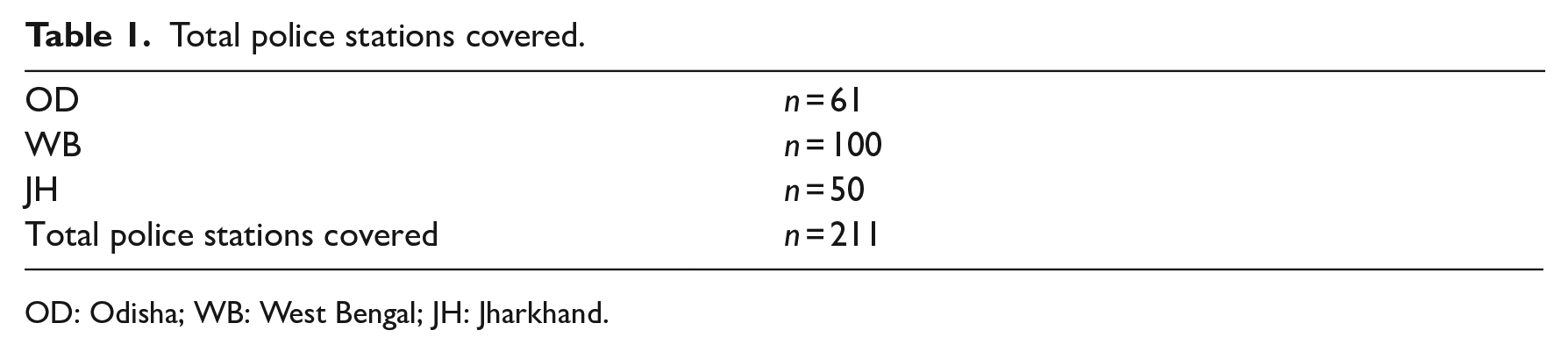
OD: Odisha; WB: West Bengal; JH: Jharkhand.
The steps taken for data collection are explained in Figure 1.
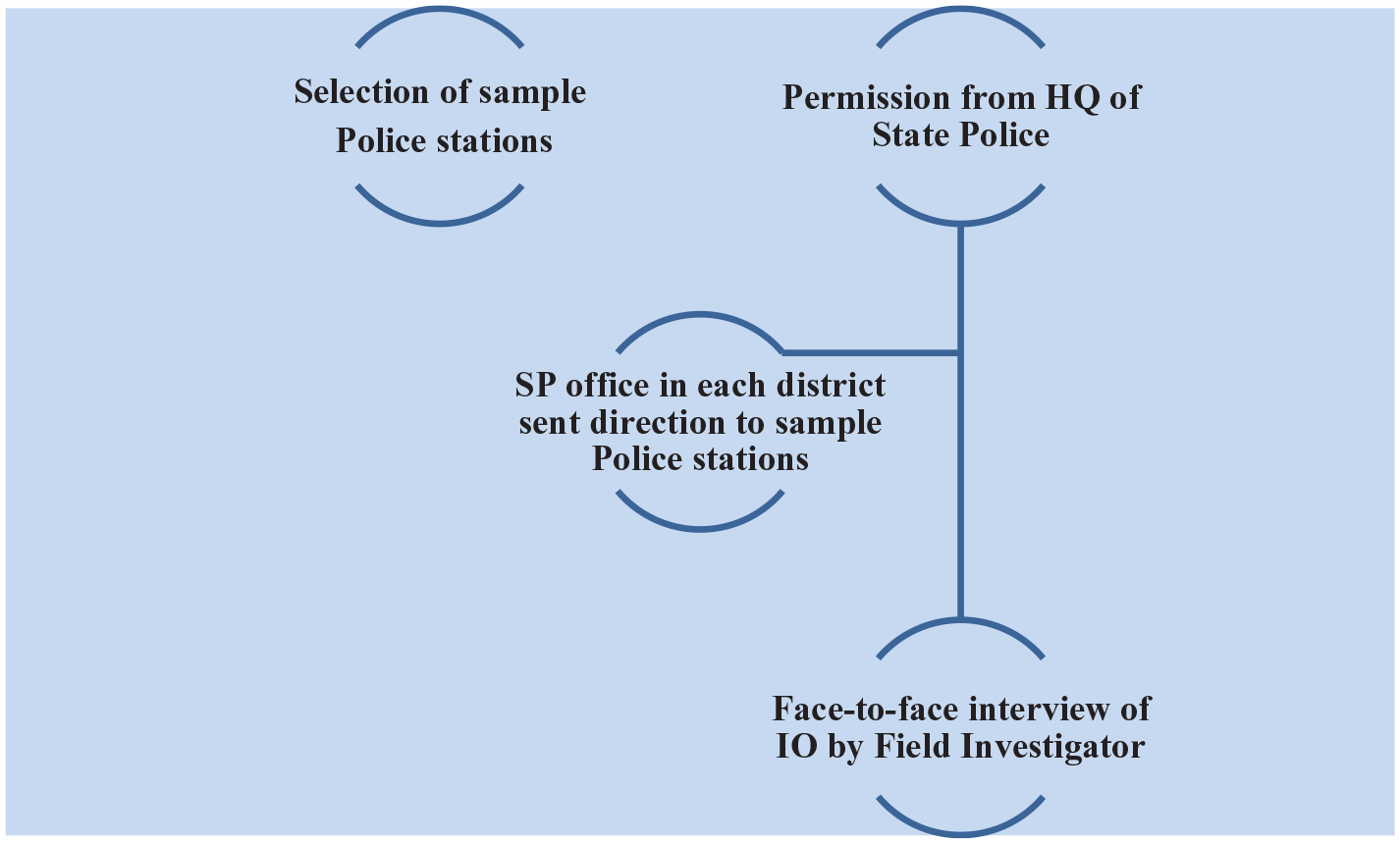
Procedure of data collection.
The requisite permissions from the state police headquarters (HQs) of OD, JH, and WB were obtained before the data collection and the questionnaires also submitted for vetting. This was followed up by specific permission from the offices of the District Superintendents of Police (SP) in the sample districts that sent prior information about the interview to each of the sample PSs with the direction to give the interview to the field investigators (FI) on specific dates. The researchers had to give an undertaking to the effect that the data collected will only be used for academic and research purposes (in WB, an affidavit had to be submitted to assure this) to get permission. The process to obtain permissions took 1-month time in JH, 4 months in OD, and 9 months in WB, and the permissions were granted with specific restrictions on collecting the case and victims’ details.
The data were collected through in-depth face-to-face interviews with the stakeholders using structured questionnaires by FIs (female research scholars) appointed for this purpose during the period October 2018–January 2020. All interviews were conducted at the PSs where the FIs first approached the OIC and then a specific IO was assigned by the OIC who gave the interview to the scholars. In none of the sample PSs was there any refusal from the IOs to do the interviews. The reason may be because they felt obligated to follow the directions of the SP office (their superior authorities). This ensured a 100% response rate of the IOs attached to each PS. There were, however, missing data where the IOs did not respond to some questions. Such missing data are represented as ‘not answered’ in the questions (variables) considered for this study and has been explained in the ‘Results’ section of this paper.
Before conducting the interviews the FIs had to explain to the IOs about the purpose of the research and once again assure that the data are being collected strictly for academic and research purposes (in line with the permissions received from the HQs). In many cases, the FIs had to explain the purpose of asking certain questions. The duration of each interview was about an hour.
The questions were mapped with the legal provisions to capture the compliance with procedures under CrPC on reporting and investigation in rape cases to be followed by the police (e.g. ‘Are registration of information of rape always done by woman police officers?’ Yes/No). There were also open-ended questions to capture the reasons for non-compliance (e.g. ‘what are the reasons for non-registration of information of rape by woman police officers?’). The qualitative data from the police responses from closed as well as open-ended questions were coded. The open-ended responses were thematically analysed based on the themes or patterns appearing from the data. The themes were recognized on the basis of commonalities in the perceptions and experiences of the IOs, and the labels were coded based on such common themes. The secondary data were collected from Crime in India statistics published by NCRB and the white paper figures as provided by the police HQs of the three states. Since the respondents were not commoners but held statutory positions charged with the implementation of relevant provisions of CrPC for reporting and investigation of rape cases, it is presumed that their response will help in understanding the ground realities of implementation of the laws while reporting and investigating rape cases.
Variables
Independent variables
The independent variables (IVs) were collected from the responses of the IOs on the following
Reporting and recording of information of rape by the police (u/s 154 CrPC)
Recording of statement of the victim by the police (u/s 161 CrPC) and by the magistrate (u/s 164 CrPC)
Medical examination of the victim (u/s 164A CrPC)
Victim-friendly approach by the police (mindset in relation to the police counselling of victims and post-traumatic counselling)
Dependent variable
For this study, the dependent variable (DV) is the number of cases pending investigation that was calculated from the average data of 3 years of cases pending investigation weighted by the number of sample PSs in each of the sample districts. The data were received from the police HQs of the three states for each of the sample districts.
Hypotheses
There is non-compliance with laws on victims of rape by the police.
There are no differences in the responses of the police between the three states on reporting and recording of statement of victim, medical examination, and adopting to the victim-friendly approaches (IVs).
The approaches of the police officers in reporting and investigation (IVs) impact the rate of completion of investigation of rape cases (DV).
Analyses
In this paper, we have used the following methods of data analysis-
Frequencies (descriptive results) of the IVs in the three states.
One-way analysis of variance (ANOVA) to test the difference of procedures in the three selected states.
Linear regression model to test the association of the selected IVs with number of cases pending investigation (DV).
Results
The data collected from the sample list of PSs (n = 211) in the states of OD, JH, and WB reflect the approaches of the police officers in discharging their legal obligations in handling rape cases. This part of the paper in each section first discusses the legal provisions to which the questions for interviews were mapped. Second, the descriptive results of the IVs with differences between states (ANOVA test results) of selected labels in the approaches of the police are given. Finally, the results of the regression analysis to test the association between the selected IVs and the DV are shown.
Reporting and registration of a case of rape (by a woman police officer)
A woman police officer or any female officer of the PS is mandated to record the information and the statement of the victim in cases of acid attack, sexual harassment, disrobing, voyeurism, outraging a woman’s modesty, and rape (of all kinds) (together referred to as specific offences against women) (under s. 154 of the CrPC as amended by the Criminal Law (Amendment) Act of 2013). The strict mandate of the law for permitting only women officers to be the first persons to face and respond to the victims of rape is due to the apparent apathy of male police personnel and shaming of the victims by them, which makes the victim reluctant to reach out to the criminal justice system even in the face of immense suffering.
In spite of the law mandating a woman police officer or any woman officer to record the First Information Report (FIR u/s 154 CrPC) and the statement of the victim (as a witness under s. 161 CrPC), it was admitted by the IOs that in almost 25% of the police cases in OD, 16% in JH, and 31% in WB they functioned without any woman officer (Table 2). Notably, 82% of the PSs in OD, 94% in JH, and 44% in WB admitted to not having the information registered by any woman officer. Ninety-seven percent of the PSs in OD stated that the lack of women officers is the main reason for non-registration of rape case by a woman officer. It was interesting to note that in spite of a clear provision in the law, the IOs in many PSs admitted their ignorance by stating that rape cases like other criminal cases case can be registered by the IIC or the OIC of a PS even though they are not women officers.
Reporting and registration of a case of rape- police responses.
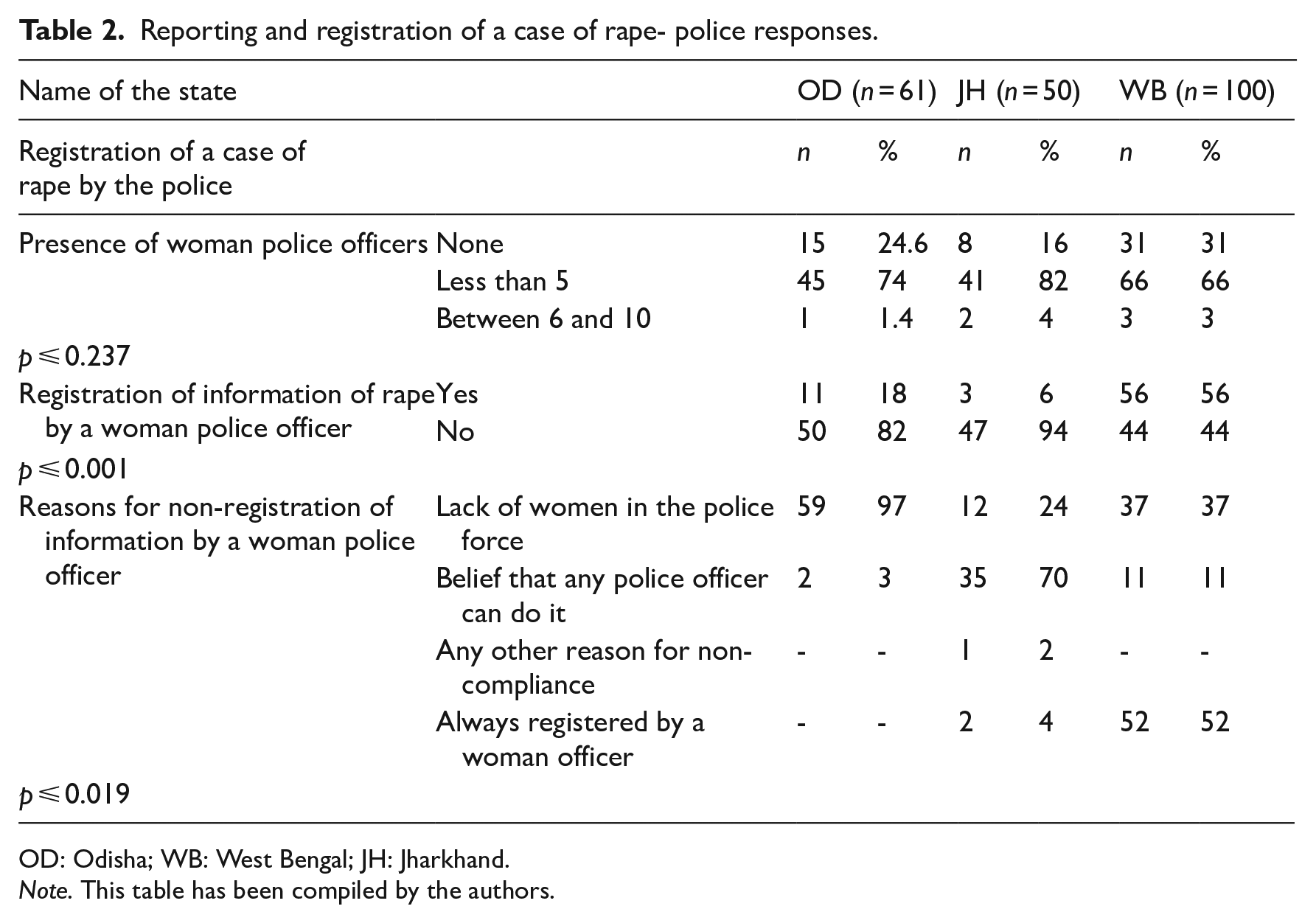
OD: Odisha; WB: West Bengal; JH: Jharkhand.
Note. This table has been compiled by the authors.
The police response from most of the PSs in these three states shows that the average strength of women officers lies somewhere between one and five, thereby showing no difference and with a very high probability value (0.237). Only in WB was the majority of the PSs believed to follow the mandate of recording the information of the victim by a woman officer while the same was not being followed in OD and JH, thereby showing a high confidence interval at 99%. Since the WB police in most of the cases admitted to registration of information by a woman police officer, while OD and JH did not, therefore, there is a statistical difference seen in the three states at a probability value of 0.19. The IOs in the PSs functioning without a woman officer were further questioned by the FIs regarding conducting an investigation of rape in their absence. It was informed that in such a situation, a requisition is sent to the nearest PS to immediately send a woman officer to record the statement of the victim and aid in the investigation of the said case.
Contrary to the responses given by the officers, Table 3 shows a completely different picture altogether. Here, the data from online official records (National Crime Records Bureau (NCRB), n.d.) show the ratio of women police officers to the total number of cases for investigation (including the number for rape and child sexual offences under the Protection of Children from Sexual Offences (POCSO) Act 2012 that mandates women police officers) and the ratio of total PSs to the total women officers in the year 2019 (the year when data collection was done).
Distributive ratio of women police officers.
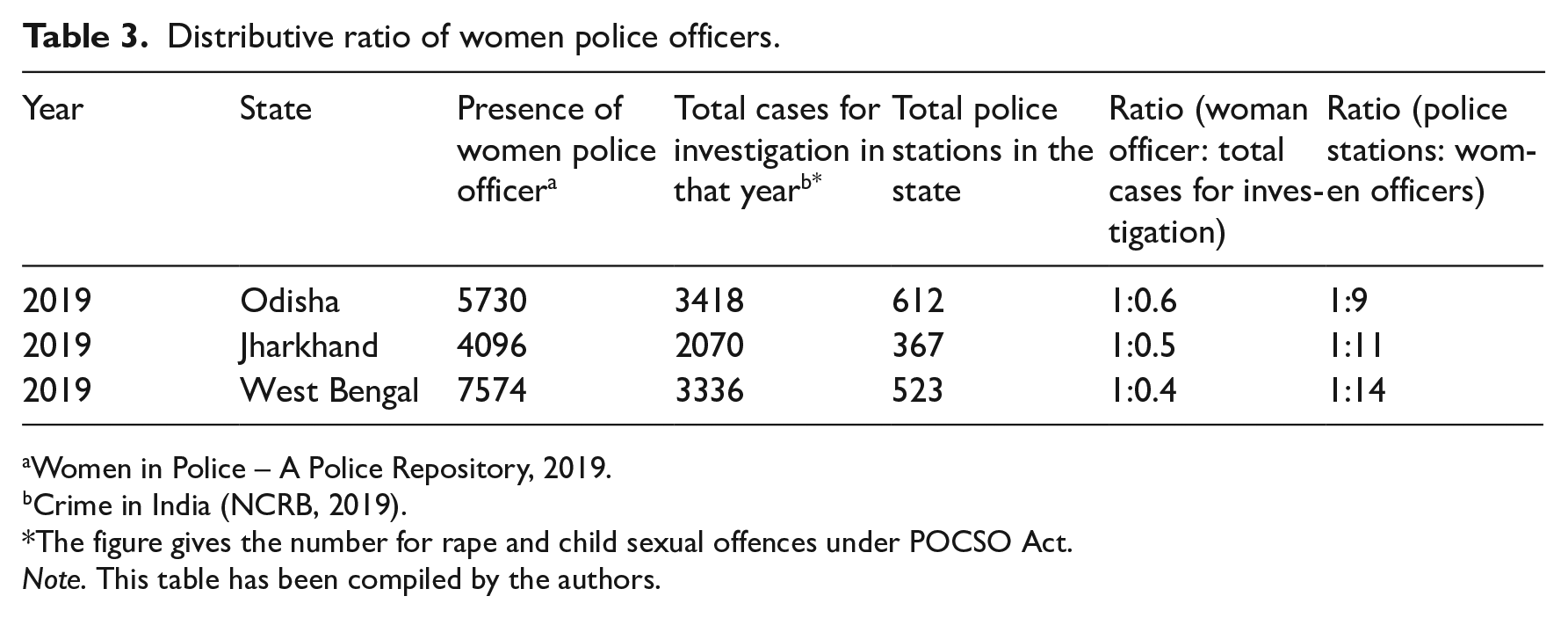
Women in Police – A Police Repository, 2019.
Crime in India (NCRB, 2019).
The figure gives the number for rape and child sexual offences under POCSO Act.
Note. This table has been compiled by the authors.
The data shown in Table 3 are from the year 2019 with figures on presence of women police officers. The above figures show that of the three states, WB police had the lowest case load in a year per officer (1:0.4), followed by JH (1:0.5) and OD (1:0.6). Although the departmental allocation of the number of women officers allotted per PSs is not known, from the table, it is clear that the number of women officers in OD is nine for each PS; in JH, 11; and in WB, 14, that is, at least one woman officer per PS could have been easily made available. This contradicts the response given by officers in Table 2 where, in about 25% of the cases in OD, 16% in JH, and 31% in WB, officers said that there was not even a single woman officer in such stations. From our data, we find that in OD, those PSs who responded to having no woman officers, nine of 15 PSs were in rural areas. Similarly, three of eight PSs in JH and 11 of 31 PSs in WB were situated in rural areas. This reflects the difference in allocation of women officers in the rural and urban PSs in the three states, showing less priority given to rural PSs.
Recording of statement of the victim by the police
The law gives the power of examination of a witness (victim) to a female police officer or any female officer (s. 161 CrPC). These changes were brought by the Criminal Law (Amendment) Act of 2013 to ensure that the victim goes through the least awkwardness possible in front of the police while narrating her story.
The police can generally call the witnesses of a crime (including a victim), to the PS to give their statements (s. 160 CrPC). The proviso introduced in 2013 exempts any male under the age of 15 or a physically or mentally disabled person or any woman from coming to the PS. This exclusion shows that the lawmakers recognize that the PSs in India can be intimidating for the vulnerable victim and such exclusion by the law lets her give her statement as a witness at a place where she may be more comfortable.
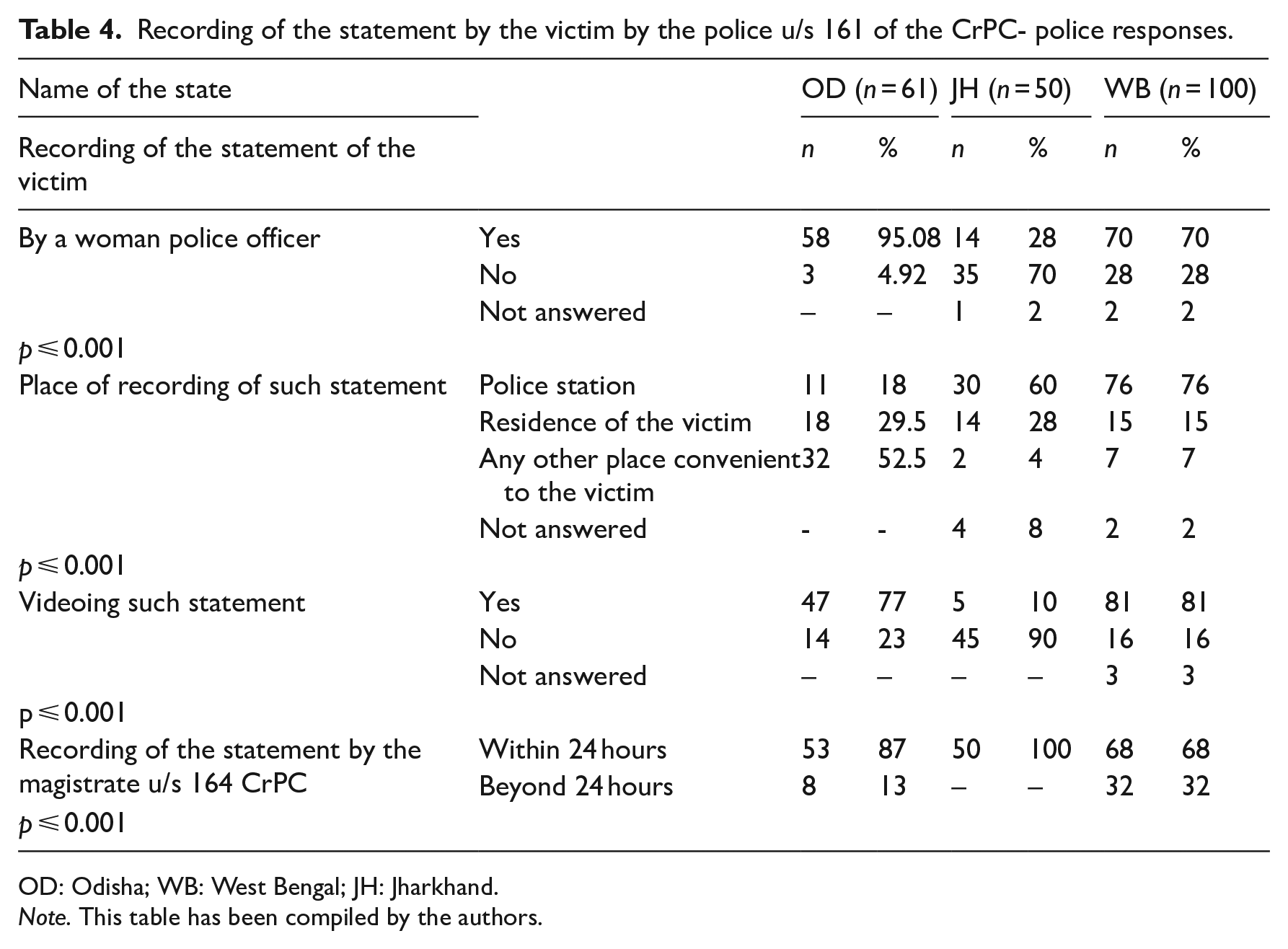
Like registration of information, the recording of the victim’s statement in an offence of rape should be done by a woman police officer or any woman officer (s. 161 of CrPC). Even though, the FIR admitted to not being registered by woman officers in OD (82% in Table 3), a high rate of compliance in recording of the statement of the victim by a woman officer was seen in OD police (Table 4). On the contrary, the response of the JH (28%) and WB (70%) police complied only with the provision of recording the statement of the victim by a woman police officer. This shows more seriousness from OD police in complying with the law, followed by WB and JH. The responses also denote 2% missing data both for JH and WB for the said variable. The plausible explanations may be either ignorance of law or indifference towards compliance.
Recording of the statement by the victim by the police u/s 161 of the CrPC- police responses.
OD: Odisha; WB: West Bengal; JH: Jharkhand.
Note. This table has been compiled by the authors.
The law also provides for the recording of the statement of the victim at a place of her convenience where a clear violation is seen as the police officers stated that they recorded the statement of the victim in the PS itself for JH (60%) and WB (76%) (Table 4). According to the responses collected from the police officers, the most commonly chosen place for such recording of victim’s statement in all the three states was either the PS or her residence and the choice depended on the victim. Eight percent of the PSs in JH and 2% in WB did not respond to this question, which could possibly hint towards recording of the statement of the victim in the PS.
Audio recording or videoing the statement was said to be done in 77% of the PS in OD and 81% in WB, though the majority of JH (90%) police stated in the negative. Lack of technical expertise was stated as the most common reason for non-compliance. However, it is interesting to note that when the trial judges handling rape cases were asked whether they admitted the audio or video statement recorded by the police for corroboration in rape trials or not, 88% of the courts in OD, 6% in WB, and 30% in JH stated that such statements were never produced in court by the police. This shows some discrepancy first, as in OD 77% of IOs used audio-videography of statements, but 88% of trial judges revealed that such video statements were not produced in court. Second, in JH, although only 10% of IOs used video, 70% of trial court judges said that such statements were produced in court.
The recording of the statement of the victim by the magistrate is another step that the police is obligated to comply with as soon as information regarding the commission of rape is given. However, in practice, the victims are taken for medical examination first and then for the recording of the statement by the magistrate. According to the responses of the IOs, the majority revealed that the victims are taken for such recording of their statement within 24 hours of reporting of offence. Yet, it was revealed by some IOs in OD that even though the police take the victim to the magistrate within the 24 hours, the recording of the statement in many cases did not take place on the same day due to unavailability of the magistrate having jurisdiction, for some reason or the other. In some cases, the delay is caused in conducting the medical examination due to the unavailability of a female doctor, as victims feel reluctant to be examined by male doctors.
In terms of the place of recording of the statement of the victim by a female police officer, there is a substantial difference in the choice of place in the three states as admitted by the police officers interviewed, showing a low probability value (0.01).
Medical examination of a victim of rape
The provision of s. 164A CrPC from 2005 recognized the important aspect of the urgency of medical examination, the need for consent from the victim and the procedure to be followed for such an examination. In fact, this was the first attempt to standardize the procedure for medical examination of rape victims, although there is no uniformity in the process of collection of samples and reporting of the medical examination. The law mandates that the victim of rape shall be examined by a registered medical practitioner (doctor) in the nearest government facility and in the absence of such a doctor, by any other registered doctor with the consent of the woman within 24 hours of receipt of information about the offence. Such a doctor shall conduct the examination without any lapse of time and the report is to be advanced to the IO who should then forward it to the Magistrate. The medical examination of the victim is a crucial step in the investigation of rape cases as significant evidence is expected to be collected from such an examination without undermining the importance of the treatment of the victim during the course of such an examination.
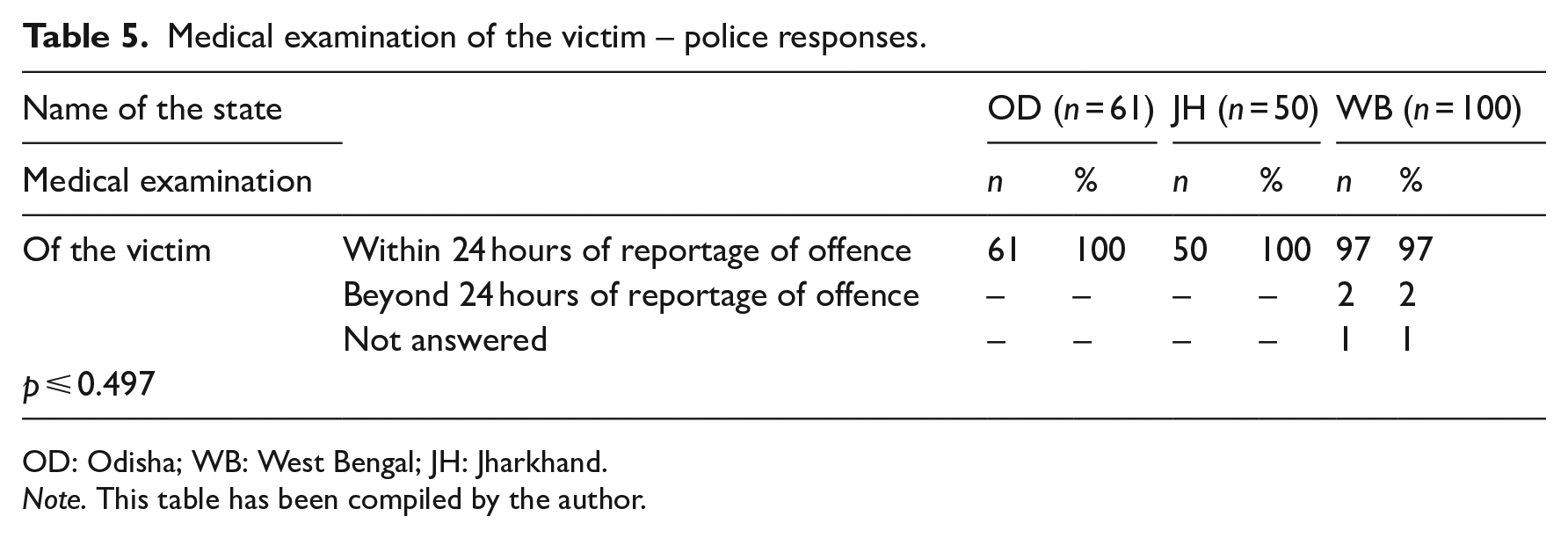
The data in Table 5 show that 100% of the police in OD and JH and 97% in WB stated that the victims were sent for medical examination within 24 hours of receipt of the report. Only 1% of IOs in WB did not respond regarding medical examination of the victim. The possible justifications for such missing data could be that these provisions are not being complied with, which the police do not want to admit. It was admitted that sometimes delay could be caused due to the unavailability of female doctors. With a high probability value of 0.497 for the medical examination of the victim, we can safely assume that there is no significant difference in the medical examination in the three states.
Medical examination of the victim – police responses.
OD: Odisha; WB: West Bengal; JH: Jharkhand.
Note. This table has been compiled by the author.
Victim-friendly approach of the police – the police responses
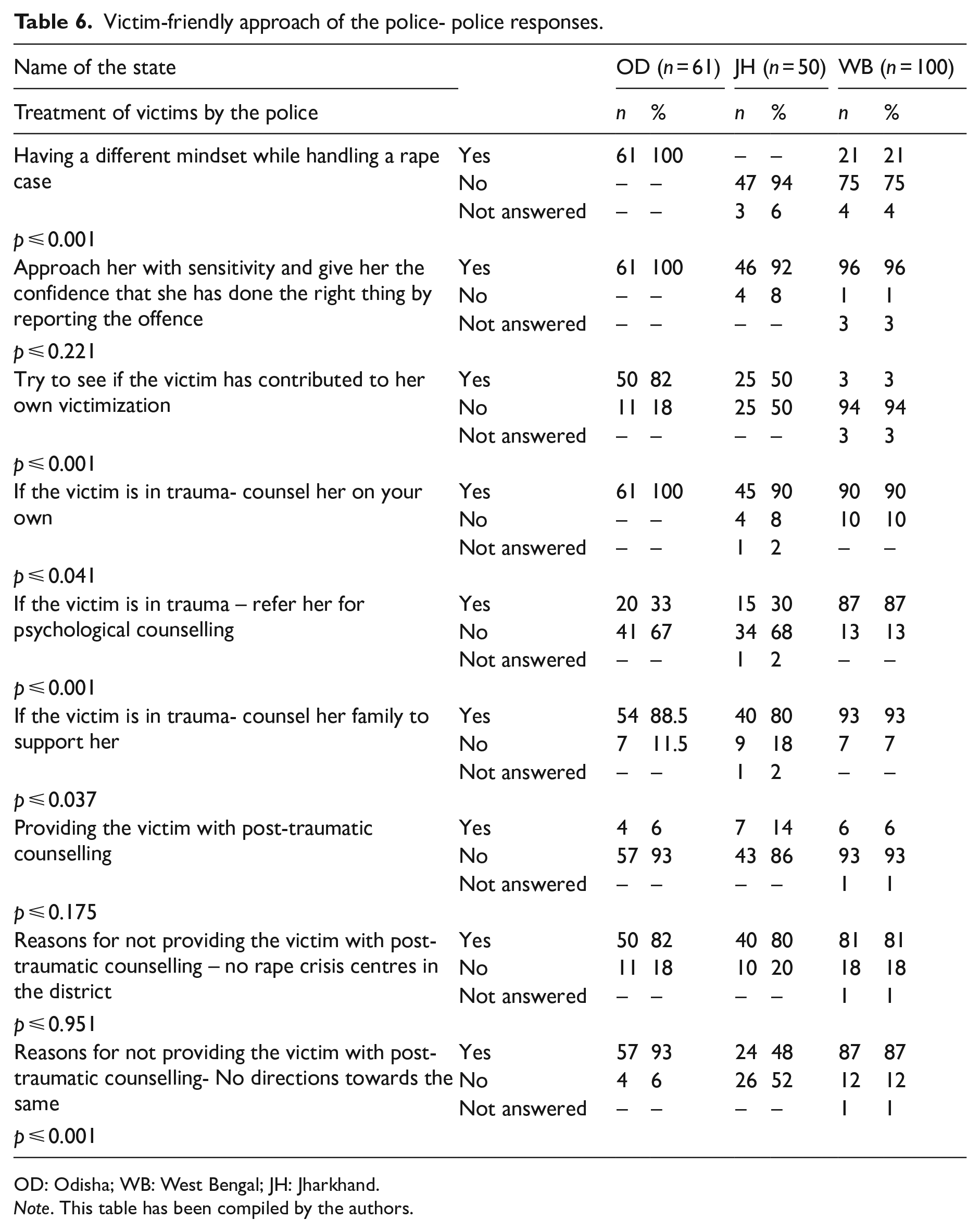
It is important to understand that the survivors of rape suffer from post-traumatic effects including a spectrum of physical and psychiatric disorders (Chaudhury et al., 2017). The Verma Committee was constituted after the infamous Delhi gang rape case and based on the recommendation of this Committee the overhauling of rape laws took place in 2013. Some of the recommendations provided that the police should have a sensitive mindset towards a rape victim and should be free from prejudices, such as rape myths, should counsel the victim, should refer her for psychological counselling if she is in trauma, and additionally, the states were mandated to set up reception centres in the nature of rape crisis centres to provide for one-stop rehabilitation for the victim (Chattoraj, 2013). Non-availability of post-traumatic counselling poses a threat to the restoration of the victim (Callender and Dartnall, 2002). The victim-friendly procedures aim to integrate these recommendations in the legal framework. The next set of questions was asked of the police officers to gauge their general mindset while handling rape cases (Table 6).
Victim-friendly approach of the police- police responses.
OD: Odisha; WB: West Bengal; JH: Jharkhand.
Note. This table has been compiled by the authors.
Table 6 reflects the true picture of police attitudes towards the victims of rape in the states of OD, JH, and WB. It shows the difference in mindset of the police, where in OD, the general view of the police was to have a different (compassionate) attitude while dealing with cases of rape as opposed to JH and WB where the majority stated otherwise. In addition, in JH, 6% and in WB, 4% included missing data for the said variable. It is important for the police to be empathetic towards the victim as the first impression affects further cooperation between the victim and the prosecution and judicial authorities (Areh et al., 2009). Such missing data in JH give us an idea that the police in JH and WB show an attitude of indifference to the victims of rape. It is only in WB that the victims were being referred for psychological counselling (87%) while the same was not being followed in OD or JH. Sec. 357C CrPC casts a responsibility on all hospitals, whether public or private, to provide immediate first aid or medical treatment free of cost to the victims of offences against women (including rape) and then immediately inform the police. Immediate first aid should also include psychological help required for restoration of the victim. In most cases, the victims approach the police before going to the hospital; therefore, as a matter of practice, it is the police who are expected to take such victims if they require immediate medical treatment.
In WB, 3% of the IOs did not respond regarding ‘approaching her with sensitivity . . .’, 1% did not respond to the questions relating to providing the victim with post-traumatic counselling, reasons for not providing the victim with post-traumatic counselling because of no rape crisis centres in the district, or reasons for not providing the victim with post-traumatic counselling because of no directions towards the same. These non-responses by the IOs shows that such IOs in WB are not attuned to having such a victim-friendly mindset. Similarly, JH reported 2% missing data for some of the questions of counselling the victim by the police, referring the victim for psychological counselling and counselling the family of the victim to support her. Such missing data may be an indication towards the apathetic mindset of the police for counselling the victim. However, all the IOs interviewed in OD responded to the above questions in Table 6 indicating a more responsive police culture.
Association between IVs and DV
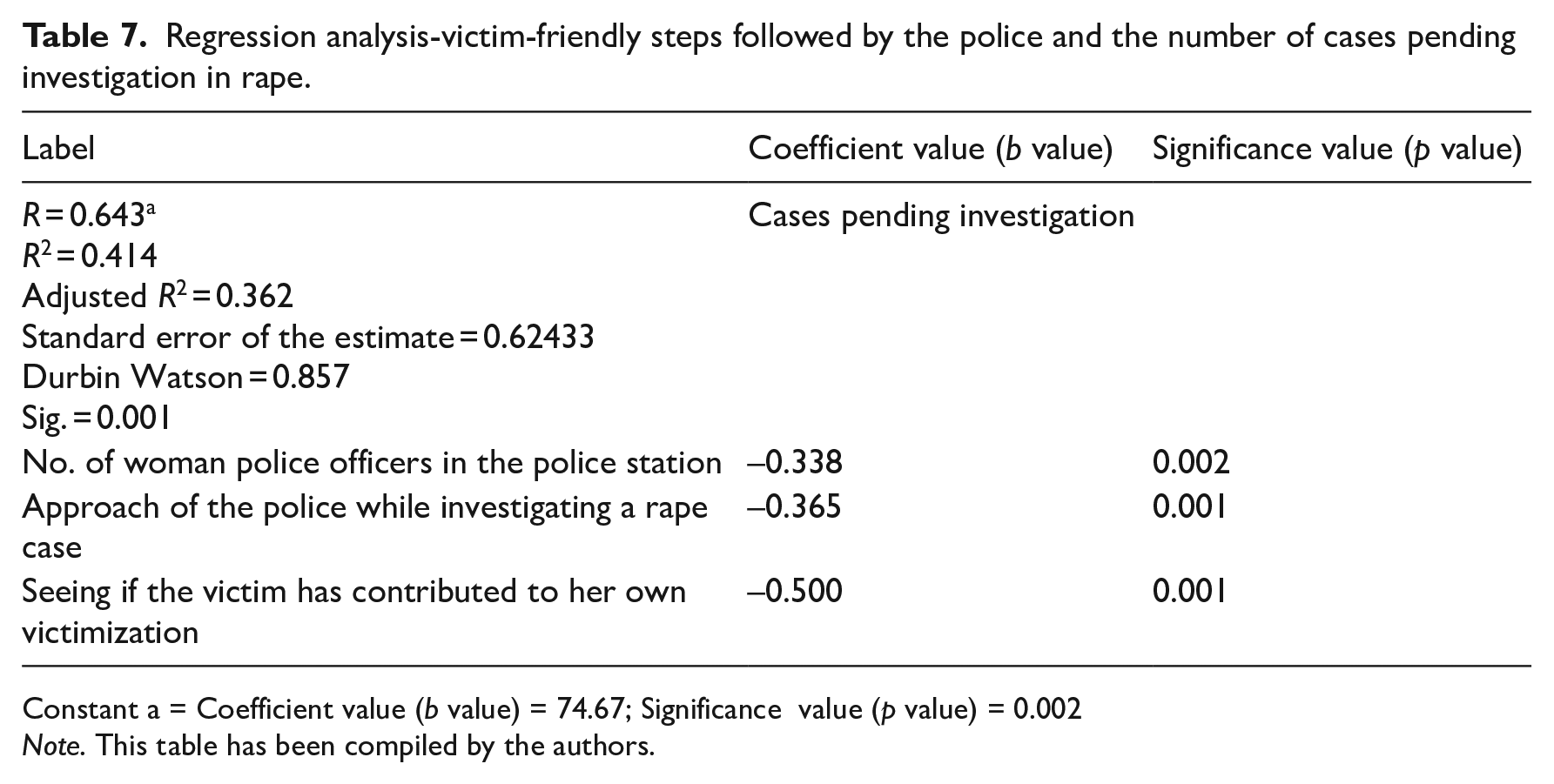
Table 7 shows the analysis from the linear regression showing an association between the selected labels of IVs and the DV based on their statistical significance. The probability value was set at 5%. The statistics shown in the model reveal significance at a 99% confidence interval.
Regression analysis-victim-friendly steps followed by the police and the number of cases pending investigation in rape.
Constant a = Coefficient value (b value) = 74.67; Significance value (p value) = 0.002
Note. This table has been compiled by the authors.
The association of the police perception regarding presence of women police officers in the PS with the DV is significant (at a 98% confidence interval) as established from our sample data and has a negative correlation with the DV. In addition, having a different (compassionate) mindset about the police while dealing with a rape victim was found to be significant with our DV (at a 99% confidence interval). We may conclude from the negative correlation of the IVs with the DV that when there is presence of women police officers, and the police approach rape cases differently from other cases, the pending rate of investigations will decrease. The variable ‘seeing if the victim has contributed to her own victimization’ (in other words, ‘victim blaming’) has a negative correlation with a significant association. Therefore, when police have an attitude of victim blaming then the investigation is not completed, compared to such cases where the police thinks that the victim to be genuine and not to be blamed for the rape. These associations reflect the outcome of the group of IVs and their impact on the DV at the population level, which also helps us to understand the police perception of the investigation process and the treatment of victims of rape cases.
Discussion
The police records of rape cases from the PSs were not accessible to the researchers due to non-disclosure provisions under the CrPC (s. 327(3)), and the IPC (s. 228A) against disclosing any details of the victims of rape and the authors relied on face-to-face interviews with the IOs to understand the extent of compliance with the legal procedures and the reasons for non-compliance in the three states. There is evidence that a face-to-face interview method is an effective tool (Utibe Monday, 2020) and guarantees a better response rate from the respondents (Nix et al., 2019).
We found that in spite of the strong mandate in the law to involve woman officers as the first stakeholders to respond to rape cases during reporting and recording of the statements of victims, in some cases, it continued to be done by male officers with negative implications for re-victimization, shaming, and making the victims reluctant to approach the police and cooperate with the case progression. It was surprising to note that there is still a lack of awareness by police officers in a few of the PSs about this basic requirement of the law as they believed that any officer, male or female, can register the information in rape cases. The analysis in Table 3 shows that there is no shortage in the number of women police officers given the low case load per year and their proportion compared to the number of PSs. Also, most non-compliance of this law is taking place in PSs situated in rural areas, which shows less priority being given to rural PSs in allocating woman officers.
The registration of an FIR symbolizes the bringing of a criminal case into motion. In most of the PS, the OIC did it as a matter of practice except in the Mahila PS (an all-woman PS). Eight percent of the sample PS in OD, 19% in WB, and 8% in JH were headed by a woman OIC where the cases were registered by such women OICs. So, it was naturally seen that the compliance with the law regarding registration of FIR and recording of statement of the victim was duly followed in these PSs. There is significant non-compliance in varied degrees in the police responses in the three states with respect to the registration of information of rape by woman police officers (18% in OD, 56% in WB, and 6% in JH), reflecting the ignorance of the law by the officers. The recording of the statement of the victim also shows a difference in the three states with high compliance in OD (95%), moderate in WB (70%), and low in JH (28%). The complying PS revealed that this step requires sensitive handling of the victim where a woman officer is better suited for the job. There is also a difference in the three states in using video recording of the statement of the victim, JH (10%) showing least compliance and OD (87%) showing maximum. However, when it was cross checked with the trial judges, 77% in OD, and 30% in JH stated that such video statements were never produced during trial. Also, the matter of taking the victim to the magistrate to get her statement recorded shows variance in the three states where 100% in JH, 87% in OD, and 68% in WB were compliant. It was seen that the legal requirement of a medical examination within 24 hours (s. 164A) is being complied with in the three states in the majority as per their responses.
There was also a difference of approach in the manner in which victims of rape were being dealt with in the three states as in OD, the police approached the victim with a more compassionate attitude as compared to the police in JH and WB. One of the stages of a rape investigation that requires sensitive handling of the victim is the recording of the statement of such victims and we find that in OD, there was 95% compliance, but it cannot be explained for JH or WB. This also raises a question mark over the existing training programmes for police officers towards creating gender sensitization while dealing with cases of rape. Moreover, it was observed that the victims were not being provided with post-traumatic counselling in any of the three states as there were no specialized centres like a rape crisis centre in the district and also there were no specific governmental directions for the same.
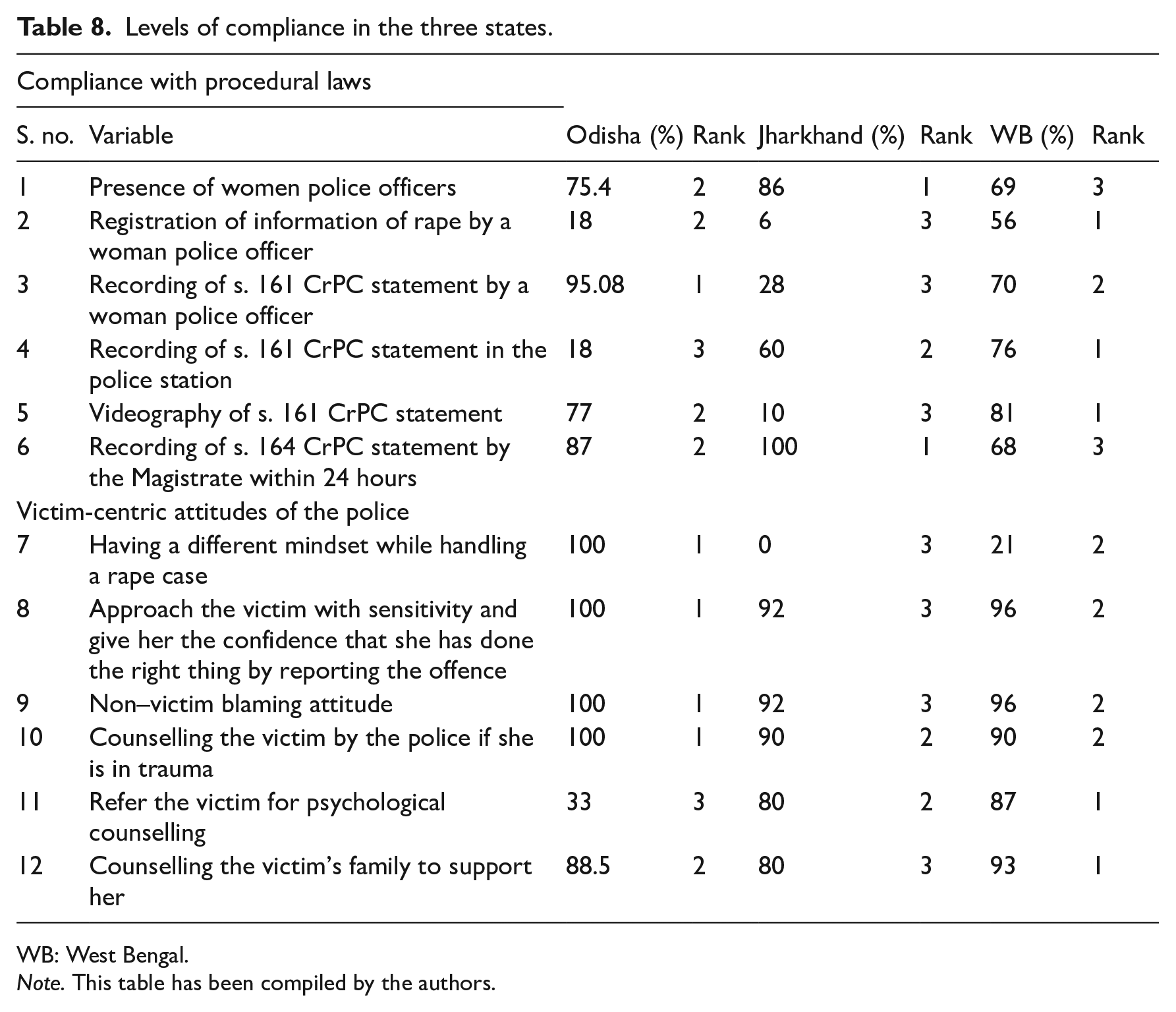
The difference in the approaches of the three states is summarized in Table 8.
Levels of compliance in the three states.
WB: West Bengal.
Note. This table has been compiled by the authors.
Following the Delhi gang rape incident and overhaul of the law, it was expected that the victim-centric laws and attitude would show uniformity in implementation. However, Table 8 shows there are differences in compliance level between the three states. In Table 8, the three states states have been ranked on the basis of being the (1) most compliant, (2) medium compliant, and (3) least compliant state. WB shows the most compliance and JH the least compliance in following the procedural mandates during investigation of rape cases, whereas OD shows the most compliance and JH least compliance in having a victim-friendly approach.
The regression analysis shows a significant association between the DV and the following IVs:
Number of woman police officers in the PS.
Approach of the police while investigating a rape case.
Seeing if the victim has contributed to her own victimization.
Therefore, from the above discussion, we can say that the first hypothesis is proved in terms of most of the variables except conducting the medical examination. The second hypothesis is not proved except for a few variables where the three states responded similarly, namely, a lack of women officers, conducting the medical examination within 24 hours and not providing post-traumatic counselling to the victim. With respect to the other variables in Table 8, most compliance in following the procedural laws was seen by police in WB and in victim-centric attitudes by the police in OD. For both these parameters, JH shows poor compliance hinting towards some lacunae in the training process of the police in JH regarding awareness of the procedural laws on rape and handling of rape victims. Finally, the third hypothesis is partially proved with only three variables showing significant association among the variables selected for this study from the victims’ perspective.
Conclusion
After the 2013 amendment to the criminal law, the victim-friendly procedures introduced for the police as one of the primary stakeholders in responding to the law, along with safeguarding the interests of rape victims, required testing on the ground. The responses of the police on implementing the laws could not be verified from other independent sources; however, this study focussed on compliance or lack of compliance with the laws from the police’s perspective, and the responses were taken as indicative of the actual application of the laws. Therefore, the current research with some limitations aims at highlighting the realities of the approaches adopted by the police. From this study, we can conclude that the majority of the victim-friendly procedures did not show uniform compliance in the three selected states, contrary to the expectations that the mandatory nature of the laws should see compliance in all states.
There has been a limited literature on compliance of law by the police in India. Research has suggested that an increase in the proportion of women police officers improves the willingness of victims to approach the criminal justice system (Amaral et al., 2021). Our research shows that there is no shortage of woman officers but there may be unhelpful allocation of such officers in the PSs. The rape law reforms were expected to bring about more accountability of the police, which is evident from the inclusion of s. 166A in the IPC, which brings penal liability on the police for failure to report and investigate cases of offences against women. In India, the general approach towards police is one of mistrust due to systemic patriarchy, inherent in the police force especially in cases of handling crimes against women. The CrPC has spelt out procedural checks to neutralize this approach of the police as much as possible and allow room for participation of the victim in a congenial environment. Therefore, it is important to increase awareness in the police not only of their legal obligations but also to inculcate more sensitivity in their response while interacting with victims of rape, which can knowingly or unknowingly attribute shame to the victim. Our findings show that the training should be made more rape victim-centric generally for all the states and specifically for JH.
Within the limited scope of permission for data collection received by the authors, understanding how the IOs approach rape cases was one of the methods available to assess the efficacy of the new provisions of the law. Through this study, it came to light that though the laws are mandatory for all the states, we found that there are differences in compliance levels by the police in most cases except where conducting the medical examination of the rape victim within 24 hours, which was being implemented rigourously by all the three states.
We can conclude that some of the significant steps that may positively impact the process of reporting and investigation of rape are, first, proper allocation of woman police officers in rural as well as urban PSs, second, reporting of information and recording of victims’ statements to be mandatorily conducted by woman police officers, third, increasing awareness of police regarding the basic legal mandates, and finally, systematic training for gender sensitization of police officers.
As a way forward, further studies could be conducted to ascertain the reasons for non-reporting or discontinuation of cases from the victims’ perspective to find the reasons behind it. The authorities are expected to monitor non-compliance with the procedures as reflected by the police responses and plug the loopholes in the implementation of the laws, so that, the prospective victims and/or their families can confidently approach the police not as a last but as a first resort.
Footnotes
Acknowledgements
This work was supported by the Indian Council of Social Science Research (grant no. G-35/2017-18/ICSSR/RP). The authors are also grateful to the High Courts and Police Headquarters of Odisha, West Bengal and Jharkhand for granting permission for data collection and the individual Police officers and judges for responding to the questions of the interview schedule.