






Abstract
This qualitative study explores the service needs and systemic gaps experienced by African, Caribbean, and Black (ACB) survivors of homicide victims in Ontario, Canada, where homicide rates have steadily risen over the past two decades, particularly among racialized populations. Through 51 interviews in five high-homicide regions, findings reveal that current victim services inadequately meet the needs of ACB survivors due to limited funding, culturally insensitive approaches, and harmful interactions with the police. Thematic analysis identified three key domains: Barriers to Accessing Support, Police Response, and Representation Matters. These domains underscore the importance of trauma-informed, culturally responsive care and the need for greater ACB representation in service delivery. The study offers concrete policy recommendations aimed at improving access, enhancing accountability in law enforcement interactions, and expanding long-term, community-based support for ACB survivors. These findings inform urgent policy reforms to ensure equity and justice in the post-homicide service landscape.
Introduction
The homicide rate in Canada has been steadily increasing over the past 20 years. In 2022, Canada’s national homicide rate of 2.25 was the highest since 1992 (Statistics Canada, 2023b), with 2022 witnessing 78 more homicides than 2021 and 110 more than 2020. The province of Ontario accounted for 32.95% of the 874 homicides reported across the country, although its homicide rate of 1.91 was lower than the national homicide rate (Statistics Canada, 2023a). As per the latest data available from Statistics Canada, there has been a significant increase in the number of youth (under 18 years of age) who were charged as perpetrators of homicide. In 2022, a total of 90 youth were charged with homicide compared with the previous 10-year average of 39 youth accused of homicide (Statistics Canada, 2023a).
While the increase in homicide rates in Ontario and Canada continues to be a concern, it is important to note that the distribution of homicide across racial groups in Canada is not uniform. Racialized populations comprised 26.5% of the overall Canadian population in 2021 (Statistics Canada, 2022b) and 30% of total homicides in 2022 (Statistics Canada, 2023a). This overrepresentation is significantly higher for African, Caribbean, and Black (ACB) communities, which comprised 4.3% of the total population in Canada per the 2021 Census of Population (Statistics Canada, 2022b) but accounted for 13% of homicide victims. The variance is even more pronounced in Ontario where ACB individuals comprise just 16.2% of the racialized population in Ontario yet account for over 54% of homicide victims (Statistics Canada, 2023c).
In the aftermath of homicides, research suggests that roughly 7–10 family members and friends of the victim (hereafter referred to as survivors) are left behind, faced with the challenge of learning to cope with the traumatic impact of their loved one’s death (Gross, 2007). Moreover, ACB communities are often composed of loved ones who are not related by blood, suggesting that the number of people grieving the murder of family members and friends may be much higher than research estimates (Sharpe and Boyas, 2011). Research has consistently demonstrated that homicide survivors often experience shock, rage, guilt, helplessness, isolation, complicated grief, and post-traumatic stress reactions for surviving family members (Burgess, 1975; Morris and Scott, 2025; Rinear, 1988; Rynearson and McCreery, 1993; Sharpe and Boyas, 2011; Turner et al., 2021). A systematic review documenting a variety of mental health problems among homicide survivors found a wide range of post-traumatic stress disorder (PTSD) estimates across studies, with lifetime homicide-related PTSD ranging from 19% to 71% (van Denderen et al., 2015). Despite knowledge of the inequitable spread of homicide in ACB communities and the negative mental health outcomes experienced by homicide survivors, the existence and availability of services designed to support ACB survivors as they grieve is limited (Sharpe et al., 2018).
Research on survivors of homicide victims in the United States indicates that culturally responsive services for Black survivors should be grounded in a social determinants of health framework, incorporating strong communal elements, and should reflect an integrated understanding of both historical trauma and ongoing experiences of loss and bereavement (Bamwine et al., 2024; Bent-Goodley et al., 2023; Magee et al, 2023; Sharpe et al., 2024). Similarly, studies of ACB survivors in Canada suggest that their grieving processes and the associated impacts are distinct from those of other racial groups, shaped in part by the intersecting effects of systemic oppression and repeated exposure to homicides across the life course (Bailey et al., 2024). This argument is grounded in the recognition that the social construction of identity within ACB communities in Canada differs in important ways from the African American identity as understood in the United States (Boatswain and Lalonde, 2000; Lalonde et al., 2008; Mensah, 2014). Demographic projections further underscore this distinction, with the ACB population in Canada expected to exceed 3 million by 2041 (Statistics Canada, 2022a, 2024). As of 2021, more than half of this population was foreign-born, including 55.3% originating from Africa and 35.6% from the Caribbean and Bermuda (Statistics Canada, 2024).
Given this considerable sociodemographic diversity, a nuanced approach is required, one that accounts for the distinct historical and sociocultural contexts shaping ACB experiences in Canada. Accordingly, research on trauma and violence within ACB communities has increasingly emphasized the need for culturally responsive policies and practices tailored to survivors of homicide victims (Motley et al., 2017; Waller et al, 2024).
Policy concerns of ACB survivors of homicide victims
An overview of the policy and program landscape of victim services in Canada reveals three elements. First, survivors of homicide victims are not considered a distinct group, and their unique identities are subsumed within the much larger category of victims of crime. Second, despite the significant overrepresentation of ACB communities as victims of crime (Cotter, 2022; Statistics Canada, 2023a), there are no ACB-specific programs among the resources on the government website, although there are resources for Indigenous populations (Ministry of Children, Community and Social Services, 2023). Third, the policy framework for victims of crime is skewed toward providing assistance navigating the criminal justice system and emergency services. Of the seven programs listed on the Canadian government’s website, five services are designed to provide support with court processes while the other two focus on crisis intervention and short-term financial support (Ministry of Children, Community and Social Services, 2023).
Within the current policy regime, there is a fundamental gap in understanding the sociopsychological consequences of the loss of a loved one due to homicide and the consequent need for services. As a result, survivors of homicide victims are compelled to seek support within the mainstream social and human service systems, such as those provided through the general Victim Support Line (Pastia and Palys, 2016). This is particularly problematic for ACB survivors of homicide victims whose cultural perspectives and practices are not recognized and incorporated into service systems.
The lack of policies that include the perspectives of communities disproportionately impacted by homicide can be attributed to a lack of post-homicide research. Post-homicide research in Canada has several insufficiently researched areas, especially those related to culturally responsive service provision (Moore et al, 2022). Contrary to the overwhelming focus on the criminal justice process, Pastia and Palys (2016) found that victim impact statements did not make survivors feel heard to the degree described in previous studies, and being informed about the circumstances surrounding the death of their loved ones was reported as being more important to survivors than involvement in criminal justice proceedings (Englebrecht, 2011; Kenney, 2010). In the absence of a considerable body of research, this paper explores policy implications from the perspectives of ACB survivors of homicide victims. The purpose of this qualitative study is to address the identified gaps in research and policy recommendations grounded in the perspectives of ACB survivors of homicide victims.
Study design and objectives
This study examines the experiences of ACB survivors of homicide victims in Ontario, Canada, and explores the policy implications for supporting this population. Data were collected between 2019 and 2021. The primary objective of the study was to examine how ACB survivors experience and cope with the homicide of a loved one and to identify their service needs in the aftermath of this traumatic loss. By centering the lived experiences of Black survivors, this study aims to inform the development of culturally responsive policies and service interventions that more effectively address the unique social, cultural, and structural contexts shaping the needs of ACB survivors of homicide victims in Ontario.
Participants
Fifty-one interviews were conducted with ACB survivors of homicide victims living in Ontario, Canada. All participants were over 18 years of age and were not related to the same homicide victim. They lived in regions throughout the Greater Toronto Area (GTA) where the majority of the population identified as ACB and where homicide rates had been highest over the 5 years preceding the project. Most participants identified as cousins of homicide victims (40%), followed by immediate family members (37.5%) and friends (22.5%).
Methods
Interviews were conducted virtually and were facilitated by members of the research team. Interviews were approximately 60–90 minutes in length. A semi-structured interview guide was used to help facilitate interviews which included specific questions about the approaches taken by service providers, the needs of survivors, and what they found most or least helpful through their grief journey (see Appendix 1).
The semi-structured guide was developed through an iterative process informed by the Model of Coping for African American Survivors of Homicide Victims (MCAASHV) and existing post-homicide bereavement literature (Sharpe and Boyas, 2011; Sharpe et al., 2023). The MCAASHV provides a sociocultural framework for understanding how African American survivors interpret and cope with the homicide of a loved one by situating the traumatic event within broader cultural, historical, and structural contexts. The model includes several key components: cultural trauma, the homicide experience and its impact, the culture of homicide, racial appraisal, and coping strategies used by survivors (Sharpe and Boyas, 2011).
Consistent with the MCAASHV (Sharpe and Boyas, 2011), the semi-structured interview guide was organized to capture survivor experiences across several key domains. Questions addressing cultural trauma explored participants’ perceptions of historical and contemporary racialized experiences that shape expectations of hardship and reliance on cultural strengths such as ancestral survivorship and community-based support. Questions related to the homicide experience and its impact examined participants’ personal experiences of losing a loved one to homicide, including the emotional, psychological, and social consequences of the violent loss. Additional questions reflected the culture of homicide, exploring survivors’ experiences with stigma, shame, blame, and perceptions of justice following the homicide. The guide also included questions examining racial appraisal, or the process through which survivors interpret the homicide through the intersecting influences of racial identity, systemic inequality, and structural barriers to resources. Finally, questions explored coping strategies utilized by African American survivors of homicide victims, including spiritual coping and meaning making, reflecting culturally grounded approaches survivors use to manage grief and trauma following the homicide of a loved one (Sharpe and Boyas, 2011)
The interview questions were related to survivors’ previous experience with service providers and their perception of their current and ongoing service needs (see Appendix 1). All interviews were recorded and transcribed verbatim using an Research Ethics Board approved, encrypted transcription service.
Analysis
Interviews were coded using NVivo 12 Plus, a qualitative research analysis software package. Using an inductive process, the research team was instructed to read interview transcriptions fully to obtain an overall sense of the meaning communicated by participants and codes that emerged (Charmaz, 2006). The components of the MCAASHV served as an initial conceptual framework to guide the development of the preliminary coding structure. Deductive codes were first organized according to the model domains (e.g. cultural trauma, the homicide experience and its impact, culture of homicide, racial appraisal, and coping strategies), while additional inductive codes were generated to capture emergent themes within and across these domains. Members of the research team independently reviewed and coded transcripts, and the coding framework was refined through iterative discussions to resolve discrepancies, ensure consistency in code application, and enhance the credibility of the analysis. The group met iteratively to discuss their initial codes, which were deliberated and extrapolated on to create themes. These themes were then analyzed in the context of other interviews along with new emerging codes. This approach includes analyzing the text for keywords, assigning codes to segments of data, and developing themes by identifying relationships and patterns among codes (Naeem et al, 2023). Finally, the themes were linked to existing theoretical frameworks and the research questions that the study set out to address (Guest et al., 2012; Sharpe and Boyas, 2011). Inductive thematic analysis was the optimal approach for this study given its exploratory nature and limited research on the topic. Research team members participated in the coding and analysis processes and regularly discussed their findings and reflections with each other. This process of inter-coder reliability allowed for the reduction of bias and helped to ensure the credibility of the results (Krippendorff, 2006).
To enhance the rigor and credibility of the analytic process, multiple strategies were employed. An audit trail was maintained throughout the study to systematically document key methodological decisions, coding processes, and the evolution of themes, thereby supporting transparency and dependability. Regular debriefing sessions were conducted with the Project Advisory Committees and Canadian Mental Health Association (CMHA) Ontario, which provided opportunities to critically examine emerging interpretations, challenge potential biases, and ensure that findings remained grounded in the data and relevant to community contexts. In addition, reflexive journaling was used to continuously interrogate the researchers’ positionality, assumptions, and potential influences on data interpretation. Together, these strategies were essential for strengthening the trustworthiness, confirmability, and contextual validity of the study’s findings.
Results
An analysis of interview data generated three domains: (1) Barriers to Accessing Support, (2) Police Response, and (3) Representation Matters. Barriers to accessing support involved factors that inhibited survivors’ ability to access and receive victim services. Police response included survivors’ experiences with the police before and after the homicide. ‘Representation matters’ highlighted the importance of service providers understanding the lived experiences of survivors across multiple identities. These domains consist of nine themes that helped elucidate the impacts of homicide, the coping strategies of ACB survivors, and their need for services. Study themes inform culturally responsive policy recommendations for victim services, including barriers to accessing support, negative interactions with the police and media, limited funding for post-homicide services, the need for increased ACB representation among service providers, and a lack of consistent communication from service providers.
Barriers to accessing support
Several participants reported that accessing formal services was difficult because they were either never informed about available support or their situation was not considered a priority. Participants also shared a lack of trust that their requests would be given proper attention due to previous negative experiences with the legal systems managing the homicide cases of their loved ones. When asked about their experience accessing services and supports, a surviving cousin reported: I would say it was not an easy process. First of all, reporting the case to the police station . . . It wasn’t [sic] easy because we would just report to the station and they will be like, ‘We are following up the case. We are following up with the investigation’.
A surviving cousin described mistrust in systems of support (e.g. police, victim services) serving as a barrier to surviving family members utilizing formal support services: I didn’t use any formal services at all. Um and I don’t believe my family did. Um, full disclosure, I am a social worker. We just don’t think about using, like I described, victim services or any formal support. We just talk to each other and rely on each other . . . But like, beyond support for ourselves, we don’t really, I don’t think we really trust formal organizations. Like if the police aren’t looking or, or dealing well with trying to find who killed him, why would we trust them to help us directly with anything else?
However, survivors of homicide victims who did report using community services found them to be useful and were often told about them by a mentor, friend, or in one case, by a police officer. A survivor who lost her boyfriend to homicide found counseling helpful and stated: [A] friend of mine told me about it [counseling]. Because I realized that now my life was almost coming to like a standstill. I would sleep all day, or maybe not eat, or maybe just be indoors crying. So I was even depressed in a way. Yeah. So, I just needed the services.
Lack of clarity over where to go for support and services
Apart from a small number of victim service agencies that approached survivors of homicide victims directly, participants in this study did not identify any procedures for service providers to proactively reach out to them. In addition, several participants indicated that they were so traumatically impacted by grief that they did not consider reaching out for assistance or support. A surviving brother expressed the challenges he experienced trying to access grief and bereavement services: I couldn’t get into contact with any services, I don’t know, maybe because I didn’t make the initiative, but it was just difficult for me to get into contact with grief counselors or anyone that, or any group that focus[ed] on victims or family members.
Exclusion of chosen family
Despite inconsistent access to services, nearly all participants expressed a need for grief and bereavement services in the immediate aftermath of homicide. In fact, several participants still believe that support services would be beneficial to helping them navigate their grief. Criteria for gaining access to victim services also served as a limitation for participants’ ability to access support services. For example, several participants described a limited Eurocentric conception of family as a barrier to accessing services. Some participants expressed not being offered support because they were not biologically related to the deceased. One survivor stated: There [are] a lot of people that lived in the house that were going through it too, and it was like everybody was just dealing with it in different avenues, but yeah. It [grief services] was not offered. It was offered to four people but not the rest of the family.
Immigrant status
Immigration status served as another barrier for receiving services. Among participants, services were not always offered because of tenuous immigration status. One surviving spouse was denied access to services because, while her immigration application was approved in principle, she had not been granted the immigration status needed for accessing mental health services. A brother in law of the deceased stated: There was absolutely no service for her [the wife] because she was no longer in the permanent resident category. So, she left, she had no counselling . . . I made sure that the money that they offered, the 10,000, I said to my parents, she needs something, especially if she has to go back [to her home country] before his funeral, you know because they wanted her out right away . . . She was able to stay for the funeral but in the long run, she had to go. She had to go back [to her home country], and it is so sad.
Financial burden
Most participants felt that the costs associated with counseling and victim services such as legal counsel were not affordable, which served as another barrier to access. In the words of one participant: ‘A lot of us don’t make a lot of money and we can’t afford these people [therapist] at a 100 into something dollars or 70 something dollars an hour. We can’t afford that’.
Participants described experiencing financial hardship both before their loved ones’ murder and in the aftermath of the homicide. As such, seeking counseling or other supportive services was not viewed as a priority. One participant described the challenges experienced in trying to retain legal counsel: I talked to four lawyers already and each one is like, this person’s misleading me. It just seems like scams all along. I think finally, I found a lawyer that [was] willing to take the case, like just to cover my dad’s estate. Because they have a mortgage on the house, so that has to be paid off and stuff. And it’s not even like they were willing to wait till the properties are sold to recoup the money. They wanted it upfront. And my job doesn’t afford me to have that kind of money to pay them.
In the absence of prolonged mental health services, several participants described community engagement as a useful coping mechanism. Still, some participants expressed that a lack of financial resources was an impediment to their community work. One participant stated: It has been six years that we have been volunteering . . . There are almost a hundred mothers, or two hundred now . . . all supporting each other through the healing process, meeting and trying to get all resources for other mothers. To tell you the truth, we decided not to just depend on the government . . . We are trying to navigate the system but are not supported through financial means.
Long-standing frustration with victim services
Although providing information regarding resources and support to survivors of homicide victims is one of the main functions of victim services, many participants noted that they had to wait for a long period of time to receive victim services. One surviving sister had to wait 3 days before the victim services department responded to her calls. She was eventually provided with a list of therapists to choose from, but with the Christmas holidays, it took her more than 3 weeks to access help. She explained how she eventually navigated her way on her own: I ended up finding a therapist. It took her three weeks to [get to] me and by that time it was January. And I basically bootstrapped myself and was like, I can’t drink like this anymore. I need to get my shit together, figure it out, and I did. But I did that really without anybody.
Similarly, another participant surviving uncle stated: Well, I did not really know where to go because nobody was providing us with that type of information. It was more or less grieve on your own, do what you got to do. But no support group . . . I am not being prejudiced, but had we been a Caucasian family, they [would] have listed out all the organizations and support groups we could have gotten at that particular time.
Several participants also expressed long-standing frustration with mental health services being underfunded and an over-reliance on medication to address trauma and grief. One participant stated: You are quick to give us drugs for depression when, a lot of times, it is not as bad and maybe counselling or therapy could bring you back before you need the drugs. But no, they prefer to give you drugs, cover you for a certain amount of drugs and put you on medication instead of giving you therapy.
Survivors of homicide victims who received counseling services were often told that they had a limited number of sessions available, regardless of their expressed mental health needs. These services were described as crisis interventions that did not account for the ongoing trauma that survivors of homicide victims continued to experience and were viewed as another barrier to accessing support. Coping with the grief of loved ones to homicide can be a lifelong process, and several survivors noted that they found themselves in need of services for several months following the incident: It was [not] until six months after my brother[‘s homicide] that [the grief] hit me most, but it was hard to find [support]; it was hard to reach. And when I did try to reach them, it took them so long to reach me, and I just forgot about it. To be honest, I do not really care no more.
One participant who experienced multiple losses described her understanding of the process of grief: Rome was never built in a day. How do you expect me to get over my trauma in ten sessions? . . . It was not like, we will give you ten [sessions] now, and maybe in the next two or three months, we will come back to you and see how you are doing, we will give you another five.
Police response
Negative and traumatizing interactions
Discussion surrounding engagement with police and other law enforcement was shared among many participants. Several participants reported that the police were the first to inform them about their loved one’s murder, and these interactions were frequently cited as unfavorable. Several participants felt as though the police were primarily interested in the homicide investigation rather than the provision of survivor support services. A survivor whose cousin was killed described their engagement with police: The police officer’s standing over him like a damn fuck shit with his hand on his hip . . . But my point is, even less than 24 hours after that, they’re making his mom and his siblings view that over and over and over again saying, ‘Do you recognize the car?’ . . . Like, [why] do you need his mom, in her old age, and bad vision, to be squinting at the screen . . . Like, you guys are doing the, why was he here? Well, who paid for his flight to come home? How did he . . . Like, it’s just these little nagging questions.
Negative and traumatizing interactions with police such as this caused some participants to prefer no involvement from law enforcement at all. One participant exclaimed, ‘Stay away! Stay away because you are just adding to the fire by showing up and not doing nothing positive for us. So, it is best you do not even show your presence’.
Post-homicide follow-up
Conversely, law enforcement’s ability to provide resources and follow up with survivors in the immediate aftermath of a homicide impacted the perception of the availability and use of services by survivors. In one instance, a culturally responsive and trauma-informed approach by a police detective helped one sibling survivor: To me, my support is the homicide detective. He came to me with all these resources. He gave me numbers. I told him, ‘It does not make sense, I am not going to call it’. And he says [sic], ‘Nope, I am going to bring them to you’. So, I honestly believe my resources started with Detective Sergeant [redacted]. To be honest, he is still my resource. He is still my therapist to this day.
Some survivors described a desire for the police to engage with community members by being respectful, attending community healing circles, and engaging with the grieving community to understand the challenges and struggles that ACB people experience. A friend of a homicide victim suggested: The badge needs to stop getting to their head and . . . understand that you need to push humanity into your practice because I feel like that is what’s missing. We are not just some number. We are not ‘some’ community to you. It is important to know who you serve.
Representation matters
Access to service providers who share racial and cultural identity with survivors in this study was extremely important to participants. Several respondents described the process of grieving as involving a diverse intersection of cultural rituals and traditions.
Shared lived experiences
Many participants expressed that dealing with homicide-related grief requires a supportive therapeutic relationship which they often found difficult to create if a service provider did not have shared lived experiences with them. A young man whose friend was murdered described the type of therapist he would consider seeing: If there’s a therapist who’s also a Black male . . . Or like who knows what he’s talking about, or has like lived in housing, or has lost a friend or a family member to gun violence and knows the pain.
Another survivor who lost a childhood friend described their preference in having someone with lived experience to talk but finding it challenging to find a Black therapist: Especially when people do things like trauma, like homicide or whatever, like that, you obviously wanna see people that look like you that have a shared experience. But also that, like you said, you said it was hard to find Black doctors who would teach the way that you were seeking.
A survivor who experienced the death of her cousin shared, ‘I am West Indian. Can I get someone who is from my culture who will understand? Or will it be, I am sorry, like a white person? Who could look at you and make assumptions about you?’
Stereotypes and stigma
Concern over being stereotyped was another factor contributing to the preference for service providers to be ACB or to have shared lived experience. Several survivors hesitated to go to therapy for fear of being judged negatively based on their identity. Many survivors of homicide victims suggested that they would rather suffer in isolation than seek help from someone who would further stereotype or stigmatize them. A survivor who lost her uncle shared her sentiment: I told you that’s most of the people they don’t really know how to deal with, uh, such victims, uh, people who are, who lost their loved ones. And I don’t feel comfortable talking to someone who will make you just feel worse. So I find it better to keep it to yourself.
Negative stereotypes and stigma were described as particularly painful by participants. Some participants felt it was preferable to keep their grief to themselves rather than accessing support that might ultimately make them feel uncomfortable. A surviving mother expressed: I am tired of living under that title. I loved my son dearly, what happened to me was unheard of. A tragedy. That was the worst experience I have ever had. And I need to come out from underneath that umbrella in order to grow. So now, when you ask me who I am, my name is [redacted]. Do you know what I mean? This is my identity. This is who I am. God did not design me to be a mother who lost her child. That is part of my story, that is not my name.
Several participants expressed that listening to people dealing with similar grief experiences played an instrumental role in helping them to navigate their lives following the homicide of their loved one. One participant shared their thoughts about the importance of being able to relate to others: A key component that I think is very important in this process in terms of support is comprehension. They need to incorporate [it into] counselling, and I am not talking [about] sitting down in front of a psychiatrist and drugging our people. I am talking about . . . I want another mother. Just a safe place or an outlet, someone to speak to or to listen to you that understands, right?
Similarly, a cousin of a homicide victim stated: You want to choose somebody [a service provider] who understands your lived experience, your religious experience, and your cultural background. And so, I helped a Jamaican family whose son was killed and there is so much that I can help them with . . . And I do not make any assumptions about people because just too many times people think, ‘Oh, it is gang-related or it’s crime related, he must have done something’. It is supposed to be about you. It is not about convincing the therapist sitting in front of you that somehow your family member did not deserve this. That is a waste of your grieving energy. This is part of why people do not come.
Despite some participants reporting positive experiences with service providers who did not share their racial identities, apprehension concerning blame and stigmatization was a theme shared among the majority of participants. Survivors emphasized the importance of working with service providers who have lived in similar neighborhoods or have also experienced the death of their loved one due to homicide. In the words of a participant who lost his friend: A response team in [location] might not look the same as a response team in say, [different location] There might be different cultures living there. It’s a different neighborhood . . . But I feel like it [services] needs to be more specific to the people living in the areas. I wouldn’t even mind if the people living in the communities had more of a role in the recruitment of these people. Just to have that sense of familiarity.
Several participants expressed a preference for receiving support from pastors or elders because formal service providers were seen as too removed from the cultural context of ACB communities disproportionately impacted by violence. A surviving cousin stated, ‘Do you really understand the depth of what I go through and how gunshots are like doorbells to where we come from? Death is like every other weekend; it is just a different funeral for a different youth’.
Discussion
Study findings suggest that current services available to ACB survivors of homicide victims do not adequately address their needs. One reason cited is that current services are not considerate of the lived experiences of ACB communities. Culturally responsive services involve awareness and respect of different cultures and might provide an avenue for more comprehensive care when applied to grief and bereavement services for ACB survivors of homicide victims (Bailey et al., 2024). However, at present, such services are reported by participants as being limited or not widely advertised. One way to help fill the gap in services is by promoting peer support groups made up of both survivors and other members of the affected community. Many participants identified this type of support as beneficial, even when a licensed service provider was not involved.
Consistent with previous research, a desire for empathy and reassurance from service providers who interacted with survivors in the aftermath of homicide reinforced the importance of trauma-informed and anti-oppressive training for service providers working with ACB homicide survivors of homicide victims (Pastia and Palys, 2016).
Many participants shared that a lack of sufficient funds for post-homicide services served as a significant barrier for accessing support. As a result, self-help was common among participants searching for healing, often in the form of community-based support groups. For some survivors, services offered by their local churches were the only long-term supportive resources of which they were aware. In these situations, community organizers and religious officials who lead these initiatives serve as neighborhood ambassadors, connecting people to available resources and allowing community voices to be heard. The institutionalization and appropriate compensation of community-based programs is not only cost-effective but may also result in greater engagement due to being led by people living in the community (Cyril et al., 2015; Edelenbos et al., 2021; Newsom et al., 2017).
The police response was perceived to be inconsistent and harmful in many areas. Several survivors shared that they never heard from the police about the outcome of the investigations related to their loved ones lost to homicide and had to contact them many times to obtain a response. Given the mistrust of police and the disproportionate presence of ACB populations within the criminal justice system, a lack of consistent and reliable communication in the aftermath of homicide diminishes opportunities for building sustainable relationships between survivors and law enforcement (Department of Justice Canada, 2022). As such, proactive communication by the police and other law enforcement is particularly important for ACB survivors of homicide victims. The findings of this study suggest that police personnel need to begin receiving specialized culturally responsive training specific to working with ACB communities in the aftermath of homicide.
In addition to recognizing the unique needs of ACB survivors of homicide victims, increasing ACB representation among service providers emerged as a central theme. This theme is consistent with the findings of the Ontario College of Social Workers and Social Service Workers’ Equity and Inclusion Data Initiative (Ontario College of Social Workers and Social Service Workers, 2024), which invited registrants to voluntarily share demographic information. Of the 18,551 registrants who took part in the initiative, representing 66.5% of the total registrant population, 1235 identified as Black. This means about 6.7% of respondents identified as Black. Although this is higher than the proportion of Black residents in Ontario’s general population, it remains far below their representation in the criminal justice system, where Black communities continue to face disproportionate levels of policing and incarceration (Department of Justice Canada, 2022). This contrast highlights a deeper systemic issue: Black people are more visible as subjects of state control than as professionals within the helping fields that support individuals and communities.
In settings where representation was not perceived to be possible, participants expressed that supporting community-based initiatives including peer-led support groups, community healing circles, and psychoeducational groups should be a priority. However, some participants spoke of a tendency among service providers to ignore the diversity within the ACB communities, conceptualizing the neighborhoods as being primarily inhabited by Black people with similar needs. This finding highlights the importance of understanding that Black communities are not a monolith but are in fact socioculturally diverse and therefore in need of services that reflect that diversity.
Policy recommendations
Based on participant feedback and a review of existing services for survivors of homicide in Ontario, the following policy recommendations aim to address key gaps in support for ACB communities.
Victim services
Ontario does not assign a single, long‑term ‘victim advocate’ to every homicide case, but families are supported through a patchwork of programs, including Ontario Victim Services (OVS), local Victim Crisis Assistance teams, and the Victim/Witness Assistance Program (VWAP). These services provide crisis intervention, emotional support, and court‑related updates. However, the system is diffused across multiple agencies, each with different mandates and timelines. Crisis teams typically offer short‑term support, while VWAP only becomes involved after charges are laid, leaving families without a consistent point of contact during long investigative periods or in cases that never reach prosecution. Because communication responsibilities are spread across police, Crown attorneys, and victim‑services units, families often experience gaps, delays, or inconsistent updates about the status or closure of homicide cases. Creating a dedicated, continuous advocate role could help address these systemic weaknesses by ensuring families receive proactive, transparent communication throughout the entire life of a case.
Victim services must adopt a more holistic and advocacy-driven approach, maintaining consistent engagement with survivors. Support should go beyond referrals and include help navigating interactions with police, media, and the justice system, particularly for ACB survivors who may hesitate to seek services. As such, Victim Services provided to homicide victims should include:
Dedicated Support Program: OVS should establish a dedicated program for survivors of homicide, staffed by professionals trained in culturally responsive, trauma-informed care.
Post-Homicide Training: In the short term, OVS should conduct intensive training for frontline staff to ensure compassionate and informed responses immediately following a homicide.
Resource Lists: Victim service providers should have access to and distribute up-to-date resource lists to survivors at first contact.
Practice Guidelines: OVS should issue guidelines clarifying eligibility criteria for services, including flexibility in defining the survivor’s relationship to the deceased.
Police Protocol: OVS and Ontario Provincial Police (OPP) should create a joint engagement protocol, triggering victim support services upon incident reporting and ensuring staff presence during initial interviews unless declined by the survivor.
Eligibility Extensions: OVS should revise the 14-day eligibility window for the Victim Quick Response Program, acknowledging that many survivors are too overwhelmed during this period to seek help.
Appeals Process: Introduce a formal appeals process to promote transparency and address concerns of racial bias and institutional mistrust among ACB communities.
Police
Mistrust of police continues to impact ACB communities and deepens trauma after homicide. To rebuild trust, OPP should implement:
Training: OPP should require anti-oppressive training focused on investigation, communication, and survivor follow-up.
Information Access: The police service should develop and proactively provide survivors of homicide victims with documentation outlining the procedure to request information about the investigation status under The Canadian Victims Bill of Rights (2015). Between the time that the requests are received and processed, the police service should provide the applicant with the contact details of an officer who can be reached by survivors of homicide victims for follow-up.
Mental Health Services
The Ministry of Health and Long-Term Care (MOH) plays a critical role in providing mental health support but must improve service accessibility and cultural relevance. As such, MOH should consider:
Expand Counseling: In consultation with experts, MOH should increase the number of counseling sessions available through both health and victim services.
Culturally Responsive Models: MOH should collaborate with professional colleges to develop and distribute a culturally appropriate psychotherapy framework for ACB survivors.
Community Support Funding: MOH should fund community-based peer groups and healing initiatives, with pilot programs in high-homicide areas.
Group Therapy Expansion: Introduce broader access to group therapy as a first line of support, with pathways to individual counseling where needed.
Strengths and limitations
This study is one of the first policy-oriented studies that offers critical insights into the experiences, needs, and systemic challenges faced by ACB survivors of homicide victims in Ontario. One of its primary strengths lies in the use of community-engaged, qualitative methods that center the voices of a diverse group of ACB participants. The study’s inductive approach allowed for the emergence of rich, nuanced themes reflective of participants’ lived experiences, cultural contexts, and perspectives on service gaps. By conducting 51 interviews across five Ontario regions with high homicide rates, the study ensured that a wide range of survivor voices were included, thus increasing the relevance and applicability of the findings to policy and practice.
Another strength is the study’s focus on a significantly under-researched population – ACB survivors of homicide victims in Canada. Unlike existing literature drawn from U.S. contexts, this study offers culturally relevant data specific to Canadian ACB communities, acknowledging their unique demographic, social, and immigration-related needs. The research team employed rigorous qualitative analysis strategies, including inter-coder reliability checks and reflexive journaling, which contributed to the trustworthiness of the findings. The study also provides concrete, actionable policy recommendations aimed at improving culturally responsive services across sectors.
Despite these strengths, several limitations must be acknowledged. First, the use of a virtual medium to conduct interviews may have excluded individuals with limited access to technology or Internet services, potentially underrepresenting some voices. In addition, while the interview format afforded privacy, it may still have limited some participants from fully exploring deeply personal or sensitive experiences. In a full focus group setting, participants often build on one another’s stories, which can encourage deeper reflection and disclosure; however, this dynamic was not possible given the one‑on‑one interview format ultimately used. The study’s findings are not generalizable to all survivors of homicide victims but are instead intended to inform culturally specific and community-relevant policy and service improvements. Finally, while the sample included a range of familial and non-familial survivors, it may not fully capture the breadth of perspectives within the broader ACB diaspora in Ontario or across Canada.
Future research should consider longitudinal methods to track the long-term needs and coping strategies of ACB survivors, while expanding representation across linguistic, ethnic, and regional lines. Mixed-methods studies may also help triangulate findings and deepen our understanding of the impact of service gaps on health and well-being outcomes among ACB communities.
Future directions
The present study underscores significant gaps in post-homicide support services for ACB survivors, calling for further investigation into the structural and cultural barriers that hinder access to care. Future research should examine the implementation and effectiveness of culturally responsive, trauma-informed, and anti-oppressive frameworks in grief and bereavement services specifically tailored to ACB survivors of homicide victims. In particular, studies should explore how services that recognize the historical and lived realities of ACB communities may foster improved access, engagement, and healing from grief.
The role of peer-led and community-based support models warrants deeper exploration, as participants in this study emphasized the value of community-driven spaces, such as healing circles and church-based groups, often led by trusted community members. Future research could assess the long-term impact of institutionalizing and adequately resourcing these models, comparing outcomes with conventional service delivery systems. Understanding the scalability and cost-effectiveness of such community-led supports could inform policy decisions and funding allocations aimed at expanding mental health infrastructure within ACB communities.
Another area for future inquiry is the relationship between law enforcement and ACB survivors in the aftermath of homicide. Research should examine how culturally responsive training for police officers impacts trust-building, communication, and survivor well-being. Efforts to increase ACB representation among service providers and to reflect the sociocultural diversity within Black communities should be prioritized. Future studies should assess the impact of these strategies on the perceived relevance and efficacy of services, recognizing that a one-size-fits-all approach fails to meet the complex needs of ACB populations.
Findings also indicated that the concept of family as it is discussed in policy frameworks and research methodologies may not be inclusive of the concept of family as it is understood within communities. In this study, even siblings of homicide victims expressed feeling unsupported due to the focus placed on loved ones’ spouses and parents. This barrier is particularly pronounced for ACB communities who have established familial roots and often reside in households with friends and ‘family members’ who are not biologically related (Plaza, 2004). As such, service providers should consider developing a more inclusive perspective of which loved ones are able to access mental health and other social services following a loss from homicide.
Conclusion
This study revealed several critical gaps in current policies and services that limit access and support for ACB survivors of homicide. A notable finding was that many participants had not accessed any publicly funded services, highlighting the pressing need to improve outreach and service delivery. The unique experiences and coping strategies within ACB communities emphasize the need for comprehensive, culturally attuned research and policies that reflect their diverse realities. Supporting ACB survivors effectively requires an intersectional approach that includes peer support, community resource mapping, collaborative networks, and improved relationships with police, media, and victim service organizations. ACB survivors must be acknowledged as a group with distinct, long-term support needs that span multiple service sectors. One effective strategy is to enhance the social support systems that already exist within ACB communities. There is an urgent need to implement culturally responsive training for service providers and to develop therapeutic and training models tailored to the specific needs of ACB survivors in Ontario. Strengthening service delivery through a focused policy framework is essential not only for preventing future violence but also for addressing the profound and immediate impacts of homicide on ACB individuals and communities.
Footnotes
Appendix 1
Semi-structured interview guide.
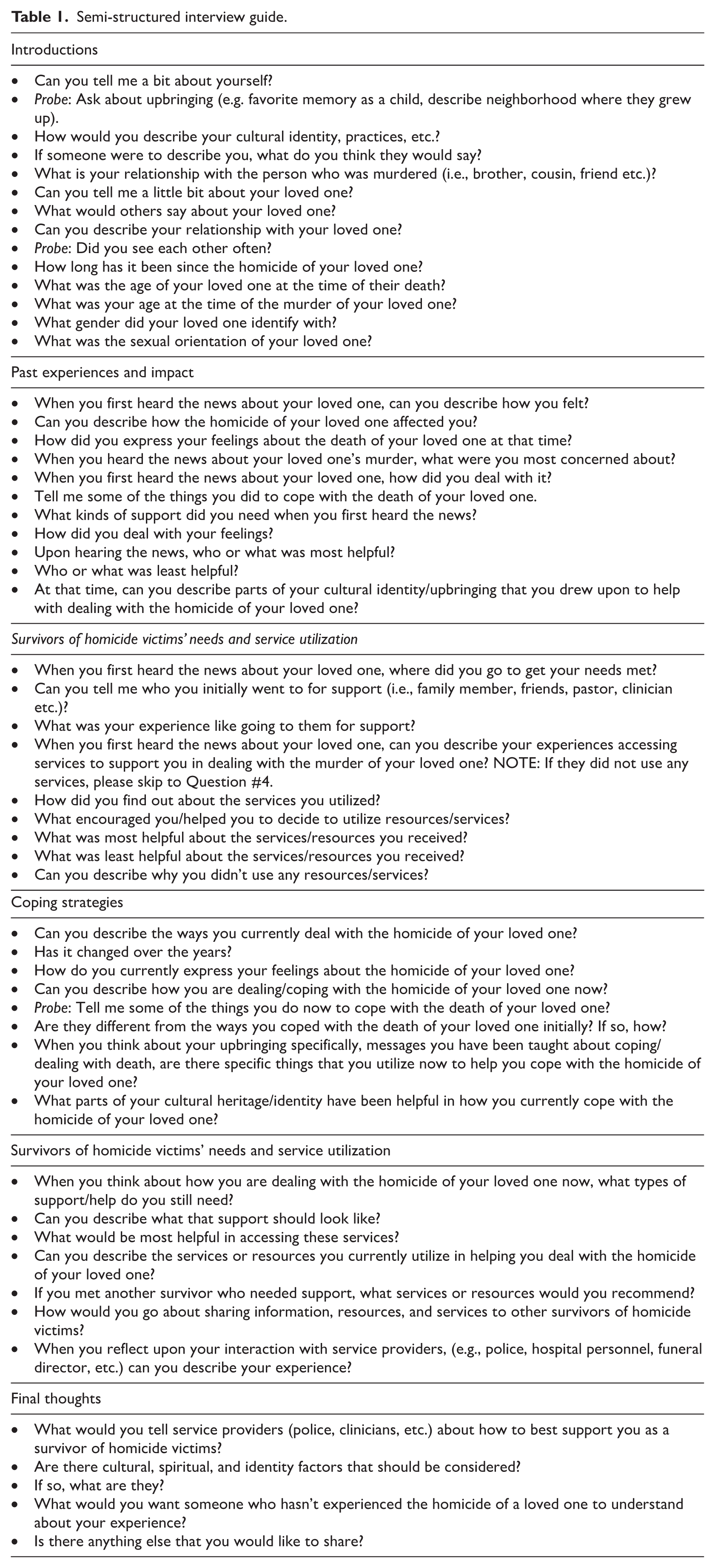
| Introductions |
|---|
| • Can you tell me a bit about yourself? • Probe: Ask about upbringing (e.g. favorite memory as a child, describe neighborhood where they grew up). • How would you describe your cultural identity, practices, etc.? • If someone were to describe you, what do you think they would say? • What is your relationship with the person who was murdered (i.e., brother, cousin, friend etc.)? • Can you tell me a little bit about your loved one? • What would others say about your loved one? • Can you describe your relationship with your loved one? • Probe: Did you see each other often? • How long has it been since the homicide of your loved one? • What was the age of your loved one at the time of their death? • What was your age at the time of the murder of your loved one? • What gender did your loved one identify with? • What was the sexual orientation of your loved one? |
| Past experiences and impact |
| • When you first heard the news about your loved one, can you describe how you felt? • Can you describe how the homicide of your loved one affected you? • How did you express your feelings about the death of your loved one at that time? • When you heard the news about your loved one’s murder, what were you most concerned about? • When you first heard the news about your loved one, how did you deal with it? • Tell me some of the things you did to cope with the death of your loved one. • What kinds of support did you need when you first heard the news? • How did you deal with your feelings? • Upon hearing the news, who or what was most helpful? • Who or what was least helpful? • At that time, can you describe parts of your cultural identity/upbringing that you drew upon to help with dealing with the homicide of your loved one? |
| Survivors of homicide victims’ needs and service utilization |
| • When you first heard the news about your loved one, where did you go to get your needs met? • Can you tell me who you initially went to for support (i.e., family member, friends, pastor, clinician etc.)? • What was your experience like going to them for support? • When you first heard the news about your loved one, can you describe your experiences accessing services to support you in dealing with the murder of your loved one? NOTE: If they did not use any services, please skip to Question #4. • How did you find out about the services you utilized? • What encouraged you/helped you to decide to utilize resources/services? • What was most helpful about the services/resources you received? • What was least helpful about the services/resources you received? • Can you describe why you didn’t use any resources/services? |
| Coping strategies |
| • Can you describe the ways you currently deal with the homicide of your loved one? • Has it changed over the years? • How do you currently express your feelings about the homicide of your loved one? • Can you describe how you are dealing/coping with the homicide of your loved one now? • Probe: Tell me some of the things you do now to cope with the death of your loved one? • Are they different from the ways you coped with the death of your loved one initially? If so, how? • When you think about your upbringing specifically, messages you have been taught about coping/dealing with death, are there specific things that you utilize now to help you cope with the homicide of your loved one? • What parts of your cultural heritage/identity have been helpful in how you currently cope with the homicide of your loved one? |
| Survivors of homicide victims’ needs and service utilization |
| • When you think about how you are dealing with the homicide of your loved one now, what types of support/help do you still need? • Can you describe what that support should look like? • What would be most helpful in accessing these services? • Can you describe the services or resources you currently utilize in helping you deal with the homicide of your loved one? • If you met another survivor who needed support, what services or resources would you recommend? • How would you go about sharing information, resources, and services to other survivors of homicide victims? • When you reflect upon your interaction with service providers, (e.g., police, hospital personnel, funeral director, etc.) can you describe your experience? |
| Final thoughts |
| • What would you tell service providers (police, clinicians, etc.) about how to best support you as a survivor of homicide victims? • Are there cultural, spiritual, and identity factors that should be considered? • If so, what are they? • What would you want someone who hasn’t experienced the homicide of a loved one to understand about your experience? • Is there anything else that you would like to share? |
Acknowledgements
The authors would like to thank the family members and friends of homicide victims for trusting us with their stories of survivorship.

Ethical considerations
This study was approved by the University of Toronto Research Ethics Board, approval number: 39858 20 November 2020.
Author contributions
Dr. Tanya Sharpe: Research design, data collection, data analysis, paper writing and preparation. Nauman Aqil: Data analysis, paper writing and preparation. Monte-Angel Richardson: Data analysis, paper writing and preparation. Uppala Chandrasekera: Research design, data analysis.
Funding
The authors disclosed receipt of the following financial support for the research, authorship, and/or publication of this article: This work was supported by The Anti-Racism Directorate, Ministry of the Solicitor General of Ontario Canada, and the Social Sciences and Humanities Research Council (SSHRC).
Declaration of conflicting interests
The authors declared no potential conflicts of interest with respect to the research, authorship, and/or publication of this article.
Data availability statements
To protect confidentiality of participants, data generated or analyzed during this study are limited to members of the research team and not available to the public.