






Abstract
Hate crimes and social victimization within online gaming environments have received increasing attention due to their potential psychological and social impact. This study, conducted within the framework of a major research project, examines the prevalence of victimization and perpetration of hate crimes in online video games and related communities, as well as the overlap between victim and offender roles. Using survey data from 1812 Spanish adult gamers, we analyze experiences of hate victimization and perpetration based on race, gender/sexuality, and political ideology. Results indicate that a substantial proportion of players report being subjected to hate-based insults, with political and racial victimization being the most frequent. Perpetration rates are significantly lower but show strong associations between different types of offenses. Moreover, the study identifies a significant victim–offender overlap, showing that individuals who experience victimization are more likely to engage in perpetration. These findings underscore the cyclical nature of online hate behaviors and highlight the need for targeted interventions to address both victimization and perpetration within gaming communities.
Introduction
Hate crime has been widely recognized as a form of victimization rooted in bias or prejudice against individuals with certain social characteristics such as race, religion, ethnicity, sexual orientation, gender identity, and disability (FBI, 2019). In line with this definition, hate crime is typically understood as a criminal offense motivated by bias against protected characteristics. However, it is important to distinguish this concept from related but analytically distinct phenomena such as hate speech and hate incidents. Hate speech generally refers to expressions that denigrate, insult, or threaten individuals or groups based on such characteristics and may or may not meet the threshold of criminality depending on the legal context, whereas hate incidents encompass non-criminal behaviors perceived as bias motivated by victims or observers. Within this broader framework, hate speech and other forms of bias-motivated expression constitute some of the most prevalent manifestations of hostility, particularly in digital environments. In this regard, victimological research has revealed the severe psychological consequences of hate incidents, which include anxiety, depression, and post-traumatic stress disorder (PTSD; Benier, 2017; Herek et al., 1997). While much of this research has focused on physical or direct acts of hate crime, there remains uncertainty regarding the extent to which exposure to hate speech and online bias-motivated harassment can lead to similar outcomes.
The proliferation of online gaming communities has provided a new and largely understudied space where hate-related behaviors—including both criminal and non-criminal forms of bias-motivated conduct—are prevalent. Recent studies have found that online gaming environments often serve as spaces where hate speech is normalized and even encouraged by some subcultures (Beres et al., 2021; Frommel et al., 2023). For instance, the Anti-Defamation League (ADL, 2024) reports that most gamers, particularly women and players from certain ethnic background, experience identity-based harassment in these spaces. Similarly, other studies have found that most online gamers had either witnessed or experienced hate speech, sexual harassment, and violent threats while playing (Kowert and Cook, 2022). Moreover, the overlap between victimization and perpetration remains an area of concern, as previous research has suggested that individuals exposed to hate incidents in gaming may either withdraw from the toxic environment or, in some cases, perpetuate the same behaviors they experienced (Wells et al., 2025). Importantly, much of this behavior, such as insults or offensive language, does not necessarily meet the legal definition of hate crime, but nevertheless constitutes harmful bias-motivated conduct with potential cumulative effects on victims.
Therefore, despite the growing body of literature on online hate incidents and their impact, there is still a lack of research on the cyclical nature of victimization and perpetration within online gaming communities. In particular, limited attention has been paid to the overlap between victimization and perpetration across the broader spectrum of hate-related behaviors, beyond strictly defined criminal offenses. Thus, this study draws from data from a representative survey of adult gamers in Spain to assess the prevalence, co-occurrence, and overlap of both victimization and perpetration of hate-related (i.e., bias-motivated) incidents, including both criminal and non-criminal forms, in the field of online gaming and their related digital communities.
Previous research
Hate crime, hate speech, and hate incidents
Hate crime has been defined by the Federal Bureau of Investigation (FBI) as any criminal offense motivated by bias or prejudice related to social characteristics including race, religion, ethnicity, sexual orientation, gender identity, and mental or physical ability (FBI, 2019). In this sense, and as mentioned in the previous section, hate crimes are legally defined offenses that meet a criminal threshold and are prosecutable, whereas hate speech refers to expressions that denigrate or threaten individuals or groups based on protected characteristics and may not always be criminalized, depending on the context.
The expansion of hate speech has been particularly notable in the context of social networks and online interactions, though the definition of hate speech and its consideration as a crime is highly controversial, since legislation and judicial decisions on this matter are at risk of violating freedom of speech and creating illegitimate ‘thought crimes’ (Holder, 2024). Much of this concern has been dealt with by legal scholars in Spain (Gorostiza, 2001; Guirao, 2016; Tamarit-Sumalla, 2018). Overall, existing scholarship highlights both the conceptual fragmentation and the regulatory tensions surrounding hate-related phenomena, particularly in digital environments.
Hate crime, hate incidents, and hate speech are generally conceptualized as distinct phenomena. Hate crimes represent the most severe offenses, defined as violations of criminal law; hate incidents encompass behaviors that can fall below the legal threshold of a crime; and hate speech refers to the abusive exercise of free expression, which is not necessarily criminal but may overlap with legal definitions in certain jurisdictions (Vergani et al., 2024). Taken together, these categories can be understood as forming a broader continuum of bias-motivated or hate-related behaviors, ranging from non-criminal expressions to legally punishable acts. This continuum perspective has been increasingly adopted in recent research as better capturing the diversity and frequency of everyday hate-related experiences, particularly in online settings.
Therefore, this study adopts a conceptualization centered on hate incidents, broadly defined as harassment, insults, and other hate-based behaviors occurring in online gaming. Accordingly, the focus is placed on all forms of bias-motivated conduct that, while not necessarily meeting the legal definition of hate crime, may still generate significant harm for those targeted. These go beyond merely disruptive conduct that violates in-game rules or community norms and does not necessarily constitute criminal offenses.
Victimological research has shown that victims of hate crimes often experience severe psychological consequences, including depression, anger, sadness, and, in some cases, suicidal ideation (Benier, 2017; Herek et al., 1997; Iganski and Lagou, 2015). Such effects, which may lead to PTSD, have been particularly observed among victims of identity-based aggression or harassment (Szymanski and Balsam, 2011). Across studies, a consistent finding is that bias-motivated victimization tends to produce more intense and longer-lasting psychological harm than comparable non-bias-motivated offenses.
However, while these findings primarily concern conventional (and particularly violent) hate crimes, it remains uncertain to what extent exposure to insults or hate-driven hostility in online gaming environments produces similar psychological harm. This gap is particularly relevant given that much online hostility takes the form of repeated, normalized, and socially embedded interactions, rather than isolated criminal acts. Thus, existing research points to a need to better understand the cumulative and potentially chronic nature of harm in digital contexts.
The impact of hate incidents varies for different types of victimization. A study conducted by Wells et al. (2024) revealed that victims of anti-gender, disability, or transgender hate crimes suffered higher rates of psychological distress. Similarly, Mellgren et al. (2021) found in Sweden differences in the emotional reaction to victimization among perceived identities: victims of hate toward sexual orientation or gender identity were more likely to experience negative feelings after victimization, compared with those victimized due to their national background or religion. These findings suggest that the effects of bias-motivated harm may also differ across types of targeted identities, an issue that remains underexplored in the context of non-criminal hate incidents in online environments.
Cybervictimization and hate incidents in online games
Cybervictimization in online gaming is highly prevalent and disproportionately affects marginalized groups. Surveys across populations, including Catalan University students (Tamarit-Sumalla et al., 2022) and international gaming communities (ADL, 2024; Wells et al., 2025), consistently show that insults, humiliation, and harassment are the most common forms of social cybervictimization, while severe acts such as threats, identity theft, or blackmail are less frequent. Exposure occurs both directly, as victimization, and indirectly, as bystanders witnessing hate speech, with most players encountering harmful content in multiple roles. Age and minority status—rather than gender alone—emerge as consistent risk factors, with younger players and individuals from marginalized racial, sexual, or gender groups facing higher levels of harassment.
Several studies highlight the types and targets of hate-based behaviors in gaming. Misogyny, anti-Asian, and anti-Muslim hate speech are most prevalent, with women, Black players, and LGBTQ+ participants experiencing more frequent and harmful interactions (Ballard and Welch, 2017; Fox and Tang, 2016; Gray, 2012). Male, White, and heterosexual players are less targeted and often perceive hate speech as less threatening (Wells et al., 2025). These findings point to structural inequalities in exposure and perception, reflecting broader societal biases that shape gaming environments.
Research also identifies environmental and contextual factors that facilitate online harassment. Competitive gameplay, weak moderation, anonymity, moral disengagement, and subcultural norms that tolerate aggressive language create conditions that normalize harmful behaviors (Beres et al., 2021; Frommel et al., 2023). These conditions are amplified for minoritized players, who may face objectification, exclusion, or severe threats, and for whom online harassment can mirror offline discrimination and workplace sexism (Euteneuer and Meints, 2020; Tomkinson and Harper, 2015; Vergel et al., 2024).
The psychological impact of exposure varies by type and target of victimization. While cumulative harassment can cause distress across groups, studies show that women and nonbinary individuals, as well as racialized players, are more likely to experience heightened negative emotional outcomes, including stress and anxiety (Keum and Hearns, 2022; Vergel et al., 2024). Observed behaviors range from withdrawal to retaliatory actions, with men more often engaging in perpetuation and women more often withdrawing (Wells et al., 2025). These patterns underscore the complex interplay between identity, exposure, and response in shaping experiences of harm.
Overall, the literature portrays online gaming as a high-risk environment for non-criminal yet harmful hate-related behaviors, where exposure is normalized, identity-based vulnerabilities are magnified, and psychological consequences are significant. Despite consistent evidence of prevalence and harm, there remain gaps in understanding how repeated exposure and indirect experiences (as bystanders) contribute to long-term impacts, particularly for youth and minoritized populations.
Victim–offender overlap
Victim–offender overlap has increasingly drawn attention in criminological research. Initially explored in the context of violent crime, this phenomenon has recently been examined in cybercrime, though studies on online gaming communities remain scarce. Theoretical approaches to victim–offender overlap have primarily relied on routine activities theory, emphasizing the convergence of a suitable target, a motivated offender, and the absence of a capable guardian, or the general theory of crime, which highlights individual self-control as a key factor (Jennings et al., 2012; Mulford et al., 2016). In addition, subcultural theories have framed overlap as a product of environments where both victimization and offending opportunities arise, such as disadvantaged neighborhoods governed by a ‘code of the street’ (Anderson, 2000), or cultural contexts that discourage conventional dispute resolution, fostering retaliatory behavior instead (Jennings et al., 2012).
Bivariate models and logistic regression analyses have been widely used to examine the relationship between offending and victimization, revealing a substantial overlap between both groups (Jennings et al., 2012). This pattern has been observed across various forms of criminal behavior, including homicide, dating violence, and family violence. While routine activities/lifestyle theory and low self-control remain dominant explanations, research has also identified involvement in unstructured or unsupervised activities as a key factor contributing to the victim–offender overlap (Mulford et al., 2016).
Regarding cybercrimes, a study by Burden (2025) has shown that the level of self-control, time spent participating in routine online activities, and demographic characteristics were significant predictors for both victimization and offending. Through a survey it was found that 40.5% of participants were victims-only, 20% offenders-only, and 16.6% were victim–offenders
The present study
This study explores the intersection between victimization and perpetration of hate incidents, defined as actions in which someone insults or demeans another person due to their membership in a specific group, gender, sexual identity, or political ideology, regardless of whether the behavior is criminalized or not, within online gaming communities. The study is focused on the extent to which individuals who experience social victimization based on race, gender/sexual orientation, or political ideology may also engage in perpetration. By examining patterns of co-occurrence between different forms of victimization and perpetration, the study aims to contribute to the understanding of the victim–offender overlap in digital environments. The study adopts an exploratory design, and draws on Routine Activity Theory, the General Theory of Crime, and Subcultural Theory as broad interpretative frameworks to contextualize observed patterns in light of the existing criminological literature.
Therefore, the main objective is to analyze the prevalence and interconnections of social victimization and perpetration within online gaming communities, with particular attention to the overlapping nature of hate-based interactions.
To achieve this, the current state of research makes it necessary to pose the following questions:
What is the prevalence of victimization and perpetration of hate incidents based on race, gender/sexual orientation, and political ideology in online gaming communities?
What patterns of association exist between different forms of victimization and perpetration, and how do these dynamics shape hate-based interactions in gaming spaces?
How do victims and perpetrators of hate incidents in online gaming overlap, and what distinguishes their profiles?
Methods
Procedure
The data for this study were collected through a survey administered, as part of a broader research project, targeting Spanish adults who had played video games within the previous 12 months.
To ensure a diverse and representative sample, the survey was disseminated through a professional market panel company. After data collection, the research team conducted rigorous data cleaning and preparation procedures to maintain analytical accuracy and validity. The entire data collection and processing phase took place between July and September 2024.
The survey incorporated a comprehensive set of questions aimed at capturing victimization experiences across multiple domains, including social, sexual, and economic victimization within online gaming environments. For this study, only specific information regarding social and hate-based victimization and perpetration experiences will be used. More precisely, the variables used assessed whether the respondent had suffered or perpetrated hate behaviors based on (a) race, (b) gender or sexual orientation, (c) political ideology, or (d) any other type of insults not included in the previous three categories, in the context of online gaming and their related digital communities (forums, chats, etc.).
Victimization was measured through a set of items referring to experiences occurring within the past 12 months. Participants were asked: ‘In the past 12 months, have you experienced any of the following situations in your digital leisure activities?’ Responses were recorded on a 5-point Likert-type scale (1 = never, 2 = rarely, 3 = sometimes, 4 = frequently, 5 = constantly). The items included (a) being targeted with offensive, insulting, or discriminatory comments based on race or ethnic origin; (b) being targeted with offensive, insulting, or discriminatory comments based on gender or sexual orientation; (c) being targeted with offensive, insulting, or discriminatory comments based on ideological or political orientation; and (d) being targeted with offensive or insulting comments for reasons other than those listed above (other insults).
Equivalent items were used to assess perpetration, referring to whether respondents had directed such behaviors toward others within the same timeframe and using the same response scale.
Although the original response format captured frequency, all victimization and perpetration variables were subsequently dichotomized for the purposes of analysis. This decision was made to prioritize the estimation of prevalence and co-occurrence patterns, rather than frequency or intensity, and to ensure robustness in the statistical analyses conducted.
Importantly, while the study focuses on online gaming, the questionnaire referred more broadly to ‘digital leisure activities’, thereby capturing interactions occurring both within games and in related online spaces (e.g., forums, chats, or streaming platforms). As such, the measures reflect a wider ecosystem of online interaction rather than exclusively in-game incidents.
The inclusion of the ‘other insults’ category serves as a comparative measure, allowing us to distinguish between bias-motivated hate incidents and more generalized forms of online hostility. This distinction is theoretically relevant to assess whether toxic interactions are primarily driven by individual prejudice or by contextual and normative dynamics within digital environments that facilitate or normalize offensive exchanges.
Other independent variables included demographic information (age, sex, occupation, etc.); behavioral activities in online and gaming contexts (hours of playing time, devices used to play, type of playing) or routine activities related to behavior when gaming (such as type of information shared or self-adopted protective measures).
The study adhered to ethical research guidelines and received approval from the Ethics Committee of the employing university (Ref. No. 221025170052). This approval encompassed the survey design, administration, and data management processes, ensuring compliance with ethical principles, participant confidentiality, and data protection regulations throughout the study.
Sample
The general study sample consisted of 1812 Spanish adults who had played video games within the past 12 months (see Table 1). The gender distribution was relatively even, with 51.2% identifying as male (n = 927), 48.1% as female (n = 872), and 0.4% as nonbinary (n = 7). In addition, 0.3% of respondents (n = 6) opted not to disclose their gender.
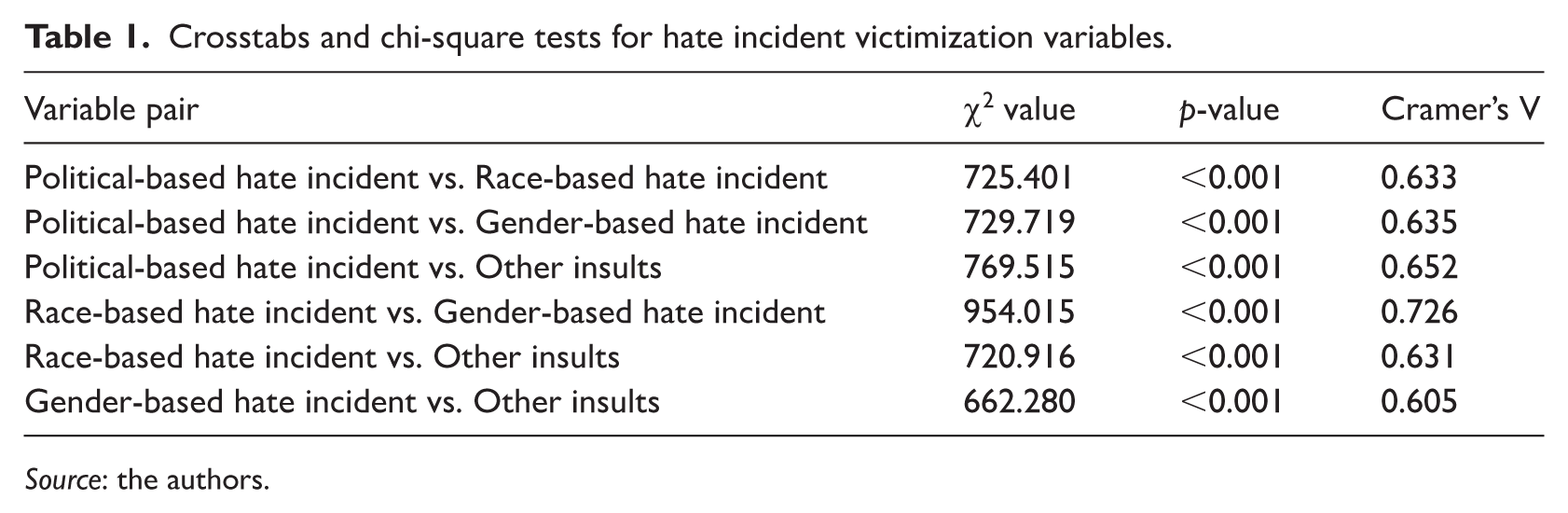
Crosstabs and chi-square tests for hate incident victimization variables.
Source: the authors.
Age was categorized into quartiles, with the largest group of male participants falling within the 26–35 age range (14.8%, n = 268), while the highest proportion of female participants also belonged to this category (15.1%, n = 273). Other notable age groups included males aged 36–45 (16.3%, n = 295) and females in the same age range (11.2%, n = 203), alongside participants distributed across other age categories.
In terms of occupational status, most participants were full-time employees (60.9%, n = 1103), followed by part-time workers (8.7%, n = 157). A notable proportion were students (7.9%, n = 143), while 8.1% (n = 146) combined studying with employment. In addition, 11.1% of respondents (n = 202) were unemployed, 2.3% worked from home (n = 41), and 1.1% were engaged in unpaid work (n = 20).
Educational attainment varied across the sample, with 34.5% holding a university degree (n = 625: undergraduate; n = 356: postgraduate). Other significant educational backgrounds included vocational training (25.5%, n = 462), high-school education (12.4%, n = 225), and secondary education (7.2%, n = 130).
Regarding sexual orientation or identity, 12.7% of participants (n = 231) self-identified as LGTBIQ+, while the remaining 87.3% (n = 1581) did not.
Analysis
Data analysis was conducted in multiple stages to systematically examine patterns of victimization and perpetration in online gaming environments. First, a descriptive analysis was performed to assess the prevalence of different hate-based victimization and perpetration experiences among participants. This was followed by a bivariate analysis to identify significant associations between variables. In addition, descriptive statistics were computed for demographic variables—including gender, age, employment status, education level, and LGBTQ+ identification—to provide context on the sample composition.
Following the descriptive analysis, a co-occurrence analysis was conducted to explore the relationships between different victimization experiences, and between the same perpetration behaviors. Chi-square tests were employed to assess the associations between categorical variables, allowing for the identification of statistically significant relationships between different forms of victimization and perpetration. Cramer’s V was used to measure the strength of these associations, providing insight into the extent to which experiencing one form of victimization or engaging in one type of perpetration was related to others.
To further examine patterns of overlap, new variables were created to capture cases where participants reported experiencing multiple forms of victimization or engaging in multiple forms of perpetration. These overlap variables were analyzed to explore their interrelationships, determining whether individuals subjected to multiple types of victimization were also more likely to engage in multiple perpetration behaviors.
All tests were conducted using a significance threshold of p <.05. Results with p-values below this threshold were interpreted as statistically significant, while nonsignificant associations were reported accordingly. To ensure robustness, expected frequencies were examined, and when necessary, continuity corrections or Fisher’s exact tests were applied for 2 × 2 tables to account for potential biases in smaller sample sizes.
Finally, three binary logistic regression models were conducted to assess whether certain variables could predict the occurrence of the victim–offender overlap for the three hate-based incidents analyzed. To this end, the overlap variables were dichotomized and included as dependent variables in the models. A range of individual, demographic, and behavioral variables were included as predictors.
All data analyses were conducted using IBM SPSS Statistics V.30.0 to examine the relationships between different forms of victimization experienced in online gaming environments.
Methodological limitations
This study has certain limitations. First, the reliance on self-reported data may introduce response biases, including underreporting or overreporting of victimization experiences. Second, the cross-sectional nature of the study does not allow for causal inferences regarding the relationships between different types of victimization. In addition, while the sample is diverse, it may not fully capture the experiences of all social groups, particularly those underrepresented in online surveys. Moreover, the use of an online panel-based sample may introduce self-selection bias, as participation is voluntary and may overrepresent individuals with greater engagement in online gaming environments. Importantly, the study considers online multiplayer video games as a single category and does not differentiate between game genres, platforms, or modes of play. As a result, we are unable to examine potential variations in victimization or perpetration patterns across specific gaming contexts. Finally, as the study is based on a Spanish sample, findings may reflect specific contextual characteristics of online gaming practices and social interactions within this national setting, which may limit the generalizability of results to other cultural contexts.
Results
Victimization and perpetration prevalence and significantly associated variables
Among the sample of 1812 respondents (N = 1812), the prevalence of social victimization varied by the type of received insult. Specifically, 22.4% of participants reported experiencing racial insults, while 22.1% reported hate victimization based on their gender/sexual orientation, 25.2% reported victimization based on political orientation, and 30.1% reported other insults. By contrast, the rates of perpetration were considerably lower across all categories: only 8.8% of respondents admitted to perpetrating racial insults, 7.7% to gender/sexual orientation-based insults, 9.9% to politically motivated insults, and 11.8% to other insults.
Regarding victimization-associated variables, the bivariate analysis revealed significant associations between hate-based victimization and gender, sexual orientation, and age. Men reported higher rates of race-based (24.8% vs. 20.0%, p = 0.014) and political ideology-based insults (28.1% vs. 22.1%, p = 0.003), while LGTBIQ+ participants experienced significantly more victimization across all categories, particularly gender/sexual orientation-based (42.9% vs. 19.0%, p < 0.001), political ideology-based (38.1% vs. 23.3%, p < 0.001), and other insults (44.2% vs. 28.1%, p < 0.001; Table 1). Younger participants (18–25) were the most affected (e.g., 35.2% for race-based insults, p < 0.001; 33.5% for gender-based, p < 0.001; 34.5% for political ideology-based, p < 0.001; 43.7% for other insults, p < 0.001), with rates decreasing with age.
As for perpetration, results showed that men were more likely than women to report perpetrating hate incidents, particularly general (15.1% vs. 8.6%, p < 0.001), political (12.4% vs. 7.6%, p < 0.001), gender-based (9.9% vs. 5.6%, p < 0.001), and race-based insults (10.4% vs. 7.1%, p = 0.013). Younger respondents (18–25) had the highest rates across all categories (up to 21.1%, p < 0.001), while those over 45 had the lowest. LGTBIQ+ individuals reported higher perpetration, particularly of political (16.0% vs. 9.0%, p < 0.001), other (18.2% vs. 10.9%, p = 0.001), gender-based (11.7% vs. 7.1%, p = 0.016), and race-based insults (13.0% vs. 8.2%, p = 0.015).
Victimization co-occurrence analysis
The analysis of victimization-related insults revealed several significant associations between the different types of received hate-based slurs (Table 1).
First, a strong association was found between receiving political-based insults and race-based insults (χ2 = 725.401, p < 0.001). The strength of this relationship was further confirmed by the Cramer’s V value of 0.633, suggesting a moderate association between these two forms of victimization. Similarly, political-based insults were significantly related to gender or sexual orientation-based insults (χ2 = 729.719, p < 0.001), with a slightly stronger Cramer’s V of 0.635, indicating a moderate relationship.
Moreover, political-based insults were also significantly associated with other insults (χ2 = 769.515, p < 0.001), yielding a Cramer’s V of 0.652, which represents a moderate to strong association. These findings suggest that individuals who experience political-based insults are also likely to experience insults based on race, gender/sexual orientation, or other insults.
In terms of the pairwise comparisons between the victimization categories, a significant relationship was found between race-based insults and gender/sexual orientation-based insults (χ2 = 954.015, p < 0.001), with a Cramer’s V value of 0.726, reflecting a moderate strength of the association. Similarly, a significant association was observed between race-based insults and other insults (χ2 = 720.916, p < 0.001), with a Cramer’s V of 0.631, indicating a moderate relationship.
Finally, gender/sexual orientation-based insults were found to be significantly related to other insults (χ2 = 662.280, p < 0.001), with a Cramer’s V value of 0.605, again suggesting a moderate association between these forms of victimization.
Perpetration co-occurrence analysis
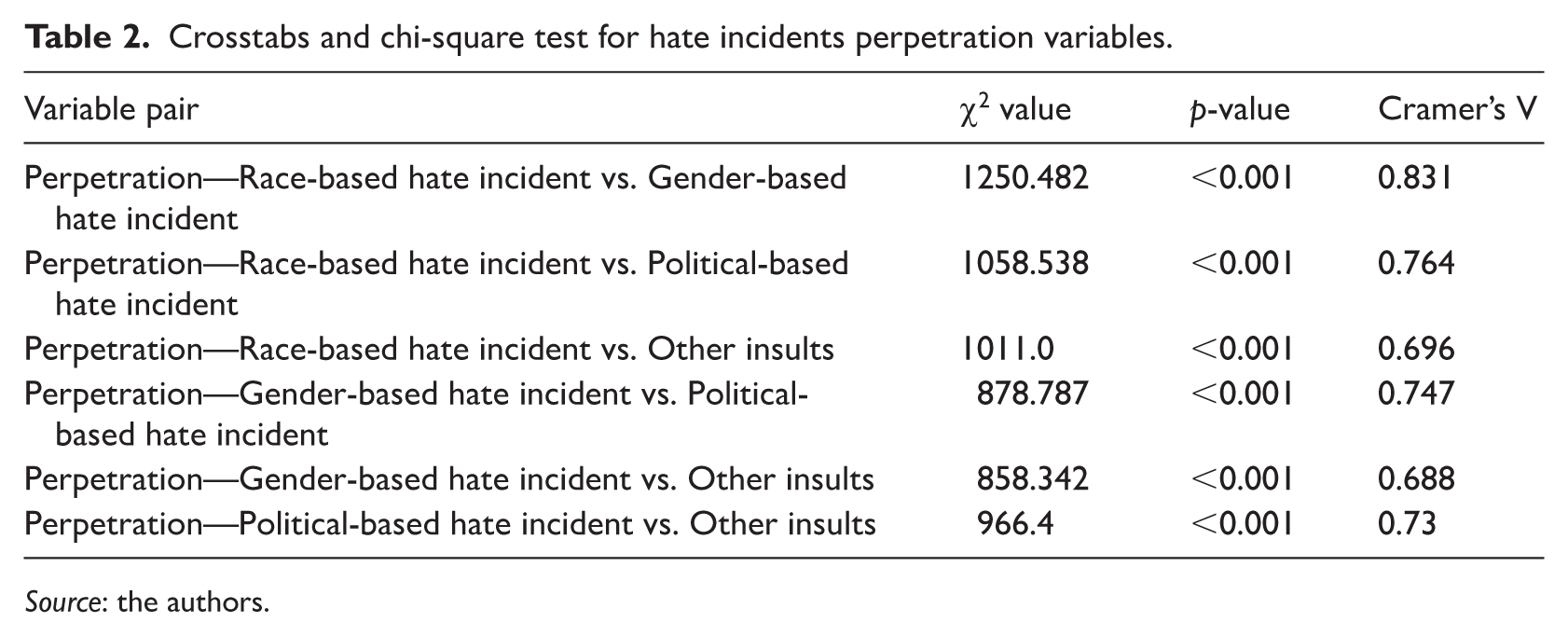
The analysis of the associations between different forms of perpetration revealed significant relationships across all pairs of variables (Table 2).
Crosstabs and chi-square test for hate incidents perpetration variables.
Source: the authors.
First, a strong association was found between perpetration related to race and perpetration related to gender (Cramer’s V = 0.831, p < 0.001). This indicates that individuals who reported engaging in one form of offense related to race were highly likely to report engaging in an offense related to sex as well.
Similarly, a strong association was also observed between perpetration related to race and perpetration related to ideology (Cramer’s V = 0.764, p < 0.001). The data suggest that these two types of offenses often co-occur in the same individuals, with the relationship being statistically significant. When examining perpetration related to race in relation to general offenses, the results showed a moderate association (Cramer’s V = 0.696, p < 0.001). Although the relationship is weaker than with the other variables, it still indicates a notable correlation between these two types of offenses.
In the case of perpetration related to gender and perpetration related to political offenses, the results revealed a strong association (Cramer’s V = 0.747, p < 0.001). This suggests that individuals who commit gender-related offenses also tend to commit political offenses, with the relationship being statistically significant. A moderate association was found between perpetration related to gender and general offenses (Cramer’s V = 0.688, p < 0.001). This indicates that while the correlation is weaker than the other pairs, there is still a significant relationship between these two types of offenses.
Finally, the analysis of perpetration related to political offenses and general offenses showed a strong association (Cramer’s V = 0.730, p < 0.001).
Victim–offender overlap analysis
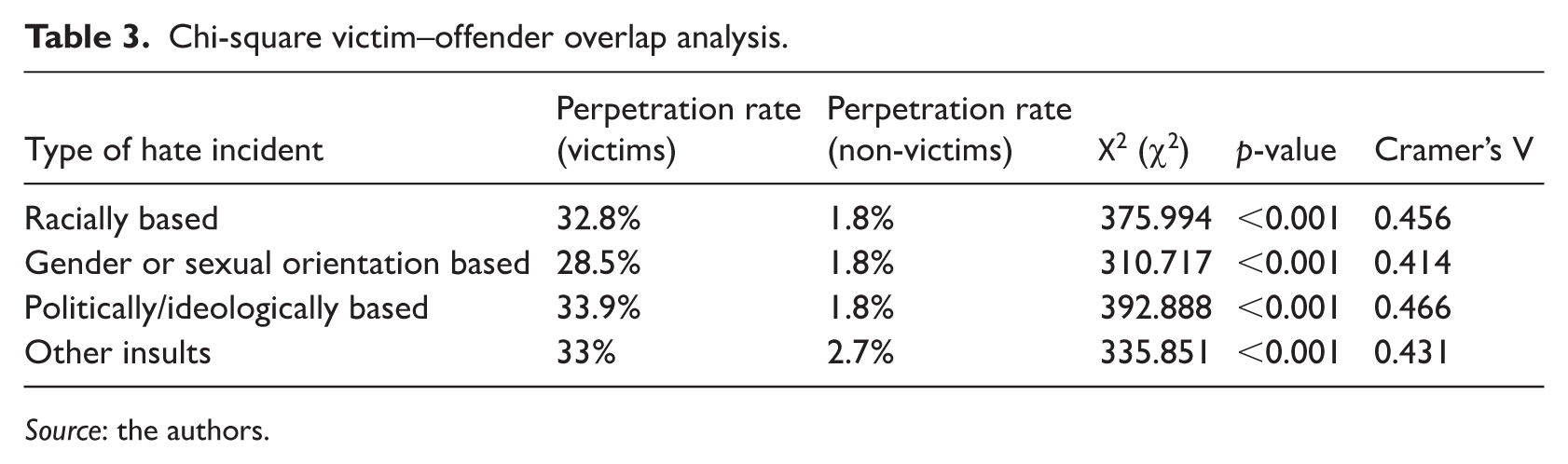
The victim–offender overlap analysis indicates a statistically significant association between experiencing a hate incident (victimization) and engaging in hate incident perpetration across all examined categories of race, gender/sexual orientation, political ideology, and general-based insults (Table 3).
Chi-square victim–offender overlap analysis.
Source: the authors.
In the case of racially motivated insults, 32.8% of those who reported being insulted due to their race also engaged in perpetration of racial insults, compared with only 1.8% among those who had not been victimized. The χ2 test confirmed a significant association (χ2(1) = 375.994, p < 0.001), with Cramer’s V = 0.456, indicating a moderate to strong effect size.
For gender/sexual orientation-based insults, 28.5% of those who experienced victimization also reported perpetrating insults in this category, whereas only 1.8% of non-victims engaged in perpetration. The Chi-square test again showed a significant association (χ2(1) = 310.717, p < 0.001), with an effect size of Cramer’s V = 0.414.
Regarding politically motivated insults, 33.9% of those who had been insulted due to their political orientation also engaged in perpetration, compared with 1.8% among those who had not experienced this form of victimization. The association was statistically significant (χ2(1) = 392.888, p < 0.001) with Cramer’s V = 0.466, the strongest observed effect among the categories.
Finally, for other insults, 33.0% of victims reported perpetration, compared with 2.7% of non-victims, with a confirmed significant relationship (χ2(1) = 335.851, p < 0.001), and an effect size of Cramer’s V = 0.431.
Across all categories, individuals who had not experienced victimization showed low levels of perpetration (between 1.8% and 2.7%), whereas those who had been victimized were significantly more likely to engage in perpetration (between 28.5% and 33.9%). The strength of the associations, as indicated by Cramer’s V values, ranged from 0.414 to 0.466, consistently falling within a moderate to strong range.
By examining the differences in the assessed four types of overlap in relation to different sociodemographic variables, the results showed several significant associations.
First, regarding occupation, significant associations were found only in racially motivated hate incidents (χ2 = 8.864, p = 0.031). Unemployed individuals were more frequently both victims and perpetrators, whereas no significant relationships were observed in the other categories, including gender/sexual orientation-based, political/ideological, or general hate incidents.
The sex variable showed significant associations with the overlap in all categories. In racial hate incidents, men were more often perpetrators, and women were more frequently victims (χ2 = 8.582, p = 0.035). In gender-based or sexual orientation-based hate incidents, women were predominantly victims, while men were the perpetrators (χ2= 22.489, p < 0.001). In political/ideological hate incidents, men were more often perpetrators, while women were more frequently victims (χ2 = 15.646, p = 0.001). Similar patterns were observed in other insults, with men more frequently being perpetrators and women victims (χ2 = 22.054, p < 0.001).
The age group 18–25 showed the highest levels of overlap as both victims and perpetrators across all categories. This age group was most represented in racial hate incidents (χ2 = 69.284, p < 0.001), but a similar trend was observed in gender-based (χ2 = 78.635, p < 0.001), political/ideological (χ2 = 39.427, p < 0.001), and general incidents (χ2 = 94.575, p < 0.001). Thus, results indicate that younger individuals were more likely to be involved in both roles in hate incidents.
Finally, the analysis found significant associations between LGTBIQ+ pertinence and the overlap of victimization and perpetration across various types of hate incidents, particularly in gender/sexual-based, political/ideological, and other insults. LGTBI individuals were more likely to experience both victimization and perpetration, with statistically significant results for gender-based (χ2 = 68.546, p < 0.001), political/ideological (χ2 = 25.718, p < 0.001), and general incidents (χ2 = 26.234, p < 0.001).
Victim–offender overlap predicting variables
Before running the regressions, and to assess potential multicollinearity among the independent variables included in the models, collinearity diagnostics were conducted. The results did not indicate problematic multicollinearity. The highest condition index observed was 30.75; however, this dimension was primarily associated with the constant and did not involve multiple predictors with substantial variance proportions. Among the predictors, the largest variance proportions in higher dimensions were observed for variables such as LGBTQ+ identification (≈0.61), sharing nationality online (≈0.52), and PC gaming (≈0.52), but these occurred in dimensions with lower condition indices (≈15–16) and were not shared across multiple predictors within the same high-index dimension. Across the remaining dimensions, variance proportions were generally low and dispersed, with no clustering of high values (i.e., >0.50) among predictors. Although several moderate condition indices (between 10 and 20) were identified, these did not correspond to patterns indicative of multicollinearity. Overall, these results suggest that the predictors do not exhibit harmful levels of collinearity and can be retained without compromising the stability or interpretability of the regression estimates.
After that, and first, the overlap regression model related to race-based hate incidents (Appendix 1), showed a Nagelkerke R2 value of .453, thus explaining 45.3% of the variance for the overlap in this category. The Hosmer–Lemeshow test indicated a good model fit (χ2 = 13.323, df = 8, p = 0.101), suggesting no significant deviation between observed and predicted values.
Regarding individual predictors, some behavioral variables showed significant associations with the dependent variable. Paying for accessing video content on platforms was associated with an increased likelihood of the dependent variable (B = 1.005, Exp(B) = 2.720, p < 0.001). Similarly, creating content on social media (B = 1.101, Exp(B) = 3.041, p < 0.001) and actively participating by commenting on videos or forums (B = 1.060, Exp(B) = 2.901, p = 0.004) were also positively associated. Participation in e-sports was another significant predictor, with B = 0.896, Exp(B) = 2.407 and p = 0.003. As for the demographic variables, age categories showed some associations, with the over 45 category (B = −0.916, Exp(B) = 0.390, p = 0.012) being less likely to experience overlap for race-based hate incidents. Sex was also a significant predictor (B = 0.535, Exp(B) = 1.660, p = 0.034), showing that males are more likely to experience victim–offender overlap in this case.
Conversely, sharing one’s real name online (B = −0.998, Exp(B) = 0.374, p = 0.004) and not sharing any personal data when gaming (B = −0.956, Exp(B) = 0.374, p = 0.035) were negatively associated with experiencing victim–offender overlap for race-based hate incidents.
Second, the logistic regression model for gender or sexual orientation-based hate incidents overlap obtained a Nagelkerke R2 of 0.455., therefore explaining 45.5% of the variance in this case (Appendix 2). The Hosmer–Lemeshow test indicated an acceptable, though marginal, model fit (χ2 = 15.847, df = 8, p = 0.045).
Several factors were found to significantly predict the likelihood of experiencing gender/sexual orientation-based hate incidents. Payment for access to video content was strongly associated with an increased likelihood of experiencing gender/sexual orientation-based hate incidents (B = 1.081, p < 0.001, Exp(B) = 2.949). Those who paid for content access were nearly three times more likely to report these incidents. Similarly, creating content on social media also emerged as a significant predictor, with individuals who created content being over four times more likely to experience hate incidents (B = 1.536, p < 0.001, Exp(B) = 4.644). By contrast, sharing one’s real name on the Internet was linked to a reduced likelihood of facing gender/sexual orientation-based hate (B = −0.789, p = 0.026, Exp(B) = 0.455). Weekly video game consumption was also a key factor; individuals with moderate gaming habits (6–14 hours a week) had a higher likelihood of encountering hate incidents (B = 0.684, p = 0.015, Exp(B) = 1.983) in comparison to those with a lower playing time (0–6 hours a week).
Sex also emerged as a significant demographic factor, with men being more likely to experience overlap in this case (B = 0.770, p = 0.003, Exp(B) = 2.159). Moreover, LGBTQ+ identification was also a significant predictor, with LGBTQ+ individuals almost twice as likely to experience victim–offender overlap for sexual orientation or gender-based hate incidents (B = 0.661, p = 0.049, Exp(B) = 1.936).
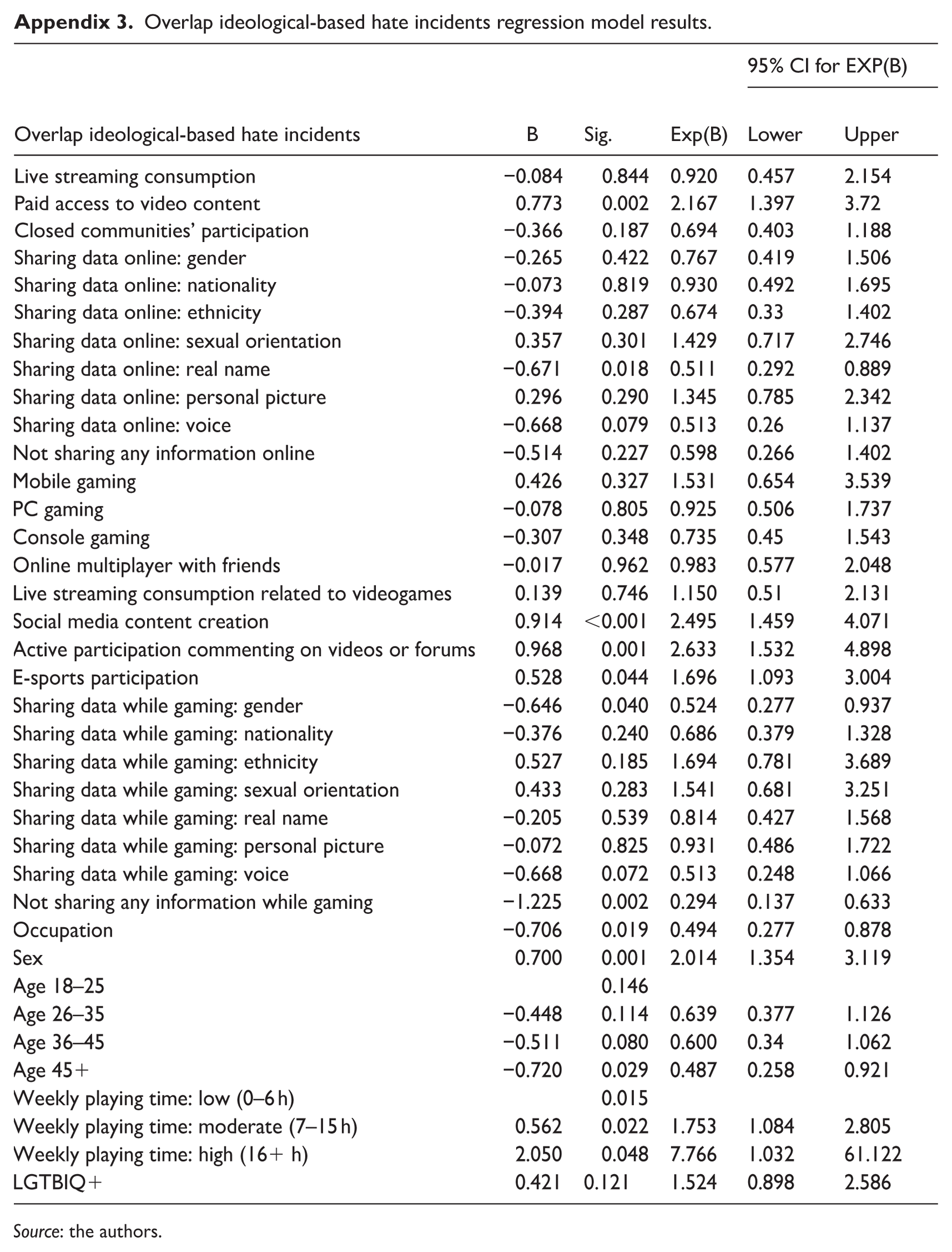
Finally, the regression model assessing the overlap of ideology-based hate incidents (Appendix 3) demonstrated moderate explanatory power (Nagelkerke R2 = 0.362). The Hosmer–Lemeshow test indicated a good model fit (χ2 = 9.172, df = 8, p = 0.328), suggesting no significant differences between observed and predicted values.
As for the predicting variables for this type of overlap, engagement in digital content creation and interaction was associated with increased odds of victimization. Specifically, individuals who create content on social media (B = 0.914, Exp(B) = 2.495, p < 0.001) or actively commented on videos and forums (B = 0.968, Exp(B) = 2.633, p = 0.001) were more likely to experience victim–offender overlap in ideology-based hate incidents. Similarly, paying for accessing video content (B = 0.773, Exp(B) = 2.167, p = 0.002) and participation in e-sports (B = 0.528, Exp(B) = 1.696, p = 0.044) were both linked to higher overlap odds.
Certain demographic and behavioral factors were similarly associated to variations in overlap probability. Identifying as male increased the likelihood of experiencing victim–offender overlap in ideology-based hate incidents (B = 0.700, Exp(B) = 2.014, p = 0.001), whereas being employed was associated with lower odds (B = −0.706, Exp(B) = 0.494, p = 0.019). Age also played a role, with older participants (45+) being less likely to experience victim–offender overlap compared with younger individuals (B = −0.720, Exp(B) = 0.487, p = 0.029).
Gaming-related behaviors further influenced overlap risk. A higher number of weekly gaming hours significantly increased the odds of overlap, with the highest gaming frequency category (more than 16 hours a week) showing the strongest association (B = 2.050, Exp(B) = 7.766, p = 0.048). Conversely, individuals who refrained from sharing personal data related to gaming activities had lower odds of experiencing victim–offender overlap for ideology-based hate incidents (B = −1.225, Exp(B) = 0.294, p = 0.002).
Discussion
The present study, based on data from a representative survey of online game players in Spain, reveals that a substantial proportion of players has been subjected to hate-based insults, with political and racial victimization being the most frequent. Victimization rates range from 22.1% to 30.1% across the four types of reported hate incidents. While significant, these figures are lower than those found in other studies, such as Aguerri et al. (2023) or Wells et al. (2025), which consider hate incidents in a broader sense, not limited to the most serious cases that could be classified as hate crimes. However, it is important to note that our results capture direct victimization experiences, rather than mere exposure to hateful content or expressions in online gaming—phenomena found to be much more prevalent in studies like those conducted by the ADL (2024 and prior reports). Victimization through hate-based insults and offensive behaviors, though less common, should be distinguished from toxicity or more general conflicts stemming from disruptive behaviors in online gaming.
A consistent association was found among the four types of victimization examined (political, race- or gender/sexual orientation-based, and other insults), suggesting that many participants experienced multiple forms of hate-based victimization. This pattern indicates that the key factors driving these incidents may be less about the specific motivation and more about the victim’s and perpetrator’s profiles, as well as the broader online gaming context.
Perpetration rates are significantly lower than victimization rates, but strong associations between different types of offenses suggest that certain individuals may be at a higher risk of engaging in hate behaviors against other players in online games. Also, it is important to note that the high levels of association between perpetration variables should be interpreted in light of their shared behavioral foundation, as all items capture forms of harmful behavior differentiated only by target. As such, these findings are likely to reflect a clustering of generalized toxic behaviors rather than distinct and independent forms of perpetration.
In this regard, the results challenge previous research (Fox and Tang, 2016), highlighting that men are significantly more victimized than women in two of the four assessed types of hate incidents (race-based and political-based), while no significant differences have been observed between men and women for gender- or sexual orientation-based hate incidents. Nevertheless, our findings align with previous literature regarding LGBTQ+ individuals (Ballard and Welch, 2017), who experienced significantly higher victimization rates across all evaluated categories. Importantly, the observed higher rates of perpetration among LGBTQ+ participants should not be interpreted as an equivalence in social power or hostility with dominant-group offenders. Rather, these behaviors may reflect complex psychosocial processes, including internalized stigma, defensive responses, or coping mechanisms aimed at managing prior victimization experiences that would need further qualitative research for a better and proper understanding.
A key insight into the dynamics of hate incidents and the profiles of victims and offenders comes from analyzing the overlap between victimization and offending. Among those victimized based on race, 32.8% also perpetrated racial insults. The overlap is 28.5% for gender/sex orientation-based insults, 33.9% for politically motivated insults, and 33.0% for other insults. In the first three categories, only 1.8% of non-victimized individuals reported offending, while for other insults, this rate was 2.7%. These differences are statistically significant, with a strong effect observed across all four categories.
The analysis of variables influencing the overlap between victimization and offending found a significant association with sex and age across all categories, with younger individuals being more likely to be involved in both roles. In addition, a significant association was observed between LGBTQ+ identity and the overlap of victimization and offending across various types of hate incidents. This underscores the importance of contextualizing perpetration within certain populations: experiences of repeated harassment may shape adaptive or defensive strategies that manifest as offensive behaviors, highlighting the potential of a cyclical dynamic of online hate that might be informed by structural inequalities and social power asymmetries, even though longitudinal approaches would be needed to further demonstrate these hypotheses.
The logistic regression models applied to different types of hate incidents provided a deeper understanding of overlapping dynamics. The analysis yielded consistent results across the various typologies. Paying for access to video content, creating content on social media, participating in e-sports, and actively engaging in discussions on videos or forums were all positively associated with victim–offender overlap. Importantly, a higher number of weekly gaming hours also significantly increased the odds of overlap, suggesting that greater exposure to online gaming environments may be a relevant factor in understanding these dynamics. Regarding sociodemographic variables, males and younger players were more likely to experience overlap, as were LGBTQ+ participants in ideology- and gender/sex orientation-based hate incidents. These patterns should be interpreted with caution and in relation to differential exposure, suggesting that repeated participation in and exposure to online environments characterized by interaction and potential hostility may contribute to both increased vulnerability and the likelihood of reciprocal engagement in harmful behaviors.
These findings align with prior research on victim–offender overlap and the role of routine activities in shaping online interactions (Jennings et al., 2012; Mulford et al., 2016). Applying routine activity theory, the study highlights that certain player behaviors—such as prolonged gaming, content creation, active participation in forums, or engagement in competitive e-sports—act as situational risk factors that increase both the likelihood of victimization and the probability of perpetrating hate incidents (Keum and Hearns, 2022). In this way, online gaming environments function as micro-settings where opportunities for hate-based interactions (both victimization and perpetration experiences) are amplified, independent of players’ ideological motivations (Miró-Llinares and Johnson, 2018).
The results also resonate with subcultural theory, suggesting that gaming communities can normalize or even encourage aggressive or offensive behaviors as part of their subcultural norms (Beres et al., 2021; Frommel et al., 2023). The high victim–offender overlap observed in this study—particularly among men and LGBTQ+ participants—can be interpreted as a product of these social dynamics, where escalation of insults or ‘trash talk’ becomes routine and socially reinforced rather than ideologically driven (Vergel et al., 2024). In this context, the overlap may suggest a cycle of reciprocal hostility rather than equivalence between marginalized victims and offenders, emphasizing the importance of considering structural and cultural influences in addition to individual-level characteristics.
Gendered patterns further illuminate the dynamics of coping and retaliation. Male players were more likely to respond to victimization with offensive behaviors, whereas female players tended to withdraw or adopt passive coping strategies. This pattern echoes Wells et al. (2025) and Fox and Tang (2016), demonstrating how gendered socialization and coping mechanisms shape the victim–offender overlap in online gaming contexts. Such insights underscore that interventions cannot merely target individuals but must address the interactional norms and behavioral scripts that reinforce cycles of aggression.
Overall, the findings highlight that hate-based victimization in online gaming is shaped by both situational exposure and community norms. They support the need for targeted interventions, such as improved moderation, community guidelines that explicitly address bias-motivated behavior, and conflict resolution mechanisms within gaming platforms. In addition, the normalization of non-ideologically motivated aggression indicates that regulatory frameworks should differentiate between harmful behaviors rooted in cultural practices within games and those driven by broader societal prejudices, thereby enhancing both prevention and victim support strategies.
Conclusions, recommendations, and future challenges
This study sheds light on the prevalence of hate-based victimization and perpetration in online gaming, revealing that political and racial insults are the most common forms of abuse. While victimization rates are notable, they are lower than those reported in broader studies, which often include exposure to hateful content. This distinction underscores the need to differentiate between hate-based victimization and general gaming toxicity in both research and intervention strategies.
A key finding is the significant overlap between victimization and perpetration, particularly among younger players, men, and LGBTQ+ individuals, thus suggesting that personal characteristics and the dynamics of online gaming culture play a critical role in shaping both victim and offender behaviors. Our results support existing theoretical models to explain the victim–offender overlap, particularly within the context of routine activities, where factors like increased gaming time and participation in competitive environments increase both risks of victimization and engagement in offensive behaviors due to the absence of suitable preventive mechanisms.
The results also highlight how the normalization of hate-based interactions within gaming subcultures contributes to a cycle of abuse that is often independent of ideological motivations, emphasizing the need for improved regulatory frameworks, better conflict resolution mechanisms, and targeted interventions to disrupt these behaviors and promote healthier gaming environments.
Future research should focus on the role of gaming culture and community dynamics in fostering or mitigating hate incidents, as well as the impact of demographic intersections on victimization. In addition, studies should evaluate the effectiveness of regulatory frameworks and intervention strategies in reducing hate-based behaviors.
Footnotes
Appendix
Overlap ideological-based hate incidents regression model results.
| Overlap ideological-based hate incidents | B | Sig. | Exp(B) | 95% CI for EXP(B) | |
|---|---|---|---|---|---|
| Lower | Upper | ||||
| Live streaming consumption | −0.084 | 0.844 | 0.920 | 0.457 | 2.154 |
| Paid access to video content | 0.773 | 0.002 | 2.167 | 1.397 | 3.72 |
| Closed communities’ participation | −0.366 | 0.187 | 0.694 | 0.403 | 1.188 |
| Sharing data online: gender | −0.265 | 0.422 | 0.767 | 0.419 | 1.506 |
| Sharing data online: nationality | −0.073 | 0.819 | 0.930 | 0.492 | 1.695 |
| Sharing data online: ethnicity | −0.394 | 0.287 | 0.674 | 0.33 | 1.402 |
| Sharing data online: sexual orientation | 0.357 | 0.301 | 1.429 | 0.717 | 2.746 |
| Sharing data online: real name | −0.671 | 0.018 | 0.511 | 0.292 | 0.889 |
| Sharing data online: personal picture | 0.296 | 0.290 | 1.345 | 0.785 | 2.342 |
| Sharing data online: voice | −0.668 | 0.079 | 0.513 | 0.26 | 1.137 |
| Not sharing any information online | −0.514 | 0.227 | 0.598 | 0.266 | 1.402 |
| Mobile gaming | 0.426 | 0.327 | 1.531 | 0.654 | 3.539 |
| PC gaming | −0.078 | 0.805 | 0.925 | 0.506 | 1.737 |
| Console gaming | −0.307 | 0.348 | 0.735 | 0.45 | 1.543 |
| Online multiplayer with friends | −0.017 | 0.962 | 0.983 | 0.577 | 2.048 |
| Live streaming consumption related to videogames | 0.139 | 0.746 | 1.150 | 0.51 | 2.131 |
| Social media content creation | 0.914 | <0.001 | 2.495 | 1.459 | 4.071 |
| Active participation commenting on videos or forums | 0.968 | 0.001 | 2.633 | 1.532 | 4.898 |
| E-sports participation | 0.528 | 0.044 | 1.696 | 1.093 | 3.004 |
| Sharing data while gaming: gender | −0.646 | 0.040 | 0.524 | 0.277 | 0.937 |
| Sharing data while gaming: nationality | −0.376 | 0.240 | 0.686 | 0.379 | 1.328 |
| Sharing data while gaming: ethnicity | 0.527 | 0.185 | 1.694 | 0.781 | 3.689 |
| Sharing data while gaming: sexual orientation | 0.433 | 0.283 | 1.541 | 0.681 | 3.251 |
| Sharing data while gaming: real name | −0.205 | 0.539 | 0.814 | 0.427 | 1.568 |
| Sharing data while gaming: personal picture | −0.072 | 0.825 | 0.931 | 0.486 | 1.722 |
| Sharing data while gaming: voice | −0.668 | 0.072 | 0.513 | 0.248 | 1.066 |
| Not sharing any information while gaming | −1.225 | 0.002 | 0.294 | 0.137 | 0.633 |
| Occupation | −0.706 | 0.019 | 0.494 | 0.277 | 0.878 |
| Sex | 0.700 | 0.001 | 2.014 | 1.354 | 3.119 |
| Age 18–25 | 0.146 | ||||
| Age 26–35 | −0.448 | 0.114 | 0.639 | 0.377 | 1.126 |
| Age 36–45 | −0.511 | 0.080 | 0.600 | 0.34 | 1.062 |
| Age 45+ | −0.720 | 0.029 | 0.487 | 0.258 | 0.921 |
| Weekly playing time: low (0–6 h) | 0.015 | ||||
| Weekly playing time: moderate (7–15 h) | 0.562 | 0.022 | 1.753 | 1.084 | 2.805 |
| Weekly playing time: high (16+ h) | 2.050 | 0.048 | 7.766 | 1.032 | 61.122 |
| LGTBIQ+ | 0.421 | 0.121 | 1.524 | 0.898 | 2.586 |
Source: the authors.

Ethical considerations
This study was approved by the Universidad Miguel Hernández Research Ethics Committee (Oficina de Investigación Responsable) in May 2024, with Reference No. 221025170052.
Funding
The authors disclosed receipt of the following financial support for the research, authorship, and/or publication of this article: This research has been supported by the GamerVictim project, funded by PROMETEO 2023 Call (Reference CIPROM/2022/33). The project has been led by Prof. Fernando Miró-Llinares. The funding body had no role in the study design, data collection, analysis, interpretation, or manuscript preparation.
Declaration of conflicting interests
The authors declared no potential conflicts of interest with respect to the research, authorship, and/or publication of this article.
Data availability statement
The data supporting the findings of this study are available upon reasonable request from the corresponding author.