






Abstract
Agomelatine is a new antidepressant with a novel profile of pharmacological action. The clinical efficacy of agomelatine has been established in major depression, but its actions on emotional bias are unknown. Consequently, the current experimental study assessed the effect of agomelatine on emotional processing in healthy volunteers using an Emotional Test Battery shown to be sensitive to serotonin and noradrenaline reuptake inhibitors. Volunteers were randomized to receive placebo, 25 mg or 50 mg of agomelatine over a 7-day period in a double-blind parallel groups design. Emotional processing (n = 48) was assessed on the morning of day 8 using the Emotional Test Battery which included facial expression recognition, emotional memory, attentional visual probe and emotion-potentiated startle. Mood and subjective state were monitored before and during treatment. Agomelatine (25 mg) decreased subjective ratings of sadness, reduced recognition of sad facial expressions, improved positive affective memory and reduced the emotion-potentiated startle response. The results show that agomelatine has more selective effects on the processing of social facial cues than conventional antidepressants, which could contribute to less blunting of emotional experience. The study highlights the potential value of volunteer models in drug development for screening and profiling of novel antidepressants.
Introduction
Most antidepressants in current clinical use potentiate the activity of serotonin (5-HT) and/or noradrenaline (NA) through blockade of the relevant neurotransmitter reuptake site in the pre-synaptic nerve terminal (Nutt, 2002). However, there is an urgent need for new advances in the pharmacological treatment of depression, where levels of disability are high and conventional drug treatments have a modest clinical efficacy/tolerability balance. Agomelatine is a new antidepressant with distinct pharmacology; it is a melatonergic agonist at MT1 and MT2 receptors and an antagonist at serotonin 5HT2C receptors. Randomized clinical trials demonstrated acute antidepressant efficacy of agomelatine at doses of 25 mg daily; in those not responding the dose can be raised to 50 mg daily (Kennedy and Emsley, 2006).
The clinical efficacy of agomelatine is believed to work via a number of mechanisms, including restoration of circadian rhythm disturbances (Lam 2008; Lemoine et al., 2007; Quera Salva et al., 2007) and increased release of noradrenaline and dopamine in the prefrontal cortex (Millan et al., 2003). Such effects imply both differences and commonalities from conventional antidepressant medication, making it an intriguing candidate for further study. In particular, it is unknown whether agomelatine affects the neuropsychological processing of emotional information in a similar way to conventional antidepressant agents.
The importance of negative biases in information processing in depression has long been recognized, but there is now a growing realization that correction of these biases may also form a key part of the pharmacological treatment of depression (Harmer, 2008). Thus, studies in healthy volunteers suggest that antidepressants can have early effects on emotional processing that may occur prior to changes in mood (see Harmer et al., 2008). Such effects are also seen in acutely depressed patients, where antidepressant administration can normalize negative emotional bias early in treatment (Harmer et al., 2009). A critical question is whether effects on emotional processing are a characteristic of the monoamine reuptake inhibitors only, or whether they are a common neuropsychological action of effective antidepressants, forming a critical component of clinical response. A common effect of drug treatment on emotional processing would support the role of these psychological changes in treatment efficacy, and perhaps vulnerability to depression. In addition, such effects would help validate these models for drug development and screening of novel candidate agents for depression. Such human experimental medicine paradigms might allow the likely efficacy of different candidate molecules emerging from animal screens to be assessed much more quickly and cost effectively than in a Phase II treatment study (Dawson and Goodwin, 2005). Such an approach may also help identify the range of active doses to be tested in subsequent Phase IIa studies in patient groups.
The current study therefore explored the effects of seven daily doses of agomelatine (given as fixed 25 mg or 50 mg doses) relative to placebo on emotional processing in healthy volunteers. The Emotional Test Battery (ETB) has previously been shown to be sensitive to selective serotonin reuptake inhibitor (SSRI), serotonin–norepinephrine reuptake inhibitor (SNRI) and norepinephrine reuptake inhibitor (NRI) treatment, including facial expression recognition, emotional memory and emotion-potentiated startle responses (Harmer et al., 2004). It was predicted that, like conventional drug treatments, agomelatine would facilitate the relative processing of positive versus negative emotional material across these measures: moreover, this effect might be particularly evident at the 25 mg dose, identified though randomized clinical trials as the most appropriate clinical starting dose.
Methods
Study design
This study was a randomized (with stratification on gender), double-blind, placebo-controlled, single-centre study with three parallel groups conducted in the UK. The study was approved by the local ethics committee and by the Medicines and Healthcare products Regulatory Agency (MHRA) who regulate clinical trials in the UK.
Subjects
Forty-eight healthy volunteers (24 female and 24 male), age range 18–35 years, with English as their first language and who provided written informed consent were included in the study. Participants meeting the criteria were confirmed to be healthy based on physical examination, electrocardiogram, medical and surgical history and by blood test (i.e. within normal ranges for haematology and biochemistry, including liver enzyme levels). They were also screened using a structured clinical interview for DSM-IV-TR axis 1 disorder and excluded if they met criteria for any current or past axis 1 disorder, or if they scored >7 for anxiety and depression scores on the Hospital Anxiety and Depression Scale (HADS) (Zigmond and Snaith, 1983). Participants were required to be non-smokers or light smokers (<5 cigarettes a day, confirmed with cotinine urine levels <200 ng/mL), not to take illicit drugs (screened for cannabinoids, amphetamines, cocaine, MDMA, methamphetamines, benzodiazepines, opiates) and to drink fewer than six cups of caffeinated drinks a day. Additional exclusion criteria were obesity (body mass index >30), pregnancy or lactation, transmeridian flights (≥3 time zones) within 2 weeks before inclusion, and shift (night) workers. Females were required to use contraceptive hormone treatment containing oestrogen, and have been on a stable dosage for at least 3 months. The premenstrual week was avoided for the weeks’ treatment and testing period.
Study procedures
To monitor group matching, the following measures were taken at screening: verbal IQ (the National Adult Reading Test, Conoley and Impara, 1995), the Eysenck Personality Questionnaire (EPQ) (Eysenck et al., 1985) and the trait measure of the State-Trait Anxiety Inventory (STAI) (Spielberger et al., 1970). To assess change following the treatment period the following questionnaire measurements were taken at baseline and at the end of the treatment period (day 8): the HADS, state anxiety, the Buss–Durkee hostility questionnaire (Buss and Durkee, 1957) and the Social Adaptation Self-evaluation Scale (SASS) (Bosc et al., 1997). The following self-report measures were also collected every day during treatment period: the Befindlichkeits scale of mood and energy (BFS) (von Zerssen et al., 1974), the Positive and Negative Affective Schedules (PANAS) (Watson et al., 1988) and Visual Analogue Scales (VAS) assessing happiness, sadness, hostility, alertness, anxiety and calmness. To allow change in mood to be quantified, baseline ratings were subtracted from scores at the end of treatment for each measure.
Participants took the study treatment each evening (at approximately 7.00 p.m.) on days 1–7 of the treatment period under supervision with an evening meal. On the morning (approximately 9.00 a.m.) of day 8 of the treatment period, participants were assessed using the ETB.
Emotional processing tasks
Facial expression recognition
The facial expression recognition task featured six basic emotions (happiness, surprise, sadness, fear, anger and disgust) taken from the Pictures of Affect Series (Ekman and Friesen, 1976), which had been morphed between each prototype and neutral (Young et al., 1997). Briefly, this procedure involved taking a variable percentage of the shape and texture differences between the two standard images 0% (neutral) and 100% (full emotion) in 10% steps. Four examples of each emotion at each intensity were given (total of 10 individuals). Each face was also given in a neutral expression, giving a total of 250 stimuli presentations. The facial stimuli were presented on a computer screen (random order) for 500 ms and replaced by a blank screen. Volunteers made their responses by pressing a labelled key on the keyboard. Each participant was asked to respond as quickly and as accurately as possible. Accuracy, false alarms (misclassifications) and reaction times were measured in this task.
Emotional categorization and memory
Self-referent: sixty personality characteristics selected to be extremely disagreeable (e.g. domineering, untidy, hostile) or agreeable (cheerful, honest, optimistic) (taken from Anderson, 1968) were presented on the computer screen for 500 ms. These words were matched in terms of word length, ratings of frequency and meaningfulness. Participants were asked to categorize these personality traits as to whether they would like or dislike to be referred to as this characteristic as quickly and as accurately as possible. Classifications and reaction times for correct identifications were computed for this task. Approximately 5 min after completion of the categorization task, participants were asked to recall, and write down, as many of the personality trait words as possible within a 2 min limit. Recognition memory was then assessed by asking participants to respond with a ‘familiar’ or ‘novel’ to each item presented on the computer screen containing the 60 targets plus 60 matched distracters (30 positive, 30 negative).
Non-self-referent: to control for non-specific effects of medication on speed and memory, a non-self-referent version of the categorization task was given. This task also involved the presentation of an attribute word on the computer screen for 500 ms, but participants were asked to indicate whether the characteristic would be an advantage (30 words, e.g. strong) or disadvantage (30 words, e.g. slow) for a predatory animal. Words were thus matched in terms of imageability and frequency, but the judgement was not self-referring. Recall and recognition of these animal-related words were also assessed approximately 5 min after the categorization task using the same parameters as above.
Visual probe task
Two types of emotional words were used in this task: 60 negative words and 60 positive words. Each emotional word was paired with a neutral word matched for length. On each trial, one of the words appeared above and the other below a central fixation position. In the unmasked condition, the word pair was presented for 500 ms and then a probe appeared in the location of one of the preceding words. The probe was either one or two stars and participants were asked to press one of two labelled buttons to indicate the number of stars present. Participants were asked to respond as quickly and as accurately as possible. The sequence of events was the same in the masked condition, except the duration of the word pair was 14 ms and the display of the word pair was immediately followed by a mask which was displayed for 186 ms. The mask was constructed from digits, letters and other non-letter symbols and was matched for word position and length. There were 180 trials in total (masked: 30 positive–neutral, 30 negative–neutral, 30 neutral–neutral; unmasked: 30 positive–neutral, 30 negative–neutral, 30 neutral–neutral) and masked and unmasked trials were presented in a random order. Reaction time and accuracy scores were recorded. Reaction time data lying at more than two standard deviations above or below each participant’s mean score was removed. To simplify these results, attentional vigilance scores were calculated for each participant by subtracting the reaction time from trials when probes appeared in the same position as the emotional word (congruent trials) from trials when probes appeared in the opposite position to the emotional word (incongruent trials).
Emotion-potentiated startle
Picture stimuli from the International Affective Picture System, designed to elicit positive, negative or neutral emotions, were used (Lang et al., 1998). Stimuli were presented for 13 s (inter-trial interval of 11–15 s) on a 43-cm computer screen sited approximately 1 m away from the volunteer. Pictures were presented in three blocks, each containing seven pictures of each category in a fixed random order with the constraint that no two of the same type (neutral, positive or negative) were presented successively. The eye blink component of the startle response was recorded from the orbicularis oculi using electromyography (EMG) (EMG startle response system, San Diego Instruments INC, USA). Acoustic probes were 50 ms, 95 dB bursts of white noise with a nearly instantaneous rise time and were delivered binaurally through headphones (delivered at 1.5, 4.5 or 7.5 s following picture onset). Within each block of 21 pictures, probes were delivered on five of each trial type (neutral, positive or negative). To limit expectation of the noise, two trials per valence did not contain any startle probes, and three probes per block were given within the inter-trial interval. To habituate participants to the startle probes and to orient them to the procedure, participants viewed an introductory set of nine neutral pictures and received nine startle probes.
EMG signals were filtered (low cut-off: 1 Hz; high cut-off: 300 Hz) and rectified. Eye blink reflex magnitudes in mV were calculated by subtracting the amount of integrated EMG at baseline (average of 0–20 ms after probe onset) from the peak amplitude maximum amount of integrated EMG between 20 and 120 ms following probe onset. Eye blink reflexes with excessive noise during the 20-ms, pre-startle baseline period were excluded. This task provides a measure of the relative acoustic startle response during unpleasant, pleasant and neutral pictorial stimuli presentation. Therefore, eye blink reflex magnitudes were z-transformed within subjects to allow comparison between these different conditions and minimize inter-subject variability. Of the 48 volunteers, 10 volunteers were not included in the analysis because of equipment failure (n = 2), electrode interference (n = 5) or because they displayed fewer than 25% satisfactory blink responses in the paradigm (n = 3). Eye blinks during positive and negative trials were compared.
Statistical analysis
As the study is exploratory, the statistical tests were performed at the two-sided significance level of 5%, with no correction for multiple tasks applied. Demographic characteristics and subjective report scores were analysed with one-way analysis of variance (ANOVA) with group (placebo, 25 mg, 50 mg) as the factor. Statistically significant main effects were followed up with one-way ANOVA, comparing each drug dose with placebo (i.e. 25 mg vs. placebo; 50 mg vs. placebo). For the emotional processing data, split-plot ANOVAs were applied with group as the between-subjects factor (placebo, 25 mg, 50 mg) and emotion as the within-subjects factor. For the visual probe task, presentation time (masked vs. unmasked) was added as an additional within-subjects factor. Statistically significant interactions were followed up by comparing 25 mg vs. placebo and 50 mg vs. placebo in separate ANOVA with group and emotion as factors. Significant interactions in this analysis were completed with simple main effect analyses (one-way ANOVA), comparing each drug dose with placebo (i.e. 25 mg vs. placebo; 50 mg vs. placebo) for each emotion.
Results
Group matching
Demographic, mood and personality measures pre-treatment. Means (standard deviations)
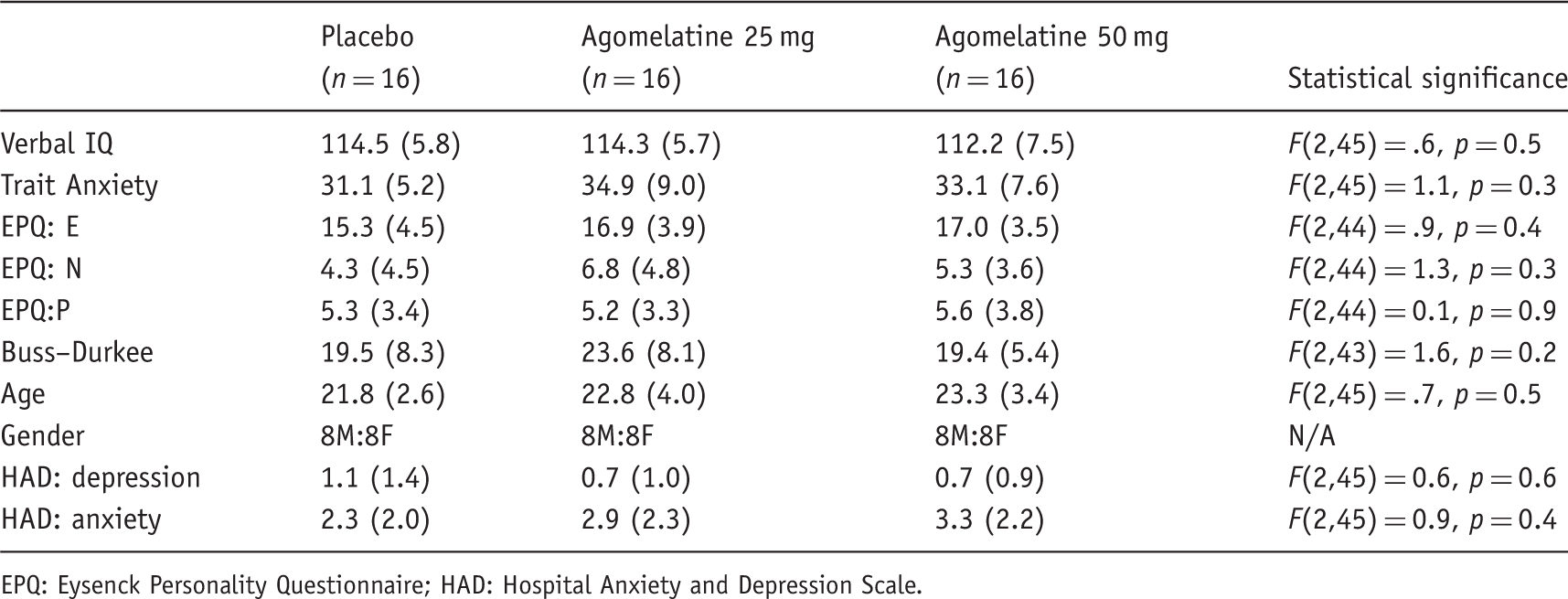
EPQ: Eysenck Personality Questionnaire; HAD: Hospital Anxiety and Depression Scale.
Subjective state
Subjective state changes over time. Values are ratings at the end of treatment minus baseline ratings. Means (standard deviations)
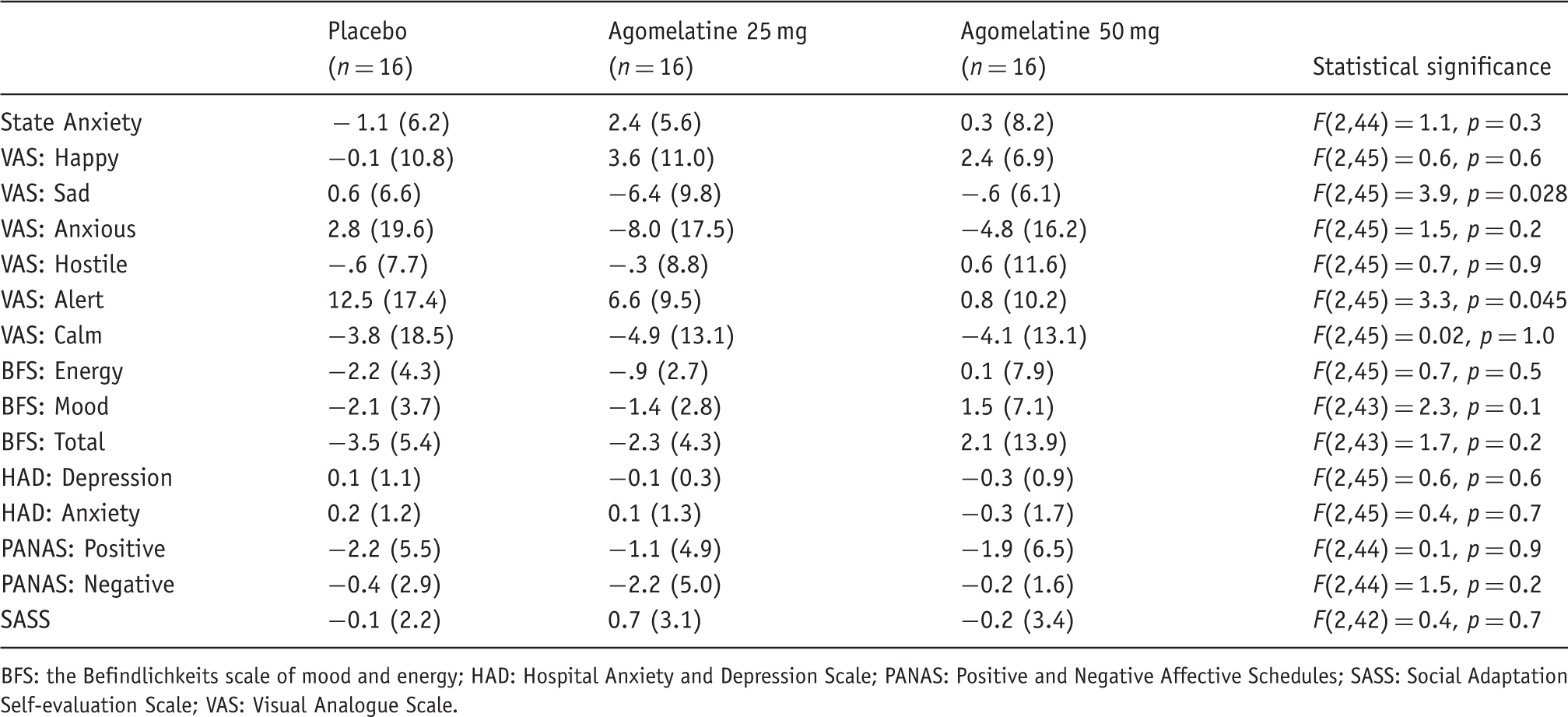
BFS: the Befindlichkeits scale of mood and energy; HAD: Hospital Anxiety and Depression Scale; PANAS: Positive and Negative Affective Schedules; SASS: Social Adaptation Self-evaluation Scale; VAS: Visual Analogue Scale.
Emotional processing
Facial expression recognition
One volunteer’s data was removed from the dataset (in the 25 mg agomelatine group) because of highly anomalous responses which met the criteria for an extreme outlier (data points lying more than three times the interquartile range above the third quartile).
Accuracy: there was a significant interaction between group and emotion in the ANOVA (F(12, 264) = 1.8, p = 0.047, Figure 1). This effect was driven by differences in facial perception between 25 mg agomelatine and placebo (group × emotion F(6,174) = 2.6, p = 0.018) but no difference between 50 mg agomelatine and placebo (group × emotion F(6,180) = 0.8, p = 0.6). The simple main effect analysis showed that volunteers receiving 25 mg agomelatine showed reduced recognition of facial expressions of sadness (df = 29, t = 2.1, p = 0.04) and a trend towards increased recognition of neutral facial expressions (df = 29, t = −1.9, p = 0.065). No other significant effects were seen (all p-values > 0.4).
Effect of agomelatine on accuracy of facial expression recognition. Top: Percent correct for all emotions summed over the different intensity levels used in this task. Lower: identification of sadness across the different intensity levels. 25 mg agomelatine reduced the perception of sad facial expressions. Values are mean % correct with standard errors. Asterisks represent the statistical significance of comparisons between drug and placebo groups *p < 0.05.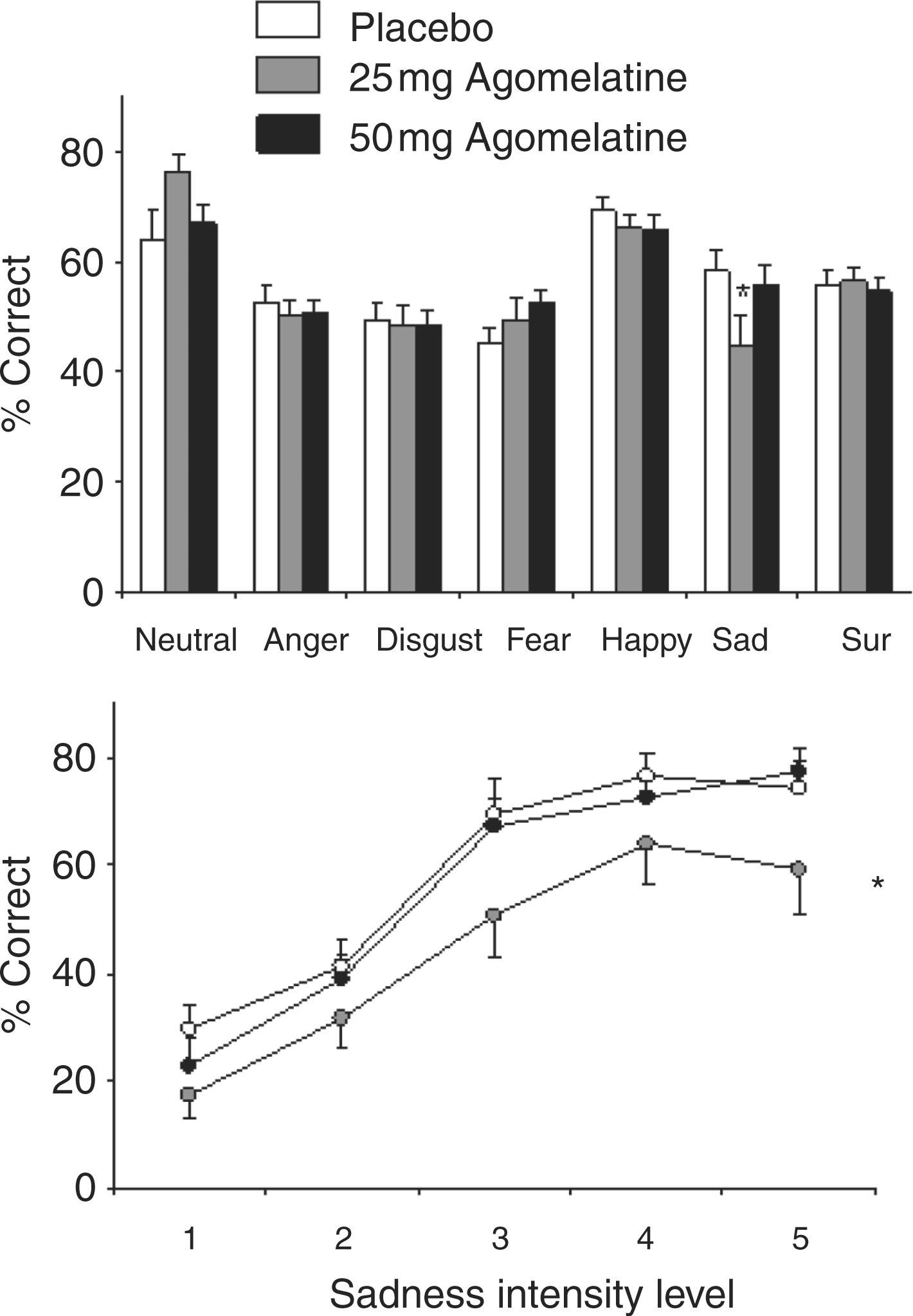
Reaction time: there was no effect of drug treatment in the ANOVA with group and emotion as factors (group × emotion F(12,258) = 0.96, p = 0.5; main effect of group F(2,43) = 1.2, p = 0.3). A separate sub-analysis also confirmed an absence of difference in reaction time to identify sad facial expressions (F(2,44) = 1.4, p = 0.3) suggesting that the differences in classification are not confounded by changes in speed–accuracy trade-off.
Misclassifications: there was an interaction between emotion and group in the ANOVA (F(12,264) = 2.3, p = 0.007). This was driven by a difference between the 25 mg dose of agomelatine and placebo (drug × emotion F(6,174) = 3.7, p = 0.002) but with no difference between the 50 mg dose and placebo (drug × emotion F(6,180) = 1.4, p = 0.2). The simple main effect analysis showed that volunteers receiving 25 mg agomelatine were more likely to misclassify facial expressions as neutral (df = 29, t = 2.1, p = 0.041) but marginally less likely to falsely label other facial expressions as sadness (df = 29, t = −1.9, p = 0.06).
Correlation analysis
To assess the involvement of the effect of 25 mg agomelatine on subjective ratings of sadness to the actions seen in recognition of this emotion in facial expression recognition, these endpoints were correlated using Pearson correlation coefficients for this treatment group. However, there was no relationship between change in subjective ratings of sadness and accuracy of sad recognition (r = 0.2, p = 0.4) or number of misclassifications of sadness (r = 0.4, p = 0.2) made in this task, suggesting a negligible role for subjective state change in emotional processing performance.
Categorization
Self-referent word stimuli: there was no effect of group in reaction time to classify positive and negative words (group × emotion F(2,45) = 0.5, p = 0.6; main effect of group F(2,45) = 0.8, p = 0.4).
Non-self-referent word stimuli: there was no significant effect of agomelatine on reaction time to classify positive and negative non-self-referent stimuli (main effect of group: F(2,44) = 2.2, p = 0.1; group × emotion F(2,44) = 0.1, p = 0.8).
Emotional memory
Self-referent word stimuli: there was an emotion × group interaction in the overall ANOVA (F(2,45) = 4.8, p = 0.01). This was driven by a significant difference between 25 mg agomelatine and placebo (F(1,30) = 8.0, p = 0.008) but no difference between 50 mg agomelatine and placebo (F(1,30) = 0.008, p = 0.9). Hence, volunteers receiving 25 mg agomelatine showed increased recall of positive versus negative items compared with those receiving placebo. This difference cannot be explained by differences in criteria for response as reflected by commission errors in this task (F(2,47) = 0.3, p = 0.7; see Figure 2). There was also no effect on recognition memory including hits (group × emotion: F(2,45) = 0.8, p = 0.5), commission errors (F(2,45) = 0.9, p = 0.4), or reaction time (group × emotion: F(2,45) = 0.02, p = 0.97).
Effect of agomelatine on emotional memory. Values are mean positive minus negative items recalled with standard errors of the mean. Asterisks represent the statistical significance of comparisons between drug and placebo groups **p < 0.01.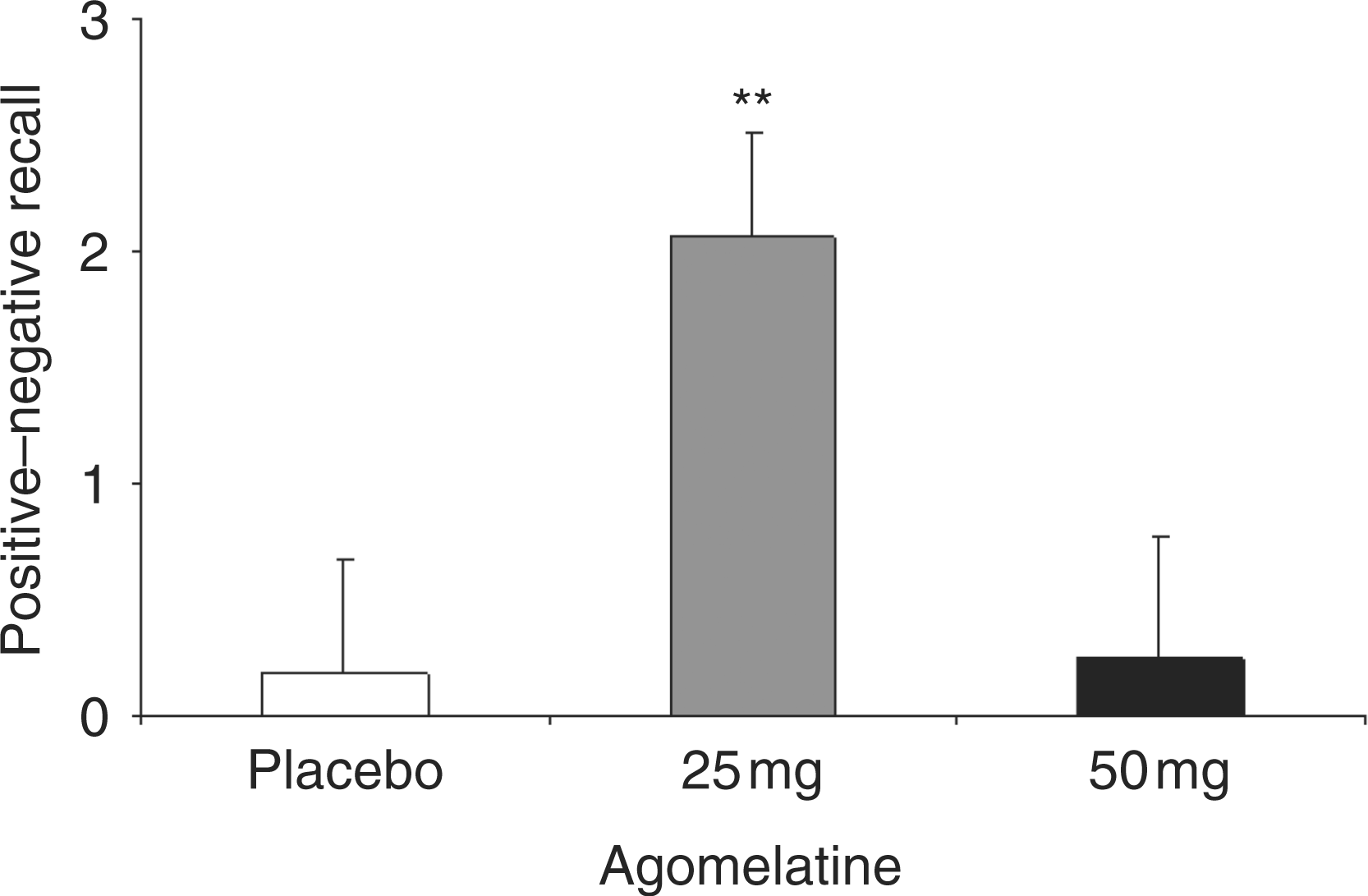
Non-self-referent word stimuli: there was no effect of agomelatine in this control task (group × emotion: F(2,45) = 0.4, p = 0.6). This was true even when considering the 25 mg and 50 mg doses separately compared with placebo (all p-values > 0.2), suggesting that the effect of agomelatine on emotional memory recall is specific, as expected, to self-referent emotional stimuli. There was also no effect of drug treatment on commission errors in this task (F(2,47) = 0.6, p = 0.6) or on recognition memory (all p-values > 0.18).
Dot-probe attentional vigilance
There was no effect on vigilance to the emotional items in this task as a function of group (main effect of group; group × emotion and group × mask × emotion: all p-values > 0.4). There was also no effect when considering the masked and unmasked trials separately (all p-values > 0.1), or when comparing 25 mg and 50 mg agomelatine directly with placebo (all p-values > 0.3).
Emotion-potentiated startle task
There was an interaction between group × emotion condition for the z-score startle responses to positive versus negative conditions (F(2,34) = 4.2, p = 0.024) which was driven by decreased relative blink amplitudes in the negative picture condition and enhanced relative blink responses during the pleasant picture condition (group × emotion F(1,35) = 7.3, p = 0.01, see Figure 3) following the 25 mg dose of agomelatine versus placebo. A similar effect was apparent following the 50 mg dose of agomelatine versus placebo (group × emotion: F(1,22) = 5.0, p = 0.036, Figure 3). These differences cannot be explained by differences in absolute or baseline levels of startle response (all p-values > 0.5 with raw scores). Hence, both the 25 mg and 50 mg dose of agomelatine specifically modulated the emotion-potentiated startle response.
Effect of agomelatine on emotion-potentiated startle responses. Values are relative startle response (z-transformed) to the white noise stimulus in the context of neutral, pleasant and unpleasant picture stimuli. Values are mean responses with standard errors in the three groups of volunteers. Asterisks represent the statistical significance of comparisons between drug and placebo group. *p < 0.05.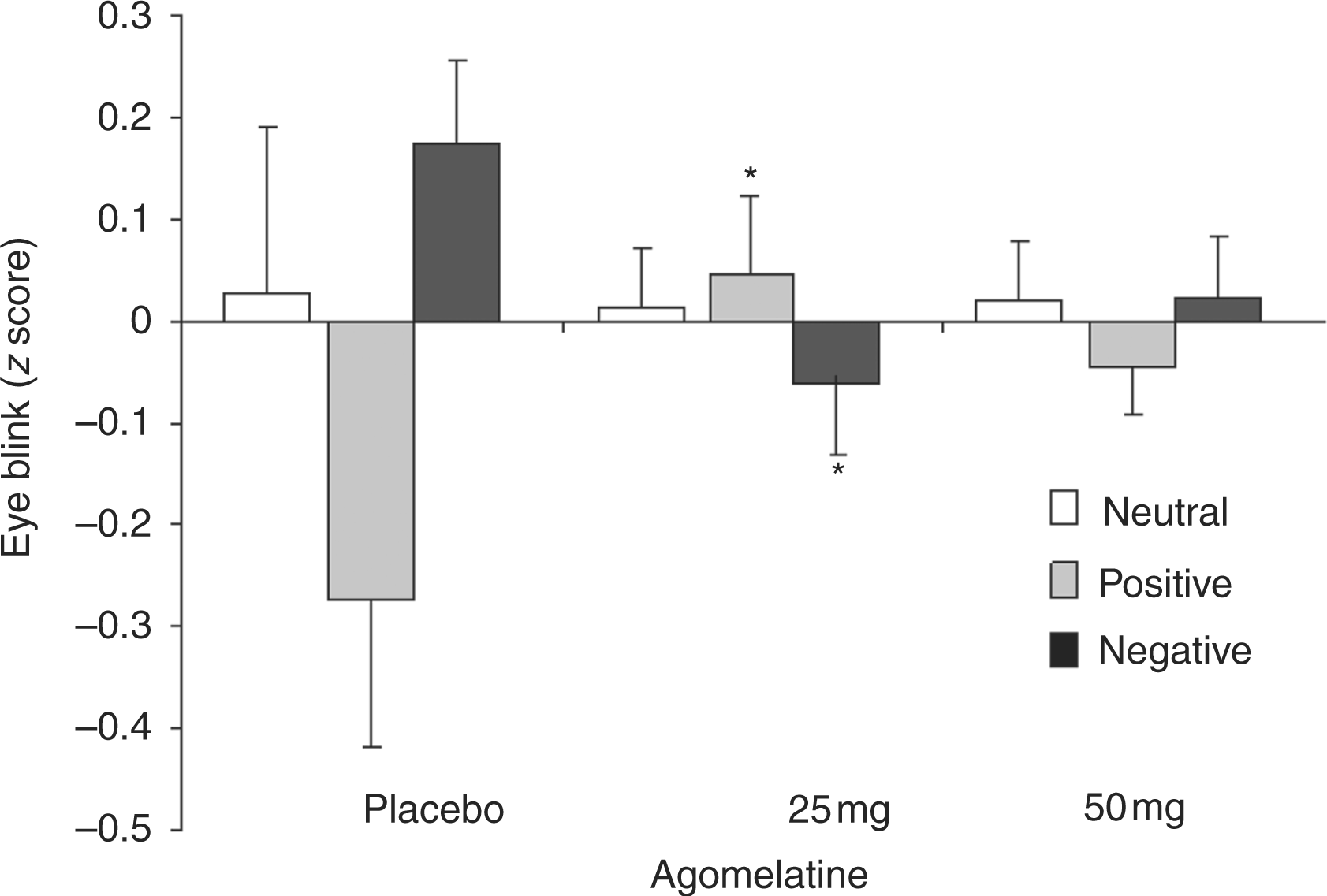
Discussion
The findings from this study suggest that agomelatine has early effects on emotional processing in healthy volunteers. Agomelatine (25 mg) reduced subjective reports of sadness, reduced recognition of sad facial expressions, improved positive affective memory and modulated the emotion-potentiated startle response. At 50 mg agomelatine also reduced the emotion-potentiated startle response but had no effect on the other outcome measures. The findings therefore suggest a neuropsychological action for agomelatine in accordance with conventional antidepressant drug treatment, particularly for emotional memory and emotion-modulated startle: they have further interesting implications for cognitive theories of antidepressant drug action and for the development of human experimental medicine models in the screening of novel candidate agents for depression.
Negative affective biases in information processing are thought to play a key role in the aetiology and maintenance of depression and are a key target for psychological treatments such as cognitive behavioural therapy (CBT) (Beck et al., 1979). The finding that these biases are also targeted with pharmacological therapy, early in treatment, offers a potential explanation for how the neurochemical actions of antidepressant drugs become translated into their clinical and psychological effects in depression. Our previous studies have found very consistent effects of antidepressants which prevent reuptake of serotonin or noradrenaline on emotional processing in healthy volunteers (Harmer, 2008). The finding that a novel antidepressant has neuropsychological effects suggests that modulation of emotional processing may be a common downstream action of treatment which is important in mechanism of clinical action.
In the current study, 25 mg agomelatine increased positive versus negative affective processing in emotional memory and reduced threat processing seen in the emotion-potentiated startle task. Several lines of evidence suggest that the modulation of emotional memory is particularly relevant to antidepressant drug action. First, healthy volunteer studies have revealed enhanced positive memory recall following administration of different antidepressant treatments, including reboxetine (Harmer et al., 2003, 2004), duloxetine (Harmer et al., 2008), mirtazapine (Arnone et al., 2009) and citalopram given for 7 days (Harmer et al., 2004), and this effect is not seen with acute anxiolytic drugs such as diazepam (Murphy et al., 2008). Recent evidence suggests that this measure is also sensitive to the depressogenic potential of drug treatments, with a single dose of the cannabinoid CB1 receptor antagonist rimonabant decreasing positive affective memory recall in healthy volunteers (Horder et al., 2009). Such effects are consistent with both experimental findings in patients with depression (see Leppanen, 2006) and theoretical models of depression (e.g. Bower, 1981) which emphasize the importance of negative memory biases in the maintenance of depressive illness.
Agomelatine given at 25 mg also decreased the perception of sad facial expressions in the current study, and this was combined with a decreased tendency to mislabel other facial expressions as sadness and to instead interpret these facial expressions as neutral. Such a pattern suggests a reduction in bias for sad facial expressions, again an effect opposite to that seen in major depression where patients are more likely to label even neutral facial expressions as showing this negative emotion (Gur et al., 1992; Surguladze et al., 2004). By contrast, previous studies exploring the effects of repeated monoamine reuptake inhibitors in healthy volunteers have typically found more generalized decreases in perception of negative facial expressions, including impaired recognition of fear, anger and disgust (Harmer et al., 2004). The clinical implications of this greater specificity require further investigation. One exciting possibility is that subjective patient reports of emotional blunting with SSRIs (most obviously in the sexual sphere, but also anecdotally as a reduced overall ability to experience and respond to a wide range of emotions) (Opbroek et al., 2002; Price et al., 2009) may be predicted by a decrease of negative perceptions in general. Since agomelatine only reduced the perception of sadness, it would be predicted that this treatment may be associated with less general detachment and blunting of emotion than may be the case with SSRIs in depression. The lack of sexual dysfunction and discontinuation symptoms observed with agomelatine is in agreement with this hypothesis (Kennedy and Eisfeld, 2007; Kennedy et al., 2008; Montgomery et al., 2004).
The finding that 25 mg agomelatine but not 50 mg significantly facilitated positive versus negative affective memory recall and reduced the perception of sadness is intriguing. Bell-shaped dose–response curves are common in pharmacological studies, and may reflect either induction of non-specific side effects negating the positive effects seen at lower doses, or an interaction with neurobiological processes where optimal levels of neurotransmitters are needed. For example, dopamine and noradrenaline in prefrontal cortex are critical for working memory performance, and manipulations which either decrease or increase their function from an optimal level adversely affect performance (Arnsten, 1997). The underlying neurochemical mechanisms involved in increasing positive affective memory performance are unknown, but it is an interesting hypothesis that increased prefrontal catecholamine function seen with agomelatine (and other 5HT2C receptor antagonists) could be involved in these actions and contribute to the different dose effects seen here. However, more general adverse effects of the higher dose of agomelatine cannot be ruled out as an explanation for these findings, especially in light of reduced ratings of alertness seen specifically after 50 mg agomelatine. Further studies are required to investigate the underlying mechanisms of this dose–response effect. It will also be important to assess whether sensitivity to the effects seen here in healthy volunteers translates to the treatment of acutely depressed patients. In particular, such a dose–response effect has not been observed in clinical trials with agomelatine in depressed patients following a dose increase from 25 mg to 50 mg (Kennedy and Emsley, 2006; Olié and Kasper, 2007). To fully understand the effects of agomelatine on emotional processing, further studies investigating the actions of both acute and longer-term dosing are required.
In contrast to the above effects associated with the treatment of depression, both doses of agomelatine modulated the emotion-potentiated startle response, an action which may be particularly relevant to anxiety (Harmer et al., 2008). The SSRI citalopram, which is used in a wide range of anxiety disorders, decreased the emotion-potentiated startle response after 7 days’ treatment (Harmer et al., 2004). Similarly, acute administration of the anxiolytic diazepam (5 mg) specifically reduced startle responses in this paradigm in the absence of changes in sedation or alertness (Murphy et al., 2008). The current effects of agomelatine in these human volunteer models of emotional processing are therefore consistent with preclinical data suggesting anxiolytic-like activity in animal models (e.g. Millan et al., 2005), and with clinical trial data which support anxiolytic drug action both in the context of major depression and in the treatment of generalized anxiety (Lôo et al., 2002; Stein et al., 2008). Importantly, we did not see the same effects with a NRI antidepressant (Harmer et al., 2004) and NRIs are not recommended for the treatment of anxiety disorders (NICE, 2007). Thus, our experimental effects to date map onto the clinical effects of different medicines in both a positive and negative sense. Such human experimental medicine paradigms could be useful in the early development of novel candidate agents for depression and anxiety and may help to define the range of doses to be tested in Phase IIa trials in patients (Dawson and Goodwin, 2005).
The findings from this study suggest that emotional processing models relevant to both depression and anxiety are sensitive to agomelatine (25 mg), a new antidepressant drug. The specific reduction in recognition of sad facial expressions further suggests that this drug treatment may not have the same more generalized blunting effect on emotional perception as SSRIs and raises the hypothesis that agomelatine’s unique mechanism of action may prevent the emotional blunting or detachment often reported with antidepressant drug treatment in depressed patients.
Footnotes
Funding
This work was fully funded by Servier ADR.
Conflicts of interest
CJH is on the advisory board of P1vital and has received consultancy fees from Servier, P1vital, Lundbeck and Merck-Sharpe and Dohme. She holds shares in P1vital. CdB is employed by Servier. GRD and CD are employed by and are company directors of P1vital Ltd. PJC has been a paid member of advisory boards of Eli Lilly, Servier and Wyeth and has been a paid lecturer for Eli Lilly, Servier and Glaxo Smith Kline. In the past 3 years, GMG has received compensation from Servier, the manufacturer of the drug studied here, and from AstraZeneca BMS, Eisai, Eli Lilly, Lundbeck, P1vital, Sanofi-Aventis and Wyeth.
Acknowledgements
Thanks are due to Dr Martina Di Simplico, Dr Mary Jane Attenburrow, and Dr Sarah McTavish for medical advice and screening for this study.