







Abstract
Research has shown that smokers have an attentional bias for pictorial smoking cues. The objective of the present study was to examine whether smokers also have an attentional bias for dynamic smoking cues in contemporary movies and therefore fixate more quickly, more often and for longer periods of time on dynamic smoking cues than non-smokers. By drawing upon established methods for assessing attentional biases for pictorial cues, we aimed to develop a new method for assessing attentional biases for dynamic smoking cues. We examined smokers’ and non-smokers’ eye movements while watching a movie clip by using eye-tracking technology. The sample consisted of 16 smoking and 17 non-smoking university students. Our results confirm the results of traditional pictorial attentional bias research. Smokers initially directed their gaze more quickly towards smoking-related cues (p = 0.01), focusing on them more often (p = 0.05) and for a longer duration (p = 0.01) compared with non-smokers. Thus, smoking cues in movies directly affect the attention of smokers. These findings indicate that the effects of dynamic smoking cues, in addition to other environmental smoking cues, need to be taken into account in smoking cessation therapies in order to increase successful smoking cessation and to prevent relapses.
Introduction
Tobacco use is still prevalent in movies (Sargent and Heatherton, 2009; Titus et al., 2009) and given that young adults spend much of their spare time watching television and videos/DVDs (Roberts, 2000; Roberts et al., 2005; Sargent et al., 2001), young adults are frequently exposed to dynamic smoking cues. The prevalence of these cues made us question whether smokers are more likely to notice smoking cues in movies than non-smokers. Possibly, attentional biases for dynamic smoking cues could either directly (Shmueli et al., 2010), or indirectly, through mediating factors such as craving (Lochbuehler et al., 2009; Sargent et al., 2009), affect smokers to light a cigarette during or immediately after watching a movie.
Biases in selective attention play an important role in the development and maintenance of drug-taking behaviour as well as in the resistance to abstinence and/or occurrence of relapse. The role of attentional biases in drug taking behaviour has been theorized by Robinson and Berridge (1993, 2001, 2008). According to their incentive sensitization theory, through classical conditioning, the drug-related cue itself is able to produce a conditioned dopamine response. As a result, the drug-related cue acquires an “incentive salience”, which means that it “grabs attention, becomes attractive and ‘wanted’ and thus guides behavior to the incentive” (Robinson and Berridge, 1993: 261).
Regarding attention to smoking cues, research has indicated that smokers have an attentional bias for smoking-related pictorial cues (Field and Cox, 2008). Both indirect (Stroop tasks and visual probe tasks) and direct measures, such as eye movement paradigms, have been used to assess attentional biases using these cues. In smoking Stroop tasks, smoking-related and neutral words are presented in different colours and participants are asked to name the colour of the word while ignoring its meaning. Smokers were slower to name the colours of smoking-related words than those of neutral words (Field et al., 2007; Munafo et al., 2003).
Likewise, in visual probe tasks a pair of images is presented simultaneously, one image being smoking related and the other unrelated to smoking. After a certain exposure time, the images disappear and a probe appears in the location of one of them. Participants are requested to indicate the location of the probe as quickly as possible by pressing one of two possible buttons. Smokers, but not non-smokers, were faster in responding to a probe that appeared in the spot of smoking-related cues compared with neutral cues (Bradley et al., 2004; Ehrman et al., 2002; Mogg et al., 2003). In visual probe tasks, the exposure duration has been manipulated in order to investigate different aspects of attention (initial orienting vs. maintenance of attention) (Field and Cox, 2008). The direction of the initial shift of the gaze (when two or more pictures are presented simultaneously) can be examined by presenting pictures briefly. A longer stimulus exposure provides the possibility to make multiple shifts in attention between the two stimuli which allows investigating the maintenance of attention (for a more detailed overview, see Field and Cox, 2008). Several studies have revealed that smokers have a bias in the maintenance of attention to smoking-related cues (Bradley et al., 2003, 2004; Field et al., 2004b; Mogg et al., 2003) and in initial orienting to smoking-related cues (Bradley et al., 2003, 2004; Field et al., 2006b).
In direct measures, the duration of eye movement fixations was monitored while participants viewed the pictures presented in a visual probe task. Smokers, but not non-smokers, maintained their gaze longer on smoking-related cues than on neutral cues (Field et al., 2004a; Mogg et al., 2003). Moreover, smokers were faster to detect probes that replaced smoking-related pictures than control pictures (Field et al., 2004a; Mogg et al., 2003).
While the existence of an attentional bias for pictorial smoking cues has been established, no study has assessed whether smokers also show an attentional bias for dynamic smoking cues. The lack of research in assessing dynamic cues provides an opening for the development of new methods capable of assessing attentional biases for dynamic smoking cues. Research on the effect of dynamic smoking cues is needed, not only because of the prevalence of dynamic smoking cues, but also because they are inherently different from pictorial cues. Moreover, it is still unclear whether the theory of attentional bias can be effectively transferred to dynamic cues.
The aim of the present study, therefore, is to investigate smokers’ and non-smokers’ attention while watching a movie with smoking cues through measuring their eye movements. To examine different aspects of attention we assessed the number of fixations on smoking cues, the duration of fixations and the latency of fixations using eye movement technology. With this new approach, eye tracking combined with dynamic smoking cues, we measured the overall amount of time that the gaze was directed to the smoking-related cues over the course of the movie clip, which should indicate the maintenance of attention (Field and Cox, 2008). The latency of fixation was assessed by measuring the time interval between cue appearance and cue fixation, which reflects the initial orienting of attention (Field and Cox, 2008). We predicted that, compared with non-smokers, smokers would be more likely to direct their gaze more often, more quickly and for longer periods towards smoking-related cues when they appear on screen.
Method
Participants
A total of 33 students (16 smokers and 17 non-smokers) from the Radboud University Nijmegen, The Netherlands participated in the study. The group of 16 smokers consisted of nine men and seven women, ranging in age from 16 to 49 (M = 23.81, SD = 10.14). On average, they had started smoking at the age of 12.9 years (SD = 3.28) and smoked 89.50 cigarettes per week (SD = 61.9, range 7–250). On average, they had smoked 74.0 min (SD = 33.73, range 5–120) prior to the experiment. The non-smoking group (three men and 14 women) had a mean age of 22.24 years (SD = 8.87, range 18–55). They reported never having smoked. All participants had visual acuity within normal limits. They participated for course credits or received €20 for their participation. The protocols for the study were approved by the Ethical Committee of the Faculty of Social Sciences, Radboud University Nijmegen, The Netherlands.
Material
The stimulus material consisted of the first 43 min of the movie Bridget Jones Diary (2001). This segment of the movie contained 14 smoking scenes (lasting in total 4 min and 19 s). The main female character used tobacco in 10 smoking scenes (3 min and 7 s) and one of the main male characters smoked in two scenes (36 s). In addition, other characters smoked in five scenes (1 min and 16 s). One smoking scene consisted of several smoking incidents which are defined by the amount of time a smoking-related cue was portrayed in the movie. Smoking-related cues were mainly portrayed in the form of cigarettes; only one incident included an ashtray. Certain smoking incidents concerned several characters smoking simultaneously. Out of a possible 75 smoking incidents, we used 58 to analyse the data. Smoking incidents were excluded from the analysis for several reasons. First, the data of certain incidents could not be analysed correctly (e.g. if the cue was too small or the movement of the cue was too fast). Second, we had to exclude some smoking incidents, because the interval of cue appearance was too short. Research has shown that participants require a certain amount of time (at least 150 ms) to shift their attention from one cue to another (e.g. after a change of scene) (Field and Cox, 2008; Theeuwes, 2005).
Apparatus
Eye movements were recorded with a corneal reflection eye tracker (Tobii T120 Eye Tracker, Tobii Technology, Danderyd, Sweden). The Tobii eye-tracking system was integrated to a 17” TFT flat screen monitor on which the stimuli were presented. The apparatus recorded gaze data of both eyes at 60 Hz with an average accuracy of 0.5° visual angle. The gaze of each participant was calibrated prior to testing. We used a nine-point calibration procedure, in which an expanding–contracting circle appeared in every position of a screen-wide 3 × 3 grid of calibration points on a white background. The participants were asked to accurately fixate the circle. If seven or fewer points were calibrated successfully, the calibration was repeated for the missing calibration points; otherwise the experiment commenced.
Procedure
The participants were recruited via an online-registration system through which students of the Radboud University Nijmegen register to participate in experiments. The registration system allowed us to select the desired number of smokers and non-smokers. Smoking status was assessed by a pre-screening questionnaire provided at the start of the participants’ degree. The experiment was described as contributing to research on movies and celebrities. After signing up, the participants were invited to a laboratory at the university. The experimental sessions lasted 1 h and 30 min. Before participation, all participants supplied their written informed consent. After entering the lab, the experimenter explained the procedure. The participants were told that they would watch a segment of a movie. Before watching the movie segment, the participants were requested to complete a questionnaire assessing several distracter items, such as questions concerning the actors, the lifestyle of the actors and their own lifestyle (including the last time they had smoked). Then, the participants were seated in a comfortable chair, 60 cm from the eye tracker. They were instructed to find a comfortable position in which they could watch the movie in a relaxed way without moving. Following calibration, the lights were dimmed and the experimenter left the room. In the questionnaire given after the movie, the participants were asked about their smoking habits. None of the participants guessed the actual aim of the study. Afterwards, the experimenter gave a debriefing before paying the participant.
Coding procedures and statistical analysis
Gaze data was measured at 60 Hz and the movie was portrayed with 25 fps (frames per second). For the analyses and coding procedure two programs that were developed in-house were used. The first program presents the movie in such a manner that each frame lasts exactly 40 ms so that the frequency of each frame remains constant over time. Moreover, the program links each frame separately marked to Clearview, which contains the frame number and the description of the scene. The second program uses the frames in such a manner that the samples of the gaze data are projected on the movie. Fifty-eight smoking incidents (lasting a total of 4 min and 19 s – 5432 frames) were coded for each participant. Figure 1 shows a still used for coding. For this illustration, the fixation of a smoker and a non-smoker are superimposed onto a single frame.
A smokers’ and non-smokers’ fixation on a random still frame. The fixation of a smoker is marked in red and that of a non-smoker is in green.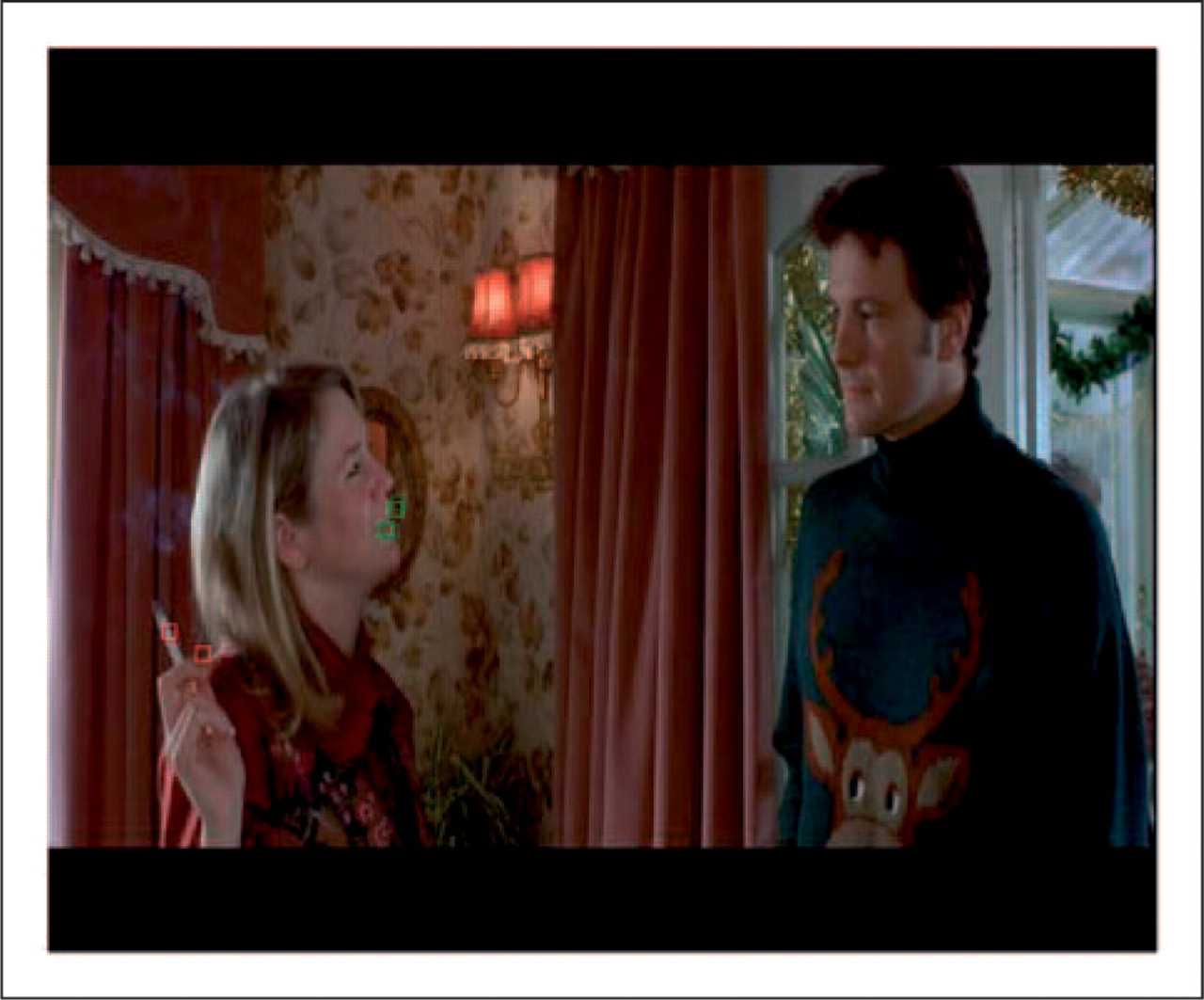
Two raters independently coded participants’ data. The intra-class correlation coefficient was 0.98 for the number of fixations measures, 0.93 for the duration measures and 0.96 for the measures of the initial fixations. One of the two coders was blind to the smoking status of the participant, whereas the second coder was blind for half of the data. As the intra-class correlations were high, we abstained from coding the data by a third coder. For each smoking incident, we defined the time of cue appearance, the length of cue appearance and the area of interest. The area of interest was restricted to the display of a smoking-related cue, which means that a fixation only took place if at least one of the participants’ eyes overlapped with the display of a smoking-related cue or if the eyes enclosed the smoking-related cue. Each frame was coded as fixation of the cue, non-fixation of the cue or missing data. Missing data included frames of either participants’ blink or saccadic shift. If a cue appeared in the same spot a participant focused on after a scene change, this was scored only if the participant focused on this spot longer than 150 ms (Field and Cox, 2008; Theeuwes, 2005).
The design had three dependent variables: the number of fixations on the smoking cues, the latency of initial fixations on the smoking cues and the duration of initial fixation (maintenance of gaze/gaze duration) (Field et al., 2006a; Mogg et al., 2003). The number of fixations on the smoking cue was determined by counting the times the participant fixated on a smoking cue. To examine the initial fixations on the cue, the interval between cue appearance and the participants’ first time to fixate on the cue within a smoking incident was measured. Maintenance of gaze was defined as the overall amount of time that the gaze was directed to the smoking cues. t-tests were used to test group differences in the number of fixations on the smoking cues, the total fixation time on the smoking cues and the latency of initial fixations.
Results
Number of fixations
The total number of fixations for each participant was expressed by the sum of the number of fixations on each smoking incident. An independent samples t-test was conducted to evaluate whether smokers directed their gaze more often to smoking-related cues than non-smokers. Overall, the results showed a significant difference in the number of fixations between smokers and non-smokers, t(31) = 2.00, p = .05, η2 = 0.11, such that smokers (M = 36.34, SD = 10.42) focused more often on smoking-related cues than non-smokers (M = 28.00, SD = 13.26). The average number of fixations on smoking-related cues of smokers and non-smokers are shown in Figure 2.
Average number of fixations (error bars depict 95% confidence intervals of the mean) of smoking-related cues in smokers (n = 16) and non-smokers (n = 17) (means are significantly different).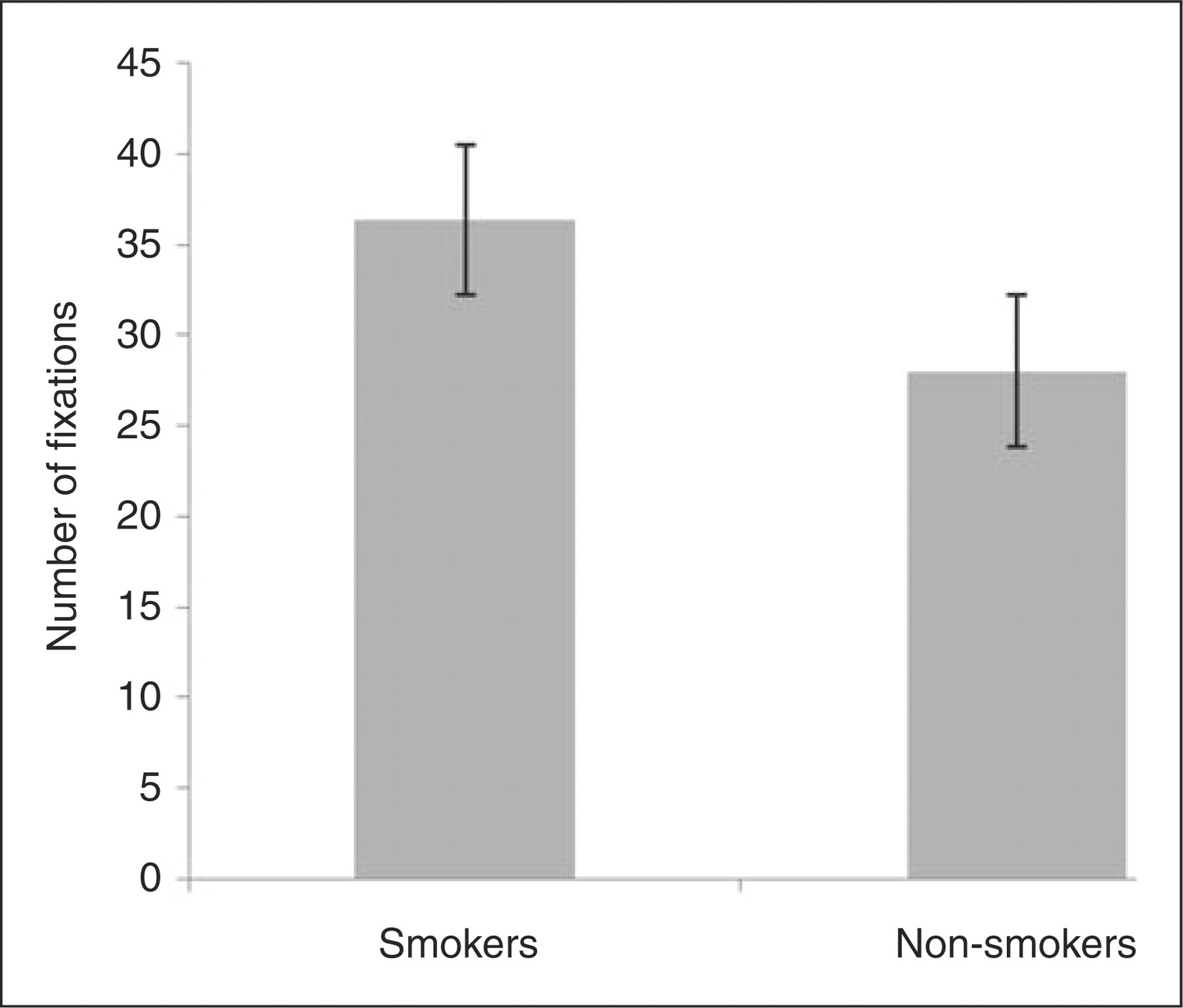
Duration of fixation
A relative duration score was calculated for each smoking incident by expressing the time of cue fixation (in ms) as a proportion of the total eye data in this incident (in ms). The total eye data were calculated by means of deducting the missing eye data from the length of the cue exposure. On average, smokers (M = 3.13, SD = 1.45) directed their gaze longer to smoking-related cues than non-smokers (M = 1.96, SD = 0.96). This difference was significant t(31) = 2.8, p < .05, η2 = 0.20.
Latency of initial fixations
To test our hypothesis that smokers direct their gaze more quickly towards smoking-related cues than non-smokers, the time interval (in ms) between cue appearance and cue fixation for each smoking incident was measured. An independent samples t-test conducted on the latency of cue fixation revealed that smokers (M = 3350.65, SD = 604.49) directed their gaze more quickly towards smoking-related cues than non-smokers (M = 4194.44, SD = 1127.35), t(31) = –2.66, p < .05, η2 = 0.19. Smokers directed their gaze to the cue on average 3351 ms after the cue appeared, non-smokers after 4194 ms. The average latency of initial fixations (in ms) towards smoking-related cues of smokers and non-smokers are shown in Figure 3.
Mean latency of initial fixations (in ms) (error bars depict 95% confidence intervals of the mean) of smoking-related cues in smokers (n = 16) and non-smokers (n = 17) (means are significantly different).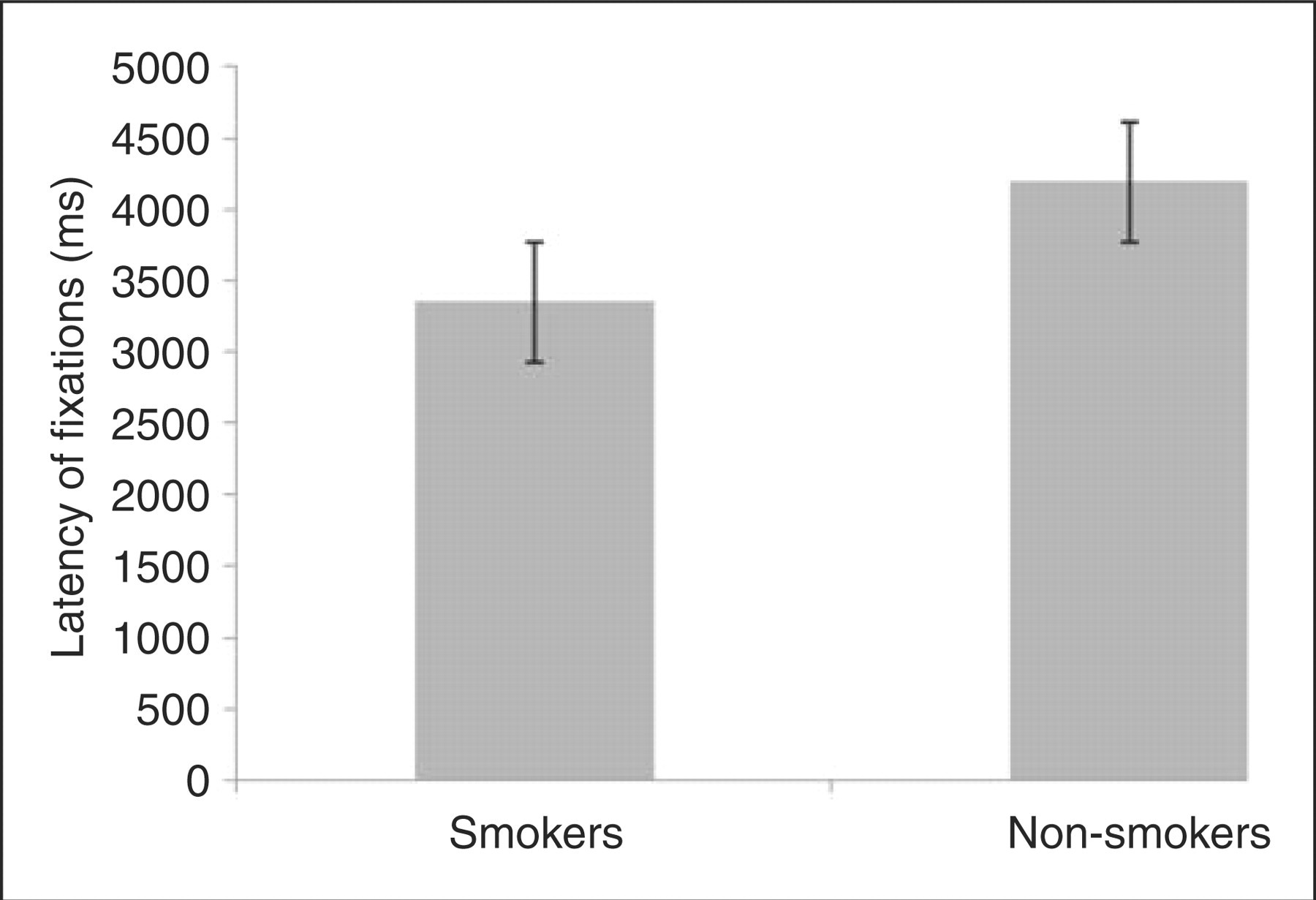
As the two groups differed with regard to sex (p = .02), an analysis of covariance (ANCOVA) on the three dependent variables (number of fixations, gaze duration and latency of initial fixations) with the smoking status of the participant as independent variable (factor) and sex as covariate was conducted to control for these differences. No differences in the results were found for the number of fixations [condition: F(1,33) = 4.77, p = .04; sex: F(1,33) = 0.48, p = .50; condition × sex: F(1,33) = 0.75, p = .39], the gaze duration [condition: F(1,33) = 5.03, p = .03; sex: F(1,33) = o.02, p = .87; condition × sex: F(1,33) = 0.003, p = .96] and the latency of initial fixations [condition: F(1,33) = 5.63, p = .03; sex: F(1,33) = 0.26, p = .62; condition × sex: F(1,33) = 0.40, p = .53]. Linear regressions with time as predictor and the number, duration and latency of fixation as dependent variables did not show a significant decrease or increase over time for smokers and non-smokers. Each of the three correlations between the three dependent variables and the number of cigarettes smoked per day and week were not significant.
Discussion
The present study was designed to examine whether smokers have an attentional bias for smoking cues in contemporary movies and to test whether the theory of attentional bias can be applied to dynamic cues. Using eye-tracking technology to assess smokers’ and non-smokers’ attention while watching a movie, the results revealed significant effects for all of the three tested aspects of attention. Smokers not only initially directed their gaze more quickly towards smoking-related cues, but also focused more often and maintained their gaze longer on smoking-related cues when compared with non-smokers. These results indicate the complexity of the construct of the attentional bias and the need to assess its different aspects. The tendency of smokers to direct their initial gaze more quickly to the cue when it appears indicates that smoking cues in movies are capable of capturing smokers’ attention. The difference in gaze duration between smokers and non-smokers reflects the difficulties smokers have in removing their attention from the smoking cue and the ability of the cues to hold smokers’ attention (Field and Cox, 2008).
Research using both indirect measures like the smoking Stroop task or the visual probe task, and direct measures, such as eye movement paradigms, have identified an attentional bias for pictorial smoking cues among smokers (Bradley et al., 2003, 2004; Field et al., 2004b, 2007; Mogg et al., 2003). Our results extend the studies using pictures to investigate the attentional bias in dynamic cues and confirm the results of traditional attentional bias research. In our paradigm, dynamic cues are embedded in context, which could result in distraction from the smoking cues. However, even if cues are presented in a less explicit way, with variations in length and context of cue exposure, dynamic smoking cues have the ability to capture and hold smokers’ attention. The fact that we found evidence for all measures underscores the theory on attentional biases.
The additional value of attentional bias research on dynamic cues presented in contemporary movies is twofold. First, as smoking cues in movies and in other types of media like soaps and TV series are omnipresent, smokers are often automatically exposed to smoking cues in movies. Smoking cues in movies, like other environmental smoking cues, capture and hold smokers’ attention and might therefore also increase their craving or affect their smoking behaviour directly (Shmueli et al., 2010). Results on the association between attentional bias and craving have been mixed (Attwood et al., 2008; Field et al., 2009a, 2009b). A recent meta-analysis of over 60 studies on the relationship between attentional bias and craving revealed a significant but weak association between attentional bias and craving (Field et al., 2009b). Other studies reported no significant associations between attentional bias and craving (Field et al., 2009a), or suggested that the effects found were moderated by gender (Attwood et al., 2008). However, these cross-sectional findings do not imply a causal relationship between attentional bias and craving and can therefore not be interpreted as such. Craving could for instance also lead to increased attention to substance cues (Franken, 2003), providing evidence for the reversed pathway. In future studies it might be interesting to scrutinize the relationship between attentional bias and smoking behaviour in more detail, and to test whether this relationship is mediated by craving. Other possible processes such as priming effects should also be considered.
Second, in addition to indirect assessments such as Stroop tasks and visual probe tasks, previous studies have used eye movement measures during pictorial visual probe tasks to assess the attentional bias (Bradley et al., 2003, 2004; Field et al., 2004b, 2007; Mogg et al., 2003). Direct measures, that is eye-tacking paradigms, are considered a preferred method to investigate attentional biases because they provide a direct measure of attention and do not infer attentional processes on the basis of reaction times in comparison to indirect measures (Field et al., 2009b). Our study is the first study to combine direct measures (eye-tracking technology) with dynamic cues in extended and long three-dimensional stimuli. In comparison to pictorial cues, direct measurements of the attentional bias of dynamic cues through eye-tracking technology increases their ecological validity, because the cues which are used are not created but already exist and participants might be confronted with those cues in everyday life. Also, research on dynamic cues carries with it fewer demand characteristics, because participants do not know the aim of the study and the cues presented are more subtle; research with pictorial cues is often characterized by an explicit and strong focus on the presented cues. A considerable advantage in using dynamic cues can be seen in the opportunity to expose participants to a variety of smoking cues in different contexts as well as to cues that vary in length of cue presentation. As mentioned before, the attentional bias is composed of different aspects, all of which need to be assessed to achieve a complete overview of the construct. The investigation of different aspects of the attentional bias enables us to accumulate more valid information about it, which in turn helps us to better understand the theory of cue reactivity and the role of the attentional bias in the process of addiction.
The use of eye-tracking technology to measure dynamic cues in other disciplines is rare. This conceptualization has been used in a study (Klin et al., 2002) to investigate gaze patterns of individuals with autism, but, to our knowledge, not in other psychopathologies. Our study shows the possibly great value of this conceptualization by which to examine eye movements of dynamic cues for other research areas as well. Taking into account the important role of attention in both internalizing (e.g. anxiety disorders) and externalizing (e.g. addiction to alcohol or drugs) psychopathologies, this method can be applied and used to answer unresolved questions about underlying mechanisms involving attention.
Several limitations of this study need to be acknowledged. First, we did not include any control cues (e.g. food cues) with which the attention to smoking-related cues can be compared. Compared with pictorial attentional bias studies, the inclusion of appropriate matching control cues seems practically impossible to realize in a design using a long segment of dynamic cues. Still, the possibility that smokers are generally susceptible to appetitive cues exists and needs to be mentioned. Second, smokers and non-smokers differed according to their sex. Due to this difference a potential bias could be present; however, after controlling for sex in the analyses, the results remained significant. Another limitation of our study is that we did not examine the link between attentional bias and craving. Our results do not provide a conclusion on the value of the attentional bias on smoking-related emotions and behaviour. As mentioned before, Field et al. (2009b) found in a meta-analysis an association between attentional bias and craving. Most of those studies used indirect measures to investigate the attentional bias. To better understand the role of attentional bias in addiction, it is necessary to investigate whether this association also exists by exposure to dynamic cues. As this is the first study investigating attentional biases of dynamic cues, the main aim of the study was to examine the existence of attentional biases among smokers. Further research is needed to test whether certain smoking scenes are responsible for the differences found. Future studies should acknowledge this issue and include certain factors such as the type of smoking-related cue, the length of display or the nature of the scene. For this purpose, future studies could include several shorter scenes of different movies as well.
In conclusion, smokers fixated more often, more quickly and for a longer duration on smoking-related cues in a contemporary 43-min movie clip compared with non-smokers. Potentially, these findings are of value for the conceptualization of interventions to reduce or to quit smoking. They suggest that in order to increase the likelihood of successful smoking cessation, therapies need to take the effects of dynamic smoking cues into account, in addition to other environmental smoking cues. Because of an attentional bias, former smokers who are attempting to quit might be at high risk of relapse when exposed to smoking cues in movies.
Footnotes
Funding
This research received no specific grant from any funding agency in the public, commercial, or not-for-profit sectors.