






Abstract
Depression is common in Parkinson’s disease (PD) and is associated with several poor outcomes. However the literature regarding treatment with antidepressants in this population is controversial. The aim of this paper was to systematically review all randomized controlled trials that studied the efficacy of antidepressants for depression in PD (dPD). Studies were retrieved from PubMed (1966–July 2012), Cochrane Library (–July 2012, issue 7), Embase (1980–July 2012), PsycINFO (1980–July 2012), Lilacs (1982–July 2012), secondary references, clinical trials registries and a thesis database. Only double-blind, randomized controlled trials in which an antidepressant was given as the main treatment and compared with placebo and/or another antidepressant were included. Out of the 1438 studies retrieved, only six could be included. Taking into account the five placebo-controlled trials, the overall risk ratio (RR) for response was 1.36 (0.98, 1.87), indicating no statistically significant superiority of antidepressants over placebo. However, in the sensitivity analysis, the RR for response was 1.41 (1.01, 1.96) and 1.48 (1.05, 2.10) after exclusion of one study with questionable results, and when only studies with low risk of bias were considered, respectively. No specific antidepressant class was superior to placebo. In general antidepressant medications were well tolerated. The results suggest antidepressants may be efficacious in the treatment of dPD. However, the results were unstable. In fact, the small number of trials and methodological drawbacks preclude definitive conclusions about their efficacy and tolerability in dPD.
Keywords
Introduction
Depression is one of the most common neuropsychiatric features of Parkinson’s disease (PD), with a 17% prevalence of major depression, 22% of minor depression, and 13% of dysthymia (Reijnders et al., 2008). It can occur early in the disease and may precede the expression of motor symptoms by more than a decade. Depression in PD (dPD) is associated with a variety of poor outcomes for both patients and their families. Besides personal suffering, depression is related to greater disability, faster progression of physical symptoms, reduced cognitive performance, less ability to care for oneself, poorer adherence to treatment, poorer quality of life (QoL), higher caregiver distress, and increased mortality (Hughes et al., 2004; Ravina et al., 2007; Schrag et al., 2006). In fact, depression seems to have more impact on QoL in patients with PD than the motor aspects of the illness (Global Parkinson’s Disease Survey Steering Committee, 2002).
Despite the importance of dPD, there is only preliminary evidence suggesting that antidepressants, electroconvulsive therapy (ECT), deep brain stimulation, dopamine (DA) agonists and cognitive-behavioral therapy may improve depression (Barone, 2011; Dobkin et al., 2011; Menza et al., 2006; Skapinakis et al., 2010). In relation to antidepressant treatment, a survey in the U.S. showed that 62.9% of the prescriptions for dPD were for selective serotonin reuptake inhibitors (SSRIs), 7.5% for tricyclic antidepressants (TCAs) and 20.6% for newer non-SSRI antidepressants (Chen et al., 2007). Nevertheless, the literature about the use of antidepressants in the treatment of dPD is controversial (Chung et al., 2003; Richard et al., 2012; Skapinakis et al., 2010; Weintraub et al., 2005). The aim of this paper was to systematically review all randomized controlled trials that studied the efficacy of antidepressants in treating dPD.
Materials and methods
This systematic review was conducted at the Instituto de Previdência dos Servidores do Estado de Minas Gerais, Faculdade da Saúde e Ecologia Humana, Faculdade de Medicina da Universidade Federal de Minas Gerais, and Faculdade de Ciências Médicas de Minas Gerais.
Studies were retrieved from the following sources: PubMed (1966 to July 2012), Cochrane Library (until July 2012), Excerpta Medica Database (Embase) (1980 to July 2012), PsycINFO (1980 to July 2012) and Literatura Latino-Americana e do Caribe em Ciências da Saúde (Lilacs) (1982 to July 2012). Medical subject headings (MeSH) terms and filters for clinical trials were applied. There were no language limits. We also scanned secondary references, clinical trials registries, a thesis database (www.capes.gov.br), and contacted experts in the field. In case of missing data, authors were contacted by email.
Criteria for considering studies in this review
Types of studies and interventions
Only double-blind, randomized controlled trials with at least one arm in which an antidepressant was given as the main treatment were included. Placebo or other antidepressants were considered acceptable comparison groups.
Participants
Participants were adult out or inpatients of all ages, both genders, with a clinical diagnosis of idiopathic PD and a clinical diagnosis of depression (as defined by the authors of the trials).
Outcome measures
Remission defined as a subthreshold score on a depression scale, for example a score of seven or less on the 17 items of the Hamilton Depression Rating Scale (HDRS) or a score of 10 or less on the Montgomery-Asberg Depression Rating Scale (MADRS) (Keller, 2003). When a trial included results from both scales, the HDRS was used.
Response defined as a reduction of at least 50% in baseline symptoms on a depression scale (Keller, 2003).
Safety: dropouts due to side effects; number and severity of adverse events.
Data collection and quality analysis
Selection of trials
Two authors independently screened each abstract and decided if it potentially fulfilled inclusion criteria. In case of incomplete information in the abstract, the full text was assessed. After this first screening, all selected studies were evaluated. Any disagreement on the eligibility of a study was discussed with a third review author reaching a consensus.
Risk of bias assessment
Risk of bias assessment was evaluated according to recommendations of the Cochrane Collaboration Handbook (Higgins and Green, 2008: Table 8.5(a), 649) taking into account the following criteria: sequence generation and allocation concealment (selection bias); blinding of participants and personnel (performance bias); blinding of outcome assessment (detection bias); incomplete outcome data (attrition bias); selective outcome reporting (reporting bias); and other sources of bias (Higgins and Green, 2008). The studies were classified as having low, unclear/moderate or high risk of bias.
Data extraction
Full data extraction of studies selected for inclusion in the review was performed independently by two authors using the Cochrane Collaboration Handbook form (Higgins and Green, 2008). Any disagreement was discussed among the reviewers.
Data analysis
Data analysis was performed using the Review Manager program (RevMan 5.0) and according to the Cochrane Collaboration Handbook (Higgins and Green, 2008). For dichotomous variables the relative risk was estimated with a 95% confidence interval (fixed effect model). Statistical heterogeneity between study results was evaluated using the inconsistency test (I2), and inconsistency was considered present when I2>50% (Higgins et al., 2003). Possible reasons for heterogeneity (statistical or clinical) were explored. Sensitivity analyses were also performed, excluding studies with high risk of bias and excluding a study that showed methodological problems during its implementation.
Results
Description of studies with potential for inclusion
Out of the 1438 studies retrieved through the search strategy and other sources, 272 were duplicated, 1159 were excluded because they failed to meet the inclusion criteria (non-randomized controlled trials, narrative reviews, case reports, retrospective studies and studies not dealing with the clinical condition or intervention of interest). Therefore, only seven trials satisfied the pre-established inclusion criteria (Akça et al., 2011; Andersen et al., 1980; Devos et al., 2008; Leentjens et al., 2003; Menza et al., 2009; Richard et al., 2012; Wermuth et al., 1998). The study by Andersen et al. (1980) was excluded due to insufficient information regarding the outcomes of interest (the authors could not be contacted). In the Akça et al. (2011) study, there was an absence of data about dropouts, therefore only data about efficacy were included in analyses (authors were contacted but did not answer) (Figure 1). Wermuth et al. employed the Diagnostic and Statistical Manual of Mental Disorders (DSM)-III-R diagnostic criteria for major depression. However, during the trial, the authors observed that many patients had shorter and more frequent episodes than expected. Therefore, after the completion of the trial, the patients were retrospectively interviewed about the course of depression during the last year before entering the trial. The results showed that 56% of the patients had current brief depression of 2–3 days’ duration. In addition, the citalopram dose used in the trial was lower than that recommended in major depression. The authors recognized that the negative results of the study might be explained by these methodological problems. Hence a sensitivity analysis excluding the Wermuth et al. study was carried out.

Flow diagram of the study.
The characteristics of the six trials included are summarized in Table 1. These trials included six serotonin and norepinephrine reuptake inhibitors (SSRIS) (two sertraline, two citalopram, and two paroxetine), two SNRI (venlafaxine), and two tricyclic (desipramine and nortriptyline) arms. The duration of the studies varied from 4.5–12 weeks. The mean age of participants varied from 61.7–69.2 years. Four studies did not specify the diagnostic criteria for PD, one used the UK Parkinson’s Disease Society Brain Bank Clinical Diagnostic Criteria (Leentjens et al., 2003), and the other the Research Diagnostic Criteria for Parkinson’s Disease (Menza et al., 2009). All studies used the DSM III-R or DSM-IV criteria for depression, three including only major depression and three including depressive disorders in general. Two studies used the MADRS (Devos et al., 2008; Leentjens et al., 2003) with mean baseline scores of 19.0 and 29.0 (moderate depression) and four used the HDRS with mean baseline scores between 16.2 (moderate depression) and 22.2 (severe depression). Demented patients were excluded from all studies. In efficacy and dropout analyses, a total of 296 and 264 patients, respectively, were included. Side effects were obtained by spontaneous report and the Unified Parkinson’s Disease Rating Scale (UPDRS) in all studies and two studies also used the Udvalg for Kliniske Undersøgelser (UKU) Side Effects Rating Scale (Akça et al., 2011; Wermuth et al., 1998).
Summary of the clinical trials included.
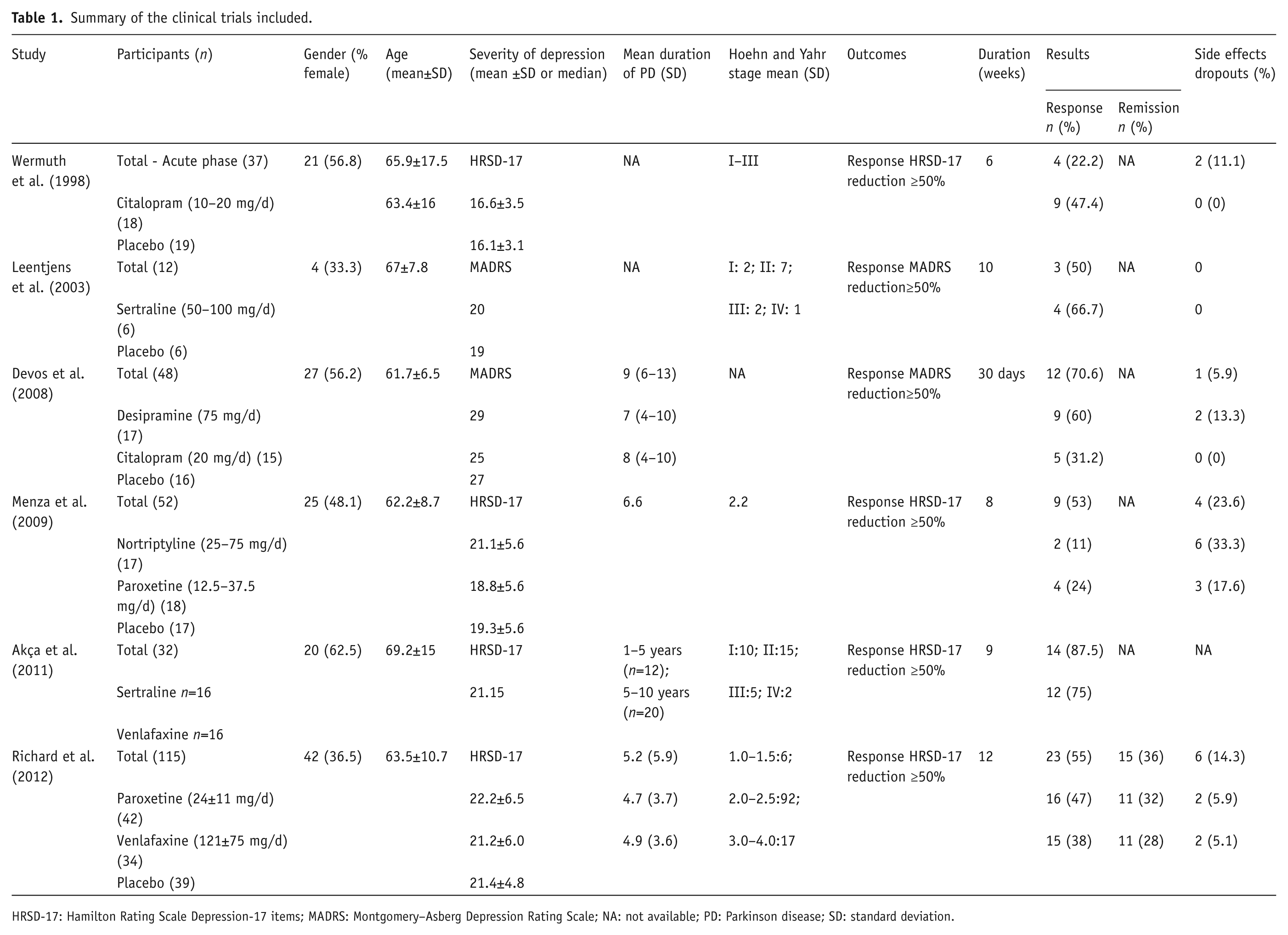
HRSD-17: Hamilton Rating Scale Depression-17 items; MADRS: Montgomery–Asberg Depression Rating Scale; NA: not available; PD: Parkinson disease; SD: standard deviation.
Methodological quality of the studies included
Three studies had low risk of bias (Devos et al., 2008; Menza et al., 2009; Richard et al., 2012), two had unclear risk (Leentjens et al., 2003; Wermuth et al., 1998) and one had a high risk (Akça et al., 2011). Regarding sequence generation, four studies were considered to have low risk of bias (Devos et al., 2008; Leentjens et al., 2003; Menza et al., 2009; Richard et al., 2012) and the others, unclear risk. Three studies described adequate allocation concealment, blinding of participants and personnel for outcome assessment (Devos et al., 2008; Menza et al., 2009; Richard et al., 2012) and the others were unclear on these issues. There was a low risk of attrition and reporting bias in all studies except for Akça et al. (2011) that presented a high risk of attrition bias and unclear risk of reporting bias, and for Devos et al. (2008) that presented unclear risks. There was no information on dropouts in the Akça et al. (2011) study.
Outcome measurements
SSRIs were superior to placebo in only two of the five studies with this comparison (Devos et al., 2008; Richard et al., 2012); tricyclics were superior to placebo in both studies in which this was investigated (Devos et al., 2008; Menza et al., 2009), and venlafaxine was superior to placebo in the only trial with this comparison (Richard et al., 2012). No difference was found between venlafaxine and sertraline in the Akça et al. study (Akça et al., 2011) (Table 1).
Taking into account the five placebo-controlled studies (Devos et al., 2008; Leentjens et al., 2003; Menza et al., 2009; Richard et al., 2012; Wermuth et al., 1998), the overall RR (risk ratio) for response was 1.36 (confidence interval (CI): 0.98, 1.87), indicating no statistically significant superiority of antidepressant over placebo treatment (Figure 2). However, in the sensitivity analysis, excluding the Wermuth et al. study, as explained above, the overall RR for response was 1.41 (1.01, 1.96) (Figure 3). Considering the three studies with low risk of bias, the RR was 1.48 (1.05, 2.10).

Risk ratio for response of antidepressants vs placebo in depression in Parkinson’s disease.

Sensitivity analysis of risk ratio for response of antidepressants vs placebo in depression in Parkinson’s disease, with study by Wermuth et al. (1998) removed. CI: confidence interval; M-H: Mantel-Haenszel.
No specific antidepressant class was superior to placebo: SSRI RR=1.20 (0.57, 2.52) (five studies) and tricyclic RR=1.20 (0.57, 2.52) (two studies). Tricyclic antidepressants were superior to SSRIs: RR=1.78 (1.06, 2.99) (two studies). No statistically significant difference was found between SSRIs and venlafaxine: RR=0.86 (0.64, 1.16) (two studies).
In relation to dropouts due to side effects, antidepressant medications in general (Figure 4) and SSRIs showed statistically significant higher rates of dropouts than placebo (RR=2.46 (1.28, 4.73) (five studies) and RR=2.54 (1.17, 5.54), respectively). Only three studies described the side effects associated to dropouts (Devos et al., 2008; Richard et al., 2012; Wermuth et al., 1998). With SSRIs the most frequent side effects were nausea, increased sweating, and sexual dysfunction; with venlafaxine the most frequent were nausea, dry mouth, headache, sedation, dizziness, and high blood pressure; and with tricyclics, dry mouth, constipation, and orthostatic hypotension.

Risk ratio for dropouts of antidepressants vs placebo in depression in Parkinson’s disease. CI: confidence interval; M-H: Mantel-Haenszel.
Discussion
Only six randomized controlled trials which examined antidepressants in the treatment of dPD were identified. The results of this systematic review and meta-analysis, taking into account the all five placebo-controlled studies, suggest that antidepressant medications were not efficacious in dPD. However, in the sensitivity analyses that excluded the questionable results of Wermuth et al. (1998) or that took into account the three studies with low risk of bias, antidepressants were efficacious in the treatment of dPD. This instability can be explained by the small number of trials and patients included. The crude response rate for antidepressants was 45.5% versus 30.7% for placebo (sensitivity analysis without Wermuth et al.: 49.7 × 33.7%, respectively; low risk of bias studies: 49.7 × 31.5%, respectively). These observed response rates for antidepressants and placebo were similar to those found in a meta-analysis that analyzed 51 double-blind randomized controlled trials of antidepressant treatment in older depressed patients in which the reported response rates were 48.0% and 38.6%, respectively (Kok et al., 2012). In the present study, the response RR for antidepressants as a group was 1.36 (0.98, 1.87) (sensitivity analysis: 1.41 (1.01, 1.96) and 1.48 (1.05, 2.10)). If confirmed, the efficacy of antidepressants in dPD is in accordance with reviews that concluded that antidepressants are efficacious in the treatment of depression occurring in the context of chronic physical health problems (National Institute for Health and Clinical Excellence, 2010; Taylor et al., 2011). Taking into account the specific classes of antidepressants studied, SSRIs, tricyclics, and venlafaxine were not found to be superior to placebo. This may be explained in part by a type II error, due to the small number of patients included. Tricyclic antidepressants were more efficacious than SSRIs, but the comparison was based on only two studies. If confirmed, this result could be explained by the loss of noradrenergic neurons in the limbic system in patients with PD and depression and by the role of the norepinephrine transporter in the prefrontal cortex that is responsible for removing DA from the synapses in this area (Moron et al., 2002; Remy et al., 2005). The tricyclic antidepressants nortriptyline and desipramine increase norepinephrine transmission in the limbic system and can facilitate dopaminergic function in the frontal cortex (Valentini et al., 2004).
The dropout rates were higher in the antidepressant than in the placebo groups. However, in general antidepressant medications were well tolerated. The side effects were consistent with those seen in non-PD populations. There is a particular concern about the use of SSRIs in dPD due to the risk of worsening motor symptoms (Van de Vijver et al., 2002). In this study, there was only one dropout in a citalopram group due to increased bradykinesia (Devos et al., 2008).
This meta-analysis has some limitations. First, a small number of studies were included. Most of them enrolled a restricted number of patients, with a total of 296 and 264 patients in the efficacy and dropout analysis, respectively. This fact precluded reliable analysis of antidepressant subgroups for there would be a high risk of false positive or negative results. Although there is no fixed minimum number of studies required for a meta-analysis, if the number of studies is too small the resulting effect size can be unstable, and can vary depending on which studies are included. In addition, some studies enrolled patients with a variety of depression diagnoses which diminishes the treatment effect (Weintraub et al., 2005). Second, patients included in the trials were not always representative of patients in clinical practice. Patients with psychotic depression, dementia, severe motor fluctuations, comorbid medical disorders and risk of suicide were excluded. Thus, the results cannot be generalized to the entire population of patients with depression and PD. Third, as the trials involved few classes of antidepressants, the majority being SSRIs, the results cannot be extrapolated to other antidepressant classes. The role of potentially useful antidepressants such as mirtazapine, a serotonergic and noradrenergic antidepressant, and bupropion, which acts as a DA and noradrenaline reuptake inhibitor should be explored further. Neuropathologic and functional imaging studies have failed to support a major role of the serotoninergic system in mood regulation on PD (Brooks, 2007; Frisina et al., 2009). The findings indicate that dPD is related to brainstem neuropathology within areas were norepinephrine and DA are concentrated and might be influenced mainly by the integrity of noradrenergic and limbic monoaminergic projections (Brooks, 2007; Frisina et al., 2009). Fourth, despite the fact that an extensive search for studies was performed, publication bias cannot be ruled out. Assessment of this bias was precluded due to the small number of trials included. Over-representation of positive studies must always be considered in systematic reviews. Therefore, it is fair to assume that our results could be biased toward a positive result. Fifth, all included studies were short-term, with duration from 4.5–12 weeks. Thus, it is impossible to know the long-term efficacy and tolerability of antidepressants in dPD.
In summary, the results of this study suggest that antidepressants may be efficacious in the treatment of dPD. However, the results were unstable and varied according to the included studies. In fact, the small number of trials and methodological drawbacks preclude definitive conclusions about the efficacy and tolerability of their use in this condition. Placebo-controlled, multicenter, short and long-term studies are necessary to assess the efficacy and tolerability of multiple classes of antidepressant medications in dPD. Studies should include patients with a wide range of ages, depression severity, cognitive function, and PD characteristics. It would also be important to identify groups of patients who would benefit the most from this strategy.
Footnotes
Acknowledgements
The authors thank Rachel Riera (Brazilian Cochrane Center – Universidade Federal de São Paulo, Brazil) for her assistance in developing the search strategy for the review, for conducting some of the database searches, and for her valuable and constructive suggestions.
Conflict of interest
Fábio Rocha: principal investigator in clinical trials (current: AstraZeneca, Eli Lilly, Roche, and Servier; past: Janssen Cilag, Pfizer).
Melissa Munir: none.
Bárbara Stumpf: none.
Cláudia Hara: sub-investigator in clinical trials (current: AstraZeneca, Eli Lilly, Roche, and Servier; past: Janssen Cilag, Pfizer).
Cíntia Fuzikawa: none.
Funding
This research received no specific grant from any funding agency in the public, commercial, or not-for-profit sectors