






Abstract
We aimed to investigate which items of the Yale-Brown Obsessive-Compulsive Severity Scale best discriminate the reduction in total scores in obsessive-compulsive disorder patients after 4 and 12 weeks of pharmacological treatment. Data from 112 obsessive-compulsive disorder patients who received fluoxetine (⩽80 mg/day) for 12 weeks were included. Improvement indices were built for each Yale-Brown Obsessive-Compulsive Severity Scale item at two timeframes: from baseline to week 4 and from baseline to week 12. Indices for each item were correlated with the total scores for obsessions and compulsions and then ranked by correlation coefficient. A correlation coefficient ⩾0.7 was used to identify items that contributed significantly to reducing obsessive-compulsive disorder severity. At week 4, the distress items reached the threshold of 0.7 for improvement on the obsession and compulsion subscales although, contrary to our expectations, there was greater improvement in the control items than in the distress items. At week 12, there was greater improvement in the time, interference, and control items than in the distress items. The use of fluoxetine led first to reductions in distress and increases in control over symptoms before affecting the time spent on, and interference from, obsessions and compulsions. Resistance did not correlate with overall improvement. Understanding the pathway of improvement with pharmacological treatment in obsessive-compulsive disorder may provide clues about how to optimize the effects of medication.
Introduction
Obsessive-compulsive disorder (OCD) is a chronic psychiatric disorder characterized by recurrent, intrusive and anxiety-provoking thoughts or images (obsessions) associated with repetitive physical or mental rituals (compulsions) aimed at relieving discomfort (Shavitt et al., 2014). It is associated with poor quality of life and impaired psychosocial functioning of patients and caregivers (Eisen et al., 2006; Hollander et al., 2010; Ramos-Cerqueira et al., 2008; Rosa et al., 2012). Despite the psychotherapeutic and pharmacologic advances achieved in recent decades, the treatments available are still incapable of overcoming the disability produced by this disorder during the lifetime of an individual with OCD (Jacoby et al., 2014).
Treatment guidelines recommend cognitive behavior psychotherapy (CBT) with exposure end response prevention (ERP) techniques and selective serotonin-reuptake inhibitors (SSRIs) as the first-line treatments for OCD (Baldwin et al., 2005; Bandelow et al., 2012; Koran et al., 2007). In the case of pharmacological treatment, approximately half of OCD patients treated with one adequate course of SSRIs fail to fully respond to treatment (Belotto-Silva et al., 2012; Erzegovesi et al., 2001). Although the combination of SSRIs with an atypical antipsychotic or clomipramine can be indicated for SSRI-resistant OCD patients (Diniz et al., 2011; Simpson et al., 2013), only one-third of such patients will show additional meaningful improvement with these add-on pharmacological strategies (Bloch et al., 2006). The combination of SSRIs with CBT represents a more promising alternative (Simpson et al., 2013). However, the limited availability of trained psychotherapists (Cavanagh, 2014) is a major obstacle to the use of such interventions on a large scale.
Understanding of the mechanisms for OCD patient improvement during treatment could further contribute to the development of new treatment strategies and a more precise utilization of the existing ones. Although SSRIs are considered the gold standard of pharmacological treatment for OCD, the mechanisms of action of these drugs are not completely understood. They do not seem to act directly on the obsessions and compulsions, but rather on the negative emotions that accompany them (Besiroglu et al., 2011). This hypothesis suggests that the effect of SSRIs on OCD symptoms is dependent on exposure to anxiety-provoking situations (otherwise the effect on negative emotions would not be noted). Therefore, avoidant behavior would be a major concern regarding treatment response. If proved right, this hypothesis would also imply that, once medicated, patients would have to face avoidant behavior in order to improve. Understanding the pathway of improvement with pharmacological treatment in OCD could provide us clues about how to optimize the effects of medication.
The most widely used instrument to quantify OCD symptom improvement in clinical trials is the Yale-Brown Obsessive-Compulsive Scale (Y-BOCS), a clinician-rated instrument. The original version of the Y-BOCS has 10 items, each scored from 0–4. The maximum score of the scale is 40 (20 for obsessions and 20 for compulsions). Higher scores indicate greater OCD severity. The Y-BOCS provides five rating dimensions for obsessions and compulsions (Goodman et al., 1989a,b): time (spent on or occupied with symptoms); interference (with functioning or relationships); distress (associated with the symptoms); resistance (to the symptoms); and control (of the symptoms). Various authors have investigated the transversal factor structure of the Y-BOCS and have questioned the division of subscales for obsessions and compulsions (Deacon and Abramowitz, 2005; Fals-Stewart, 1992; Kim et al., 1994; McKay et al., 1995; McKay et al., 1998; Moritz et al., 2002). However, to date, there have been no longitudinal studies designed to determine how sensitive individual items are to improvement promoted by pharmacological treatment.
Given the available evidence on OCD treatment response and the widespread use of the Y-BOCS in clinical trials for OCD, the quest for a better understanding of the process of improvement in OCD patients receiving appropriate pharmacological treatment seems justified. Our main goal was to determine whether a specific Y-BOCS item better discriminates the reduction in the Y-BOCS total score in OCD patients receiving the SSRI fluoxetine at up to the maximum recommended dosage for 12 weeks. In addition, as each Y-BOCS item score was collected at baseline as well as at four and 12 weeks after treatment initiation, we also evaluated the time sequence of improvement, item by item. We hypothesized that the items related to distress would be those that most contributed to the reduction in the total Y-BOCS scores and that they would improve earlier in the time-course of treatment.
Materials and methods
We performed a secondary analysis of the results of a clinical trial (ClinicalTrials.gov Identifier: NCT00680602) involving OCD patients seeking treatment via the OCD Spectrum Disorders Program at the Institute of Psychiatry of the University of São Paulo School of Medicine, in São Paulo, Brazil, between February 2005–October 2009 (Belotto-Silva et al., 2012). The local institutional review board approved the protocol, and all participants gave written informed consent.
Study design and assessments
Patients were enrolled in a randomized practical clinical trial and were sequentially allocated to receive fluoxetine monotherapy or group CBT (GCBT). Initially, 459 individuals were submitted to psychiatric screening; 304 met the inclusion criteria and were randomized to receive fluoxetine (n=199) or GCBT (n=105). Among those allocated to receive GCBT, non-responders and drop-outs were given the option to initiate fluoxetine. Measures of OCD severity (Y-BOCS scores) at baseline, as well as at four and 12 weeks after treatment initiation, were available for 90 of the patients initially allocated to the fluoxetine group. Likewise, Y-BOCS scores obtained at all three time-points were available for 22 of the patients who were initially allocated to the GCBT group and were later switched to the fluoxetine group.
Participants
The sample is similar to that described in another study (da Conceição Costa et al., 2013). In the present study, we analyzed data only for subjects maintained on fluoxetine for the full 12 weeks of treatment (n=114). Item-by-item Y-BOCS scores were unavailable for two subjects. Therefore, our final sample comprised 112 adult OCD outpatients. Patients were referred from primary psychiatric care facilities, patient associations, or media (radio, television or newspaper) announcements. Inclusion criteria were being between 18–65 years of age; having a primary diagnosis of OCD, as defined in the Diagnostic and Statistical Manual of Mental Disorders, 4th edition (American Psychiatric Association, 2000); being naive to appropriate pharmacological treatment for OCD, defined as the use of clomipramine or an SSRI (citalopram, escitalopram, fluoxetine, fluvoxamine, sertraline or paroxetine) at the maximum recommended or tolerated dose for at least 12 weeks; and having, at baseline, a Y-BOCS total score ⩾16 or a Y-BOCS score for obsessions or compulsions alone ⩾10. The following exclusion criteria were also applied: any condition that could impair understanding of the protocol or interpretation of the results (e.g. a history of head trauma with post-traumatic amnesia); current drug abuse or dependence; current psychotic symptoms; suicide risk; and clinical or psychiatric comorbidities that precluded the use of the protocol medications (Belotto-Silva et al., 2012).
Treatment
Fluoxetine was used at a stable dosage of up to 80 mg/day or the maximum tolerated dosage (titration: weekly increases of 20 mg/day). The mean daily doses of fluoxetine used at weeks 4 and 12 by the patients included in this study were 69.2 mg (standard deviation (SD)=18.7) and 74.0 mg (SD=13.1), respectively.
Statistical analysis
All statistical analyses were conducted using the software R: A language and environment for statistical computing (R Development Core Team, 2010). Categorical variables were described as absolute and relative values, whereas continuous variables were described as means and standard deviations.
We constructed graphic representations of the pre- and post-treatment distribution of Y-BOCS items and subscale scores (for obsessions and for compulsions) for four weeks of treatment versus baseline (Figure 1) and for 12 weeks of treatment versus baseline (Figure 2). Improvement indices were built for each Y-BOCS item at two timeframes: from baseline to four weeks and from baseline to 12 weeks. The same process was used in order to build separate improvement indices for the subscale scores and the total score. A thorough description of how the indices were built is available in the online Supplementary Material, Appendix 1.
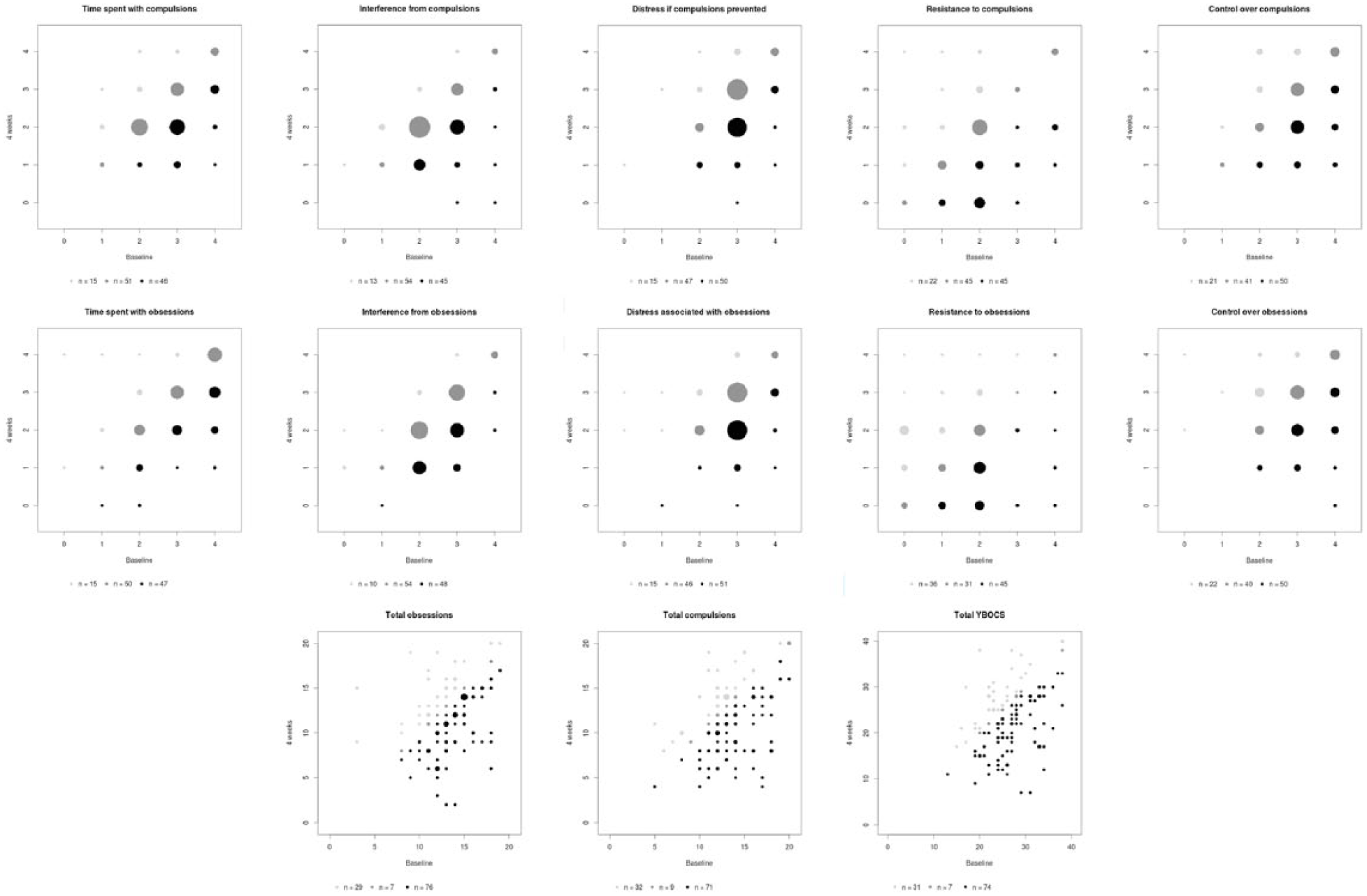
Distribution of Yale-Brown Obsessive-Compulsive Scale (Y-BOCS) subscale and total scores at baseline and after four weeks of treatment with fluoxetine. The circle sizes are proportional to the number of individuals. Black circles indicate individuals whose obsessive-compulsive disorder (OCD) symptoms improved; medium grey circles indicate those whose OCD symptoms severity did not change; and light grey circles indicate those who experienced worsening of OCD symptoms.
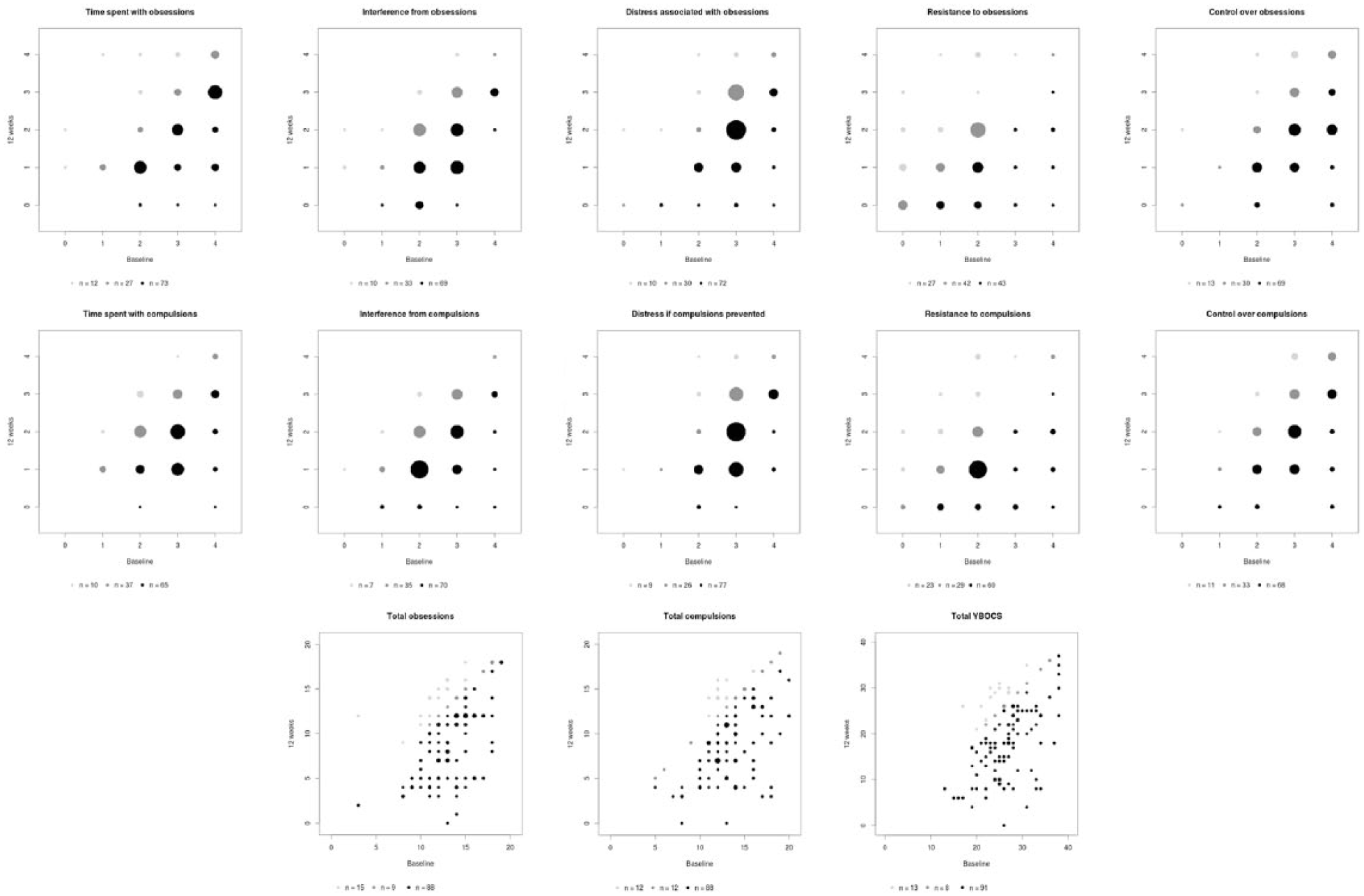
Distribution of Yale-Brown Obsessive-Compulsive Scale (Y-BOCS) subscale and total scores at baseline and after 12 weeks of treatment with fluoxetine. The circle sizes are proportional to the number of individuals. Black circles indicate individuals whose obsessive-compulsive disorder (OCD) symptoms improved; medium grey circles indicate those whose OCD symptoms severity did not change; and light grey circles indicate those who experienced worsening of OCD symptoms.
Pearson’s correlation was used in order to test the association among the improvement indices for each item score, the score for the obsessions subscale (items 1–5), the score for the compulsions subscale (items 6–10) and the total Y-BOCS score (items 1–10). The confidence intervals for Pearson’s correlation coefficients were calculated as suggested by Bonett (Bonett, 2002; Bonett and Price, 2002). Items were ranked according to their correlation coefficients regarding obsessions, compulsions, and Y-BOCS. Higher coefficients indicate the items that are more strongly associated with the improvement in obsessions, compulsions, and Y-BOCS total. A correlation coefficient threshold of 0.7 was set in order to determine which items contributed significantly to reducing the scores for obsessions and compulsions at four and 12 weeks of treatment. Given that distress and control items correlated significantly with the scores for obsessions and compulsions (coefficients >0.7) at four weeks, correlations between the improvement indices for those items were also calculated.
We performed confirmatory analyses by building the Bayes estimates of the population proportions of improvement in each item. Differently from the previous analyses considering indices of improvement, these confirmatory analyses did not account for the magnitude of the improvement for each item. Higher estimates of population proportions of improvement indicate the items that are more likely to indicate symptomatic improvement. Bayes estimates are described in detail in the Supplementary Material, Appendix 2.
Results
The main demographic and clinical features of the individuals included in the study are described in Table 1.
Socio-demographic and clinical characteristics of obsessive-compulsive disorder (OCD) patients evaluated after four and 12 weeks of treatment with fluoxetine.
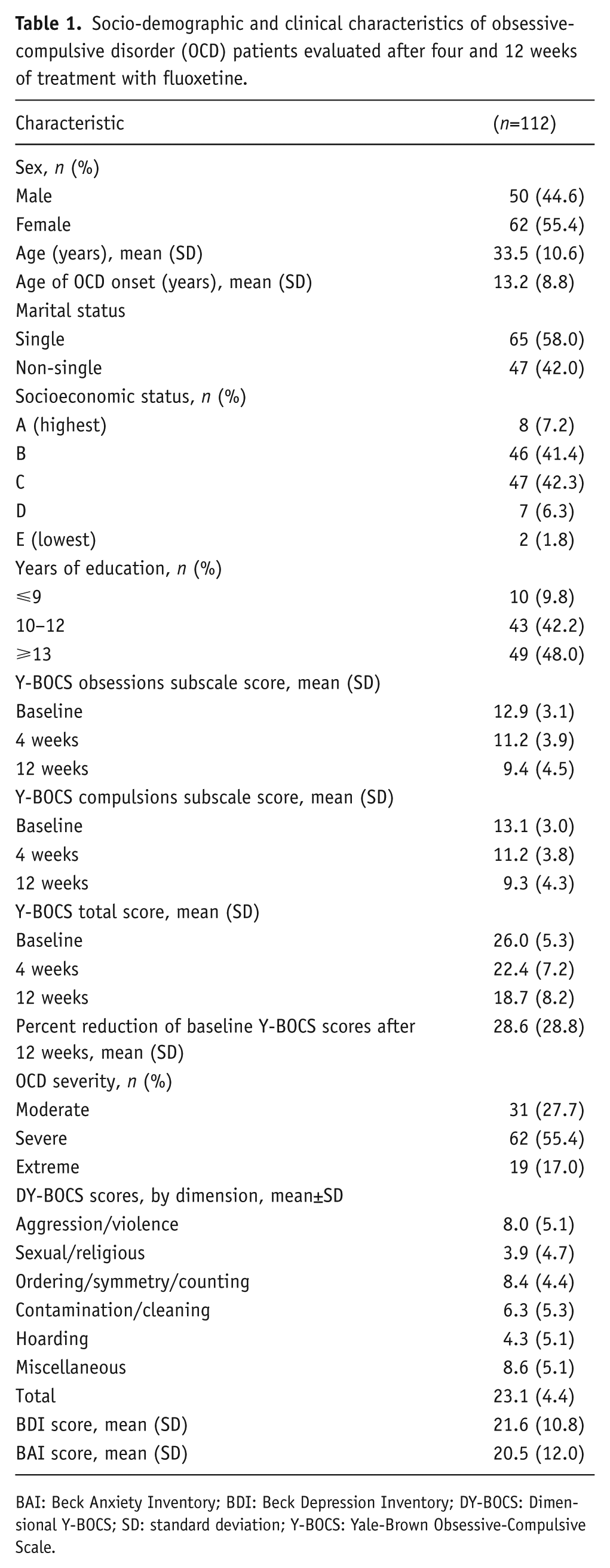
BAI: Beck Anxiety Inventory; BDI: Beck Depression Inventory; DY-BOCS: Dimensional Y-BOCS; SD: standard deviation; Y-BOCS: Yale-Brown Obsessive-Compulsive Scale.
In the graphic representations of the Y-BOCS item score frequencies at week 4 (Figure 1), it is possible to observe that most of the subjects showed identical pre- and post-treatment scores (no improvement) or post-treatment scores that were only one unit below their pre-treatment scores (slight improvement). As expected, the frequency of subjects with item scores below the line of no change was higher at week 12 (Figure 2) than at week 4 (Figure 1), as was that of subjects with item scores on the lines representing >1 point of improvement. For all items, we observed that extreme values were less frequent than were intermediate values. Items 1, 3 and 8 were the most consistent in terms of the response to treatment at week 12 (Figure 2).
Improvement indices correlations
Correlation coefficients and confidence intervals for the improvement indices are presented in Table 2.
Correlation coefficients a for the improvement indices for the Yale-Brown Obsessive-Compulsive Scale (Y-BOCS) items, in relation to the Y-BOCS subscale and total scores, comparing baseline scores with those obtained at four and 12 weeks after the initiation of treatment with fluoxetine.
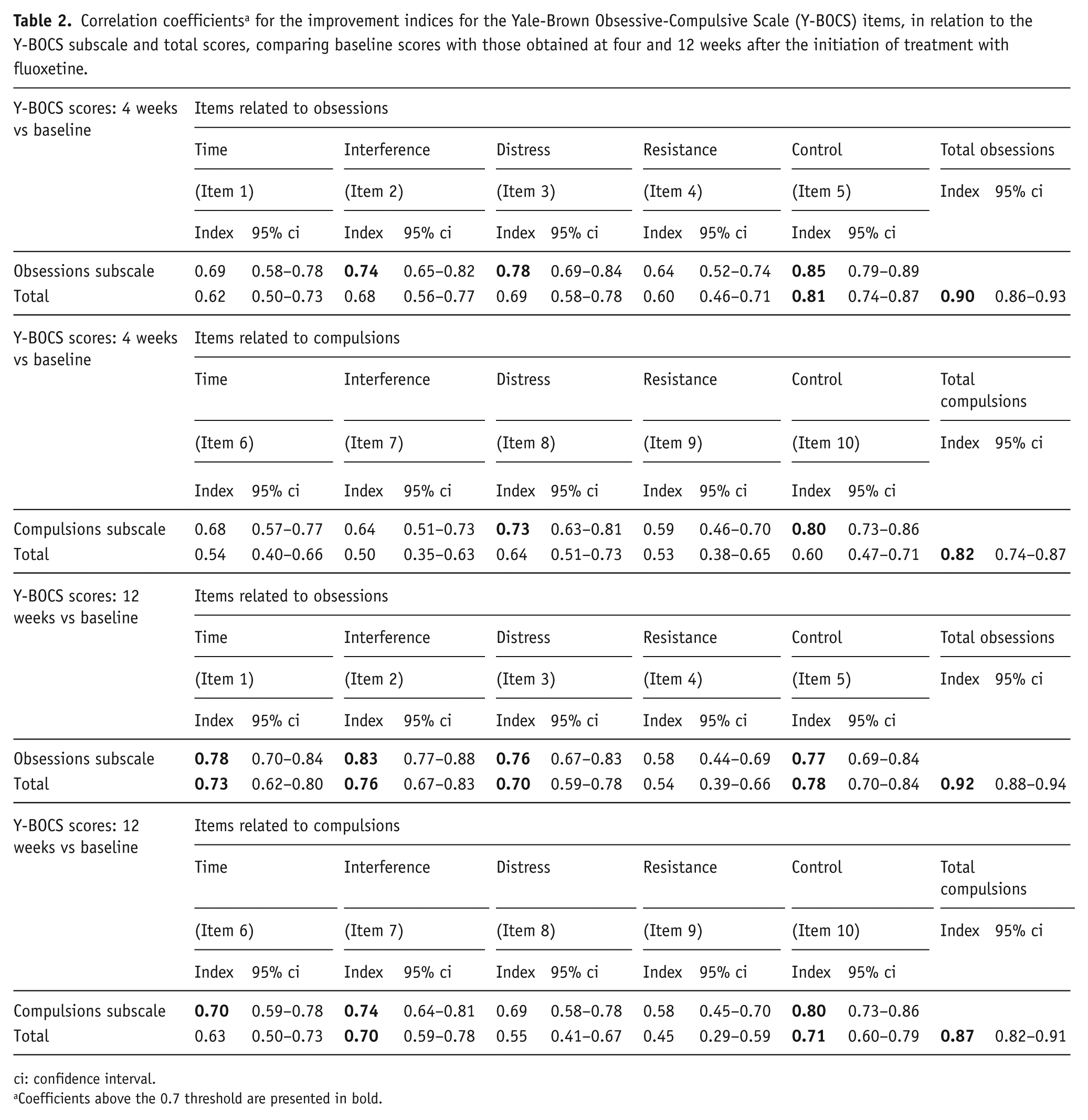
ci: confidence interval.
Coefficients above the 0.7 threshold are presented in bold.
Time spent on obsessions/compulsions
Regarding the difference between baseline and week 4 measures, the correlation coefficient for Y-BOCS item 1 (time spent on obsessions) did not reach threshold of 0.7, neither for the reduction in the obsessions subscale score nor for the reduction in the total score. At week 12, that trend was reverted, item 1 showing a correlation coefficient >0.7 for the reduction in the obsessions subscale score and for the total score. Similarly, the correlation coefficient for Y-BOCS item 6 (time spent on compulsions) did not reach the threshold of 0.7 for the reduction in the compulsions subscale score or total score at week 4. At week 12, this trend was partially reverted, item 6 showing a correlation coefficient >0.7 for the reduction in the compulsions subscale score but not for the reduction in the total score.
Interference
At week 4, the correlation coefficient for Y-BOCS item 2 (interference from obsessions) was >0.7 for a reduction in the obsessions subscale score but not for a reduction in the total score. At week 12, the correlation coefficient for item 2 was even better for a reduction in the obsessions subscale score and reached the 0.7 threshold for a reduction in the total score, whereas that for item 7 (interference from compulsions) was lower than was that for item 2 regarding the subscale and total scores but followed a similar pattern of better performance at week 12 than at week 4.
Distress
Regarding the difference between baseline and week 4, the correlation coefficients for Y-BOCS items 3 and 8 (distress if compulsions are prevented and distress associated with obsessions) both reached the 0.7 threshold for reductions in the obsessions and compulsions subscale scores. However, contrary to our expectations, the correlation coefficients for items 3 and 8 did not reach the 0.7 threshold for a reduction in the total score. At week 12, the correlation coefficients for item 3 were >0.7 for reductions in the obsessions subscale and total scores, whereas those for item 8 were <0.7 for reductions in the compulsions subscale and total scores, the distress items being outperformed by the time, interference and control items.
Resistance
The correlation coefficients for Y-BOCS item 4 (resistance to obsessions) did not reach the 0.7 threshold at either of the evaluated timeframes. The same was true for item 9 (resistance to compulsions). In fact, these two items had the lowest coefficients at both timeframes.
Control
At week 4, the correlation coefficients were higher for the Y-BOCS control items than for any of the other items, indicating a significant contribution to the reductions in the obsessions and compulsions subscale scores. At week 12, control over compulsions had the best performance regarding the reduction in the compulsions subscale score. At week 12, the correlation coefficient for control over obsessions was above the 0.7 threshold for the obsessions subscale score but was outperformed by items related to time spent on obsessions and interference from obsessions.
Interdependence of distress and control
The scatter plot showing the dependence between the improvement indices for distress and control items is depicted in Figure 3. Distress and control items had correlation coefficients of 0.6 for improvements in obsessions and compulsions at four weeks of treatment.
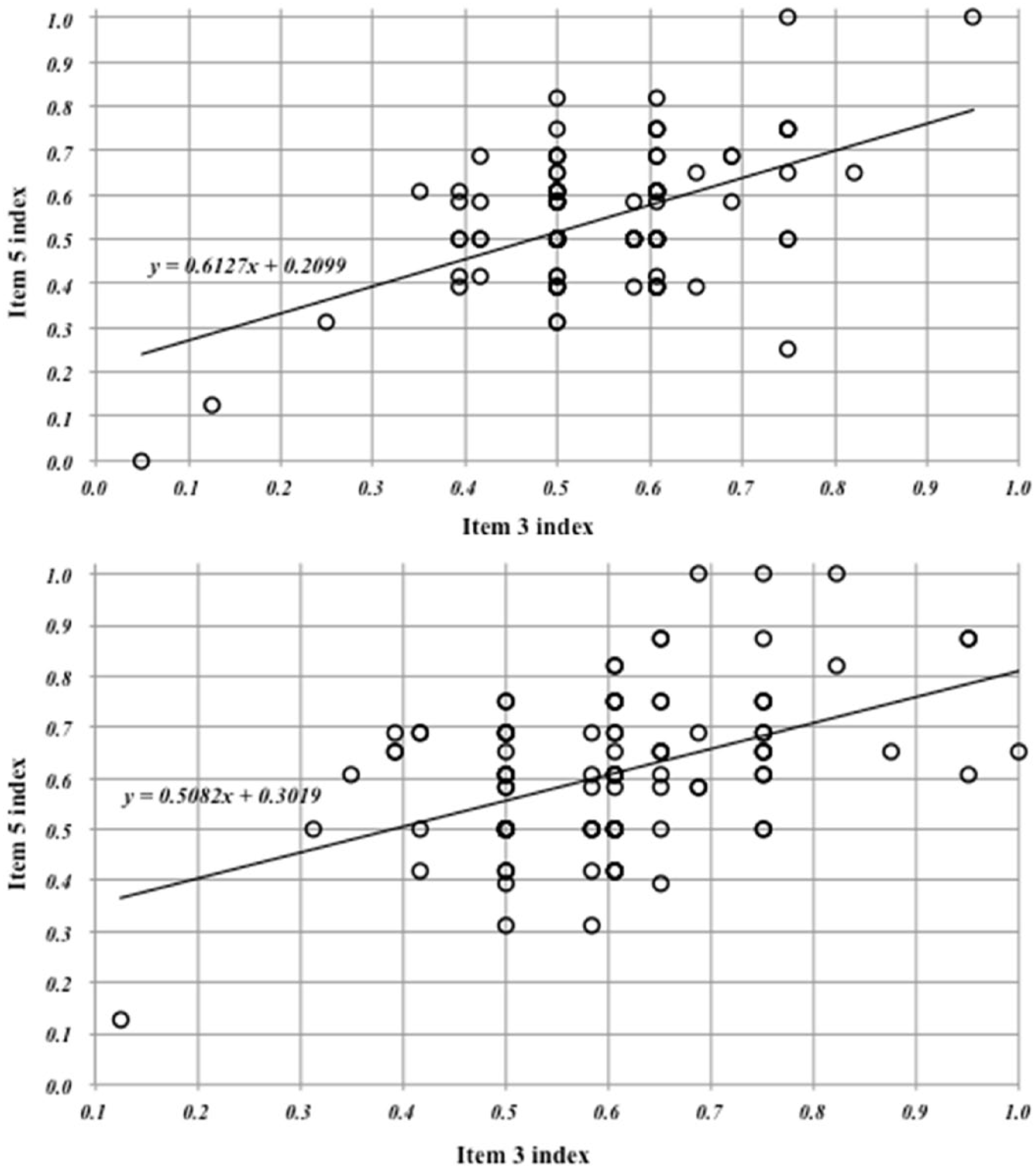
Scatterplots depicting improvement indices for Yale-Brown Obsessive-Compulsive Scale (Y-BOCS) items 3 (distress associated with obsessions) and 5 (control over obsessions) after four and 12 weeks of treatment with fluoxetine (upper and lower panels, respectively).
Population proportion estimates intervals
Bayes estimates of the population proportion of improvement of each item are shown in Table 3. With the exception of resistance to obsessions, all items were associated with a higher estimated population proportion of improvement at week 12 than at week 4. Similarly to the analyses using correlation coefficients, distress and control items showed the highest estimates of improvement at week 4. At week 12, for improvement in obsessions, time outperformed distress and control, whereas, for improvement in compulsions, distress retained the highest estimate of improvement, followed by interference and control.
Estimates of population proportions of worsening, no change and improvement, in the study sample, for the various Yale-Brown Obsessive-Compulsive Scale (Y-BOCS) item scores.
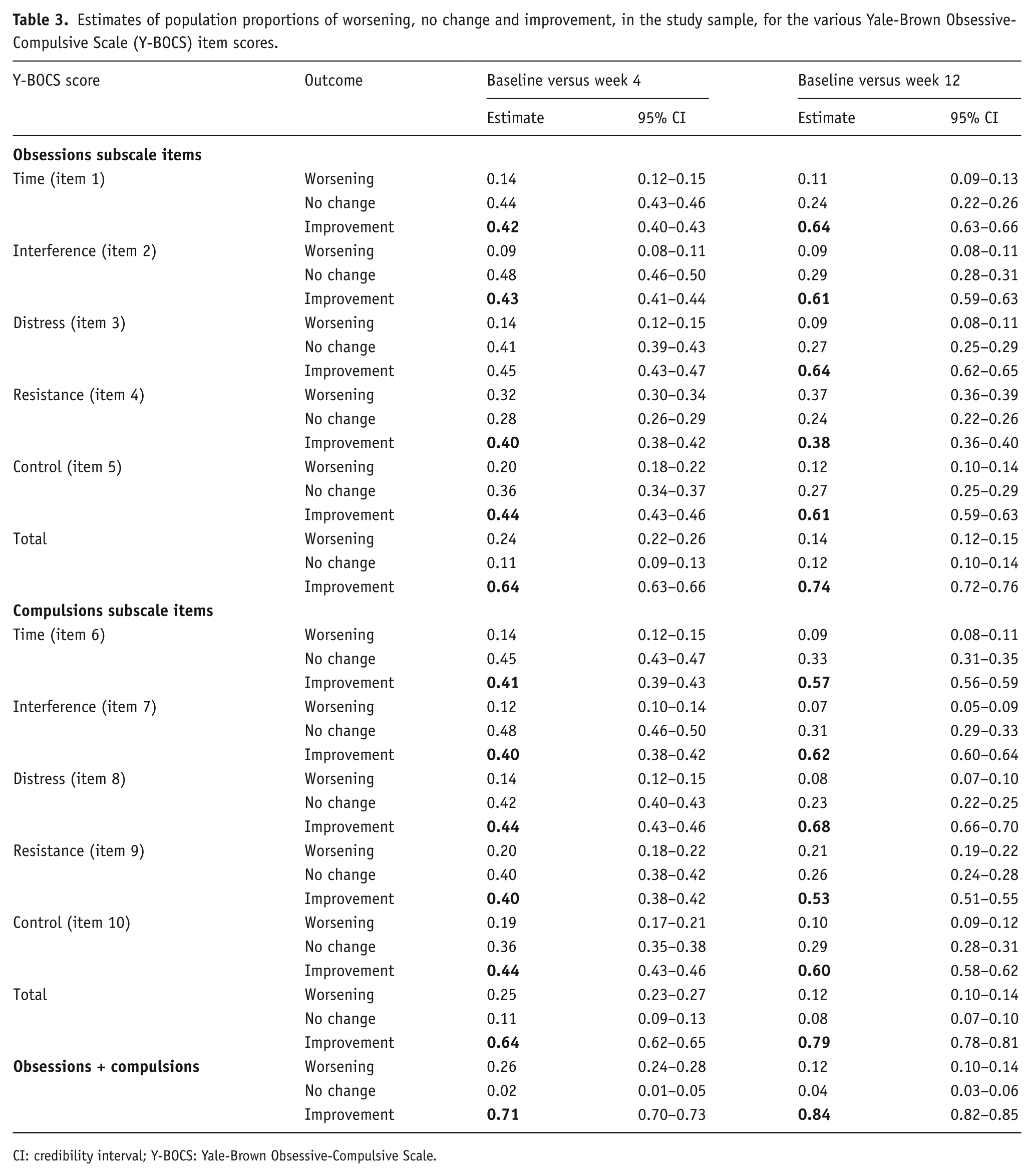
CI: credibility interval; Y-BOCS: Yale-Brown Obsessive-Compulsive Scale.
Discussion
Overview
To our knowledge, this is the first study to examine which Y-BOCS items most contribute to variations in the partial and total scores observed at two different time-points after the initiation of pharmacological treatment in a sample of OCD patients. Corroborating our initial hypothesis, distress items were highly correlated with obsessions and compulsions improvement during the initial four weeks of treatment with fluoxetine. On the other hand, control items showed an even higher correlation than distress with improvement after four weeks. As expected, distress items lost space for time spent on obsessions and compulsions and interference related to obsessions and compulsions at week 12. Resistance items were the worst performing items at all time points.
Time spent on obsessions/compulsions
On the obsessions and compulsions subscales, the Y-BOCS time (spent) items offer the following answer choices: none; less than 1 h per day; 1–3 h per day; 3–8 h per day; and more than 8 h per day. For obsessions, interviewers have to rely on the ability of the patients to discern between obsessions, regular everyday-life worries and frequent non-anxiety-provoking thoughts.
In the second edition of the Y-BOCS (Storch et al., 2010a,b), behavioral avoidance of situations that could trigger compulsions was integrated into the scoring of the severity scale items. According to this version, for compulsions, patients are instructed to compute not only the time spent on rituals and compulsions but also the time spent on avoidance. In the present study, we used the first edition of the scale, and it is therefore likely that avoidance is underrepresented in our results.
In the factor analyses of the Y-BOCS items, time spent on either obsessions or compulsions was always classified under the umbrella of symptom severity (Deacon and Abramowitz, 2005). Our results highlight the fact that the time spent on obsessions can have less influence on improvement in the early stages of treatment than does distress related to obsessions and control over obsessions/compulsions. That delay may be related to the improvement pathway that patients may have to navigate along treatment. Time spent on compulsions could take even longer to improve, as this item did not recover as well as did time spent on obsessions at week 12. From a clinical standpoint, these results suggest that we cannot expect much reduction in the perception of patients regarding the time spent on symptoms in the 12-week timeframe and that, earlier in treatment, distress and control might be better markers of the effectiveness of a given intervention. At this point, it is difficult to predict whether including the time spent avoiding symptoms (using a later version of the Y-BOCS scale) would alter these results.
Interference
The Y-BOCS items that quantify interference require the patient to determine the extent to which OCD symptoms impair their social, school, work and family activities. Factor analysis has shown that these items correlate strongly with severity measures (Deacon and Abramowitz, 2005). The impairment caused by OCD symptoms can take years to develop and considerable time to retreat. Our results highlight the importance of long-term follow-up in order to convert symptomatic improvements into functional gains.
Distress
To evaluate distress, we required patients to report how much anxiety or anguish they feel when experiencing obsessions or when compulsions are prevented. We expected the Y-BOCS distress items to be the most informative regarding the response to pharmacological treatment. Our hypothesis was that the effects of medication would be directed at the reduction of distress and that behavioral improvement would follow, not as an effect of medication, but rather as an effect of incidental exposure facilitated by the amelioration of distress.
Although we confirmed the importance of distress as a measure of symptomatic improvement at week 4, we had not foreseen the importance of questioning how much control patients felt they had over obsessions and compulsions as a measure of symptomatic improvement so early in the pharmacological treatment timeframe. In addition, the poor performance of the resistance items shows that control over symptoms improve despite a lack of gains in resistance. How could patients improve their control over symptoms if they did not try to resist more than usual? The explanation might be that resistance items showed the lowest scores at baseline. That means that even at baseline patients had already tried to resist obsessions and compulsions. Therefore, the benefit they gained from treatment was that their resistance became more successful. In that context, the improvement in distress might in fact be a mediator of this effect. In other words, when the level of distress is reduced, patients attempting to resist symptoms feel more in control and are better at avoiding obsessions or preventing compulsions.
Resistance
Two different factor analyses have found that resistance items do not segregate along with other Y-BOCS items and do not correlate well with measures of severity (Kim et al., 1994; Moritz et al., 2002). Corroborating those findings, we found that resistance items showed less variation than did the other Y-BOCS items, in terms of the obsessions subscale, compulsions subscale, and total scores, at both of the evaluated timeframes.
The Y-BOCS item “resistance to obsessions” has always generated some controversy among OCD experts. Individuals with OCD who always make an effort to resist as well as those who do not need to resist their obsessions receive a lower (i.e. better) score than do those who willingly yield to the unwanted thoughts. This is in striking contrast with techniques used in treating OCD such as cognitive therapy and ERP.
In cognitive therapy, patients are taught that thoughts are uncontrollable. A common example is the exercise used by therapists known as the white elephant. The therapist instructs the patient “not to think about a white elephant for the following 60 seconds” and then argues how difficult it is to control a thought when you try “not to think” about something specific or, in other words, how difficult it is to “resist obsessions” when you are making an effort “not to think”. The therapist then suggests other techniques for dealing with obsessions, such as cognitive reappraisal, which describes the process of “rethinking” once the obsession appears rather than “not thinking” or “resisting” an obsession (Emmelkamp and Beens, 1991; van Oppen and Arntz, 1994; van Oppen et al., 1995).
In ERP, therapists purposefully generate anxiety-provoking situations, either in reality or using imagination and visualization (Foa, 2010). In this treatment approach, OCD patients who are able to prevent responding to (ritualizing) the anxiety generated by obsessions will gradually improve through the process of habituation. For habituation to occur, patients have to stop resisting obsessions and just let the thoughts fluctuate with no further interference. The hypothesis that underlies ERP is that, once resistance and ritualization have been abolished, the aversive responses linked to obsessions will diminish and eventually disappear. Consequently, the thought will become unimportant even though it may still arise from time to time.
As a consequence of cognitive therapy and ERP, patients undergoing CBT might report not trying to resist obsessions because they were instructed not to resist, which can be unrelated to the severity of obsessions per se. The patients in our study were under exclusive pharmacological treatment and had not received any direct instruction not to resist obsessions.
Control
Control items require patients to evaluate how often they are able to control and distract themselves from obsessions or to prevent performing compulsive behaviors. In contrast with resistance items, control items were classified as being related to symptom severity in a previous factor analysis.
The Y-BOCS control and distress items both showed significant correlations with the obsessions and compulsions subscale scores (correlation coefficient>0.7 for all). The correlation between control items and distress items was significant, albeit low (correlation coefficient=0.6). This finding partially contradicts our initial hypothesis that distress has to be low for control to improve. At least some of the patients reported better control over symptoms despite not being aware of significant improvements in distress.
With regard to the biological mechanisms for the observed results, it seems relevant to evoke serotonin as an important neurotransmitter with multiple functions in the peripheral and central nervous systems. Its synthesis in the central nervous system is restricted to a very limited number of cells in the brainstem raphe nuclei with a vast axonal network (Alenina et al., 2006). Neuroimaging studies (Saxena and Rauch, 2000) have provided in vivo evidence of disturbed cortical-basal ganglia-thalamic-cortical brain circuits in OCD. These network imbalances might be connected to or influenced by monoaminergic cortical-striatal, midbrain-basal ganglia, or midbrain-thalamus projections, which consist of serotonergic fibers (Heinz, 1999; Hesse et al., 2005; Micallef and Blin, 2001). The exact mechanisms of action by which SSRIs ameliorate OCD symptoms remain unknown. Animal studies have indicated that prolonged SSRI treatment results in enhanced serotonin release in the orbitofrontal cortex (el Mansari et al., 1995). This alteration could be attributed to desensitization of the terminal serotonin auto-receptor in that particular brain region (Blier and de Montigny, 1998). Greater inhibition of serotonin reuptake, produced by higher doses of SSRIs, also appears essential to obtain these modifications in the function of serotonin terminals (Bergqvist et al., 1999). However, the decreased OCD symptom severity observed in patients receiving pharmacological treatment can be attributed not only to the SSRI effect but also to a range of factors, including placebo effects, and effects that are not dependent on receiving treatment (Ernst and Resch, 1995). The latter comprise the natural course and variation in the disease, regression toward the mean, other time-dependent effects, and unidentified parallel interventions (McQueen et al., 2013).
The importance of the Y-BOCS items designed to quantify control observed after four weeks of pharmacological treatment might not be the direct result of medication, but rather a reflection of the degree to which patients are engaged with treatment. In a previous trial conducted by our group, we found that improvement reported after four weeks of treatment was predictive of the overall response at week 12, with moderate to high sensitivity and specificity (da Conceição Costa et al., 2013). On the basis of the results of the present study, we can speculate that such an early response is related to patient motivation. If that is indeed the case, the motivation evidenced by greater efforts to control OCD symptoms at week 4 might play an important role in improvement after 12 weeks regardless of drug-effects. Nevertheless, these hypotheses are still quite speculative and further investigation is warranted.
Limitations
Our study was not originally designed to investigate the behavior of Y-BOCS items scores over the course of treatment, which guaranteed that the evaluators were unaware of the study hypothesis when collecting data. On the other hand, it might have resulted in certain methodological limitations that can be overcome in future trials designed specifically for this purpose.
The main limitation of this study is that the original trial lacked a placebo arm and additional control measures of improvement. In a double-blind placebo-controlled trial we could have disentangled drug effects from placebo effects and normal fluctuation. In addition, shorter intervals between evaluations and additional control measures of symptomatic improvement could have provided more consistent information on the score reductions for each item over the course of treatment. Furthermore, the 12-week treatment duration was too short to evaluate the long-term maintenance of the improvement obtained with medication. Further studies, with a higher number of repeated Y-BOCS assessments over longer periods of follow-up, are warranted in order to confirm our findings. Despite these limitations, our results provide an informative picture of the routes to improvement in OCD treatment.
Conclusion
There seems to be a pathway to improvement along which patients have to navigate during treatment. The use of fluoxetine led first to reductions in distress and increases in control over symptoms before affecting the time spent on and interference from obsessions and compulsions. Resistance did not correlate with overall improvement and continues to be the most controversial items of the Y-BOCS.
Footnotes
Acknowledgements
The authors wish to thank Sonia Borcato and Marinês Joaquim for their participation in the data collection.
Declaration of conflicting interests
The author(s) disclosed receipt of the following financial support for the research, authorship, and/or publication of this article.
Funding
The author(s) disclosed receipt of the following financial support for the research, authorship, and/or publication of this article: This study received financial support in the form of grant and scholarship from the Fundação de Amparo à Pesquisa do Estado de São Paulo (FAPESP, Foundation for Research Support in the State of São Paulo), a Brazilian governmental funding agency. Grant numbers: 2011/51485-9 and 2012/14070-8. FAPESP had no role in the design, analysis, interpretation, or publication of this study.
References
Supplementary Material
Please find the following supplemental material available below.
For Open Access articles published under a Creative Commons License, all supplemental material carries the same license as the article it is associated with.
For non-Open Access articles published, all supplemental material carries a non-exclusive license, and permission requests for re-use of supplemental material or any part of supplemental material shall be sent directly to the copyright owner as specified in the copyright notice associated with the article.
