







Abstract
Background:
The use of herbal extracts and supplements to enhance health and wellbeing is increasing in western society.
Aims:
This study investigated the impact of the acute ingestion of a commercially available water containing an extract and hydrolat of rosemary (Rosmarinus officinalis L. syn. Salvia rosmarinus Schleid.). Aspects of cognitive functioning, mood and cerebrovascular response measured by near-infrared spectroscopy provided the dependent variables.
Methods:
Eighty healthy adults were randomly allocated to consume either 250 mL of rosemary water or plain mineral water. They then completed a series of computerised cognitive tasks, followed by subjective measures of alertness and fatigue. Near-infrared spectroscopy monitored levels of total, oxygenated and deoxygenated haemoglobin at baseline and throughout the cognitive testing procedure.
Results:
Analysis of the data revealed a number of statistically significant, small, beneficial effects of rosemary water on cognition, consistent with those found previously for the inhalation of the aroma of rosemary essential oil. Of particular interest here are the cerebrovascular effects noted for deoxygenated haemoglobin levels during cognitive task performance that were significantly higher in the rosemary water condition. This represents a novel finding in this area, and may indicate a facilitation of oxygen extraction at times of cognitive demand.
Conclusion:
Taken together the data suggest potential beneficial properties of acute consumption of rosemary water. The findings are discussed in terms of putative metabolic and cholinergic mechanisms.
Introduction
Interest in orally administered herbal extracts and supplements as life-quality enhancers, potential medical treatments and preventative interventions continues to grow in western society (Bardia et al., 2007, Braun and Cohen, 2015). The body of research into the efficacy of such extracts continues to grow but is still outstripped by the increase in products available. With regard to the potential to impact positively on human cognition a number of plants have received particular attention. Sage (Salvia) species effects have been considered in a range of population groups. Scholey and colleagues (Scholey et al., 2008) describe benefits for memory and attention in the healthy elderly following acute Salvia officinalis extract supplementation. Similar beneficial effects have been reported for healthy young participants when completing a multi-tasking framework (Kennedy et al., 2006). Spanish sage (Salvia lavandulaefolia) has also been assessed and found to deliver enhancements in young volunteers (Tildesley et al., 2003; Tildesley et al., 2005). The researchers proposed that the observed effects for Salvia species are the consequence of cholinesterase inhibition delivered by the extract and assessed in vitro (Kennedy et al., 2006). In a similar vein, the potentially beneficial effects of huperzine A as a treatment for dementia have been attributed to an impact on the cholinergic system (Xu et al., 1995, Zhang et al., 1991). Gingko biloba has also been widely researched in both healthy young (Kennedy et al., 2002) and older populations (Ossoukhova et al., 2015), and also as a potential treatment for dementia (Ernst and Pittler, 1999, Weinmann et al., 2010). The positive effects recorded have been attributed to one or more of the anti-ischaemic, anti-oedemic, anti-hypoxic, radical-scavenging and metabolic actions of the plant that have been evidenced in a range of models (Ernst and Pittler, 1999). Other relatively well researched plants with cognitive enhancing properties include Bacopa monnieri (Calabrese et al., 2008; Pase et al., 2012; Stough et al., 2001), and Nigella sativa (Hosseini et al., 2015; Sayeed et al., 2013; Sayeed et al., 2014) with general indications of cholinergic and antioxidant properties.
Rosemary (Rosmarinus officinalis) contains a number of active phenolics and terpenes identified in sage and this makes it an interesting candidate for investigation (see Wang et al. (2008) and Gachkar et al. (2007) for comprehensive constituent analyses). The herb has held a prominent place in folklore and culture in a number of countries and, in many respects, continues to do so. Students in ancient Greece reportedly wore a garland of rosemary around their heads when being examined as they believed it enhanced memory, and the practice of burning the herb during examination preparation continues today (Tapsell et al., 2006). In the UK, Nicholas Culpepper described rosemary as ‘an admirable cure-all remedy of all kinds of cold, loss of memory, headache, coma’ in his book Complete Herbal (1826), whilst Shakespeare made reference to the association between rosemary and memory in his play Hamlet, where Ophelia states ‘There’s rosemary, that’s for remembrance’ (Act 4, scene V). Given its historical reputation, a surprisingly limited amount of scientific psychological research has focused on rosemary. A small number of studies have reported the beneficial effects of acute exposure to the aroma of the essential oil of rosemary. Moss and colleagues found improvements in long term memory (Moss et al., 2003), and Moss and Oliver (2012) correlated improved performance on serial subtraction tasks with plasma levels of 1,8-cineole following exposure to rosemary aroma. Based on the in vitro demonstration of cholinergic activity of 1,8 cineole (Orhan et al., 2008), coupled with the fact that it readily crosses the blood-brain barrier (Boyle et al., 2005), Moss and Oliver suggest this finding supports a pharmacological mechanism behind the cognitive effects observed, in line with that proposed for sage. This proposal is further supported by a scopolamine challenge study in rats where reversal of memory impairments was observed alongside inhibition of acetylcholinesterase in the rats brain following exposure to rosemary (Ozarowski et al., 2013).
A number of studies have investigated the potential for rosemary extracts and constituent compounds to deliver anti-amyloid (Hamaguchi et al., 2009), neuroprotective (Kayashima and Matsubara, 2012) and antidepressant effects (Sasaki et al., 2013) via antioxidant and monoaminergic neurotransmitter activity. However, only two human trials of orally administered extracts of rosemary on human cognition are available to the knowledge of all the authors. A small study comparing 1600 mg of dried herb to placebo identified medium-sized effects in favour of the rosemary group for measures of spatial and working memory, combined with a medium-sized impairment effect for accuracy of attention (Laybourne et al., 2003). More recently, Pengelly and colleagues investigated the possible differential impact of a range of doses of rosemary on a number of cognitive measures in a sample of elderly participants in a balanced cross-over design study (Pengelly et al., 2012). Interestingly, although the 750 mg dose improved performance on the speed of memory processing, the highest dose (6000 mg) led to a decline in performance. Such an ‘inverted U’ shaped curve is characteristic of pharmacological cognitive enhancers (Husain and Mehta, 2011; Parsons and Gold, 1992; Vijayraghavan et al., 2007). An animal study demonstrated that orally administered 1,8-cineole is readily absorbed into the blood (Boyle et al., 2005), and it is plausible that the effects observed for oral rosemary administration may be ascribed to such absorption.
When considering potential mechanisms that underpin the enhancement of cognition, in addition to neurotransmitter systems a number of recent studies have investigated the potential for herbal extracts and constituents to impact on cerebral blood flow (CBF). The continuing development of near-infrared spectroscopy (NIRS) permits real-time measurement during concurrent cognitive assessment, and may offer insights into how any observed effects may be mediated (Cui et al., 2011; Kennedy et al., 2016; Shin et al., 2018). Although no published studies to date report the impact of rosemary on such NIRS measures, previous work has assessed the effect of 1,8-cineole on CBF. The results indicate increased global CBF following inhalation of 1,8-cineole and this is inferred as representing greater cortical activation, (Nasel et al., 1994). Evidence from animal studies further suggests that 1,8-cineole significantly increases nitric oxide concentrations (Moon et al., 2014), and this may underpin any changes in CBF observed by Nasel and colleagues (Webb et al., 2008). Given the brain’s dependence on adequate delivery of glucose and oxygen to maintain metabolism at required levels, and the observation that reduced CBF is associated with a decline in cognitive performance (Beishon et al., 2017; Leeuwis et al., 2017), it is possible that enhancement of CBF parameters might facilitate performance on tasks at times of high demand (Paulson et al., 2010).
Recent years have seen a substantial increase in demand for herbal functional drinks (Shaw and Charters, 2016) and many have appeared on the shelves of supermarkets and health food stores around the world. Often the marketing alludes to, but does not specifically state, claims around the beneficial impact these products might have on aspects of health and wellbeing. A number of rosemary extract products are available from a range of suppliers, and the details provided regarding the constituents vary considerably. The current study evaluates the acute ingestion of No1 Rosemary Water ‘shot strength’ on a number of cognitive and subjective measures that have previously been shown to be sensitive to the aroma of rosemary and oral administration of rosemary and other herbs as outlined above. In addition, aspects of cerebro-vascular activity are included to further investigate possible mechanisms behind any observed effects.
Method
Design
A single factor independent groups design was employed. The independent variable had two levels: the ingestion of a 250 mL rosemary water or 250 mL of plain water, with participants randomly allocated to condition. The dependent variables were self-reported subjective state, cognitive performance and levels of oxygenated, deoxygenated and total haemoglobin. For the latter levels, a repeated measures factor ‘epoch’ was employed to break the data down into equal sections that permitted comparison of the two conditions across the phases of the study for these variables as previously reported (Kennedy et al., 2010).
Sample size calculation
G*Power was used to calculate the required sample size for a global multivariate analysis of variance (MANOVA) effect with two groups and 21 outcome variables for a study with an alpha level set at 0.05, power of 0.8 and effect size f2=0.3. This produced an indicative sample size of 90 participants. In order to achieve significance for Holm-Bonferroni corrected tests for each dependent variable a sample size estimated at over 1000 would be required. Given that this was unfeasible but that all dependent variables were of interest, the approach of a global MANOVA test for significance followed by evaluation of effect sizes for individual dependent variables was adopted, with nominal levels of significance presented for information only. Such an approach is in line with American Psychological Association guidelines which indicate that when examining effects using small sample sizes, significance testing can be misleading (Wilkinson 1999).
Participants
Eighty healthy young adults were each paid £10 to compensate for their time to take part in the study. The rosemary water group consisted of 23 females (mean age=22.9 years, standard deviation (SD)=2.9) and 17 males (mean age=23.4 years, SD=5.0). The plain water group consisted of 28 females (mean age=22.5 years, SD=4.2) and 12 males (mean age=23.9 years, SD=4.7). All participants completed a standard health screen questionnaire and none were excluded on the basis of their responses.
Materials
Treatment
‘Shot strength’ rosemary water was supplied in 250 mL bottles by No1 Rosemary Water Ltd (Chelsea, London, UK). The water contains a hydrolat containing volatile compounds produced by steam distillation, and an extract containing botanical soluble compounds infused into the solvent (water and ethanol) of fresh rosemary sourced from Campania, Italy. No other ingredients are added to the product. Production and analysis of the batch hydrolat and extract used in the production of the treatments employed here was undertaken by Blue Sky Botanics (Upton Bishop, Ross-on-Wye, UK). The two elements have different constituent profiles with the extract containing number of terpenes predominantly 1,8-cineole (0.025 mg/mL), and also rosmarinic acid (0.13 mg/mL). The hydrolat contains substantially lower levels of terpenes including 1,8-cineole (0.012 mg/mL), no rosmarinic acid, but quinic acid and glucosamine-like compounds are detectable. The NIST 17 mass spectral library database (Scientific Instrument Services, Inc., Ringoes, NJ, USA) suggests glucosamine, however the retention time is shorter than that recorded for glucosamine and this suggests that it is probably a smaller glucosamine derivative molecule. Gas chromatography mass spectrometry (GC-MS) traces are presented in Figure 1(a). High performance liquid chromatography (HPLC) traces are presented in Figure 1(b).
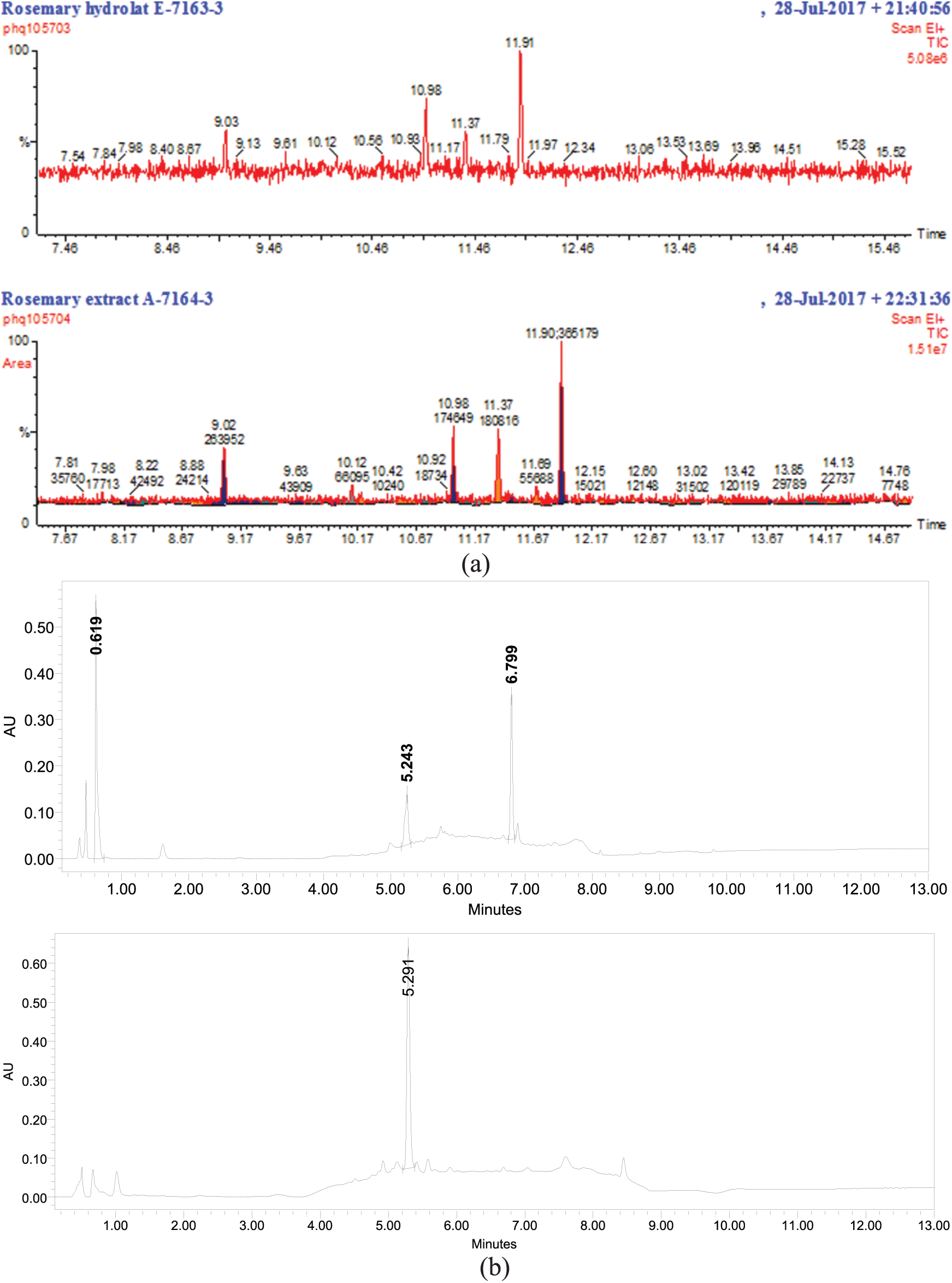
(a) Gas chromatography mass spectrometry (GC-MS) traces of trimethylsilyated samples for both the hydrolat (top) and extract (bottom) used to produce the ‘shot strength’ rosemary water. 1,8-Cineole emerges at 9.03 min, camphor at 10.98 min, isoborneol at 11.37 min and heptanaol at 11.90 min (matched using the National Institute of Standards and Technology (NIST) Spectral Database. (b) High performance liquid chromatography (HPLC) chromatograms of dried samples taken up in acetonitrile water for both the hydrolat (top) and extract (bottom) used to produce the ‘shot strength’ rosemary water. Rosmarinic acid appears at 5.3 min in the extract, and although there is a peak with the correct retention time in the hydrolat the spectrum does not match.
Blinding
Rosemary water has a distinct taste. In an attempt to blind participants as to condition, those allocated to the rosemary water condition were told that a placebo drink with the same taste had been prepared and that the researcher did not know which the participant was being given. Those in the plain water condition were told that the rosemary extract had had the taste components removed such that the rosemary water tasted indistinguishable from standard mineral water and again that the researcher was unaware of the participants’ allocation. The effectiveness of this technique was assessed at the end of testing by asking participants which condition they thought they had been in. The frequencies of correct identification of condition approached but did not quite reach statistical significance (χ2(1)=3.208, p=0.073). The blinding procedure was therefore considered acceptable.
Functional NIRS
Functional NIRS is a non-invasive brain-imaging technique that measures haemodynamic responses to neural activity. Near-infrared light easily passes through the surface brain tissue and its absorption is related to haemoglobin oxygenation status which can be taken as a proxy for neural activation. An increase in cerebral blood flow in the cortex is seen as an increase in the total concentration of haemoglobin and a concomitant decrease in deoxyhaemoglobin (Steinbrink et al., 2006). These changes have been shown to correlate with functional magnetic resonance imaging (MRI) signals of metabolic activity (Ye et al., 2009). NIRS has been employed as a technique for the imaging of task-related brain activity (Schecklmann et al., 2008), and a growing number of pharmacological intervention studies have used the technique to such ends (Kanamaru et al., 2008) drawing from changes in haemoglobin concentrations (Bönöczk et al., 2002). In the current study, relative changes in the absorption of near-infrared light were measured at a time resolution of 10 Hz by using a 12-channel Oxymon system (Artinis Medical Systems BV, Zetten, Netherlands). The emitter/optode pairs were positioned over the left and right frontal cortex by using a standard headband. The system emitted 765 nm and 855 nm wavelengths of light with an emitter/optode separation distance of 4 cm at prefrontal cortex areas corresponding to the Fp1 and Fp2 electroencephalogram positions. Relative concentration changes in oxygenated, deoxygenated, and total haemoglobin were calculated by means of a modified Beer-Lambert law (Obrig and Villringer, 2003) by the system software. All NIRS output data were time-stamped at the beginning of each task to ensure that data corresponded to the relevant epoch of task performance.
Cognitive tasks
All cognitive and mood measures were delivered using the Computerised Mental Performance Assessment System (COMPASS, Northumbria University, Newcastle upon Tyne, UK). COMPASS has been used in a number of herbal and nutritional intervention studies (Kennedy et al., 2010). The tasks were chosen based on their sensitivity to such interventions, in particular targeting aspects of memory and complex information processing that previous research has indicated may be affected by rosemary (Moss et al., 2003, Moss and Oliver, 2012). The cognitive battery lasted 20 min in total and tasks were presented in the following order.
Word presentation
Fifteen words are presented on the screen, one at a time, at the rate of one per second.
Immediate word recall
Participants are given 60 s to orally recall as many words as possible from the list presented.
Corsi blocks
Nine blue squares are presented on a black background. Some of the squares change to red and then back to blue again in a sequence. Participants are required to remember the sequence and use the mouse to click the blocks in the exact sequence in which they changed back to blue. The task is repeated five times with increasing difficulty, starting with four blocks in the sequence, and increasing to nine until the participant fails to correctly recall the sequence. The task was scored as an average of the last three correctly completed trials.
Numeric working memory
Five single digit numbers are presented one at a time on the screen at a rate of one per second. Participants are asked to memorise the numbers as they appear. Once the series is complete, numbers are displayed one at a time and the participants are required to indicate if each of the numbers were presented in the original sequence or not, using buttons on a response pad. Three repetitions constitute the task. Scores are recorded for overall accuracy (percentage) and reaction time (ms).
Serial subtraction of threes and sevens
A random number (between 800–999) is presented on the screen. Participants are required to serially subtract either three or seven (dependent on task) from the starting number until the end of the task. Participants enter their responses using a standard keyboard. Each task lasts two minutes in total, with serial sevens being completed immediately after serial threes. The number of correct responses and errors are recorded.
Rapid Visual Information Processing (RVIP)
A series of single digit numbers are presented on the screen at a rate of 100 per minute. Participants monitor this and press a button whenever three odd or three even numbers appear in a row. The task lasts five minutes in total, with eight correct target strings presented each minute. The task records target strings detected (percentage), and mean reaction time for correct detection (ms).
Delayed word recall
Participants are given 60 s to orally recall as many words as possible from the original list presented.
Alertness and mental fatigue visual analogue scales (VASs)
The scales showed a 100 mm line with ‘Not at all’ and ‘Extremely’ at either end on which participants mark their current subjective evaluation.
Procedure
The study received ethical approval from the Department of Psychology research ethics committee at Northumbria University, Newcastle, UK prior to any data collection. Each participant attended the laboratory once between 09:00–11:00. Participants were asked not to consume any caffeine-containing products on the day of testing, and to eat a light breakfast at least 30 min before attending. On arrival at the laboratory participants were briefed regarding the aims of the study, provided informed consent and were then fitted with the NIRS headband, and the nature of the cognitive tasks explained. Once comfortable, a five-minute seated rest period followed during which baseline NIRS data was gathered, after which participants were given their treatment and asked to drink it all in five minutes. During this time and for next 20 min during the absorption period, the participants sat quietly watching a non-arousing DVD. Participants then completed the cognitive assessments and mood scales. At the end of the assessment the NIRS equipment was removed and the participants were fully debriefed and the nature of their intervention revealed. The testing visit lasted about 60 min in total.
Treatment of NIRS data
The NIRS data were split into seven ‘task’ epochs across the testing period that reflected the mean values for the duration of each task, consistent with previous studies of this kind (e.g. Kennedy et al., 2010). As the time taken to complete the Corsi blocks task depended on the individual participant’s performance, NIRS data from just the first three minutes of the task was analysed as this was the minimum duration of the task. NIRS data for each task were converted to a relative change from baseline (averaged over a five-minute pre-treatment rest period). Since each task epoch of averaged NIRS data was substantially longer than the potential drift that can occur in shorter periods of NIRS recording (Hoshi, 2007), no control for these phenomena was required. Prior to the main analysis, a hemisphere×treatment group×task epoch mixed analysis of variance (ANOVA) was performed to examine any hemispheric differences. As no treatment-related interactions emerged the two channels were averaged across hemispheres.
Results
Multivariate analysis
Individual data results are shown in the Supplementary Material tables. Given the large number of dependent variables in this study, an initial MANOVA was conducted to establish if the rosemary water and placebo treatments differed along a combination of all these variables, whilst protecting against inflated type 1 error due to multiple tests of correlated dependent variables (Tabachnick and Fidell, 2007). Box’s test of homogeneity of covariance matrices produced a significant result M=326.730, F(171,18674.741)=1.441, p<0.001. As a consequence of violation of this assumption, Hotellings T2 is reported as this test is robust to such violations in a two-group situation when sample sizes are equal (Hakstian et al., 1979). The multivariate analysis revealed a clear significant difference between treatments on the combined dependent variables, Hotelling’s trace=0.835, F(20,59)=2.462, p=0.004, partial eta squared=0.455. Given the significance of the multivariate test, the individual dependent variables clearly warrant close inspection.
Between-groups analysis of all dependent variables
Individual cognitive, mood and NIRS dependent variable data were further compared between treatments using one-way ANOVAs for independent groups and the calculation of Cohen’s d effect sizes (Table 1). The following analyses focus on Cohen’s d effect sizes for the evaluation of differences between treatments on the individual dependent variables as the impact of Holm Bonferroni corrections with such a large number of dependent variables renders the initially significant univariate comparisons non-significant. Based on Cohen’s criteria (Cohen, 1992), small to medium-sized beneficial effects, were observed for rosemary water consumption in terms of performance for the Corsi blocks mean span length, serial threes and sevens correct responses, RVIP correct responses and errors, and immediate and delayed word recall. The ‘fatigue’ measure of mood indicates a small negative impact of the intervention to be present.
Means (standard deviations) for the cognitive assessment variables, subjective mood scores and near-infrared spectroscopy (NIRS) data included in the multivariate analysis of variance (MANOVA). Reaction times are in ms. F, Sig and Cohen’s d are derived from the main effect of condition in the analysis of variance (ANOVA).
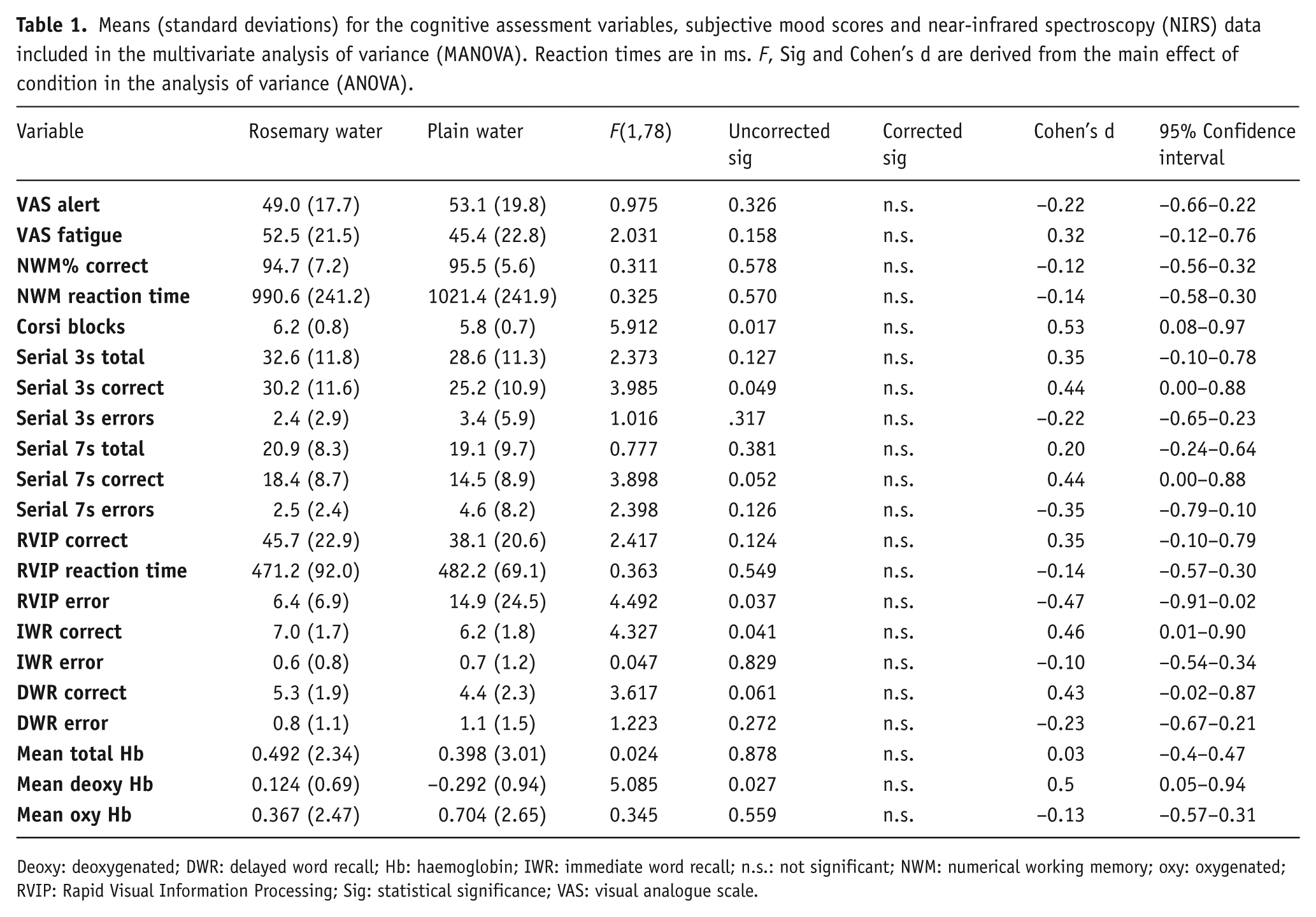
Deoxy: deoxygenated; DWR: delayed word recall; Hb: haemoglobin; IWR: immediate word recall; n.s.: not significant; NWM: numerical working memory; oxy: oxygenated; RVIP: Rapid Visual Information Processing; Sig: statistical significance; VAS: visual analogue scale.
NIRS
In order to gain a finer grained understanding of the possible relationship between treatment, task and near-infrared signalling, the NIRS data were further analysed with mixed ANOVA (treatment group×task epoch) with the multivariate approach favoured for reporting the repeated measures (task epoch) factor due to a significant violation of the assumption of sphericity. Significant main effects of treatment and treatment×epoch interaction were followed up with a priori planned comparisons between the rosemary water group and the plain water group for each epoch.
Total haemoglobin
No significant main effect of treatment was found (F(1,78)=0.024, p=0.878, ηp2=0.000). Means indicate that both groups showed an increase in total haemoglobin compared to baseline (rosemary water=0.567 µmol/L, plain water=0.519 µmol/L). A significant main effect of epoch was apparent (F(6,73)=20.276, p<0.001, ηp2=0.625) with total haemoglobin increasing over the testing period (Figure 2). No significant treatment × task epoch interaction was observed (F(6,73)=1.649, p=0.146, ηp2=0.119).
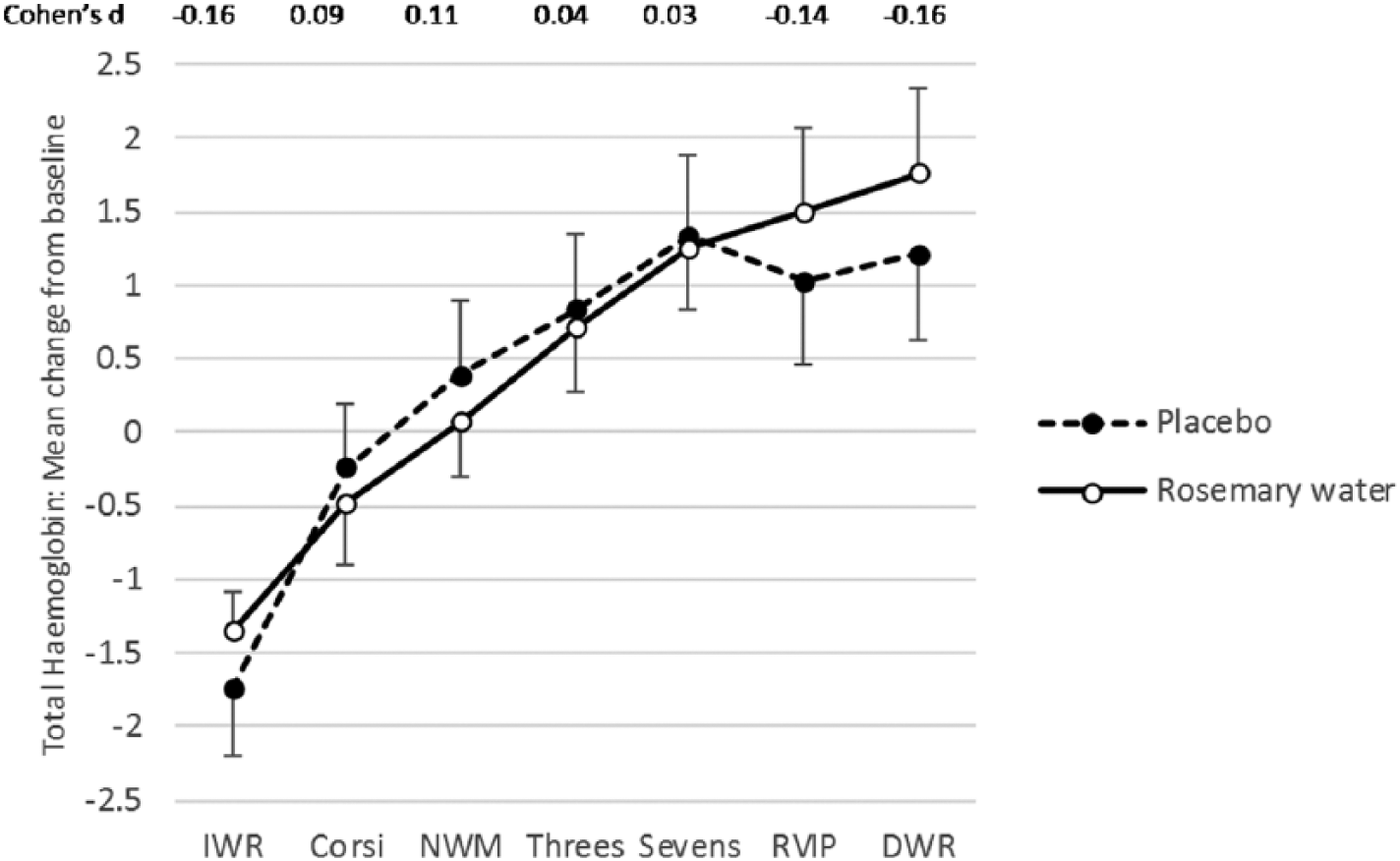
Mean change from baseline in concentration of total haemoglobin during cognitive assessment. Error bars represent standard errors. Cohen’s d effect sizes are presented at the top of the figure for each task epoch.
Oxygenated haemoglobin
No significant main effect of treatment was found (F(1,78)=0.345, p=0.559, ηp2=0.004). Means indicate that both groups showed an increase in oxyhaemoglobin compared to baseline (rosemary water=0.454 µmol/L, plain water=0.848 µmol/L). A significant main effect of task epoch was apparent (F(6,73)=24.375, p<0.001, ηp2=0.667), with oxyhaemoglobin increasing over the testing period (Figure 3). No significant treatment×epoch interaction was observed (F(6,73)=1.387, p=0.231, ηp2=0.102).
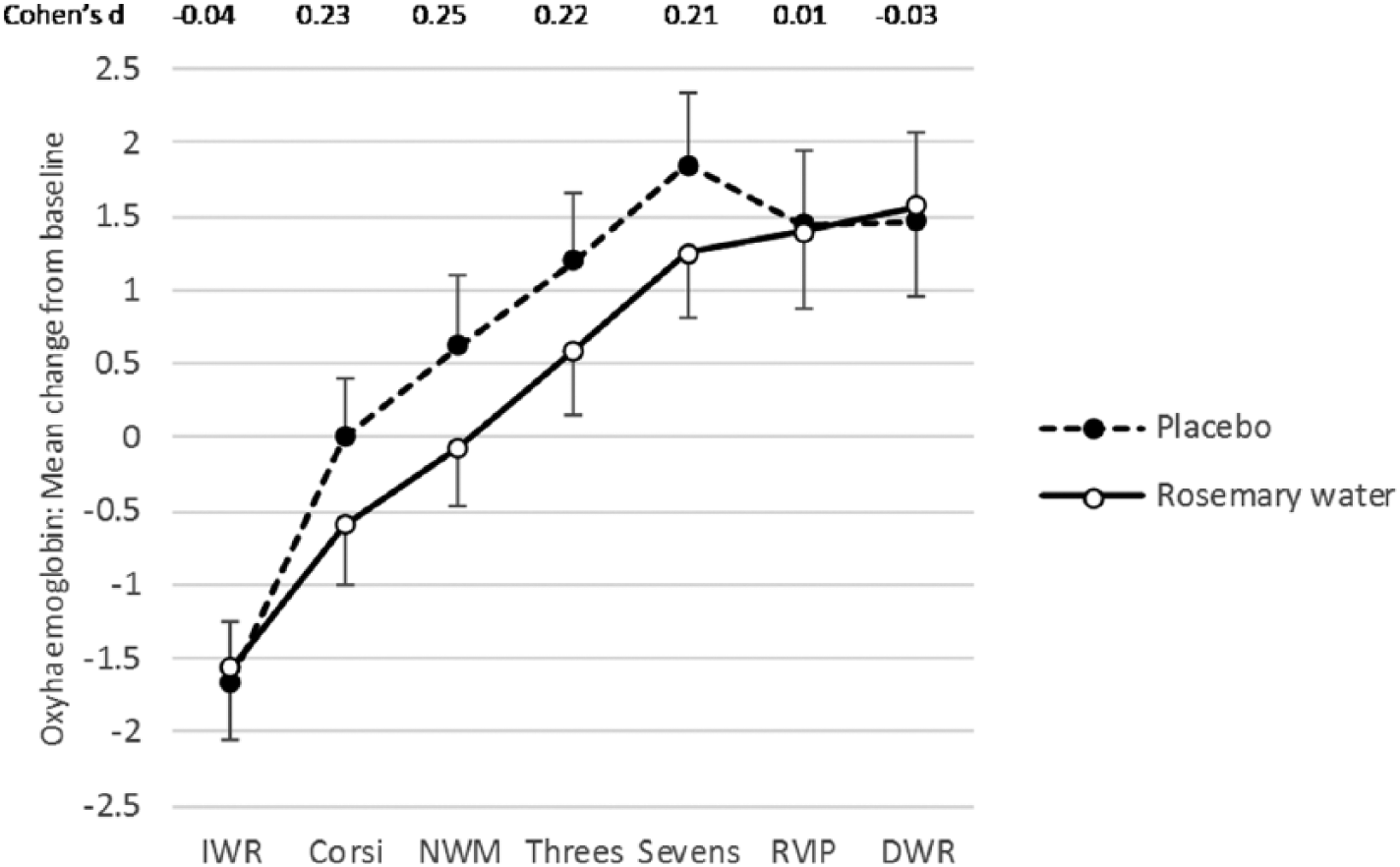
Mean change from baseline in concentration of oxyhaemoglobin during cognitive assessment. Error bars represent standard errors. Cohen’s d effect sizes are presented at the top of the figure for each task epoch.
Deoxygenated haemoglobin
A significant main effect of treatment was found (F(1,78)=5.085, p=0.027, ηp2=0.061). Given that, as stated above, the Holm-Bonferroni correction renders this non-significant, only Cohen’s d effect sizes are considered further (Figure 4). A significant main effect of task epoch was also apparent (F(6,73)=4.412, p=0.001, ηp2=0.266),with total deoxyhaemoglobin decreasing in the middle of the testing period and rising towards the end. No significant treatment×task epoch interaction was observed (F(6,73)=0.955, p=0.462, ηp2=0.073).
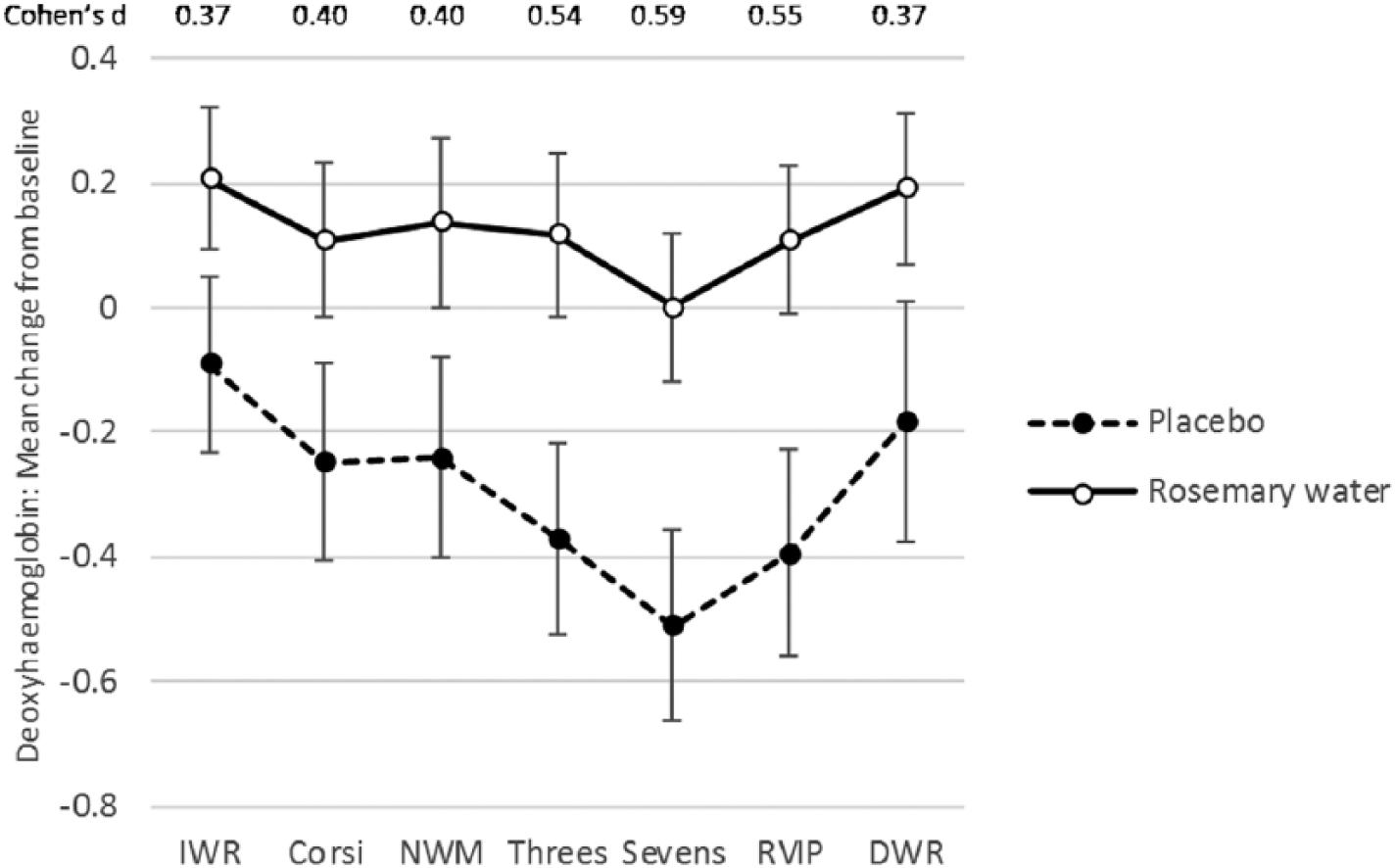
Mean change from baseline in concentration of deoxyhaemoglobin during cognitive assessment. Error bars represent standard errors. Cohen’s d effect sizes are presented at the top of the figure for each task epoch.
Discussion
This is the first study to investigate the potential impact of rosemary water on cognitive variables previously reported as sensitive to the aroma of rosemary essential oil and other herbal extracts. The data indicate a significant impact of rosemary water on combined dependent variables derived from cognition, mood and cerebrovascular measures. Follow-up analyses revealed a number of small to medium-sized effects for aspects of cognition following acute consumption of the rosemary water treatment compared to a plain water control. Very small effects were found for the subjective variables of alertness or fatigue that indicated a potential negative impact of the experimental treatment. The NIRS data clearly demonstrate a main effect of condition on deoxygenated haemoglobin levels with rosemary water producing higher levels across the cognitive task completions, but no effects were evident for the total or oxygenated haemoglobin concentration measures. No condition×task epoch interactions were observed for any of the CBF variables.
With regard to cognitive performance, the size of the effects for the word recall tasks are comparable to those previously reported for rosemary aroma (Moss et al., 2003), and dried herb (Laybourne et al., 2003), but considerably smaller than that reported recently for an orally administered sage/rosemary/melissa combination (Perry et al., 2017). Of note, the latter study comprised a two-week chronic treatment as opposed to the acute nature of the current research and that of Moss et al. and Laybourne et al. cited above. Furthermore, Perry and colleagues employed two participant groups, one below and one above 63 years of age, and report that only the younger group demonstrated improved memory performance following the treatment. Participants in the current study averaged 23 years of age, and it may be that younger populations are better able to gain advantage through herbal supplementation, either as a consequence of more sensitive CBF responses (Popa-Wagner et al., 2015) or greater cholinergic neurotransmitter activity (Perry, 1980). Improved performance on the Corsi blocks task is novel in terms of rosemary administration but has been observed previously for Ginkgo biloba in elderly participants – a finding that the authors put down to increased cerebral perfusion (Santos et al., 2003).
Performance of cognitive tasks increases aerobic glucose metabolism (Al-Naher et al., 2016), and increases in the availability of both glucose and oxygen have previously been demonstrated to facilitate cognitive performance (Moss and Scholey, 1996; Scholey et al., 2001). The increases in the NIRS measures of total blood flow and oxygenated haemoglobin in the current study exhibit clearly the impact of cognitive task performance on demand for ‘fuel’ and that this exists equally for both conditions. Such NIRS effects have been demonstrated previously in response to cognitive effort (Witte et al., 2015) although, interestingly in a study that assessed only attention, a decrease in total and oxygenated haemoglobin has been reported (Bierre et al., 2016). This might not be wholly surprising as previous research has long established that attention-based tasks are also associated with a decrease in heart rate (Porges and Raskin, 1969), and the conclusion that they are not metabolically demanding overall, perhaps due to selective deactivation of unattended areas (Kawashima et al., 1995). What is of particular interest here is the observation that levels of deoxygenated haemoglobin were at consistently higher levels with medium-effect sizes during cognitive task completion in the rosemary water condition. We argue that this reflects a facilitation of oxygen extraction in response to demand that is not available in the control condition. Such an argument has been made elsewhere (Bönöczk et al., 2002; Kennedy et al., 2010), although Kennedy et al. identified no impact on cognition associated with such an effect. In the current study, despite a consistent increase in deoxygenated haemoglobin throughout cognitive testing, only a subgroup of task measures were affected. If increased oxygen extraction was the key to enhancement then why were all measures not affected? Indeed, some of the largest differences observed here are in fact associated with tasks where performance was not enhanced by the rosemary water e.g. numeric working memory and rapid visual information processing. This introduces an interesting question, that is whether the observed changes in cerebral blood flow are in fact related to cognitive performance changes, or simply artifacts of nutritional supplementation that do not enhance cognition via augmented aerobic glucose metabolism?
The alternate pharmacological mechanism of cognitive enhancement remains a coherent explanation for the impact of the consumption of rosemary water. A number of pharmaceutical acetylcholinesterase inhibitors e.g. donepezil, rivastigmine, galantamine and physostigmine have been demonstrated to enhance cognition in healthy adults (Fond et al., 2015). The analysis of the rosemary extract and hydrolat that constitute the water clearly indicate the presence of 1,8-cineole and rosmarinic acid and the absorption of these (and other) compounds may facilitate performance through cholinergic pathways. Serum levels of 1,8-cineole have previously been demonstrated to correlate with task performance following exposure to rosemary aroma (Moss and Oliver, 2012), and the compound has been demonstrated to possess the ability to inhibit acetylcholinesterase in both in vitro and in vivo models (Orhan et al., 2008; Ozarowski et al., 2013). However, aroma administration is much more direct than oral administration of active compounds due to the avoidance of digestion and first-pass metabolism. Although animal models show rapid absorption of orally administered 1,8-cineole (Boyle et al., 2005), future studies in this area should assess serum levels of 1,8-cineole to address the question of bioavailability of this and other compounds in rosemary water and further understand how it might affect cognition. In this regard, Romo Vaquero and colleagues investigated rosemary’s major bioactive terpenoids in rats and tentatively identified 26 different metabolites in the gut, liver and plasma. Interestingly, trace quantities of carnosic acid metabolites were also identified in the brain (Romo Vaquero et al., 2013). Further animal studies suggest rosmarinic acid is also able to cross the blood-brain barrier and exert neuroprotective anti-inflammatory effects (Luan et al., 2013, Yu et al., 2007). However, more information about the metabolism and fate of compounds in vivo is needed to establish if they are actually able to reach target tissues in realistic conditions (del Pilar Sánchez-Camargo and Herrero, 2017).
An important possibility when considering the pharmacological mechanism of herbal-based cognitive enhancement is that of synergy. Synergistic effects are well known in pharmacology e.g. (Díaz-Reval et al., 2010; Diener et al., 2005) and often the whole can be greater than the sum of its parts (Pini et al., 2008). The observation of a pharmacological action for 1,8-cineole and its identification in plasma might in fact only be ‘markers’ for the synergistic impact of a wider range of compounds present in smaller amounts but perhaps important in unlocking the enhancement effect. Previous animal models have led to the conclusion that ‘anticholinesterase activity of rosemary essential oil most likely depends on a synergic mechanism between a number of oil components’ (Ozarowski et al., 2013, p.270). Such compounds as rosmarinic and ursolic acid also possess pharmacological properties (Chung et al., 2001; Gülçin et al., 2016) and also appear in the profile of rosemary essential oil as analysed by GC-MS (Jiang et al., 2011). Importantly, these compounds are also present in the extract that is used in the production of rosemary water (see GC-MS profile in treatments section), as is glucosamine, a compound that has recently been shown to suppress hypoxic memory impairments in an animal model (Lee et al., 2018). It may be that absorption of a combination of active constituents that then act in synergy is required to bring about improvements in performance in a manner previously proposed (Savelev et al., 2003). This would also go some way to explain the null findings previously reported for pure 1,8-cineole administration on working memory (Ambrosch et al., 2018) where synergistic mechanisms would be precluded. The synergistic explanation would also fit well with the findings of Perry et al. (2017) of significant enhancement following administration of a herbal combination that appeared to exceed the impact of the herbs in isolation. Such findings may be the consequence of beneficial combinations of active compounds being maximised.
The null effects found for the mood variables here run somewhat counter to those found for rosemary aroma, which has been linked to increased alertness (Diego et al., 1998; Moss et al., 2003). However, correlations between subjective alertness and objective assessments of cognitive performance have not typically been evident e.g. (Moss, 2014), nor linked to levels of serum 1,8-cineole (Moss and Oliver, 2012). It may be that the subjective effects of aromas are mediated via the close association between the olfactory and limbic systems as previously posited (Bear et al., 2007), and as such independent of the cognitive impact of absorbed compounds. Research on the impact of food flavours on mood is limited (Köster and Mojet, 2015), with the general focus being in the reverse direction where mood has been identified as changing ratings of taste (Platte et al., 2013), flavour (Heath et al., 2006) and food consumption (Macht, 2008). As such the lack of any impact of the taste and flavour properties of rosemary water on mood is difficult to contextualise. Where specific foods have been linked to mood change (e.g. chocolate Scholey and Owen, 2013), the mechanisms considered are tentative. A comprehensive review of bioactive food flavour chemicals did identify similarities between a number of compounds and the antidepressant valproic acid (Martinez-Mayorga et al., 2013). However, these are dissimilar in structure to the compounds found in rosemary. Taken on the current evidence, there is no indication that rosemary water impacts on subjective state.
In conclusion, the current study identified that acute oral administration of No1 Rosemary Water ‘shot strength’ can enhance aspects of long-term and working memory with small to medium-effect sizes, although the power of the current study meant that these findings were not statistically significant. CBF is augmented; at least in terms of the extraction of oxygen with medium-sized effects across the cognitive-testing period. Whether this, or the absorption of pharmacologically active compounds underpins the cognitive effects is not clear at this time, but presents an intriguing line for further enquiry. Such enquiry might also encompass product composition, bioavailability, potential synergistic activity and impact on neurochemical systems. Furthermore, the question of whether chronic consumption of rosemary water might impart any longer term protective effects as a consequence of possible antioxidant (Bozin et al., 2007), dopaminergic (Kim et al., 2006, Park et al., 2010) and anti-hyperglycaemic (Rashidipour et al., 2017) neuroprotective effects also warrants investigation.
Supplemental Material
JOP798339-_Supplementary_table – Supplemental material for Acute ingestion of rosemary water: Evidence of cognitive and cerebrovascular effects in healthy adults
Supplemental material, JOP798339-_Supplementary_table for Acute ingestion of rosemary water: Evidence of cognitive and cerebrovascular effects in healthy adults by Mark Moss, Ellen Smith, Matthew Milner and Jemma McCready in Journal of Psychopharmacology
Footnotes
Declaration of conflicting interests
The author(s) declared no potential conflicts of interest with respect to the research, authorship, and/or publication of this article.
Funding
The author(s) disclosed receipt of the following financial support for the research, authorship, and/or publication of this article: This study was sponsored by No.1 Rosemary Water Ltd, 6 Burnsall Street, Chelsea, London, SW3 3ST.

References
Supplementary Material
Please find the following supplemental material available below.
For Open Access articles published under a Creative Commons License, all supplemental material carries the same license as the article it is associated with.
For non-Open Access articles published, all supplemental material carries a non-exclusive license, and permission requests for re-use of supplemental material or any part of supplemental material shall be sent directly to the copyright owner as specified in the copyright notice associated with the article.
